Search Results: "anbe"

25 May 2022

Dirk Eddelbuettel: RcppAPT 0.0.9: Minor Update

A new version of the RcppAPT package with the R interface to the C++ library behind the awesome apt, apt-get, apt-cache, commands and their cache powering Debian, Ubuntu and the like arrived on CRAN earlier today. RcppAPT allows you to query the (Debian or Ubuntu) package dependency graph at will, with build-dependencies (if you have deb-src entries), reverse dependencies, and all other goodies. See the vignette and examples for illustrations. This release updates the code to the Apt 2.5.0 release this makes. It makes a cleaner distinction between public and private components of the API. We adjusted one access point to a pattern we already used, and while at it, simplified some of the transition from the pre-Apt 2.0.0 interface. No new features. The NEWS entries follow.

Changes in version 0.0.9 (2022-05-25)
  • Simplified and standardized to only use public API
  • No longer tests and accomodates pre-Apt 2.0 API

Courtesy of my CRANberries, there is also a diffstat report for this release. A bit more information about the package is available here as well as at the GitHub repo. If you like this or other open-source work I do, you can now sponsor me at GitHub.

This post by Dirk Eddelbuettel originated on his Thinking inside the box blog. Please report excessive re-aggregation in third-party for-profit settings.


15 May 2022

Dirk Eddelbuettel: RcppArmadillo 0.11.1.1.0 on CRAN: Updates

armadillo image Armadillo is a powerful and expressive C++ template library for linear algebra and scientific computing. It aims towards a good balance between speed and ease of use, has syntax deliberately close to Matlab and is useful for algorithm development directly in C++, or quick conversion of research code into production environments. RcppArmadillo integrates this library with the R environment and language and is widely used by (currently) 978 other packages on CRAN, downloaded over 24 million times (per the partial logs from the cloud mirrors of CRAN), and the CSDA paper (preprint / vignette) by Conrad and myself has been cited 469 times according to Google Scholar. This release brings a first new upstream fix in the new release series 11.*. In particular, treatment of ill-conditioned matrices is further strengthened. We once again tested this very rigorously via three different RC releases each of which got a full reverse-dependencies run (for which results are always logged here). A minor issue with old g++ compilers was found once 11.1.0 was tagged to this upstream release is now 11.1.1. Also fixed is an OpenMP setup issue where Justin Silverman noticed that we did not propagate the -fopenmp setting correctly. The full set of changes (since the last CRAN release 0.11.0.0.0) follows.

Changes in RcppArmadillo version 0.11.1.1.0 (2022-05-15)
  • Upgraded to Armadillo release 11.1.1 (Angry Kitchen Appliance)
    • added inv_opts::no_ugly option to inv() and inv_sympd() to disallow inverses of poorly conditioned matrices
    • more efficient handling of rank-deficient matrices via inv_opts::allow_approx option in inv() and inv_sympd()
    • better detection of rank deficient matrices by solve()
    • faster handling of symmetric and diagonal matrices by cond()
  • The configure script again propagates the'found' case again, thanks to Justin Silverman for the heads-up and suggested fix (Dirk and Justin in #376 and #377 fixing #375).

Changes in RcppArmadillo version 0.11.0.1.0 (2022-04-14)
  • Upgraded to Armadillo release 11.0.1 (Creme Brulee)
    • fix miscompilation of inv() and inv_sympd() functions when using inv_opts::allow_approx and inv_opts::tiny options

Courtesy of my CRANberries, there is a diffstat report relative to previous release. More detailed information is on the RcppArmadillo page. Questions, comments etc should go to the rcpp-devel mailing list off the R-Forge page. If you like this or other open-source work I do, you can sponsor me at GitHub.

This post by Dirk Eddelbuettel originated on his Thinking inside the box blog. Please report excessive re-aggregation in third-party for-profit settings.

6 May 2022

Dirk Eddelbuettel: RProtoBuf 0.4.19 on CRAN: Updates

A new release 0.4.19 of RProtoBuf arrived on CRAN earlier today. RProtoBuf provides R with bindings for the Google Protocol Buffers ( ProtoBuf ) data encoding and serialization library used and released by Google, and deployed very widely in numerous projects as a language and operating-system agnostic protocol. This release contains a pull request contribution by Michael Chirico to add support for the TextFormat API, a minor maintenance fix ensuring (standard) string are referenced as std::string to avoid a hickup on Arch builds, some repo updates, plus reporting of (package and library) versions on startup. The following section from the NEWS.Rd file has more details.

Changes in RProtoBuf version 0.4.19 (2022-05-06)
  • Small cleanups to repository
  • Raise minimum Protocol Buffers version to 3.3 (closes #83)
  • Update package version display, added to startup message
  • Expose TextFormat API (Michael Chirico in #88 closing #87)
  • Add missing explicit std:: on seven string instances in one file (closes #89)

Thanks to my CRANberries, there is a diff to the previous release. The RProtoBuf page has copies of the (older) package vignette, the quick overview vignette, and the pre-print of our JSS paper. Questions, comments etc should go to the GitHub issue tracker off the GitHub repo. If you like this or other open-source work I do, you can now sponsor me at GitHub.

This post by Dirk Eddelbuettel originated on his Thinking inside the box blog. Please report excessive re-aggregation in third-party for-profit settings.

Dirk Eddelbuettel: RQuantLib 0.4.16 on CRAN: Small Updates

A new release 0.4.16 of RQuantLib arrived at CRAN earlier today, and has been uploaded to Debian as well. QuantLib is a very comprehensice free/open-source library for quantitative finance; RQuantLib connects it to the R environment and language. The release of RQuantLib comes agaain about four months after the previous release, and brings a a few small updates for daycounters, all thanks to Kai Lin, plus a small parameter change to avoid an error in an example, and small updates to the Docker files.

Changes in RQuantLib version 0.4.16 (2022-05-05)
  • Documentationn for daycounters was updated and extended (Kai Lin)
  • Deprecated daycounters were approtiately updated (Kai Lin)
  • One example parameterization was changed to avoid error (Dirk)
  • The Docker files were updated

Courtesy of my CRANberries, there is also a diffstat report for the this release. As always, more detailed information is on the RQuantLib page. Questions, comments etc should go to the new rquantlib-devel mailing list. Issue tickets can be filed at the GitHub repo. If you like this or other open-source work I do, you can now sponsor me at GitHub.

This post by Dirk Eddelbuettel originated on his Thinking inside the box blog. Please report excessive re-aggregation in third-party for-profit settings.

14 April 2022

Dirk Eddelbuettel: drat 0.2.3 on CRAN: Arm M1 Support

drat user A new minor release of drat arrived on CRAN today. drat stands for drat R Archive Template, and helps with easy-to-create and easy-to-use repositories for R packages. Since its inception in early 2015 it has found widespread adoption among R users because repositories with marked releases is the better way to distribute code. See below for a few custom reference examples. Because for once it really is as your mother told you: Friends don t let friends install random git commit snapshots. Properly rolled-up releases it is. Just how CRAN shows us: a model that has demonstrated for two-plus decades how to do this. And you can too: drat is easy to use, documented by six vignettes and just works. Detailed information about drat is at its documentation site. This release adds support for the macOS Arm M1 architecture, initially supplied in a PR last fall and now finalized with additional tests. The NEWS file summarises the release as follows:

Changes in drat version 0.2.3 (2022-04-13)
  • Arm M1 repos are now supported (#126 and #131 fixing #125)
  • A vignette typo has been fixed (#130)

Courtesy of my CRANberries, there is a comparison to the previous release. More detailed information is on the drat page as well as at the documentation site. If you like this or other open-source work I do, you can now sponsor me at GitHub.

This post by Dirk Eddelbuettel originated on his Thinking inside the box blog. Please report excessive re-aggregation in third-party for-profit settings.

10 April 2022

Dirk Eddelbuettel: RcppRedis 0.2.1: Maintenance

A month after the major release 0.2.0 bringing pub/sub and other goodies to our RcppRedis package, a new version 0.2.1 arrived on CRAN yesterday. RcppRedis is one of several packages connecting R to the fabulous Redis in-memory datastructure store (and much more). RcppRedis does not pretend to be feature complete, but it may do some things faster than the other interfaces, and also offers an optional coupling with MessagePack binary (de)serialization via RcppMsgPack. The package has carried production loads for several years now. This release updated the rredis suggestion by adding an Additional_repositories entry as Bryan decided to retire the rredis package. You can still install it via install.packages("rredis") by setting the addtional repo, for example repos=c("https://ghrr.github.io/drat", getOption("repos")) as documented in package and at our ghrr drat repo. The detailed changes list follows.

Changes in version 0.2.1 (2022-04-09)
  • The rredis package can be installed via the repo listed in Additional_repositories; the pubsub.R test file makes rredis optional and conditional; all demos now note that the optional rredis package is installable via the drat listed in Additional_repositories.
  • The fallback-compilation of hiredis has been forced to override compilation flags because CRAN knows better than upstream.
  • The GLOBEX pub/sub example has small updates.

Courtesy of CRANberries, there is also a diffstat report for this release. More information is on the RcppRedis page. If you like this or other open-source work I do, you can now sponsor me at GitHub.

This post by Dirk Eddelbuettel originated on his Thinking inside the box blog. Please report excessive re-aggregation in third-party for-profit settings.

8 April 2022

Dirk Eddelbuettel: RcppEigen 0.3.3.9.2 on CRAN: Maintenance

A new release 0.3.3.9.2 of RcppEigen arrived on CRAN today (and already went to Debian). Eigen is a C++ template library for linear algebra: matrices, vectors, numerical solvers, and related algorithms. This update was (as it happens) requested by CRAN as R aims to bring the Fortran / C interface to best practices. We call dgesdd twice in one example and use a character argument, and the-powers-that-be now prefer better control over that character argument. So we did. Another change, kindly contributed by Mikael Jagan, switches row and column indices for R_xlen_t allowing for greater range. Plus some more small tweaks mostly to CI, see the NEWS entry below for full details. And again as we said for the previous three releases:
One additional and recent change was the accomodation of a recent CRAN Policy change to not allow gcc or clang to mess with diagnostic messages. A word of caution: this may make your compilation of packages using RcppEigen very noisy so consider adding -Wno-ignored-attributes to the compiler flags added in your ~/.R/Makevars.
We still find this requirement rather annoying. Eigen is only usable if you set, say,
-Wno-deprecated-declarations -Wno-parentheses -Wno-ignored-attributes -Wno-unused-function
asoptions in~/.R/Makevars . But CRAN makes the rules. Maybe if a few of us gently and politely nudge them they may relent one day. One can only hope. The complete NEWS file entry follows.

Changes in RcppEigen version 0.3.3.9.2 (2022-04-05)
  • Added test coverage in continuous integration
  • Added new tests to increase test coverage
  • Small improvement to the RcppEigen.package.skeleton() code
  • Small updates and edits to README.md and inst/CITATION
  • Use R_xlen_t for vector rows and columns (by Mikael Jagan)
  • Support USE_FC_LEN_T by adding FCONE to two dgesdd calls

Courtesy of CRANberries, there is also a diffstat report for the most recent release. If you like this or other open-source work I do, you can sponsor me at GitHub.

This post by Dirk Eddelbuettel originated on his Thinking inside the box blog. Please report excessive re-aggregation in third-party for-profit settings.

5 April 2022

Dirk Eddelbuettel: RcppSpdlog 0.0.8 on CRAN: Upstream Update

A new version 0.0.8 of RcppSpdlog is now on CRAN. RcppSpdlog bundles spdlog, a wonderful header-only C++ logging library with all the bells and whistles you would want that was written by Gabi Melman, and also includes fmt by Victor Zverovich. This release brings a new upstream release 1.10.0 of spdlog. The (minimal) NEWS entry for this release follows.

Changes in RcppSpdlog version 0.0.8 (2022-04-04)
  • Upgraded to upstream releases spdlog 1.10.0

Courtesy of my CRANberries, there is also a diffstat report. More detailed information is on the RcppSpdlog page, or the package documention site. If you like this or other open-source work I do, you can sponsor me at GitHub.

This post by Dirk Eddelbuettel originated on his Thinking inside the box blog. Please report excessive re-aggregation in third-party for-profit settings.

Dirk Eddelbuettel: RcppArmadillo 0.11.0.0.0 on CRAN: Upstream Updates

armadillo image Armadillo is a powerful and expressive C++ template library for linear algebra aiming towards a good balance between speed and ease of use with a syntax deliberately close to a Matlab. RcppArmadillo integrates this library with the R environment and language and is widely used by (currently) 972 other packages on CRAN, downloaded over 24 million times (per the partial logs from the cloud mirrors of CRAN), and the CSDA paper (preprint / vignette) by Conrad and myself has been cited 465 times according to Google Scholar. This release brings a new upstream release 11.0.0. We tested this very rigorously via three different RC release each of which got a full reverse-dependencies run (for which results are always logged here). The full set of changes (since the last CRAN release 0.10.8.1.0) follows.

Changes in RcppArmadillo version 0.11.0.0 (2022-04-04)
  • Upgraded to Armadillo release 11.0.0 (Creme Brulee)
    • added variants of inv() and inv_sympd() that provide rcond (reciprocal condition number)
    • expanded inv() and inv_sympd() with options inv_opts::tiny and inv_opts::allow_approx
    • stricter handling of singular matrices by inv() and inv_sympd()
    • stricter handling of non-sympd matrices by inv() and inv_sympd()
    • stricter handling of non-finitie matrices by pinv()
    • more robust handling of rank deficient matrices by solve()
    • faster handling of diagonal matrices by rcond()
    • changed eigs_sym() and eigs_gen() to use higher quality RNG
    • quantile() and median() will now throw an exception if given matrices/vectors have NaN elements
    • workaround for yet another bug in Intel MKL
  • Until May 2022, protect correction to Field behavior via define of RCPP_ARMADILLO_FIX_Field
  • If a LAPACK installation with missing complex routines is found (as e.g. Ubuntu using 3.9.0) then the LAPACK unit test is skipped.

Changes in RcppArmadillo version 0.10.8.2.0 (2022-02-01)
  • Upgraded to Armadillo release 10.8.2 (Realm Raider)
    • fix potential speed regression in pinv() and rank()

Courtesy of my CRANberries, there is a diffstat report relative to previous release. More detailed information is on the RcppArmadillo page. Questions, comments etc should go to the rcpp-devel mailing list off the R-Forge page. If you like this or other open-source work I do, you can sponsor me at GitHub.

This post by Dirk Eddelbuettel originated on his Thinking inside the box blog. Please report excessive re-aggregation in third-party for-profit settings.

1 April 2022

Dirk Eddelbuettel: RInside 0.2.17

A new release 0.2.17 of RInside arrived on CRAN and in Debian today. This is the first release in two years since the 0.2.16 release. RInside provides a set of convenience classes which facilitate embedding of R inside of C++ applications and programs, using the classes and functions provided by Rcpp. This release brings a minor update for R 4.2.0, due out later this month, and kindly provided by Tomas Kalibera. It updates one function declaration; we wrapped some conditioning around so that RInside continues to build with older releases too. Besides that minor updates were made to continuous integration and some of the package files. The short list of changes since the last release were:

Changes in RInside version 0.2.17 (2022-03-31)
  • A Windows-only patch for R 4.2.0 kindly provided by Tomas Kalibera was applied, and also conditioned on R (>= 4.2.0)
  • Continuous Integration setup was updated and now uses r-ci.
  • Several updates were made to README.md (badges etc) and DESCRIPTION

My CRANberries also provides a short report with changes from the previous release. More information is on the RInside page. Questions, comments etc should go to the rcpp-devel mailing list off the Rcpp R-Forge page, or to issues tickets at the GitHub repo. If you like this or other open-source work I do, you can now sponsor me at GitHub.

This post by Dirk Eddelbuettel originated on his Thinking inside the box blog. Please report excessive re-aggregation in third-party for-profit settings.

29 March 2022

Dirk Eddelbuettel: RcppBDT 0.2.5: Maintenance

A minor maintenance release for the RcppBDT package is now on CRAN. The RcppBDT package is an early adopter of Rcpp and was one of the first packages utilizing Boost and its Date_Time library. The now more widely-used package anytime is a direct descentant of RcppBDT. Thanks again for the heads-up! This release mostly deals with a one-definition rule violation detected by link-time optimisation (which can be enable when configuring R itself at build time with --enable-lto). I confused myself into thinking Rcpp Modules may be at fault, but I aki was a little more awake than myself and noticed that I only needed to carry the (common) header RcppBDT.h to the file toPOSIXct.cpp added last summer. The NEWS entry follows:

Changes in version 0.2.5 (2022-03-29)
  • Ensure consistent compilation by ensuring RcppBDT.h is included in all files, this addresses an LTO/ODR issue
  • Correct one declaration in init.c
  • Minor additional cleanups

Courtesy of my CRANberries, there is also a diffstat report for this release. If you like this or other open-source work I do, you can now sponsor me at GitHub.

This post by Dirk Eddelbuettel originated on his Thinking inside the box blog. Please report excessive re-aggregation in third-party for-profit settings.

28 March 2022

Dirk Eddelbuettel: RcppCNPy 0.2.11

A minor maintenance release of the RcppCNPy package arrived on CRAN three days ago, but we skipped announcing it right then. RcppCNPy provides R with read and write access to NumPy files thanks to the cnpy library by Carl Rogers along with Rcpp for the glue to R. One of the vignettes created an issue at CRAN with one of the Python modules used, so we simply switched to pre-made vignettes just as we do for a few other packages. Other small changes that had accumulated since the previous release were a new section in the reticulate vignette as well as some more documentation on types as well as some updates to continuous integration and bdages.

Changes in version 0.2.11 (2022-03-24)
  • The reticulate vignette has new section on 3d-arrays.
  • Added clarification to the manual page that the default types are 32-bit integer and 64-bit double (as we are working with R here).
  • Several updates have been made to the CI system; it now runs r-ci.
  • The README.md was updated with some new badges.
  • The vignettes are now pre-made to avoid any external dependencies.

CRANberries also provides a diffstat report for the latest release. As always, feedback is welcome and the best place to start a discussion may be the GitHub issue tickets page.

This post by Dirk Eddelbuettel originated on his Thinking inside the box blog. Please report excessive re-aggregation in third-party for-profit settings.

17 March 2022

Dirk Eddelbuettel: Rcpp 1.0.8.3: Hotfixing Hotfix

rcpp logo An even newer hot-fix release 1.0.8.3 of Rcpp follows the 1.0.8.2 release of a few days ago and got to CRAN this morning. A Debian upload will follow shortly, and Windows and macOS binaries will appear at CRAN in the next few days. This release again breaks with the six-months cycle started with release 1.0.5 in July 2020. When we addressed the CRAN request in 1.0.8.2 we forgot to dial testing down to their desired level (as three-part release numbers do automagically for us, whereas four-part do not). This is now taken care of, along with the hot-fix that was in 1.0.8.2 already. Rcpp has become the most popular way of enhancing R with C or C++ code. Right now, around 2522 packages on CRAN depend on Rcpp for making analytical code go faster and further, along with 239 in BioConductor. The full list of details for these two interim releases (and hence all changes accumulated since the last regular release, 1.0.8 in January) follows.
Changes in Rcpp hotfix release version 1.0.8.3 (2022-03-14)
  • Changes in Rcpp API:
    • Accomodate C++98 compilation by adjusting attributes.cpp (Dirk in #1193 fixing #1192)
    • Accomodate newest compilers replacing deprecated std::unary_function and std::binary_function with std::function (Dirk in #1202 fixing #1201 and CRAN request)
  • Changes in Rcpp Documentation:
    • Adjust one overflowing column (Bill Denney in #1196 fixing #1195)
  • Changes in Rcpp Deployment:
    • Accomodate four digit version numbers in unit test (Dirk)
    • Do not run complete test suite to limit test time to CRAN preference (Dirk)

Thanks to my CRANberries, you can also look at a diff to the previous release. Questions, comments etc should go to the rcpp-devel mailing list off the R-Forge page. Bugs reports are welcome at the GitHub issue tracker as well (where one can also search among open or closed issues); questions are also welcome under rcpp tag at StackOverflow which also allows searching among the (currently) 2843 previous questions. If you like this or other open-source work I do, you can sponsor me at GitHub.

This post by Dirk Eddelbuettel originated on his Thinking inside the box blog. Please report excessive re-aggregation in third-party for-profit settings.

12 March 2022

Dirk Eddelbuettel: RcppGSL 0.3.11: Small Maintenance

A new release 0.3.11 of RcppGSL is now on CRAN. The RcppGSL package provides an interface from R to the GNU GSL by relying on the Rcpp package. This release updates src/Makefile.ucrt to use the RTools42 libraries. Details follow from the NEWS file.

Changes in version 0.3.11 (2022-03-12)
  • The UCRT Makefile was updated
  • Minor edits to README.md were made

Courtesy of CRANberries, a summary of changes in the most recent release is also available. More information is on the RcppGSL page. Questions, comments etc should go to the issue tickets at the GitHub repo. If you like this or other open-source work I do, you can now sponsor me at GitHub.

This post by Dirk Eddelbuettel originated on his Thinking inside the box blog. Please report excessive re-aggregation in third-party for-profit settings.

Dirk Eddelbuettel: Rcpp 1.0.8.2: Hotfix release per CRAN request

rcpp logo A new hot-fix release 1.0.8.2 of Rcpp just got to CRAN. It will also be uploaded to Debian shortly, and Windows and macOS binaries will appear at CRAN in the next few days. This release breaks with the six-months cycle started with release 1.0.5 in July 2020 as CRAN desired an update to silence nags from the newest clang version which turned a little loud over a feature deprecated in C++11 (namely std::unary_function() and std::binary_function()). This was easy to replace with std::function() which we did. The release also contains a minor bugfix relative to 1.0.8 and C++98 builds, and minor correction to one pdf vignette. The release was fully tested by us and CRAN as usual against all reverse dependencies. Rcpp has become the most popular way of enhancing R with C or C++ code. Right now, around 2519 packages on CRAN depend on Rcpp for making analytical code go faster and further, along with 239 in BioConductor. The full list of details for this interim release follows.

Changes in Rcpp hotfix release version 1.0.8.2 (2022-03-10)
  • Changes in Rcpp API:
    • Accomodate C++98 compilation by adjusting attributes.cpp (Dirk in #1193 fixing #1192)
    • Accomodate newest compilers replacing deprecated std::unary_function and std::binary_function with std::function (Dirk in #1202 fixing #1201 and CRAN request)
  • Changes in Rcpp Documentation:
    • Adjust one overflowing column (Bill Denney in #1196 fixing #1195)
  • Changes in Rcpp Deployment:
    • Accomodate four digit version numbers in unit test (Dirk)

Thanks to my CRANberries, you can also look at a diff to the previous release. Questions, comments etc should go to the rcpp-devel mailing list off the R-Forge page. Bugs reports are welcome at the GitHub issue tracker as well (where one can also search among open or closed issues); questions are also welcome under rcpp tag at StackOverflow which also allows searching among the (currently) 2843 previous questions. If you like this or other open-source work I do, you can sponsor me at GitHub.

This post by Dirk Eddelbuettel originated on his Thinking inside the box blog. Please report excessive re-aggregation in third-party for-profit settings.

9 March 2022

Dirk Eddelbuettel: RcppRedis 0.2.0: Major Updates

A new major release of RcppRedis arrived on CRAN today. RcppRedis is one of several packages connecting R to the fabulous Redis in-memory datastructure store (and much more). RcppRedis does not pretend to be feature complete, but it may do some things faster than the other interfaces, and also offers an optional coupling with MessagePack binary (de)serialization via RcppMsgPack. The package has carried production loads for several years now. This release integrates support for pub/sub, a popular messaging pattern in which one or more clients can subscribe to one or more channels . Whenever a client instances publishes, the Redis server immediately updates all clients listening on the given channel. This pattern is fairly common to transmit data to listeners. A there is a bit more to explain about this, I also added a brand-new vignette describing pub/sub with RcppRedis, along with another introductory vignette about Redis itself. We blogged about this exciting new feature and its particular use for market monitoring in R4 #36 recently too. The pub/sub feature was available in package rredis by Bryan Lewis and has now been ported over by Bryan in a truly elegant yet compact implementation. We placed the code for the pub/sub examples, both for a single symbol (SP 500) as well as for a set of (futures) symbols, into a new examples/ subdirectory. Other changes in this release are the removal of the build-dependency on Boost (or, rather, my BH package), an update to the included hiredis library (used if no system-wide version is found), and an updated to the UCRT build for R. That last one is a bit of a sore spot and nobody at CRAN deemed it necessary to tell me they were waiting for me to make this change; communication with the CRAN team can still be challenging (and I am being generous here). Anyway, the package is now on CRAN so all is well now, at long last. The detailed changes list follows.

Changes in version 0.2.0 (2022-03-08)
  • Two simple C++11 features remove needs for BH and lexical_cast() (Dirk in #45 addressing #44).
  • Redis pub/sub is now supported (Dirk in #43, Bryan in #46).
  • Bryan Lewis is now a coauthor.
  • Added pub/sub examples for single and multiple Globex symbols.
  • The included hiredis sources have been updated to release 1.0.2.
  • Two vignettes have been added to introduce Redis and to described a live market-monitoring application included in directory pubsub/.
  • The UCRT build was updated per a suggestion by Tomas.

Courtesy of CRANberries, there is also a diffstat report for this release. More information is on the RcppRedis page. If you like this or other open-source work I do, you can now sponsor me at GitHub.

This post by Dirk Eddelbuettel originated on his Thinking inside the box blog. Please report excessive re-aggregation in third-party for-profit settings.

6 March 2022

Dirk Eddelbuettel: nanotime 0.3.6 on CRAN: Updates

Leonardo and I are pleased to another update to our nanotime package bringing it to version 0.3.6 which landed on CRAN earlier today. nanotime relies on the RcppCCTZ package (as well as the RcppDate package for additional C++ operations) and offers efficient high(er) resolution time parsing and formatting up to nanosecond resolution, and the bit64 package for the actual integer64 arithmetic. Initially implemented using the S3 system, it has benefitted greatly from a rigorous refactoring by Leonardo who not only rejigged nanotime internals in S4 but also added new S4 types for periods, intervals and durations. This release corrects subsetting with %in% operator, integrates it better fit in the mixed S3/S4 setup, fixes a negative period parse, and updates class comparisons to rely on inherits(). The NEWS snippet has the full more details.

Changes in version 0.3.6 (2022-03-06)
  • Fix incorrect subsetting with operator %in% (Leonardo in #100 fixing #99).
  • Fix incorrect parsing for negative nanoperiod (Leonardo in #100 fixing #96).
  • Test for class via inherits() (Dirk).

Thanks to my CRANberries there is also a diff to the previous version. More details and examples are at the nanotime page; code, issue tickets etc at the GitHub repository and all documentation is provided at the nanotime documentation site. If you like this or other open-source work I do, you can now sponsor me at GitHub.

This post by Dirk Eddelbuettel originated on his Thinking inside the box blog. Please report excessive re-aggregation in third-party for-profit settings.

25 February 2022

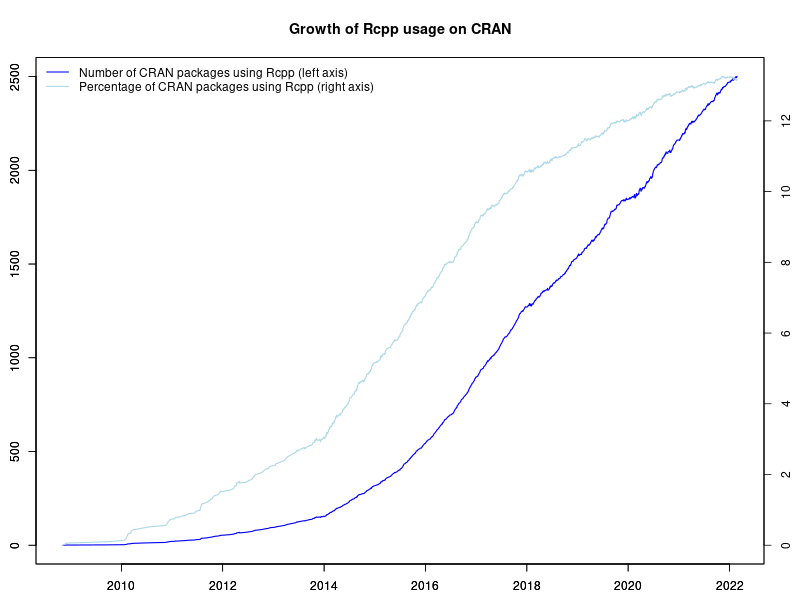
Dirk Eddelbuettel: Rcpp now used by 2500 CRAN packages!

2500 Rcpp packages As of this morning, Rcpp stands at 2501 reverse-dependencies on CRAN. The graph on the left depicts the growth of Rcpp usage (as measured by Depends, Imports and LinkingTo, but excluding Suggests) over time. Rcpp was first released in November 2008. It probably cleared 50 packages around three years later in December 2011, 100 packages in January 2013, 200 packages in April 2014, and 300 packages in November 2014. It passed 400 packages in June 2015 (when I tweeted about it), 500 packages in late October 2015, 600 packages in March 2016, 700 packages in July 2016, 800 packages in October 2016, 900 packages early January 2017, 1000 packages in April 2017, 1250 packages in November 2017, 1500 packages in November 2018, 1750 packages in August 2019, 2000 packages in July 2020, and 2250 package in March of last year. The chart extends to the very beginning via manually compiled data from CRANberries and checked with crandb. The next part uses manually saved entries. The core (and by far largest) part of the data set was generated semi-automatically via a short script appending updates to a small file-based backend. A (manually curated) list of packages using Rcpp is available too. Also displayed in the graph is the relative proportion of CRAN packages using Rcpp. The four per-cent hurdle was cleared just before useR! 2014 where I showed a similar graph (as two distinct graphs) in my invited talk. We passed five percent in December of 2014, six percent July of 2015, seven percent just before Christmas 2015, eight percent in the summer of 2016, nine percent mid-December 2016, cracked ten percent in the summer of 2017, eleven percent in 2018 and passed 12.5 percent or one in every eight CRAN packages dependens on Rcpp along with the 2000 packages mark. Truly stunning. As before, there is more detail in the chart: how CRAN seems to be pushing back more and removing more aggressively (which my CRANberries tracks but not in as much detail as it could), how the growth of Rcpp seems to be slowing somewhat outright and even more so as a proportion of CRAN as one would expect a growth curve to. The Rcpp team continues to aim for keeping Rcpp as performant and reliable as it has been (and see e.g. here for some more details). A really big shoutout and Thank You! to all users and contributors of Rcpp for help, suggestions, bug reports, documentation or, of course, code. If you like this or other open-source work I do, you can now sponsor me at GitHub. For the first year, GitHub will match your contributions.

This post by Dirk Eddelbuettel originated on his Thinking inside the box blog. Please report excessive re-aggregation in third-party for-profit settings.

18 February 2022

Dirk Eddelbuettel: RcppSimdJson 0.1.7 on CRAN: Maintenance

The RcppSimdJson package was updated to release 0.1.7 today. CRAN had sent a note overnight that it triggered LENGTH_1 error (where boolean comparisons happen with longer vectors). That may be debatable in the two cases flagged if one looks at the commit but life being too short to debate this so we just fixed it. The email came in at 04:50h-ish when I was sound asleep, but four hours later the fixed version was on CRAN thanks to the automated processing: RcppSimdJson wraps the fantastic and genuinely impressive simdjson library by Daniel Lemire and collaborators. Via very clever algorithmic engineering to obtain largely branch-free code, coupled with modern C++ and newer compiler instructions, it results in parsing gigabytes of JSON parsed per second which is quite mindboggling. The best-case performance is faster than CPU speed as use of parallel SIMD instructions and careful branch avoidance can lead to less than one cpu cycle per byte parsed; see the video of the talk by Daniel Lemire at QCon (also voted best talk). The very short NEWS entry for this release follows.

Changes in version 0.1.7 (2022-02-18)
  • Two URLs were updated in 'README.md', and Travis artifacts and badges have been removed (Dirk).
  • One unit test file was updated to not trigger a 'LENGTH_1' warning (Dirk closing #76).

Courtesy of my CRANberries, there is also a diffstat report for this release. For questions, suggestions, or issues please use the issue tracker at the GitHub repo. If you like this or other open-source work I do, you can now sponsor me at GitHub.

This post by Dirk Eddelbuettel originated on his Thinking inside the box blog. Please report excessive re-aggregation in third-party for-profit settings.

7 February 2022

Dirk Eddelbuettel: x13binary 1.1.57-3 on CRAN: Packaging Updates

Release 1.1.57-3 of the x13binary package providing the X-13ARIMA-SEATS program by the US Census Bureau arrived late yesterday on CRAN. This release relaxes the download requirement on macOS and Linux: if a user supplies a path in an environment variable X13_PATH we check for a suitable binary there and omit the download. This helps with air-gapped installation (and alike). Courtesy of my CRANberries, there is also a diffstat report for this release showing changes to the previous release. If you like this or other open-source work I do, you can sponsor me at GitHub.

This post by Dirk Eddelbuettel originated on his Thinking inside the box blog. Please report excessive re-aggregation in third-party for-profit settings.

Next.

Previous.
