Search Results: "nic"

3 January 2016

Niels Thykier: Tor enabled MTA

As I posted earlier, I have migrated to use tor on my machine. Though I had a couple of unsolved issues back then. One of them being my Mail Transport Agent (MTA) did not support tor. A regular user might not have a lot of use for a MTA on their laptop. However, it is needed for a lot of Debian development scripts (bts, mass-bug, nmudiff), if they are to file/manipulate bugs for you. I have some requirements for my MTA I also have some non-requirements: Originally, I used postfix, which supported most of these requirements. Except: Per suggestion of Jakub Wilk, I tried msmtp, which turned out do what I wanted. The only feature I will probably miss is having a local queue, which can be rate limited. But all in all, I am quite happy with it so far. :)
Filed under: Debian

Iustin Pop: Orcas Island day trip, June 2015

I just finished going through my last set of pending-review pictures from 2015, so I'm starting 2016 with a post about the past. In June 2015 I travelled to Seattle/Kirkland area for work purposes, and took advantage of a weekend to plan some more outdoors stuff. After looking around on maps, I settled on the San Juan islands, so I started looking at hiking possibilities, and in the end Orcas island looked the best choice - all the others had much lower elevations. So, early in the morning, I started driving from Kirkland to Anacortes ferry terminal. The drive itself is quite nice: after getting past the more populated areas, passing Everett, the the view are very nice, especially in the early morning hours and with very few traffic. At Anacortes, there was already a small queue, fortunately I had a pre-ordered ticket, and there was not much to do until the ferry arrived except to look forward at the day, and hope that the weather will stay nice. On the ferry then, crossing the straits and enjoying the very nice views: Perfect blue Catching the morning wind The ferry stops at Orcas (is it a town or just the terminal), and the next stop is Eastsound town. I pre-planned here a stop to get a second mini-breakfast: however, I misjudged what the portion sizes are and got myself a maxi-cinnamon roll at Caffe Olga: Second breakfast :) At least I knew I wasn't going to be hungry for a while :) Driving on, briefly stopping at Cascade Lake (I also stopped on the way back, the view is nice), then reaching the parking at the Twin Lakes trail on the shore of Mountain Lake. Good think I arrived somewhat early the parking was quite full already. I also got a bit confused on which way the hike starts, since it's not well marked, but after that I started the hike. It's also possible to drive up to Mount Constitution, but that's just lame; hiking from the base it's quite easy, if you find how to start the hike. Anyway: Starting to climb Finished the steepest part At one point, one meets this particular sign: Which way now? Beware the Little Summit is not to be missed! After ~40 minutes of hiking, with some parts a tiny bit strenuous, the view is really breathtaking. It's definitely worth stopping by, as the view is (IMHO) nicer than the view from the top of Mt. Constitution: Wow! The reason I say this is better is because you look towards ocean, whereas later the view is back towards the continent. And looking towards the big ocean is just perfect! Plus, the many small island, fully covered with forest are also nice. Onwards then towards the peak of Mount Constitution. You cross the "ridge" of the island, and your view shifts to the other side. Which means you see back to the Mountain Lake where the hike starts: Loocking back towards the start Here the path is more exposed, not through tall forest like at the beginning: Watching the horizon Right before reaching the peak, you pass through an interesting forest: A different kind of forest And then you're finally reaching the peak. Compared to Switzerland, it's very much not impressive (730m), but nevertheless, being so close to the ocean results in some very nice views: Couldn't have asked for better weather You can go into the small tower, and read through the history of the location, including the personal life of Robert Moran (shipbuilder), who retired in 1905 to Orcas island to live what (his doctors said to be) his last months, and who instead ended living until 1943. Not bad! To be filled under "too much stress is bad, nature is good" heading, I think. After eating a small packed lunch, I started back. At the beginning the forest is similar to the one back at the beginning of the hike, but then, as you reach the level of lakes, it is slightly different. More tall (old?) trees, more moss and ferns: Afternoon sun in the forest I passed briefly by the Twin Lakes, which were interesting (lots of submerged trunks), and then finally on the Twin Lakes trail back to the start. The views of Mountain Lake from here are also nice, especially in the less harsh afternoon sun: Reached Mountain Lake How did those trees get there? And then the hike was over. I still had some time to spend before the ferry I had a ticket on was scheduled, so I drove down to Olga town, as I was curious what was at the end of "Olga Road". Not much, but again nice views, and this very picturesque pier: Nice pier in Olga And then it was back to the ferry, waiting in line, getting on the ferry, and crossing back: Goodbye Orcas! Overall, it was a day well spent, part different, part similar to last year's mostly road trip. Definitely recommended if you're in the area, and there are a couple of other hikes on Orcas Island, plus all the other islands which make up the San Juans. However, traffic on the way back was not that awesome :/ Small price though!

2 January 2016

Daniel Pocock: The great life of Ian Murdock and police brutality in context

Tributes: (You can Follow or Tweet about this blog on Twitter) Over the last week, people have been saying a lot about the wonderful life of Ian Murdock and his contributions to Debian and the world of free software. According to one news site, a San Francisco police officer, Grace Gatpandan, has been doing the opposite, starting a PR spin operation, leaking snippets of information about what may have happened during Ian's final 24 hours. Sadly, these things are now starting to be regurgitated without proper scrutiny by the mainstream press (note the erroneous reference to SFGate with link to SFBay.ca, this is British tabloid media at its best). The report talks about somebody (no suggestion that it was even Ian) "trying to break into a residence". Let's translate that from the spin-doctor-speak back to English: it is the silly season, when many people have a couple of extra drinks and do silly things like losing their keys. "a residence", or just their own home perhaps? Maybe some AirBNB guest arriving late to the irritation of annoyed neighbours? Doesn't the choice of words make the motive sound so much more sinister? Nobody knows the full story and nobody knows if this was Ian, so snippets of information like this are inappropriate, especially when somebody is deceased. Did they really mean to leave people with the impression that one of the greatest visionaries of the Linux world was also a cat burglar? That somebody who spent his life giving selflessly and generously for the benefit of the whole world (his legacy is far greater than Steve Jobs, as Debian comes with no strings attached) spends the Christmas weekend taking things from other people's houses in the dark of the night? The report doesn't mention any evidence of a break-in or any charges for breaking-in. If having a few drinks and losing your keys in December is such a sorry state to be in, many of us could potentially be framed in the same terms at some point in our lives. That is one of the reasons I feel so compelled to write this: somebody else could be going through exactly the same experience at the moment you are reading this. Any of us could end up facing an assault as unpleasant as the tweets imply at some point in the future. At least I can console myself that as a privileged white male, the risk to myself is much lower than for those with mental illness, the homeless, transgender, Muslim or black people but as the tweets suggest, it could be any of us. The story reports that officers didn't actually come across Ian breaking in to anything, they encountered him at a nearby street corner. If he had weapons or drugs or he was known to police that would have almost certainly been emphasized. Is it right to rush in and deprive somebody of their liberties without first giving them an opportunity to identify themselves and possibly confirm if they had a reason to be there? The report goes on, "he was belligerent", "he became violent", "banging his head" all by himself. How often do you see intelligent and successful people like Ian Murdock spontaneously harming themselves in that way? Can you find anything like that in any of the 4,390 Ian Murdock videos on YouTube? How much more frequently do you see reports that somebody "banged their head", all by themselves of course, during some encounter with law enforcement? Do police never make mistakes like other human beings? If any person was genuinely trying to spontaneously inflict a head injury on himself, as the police have suggested, why wouldn't the police leave them in the hospital or other suitable care? Do they really think that when people are displaying signs of self-harm, rounding them up and taking them to jail will be in their best interests? Now, I'm not suggesting this started out with some sort of conspiracy. Police may have been at the end of a long shift (and it is a disgrace that many US police are not paid for their overtime) or just had a rough experience with somebody far more sinister. On the other hand, there may have been a mistake, gaps in police training or an inappropriate use of a procedure that is not always justified, like a strip search, that causes profound suffering for many victims. A select number of US police forces have been shamed around the world for a series of incidents of extreme violence in recent times, including the death of Michael Brown in Ferguson, shooting Walter Scott in the back, death of Freddie Gray in Baltimore and the attempts of Chicago's police to run an on-shore version of Guantanamo Bay. Beyond those highly violent incidents, the world has also seen the abuse of Ahmed Mohamed, the Muslim schoolboy arrested for his interest in electronics and in 2013, the suicide of Aaron Swartz which appears to be a direct consequence of the "Justice" department's obsession with him. What have the police learned from all this bad publicity? Are they changing their methods, or just hiring more spin doctors? If that is their response, then doesn't it leave them with a cruel advantage over those people who were deceased? Isn't it standard practice for some police to simply round up anybody who is a bit lost and write up a charge sheet for resisting arrest or assaulting an officer as insurance against questions about their own excessive use of force? When British police executed Jean Charles de Menezes on a crowded tube train and realized they had just done something incredibly outrageous, their PR office went to great lengths to try and protect their image, even photoshopping images of Menezes to make him look more like some other suspect in a wanted poster. To this day, they continue to refer to Menezes as a victim of the terrorists, could they be any more arrogant? While nobody believes the police woke up that morning thinking "let's kill some random guy on the tube", it is clear they made a mistake and like many people (not just police), they immediately prioritized protecting their reputation over protecting the truth. Nobody else knows exactly what Ian was doing and exactly what the police did to him. We may never know. However, any disparaging or irrelevant comments from the police should be viewed with some caution. The horrors of incarceration It would be hard for any of us to understand everything that an innocent person goes through when detained by the police. The recently released movie about The Stanford Prison Experiment may be an interesting place to start, a German version produced in 2001, Das Experiment, is also very highly respected. The United States has the largest prison population in the world and the second-highest per-capita incarceration rate. Many, including some on death row, are actually innocent, in the wrong place at the wrong time, without the funds to hire an attorney. The system, and the police and prison officers who operate it, treat these people as packages on a conveyor belt, without even the most basic human dignity. Whether their encounter lasts for just a few hours or decades, is it any surprise that something dies inside them when they discover this cruel side of American society? Worldwide, there is an increasing trend to make incarceration as degrading as possible. People may be innocent until proven guilty, but this hasn't stopped police in the UK from locking up and strip-searching over 4,500 children in a five year period, would these children go away feeling any different than if they had an encounter with Jimmy Saville or Rolf Harris? One can only wonder what they do to adults. What all this boils down to is that people shouldn't really be incarcerated unless it is clear the danger they pose to society is greater than the danger they may face in a prison. What can people do for Ian and for justice? Now that these unfortunate smears have appeared, it would be great to try and fill the Internet with stories of the great things Ian has done for the world. Write whatever you feel about Ian's work and your own experience of Debian. While the circumstances of the final tweets from his Twitter account are confusing, the tweets appear to be consistent with many other complaints about US law enforcement. Are there positive things that people can do in their community to help reduce the harm? Sending books to prisoners (the UK tried to ban this) can make a difference. Treat them like humans, even if the system doesn't. Recording incidents of police activities can also make a huge difference, such as the video of the shooting of Walter Scott or the UK police making a brutal unprovoked attack on a newspaper vendor. Don't just walk past a situation and assume everything is under control. People making recordings may find themselves in danger, it is recommended to use software that automatically duplicates each recording, preferably to the cloud, so that if the police ask you to delete such evidence, you can let them watch you delete it and still have a copy. Can anybody think of awards that Ian Murdock should be nominated for, either in free software, computing or engineering in general? Some, like the prestigious Queen Elizabeth Prize for Engineering can't be awarded posthumously but others may be within reach. Come and share your ideas on the debian-project mailing list, there are already some here. Best of all, Ian didn't just build software, he built an organization, Debian. Debian's principles have helped to unite many people from otherwise different backgrounds and carry on those principles even when Ian is no longer among us. Find out more, install it on your computer or even look for ways to participate in the project.

Niels Thykier: dput change-all-of-debian.changes

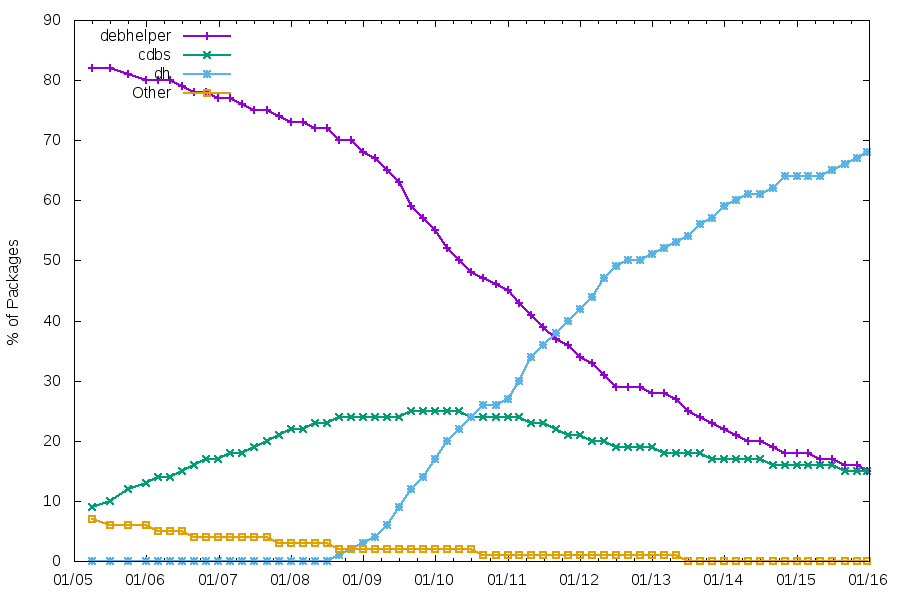
Lucas Nussbaum recently did a blog post called Debian is still changing . I found it a very welcome continuation of his previous blog post on the same topic. I find the graphs very interesting and was very happy to learn that he included relative graphs this time. Now I can with relatively ease say that 69% of all Debian packages are using a dh-style build (source). We have another 15% using classic debhelper, which means that at least 84% of all packages uses debhelper directly. Assuming all CDBS based packages rely on the debhelper class , we are at 99%! The latter is certainly an assumption, although I suspect it is probably pretty accurate[1]. Now, it is very cute to have world dominance , but that is not my primary interest in these numbers. Instead, we can use these numbers to determine that: Such as automatic dbgsym packages, indexable build-id from dbg(sym) packages via Packages files[2], and replacing maintscripts with ldconfig triggers. All of these changes happen to be changes that could be trivially deployed with very little risk and very high efficiency[3]. Notably, none of them required a compat bump (or a new debhelper tool). Of course, I do not intend to say that every change can (or should) be deployed via debhelper and much less into an existing dh_cmd -tool. Notably, dh_strip is reaching its breaking point for content. And if we were to require a compat bump for your change, we can now at least see the adoption rate via lintian. :) Nevertheless, it is nice to know that (politics aside) there is some agility in the Debian build system! :) [1] I would very much love to see numbers to (dis)prove my assumption about CDBS + debhelper. In fact, an absolute number of packages not using debhelper (indirectly) in Debian would be very intriguing. [2] New fields by default end up the Packages file. See e.g. the Packages.xz file on the debug mirror or your apt-cache via:
apt-cache show mscgen-dbgsym   grep ^Build-Ids
The latter assumes that you have the debug mirror in your sources list. [3] Efficiency here being features people rarely override/disable.
Filed under: Debhelper, Debian

Junichi Uekawa: 2015 added a new family member.

2015 added a new family member. That meant that I needed a new approach to working and my personal life. What awaits 2016?

1 January 2016

Mehdi Dogguy: In memoriam: Ian Murdock

It is with great sadness that I learned of the passing of Ian Murdock. I have never had the chance to meet him. Several persons testify for his kindness and talent. We will always remember him. His legacy influences our lives everyday!

Looking at his latest blog posts, he seemed a bit nostalgic about Debian and still very proud of it.

Later, he wrote about how he came to find Linux and the importance of telling the story of hackers of his generation. In his memory, I'll reread Stephen Levy s Hackers for the nth time too.

When (if?) his webserver will shut down, you will still be able to read his past blog posts using the archived version of his website or a static mirror that has been set up.

RIP Ian.

Bdale Garbee: Term Limited

I woke up this morning and realized that for the first time since 17 April 2001, I am no longer a member of the Debian Technical Committee. My departure from the committee is a consequence of the Debian General Resolution "limiting the term of the technical committee members" that was passed amending the Debian Constitution nearly a year ago. As the two longest-serving members, both over the term limit, Steve Langasek and I completed our service yesterday. In early March 2015, I stepped down from the role of chairman after serving in that role for the better part of a decade, to help ensure a smooth transition. Don Armstrong is now serving admirably in that role, I have the utmost respect for the remaining members of the TC, and the process of nominating replacements for the two now-vacant seats is already well underway. So, for the Debian project as a whole, today is really a non-event... which is exactly as it should be! Debian has been a part of my life since 1994, and I sincerely hope to be able to remain involved for many years to come!

31 December 2015

Laura Arjona Reina: Thanks Ian, thanks Debian

I didn t know Ian Murdock but the news about his passing left me with a very strange and sad feeling, because he started the project that creates the tool that I use every day in my work, and everyday in my communication with my family and friends, and everyday for anything computer related It s like if somebody puts a treasure in your hands and you got distracted looking at it and when you head up to look at the person and say Thank you , he s gone And, in the last years, Debian for me is not just my favorite tool , I ve been slowly getting involved in the community, known some people here and there, been able to put some work to try to improve some small parts, been able to work with other people as a team, and I ve been touched many times admiring how the Debianers work, how they talk and write, how they behave to each other and to the ones that reach the community for first time, and to the world, since most of the communication and work is public I ve felt myself helped, welcomed, encouraged, empowered. Not only in my computer related skills or the improved capabilities of my humble hardware. I ve felt myself helped, welcomed, encouraged and empowered in important areas of my life (understanding other points of view, caring about the ones that don t speak aloud, enjoying diversity and becoming flexible to make it flourish, making friends ). And I like to think that I try to emulate that and help, welcome, encourage, empower others too I m learning. Thanks Ian, for this alive and growing treasure that is Debian (the OS, the community), and thanks Debian, for the past, present and future miracles.
Filed under: My experiences and opinion Tagged: Communities, Contributing to libre software, Debian, English, Moving into free software

Chris Lamb: Free software activities in December 2015

Here is my monthly update covering a large part of what I have been doing in the free software world (previously):
Debian My work in the Reproducible Builds project was also covered in more depth in Lunar's weekly reports (#31, #32, #33, #34).
LTS

This month I have been paid to work 12 hours on Debian Long Term Support (LTS). In that time I did the following:
  • Issued DLA 363-1 for libphp-phpmailer fixing a header injection vulnerability.
  • Issued DLA 365-1 for foomatic-filters correcting a shell injection vulnerability.
  • Issued DLA 369-1 for pygments fixing an issue shell injection vulnerability.
  • Issued DLA 374-1 for cacti to fix an SQL injection vulnerability.
  • Did some futher investigation of CVE-2011-5325 in busybox.

Uploads
  • python-django (1.9) New upstream release.
  • redis (3.0.6) New upstream stable release. I additionally backported this package to Debian stable.
  • redis (3.2~rc1) Uploaded upstream's "testing/next" branch to experimental for testing.
  • gunicorn (19.4.1) New upstream release.


Patches contributed

I also filed FTBFS bugs against acpid, android-platform-frameworks-base, antlr3, artemis, beignet, bisonc++, bobcat, bustle, cargo, checkbox-ng, code2html, cplay, datanommer.commands, dcmtkpp, debci, diffutils, diod, django-restricted-resource, docker-libkv, doomsday, dvdauthor, dwww, elasticsearch, elki, flask-script, freeipa, fso-frameworkd, funny-manpages, ggcov, ghc-mod, gmpc-plugins, gparted, gs-collections, guacamole-server, guncat, haskell-concrete-typerep, haskell-geniplate, haskell-nats, haskell-x509-util, hawtbuf, heimdal, htsjdk, inspircd, jboss-xnio, jenkins-winstone, jpeginfo, jruby-openssl, kaffeine, kdbg, ktp-accounts-kcm, kuser, libcommons-cli-java, libcommons-openpgp-java, libconfig-model-lcdproc-perl, libdata-faker-perl, libexplain, libgettext-commons-java, libgtk2-ex-printdialog-perl, libmoops-perl, libnet-frame-perl, libsendmail-milter-perl, libupnp, libuv, libvpx, liwc, m4, maven2, meep-mpich2, nagios-plugin-check-multi, natlog, netpipe, ocserv, ogre-1.8, orthanc-dicomweb, perspectives-extension, php-mail, php-pinba, phpseclib, pkg-haskell-tools, plastimatch, plexus-compiler, plexus-compiler-1.0, python-acme, python-crontab, python-cs, python-csscompressor, python-debian, python-distutils-extra, python-django-compressor, python-django-openstack-auth, python-django-tagging, python-pygit2, python-pyramid, python-pywcs, python-releases, python-shade, python-statsd, python-tasklib, python-tasklib, python-webm, python-websockets, regina-normal, rinetd, roboptim-core, rpm2html, rpm2html, ruby-factory-girl, ruby-fogbugz, ruby-i18n-inflector, ruby-loofah, ruby-protected-attributes, ruby-rack-contrib, ruby-rufus-scheduler, ruby-sanitize, ruby-sidetiq, ruby-sinatra, scsh-0.6, shogun, sleekxmpp, slugimage, spatial4j, sqwebmail-de, trac-announcer, ttt, txaws, umbrello, wine-gecko-2.21, xboxdrv, xfonts-wqy, xserver-xorg-video-openchrome, yorick & yoshimi.

Raphaël Hertzog: My Free Software Activities in December 2015

My monthly report covers a large part of what I have been doing in the free software world. I write it for my donators (thanks to them!) but also for the wider Debian community because it can give ideas to newcomers and it s one of the best ways to find volunteers to work with me on projects that matter to me. Debian LTS This month I have been paid to work 21.25 hours on Debian LTS. During this time I worked on the following things: Distro Tracker I put a big focus on tracker.debian.org work this month. I completed the switch of the mail interface from packages.qa.debian.org to tracker.debian.org and I announced the change on debian-devel-announce. The changes resulted in a few problems that I quickly fixed (like #807073) and some other failures seen only by me and that were generated by weird spam messages (did you know that a subject can t have a newline character but that it can be encoded and folded over multiple lines?). Related to that I fixed some services so that they send their mails to tracker.debian.org directly instead of relying on the old emails (they get forwarded for now but it would be nice to be able to get rid of that forward). I updated (with the help of Lucas Nussbaum) the service that forwards the Launchpad bugs to the tracker, I sent a patch to update the @packages.debian.org aliases (not yet applied), I updated the configuration of all git commit notice scripts in the Alioth collab-maint and python-modules project (many remain to be done). I asked Ubuntu s Merge-O-Matic to use the new emails as well (see LP 1525497). DAK and the Debian BTS still have to be updated, as of yet nobody reacted to my announce last but not least I updated many wiki pages which duplicated the instructions to setup the commit notice sent to the PTS. While on a good track I opted to tackle the long-standing RC bug that was plaguing tracker.debian.org (#789183), so I updated the codebase to rely on Twitter s bootstrap v4 instead of v2. I had to switch to something else for the icons since glyphicons is no longer provided as part of bootstrap and the actual license for the standalone version was not suitable for use. I opted for Github s Octicons. I made numerous little improvements while doing that (closing some bugs in the process) and I believe that the result is more pleasant to use. I also did a lot of bug triage and fixed a few small issues like the incomplete architecture list (#793547), or fixing a page used only by people with javascript disabled that was not working. Or the invalid links for packages still using CVS (ugh, see #561228). Misc packaging Django. After having added DEP-8 tests (as part of my LTS work, see above), I discovered that the current version in unstable did not pass its test suite so I filed the issue upstream (ticket 26016) and added the corresponding patch. And I encouraged others to update python-bcrypt in Debian to a newer version that would have worked with Django 1.9 (see #803096). I also fixed another small issue in Django (see ticket 26017 with my pull request that got accepted). I asked the release managers to consider accepting the latest 1.7.x version in jessie (see #807654) but I have gotten zero answer so far. And I m not the only one waiting an answer. It s a bit of a sad situation we still have a few weeks until the next point release but for once I do it in advance and I would love to have timely feedback. Last but not least, I started the maintaining the current LTS release (1.8.x) in jessie-backports. Tryton. I upgraded to Tryton 3.8 and discovered an issue that I filed in #806781. I sponsored 5 new tryton modules for Matthias Behrle (who is DM) as well as one security upload (for CVE-2015-0861). Debian Handbook. I uploaded a new version to Debian Unstable and requested (to the release managers) the permission to upload a backport of it to jessie so that jessie has a version of the package that documents jessie and not wheezy contrary to my other Django request, this one should be non-controversial but I also have had zero answer so far, see #807515. Misc. I filed #808583 when sbuild stopped working with Perl 5.22. I handled #807860 on publican, I found the corresponding upstream ticket and discovered a work around with the help of upstream (see here). Kali related work I reported a bug to #debian-apt about apt miscalculating download size (ending up with 18 EB!) which resulted in a fix here in version 1.1.4. Installing a meta-package that needed more than 2GB was no longer possible without this fix and we have a kali-linux-all metapackage in that situation that gets regularly installed in a Jenkins test. I added captcha support to Distro Tracker and enabled this feature on pkg.kali.org. I filed #808863 against uhd-host because it was not possible to install the package in a systemd-nspawn s managed chroot where /proc is read-only. And we started using this to test dist-upgrade from one version of Kali to the next Thanks See you next month for a new summary of my activities.
No comment Liked this article? Click here. My blog is Flattr-enabled.

30 December 2015

Bits from Debian: Debian lamenta el dec s de l'Ian Murdock

Ian Murdock Amb el cor compungit, Debian lamenta la p rdua d'Ian Murdock, ferm partidari del programari lliure i de codi obert, pare, fill i l'"ian" a Debian. L'Ian va comen ar el projecte Debian l'agost de 1993, i va publicar les primeres versions m s tard el mateix any. Debian es convertiria en el sistema operatiu universal pel m n, que funciona en tot tipus de dispositius, des de sistemes encastats fins a l'estaci especial. L'Ian es va centrar en crear una distribuci i una cultura de comunitat que fessin el correcte, ticament o t cnica. Publicar quan estigui a punt i la ferma posici sobre la llibertat de programari s n les regles d'or en el m n del programari lliure i de codi obert. La seva devoci per fer el correcte va guiar la seva feina, tant a Debian com els seg ents anys, sempre treball per assolir el millor futur possible. El somni de l'Ian est viu, la comunitat de Debian continua incre blement activa, amb milers de desenvolupadors que treballen innumerables hores per proporcionar un sistema operatiu segur i fiable. Els pensaments de la comunitat de Debian s n amb la fam lia de l'Ian en aquests moments tant durs. La seva fam lia ens ha demanat privacitat en aquests moments dif cils i volem respectar-ho. Des de Debian i des de la comunitat de Linux en general podem enviar mostres de condol a in-memoriam-ian@debian.org; seran guardades i arxivades.

Bits from Debian: Debian mourns the passing of Ian Murdock

Ian Murdock With a heavy heart Debian mourns the passing of Ian Murdock, stalwart proponent of Free Open Source Software, Father, Son, and the 'ian' in Debian. Ian started the Debian project in August of 1993, releasing the first versions of Debian later that same year. Debian would go on to become the world's Universal Operating System, running on everything from embedded devices to the space station. Ian's sharp focus was on creating a Distribution and community culture that did the right thing, be it ethically, or technically. Releases went out when they were ready, and the project's staunch stance on Software Freedom are the gold standards in the Free and Open Source world. Ian's devotion to the right thing guided his work, both in Debian and in the subsequent years, always working towards the best possible future. Ian's dream has lived on, the Debian community remains incredibly active, with thousands of developers working untold hours to bring the world a reliable and secure operating system. The thoughts of the Debian Community are with Ian's family in this hard time. His family has asked for privacy during this difficult time and we very much wish to respect that. Within our Debian and the larger Linux community condolences may be sent to in-memoriam-ian@debian.org where they will be kept and archived.

Bits from Debian: Debian lamenta el fallecimiento de Ian Murdock

Ian Murdock Con el coraz n compungido, Debian lamenta el fallecimiento de Ian Murdock, firme partidario del software libre y abierto, padre, hijo y el 'ian' en Debian. Ian empez el proyecto en agosto de 1993, publicando la primera versi n de Debian m s tarde en el mismo a o. Debian se convertir a as en el sistema operativo universal para el mundo, funcionando en cualquier dispositivo, desde sistemas embebidos hasta la estaci n espacial. Ian se centr en crear una distribuci n y una cultura de comunidad que hiciera lo correcto tanto en lo tico como en lo t cnico. Publicar cuando est listo y una postura firme sobre la libertad de software son las reglas de oro en el mundo del software libre y de c digo abierto. La devoci n le gui en su trabajo, tanto en Debian como en los a os posteriores, siempre trabajando hacia un futuro lo mejor posible. El sue o de Debian est vivo, la comunidad permanece incre blemente activa con miles de desarrolladores que trabajan incontables horas para ofrecer un sistema operativo seguro y confiable. La comunidad de Debian da el p same a la familia en este momento tan dif cil. Su familia nos ha pedido discreci n durante estos momentos dif ciles y deseamos respetarlo. Desde dentro de Debian y de la amplia comunidad de Linux podemos expresar nuestras muestras de condolencia a in-memoriam-ian@debian.org, donde ser n guardadas y archivadas.

Christoph Egger: Finally moving the Weblog

As of a few minutes ago, the old weblog on christoph-egger.org is past. I've added redirects for all the entries to the new one at weblog.siccegge.de.if you find any dead links please contact me so I can fix it up. Note that comments are gone. I'll try to include the already present comments on the new blog some time in the future. Not sure if I will ever add a comment function again (though chronicle seems to have some support for that)

Craig Small: Forking processes and Gtk2

I made a change recently on the gjay program. gjay is a gtk program that basically analyzes your music and makes playlists. There is a gui frontend and a analyzer back-end and they communicate through a pipe. One really useful debugging option gtk has is to make warnings fatal, so when gtk finds one it crashes at that point and you can use gdb to trap it. The flag is g-fatal-warnings. I have been updating gjay and initially it didn t have this option, so I needed to add the gtk options, which is a simple one-liner. But then gjay gave some odd errors about XCB. Often, but not every time gjay started on stderr the following cryptic messages appear:
[xcb] Unknown sequence number while processing queue
[xcb] Most likely this is a multi-threaded client and XInitThreads has not been called
[xcb] Aborting, sorry about that.
forktest: ../../src/xcb_io.c:274: poll_for_event: Assertion  !xcb_xlib_threads_sequence_lost' failed.
OK, so part of my init sequence was unhappy. The odd thing was it only appeared when I added the gtk options. I narrowed it down with some test code which displayed the error but stripped all the other parts out.
  1. #include <gtk/gtk.h>
  2.  
  3. int main(int argc, char *argv[])
  4.  
  5.     GOptionContext *context;
  6.     GError *error;
  7.     pid_t pid;
  8.     GtkWidget *win;
  9.  
  10.     context = g_option_context_new("My test");
  11.     g_option_context_add_group (context, gtk_get_option_group (TRUE));
  12.     error = NULL;
  13.     if (!g_option_context_parse(context, &argc, &argv, &error))
  14.         return 1;
  15.     pid = fork();
  16.     if (pid < 0) 
  17.         return 1;
  18.     if (pid == 0)   //child
  19.         GMainLoop *loop;
  20.  
  21.         loop = g_main_new(FALSE);
  22.         g_main_run(loop);
  23.         return 0;
  24.       else   // parent
  25.         if (gtk_init_check(&argc, &argv) == FALSE)
  26.             return 1;
  27.         win = gtk_window_new(GTK_WINDOW_TOPLEVEL);
  28.         gtk_widget_show(win);
  29.         gtk_main();
  30.      
  31.     return 0;
  32.  
What we got going on here is a simple gtk program. Line 11 with the gtk_get_option_group() was the line I added. The problem is that the child process is not quite setup and when the parent goes into gtk_main then you get those xcb errors. The options need to be parsed before the fork, because one of the options is to not fork (it just runs the child code directly and uses stdout with no GUI). Gjay is obviously a lot more complex than this, but follows the same pattern. There is the front-end looping through gtk_main and the back-end looping on g_main_run. The backend needs to use glib not gtk as there is a non-gui option which can be used. The solution is actually (but not obviously to me) in the documentation for gtk_get_option_group. The parameter for that function whether to open the default display when parsing the commandline arguments . Changing the TRUE to FALSE on line 11 stops XCB from complaining! The screen still appears fine but not more strange XCB messages.

Clint Adams: Oh what a night, late December 1963

24 Dec. 63 Dear Uncle Ron and Aunt Helen, It has been quite awhile since I have written you folks. I am not too much of one for writing, and when I do write, I keep putting it off, and putting it off; and the next thing you know, the weeks turn into months and then the months into years. I haven't sent any Christmas cards, so at this time I'll offer my best wishes for the season to you. It is Christmas Eve and I am working tonight. I will also work New Year's eve and day. It really doesn't seem like Christmas here, and there isn't that much to do in the evening's; So I'm just as well off working. As I had mentioned, I had intended to send you some coins from Korea but I believe that I put them in with a package that I had sent to Mom and told her to give them to you. In any event, here are some in this box. The Korean coin with the 10 on it is 10 Won, and worth about $.0769. The large copper coin is Japanese ( 10 Yen) and about 2.8 Wait! I was wrong on the Korean coins.They are 10 Hwan which is the old money. When they Changed to Won, they made 10 Hwan equal to 1 Won. (Sounds confusing and tongue-tying, doesn't it?) So these 10 copper pieces with the 10 on them altogether are only worth 7 / The Viet Namese coins with the former president Diem picture on them are soon being taken out of circulation. ( Since he was overthrown and killed, they are going to replace the money also.) The small pieces marked 1 dong are 1 piastre; also called one Viet Namese dollar. 1 piastre is about .7 . I also recall sending some coins home in my hold baggage. I'll tell Mom to look for them and give them to you. Now that I look back on it, the year I spent in Korea wasn't bad. It was difficult at first having to work for an arrogant Jew boss, but after a few months I got out of his office and was on my own working directly for the army people ( U.S.) The country of Korea isn't too bad. As you can see on the coins they were in the year 4294 last year. It is surprising for a civilization to be that far along in years and still live under very primitive conditions. Going from Korea to Japan is like going from the dark ages into the future science fiction world. Those people are really progressing in Japan. I spent several days in Japan after I left Korea. Then I went to Honolulu for almost a month. Then I went back to Japan for Leave for 3 weeks and then down here to Viet Nam in October. They were building like crazy in Japan to get ready for the Olympics. Working 4 hours a day, 7 days a week on construction. You could drive into Tokyo early in the evening and return late in the night and find the road you had gone in on was now completely torn away. And downtown Tokyo is vey nice. Lots of modern building and just about any modern gadget you can think of. I really like their cooking also. Their Kobe Beef is excellent. In this beef, the cattle are pampered from the time they are born until they are slaughtered. They massage them, feed them beer, and let them live a lazy life. I would really like to work a year or two in Japan. The hot baths and big tubs are also great. Only it is almost impossible to stand the hot temperatures that they can. Westerners always have to add quite a lot of cold water before they can get in the tub. The Viet Namese people are much dirtier than the Japanese or Koreans. They don't have any hot baths here in Viet Nam. In fact, the majority of hotels ( built by the French) don't even have hot water in them. The Korean houses don't look like much from the outside, but inside they are spotlessly clean. The older Japanese buildings look nic efrom the outside and are also clean inside. I am here in the town of Nha Trang. It is a small town on the coast of the China Sea. I like it here. My hotel is less than a hundred yards from the beach. We are now in the winter season also, but it just got a little cooler from having winds the past few weeks. This afternoon as we came to work there were all sorts of people in swimming. Lobster is also plentiful here and I eat quite a bit of it. Most of the restaurant make a creamed corn soup with lots of chunks of crab meat in it. This is very good. Being out here in Nha Trang, we missed the coup d'etat. Things were quiet here and the only way we knew what was happening was to listen to the radio and talk to our co-workers of our radio system in Saigon. When they lifted martial law and the curfew in Saigon, it took them several days later to follow suit here. There seems to be a noticed improvement since the coup. The people in general seem much happier and there appears to be much more general activity going on. Well, I guess that's about it for now. I think I may have some Korean Won notes back in my room and I'll check and enclose them if I can find them. Say hello to Ira & family when you see them, and also to Aunt Marie if she is still there with you. 'Bye for now Your nephew PS The Viet Namese coins with 50 XU on them are piastres.

29 December 2015

Daniel Pocock: Real-Time Communication in FOSDEM 2016 main track

FOSDEM is nearly here and Real-Time Communications is back with a bang. Whether you are keen on finding the perfect privacy solution, innovative new features or just improving the efficiency of existing telephony, you will find plenty of opportunities at FOSDEM. Main track Saturday, 30 January, 17:00 Dave Neary presents How to run a telco on free software. This session is of interest to anybody building or running a telco-like service or any system administrator keen to look at a practical application of cloud computing with OpenStack. Sunday, 31 January, 10:00 is my own presentation on Free Communications with Free Software. This session looks at the state of free communications, especially open standards like SIP, XMPP and WebRTC and practical solutions like DruCall (for Drupal), Lumicall (for Android) and much more. Sunday, 31 January, 11:00 Guillaume Roguez and Adrien B raud from Savoir-faire Linux present Building a peer-to-peer network for Real-Time Communication. They explain how their Ring solution, based on OpenDHT, can provide a true peer-to-peer solution. and much, much more....
  • XMPP Summit 19 is on January 28 and 29, the Thursday and Friday before FOSDEM as part of the FOSDEM Fringe.
  • The FOSDEM Beer Night on Friday, 29 January provides a unique opportunity for Real-Time Communication without software
  • The Real-Time Lounge will operate in the K building over both days of FOSDEM, come and meet the developers of your favourite RTC projects
  • The Real-Time dev-room is the successor of the previous XMPP and Telephony dev-rooms. The Real-Time dev-room is in K.3.401 and the schedule will be announced shortly.
Volunteers and sponsors still needed Please come and join the FreeRTC mailing list to find out more about ways to participate, the Saturday night dinner and other opportunities. The FOSDEM team is still fundraising. If your company derives benefit from free software and events like FOSDEM, please see the sponsorship pages.

David Bremner: Converting PDFs to DJVU

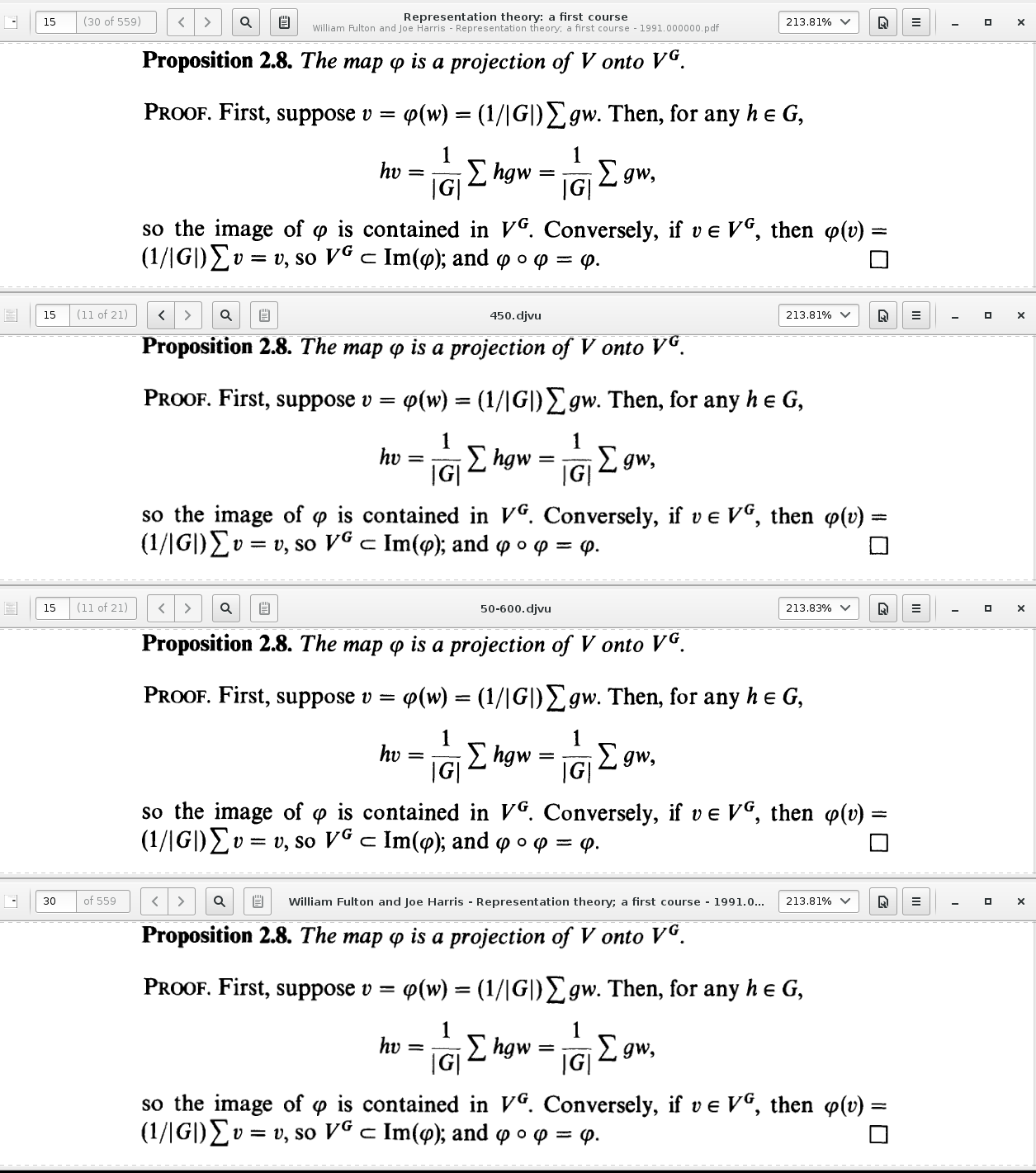
Today I was wondering about converting a pdf made from scan of a book into djvu, hopefully to reduce the size, without too much loss of quality. My initial experiments with pdf2djvu were a bit discouraging, so I invested some time building gsdjvu in order to be able to run djvudigital. Watching the messages from djvudigital I realized that the reason it was achieving so much better compression was that it was using black and white for the foreground layer by default. I also figured out that the default 300dpi looks crappy since my source document is apparently 600dpi. I then went back an compared djvudigital to pdf2djvu a bit more carefully. My not-very-scientific conclusions: Perhaps most compellingly, the output from pdf2djvu has sensible metadata and is searchable in evince. Even with the --words option, the output from djvudigital is not. This is possibly related to the error messages like
Can't build /Identity.Unicode /CIDDecoding resource. See gs_ciddc.ps .
It could well be my fault, because building gsdjvu involved guessing at corrections for several errors. Some of these issues have to do with building software from 2009 (the instructions suggestion building with ghostscript 8.64) in a modern toolchain; others I'm not sure. There was an upload of gsdjvu in February of 2015, somewhat to my surprise. AT&T has more or less crippled the project by licensing it under the CPL, which means binaries are not distributable, hence motivation to fix all the rough edges is minimal.
Version kilobytes per page position in figure
Original PDF 80.9 top
pdf2djvu --dpi=450 92.0 not shown
pdf2djvu --monochrome --dpi=450 27.5 second from top
pdf2djvu --monochrome --dpi=600 --loss-level=50 21.3 second from bottom
djvudigital --dpi=450 29.4 bottom
djvu-compare.png

Neil Williams: Experimenting with LXQt in Debian

LXQt is a Qt lightweight desktop the Qt port of LXDE. Packages exist in Debian albeit without a top level metapackage or task package to make installing it easier. So I wrote up a simple-ish vmdebootstrap call:
$ sudo vmdebootstrap --image lxqt.img --size=5G --package=lxqt-panel --package=libqt5xcbqpa5 --package=qterminal --package=openbox --package=xdm --package=lxqt-session --package=lxqt-about --package=lxqt-policykit --package=lxqt-globalkeys --package=lxqt-notificationd --package=lxqt-sudo --package=dbus-x11 --package=lxqt-admin --package=lxqt-runner --package=lxqt-config --package=task-desktop --package=locales --package=xserver-xorg-core --package=oxygen-icon-theme --grub --distribution=unstable --mirror=http://mirror.bytemark.co.uk/debian --configure-apt --enable-dhcp --serial-console --sudo --verbose --owner=neil --user='neil/neil'
(You ll need to adapt the last two commands to be a real user.) This uses xdm instead of lxdm as this tests LXQt without having any GTK+ dependencies installed. lxdm does give a nicer experience at the cost of needing GTK+. YMMV. Note the explicit additions:--package=libqt5xcbqpa5 --package=dbus-x11 as debootstrap does not follow Recommends, libqt5xcbqpa5 needs to be specified explicitly or the desktop will fail to start. dbus-x11 is also needed to get things working. task-desktop adds the Debian artwork and needs to be in the list of packages passed to debootstrap so that the Recommends of the task packages are not selected. (Note that I have so far failed to get LXQt to use the Debian artwork as a desktop background.) So, what is it like? Well alpha is how I might describe it. Not in terms of stability, more in terms of functionality. I do have a second install using lxdm which has been tweaked but it depends on your objective. If your aim is to not have GTK+ but not have KDE, then LXQt is a beginning only. In particular, if you really are intent on not having GTK+ at all, your choice of web browser is somewhat limited, to lynx. (There s no bare Qt file manager in Debian pcmanfm-qt depends on libfm-modules which uses GTK+ nor a bare text editor despite this being one of the simplest examples of a QApplication). There is a large gap in the software availability which is Qt but not KDE, despite the power and flexibility of Qt itself. (I ve written applications using Qt directly before, it is much more flexible and configurable than GTK+). So there would seem to be a reason why a metapackage and a task package do not yet exist, there is a lot more to do. I m happy to mix GTK+ applications, so my test environment can use iceweasel, chromium, leafpad and thunar. Overall, this was an interesting diversion prompted by a separate discussion about the merits and controversies of GTK+, GNOME etc. I failed to work out why the icon theme works if lxdm was installed but not with xdm (so there s a missing package but I m not yet sure exactly which), so the screenshot is more bare than I expected. lxqt-unstable With iceweasel installed and various other tweaks:
lxqt-unstable-2 Finally, note #809339 I have local changes which are being tested to use systemd-networkd but currently the masking of PredictableInterfaceNames as documented does not work, so some editing of /etc/network/interfaces.d/setup (or enable systemd-networkd yourself and add a suitable file to /etc/systemd/network/) will be needed to get a working network connection in the VM.

27 December 2015

Ben Hutchings: What's new in initramfs-tools

I spent much of my Debian time in the last few weeks triaging and fixing bugs in initramfs-tools. All of the important bugs should be fixed, except for two where I needed more information from the submitter. Due to the scope of these changes and potential for regressions, I've made a release candidate, version 0.121~rc2, rather than a full release. This is now available in experimental, and I would appreciate real-world testing feedback in the next few weeks. (If you're wondering what happened to rc1, that had 'unstable' as the distribution, which I didn't notice until after pushing the tag.) From the release announcement, the major changes are: Thanks to Andy Whitcroft, Boris Egorov, Laurent Bigonville, Roger Leigh, Roger Shimizu and Salvatore Bonaccorso for their patches which I applied in this version.
Next.

Previous.


