Search Results: "ean"

30 September 2015

Norbert Preining: 6 years in Japan

Exactly 6 years ago, on October 1, 2009, I started my work at the Japan Advanced Institute of Science and Technology (JAIST), arriving the previous day in a place not completely unknown, but with a completely different outlook: I had a position as Associate Professor, and somehow was looking forward to an interesting and challenging time. japan-flag 6 years later I am still here at the JAIST, but things have changed considerably, and my future is even less clear than 6 years ago. So it is time to reflect a bit about the last years. The biggest achievement My biggest achievement in these 6 years is probably that I managed to learn Japanese to a degree that I can teach in Japanese (math, logic, etc), can read Japanese books to a certain degree, and have generally no problem communicating in daily life. Said that, there is still a long way to go. Reading, and much more writing, is still requiring concentration and power, far from the natural flow in my other languages. While talking feels rather natural, the complexity of the written language is a huge hurdle. But this is probably the good, the high point of the 6 years, a great challenge, that keeps my mind busy and working and challenged over long time, with still more to do. The happiest thing Many events here in Japan were of great fun and enjoyment for me. The rich culture, paired with a spectacular love for traditional handicraft I haven t seen anywhere else, is a guarantee for enjoyable and intellectually stimulating activities. But the biggest joy of my time here of course was that I found a lovely, beautiful, and caring wife. Not knowing the challenges of an international marriage, I was caught without preparation, and so we had (and still have) rough times due to the cultural differences, and different expectations. But this is what makes life interesting, and so I am always grateful for this chance. Whatever happens in the future, she will be part of my decisions and the center of my life. The biggest disappointment Of course, when you live in a country for some time, you learn to know the highs and lows. As someone interested in politics and social systems, Japan is a pain in the butt in many respects. But the biggest disappointment was in a different area: Working environment. While I love my work and had great surroundings, there is something that always is present in the background: Foreigners here are not considered assets, but embellishment. Meaning that they are the first ones to loose their jobs when times are difficult, meaning that they are not considered as full members. After many years at a university here, and with no outlook on a job after March, I can only say, Japan is a country of Japanese first , especially when it comes to jobs. Of course, other countries are not that different, but looking at the average mixture of nationalities at universities in Europe or the US, and comparing them to Japanese universities, a bleak image is arising. I enjoyed my time here, I worked hard and did a lot for my university, but the economically hard times make it necessary to change things, and that means getting rid of foreigners. That is the reason why the work environment is the biggest disappointment in these years. Future The future is unclear, as it always was. The dire fate of many researchers. Being in my 40ies without a permanent position and a family, I am forced to think hard what my next options are. The hide-and-seek games of Japanese (and other) universities seem to me less and less an option. Sad as it is, after having worked 20+ years in academics, having done some interesting (for me) research and having managed to secure a name in our community, I am not sure where my future is. Continuing on definite contracts does not sound like a great option for me. Several things for the future come to my mind: starting my own business, work as programmer (maybe Google still wants me after I rejected them 2 years ago), work as mountain guide (have done that for some years before going to Japan). All of that is possible, but my loosing the time to research will always be a pain, since I enjoy cracking my brain on some complicated and deep logical problems. Whatever comes, I will take it as a chance to learn new things. And in one way or another it will work out, I hope.

Yves-Alexis Perez: Kernel recipes 2015: Hardened kernels for everyone

As part of my ongoing effort to provide grsecurity patched kernels for Debian, I gave a talk this morning at Kernel Recipes 2015. Slides and video should be available at one point, but you can find the former here in the meantime. I'm making some progresses on #605090 which I should be able to push soon.

Dominique Dumont: Using custom cache object with AngularJS $http

Hello At work, I ve been bitten by the way AngularJS handles cache by default when using $https service. This post will show a simple way to improve cache handling with $http service. The service I m working on must perform the followings tasks: At first, I ve naively used $http.get cache parameter to enable or disable caching using a sequence like:
  1. $http.get(url, cache: true )
  2. $http.post(url)
  3. $http.get(url, cache: false )
  4. $http.get(url, cache: true )
Let s say the calls above use the following data:
  1. $http.get(url, cache: true ) returns foo
  2. $http.post(url) stores bar
  3. $http.get(url, cache: false ) returns bar
I expected the next call $http.get(url, cache: false ) to return bar . But no, I got foo , i.e. the obsolete data. Turns out that cache object is completely left alone when cache: false is passed to $http.get. ok. Fair enough. But this means that the value of the cache parameter should not change for a given URL. The default cache provided by $https cannot be cleared. (Well, actually, you can clear the cache under AngularJS s hood, but that will probably not improve the readability of your code). The naive approach does not work. Let s try another solution by using a custom cache object as suggested by AngularJS doc. This cache object should be created by $cacheFactory service. This cache object can then be passed to $http.get to be used as cache. When needed, the cache can be cleared. In the example above, the cache must be cleared after saving some data to the remote service. There s 2 possibilities to clear a cache: So, we have to use the first solution and create a cache object for each API entry point:
angular.module('app').factory('myService', function ($http, $cacheFactory)  
  var myFooUrl = '/foo-rest-service';
  
  // create cache object. The cache id must be unique
  var fooCache = $cacheFactory('myService.foo'); 
  function getFooData ()  
    return $http.get( myFooUrl,   cache: fooCache  );
   ;
 
  function saveFooData(data)  
    return $http.post( myFooUrl,   cache: fooCache  ).then(function()  
      myCache.removeAll() ;
     );
   
 );
The code above ensures that: This simple approach has the following limitations: If you need more a more advance cache mechanism, you may want to check jmdobry s angular cache project All the best

29 September 2015

Erich Schubert: Ubuntu broke Java because of Unity

Unity, that is the Ubuntu user interface, that nobody else uses. Since it is a Ubuntu-only thing, few applications have native support for its OSX-style hipster "global" menus. For Java, someone once wrote a hack called java-swing-ayatana, or "jayatana", that is preloaded into the JVM via the environment variable JAVA_TOOL_OPTIONS. The hacks seems to be unmaintained now. Unfortunately, this hack seems to be broken now (Google has thousands of problem reports), and causes a NullPointerException or similar crashes in many applications; likely due to a change in OpenJDK 8. Now all Java Swing applications appear to be broken for Ubuntu users, if they have the jayatana package installed. Congratulations! And of couse, you see bug reports everywhere. Matlab seems to no longer work for some, NetBeans appears to have issues, and I got a number of bug reports on ELKI because of Ubuntu. Thank you, not.

28 September 2015

Antoine Beaupr : Fun experiments with laptop battery

After reading up on a eye-opening blog from Petter Reinholdtsen about laptop batteries, or more specifically Lithium-Ion laptop batteries, I figured I needed to try out the "TLP Linux Advanced Power Management" that I had been keeping an eye on for a while. tlp is yet another tool to control power usage on laptops (mostly Thinkpad, mine is a X120e). The novelty of tlp is the "hands off" approach: everything should be automatically configured for you... Obviously, that means I then went on working for a few hours on breaking and fixing my laptop in random operations. I opened a bunch of pull requests on the interesting battery status package that Petter produced to make it work with my setup and make it display graphs directly (instead of into a file). I also rewrote the graphing tool in Python with SciPy in order to have cleaner labels and be able to deduce the date at which a battery would be completely unusuable because it can't recharge high enough. (At the time of writing, the battery estimated death time is december 7th, but that data is skewed because of a quick change in the battery charge after the BIOS upgrade, below.) I then went on to try to limit my laptop charging to 80%, since this seems to make the battery last longer (sources from Petter: 1, 2, 3). Unfortunately, even after building a local (and trivial) backport of the tlp package to Debian stable (8.2/Jessie), I still couldn't access those controls, as TLP is really just a set of shell scripts that glue a bunch of stuff together.
The backport was simply:
apt-get source tlp
cd tlp*/
debuild
sudo dpkg -i ../tlp*.deb
I read here and there (and in Petter's post) that I needed the tp-smapi-dkms package, so I went ahead an installed it:
sudo apt install tp-smapi-dkms
(Yes, Jessie has a neat apt command now, it's great, upgrade now.) Unfortunately, this still didn't work. I think the error back then was something like:
thinkpad_ec: thinkpad_ec_request_row: arg0 rejected: (0x01:0x00)->0x00
thinkpad_ec: thinkpad_ec_read_row: failed requesting row: (0x01:0x00)->0xfffffffb
thinkpad_ec: initial ec test failed
I have seen suggestions here and there to try the acpi-call-dkms package, but that was useless as it doesn't support my model (but may work with others!). The error there was:
acpi_call: Cannot get handle: Error: AE_NOT_FOUND
Note: I still have it installed - it's unclear what impact it has, and I do not want to break my current setup.
So I then started to look at upgrading my BIOS, for some reason. I was running version 1.13 (8FET29WW) from 05/06/2011. I was able to update to 1.17 (8FET33WW) from 11/07/2012, using the memdisk binary from the syslinux-common package, with some help from the quite useful grub-imageboot package:
sudo apt install syslinux-common grub-imageboot
wget https://download.lenovo.com/ibmdl/pub/pc/pccbbs/mobiles/8fuj10uc.iso
sudo mkdir /boot/images
sudo mv 8fuj10uc.iso /boot/images
sudo reboot
I found the image on the Thinkpad x120e support page from Lenovo (which happily bounces around, so don't rely on the above URLs too much). When I rebooted, I was offered to boot from the image by grub, which went on fine, considering it was running some version of DOS, which is always a bit scary considering it is software that is somewhat almost as old as me.
I wish I could have installed some free software in the BIOS instead of the outdated crap that Lenovo provides, but unfortunately, it seems this will never be possible with Libreboot or Coreboot, mostly because Intel is evil and installs backdoors in all their computers. Fun times.
Fortunately and surprisingly, the update worked and went on pretty smoothly. After that, I was able to set the charge limit with:
echo 80   sudo tee /sys/devices/platform/smapi/BAT0/stop_charge_thresh
Amazing! I had almost forgotten why I almost bricked my system on a thursday, good thing that worked! Now the fun part was that, after some reboots or something I did, I am not sure what, the above stopped working: I couldn't load the drivers at all anymore, dmesg treating me with a nasty:
thinkpad_ec: thinkpad_ec_read_row: failed requesting row: (0x01:0x00)->0xfffffff0
thinkpad_ec: initial ec test failed
Now that is some obscure error message material! Fun stuff. I tried uninstalling tlp, the smapi modules, the acpi-call modules, rebooting, turning the machine off, removing the battery, nothing worked. Even more hilarious, the charge controler was now stuck at 80%: I had artificially destroyed 20% of the battery capacity in software. Ouch. I think this may have been related to uninstalling the tp-smapi-dkms package without unloading it at first. I found some weird entries in my kern.log like this:
tp_smapi unloaded.
thinkpad_ec: thinkpad_ec_read_row: failed requesting row: (0x14:0x00)->0xfffffff0
hdaps: cannot power off
hdaps: driver unloaded.
thinkpad_ec: unloaded.
I think that after that point, I couldn't load either module, not even thinkpad_ec... After tearing out a few more hairs and hammering my head on the keyboard randomly, I thought I could just try another BIOS upgrade, just for the fun of it. Turns out you actually can't rerun the upgrade, but you can change the model number through the same software, and this seems to reset some stuff. So I went back in the ISO image I had loaded earlier, and went on to change the model number (actually setting it to the same value, but whatever, it still ran the update). It turns out this seems to have reset a bunch of stuff and now everything works. I can use tlp setcharge and all the neat tools go well. The two key commands are:
# limit charging to 80% of the battery, but not lower than 40%
sudo tlp setcharge 40 80
# clear the above setting and just charge the battery to 100%
sudo tlp fullcharge
It seems that the 40% bit isn't supported by my laptop, but whatever: the battery stays charged when on AC power anyways, so I don't really understand what the setting is for in the first place. The error there is:
smapi smapi: smapi_request: SMAPI error: Function is not supported by SMAPI BIOS (func=2116)
smapi smapi: __get_real_thresh: cannot get start_thresh of bat=0: Function is not supported by SMAPI BIOS
The second command is what I will need to remember to run before I unplug the laptop for a trip. I suspect this will be really annoying and I may end up disabling all this stuff and just yank the power cable out when the battery reaches 80%, by hand, when I need to. But it was a fun geeking out, and hopefully this will be useful for others. And of course, the graphs from Petter will be interesting in a few months... Before the BIOS upgrade, the battery capacity was reported as 100% (actually, at 100.03%, which was strange). Now, the capacity is at 98.09%, which is probably just a more accurate reading that was fixed in the BIOS upgrade. Finally, also see the useful thinkwiki troubleshooting page and especially their interesting BIOS upgrade documentation which inspired me to write my own version. I would have gladly contributed to theirs, but I seem to have lost my password on this site, with no recovery possible... The arch linux wiki has obviously excellent documentation as well, as usual.

27 September 2015

Ben Armstrong: Annual Bluff Hike, 2015

Here is a photo journal of our hike on the Bluff Wilderness Trail with my friend, Ryan Neily, as is our tradition at this time of year. Rather than hike all four loops, as we achieved last year, we chose to cover only the Pot Lake and Indian Hill loops. Like our meandering pace, our conversations were enjoyable and far ranging, with Nature doing her part, stimulating our minds and bodies and refreshing our spirits.
A break at the summit of Pot Lake loop. Click to start slideshow.A break at the summit of Pot Lake loop. Click to start slideshow.
Northern bayberry A few showers quickly dissipated into light mist on the first leg of the hike Ryan, enjoying one of the many beautiful views Cormorant or shag. Hard to say from this poor, zoomed cellphone shot. Darkened pool amongst the rugged trees Late summer colours A riot of life shoots up in every crevice Large boulders and trees, forming a non-concrete alley along the trail margin Huckleberries still plentiful on the Indian Hill loop Sustenance to keep us going Not at all picked over, like the Pot Lake loop We break here for lunch Just about ready to embark on the last half We are surprised by the productivity of these short, scrubby huckleberries Barely rising from the reindeer moss, each huckleberry twig provides sweet, juicy handfuls A small pond on the trip back A break on the home stretch Common juniper, which nevertheless is not so common out here Immature green common juniper berries (actually cones)
facebooktwittergoogle_plusredditpinterestlinkedinmail

25 September 2015

Steve McIntyre: Linaro VLANd v0.4

VLANd is a python program intended to make it easy to manage port-based VLAN setups across multiple switches in a network. It is designed to be vendor-agnostic, with a clean pluggable driver API to allow for a wide range of different switches to be controlled together. There's more information in the README file. I've just released v0.4, with a lot of changes included since the last release: VLANd is Free Software, released under the GPL version 2 (or any later version). For now, grab it from git; tarballs will be coming shortly.

24 September 2015

Joachim Breitner: The Incredible Proof Machine

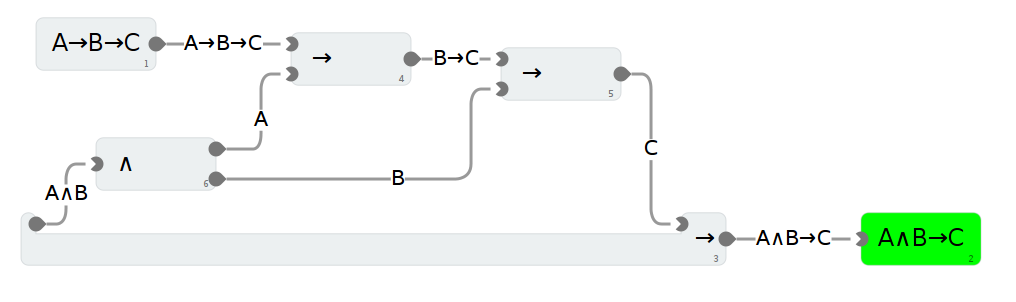
In a few weeks, I will have the opportunity to offer a weekend workshop to selected and motivated high school students1 to a topic of my choice. My idea is to tell them something about logic, proofs, and the joy of searching and finding proofs, and the gratification of irrevocable truths. While proving things on paper is already quite nice, it is much more fun to use an interactive theorem prover, such as Isabelle, Coq or Agda: You get immediate feedback, you can experiment and play around if you are stuck, and you get lots of small successes. Someone2 once called interactive theorem proving the worlds most geekiest videogame . Unfortunately, I don t think one can get high school students without any prior knowledge in logic, or programming, or fancy mathematical symbols, to do something meaningful with a system like Isabelle, so I need something that is (much) easier to use. I always had this idea in the back of my head that proving is not so much about writing text (as in normally written proofs) or programs (as in Agda) or labeled statements (as in Hilbert-style proofs), but rather something involving facts that I have proven so far floating around freely, and way to combine these facts to new facts, without the need to name them, or put them in a particular order or sequence. In a way, I m looking for labVIEW wrestled through the Curry-Horward-isomorphism. Something like this:
A proof of implication currying

A proof of implication currying

So I set out, rounded up a few contributors (Thanks!), implemented this, and now I proudly present: The Incredible Proof Machine3 This interactive theorem prover allows you to do perform proofs purely by dragging blocks (representing proof steps) onto the paper and connecting them properly. There is no need to learn syntax, and hence no frustration about getting that wrong. Furthermore, it comes with a number of example tasks to experiment with, so you can simply see it as a challenging computer came and work through them one by one, learning something about the logical connectives and how they work as you go. For the actual workshop, my plan is to let the students first try to solve the tasks of one session on their own, let them draw their own conclusions and come up with an idea of what they just did, and then deliver an explanation of the logical meaning of what they did. The implementation is heavily influenced by Isabelle: The software does not know anything about, say, conjunction ( ) and implication ( ). To the core, everything is but an untyped lambda expression, and when two blocks are connected, it does unification4 of the proposition present on either side. This general framework is then instantiated by specifying the basic rules (or axioms) in a descriptive manner. It is quite feasible to implement other logics or formal systems on top of this as well. Another influence of Isabelle is the non-linear editing: You neither have to create the proof in a particular order nor have to manually manage a proof focus . Instead, you can edit any bit of the proof at any time, and the system checks all of it continuously. As always, I am keen on feedback. Also, if you want to use this for your own teaching or experimenting needs, let me know. We have a mailing list for the project, the code is on GitHub, where you can also file bug reports and feature requests. Contributions are welcome! All aspects of the logic are implemented in Haskell and compiled to JavaScript using GHCJS, the UI is plain hand-written and messy JavaScript code, using JointJS to handle the graph interaction. Obviously, there is still plenty that can be done to improve the machine. In particular, the ability to create your own proof blocks, such as proof by contradiction, prove them to be valid and then use them in further proofs, is currently being worked on. And while the page will store your current progress, including all proofs you create, in your browser, it needs better ways to save, load and share tasks, blocks and proofs. Also, we d like to add some gamification, i.e. achievements ( First proof by contradiction , 50 theorems proven ), statistics, maybe a share theorem on twitter button. As the UI becomes more complicated, I d like to investigating moving more of it into Haskell world and use Functional Reactive Programming, i.e. Ryan Trickle s reflex, to stay sane. Customers who liked The Incredible Proof Machine might also like these artifacts, that I found while looking whether something like this exists:

  1. Students with migration background supported by the START scholarship
  2. Does anyone know the reference?
  3. We almost named it Proofcraft , which would be a name our current Minecraft-wild youth would appreciate, but it is alreay taken by Gerwin Kleins blog. Also, the irony of a theorem prover being in-credible is worth something.
  4. Luckily, two decades ago, Tobias Nipkow published a nice implementation of higher order pattern unification as ML code, which I transliterated to Haskell for this project.

Matthew Garrett: Filling in the holes in Linux boot chain measurement, and the TPM measurement log

When I wrote about TPM attestation via 2FA, I mentioned that you needed a bootloader that actually performed measurement. I've now written some patches for Shim and Grub that do so.

The Shim code does a couple of things. The obvious one is to measure the second-stage bootloader into PCR 9. The perhaps less expected one is to measure the contents of the MokList and MokSBState UEFI variables into PCR 14. This means that if you're happy simply running a system with your own set of signing keys and just want to ensure that your secure boot configuration hasn't been compromised, you can simply seal to PCR 7 (which will contain the UEFI Secure Boot state as defined by the UEFI spec) and PCR 14 (which will contain the additional state used by Shim) and ignore all the others.

The grub code is a little more complicated because there's more ways to get it to execute code. Right now I've gone for a fairly extreme implementation. On BIOS systems, the grub stage 1 and 2 will be measured into PCR 9[1]. That's the only BIOS-specific part of things. From then on, any grub modules that are loaded will also be measured into PCR 9. The full kernel image will be measured into PCR10, and the full initramfs will be measured into PCR11. The command line passed to the kernel is in PCR12. Finally, each command executed by grub (including those in the config file) is measured into PCR 13.

That's quite a lot of measurement, and there are probably fairly reasonable circumstances under which you won't want to pay attention to all of those PCRs. But you've probably also noticed that several different things may be measured into the same PCR, and that makes it more difficult to figure out what's going on. Thankfully, the spec designers have a solution to this in the form of the TPM measurement log.

Rather than merely extending a PCR with a new hash, software can extend the measurement log at the same time. This is stored outside the TPM and so isn't directly cryptographically protected. In the simplest form, it contains a hash and some form of description of the event associated with that hash. If you replay those hashes you should end up with the same value that's in the TPM, so for attestation purposes you can perform that verification and then merely check that specific log values you care about are correct. This makes it possible to have a system perform an attestation to a remote server that contains a full list of the grub commands that it ran and for that server to make its attestation decision based on a subset of those.

No promises as yet about PCR allocation being final or these patches ever going anywhere in their current form, but it seems reasonable to get them out there so people can play. Let me know if you end up using them!

[1] The code for this is derived from the old Trusted Grub patchset, by way of Sirrix AG's Trusted Grub 2 tree.

comment count unavailable comments

23 September 2015

Daniel Pocock: The only way to ensure the VW scandal never happens again

The automotive industry has been in the spotlight after a massive scandal at Volkswagen, using code hidden in the engine management software to cheat emissions tests. What else is hidden in your new car's computer? Every technology we use in our lives is becoming more computerized, even light bulbs and toilet seats. In a large piece of equipment like a car, there are many opportunities for computerization. In most cases, consumers aren't even given a choice whether or not they want software in their car. It has long been known that such software is spying on the habits of the driver and this data is extracted from the car when it is serviced and uploaded to the car company. Car companies are building vast databases about the lifestyles, habits and employment activities of their customers. Computers aren't going away, so what can be done? Most people realize that computers aren't going to go away any time soon. That doesn't mean that people have to put up with these deceptions and intrusions on our lives. For years, many leading experts in the software engineering world have been promoting the benefits and principles of free software. What we mean by free is that users, regulators and other independent experts should have the freedom to see and modify the source code in the equipment that we depend on as part of modern life. In fact, experts generally agree that there is no means other than software freedom to counter the might of corporations like Volkswagen and their potential to misuse that power, as demonstrated in the emissions testing scandal. If Governments and regulators want to be taken seriously and protect society, isn't it time that they insisted that the car industry replaces all hidden code with free and open source software?

Russ Allbery: Review: Getting Back to Full Employment

Review: Getting Back to Full Employment, by Dean Baker & Jared Bernstein
Publisher: CEPR
Copyright: 2013
ISBN: 0-615-91836-0
Format: Kindle
Pages: 116
Getting Back to Full Employment is more of a policy paper than a book. The authors both work for economic think tanks; one of those, the Center for Economic and Policy research (co-founded by Baker), is the publisher of this book. It's also free on the Kindle, another sign that the purpose is more about educating and convincing the public than about selling a non-fiction analysis. I found out about this through Paul Krugman, and if you're a regular reader of Krugman's columns and blog, not much here will be a surprise. Baker and Bernstein are advocating what I would call conventional-liberal economic policy by US standards (which means that it's not really that liberal). The short version is that full employment is vital for improving the economic position of the average person, inflation is nowhere near as much of a risk as people claim, and the best economic action the US government can take at present is to aggressively pursue a full employment strategy without worrying excessively about inflation. If you're at all familiar with this debate, you probably already have an opinion about everything in that summary. I certainly do. If you follow economics at all, this debate has been raging ever since the 2008 financial crisis (and earlier versions of the debate were raging before then). Since I'm a regular Krugman reader, you probably know my opinion: the people who have been crying wolf about the dangers of inflation have been systematically wrong about everything for seven years solid, and it's amazing that anyone is still giving them the time of day. Baker and Bernstein make a similar argument at greater length, and with a more academic tone. The risk of any policy paper like this is that reactions will be almost entirely decided by one's pre-existing opinion about the political actions that each economic policy implies. If you (like me) have already decided that government intervention in the economy is useful to prevent concentration of wealth in the hands of a few and provide support for the most vulnerable, everything Baker and Bernstein say here is going to sound quite convincing. If you've already decided that government intervention in the economy almost always leads to tears, and that a large government with the ability to take economic action is far more dangerous than any of the effects of economic downturns and unemployment, it would surprise me if Baker and Bernstein will change your mind. In other words, I'm skeptical that policy papers like this accomplish much. That said, there are a lot of facts and data here, which at least help ground this ongoing argument in more specifics. The authors show you the math: the evidence for moderate inflation not leading to any serious impact for economies, the very strong correlations between low unemployment rates and rising median wages, the theoretical basis for lower bounds on unemployment rates and our extensive past history of assuming that lower bound is much higher than it actually is, and some pointed comparisons to countries like Germany that have taken many of the specific policy recommendations included here and have a far healthier labor market as a result. All the statistics, charts, and discussion of analysis techniques is fairly dry, but I think the data is compelling. Of course, I was already convinced by earlier reading. There are a few bits here that I hadn't seen before, or at least hadn't internalized. One is a subtle but very important statistical limitation: any uncertainty in measuring the inflation rate will lead to incorrect statistical findings that inflation slows growth. The explanation for this takes several pages and is somewhat technical: the short and somewhat inaccurate version is that growth is measured in inflation-adjusted GDP, so if you get inflation wrong, you magnify the correlation between GDP and inflation. An inaccurately-high measure of inflation rate simultaneously leads to underestimating GDP growth for that country; an inflation rate that's inaccurate on the low side leads to overestimating GDP growth. This is inherent in how this comparison is done, and it's hard to see how to avoid it. It's therefore worth taking any analysis of the growth impact from higher inflation with a grain of salt. (Please note here that we're talking about moderate inflation the typical rates between 1% and 8% that you see in developed economics.) Another bit that was new to me was the analysis of the connection between trade deficits and full employment. I typically dismiss any international trade analysis in macroeconomic policy for the US since international trade is a much smaller part of our economy than most people think it is, and because protectionism has been rightfully discarded as a policy approach. But Baker and Bernstein make an interesting argument here about the effects of a strong currency on increasing unemployment; even with the relatively small amount of trade, reducing the deficit would have a noticeable effect. (Increasing the volume of trade but not changing the balance would not.) The authors certainly don't recommend protectionism; they do recommend being willing to let the value of the dollar drop against other currencies as a good way to reduce the deficit, and to be aware that other central banks have intentional policies of propping up the dollar that we're largely ignoring. They also mention that this is a zero-sum game for the world economy as a whole, although I would have preferred a bit more emphasis on that. You can't get very far via beggar-thy-neighbor economic policy. But it's a good reminder that the obsession in some parts with not "devaluing the currency" is economic nonsense and directly hurts employment. The end of the book discusses a variety of sensible policy recommendations ranging from international currency policy to Germany's work-sharing program where the government subsidies reduction of worker hours the same way that we already subsidize unemployment. They all seemed reasonable to me, although, sadly, I have little faith that the dysfunctional US government will consider any of them seriously, particularly more direct approaches such as government taking on the role of employer of last resort. But they're fun to read about and imagine a US in which the government actually did sensible things like that. Getting Back to Full Employment is pretty dry, and it's hard to shake the feeling that writing things like this is basically pointless, so I'm not sure I can really recommend it. But if you like reading Krugman's columns and are interested in similar material from different people at a longer length, that's basically what this is. Rating: 6 out of 10

22 September 2015

Clint Adams: 404 No forwarding address for Ryan Hockert-Lotz in Fall River, MA

[As You Like It, Act III, Scene V] Hey Beautiful I thought of you on the Fourth of July; which does not, in and of itself, distinguish the day from any other since I met you. It was remarkable only in that it was justifiable, given our conversation about fireworks displays. Of course, I'm happy to take the flimsiest of displays as an excuse to mark you. I'm home alone right now, after watching The Bad Seed. Truth be told, the shadows keep spooking me. I can't seem to stop myself from imagining precocious blonde murderers in them. It's a manageable silliness, but made a little less so by the fact that I forgot to lock the door. Less troublesome than the night I spent after Ringu (the original Japanese version of The Ring). I finished watching it in the wee hours of the morning, and I wanted to go to sleep. I was in half a stupor, but the incessant inner critic in me kept imagining all the changes that could have been made to make the movie more truly unsettling until visions of Obake were swimming around me. Ordinarily I doubt I'd be bothered particularly by a 50's classic, but went back up to Boston this afternoon. 's at a conference in Finland, so I invited him down to visit while I have the apartment all to myself. It was strange to have a visitor actually in my home for whom I didn't have to play at being contented. At any rate, being around for three days essentially meant carrying on a three-day-long conversaiton, and the abrupt drop of sociability makes me feel my isolation a little more acutely. We watched The Way We Were together, and agreed that it should be remade with casting that actually works. I hadn't seen it before, and was surprised to find it unusually nuanced and substantial, yet still not good. It was nice to have someone around who would dissect it with me afterward. It's been a while since I actually discussed a film with someone. Partly out of my own fault; I don't always enjoy verbalizing my opinions of movies immediately after watching them if I've found them in the least bit moving. I guess I consider the aftertaste part of the experience. In this case, we both felt the film had missed its emotional mark so it wasn't so much of an issue. On the other hand, I don't find most movies moving. I find them frustratingly flawed, and by the time they end I'm raring to rant about their petty contradictions and failures of logic. I think it might give people the impression that I don't actually make any effort to tease out the messages filmmakers weave into their work. Or maybe I'm just making excuses for having uninteresting friends. Either way, it was pleasant to be in the company of someone eager to tolerate the convolutions of my thought process. On Wednesday night, I have a date to meet up with some former co-workers/friends that I've been passively avoiding for several years now. Every time I fail to carefully manage my visibility, people seem to come flooding back into my life. This time the culprit was a day spent logged into instant messaging without stringent privacy settings. I should feel lucky for that, I suppose. I'm not sure how I actually feel. One of the formers is a woman I was very close to, as far as most of the world her included could discern. The other is a Boston boy I admired for the touch of golden child in the air that hung about him. The main theme of his life was (and I suspect still is) getting to drinks with friends at one of his regular bars at the end of every evening. Which did not at all stop him from being productive, interested in the world, and bright. If he had been a girl I would have been hateful with envy. Instead he's always stood out in my memory as the only person I've had a bit of a crush on despite not finding him particularly intellectually stimulating. A month or so ago he sold his company to google. Now he spends a lot of time out of town giving lectures. I suspect I may be generally happy for him, and I'm not quite sure what to do with that. Thursday I'm leaving for a few days in Denver. I wish I hadn't scheduled it for a time when I could have been the sole occupant of my domicile, but other than that I'm looking forward to it. I've no idea what I'll do there, but at least that means I really am going someplace that wouldn't occur to me outside of a peculiar set of constraints. I think it would be advisable to work out the transportation system before I depart, though. I hope this letter finds you relatively satisfied, at a minimum. I don't actually need to tell you how much I miss talking to you, do I? You're wonderful. Affectionally, as always,

Russ Allbery: INN 2.6.0

This is the first major release of INN in several years, and incorporates lots of updates to the build system, protocol support, and the test suite. Major highlights and things to watch out for: There are also tons of accumulated bug fixes, including (of course) all the fixes that were in INN 2.5.5. There are a lot of other changes, so I won't go into all the details here. If you're curious, take a look at the NEWS file. As always, thanks to Julien LIE for preparing this release and doing most of the maintenance work on INN! You can get the latest version from the official ISC download page or from my personal INN pages. The latter also has links to the full changelog and the other INN documentation.

21 September 2015

Jonathan McDowell: Getting a Dell E7240 working with a dock + a monitor

I have a Dell E7240. I m pretty happy with it - my main complaint is that it has a very shiny screen, and that seems to be because it s the touchscreen variant. While I don t care about that feature I do care about the fact it means I get FullHD in 12.5 Anyway. I ve had issues with using a dock and an external monitor with the laptop for some time, including getting so far as mentioning the problems on the appropriate bug tracker. I ve also had discussions with a friend who has the same laptop with the same issues, and has some time trying to get it reliably work. However up until this week I haven t had a desk I m sitting at for any length of time to use the laptop, so it s always been low priority for me. Today I sat down to try and figure out if there had been any improvement. Firstly I knew the dock wasn t at fault. A Dell E6330 works just fine with multiple monitors on the same dock. The E6330 is Ivybridge, while the E7240 is Haswell, so I thought potentially there might be an issue going on there. Further digging revealed another wrinkle I hadn t previously been aware of; there is a DisplayPort Multi-Stream Transport (MST) hub in play, in particular a Synaptics VMM2320. Dell have a knowledge base article about Multiple external display issues when docked with a Latitude E7440/E7240 which suggests a BIOS update (I was already on A15) and a firmware update for the MST HUB. Sadly the firmware update is Windows only, so I had to do a suitable dance to be able to try and run it. I then discovered that the A05 update refused to work, complaining I had an invalid product ID. The A04 update did the same. The A01 update thankfully succeeded and told me it was upgrading from 2.00.002 to 2.15.000. After that had completed (and I d power cycled to switch to the new firmware) I tried A05 again and this time it worked and upgraded me to 2.22.000. Booting up Linux again I got further than before; it was definitely detecting that there was a monitor but it was very unhappy with lots of [drm:intel_dp_start_link_train] *ERROR* too many full retries, give up errors being logged. This was with 4.2, and as I d been meaning to try 4.3-rc2 I thought this was a good time to give it a try. Lo and behold, it worked! Even docking and undocking does what I d expect, with the extra monitor appearing / disappearing as you d expect. Now, I m not going to assume this means it s all happy, as I ve seen this sort-of work in the past, but the clue about MST, the upgrade of that firmware (and noticing that it made things better under Windows as well) and the fact that there have been improvements in the kernel s MST support according to the post 4.2 log gives me some hope that things will be better from here on.

Lunar: Reproducible builds: week 21 in Stretch cycle

If you see someone on the Debian ReproducibleBuilds project, buy him/her a beer. This work is awesome. What happened in the reproducible builds effort this week: Media coverage Nathan Willis covered our DebConf15 status update in Linux Weekly News. Access to non-LWN subscribers will be given on Thursday 24th. Linux Journal published a more general piece last Tuesday. Unexpected praise for reproducible builds appeared this week in the form of several iOS applications identified as including spyware. The malware was undetected by Apple screening. This actually happened because application developers had simply downloaded a trojaned version of XCode through an unofficial source. While reproducible builds can't really help users of non-free software, this is exactly the kind of attacks that we are trying to prevent in our systems. Toolchain fixes Niko Tyni wrote and uploaded a better patch for the source order problem in libmodule-build-perl. Tristan Seligmann identified how the code generated by python-cffi could be emitted in random order in some cases. Upstream has already fixed the problem. Packages fixed The following 24 packages became reproducible due to changes in their build dependencies: apache-curator, checkbox-ng, gant, gnome-clocks, hawtjni, jackrabbit, jersey1, libjsr305-java, mathjax-docs, mlpy, moap, octave-geometry, paste, pdf.js, pyinotify, pytango, python-asyncssh, python-mock, python-openid, python-repoze.who, shadow, swift, tcpwatch-httpproxy, transfig. The following packages became reproducible after getting fixed: Some uploads fixed some reproducibility issues but not all of them: Patches submitted which have not made their way to the archive yet: reproducible.debian.net Tests for Coreboot, OpenWrt, NetBSD, and FreeBSD now runs weekly (instead of monthly). diffoscope development Python 3 offers new features (namely yield from and concurrent.futures) that could help implement parallel processing. The clear separation of bytes and unicode strings is also likely to reduce encoding related issues. Mattia Rizolo thus kicked the effort of porting diffoscope to Python 3. tlsh was the only dependency missing a Python 3 module. This got quickly fixed by a new upload. The rest of the code has been moved to the point where only incompatibilities between Python 2.7 and Pyhon 3.4 had to be changed. The commit stream still require some cleanups but all tests are now passing under Python 3. Documentation update The documentation on how to assemble the weekly reports has been updated. (Lunar) The example on how to use SOURCE_DATE_EPOCH with CMake has been improved. (Ben Beockel, Daniel Kahn Gillmor) The solution for timestamps in man pages generated by Sphinx now uses SOURCE_DATE_EPOCH. (Mattia Rizzolo) Package reviews 45 reviews have been removed, 141 added and 62 updated this week. 67 new FTBFS reports have been filled by Chris Lamb, Niko Tyni, and Lisandro Dami n Nicanor P rez Meyer. New issues added this week: randomness_in_r_rdb_rds_databases, python-ply_compiled_parse_tables. Misc. The prebuilder script is now properly testing umask variations again. Santiago Villa started a discussion on debian-devel on how binNMUs would work for reproducible builds.

Norbert Preining: International Sad Hits Volume 1

I stumbled over this CD a few weeks ago, and immediately ordered it from some second-hand dealer in the US: International Sad Hits Volume 1: Altaic Group. Four artists from different countries (2x Japan, Korea, Turkey) and very different music style, but connected in one thing: That they don t fit into the happy-peppy culture of AKB48, JPOP, KPOP and the like, but singers and songwriters that probe the depths of sadness. With two of my favorite Japanese appearing in the list (Tomokawa Kazuki and Mikami Kan), there was no way I could not buy this CD. international-sad-hits-volume-1 The four artist combined in this excellent CD are: Fikret K z lok, a Turkish musician, singer and songwriter. Quoting from the pamphlet:
However, in 1983 K z lok returned with one of his most important and best albums: Zaman Zaman (Time to time). [ ] These albums presented an alternative to the horrible pop scene emerging in Turkey they criticized the political situation, the so-called intellectuals, and the pop stars.
The Korean artist is (Kim Doo Soo), who was the great surprise of the CD for me. The sadness and beauty that is transmitted through is music is special. The pamphlet of the CD states:
The strictness of his home atmosphere suffocated him, and in defiance against his father he dropped out, and walked along the roads. He said later that, Hatred towards the world, and the emptiness of life overwhelmed me. I lived my life with alcohol every day.
After some problems due to political crisis, and fierce reactions to his song Bohemian (included) made him disappear into the mountains for 10 years, only to return with even better music. The third artist is one of my big favorites, Tomokawa Kazuki (Official site, Wikipedia) from Japan. I have written often about Tomokawa, but found a very fitting description in the booklet:
Author Tatematsu Wahei has described Tomokawa as a man standing naked, his sensibility utterly exposed and tingling. It s an accurate response to a creativity that seems unmediated by embarrassment, voraciously feeding off the artist s personal concern.
The forth artist is again from Japan, Mikami Kan, a well known wild man from the Japanese music scene. After is debut at the Nakatsugawa All-Japan Folk Jamboree in 1971, he was something like a star for some years, but without a record deal his popularity decreased steadily.
During this period his songwriting gradually altered, becoming more dense, surreal and uncompromisingly personal.
Every song on this CD is a masterpiece by itself, but despite me being a great fan of Tomokawa, my favorite is Kim Doo Soo here, with songs that grip your heart and soul, stunningly beauty and sad at the same time.

20 September 2015

Matthew Garrett: The Internet of Incompatible Things

I have an Amazon Echo. I also have a LIFX Smart Bulb. The Echo can integrate with Philips Hue devices, letting you control your lights by voice. It has no integration with LIFX. Worse, the Echo developer program is fairly limited - while the device's built in code supports communicating with devices on your local network, the third party developer interface only allows you to make calls to remote sites[1]. It seemed like I was going to have to put up with either controlling my bedroom light by phone or actually getting out of bed to hit the switch.

Then I found this article describing the implementation of a bridge between the Echo and Belkin Wemo switches, cunningly called Fauxmo. The Echo already supports controlling Wemo switches, and the code in question simply implements enough of the Wemo API to convince the Echo that there's a bunch of Wemo switches on your network. When the Echo sends a command to them asking them to turn on or off, the code executes an arbitrary callback that integrates with whatever API you want.

This seemed like a good starting point. There's a free implementation of the LIFX bulb API called Lazylights, and with a quick bit of hacking I could use the Echo to turn my bulb on or off. But the Echo's Hue support also allows dimming of lights, and that seemed like a nice feature to have. Tcpdump showed that asking the Echo to look for Hue devices resulted in similar UPnP discovery requests to it looking for Wemo devices, so extending the Fauxmo code seemed plausible. I signed up for the Philips developer program and then discovered that the terms and conditions explicitly forbade using any information on their site to implement any kind of Hue-compatible endpoint. So that was out. Thankfully enough people have written their own Hue code at various points that I could figure out enough of the protocol by searching Github instead, and now I have a branch of Fauxmo that supports searching for LIFX bulbs and presenting them as Hues[2].

Running this on a machine on my local network is enough to keep the Echo happy, and I can now dim my bedroom light in addition to turning it on or off. But it demonstrates a somewhat awkward situation. Right now vendors have no real incentive to offer any kind of compatibility with each other. Instead they're all trying to define their own ecosystems with their own incompatible protocols with the aim of forcing users to continue buying from them. Worse, they attempt to restrict developers from implementing any kind of compatibility layers. The inevitable outcome is going to be either stacks of discarded devices speaking abandoned protocols or a cottage industry of developers writing bridge code and trying to avoid DMCA takedowns.

The dystopian future we're heading towards isn't Gibsonian giant megacorporations engaging in physical warfare, it's one where buying a new toaster means replacing all your lightbulbs or discovering that the code making your home alarm system work is now considered a copyright infringement. Is there a market where I can invest in IP lawyers?

[1] It also requires an additional phrase at the beginning of a request to indicate which third party app you want your query to go to, so it's much more clumsy to make those requests compared to using a built-in app.
[2] I only have one bulb, so as yet I haven't added any support for groups.

comment count unavailable comments

19 September 2015

Russ Allbery: Review: Magic's Promise

Review: Magic's Promise, by Mercedes Lackey
Series: Last Herald Mage #2
Publisher: DAW
Copyright: January 1990
ISBN: 0-88677-401-2
Format: Mass market
Pages: 320
Magic's Promise is the second book of the Last Herald Mage trilogy and a sequel to Magic's Pawn. As tempting as it is to skip the first book, which isn't very good, I think you'd miss a lot of the emotional dynamics between Vanyel and his family if you didn't read it. Magic's Promise opens years after the end of Magic's Pawn. Vanyel has become the most powerful Herald-mage of the kingdom, which is lucky for the kingdom because it's beset on all sides by magical attack. Heralds are being killed, countries on the border are looking for opportunities to spring, and Vanyel is being run ragged. Ragged enough that he's worried he's going to hurt someone by mistake when surprised. It's time for a desperately-needed vacation. Unfortunately for his ability to relax, that vacation means going home to visit his parents, who have never understood him and who disapprove strongly of his sexuality. (Not that he's actually had a lover in years.) It also means being in the same household as the armsmaster who broke his wrist as a child, and his father's deeply disapproving priest. And the border near his parents' lands may be heating up as well. Magic's Promise is the book where this trilogy hits its stride. After the events of the previous book, Vanyel is ridiculously overpowered and will be for the rest of the trilogy, but the problems in this book aren't the sort that raw power can fix. (That's a balance Lackey handles well in general.) There are a few places where Vanyel can simply overpower his problems, but the heart of the plot is a mystery that requires analysis, investigation, and a bit of undercover snooping. I enjoyed the defense of the kingdom plot (more than I had remembered, in fact), but the heart of this book is Vanyel and his family coming to terms with each other. Vanyel is a lot older and more confident than he was in the first book, and his service to the kingdom forces some grudging respect. But the way that grudging respect turns into real affection over the course of this book is a delight to read. This degree of reconciliation is wish-fulfillment most of the Valdemar series is heavy on wish-fulfillment but it's the sort of wish-fulfillment that matches the way that you wish the world would work. People figure out that they've been ignorant and cruel and actually change, and Vanyel learns some important lessons about giving people room to change. I particularly liked that the growth of respect wasn't one-sided. Most of the movement comes (and has to come) from Vanyel's family, but Vanyel gains some new-found appreciation and empathy for some strengths that he'd previously been blind to. Lackey's writing is still not the best here. There's something a bit awkward about the dialogue patterns in places, one gets a bit tired of the repetitive narrative focus on Vanyel's exhaustion, and the sentence-level construction of the story is more workable than delightful. You have to be invested in the characters; the beauty of the writing itself isn't going to win you over. As with a lot of Lackey's writing, I think your enjoyment will depend greatly on whether she happens to hit your emotional buttons. But the story she tells here, of people finding the inner goodness in each other and healing over past wounds, is one that I very much enjoy reading. I think this is the third time I read this book, and it's the first of the Valdemar series in this re-read that held up to my memory. So far, it's the best of the series. Followed by Magic's Price. Rating: 8 out of 10

Russ Allbery: pam-afs-session 2.6

I no longer use this PAM module, since I don't use AFS any more, and it's actually orphaned. But there was a bug report against the Debian package that was actually a PAM issue, not an AFS issue, so I went ahead and fixed that. The bug was that running sudo when you had the AFS PAM module enabled would delete your tokens. This was because sudo calls pam_setcred and pam_open_session in a somewhat strange way, leading the PAM module to think that sudo was taking ownership of the token but without putting the user in a new PAG. Then, when sudo closed its PAM session, the module would erroneously delete the token. The fix is to not set the flag to skip subsequent open_session and close_session handling when called with PAM_REINITIALIZE_CRED or PAM_REFRESH_CRED. This preserves correct session handling behavior and avoids this issue. Also with this release, I finally rewrote the test suite to use my generic PAM test suite code, and got rid of a bunch of old, legacy testing code. I lost one test for which the new test framework doesn't have enough hooks, but it wasn't particularly important, and the new code is much cleaner and more data-driven. There are also a few other, accumulated fixes, such as a compilation fix on Solaris 11, and a significant modernization of all of my common support libraries. (The last official release was in 2011!) You can get the latest version from the pam-afs-session distribution page.

18 September 2015

Dimitri John Ledkov: Clear Containers for Docker* Engine

Today at work, I announced something James Hunt, Ikey Doherty and myself have been working on. We integrated Clear Containers technology with Docker* Engine to create Clear Containers for Docker* Engine.

After following installation instructions, one can pull and run existing Docker* containers in the secure Clear Containers environment. This means that instead of namespaces, a fast virtual machine is started using the kvmtool hypervisor. This VM is running an optimised minimal Linux* kernel and the optimised Clear Linux* for Intel Architecture Project user-space, with the only goal to execute the Docker* workload and then shut down.

The net effect is almost indistinguishable from typical Docker* container usage:
$ docker run -ti ubuntu:vivid
root@d88a60502ed7:/# systemd-detect-virt
kvm
Apart from, as you see, it's running inside a kvm VM, and thus protected by Intel Virtualization Technology.

This is available on Clear Linux* as well as multiple other operating systems.

I hope this is exciting enough for people to try out, and if you have any feedback, feel free to leave comments or join our mailing list.

*Other names and brands may be claimed as the property of others

The postings on this site are my own and don't necessarily represent Intel s positions, strategies, or opinions.

Next.

Previous.