Search Results: "agi"

30 April 2012

Cyril Brulebois: Debian XSF News #11

Long time no see Summary Anyway, here are some quick news from the X packaging front, focussing on the past few weeks.
  1. While I was busy doing other things, Julien took care of uploading lots of libraries (making most of them multiarch-aware) along with our usual meta-packages (like x11-apps, x11-utils, etc.), preparing for the upcoming 7.7 katamari.
  2. Mesa 8.0.2 was finally uploaded to experimental, where it seems to be building fine, and working fine, at least for me.
  3. Accordingly, I m planning an upload to unstable very soon, and I won t be disabling wayland support this time, since wayland/weston reached their first milestone with a public release (0.85). There s nothing very interesting to see here, but since wayland support doesn t really hurt, I thought I d just keep it. That s why wayland hit unstable yesterday; weston should follow after mesa. (In case somebody is in a hurry, they have been in experimental for quite some time already.)
  4. Scrolling issues with the synaptics driver seem to be finally fixed thanks to rc4: #665004 was confirmed as fixed by many reporters (thanks everyone for the quick feedback after my ping). Accordingly, I ve pinged the release team to get an age-days 3 to make it migrate faster, and a kind RM added that hint to his file, so testing is getting the fixed package thanks to this midnight s britney run.
  5. libcairo2/server/EXA/ati/nouveau fun: will be added through an edition of this post. Executive summary: downgrade libcairo2 to testing s version if you re seeing text corruptions.
Upcoming X server transition X server 1.12 has been prepared in experimental for a while, from release candidates to the first stable release from server-1.12-branch. Since a bunch of drivers were uploaded to cope with that version when it shows up, we should be able to upload xorg-server 1.12 to unstable VERY SOON. What does that mean? Basically, that s a transition. In details:
  1. We upload xorg-server, and wait for it to be built everywhere, then we trigger binNMUs for all architectures at once when it s ready on all of them.
  2. Unlike shared libraries, there s no old and new library packages (old+new SONAME); instead, the server itself provides different packages (because of the different input and video ABI). That means that drivers won t be installable until they are rebuilt against the new server. Usually, we re talking about a few dinstall runs, meaning less than a day.
Frequently Yelled Phrases:
  1. Upgrades are broken! No, it just means you can t upgrade the server alone, you need the drivers too (see above).
  2. Installations are broken! Well, that s unstable, and you probably know installability-related issues are trivially solved by pulling packages from testing when needed. This is such a case.
Please don t report bugs on this topic, thanks already, and enjoy that new server.

John Goerzen: Review: Amateur Radio Handhelds (HTs), APRS, and Battery Tuning Tips

There are a lot of opinions about handhelds for amateur radio users (these handhelds are often known as HTs). I ve used three of them, two with APRS capability, and thought it s about time I write about them. First, I ll talk about the units in particular, then I ll get to some broader Yaesu vs. Kenwood generalizations and conclusions. Yaesu VX-7R a rugged first HT without APRS Cost: $350 as of 4/30/2012 This was the first HT I got as a ham, at the suggestion of Mike AE0MW. It truly does make a great first handheld for a ham. Radio-wise, one unique feature is a receive that s wideband enough to cover both broadcast FM and broadcast AM, the various ham bands, and plenty of others besides. The battery life quoted in the manual is 6 hours on 2m and 5.5 hours on 440 (using standard 6s TX / 6s RX / 48s squelched metric), and in my experience it seems it must be even better in some cases. The real piece of news about this unit, though, is just how rugged it is. It says submersible across the front and I absolutely believe it. I have personal experience with its ruggedness. I once was at an event and put the radio on my car roof while helping one of my children into the car. I then started driving home and forgot it there. When we got home, I realized what had happened, and also realized what that mysterious CLUNK along the busy county road was. So I drove 45 minutes back to where I heard the clunk, and found the VX-7R still lying in the roadway, where it had been for 1.5 hours on the 55 MPH road. The thing was really beat up. It had obviously been hit by numerous vehicles. The antenna was ripped off, taking the SMA mount with it. But wouldn t you know it, the darn thing still powered up. I took it to a local amateur radio shop, and about $80 later it was repaired. Incredible. The only real problem was the antenna connector. I took this radio with me on my bicycle many days, mounted on my handlebars. It got bounced around, but still worked great. Some days I listened to FM radio from it while riding my bike, monitoring a local repeater while I rode. Other days, I spent most of my ride (about an hour each way) chatting with people on the repeaters I have a mobile antenna mounted on the bike, fed to the VX-7R, and a headset. It all worked fine never a problem at all. The ruggedness has its downside. All of the connectors on the radio, except for DC in, are screw-down even the speaker/mic connector. This obviously helps keep water out, but means that it can take a lot longer than normal to do a simple thing like plug in a speaker/mic. It doesn t need any tools, but can get a little annoying. The radio physically is small (unless you install the belt clip, which has an odd peg-based mechanism that protrudes unnecessarily far and is surprisingly non-rugged). It can easily fit into a pocket. The other downsides of the VX-7R mostly surround its interface. I m not one of the Yaesu haters that seem to be so common. I find the interface usable if you read the manual; it seems a lot of people that complain about it don t. But it is quirky. The SET mode is one long menu in sort of a ring. You scroll with the knob, and when you get to the end, it repeats to the beginning. There are one or two shortcut keys to a specific setting, but overall either you use the thing so much you know exactly where you re going, or you re twisting the knob for awhile until the option you want rolls around. (I know of nobody that uses it so much they know exactly where they re going.) They do have options grouped into categories, but it doesn t help much because there s no quick way to skip between categories. The dual transceivers work less elegantly than on the TH-D72A or VX-8GR. Instead of being two equal transceivers A and B, they are main and sub . The sub transceiver is not broadband receive like the main receiver is. But there are also other limitations that have no apparent logic. For instance, you can program memory groups into the device putting, say, all the local repeaters into a certain group, or all the public safety frequencies (to use as a scanner). You can go to the special set menu, select group, then activate SCAN, and it will scan only the memories in that group. But you can t select the special group mode on the sub transceiver for no apparent reason. One other complaint is that the AC charger introduces so much noise to a transmission that you cannot really use the VX-7R to transmit while the charger is connected. Yaesu sells a programming cable that plugs into the speaker/mic port on one end, and a DB-9 serial port on the other, and includes programming software. For an incredibly high price. For far less, I found a similar cable on eBay that has a USB port on the other end (with a built-in USB/serial converter), and used VX-7R Commander though now that Chirp is available for Linux, I ll probably switch to it. I would probably continue to recommend this transceiver for a new ham. The ruggedness, plus the broadband RX, are features that should make it appealing. It is an excellent emergency preparedness/response radio due to those properties; having TX and RX on ham bands, plus RX on broadcast and public safety could be quite the asset. However, for someone that has any interest in APRS, one of the other two radios I mention is probably a better choice. At only $10 more, the VX-8GR sacrifices ruggedness and broadband receive for APRS functionality and could make a compelling alternative to the VX-7R at the same price point. The very low-power transmit at 50MHz and 220MHz on the VX-7R strikes me as a gimmick feature at best that has very little actual use. Shipped battery: FNB-80LI, 7.4V, 1400 mAh, lithium-ion Kenwood TH-D72A / D72E The Cadillac HT, with APRS and GPS Cost: $464 as of April 30, 2012 It s hard to use any word but incredible to describe this HT, though it does have its own rough edges. Starting with the basics, it has dual transceivers with full duplex (meaning you can be transmitting on one band while receiving on another). Its stored memory system and memory bank scanning system are both a lot easier and faster to use than Yaesu s, and work the same on both transceivers A and B, though perhaps offer slightly less flexibility than Yaesu s (on the VX-7R, a single memory can be a member of more than one group). The quoted operating time is 6 hours, which is probably accurate with APRS and GPS off, matching (or nearly matching) the VX-7R. The TH-D72A has the usual mic and speaker ports. Unlike Yaesu, Kenwood has used the same jack for years, so it is not necessary to purchase new accessories with each upgrade. The unit also has both serial (Kenwood connector) and standard mini USB ports, and even ships with a USB cable. The USB port is designed to interface to a PC, and the radio presents itself as a serial-over-USB device. Kenwood also includes MCP-4A, the programming software for the unit, free. This is one example of several things that Kenwood includes for free but are costly add-ons with Yaesu. Kenwood s configuration menu system is hierarchical. You can scroll through the four top-level menus (RADIO, GPS, APRS, and SKY), then navigate through sub menus. The result is that it s both faster and easier to find what you want than on the Yaesu menus. Plus, as you navigate, the radio shows you the shortcut key to get to a particular option (each level of menu is numbered starting) so, for instance, Menu-1-1-0 takes me directly to the configuration for RX battery saver interval far faster than I could get there on the VX-7R or VX-8GR. Only the APRS menu gets a bit crowded with this setup. The D72A supports Kenwood s Sky Command II an intriguing way of making it essentially a remote for a Kenwood HF rig such as the TS-2000. It works by engaging a crossband repeater for the audio, and setting up a AX.25 packet link for the control. It works, but as the response time to frequency adjustments is measured in seconds, is klunky for tuning around a HF band. A nifty, though perhaps not supremely useful, feature with some hackable potential that I haven t explored yet. The TH-D72A is one of only two shipping general-purpose amateur radios that have a built-in GPS the other is the Yaesu VX-8GR, which I ll review below. The GPS works well, and can get a fix indoors if desired. It has a system of saving waypoints, which you can then navigate back to later (using distance/bearing indicators). It also has a track log. While the track log can t be viewed on the unit, it can be downloaded with the included MCP-4A software and saved in a variety of formats including Google s KML for later importing into Google Maps or Google Earth. I enjoy this feature on trips to see where I went later on. There is also a GPS-only mode, which disables all of the other radio circuitry on the radio for very low power consumption. The GPS navigation screens all support heading-up or north-up indicators. But where this radio really shines is APRS. The D72 has all the basics you d expect sending and receiving beacons, sending and receiving messages and bulletins, etc. It has built-in support for being a digipeater in many different ways, including new-N UI-Trace. Coupled with an MFJ VHF amplifier, this could make a nice temporary (or even permanent) digi. The message interface permits sending, receiving, and shortcuts for replying to messages. Beacon transmission can be completely manual, at set intervals, or using SmartBeaconing. Outbound beacons also support proportional pathing (meaning adjusting via-path to not have wide coverage with every transmission). Also, if not using SmartBeaconing, a decay algorithm can be used to send beacons less frequently when the station s location isn t changing. An alternative tells the system to transmit a beacon every time PTT is released, subject to rate limiting by interval. So lots of choices there. For incoming beacons, there are various filters by callsign pattern, packet type, etc. that control whether they will be processed at all, and what kind of alert (visual or audible) to present. Beacons are also placed in a received beacon list, sorted with the most recent at the top (duplicates from the same station are always removed, so only the most recent is presented.) A long press of the LIST button shows time received and type of device next to the callsign. Selecting a specific beacon shows status text, comment, device type, bearing/distance (with graphical north-up or heading-up display), telemetry (weather information and the like), and a little bit of info about the via-path. Pretty nice to see weather reports from local weather stations on there. You can sort the list by received time, station call, or distance from your position but it doesn t stay sorted by anything other than received time, and takes several seconds to re-sort. Seems like a bit of an oversight there. The D72A supports QSY information in beacons. This can automatically insert the frequency of the other band on the transceiver into your transmitted beacons for you, or give you a quick way to tune to the frequency mentioned on others beacons. Either way, a nice touch. The D72 also supports query packets, such as packets asking your station to transmit its position right now. The TH-D72A can directly interface with several types of weather stations via serial link to read weather sensor information and transmit it into APRS packets directly, with no need for a PC to be in the picture at all. But if you do hook up a PC to it, there are quite a few more possibilities. You can hook it up to PC APRS software (or a hardware device such as the AVMAP) to see locations of other APRS stations on a map. It can emit APRS packets, plus even GPS sentences, down the USB port to the PC. Moreover, in PACKET mode, it acts as a full TNC, with a fairly robust TNC command set. In short, it can do more than APRS; it can also do regular AX.25 such as DX clusters, BBS, nodes, etc. As far as I know, this is the only HT that can interface with a PC in this manner, and only Kenwood s mobile D710 has the same kind of feature set at that. Kenwood includes a lot of documentation with the TH-D72A. The 51-page printed manual is a summary or introductory guide. The included CD-ROM supplies another 75 pages of detailed reference material, and the 92-page in-depth APRS manual has a level of detail that true geeks like me appreciate. I ve referred to Kenwood s documentation more than once while figuring out things about the VX-8GR (which woefully under-documents things like SmartBeaconing). That said, it appears that at least some of the documentation has been copied from the earlier TH-D7A. Page 4 of the printed book is a good example. It talks about the memory effect of the battery, and warns against unplugging and replugging the charger because the charge cycle will be reset and the battery will be over-charged (I find it hard to believe that a Li-Ion charge controller would be that stupid, and furthermore direct observation suggests that it isn t.) Parts of the in-depth APRS guide appear to have been written for the D710, but that s a really minor nit. Unlike Yaesu, Kenwood issues periodic firmware updates to the D72A, which you can apply over USB. They have fixed bugs and added features to the unit over time. Now onto the things that aren t so good about the D72A. I ll start with the battery system, since we were already discussing it. Despite shipping with a much larger battery than the VX-8GR (1800 mAh vs. 1100 mAh), it only manages roughly equal battery life with APRS and GPS engaged. (It will probably do better as a simple voice unit, however.) This has been confirmed by numerous reports on the Internet. I will discuss this topic more below. There is very little else to fault the D72A on, feature-wise. I have a minor nit in that it is impossible to cause the keylock feature to also lock PTT. It would be nice to be able to see raw APRS packets on beacons and messages. Other than that, I can t think of a feature it really lacks. Compared to the VX-7R and VX-8GR, the TH-D72A is significantly larger physically, in every dimension. It is not uncomfortably large, and still fits in my hand fine. But its size is enough different that it feels like the design is dated and could have been more compact if Kenwood would have bothered. It s a nit, sure, but a nontrivial one. With the single exception of the sturdy metal belt clip, the D72 doesn t feel nearly as rugged as the VX-7R, and not even as rugged as the VX-8GR. The keys have a squishy feel to them, the PTT button works fine but has a cheap plastic design (as opposed to the rubberized versions on Yaesu s HTs). The manual doesn t mention it, but one Kenwood brochure mentions and IP54 weatherproofing. That means it is protected against limited ingress of dust and against water sprayed from all directions limited ingress permitted. Contrast that to the VX-7R, which is rated for 30 minutes of submersion at 3ft and has a magnesium case. It seems to be specced similarly to the VX-8GR, though the VX-8GR certainly feels a lot more solid. I have no proof, as I m not about to sacrifice my HTs for science, but I doubt that the TH-D72A would have survived over an hour on a busy road as well as the VX-7R did, and probably not even as well as the VX-8GR would. The case is plastic a stout plastic, but still plastic. Like the VX-8GR, and unlike the VX-7R, the D72A does not have broadband receive. It can receive some bands adjacent to the ham bands it supports, which includes a lot of bands of interest to people with scanners, but still can t receive broadcast FM signals like the VX-7R. Shipped battery: PB-45L, 1800 mAh, lithium-ion Yaesu VX-8GR: Cheaper APRS & GPS Cost: $360 as of 4/30/2012 One could probably call this Yaesu s closest competitor to the D72A. At about $100 cheaper, it doesn t have a featureset that matches Kenwood s, but it does have a few innovations that the D72A lacks. Starting with the basics, it lacks the VX-7R s broadband receive, with the receive roughly matching the TH-D72A s. The 8GR is a dual-transceiver HT, and it works this effectively (moreso than the VX-7R). Yaesu has a bad habit of changing connectors on radios with regularity, and charging an arm and a leg for accessories to boot. Even within the VX-8 line, the 8GR uses different accessories than the 8DR, and of course has different plugs than the 7R (though it appears that the DC power plug is the same, and with some luck you might be able to use a VX-7R speaker/mic on the 8GR, though not the reverse). The menu system on the 8GR is still similar to the 7R, though Yaesu has done several things to improve it. For one, scrolling through the menu now shows several lines of context on the screen at once, making it faster to scan. Also, there are more ways to jump into the menu at a certain location than before and even a small bit of clumsily-implemented hierarchy (there are several settings on the SmartBeaconing page, for instance). The menu key now toggles between various displays: the default frequency/status display, a GPS display, an APRS staion list, and an APRS message list. Just about everything operationally takes more keypresses than the D72A. On the D72A, it s one or two keys (a physical button or F+button) to do almost everything: toggle GPS state, change TNC/APRS state (turn on or off), etc. All of that is in the scrolling menus on the 8GR. The quickest way there, which is documented in the manual, is to press MENU until a certain screen comes up, then press and hold MENU to bring up the settings (defaulting to a certain APRS-related category), then scroll and change settings. It s a pain to turn APRS on and off, because you have to do this process for both the GPS and the APRS modem. Inexplicably, there is a hotkey to change the APRS beacon method (manual, auto, or SmartBeaconing) but not to turn APRS itself on or off. (The D72A has a hotkey to toggle the beaconing, though not to change its method; though in truth, if you do it frequently, the menu shortcuts will get you there rapidly.) Physically, the VX-8GR is closer to the size of the 7R than the size of the D72A, and notably is significantly smaller than the D72A (at least with the standard battery). As noted in the D72A review, the VX-8GR feels more rugged than the D72A, though whether that is actually true or not is hard to pin down. It is definitely less rugged than the VX-7R. The keys require more pressure than the D72A, and in this they are similar to the 7R, but feel satisfyingly solid. Unlike the other radios here, the 8GR does not have a dedicated volume knob, having only one dial on the top. To adjust volume, you hold the volume button on the left while twisting the knob. In practice, this is probably not usually very annoying, but if the radio is on your belt or otherwise not in your hand, this would be a frustration. (I think it would be particularly annoying if using it with a speaker/mic). Setting 99 will let you change the key so you don t have to hold it in, which could probably go a long way to making the situation more tolerable. One unique feature of the VX-8GR, as far as I know completely unique to it, is a vibrating alert. This would most frequently be used with APRS to provide a nearly-silent alert of incoming messages and the like. The screen of the 8G, while similar in size to both the D72A and the 7R, appears to be higher-resolution (or if not, they make better use of it). More information is packed onto the screen at once, and although the D72A does have a small font, it uses it so rarely that lots of scrolling is needed. The 8GR uses a smaller font than the D72A to show content of messages and the like, which makes a much faster experience since there is a lot less scrolling. Neither radio has a setting to change this behavior, so if your eyesight isn t good, you may prefer the D72A anyhow. The VX-8GR supports a heading-up or a north-up view of the received GPS data, but strangely it does not support this when navigating to a received beacon (north-up is the only option). Unlike the TH-D72A, you can engage keylock on the 8GR while someone s beacon is on the display. Also unlike the TH-D72A, you can lock out the PTT key on the 8GR. However, the keylock feature is just a quick press of the power button, which makes me a bit nervous. And worse, if you tell it to lock the PTT key, then it also won t transmit any automatic APRS beacons! There are a lot of things the D72A supports in the APRS area that the 8GR doesn t. Here s a summary of features missing in the 8GR compared to the D72A: voice alert (can t even do it manually since tone/CTCSS are locked out in APRS mode), quick replying to messages, TNC mode (meaning you can t use it with PC-based APRS programs), full AX.25 packet mode, full PC linking, weather station inputs, built-in digipeater mode, heading-up display, GPS track logs, QSY in beacons, quick tuning to others QSY info, responding to position queries, proportional pathing, automatic decay, beaconing on PTT release, sorting of beacon list, hotkey access to many features, and I m sure the list goes on. On the flipside, the only thing feature-wise that you get on the 8GR s APRS implementation that the D72A lacks is ability to inspect raw APRS packets. The VX-8GR has the lowest-capacity battery of the three radios covered in this post, and this is an oft-cited problem for users of the unit. Yeasu does seem to do a much better job of power management than Kenwood, though, so in full APRS and GPS mode, the battery life is roughly the same, amazingly enough. It is unlikely that the talk time on the 8GR would match either the 7R or the D72A, however. Kenwood and Yaesu both have a battery saver feature which cuts power to the RX circuit except for brief checks for signals. Yaesu completely disables this while the APRS modem is on (and STILL matches Kenwood s battery life, despite the smaller battery!) Kenwood doesn t, though recommends changing the signal-check interval from 0.2s to 0.03s in order to avoid truncating APRS packets. Yaesu offers an 1800 mAh extended-life battery which should significantly exceed Kenwood s battery life. Aftermarket vendors have 2000 mAh batteries as well. Either way, expect APRS to be a drain on batteries. More on that below. Although Yaesu includes 168 pages of documentation with the 8GR, don t expect it to match the quality and detail of Kenwood s 218 pages. There are a lot of gimmicky/useless features on the 8GR (WIRES, for one) that get extensive treatment, and there is a fair bit of repetition. I particularly single out the SmartBeaconing documentation on the 8GR as being, at best, woefully incomplete and probably also inaccurate to boot. Read the D72A manuals to figure out how that feature works on your 8GR. I bought the VX-8GR intending it to be something akin to a more versatile TinyTrak. On that score, it mostly succeeds. It may be my go-to rig for use at bicycle rides, marathons, emergencies, etc., while the D72A will probably be the one that goes with me on trips. Shipped battery: FNB-101LI, 7.4V, 1100 mAh, lithium-ion Not covered: VX-8DR poor value for the dollar Cost: $434 ($550 with GPS and GPS connector) Yaesu s top-of-the-line HT is sometimes considered to be the VX-8DR. It maintains the broadband capability of the 7R, is probably almost as rugged as the 7R, and has APRS built in, like the 8GR. It even has an option to add a Bluetooth board. What is doesn t have built-in is a GPS. You can add one on for $77 for the FGPS-2 plus $39 for the CT-136 connector which connects the GPS to the unit. But then you have a unit a lot less rugged than even the D72A (that s a small connector for the GPS), a lot less small, with the same APRS featureset as the 8GR (meaning a lot less than the D72A), which costs about $100 more than the D72A. Frankly I think this makes for a poor APRS package, and would probably only be reasonable for someone that wants other 8DR features and has a desire for some very occasionaly APRS work. Battery Life and APRS One of my first surprises with APRS HTs was the poor battery life I saw. Doing my research seemed to suggest that, contrary to popular opinion, the transmitted beacons were not the culiprit, but the receive circuits were to blame. Because it is not acceptable to cut off the first 200ms of an AX.25 packet like it is with a repeater, the RX circuit is either engaged much more frequently (Kenwood) or continuously (Yaesu), putting a lot more drain on the battery. (This has also been confirmed by multiple others that have done testing) The GPS receiver also adds drain, and on the D72A, so does the TNC, which is always active when APRS is. If you don t care about received beacons, you can dramatically raise the battery life on the D72A by setting the power saver to 1 second or greater as high as 14 hours by one report. On either unit, raising the squelch should have some effect (though not as much; but in any case, weak packets won t decode anyhow, so there s no sense in letting them in.) On the 8GR, getting the extended life 1800 mAh (or aftermarket version) could produce battery life in nearly that same region, without compromising on the RX side of things. Conclusions If you want a HT capable of APRS, seriously think of the TH-D72A before anything else. It is $100 more expensive than the 8GR, but has more than $100 worth of extra features (and included things, like PC link cable and software, that are extra on the 8GR), so it has a better value. If you re particularly budget-conscious or want the most ruggedness you can find, the 7R and 8GR are solid contenders if you can sacrifice the extra APRS features. Update May 1: Clarified what the lack of TNC mode on the VX-8GR means, and also how the VX-8GR PTT keylock also locks out APRS transmissions.

Russell Coker: The Royal Caribbean Official Android app

I ve just played with the official Android app [1] for the Royal Carribean cruise line [2]. The cruise line is apparently great (I ve never been on one of their ships but the reviews are good) but the Android app isn t. Net Access The most obvious and significant problem with this app is that it s entirely useless without net access. All data of note comes from the Internet which means that the program is useless in any location where Internet access is unavailable (or unreasonably expensive). They wrote an app about cruising that can t be used on a cruise ship! Did they even think about what they were doing? The correct thing to do when writing such an application is to have all basic data about all ships included in the app. This means that when they change the deck plan of a ship they need to release a new version of the app and have people download it. Having done a lot of software development I understand that forcing software updates (even updates to included data files) involves some effort and expense. But when they spend $20,000,000 to update a ship (which is about the minimum that is spent for a major ship in dry-dock according to TV documentaries I ve watched) it seems quite reasonable to budget $10,000 to release new software. Also one benefit of updating the software is that it can promote the changes, after spending tens of millions of dollars improving a ship they probably want to promote that to customers and pushing a new app update with adverts for the improved ship seems like a good way of doing that. There is some data that can t reasonably be included in the app due to size constraints with photos of ships being the most notable example. The solution to this is to provide an option for the user to cache the data that interests them. For example if I was meeting some people to discuss the possibility of a group cruise on a RCL ship then I could download all the pictures of that ship on my home Wifi network and then have them all available with no delay or 3G costs. Also the app seems to hang if net access is temporarily interrupted. As phones are expected to have unreliable net access this is also a significant flaw. Maps The maps of the ships are comprised of a series of pictures which each show one deck. In addition to being downloaded (not cached or included in the app) they aren t scalable (they should be SVG or at least allow zooming the high resolution pictures) and they don t allow a 3D view. The paper maps used to promote cruises (including RCI cruises) and which are given to all passengers on Princess cruises (I m not sure about other lines) show a side cutaway view of the ship which is handy for working out which things are near where you are. It seems that an ideal cruise ship mapping program would have some sort of 3D component, maybe X3D. My experience is that a two night cruise isn t long enough to become familiar with one of the smaller cruise ships. Using a map is essential and a smart phone is a good way of managing such a map as typical 2D paper maps just aren t good enough for such a large and complex structure. Photos One of the significant things that is wrong with the app is a lack of care in displaying the photos of ships. They display three pictures of the Allure of the Seas (one of the two newest, biggest, and most luxurious ships in their fleet), but one of those three photos is actually of the Oasis of the Seas. The fact that the two ships are almost identical is no excuse, there is a principle at stake! Also only having three pictures is pretty poor, there is no way that less than 50 pictures could do justice to such a big ship! A Google search for the words cruise and photos turns up many sites with pictures of cruise ships and it s not particularly difficult to find pictures of any particular ship. Photographs by customers are often of high quality as some of the better DSLR cameras are in the same price range as some of the cheaper tickets for cruise ships. Probably the best thing that RCI could do is to run a contest and allow their customers to enter photos and vote towards the winning entries. That would get them photos that aren t as sterile as the official photos and which include the things that are of most interest to customers. Finally in terms of caching, pictures are the most easily cached source of data and as phones get higher resolution they keep getting bigger. The storage space for a modern phone is equivalent to the entire 3G download quota for about a year on an affordable Australian 3G plan. When dealing with photos downloaded from the net the default should be to cache everything. Navigation Navigating a smart-phone app is a lot more difficult than navigating the same data on a desktop system (which would be in a web browser). Users can compensate for some deficiencies with web site organisation by using a large monitor and having several web browser windows with multiple tabs. But with a phone it should be possible to switch between things quickly. The main menu has a View Our Ships option (which allows viewing deck plans and pictures) and a View Our Staterooms option which offers a list of ships and then describes the state rooms available for each one. This means that you can t see all the information about a ship in one place and even worse you can t easily compare ships. As it seems likely that people will want to use this app for selecting a cruise it should be possible to select a few ships that are of interest and then quickly flip between them. For example the Rhapsody of the Seas and the Voyager of the Seas are cruising in my part of the world so it would be nice if I could tell the app to compare those ships and then allow me to view a page about one ship and then flick to the equivalent page about the other ship. Another notable problem is that the ships are listed in alphabetical order. The sensible thing to do is to list them by class going from biggest to smallest. Lessons to be Learned These problems aren t specific to the RCI app, many other Android apps have the same flaws. For example the Google Play market app doesn t cache the icons of the installed apps so every time I want to see a list of installed apps it goes slow and wastes some of my bandwidth. Doing something wrong in the same way as Google isn t necessarily a great mistake, although using the Google Play market on a cruise ship is probably very uncommon. Probably the biggest problem is a lack of testing. They should have sent the developers on a cruise as a live test. Every cruise ship has a sales desk for booking future cruises so it wouldn t be difficult to have a dozen Android phones at the sales desk to see how real customers who really want to book a cruise find it. I presume that even if net access was available then such a test would fail dismally. If a 3D display of a ship combined with all the data management capabilities of a modern smart phone (which is a lot more powerful than the desktop systems I used prior to 2000) can t at least be a useful supplement to a stack of paper brochures then it s probably a failure. I think that the RCI app is an example of how to make an Android app which doesn t fall into the more common failings (such as being a quick and dirty port from iOS) but yet still isn t useful to customers. I recommend that people who develop apps which have an objective of imparting information to users try it out as an example of what not to do. Try a few basic tasks like comparing the three biggest classes of RCI ships in terms of features, after failing to do that with the app you can then use Wikipedia to get the result. But don t use the Wikipedia client apps, use a tabbed browser such as Opera Mini. Related posts:
  1. An Introduction to Android I gave a brief introductory talk about Android at this...
  2. Choosing an Android Phone My phone contract ends in a few months, so I m...
  3. Galaxy S vs Xperia X10 and Android Network Access Galaxy S Review I ve just been given an indefinite loan...

23 April 2012

Clint Adams: Work in advertising!

The marketing industry divides itself up into a number of businesses. Some are boutique agencies, but most are owned by one of the world's four major holding companies. These conglomerates pursue an aggressive M&A strategy, snapping up smaller companies all the time. There are other sets of services, as well as variations on the above, particularly in terms of targeting certain age groups or ethnic groups, but also particular industries or sectors (movies, politics). There is direct marketing (spamming) through all the imaginable media. There is also paying people to blog about certain things without disclosing their sponsorship.

22 April 2012

Joey Hess: moving my email archives and packages to git-annex

I've recently been moving some important data into git-annex, and finding it simplifies things while also increasing my flexability. email archives I've kept my email archives in git for years. This works ok, just choose the right file format (compressed mbox) and number of files (one archive per mailbox per month or so) and git can handle this well enough, as email is not really large. But, email is not really small either. Keeping my email repository checked out on my netbook consumes 2 gigabytes of its 30 gigabyte SSD, half of which is duplication in .git. Also, I have only kept it at 2 gigabytes through careful selection of what classes of mail I archive. That made sense when archival disk was more expensive, but what makes sense these days is to archive everything. For a while I've wanted to have a "raw" archive, that includes all email I receive. (Even spam.) This protects against various disasters in mail filtering or reading. Setting that up was my impetus for switching my mail archives to git-annex today. The new system I've settled on is to first copy all incoming mail into a "raw" maildir folder. Then mailfilter sorts it into the folders I sync (with offlineimap) and read. Each day, the "raw" folder is moved into a mbox archive, and that's added to the git annex. Each month, the mail I've read is moved into a monthly archives, and added to the git annex. A simple script does the work. I counted the number of copies that existed of my mail when it was stored in git, and found 7 copies spread amoung just 3 drives. I decided to slim that back, and configured git-annex to require only 5 copies. But those 5 copies will spread amoung more drives, including several offline archival drives, so it will be more robust overall. My netbook will have an incomplete checkout of my mail, omitting the "raw" archive. If I need to peek inside a spam folder for a lost mail, I can quickly pull it down; if I need to free up space I can quickly drop older archives. This is the flexability that git-annex fans love. :) By the way, this also makes it easier to permanantly delete mail, when you really need to (ie, for contractual reasons). Before, I'd have to do a painful git-filter-branch if I needed to get rid of eg, mail for old jobs. Now I can git annex drop --force. Pro Tip: If you're doing this kind of migration to git-annex, you can save bandwidth by not re-transferring files to machines that already have a copy. I ran this command on my netbook to inject the archives it had in the old repository into the new repository, verifying checksums as it goes:
cd ~/mail/archive; find -type l -exec git annex reinject ~/mail.old/archive/    \;
Note on mairix compatability: I use mairix to index and search my mail. But it refuses to follow git-annex's symlinks to the content. So I have to point it at .git/annex/objects/. I also configured annex.backend to SHA256E, which keeps the extensions on my compressed mailbox files, which is necessary for mairix to realize they're compressed. debian packages I'd evolved a complex and fragile chain of personal apt repositories to hold Debian packages I've released. I recently got rid of the mess, which looked like this: dput local mini-dinstall repo dput→mini-dinstallrepo on my server →dput Debian The point of all that was that I could "upload" a package locally while offline and batch transfer it later. And I had a local and a public apt repository of just the packages I've uploaded. But these days, packages uploaded to Debian are available nearly immediately, so there's not much reason to do that. My old system also had a problem: It only kept the most recent single copy of each package. Again, disk is cheap, so I'd rather have archives of everything I have uploaded. Again I switched to git-annex. My new system is simplicity itself. I release a package by checking it into a "toupload" directory in my git annex repository on my netbook. Items in that directory are dput to Debian and moved to "released". I have various other clones of that repository, which I git annex move packages to periodically to free up SSD space. In the rare cases when I build a package on a server, I check it into the clone on the server, and again rely on git-annex to copy it around. Now, does anyone know a good way to download a copy of every package you're ever released from archive.debian.org? (Ideally as a list of urls I can feed to git annex addurl.) conclusion My email and Debian packages were the last large files I was not storing in git-annex. Even backups of my backups end up checked into git-annex and archived away. Now that I'm using git-annex in every place I can, my goal with it is to make it as easy as possible for as many of you to use it as possible, too. I have some inotify tricks up my sleeve that seem promising. Kickstarter may be involved. Watch this space!

Julian Andres Klode: Reference Counting and Tail Calls

One thing I thought about today is reference counting in combination with tail calls. Imagine a function like this:
function f(x)   return g(x+1);  
Now consider that x is a reference counted object and that x + 1 creates a new object. The call to g(x + 1) shall be in tail call position. In most reference counted languages, the reference to an argument is owned by the caller. That is, f() owns the reference to x + 1. In that case, the call to g() would no longer be in a tail call position, as we still have to decrease the reference count after g() exits. An alternative would be that the callee owns the reference. This however, will most likely create far more reference count changes than a caller-owns language (increase reference count in caller, decrease reference count in callee). For example, the following function requires an increment before the call to g().
function f1(x)   return g(x);  
Does anyone have any ideas on how to solve the problem of tail calls while avoiding the callee-owns scenario? Something that does not require a (non-reference-counting) garbage collector would be preferably.
Filed under: General

Russell Coker: Autism as an Excuse

A Polish geek going by the handle of mmemuar has recently written a blog post claiming that people use Autism as an excuse for bad behavior [1]. He gets enough things wrong in one short post to make it worth debunking it. It seems that Google s translation of Polish isn t as good as some other languages, but unless Google mistranslated about a dozen sections such that they had the exact opposite meaning then mmemuar s post has a lot of wrong ideas. Does Anyone use Autism as an Excuse? I ve read a lot of blog posts written by people on the Autism Spectrum, read many forum discussions, and talked to more than a few people in person. So far I haven t yet encountered any evidence of people using an Autism Spectrum Disorder (ASD) diagnosis as an excuse. There are probably about 70,000,000 people who meet the diagnostic criteria (most of whom have not been diagnosed due to not having access to anyone who is qualified to do an assessment). The number of people who have been diagnosed is large enough that I couldn t claim that none of them have ever used it as an excuse. The number of self-diagnosed people is also large enough that there has to be some people who wouldn t get diagnosed if professionally assessed. But I don t see any evidence that using an ASD as an excuse is at all common. I imagine that some people would take someone merely mentioning the fact that they have an ASD diagnosis in a public place (EG a mailing list or a blog post) as some sort of an excuse. One problem with such an interpretation is that for every way in which people on the Autism Spectrum annoy other people it s the ones who aren t diagnosed (or who reject a diagnosis) that will do it the most. Being diagnosed with an ASD is correlated with annoying other people less. Another problem is that keeping quiet about such things when they get raised for discussion so often takes a psychological toll. When someone is diagnosed as an adult a fairly common reaction is to study Psychology and Sociology (usually through web sites such as Sociological Images which I highly recommend [2]) and try to get a better understanding of other people. Any time you assume that everyone else thinks like you then you will get things wrong, when someone gets an ASD diagnosis they will probably take more care to avoid making such mistakes. Is Autism Obvious? Mmemuar says if you were full of autistic, which is very easy to overheat the brain from excess signals at the input, it would be very obvious to all . There are some people who are utterly incapable of acting like an NT. But the majority of people on the Autism Spectrum have some ability to pass as NT, it just takes a lot of effort. So if someone is spending all their effort to walk, talk, and make eye contact in a way that most people expect then they will have little spare effort for other things. This can result in them having little patience for other people. The solution to this is to not require people to look average. Even apart from Autism there are people who fidget, don t make eye contact in the way you expect, and do other things a little differently. Being tolerant of such things won t hurt you and will generally make things easier for everyone. TheAnMish gave a good Youtube presentation about the way that she has to act normal [3]. Note that while her video represents her own personal experiences (which differ slightly from those of other Aspies particularly male Aspies) they are regarded as representative enough for her video to be shown by Tony Attwood (a world renowned expert on Asperger Syndrome) at a conference about women on the Autism Spectrum. As an aside I disagree with her use of the word normal without scare-quotes. Learning about Psychology through Sci-Fi In the end of the blog post and in some of the comments there is discussion about learning to understand people through reading sci-fi books. The first problem with this is that fiction books generally have a range of characters that is determined by the author s understanding of people, if you read multiple books by an author then you will usually notice the same character types. The second problem is that characters in fiction books are simplified to fit into a reasonable sized book, in real life people have lots of really boring reasons for doing what they do, in fiction only stuff that is interesting ends up in print. But the biggest problem is that fiction books just aren t a good way of learning about people. Whatever lessons might be in a fiction book will probably be missed by a reader who is concentrating on the plot. You can learn things about people by reading an analysis of literature by a Psychologist or a Sociologist, but apart from that you probably won t be able to learn things if you don t already know them. As an aside, my experience of reading sci-fi books suggests that some of the popular sci-fi authors have such a poor understanding of people that it impairs their ability to write believable fiction about human characters. If I was going to try and learn about people by reading fiction I d choose something that s been popular for a long time. If a book has been popular for more than 100 years and sold well in different times, cultures, and languages then it probably has something to say about the human condition. Catching up on Youth Mmemuar says absolutely nothing prevents you to the age of twenty he began to catch up on some of youth . Actually one significant thing is that the human brain develops in particular stages, the older you get the more difficult it becomes to learn things. So even if it was just a matter of learning things someone who was behind at age 20 would have some significant difficulty in catching up. But some things just can t be learned, for example someone who has extreme discomfort in making eye contact can t just learn to be happy with it. Also there are some things which people would have learned if it was possible. For example people who have Prosopagnosia (an inability to recognise faces) suffer extreme bullying in school, if they could just learn to recognise people then they surely would do so, so if they complete school without learning then it s probably going to be impossible for them. Prosopagnosia is one of many conditions which can contribute to social difficulties and therefore contribute to an ASD diagnosis. Can Aspies get Married? Some people think that people on the Autism Spectrum can t get married. In fact this belief is so widely held that some people who seem very obviously Autistic are convinced that they are NT simply because they are married! The fact that there are more than few books offering advice to people who have married someone who is on the Autism Spectrum is clear proof that such claims are bogus. The Relevance to Geek Communities People who meet the diagnostic criteria for Asperger Syndrome will almost certainly be Geeks due to the Restricted, repetitive patterns of behavior, interests, or activities section of the diagnostic criteria (the proposed revision for the DSM-V is the best reference I know for this [4]) as the modern use of the term Geek applies to anyone who has an extreme interest in something. The more Geeky a community is the greater the incidence of people who could be diagnosed with an ASD. Spreading ideas such as those of mmemuar will lead to people not being assessed for an ASD. I would have been assessed earlier if it wasn t for hearing an influential member of the Linux community say some things which were similar in concept (although not as deliberate). Having people not be assessed is bad for the individuals in question and bad for the community. Related posts:
  1. Autism Awareness and the Free Software Community It s Autism Awareness Month April is Autism Awareness month, there...
  2. Autism vs Asperger Syndrome Diagnostic Changes for Autism Spectrum Disorders Currently Asperger Syndrome (AS)...
  3. Communication Shutdown and Autism The AEIOU Foundation The AEIOU Foundation [1] is a support...

20 April 2012

Dominique Dumont: A success story for Config::Model

Hello Here s a mail telling how the Config::Model Perl module was used to refactor existing configuration tools in Perl. Some punctuation and blank lines were added to improve the flow of this text. The full name and mail address of gkr is withheld on his request.
I took over a perl script that was responsible to pull data from several sources and push it after validation and re-packaging including some meta data into one of our production systems. The script was never intended to be used for more then a few month. But as things go, we were still using it after a few years. Only now for a lot more sources. Since all the configuration of sources and meta data were contained as a single hash in this script, it became very unwieldy. Although the configuration seldom changed, once it got added it was not an option to keep it like this especially as we decided to prepare a Debian package for faster installation and version tracking. So I had to re-work it and was looking for some library that was allowing me to define how the configuration has to look like, providing sensible hard coded and computed defaults for some of the values. This was when I found Config::Model on Cpan. It was, after some digging into the documentation, quite simple to define a rough first version of the complete config, including global default values as ini file and very simple to read in and write out. A more advanced version was not working because the Config::Model in Debian squeeze did not provide needed features. Switching to yaml as configuration file format not only increased readability but also worked with the standard Squeeze package. Consistency is checked automatically inside the model so broken configurations are more unlikely in the future. Of course I had some work re-factoring the original source but Config::Model allowed an easy addition of a value-checked and documented configuration file. To access the Config::Model::Instance I added small wrapper packages that allowed an easy access of the config elements by name to make the source easier to understand. The re-factoring needed for creating a Debian package for the Script which is now a set of modules and a small executable was simple once I had Config::Model working, since I was able to add new configuration items effortlessly and remove a lot of hard coded parameters. I don t use the cli tool yet for configuration editing but that s going to be the next step.
Many thanks to gkr for this feedback. Let s hope he will continue to give feedback on his usage of Config::Model. All the best
Tagged: config-model, configuration, debian, Perl

Keith Packard: fireworks

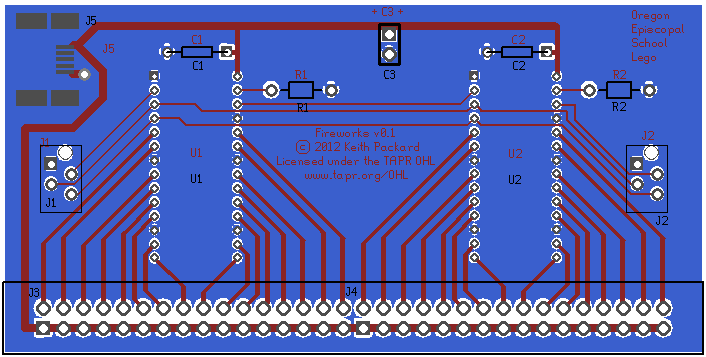
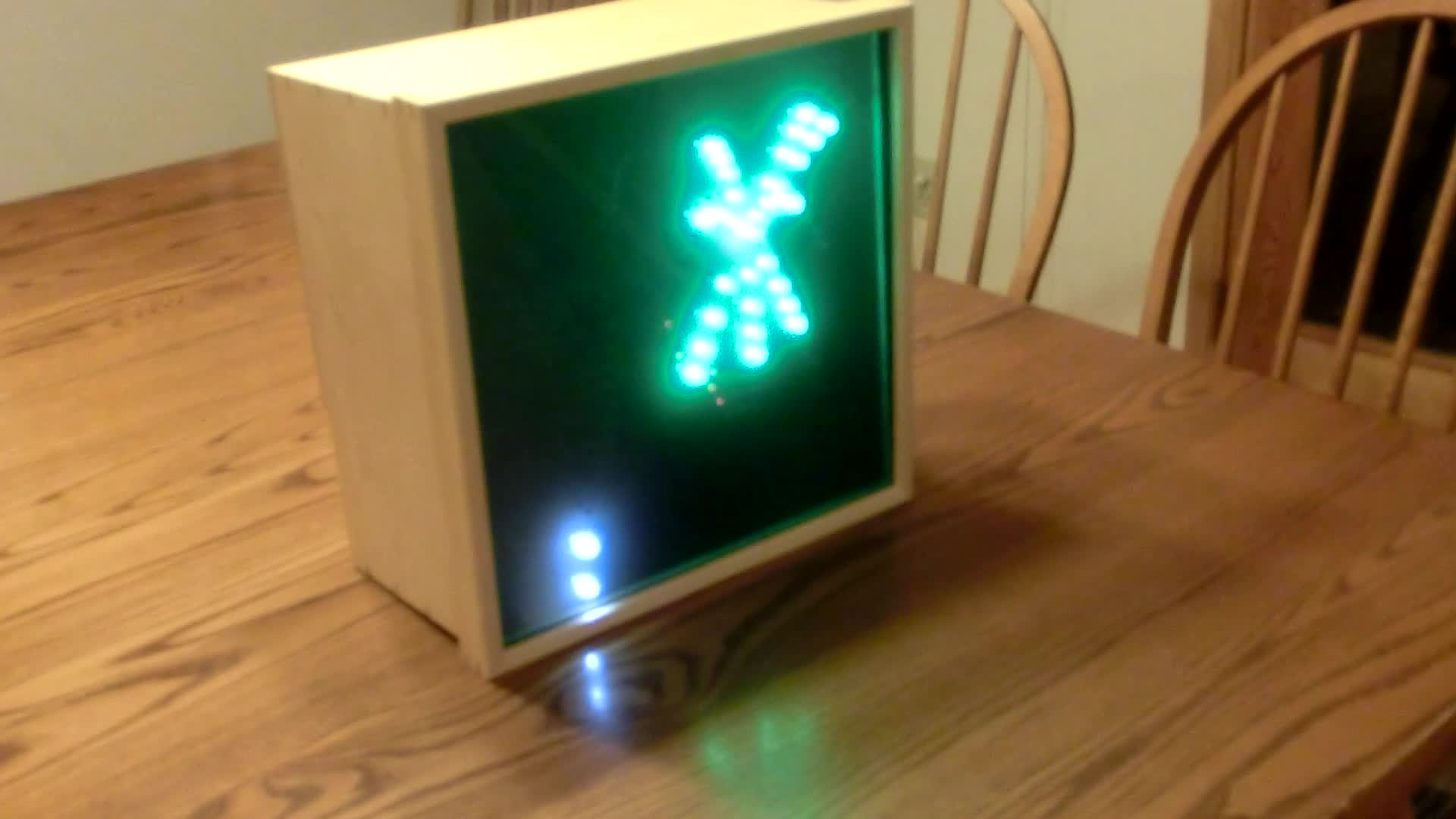
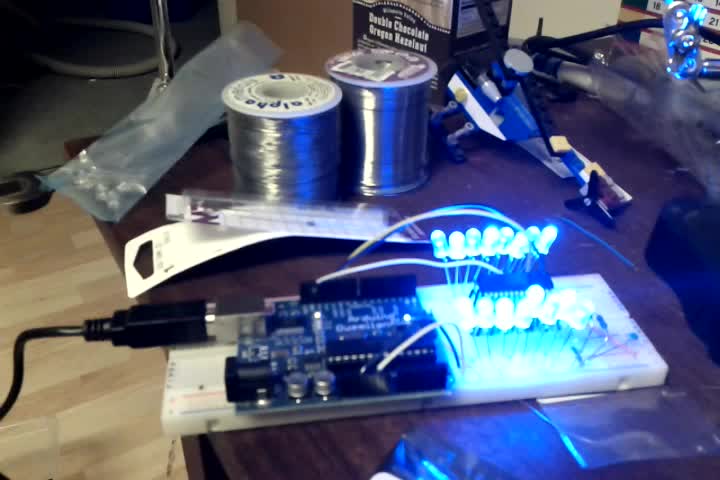
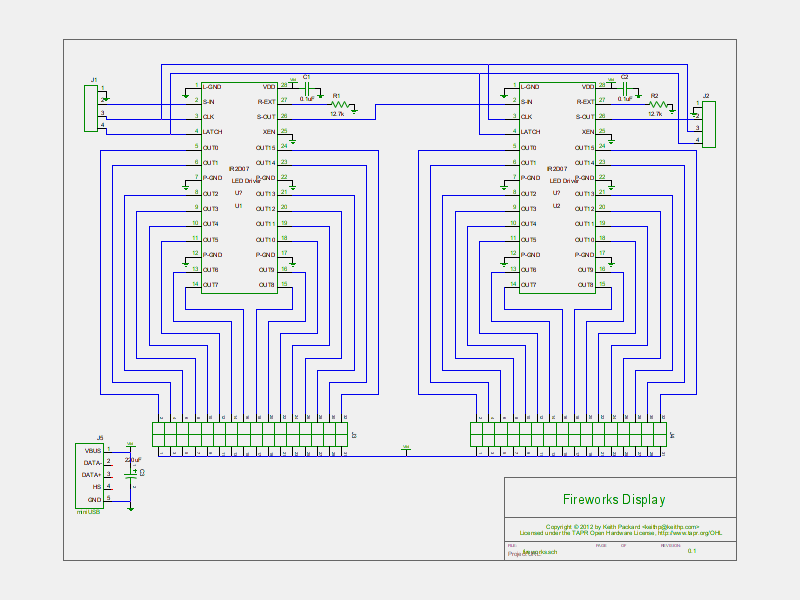
LED Fireworks. Or, parent helpers go overboard My friend, Mike Ward, and I help out at our kids school by teaching 5th and 6th graders programming in conjunction with a Lego class. For several years, I was teaching Logo on ancient Apple II machines. The teacher had a great curriculum and the kids learned a lot, but this year we decided to switch things around and try them out on Arduinos. This spring, the kids are building a Lego display centered around a birthday party theme for the star elephant at the Oregon Zoo (Packy), who turned 50 last weekend. In a moment of fun, I suggested that perhaps we should have some fireworks, along with the presents and birthday cake. How hard could it be to wire up a couple of LEDs to an Arduino to make something that looked like fireworks? Selecting parts. Mike and I sat down to order some parts from Digikey. We found these nice, cheap, LED drivers from Sharp. Then we found a selection of LEDs from Cree along with current-programming resistors (12.7k ) to drive the LEDs at 20mA, and some bypass caps (0.1 F) to keep the parts happy. The LED drivers are simple shift registers, with separate clock and data. They have both input and output pins, so you can daisy chain them and drive as many as you like from a single pair of CPU pins. We figured 160 LEDs would be plenty, so we ordered 10 chips. The LED drivers came in a through-hole, DIP package; it seemed like we d be able to just stuff them into a breadboard and quickly wire things up. Prototyping the design The LED driver chips turn out to use a much finer pitch package than the usual 0.1 spacing. There s no way we could stuff them into a breadboard and quickly wire things up. Obviously, a bit more care while ordering would have uncovered this, but my experience with through-hole parts is limited to parts from the mid 1970s I soldered extension wires onto one chip to test the circuit, and managed to get one chip talking to an Arduino. Here s a short movie of that in action: You can see the LED driver chip sitting on a set of extension leads plugged into the breadboard. It s hooked to the SPI port on the Arduino board, with the clock set as fast as it will go. If you watch the video, you can see that the LEDs actually vary in brightness. They re actually being pulse-width modulated. Clocked at 2MHz, there s enough bandwidth in the SPI bus to drive 160 LEDs with 127 discrete pulse widths at nearly 100Hz (100 * 127 * 160 = 2032000). Is bread boarding practical? With the chip propped up on its extension wires, and the LEDs plugged in, the whole setup was not surprisingly fragile. Getting five of these chips wired up and running for the length of the Lego show (one day at school and two days at the zoo) seemed unlikely. So, we decided to build some custom circuit boards. Using the GEDA tools to make circuit boards My business partner, Bdale Garbee, and I build rocketry electronics through Altus Metrum. He s the hardware guy and I spend my weekends writing firmware for various micro-controllers. Of course, I use free software tools for the firmware, and Bdale uses the free gEDA tools for the hardware. I ve gotten vaguely familiar with those by helping Bdale review circuit diagrams and PC board layout over the years. So I figured I d be able to learn a bit more about them and come up with some designs. I decided to stick two LED drivers on each board. As the chips can drive each LED with up to 50mA of current, each board could potentially consume 1.6A at 5V. Sticking a linear regulator on each board capable of supplying that much current would have required a hefty heat sink. Instead, I decided to stick a mini USB connector on the board and use some cheap USB power supplies. Of course, there wasn t a pre-packaged schematic symbol or footprint for the LED driver, so I first had to construct those. But, with symbols for all of the parts I used available, I drew this circuit: Wiring up 32 LEDs It s really easy to draw wires showing 32 LEDs hooked up to each board. Actually selecting connectors that can be easily hooked up took a bit more time. The idea of crimping individual two-pin connectors for 160 LEDs didn t seem like fun, plus individual connectors were going to cost a small fortune (the best option I found would have cost about $0.40 per LED). Bdale suggested using ribbon cable with a crimp-on connector crimp a connector across the whole cable and then split out two-wire sets for each LED. I d still have to individually solder each LED to the wire, but on the board end, all I d have to do is crimp the connector on to the cable. Designing the circuit boards The gEDA tools separate schematic design and PCB layout into two separate tools; the schematic program, gschem, exports a netlist and set of components which the schematic program, PCB, can import. This sounded a bit clunky to me, as you have to re-export and re-import the schematic data into the PCB each time you make changes, but it seems to work reasonably well in practice. The first time the schematic data is imported to the PCB tool, all of the component footprints are simply stacked on top of one another. With those moved to sensible locations, the tool will show rats for each netlist. Having drawn the schematic with symbols that strongly resembled the actual components, it was pretty easy to work through the rats one at a time by painting copper on the board. I d noticed that all of the signals could easily be routed on one side of the board, so I flooded the back side with a ground plane to keep things quiet. The final circuit board design looks like this: Circuit boards. All Altus Metrum products are manufactured by Advanced Circuits, and we ve been quite happy with them. They offer a cheap and fast prototyping service through their barebonespcb.com site. These boards are two layers with no silk screen or solder mask. I uploaded my design and in a couple of days I got back some shiny circuit boards: The footprint I designed for the LED drivers turned out to have a very small gap between the pads for each pin and the ground plane. This lead to a couple of shorted pins in the five boards, which were pretty easy to diagnose as the LED driven by that pin would be stuck on. Here s another picture with the ribbon cable connected and an LED lit up: Mounting the LEDs I started by writing a small nickle program to simulate the trajectory of a ballistic fireworks shell followed by an explosion at apogee and subsequent ballistic tracks for the resulting pieces. I made the initial conditions of the launch somewhat random, and Mike and I sat and watched that draw things until we saw a couple that looked good . The output from that was a series of X/Y locations spaced uniformly in time. Mike used those to drill holes in a piece of acrylic from TAP plastics. He glued the LEDs into that with some white glue (so that we have a chance of getting them back out): A custom maple box? I spent last weekend visiting my father for his birthday. Meanwhile, Mike was busy back home building a case for the project. I got home and found that he had fabricated a solid maple case. It s beautiful, and holds all of the LEDs, boards, wires and a couple of 4-outlet USB power supplies. Here s a picture of the joint he made in the box corners: The finished product Here s the inside of the box: And here s a movie of the whole thing in action. It s missing 8 white LEDs; I hadn t ordered enough from Digikey. Downloading schematics and PCB artwork The hardware design is licensed under the TAPR Open Hardware License. It s all stored in git (of course):
git://keithp.com/git/hw/fireworks
All of the symbols I created are also available through git:
git://keithp.com/git/hw/keithp
Things I d do differently One of the frustrating things about moving atoms around instead of just bits is that once you ve got a physical artifact, it s really expensive to change it. There are a couple of minor things I would change if I were going to build more of these: Things that worked well There were a couple of things that went better than I had expected:

19 April 2012

Raphaël Hertzog: People behind Debian: Samuel Thibault, working on accessibility and the Hurd

Samuel Thibault is a French guy like me, but it took years until we met. He tends to keep a low profile, even though he s doing lots of good work that deserves to be mentioned. He focuses on improving Debian s accessibility and contributes to the Hurd. Who said he s a dreamer? :-) Checkout his interview to have some news of Wheezy s status on those topics. Raphael: Who are you? Samuel: I am 30 years old, and live in Bordeaux, France. During the workday, I teach Computer Science (Architecture, Networking, Operating Systems, and Parallel Programming, roughly) at the University of Bordeaux, and conduct researches in heterogeneous parallel computing. During the evening, I play the drums and the trombone in various orchestra (harmonic/symphonic/banda/brass). During the night, I hack on whatever fun things I can find, mainly accessibility and the Hurd at the moment, but also miscellaneous bits such as the Linux console support. I am also involved in the development of Aquilenet, an associative ISP around Bordeaux, and getting involved in the development of the network infrastructure in Bordeaux. I am not practicing Judo any more, but I roller-skate to work, and I like hiking in the mountains. I also read quite a few mangas. Saturday mornings do not exist in my schedule (Sunday mornings do, it s Brass Band rehearsal :) ). Raphael: How did you start contributing to Debian? Samuel: Bit by bit. I have been hacking around GNU/Linux since around 1998. I installed my first Debian system around 2000, as a replacement for my old Mandrake installation (which after all my tinkering was actually no longer looking like a Mandrake system any more!). That was Potato at the time, which somebody offered me through a set of CDs (downloading packages over the Internet was unthinkable at the time with the old modems). I have been happily reading and hacking around documentation, source code, etc. provided on them. Contribution things really started to take off when I went to the ENS Lyon high school in 2001: broadband Internet access in one s own student room! Since sending a mail was then really free, I started submitting bugs against various packages I was using. Right after that I started submitting patches along them, and then patches to other bugs. I did that for a long time actually. I had very little knowledge of all packaging details at the time, I was just a happy hacker submitting reports and patches against the upstream source code. At ENS Lyon, I met a blind colleague with very similar hacking tastes (of course we got friends) and he proposed me, for our student project, to work on a brlnet project (now called brlapi), a client/server protocol that lets applications render text on braille devices themselves. Along the way, I got to learn in details how a blind person can use a Unix system and the principles that should be followed when developing Accessibility. That is how I got involved in it. We presented our project at JDLL, and the Hurd booth happened to be next to our table, so I discussed with the Hurd people there about how the Hurd console could be used through braille. That is how I got into the Hurd too. From then on, I progressively contributed more and more to the upstream parts of both accessibility software and the Hurd. And then to the packaging part of them. Through patches in bug reports first, as usual, as well as through discussions on the mailing lists. But quickly enough people gave me commit access so I could just throw the code in. I was also given control over the Hurd buildds to keep them running. It was all good at that stage: I could contribute in all the parts I was caring about. People however started telling me that I should just apply for being a Debian Developer; both from accessibility and Hurd sides. I had also seen a bunch of my friends going through the process. I was however a bit scared (or probably it was just an excuse) by having to manage a gpg key, it seemed like a quite dangerous tool to me (even if I already had commit access to glibc at the time anyway ). I eventually applied for DM in 2008 so as to at least be able to upload some packages to help the little manpower of the Accessibility and Hurd teams. Henceforth I had already a gpg key, thus no excuse any more. And having it in the DM keyring was not enough for e.g. signing the hurd-i386 buildd packages. So I ended up going through NM in 2009, which went very fast, since I had already been contributing to Debian and learning all the needed stuff for almost 10 years! I now have around 50 packages in my QA page, and being a DD is actually useful for my work, to easily push our software to the masses :) So to sum it up, the Debian project is very easy to contribute to and open to new people. It was used during discussions at the GNU Hackers Meeting 2011 as an example of a very open community with public mailing lists and discussions. The mere fact that anybody can take the initiative of manipulating the BTS (if not scared by the commands) without having to ask anybody is an excellent thing to welcome contributions; it is notable tha the GNU project migrated to the Debbugs BTS. More generally, I don t really see the DD status as a must, especially now that we have the DM status (which is still a very good way to drag people into becoming DDs). For instance, I gave a talk at FOSDEM 2008 about the state of accessibility in Debian. People did not care whom I was, they cared that there was important stuff going on and somebody talking about it. More generally, decisions that are made through a vote are actually very rare. Most of the time, things just happen on the mailing lists or IRC channels where anybody can join the discussion. So I would recommend beginners to first use the software, then start reporting bugs, then start digging in the software to try fix the bugs by oneself, eventually propose patches, get them reviewed. At some point the submitted patches will be correct already most of the time. That s when the maintainers will start getting bored of just applying the patches, and simply provide with commit access, and voil , one has become a main contributor. Raphael: You re one of the main contributors to the Debian GNU/Hurd port. What motivates you in this project? Samuel: As I mentioned above, I first got real contact with the Hurd from the accessibility point of view. That initially brought me into the Hurd console, which uses a flexible design and nice interfaces to interact with it. The Hurd driver for console accessibility is actually very straightforward, way simpler than the Windows or Linux drivers. That is what caught me initially. I have continued working on it for several reasons. First, the design is really interesting for users. There are many things that are natural in the Hurd while Linux is still struggling to achieve them, such as UID isolation, recently mentioned in LWN. What I really like in the Hurd is that it excels at providing users with the same features as the administrator s. For instance, I find it annoying that I still can not mount an ISO image that I build on e.g. ries.debian.org. Linux now has FUSE which is supposed to permit that, but I have never seen it enabled on an ssh-accessible machine, only on desktop machines, and usually just because the administrator happens to be the user of the machine (who could as well just have used sudo ) For me, it is actually Freedom #0 of Free Software: let the user run programs for any purpose, that is, combining things together all the possible ways, and not being prevented from doing some things just because the design does not permit to achieve them securely. I had the chance to give a Hurd talk to explain that at GHM 2011, whose main topic was extensibility , I called it GNU/Hurd AKA Extensibility from the Ground, because the design of the Hurd is basically meant for extensibility, and does not care whether it is done by root or a mere user. All the tools that root uses to build a GNU/Hurd system can be used by the user to build its own GNU/Hurd environment. That is guaranteed by the design itself: the libc asks for things not to the kernel, but to servers (called translators), which can be provided by root, or by the user. It is interesting to see that it is actually also tried with varying success in GNU/Linux, through gvfs or Plash. An example of things I love being able to do is: $ zgrep foo ~/ftp://cdn.debian.net/debian/dists/sid/main/Contents-*.gz On my Hurd box, the ~/ftp: directory is indeed actually served by an ftpfs translator, run under my user uid, which is thus completely harmless to the system. Secondly and not the least, the Hurd provides me with interesting yet not too hard challenges. LWN confirmed several times that the Linux kernel has become very difficult to significantly contribute to, so it is no real hacking fun any more. I have notably implemented TLS support in the Hurd and the Xen and 64bit support in the GNU Mach kernel used by the Hurd. All three were very interesting to do, but were already done for Linux (at least for all the architectures which I actually know a bit and own). It happens that both TLS and Xen hacking experience became actually useful later on: I implemented TLS in the threading library of our research team, and the Xen port was a quite interesting line on my CV for getting a postdoc position at XenSource :) Lastly, I would say that I am used to lost causes :) My work on accessibility is sometimes a real struggle, so the Hurd is almost a kind of relief. It is famous for his vapourware reputation anyway, and so it is fun to just try to contribute to it nevertheless. An interesting thing is that the opinion of people on the Hurd is often quite extreme, and only rarely neutral. Some will say it is pure vapourware, while others will say that it is the hope of humanity (yes we do see those coming to #hurd, and they are not always just trolls!). When I published a 0.401 version on 2011 April 1st, the comments of people were very diverse, and some even went as far as saying that it was horrible of us to make a joke about the promised software :) Raphael: The FTPmasters want to demote the Hurd port to the debian-ports.org archive if it doesn t manage a stable release with wheezy. We re now at 2 months of the freeze. How far are you from being releasable ? Samuel: Of course, I can not speak for the Debian Release team. The current progress is however encouraging. During Debconf11, Michael Banck and I discussed with a few Debian Release team members about the kind of goals that should be achieved, and we are near completion of that part. The Debian GNU/Hurd port can almost completely be installed from the official mirrors, using the standard Debian Installer. Some patches need some polishing, but others are just waiting for being uploaded Debian GNU/Hurd can start a graphical desktop and run office tools such as gnumeric, as well as the iceweasel graphical web browser, KDE applications thanks to Pino Toscano s care, and GNOME application thanks to Emilio Pozuelo Monfort s care. Of course, general textmode hacking with gcc/make/gdb/etc. just works smoothly. Thanks to recent work on ghc and ada by Svante Signell, the archive coverage has passed 76%. There was a concern about network board driver support: until recently, the GNU Mach kernel was indeed still using a glue layer to embed the Linux 2.2 or even 2.0 drivers (!). Finding a network board supported by such drivers had of course become a real challenge. Thanks to the GSoC work of Zheng Da, the DDE layer can now be used to embed Linux 2.6.32 drivers in userland translators, which was recently ACCEPTed into the archive, and thus brings way larger support for network boards. It also pushes yet more toward the Hurd design: network drivers as userland process rather than kernel modules. That said, the freeze itself is not the final deadline. Actually, freeze periods are rests for porters, because maintainers stop bringing newer upstream versions which of course break on peculiar architectures. That will probably be helpful to continue improving the archive coverage. Raphael: The kfreebsd port brought into light all the packages which were not portable between different kernels. Did that help the Hurd port or are the problems too different to expect any mutual benefit? Samuel: The two ports have clearly helped each other in many aspects. The hurd-i386 port is the only non-Linux one that has been kept working (at least basically) for the past decade. That helped to make sure that all tools (dpkg, apt, toolchain, etc.) were able to cope with non-Linux ports, and keep that odd-but-why-not goal around, and evidently-enough achievable. In return, the kFreeBSD port managed to show that it was actually releasable, at least as a technological preview, thus making an example. In the daily work, we have sometimes worked hand in hand. The recent porting efforts of the Debian Installer happened roughly at the same time. When fixing some piece of code for one, the switch-case would be left for the other. When some code could be reused by the other, a mail would be sent to advise doing so, etc. In the packaging effort, it also made a lot of difference that a non-Linux port is exposed as released architecture: people attempted by themselves to fix code that is Linuxish for no real reason. The presence of the kFreeBSD is however also sometimes a difficulty for the Hurd: in the discussions, it sometimes tends to become a target to be reached, even if the systems are not really comparable. I do not need to detail the long history of the FreeBSD kernel and the amount of people hacking on it, some of them full-time, while the Hurd has only a small handful of free-time hackers. The FreeBSD kernel stability has already seen long-term polishing, and a fair amount of the Debian software was actually already ported to the FreeBSD kernel, thanks to the big existing pure-FreeBSD hackerbase. These do not hold for the GNU/Hurd port, so the expectations should go along. Raphael: You re also very much involved in the Debian Accessibility team. What are the responsibilities of this team and what are you doing there? Samuel: As you would expect it, the Debian Accessibility team works on packaging accessibility-related packages, and helping users with them; I thus do both. But the goal is way beyond just that. Actual accessibility requires integration. Ideally enough, a blind user should be able to just come to a Debian desktop system, plug his braille device, or press a shortcut to enable speech synthesis, and just use the damn computer, without having to ask the administrator to install some oddly-named package and whatnot. Just like any sighted user would do. He should be able to diagnose why his system does not boot, and at worse be able to reinstall his computer all by himself (typically at 2am ). And that is hard to achieve, because it means discussing about integration by default of accessibility features. For instance, the Debian CD images now beep during at the boot menu. That is a precious feature that has been discussed between debian-boot and debian-accessibility for a few weeks before agreeing on how to do it without too much disturbance. Similarly, my proposition of installing the desktop accessibility engines has been discussed for some time before being commited. What was however surprisingly great is that when somebody brought the topic back for discussion, non-debian-accessibility people answered themselves. This is reassuring, because it means things can be done durably in Debian. On the installation side, our current status is that the stable Debian installer has a high contrast color theme, and several years ago, I have pushed toward making standard CD images automatically detect braille devices, which permits standalone installation. I have added to the Wheezy installer some software speech synthesis (which again brought discussion about size increase vs versatility etc.) for blind people who do not have a braille device. I find it interesting to work on such topic in Debian rather than another distribution, because Debian is an upstream for a lot of distributions. Hopefully they just inherit our accessibility work. It at least worked for the text installer of Ubuntu. Of course, the Accessibility team is looking for help, to maintain our current packages, but also introduce new packages from the TODO list or create some backports. One does not need to be an expert in accessibility: tools can usually be tested, at least basically, by anybody, without particular hardware (I do not own any, I contributed virtual ones to qemu). For new developments and ideas, it is strongly recommended to come and discuss on debian-accessibility, because it is easy to get on a wrong track that does not bring actual accessibility. We still have several goals to achieve: the closest one is to just fix the transition to gnome3, which has been quite bad for accessibility so far :/ On the longer run, we should ideally reach the scenario I have detailed above: desktop accessibility available and ready to be enabled easily by default. Raphael: What s the biggest problem of Debian? Samuel: Debian is famous for its heated debian-devel discussions. And some people eventually say this no fun any more . That is exemplified in a less extreme way in the debian-boot/accessibility discussions that I have mentioned above. Sometimes, one needs to have a real stubborn thick head to continue the discussion until finding a compromise that will be accepted for commit. That is a problem because people do not necessarily have so much patience, and will thus prefer to contribute to a project with easier acceptance. But it is also a quality: as I explained above, once it is there, it is apparently for good. The Ubuntu support of accessibility in its installer has been very diverse, in part due to quite changing codebase. The Debian Installer codebase is more in a convergence process. Its base will have almost not changed between squeeze and wheezy. That allowed the Debian Accessibility team to continue improving its accessibility support, and not have to re-do it. A wiki page explains how to test its accessibility features, and some non-debian-accessibility people do go through it. A problem I am much more frightened by is the manpower in some core teams. The Debian Installer, grub, glibc, Xorg, gcc, mozilla derivatives, When reading the changelogs of these, we essentially keep seeing the same very few names over and over. And when one core developer leaves, it is very often still the same names which appear again to do the work. It is hard to believe that there are a thousand DDs working on Debian. I fear that Debian does not manage to get people to work on core things. I often hear people saying that they do not even dare thinking about putting their hands inside Xorg, for instance. Xorg is complex, but it seems to me that it tends to be overrated, and a lot of people could actually help there, as well as all the teams mentioned above. And if nobody does it, who will? Raphael: Do you have wishes for Debian Wheezy? Samuel: That is an easy one :) Of course I wish that we manage to release the hurd-i386 port. I also wish that accessibility of gnome3 gets fixed enough to become usable again. The current state is worrying: so much has changed that the transition will be difficult for users already, the current bugs will clearly not help. I also hope to find the time to fix the qt-at-spi bridge, which should (at last!) bring complete KDE accessibility. Raphael: Is there someone in Debian that you admire for their contributions? Samuel: Given the concerns I expressed above, I admire all the people who do spend time on core packages, even when that is really not fun everyday. Just to alphabetically name a few people I have seen so often here and there in the areas I have touched in the last few years: Aur lien Jarno, Bastian Blank, Christian Perrier, Colin Watson, Cyril Brulebois, Frans Pop, J rg Jaspert, Joey Hess, Josselin Mouette, Julien Cristau, Matthias Klose, Mike Hommey, Otavio Salvador, Petr Salinger, Robert Millan, Steve Langasek. Man, so many things that each of them works on! Of course this list is biased towards the parts that I touched, but people working in others core areas also deserve the same admiration.
Thank you to Samuel for the time spent answering my questions. I hope you enjoyed reading his answers as I did. Note that older interviews are indexed on wiki.debian.org/PeopleBehindDebian.

Subscribe to my newsletter to get my monthly summary of the Debian/Ubuntu news and to not miss further interviews. You can also follow along on Identi.ca, Google+, Twitter and Facebook.

3 comments Liked this article? Click here. My blog is Flattr-enabled.

18 April 2012

Wouter Verhelst: Screen scraping sucks

At a customer, I've migrated a number of manually-maintained servers to having them be maintained through puppet not so long ago. Since then, some more machines have been added, and getting them up and running properly was a breeze: do a base install, install puppet, sign the certificate, restart puppet, and then wait and twiddle thumbs while puppet did its magic. Easy as pie. Now, a few months later, we needed to install a number of windows machines for a lab (not my choice), and the person involved asked me to figure out some diskspace so we could start creating images for those. Not a chance. Instead, I suggested looking for a configuration management system, similar to puppet. Since we're using Samba 3 to run the Windows network here, dropping everything in Active Directory was not an option. But a short while later, he came back with the note that puppet, in its 2.7 version, actually does support Windows as a platform for the managed machines. Interesting. The unfortunate bit was that puppet supports creating files and installing software when it is distributed as an MSI file, but not when it's distributed as a .exe file. This is not unexpected; MSI files can be installed noninteractively; but when something is distributed as a .exe file, it means it needs to be installed interactively; and puppet does not have the ability to interact with GUI software. The workaround: use something that does have that ability (in my case, autoit), and use an exec block in puppet to make it call those scripts. In effect, that's a bit like screenscraping. Add a creates stanza to the block, so that the installer isn't started again if the software at hand has already been installed. This 'autoit' thing also comes with a recording utility, allowing one to create an initial script by just doing the installation, and having the tool just record stuff. With that, the machines are installed 99% automated. I say 99%, because there are still some issues: I'll have to think about this some more, I guess. First, it's clear that while puppet does have some Windows functionality, it's not entirely ready yet. And somehow, using autoit to add to Puppet functionality feels like an ugly hack. We'll see what the future brings.

17 April 2012

Russell Coker: The Most Important things for running a Reliable Internet Service

One of my clients is currently investigating new hosting arrangements. It s a bit of a complex process because there are lots of architectural issues relating to things such as the storage and backup of some terabytes of data and some serious computation on the data. Among other options we are considering cheap servers in the EX range from Hetzner [1] which provide 3TB of RAID-1 storage per server along with reasonable CPU power and RAM and Amazon EC2 [2]. Hetzner and Amazon aren t the only companies providing services that can be used to solve my client s problems, but they both provide good value for what they provide and we have prior experience with them. To add an extra complication my client did some web research on hosting companies and found that Hetzner wasn t even in the list of reliable hosting companies (whichever list that was). This is in some ways not particularly surprising, Hetzner offers servers without a full management interface (you can t see a serial console or a KVM, you merely get access to reset it) and the best value servers (the only servers to consider for many terabytes of data) have SATA disks which presumably have a lower MTBF than SAS disks. But I don t think that this is a real problem. Even when hardware that s designed for the desktop is run in a server room the reliability tends to be reasonable. My experience is that a desktop PC with two hard drives in a RAID-1 array will give a level of reliability in practice that compares very well to an expensive server with ECC RAM, redundant fans, redundant PSUs, etc. My experience is that the most critical factor for server reliability is management. A server that is designed to be reliable can give very poor uptime if poorly maintained or if there is no rapid way of discovering and fixing problems. But a system that is designed to be cheap can give quite good uptime if well maintained, if problems can be repidly discovered and fixed. A Brief Overview of Managing Servers There are text books about how to manage servers, so obviously I can t cover the topic in detail in a blog post. But here are some quick points. Note that I m not claiming that this list includes everything, please add comments about anything particularly noteworthy that you think I ve missed.
  1. For a server to be well managed it needs to be kept up to date. It s probably a good idea for management to have this on the list of things to do. A plan to check for necessary updates and apply them at fixed times (at least once a week) would be a good thing. My experience is that usually managers don t have anything to do with this and sysadmins either apply patches or not at their own whim.
  2. It is really ideal for people to know how all the software works. For every piece of software that s running it should either have come from a source that provides some degree of support (EG a Linux distribution) or be maintained by someone who knows it well. When you install custom software from people who become unavailable then it puts the reliability of the entire system at risk if anything breaks then you won t be able to get it fixed quickly.
  3. It should be possible to rapidly discover problems, having a client phone you to tell you that your web site is offline is a bad thing. Ideally you will have software like Nagios monitoring the network and reporting problems via a SMS gateway service such as ClickaTell.com. I am not sure that Nagios is the best network monitoring system or that ClickaTell is the best SMS gateway, but they have both worked well in my experience. If you think that there are better options for either of those then please write a comment.
  4. It should be possible to rapidly fix problems. That means that a sysadmin must be available 24*7 to respond to SMS and you must have a backup sysadmin for when the main person takes a holiday, or ideally two backup sysadmins so that if one is on holiday and another has an emergency then problems can still be fixed. Another thing to consider is that an increasing number of hotels, resorts, and cruise ships are providing net access. So you could decrease your need for backup sysadmins if you give a holiday bonus to a sysadmin who uses a hotel, resort, or cruise ship that has good net access. ;)
  5. If it seems likely that there may be some staff changes then it s a really good idea to hire a potential replacement on a casual basis so that they can learn how things work. There have been a few occasions when I started a sysadmin contract after the old sysadmin ceased being on speaking terms with the company owner. This made it difficult for me to learn what s going on.
  6. If your network is in any way complex (IE it s something that needs some skill to manage) then it will probably be impossible to hire someone who has experience in all the areas of technology at a salary you are prepared to pay. So you should assume that whoever you hire will do some learning on the job. This isn t necessarily a problem but is something that needs to be considered. If you use some unusual hardware or software and want it to run reliably then you should have a spare system for testing so that the types of mistake which are typically made in the learning process are not made on your production network.
Conclusion If you have a business which depends on running servers on the Internet and you don t do all the things in the above list then the reliability of a service like Hetzner probably isn t going to be an issue at all. Related posts:
  1. Servers vs Phones Hetzner have recently updated their offerings to include servers with...
  2. Why Internet Access in Australia Sucks In a comment on my post about (relatively) Cheap Net...
  3. The National Cost of Slow Internet Access Australia has slow Internet access when compared to other first-world...

Debian Med: New Debian Med metapackages uploaded (Posted by Andreas Tille)

I just uploaded new metapackages featuring dependencies of several new packages prepared thanks to the great work of the Debian Med team. Here are the newcomers (and packages we lost):

med-bio:
+ ballview
+ bowtie2
+ cd-hit
+ clustalo
+ ffindex
+ gassst
+ grinder
+ hhsuite
+ profphd-utils
+ proftmb
+ profphd
+ profphd-utils
+ pynast
+ qiime
+ r-bioc-cummerbund
+ reprof
- seq-gen (turned out to be non-free)

med-bio-dev:
+ libchado-perl
+ libffindex0-dev
+ libtfbs-perl
+ libpal-java
+ librg-reprof-bundle-perl
+ librostlab-blast0-dev
+ librostlab-blast-doc
+ librostlab3-dev
+ librostlab-doc
+ libzerg0-dev
+ libzerg-perl

med-data:
- freediams (restructuring upstream, will be back with next release hopefully)

med-imaging:
+ imagevis3d
+ itksnap
+ odin
+ volview

med-imaging-dev:
+ python-pyxnat

med-practice:
+ clinica
- freediams (restructuring upstream, will be back with next release hopefully)

Seems the regular sprints of the Debian Med team have enhanced the team (regarding the number of people and the effectivity of the cooperation). Thanks to all people who joined our effort to make Debian the best free operating system for medical care and biological research.

15 April 2012

Vasudev Kamath: Update: Falcon Debian package Status

Recently I wrote about packaging Falcon programming language for Debian. So here is the status of package. Package builds multiple binaries and we have successfully separated modules from core Falcon language component
  1. falconpl (Falcon language itself )
  2. falconpl-dbg (Debug symbols)
  3. libfalconpl-engine1 (Falcon engine library)
  4. libfalconpl-engine1-dbg (Debug symbols for Falcon enging)
Core modules like feathers and modules writtein Falcon itself are part of libfalconpl-engine1. Rest of modules are separated into following packages
  1. falconpl-mongodb: Mongodb connector module
  2. falconpl-dbi : Database Abstraction layer
  3. falconpl-dbi-sqlite3: SQLite3 connector based on DBI module
  4. falconpl-dbi-postgresql: PostgreSQL connector based on DBI module
  5. falconpl-dbi-mysql: MySQL connector based on DBI module
  6. falconpl-dbi-firebird: Firebird DB server connector
  7. falconpl-curl: Curl bindings for Falcon
  8. falconpl-dbus: DBus bindings for Falcon
  9. falconpl-dmtx: Data Matrix reader/writer for Falcon
  10. falconpl-hpdf: Haru based PDF module for Falcon
  11. falconpl-gd2: Graphic manipulation module for Falcon
There are 4 modules which I'm not sure how to build (dependency) or if at all possible to build for Linux they are dynlib, wopi, sdl, conio. I need to consult upstream on these modules status and ability to build. Modules not built We didn't build dbi-oracle and dbi-odbc modules as these are proprietary software dependant. Additionally in a conversation with upstream on IRC it was told dynlib module can't be built for 64bit and X86 version of Linux because lack of assembler, but I've not fully confirmed this. Legal Issues To enable the curl bindings I added curl dependency which in turn has dependency on libssl1.0 library which is part of openssl source package which is causing lintian thrown GPL violation error. Kartik will be looking into this. Patches submitted I've submitted total of 6 patches of which 5 patches are already applied to upstream git repo and 6th one is waiting to be applied. In other words upstream is really helpful to us. Well thats all for this week more updates next week (or may be even before that ;-) )

14 April 2012

Wouter Verhelst: LOAD: tutorial on Debian Packaging

Two weeks ago, I was at LOAD, where I did a tutorial on Debian Packaging. Unfortunately, I wasn't doing very well physically, and as a result my preparation wasn't what I had hoped for. It ended up being not so much a tutorial as a walking the audience through packaging a piece of software in casu NBD with debhelper in dh mode. Not very difficult, but since there's nothing for people to fall back on afterwards, it may help if they have a writedown of what I said during the session; and I promised to put it on my blog. So, here goes. However, note that the canonical written tutorial on Debian Packaging is here. With apologies to readers of Planet Debian, most of whom for which all this is probably old hat. Unlike RPM packaging, in Debian, the data that tells the debian packaging system how to package a piece of software is functionally split among a number of files. All these files go in a toplevel directory in the source package, (unsurprisingly) called 'debian'. There are four files that are required for every Debian package: the control, changelog, copyright, and rules files. Without these files, dpkg-dev will fail to produce a package any package. The first, the control file, contains metadata on packages: the name of the package, its description, the dependencies, etc. Basically, almost all the information you see when you run 'apt-cache show <package>' (with one exception) is in the control file. If you have a source package that builds multiple binary packages, then you should have multiple 'Package' stanzas in the control file. In my opinion, creating a control file is easiest done by copying a control file from another (similar?) package, and modifying it to suit the software you're dealing with. The one exception, the one bit of metadata that is not found in the control file is the version number: this data is contained in the changelog file. This file looks like a free-form file for the most part, but it really is a machine-parsable format; as such, it's best to edit it with specialized tools, such as the debian-changelog-mode in the emacs editor, or the debchange script, also available as dch, from the devscripts package. In the changelog, you should document any changes you make to the package, making sure the version number (top line), distribution (unstable, experimental, stable, ...; top line), urgency (top line; used mainly when testing needs to be updated urgently for things like security updates), author (bottom line) and date and time (also bottom line) are correct. The copyright file, unsurprisingly, should contain the copyrights statements of the original software, and the license (or a reference to a copy of the same license text under /usr/share/common-licenses). This file is still free-format in most packages today, although a machine-readable format for this file has recently been defined. Of the four required files, this is probably the most boring one, but hey, we can't like everything we do. The last file, the rules file, is where all the action happens. This file is defined as a Makefile, of which the targets are called for various parts of the build system. The rules file has a number of required targets (such as build, clean, and others), but if you're using debhelper in dh mode, you don't need to worry about those; instead, you can use the following simple rules file:
#!/usr/bin/make -f
%:
	dh $@
With the first line, the shebang, we make clear that this is a makefile, and that it should be called by make. The next is a generic target (the % is a wildcard for make), with just one command: 'call dh with the name of the target being called'. Since dh implements all required rules targets, that immediately gets you a working package. Go ahead, try! Run 'dpkg-buildpackage -rfakeroot', and see what happens. Did that work? Maybe, maybe not. First, you'll have seen loads of warnings about something involving a "compatibility level". This is from debhelper; this compatibility level, or 'API level' if you wish, allows debhelper to move forward and make incompatible changes without breaking all the existing packages out there; whenever the compat level is bumped, some new functionality will only be made available if you also raise the compat level in your source package (and then you'll know you may have some changes to do in your package). Since the original debhelper, over a decade ago, did not have a compat level, the absense of a compat level signals compat level 1, which is far outdated now, and about to be unsupported. Hence the warning. The fix is simple: create a file debian/compat containing a single number: the compatibility level you're working with. It's best to use the most recent level which debhelper supports when you create your package, which as of this writing is level 9. Ignoring the compatibility level, if you're building a software package which uses a well-established build system, and you only build one binary package out of that, chances are pretty high that everything worked as expected. If not, you'll have more work. Building multiple packages requires that you tell debhelper somehow which file goes in which package. You can do this with a file debian/package.install, where package is the name of the binary package you're building. The install file is read by dh_install, one of many tools in the debhelper suite. You see, in the old days (before debhelper 7), debhelper was just a suite of tools, which required that you wrote a debian/rules file containing all the individual tools to be called in the correct order. This mode is still supported; in fact, even if you do use dh, you do, since all that tool really does is call the right tools in the right order; the real work is done by the invidual tools. They all have their own man page; to understand how dh_install chooses which file to put in which package, go read man dh_install. Go ahead, do it now; I'll wait. Back? Good. You've now learned that dh_install can install files either from the source directory (useful for packages containing only scripts or so), or from a directory debian/tmp. If you use an autotools-based software package, this is what dh will do for you. When you called dpkg-builpackage above, you may also have noticed that the output contained many lines starting with dh_, one of which said dh_install. As you may have guessed, dh echoes every debhelper command just before it will execute them. This allows you to look at the output, and see what's happening. For more detail, set the environment variable DH_VERBOSE to a non-zero value. I'm sure you'll have seen one or two debhelper tools that could make your package better. Go ahead, go and read their man pages to see what they do, and how they do it. Most of these will require you to create a file debian/package.toolname to specify details. In some cases, you may need to specify command-line arguments to the tool to get it to do what you want. In yet other cases, the tool won't support what you need it to do, and you'll have to do something manual. What to do now? The dh command line doesn't support adding extra commands easily. Does this mean you'd have to revert to old-style long, non-dh debian/rules files? Luckily, no. You can create an override target. If dh detects that you have such a target for a particular tool, it will call that target instead of the tool. This target's rules can then call the tool in question (or not), and add any command line arguments, or extra commands, as needed. An override target is a normal Makefile target with a name of the form override_dh_something, where dh_something is the name of the tool you wish to override. At this point, I'd reached almost the end of my two allotted hours, and a member of the audience asked how to make dpkg deal with configuration files. The answer is, you don't need to do anything! Not if you use debhelper, anyway; all you need to do is install the file in /etc. Since debian policy specifies that all files in /etc need to be configuration files and that no conffiles may be placed anywhere but in /etc, debhelper will automatically mark any file installed in /etc as a conffile, which will cause dpkg to ask the user what to do with changes to such files. Note that in Debian parlance, a conffile is not the same thing as a configuration file: a conffile is a configuration file that is part of the binary package (i.e., if you call 'dpkg --contents' on the .deb file, you'll see it in the output), whereas a configuration file is a file (any file, including files generated during or after installation of the .deb file on a system). Occasionally, this is also why some differences to configuration files are managed through debconf, while others aren't: the ones managed through debconf are non-conffile configuration files managed through ucf, whereas the others are conffiles. So in the simplest of cases, if you want to install a configuration file and you want to make sure it's protected against accidental overwrites by package upgrades, all you need to do is make sure it's installed to /etc; debhelper will do the rest. And that concludes this introduction. Please note it's only an introduction, not a full-blown tutorial; while this will allow you to get started, you may have to learn a bit more if you wish to eventually upload a package to Debian.

13 April 2012

Gregor Herrmann: cme fix dpkg-copyright

a short note to all fans of Copyright-Format 1.0: if you have debian/copyright files formatted according to one of the myriads of revisions of DEP5 & want to convert them to the released format, just run
cme fix dpkg-copyright
& be done with it.

cme is in the libconfig-model-perl package, & you should try to use the version from unstable, since Dominique constantly improves it (& he's also always open to proposals & nit-pickings from me merci beaucoup !).

More info about Config::Model on its homepage.

Lucas Nussbaum: Update of Debian Packaging Tutorial

I ve just updated the Debian Packaging Tutorial. This new version addresses a few comments and questions I received over the past months. Note that there are also french and spanish versions of the tutorial, and I m of course open to adding other translations. The tutorial can be found in the packaging-tutorial package (PDF files are in /usr/share/doc/packaging-tutorial/), or on www.debian.org (see links above).

12 April 2012

Tanguy Ortolo: Why www. ?

Three big  W s in shades of green Many websites have addresses that use a www.- prefix. Some people are encouraging this practice, other are advising against it. I, for one, think this prefix makes sense and is really useful, so here is an explanation of my opinion. In a nutshell: the Wold Wide Web is one Internet service among many other such as domain name, mail, mailboxes or instant messenging; using a dedicated prefix allows to distribute all these services to specific servers in a convenient way.On Internet, you can expose several services, the most common being domain names (DNS), websites (HTTP), incoming mail (SMTP), outgoing mail submission (submission), mailbox fetching (POP) or consultating (IMAP) and instant messenging (XMPP). Constraints Modern Internet services can have constraints such as load balancing, failover and most importantly the possibility to use specific servers for each service instead of having all of them on the same server. Dedicated records Some service were designed or revised to take these contraints into account; this include the domain name, incoming mail and instant messenging, by using dedicated DNS records:
example.com.                    NS              roquefort.example.com.
example.com.                    MX  10          morbier.example.com.
_xmpp-server._tcp.example.com.  SRV 10 100 5269 morbier.example.com.
In that example, the name service of example.com. is provided by the server Roquefort while the incoming mail and instant messenging service are provided by Morbier Dedicated prefixes On the contrary, some services were not designed to take these constraint into account, and may be too fossilized to be revised for that; this includes the Web and mailbox service. A convenient way to work around the antiquated design of these services is to use a well known prefix:
www.example.com.                CNAME           ossau-iraty.example.com.
smtp.example.com.               CNAME           morbier.example.com.
pop.example.com.                CNAME           morbier.example.com.
imap.example.com.               CNAME           morbier.example.com.
In that example, the Web service of example.com. is provided by the server Ossay-Iraty while the email submission and mailbox services are provided by Morbier. Readability and flexibility Using dedicated records and prefixes increases the consistency and readability of a DNS zone, since it allows to refer to the servers by their canonical host name, and to define their IP addresses once and for all:
; Services
example.com.                    NS              roquefort.example.com.
example.com.                    MX  10          morbier.example.com.
pop.example.com.                CNAME           morbier.example.com.
imap.example.com.               CNAME           morbier.example.com.
www.example.com.                CNAME           ossau-iraty.example.com.
; Hosts
roquefort.example.com.          A               192.2.0.12
                                AAAA            2001:db8::12
morbier.example.com             A               192.2.0.42
                                AAAA            2001:db8::42
ossau-iraty.example.com.        A               192.2.0.51
                                AAAA            2001:db8::51
You can think of that practice as connecting dots between services and hosts:
name service    Roquefort
incoming mail   Morbier
mailboxes         Ossau-Iraty
website        
With such a DNS zone, it is very easy to identify which server is hosting each service. Using host names rather than IP addresses multiple times reduces the information duplication, which in turn facilitates future chances and reduces the risk of error (it is easier to swith the website from Ossay-Iraty to Morbier than from 192.2.0.51/2001:db8::51 to 192.2.0.42/2001:db8::42).

11 April 2012

Tim Retout: Weekend of change

Agile processes harness change for the customer's competitive advantage. Principles behind the Agile Manifesto
After two and a half years at Smoothwall, I'm moving on - Friday is my last day. Since I joined the development team, we have adopted Agile development, set up a pretty nifty Gerrit/Jenkins code review + integration system, and introduced dpkg for package management. Along the way, I helped with a bunch of important features for the business, like a ground-up rewrite of the web filter, and time-based browsing usage quotas. I will be starting at CV-Library on Monday, for a whole new set of challenges. They're based in Fleet, so I'll have an hour-long commute each way on the train. I've been assured by an expert in these matters that facilitating wage slavery is a comparatively more ethical pursuit than facilitating internet censorship. :) To make the commute somewhat more bearable, I'm moving house on Saturday. So far, the packing's going quite well...

Erich Schubert: Are likes still worth anything?

When Facebook became "the next big thing", you had the "like" buttons pop up on various web sites. An of course "going viral" was the big thing everybody talked about, in particular SEO experts (or those that would like to be that).
But things have changed. In particular Facebook has. In the beginning, any "like" would be announced in the newsfeed to all your friends. This was what allowed likes to go viral, when your friends re-liked the link. This is what made it attractive to have like buttons on your web pages. (Note that I'm not referring to "likes" of a single Facebook post; they are something quite different!)
Once that everybody "knew" how important this was, everbody tried to make the most out of it. In particular scammers, viruses and SEO people. Every other day, some clickjacking application would flood Facebook with likes. Every backwater website was trying to get more audience by getting "liked". But at some point Facebook just stopped showing "likes". This is not bad. It is the obvious reaction when people get too annoyed by the constant "like spam". Facebook had to put an end to this.

But now that a "like" is pretty much worthless (in my opinion). Still, many people following "SEO Tutorials" are all crazy about likes. Instead, we should reconsider whether we really want to slow down our site loading by having like buttons on every page. A like button is not as lightweight as you might think it is. It's a complex JavaScript that tries to detect clickjacking attacks, and in fact invades your users' privacy, up to the point where for example in Germany it may even be illegal to use the Facebook like button on a web site.
In a few months, the SEO people will realize that the "like"s are a fad now, and will likely all try to jump the Google+ bandwagon. Google+ is probably not half as much a "dud" as many think it is (because their friends are still on Facebook and because you cannot scribble birthday wishes on a wall in Google+). The point is that Google can actually use the "+1" likes to improve everyday search results. Google for something a friend liked, and it will show up higher in the search results, and Google will show the friend who recommended it. Facebook cannot do this, because it is not a search engine (well, you can use it for searching people, although Ark probably is better at this, and one does nowhere search as many people as one does regular web searches). Unless they go into a strong partnership with Microsoft Bing or Yahoo, the "like"s can never be as important as Google "+1" likes. So don't underestimate the Google+ strategy on the long run.
There are more points where Facebook by now is much less useful as it used to be. For example event invitations. When Facebook was in full growth, you could essentially invite all your friends to your events. You could also use lists to organize your friends, and invite only the appropriate subset, if you cared enough. The problem again was: nobody cared enough. Everybody would just invite all their friends, and you would end up getting "invitation spam" several times a day. So again Facebook had to change and limit the invitation capabilities. You can no longer invite all, or even just all on one particular list. There are some tools and tricks that can work around this to some extend, but once everybody uses that, Facebook will just have to cut it down even further.
Similarly, you might remember "superpoke" and all the "gift" applications. Facebook (and the app makers) probably made a fortune on them with premium pokes and gifts. But then this too reached a level that started to annoy the users, so they had to cut down the ability of applications to post to walls. And boom, this segment essentially imploded. I havn't seen numbers on Facebook gaming, and I figure that by doing some special setup for the games Facebook managed to keep them somewhat happy. But many will remember the time when the newsfeed would be full of Farmville and Mafia Wars crap ... it just does no longer work this way.

So when working with Facebook and such, you really need to be on the move. Right now it seems that groups and applications are more useful to get that viral dream going. A couple of apps such as Yahoo currently require you to install their app (which then may post to your wall on your behalf and get your personal information!) to follow a link shared this way, and then can actively encourage you to reshare. And messages sent to a "Facebook group" are more likely to reach people that aren't direct friends of yours. When friends actually "join" an event, this is currently showing up in the news feed. But all of this can change with 0 days notice.
It will be interesting to see if Facebook can on the long run keep up with Googles ability to integrate the +1 likes into search results. It probably takes just a few success stories in the SEO community to become the "next big thing" in SEO to get +1 instead of Facebook likes. Then Google just has to wait for them to virally spread +1 adoption. Google can wait - its Google Plus growth rates aren't bad, and they have a working business model already that doesn't rely on the extra growth - they are big already and make good profits.
Facebook however is walking on a surprisingly thin line. They need a tight control on the amount of data shared (which is probably why they try to do this with "magic"). People don't want to have the impression that Facebook is hiding something from them (although it is in fact suppressing a huge part of your friends activity!), but they also don't want to get all this data spammed onto them. And in particular, it needs to give the web publishers and app developers the right amount of that extra access to the users, while in turn keeping the major spam away from the users.

Independent of the technology and actual products, it will be really interesting to see if we manage to find some way to keep the balance in "social" one-to-many communication right. It's not a fault of Facebook that many people "spam" all their friends with all their "data". Googles Circles probably isn't the final answer either. The reason why email still works rather well was probably because it makes one-to-one communication easier than one-to-many, because it isn't realtime, and because people expect you to put enough effort into composing your mails and choosing the right receipients for the message. Current "social" communication is pretty much posting everything to everyone you know adressed as "to whoever it may concern". Much of it is in fact pretty non-personal or even non-social. We have definitely reached the point where more data is shared than is being read. Twitter is probably the most extreme example of a "write-only" medium. The average number a tweet is read by a human except the original poster must be way below 1, and definitely much less than the average number of "followers".
So in the end, the answer may actually be a good automatic address book, with automatic groups and rich clients, to enable everybody to easily use email more efficiently. On the other hand, separting "serious" communication from "entertainment" communication may be well worth having a separate communications channel, and email definitely is dated and is having spam problems.

Next.

Previous.