Search Results: "ag"

25 July 2006

Davide Viti: FTFT

After rather unsuccessful messages on debian-boot and debian-i18n
there are still errors in level1 translations for d-i; since there's a
chance that new uploads can be made to fix those before Beta 3 is out,
I'm taking advance of this blog to ask people to spend a couple of
minutes to fix those.

so please... Fix The Fu***ng Translasions!

Joey Hess: moreutils musings

I have an important decision to make about moreutils, my collection of new unix tools. The question is whether to stand firm behind the idea of only adding tools to moreutils that are truely unique and not available in similar form in other packages, or whether to collect good tools to fill in missing gaps in the standard unix toolset, even if they are similar to already existing, but possibly hard to find tools. So far I've had an easy time deciding to reject some tools like add, todist and tostats, which are somewhat special purpose and which turn out to already be mostly implemented in the numutils package. And I'm also fairly comfortable with Lars's and my decision to not include mime, which is similar to File::MimeInfo's mimetype program, if only because implementing that requires a lot of code or a long dependency chain. The decision is harder for things like shuffle/unsort, which both fill in the gap of a file randomisation tool. There already are packages in Debian (bogosort and randomise-lines) that provide this functionality. Another example is srename, which is similar to the rename program hidden in perl, which is insanely useful and rather underused. It's also tricky since I could well be missing existing tools that overlap with moreutils. For example I just learned of the renameutils package, which contains a qmv. That is close to the same thing as vidir, although limited to filename removals (no deletions), and rather more complex, with an interactive command line mode. I've decided that it's worth keeping vidir despite this, if only for the delation support and the possible broader scope later, but it does point to a more general issue. I've already concluded earlier that:
Maybe the problem isn't that no-one is writing them, or that the unix toolspace is covered except for specialised tools, but that the most basic tools fall through the cracks and are never noticed by people who could benefit from them.
One way that tools fall between the cracks, after all, is by being spread amoung lots of little obscure packages like File::MimeInfo, bogosort, randomise-lines, odd corners of perl, mmv, renameutils, etc. You might know about some of these packages, but you probably didn't know about all of them -- I know I didn't. I suspect that the authors of some of them didn't know about others and duplicated work. A single package that collected good generic, consistent, and simple implementations of tools, even if some of them were not unique to it, could benefit from getting more attention than lots of small packages like those, and both help users find out about these tools as well as focus development energy on them to make them better. So which is more important, focusing on collecting and writing unique tools or promoting slightly less unique tools?

Aigars Mahinovs: Spelling

From the previous version of my last post, people with even moderate knowledge of English could have easily understood that I suck at spelling ad that, consequently, I did not have a spelling checker installed at this blog. Both of those two conclusions would be true.
So I decided to break in and install something to help me and after some mishaps, I settled on Visual Spellcheck plug-in. I am editing my posts in HTML anyway, so lack of WYSIWYG editor support is not critical for me, more like the opposite. All I needed was to install the plug-in, activate it in wordpress, install php5-pspell package and restart Apache. I forgot to restart Apache at first and got a cryptic error from the included fake pspell wrapper. Also aspell and corresponding language libraries must be installed on server site.
Note: after you have corrected all spelling errors in your text you must also remember to press “Continue Editing” link or otherwise changes will not be saved. I think that is a bug.

24 July 2006

Wouter Verhelst: Ahh.

I had a great weekend this week. It didn't start off too great, though; I had been walking around with a rash on my hands for a few days already, and had to call in the doctor. Luckily he told me it's just a allergic reaction to something; and though we weren't able to pinpoint exactly what the problem was, apparently that doesn't matter much. I'm on some medication now which should, at least, make it less of a problem. After that, I left for Ninove, where Freek, a long-time friend of mine, lives. This is not the type of friend that I see every weekend, but it is someone I know from high school and that I kept in contact with over the years. It had been three years since I'd last seen him, even though we had called eachother on our respective birthdays during those years. Which boils down to "we haven't seen much of eachother in three years". Still, I consider him one of my best friends, because of the very special relationship I have with him; we have no secrets for eachother, and I would trust him with my life. Which is strange, considering how little we see eachother. Oh well. Due to a misunderstanding, however, I arrived in Ninove a few hours early. However, I still had a few hours worth of battery energy in my laptop, so I did some work on the exim4-config-wouter package I've been working on for a few weeks now. Not quite there yet, as you can see in the other blog post. Spent some great time with Freek in Ninove—mostly catching up with eachother, but some other interesting things, too—and then left for Leuven, where I'd arranged to meet p2(@debian.org), who was going to help me understand some of the more obscure parts of the lowlevel code on a GNU/Linux system. I needed that help, because in my work to get Debian/m68k working on the ColdFire V4e processor family, I had gotten stuck due to the fact that I didn't understand some of the bits there properly. P2 and I had some beer together, and lunch too, since we met in a bar that had food on the menu as well, and, well, because I, at least, was hungry. Next, we went to the mind (ex-)offices, and played a bit with the support packages for the Belgian electronic ID card that I maintain for Debian, and reached some incremental successes. Whee. New packages are in incoming. Right now, I'm on my third train trip of the weekend, which is "towards home". I hope to be able to go to bed soonishly, since I have to get up early tomorrow -- and I didn't get to catch much sleep last night... ... It turned out I did. So quickly, even, that I was unable to post this particular blog entry before hitting the deck. Oh well, being one day late on that won't hurt anyone ;-)

Aigars Mahinovs: Break-in

Speaker break-in tme myth or reality tries to debunk the myth of audio speakers needing time in orders of 30-50 hours to get to ther best audio properties after purhase.
I bought a new set of Sennheiser HD 215 a few weeks ago. I unpacked them and conected to my laptop. I was blown away by their performance, but something at how the bass frequencies were “muddy” and not clean confused me. Then I read in the manual that I should play some music on the headphones for at least 30 hours to break them in and only then they would get to their best audio characteristics. So I left the headphones on the laptop and left some music playing in them overnight and only came to them after at least 20 more hours of breaking-in. I put the same music on as I did the first time and I was not dissappointed - the bass was much more clean and instruments in the bass area were finally as distinct as they should be at this level of headphones. I did not listen to the music during the break-in time, so my brain did not adopt to the sound of these headphnes - they acctually sounded better.
I do not really care that a distinguised loudspeeker engineer can not find an explanation of how this break-in happens, but that does not change the fact - it exists.
Update - A few more links: In the end peple end up playing sine waves and measuring frequency response thus oversimplifying the problem. It is well possible that non-sinusiodal sound is needed for proper break-in (as in sound with multiple different frequencies at once, or sound with harmonics, …). It is well possible that the “sharpness” or “mddiness” that is reported by the audiphiles as the characteristic of a non-broken in sound system is not something that is measurable by frequency response - aharmonic dispositions, temporal dispositions and other distortions of the sound are easy to detect by a trained ear, but very hard measure with precision unless targeted. Also people ignore the real complexities of the materials that are used. We think that wood is simple and plain and understood material, but in reality wood is such a superior microcomposite material that it has properties that are still not nderstood by modern material science. And when we get cooperation of metalic parts, wood, chemicals and, most importantly, natural and complex vibration - predicting all effects of such vibration on the complex system, that is a simple speaker, is … well … complex. Audiophile ear can easily hear distortions that normal audio equipment simply can not measure with any confidence. Discarding phenomena that one simply does not know how to measure or explain is just blindfolding yourself. I was even more fascinated by the description of an simple non-scientific experiment showing break-in effect on audio cables. This was discarded outright as impossible, but it is acctually much easier to understand. Cable is simply a thin piece of metal through which a stream of electrons is flowing. It is not too hard to imagine that these electrons traveling at light speed could impact any impurities or defects in the cable. Any such impacts would distort the analog signal going through the cable. Also after multiple weeks of electron bonbardment it is not impossible to imagine such impurities or defects (or the material around them) being changed in a way to ease the flow of electros (like wind erosion of rocks) thus breaking-in the cables and improving their sound - making it more fluid. That is quite easy to see - why should not there be a set of similar efects working on a whole audiospeaker?

Philipp Kern: XFS on root on powerpc

Thank you very much, Aur lien G R ME. So yaboot on XFS is finally fixed. (Which means that root on XFS is finally possible again on powerpc.) Ah and this is also fixed in Edgy's yaboot 1.3.13a-1ubuntu1.

Alexander Sack: mozilla-thunderbird security update

mozilla-thunderbird 1.0.2-2.sarge1.0.8a has been uploaded to the security buildds. It addresses the same issues recently fixed in DSA-1118 for mozilla and DSA-1120 for mozilla-firefox. I don’t expect hard regressions, but if you find any, please let me know. Otherwise, this package will enter stable-security soon. You can obtain this build from: http://people.debian.org/~asac/security/

Otavio Salvador: New GRUB packages has Xen kernel detection support

Today will hit unstable the new GRUB package version. This version has a new and very interesting feature: Xen kernel detection. Until now, every Xen user needed to change the menu.lst byhand to have it suitable to boot the dom0 and that’s a very error prone way of to do that. Currently, like any other image on menu.lst, you can change the Xen dom0 kernel options and they will be use to write down the kernel entries. Very nift. Thanks by all Xen Packaging Team for their work on it.

Andree Leidenfrost: mindi-kernel package is going

I've taken a deep breath and finally filed a request to get the mindi-kernel package removed from etch and sid.

mindi-kernel has been obsolete and hasn't been used by mindi for some time with apparently no detrimental effects, also it has always been i386-only and thus was never available for amd64.

What got me finally over the line was the announcement that we will not ship etch with 2.4 kernels - yeah!

Erich Schubert: 3D desktop prototype

This 3D Desktop prototype sure looks cool, the animations are very fluent, and the interaction possibilities are numerous. But: Would you actually use it? To me, this would only make sense if you'd abolish folders. It seems to be much slower than traditional sorting into folders. And when I have the files in folders I can work much better with them. It's not as if I'm moving icons around on my desktop all day! Actually, I've disabled icons on my desktop, because I'm keeping windows full-screen all the time anyway. Just about everyone I've seen so far had a huge mess on his desktop, so that was an easy choice - why engage in something so pointless? Usually I keep files in a well defined context; so I never would have to "push" them around, shuffle them, whatever. They're just where they belong. And in folders I can apply my shell magic to them, and mass process them. In the shell, I can access my "pdf" files much easier than with any UI. With all that fancy bells and whistles (XGL etc.) - where is the productivity gain? To me, it's just a waste of CPU power, decreasing battery performance and slowing me in getting the actual work done.

Ross Burton: American In Britain

Britain is often said to be part of "the United Kingdom", along with several other countries, including England. Ireland is also nearby, and is considered part of Scotland, which, in turn, is adjacent to, and included in, a small country called Wales. To first-time visitors this can be confusing, especially when one learns that - paradoxically - France is considered by the British to be its very own nation!
A snipped from the first article in a series in The Guardian. It continues later:
The traveller must, of course, always be cautious of the overly broad generalisation. But I am an American, and a paucity of data does not stop me from making sweeping, vague, conceptual statements and, if necessary, following these statements up with troops.
NP: Neighbour Radio, Last.fm

Ross Burton: Hot Patch And Merge Action

For the last few weeks I've been trying to get as many of the non-DBus specific changes to EDS we've made in the eds-dbus port, to ease re-basing the port against EDS 1.8 for eventual upstreaming. Many thanks to the Evolution maintainers for reviewing so many patches so quickly, I just hope I broke nothing in the process! Out of the thirty commits to the addressbook since since April, half were merged from the DBus port! NP: Feedback, Jurassic 5

David Pashley: Strict feed parsers are useless

Erich, I'm not entirely sure what you did to break Planet, but using a strict feed parser will just result in you missing a significant number of entries. People sadly don't produce valid feeds and will blame your software rather than their feeds. It doesn't help that a number of validators aren't entirely strict and that RSS doesn't have a very comprehensive spec. RSS is a lot worse than Atom, in part thanks to the Atom validator and very well thought out spec. It's for this reason that I ended up writing Eddie rather than using ROME as it was a DOM parser and just failed to get any information out of a non-wellformed feed. Eddie on the other hand is a SAX-based parser. In a recent comparison, an Eddie based aggregator managed to correctly parse several more entries than a ROME based aggregator one particular day. You also have major aggregators being liberal. Sam Ruby discussed this recently with Bloglines becoming the defacto validator; if bloglines parses it, then it's valid. We had the same problem with HTML with people making sure their pages worked in a browser rather than met the spec. I suspect the problem you had with Planet is that you failed to close a tag, causing the rest of the page to be in bold or be a link etc. This is fairly easily solvable and in fact has been with FeedParser, which is the feed parsing library Planet uses. It has support for using HTMLTidy and similar libraries for fixing unbalanced elements. Eddie uses TagSoup to do a similar thing. As a result I've not noticed any particular entry leaking markup and breaking the page. Parhaps Planet Debian just needs to install one of the markup cleaning libraries. I agree that people should use XML tools where possible. Unfortunately, most blogging tools use text based templating systems, which makes producing non-wellformed XML too easy. To deal with this I pass all my output through an XSLT filter, which means that everything is either well formed or doesn't output at all. Unfortunately I don't think everyone would be capable or willing to use XSLT.

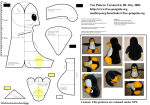
Amaya Rodrigo: DIY plush Tux


A GPLed Tux sewing pattern project that describes itself like this: "The starting point of this project was the question: "Why is it that on the one hand in the Linux world all code of software is freely available and on the other hand the code to compile a soft toy penguin is still not open source?" This project will try to publish code that will enable people to sew soft toy penguins themselves provided they meet certain hardware requirements". 

Blog

Make your own soft-toy Linux  penguin


There is even a submissions blog with lots of inspiration for your own project. Click on the Penguin to see more. Click on the pattern to go to the website.

Joey Hess: mtn stage

Back from seeing Mountain Stage record a radio show at the Paramount. Dale Jett, Tim O'Brien, the attack mandalin and bass of the Yonder Mountain String Band, Odetta (who has a commanding presence onstage even before she speaks), and Ralph Stanley & The Clinch Mountain Boys. Great fun watching Larry Groce croud them all onstage at the end and arrange an song on the spur of the moment. First time I've been to a radio show. Got me thinking to one of the first times I remember being struck by something on the radio, when we were driving up to the tobacco warehouse one night in Abington in Silas's truck, with its noxious chaw spit can, and I heard this ethereal mountian voice coming out of the radio, sounded 50 years ago and at the same time so immediate. Could have been Ralph Stanley, come to think.. After the show, I humped a dorm-style cube fridge half an hour downhill thru the woods in the dark. But that's a different story..

Bdale Garbee: SPI Board Election

All contributing members of SPI should make time to go vote in the SPI Board Election currently underway. We have 5 candidates for 3 open seats this year, and there has been some spirited discussion among candidates and others about the purpose and direction of the organization. The election closes on the 29th, so do it today!

Bdale Garbee: Flag Burning

It's rare that I find a letter to the editor of a newspaper profound enough to be worth tearing out and saving. Today was one of those days. I am pleased to discover that the full text is visible online, so I can share Ashley Frohwein's letter Insight on Fourth of July flag burning here. Sadly, I'm not always proud of my country... but some of the principles on which it was founded remain as noble and inspiring as ever!

Bdale Garbee: Debian LWN Subscriptions

I just discovered that at least some of the requests for access to LWN.net under the group subscription Debian paid for by HP have ended up in the wrong mailbox for a few weeks. Sorry about that, it's entirely my fault. I believe I've now caught up and given everyone access who asked for it and meets the requirements. If I missed any, please re-send the request. If you're a DD and don't know what I'm talking about, you can find details about LWN and how to get added to the Debian group subscription in this message in the Debian mailing list archives. For what it's worth, there are now 427 DD's subscribed to LWN as part of this group subscription.

Bdale Garbee: Gender Research

Back in mid-February, I was invited to participate in a review of EU government policy support research on gender issues in Free Software communities at the University of Cambridge. The meeting was fascinating to me not only because of my level of interest in the content, but also because the reviewers were a wonderfully diverse group of genuinely interesting people. I also must admit that being a guest of Kings College for two nights was quite an experience in and of itself... As someone who has been a strong proponent of the idea that approaches and technologies adopted by Free Software developers are something other communities might want to borrow from or emulate, I found the results of this research both disturbing and enlightening. The disturbance centers around just how strongly male-biased our current behaviors seem to be in practice, particularly in the Debian project. My moment of enlightenment was the realization that many of the ideas we discussed about how to encourage and enable more female participation in our communities could simultaneously make our projects more appealing and rewarding to all of our contributors! I've talked to various people about this research in my travels since the meeting in February, and many have followed up asking for pointers to the findings. I was pleased to learn this morning that the integrated report of findings and recommendations from this work are finally available online. I hope at least some of you will read this report, and will then be as interested as I am in looking for ways to change the status quo. Perhaps a BOF at the upcoming Debian developer's conference to discuss these results and brainstorm specific actions we can take in the Debian project would be a good place to start? I expect to arrive late on the 15th, and must depart early on the morning of the 21st...

Bdale Garbee: Teac FD-55F

Every once in a while I feed a few "interesting" key words into the eBay search engine. Last night, I happened to find a pair of Teac FD-55F 720k 5.25" floppy disk drives for sale at a reasonable price. I think the pair I once had got sold along with an XT clone I used for my FIDO BBS back in the day. They were a neat thing to have in an XT, because they would put twice the backup data per floppy on cheap floppies (the kind sold for 360k drives, the floppies for 1.2M drives were significantly more expensive!), and with two of them you could do a full backup of a reasonable hard disk of the era quickly by loading floppies in alternating drives about as fast as you could handle them. But the reason I've been looking for a pair is that before I put them in that XT clone, they were the drives I used on my original Ampro Z-80 Little Board running CP/M in the mid-80's. Shoveling through the stuff in the shed a while back, I discovered that I still have that board, a bunch of oddball accessories I bought or built for it, and a significant pile of floppies and documentation that all appear to be in reasonable condition. I got a lot of use out of that system back in the day, and it would please me to have it in working order again. Fingers crossed that the drives I just bought on eBay actually work when they get here...

Next.

Previous.