Search Results: "xam"

31 January 2013

Russ Allbery: Consensus failure

As most people reading this have probably seen, xkcd found a particularly entertaining Wikipedia argument. (It is all true. There are at least 40,000 words arguing over whether to capitalize an "i" in a page title. I went and looked last night and spent several hours following the conversation.) This is, of course, funny, and I'm sure lots of people went away smiling at an excellent example of bikeshed painting on the Internet. But I think it's rather more serious than it appears to be. In fact, I would go so far as to say that it is a visible manifestation of a deeply-rooted problem that is the core of why I personally refuse to contribute to Wikipedia in any way that requires me to invest non-trivial time or become a member of that community. To explain that statement requires a bit of background. One of the very first services I found when I joined the Internet in 1993 was Usenet. Originally, I talked about comics collecting and then Magic: The Gathering, but I eventually ended up involved in Usenet governance. I spent more than ten years deeply invested in Usenet hierarchy administration; roughly, the process of agreeing on names for and sometimes moderators for global Usenet discussion groups, as well as all the supporting infrastructure for Usenet news server administrators to agree upon and share articles in those groups. Usenet newsgroup creation was, throughout that period, a consensus-driven process. There was a voting system that was used to measure consensus, but the voting system was largely designed to ensure that rough consensus existed (it was heavily skewed towards not changing anything). We took great pride in that fact. I'm sure that one could find many articles from me proudly championing the concept of a consensus-based decision-making process against many alternatives. That means I was also there when the toxic flaws at the heart of a consensus-based process completely destroyed it and, as a side effect, destroyed the community of people who had formed around it. I will never again invest my time and energy in a community that operates solely via a consensus process unless that community is small enough that consensus can actually work (which means not much more than twenty people). Consensus decision-making in large groups destroys communities and hurts people. These sorts of extended arguments on Wikipedia are not rare anomolies. They happen with some frequency; just by going through the debate xkcd references and looking at pointers, you can easily find others (Sega Genesis, cat ownership vs. companionship, endless notability debates... there are many). They look funny from outside, but from inside they're hugely demoralizing. Even when they don't get heated and spill over into personal animosity (and if they don't do that, you're lucky), they consume astonishingly vast quantities of time exactly not the resource that you want to be squandering in volunteer projects. And they do so without giving back anything emotionally. I know these arguments very well. One of the most contentious and angry arguments in the history of Usenet newsgroup creation was the argument over whether, when breaking up a group into multiple more focused groups, to rename the original group to end in *.misc or leave its existing name. This argument went on for years and led to deep, lingering hatred between the participants. It's the same sort of thing. These arguments happen in the way that they happen because there is toxic waste at the center of Wikipedia's governance process. And that toxic waste hurts people, wastes their time, and destroys their willingness to volunteer. It undermines community, which is sad and ironic because the whole point of consensus decision-making is to create, support, and empower community. But it doesn't work. It doesn't work for two very simple but very closely-related reasons: it's impossible to ever end an argument, and there is no incentive for anyone to shut up. As a result, it is nearly impossible to get the decision-making to cohere into something that is timely, consistent, unambiguous, and final. These are not optional requirements of a decision-making process. Without them, people will lose faith in the decision-making process itself, and some people will learn that, as long as they never stop talking about something, they can prolong the debate indefinitely and possibly eventually get their way. Now, of course, I'm deeply involved and invested in Debian. And on the surface, it may look like Debian also uses a consensus-based decision-making process. But while Debian decision-making has some problems, it's much healthier for a few reasons that are useful to examine:
  1. Individual packages in Debian are not managed by consensus, but rather fall under the authority of the package maintainer, who is either a single person or a small team. (Consensus works in small teams; it's great if the number of people involved is five or less.) This drastically limits the number of decisions that are subject to a large-scale consensus process. Nearly all decisions in Debian are made directly by the person doing the work, and only in exceptional circumstances can some larger process be invoked. This, on the surface, sounds like it could be similar to Wikipedia, but note that appeals to a larger process are much rarer in Debian than they are in Wikipedia. There is a strong bias in favor of letting the person working on the package do their job however they want to do it. This is more social than structural, but it's a core value (and we should be very careful about changing it). As a result, Debian operates less by mass consensus and more as a federation of semi-autonomous fiefdoms. This sounds worse: it sounds authoritarian and non-democratic. But it's significantly more functional, and it doesn't waste people's time.
  2. On appeal, and for broader questions that necessarily cut across multiple packages, there are several people in Debian who are perceived as having clear authority to make timely and relatively final decisions, who are almost never overruled, and who can therefore effectively end arguments. These include core teams like ftp-master or the release team, formal appeal bodies like the Technical Committee, and the Debian Project Leader. Not all of this ability is written in black and white in the governance process, but that's not the important part; the important part is that it works in practice to provide timely, consistent, unambiguous, and final decisions most of the time. (Some parts work better than others, and we do struggle with timely, but I've seen much, much worse.)
  3. There is a well-established ultimate appeal (a General Resolution), the ultimate appeal process is very specific and concrete, there is little or no ambiguity or human interpretation involved in analyzing the results, it is time-limited, and it's almost universally respected. Everyone abides by the result of a GR if matters get to that point, and while it's theoretically possible to propose another GR immediately to overturn the first one, this doesn't happen in practice. There's also substantial pushback against invoking the GR process for anything that isn't really important.
We still occasionally devolve into endless discussion, usually on some technical topic that cuts across the distribution and usually when the options haven't cohered enough for any authority to make a useful decision (often because it's too early for it to be possible to make a final decision). Those cases, such as the recurring systemd vs. upstart discussion, are still quite frustrating. But they're also relatively rare and largely ignorable because they have to be about just the right sort of issue. Wikipedia has these sorts of arguments all the time, and they're much less ignorable, because consensus is invoked for every minor dispute on any page in the entire project. You have to participate in endless consensus process or risk having your work undone, reverted, or removed. We would all like all decisions to be made by consensus, since we don't want anyone in a volunteer project to lose (and because we all love to convince other people we're right). And for small teams, consensus is wonderful. But that's precisely because governance in small teams is very easy; humans are naturally adapted for decision-making in small teams and have a huge variety of natural tools, tendencies, and abilities devoted to making those sorts of decisions. You rarely need any formal decision-making process; most decisions will just happen. You need a decision-making process when enough people are involved that mutual social pressure can't bring a dispute to resolution, and when you're in that situation, consensus is a horrible process. Due to my past experiences, I'm almost certainly at the extreme in dislike of consensus processes. Most people are not going to refuse to participate in communities solely on that basis. But be aware that 40,000 words of discussion about something that an outsider will not consider particularly important is not an accidental phenomenon. It's not something that just happens randomly on the Internet. It's an effect, and symptom, of a governance process, or lack thereof, and it's something that you can do something about if you want to.

Dirk Eddelbuettel: RcppArmadillo 0.3.6.2

A new Armadillo version 3.6.2 came out yesterday, and the corresponding RcppArmadillo version is now on CRAN. Changes are mostky incremental:
Changes in RcppArmadillo version 0.3.6.2 (2013-01-29)
  • Upgraded to Armadillo release Version 3.6.2
    • faster determinant for matrices marked as diagonal or triangular
    • more fine-grained handling of 64 bit integers
  • Added a new example of a Kalman filter implementation in R, and C++ using Armadillo via RcppArmadillo, complete with timing comparison
Courtesy of CRANberries, there is also a diffstat report for the most recent release As always, more detailed information is on the RcppArmadillo page. Questions, comments etc should go to the rcpp-devel mailing list off the R-Forge page.

30 January 2013

Russell Coker: SE Linux Things To Do

At the end of my talk on Monday about the status of SE Linux [1] I described some of the things that I want to do with SE Linux in Debian (and general SE Linux stuff). Here is a brief summary of some of them: One thing I ve wanted to do for years is to get X Access Controls working in Debian. This means that two X applications could have windows on the same desktop but be unable to communicate with each other by any of the X methods (this includes screen capture and clipboard). It seems that the Fedora people are moving to sandbox processes with Xephyr for X access (see Dan Walsh s blog post about sandbox -X [2]). But XAce will take a lot of work and time is always an issue. An ongoing problem with SE Linux (and most security systems) is the difficulty in running applications with minimum privilege. One example of this is utility programs which can be run by multiple programs, if a utility is usually run by a process that is privileged then we probably won t notice that it requires excess privileges until it s run in a different context. This is a particular problem when trying to restrict programs that may be run as part of a user session. A common example is programs that open files read-write when they only need to read them, if the program then aborts when it can t open the file in question then we will have a problem when it s run from a context that doesn t grant it write access. To deal with such latent problems I am considering ways of analysing the operation of systems to try and determine which programs request more access than they really need. During my talk I discussed the possibility of using a shared object to log file open/read/write to find such latent problems. A member of the audience suggested static code analysis which seems useful for some languages but doesn t seem likely to cover all necessary languages. Of course the benefit of static code analysis is that it will catch operations that the program doesn t perform in a test environment error handling is one particularly important corner case in this regard.

James Morrison: Penance driven development

Recently, I got to try out working in a couple different environments. Working in these environments helped me formalize some of the things that I like and some of the things I don't like. With these new environments I've come to realize my style of development. It's called penance driven development. It's called this because there are two important things:
1) It's better to ask forgiveness than for permissions
2) You need to be deserving of forgiveness.

So the concept is simple, whenever you break something, you first fix the symptom, then you improve the infrastructure so similar breaks should be harder to do. The cost of the penance doesn't have to be huge, but the penance has to be done, otherwise technical debt accumulates and people believe there is no downside to breaking things.

What needs to be improved depends on what is missing. For example, if an engineer broke a feature, but that feature didn't have a test, the penance should be to write a test. Even if the one that broke the feature isn't the owner or the one that wrote the feature. If someone breaks the build and no one noticed because the continuous build didn't email, the fix could be setting up the continuous build to email out build failures, or even better, run each change on a build bot before allowing commits.

I think I'll have to start a penance of the day blog/twitter stream.

I've been practicing this style of development for most of my career, and it's similar if less precise than the 5 whys . As mentioned in the The Lean Startup, the cost of the penance should be proportional to the cost of the break.

Raphael Geissert: A bashism a week: sleep

To delay execution of some commands in a shell script, the sleep command comes handy.
Even though many shells do not provide it as a built-in and the GNU sleep command is used, there are a couple of things to note:


This of course is regarding what is required by POSIX:2001; it only requires the sleep command to take an unsigned integer. FreeBSD's sleep command does accept fractions of seconds, for example.

Remember, if you rely on any non-standard behaviour or feature make sure you document it and, if feasible, check for it at run-time.

In this case, since the sleep command is not required to be a built-in, it does not matter what shell you specify in your script's shebang. Moreover, calling /bin/sleep doesn't guarantee you anything. The exception is if you specify a shell that has its own sleep built-in, then you could probably rely on it.

The easiest replacement for suffixes is calculating the desired amount of time in seconds. As for the second case, you may want to reconsider your use of a shell script.

Paul Tagliamonte: dput-ng/1.4 in unstable

Changes:
dput-ng (1.4) unstable; urgency=low
   [ Arno T ll ]
   * Really fix #696659 by making sure the command line tool uses the most recent
     version of the library.
   * Mark several fields to be required in profiles (incoming, method)
   * Fix broken tests.
   * Do not run the check-debs hook in our mentors.d.n profile
   * Fix "[dcut] dm bombed out" by using the profile key only when defined
     (Closes: #698232)
   * Parse the gecos field to obtain the user name / email address from the local
     system when DEBFULLNAME and DEBEMAIL are not set.
   * Fix "dcut reschedule sends "None-day" to ftp-master if the delay is
     not specified" by forcing the corresponding parameter (Closes: #698719)
 .
   [ Luca Falavigna ]
   * Implement default_keyid option. This is particularly useful with multiple
     GPG keys, so dcut is aware of which one to use.
   * Make scp uploader aware of "port" configuration option.
 .
   [ Paul Tagliamonte ]
   * Hack around Launchpad's SFTP implementation. We musn't stat *anything*.
     "Be vewy vewy quiet, I'm hunting wabbits" (Closes: #696558).
   * Rewrote the test suite to actually test the majority of the codepaths we
     take during an upload. Back up to 60%.
   * Added a README for the twitter hook, Thanks to Sandro Tosi for the bug,
     and Gergely Nagy for poking me about it. (Closes: #697768).
   * Added a doc for helping folks install hooks into dput-ng (Closes: #697862).
   * Properly remove DEFAULT from loadable config blocks. (Closes: #698157).
   * Allow upload of more then one file. Thanks to Iain Lane for the
     suggestion. (Closes: #698855).
 .
   [ Bernhard R. Link ]
   * allow empty incoming dir to upload directly to the home directory
 .
   [ Sandro Tosi ]
   * Install example hooks (Closes: #697767).
Thanks to all the contributors! For anyone who doesn t know, you should check out the docs.

29 January 2013

Jonathan Carter: Ubuntu Developer Summit for 13.04 (Raring)

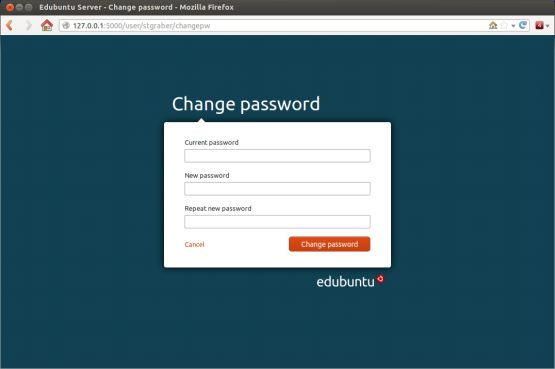
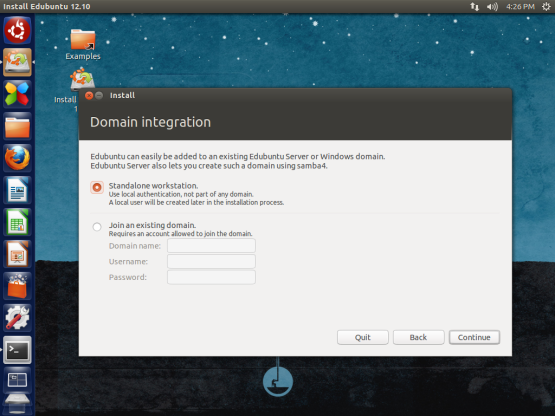
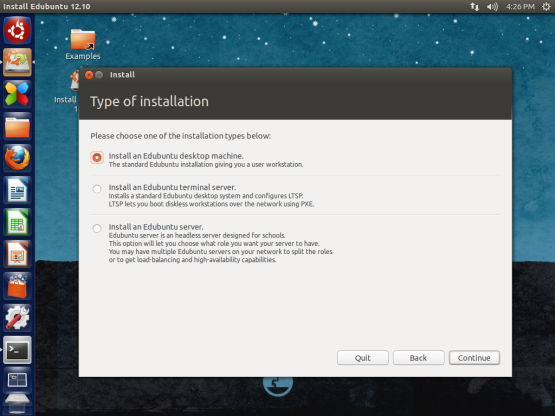
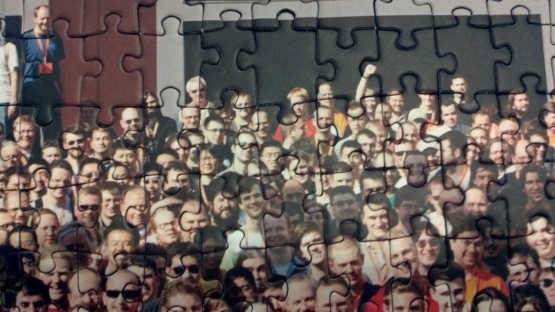
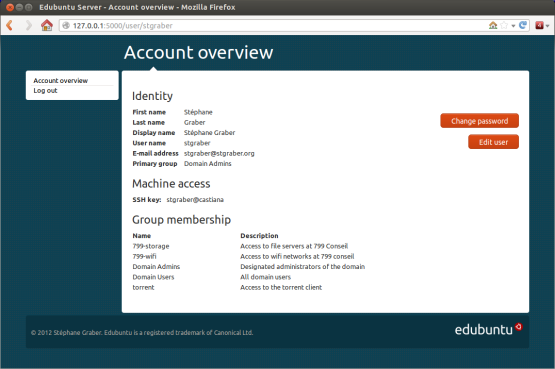
The War on Time Whoosh! I ve been incredibly quiet on my blog for the last 2-3 months. It s been a crazy time but I ll catch up and explain everything over the next few entries. Firstly, I d like to get out a few details about the last Ubuntu Developer Summit that took place in Copenhagen, Denmark in October. I m usually really good at getting my blog post out by the end of UDS or a day or two after, but this time it just flew by so incredibly fast for me that I couldn t keep up. It was a bit shorter than usual at 4 days, as apposed to the usual 5. The reason I heard for that was that people commented in previous post-UDS surveys that 5 days were too long, which is especially understandable for Canonical staff who are often in sprints (away from home) for the week before the UDS as well. I think the shorter period works well, it might need a bit more fine-tuning, I think the summary session at the end wasn t that useful because, like me, there wasn t enough time for people to process the vast amount of data generated during UDS and give nice summaries on it. Overall, it was a great get-together of people who care about Ubuntu and also many areas of interest outside of Ubuntu. Copenhagen, Denmark I didn t take many photos this UDS, my camera is broken and only takes blurry pics (not my fault I swear!). So I just ended up taking a few pictures with my phone. Go tag yourself on Google+ if you were there. One of the first interesting things I saw when arriving in Copenhagen was the hotel we stayed in. The origami-like design reminded me of the design of the Quantal Quetzel logo that is used for the current stable Ubuntu release. 2012-10-28_05-50-14_21 quantal The Road ahead for Edubuntu to 14.04 and beyond St phane previously posted about the vision we share for Edubuntu 14.04 and beyond, this was what was mostly discussed during UDS and how we ll approach those goals for the 13.04 release. This release will mostly focus on the Edubuntu Server aspect. If everything works out, you will be able to use the standard Edubuntu DVD to also install an Edubuntu Server system that will act as a Linux container host as well as an Active Directory compatible directory server using Samba 4. The catch with Samba 4 is that it doesn t have many administration tools for Linux yet. St phane has started work on a web interface for Edubuntu server that looks quite nice already. I m supposed to do some CSS work on it, but I have to say it looks really nice already, it s based on the MAAS service theme and St phane did some colour changes and fixes on it already. edu-server-account edu-server-password From the Edubuntu installer, you ll be able to choose whether this machine should act as a domain server, or whether you would like to join an existing domain. Since Edubuntu Server is highly compatible with Microsoft Active Directory, the installer will connect to it regardless of whether it s a Windows Domain or Edubuntu Domain. This should make it really easy for administrators in schools with mixed environments and where complete infrastructure migrations are planned. Authentication Options Choosing machine role You will be able to connect to the same domain whether you re using Edubuntu on thin clients, desktops or tablets and everything is controllable using the Epoptes administration tool. Many people are asking whether this is planned for Ubuntu / Ubuntu Server as well, since this could be incredibly useful in other organisations who have a domain infrastructure. It s currently meant to be easily rebrandable and the aim is to have it available as a general solution for Ubuntu once all the pieces work together. Empowering Ubuntu Flavours This cycle, Ubuntu is making some changes to the release schedule. One of the biggest changes made this cycle is that the alpha and beta releases are being dropped for the main Ubunut product. This session was about establishing how much divergence and changes the Ubuntu Flavours (Ubuntu Studio, Mythbuntu, Kubuntu, Lubuntu and Edubuntu) could have from the main release cycle. Edubuntu and Kubuntu decided to be a bit more conservative and maintain the snapshot releases. For Edubuntu it has certainly helped so far in identifying and finding some early bugs and I m already glad that we did that. Mythbuntu is also a notable exception since it will now only do LTS releases. We re tempted to change Edubuntu s official policy that the LTS releases are the main releases and treat the releases in between more like technology previews for the next LTS. It s already not such a far stretch from the truth, but we ll need to properly review and communicate that at some point. Valve at UDS and Steam for Linux One of the first plenaries was from Valve where Drew Bliss talked about Steam on Linux. Steam is one of the most popular publishing and distribution systems for games and up until recently it has only been available on Windows and Mac. Valve (the company behind Steam and many popular games such as Half Life and Portal) are actively working on porting games to run natively on Linux as well. Some people have asked me what I think about it, since the system is essentially using a free software platform to promote a lot of non-free software. My views on this is pretty simple, I think it s an overwhelmingly good thing for Linux desktop adoption and it s been proven to be a good thing for people who don t even play games. Since the announcement from Valve, Nvidia has already doubled perfomance in many cases for its Linux drivers. AMD, who have been slacking on Linux support the last few years have beefed up their support drastically with the announcement of new drivers that were released earlier this month. This new collection of AMD drivers also adds support for a range of cards where the drivers were completely discontinued, giving new life to many older laptops and machines which would be destined for the dumpster otherwise. This benefits not only gamers, but everyone from an average office worker who wants snappy office suite performance and fast web browsing to designers who work with graphics, videos and computer aided design. Also, it means that many home users who prefer Linux-based systems would no longer need to dual-boot to Windows or OS X for their games. While Steam will actively be promoting non-free software, it more than makes up for that by the enablement it does for the free software eco-system. I think anyone who disagrees with that is somewhat of a purist and should be more willing to make compromises in order to make progress. Ubuntu Release Changes Last week, there was a lot of media noise stating that Ubuntu will no longer do releases and will become a rolling release except for the LTS releases. This is certainly not the case, at least not any time soon. One meme that I ve noticed increasingly over the last UDSs was that there s an increasing desire to improve the LTS releases and using the usual Ubuntu releases more and more for experimentation purposes. I think there s more and more consensus that the current 6 month cycle isn t really optimal and that there must be a better way to get Ubuntu to the masses, it s just the details of what the better way is that leaves a lot to be figured out. There s a desire between developers to provide better support (better SRUs and backports) for the LTS releases to make it easier for people to stick with it and still have access to new features and hardware support. Having less versions between LTS releases will certainly make that easier. In my opinion it will probably take at least another 2 cycles worth of looking at all the factors from different angles and getting feedback from all the stakeholders before a good plan will have formed for the future of Ubuntu releases. I m glad to see that there is so much enthusiastic discussion around this and I m eager to see how Ubuntu s releases will continue to evolve. Lightning Talks Lightning talks are a lot like punk-rock songs. When it s good, it s really, really amazingly good and fun. When it s bad, at least it will be over soon :) Unfortunately, since it s been a few months since the UDS, I can t remember all the details of the lightning talks, but one thing that I find worth mentioning is that they re not just awesome for the topic they aim to produce (for example, the one lightning talks session I attended was on the topic of Tests in your software ), but since they are more demo-like than presentation-like, you get to learn a lot of neat tricks and cool things that you didn t know before. Every few minutes someone would do something and I d hear someone say something like Awesome! I didn t know you could do that with apt-daemon! . It s fun and educational and I hope lightning talks will continue to be a tradition at future UDSs. Social Stefano Rivera (fellow MOTU, Debianista, Capetonian, Clugger) wins the prize for person I ve seen in the most countries in one year. In 2012, I saw him in Cape Town for Scaleconf, Managua during Debconf, Oakland for a previous UDS and Copenhagen for this UDS. Sometimes when I look at silly little statistics like that I realise what a great adventure the year was! Between the meet n greet, an evening of lightning talks and the closing party (which was viking themed and pretty awesome) there was just one free evening left. I used it to gather with the Debian folk who were at UDS. It was great to see how many Debian people were attending, I think we had around a dozen or so people at the dinner and there were even more who couldn t make it since they work for Canonical or Linaro and had to attend team dinners the same evening. It was as usual, great to put some more faces to names and get to know some people better. It was also great to have a UDS with many strong technical community folk present who is willing to engage in discussion. There were still a few people who felt missing but it was less than at some previous UDSs. I also discovered my face on a few puzzles! They were a *great* idea, I saw a few people come and go to work on them during the week, they seem to have acted as good menial activities for people to fix their brains when they got fried during sessions :) 2012-10-31_14-32-28_374 Overall, this was a good and punchy UDS. I ll probably not make the next one in Oakland due to many changes in my life currently taking place (although I will remotely participate), but will probably make the one later this year, especially if it s in Europe. I ll also make a point of live-blogging a bit more, it s just so hard remembering all the details a few months after the fact. Thanks to everyone who contributed their piece in making it a great week!

Jon Dowland: Puppet and persistent network interface names

On Linux, network interface device naming has been somewhat chaotic: depending on a number of factors, eth0 today might not be eth0 tomorrow. For me, this has never been a problem in practice. At work, our physical servers have a bank of on-mainboard network ports, all managed by the same driver and so are assigned names predictably. For our virtual machines, the same is true: 99% of the time they have one network interface, but when they have more than one, they are of the same type and so are assigned predictably. At home, even on desktops and laptops with multiple network devices being added and removed at a time, I've never actually hit a problem where one was mis-identified. However, it must have been a problem for some people because it has been solved three times now. Sadly, these incompatible solutions cause headaches in all of my use cases. At work we have a puppet snippet that relies on knowing the interface name for a host's "primary" interface. In our case, "primary" means something like "the one the default route is over". We used to hardcode eth0 into this recipe. I don't feel too bad about that, as the puppet folks do the exact same thing in many of their scripts. This breaks for newer physical hosts where one of the three schemes are in play and the interfaces are named/numbered em1 and counting. We worked around it by parameterizing the interface name in our recipe and defining it in our nodes.pp for the troublesome hosts, but that just moves the problem around. My more permanent solution is to define a facter fact primary_interface that tells puppet what the correct interface should be. Here's my first attempt:
Facter.add("primary_interface") do
  setcode do
    ifs = Dir.new("/sys/class/net").each.to_a - \
      Dir.new("/sys/devices/virtual/net").each.to_a
      # filter out ones with no link
      ifs.reject! do  i 
        begin
          File.read("/sys/class/net/# i /carrier") != "1\n"
        rescue Errno::EINVAL
          true
        end
      end
    ifs[0]
  end
end
Of course, there is plenty of room for improvement with this solution: if ifs has more than one element at the end, a lexographic sort may prove more accurate; if there is an existing network default route up, that might be a strong clue too. It's also very Linux specific. My question though is whether this is a sensible approach in the first place?

28 January 2013

Russ Allbery: Management and the problem stream

Well, today was another day of sleeping, zoning, and having no brain for programming (and no willpower for that or exercise, which is even more frustrating), so you all get more musing about missions and work. Tomorrow, I will re-engage my normal schedule and turn the television off again, because seriously, two days of recovery should be enough even for a whole afternoon of meetings. Perhaps the best concept in the scrum methodology for agile project management is the concept of the product backlog and the product owner. For those who aren't familiar, a scrum project has, as one of its inputs, a prioritized list of stories that the team will implement. During each planning session (generally between once a week and once a month), the development team estimates and takes from the front of the product backlog the top-priority stories that can be completed during that period of time. The product owner is responsible for building the list of pending development stories based on business needs and keeping them sorted in priority order so that the work of the team follows the goals of the larger organization. But the product owner does not get to say how difficult the stories are; the development team estimates the stories, and the product owner may change order based on those estimates (to do simpler things earlier, for example). We've been doing scrum to some extent or another for quite some time now, and while there are a variety of things that I like about it, I think this is the best part. And I think it has very useful concepts for management in general. The product backlog is effectively a problem stream of the sort that I talked about in my last couple of posts. It's a set of problems that need to be solved, that matter to other people. And, if the team is doing scrum properly, the problems are presented in a form that describe a complete unit of desired functionality with its requirements and constraints, but without assuming any sort of implementation. The problem is the domain of the product owner; the solution is the domain of the development team. I am increasingly convinced that my quality of life at work, and that of many other people doing similar sorts of development and project work, would be drastically improved if managers considered this role the core of their jobs. (Ironically, at least in our initial experiences with scrum, it was quite rare for regular managers to be product owners; instead, individual line staff or project managers act as product owners. I think this speaks to how confused a lot of managers are about their roles in a technical development organization. This seems to be improving.) The core of the sort of work that I do is a combination of ongoing maintenance and solving new problems. Both of those can be viewed as a sequence of (possibly recurring) stories; I know this because that's largely how I do my own time management. Apart from HR and staffing, the core role of a manager is almost exactly what scrum calls "backlog grooming": communicating with everyone who has input into what their group is doing, finding out what their problems are, translating that into a list of things that the organization needs to have done, prioritizing them, breaking them into manageable chunks, ensuring they are fully specified and actionable (read: well-written stories), and communicating their completion back to other stakeholders (and then possibly iterating). This lept out at me when I started thinking about our larger strategic vision. That strategic vision is a sort of product backlog: a set of development stories (or, in this case, epics that would be broken down into a large number of smaller stories). But most strategic plans have glaring flaws if they're evaluated by the standards of scrum product backlogs. They're normally written as marketing statements and aimed at the clients or customers rather than at the staff. From the staff perspective, they're often hopelessly vague, not concrete, actionable epics. Often, they are almost entirely composed of grand, conceptual epics that any scrum team would immediately reject as too large and nebulous to even discuss. And often they're undefined but still scheduled: statements that the organization will definitely complete some underspecified thing within the next year or two. Scrum rightfully rejects any form of scheduling for unspecified stories and epics. Additional vagueness and sketchiness is tolerated the farther the story is from the current iteration, so they can be put into the future backlog, but scrum makes no guarantees about when they'll get done until they've been sized and you can apply a reasonable velocity estimate. If you want to put a date on something, you have to make it concrete. This is exactly the problem that I have with long-range strategic plans. We already know this about technology development: long-range strategic plans are feel-good guesses, half-truths, and lies that we tell other people because we're expected to do so, but which no one really believes. The chance that we can predict anything about the shape of projects and rate of delivery of those projects three years from now is laughable, and certainly none of the work that would be required to make real estimates has normally been done for those sorts of long-term strategic projects. There are a lot of scrum advocates who would go farther than I in asking for a complete revolution of how technical projects are planned. I'm not sure how realistic that is, or how well the whole scrum process would work when rolling up work across dozens, if not hundreds, of scrum-sized teams. But in the specific area of the role of managers in a development organization, I think we could learn a lot from this product backlog concept. Right now, there is a constant tension between managers who feel like they need to provide some sort of visionary leadership and guidance (the cult of Steve Jobs) and line staff who feel like managers don't understand enough about specific technology to lead or guide anything. But if you ask a technical developer whether, instead, it would be useful for managers to provide a well-structured, priority-ordered, and clean problem stream from the larger organization so that the developer can trust the problem stream (and not have to go talk to everyone themselves) but have control over the choice of implementation within the described constraints, I think you would find a great deal of enthusiasm. As a further bonus, scrum has a lot of advice about what that problem stream should look like. I think some of the story structuring is overblown (for example, I can't stand the story phrasing structures, the "AS A... I WANT TO... SO THAT..." shackles), but one thing it does correctly emphasize is the difference between problem and solution. The purpose of the story is to describe the outcome from the perspective of the person who will use the resulting technology. Describing the constraints on the solution, in terms of cost or integrations, is actively encouraged. Describing the implementation is verboten; it's up to the project team to choose the implementation that satisfies the constraints. If managers in general would pick up even that simple distinction, I think it would greatly improve the engagement, excitement, and joy that developers could take in their work. There's very little that's more frustrating than to be given an interesting problem in the guise of a half-designed solution and be told that one is not permitted to apply any of one's expertise in elegance, robustness, or durability to replacing the half-baked partial solution. Or even be allowed to know the actual motivating problem, instead of the half-digested form that the manager is willing to pass on.

25 January 2013

Richard Hartmann: Release Critical Bug report for Week 04

The UDD bugs interface currently knows about the following release critical bugs: How do we compare to the Squeeze release cycle?
Week Squeeze Wheezy Diff
43 284 (213+71) 468 (332+136) +184 (+119/+65)
44 261 (201+60) 408 (265+143) +147 (+64/+83)
45 261 (205+56) 425 (291+134) +164 (+86/+78)
46 271 (200+71) 401 (258+143) +130 (+58/+72)
47 283 (209+74) 366 (221+145) +83 (+12/+71)
48 256 (177+79) 378 (230+148) +122 (+53/+69)
49 256 (180+76) 360 (216+155) +104 (+36/+79)
50 204 (148+56) 339 (195+144) +135 (+47/+90)
51 178 (124+54) 323 (190+133) +145 (+66/+79)
52 115 (78+37) 289 (190+99) +174 (+112/+62)
1 93 (60+33) 287 (171+116) +194 (111/+83)
2 82 (46+36) 271 (162+109) +189 (+116/+73)
3 25 (15+10) 249 (165+84) +224 (+150/+74)
4 14 (8+6) 244 (176+68) +230 (+168/+62)
5 2 (0+2)
6 release!
Graphical overview of bug stats thanks to azhag:

Josselin Mouette: So(lusOS) I herd U liek mudslingingz?

After this announcement about the future of GNOME in Debian, I received several requests to look at SolusOS and their Consort fork of GNOME. On the paper, this doesn t look like a too bad idea, since they only forked gnome-panel and metacity, the two key components that are no longer maintained upstream. Still, starting a plain fork at the very moment when the former maintainer decided to give the key to anyone who wanted to, looked like a very destructive way of acting. Even if the fork gains momentum (which remains speculative), the amount of effort to rename packages makes you think twice before such a switch. I decided to go talk about it with them on IRC nevertheless. Mind you, they work on a GNOME fork and a Debian derivative, but deliberately use their own IRC server (you ll soon understand why). Just in case you would want to cooperate with SolusOS, you d have to use their infrastructure. It is an euphemism to say that the conversation didn t go well. This could have ended there, but thankfully for your already widening eyes, Ikey (the charming person I had the opportunity to discuss with) made the log public, in an attempt at public shaming that would soon gather his followers, chanting out loud how the revolutionary SolusOS would quickly replace every other Linux distribution. (As a side note, of the hundreds of such claims that were made public in the last 10 years, only one came true, and it was from a billionnaire who hired dozens of developers. Just saying.) Then you can understand why the specific IRC server: it is to K-line people who don t behave with enough deference to Ikey, because kickban is not enough. This log and the claims made in the comments look very ironical, if only for presenting a person working in a team of 10+ on the most popular desktop on one of the most popular desktop distributions, as a beggar. Even more ironical when it is the person who spent the most time on making GNOME Classic available and working nicely for wheezy. So when a dozen kids go chanting that Consort is so much better than GNOME and will replace it, while it just re-does the work I already did, let me at least smile. So what is SolusOS, after all? If you want to see where this story is going, there s a place that tells you: the consortium and consort-panel repositories. Here you will find interesting things: I ve stopped looking there. We re facing an ego issue, but not something that can improve the desktop for our users. In the end, I m sorry for those who genuinely thought we could do better by sharing some maintenance load with SolusOS, but it doesn t look like a big loss anyway.

Johannes Schauer: Bootstrappable Debian - New Milestone

This post is about the port bootstrap build ordering tool (naming suggestions welcome) which was started as a Debian Google Summer of Code project in 2012 and continued to be developed afterwards. Sources are available through gitorious. In the end of November 2012, I managed to put down an approximation algorithm to the feedback arc set problem which allowed to break the dependency graph into a directed acyclic graph with only few removed build dependencies. I wrote about this effort on our mailinglist but didnt mention it here because it was still too much of a proof-of-concept. Later, in January 2013, I mentioned the result of this algorithm in an email wookey and me wrote to debian-devel mailinglist. Many things happened since November 2012:
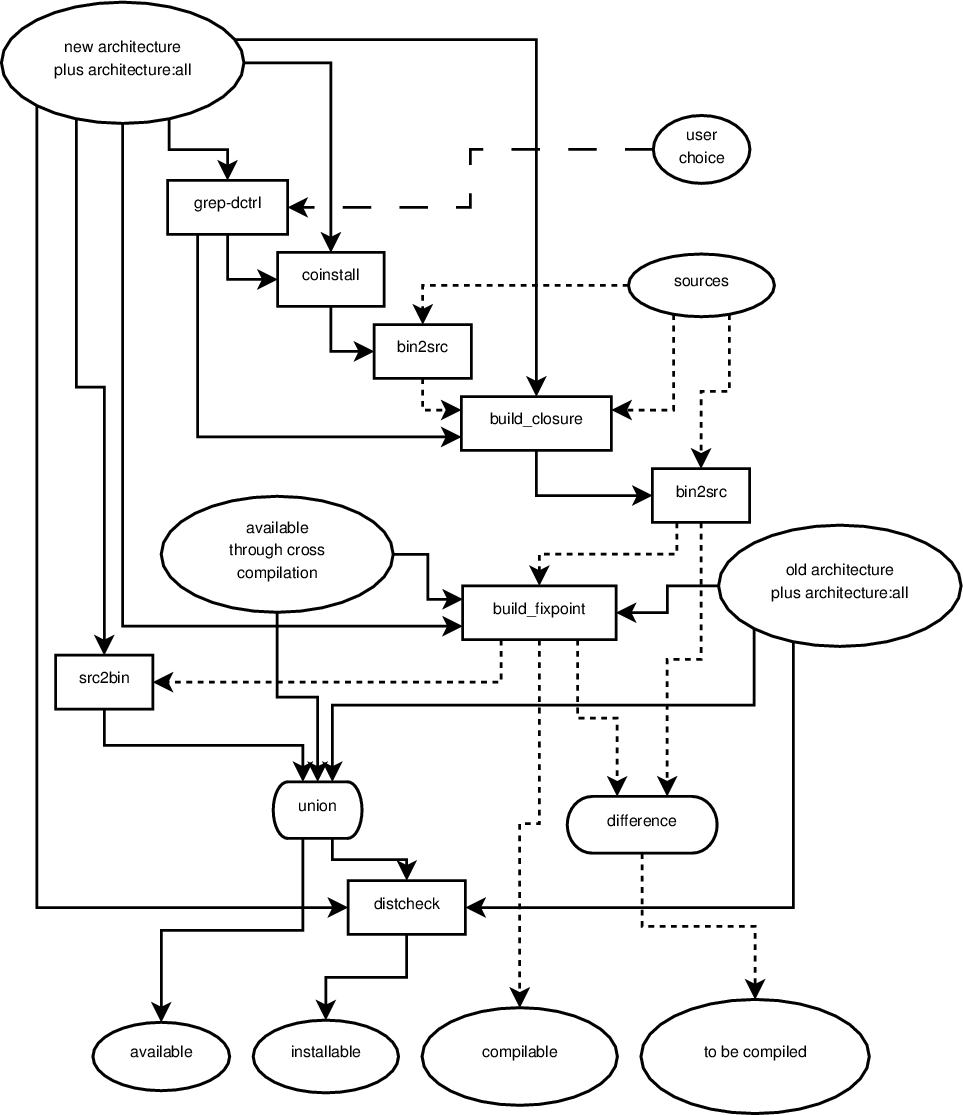
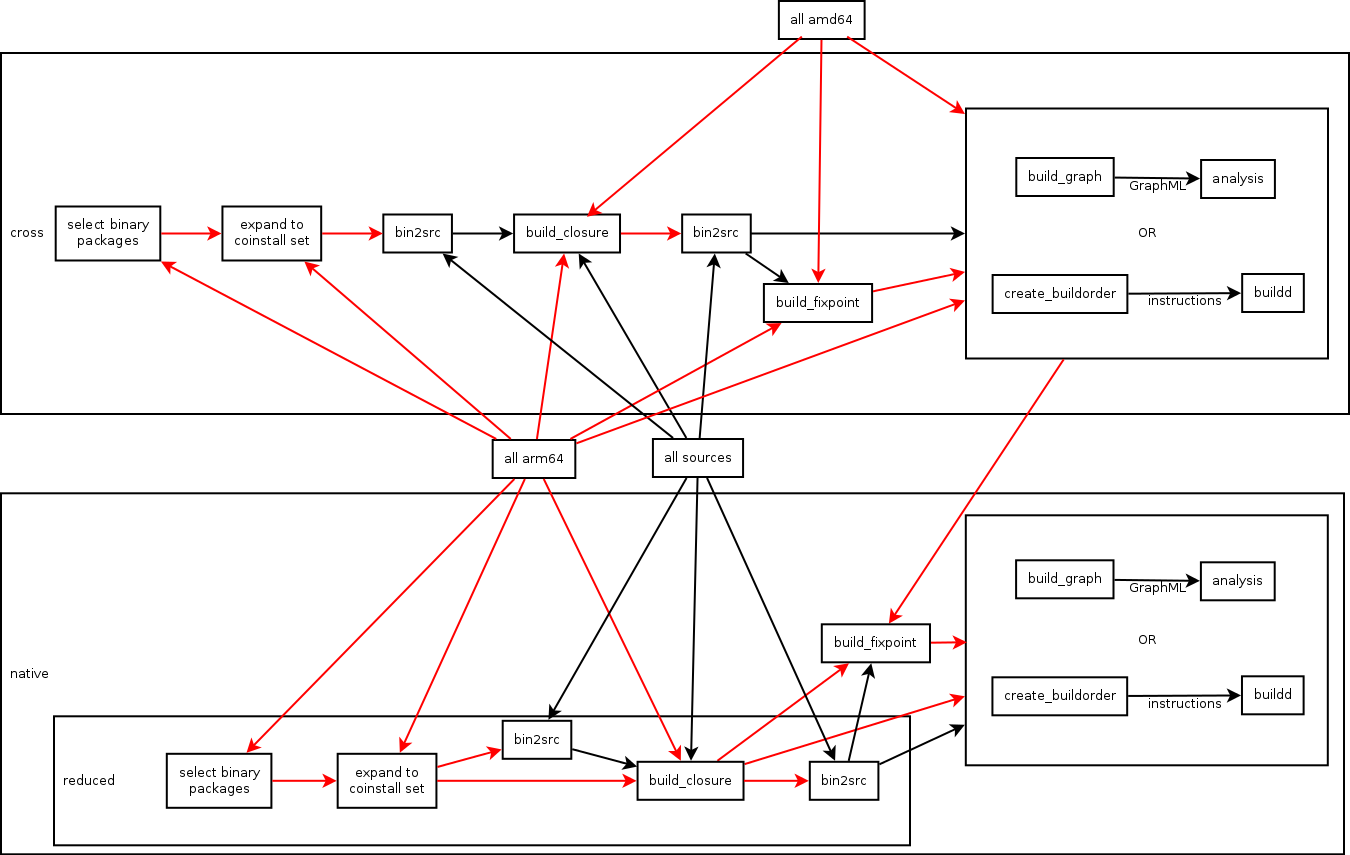
Processing pipeline instead of monolithic tools The tools I developed so far tried to accomplish everything by themselves, reusing functionality implemented in a central library. Therefor, if one wanted to try out even trivial new things, it mostly meant to hack some OCaml code. Pietro Abate suggested to instead develop smaller tools which could work independently of each other, would only execute one algorithm each and could easily be connected together in different ways to achieve different effects. This switch is now done and all functionality from the old tools is moved into a new toolset. The exchange format between the tools is either plain text files in deb822 control format (Packages/Sources files) or a dependency graph. The dependency graph is currently marshalled by OCaml but future versions should work with just passing a GraphML (an XML graph format) representation around. This new way of doing things seems close to the UNIX philosophy (each program does one thing well, data is stored as text, every program is a filter). For example the deb822 control output can easily be manipulated using grep-dctrl(1) and there exist many tools which can read, analyze and manipulate GraphML. It is a big improvement over the old, monolithic tools which did not allow to manipulate any intermediate result by external, existing tools. Currently, a shell script (native.sh) will execute all tools in a meaningful order, connecting them together correctly. The same tools will be used for a future cross.sh but they will be connected differently. I wrote about a first proposal of what the individual tools should do and how they should be connected in this email from which I also linked a confusing overview of the pipeline. This overview has recently been improved to be even more confusing and the current version of the lower half (the native part) now looks like this: native reduced Solid arrows represent a flow of binary packages, dottend arrows represent a flow of source packages, ovals represent a set of packages, boxes with rounded corners represent set operations, rectangular boxes represent filters. There is only one input to a filter, which is the arrow connected to the top of the box. Outgoing arrows from the bottom represent the filtered input. Ingoing arrows to either side are arguments to the filter and control how the filter behaves depending on the algorithm. I will explain this better once the pipeline proved to be less in flux. The pipeline is currently executed like this by native.sh.

Two new ways to break dependency cycles have been discovered So far, we knew of three ways to formally break dependency cycles:
  • remove build dependencies through build profiles
  • find out that the build dependency is only used to build arch:all packages and therefor put it into Build-Depends-Indep
  • cross compile some source packages
Two new methods can be added to the above:

Dependency graph definition changed Back in September when I was visiting irill, Pietro found a flaw in how the dependency graph used to be generated. He supplied a new definition of the dependency graph which does away with the problem he found. After fixing some small issues with his code, I changed all the existing algorithms to use the new graph definition. The old graph is as of today removed from the repository. Thanks to Pietro for supplying the new graph definition - I must still admit that my OCaml foo is not strong enough to have come up with his code.

Added complexity for profile built source packages As mentioned in the introduction, wookey and me addressed the debian-devel list with a proposal on necessary changes for an automated bootstrapping of Debian. During the discussiong, two important things came up which are to be considered by the dependency graph algorithms:
  • profile built source packages may not create all binary packages
  • profile built source packages may need additional build dependencies
Both things make it necessary to alter the dependency graph during the generation of a feedback arc set and feedback vertex set beyond the simple removal of edges. Luckily, the developed approximation algorithms can be extended to support such changes in the graph.

Different feedback arc set algorithms The initially developed feedback arc set algorithm is well suited to discover build dependency edges which should be dropped. It performs far worse when creating the final build order because it only considers edges by itself and not how many edges of a source package can be dropped by profile building it. The adjusted algorithm for generating a build order is more of a feedback vertex set algorithm because instead of greedily finding the edge with most cycles through it, it greedily finds the source package which would break most cycles if it was profile built.

Generating a build order with less profile built source packages After implementing all the features above I now feel more confident to publish the current status of the tools to a wider audience. The following test shows a run of the aforementioned ./native.sh shell script. Its final output is a list of source packages which have to be profile built and a build order. Using the resulting build order, starting from a minimal build system (essential:yes, build-essential and debhelper), all source packages will be compiled which are needed to compile all binary packages in the system. The result will therefor be a list of source and binary packages which fulfill the following property:
  • all binary packages can be built from the available source packages
  • all source packages can be built with the available binary packages
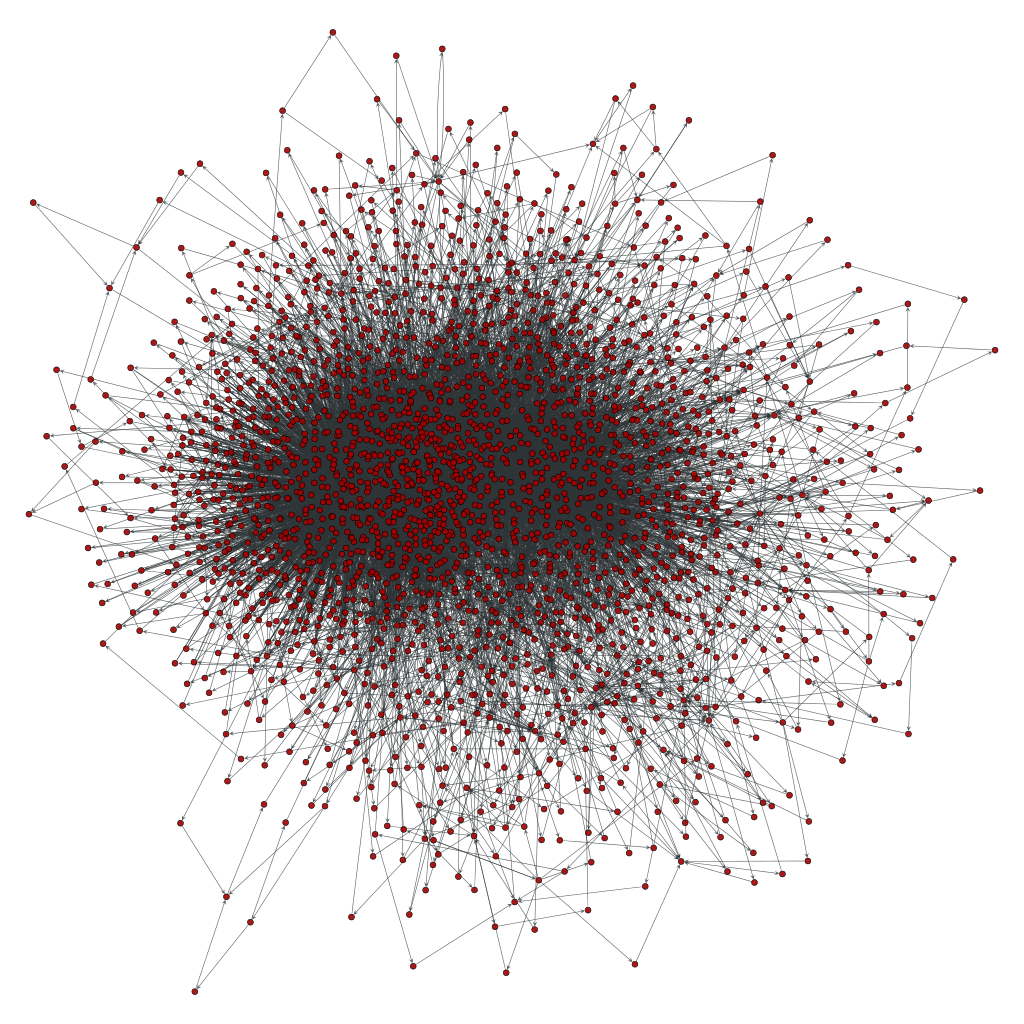
I called this a "reduceded distribution" in earlier posts. The interesting property of this specific selection is, that it contains the biggest problem set of Debian when bootstrapping it: a 900 to 1000 nodes big strongly connected component. Here is a visualization of the problem: hideous mess Source packages do not yet come with build profiles and the cross build situation can not yet be analyzed, so the following assumptions were made: The last point is about 14 build dependencies which were decided to be broken by the feedback arc set algorithm but for which other data sources did not indicate that they are actually breakable. Those 14 are dynamically generated by native.sh. If above assumptions should not be too far from the actual situation, then not more than 73 source packages have to be modified to bootstrap a reduced distribution. This reduced distribution even includes dependency-wise "big" packages like webkit, metacity, iceweasel, network-manager, tracker, gnome-panel, evolution-data-server, kde-runtime, libav and nautilus. By changing one line in native.sh one could easily develop a build order which generates gnome-desktop or really any given (meta-)package selection. All of native.sh takes only 80 seconds to execute on my system (Core i5, 2.5 GHz, singlethreaded). Here is the final build order which creates 2044 binary packages from 613 source packages.
  1. nspr, libio-pty-perl, libmcrypt, unzip, libdbi-perl, cdparanoia, libelf, c-ares, liblocale-gettext-perl, libibverbs, numactl, ilmbase, tbb, check, libogg, libatomic-ops, libnl($), orc($), libaio, tcl8.4, kmod, libgsm, lame, opencore-amr, tcl8.5, exuberant-ctags, mhash, libtext-iconv-perl, libutempter, pciutils, gperf, hspell, recode, tcp-wrappers, fdupes, chrpath, libbsd, zip, procps, wireless-tools, cpufrequtils, ed, libjpeg8, hesiod, pax, less, dietlibc, netkit-telnet, psmisc, docbook-to-man, libhtml-parser-perl, libonig, opensp($), libterm-size-perl, linux86, libxmltok, db-defaults, java-common, sharutils, libgpg-error, hardening-wrapper, cvsps, p11-kit, libyaml, diffstat, m4
  2. openexr, enca, help2man, speex, libvorbis, libid3tag, patch, openjade1.3, openjade, expat, fakeroot, libgcrypt11($), ustr, sysvinit, netcat, libirman, html2text, libmad, pth, clucene-core, libdaemon($), texinfo, popt, net-tools, tar, libsigsegv, gmp, patchutils($), dirac, cunit, bridge-utils, expect, libgc, nettle, elfutils, jade, bison
  3. sed, indent, findutils, fastjar, cpio, chicken, bzip2, aspell, realpath, dctrl-tools, rsync, ctdb, pkg-config($), libarchive, gpgme1.0, exempi, pump, re2c, klibc, gzip, gawk, flex-old, original-awk, mawk, libtasn1-3($), flex($), libtool
  4. libcap2, mksh, readline6, libcdio, libpipeline, libcroco, schroedinger, desktop-file-utils, eina, fribidi, libusb, binfmt-support, silgraphite2.0, atk1.0($), perl, gnutls26($), netcat-openbsd, ossp-uuid, gsl, libnfnetlink, sg3-utils, jbigkit, lua5.1, unixodbc, sqlite, wayland, radvd, open-iscsi, libpcap, linux-atm, gdbm, id3lib3.8.3, vo-aacenc, vo-amrwbenc, fam, faad2, hunspell, dpkg, tslib, libart-lgpl, libidl, dh-exec, giflib, openslp-dfsg, ppl($), xutils-dev, blcr, bc, time, libdatrie, libpthread-stubs, guile-1.8, libev, attr, libsigc++-2.0, pixman, libpng, libssh2, sqlite3, acpica-unix, acl, a52dec
  5. json-c, cloog-ppl, libverto, glibmm2.4, rtmpdump, libdbd-sqlite3-perl, nss, freetds, slang2, libpciaccess, iptables, e2fsprogs, libnetfilter-conntrack, bash, libthai, python2.6($), libice($), libpaper, libfontenc($), libxau, libxdmcp($), openldap($), cyrus-sasl2($), openssl, python2.7($)
  6. psutils, libevent, stunnel4, libnet-ssleay-perl, libffi, readline5, file, libvoikko, gamin, libieee1284, build-essential, libcap-ng($), lcms($), keyutils, libxml2, libxml++2.6, gcc-4.6($), binutils, dbus($), libsm($), libxslt, doxygen($)
  7. liblqr, rarian, xmlto, policykit-1($), libxml-parser-perl, tdb, devscripts, eet, libasyncns, libusbx, icu, linux, libmng, shadow, xmlstarlet, tidy, gavl, flac, dbus-glib($), libxcb, apr, krb5, alsa-lib
  8. usbutils, enchant, neon27, uw-imap, libsndfile, yasm, xcb-util, gconf($), shared-mime-info($), audiofile, ijs($), jbig2dec, libx11($)
  9. esound, freetype, libxkbfile, xvidcore, xcb-util-image, udev($), libxfixes, libxext($), libxt, libxrender
  10. tk8.4, startup-notification, libatasmart, fontconfig, libxp, libdmx, libvdpau, libdrm, libxres, directfb, libxv, libxxf86dga, libxxf86vm, pcsc-lite, libxss, libxcomposite, libxcursor, libxdamage, libxi($), libxinerama, libxrandr, libxmu($), libxpm, libxfont($)
  11. xfonts-utils, libxvmc, xauth, libxtst($), libxaw($)
  12. pmake, corosync, x11-xserver-utils, x11-xkb-utils, coreutils, xft, nas, cairo
  13. libedit, cairomm, tk8.5, openais, pango1.0($)
  14. ocaml, blt, ruby1.8, firebird2.5, heimdal, lvm2($)
  15. cvs($), python-stdlib-extensions, parted, llvm-2.9, ruby1.9.1, findlib, qt4-x11($)
  16. xen, mesa, audit($), avahi($)
  17. x11-utils, xorg-server, freeglut, libva
  18. jasper, tiff3, python3.2($)
  19. openjpeg, qt-assistant-compat, v4l-utils, qca2, jinja2, markupsafe, lcms2, sip4, imlib2, netpbm-free, cracklib2, cups($), postgresql-9.1
  20. py3cairo, pycairo, pam, libgnomecups, gobject-introspection($)
  21. gdk-pixbuf, libgnomeprint, gnome-menus, gsettings-desktop-schemas, pangomm, consolekit, vala-0.16($), colord($), atkmm1.6
  22. libgee, gtk+3.0($), gtk+2.0($)
  23. gtkmm2.4, poppler($), openssh, libglade2, libiodbc2, gcr($), libwmf, systemd($), gcj-4.7, java-atk-wrapper($)
  24. torque, ecj($), vala-0.14, gnome-keyring($), gcc-defaults, gnome-vfs($)
  25. libidn, libgnome-keyring($), openmpi
  26. mpi-defaults, dnsmasq, wget, lynx-cur, ghostscript, curl
  27. fftw3, gnupg, libquvi, xmlrpc-c, raptor, liboauth, groff, fftw, boost1.49, apt
  28. boost-defaults, libsamplerate, cmake, python-apt
  29. qjson, qtzeitgeist, libssh, qimageblitz, pkg-kde-tools, libical, dwarves-dfsg, automoc, attica, yajl, source-highlight, pygobject, pygobject-2, mysql-5.5($)
  30. libdbd-mysql-perl, polkit-qt-1, libdbusmenu-qt, raptor2, dbus-python, apr-util
  31. rasqal, serf, subversion($), apache2
  32. git, redland
  33. xz-utils, util-linux, rpm, man-db, make-dfsg, libvisual, cryptsetup, libgd2, gstreamer0.10
  34. mscgen, texlive-bin
  35. dvipng, luatex
  36. libconfig, transfig, augeas, blas, libcaca, autogen, libdbi, linuxdoc-tools, gdb, gpm
  37. ncurses, python-numpy($), rrdtool, w3m, iproute, gcc-4.7, libtheora($), gcc-4.4
  38. libraw1394, base-passwd, lm-sensors, netcf, eglibc, gst-plugins-base0.10
  39. libiec61883, qtwebkit, libvirt, libdc1394-22, net-snmp, jack-audio-connection-kit($), bluez
  40. redhat-cluster, gvfs($), pulseaudio($)
  41. phonon, libsdl1.2, openjdk-6($)
  42. phonon-backend-gstreamer($), gettext, libbluray, db, swi-prolog, qdbm, swig2.0($)
  43. highlight, libselinux, talloc, libhdate, libftdi, libplist, python-qt4, libprelude, libsemanage, php5
  44. samba, usbmuxd, libvpx, lirc, bsdmainutils, libiptcdata, libgtop2, libgsf, telepathy-glib, libwnck3, libnotify, libunique3, gnome-desktop3, gmime, glib2.0, json-glib, libgnomecanvas, libcanberra, orbit2, udisks, d-conf, libgusb
  45. libgnomeprintui, libimobiledevice, nautilus($), libbonobo, librsvg
  46. evas, wxwidgets2.8, upower, gnome-disk-utility, libgnome
  47. ecore, libbonoboui
  48. libgnomeui
  49. graphviz
  50. exiv2, libexif, lapack, soprano, libnl3, dbus-c++
  51. atlas, libffado, graphicsmagick, libgphoto2, network-manager
  52. pygtk, jackd2, sane-backends, djvulibre
  53. libav($), gpac($), ntrack, python-imaging, imagemagick, dia
  54. x264($), matplotlib, iceweasel
  55. strigi, opencv, libproxy($), ffms2
  56. kde4libs, frei0r, glib-networking
  57. kde-baseapps, kate, libsoup2.4
  58. geoclue, kde-runtime, totem-pl-parser, libgweather, librest, libgdata
  59. webkit
  60. zenity, gnome-online-accounts
  61. metacity, evolution-data-server
  62. gnome-panel
  63. tracker
The final recompilation of profile built source packages is omitted. Source packages marked with a ($) are selected to be profile built. All source packages listed in the same line can be built in parallel as they do not depend upon each other. This order looks convincing as it first compiles a multitude of source packages which have no or only few build dependencies lacking. Later steps allow fewer source packages to be compiled in parallel. The amount of needed build dependencies is highest in the source packages that are built last.

Russ Allbery: The "Why?" of Work

(This is going to be long and rambling. Hopefully at some point I'll be able to distill it into something shorter.) In preparation for a tech leads retreat tomorrow, several of us at work were asked to watch Simon Sinek's TED talk, "How great leaders inspire action". I'll be honest with you: I hated this talk. Sinek lost me right at the start by portraying his idea as the point of commonality among great leaders (don't get me started on survivorship bias; it's a pet peeve) and then compounded the presentation problem with some dubious biology about brain structure. So, after watching it, I ranted a bit about how much I disliked it (to, as it turns out, people who had gotten a lot out of it). (Don't do this, btw. It's nearly always worthwhile to suppress negativity about something someone else enjoyed. I say this to increase the pool of people who can remind me of what I said the next time I forget. Which, if my normal pattern holds, will be about five minutes from now.) Thankfully, I work with tolerant and forgiving people who kindly pointed out the things they saw in the video that I missed, and we ended up having a really good hour and a half discussion, which convinced me that there's an idea under here that's worth talking about. It also helped clarify for me just how much I hate the conventional construction of both leadership and success. This talk is framed around getting other people to do things, which is one of the reasons why I had such a negative reaction to it. It's right there in the title: leaders inspiring action. This feeds into what at least in the United States is an endemic belief that the world consists of leaders and followers, and that the key to success in the world (in business, in politics, in everything else) is to become one of the leaders and accumulate followers (most frequently as customers, since we have a capitalist obsession). This is then defined as success. I think this idea of success is bullshit. Now, that statement requires an immediate qualification. Saying that the societal definition of success is bullshit is a statement from privilege. I have the luxury of saying that because I am successful; I'm in a position where I have a lot of control over my own job, I'm not struggling to make ends meet, and I can spend my time pondering existential questions like how to define success. If I were a little less lucky, success would be whatever put food on the table and kept a roof over my head. I'm making an argument from the top of Maslow's hierarchy. But that is, in a roundabout way, my point: why is defining and constructing success still so hard, and why do we do such a bad job at it, even when we're at the top of the pyramid and able to focus on self-actualization? The context of this talk for my group is pre-work for a discussion about, in Sinek's construction, the "why?" of our group. Why are we here, what is our purpose, and what do we care about? By the mere fact that we are able to ask questions like that, you can correctly surmise that we're already successful. The question, therefore, is what should we do with that success? I normally hear one or more of the following answers, all of which I find unsatisfying or problematic. So, what should I do with success? Or, put another way, since I have the luxury of figuring out a "why?", what's my "why?" This question comes at a good time. As I've mentioned the last couple of days here, I've just come off of two days of the most fun I've had at work in the last several years. I spent about 25 hours total building a log parsing infrastructure that I'm quite fond of, and which may even be useful to other people. And I did that in response to a rather prosaic request: produce a report of user agents by authenticated unique users, rather than by hits, so that we can get an idea of what percentage of our community uses different devices or browsers. This was a problem that I probably could have solved adequately enough for the original request in four hours, maybe less, and then moved on to something else. I spent six times that long on it. That's something I can do because I'm successful: that's the sort of luxury you get when you can define how you want to do your job. So, apparently I have an answer to my question staring me in my face: what I do with success, when I have it, is use that leeway to produce elegant and comprehensive solutions to problems in a way that fully engages me, makes the problem more interesting, and constructs infrastructure that I can reuse for other problems. Huh. That sounds like a "why?" response that's quite common among hackers and software developers. Nothing earth-shattering there... except why is that so rare in a business context? Why isn't it common to answer questions like "what is our group mission statement" with answers like that? This is what I missed in the TED talk, and what the subsequent discussion with my co-workers brought to light for me. I think Sinek was getting at this, but I think he buried the lede. The "why?" should be something that excites you. Something that you're passionate about. Something that you believe in. He says that's because other people will then believe in it too and will buy it from you. I personally don't care about (or, to be honest, have active antipathy towards) that particular outcome, but that's fine; that's not the point. The point is that a "why?" comes from the heart, from something that actually matters, and it creates a motivating and limiting principle. It defines both what you want to do and what you don't want to do. That gives me a personal answer. My "why?" is that I want to build elegant solutions to problems and do work that I find engaging and can be proud of afterwards. I automate common tasks not because I particularly care about being efficient, but because manually doing common tasks is mind-numbing and boring, and I don't like being bored. I write reliable systems not particularly because that helps clients, but primarily because reliable software is more elegant and beautiful and unreliable software offends me. (Being more usable and frustrating for clients is also good; don't get me wrong. It's just not a motive. It's an outcome.) What does that mean for a group mission statement, a group "why?" Usually these exercises produce some sort of distillation of the collective job responsibilities of the people in the group. Our mission is to maintain core infrastructure to let people do their work and to support authentication and authorization services for the university, yadda yadda yadda... this is all true, in its way, but it's also boring. One can work oneself up to caring about things like that, but it requires a lot of effort. But we all have individual "why?" answers, and I bet they look more like my answer than they do like traditional mission statements. If we're in a place where we have the luxury of worrying about self-actualization questions, what gets us up in the morning, what makes it exciting to go into work, is probably some variation on doing interesting and engaging work. But it's probably a different variation for everyone in the group. For example, as you can see from above, I like building things. My happiest moments are when someone gives me a clearly-defined problem statement that fills a real need and then goes away and leaves me in peace to solve it. One thing I've learned is that I'm not very good at coming up with the problem statements myself; I can do it, but usually I end up solving some problem that isn't very important to other people. I love it when my employer can hand me real problems that will make the world better for people, since often they're a lot more interesting (and meaningful) than the problems I come up with on my own. But that's all highly idiosyncratic and is not going to be shared by everyone in my group. I'm an introvert; the "leave me alone" part of that is important. Other people are extroverts; what gets them up in the morning is, in part, engaging with other people. Some people care passionately about UI design. (I also care passionately about UI design, but the UI designs that I'm passionate about are the ones that are natural for my people, who are apparently aliens from another galaxy, so I'm not the person you want doing UI design for things used by humans.) Others might be particularly interested in researching new technology, or coming up with those problem statements, or in smoothly-running production systems, or in metrics and reporting... I don't really know, but I do know that there's no one answer that fits everyone. Which means that none of our individual "why?" responses should become the group "why?". However, I think that leads to an answer, and it's the answer I'm going to advocate for in the meeting tomorrow. I believe the "why?" of our team should be to use the leeway, trust, and credibility that we have because we're successful to try to create an environment in which every individual member of the team can follow their own "why?" responses. In other words, I think the mission of our group should not be about any specific technology, or about any specific set of services, or outcomes. The way we should use our success is to let every member of our team work in a way that lights their fire. That makes them excited to come into work. That lets each of us have as much fun as I had in the past two days. We should have as our goal to create passionate and empowered employees. Nothing more, but nothing less. This is totally not how group mission statements are done. They're always about blending in to some larger overall technological purpose. But I think that's a mistake, and (despite disliking the presentation), I think that's what this TED talk does actually get at. The purpose is the what, or sometimes the how. It's not the why. And the why isn't static; technology is changing fast, and people are using technology in different ways. Any mission statement around technology today is going to be obsolete in short order, and is going to be too narrow. But I think the flip side is that good technological solutions to the problems of the larger organization are outcomes that fall out of having passionate and inspired employees. If people can work in ways that engage and excite them, they will end up solving problems. We're all adults; we know that we're paid to do a job and that job needs to involve solving real problems for the larger organization. All of that is obvious, and therefore none of that belongs in a mission statement. A mission statement should state the inobvious. And while some visionary people can come up with mission statements around technology or around how people use technology that can be a rallying point for a team or organization, I think that's much rarer than people like to think it is. If you stumble across one like that, great, but I think most teams, and certainly our team, would be better served by having the team mission statement be to enable every individual on the team to be passionate about their work. What should our group work on next? Figure out what the university's problems are, line those needs up with the passions of the members of the team, ask the people most excited about each problem how they want to solve that problem, and write down the answers. There's our roadmap and our strategy, all rolled into one.

24 January 2013

Benjamin Mako Hill: Aaron Swartz

I moved to Boston in 2005 at the same time that Aaron Swartz did and we were introduced by a mutual friend. Aaron was one of my first friends in Boston and we became close. When Aaron moved to San Francisco, I moved into his apartment in Somerville where he kept a room for a year or so. Mika and I still live there. His old posters remain on our walls and his old books remain on our shelves. Aaron s brothers Ben and Noah both lived with us and remain close friends. I have spent hours (days?) reading and thinking about Aaron over the last two weeks. It has been disorienting but beautiful to read the descriptions of, and commentaries on, Aaron s life. Although I suspect I may never feel ready, there are several things I want to say about Aaron s death, about Aaron s work, and about what Aaron means to me. 1. Aaron s Death The reaction to Aaron s death has been overwhelming and inspirational. At some point in the near future I plan to join some of the important campaigns already being waged in his name. There are many attempts to understand why Aaron died and many attempts to prevent it from happening to others in the future. Unfortunately, I am familiar with the process of soul-searching and second-guessing that happens when a friend commits suicide. I m sure that every one of his friends has asked themselves, as I have, What could I have done differently? I don t know the answer, but I do know this: Aaron was facing the real risk of losing half his life to prison. But even if one believed that he was only facing the likely loss of ten percent or even one percent of his life I wish that we all, and I wish that I in particular, had reacted with the passion, time, anger, activity, and volume proportional to how we have reacted in the last two weeks when he lost the whole thing. 2. Aaron s Work Of course, Aaron and I worked on related projects and I followed his work. And despite all the incredible things that have been said about Aaron, I feel that Aaron s work was more focused, more ambitious, more transformative, more innovative, and more reckless (in a positive sense) than the outpour online suggests. Although discussion of Aaron has focused his successes, achievements, and victories, the work that inspired me most was not the projects that were most popular or successful. Much of Aaron s work was deeply, and as it turned out overly, ambitious. His best projects were self-conscious attempts to transform knowledge production, organization, and dissemination. Although he moved from project to project, his work was consistently focused on bringing semantic-web concepts and technologies to peer production, to the movement for free culture, and to progressive political activism and on the meta-politics necessary to remove barriers to this work. For example, Aaron created an online collaborative encyclopedia project called the TheInfoNetwork (TIN) several years before Wikipedia was started. I talked to Aaron at length about that project for a research project I am working on. Aaron s work was years ahead of its time; in 2000, TIN embraced more of the Wikimedia Foundation s current goals and principles than Wikipedia did when it was launched. While Wikipedia sought to create a free reference work online, Aaron s effort sought to find out what a reference work online could look like. It turned out to be too ambitious, perhaps, but it taught many, including myself, an enormous amount in that process. When I met Aaron, he was in the process starting a company, Infogami, that was trying to chase many of TIN s goals. Infogami was conceived of as a wiki aware of the structure of data. The model was both simple and profound. Years later, Wikimedia Deutschland s WikiData project is beginning to bring some of these ideas to the mainstream. Infogami merged with Reddit as equal halves of a company with a shared technological foundation based on some of Aaron s other work. But when Reddit took off, Infogami was rarely mentioned, even by Aaron. I think that is too bad. Reddit got traction because it made the most popular stuff more visible; Reddit is popular, fundamentally, because popular things are popular. But popular is not necessary positive. For that reason, Reddit never struck me as either surprising or transformative. But what started as Aaron s half the company, on the other hand, aimed to create a powerful form of democratized information production and dissemination. And although Infogami didn t take off, the ideas and code behind the project found life at the heart of Open Library and will continue to influence and inspire countless other projects. I believe that Infogami s lessons and legacy will undergird a generation of transformative peer production technologies in a way that the Reddit website important as it is will not. 3. What Aaron Means to Me A lot of what has been written about Aaron speaks to his intelligence, his curiosity, his generosity, his ethics and his drive. Although I recognize all these qualities in the Aaron I knew, I ve felt alienated by how abstract some of the discussion of Aaron has been my memories are of particularities.
I remember the time Aaron was hospitalized and I spent two hours on the phone going through my bookshelves arguing with him about the virtues of the books in my library as we tried to decide which books I would bring him. I remember Aaron confronting Peter Singer intellectual founder of the modern animal rights movement at the Boston Vegetarian Food Festival to ask if humans had a moral obligation to stop animals from killing each other. I lurked behind, embarrassed about the question but curious to hear the answer. (Singer sighed and said yes sort of and complemented Aaron on the enormous Marxist commentary he was carrying.) I remember 1-800-INTERNET.com. I remember talking with Aaron about whether being wealthy could be ethical. I argued it could not but Aaron argued uncharacteristically I thought that it could. Aaron told Mika she should slap him if he ever became wealthy. The very next day, it was announced that his company had been acquired and that Aaron was a millionaire. I remember the standing bets I had with Aaron and how he would email me every time news reports favored his claims (but never when they did not). And I remember that I won t hear from him again.
Aaron was a friend and inspiration. I miss him deeply and I am very sad.

Hideki Yamane: net-snmp package

Current net-snmp package maintainers are busy, so now I'm trying to update it. One of maintainers Jochen Friedrich kindly checked my experimental package (thank!), and point MIB files should be removed to upload to Debian out (at least).

Anyway, current changelog is here (a little bit long). If you want to try it, get dsc file and build it.


net-snmp (5.7.2~dfsg-1~0.1) UNRELEASED; urgency=low
* Non-maintainer upload.
* New upstream version 5.7.2 (Closes: #557348, #631063, #684388, #599929,
#673197, #581185, #558356, #568550, #514842, #445608, #557186, #411858,
#428824, #611837)
* debian/control
- set "Standards-Version: 3.9.4"
- set "Build-Depends: debhelper (>= 9)" to enable hardening
- set "Build-Depends: automake", instead of automake1.9
- drop "Build-Depends: python-central", use dh_python2 by default, instead
- remove duplicational "Priority:" and "Section:" fields
- make it "Multi-Arch" enable
- add description for non-free snmp-mibs-downloader for users' convinience
(Closes: #561124)
- add "Build-Depends: libmysqld-dev" to support MySQL
- add "Build-Depends: dh-autoreconf"
- use python-all (2.6.6-3~) instead of python-all-dev (>= 2.5.4-1~), python
(>=2.3.5-7) for Build-Depends
- add "Build-Depends: python2.7-dev"
- s/libsnmp-python/python-netsnmp/ as Python Policy compliant (Closes: #661899)
* debian/compat
- set 9
* debian/*.install
- split into *.manpages
* debian/fixman: drop it.
* debian/*.manpages (Closes: #505149)
- remove unnecessary"snmp" from tail of all man pages
* debian/libsnmp-base.install
- move /usr/share/mibs to /usr/share/snmp/mibs (probably, previous setting
was just wrong...)
- install all mibs/*.txt
* debian/libsnmp-dev.install
- change from "usr/lib/*" to "usr/lib/*/*" to deal with Multi-Arch
* debian/libsnmp30.install
- change from "usr/lib/*.so" to "usr/lib/*/*.so" to deal with Multi-Arch
* debian/snmp.dirs: remove it since unnecessary
* debian/snmpd.dirs: remove lintian overrides direcotry, add /etc/snmp
* debian/libsnmp-dev.dirs: add it
* debian/libsnmp-perl.examples: add it since dh_installexamples target in
previous debian/rules doesn't work correctly.
* debian/patches
- remove all *.README files
- add fix_typo_in_snmpd.conf.patch (Closes: #603593)
Thanks to Slavko <linux@slavino.sk>
- add fix_logging_option.patch (Closes: #616437)
- add fix_snmpcheck_perl_path.patch to provide snmpcheck (Closes: #44373)
- add net-snmp-config_multi-arch.patch to enable Multi-Arch
- add fix_regular_expression.patch enable to build under Multi-Arch
- add to snmptranslate.1.patch fix lintian "hyphen-used-as-minus-sign"
warnings
- add fix_spelling_error.patch to fix typo
- adjust and refresh 03_makefiles.patch
- drop 25_duplicate_iftable.patch and 44_nlist_kvm.patch since it cannot be
applied to current code.
- drop 32_mnttab_path.patch since it was merged to upstream as
configure.d/config_os_misc4
- drop 56_manpage.patch since most of patches are merged, and others are
unnecessary because upstream files are disappeared.
- refresh 61_vacm_missing_dependency_check.patch
- drop 63_fix_shell.patch since it was merged to upstream
- reapplied 64_missing_lib.patch since upstream source has been changed.
- drop 65_CVE-2012-2141.patch since it was merged to upstream
- drop 66_formatstrings.patch since almost merged to upstream, some of
code are changed in upstream and become unnecessary.
- move 08_defaultconfig.patch to debian/snmptrapd.conf
* debian/rules
- enable hardening
(TODO: building perl module would be failed without -pie)
- specify LDFLAGS to enable hardening
- add "--with autotools-dev,autoreconf"
- export DEB_BUILD_MAINT_OPTIONS to enable hardening
- drop "dh --with python-central" (Closes: #616913)
- drop "include /usr/share/python/python.mk"
- remove "$(PYVERS:%=debian/python-install-stamp-%)"
- move exist python targets under override_dh_install
- remove unnecessary .PHONY lines
- enable tests by removing no instructions with dh_auto_test line
- set DEB_HOST_MULTIARCH to enable Multi-Arch
- enable install snmpcheck
- don't specify to copy files but install them by using .install file
(mostly)
- enable mysql support
- enable AES support (Closes: #447705)
- don't make symlink for /usr/share/doc/libsnmp-perl since other are okay
but it has examples files.
- snmpd doc files link to libsnmp (Closes: #453124)
- adjust dh_strip for dbg package.
- adjust dh_clean target
- remove override_dh_auto_build since LD_RUN_PATH is clearly specified
during building perl modules
- add mibII/mta_sendmail to build modules (Closes: #641608)
* debian/clean
- most listed files are cared by autotools-dev, so removed.
* debian/snmp.conf: fix typo (Closes: #623499, #647468)
* debian/snmpd.init
- force remove pid files (Closes: #528104)

-- Hideki Yamane <henrich@debian.org> Wed, 18 Jul 2012 13:39:41 +0900

And if I can put it to Debian, then I hope someone will maintain it...

Dirk Eddelbuettel: Rcpp reaches 100 dependents on CRAN

With the arrival earlier today of the stochvol package onto the CRAN network for R, our Rcpp project reached a new milestone: 100 packages have either a Depends:, Imports: or LinkingTo: statement on it. The full list will always be at the bottom of the CRAN page for Rcpp; I also manually edit a list on my Rcpp page. But for the record as of today, here is the current list as produced by a little helper script I keep:
 acer                apcluster           auteur             
 bcp                 bfa                 bfp                
 bifactorial         blockcluster        ccaPP              
 cda                 classify            clusteval          
 ConConPiWiFun       EpiContactTrace     fastGHQuad         
 fdaMixed            forecast            fugeR              
 GeneticTools        gMWT                gof                
 gRbase              gRim                growcurves         
 GUTS                jaatha              KernSmoothIRT      
 LaF                 maxent              mets               
 minqa               mirt                mRMRe              
 multmod             mvabund             MVB                
 NetworkAnalysis     ngspatial           oem                
 openair             orQA                parser             
 pbdBASE             pbdDMAT             phom               
 phylobase           planar              psgp               
 quadrupen           Rchemcpp            Rclusterpp         
 RcppArmadillo       RcppBDT             rcppbugs           
 RcppClassic         RcppClassicExamples RcppCNPy           
 RcppDE              RcppEigen           RcppExamples       
 RcppGSL             RcppOctave          RcppRoll           
 RcppSMC             RcppXts             rforensicbatwing   
 rgam                RInside             Rmalschains        
 Rmixmod             robustgam           robustHD           
 rococo              RProtoBuf           RQuantLib          
 RSNNS               RSofia              rugarch            
 RVowpalWabbit       SBSA                sdcMicro           
 sdcTable            simFrame            spacodiR           
 sparseHessianFD     sparseLTSEigen      SpatialTools       
 stochvol            surveillance        survSNP            
 termstrc            tmg                 transmission       
 trustOptim          unmarked            VIM                
 waffect             WideLM              wordcloud          
 zic                
And not to be forgotten is BioConductor which has another 10:
 ddgraph            GeneNetworkBuilder GOSemSim          
 GRENITS            mosaics            mzR               
 pcaMethods         Rdisop             Risa              
 rTANDEM  
As developers of Rcpp, we are both proud and also a little humbled. The packages using Rcpp span everything from bringing new libraries to R, to implementing faster ways of doing things we have before to doing completely new things. It is an exciting time to be using R, and to be connecting R to C++, especially with so many exciting things happening in C++ right now. Follow the Rcpp links for more, and come join us on the Rcpp-devel mailing list to discuss and learn.

23 January 2013

Russ Allbery: Log parsing and infinite streams

I have a problem I have to solve for work that involves correlating Apache access and error logs. Part of WebAuth logs successful authentications to the Apache error log, and I want to correlate User-Agent strings with users so that we can figure out what devices our users are using by percentage of users rather than percentage of hits. The problem, as those who have tried to do this prior to Apache 2.4 know, is that Apache doesn't provide any easy way to correlate access and error log entries (made even more complex because two separate components are involved). I could have just hacked something together, but I've written way too many ad hoc log parsers, and, see, I was reading this book.... The book in question is Mark Jason Dominus's Higher Order Perl. I'm not quite done with it, and will post a full review when I am. I have some problems with it, mostly around the author's choice of example problems. But there is one chapter on infinite streams, and the moment I read that chapter on the train, it struck me as the perfect solution to log parsing problems. I'm not much of a functional programming person (which is where Dominus is drawing most of the material for this book), so I don't know if this terminology is standard or somewhat unique to the book. An infinite stream in this context is basically a variation on an interator that lets you look at the next item without consuming it. The power comes from putting this modified iterator in front of a generator and use it to consume one element at a time, and then compose this with transformation and filtering functions. That gives you all the power of the iterator to store state and lets you process one logical element from the stream at a time, without inverting your flow of control. Dominus provides code in the book for a very nice functional implementation of this that's about as close as you're probably going to get to writing Haskell in Perl. Unfortunately, his publisher decided to write their own free software license, so the license is kind of weird and doesn't explicitly permit redistribution of modified code. It's probably fine, but I didn't feel like dealing with it, and I'm more comfortable with writing object-oriented code at the moment (at least in Perl), so I decided to write an object-oriented version of the same code specific for log parsing. That's what I've been doing since shortly after lunch, and I can't remember the last time I've had this much fun writing code. I have a reasonable first cut at a (fully tested and fully test-driven) log parsing framework built on top of a reasonably generic implementation of the core ideas behind infinite streams. I also used this as an opportunity to experiment with Module::Build, and have discovered that the things I most disliked about it have apparently all been fixed. And I'm also using Perl 5.10 features. (I was tempted to start using some things from 5.12, but I do actually need to run this on Debian stable.) It's rather satisfying to write a thoroughly modern Perl module. There are some definite drawbacks to writing this in an object-oriented fashion. There's rather more machinery and glue that has to be set up, it's probably a bit slower, and it tends to accumulate layers of calls. One of the advantages of the method with standalone functions and a very simple, transparent data structure is that it's easier to eliminate unnecessary call nesting. But I suspect the object-oriented version will do what I want without any difficulties, and if I feel very inspired, I can always fiddle with it later. Maybe I'll eventually use this as a project to experiment with Moose as well. I'm surprised that no one else has done this, but I poked around on CPAN a fair bit and couldn't find anything. This will all show up on CPAN (as Log::Stream) as soon as I've finished enough of it to implement my sample application. And then I'll hopefully find some time to rewrite our metrics system using it, which should simplify it considerably....

22 January 2013

Julien Danjou: Extending Swift with middleware: example with ClamAV

In this article, I'm going to explain you how you can extend Swift, the OpenStack Object Storage project, so it performs extra action on files at upload or at download time. We're going to build an anti-virus filter inside Swift. The goal is to refuse uploaded data if they contain a virus. To help us with virus analyses, we'll use ClamAV. WSGI, paste and middleware
In a pipeline, a black cat can become a white cat with the help of some middleware.
To do our content analysis, the best place to hook in the Swift architecture is at the beginning of every request, on swift-proxy, before the file is actually stored on the cluster. Swift proxy uses, like many other OpenStack projects, paste to build his HTTP architecture. Paste uses WSGI and provides an architecture based on a pipeline. The pipeline is composed of a succession of middleware, ending with one application. Each middleware has the chance to look at the request or at the response, can modify it, and then pass it to the following middleware. The latest component of the pipeline is the real application, and in this case, the Swift proxy server. If you've already deployed Swift, you encountered a default pipeline in the swift-proxy.conf configuration file:
[pipeline:main]
pipeline = catch_errors healthcheck cache ratelimit tempauth proxy-logging proxy-server

This is a really basic pipeline with a few middleware. The first one catches error, the second one is in charge to return 200 OK response if you send a GET /healthcheck request on your proxy server. The third one is in charge of caching, the fourth one is used for rate limiting, the fifth for authentication, the sixth one for logging, and the final one is the actual proxy server, in charge of proxying the request to the account, container, or object servers (the others components of Swift). Of course, we could remove or add any of the middleware here at our convenience. Be aware that the order matters: for example, if you put healthcheck after tempauth, you won't be able to access the /healthcheck URL without being authenticated! ClamAV
If you don't know ClamAV, it's an antivirus engine designed for detecting trojans, viruses, malware and other malicious threats. Wwe're going to use it to scan every incoming file. To build the middleware, we'll use the Python binding pyclamd. The API is quite simple, see:
>>> import pyclamd
>>> pyclamd.init_unix_socket('/var/run/clamav/clamd.ctl')
>>> print pyclamd.scan_stream(pyclamd.EICAR)
'stream': 'Eicar-Test-Signature(44d88612fea8a8f36de82e1278abb02f:68)'
>>> print pyclamd.scan_stream("safe!")
None

Anatomy of a WSGI middleware Your WSGI middleware should consist of a callable object. Usually this is done with a class implementing the __call__ method. Here's a basic boilerplate:
class SwiftClamavMiddleware(object):
"""Middleware doing virus scan for Swift."""

def __init__(self, app, conf):
# app is the final application
self.app = app

def __call__(self, env, start_response):
return self.app(env, start_response)


def filter_factory(global_conf, **local_conf):
conf = global_conf.copy()
conf.update(local_conf)

def clamav_filter(app):
return SwiftClamavMiddleware(app, conf)
return clamav_filter

I'm not going to expand more on why this is built this way, but if you want to have more info on this kind of filter middleware, you can read their documentation on Paste. This middleware will just do nothing as it is. It's going to simply pass all requests it receives to the final application, and returns the result. Testing our basic middleware
Now is a really good time to add unit tests. I hope you didn't think we were going to write code without some tests, right? It's really easy to test a middleware, as we're going to use WebOb for that.
import unittest
from webob import Request


class FakeApp(object):
def __call__(self, env, start_response):
return Response(body="FAKE APP")(env, start_response)


class TestSwiftClamavMiddleware(unittest.TestCase):

def setUp(self):
self.app = SwiftClamavMiddleware(FakeApp(), )

def test_simple_request(self):
resp = Request.blank('/',
environ=
'REQUEST_METHOD': 'GET',
).get_response(self.app)
self.assertEqual(resp.body, "FAKE APP")

We create a FakeApp class, that represents a fake WSGI application. You could also use a real application, or write a fake application looking like the one you want to test. It'll require more time, but your tests will be closer to the reality. Here we write the simplest test we can for our middleware. We're just sending a GET / request to it, so it passes the request to the final application and returns the result. It is transparent, it does nothing. Now, with that solid base we'll able to add more features and test these features incrementally. Plugging ClamAV in With our base ready, we can start thinking about how to plug ClamAV in. What we want to check here, is the content of the file when it's uploaded. If we refer to the OpenStack object storage API , a file upload is done via a PUT request, so we're going to limit the check to that kind of requests. Obviously, more checks could be added, but we'll keep things simple here for the sake of comprehensibility. With WSGI, the content of the request is available in env['wsgi.input'] as an object implementing a file interface. We'll scan that stream with ClamAV to check for viruses.
import pyclamd
from webob import Response


class SwiftClamavMiddleware(object):
"""Middleware doing virus scan for Swift."""

def __init__(self, app, conf):
pyclamd.init_unix_socket('/var/run/clamav/clamd.ctl')
# app is the final application
self.app = app

def __call__(self, env, start_response):
if env['REQUEST_METHOD'] == "PUT":
# We have to read the whole content in memory because pyclamd
# forces us to, but this is a bad idea if the file is huge.
scan = pyclamd.scan_stream(env['wsgi.input'].read())
if scan:
return Response(status=403,
body="Virus %s detected" % scan['stream'],
content_type="text/plain")(env, start_response)
return self.app(env, start_response)


def filter_factory(global_conf, **local_conf):
conf = global_conf.copy()
conf.update(local_conf)

def clamav_filter(app):
return SwiftClamavMiddleware(app, conf)
return clamav_filter

That's it. We only check for PUT requests and if there's a virus in the file, we return a 403 Forbidden error with the name of the detected virus, bypassing entirely the rest of the middleware chain and the application handling. Then, we can simply test it.
import unittest
from cStringIO import StringIO
from webob import Request, Response


class FakeApp(object):
def __call__(self, env, start_response):
return Response(body="FAKE APP")(env, start_response)


class TestSwiftClamavMiddleware(unittest.TestCase):
def setUp(self):
self.app = SwiftClamavMiddleware(FakeApp(), )

def test_put_empty(self):
resp = Request.blank('/v1/account/container/object',
environ=
'REQUEST_METHOD': 'PUT',
).get_response(self.app)
self.assertEqual(resp.body, "FAKE APP")

def test_put_no_virus(self):
resp = Request.blank('/v1/account/container/object',
environ=
'REQUEST_METHOD': 'PUT',
'wsgi.input': StringIO('foobar')
).get_response(self.app)
self.assertEqual(resp.body, "FAKE APP")

def test_put_virus(self):
resp = Request.blank('/v1/account/container/object',
environ=
'REQUEST_METHOD': 'PUT',
'wsgi.input': StringIO(pyclamd.EICAR)
).get_response(self.app)
self.assertEqual(resp.status_code, 403)

The first test test_put_empty simulates an empty PUT request. The second one, test_put_no_virus simulates a regular PUT request but with a simple file containing no virus. Finally, the third and last test simulates the upload of a virus using the EICAR test file. This is a special test file that is recognized as a virus, even if it's not real one. Very handy for testing virus detection software! Configuring Swift proxy Our middleware is ready! We can configure Swift's proxy server to use it. We need to add the following lines to our swift-proxy.conf to teach it how to load the filter:
[filter:clamav]
paste.filter_factory = swiftclamav:clamav_filter

We'll assume that our Python modules is named swiftclamava here. Now that we've defined our filter and how to load it, we can use it in our pipeline:
[pipeline:main]
pipeline = catch_errors healthcheck cache ratelimit tempauth clamav proxy-logging proxy-server

Just before reaching the proxy-server, and after the user being authenticated, the content will be scanned for viruses. It's important here to put this after authentication for example, because otherwise we may scan content that will get rejected by the authtemp module, thus scanning for nothing! Beyond scanning And voil , we now have a simple middleware testing uploaded content and refusing infected files. We could enhance it with various other things, like configuration handling, but I'll let that as an exercise for the interested readers. We didn't exploited it here, but note that you can also manipulate request headers and modify them if needed. For example, we could have added a header X-Object-Meta-Scanned-By: ClamAV to indicates that the file has been scanned by ClamAV. You should now be able to build your own middleware doing whatever you want with uploaded data. Happy hacking!

Matthew Palmer: When is a guess not a guess?

when it s a prediction . In the 4th January edition of the Guardian Weekly , the front page story, entitled Meet the world s new boomers 1 contained this little gem:
Back in 2006, [PricewaterhouseCoopers] made some forecasts about what the global economy might look like in 2050, and it has now updated the predictions in the light of the financial crisis and its aftermath.
Delightful. They made some forecasts about what the global economy might look like. Given that they clearly didn t include any impact of the GFC in their forecasts, it clearly wasn t a particularly accurate forecast. Y know what an inaccurate prediction is called? Guesswork. Let s call a spade a spade here. I see this all the time, and it s starting to shit me. People making predictions and forecasts and projections hither and yon, and they re almost always complete bollocks, and they never get called on it. I read the Greater Fool blog now and then, and that blog is chock full of examples of people making predictions which have very little chance of being in any way accurate. While Dr Ben Goldacre and others are making inroads into requiring full disclosure in clinical trials, I m not aware of anyone taking a similar stand against charlatans making dodgy-as-hell predictions over and over again, with the sole purpose of getting attention, without any responsibility for the accuracy of those predictions. Is anyone aware of anyone doing work in this area, or do I need to register badpredictions.net and start calling out dodginess?

18 January 2013

Richard Hartmann: Release Critical Bug report for Week 03

The UDD bugs interface currently knows about the following release critical bugs: How do we compare to the Squeeze release cycle?
Week Squeeze Wheezy Diff
43 284 (213+71) 468 (332+136) +184 (+119/+65)
44 261 (201+60) 408 (265+143) +147 (+64/+83)
45 261 (205+56) 425 (291+134) +164 (+86/+78)
46 271 (200+71) 401 (258+143) +130 (+58/+72)
47 283 (209+74) 366 (221+145) +83 (+12/+71)
48 256 (177+79) 378 (230+148) +122 (+53/+69)
49 256 (180+76) 360 (216+155) +104 (+36/+79)
50 204 (148+56) 339 (195+144) +135 (+47/+90)
51 178 (124+54) 323 (190+133) +145 (+66/+79)
52 115 (78+37) 289 (190+99) +174 (+112/+62)
1 93 (60+33) 287 (171+116) +194 (111/+83)
2 82 (46+36) 271 (162+109) +189 (+116/+73)
3 25 (15+10) 249 (165+84) +224 (150/+74)
4 14 (8+6)
5 2 (0+2)
6 release!
Graphical overview of bug stats thanks to azhag:

Next.

Previous.