Search Results: "tb"

11 August 2011

Russell Coker: Name Server IP and a Dead Server

About 24 hours ago I rebooted the system that runs the secondary DNS for my zone and a few other zones. I d upgraded a few things and the system had been running for almost 200 days without a reboot so it was time for it. Unfortunately it didn t come back up. Even more unfortunately the other DNS server for my zone is ns.sws.net.au which is also the only other server for the sws.net.au zone. Normally this will work because the servers for the net.au zone have a glue record containing the server IP address. So when asked for the NS records for the sws.net.au domain the reply will include the IP address of ns.sws.net.au. The unfortunate part was that the IP address was the old IP address from before the sws.net.au servers changed to a new IP address range, I wonder whether this was due to the recovery process after the Distribute IT hack [1], as forgetting to change a glue record is not something that I or the other guy who runs that network would forget. But it is possible that we both stuffed up. The DNS secondary was an IBM P3-1GHz desktop system with two IDE disks in a RAID-1 array. It s been quite reliable, it s been running in the same hardware configuration for about four years now with only one disk replacement. It turned out that the cooling fan in the front of the case had seized up due to a lot of dirt and the BIOS wouldn t let the system boot in that state. Also one of the disks was reporting serious SMART problems and needed to be replaced poor cooling tends to cause disk errors. It seems that Compaq systems are good at informing the user of SMART problems, two different Compaq desktop systems (one from before the HP buyout and one from after) made very forceful recommendations that I replace the disk, it s a pity that the BIOS doesn t allow a normal boot process after the warning as following the recommendation to backup the data is difficult when the system won t boot. I have a temporary server running now, but my plan is to install a P3-866 system and use a 5400rpm disk to replace the 7200rpm that s currently in the second position in the RAID array. I ve done some tests on power use and an old P3 system uses a lot less than most new systems [2]. Power use directly maps to heat dissipation and a full size desktop system with big fans that dissipates less than 50W is more likely to survive a poorly cooled room in summer. Laptops dissipate less heat but as their vents are smaller (thus less effective at the best of times and more likely to get blocked) this doesn t provide a great benefit. Also my past experience of laptops as servers is that they don t want to boot up when the lid is closed and getting RAID-1 and multiple ethernet ports on a laptop is difficult. Finally I am going to create a third DNS server for the sws.net.au domain. While it is more pain to run extra servers, for some zones it s just worth it.

10 August 2011

Tanguy Ortolo: ASCII Art signatures

Using a very customizable email user agent (namely, Mutt), I am able to use several signatures depending on almost whatever criterion I want. So I spent some time drawing several thematic ones in ASCII Art, sometimes taking inspiration on existing models, sometimes entirely by myself (in bold). Hoping that it may be useful, here are some of them:
Bee (a logo of my engineering school, Centrale Paris)
 ___
(___\ ,-
<(((((>0      Tanguy Ortolo
(___/  -
Fishes (for April 1st)
 (\_ _/)
)\/__( > Tanguy < )__\/(
)/ '
Angel (for Christmas)
(\ _          
( \o
  /\/     Tanguy
 _)>
Cyclist
 __o
 _<_\,_     Tanguy
(_) '(_)
Fencer
< o
 /--)---- Tanguy
/ >
Cypherpunk
  ____   Tanguy Ortolo
 /_   \______________
((_)   _ .--^---^^-^-'
 \____/  ' urn:pgp:240BBA15B694DD00E38030D8D6EFA6AC4B10D847:
Hacker
. o .
. . o       Tanguy Ortolo
o o o
Debianist
 ,--.
: /  )   Tanguy Ortolo
   -'    Debian Maintainer
 \_
If you like them, do not hesitate to copy them. I am not sure whether or not this can seriously be an object of copyright, so in case it would be necessary: I put them, at least those that are of my own (those labelled in bold), under CC0 (unfortunately my country law do not allow me to put my works under public domain): Copying is an act of love. Please copy.
PS: Sorry, but my blog does not allow comments with fixed-width fonts

9 August 2011

Aurelien Jarno: Debian s390x port (aka 31 bits is not enough)

During Debconf 11, I got access to a fast s390 machine, and I have started to work on a Debian s390x port, the 64-bit version of the s390 port. One of my goal was to help the SPARC64 port, as some of the issues are the same: both are 64-bit big-endian, don t support unaligned access and behave differently between -fpic and -fPIC. Why such a port? When talking about 64-bit ports, we usually hear: 4GB is enough, handling 64-bit takes more memory . This really sounds like 640K ought to be enough for anybody . The s390 port is actually 31-bit from the address point of view (one bit is reserved for address space extension from 24 to 31 bits), so each process is limited to 2GB only. Nowadays applications which need more than 2GB are not that uncommon, especially on mainframes. Actually the 2GB limit already causes some problem in Debian: in some cases it s not possible to build haskell applications or even C applications using GCC. On the other hand, we already require a 64-bit kernel on the s390 port (only the userland is 32-bit), and applications are handling more and more 64-bit or greater values (files offset, time counters, uid, etc.). What is the status? Bootstrapping the architecture was not really easy (as for any other new architectures), due to a huge amount of dependencies and build-dependencies loops, as explained by Wookey during Debconf11. Now that this part is mostly done, an autobuilder has been started and currently more than 65% of the packages are built. The s390x port is hosted on debian-ports.org. Unfortunately it is not yet deboostrapable, though that should happen in the next few days (only a few packages are missing). The main issues are currently packages which fail to build from source due to linker, gcc-4.6 and curl changes, or due to the libjpeg and multiarch transitions, and thus are not directly related to s390x. If your package is in this case, it would be a good idea to fix it. Otherwise if it has a lot of reverse dependencies and the bug is opened for a while, just expect an NMU (as allowed by the 0-day NMU policy). Of course for a few packages s390x specific fixes are needed, some of them are already in the BTS. How you can help? The list of bugs blocking the s390x port is available through the s390x usertag, fixing these bugs (a lot of them are general FTBFS) would help a lot. Alternatively if you have access to an s390x machine you can take a look at the packages failing to build. Update: Fixed the explanation about the 32th bit, thanks to Bastian Blank for the comment.

8 August 2011

Jaldhar Vyas: Debian GNU/Minix Erratically Timed News vol. 1

Wondering what is going on with the port of Debian to the Minix 3 microkernal? Here's an update. dpkg Ported Well, the big news as I mentioned in my last post is that dpkg has been successfully ported. I haven't sent the patches to the maintainers just yet as they need review and clean up but I will do that ASAP. The architecture name is defined as minix_i386. (There is no k because I am using the Minix libc as well as the kernel.) I am currently targetting squeeze. A Maze of Twisty Dependencies All Different Armed with my new dpkg, I have begun building packages which has been an interesting experience. The Debian packaging systems greatest asset dependencies is also its most frustrating during initial bootstrapping. Take debhelper for instance; nowadays most packages depend on it and I personally wouldn't think of creating a .deb without it but it build-depends e.g. po4a which build-depends on...debhelper. Also some programs which are assumed to be present on linux such as ldconfig are simply not available on Minix. So currently theres a lot of dpkg --force-depends and even --force-all going on. Of course this is only a temporary problem until I get a full set of base packages built. The equivs package is coming in handy too. In lieu of working .debs, I have been using Minix native packages to fill in the gaps. They use NetBSD pkgsrc which is a new experience for me. I can't say I'm that impressed but they work and, being uptodate, are a good source of patches. Works in Progress The two big packages I need to work on next are perl 5.10.1 and gcc 4.4.5. I haven't touched the latter yet. Perl is failing in its second-stage bootstrap for reasons I haven't gotten to the bottom of just yet. I suspect it has more to do with deficiencies in my build environment than a problem in perl itself. libc Deficiencies As I mentioned last time, the situation has improved tremendously since Minix switched over to using the NetBSD libc but I am still running into problems with unimplemented APIs. Take getpwent(3) and getpwuid(3) for instance. Being able to map between user ids and names is kind of important you know? Even worse instead of being completely absent some of these exist as stubs. So they compile and link without warning but always return ENOFILE and so on. I was surprised to find that there is no standardized API for getting information on mounted filesystems. (Which e.g. df(1) needs.) Linux uses getmnt(3) similar but incompatible with System V. The BSDs use getmntinfo so probably this is what Minix will implement. GNU programs are good about portability but a lot of Free software is unfortunately Linux-centric. Hopefully the Debian FreeBSD port already has patches for these cases. There are several annoyances like this but I suppose I shouldn't complain too much. I am using an unreleased version of Minix which is under heavy development and I must say the upstream developers have been good about responding to my concerns. Looking forward: fakeroot, grub2, ext2 fakeroot is a very handy development tool that frees a developer from having to create .debs as root. Alas it won't work under Minix as it depends on LD_PRELOAD and Minix doesn't even support shared libraries. fakeroot-ng sounds a bit more promising as it uses the ptrace(2) system call which is implemented in the Minix kernel though I don't know how well. Minix is now multiboot compliant so it is possible to use grub2 instead of the Minix boot loader. Definitely something I'm going to look at soon. Minix now supports ext2 (though not ext3 or ext4) in addition to its native file system. For compatability this should become the default in the Debian port. While the kernel support is part of the standard Minix system, the userland support (e2fsprogs) is not for some reason. So I'll have to see about porting that. Can I Help the Porting Effort? Sorry not yet. Though if you are determined I'll try and help you get set up. Hopefully in a month or less I will be able to distribute a pre-alpha version so I suggest waiting for that. I am definitely going to be looking for outside help.

Charles Plessy: Installing Debian in a cloud

It has been a long time I want to prepare a pure Debian virtual image for the Amazon elastic computer cloud, that would contain the bioinformatics tools that we package in Debian Med. Most methods discussed in the ec2debian group use debootstrap, and finish the preparation with external scripts. Now that Amazon Machine Images can boot on their original kernel, I am exploring the use of the debian installer to setup a pristine system on a elastic block storage volume. The Debian installer can be booted with GRUB and preseeded through a file downloaded early after starting. In the Amazon cloud, this file can be put at http://169.254.169.254/latest/user-data with the other instance metadata. Since I am not much experienced in this field, I progress slowly on automating the procedure. For the moment, preseeding is not comprehensive, but at least the installer's SSH console is started. Ideally, one should connect using a key, but for the moment I go with a password. Currently, I am stuck with the partitioning of the hard drive: No root file system is defined . Here are a couple of technical details. I use the cheapest instances, t1.micro (32 bits) for the tests. I downloaded debian-installer on an elastic volume of 1 Gb, that I formatted in ext2. Not knowing if the device name will stay stable (/dev/sda1 or /dev/xvda1), I flagged the partition, as I have seen in Ubuntu virtual machines.
ARCH=i386
DIST=squeeze
DI_VERSION=20110106+squeeze3
MIRROR=jp
BASEURL=http://ftp.$MIRROR.debian.org/debian/dists/$DIST/main/installer-$ARCH/$DI_VERSION/images/netboot/xen
mke2fs -L debian-installer /dev/sdb -F
mount LABEL=debian-installer /mnt/ && cd /mnt/
wget $BASEURL/initrd.gz $BASEURL/vmlinuz
mkdir -p boot/grub
cat > boot/grub/menu.lst <<__END__
default 0
timeout 3
title  Debian Installer ($DI_VERSION $ARCH)
root   (hd0)
kernel /vmlinuz root=LABEL=debian-installer ro console=hvc0 auto=true priority=critical url=http://169.254.169.254/latest/user-data
initrd /initrd.gz
__END__
A snapshot of this volume can then be registered as an image machine. The kernel to use will depend on whether the system has been installed in the whole volume or a partition. Debian distributes tools for all these operations, such as euca2ools.

7 August 2011

Jan Wagner: Alone at home

Sometime it happens, that there are school holidays. As my lovely girl used to be a teacher, she has some time off at that period. So she left me with our kids yesterday to visit the grandparents.
It was two hours after leaving, when I was really surprized that I was sitting around and thinking about what to do next, as normaly the weekend are family time.
So I decided to take my bike and a paper map to get of for a trip. Since some years, I usually use my bike to escort the girls or when going to work, which is just a 5 minutes ride, so I thought that would be a great opportunitiy.
I took a backpack with raining clothes, mounted the bike helmet on it, in case I needed to go cross country, some water and my music player.
It was a great ride, beside that I realized I m not in the same condition as some years ago. Unfortunately this will likely not change in the next 12 mounth, as we have some projects in the queue we need to deal with. Hopefully we will solve that satisfactorily and have a bit more spare time afterwards.

Anyways .. 27,65km in 1h40 is not so bad, as it was hot and humid.
Ride summary:

5 August 2011

Dirk Eddelbuettel: New Rcpp master classes scheduled for New York and San Francisco

Together with Revolution Analytics, I will be offering two more one-day classes on the Rcpp package for seamless integration of R and C++. The format will follow the workshop Romain and I gave during the tutorial day preceding this year's R/Finance conference. The style will once again be hands-on, with copious concrete examples and solid coverage of most aspects of Rcpp and related packages such as RInside, RcppArmadillo and others. The eight-hour schedule contains about six hours of instruction, split into four sessions of around ninety minutes. This leaves ample time for both lunch and coffee breaks, and for informal discussions and Q+A. Two one-day classes will be offered: The first in New York on Saturday, September 28, 2011 and the second one two weeks later in San Franciso on Saturday, October 8, 2011. Please see the official course page for more details, concrete location info and maps as well as registration details. Feel free to contact me at the usual email address with questions.

4 August 2011

Petter Reinholdtsen: How is booting into runlevel 1 different from single user boots?

Wouter Verhelst have some interesting comments and opinions on my blog post on the need to clean up /etc/rcS.d/ in Debian and my blog post about the default KDE desktop in Debian. I only have time to address one small piece of his comment now, and though it best to address the misunderstanding he bring forward:
Currently, a system admin has four options: [...] boot to a single-user system (by adding 'single' to the kernel command line; this runs rcS and rc1 scripts)
This make me believe Wouter believe booting into single user mode and booting into runlevel 1 is the same. I am not surprised he believe this, because it would make sense and is a quite sensible thing to believe. But because the boot in Debian is slightly broken, runlevel 1 do not work properly and it isn't the same as single user mode. I'll try to explain what is actually happing, but it is a bit hard to explain. Single user mode is defined like this in /etc/inittab: "~~:S:wait:/sbin/sulogin". This means the only thing that is executed in single user mode is sulogin. Single user mode is a boot state "between" the runlevels, and when booting into single user mode, only the scripts in /etc/rcS.d/ are executed before the init process enters the single user state. When switching to runlevel 1, the state is in fact not ending in runlevel 1, but it passes through runlevel 1 and end up in the single user mode (see /etc/rc1.d/S03single, which runs "init -t1 S" to switch to single user mode at the end of runlevel 1. It is confusing that the 'S' (single user) init mode is not the mode enabled by /etc/rcS.d/ (which is more like the initial boot mode). This summary might make it clearer. When booting for the first time into single user mode, the following commands are executed: "/etc/init.d/rc S; /sbin/sulogin". When booting into runlevel 1, the following commands are executed: "/etc/init.d/rc S; /etc/init.d/rc 1; /sbin/sulogin". A problem show up when trying to continue after visiting single user mode. Not all services are started again as they should, causing the machine to end up in an unpredicatble state. This is why Debian admins recommend rebooting after visiting single user mode. A similar problem with runlevel 1 is caused by the amount of scripts executed from /etc/rcS.d/. When switching from say runlevel 2 to runlevel 1, the services started from /etc/rcS.d/ are not properly stopped when passing through the scripts in /etc/rc1.d/, and not started again when switching away from runlevel 1 to the runlevels 2-5. I believe the problem is best fixed by moving all the scripts out of /etc/rcS.d/ that are not required to get a functioning single user mode during boot. I have spent several years investigating the Debian boot system, and discovered this problem a few years ago. I suspect it originates from when sysvinit was introduced into Debian, a long time ago.

1 August 2011

Nathan Handler: Google Summer of Code Report #4

Due to the midterm evaluation, this report will cover a span of 4 weeks. As a result, it will be quite a bit longer than my previous reports. One of the first things I did after my last report was create a FAQ for the project. At first, the FAQ was a plain text file living only in the git repository. Then, it moved to being maintained on the Debian wiki with a cronjob pulling it into my local repository for me to commit and push. Finally, the cronjob moved to wagner. The FAQ is not actually committed to the git repository, but it is available in the dextools instance running on wagner or on the wiki. There is also now a basic README file that is part of the git repository that simply points people to the FAQ on the wiki (so people who branch the repository can easily find the documentation). For those of you who have been reading my other reports and/or testing the dashboard, you have probably noticed the problems I was having getting the text boxes sized properly. After spending countless hours researching and testing different solutions, we finally decided to give up on this for the time being. Therefore, all of the size attributes have been removed from the text inputs, and the background color has been reset to its default value. This means that we will no longer experience the issue of very wide text boxes and a horizontally stretched table. However, it also means that long strings will get cut-off when displayed in a text input. Since my initial mockup design at the start of the summer, I have had the rows of the table zebra-striped. Based on some feedback from Paul Wise (pabs), I changed this so that the row colors are based on the status of the task. Open tasks are red, closed tasks are green, and in progress tasks are yellow. This makes it much easier to quickly see the progress of the project and find tasks you are interested in. My original dashboard consisted of one main dex.html file. This file used some javascript to pull in each project s task list. We felt that a much more common use case would involve a user only interested in one particular project. As a result, they would not be likely to use the select boxes to change projects. This ultimately led to me creating standalone dex.html dashboards for each project. These per-project dashboards were identical to the original dex.html, except they did not include the select boxes at the top for changing projects. Eventually, I decided to completely get rid of the original dex.html dashboard. That file now consists of a simple list of links to all of the projects sorted by distribution. Another advantage of this change is that it is much easier to link to a specific project. For example, you might now link to /projects/dex-ubuntu-ancient-patches/dex.html (you can get the URL by simply copying it from the address bar). Another advantage is that you can now link directly to a specific project s graphs (just append #graph). Another feature that I am still working on is per-project documentation. From the start, we wanted to make it easy for new contributors to get involved in DEX. One way we can do this is by having clear documentation about what the project is and how to deal with tasks. I decided that the easiest approach would be to have this documentation live on the wiki. This allows users to use the familiar wiki markup language to format their text, and it gives us all of the other benefits a wiki provides. Documentation will live at /DEX/<distribution>/ <project>. The dashboard will then take care of pulling in this documentation and displaying it at the top of the proper page. For a while, I was thinking that it would be necessary to filter the HTML produced by the wiki to prevent malicious code from ending up on the dashboard. However, after playing around for a bit, I think that it should be pretty safe to just use the HTML as-is (if someone spams the wiki, we can always revert the change). I am currently finishing up some of the code to handle this, and it should be live sometime this week (a partially working version is live on wagner). There are also two new checkboxes at the top of each dashboard. These allow users to add completed tasks and/or tasks with completed bugs. This is useful for projects that are close to being complete, as it allows users to quickly view the few remaining tasks. This feature was requested by several people, and I am glad to finally be able to implement it for them. There is also a second graph on each page. This graph is a bar graph that shows the number of tasks each person has completed. It gets the people from the assignee column for the project, and it only counts tasks with a status of Complete . The graph is updated whenever the getbugs.py script runs to update the task listing (currently every 10 minutes). The bars are sorted from tallest to shortest. The idea behind this graph is to recognize the people working on a project. The form processing script has not worked on wagner. This was mainly due to a permission issue. Thanks to a hint from Rapha l Hertzog, I was able to use setfacl to fix this. The form can now be submitted, and it should successfully save all changes made via the web form. This involved some updates to support the per-project dex.html files. The form processing script will also ignore any status that is not complete , in progress , or incomplete , which prevents people from messing up the dashboard by submitting invalid information. Finally, the script will now try to use the HTTP_REFERER header to send the user back to the correct page. If this header is not set, the user will be sent back to the main dex.html index page. Sorting the table has been partially broken since I started including text inputs. I finally got this issue resolved, and I should now be able to sort by text inputs, select boxes, or anything else I might end up including in the table. You can test this by clicking on any header in the table. I will probably add a tiny image to make it more clear which header is being used to sort the table. By default, it is sorted based on the status and then the task name. The status column now has a select box for setting the status. Since the row coloring is done via javascript, the minute you change the status in the select box, the row color will change to reflect the new status. Keep in mind, for the time being, any change you make via the web form will be lost if you do not hit the Submit button at the top of the form. That covers most of the dashboard changes that have taken place since my last report. However, there were also some other changes that are worth noting. Matt Zimmerman, my original mentor, settled down from his traveling and resumed serving as my mentor for the project. I would like to thank Stefano Zacchiroli for all of his help this summer. I look forward to working with him more in the future. I have also started using the issue tracker feature on alioth for dextools. Right now, it is mainly being used to help me keep track of bugs and features that I need to deal with. I am hoping that as dextools starts to be used by more people that they will also help report issues on the tracker. This issue tracker is a good source of information for people interested in knowing what I will be working on in the future. I will briefly talk about some of the more important features that I will be working on. The first issue is one that I have already touched upon in this report. I want to sort out the per-project documentation. This is rather important, as it will most likely be utilized by all projects using the dashboard. It is also essential if we are to get new contributors involved in DEX projects. Second, I want to setup some method for backing up the projects/ directory on wagner. This directory is not maintained in the git repository, and it contains all of the information submitted via the web form and generated by the scripts. My current plan is to have this directory maintained in its own VCS. Every time getbugs.py runs or the form is submitted, a new commit will be made. This will allow us to easily revert any changes (spam) made to the dashboard. Since we do not foresee the dashboard being the target of much abuse, any user will be able to modify data via the web form. I also want to add the ability for users to create new projects and task via the web. I envision this as a separate form where they enter the distribution name, project name, a list of BTS bug numbers, and a list of any additional tasks. The script will then take care of applying the necessary usertag to the bugs and/or creating a tasks file in the projects directory for the non-bts tasks. Doing this will make starting a new project trivial, and will eliminate the need for VCS access to create projects that do not utilize BTS bugs. Finally, I want to eliminate the need for the user to hit the Submit button to save their changes. Any change the user makes should be submitted and saved instantly using AJAX. This will also help eliminate some confusion that was caused by the row color instantly changing when the status is changed. Some users thought that the color change meant that the change was saved when it really was not. Matt asked me the other day what features I think need to get added before the dashboard is really ready for public use. While the features and issues I mentioned above will help make the dashboard easier to use, the dashboard is still perfectly usable without them. There are only a few more weeks left in the Google Summer of Code 2011. By that time, all of these features and bugs should be sorted out, and we should be able to properly announce the dashboard and make it available for use on all DEX projects. That does not mean that the dashboard will be done . Instead, it will probably result in many new bugs and feature requests being submitted. However, at that point, I will make a very strong effort to keep the dashboard stable and to prevent data loss. I am looking forward to the finally finishing up this project and seeing it used by the DEX team. As always, if you are interested in helping out with DEX or dextools, my code is available in a git repository on alioth. There is also the new issue tracker where you can report bugs and request new features. Finally, you can join the debian-derivatives mailing list, join #debian-derivatives on OFTC, or contact me directly via email or on IRC (nhandler).</project></distribution>

Iustin Pop: New harddrives WD RE4

I've recently exchanged my old RE3 harddrives (500GB) with new RE4 (non-green power) 2TB harddrives. Here is some data gathered if anyone is interested (I usually look for this kind of information before buying). Smart information:
smartctl 5.41 2011-06-09 r3365 [x86_64-linux-3.0.0-ruru0] (local build)
Copyright (C) 2002-11 by Bruce Allen, http://smartmontools.sourceforge.net
=== START OF INFORMATION SECTION ===
Model Family:     Western Digital RE4 Serial ATA
Device Model:     WDC WD2003FYYS-02W0B0
Serial Number:    WD-XXXXXXXXXXXX
LU WWN Device Id: X XXXXXX XXXXXXXXX
Firmware Version: 01.01D01
User Capacity:    2,000,398,934,016 bytes [2.00 TB]
Sector Size:      512 bytes logical/physical
Device is:        In smartctl database [for details use: -P show]
ATA Version is:   8
ATA Standard is:  Exact ATA specification draft version not indicated
Local Time is:    Thu Jul 28 20:31:24 2011 CEST
SMART support is: Available - device has SMART capability.
SMART support is: Enabled
=== START OF READ SMART DATA SECTION ===
SMART overall-health self-assessment test result: PASSED
General SMART Values:
Offline data collection status:  (0x80) Offline data collection activity
                                        was never started.
                                        Auto Offline Data Collection: Enabled.
Self-test execution status:      (   0) The previous self-test routine completed
                                        without error or no self-test has ever
                                        been run.
Total time to complete Offline
data collection:                (28860) seconds.
Offline data collection
capabilities:                    (0x7b) SMART execute Offline immediate.
                                        Auto Offline data collection on/off support.
                                        Suspend Offline collection upon new
                                        command.
                                        Offline surface scan supported.
                                        Self-test supported.
                                        Conveyance Self-test supported.
                                        Selective Self-test supported.
SMART capabilities:            (0x0003) Saves SMART data before entering
                                        power-saving mode.
                                        Supports SMART auto save timer.
Error logging capability:        (0x01) Error logging supported.
                                        General Purpose Logging supported.
Short self-test routine
recommended polling time:        (   2) minutes.
Extended self-test routine
recommended polling time:        ( 255) minutes.
Conveyance self-test routine
recommended polling time:        (   5) minutes.
SCT capabilities:              (0x303f) SCT Status supported.
                                        SCT Error Recovery Control supported.
                                        SCT Feature Control supported.
                                        SCT Data Table supported.
SMART Attributes Data Structure revision number: 16
Vendor Specific SMART Attributes with Thresholds:
ID# ATTRIBUTE_NAME          FLAG     VALUE WORST THRESH TYPE      UPDATED  WHEN_FAILED RAW_VALUE
  1 Raw_Read_Error_Rate     0x002f   100   253   051    Pre-fail  Always       -       0
  3 Spin_Up_Time            0x0027   100   253   021    Pre-fail  Always       -       0
  4 Start_Stop_Count        0x0032   100   100   000    Old_age   Always       -       4
  5 Reallocated_Sector_Ct   0x0033   200   200   140    Pre-fail  Always       -       0
  7 Seek_Error_Rate         0x002e   100   253   000    Old_age   Always       -       0
  9 Power_On_Hours          0x0032   100   100   000    Old_age   Always       -       0
 10 Spin_Retry_Count        0x0032   100   253   000    Old_age   Always       -       0
 11 Calibration_Retry_Count 0x0032   100   253   000    Old_age   Always       -       0
 12 Power_Cycle_Count       0x0032   100   100   000    Old_age   Always       -       3
192 Power-Off_Retract_Count 0x0032   200   200   000    Old_age   Always       -       2
193 Load_Cycle_Count        0x0032   200   200   000    Old_age   Always       -       1
194 Temperature_Celsius     0x0022   120   116   000    Old_age   Always       -       32
196 Reallocated_Event_Count 0x0032   200   200   000    Old_age   Always       -       0
197 Current_Pending_Sector  0x0032   200   200   000    Old_age   Always       -       0
198 Offline_Uncorrectable   0x0030   100   253   000    Old_age   Offline      -       0
199 UDMA_CRC_Error_Count    0x0032   200   253   000    Old_age   Always       -       0
200 Multi_Zone_Error_Rate   0x0008   100   253   000    Old_age   Offline      -       0
SMART Error Log Version: 1
No Errors Logged
SMART Self-test log structure revision number 1
No self-tests have been logged.  [To run self-tests, use: smartctl -t]
SMART Selective self-test log data structure revision number 1
     SPAN  MIN_LBA  MAX_LBA  CURRENT_TEST_STATUS
        1        0        0  Not_testing
        2        0        0  Not_testing
        3        0        0  Not_testing
        4        0        0  Not_testing
        5        0        0  Not_testing
Selective self-test flags (0x0):
      After scanning selected spans, do NOT read-scan remainder of disk.
If Selective self-test is pending on power-up, resume after 0 minute delay.
hdparm information:
ATA device, with non-removable media
powers-up in standby; SET FEATURES subcmd spins-up.
        Model Number:       WDC WD2003FYYS-02W0B0
        Serial Number:      WD-XXXXXXXXXXXX
        Firmware Revision:  01.01D01
        Transport:          Serial, SATA 1.0a, SATA II Extensions, SATA Rev 2.5, SATA Rev 2.6
Standards:
        Supported: 8 7 6 5
        Likely used: 8
Configuration:
    Logical         max     current
    cylinders       16383   16383
    heads           16      16
    sectors/track   63      63
    --
    CHS current addressable sectors:   16514064
    LBA    user addressable sectors:  268435455
    LBA48  user addressable sectors: 3907029168
    Logical/Physical Sector size:           512 bytes
    device size with M = 1024*1024:     1907729 MBytes
    device size with M = 1000*1000:     2000398 MBytes (2000 GB)
    cache/buffer size  = unknown
    Nominal Media Rotation Rate: 7200
Capabilities:
    LBA, IORDY(can be disabled)
    Queue depth: 32
    Standby timer values: spec'd by Standard, with device specific minimum
    R/W multiple sector transfer: Max = 16  Current = 0
    Advanced power management level: 128
    Recommended acoustic management value: 128, current value: 254
    DMA: mdma0 mdma1 mdma2 udma0 udma1 udma2 udma3 udma4 udma5 *udma6
                 Cycle time: min=120ns recommended=120ns
    PIO: pio0 pio1 pio2 pio3 pio4
                 Cycle time: no flow control=120ns  IORDY flow control=120ns
Commands/features:
        Enabled Supported:
           *    SMART feature set
                Security Mode feature set
           *    Power Management feature set
           *    Write cache
           *    Look-ahead
           *    Host Protected Area feature set
           *    WRITE_BUFFER command
           *    READ_BUFFER command
           *    NOP cmd
           *    DOWNLOAD_MICROCODE
           *    Advanced Power Management feature set
           *    Power-Up In Standby feature set
           *    SET_FEATURES required to spinup after power up
                SET_MAX security extension
           *    Automatic Acoustic Management feature set
           *    48-bit Address feature set
           *    Device Configuration Overlay feature set
           *    Mandatory FLUSH_CACHE
           *    FLUSH_CACHE_EXT
           *    SMART error logging
           *    SMART self-test
           *    General Purpose Logging feature set
           *    WRITE_ DMA MULTIPLE _FUA_EXT
           *    64-bit World wide name
           *    IDLE_IMMEDIATE with UNLOAD
           *    WRITE_UNCORRECTABLE_EXT command
           *     READ,WRITE _DMA_EXT_GPL commands
           *    Segmented DOWNLOAD_MICROCODE
           *    Gen1 signaling speed (1.5Gb/s)
           *    Gen2 signaling speed (3.0Gb/s)
           *    Native Command Queueing (NCQ)
           *    Phy event counters
           *    Idle-Unload when NCQ is active
           *    NCQ priority information
           *    DMA Setup Auto-Activate optimization
           *    Software settings preservation
           *    SMART Command Transport (SCT) feature set
           *    SCT Long Sector Access (AC1)
           *    SCT LBA Segment Access (AC2)
           *    SCT Error Recovery Control (AC3)
           *    SCT Features Control (AC4)
           *    SCT Data Tables (AC5)
                unknown 206[12] (vendor specific)
                unknown 206[13] (vendor specific)
Security:
    Master password revision code = 65534
            supported
    not     enabled
    not     locked
    not     frozen
    not     expired: security count
            supported: enhanced erase
    294min for SECURITY ERASE UNIT. 294min for ENHANCED SECURITY ERASE UNIT.
Logical Unit WWN Device Identifier: XXXXXXXXXXXXXXXX
    NAA             : X
    IEEE OUI        : XXXXXX
    Unique ID       : XXXXXXXXX
Checksum: correct
Using fio running on all three drives in read mode results in a nice ~420 MiB/s average throughput at the start of the disk, not bad. This is the zone bandwidth graph: Bandwidth graph and the IOPS graph: IOPS graph The IOPS doesn't compare with either a 10K drive nor any SSD, but the bandwidth is not that bad for a mechanical harddrive.

31 July 2011

Russell Coker: Links July 2011

The Reid Report has an article about the marriage pledge that Michelle Bachmann signed which implies that slavery wasn t so bad [1]. Greg Carey has written an interesting article for the Huffington Post about marriage and the bible [2], I always knew that the so-called conservatives weren t basing their stuff on the Bible, but the truth surprised me. Geoff Lemon has written an interesting blog post about the carbon tax debate in Australia [3]. He focuses on how small it is and how petty the arguments against it are. Lord Bacon wrote an interesting list of the top 100 items to disappear first in a national emergency [4]. Some of them are specific to region and climate but it is still a good source of ideas for things to stockpile. Markus Fischer gave an interesting TED talk about the SmartBird that he and his team built [5]. A flying machine that flaps it s wings isn t that exciting (my local department store sells toys that implement that concept), but having one closely match the way a bird s wings work is interesting.

27 July 2011

Thorsten Glaser: jupp: new release, new distro package

jupp 3.1.17 uploaded today, mostly thanks to user input suggesting I improve things, especially the syntax highlighting. (Maybe more to come.) I like users who don t complain but give helpful comments and send in patches even. Since the Debian FTP masters complain that the NEW queue is empty for the first time in ages, I also uploaded jupp to Debian proper (got requests, several, from actual users independent of each other). I originally thought I were the only user, it s not worth it, maybe too close to joe (which segfaults a lot more and has some ugly things, so I cherry-picked the better features of it instead of rebasing jupp), but it s had a package in mports (MidnightBSD ports) for ages, users submitted one to FreeBSD last year and keep it updated, there s even a WIP package in pkgsrc , and who knows where else or how many people are using my OpenSuSE Buildservice package or have had installed the previous DEB package I uploaded to my play repo. So now I feel it worth to upload. I even invested some major packaging rework, such as splitting the build-arch and build-indep parts from each other, and importing the upstream source into the packaging VCS, as I have learned in the packaging with git talk here at DebConf. (No guys, I will stick to CVS as git doesn t give me anything.)

26 July 2011

Tiago Bortoletto Vaz: Some pictures of DC11 Cheese and Wine party

In DebConf9 i worked on some photo editing and ended with a sort of over-saturated album which is still available online. For the C&W party in DebConf11 i tried to delivery a black and white set of pictures by just doing some adjustments using ufraw. Pictures were taken with a Nikon D50 camera + Nikkor 50mm 1/1.4 in raw mode. Here are some examples of the result:
debconf11debconf11debconf11
You can enjoy these and other DebConf11 shots by following the links in DC11 wikipage.

Matthew Garrett: Further adventures in EFI booting

Many people still install Linux from CDs. But a growing number install from USB. In an ideal world you'd be able to download one image that would let you do either, but it turns out that that's quite difficult. Shockingly enough, it's another situation where the system firmware exists to make your life difficult.

Booting a hard drive is pretty easy. The BIOS reads the first 512 bytes off the drive, copies them to RAM and executes them. That code is then responsible for either starting your bootloader or identifying the currently active partition and jumping to its boot sector, but before too long you're in a happy place where you're executing whatever you want to. Life is good. So you'd think that CDs would work in a similar way. The ISO 9660 format even leaves a whole 32KB at the start of a filesystem, which is enough space for a pretty awesome bootloader. But no. This is not how CDs work. That would be far too easy.

Let's imagine we're back in the 90s. People want to be able to boot off CD without needing a boot floppy to do so. And you're a PC vendor with a BIOS that's been lovingly[1] forced into a tiny piece of flash and which has to execute out of an almost as tiny piece of RAM if you want your users to be able to play any games. Letting boot code read arbitrary content off the CD would mean adding a new set of interrupt hooks, and that's going to be even more complicated because CDs have a sector size of 2K while hard drives are 512 bytes[2] and who's going to pay to implement this and for the extra flash and RAM and look surely there has to be another way?

So, of course, another way was found. The El Torito specification defines a way for shoving a reference to some linear blocks into the ISO 9660 header. The BIOS reads those blocks into memory and then redirects either the floppy or hard drive access interrupts (depending on the El Torito type) to that region. The boot code can then proceed as if it had been read off a floppy without all the trouble of actually putting a floppy in the machine, and the extra code required in the system BIOS is minimal.

USB sticks, however, are treated as hard drives. The BIOS won't look for El Torito images on them. Instead, it'll try to execute a boot sector. That isn't there on a CD image. Sigh.

A few years ago a piece of software called isohybrid popped up and solved this problem nicely. isohybrid is a companion to isolinux, which itself is a bootloader that fits into an El Torito image and can then load your kernel and installer from CD. isohybrid takes an ISO image, adds an x86 boot sector and partition table and does some more fiddling to turn a valid ISO image into one that can be copied directly onto a USB stick and booted. The world suddenly becomes a better place.

But that's BIOS. EFI makes this easier, right? Right?

No. EFI does not make this easier.

Despite EFI being a modern firmware for the modern world[3], EFI implementations are not required to be able to understand ISO 9660. In fact, I've never seen one that does. FAT is all the spec requires, and FAT is typically all you get. Nor will EFI just execute some arbitrary boot code from the start of the CD. So, how does EFI boot off CD?

El Torito. Obviously.

It's not quite as bad as it sounds, merely almost as bad as it sounds. While the typical way of using El Torito for a long time was to use floppy or hard drive emulation, it also supports a "No emulation" mode. It also supports setting a type flag for your media, which means you can distinguish between images intended for BIOS booting and EFI booting. But the fact remains that your CD has to include an embedded FAT partition that then contains a bootloader that's able to read ISO 9660 because your firmware is too inept to handle that itself[4].

How about USB sticks? Thankfully, booting these on EFI doesn't require any boot sectors at all. Instead you just have to have a partition table, a FAT partition and a bootloader in a well known location in that FAT partition. The required partition is, in fact, identical to the one you need in an El Torito image. And so this is where we start introducing some extra hacks.

Like I said earlier, isohybrid fakes up an MBR and adds some boot code that points at the actual bootloader. It needs to do a little more on EFI. The first problem is that the isohybrid MBR partition has to cover the entire ISO 9660 filesystem on the USB stick so that the operating system can access it later, but the El Torito FAT image is inside that partition. A lot of MBR-based code becomes very unhappy if you try to set up a partition that's a subset of another partition. So we can't really use MBR. On to GPT.

GPT, or the GUID Partition Table, is the EFI era's replacement for MBR partitions. It has two main advantages over MBR - firstly it can cover partitions larger than 2TB without having to increase sector size, and secondly it doesn't have the primary/logical partition horror that still makes MBR more difficult than it has any right to be. The format is pretty simple - you have a header block 1 logical block into the media (so 512 bytes on a typical USB stick), and then a pointer to a list of partitions. There's then a secondary table one block from the end of the disk, which points at another list of partitions. Both blocks have multiple CRCs that guarantee that neither the header nor the partition list have been corrupted. It turns out to be a relatively straightforward modification of isohybrid to get it to look for a secondary EFI image and construct a GPT entry pointing at it. This works surprisingly well, and media prepared this way will boot EFI machines if burned to a CD or written to a USB stick.

There's a few quirks. Macs will show two boot icons for these CDs[6], one marked "EFI Boot" and one helpfully marked "Windows"[7], with the latter booting the BIOS El Torito image. That's a little irritating, but not insurmountable. The other issue is that older Macs won't look for boot loaders in the legacy locations. This is where things start getting horrible.

Back in the old days, Apple boot media used to have a special "blessed" folder. Attempting to boot would involve the firmware looking for such a folder and then using that to start itself up. Any folder in the filesystem could be blessed. Modern hardware doesn't use boot folders, but does use boot files. For an HFS+ filesystem, the inode of the bootloader is written to a specific offset in the filesystem superblock and the firmware simply finds that inode and executes it. And this appears to be all that older Macs support.

So, having written a small tool to bless an HFS+ partition, I tried the obvious first step of burning a CD with three El Torito images (one BIOS, one FAT, one HFS+). It failed. While Refit could see the bootloader in the HFS+ image, the firmware appeared to have no interest at all in booting off it. Yet Apple install media would boot. What was the difference?

The difference, obviously, was that these earlier Macs don't appear to support El Torito booting. The Apple install media contained an Apple partition map.

The Apple partition map (APM) is Apple's legacy partition table format. Apple mostly dropped it when they went to x86, where it's retained for two purposes. The first is for drives that need to be shared between Intel Macs and PPC ones. The second seems to be for their install DVDs. Some further playing revealed that burning a CD with an APM entry pointing at the HFS+ filesystem on the CD gave me a boot icon. Problem solved?

Not really. Remember how I earlier mentioned that ISO 9660 leaves 32KB at the start of the image, and that an isohybrid image then writes an MBR and boot sector in the first 512 bytes of that, and the GPT header starts 512 bytes into a drive? That means that it's easy to produce an ISO that has both a boot sector, MBR partition table and GPT. None of them overlap. APM, on the other hand, has a header that's located at byte 0 of the media, overlapping with the boot sector. And it has a partition listing that's located at sector 1, overlapping with the GPT. Is all lost?

No. Merely sanity.

The first thing to remember is that the boot sector is just raw assembler. It's a byte stream that's executed by the CPU. And there's a lot of things you can tell a CPU to do that result in nothing happening. Peter Jones pointed out that the only bits of the AFP header you actually need are the letters "ER", followed by the sector size as a two byte big endian integer. These disassemble to harmless instructions, so we can simply move the boot code down a little and stick these at the beginning. A PC that executes it will read straight through the bizarre (but harmless) Apple bytes and then execute the real boot code.

The second thing that's important here is that we were just given the opportunity to specify the sector size. The GPT is only relevant when the image is written to a USB stick, so assumes a sector size of 512 bytes. So when the GPT starts one sector into the drive, it's actually starting 512 bytes into the drive. APM also starts one sector into the drive, but we can simply put a different sector size into the header and suddenly we're able to choose where that's going to be. 2K seems like a good choice, and so the firmware will now look for the header at byte 2048.

That's still in them middle of the GPT partition listing, though. Except we can avoid that as well. GPT lets you specify where the partition listing starts and doesn't require it to be immediately after the header. So we can offset the partition listing to, say, byte 8192 and leave a hole for the Apple partition map.

And, shockingly, this works. Setting up a CD this way gives a boot icon on old Macs. On new Macs, it gives three - one for legacy boot, one for EFI boot via FAT and one for EFI boot via HFS. Less than ideal, but eh. The one remaining problem is that this doesn't work for USB sticks (the firmware sees the GPT and ignores the APM), so we also need to add a GPT entry for the HFS+ partition. Job done.

So, it is possible to produce install media that will work if burned to CD or written to a USB stick. It's even possible to produce a version that will work on Macs, as long as you're willing to put up with three partition tables and an x86 boot sector that doubles as an APM header. And patches to isohybrid to do all of this will be turning up as soon as I tidy the code to the point where it works without having to hack in offsets by hand.

[1] Insert some other adverb here if you feel like it
[2] Why yes, 15 years later BIOSes still tend to assume 512 bytes. Which is why your 4K sector disk is much harder to work with than you'd like it to be.
[3] Ever noticed how the modern world involves a great deal of suffering, misery and death? EFI fits into that world perfectly.
[4] Obviously if you want your media to be bootable via both BIOS and EFI you need to produce a CD with two El Torito images. BIOS systems should ignore the image that says it's for EFI, and EFI systems should ignore the BIOS one. Some especially creative BIOS authors[5] have decided that users shouldn't have their choices limited in such a way, and so pop up a screen that says:
1.
2.
Select CD-ROM boot type:

and wait for the user to press a key. The lack of labels after the numbers is not a typographical error on my part.
[5] Older (pre-2009, and some 2009 models) Apple hardware has this bug if a dual-El Torito CD is booted via the BIOS compatibility layer. This is especially unfortunate because said machines often fail to provide a working keyboard emulation at this stage, resulting in you being stuck forever at an impressively unhelpful screen. This isn't a Linux bug, since it's happening before we've run any of our code at all. It's not even limited to Linux. 64-bit install media for Vista SP1, Windows 7 and Server 2008 all have similar El Torito layout and all trigger the same bug on Apple hardware. Apple's aware of this, and has resolved the issue by declaring that these machines don't support 64 bit Windows.
[6] Even further investigation reveals that Apple will show you as many icons as there are El Torito images, which is a rare example of Apple giving the user the freedom to brutally butcher their extremities if they so desire
[7] "Windows" is Apple code for "Booting via BIOS compatibility". The Apple boot menu will call any filesystem with a BIOS boot sector Windows.

John Goerzen: Jacob and the Amazing Technicolor Adding Machine

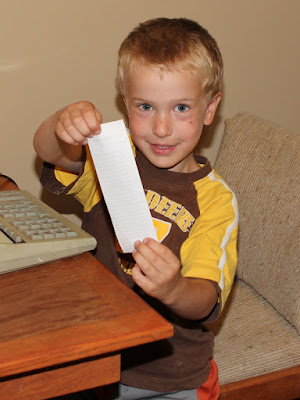
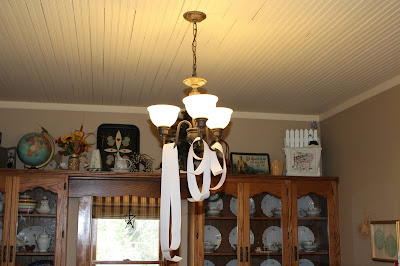
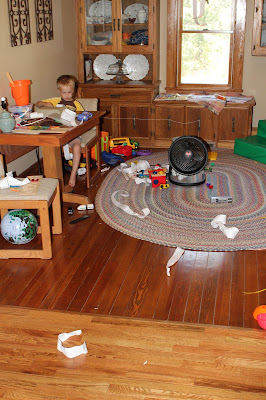
Jacob has been eagerly awaiting this day for at least, well, 2 days now. This morning he started asking questions. All day long he has been wondering how long until the big event. And that event is the arrival of the UPS truck carrying a special $8 package for him. And in that $8 package is not a DVD, or a book, or a toy, but rather 12 rolls of adding machine tape (totaling 1/3 of a mile). Oh yes, our four-year-old can hardly contain his excitement over office supplies. Let me back up a bit to explain. I am always on the lookout for a certain kind of toy. The sort of thing that you don t find in the toy section of a store. The sort of thing that is interesting and engages the curiosity of our boys, that most people would consider would toss, and that usually costs less than $5. Along those lines, Jacob has an old manual typewriter he can use, he and I built a switchbox full of switches and light bulbs that the boys love to play with, we built him a command-line-only PC out of spare parts, the boys have some radios they can use, and one day I salvaged a decades-old adding machine that was going to be thrown out. Jacob liked it he enjoys number and letter games and had some fun, but didn t zealously engage with it until just a few days ago. He sat down at his table and started making cards . He will print out a bunch of numbers, making a strip a couple of feet long, and then say, Dad, I made another card for you! We will then happily accept the card and he will continue making more. Here he is, holding up one of his cards: Jacob had a ton of fun making them, and Oliver wanted in on the action too. Oliver was somewhat interested in the adding machine, but not as much as Jacob, and Jacob didn t want to share. So somehow they decided that Oliver would run and get cards from Jacob and then take them to whatever parent Jacob said. Today Jacob said, Dad, the Oliver delivery service will bring you a card! Saturday morning we had some time to hang around and play, so we played some adding machine tape games. I tucked some long cards under my waistband, and the boys happily chased me all over the house trying to get them back. We also decorated: And here is what the room looked like after some cleanup: That orange bucket on the desk is my card bucket where I can put all the cards he gives me. He even helpfully empties it out into the recycle bin when there are too many old cards in it! But then tragedy struck it was out of paper! I ordered a 12-roll pack off Amazon, and boy was it a long couple of days until it arrived. Today before the UPS truck got here, I showed him how we could feed old paper through and print on the back side an incredible innovation, it seemed! Terah had a conversation with him earlier that went like this: Terah: Jacob, we need to clean up the house. Jacob: Why? Terah: Because some people are coming over. Jacob: Who is OH YES! The UPS delivery man! Yes, let s clean! Terah: Ah, well yes he will be here too, but your great uncle and aunt are coming. Jacob: Oh yay! And the UPS man! It is hard to describe Jacob s excitement when the package arrived. I quickly opened it up, and at his great uncle s prompting, he counted to see if he really did get 12 rolls of paper. IT IS TWELVE ROLLS! YAY! And then we quickly installed it in the machine and off he went. At his great uncle s prompting, he started writing a J on each card . This meant Jacob , or maybe he d put two J s, meaning To John From Jacob , or perhaps the two J s meant To Terah From Jacob he d always have to clue us in. Anyhow, for an $8 investment in paper this has brought hours of joy to our boys. Even though Jacob isn t yet really using it to perform arithmetic, it is setting him up to enjoy that sort of thing and encouraging his curiosity. Both good things.

25 July 2011

Andrea Veri: Backup your Gmail in a few easy steps!

I ve actually spent a few hours searching around for a good backup solution for my mailbox until I decided to stick with getmail. What you ll be able to achieve after reading this HowTo and deploying the following setup is:
  1. A full backup of your e-mail DATA in the Mbox format. (yes, Gmail s labels / folders as well)
  2. Prevent getmail to mark all mails as read after delivering them. (this was a pretty bad issue since getmail was marking all my mails as read even if I did not access my e-mail at all)
  3. Keep your backups up-to-date with the latest content from your mailbox. (by default getmail grabs all the DATA from your mailbox and fills up the Mbox / Maildir content keeping deleted mails. So let s say I deleted a mail two days ago, well it ll still appear on today s backups. This behaviour is definitely unwanted)
I ll now move to explain a few details about my new configuration but before moving to tweak getmail s main config file, please do the following change on _retrieverbases.py* :
return self._getmsgpartbyid(msgid, (RFC822) ) to return self._getmsgpartbyid(msgid, (BODY.PEEK[]) )
When done grab the following getmailrc and adapt it to your needs**:
[retriever]
type = SimpleIMAPSSLRetriever ## or SimplePOP3SSLRetriever.
server = imap.gmail.com ## or pop.gmail.com for POP3.
username = example@gmail.com
password = password ## so-called Gmail s labels should be listed one by one here for getmail to retrieve mail from them successfully. mailboxes = ( INBOX , [Gmail]/Sent mail ,
ubuntu , gnome/example , linux/example ) [destination]
type = Mboxrd
path = ~/.getmail/backup.mbox [options]
delivered_to = false ## No delivered_to header added automatically.
received = false ## No received header added automatically.
verbose = 2 ## getmail will print messages about each of its actions.
When done we should go ahead setting up getmail s directories and config file:
mkdir $HOME/.getmail cp $HOME/getmailrc $HOME/.getmail/ ## Adapt $HOME/getmailrc to whatever dir you put that file into.
But pretty much all the remaining work will be done by a small shell script I wrote:
#!/bin/sh WORKDIR=$HOME/.getmail
date= date +%d-%m-%Y_%H:%M if [ ! -f $WORKDIR/backup.mbox ]
then
touch $WORKDIR/backup.mbox
fi getmail > $WORKDIR/getmail.log
OUT=$?
if [ $OUT -eq 0 ]
then
mkdir -p $WORKDIR/backups/ && mv $WORKDIR/backup.mbox $WORKDIR/backups/backup_$date.mbox ;
else [ $OUT -eq 1 ]
exit 1
fi ## Cleanup older than 3 days backups
find $WORKDIR/backups/* -mtime +3 -exec rm ;
cd $WORKDIR && rm -rf oldmail-* ;
This script will:
  1. Run getmail using the getmailrc config file you previously worked on.
  2. If the above command will be successful, it ll create a backups dir into $HOME/.getmail and move the latest Mbox file there appending a date and time to its name. (by doing this we are sure next getmail run will happen on an empty backup.mbox file, thus it will just contain the latest content from your mailbox)
  3. It ll re-create a backup.mbox file on $HOME/.getmail to avoid the next getmail run to fail.
  4. In the end, it ll clean up older than 3 days backups to avoid a too crowded backups folder. (it removes the oldmail file as well since it is useless in our case)
In the end set up a cronjob that will run the above script and generate the backups for you every one hour:
0 * * * * $HOME/.getmail/getmail_run.sh > /dev/null
Feel free to let me know if you ve encountered any issue while following the above HowTo. Enjoy! * /usr/share/getmail4/getmailcore/_retrieverbases.py on line 901. ** More documentation about the getmailrc file and syntax can be found on getmail s documentation page.

24 July 2011

Russell Coker: SE Linux File Context Precedence

In my previous post I expressed a desire to use regular expressions for files that may appear in multiple places in the tree due to bind mounts for /run and /var/run etc [1]. However there is a problem with this idea. The SE Linux file labeling program restorecon reads the file /etc/selinux/$SELINUXTYPE/contexts/files/file_contexts which contains a set of regular expressions to assign labels to files. That file is ordered and the last entry which matches is the one that counts. When the file_contexts file is created the order is based on how many characters at the start of the file specification aren t regular expression meta-characters. For example the entry /.* is at the top of the file (and therefore has the lowest precedence), which makes it the catch-all entry for files that have no other match. So an entry for /var/run/REGEX will have a higher precedence than one for /var/REGEX , this means however that when I replaced the /var/run part with a regular expression then it had a lower precedence and it didn t work properly. I should have remembered this as I did a lot of work on setfiles (which became restorecon) in the early days. I have now developed a new way of solving this and this time I m testing it before blogging about it. I have written the following PERL program to fix the file contexts, this adds multiple lines and uses a distro_debian conditional on them so that they don t slip into upstream use and so that if I lose track of where each patch came from I ll know that I can delete them in future because it only matters to Debian. #!/usr/bin/perl
use warnings;
use strict; open(LIST, "find . -name \"*.fc\" xargs egrep \"^/(var.*run) (var/lock) (dev/shm)\" cut -f1 -d: uniq ") or die "Can't get file list\n";
while(<LIST>)

my $filename = $_;
chomp $filename;
open(my $infile, "<", $filename) or die "Can't open file $filename";
open(my $outfile, ">", $filename . ".new") or die "Can't open file ". $filename . ".new";
while(<$infile>)

print $outfile $_;
my $newline;
if($_ =~ /^\/var\/run/)

print $outfile "ifdef( distro_debian', \n";
$newline = $_;
$newline =~ s/^\/var//;
print $outfile $newline;
print $outfile "')\n";

if($_ =~ /^\/var\/lock/)

print $outfile "ifdef( distro_debian', \n";
$newline = $_;
$newline =~ s/^\/var/\/var\/run/;
print $outfile $newline;
$newline =~ s/^\/var//;
print $outfile $newline;
print $outfile "')\n";

if($_ =~ /^\/dev\/shm/)

print $outfile "ifdef( distro_debian', \n";
$newline = $_;
$newline =~ s/^\/dev/\/run/;
print $outfile $newline;
print $outfile "/var" . $newline;
print $outfile "')\n";


close($infile);
close($outfile);
rename $filename . ".new", $filename or die "Can't rename " . $filename . ".new to " . $filename;
The next policy thing that I have to work on is systemd. From a quick test it seems that systemd policy changes will be more invasive than is suitable for Squeeze. This means that someone who wants to upgrade from Squeeze to Wheezy+systemd will have to upgrade to Wheeze policy before installing systemd. I think that I will make 0.2.20100524-10 the last version in Unstable based on the 2010 release, I will now start work on packaging the latest upstream policy for Unstable. PS I m not much of a PERL programmer, so if anyone has suggestions for how to improve the above PERL code then please let me know. Please note however that I m not interested in making my code look like line-noise.

Martin Michlmayr: Upgrade to mainline U-Boot from Debian archive

When Marvell originally released the first plug computer, they created their own version of u-boot with support for their new devices. Unfortunately, this version of u-boot is fairly out of date nowadays compared to mainline u-boot and has several problems. Support for plug computers (such as SheevaPlug and GuruPlug) have been integrated into the mainline u-boot (also known as DENX u-boot) in the meantime and Clint Adams has packaged it for Debian. I finally found the time to test Clint's u-boot binary on my devices and have updated the SheevaPlug installation guide accordingly. If you're have installed Debian to a SheevaPlug according to my instructions, I suggest you upgrade. If you boot from a MMC/SD card, you should be aware that the mmcinit command has been renamed to mmc init in order to be consistent with the naming of other commands. You'll therefore have to update your bootcmd_mmc variable in u-boot like this:
setenv bootcmd_mmc 'mmc init; ext2load mmc 0:1 0x00800000 /uImage; ext2load mmc 0:1 0x01100000 /uInitrd'
saveenv

22 July 2011

Stefano Zacchiroli: 16 months of debian sprints

average sprint speed: 1 sprint/month I've proposed a DebConf11 BoF on Debian sprints and, more generally, on how we have been using Debian money in the past 1.3 years. As part of the BoF preparation, I've taken the time to review the last 16 months of sprints and check how the Debian Sprint Program which we've recently streamlined and "marketed" quite a bit is going. In particular, I've finally done the homework of preparing the big table of sprints and their costs, in order to evaluate how sustainable the sprint program is. Without further ado, here is the table:
Debian sprints held from April 2010 to June 2011
No Sprint When (month) Where Attendees Debian cost (EUR)
1 groupware (report) 04/2010 de 4 240
2 FAI (report) 06/2010 de 7 570
(DebConf10) 08/2010 us
3 ftpmaster (report) 09/2010 de 3 350
4 DSA (report) 09/2010 de 3 400
5 release team (report) 10/2010 fr 6 0
6 kernel team (report) 10/2010 fr 3 120
7 www team 12/2010 at 5 1430
8 debian med 01/2011 de 25 460
9 security team 01/2011 de 7 1000
10 emdebian 02/2011 uk 17 0
11 ftpmaster 03/2011 de 5 2000
12 groupware 04/2011 de 6 300
13 alioth 05/2011 uk 4 500
14 debian edu 06/2011 de 9 760
15 release team 06/2011 be 5 1640
(DebConf11) 07/2010 ba
Total 15 sprints 16 months 9770
To better understand the table, several comments are in order: Please note that the purpose of the table is not to be precise and transparent about Debian finances and how we use them. That is a (very!) worthwhile goal and I do think Debian should do much better in informing its community about how donated money are used to further Debian goals. But that is a broader topic on which the auditors are working; it is not up to me to discuss it here. If you are interested in that topic though, you might want to follow tbm's BoF at DebConf11. The purpose of the table is rather to find out some general figures about Debian sprints held in the recent past: I'm personally quite happy about those figures. Enabling volunteer developers to meet and hack together in person is possibly the most valuable way of using donated money. Having 1 sprint/month is not bad, but in a project the size of Debian is quite possibly a minimum. Doing more than that is highly desirable. It is also financially sustainable, especially if we will be able to show by actually having more sprints and being transparent about them that we can put into good use donated money. Another, more subtle, aspect of sustainability is that related to sprint management. Processing sprint requests and ensuring that transparency guidelines are actually followed by the organizers is still quite some work. I've been mostly doing that myself up to now, which is all fine and well, but does not necessarily scale. Other organizations (such as KDE e.V.) have realized that to the point of having hired people specifically to manage sprints in an otherwise volunteer community. In Debian we are quite keen of maintaining the project running on a volunteer basis. At the same time I feel we should have more room for scalability in the number of sprints we could run. So if you are looking for a management task to help Debian with, think about becoming, err, "sprint master", and contact me. If otherwise you want to focus on Debian hacking, what are you waiting for? Check the guidelines and propose your sprint! To know more about sprints, Debian money, and how you could help with all that, be sure not to miss the Sprint and money BoF.

Russell Coker: /run and SE Linux Policy

Currently Debian/Unstable is going through a transition to using /run instead of /var/run. Naturally any significant change to the filesystem layout requires matching changes to SE Linux policy. We currently have Debian bug #626720 open about this. Currently the initscripts package breaks selinux-policy-default in Debian/Unstable so that you can t have initscripts using /run if the SE Linux policy doesn t support it. A patch has been suggested to the policy which uses a subst file, basically that causes the SE Linux labeling programs to treat one directory tree the same way as another. The problem with this is that it depends on a libselinux patch that is not in any yet released version of libselinux (and certainly won t be in a Squeeze update). The upside of such a fix is that it would work for policy that I package as well as custom policy, so if someone wrote custom policy referring to /var/run it would automatically work with /run without any extra effort. I think that the only way to do this is to just have regular expressions that deal with this in the file contexts. It s a bit ugly and slows the relabel process down a little (probably no more than about 10%) but it will work and work on Squeeze as well. One thing I really like to do is to have the SE Linux policy for version X of Debian work with version X+1. This makes upgrades a lot easier for the users. Ideally upgrading a server could be a process that involves separate upgrades of the kernel, the SE Linux policy, and user-space in any particular order because upgrading everything at once almost guarantees that something will break and it may be difficult to determine the cause. At this time I m not sure whether I ll add a new policy using the subs file before the release of Wheezy (the next stable release of Debian) or just keep using regular expressions. I can have the Wheezy policy depend on a new enough libselinux so it won t be a problem in that regard (a new upstream version of libselinux with the subst feature should be released soon). In any case I need a back-port to Squeeze to use regular expressions to make an upgrade to Wheezy easier. for n in $(find . -name "*.fc" xargs grep var/run cut -f1 -d: uniq) ; do
sed -e "s/\/var\/run/\/(var\/)?run/" < $n > $n.new
mv $n.new $n
done
for n in $(find . -name "*.fc" xargs grep var/lock cut -f1 -d: uniq) ; do
sed -e "s/\/var\/lock/\/((var\/run) (run) (var))\/lock/" < $n > $n.new
mv $n.new $n
done
for n in $(find . -name "*.fc" xargs grep dev/shm cut -f1 -d: uniq) ; do
sed -e "s/\/dev\/shm/\/((var\/run) (run) (dev))\/shm/" < $n > $n.new
mv $n.new $n
done I used the above fragment of shell code to change /var/run to /(var/)?run , /var/lock to /((var/run) (run) (var))/lock , and change /dev/shm to /(var/run) (run) (dev))/shm . It involves a reasonable number of changes to policy (mostly for /var/run), but hopefully this will be acceptable to the release team for inclusion in the next Squeeze update as the changes are relatively simple and obvious and the size of the patch is due to it being generated code. There is one final complication, Squeeze currently has selinux-policy-default version 2:0.2.20100524-7+squeeze1, but initscripts in Unstable breaks versions <= 2:0.2.20100524-9. So I guess I could submit a proposed version 2:0.2.20100524-9+squeeze1 to the release team to fix this. I would really like to have the Squeeze policy work with initscripts from Unstable or Wheezy. Any suggestions for how to deal with this? Update: I wrote the above before testing the code, and it turned out to not work. I ve written another post describing a better solution that I have now uploaded to Unstable. I still have to sort something out with an update for Squeeze.

Next.

Previous.