Search Results: "tar"

17 August 2017

Julian Andres Klode: Why TUF does not shine (for APT repositories)

In DebConf17 there was a talk about The Update Framework, short TUF. TUF claims to be a plug-in solution to software updates, but while it has the same practical level of security as apt, it also has the same shortcomings, including no way to effectively revoke keys. TUF divides signing responsibilities into roles: A root role, a targets rule (signing stuff to download), a snapshots rule (signing meta data), and a time stamp rule (signing a time stamp file). There also is a mirror role for signing a list of mirrors, but we can ignore that for now. It strongly recommends that all keys except for timestamp and mirrors are kept offline, which is not applicable for APT repositories Ubuntu updates the repository every 30 minutes, imagine doing that with offline keys. An insane proposal. In APT repositories, we effectively only have a snapshots rule the only thing we sign are Release files, and trust is then chained down by hashes (Release files hashes Packages index files, and they have hashes of individual packages). The keys used to sign repositories are online keys, after all, all the metadata files change every 30 minutes (Ubuntu) or 6 hours (Debian) it s impossible to sign them by hand. The timestamp role is replaced by a field in the Release file specifying until when the Release file is considered valid. Let s check the attacks TUF protects again: As we can see, APT addresses all attacks TUF addresses. But both do not handle key revocation. So, if a key & mirror gets compromised (or just key and the mirror is MITMed), we cannot inform the user that the key has been compromised and block updates from the compromised repository. I just wrote up a proposal to allow APT to query for revoked keys from a different host with a key revocation list (KRL) file that is signed by different keys than the repository. This would solve the problem of key revocation easily even if the repository host is MITMed or compromised, we can still revoke the keys signing the repository from a different location.
Filed under: Debian, Ubuntu

Shirish Agarwal: Composers are not given due recognition

Update Some youtube links are not viewable or even seen on planet.debian.org. Seems p.d.o. tries its best to remove external links, sorry for the breakage. Beware some youtube-links would be shared in this entry, sorry couldn t find a better/easier media platform to work with. If anyone knows any other platform or wants to suggest, feel free to either mail me or let me know in comments. I want to start today s sharing with a picture of Ganesha I saw today. It is and was public art hence sharing it without an issue. Sketch of Ganesha/Ganapati This is starting of festivities time in India and Ganesha or Ganpati is looked up as a good omen in India. The festival of Ganesh Chaturthi would be starting on the 25th of August and is a sight to behold. Just like Rio has its carnival, Ganesh Chaturthi is also a carnival. We also have parades where people come with Pandals (or temporary structures) The mythology says he has a sweet tooth (hence lot of distribution of sweets, especially modak) and anything which might be troubling people, he creates solutions for them. Here is one video of how people celebrate his immersion in India. This is from my home-town few years ago, every year the madness and the celebrations are becoming more and more. People from far off come to see how we celebrate and see how different people make their Pandals. While some are with music, others are with social messages. Usually people start going to see these structures after dusk and return home way after midnight or early morning. I hope to do this endeavour after many years. One is drunk from hearing all sorts of different kids of music, decoration, messages, a feast and a strain to all the senses. Ganesha immersion celebrations https://www.youtube.com/watch?v=hjWfpGUryho If one is interested one can find more info. at https://en.wikipedia.org/wiki/Ganesh_Chaturthi After quite a bit of time, I wrote an article about various foss internships which I knew besides GSOC over the years. I finally penned them down at https://itsfoss.com/best-open-source-internships/ Interestingly, I was amazed to see that all FOSS U.S. projects (outside of GSOC) are for students who are either living or studying in U.S. and have a student work visa (which from private discussions I came to know is lot harder to get nowadays than before). Except for the National Science Foundation (NSF) which probably has U.S. defence relations and hence they might be sensitive, I fail to understand other institutes preferences for only getting people from the U.S. and hence having a lesser talent pool of people. This also affects the growth of the projects themselves. Just think how limited Debian would have been if it had decided to only have people from only any one community develop it. Dunno if this is due to the present President Trump or these policies had been there before. It would be nice and interesting if people in the know can share. What has also been interesting to watch is Mr. Trump blaming low-cost manufacturing centres like India and China when as far as I recall, lot of manufacturing, specifically auto-mobiles manufacturing was shifted out of the U.S. to Ireland and other places years before which are relatively high-cost places (at least compared to India). I *believe* the change was as early as in 1980 s itself where India was insulated and had a limited market for everything (similar to Russian communism as shown in popular media but not so bad.) Interestingly, it took almost a month for the perl 2.56 to make the transition smoothly. It took quite a bit of time for all the components to work together and be installable. Also saw this few days back http://fortune.com/2017/04/12/auto-industry-decline/ While Tesla is expensive even by American standards the idea of lesser parts, lesser complexity and hence lower costs to use, maintain is good. I do hope that he and his team or any of the competitors do overcome the significant challenges. Any significant improvement in battery technology is bound to have huge impact in almost everything that is used in 21st century. Two recent articles tell me the future may become present very quickly. https://www.purdue.edu/newsroom/releases/2017/Q2/instantly-rechargeable-battery-could-change-the-future-of-electric-and-hybrid-automobiles.html Toyota could finally start mass producing electric cars thanks to China I do hope to see EV being prevalent before the next decade is over otherwise we don t have any hope due to climate change. As for my health, I am much better than before. Just to share some stats, before my illness for lack of better word, I was 120 kgs. , when I was kept in the hospital for about 2-2.5 weeks I came down to 95 kgs. and now back upto 108 kgs. Do go for exercising every other day and trying to get back the strength, stamina and increasing a bit of both. Doctors have given me another 4-5 months after which a brain scan will reveal if there are any remaining blood clots in the brain or not. Lastly, while it has become somewhat of a sensitive issue to love Muslims or to talk about their work in any field in the current political climate, there are 4-5 music pieces I listen whenever I can, especially before going to bed. While almost all the pieces have been sung and written by Muslims, sadly I don t know who the composers of these beautiful songs are. While it is much easier to get the names of the singer and the lyricist, one of the more important roles in my view is the composer or/and music arranger. Without them, the songs would not have the same haunting quality that the songs have. While I have been lucky to find the names of the composer/music arranger for the pieces below but this is not the case if and when the songs comes on television. I do remember in old times at least on Radio they used to mention about who has given the music as well, dunno in modern times. I am sharing the songs, and hopefully will also share the translations if I find on the web, please see the lyrics. The numbering is for convenience only and am torn in these 4-5 songs which is the best. Just to share these are all sufi love songs except the last one which I am sharing. 1. Lyrical song https://www.youtube.com/watch?v=ehqN6oTpmb8 Translation with video of song http://www.bollynook.com/en/lyrics/6443/aaj-din-chadheya/ While there probably are stories with each song, I was lucky to find the story about this one. The lyrics of the song are actually a love lost Punjabi poet who writes in the memory of his beloved to which he could not marry and he pens those when standing in line for his liquor. The story goes on that he marries a girl later in life who bears a resemblance to his beloved whom he couldn t forget till his dying day. 2. Lyrical song https://www.youtube.com/watch?v=uTC_2c83qn0 The same song has been sung by different people and I love them all the more for it. Another video https://www.youtube.com/watch?v=3G7Qg4LJ7WE Another video https://www.youtube.com/watch?v=kOsvNuR3m5Y Translation http://www.bollynook.com/en/lyrics/10703/o-re-piya/ 3. Lyrical song https://www.youtube.com/watch?v=qG7Kms_YA5Q The translation http://www.filmyquotes.com/songs/885 The translation of the song is a bit crude but then translations are supposed to be crude  Anyways, the above song is what would be called a perfect Sufi song. I hope people enjoy the longing and the silence which follows this piece. Another classic one 4. Lyrical song https://www.youtube.com/watch?v=Ube5XhN_lpM English translation http://www.ardhamy.com/song/aye-dil-e-naadan While the song is from the movie Razia Sultana and was a flop as the movie was about Race and controversial then as it probably would be now. As seen in the other songs of the same genre, it has strands of longing, loneliness as seen of the above. 5. Lyrical song https://www.youtube.com/watch?v=tv242qOnHJA This one is not a sufi song but I love all the women and the girls and the way they enhanced the song. I dunno how much they must have practised as it s a very fast and peppy song and doesn t give time to the singer to breathe except for that one section which has a bit of Carnatic music. At the very end I would like to share http://www.globalrhythm.net/ I have found some interesting sounds on the site. Hope the site enriches you as well. FWIW I have no links with the site except as somebody who likes to diversify his music listening. Lastly, for a long period of time, I had been hearing the criticism, especially for FOSS games that they don t have AAA quality assets. Recently I came across a game called Starship Theory (sadly its only for MS-Windows) Game video https://www.youtube.com/watch?v=imaL2pjNURg You look at the game and see the number of videos the guy has made. What FOSS game developers can learn from this, you don t need high-end 2.5/3d models, clipart will do but need depth in gameplay which can make FOSS games be popular and also earn a pretty bundle. I do hope some FOSS game upstream developers take note and use that game s inspiration to bring more depth. That doesn t mean games like 0ad are not liked by people but it takes huge amount of time and resources. 0ad video https://www.youtube.com/watch?v=DHx5XBtypcQ Hope you have a good time with all the ideas, anecdotes and videos I shared above.
Filed under: Miscellenous Tagged: #FOSS Internships, #Ganesh Chaturthi, #Ganeshji, #planet-debian, #Sufi Bollywood Music, FOSS, FOSS games, politics

16 August 2017

Holger Levsen: 20170816-irssi-timezones

How to change irssi's timezone without restart Happy birthday to all you lovely Debian people! For my future self:
<Rhonda>   h01ger: /script exec $ENV TZ  = 'Europe/Vienna';

Simon McVittie: DebConf 17: Flatpak and Debian

The indoor garden at Coll ge de Maisonneuve, the DebConf 17 venue
Decorative photo of the indoor garden
I'm currently at DebConf 17 in Montr al, back at DebConf for the first time in 10 years (last time was DebConf 7 in Edinburgh). It's great to put names to faces and meet more of my co-developers in person! On Monday I gave a talk entitled A Debian maintainer's guide to Flatpak , aiming to introduce Debian developers to Flatpak, and show how Flatpak and Debian (and Debian derivatives like SteamOS) can help each other. It seems to have been quite well received, with people generally positive about the idea of using Flatpak to deliver backports and faster-moving leaf packages (games!) onto the stable base platform that Debian is so good at providing. A video of the talk is available from the Debian Meetings Archive. I've also put up my slides in the DebConf git-annex repository, with some small edits to link to more source code: A Debian maintainer's guide to Flatpak. Source code for the slides is also available from Collabora's git server. The next step is to take my proof-of-concept for building Flatpak runtimes and apps from Debian and SteamOS packages, flatdeb, get it a bit more production-ready, and perhaps start publishing some sample runtimes from a cron job on a Debian or Collabora server. (By the way, if you downloaded that source right after my talk, please update - I've now pushed some late changes that were necessary to fix the 3D drivers for my OpenArena demo.) I don't think Debian will be going quite as far as Endless any time soon: as Cosimo outlined in the talk right before mine, they deploy their Debian derivative as an immutable base OS with libOSTree, with all the user-installable modules above that coming from Flatpak. That model is certainly an interesting thing to think about for Debian derivatives, though: at Collabora we work on a lot of appliance-like embedded Debian derivatives, with a lot of flexibility during development but very limited state on deployed systems, and Endless' approach seems a perfect fit for those situations. [Edited 2017-08-16 to fix the link for the slides, and add links for the video]

Ross Gammon: My Debian & Ubuntu work from April to mid-August 2017

Okay, so I have been slack with my blogging again. I have been travelling around Europe with work quite a bit, had a short holiday over Easter in Denmark, and also had 3 weeks of Summer Holiday in Germany. Debian
  • Tidied up the packaging and tried building the latest version of libdrumstick, but tests had been added to the package by upstream which were failing. I still need to get back and investigate that.
  • Updated node-seq (targeted at experimental due to the Debian Stretch release freeze) and asked for sponsorship (as I did not have DM rights for it yet).
  • Uploaded the latest version of abcmidi (also to experimental), and again.
  • Updated node-tmp to the latest version and uploaded to experimental.
  • Worked some more on bluebird RFP, but getting errors when running tests. I still haven t gone back to investigate that.
  • Updated node-coffeeify to the latest version and uploaded to experimental.
  • Uploaded the latest version of node-os-tmpdir (also to experimental).
  • Uploaded the latest version of node-concat-stream (also to experimental).
  • After encouragement from several Debian Developers, I applied to become a full Debian Developer. Over the summer months I worked with Santiago as my Application Manager and answered questions about working in the Debian Project.
  • A web vulnerability was identified in node-concat-stream, so I prepared a fix to the version in unstable, uploaded it to unstable, and submitted a unblock request bug so that it would be fixed in the coming Debian Stretch release.
  • Debian 10 (Stretch) was released! Yay!
  • Moved abcmidi from experimental to unstable, adding an autopkgtest at the same time.
  • Moved node-concat-stream from experimental to unstable. During the process I had to take care of the intermediate upload to stretch (on a separate branch) because of the freeze.
  • Moved node-tmp to unstable from experimental.
  • Moved node-os-tmpdir from experimental to unstable.
  • Filed a removal bug for creepy, which seems to be unmaintained upstream these days. Sent my unfinished Qt4 to Qt5 porting patches upstream just in case!
  • Uploaded node-object-inspect to experimental to check the reverse dependencies, then moved it to unstable. Then a new upstream version came out which is now in experimental waiting for a retest of reverse dependencies.
  • Uploaded the latest version of gramps (4.2.6).
  • Uploaded a new version of node-cross-spawn to experimental.
  • Discovered that I had successfully completed the DD application process and I was now a Debian Developer. I celebrated by uploading the Debian Multimedia Blends package to the NEW queue, which I was not able to do before!
  • Tweaked and uploaded the node-seq package (with an RC fix) which had been sitting there because I did not have DM rights to the package. It is not an important package anyhow, as it is just one of the many dependencies that need to be packaged for Browserify.
  • Packaged and uploaded the latest node-isarray directly to unstable, as the changes seemed harmless.
  • Prepared and uploaded the latest node-js-yaml to experimental.
  • Did an update to the Node packaging Manual now that we are allowed to use node as the executable in Debian instead of nodejs which caused us to do a lot of patching in the past to get node packages working in Debian.
Ubuntu
  • Did a freeze exception bug for ubuntustudio-controls, but we did not manage to get it sponsored before the Ubuntu Studio Zesty 17.04 release.
  • Investigated why Ardour was not migrating from zesty-proposed, but I couldn t be sure of what was holding it up. After getting some help from the Developer s mailing list, I prepared no change rebuild of pd-aubio which was sponsored by Steve Langasek after a little tweak. This did the trick.
  • Wrote to the Ubuntu Studio list asking for support for testing the Ubuntu Studio Zesty release, as I would be on holiday in the lead up to the release. When I got back, I found the release had gone smoothly. Thanks team!
  • Worked on some blueprints for the next Ubuntu Studio Artful release.
  • As Set no longer has enough spare time to work on Ubuntu Studio, we had a meeting on IRC to decide what to do. We decided that we should set up a Council like Xubuntu have. I drafted an announcement, but we still have not gone live with it yet. Maybe someone will have read this far and give us a push (or help).
  • Did a quick test of Len s ubuntustudio-controls re-write (at least the GUI bits). We better get a move on if we want this to be part of Artful!
  • Tested ISO for Ubuntu Studio Xenial 16.04.3 point release, and updated the release notes.
  • Started working on a merge of Qjackctl using git-ubuntu for the first time. Had some issues getting going, so I asked the authors for some advice.

15 August 2017

Lisandro Dami n Nicanor P rez Meyer: Qt 4 removal in Debian testing (Buster)/unstable

We have been announcing it: we are going to remove Qt 4 during the Buster cycle.

Or at least that's the best outcome we can expect. Removing a very highly used library is hard, as Qt4's Webkit has proved. Qt 4 is long dead upstream and we have already started to need to patch it with untested patches as in the OpenSSL 1.1 case (will be in experimental in a few hours after this post).

We will try to put as less effort as possible in keeping it alive meaning that from now on if we need to patch it to make it support a newer lib or alike we will simply remove its support if possible. Using the OpenSSL case as an example, if we need to support any version > 1.1 we will simply remove the SSL support. That means things will break.

So, if you depend on FLOSS which is still based on Qt 4 be sure to try to port it. If you depend on a proprietary vendor software which uses Qt 4 then you better start telling them it's really time to update it. Really.

We will soon start filing bugs against packages using Qt 4. I'll update this blog post later to add that info.

For the Qt/KDE team, Lisandro.

Dirk Eddelbuettel: #9: Compacting your Shared Libraries

Welcome to the nineth post in the recognisably rancid R randomness series, or R4 for short. Following on the heels of last week's post, we aim to look into the shared libraries created by R. We love the R build process. It is robust, cross-platform, reliable and rather predicatable. It. Just. Works. One minor issue, though, which has come up once or twice in the past is the (in)ability to fully control all compilation options. R will always recall CFLAGS, CXXFLAGS, ... etc as used when it was compiled. Which often entails the -g flag for debugging which can seriously inflate the size of the generated object code. And once stored in $ RHOME /etc/Makeconf we cannot on the fly override these values. But there is always a way. Sometimes even two. The first is local and can be used via the (personal) ~/.R/Makevars file (about which I will have to say more in another post). But something I have been using quite a bite lately uses the flags for the shared library linker. Given that we can have different code flavours and compilation choices---between C, Fortran and the different C++ standards---one can end up with a few lines. I currently use this which uses -Wl, to pass an the -S (or --strip-debug) option to the linker (and also reiterates the desire for a shared library, presumably superfluous):
SHLIB_CXXLDFLAGS = -Wl,-S -shared
SHLIB_CXX11LDFLAGS = -Wl,-S -shared
SHLIB_CXX14LDFLAGS = -Wl,-S -shared
SHLIB_FCLDFLAGS = -Wl,-S -shared
SHLIB_LDFLAGS = -Wl,-S -shared
Let's consider an example: my most recently uploaded package RProtoBuf. Built under a standard 64-bit Linux setup (Ubuntu 17.04, g++ 6.3) and not using the above, we end up with library containing 12 megabytes (!!) of object code:
edd@brad:~/git/rprotobuf(feature/fewer_warnings)$ ls -lh src/RProtoBuf.so
-rwxr-xr-x 1 edd edd 12M Aug 14 20:22 src/RProtoBuf.so
edd@brad:~/git/rprotobuf(feature/fewer_warnings)$ 
However, if we use the flags shown above in .R/Makevars, we end up with much less:
edd@brad:~/git/rprotobuf(feature/fewer_warnings)$ ls -lh src/RProtoBuf.so 
-rwxr-xr-x 1 edd edd 626K Aug 14 20:29 src/RProtoBuf.so
edd@brad:~/git/rprotobuf(feature/fewer_warnings)$ 
So we reduced the size from 12mb to 0.6mb, an 18-fold decrease. And the file tool still shows the file as 'not stripped' as it still contains the symbols. Only debugging information was removed. What reduction in size can one expect, generally speaking? I have seen substantial reductions for C++ code, particularly when using tenmplated code. More old-fashioned C code will be less affected. It seems a little difficult to tell---but this method is my new build default as I continually find rather substantial reductions in size (as I tend to work mostly with C++-based packages). The second option only occured to me this evening, and complements the first which is after all only applicable locally via the ~/.R/Makevars file. What if we wanted it affect each installation of a package? The following addition to its src/Makevars should do:
strippedLib: $(SHLIB)
        if test -e "/usr/bin/strip"; then /usr/bin/strip --strip-debug $(SHLIB); fi
.phony: strippedLib
We declare a new Makefile target strippedLib. But making it dependent on $(SHLIB), we ensure the standard target of this Makefile is built. And by making the target .phony we ensure it will always be executed. And it simply tests for the strip tool, and invokes it on the library after it has been built. Needless to say we get the same reduction is size. And this scheme may even pass muster with CRAN, but I have not yet tried. Lastly, and acknowledgement. Everything in this post has benefited from discussion with my former colleague Dan Dillon who went as far as setting up tooling in his r-stripper repository. What we have here may be simpler, but it would not have happened with what Dan had put together earlier.

This post by Dirk Eddelbuettel originated on his Thinking inside the box blog. Please report excessive re-aggregation in third-party for-profit settings.

14 August 2017

Holger Levsen: 20170812-reproducible-policy

"packages should build reproducibly" - after 4 years this work of many is in debian-policy now This post was written roughly 44h ago and now that the fix for #844431 has been merged into the git master branch, I'm publishing it - hoping you'll enjoy this as much as I do! So today is the last (official) day of DebConf17 and it looks like #844431: "packages should build reproducibly" will be merged into debian-policy today! So I'm super excited, super happy, quite tired and a bit sad (DebConf is ending ) right now! :-) Four years ago Lunar held a BoF at DebConf13 which started the initiative in Debian. I only got involved in September 2014 with setting up continuous tests, rebuilding each package twice with some variations and then comparing the results using diffoscope, which back then was still called debbindiff and which we renamed as part of our efforts to make Reproducible Builds the norm in Free Software. Many people have worked on this, and I'm also very happy how visible this has been in our talk here yesterday. You people rock and I'm very thankful and proud to be part of this team. Thank you everyone! And please understand: we are not 94% done yet (which our reproducibility stats might have made you think), rather more like half done or so. We still need tools and processes to enable anyone to indepently verify that a given binary comes from the sources it is said to be coming, this will involve distributing .buildinfo files and providing user interfaces in APT and elsewhere. And probably also systematic rebuilds by us and other parties. And 6 or 7% of the archive are a lot of packages still, eg in Buster we currently still have 273 unreproducible key packages and for a large part we don't have patches yet. So there is still a lot of work ahead. This is what was added to debian-policy now:
Reproducibility
---------------
Packages should build reproducibly, which for the purposes of this
document [#]_ means that given
- a version of a source package unpacked at a given path;
- a set of versions of installed build dependencies;
- a set of environment variable values;
- a build architecture; and
- a host architecture,
repeatedly building the source package for the build architecture on
any machine of the host architecture with those versions of the build
dependencies installed and exactly those environment variable values
set will produce bit-for-bit identical binary packages.
It is recommended that packages produce bit-for-bit identical binaries
even if most environment variables and build paths are varied.  It is
intended for this stricter standard to replace the above when it is
easier for packages to meet it.
.. [#]
   This is Debian's precisification of the  reproducible-builds.org
   definition  _.
For now violating this part of policy may result in a severity: normal bug, though I think we should still only file them if we have patches, else it's probably better to just take a note in our notes.git, like we did before the policy change. Finally one last comment: we could do reproducible security updates for Stretch now too, for those 94% of the packages which are reproducible. It just needs to be done by someones and the first step would be publishing those .buildinfo files from those builds

Tim Retout: Jenkins milestone steps do not work yet

Public Service Announcement for anyone relying on Jenkins for continuous deployment - the milestone step plugin as of version 1.3.1 will not function correctly if you could have more than two builds running at once - older builds could get deployed after newer builds. See JENKINS-46097. A possible workaround is to add an initial milestone at the start of the pipeline, which will then allow builds to be killed early. (Builds are only killed early once they have passed their first milestone.) Going by the source history, I reckon this bug has been present since the milestone-step plugin was created.

13 August 2017

Lars Wirzenius: Retiring Obnam

This is a difficult announcement to write. The summary is if you use Obnam you should switch to another backup program in the coming months. The first commit to Obnam's current code base is this:
commit 7eaf5a44534ffa7f9c0b9a4e9ee98d312f2fcb14
Author: Lars Wirzenius <liw@iki.fi>
Date:   Wed Sep 6 18:35:52 2006 +0300
    Initial commit.
It's followed by over 5200 more commits until the latest one, which is from yesterday. The NEWS file contains 58 releases. There are 20761 lines of Python, 15384 words in the English language manual, with translations in German and French. The yarn test suite, which is a kind of a manual, is another 13382 words in English and pseudo-English. That's a fair bit of code and prose. Not all of it mine, I've had help from some wonderful people. But most of it mine. I wrote all of that because backups were fun. It was pleasing to use my own program to guarantee the safety of my own data. The technical challenges of implmenting the kind of backup program I wanted were interesting, and solving interesting problems is a big part of why I am a programmer. Obnam has a kind user base. It's not a large user base: the Debian "popularity contest" service estimates it at around 500. But it's a user base that is kind and has treated me well. I have tried to reciprocate. Unfortunately, I have not had fun while developing Obnam for some time now. This has changed. A few years ago, I lived in Manchester, UK, and commuted by train to work. It was a short train ride, about 15 minutes. At times I would sit on the floor with my laptop on my knees, writing code or the manual. Back then Obnam was a lot of fun. I was excited, and enthusiastic. In the past two years or so, I've not been able to feel that excitement again. My native language, Finnish, has an expression describing unpleasant tasks: something is as much fun as drinking tar. That describes Obnam in recent years for me. Obnam has not turned out well, from a maintainability point of view. It seems that every time I try to fix something, I break something else. Usuaully what breaks is speed or memory use: Obnam gets slower or starts using even more memory. For several years now I've been working on a new repository format for Obnam, code names GREEN ALBATROSS. It was meant to solve Obnam's problems as far as extensibility, performance, and resource use were concerned. It seems to have failed. I'm afraid I've had enough. I'm going to retire Obnam as a project and as a program, and move on to doing something else, so I can feel excitement and pleasure again. After some careful thought, I fear that the maintainability problems of Obnam can realistically only be solved by a complete rewrite from scratch, and I'm not up to doing that. If you use Obnam, you should migrate to some other backup solution. Don't worry, you have until the end of the year. I will be around and I intend to fix any serious bugs in Obnam; in particular, security flaws. But you should start looking for a replacement sooner rather than later. I will be asking Obnam to be removed from the Debian unstable and testing branches. The next Debian release (buster, Debian 10) won't include Obnam. The Obnam mailing lists are kindly hosted by Daniel Silverstone, and they will remain, but later this year I will change them to be moderated. The Obnam git repository will remain. The web site will remain, but I will add a note that Obnam is no longer maintained. Other Obnam online resources may disappear. If you would like to take over the Obnam project, and try to resolve the various issues, please contact me to discuss that. Thank you, and may you never need to restore.

Mike Gabriel: @DebConf17: Ad-hoc BoF: Debian for the Remote Desktop

On Thursday at DebConf17, all people interested in using this or that Remote Desktop solution on Debian (as a server, as a client, as both) came together for a BoF. Sharing about Usage Scenarios Quite some time we informally shared with one another what technologies and software we use for remote access to Debian machines and what the experiences are. The situation in Debian and on GNU/Linux in general is that many technical approaches exist, all of them have certain features and certain limitations. The composition of features and limitations finally lead the users to choosing one or another technology as his or her favourite solution. The Debian Remote Maintainers Team On the developers' side, Dominik George and I set up a packaging team for Remote Desktop related software in Debian. A packaging team that we invite everyone who is maintaining such software in the widest sense to join: https://qa.debian.org/developer.php?login=pkg-remote-team%40lists.alioth... 'DebianRemote' namespace on the Debian Wiki For users of Debian, the group agreed, we need an overview page (on wiki.debian.org) that provides an entry point for Debian on the Remote Desktop. An entry point that provides user information as well as developer information. A skeleton of this wiki page, I have just set up (thanks to Vagrant for taking some notes in Gobby during the BoF): https://wiki.debian.org/DebianRemote However, the page still contains loads of FIXMEs, so the actual work only now really starts. Fill the template with content (and also adapt the template, if needed). Everyone with experience and know-how about Remote Desktop on Debian systems is invited to share knowledge and improve this wiki namespace. (I will, at the earliest, start working on Arctica, X2Go and NX passages end of August, but I'll be also happy to find passages having been written down that I can review by then). Tracking Debian Remote Issues in Debian BTS At the BoF, also the following suggestions came up: The Remote Desktop experience on a GNU/Linux desktop or terminal server can be affected by all graphical applications available. Often it happens, that a change in this or that graphical application results in problems in remote sessions, but not so in local sessions. We agreed on filing and tagging such bugs accordingly. For new bugs, please file such bugs with the following BTS header at the top of your mail and always explain what remote desktop solution is being used when the bug appears:
Package: file
Version: 1:5.19-2
Severity: important
User: debian-edu@lists.debian.org
Usertags: debian-edu
Conclusion Overall, I was quite happy that the BoF has been attended by so many people and to see that there is quite "a lobby" in Debian. Let's dive into the work and make Debian 10 the first Debian, that mentions the Remote Desktop in its release notes. Let's, in fact, release Debian 10 as the first Debian with the official announcement as an operating system for the Remote Desktop (like the Fedora people did already for Fedora 20).

Enrico Zini: Consensually doing things together?

On 2017-08-06 I have a talk at DebConf17 in Montreal titled "Consensually doing things together?" (video). Here are the talk notes. Abstract At DebConf Heidelberg I talked about how Free Software has a lot to do about consensually doing things together. Is that always true, at least in Debian? I d like to explore what motivates one to start a project and what motivates one to keep maintaining it. What are the energy levels required to manage bits of Debian as the project keeps growing. How easy it is to say no. Whether we have roles in Debian that require irreplaceable heroes to keep them going. What could be done to make life easier for heroes, easy enough that mere mortals can help, or take their place. Unhappy is the community that needs heroes, and unhappy is the community that needs martyrs. I d like to try and make sure that now, or in the very near future, Debian is not such an unhappy community. Consensually doing things together I gave a talk in Heidelberg. Valhalla made stickers Debian France distributed many of them. There's one on my laptop. Which reminds me of what we ought to be doing. Of what we have a chance to do, if we play our cards right. I'm going to talk about relationships. Consensual relationships. Relationships in short. Nonconsensual relationships are usually called abuse. I like to see Debian as a relationship between multiple people. And I'd like it to be a consensual one. I'd like it not to be abuse. Consent From wikpedia:
In Canada "consent means the voluntary agreement of the complainant to engage in sexual activity" without abuse or exploitation of "trust, power or authority", coercion or threats.[7] Consent can also be revoked at any moment.[8] There are 3 pillars often included in the description of sexual consent, or "the way we let others know what we're up for, be it a good-night kiss or the moments leading up to sex." They are:
  • Knowing exactly what and how much I'm agreeing to
  • Expressing my intent to participate
  • Deciding freely and voluntarily to participate[20]
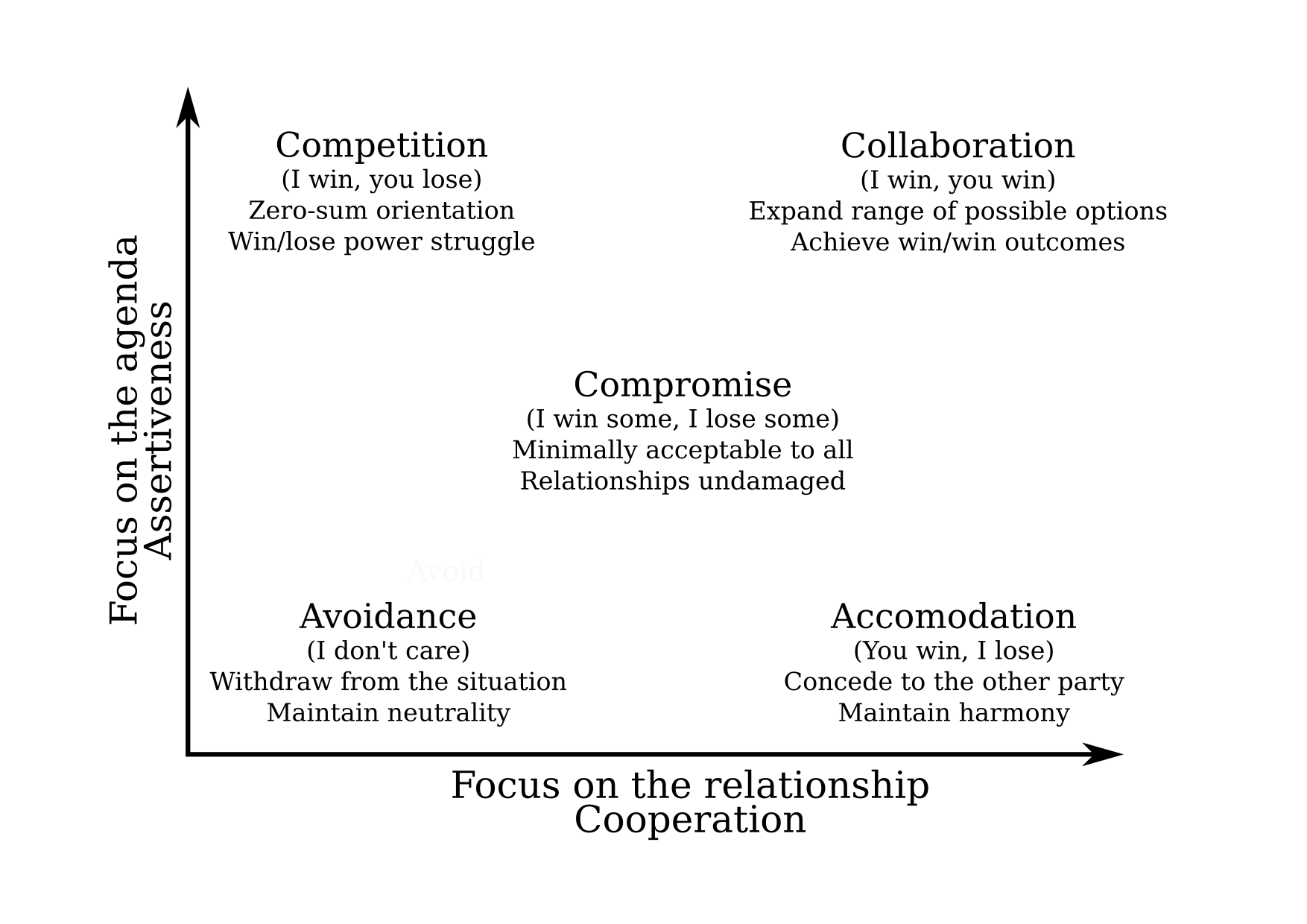
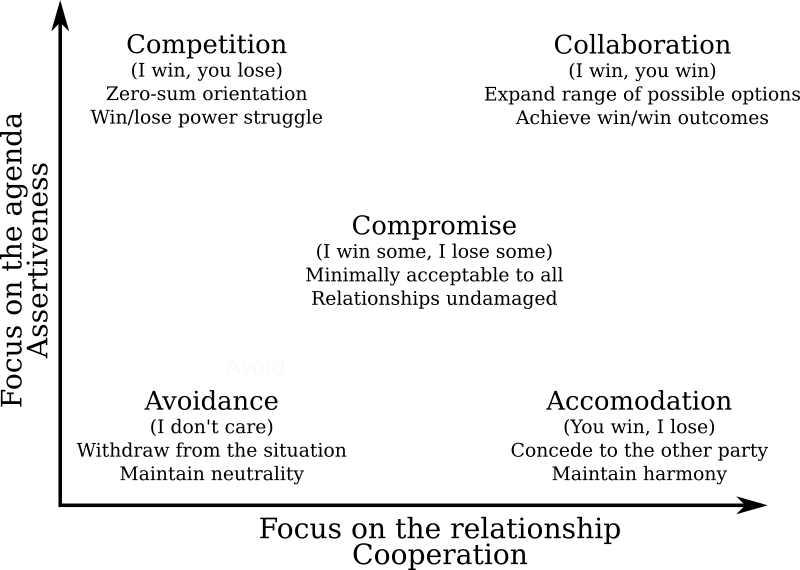
Saying "I've decided I won't do laundry anymore" when the other partner is tired, or busy doing things. Is different than saying "I've decided I won't do laundry anymore" when the other partner has a chance to say "why? tell me more" and take part in negotiation. Resources: Relationships Debian is the Universal Operating System. Debian is made and maintained by people. The long term health of debian is a consequence of the long term health of the relationship between Debian contributors. Debian doesn't need to be technically perfect, it needs to be socially healthy. Technical problems can be fixed by a healty community. graph showing relationship between avoidance, accomodation, compromise, competition, collaboration The Thomas-Kilmann Conflict Mode Instrument: source png. Motivations Quick poll: What are your motivations to be in a relationship? Which of those motivations are healthy/unhealthy? "Galadriel" (noun, by Francesca Ciceri): a task you have to do otherwise Sauron takes over Middle Earth See: http://blog.zouish.org/nonupdd/#/22/1 What motivates me to start a project or pick one up? What motivates me to keep maintaning a project? What motivates you? What's an example of a sustainable motivation? Is it really all consensual in Debian? Energy Energy that thing which is measured in spoons. The metaphore comes from people suffering with chronic health issues:
"Spoons" are a visual representation used as a unit of measure used to quantify how much energy a person has throughout a given day. Each activity requires a given number of spoons, which will only be replaced as the person "recharges" through rest. A person who runs out of spoons has no choice but to rest until their spoons are replenished.
For example, in Debian, I could spend: What is one person capable of doing? Have reasonable expectations, on others: Have reasonable expectations, on yourself: Debian is a shared responsibility When spoons are limited, what takes more energy tends not to get done As the project grows, project-wide tasks become harder Are they still humanly achievable? I don't want Debian to have positions that require hero-types to fill them Dictatorship of who has more spoons: Perfectionism You are in a relationship that is just perfect. All your friends look up to you. You give people relationship advice. You are safe in knowing that You Are Doing It Right. Then one day you have an argument in public. You don't just have to deal with the argument, but also with your reputation and self-perception shattering. One things I hate about Debian: consistent technical excellence. I don't want to be required to always be right. One of my favourite moments in the history of Debian is the openssl bug Debian doesn't need to be technically perfect, it needs to be socially healthy, technical problems can be fixed. I want to remove perfectionism from Debian: if we discover we've been wrong all the time in something important, it's not the end of Debian, it's the beginning of an improved Debian. Too good to be true There comes a point in most people's dating experience where one learns that when some things feel too good to be true, they might indeed be. There are people who cannot say no: There are people who cannot take a no: Note the diversity statement: it's not a problem to have one of those (and many other) tendencies, as long as one manages to keep interacting constructively with the rest of the community Also, it is important to be aware of these patterns, to be able to compensate for one's own tendencies. What happens when an avoidant person meets a narcissistic person, and they are both unaware of the risks? Resources: Note: there are problems with the way these resources are framed: Red flag / green flag http://pervocracy.blogspot.ca/2012/07/green-flags.html Ask for examples of red/green flags in Debian. Green flags: Red flags: Apologies / Dealing with issues I don't see the usefulness of apologies that are about accepting blame, or making a person stop complaining. I see apologies as opportunities to understand the problem I caused, help fix it, and possibly find ways of avoiding causing that problem again in the future. A Better Way to Say Sorry lists a 4 step process, which is basically what we do when in bug reports already: 1, Try to understand and reproduce the exact problem the person had. 2. Try to find the cause of the issue. 3. Try to find a solution for the issue. 4. Verify with the reporter that the solution does indeed fix the issue. This is just to say
My software ate
the files
that where in
your home directory and which
you were probably
needing
for work Forgive me
it was so quick to write
without tests
and it worked so well for me
(inspired by a 1934 poem by William Carlos Williams) Don't be afraid to fail Don't be afraid to fail or drop the ball. I think that anything that has a label attached of "if you don't do it, nobody will", shouldn't fall on anybody's shoulders and should be shared no matter what. Shared or dropped. Share the responsibility for a healthy relationship Don't expect that the more experienced mates will take care of everything. In a project with active people counted by the thousand, it's unlikely that harassment isn't happening. Is anyone writing anti-harassment? Do we have stats? Is having an email address and a CoC giving us a false sense of security?
When you get involved in a new community, such as Debian, find out early where, if that happens, you can find support, understanding, and help to make it stop. If you cannot find any, or if the only thing you can find is people who say "it never happens here", consider whether you really want to be in that community.
(from http://www.enricozini.org/blog/2016/debian/you-ll-thank-me-later/)
There are some nice people in the world. I mean nice people, the sort I couldn t describe myself as. People who are friends with everyone, who are somehow never involved in any argument, who seem content to spend their time drawing pictures of bumblebees on flowers that make everyone happy. Those people are great to have around. You want to hold onto them as much as you can. But people only have so much tolerance for jerkiness, and really nice people often have less tolerance than the rest of us. The trouble with not ejecting a jerk whether their shenanigans are deliberate or incidental is that you allow the average jerkiness of the community to rise slightly. The higher it goes, the more likely it is that those really nice people will come around less often, or stop coming around at all. That, in turn, makes the average jerkiness rise even more, which teaches the original jerk that their behavior is acceptable and makes your community more appealing to other jerks. Meanwhile, more people at the nice end of the scale are drifting away.
(from https://eev.ee/blog/2016/07/22/on-a-technicality/) Give people freedom If someone tries something in Debian, try to acknowledge and accept their work. You can give feedback on what they are doing, and try not to stand in their way, unless what they are doing is actually hurting you. In that case, try to collaborate, so that you all can get what you need. It's ok if you don't like everything that they are doing. I personally don't care if people tell me I'm good when I do something, I perceive it a bit like "good boy" or "good dog". I rather prefer if people show an interest, say "that looks useful" or "how does it work?" or "what do you need to deploy this?" Acknowledge that I've done something. I don't care if it's especially liked, give me the freedom to keep doing it. Don't give me rewards, give me space and dignity. Rather than feeding my ego, feed by freedom, and feed my possibility to create.

Mike Gabriel: @DebConf17: Work for Debian and FLOSS I got done during DebCamp and DebConf... and Beyond...

People I Met and will Remember Topics I have worked on Talks and BoFs Packages Uploaded to Debian unstable Packages Uploaded to Debian NEW I also looked into lightdm-webkit2-greeter, but upstream is in the middle of a transition from Gtk3 to Qt5, so this has been suspended for now. Packages Uploaded to oldstable-/stable-proposed-updates or -security Other Package related Stuff Thanks to Everyone Making This Event Possible A big thanks to everyone who made it possible for me to attend this event!!!

12 August 2017

Steve Kemp: A day in the life of Steve

I used to think I was a programmer who did "sysadmin-stuff". Nowadays I interact with too many real programmers to believe that. Or rather I can code/program/develop, but I'm not often as good as I could be. These days I'm getting more consistent with writing tests, and I like it when things are thoroughly planned and developed. But too often if I'm busy, or distracted, I think to myself "Hrm .. compiles? Probably done. Oops. Bug, you say?" I was going to write about working with golang today. The go language is minimal and quite neat. I like the toolset: Instead I think today I'm going to write about something else. Since having a child a lot of my life is different. Routine becomes something that is essential, as is planning and scheduling. So an average week-day goes something like this: In short I'm responsible for Oiva from 6ish-8ish in the morning, then from 6PM-10PM (with a little break while he's put to bed.) There are some exceptions to this routine - for example I work from home on Monday/Friday afternoons, and Monday evenings he goes to his swimming classes. But most working-days are the same. Weekends are a bit different. There I tend to take him 6AM-8AM, then 1PM-10PM with a few breaks for tea, and bed. At the moment we're starting to reach the peak-party time of year, which means weekends often involve negotiation(s) about which parent is having a party, and which parent is either leaving early, or not going out at all. Today I have him all day, and it's awesome. He's just learned to say "Daddy" which makes any stress, angst or unpleasantness utterly worthwhile.

Sam Hartman: Debian: a Commons of Innovation

I recently returned from Debconf. This year at Debconf, Matthew Garrett gave a talk about the next twenty years in free software. In his talk he raised concerns that Debian might not be relevant in that ecosystem and talked about some of the trends that contribute to his concerns.
I was talking to Marga after the talk and she said that Debian used to be a lot more innovative than it is today.
My initial reaction was doubt; what she said didn't feel right to me. At the time I didn't have a good answer. Since then I've been pondering the issue, and I think I have a partial answer to both Marga and Matthew and so I'll share it here.
In the beginning Debian focused on a lot of technical innovations related to bringing an operating system together. We didn't understand how to approach builds and build dependencies in a uniform manner. Producing packages in a clean environment was hard. We didn't understand what we wanted out of packages in terms of a uniform approach to configuration handling and upgrades. To a large extent we've solved those problems.
However, as the community has grown, our interests are more diverse. Our users and free software (and the operating system we build together) are what bring us together: we still have a central focus. However, no one technical project captures us all. There's still significant technical innovation in the Debian ecosystem. That innovation happens in Debian teams, companies and organizations that interact with the Debian community. We saw several talks about such innovation this year. I found the talk about ostree and flatpak interesting, especially because it focused on people in the broader Debian ecosystem valuing Debian along with some of the same technologies that Matthew is worried will undermine our relevance.
Matthew talked about how Debian ends up being a man-in-the-middle. We're between users and developers. we're between distributions and upstreams. Users are frustrated because we hold back the latest version of software they want from getting to them. Developers are frustrated because we present our users with old versions of their software configured not as they would like, combined with different dependencies than they expect.
All these weaknesses are real.
However, I think Debian-in-the-middle is our greatest strength both on the technical and social front.
I value Debian because I get a relatively uniform interface to the software I use. I can take one approach to reporting bugs whether they are upstream or Debian specific. I expect the software to behave in uniform ways with regard to things covered by policy. I know that I'm not going to have to configure multiple different versions of core dependencies; for the most part system services are shared. When Debian has value it's because our users want those things we provide. Debian has also reviewed every source file in the software we ship to understand the license and license compatibility. As a free software supporter and as someone who consumes software in commercial context, that value alone is enormous.
The world has evolved and we're facing technologies that provide different models. They've been coming for years: Python, Ruby, Java, Perl and others have been putting together their own commons of software. They have all been working to provide virtualization to isolate one program (and its dependencies) from another. Containerization takes that to the next level. Sometimes that's what our users want.
We haven't figured out what the balances are, how we fit into this new world. However, I disagree with the claim that we aren't even discussing the problem. I think we're trying a lot of things off in our own little technical groups. We're just getting to the level of critical mass of understanding where we can take advantage of Debian's modern form of innovation.
Because here's the thing. Debian's innovation now is social, not technical. Just as we're in the middle technically, we're in the middle socially. Upstreams, developers, users, derivatives, and all the other members of our community work together. we're a place where we can share technology, explore solutions, and pull apart common elements. This is the first Debconf where it felt like we'd explored some of these trends enough to start understanding how they might fit together in a whole. Seven years ago, it felt like we were busy being convinced the Java folks were wrong-headed. A couple of years later, it felt like we were starting to understand our users' desires that let to models different than packaging, but we didn't have any thoughts. At least in my part of the hallway it sounded like people were starting to think about how they might fit parts together and what the tradeoffs would be.
Yes, Matthew's talk doubtless sparked some of that. I think he gave us a well deserved and important wake-up call. However, I was excited by the discussion prior to Thursday.
What I'm taking a way is that Debian is valuable when there's a role in the middle. Both socially and technically we should capitalize on situations where something between makes things better and get out of the way where it does not.

11 August 2017

Thorsten Glaser: [PSA] Fixing CVE-2017-12836 (Debian #871810) in GNU cvs

Considering I ve become the de-facto upstream of cvs(GNU) even if not yet formally the de-iure upstream maintainer, fixing this bug obviously falls to me not quite the way I had planned passing this evening after coming home from work and a decent and, worse, very filling meal at the local Croatian restaurant. But, so s life. The problem here is basically that CVS invokes ssh(1) (well, rsh originally ) but doesn t add the argument separator -- before the (user-provided) hostname, which when starting with a hyphen-minus will be interpreted by ssh as an argument. (Apparently the other VCSes also had additional vulnerabilities such as not properly escaping semicoloi or pipes from the shell or unescaping percent-escaped fun characters, but that doesn t affect us.) The obvious fix and the one I implemented first is to simply add the dashes. This will also be backported to Debian , ,old old stable-security. Then I looked at other VCSes out of which only one did this, but they all added extra paranoia hostname checks (some of them passing invalid hostnames, such as those with underscores in them). OK, I thought, then also let s add extra checks to CVS repository reference handling. This will end up in Debian sid and MirBSD, pending passing the regression tests of course hah, while writing this article I had to fixup because a test failed. Anyway, it s not strictly necessary AFAICT to fix the issue. Update, about 2 hours past midnight (the testsuite runs for several hours): of course, the sanity testsuite (which itself is rather insane ) also needs adjustments, plus a bonus fix (for something that got broken when the recent allow-root-regex patch was merged and got fixed in the same go to night). tl;dr: a fix will end up in Debian *stable-security and can be taken out of my mail to the bugreport; another few changes for robustness are being tested and then added to both MirBSD and Debian sid. The impact is likely small, as it s hard to get a user (if you find one, in the first place) to use a crafted CVSROOT string, which is easy to spot as well. Update, Monday: apparently someone took care of the DSA and DLA yesterday after ACCEPTing the uploads thanks, I was outside during the day.

Mike Gabriel: @DebConf 2017: Ayatana Indicators

On last Tuesday, I gave a 20 min talk about Ayatana Indicators at DebConf 17 in Montreal. Ayatana Indicators Talk The talk had video coverage, so big thanks to the DebConf video team for making it possible to send the below video link around to people in the world: http://meetings-archive.debian.net/pub/debian-meetings/2017/debconf17/ay... The document of notes shown in the video is available on Debian's Infinote (Gobby) server:
$ sudo apt-get install gobby
$ sudo gobby infinote://gobby.debian.org/debconf17/talk/ayatana-indicators 
The major outcome of this talk was getting to know Dimitri John Ledkov from the Foundation Team at Canonical Ltd. We agreed on investigating the following actions, targetting the Ubuntu 18.04 LTS release and later on Debian 10 (aka buster): Upstream Todos Debian/Ubuntu Todos Please get in Touch... As this is going to be quite an effort, esp. if we want to get this done until 18.04 LTS, let me say, that this blog post is a call for help. If you are attached to Ubuntu and have used desktops with indicator support until now, please get in touch with the Ayatana Indicators team upstream as well as downstream (Debian/Ubuntu). Contact: Looking forward to meeting you online or on person and possibly working together with you on this transition project.

Lucas Nussbaum: systemd services, and queue management?

I ve been increasingly using systemd timers as a replacement for cron jobs. The fact that you get free logging is great, and also the fact that you don t have to care about multiple instances running simultaneously. However, sometimes I would be interested in more complex scenarios, such as: Is this doable with systemd? If not, how do people do that outside of systemd?
Dirk Eddelbuettel: #8: Customizing Spell Checks for R CMD check

Welcome to the eight post in the ramblingly random R rants series, or R4 for short. We took a short break over the last few weeks due to some conferencing followed by some vacationing and general chill. But we're back now, and this post gets us back to initial spirit of (hopefully) quick and useful posts. Perusing yesterday's batch of CRANberries posts, I noticed a peculiar new directory shown the in the diffstat output we use to compare two subsequent source tarballs. It was entitled .aspell/, in the top-level directory, and in two new packages by R Core member Kurt Hornik himself. The context is, of course, the not infrequently-expressed desire to customize the spell checking done on CRAN incoming packages, see e.g. this r-package-devel thread. And now we can as I verified with (the upcoming next release of) RcppArmadillo, along with a recent-enough (i.e. last few days) version of r-devel. Just copying what Kurt did, i.e. adding a file .aspell/defaults.R, and in it pointing to rds file (named as the package) containing a character vector with words added to the spell checker's universe is all it takes. For my package, see here for the peculiars. Or see here:
edd@bud:~/git/rcpparmadillo/.aspell(master)$ cat defaults.R 
Rd_files <- vignettes <- R_files <- description <-
    list(encoding = "UTF-8",
         language = "en",
         dictionaries = c("en_stats", "RcppArmadillo"))
edd@bud:~/git/rcpparmadillo/.aspell(master)$ r -p -e 'readRDS("RcppArmadillo.rds")'
[1] "MPL"            "Sanderson"      "Templated"
[4] "decompositions" "onwards"        "templated"
edd@bud:~/git/rcpparmadillo/.aspell(master)$     
And now R(-devel) CMD check --as-cran ... is silent about spelling. Yay! But take this with a grain of salt as this does not yet seem to be "announced" as e.g. yesterday's change in the CRAN Policy did not mention it. So things may well change -- but hey, it worked for me. And this all is about aspell, here is something topical about a spell to close the post:

This post by Dirk Eddelbuettel originated on his Thinking inside the box blog. Please report excessive re-aggregation in third-party for-profit settings.

10 August 2017

Fran ois Marier: pristine-tar and git-buildpackage Work-arounds

I recently ran into problems trying to package the latest version of my planetfilter tool. This is how I was able to temporarily work-around bugs in my tools and still produce a package that can be built reproducibly from source and that contains a verifiable upstream signature.

pristine-tar being is unable to reproduce a tarball After importing the latest upstream tarball using gbp import-orig, I tried to build the package but ran into this pristine-tar error:
$ gbp buildpackage
gbp:error: Pristine-tar couldn't checkout "planetfilter_0.7.4.orig.tar.gz": xdelta3: target window checksum mismatch: XD3_INVALID_INPUT
xdelta3: normally this indicates that the source file is incorrect
xdelta3: please verify the source file with sha1sum or equivalent
xdelta3 decode failed! at /usr/share/perl5/Pristine/Tar/DeltaTools.pm line 56.
pristine-tar: command failed: pristine-gz --no-verbose --no-debug --no-keep gengz /tmp/user/1000/pristine-tar.mgnaMjnwlk/wrapper /tmp/user/1000/pristine-tar.EV5aXIPWfn/planetfilter_0.7.4.orig.tar.gz.tmp
pristine-tar: failed to generate tarball
So I decided to throw away what I had, re-import the tarball and try again. This time, I got a different pristine-tar error:
$ gbp buildpackage
gbp:error: Pristine-tar couldn't checkout "planetfilter_0.7.4.orig.tar.gz": xdelta3: target window checksum mismatch: XD3_INVALID_INPUT
xdelta3: normally this indicates that the source file is incorrect
xdelta3: please verify the source file with sha1sum or equivalent
xdelta3 decode failed! at /usr/share/perl5/Pristine/Tar/DeltaTools.pm line 56.
pristine-tar: command failed: pristine-gz --no-verbose --no-debug --no-keep gengz /tmp/user/1000/pristine-tar.mgnaMjnwlk/wrapper /tmp/user/1000/pristine-tar.EV5aXIPWfn/planetfilter_0.7.4.orig.tar.gz.tmp
pristine-tar: failed to generate tarball
I filed bug 871938 for this. As a work-around, I simply symlinked the upstream tarball I already had and then built the package using the tarball directly instead of the upstream git branch:
ln -s ~/deve/remote/planetfilter/dist/planetfilter-0.7.4.tar.gz ../planetfilter_0.7.4.orig.tar.gz
gbp buildpackage --git-tarball-dir=..
Given that only the upstream and master branches are signed, the .delta file on the pristine-tar branch could be fixed at any time in the future by committing a new .delta file once pristine-tar gets fixed. This therefore seems like a reasonable work-around.

git-buildpackage doesn't import the upstream tarball signature The second problem I ran into was a missing upstream signature after building the package with git-buildpackage:
$ lintian -i planetfilter_0.7.4-1_amd64.changes
E: planetfilter changes: orig-tarball-missing-upstream-signature planetfilter_0.7.4.orig.tar.gz
N: 
N:    The packaging includes an upstream signing key but the corresponding
N:    .asc signature for one or more source tarballs are not included in your
N:    .changes file.
N:    
N:    Severity: important, Certainty: certain
N:    
N:    Check: changes-file, Type: changes
N: 
This problem (and the lintian error I suspect) is fairly new and hasn't been solved yet. So until gbp import-orig gets proper support for upstream signatures, my work-around was to copy the upstream signature in the export-dir output directory (which I set in ~/.gbp.conf) so that it can be picked up by the final stages of gbp buildpackage:
ln -s ~/deve/remote/planetfilter/dist/planetfilter-0.7.4.tar.gz.asc ../build-area/planetfilter_0.7.4.orig.tar.gz.asc
If there's a better way to do this, please feel free to leave a comment (authentication not required)!

Next.

Previous.