Search Results: "ron"

31 March 2016

Chris Lamb: Free software activities in March 2016

Here is my monthly update covering a large part of what I have been doing in the free software world (previously):
Debian
  • Presented Reproducible Builds - fulfilling the original promise of free software at FOSSASIA '16.
  • Uploaded libfiu (0.94-4), adding a patch from Logan Rose to fix a FTBFS with ld --as-needed.
My work in the Reproducible Builds project was also covered in more depth in Lunar's weekly reports (#44, #45, #46, #47).
LTS

This month I have been paid to work 7 hours on Debian Long Term Support (LTS). Whilst the LTS team will take over support from the Security Team on April 26, 2016, in the meantime I did the following:
  • Archived the squeeze distribution (via the FTPteam).
  • Assisted in preparing updates for python-django.
  • Helping end-users migrate to wheezy now that squeeze LTS has reached end-of-life.


FTP Team

As a Debian FTP assistant I ACCEPTed 143 packages: acme-tiny, berkshelf-api, circlator, cloud-utils, corsix-th, cronic, diaspora-installer, dub, dumb-init, firehol, firetools, flask-bcrypt, flask-oldsessions, flycheck, ganeti, geany-plugins, git-build-recipe, git-phab, gnome-shell-extension-caffeine, gnome-shell-extension-mediaplayer, golang-github-cheggaaa-pb, golang-github-coreos-ioprogress, golang-github-cyberdelia-go-metrics-graphite, golang-github-cznic-ql, golang-github-elazarl-goproxy, golang-github-hashicorp-hil, golang-github-mitchellh-go-wordwrap, golang-github-mvdan-xurls, golang-github-paulrosania-go-charset, golang-github-xeipuuv-gojsonreference, golang-github-xeipuuv-gojsonschema, grilo-plugins, gtk3-nocsd, herisvm, identity4c, lemonldap-ng, libisal, libmath-gsl-perl, libmemcached-libmemcached-perl, libplack-middleware-logany-perl, libplack-middleware-logwarn-perl, libpng1.6, libqmi, librdf-generator-http-perl, libtime-moment-perl, libvirt-php, libxml-compile-soap-perl, libxml-compile-wsdl11-perl, linux, linux-tools, mdk-doc, mesa, mpdecimal, msi-keyboard, nauty, node-addressparser, node-ansi-regex, node-argparse, node-array-find-index, node-base62, node-co, node-component-consoler, node-crypto-cacerts, node-decamelize, node-delve, node-for-in, node-function-bind, node-generator-supported, node-invert-kv, node-json-localizer, node-normalize-git-url, node-nth-check, node-obj-util, node-read-file, node-require-dir, node-require-main-filename, node-seq, node-starttls, node-through, node-uid-number, node-uri-path, node-url-join, node-xmlhttprequest-ssl, ocrmypdf, octave-netcdf, open-infrastructure-container-tools, osmose-emulator, pdal, pep8, pg-backup-ctl, php-guzzle, printrun, pydocstyle, pysynphot, python-antlr3, python-biom-format, python-brainstorm, python-django-adminsortable, python-feather-format, python-gevent, python-lxc, python-mongoengine, python-nameparser, python-pdal, python-pefile, python-phabricator, python-pika-pool, python-pynlpl, python-qtawesome, python-requests-unixsocket, python-saharaclient, python-stringtemplate3, r-cran-adegraphics, r-cran-assertthat, r-cran-bold, r-cran-curl, r-cran-data.table, r-cran-htmltools, r-cran-httr, r-cran-lazyeval, r-cran-mcmc, r-cran-openssl, r-cran-pbdzmq, r-cran-rncl, r-cran-uuid, rawtran, reel, ruby-certificate-authority, ruby-rspec-pending-for, ruby-ruby-engine, ruby-ruby-version, scribus-ng, specutils, symfony, tandem-mass, tdb, thrift, udfclient, vala, why3, wmaker, xdg-app & xiccd.


Michael Prokop: Event: OSDC 2016

* Open Source Data Center Conference (OSDC) is a conference on open source software in data centers and huge IT environments and will take place in Berlin/Germany in April 2016. I will give a talk titled Continuous Integration in Data Centers Further 3 Years Later there. I gave a talk titled Continuous Integration in data centers at OSDC in 2013, presenting ways how to realize continuous integration/delivery with Jenkins and related tools. Three years later we gained new tools in our continuous delivery pipeline, including Docker, Gerrit and Goss. Over the years we also had to deal with different problems caused by faster release cycles, a growing team and gaining new projects. We therefore established code review in our pipeline, improved our test infrastructure and invested in our infrastructure automation. In this talk I will discuss the lessons we learned over the last years, demonstrate how a proper continuous delivery pipeline can improve your life and how open source tools like Jenkins, Docker and Gerrit can be leveraged for setting up such an environment. Hope to see you there!

30 March 2016

Mike Gabriel: Pushing X.org Git repos to Github et al.

TL;DR; If you want to know why cloning several of the X.org repositories to Github or GitLab instances fails and how this can be worked around, you may want to continue reading. Why we stumbled over this issue... As a joint effort of the Arctica Project, TheQVD and X2Go, Ulrich Sibiller and I are currently preparing a build workflow for the nxagent X-server (version 3) [1] that allows building nxagent against the modular X.org 7.0 (using autoconf and automake) rather than the monolithic build workflow of X.org 6.9 (using ancient imake). Our goal is to rewind all X.org components required for building nxagent back to a state where nxagent successfully builds and runs. Then we will go through various, (probably) monthly cycles of Our first hurdle... After Ulrich now has a functioning nxagent-against-X.org-7.0-workflow locally, we want to get everything into the Arctica Project's Github namespace. Which fails...
[mike@minobo xorg.upstream]$ git clone https://anongit.freedesktop.org/git/xorg/lib/libX11.git
Cloning into 'libX11'...
remote: Counting objects: 18520, done.
remote: Compressing objects: 100% (3441/3441), done.
remote: Total 18520 (delta 15094), reused 18325 (delta 14954)
Receiving objects: 100% (18520/18520), 5.98 MiB   549.00 KiB/s, done.
Resolving deltas: 100% (15094/15094), done.
Checking connectivity... done.
[mike@minobo xorg.upstream]$ cd libX11/
[mike@minobo libX11 (master)]$ git remote rename origin upstream 
[mike@minobo libX11 (master)]$ git remote add origin git@github.com:ArcticaProject/libX11.git
[mike@minobo libX11 (master)]$ git push --mirror origin 
Counting objects: 18520, done.
Delta compression using up to 4 threads.
Compressing objects: 100% (3301/3301), done.
remote: error: object 70d5e4d45dd7bf1e05b099cb5a4dd529344084f0: missingSpaceBeforeDate: invalid author/committer line - missing space before date
remote: fatal: Error in object
error: pack-objects died of signal 13
error: failed to push some refs to 'git@github.com:ArcticaProject/libX11.git'
This issue should be a known issue at X.org / Mesa upstream [2]. The underlying problem occurs with Git 2.5 and above... If you run git-fsck from Git (>= 2.5) against several of the X.org Git repositories, you will stumble over the above issue. For libX11.git, we see these errors reported when running git-fsck from current Debian unstable:
mike@sid:~/xorg/libX11.git$ git fsck 
Checking object directories: 100% (256/256), done.
error in tag 70d5e4d45dd7bf1e05b099cb5a4dd529344084f0: missingSpaceBeforeDate: invalid author/committer line - missing space before date
error in tag a3bfe698090a5d41f1e9acb1b57a049085d6b04e: missingSpaceBeforeDate: invalid author/committer line - missing space before date
error in tag c1fc8c9aec1bc92d03d08d5e986dd40b194a7a3e: missingSpaceBeforeDate: invalid author/committer line - missing space before date
error in tag d4c27f7e7d8e2ea32418f341ad85c33f3b76862d: missingSpaceBeforeDate: invalid author/committer line - missing space before date
error in tag 79780379aee21bf4d4bcb046a3b54774893ea6b1: missingSpaceBeforeDate: invalid author/committer line - missing space before date
error in tag a638de80ec20dc1de625cd323ed19a6646fecf2e: missingSpaceBeforeDate: invalid author/committer line - missing space before date
error in tag f6a6414e4e52a971a35fd118c350567e2383d034: missingSpaceBeforeDate: invalid author/committer line - missing space before date
error in tag b5c6810e21be2e7ccfac8f0539d46bf75dbe50a0: missingSpaceBeforeDate: invalid author/committer line - missing space before date
error in tag 86cec9d20428cc190ec7278a0abe481b180288ac: missingSpaceBeforeDate: invalid author/committer line - missing space before date
error in tag ac912988091574790c7cffbbc2c60b8c59f8fcef: missingSpaceBeforeDate: invalid author/committer line - missing space before date
error in tag 2d01674092951cd3284b3b099978b2436ea468ad: missingSpaceBeforeDate: invalid author/committer line - missing space before date
error in tag 922d0534154668918eaa09a36cc5cd53fc6b71b7: missingSpaceBeforeDate: invalid author/committer line - missing space before date
error in tag 8ef91b9cc0a4a7b0361f6b40b3f735221c8272cb: missingSpaceBeforeDate: invalid author/committer line - missing space before date
error in tag 1516173727005a87aa501e1ad708d72e6ae6e753: missingSpaceBeforeDate: invalid author/committer line - missing space before date
error in tag 77c9e63a3abff1593ccbed249b2c3ae7f68e1833: missingSpaceBeforeDate: invalid author/committer line - missing space before date
error in tag 58044c7087137ce2b521297dbb31934ccaedc94e: missingSpaceBeforeDate: invalid author/committer line - missing space before date
error in tag 2e0d061c6830891dcc856a04aac900e5bb6d0779: missingSpaceBeforeDate: invalid author/committer line - missing space before date
error in tag 2f58c7cc4cbf3d30927f6301039b6bf018ed38fd: missingSpaceBeforeDate: invalid author/committer line - missing space before date
error in tag 77fc2e1e26019c3ba92275d249fe1979570255d2: missingSpaceBeforeDate: invalid author/committer line - missing space before date
error in tag 9b2e06fa262f23dbcbbccd42be6477e08a452268: missingSpaceBeforeDate: invalid author/committer line - missing space before date
error in tag 7f99410bb9cc9f7cbbc2d43d8ad044771a6eec0a: missingSpaceBeforeDate: invalid author/committer line - missing space before date
error in tag 99b59b83f126b4abb9da89f577a5b8147d543c25: missingSpaceBeforeDate: invalid author/committer line - missing space before date
error in tag 97170c33f99761acd932f968e21d6d7664e7ba80: missingSpaceBeforeDate: invalid author/committer line - missing space before date
error in tag b39966d452127c992987d082f69321f950ae4c39: missingSpaceBeforeDate: invalid author/committer line - missing space before date
error in tag 05e20c3bd8ac6b7e873607db73894486a4ac0519: missingSpaceBeforeDate: invalid author/committer line - missing space before date
error in tag f478497b5a3e9d6b92237e0f408c9f0f18108f52: missingSpaceBeforeDate: invalid author/committer line - missing space before date
error in tag c5ed936f28ce70c8932e33d67a6e06d140e35ba8: missingSpaceBeforeDate: invalid author/committer line - missing space before date
error in tag 2b6beba295a6ff997dfe15a732c95ae6577fa735: missingSpaceBeforeDate: invalid author/committer line - missing space before date
error in tag 32edbb1e9c5b7d1c6f8639dab85e5368d303df7f: missingSpaceBeforeDate: invalid author/committer line - missing space before date
error in tag 490fbe2afb9ffc7057c0eb150f7cdd4d4fa8686c: missingSpaceBeforeDate: invalid author/committer line - missing space before date
error in tag fc605ac48bd7d675d6d04162a0f3bfebe27f2037: missingSpaceBeforeDate: invalid author/committer line - missing space before date
error in tag 6289ecc26d1d505f395c59da744a9354d7aad2a2: missingSpaceBeforeDate: invalid author/committer line - missing space before date
error in tag 8c9c30dac72aebd1a2c31a55a47c0ac11bc328db: missingSpaceBeforeDate: invalid author/committer line - missing space before date
error in tag 3b7aa57994924be0dad693e837559d9ee900299c: missingSpaceBeforeDate: invalid author/committer line - missing space before date
error in tag b02ad9a8ec96e3c1027ca71289aeef5b8748e17e: missingSpaceBeforeDate: invalid author/committer line - missing space before date
error in tag 4402ab1a86226a9cd0ce84fb8147b1c4958c684d: missingSpaceBeforeDate: invalid author/committer line - missing space before date
error in tag bb02b4fbde316644c771d28d5edeeb9b213a6d6a: missingSpaceBeforeDate: invalid author/committer line - missing space before date
error in tag 95b6462c70213b562c9d2b8726eda706edc9c456: missingSpaceBeforeDate: invalid author/committer line - missing space before date
error in tag a99fea43ad53907623f269942c55237c238645e0: missingSpaceBeforeDate: invalid author/committer line - missing space before date
error in tag 0c417ce98a6cf927ce7a1359b198b2bb746c707e: missingSpaceBeforeDate: invalid author/committer line - missing space before date
error in tag ce3ff6b102f360fc9dcd3a85361f44da054de0b1: missingSpaceBeforeDate: invalid author/committer line - missing space before date
error in tag 2fb7b16b38a365c5009bd170d4463634c1f3de26: missingSpaceBeforeDate: invalid author/committer line - missing space before date
error in tag 95570f484bfde5fc2ed8548cb17b87d8114a2866: missingSpaceBeforeDate: invalid author/committer line - missing space before date
error in tag d6e5895c104cfe0d135494a605013dd2910a93a1: missingSpaceBeforeDate: invalid author/committer line - missing space before date
error in tag 49be7144523c4a56afcb389a9aa021d167710d2c: missingSpaceBeforeDate: invalid author/committer line - missing space before date
error in tag 020353d1b982ac938d229039ca13bfea5793fcd9: missingSpaceBeforeDate: invalid author/committer line - missing space before date
error in tag 991792d4f8477ab65ad4d8a0245c9a3bbb1f0294: missingSpaceBeforeDate: invalid author/committer line - missing space before date
error in tag e8037555efe299a7143370b485f754f6b08ffac7: missingSpaceBeforeDate: invalid author/committer line - missing space before date
error in tag 4fdc8e36a5022f3e32d5567305d8e9cde4011f1a: missingSpaceBeforeDate: invalid author/committer line - missing space before date
error in tag 9c93a19a76163328e30a7306bb0babe3175fb9a2: missingSpaceBeforeDate: invalid author/committer line - missing space before date
error in tag 9f90bf4424250f80340b3e2803d343c74d2adb0b: missingSpaceBeforeDate: invalid author/committer line - missing space before date
error in tag 2e7a8c7974777e3e869de9013025dc3f61633e1e: missingSpaceBeforeDate: invalid author/committer line - missing space before date
error in tag 59b7c06da2a64d72668394e9239e3dfe8a5cff59: missingSpaceBeforeDate: invalid author/committer line - missing space before date
error in tag 0263c4f684faa9a5126a0db524d5d35be7277e52: missingSpaceBeforeDate: invalid author/committer line - missing space before date
error in tag 1514e654c1a9b346cbfca5a81f6d331f106242aa: missingSpaceBeforeDate: invalid author/committer line - missing space before date
error in tag 6aa83ec3d1d82ee332cedcf4e99d3cbd56e73edd: missingSpaceBeforeDate: invalid author/committer line - missing space before date
Checking objects: 100% (18523/18523), done.
What actually is going wrong here... When looking at one of those tags (luckily, only tags are affected), we see that something's not ok with the date string of the tag (I am not a Git plumber, so sorry for being superficial here):
mike@sid:~/xorg/libX11.git$ git show 2fb7b16b38a365c5009bd170d4463634c1f3de26
tag XORG-RELEASE-1-TM-MERGE
Tagger: Alan Coopersmith 
Date:   Thu Jan 1 00:00:00 1970 +0000
        ^^^^^^^^^^^^^^^^^^^^^^^^^^^^^
commit 84adc60cae8e944777563501dd633622a28bdb3b
Author: Alan Coopersmith 
Date:   Sat Mar 27 07:08:16 2004 +0000
    Fix typo (IsModiferKey should be IsModifierKey)
[... not quoting the diff for the above commit ...]
How to work around that issue... We then got the idea that we could redo those tags with the date string derived from the commit that this tag points at. This can be scripted (credits go to an unnamed person in Ulrich's surrounding!!!):
mike@sid:~/xorg/libX11$ cat repair.sh
#!/bin/bash
set -x
git fsck 2>&1   tee git-fsck.log   grep "error in tag"   sed -r -e 's/error in tag ([0-9a-f]+):.*/\1/p'   while read broken; do
         echo $broken
         commit=$(git rev-parse $ broken ^ commit )
         tag=$(git cat-file tag $broken   sed -n 's/^tag //p')
         tag_msg=$(git cat-file tag $broken   sed -n '/^$/,$p'   tail -n +2)
         export GIT_COMMITTER_NAME="$(git log -1 --format='%cn' $commit)"
         export GIT_COMMITTER_EMAIL="$(git log -1 --format='%ce' $commit)"
         export GIT_COMMITTER_DATE="$(git log -1 --format='%cD' $commit)"
         git tag -a -f -m "$tag_msg" $tag $commit
done
# drop all old content...
git reflog expire --expire=all --all
git gc --prune=all
# no more errors should be reported...
git fsck
Copy this repair.sh into the Git repo itself and let the script walk over your tags. After this script has been applied you can push the X.org Git repo with broken tags redone to Git hosters like Github or GitLab. light+love,
Mike [1] https://github.com/ArcticaProject/nx-libs
[2] https://lists.freedesktop.org/archives/mesa-dev/2016-February/106268.html

Bits from Debian: DebConf16 welcomes its first nine sponsors!

DebConf16 logo DebConf16 will take place in Cape Town, South Africa in July 2016. We strive to provide an intense working environment and enable good progress for Debian and for Free Software in general. We extend an invitation to everyone to join us and to support this event. As a volunteer-run non-profit conference, we depend on our sponsors. Nine companies have already committed to sponsor DebConf16! Let's introduce them: Our first Platinum sponsor is Hewlett Packard Enterprise (HPE). HPE is one of the largest computer companies in the world, providing a wide range of products and services, such as servers, storage, networking, consulting and support, software, and financial services. HPE is also a development partner of Debian, and provides hardware for port development, Debian mirrors, and other Debian services (hardware donations are listed in the Debian machines page). Our first Gold sponsor is Valve, a company developing games, social entertainment platform, and game engine technologies. Our second Gold sponsor is Google, the technology company specialized in Internet-related services as online advertising and search engine. Rusbitech (developers of the Astra Linux Debian derivative), credativ (a service-oriented company focusing on open-source software and also a Debian development partner), Catalyst (a company offering IT solutions using open source software), the Bern University of Applied Sciences (with over 7,000 students enrolled, located in the Swiss capital), and Texas Instruments (the global semiconductor company) are our four Silver sponsors. And last but not least, the open source company Univention has agreed to support us as Bronze-level. Become a sponsor too! Would you like to become a sponsor? Do you know of or work in a company or organization that may consider sponsorship? Please have a look at our sponsorship brochure (or a summarized flyer), in which we outline all the details and describe the sponsor benefits. For further details, feel free to contact us through sponsors@debconf.org, and visit the DebConf16 website at https://debconf16.debconf.org.

Colin Watson: Re-signing PPAs

Julian has written about their efforts to strengthen security in APT, and shortly before that notified us that Launchpad s signatures on PPAs use weak SHA-1 digests. Unfortunately we hadn t noticed that before; GnuPG s defaults tend to result in weak digests unless carefully tweaked, which is a shame. I started on the necessary fixes for this immediately we heard of the problem, but it s taken a little while to get everything in place, and I thought I d explain why since some of the problems uncovered are interesting in their own right. Firstly, there was the relatively trivial matter of using SHA-512 digests on new signatures. This was mostly a matter of adjusting our configuration, although writing the test was a bit tricky since PyGPGME isn t as helpful as it could be. (Simpler repository implementations that call gpg from the command line should probably just add the --digest-algo SHA512 option instead of imitating this.) After getting that in place, any change to a suite in a PPA will result in it being re-signed with SHA-512, which is good as far as it goes, but we also want to re-sign PPAs that haven t been modified. Launchpad hosts more than 50000 active PPAs, though, a significant percentage of which include packages for sufficiently recent Ubuntu releases that we d want to re-sign them for this. We can t expect everyone to push new uploads, and we need to run this through at least some part of our usual publication machinery rather than just writing a hacky shell script to do the job (which would have no idea which keys to sign with, to start with); but forcing full reprocessing of all those PPAs would take a prohibitively long time, and at the moment we need to interrupt normal PPA publication to do this kind of work. I therefore had to spend some quality time working out how to make things go fast enough. The first couple of changes (1, 2) were to add options to our publisher script to let us run just the one step we need in careful mode: that is, forcibly re-run the Release file processing step even if it thinks nothing has changed, and entirely disable the other steps such as generating Packages and Sources files. Then last week I finally got around to timing things on one of our staging systems so that we could estimate how long a full run would take. It was taking a little over two seconds per archive, which meant that if we were to re-sign all published PPAs then that would take more than 33 hours! Obviously this wasn t viable; even just re-signing xenial would be prohibitively slow. The next question was where all that time was going. I thought perhaps that the actual signing might be slow for some reason, but it was taking about half a second per archive: not great, but not enough to account for most of the slowness. The main part of the delay was in fact when we committed the database transaction after processing each archive, but not in the actual PostgreSQL commit, rather in the ORM invalidate method called to prepare for a commit. Launchpad uses the excellent Storm for all of its database interactions. One property of this ORM (and possibly of others; I ll cheerfully admit to not having spent much time with other ORMs) is that it uses a WeakValueDictionary to keep track of the objects it s populated with database results. Before it commits a transaction, it iterates over all those alive objects to note that if they re used in future then information needs to be reloaded from the database first. Usually this is a very good thing: it saves us from having to think too hard about data consistency at the application layer. But in this case, one of the things we did at the start of the publisher script was:
def getPPAs(self, distribution):
    """Find private package archives for the selected distribution."""
    if (self.isCareful(self.options.careful_publishing) or
            self.options.include_non_pending):
        return distribution.getAllPPAs()
    else:
        return distribution.getPendingPublicationPPAs()
def getTargetArchives(self, distribution):
    """Find the archive(s) selected by the script's options."""
    if self.options.partner:
        return [distribution.getArchiveByComponent('partner')]
    elif self.options.ppa:
        return filter(is_ppa_public, self.getPPAs(distribution))
    elif self.options.private_ppa:
        return filter(is_ppa_private, self.getPPAs(distribution))
    elif self.options.copy_archive:
        return self.getCopyArchives(distribution)
    else:
        return [distribution.main_archive]
That innocuous-looking filter means that we do all the public/private filtering of PPAs up-front and return a list of all the PPAs we intend to operate on. This means that all those objects are alive as far as Storm is concerned and need to be considered for invalidation on every commit, and the time required for that stacks up when many thousands of objects are involved: this is essentially accidentally quadratic behaviour, because all archives are considered when committing changes to each archive in turn. Normally this isn t too bad because only a few hundred PPAs need to be processed in any given run; but if we re running in a mode where we re processing all PPAs rather than just ones that are pending publication, then suddenly this balloons to the point where it takes a couple of seconds. The fix is very simple, using an iterator instead so that we don t need to keep all the objects alive:
from itertools import ifilter
def getTargetArchives(self, distribution):
    """Find the archive(s) selected by the script's options."""
    if self.options.partner:
        return [distribution.getArchiveByComponent('partner')]
    elif self.options.ppa:
        return ifilter(is_ppa_public, self.getPPAs(distribution))
    elif self.options.private_ppa:
        return ifilter(is_ppa_private, self.getPPAs(distribution))
    elif self.options.copy_archive:
        return self.getCopyArchives(distribution)
    else:
        return [distribution.main_archive]
After that, I turned to that half a second for signing. A good chunk of that was accounted for by the signContent method taking a fingerprint rather than a key, despite the fact that we normally already had the key in hand; this caused us to have to ask GPGME to reload the key, which requires two subprocess calls. Converting this to take a key rather than a fingerprint gets the per-archive time down to about a quarter of a second on our staging system, about eight times faster than where we started. Using this, we ve now re-signed all xenial Release files in PPAs using SHA-512 digests. On production, this took about 80 minutes to iterate over around 70000 archives, of which 1761 were modified. Most of the time appears to have been spent skipping over unmodified archives; even a few hundredths of a second per archive adds up quickly there. The remaining time comes out to around 0.4 seconds per modified archive. There s certainly still room for speeding this up a bit. We wouldn t want to do this procedure every day, but it s acceptable for occasional tasks like this. I expect that we ll similarly re-sign wily, vivid, and trusty Release files soon in the same way.

28 March 2016

Rhonda D'Vine: Ich bin was ich bin

As my readers probably are well aware, I wrote my transgender coming out poem Mermaids over 10 years ago, to make it clear to people how I define, what I am and how I would hope they could accept me. I did put it publicly into my blog so I could point people to it. And I still do so regularly. It still comes from the bottom of my heart. And I am very happy that I got the chance to present it in a Poetry Slam last year, it was even recorded and uploaded to YouTube. There is just one thing that I was also told over the time every now and then by some people that I would have liked to understand what's going on: Why is it in English, my English isn't that good. My usual response was along the lines of that the events that triggered me writing it were in an international context and I wanted to make sure that they understood what I wrote. At that time I didn't realize that I am cutting out a different group of people from being able to understand what's going on inside me. So this year there was a similar event: the Flawless Poetry Slam which touched the topics of Feminist? Queer? Gender? Rolemodels? - Let's talk about it. I took that as motivation to finally write another text on the topic, and this time in German. Unfortunately though I wasn't able to present it that evening, I wasn't drawn for the lineup. But, I was told that there was another slam going on just last wednesday, so I went there ... and made it onto the stage! And this is the text that I presented there. I am uncertain how well online translators work for you, but I hope you get the core points if you don't understand German:
Ich bin was ich bin
F nf Worte mit wahrem Sinn:
Ich bin was ich bin Du denkst: "Mann im Rock?
Das ist ja wohl l cherlich,
der ist sicher schwul." "Fingernagellack?
Na da schau ich nicht mehr hin,
wer will das schon seh'n." Jedoch liegst du falsch,
Mit all deinen Punkten, denn:
Ich bin was ich bin. Ich bin Transgender
Und erlebe mich selber,
ich bin eine Frau. "Haha, eine Frau?
Wem willst du das weismachen?
Heb mal den Rock hoch!" Und wie ist's bei dir?
Was ist zwischen den Beinen?
Geht mich das nichts an? Warum fragst du mich?
Da ist's dann in Ordnung?
Oder vielleicht nicht? Ich bin was ich bin
F nf Worte mit ernstem Sinn:
Ich bin was ich bin Ich steh weiblich hier
Und das hier ist mein K rper
Mein Geschlecht ist's auch Oberfl chlichkeit
Das ist mein gr tes Problem
Schl gt mir entgegen Wenn ich mich ffne
Verst ndnis fast berall
Es wird akzeptiert Doch gelegentlich
und das schmerzt mich am meisten
sagt doch mal wer "er" Von Fremden? Egal
Doch hab ich mich ge ffnet
Ist es eine Qual "Ich seh dich als Mann"
Da ist, was es transportiert
Akzeptanz? Dahin Meine Pronomen
Wenn ihr ber mich redet
sind sie, ihr, ihres Ich leb was ich leb
F nf Worte mit tiefem Sinn:
Ich bin was ich bin "Doch, wie der erst spricht!
Ich meinte, wie sie denn spricht!
Das ist nicht normal." Ich schreib hier Haikus:
Japanische Gedichtsform
Mit fixem Versmars Sind f nf, sieben, f nf
Silben in jeder Zeile
Haikus sind simpel Probier es mal aus
Transportier eine Message
Es macht auch viel Spa Wortwahl ist wichtig
Ein guter Thesaurus hilft
Sei kurz und pr gnant Ich sag was ich sag
F nf Worte mit klugem Sinn:
Ich bin was ich bin Doch ich schweife ab
Verst ndnis fast berall?
Wird es akzeptiert? Erstaunlicherweise
Doch ich bin auch was and'res
Und hier geht's bergab Eine Sache gibt's
Die erw h'n ich besser nicht
f r die steck ich ein "Deshalb bin ich hier"
So der Titel eines Lieds
verfasst von Thomas D "Wenn ich erkl re
warum ich mich wie ern hr"
So weit komm ich nicht Man erw hnt Vegan
Die Intoleranz ist da
Man ist unten durch "Mangelerscheinung!"
"Das Essen meines Essens!"
Akzeptanz ade Hab 'ne Theorie:
Vegan sein: 'ne Entscheidung
Transgender sein nicht Mensch f hlt sich dann schlecht
dass bei sich selbst die Kraft fehlt
und greift damit an "Ich k nnte das nicht"
Ich verurteile dich nicht
Iss doch was du willst Ich zwing es nicht auf
Aber R cksicht w r schon fein
Statt nur Hohn und Schm h Ich ess was ich ess
F nf Worte zum nachdenken:
Ich bin was ich bin
Hope you get the idea. The audience definitely liked it, the jury wasn't so much on board but that's fine, it's five random people and it's mostly for fun anyway. Later that night though some things happened that didn't make me feel so comfortable anymore. I went to the loo, waiting in line with the other ladies, a bit later the waitress came along telling me "the men's room is over there". I told her that I'm aware of that and thanked her, which got her confused and said something along the lines of "so you are both, or what?" but went away after that. Her tone and response wasn't really giving me much comfort, though none of the other ladies in the line did look strangely.
But the most disturbing event after that was to find out about North Carolina signed the bathroom bill making it illegal for trans people to use the bathroom for their gender and insisting on using the one for the gender they were assigned at birth. So men like James Sheffield are now forced to go to the lady's restroom, or face getting arrested. Brave new world. :/ So, enjoy the text and don't get too wound up by stupid laws and hope for time to fix people's discriminatory minds for fixing issues that already are regulated: Assaults are assaults and are already banned. Arguing with people might get assaulted and thus discriminating trans people is totally missing the point, by miles.

/personal permanent link Comments: 2 Flattr this

Joey Hess: type safe multi-OS Propellor

Propellor was recently ported to FreeBSD, by Evan Cofsky. This new feature led me down a two week long rabbit hole to make it type safe. In particular, Propellor needed to be taught that some properties work on Debian, others on FreeBSD, and others on both. The user shouldn't need to worry about making a mistake like this; the type checker should tell them they're asking for something that can't fly.
-- Is this a Debian or a FreeBSD host? I can't remember, let's use both package managers!
host "example.com" $ props
    & aptUpgraded
    & pkgUpgraded
As of propellor 3.0.0 (in git now; to be released soon), the type checker will catch such mistakes. Also, it's really easy to combine two OS-specific properties into a property that supports both OS's:
upgraded = aptUpgraded  pickOS  pkgUpgraded
type level lists and functions The magick making this work is type-level lists. A property has a metatypes list as part of its type. (So called because it's additional types describing the type, and I couldn't find a better name.) This list can contain one or more OS's targeted by the property:
aptUpgraded :: Property (MetaTypes '[ 'Targeting 'OSDebian, 'Targeting 'OSBuntish ])
pkgUpgraded :: Property (MetaTypes '[ 'Targeting 'OSFreeBSD ])
In Haskell type-level lists and other DataKinds are indicated by the ' if you have not seen that before. There are some convenience aliases and type operators, which let the same types be expressed more cleanly:
aptUpgraded :: Property (Debian + Buntish)
pkgUpgraded :: Property FreeBSD
Whenever two properties are combined, their metatypes are combined using a type-level function. Combining aptUpgraded and pkgUpgraded will yield a metatypes that targets no OS's, since they have none in common. So will fail to type check. My implementation of the metatypes lists is hundreds of lines of code, consisting entirely of types and type families. It includes a basic implementation of singletons, and is portable back to ghc 7.6 to support Debian stable. While it takes some contortions to support such an old version of ghc, it's pretty awesome that the ghc in Debian stable supports this stuff. extending beyond targeted OS's Before this change, Propellor's Property type had already been slightly refined, tagging them with HasInfo or NoInfo, as described in making propellor safer with GADTs and type families. I needed to keep that HasInfo in the type of properties. But, it seemed unnecessary verbose to have types like Property NoInfo Debian. Especially if I want to add even more information to Property types later. Property NoInfo Debian NoPortsOpen would be a real mouthful to need to write for every property. Luckily I now have this handy type-level list. So, I can shove more types into it, so Property (HasInfo + Debian) is used where necessary, and Property Debian can be used everywhere else. Since I can add more types to the type-level list, without affecting other properties, I expect to be able to implement type-level port conflict detection next. Should be fairly easy to do without changing the API except for properties that use ports. singletons As shown here, pickOS makes a property that decides which of two properties to use based on the host's OS.
aptUpgraded :: Property DebianLike
aptUpgraded = property "apt upgraded" (apt "upgrade"  requires  apt "update")
pkgUpgraded :: Property FreeBSD
pkgUpgraded = property "pkg upgraded" (pkg "upgrade")
    
upgraded :: Property UnixLike
upgraded = (aptUpgraded  pickOS  pkgUpgraded)
     describe  "OS upgraded"
Any number of OS's can be chained this way, to build a property that is super-portable out of simple little non-portable properties. This is a sweet combinator! Singletons are types that are inhabited by a single value. This lets the value be inferred from the type, which came in handy in building the pickOS property combinator. Its implementation needs to be able to look at each of the properties at runtime, to compare the OS's they target with the actial OS of the host. That's done by stashing a target list value inside a property. The target list value is inferred from the type of the property, thanks to singletons, and so does not need to be passed in to property. That saves keyboard time and avoids mistakes. is it worth it? It's important to consider whether more complicated types are a net benefit. Of course, opinions vary widely on that question in general! But let's consider it in light of my main goals for Propellor:
  1. Help save the user from pushing a broken configuration to their machines at a time when they're down in the trenches dealing with some urgent problem at 3 am.
  2. Advance the state of the art in configuration management by taking advantage of the state of the art in strongly typed haskell.
This change definitely meets both criteria. But there is a tradeoff; it got a little bit harder to write new propellor properties. Not only do new properties need to have their type set to target appropriate systems, but the more polymorphic code is, the more likely the type checker can't figure out all the types without some help. A simple example of this problem is as follows.
foo :: Property UnixLike
foo = p  requires  bar
  where
    p = property "foo" $ do
        ...
The type checker will complain that "The type variable metatypes1 is ambiguous". Problem is that it can't infer the type of p because many different types could be combined with the bar property and all would yield a Property UnixLike. The solution is simply to add a type signature like p :: Property UnixLike Since this only affects creating new properties, and not combining existing properties (which have known types), it seems like a reasonable tradeoff. things to improve later There are a few warts that I'm willing to live with for now... Currently, Property (HasInfo + Debian) is different than Property (Debian + HasInfo), but they should really be considered to be the same type. That is, I need type-level sets, not lists. While there's a type level sets library for hackage, it still seems to require a specific order of the set items when writing down a type signature. Also, using ensureProperty, which runs one property inside the action of another property, got complicated by the need to pass it a type witness.
foo = Property Debian
foo = property' $ \witness -> do
    ensureProperty witness (aptInstall "foo")
That witness is used to type check that the inner property targets every OS that the outer property targets. I think it might be possible to store the witness in the monad, and have ensureProperty read it, but it might complicate the type of the monad too much, since it would have to be parameterized on the type of the witness. Oh no, I mentioned monads. While type level lists and type functions and generally bending the type checker to my will is all well and good, I know most readers stop reading at "monad". So, I'll stop writing. ;) thanks Thanks to David Miani who answered my first tentative question with a big hunk of example code that got me on the right track. Also to many other people who answered increasingly esoteric Haskell type system questions. Also thanks to the Shuttleworth foundation, which funded this work by way of a Flash Grant.

23 March 2016

Daniel Pocock: GSoC 2016 opportunities for Voice, Video and Chat Communication

I've advertised a GSoC project under Debian for improving voice, video and chat communication with free software. Replacing Skype, Viber and WhatsApp is a big task, however, it is quite achievable by breaking it down into small chunks of work. I've been cataloguing many of the key improvements needed to make Free RTC products work together. Many of these chunks are within the scope of a GSoC project. If you can refer any students, if you would like to help as a mentor or if you are a student, please come and introduce yourself on the FreeRTC mailing list. If additional mentors volunteer, there is a good chance we can have more than one student funded to work on this topic. The deadline is Friday, 25 March 2016 The student application deadline is 25 March 2016 19:00 UTC. This is a hard deadline for students. Mentors can still join after the deadline, during the phase where student applications are evaluated. The Google site can be very busy in the hours before the deadline so it is recommended to try and complete the application at least 8 hours before the final deadline. Action items for students:
  • Register yourself on the Google Site and submit an application. You can submit applications to multiple organizations. For example, if you wish to focus on the DruCall module for Drupal, you can apply to both Debian and Drupal.
  • Join the FreeRTC mailing list and send a message introducing yourself. Tell us which topics you are interested in, which programming languages your are most confident with and which organizations you applied to through the Google site.
  • Create an application wiki page on the Debian wiki. You are permitted to edit the page after the 25 March deadline, so if you are applying at the last minute, just create a basic list of things you will work on and expand it over the following 2-3 days
Introducing yourself and making a strong application When completing the application form for Google, the wiki page and writing the email to introduce yourself, consider including the following details:
  • Link to any public profile you have on sites like Github or bug trackers
  • Tell us about your programming language skills, list the top three programming languages you are comfortable with and tell us how many years you have used each
  • other skills you have or courses you have completed
  • any talks you have given at conferences
  • any papers you have had published
  • any conferences you have attended or would like to attend
  • where you are located and where you study, including timezone
  • any work experience you already have
  • any courses, exams or employment commitments you have between 22 May and 24 August
  • anybody from your local free software community or university who may be willing to help as an additional mentor
Further reading Please also see my other project idea, for ham radio / SDR projects and my blog Want to be selected for Google Summer of Code 2016?. If you are not selected in 2016 We try to make contact with all students who apply and give some feedback, in particular, we will try to let you know what to do to increase your chances of selection in the next year, 2017. Applying for GSoC and being interviewed by mentors is a great way to practice for applying for other internships and jobs.

22 March 2016

Michal Čihař: Weekly phpMyAdmin contributions 2016-W11

Last week was a bit less working for me as I had few days off. The 4.6.0 is about to be released in the time as this blog post will be published, so the focus was obviously on fixing bugs. Most of annoying issues I've fixed were caused by our SQL Parser which we need to generate some export statements and which didn't properly understand some more complex syntax. Most of the export issues are now fixed, but there are still situations where it doesn't parse the query right, usually this is true for nested SELECT statements or some more complex constructs (CASE). Anyway it's being improved and works better with every release. Handled issues:

Filed under: English phpMyAdmin 0 comments

19 March 2016

Petter Reinholdtsen: UsingQR - "Electronic" paper invoices using JSON and QR codes

Back in 2013 I proposed a way to make paper and PDF invoices easier to process electronically by adding a QR code with the key information about the invoice. I suggested using vCard field definition, to get some standard format for name and address, but any format would work. I did not do anything about the proposal, but hoped someone one day would make something like it. It would make it possible to efficiently send machine readable invoices directly between seller and buyer. This was the background when I came across a proposal and specification from the web based accounting and invoicing supplier Visma in Sweden called UsingQR. Their PDF invoices contain a QR code with the key information of the invoice in JSON format. This is the typical content of a QR code following the UsingQR specification (based on a real world example, some numbers replaced to get a more bogus entry). I've reformatted the JSON to make it easier to read. Normally this is all on one long line:
 
 "vh":500.00,
 "vm":0,
 "vl":0,
 "uqr":1,
 "tp":1,
 "nme":"Din Leverand r",
 "cc":"NO",
 "cid":"997912345 MVA",
 "iref":"12300001",
 "idt":"20151022",
 "ddt":"20151105",
 "due":2500.0000,
 "cur":"NOK",
 "pt":"BBAN",
 "acc":"17202612345",
 "bc":"BIENNOK1",
 "adr":"0313 OSLO"
 
The interpretation of the fields can be found in the format specification (revision 2 from june 2014). The format seem to have most of the information needed to handle accounting and payment of invoices, at least the fields I have needed so far here in Norway. Unfortunately, the site and document do not mention anything about the patent, trademark and copyright status of the format and the specification. Because of this, I asked the people behind it back in November to clarify. Ann-Christine Savlid (ann-christine.savlid (at) visma.com) replied that Visma had not applied for patent or trademark protection for this format, and that there were no copyright based usage limitations for the format. I urged her to make sure this was explicitly written on the web pages and in the specification, but unfortunately this has not happened yet. So I guess if there is submarine patents, hidden trademarks or a will to sue for copyright infringements, those starting to use the UsingQR format might be at risk, but if this happen there is some legal defense in the fact that the people behind the format claimed it was safe to do so. At least with patents, there is always a chance of getting sued... I also asked if they planned to maintain the format in an independent standard organization to give others more confidence that they would participate in the standardization process on equal terms with Visma, but they had no immediate plans for this. Their plan was to work with banks to try to get more users of the format, and evaluate the way forward if the format proved to be popular. I hope they conclude that using an open standard organisation like IETF is the correct place to maintain such specification. Update 2016-03-20: Via Twitter I became aware of some comments about this blog post that had several useful links and references to similar systems. In the Czech republic, the Czech Banking Association standard #26, with short name SPAYD, uses QR codes with payment information. More information is available from the Wikipedia page on Short Payment Descriptor. And in Germany, there is a system named BezahlCode, (specification v1.8 2013-12-05 available as PDF), which uses QR codes with URL-like formatting using "bank:" as the URI schema/protocol to provide the payment information. There is also the ZUGFeRD file format that perhaps could be transfered using QR codes, but I am not sure if it is done already. Last, in Bolivia there are reports that tax information since november 2014 need to be printed in QR format on invoices. I have not been able to track down a specification for this format, because of my limited language skill sets.

15 March 2016

Michal Čihař: Weekly phpMyAdmin contributions 2016-W10

Last week was quite equally split between refactoring and bug fixing. As we're getting closer to 4.6.0 release more people give feedback on it and some corner case issues are being discovered. However the biggest challenge was strange bug that was reported long time ago - it affected only Italian translation on Windows server. After lot of debugging, I've realized that trying to encode Cardinalit </td> to json (using json_encode) causes this problem. Obviously there have to be more conditions met as this string only doesn't cause it, however removing it or placing x between and < fixes the problem. In the end I've workarounded it in our code and hopefully I will get to create proper bugreport for php so that it can be fixed upstream as well. The refactoring was mostly focused on encoding conversion part which is now all embedded in the Encoding class. It was quite simplified and should also speed up pages a bit as it does the initialization only when needed not on every phpMyAdmin's page. Handled issues:

Filed under: English phpMyAdmin 0 comments

14 March 2016

Simon Richter: IPsec settings for FortiNet VPN

So, a customer uses a FortiNet VPN gateway. Because I have perfectly fine IPsec software already installed, the only thing missing are appropriate settings. As they use IKEv1 in aggressive mode, there is not much of an error reply if you get any of them wrong. So, here's a StrongSwan setup that works for me:
conn fortinet
        left=%any
        leftauth=psk
        leftid=""
        leftauth2=xauth
        xauth_identity="your username"
        leftsourceip=%config
        right=gateway IP address
        rightsubnet=VPN subnet
        rightauth=psk
        keyexchange=ikev1
        aggressive=yes
        ike=aes128-sha1-modp1536!
        esp=aes128-sha1-modp1536!
        auto=add
Not sure if that can be optimized further by getting the VPN subnet through mode_config as well, but I'm basically happy with the current state. In addition to that, you need the PSK and XAUTH secrets, obviously.

13 March 2016

Vincent Sanders: I changed my mind, Erase and rewind

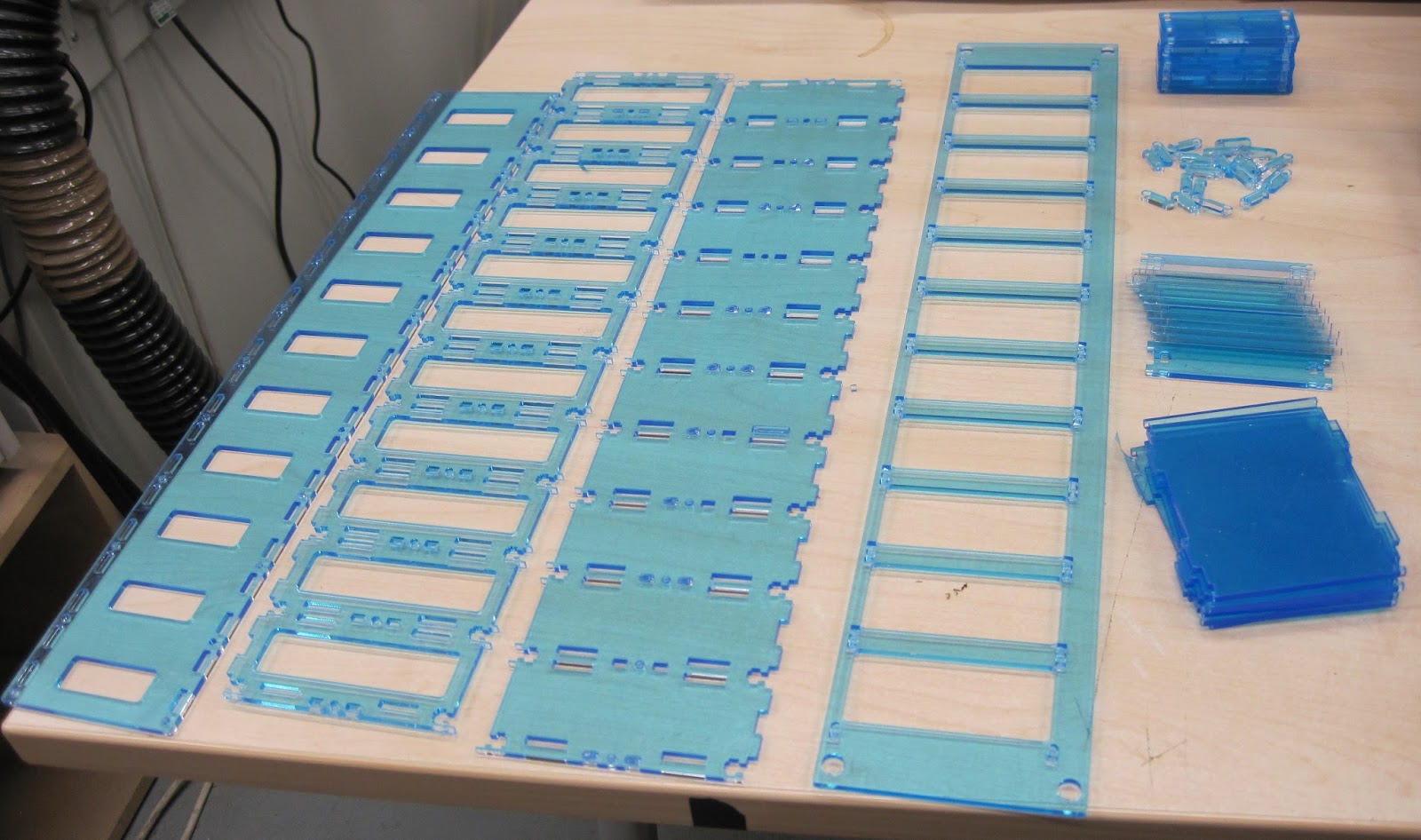
My recent rack design turned out to simply not be practical. It did not hold all the SBC I needed it to and most troubling accessing connectors was impractical. I was forced to remove the enclosure from the rack and go back to piles of SBC on a shelf.

View of the acrylic being laser cut through the heavily tinted window
This sent me back to the beginning of the design process. The requirement for easy access to connectors had been compromised on in my first solution because I wanted a compact 1U size. This time I returned to my initial toast rack layout but retaining the SBC inside their clip cases.

By facing the connectors downwards and providing basic cable management the design should be much more practical.

My design process is to use the QCAD package to create layered 2D outlines which are then converted from DXF into toolpaths with Lasercut CAM software. The toolpaths are then uploaded to the laser cutter directly from the PC running Lasercut.

Assembled sub rack enclosureDespite the laser cutters being professional grade systems the Lasercut software is a continuous cause of issues for many users, it is the only closed source piece of software in the production process and it has a pretty poor user interface. On this occasion my main issue with it was my design was quite large at 700mm by 400mm which caused the software to crash repeatedly. I broke the design down into two halves and this allowed me to continue.

Once I defeated the software the design was laser cut from 3mm clear extruded acrylic. The assembled is secured with 72 off M3 nuts and bolts. The resulting construction is very strong and probably contains much more material than necessary.

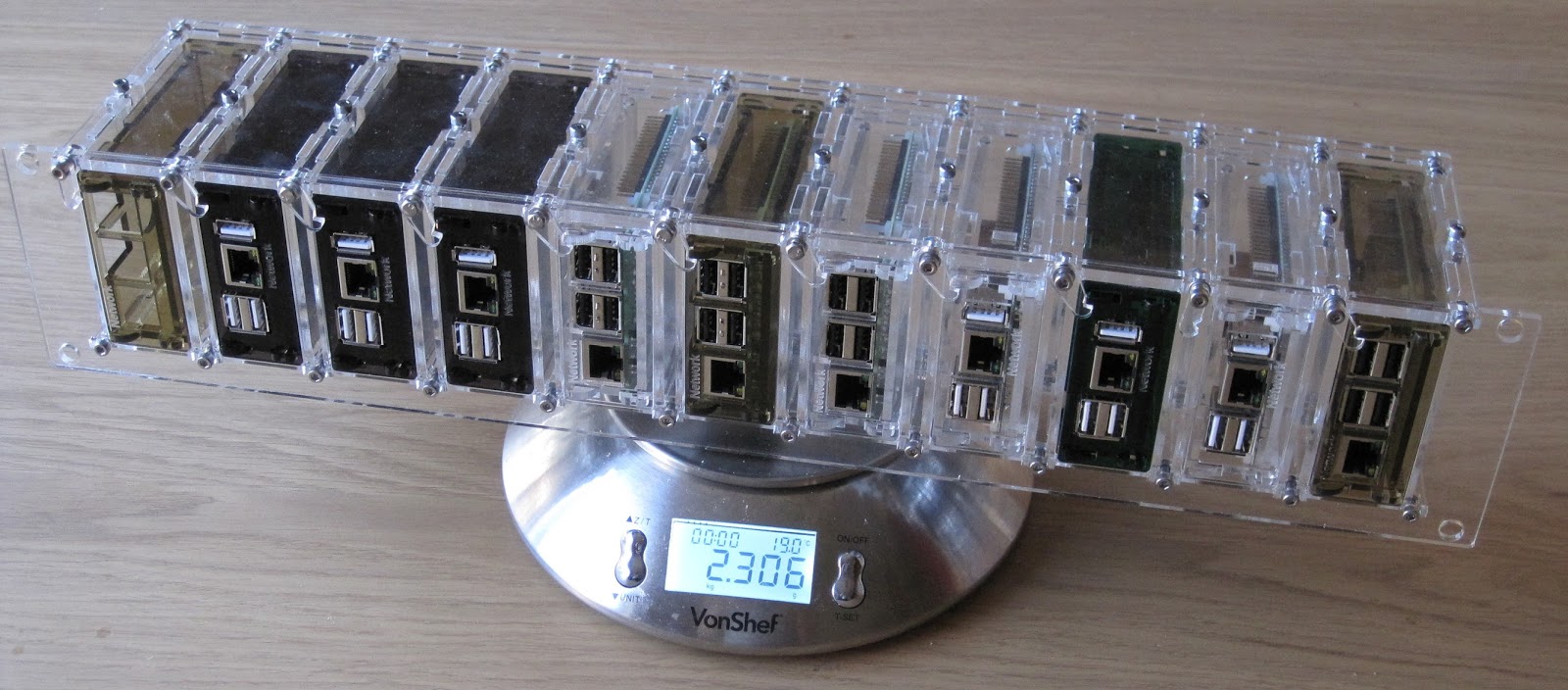
One interesting thing I discovered is that in going from a 1U enclosure holding 5 units to a 2U design holding 11 units I had increased the final weight from 320g to 980g and when all 11 SBC are installed that goes up to a whopping 2300g. Fortunately this is within the mechanical capabilities of the material but it is the heaviest thing I have ever constructed from 3mm acrylic.

bolted into the rack and operatingOnce installed in the rack with all SBC inserted and connected this finally actually works and provides a practical solution. The self is finally clear of SBC and has enough space for all the other systems I need to accommodate for various projects.

As usual the design files are all freely available though I really cannot see anyone else needing to replicate this.

12 March 2016

Lars Wirzenius: Not-platform for Debian project leader elections 2016

After some serious thinking, I've decided not to nominate myself in the Debian project leader elections for 2016. While I was doing that, I wrote the beginnings of a platform, below. I'm publishing it to have a record of what I was thinking, in case I change my mind in the future, and perhaps it can inspire other other people to do something I would like to happen. Why not run? I don't think I want to deal with the stress. I already have more than enough stress in my life, from work. I enjoy my obscurity in Debian. It allows me to go away for long periods of time, and to ignore any discussions, topics, and people that annoy or frustrate me, if I don't happen to want to tackle them at any one time. I couldn't do that if I was DPL. NOT a platform for Debian project leader election, 2016 Apart from what the Debian constitution formally specifies, I find that the important duties of the Debian project leader are: I do not feel it is the job of the DPL to set goals for the project, technical or otherwise, any more than any other member of the project. Such goals tend to best come from enthusiastic individual developer who want something and are willing to work on it. The DPL should enable such developers, and make sure they have what they need to do the work. My plan, if elected
  1. Keep Debian running. Debian can run for a long time effectively on autopilot, even if the DPL vanishes, but not indefinitely. At minimum, the DPL should delegate the secretary and technical committee members, and decide on how money should be spent. I will make sure this minimum level is achieved.
  2. While I have no technical goals to set for the project, I have an organisational one. I believe it is time for the project to form a social committee whose mandate is to step in and help resolve conflicts in their early stages, before they grow big enough that the DPL, the tech-ctte, listmasters, or the DAM needs to involved. See below for more details on this. If I am elected, I will do my best to get a social committee started, and I will assume that any vote for me is also a vote for a social committee.
Social committee (Note: It's been suggested that this is a silly name, but I haven't had time to come up with anything better. I already rejected "nanny patrol".) We are a big project now. Despite our reputation, we are a remarkably calm project, but there are still occasional conflicts, and some of them spill out into our big mailing lists. We are not very good, as a project, in handling such situations. It is not a new idea, but I think its time has come, and I propose that we form a new committee, a social committee, whose job is to help de-escalate conflict situations while they are still small conflicts, to avoid them growing into big problems, and to help resolve big conflicts if they still happen. This is something the DPL has always been doing. People write to the DPL to ask for mediation, or other help, when they can't resolve a situation by themselves. We also have the technical committee, listmasters, GRs, and the expulsion process defined by the DAM. These are mostly heavy-weight tools and by the time it's time to consider their use, it's already too late to find a good solution. Having the DPL do this alone puts too much pressure on one person. We've learnt that important tasks should generally be handled by teams rather than just one person. Thus, I would like us to have a social committee that: About me I've been a Debian developer since 1996. I've been retired twice, while I spent large amounts of time on other things. I haven't been a member of any important team in Debian, but I've been around long enough that I know many people, and have a reasonable understanding of how the projects works.

11 March 2016

Steinar H. Gunderson: Agon and the Candidates tournament

The situation where Agon (the designated organizer of the Chess World Championship, and also the Candidates tournament, the prequalifier to said WC) is trying to claim exclusive rights of the broadcasting of the moves (not just the video) is turning bizarre. First of all, they have readily acknowledged they have no basis in copyright to do so; chess moves, once played, are facts and cannot be limited. They try to jump through some hoops with a New York-specific doctrine (even though the Candidates, unlike the World Championship, is played in Moscow) about hot news , but their main weapon seems to be that they simply will throw out anyone from the hall who tries to report on the moves, and then try to give them only to those that promise not to give them on. This leads to the previously unheard-of situation where you need to register and accept their terms just to get to watch the games in your browser. You have to wonder what they will be doing about the World Championship, which is broadcast unencrypted on Norwegian television (previous editions also with no geoblock). Needless to say, this wasn't practically possible to hold together. All the big sites (like Chessdom, ChessBomb and Chess24) had coverage as if nothing had happened. Move sourcing is a bit of a murky business where nobody really wants to say where they get the moves from (although it's pretty clear that for many tournaments, the tournament organizers will simply come to one or more of the big players with an URL they can poll at will, containing the games in the standard PGN format), and this was no exception ChessBomb went to the unusual move of asking their viewers to download Tor and crowdsource the moves, while Chessdom and Chess24 appeared to do no such thing. In fact, unlike Chessdom and ChessBomb, Chess24 didn't seem to say a thing about the controversy, possibly because they now found themselves on the other side of the fence from Norway Chess 2015, where they themselves had exclusive rights to the PGN in a similar controversy although it would seem from a tweet that they were perfectly okay with people just re-broadcasting from their site if they paid for a (quite expensive) premium membership, and didn't come up with any similar legal acrobatics to try to scare other sites. However, their ToS were less clear on the issue, and they didn't respond to requests for clarification at the time, so I guess all of this just continues to be on some sort of gentleman's agreement among the bigger players. (ChessBomb also provides PGNs for premium members for the tournaments they serve, but they expressly prohibit rebroadcast. They claim that for the tournaments they host, which is a small minority, they provide free PGNs for all.) Agon, predictably, sent out angry letters where they threatened to sue the sites in question, although it's not clear at all to me what exactly they would sue for. Nobody seemed to care, except one entity TWIC, which normally has live PGNs from most tournaments, announced they would not be broadcasting from the Candidats tournament. This isn't that unexpected, as TWIC (which is pretty much a one-man project anyway) mainly is about archival, where they publish weekly dumps of all top-level games played that week. This didn't affect a lot of sites, though, as TWIC's live PGNs are often not what you'd want to base a top-caliber site on (they usually lack clock information, and moves are often delayed by half a minute or so). I run a hobby chess relay/analysis site myself (mainly focusing on the games of Magnus Carlsen), though, so I've used TWIC a fair bit in the past, and if I were to cover the Candidates tournament (I don't plan to do so, given Agon's behavior, although I plan to cover the World Championship itself), I might have been hit by this. So, that was the background. The strange part started when worldchess.com, Agon's broadcasting site, promptly went down during the first round of the Candidates tournament today Agon blamed DDoS, which I'm sure is true, but it's unclear exactly how strong the DDoS was, and if they did anything at all to deal with it other than to simply wait it out. But this lead to the crazy situation where the self-declared monopolist was the only big player not broadcasting the tournament in some form. And now, in the trully bizarre move, World Chess is publishing a detailed rebuttal of Agon's arguments, explaining how it is bad for chess, not juridically sound, and also morally wrong. Yes, you read that right; Agon's broadcast site is carrying an op-ed saying Agon is wrong. You at least have to give them credit for not trying to censor their columinst when he says something they don't agree with. Oh, and if you want those PGNs? I will, at least for the time being, be pushing them out live on http://pgn.sesse.net/. I have not gone into any agreement with Agon, and they're hosted in Norway, far from any New York-specific doctrines. So feel free to relay from them, although I would of course be happy to know if you do.

Matthew Garrett: I stayed in a hotel with Android lightswitches and it was just as bad as you'd imagine

I'm in London for Kubecon right now, and the hotel I'm staying at has decided that light switches are unfashionable and replaced them with a series of Android tablets.
A tablet displaying the text UK_bathroom isn't responding. Do you want to close it?
One was embedded in the wall, but the two next to the bed had convenient looking ethernet cables plugged into the wall. So.

I managed to borrow a couple of USB ethernet adapters, set up a transparent bridge (brctl addbr br0; brctl addif br0 enp0s20f0u1; brctl addif br0 enp0s20f0u2; ifconfig br0 up) and then stuck my laptop between the tablet and the wall. tcpdump -i br0 showed traffic, and wireshark revealed that it was Modbus over TCP. Modbus is a pretty trivial protocol, and notably has no authentication whatsoever. tcpdump showed that traffic was being sent to 172.16.207.14, and pymodbus let me start controlling my lights, turning the TV on and off and even making my curtains open and close. What fun!

And then I noticed something. My room number is 714. The IP address I was communicating with was 172.16.207.14. They wouldn't, would they?

I mean yes obviously they would.

It's basically as bad as it could be - once I'd figured out the gateway, I could access the control systems on every floor and query other rooms to figure out whether the lights were on or not, which strongly implies that I could control them as well. Jesus Molina talked about doing this kind of thing a couple of years ago, so it's not some kind of one-off - instead, hotels are happily deploying systems with no meaningful security, and the outcome of sending a constant stream of "Set room lights to full" and "Open curtain" commands at 3AM seems fairly predictable.

We're doomed.

(edited: this previously claimed I could only access systems on my own floor, but it turns out that each floor is a separate broadcast domain and I just needed to set a gateway to access the others)

(further edit: I'm deliberately not naming the hotel. They were receptive to my feedback and promised to do something about the issue.)

comment count unavailable comments

Wouter Verhelst: File not found on exec

cat hello.c
#include <stdio.h>
int main(void)  
    printf("Hello World!\n");
    return 0;
 
A simple, standard, C program. Compiling and running it shouldn't produce any surprises... except when it does.
./hello
bash: ./hello: No such file or directory
The first time I got that, it was quite confusing. So, strace to the rescue -- I thought. But nope:
strace ./hello
execve("./hello", ["./hello"], [/* 14 vars */]) = -1 ENOENT (No such file or directory)
(output trimmed) No luck there. What's going on? No, it's not some race condition whereby the file is being removed. A simple ls -l will show it's there, and that it's executable. So what? When I first encountered this, I was at a loss. Eventually, after searching for several hours, I figured it out and filed it under "surprising things with an easy fix". And didn't think of it anymore for a while, because once you understand what's going on, it's not that complicated. But I recently realized that it's not that obvious, and I've met several people who were at a loss when encountering this, and who didn't figure it out. So, here goes: If you tell the kernel to run some application (i.e., if you run one of the exec system calls), it will open the binary and try to figure out what kind of application it's dealing with. It may be a script with a shebang line (in which case the kernel calls the appropriate interpreter), or it may be an ELF binary, or whatever. If it is an ELF binary, the kernel checks if the architecture of the binary matches the CPU we're running on. If that's the case, it will just execute the instructions in the binary. If it's not an ELF binary, or if the architecture doesn't match, it will fall back on some other mechanism (e.g., the binfmt_misc subsystem could have some emulator set up to run binaries for the architecture in question, or may have been set up to run java on jar files, etc). Eventually, if all else fails, the kernel will return an error:
./hello: cannot execute binary file: Exec format error
"Exec format error" is the error message for ENOEXEC, the error code which the kernel returns if it determines that it cannot run the given binary. This makes it fairly obvious what's wrong, and why. Now assume the kernel is biarch -- that is, it runs on an architecture which can run binaries for two CPU ISAs; e.g., this may be the case for an x86-64 machine, where the CPU can run binaries for that architecture as well as binaries for the i386 architecture (and its 32-bit decendants) without emulation. If the kernel has the option to run 32-bit x86 binaries enabled at compile time (which most binary distributions do, these days), then running i386 ELF binaries is possible, in theory. As far as the kernel is concerned, at least. So, the kernel maps the i386 binary into memory, and jumps to the binary's entry point. And here is where it gets interesting: When the binary in question uses shared libraries, the kernel not only needs to open this binary itself, but also the runtime dynamic linker (RTDL). It is then the job of the RTDL to map the shared libraries into memory for the process to use, before jumping to its code. But what if the RTDL isn't installed? Well, then the kernel won't find it. The RTDL is just this file, so that means it will produce an ENOENT error code -- the error message for which is "No such file or directory". And there you have it. The solution is simple, and the explanation too; but still, even so, it can be a bit baffling: the system tells you "the file isn't there", without telling you which file it's missing. Since you passed it only one file, it's reasonable for you to believe the missing file is the binary you're asking the system to execute. But usually, that's not the problem: the problem is that the file containing the RTDL is not installed, which is just a result of you not having enabled multiarch. Solution:
dpkg --add-architecture <target architecture>
apt update
apt install libc6:<target architecture>
Obviously you might need to add some more libraries, too, but that's not usually a problem.

Rapha&#235;l Hertzog: Freexian s report about Debian Long Term Support, February 2016

A Debian LTS logoLike each month, here comes a report about the work of paid contributors to Debian LTS. Individual reports In February, 112.50 work hours have been dispatched among 11 paid contributors. Their reports are available: Evolution of the situation The number of sponsored hours continued to decrease a little bit. It s not worrisome yet but we should try to get back to a positive slope if we want to be able to do an outstanding job for wheezy LTS. On the positive side, TOSHIBA renewed their platinum sponsorship for another 6 months at least and we have some contacts for new sponsors, though they are far from being concluded yet. We are now in transition between squeeze LTS and wheezy LTS. The paid contributors are helping the security team by fixing packages that were fixed in squeeze already but that are still outstanding in wheezy. They are also taking generic measures to prepare wheezy LTS (for example to ensure all packages work with OpenJDK 7.x since support for 6.x will be dropped in the LTS period). Thanks to our sponsors New sponsors are in bold (none this month).

No comment Liked this article? Click here. My blog is Flattr-enabled.

10 March 2016

Lunar: Reproducible builds: week 45 in Stretch cycle

What happened in the reproducible builds effort between February 28th and March 5th:

Toolchain fixes
  • Antonio Terceiro uploaded gem2deb/0.27 that forces generated gemspecs to use the date from debian/changelog.
  • Antonio Terceiro uploaded gem2deb/0.28 that forces generated gemspecs to have their contains file lists sorted.
  • Robert Luberda uploaded ispell/3.4.00-5 which make builds of hashes reproducible.
  • C dric Boutillier uploaded ruby-ronn/0.7.3-4 which will make the output locale agnostic. Original patch by Chris Lamb.
  • Markus Koschany uploaded spring/101.0+dfsg-1. Fixed by Alexandre Detiste.
Ximin Luo resubmitted the patch adding the --clamp-mtime option to Tar on Savannah's bug tracker. Lunar rebased our experimental dpkg on top of the current master branch. Changes in the test infrastructure are required before uploading a new version to our experimental repository. Reiner Herrmann rebased our custom texlive-bin against the latest uploaded version.

Packages fixed The following 77 packages have become reproducible due to changes in their build dependencies: asciidoctor, atig, fuel-astute, jekyll, libphone-ui-shr, linkchecker, maven-plugin-testing, node-iscroll, origami-pdf, plexus-digest, pry, python-avro, python-odf, rails, ruby-actionpack-xml-parser, ruby-active-model-serializers, ruby-activerecord-session-store, ruby-api-pagination, ruby-babosa, ruby-carrierwave, ruby-classifier-reborn, ruby-compass, ruby-concurrent, ruby-configurate, ruby-crack, ruby-css-parser, ruby-cucumber-rails, ruby-delorean, ruby-encryptor, ruby-fakeweb, ruby-flexmock, ruby-fog-vsphere, ruby-gemojione, ruby-git, ruby-grack, ruby-htmlentities, ruby-jekyll-feed, ruby-json-schema, ruby-listen, ruby-markerb, ruby-mathml, ruby-mini-magick, ruby-net-telnet, ruby-omniauth-azure-oauth2, ruby-omniauth-saml, ruby-org, ruby-origin, ruby-prawn, ruby-pygments.rb, ruby-raemon, ruby-rails-deprecated-sanitizer, ruby-raindrops, ruby-rbpdf, ruby-rbvmomi, ruby-recaptcha, ruby-ref, ruby-responders, ruby-rjb, ruby-rspec-rails, ruby-rspec, ruby-rufus-scheduler, ruby-sass-rails, ruby-sass, ruby-sentry-raven, ruby-sequel-pg, ruby-sequel, ruby-settingslogic, ruby-shoulda-matchers, ruby-slack-notifier, ruby-symboltable, ruby-timers, ruby-zip, ticgit, tmuxinator, vagrant, wagon, yard. The following packages became reproducible after getting fixed: Some uploads fixed some reproducibility issues, but not all of them: Patches submitted which have not made their way to the archive yet:
  • #816209 on elog by Reiner Herrmann: use printf instead of echo which is shell-independent.
  • #816214 on python-pip by Reiner Herrmann: removes timestamp from generated Python scripts.
  • #816230 on rows by Reiner Herrmann: tell grep to always treat the input as text.
  • #816232 on eficas by Reiner Herrmann: use printf instead of echo which is shell-independent.
Florent Daigniere and bancfc reported that linux-grsec was currently built with GRKERNSEC_RANDSTRUCT which will prevent reproducible builds with the current packaging.

tests.reproducible-builds.org pbuilder has been updated to the last version to be able to support Build-Depends-Arch and Build-Conflicts-Arch. (Mattia Rizzolo, h01ger) New package sets have been added for Subgraph OS, which is based on Debian Stretch: packages and build dependencies. (h01ger) Two new armhf build nodes have been added (thanks Vagrant Cascadian) and integrated in our Jenkins setup with 8 new armhf builder jobs. (h01ger)

strip-nondeterminism development strip-nondeterminism version 0.016-1 was released on Sunday 28th. It will now normalize the POT-Creation-Date field in GNU Gettext .mo files. (Reiner Herrmann) Several improvements to the packages metadata have also been made. (h01ger, Ben Finney)

Package reviews 185 reviews have been removed, 91 added and 33 updated in the previous week. New issue: fileorder_in_gemspec_files_list. 43 FTBFS bugs were reported by Chris Lamb, Martin Michlmayr, and gregor herrmann.

Misc. After merging the patch from Dhiru Kholia adding support for SOURCE_DATE_EPOCH in rpm, Florian Festi opened a discussion on the rpm-ecosystem mailing list about reproducible builds. On March 4th, Lunar gave an overview of the general reproducible builds effort at the Internet Freedom Festival in Valencia.

Antoine Beaupr : Trying out Keybase

I was privileged enough to get access to the alpha preview of Keybase.io. Last year, the project raised 11M$ in venture capital and they seem to be attacking the hard problems, so it is a serious project, worth considering for any cryptography hacker like me. This was obviously discussed elsewhere previously but since Keybase has evolved a bit since then, I figured it would be worth adding my grain of salt.

The elite alpha problem My first problem with Keybase was of course that I wasn't in the elite club of invited people. Somehow, I finally got in but the problem remains for the everyone else. In my case, it was the Keybase filesystem announcement that brought my attention back to the project, although I have yet to test that itself - yet another invite-only problem (need to email chris@keybase.io to get access, I guess). Still, 10GB of storage might be interesting for some people, but considering the number of hurdles or "friction", as they say, that needs to be jumped over to get access, I am not sure how much traction this will get for now. The project has been in alpha for a while now (more than a year) with no announced public beta just yet, which is way slower than similarly challenging projects with less capital. Let's encrypt, as a comparison, was publicly announced in 2014 and by the end of 2015, the public beta was opened.

Private key leakage My second major concern is that Keybase does worrisome things to private key material. If you tell it to import your regular GPG keys, it will copy them into the keybase keyring, which is already a problem: now you have two places where you store sensitive secrets. But worse, Keybase offers you to upload your private key material on the server, without clearly and explicitely exposing the potential risks that means to the user. The key, presumably, is encrypted (at least that is what I can parse from the Keybase privacy policy). Yet this is still a concern: a determined attacker (e.g. the government or another malicious entity) could force Keybase to give up the encrypted private key material and install sniffers that would reveal the passphrase that would allow decryption and impersonation of the related identity. That is a huge deal. This is what caused Hushmail's demise in 2007: they had similar promises about how they had a "secure" email (in this case) service based on OpenPGP, but since they key was stored on the server, they only had to serve a malicious applet to victims and were able to give cleartext data to the US government (12 CDs!) under a Mutual Legal Assistance Treaty with Canada. In Keybase, When I generate a new key, it asks me if I want to upload the key to their servers, and "Yes" is chosen as a default, so it is clearly a policy that is encouraged. This is presumably to enable browser-based crypto, yet this could be done by storing keys within the browser, not on the server. The mere possibility that the client can meddle with secret key material in such a way is a problem. Even if uploading secret keys to the server is optional, the fact that it is a possibility widens the attack surface on the client significantly. GPG has been working on isolating private key operations to a different process (gpg-agent) or smart cards, SSH has privilege seperation. The idea of uploading secret key material online is so beyond current practices that it should bring the project to a full stop already. My private key material is pretty sensitive. I am a Debian developer: if someone gets access to that key, they can upload arbitrary code for thousands of packages, affecting thousands if not millions of users. That is a huge deal, and I am not ready to give that power to an arbitrary third party that I know little about.

Privacy policy issues Furthermore, the Keybase privacy policy explicitely states that "Logs of this information may persist for an indefinite period", which include, and I quote:
  • Your computer s IP address
  • Your preferences and settings (time zone, language, privacy preferences, application preferences, etc.)
  • The URL of the site that referred you to the Service
  • The buttons and controls you clicked on (if any) within the Service
  • How long you used the Service and which parts and features you used
  • Session times and lengths
For a company working to improve user's privacy, this is a pretty bad policy. It exposes Keybase users to undue surveillance, on a lot of private information that is not necessary to operate the service. I haven't actually read the remaining of the policy, as I was already scared as hell and figure I would just log off for now and try not to add any extra personal information in that already growing pile. Let's mention, while I'm here, that the keybase commandline client has this odd way of working that it forks a daemon in the background all the time, even to run just keybase status. One has to wonder if this thing is included in the surveillance data above, which would make the keybase client an amazing surveillance device in itself. To stop all this, you need:
keybase logout
keybase ctl stop
Not quite obvious...

Usability issues Which brings me to a series of usability issues I have found while working with Keybase. Having worked on usability myself in the Monkeysphere project, I understand how hard those problems can be. But right now, the fact is that keybase is only a commandline client, with some web-based sugar sprinkled on top. I recognize the huge efforts that have been done to make the user experience (UX) as easy as possible through the commandline, but this is definitely not "grand public" material yet. Even as a OpenPGP hacker, Keybase can get confusing. Since it has its own separate keyring from GPG, things that used to be obvious before are suddenly new things to learn. For example, I originally generated a key for anarcat@debian.org in keybase, thinking it would be a separate thing from my current GPG identity. Well, that ended up creating a new key in my GPG keyring, duplicating my existing identity, with no way for me to tell this was a Keybase copy. This could have ended up on the keyservers and confuse anyone looking for my PGP key.

Revoking keys So I revoked that key, which, in itself, is not such an obvious process either. I first had to "drop" the key:
keybase pgp drop '010143572d4e438f457a7447c9758804cc7be44c1ee2b7915c3904567d0a3fb5cf590a'
To find that magic number, I had to go on the website and click through the PGP key to end up on the revoke link which told me which magic string to put. The web UI was telling me I could use keybase status to get that information, but I couldn't find that in the output here:
$ keybase status
Username:      anarcat
Logged in:     no
Device:
    name:      angela
    ID:        070f6a13f2a66afbb463f49dadfd4518
    status:    active
Keybase keys:  unlocked
Session:       anarcat [salt only]
KBFS:
    status:    not running
    version:
    log:       /home/anarcat/.cache/keybase/keybase.kbfs.log
Service:
    status:    running
    version:   1.0.14-1
    log:       /home/anarcat/.cache/keybase/keybase.service.log
Platform Information:
    OS:        linux
    Runtime:   go1.5.3
    Arch:      amd64
Client:
    version:   1.0.14-1
Desktop app:
    status:    not running
    version:
    log:       /home/anarcat/.cache/keybase/Keybase.app.log
Config path:   /home/anarcat/.config/keybase/config.json
Default user:  anarcat
Other users:
command-line client:
    keybase status [pid: 14562, version: 1.0.14-1]
So keybase drop "deletes" the key from the keybase client (and presumably the server). One problem here is that we have three different verbs to mean the same thing: in some places, the website says "deleted" (in the web graph), the commandline client uses "drop" and everyone else using PGP in the world uses "revoke". So what is it? Also note that just dropping that key is not enough to eradicate that key: you still need to generate and import a revocation certificate on GPG's side as well, for that key. This makes sense, because you may have imported that key and you may not want to destroy it when you remove it from keybase, but there could be a little better guessing and UX here as well.

Password usage Then another problem is that, when you signup on the commandline, it asks you to choose a passphrase. It's not clear at all from the UI what that passphrase is for. Is it to protect the private key material? To login the website? Both? It turns out it is actually to login to the website and the Keybase API. It could also be the key to the private key material, but I haven't quite figured that out yet. Similarly, the "paper devices" are a little confusing to me as well. The registration process is fairly insistent that I need to write a series of secret words down on a piece of paper and put it my wallet. This is based on the idea that you can use that key to recover your account and setup new devices. However, it is not made clear at all how those credentials should be protected or used. What if I lose my wallet? What do I do then? Is it okay if i write it on the back of my laptop instead? I know it sounds like stupid questions to crypto geek, but it's definitely stuff people will do, and education, at all levels, is necessary here.

The existing web of trust Finally, I found it surprisingly counter-intuitive to sign keys with keybase. I was assuming the whole point of the thing was to expand the web of trust, but it seems their mission lies somewhere else: there is no facility to sign keys directly in keybase. You sign statements on various social sites (Github, Twitter, Reddit...) but doing traditional key exchanges seems to be off limits. My obvious use case was to sign my existing key material with my newly generated anarcat@keybase.io key, so that keybase would become another way of verifying my identity. Well, this is not possible with keybase directly - you still have to go through the regular:
gpg --sign-key DEADBEEF
Which is really unfortunate, because some craaaazy people like me insist on doing in person, actually secure key exchanges sometimes, and the tools to do this right now (mainly gpg, caff and monkeysign) really need a lot of love and help. Keybase could have helped a lot in pushing those initiatives forward and bring new ways of doing secure key exchanges, instead of only lowering the standards on cryptographic identity.

Usual proprietary startup rant I can't help but finish by noticing that the whole basic problem with Keybase is more fundamental than a few usability issues, which can all be fixed fairly easily. Keybase.IO is a web-based service that is entirely proprietary. The client is freely downloadable and free software - but the server side is not. This makes us rely on a central point of failure and the goodwill of those operators to not only keep the service running (for free?) indefinitely, but to protect us against all attackers, state-run or otherwise. This is definitely against basic free software principles and the open architecture of the internet federation, well embodied in the Franklin street statement. Online services should be decentralized and open like the OpenPGP keyservers have always been, period.

Conclusion I am curious to see where Keybase brings us, as a community. So far, I am concerned about centralization and devaluation of the web of trust as cryptographic system. I do not believe that trusting multiple corporate social networking sites bring much benefit to our security, although it does improve usability significantly and is certainly better than TOFU, so that part of the project is definitely interesting, especially since it allows leveraging classical internet protocols like DNS and HTTPS. Key exchange is a critical problem that still hasn't properly been resolved in the cryptographic community. Most efforts at building communication tools (say like Signal or Telegram) mostly ignore the problem and expect people to read up strings of numbers or rely on synchronous communications (see the Axolotl rachet for Signal's take on it). Keybase's attempts at fixing this are great, but needs much more work to actually resolve the PKI issues in a significant way. More fundamentally, the practice of storing keys on the servers should just stop: it is a definite no go for me, and a classic crypto mistake that has bitten way too many people. In my mind, it discredits the whole project. The point of OpenPGP is end to end encryption across devices: storing the keys on a server breaks that apart, and doesn't improve much on the existing HTTPS security systems already in place on the web. It is especially a problem given the new waves of attacks on cryptography from western governments, from the UK to California... Until those issues are resolved, I can't get myself to recommend Keybase to anyone just yet.

Post-scriptum Note to Keybase developers: I have considered filing issues regarding the above, but unfortunately, I was unable to filter through the gigantic github issues list for duplicates, and didn't have time to file detailed reports for everything. I apologize for bypassing those usual conventions. If you want to try out Keybase to make your own opinion, I do have 4 invites I can give away, but I will do so only if you need to test specific issues. Otherwise, I note that there is a Request For Package for the Debian package to become official, that Debian developers (or Keybase developers!) may be interested in completing.

Next.

Previous.