Search Results: "reg"

19 February 2015

Matthew Garrett: It has been 0 days since the last significant security failure. It always will be.

So blah blah Superfish blah blah trivial MITM everything's broken.

Lenovo deserve criticism. The level of incompetence involved here is so staggering that it wouldn't be a gross injustice for the company to go under as a result[1]. But let's not pretend that this is some sort of isolated incident. As an industry, we don't care about user security. We will gladly ship products with known security failings and no plans to update them. We will produce devices that are locked down such that it's impossible for anybody else to fix our failures. We will hide behind vague denials, we will obfuscate the impact of flaws and we will deflect criticisms with announcements of new and shinier products that will make everything better.

It'd be wonderful to say that this is limited to the proprietary software industry. I would love to be able to argue that we respect users more in the free software world. But there are too many cases that demonstrate otherwise, even where we should have the opportunity to prove the benefits of open development. An obvious example is the smartphone market. Hardware vendors will frequently fail to provide timely security updates, and will cease to update devices entirely after a very short period of time. Fortunately there's a huge community of people willing to produce updated firmware. Phone manufacturer is never going to fix the latest OpenSSL flaw? As long as your phone can be unlocked, there's a reasonable chance that there's an updated version on the internet.

But this is let down by a kind of callous disregard for any deeper level of security. Almost every single third-party Android image is either unsigned or signed with the "test keys", a set of keys distributed with the Android source code. These keys are publicly available, and as such anybody can sign anything with them. If you configure your phone to allow you to install these images, anybody with physical access to your phone can replace your operating system. You've gained some level of security at the application level by giving up any real ability to trust your operating system.

This is symptomatic of our entire ecosystem. We're happy to tell people to disable security features in order to install third-party software. We're happy to tell people to download and build source code without providing any meaningful way to verify that it hasn't been tampered with. Install methods for popular utilities often still start "curl sudo bash". This isn't good enough.

We can laugh at proprietary vendors engaging in dreadful security practices. We can feel smug about giving users the tools to choose their own level of security. But until we're actually making it straightforward for users to choose freedom without giving up security, we're not providing something meaningfully better - we're just providing the same shit sandwich on different bread.

[1] I don't see any way that they will, but it wouldn't upset me

comment count unavailable comments

Niels Thykier: Partial rewrite of lintian s reporting setup

I had the mixed pleasure of doing a partial rewrite of lintian s reporting framework. It started as a problem with generating the graphs, which turned out to be not enough memory . On the plus side, I am actually quite pleased with the end result. I managed to scope-creep myself quite a bit and I ended up getting rid of a lot of old issues. The major changes in summary: There are also some nice minor features : As you can probably tell, I am quite pleased with the end result. The reporting framework lacks behind in development, since it just sits there and takes care of itself . Also with the complete lack of testing, it also suffers from the if it is not broken, then do not fix it paradigm (because we will not notice if we broke until it is too late). Of course, I managed to break the setup a couple of times in the process. However, a bonus feature of the reporting setup is that if you break it, it simply leaves an outdated report on the website. Anyway, enjoy. :)
Filed under: Debian, Lintian

Michal Čihař: Weblate 2.2

Weblate 2.2 has been released today. It comes with improved search, user interface cleanup and various other fixes. Full list of changes for 2.2: You can find more information about Weblate on http://weblate.org, the code is hosted on Github. If you are curious how it looks, you can try it out on demo server. You can login there with demo account using demo password or register your own user. Weblate is also being used https://hosted.weblate.org/ as official translating service for phpMyAdmin, Gammu, Weblate itself and other projects. If you are free software project which would like to use Weblate, I'm happy to help you with set up or even host Weblate for you. Further development of Weblate would not be possible without people providing donations, thanks to everybody who have helped so far! PS: The roadmap for next release is just being prepared, you can influence this by expressing support for individual issues either by comments or by providing bounty for them.

Filed under: English phpMyAdmin SUSE Weblate 0 comments Flattr this!

17 February 2015

Lucas Nussbaum: Some email organization tips and tricks

I d like to share a few tips that were useful to strengthen my personal email organization. Most of what follows is probably not very new nor special, but hey, let s document it anyway. Many people have an inbox folder that just grow over time. It s actually similar to a twitter or RSS feed (except they probably agree that they are supposed to read more of their email feed ). When I send an email to them, it sometimes happen that they don t notice it, if the email arrives at a bad time. Of course, as long as they don t receive too many emails, and there aren t too many people relying on them, it might just work. But from time to time, it s super-painful for those interacting with them, when they miss an email and they need to be pinged again. So let s try not to be like them. :-) Tip #1: do Inbox Zero (or your own variant of it) Inbox Zero is an email management methodology inspired from David Allen s Getting Things Done book. It s best described in this video. The idea is to turn one s Inbox into an area that is only temporary storage, where every email will get processed at some point. Processing can mean deleting an email, archiving it, doing the action described in the email (and replying to it), etc. Put differently, it basically means implementing the Getting Things Done workflow on one s email. Tip #1.1: archive everything One of the time-consuming decisions in the original GTD workflow is to decide whether something should be eliminated (deleted) or stored for reference. Given that disk space is quite cheap, it s much easier to never decide about that, and just archive everything (by duplicating the email to an archive folder when it is received). To retrieve archived emails when needed, I then use notmuch within mutt to easily search through recent (< 2 year) archives. I use archivemail to archive older email in compressed mboxes from time to time, and grepmail to search through those mboxes when needed. I don t archive most Debian mailing lists though, as they are easy to fetch from master.d.o with the following script:
#!/bin/sh
rsync -vP master.debian.org:~debian/*/*$1/*$1.$ 2:-$(date +%Y%m) * .
Then I can fetch a specific list archive with getlist devel 201502, or a set of archives with e.g. getlist devel 2014, or the current month with e.g. getlist devel. Note that to use grepmail on XZ-compressed archives, you need libmail-mbox-messageparser-perl version 1.5002-3 (only in unstable I was using a locally-patched version for ages, but finally made a patch last week, which Gregor kindly uploaded). Tip #1.2: split your inbox (Yes, this one looks obvious but I m always surprised at how many people don t do that.) Like me, you probably receive various kinds of emails: Splitting those into separate folders has several advantages: I ve seen some people splitting their inbox into too many folders. There s not much point in having a per-sender folder organization (unless there s really a recurring flow of emails from a specific person), as it increases the risk of missing an email. I use procmail to organize my email into folders. I know that there are several more modern alternatives, but I haven t looked at them since procmail does the job for me. Resulting organization I use one folder for my day-job email, one for my DPL email, one for all other email directed or Cced to me. Then, I have a few folders for automated notifications of stuff. My Debian mailing list folders are auto-managed by procmail s $MATCH:
:0:
 * ^X-Mailing-List: <.*@lists\.debian\.org>
 * ^X-Mailing-List: <debian-\/[^@]*
 .ml.debian.$MATCH/
Some other mailing lists are in they separate folders, and there s a catch-all folder for the remaining ones. Ah, and since I use feed2imap, I have folders for the RSS/Atom feeds I follow. I have two different commands to start mutt. One only shows a restricted number of (important) folders. The other one shows the full list of (non-empty) folders. This is a good trick to avoid spending time reading email when I am supposed to do something more important. :) As for many people probably, my own organization is loosely based on GTD and Inbox Zero. It sometimes happen that some emails stay in my Inbox for several days or weeks, but I very rarely have more than 20 or 30 emails in one of my main inbox folders. I also do reviews of the whole content of my main inbox folders once or twice a week, to ensure that I did not miss an email that could be acted on quickly. A last trick is that I have a special folder replies, where procmail copies emails that are replies to a mail I sent, but which do not Cc me. That s useful to work-around Debian s no Cc on reply to mailing list posts policy. I receive email using offlineimap (over SSH to my mail server), and send it using nullmailer (through a SSH tunnel). The main advantage of offlineimap over using IMAP directly in mutt is that using IMAP to a remote server feels much more sluggish. Another advantage is that I only need SSH access to get my full email setup to work. Tip #2: tracking sent emails Two recurring needs I had was: I developed a short script to address that. It scans the content of my Sent maildir and my archive maildirs, and, for each email address I use, displays (see example output in README) the list of emails sent with this address (one email per line). It also detects if an email was replied to ( R column after the date), and abbreviates common parts in email addresses (debian-project@lists.debian.org becomes d-project@l.d.o). It also generates a temporary maildir with symlinks to all emails, so that I can just open the maildir if needed.

16 February 2015

Julien Danjou: Hacking Python AST: checking methods declaration

A few months ago, I wrote the definitive guide about Python method declaration, which had quite a good success. I still fight every day in OpenStack to have the developers declare their methods correctly in the patches they submit. Automation plan The thing is, I really dislike doing the same things over and over again. Furthermore, I'm not perfect either, and I miss a lot of these kind of problems in the reviews I made. So I decided to replace me by a program a more scalable and less error-prone version of my brain. In OpenStack, we rely on flake8 to do static analysis of our Python code in order to spot common programming mistakes. But we are really pedantic, so we wrote some extra hacking rules that we enforce on our code. To that end, we wrote a flake8 extension called hacking. I really like these rules, I even recommend to apply them in your own project. Though I might be biased or victim of Stockholm syndrome. Your call. Anyway, it's pretty clear that I need to add a check for method declaration in hacking. Let's write a flake8 extension! Typical error The typical error I spot is the following:
class Foo(object):
# self is not used, the method does not need
# to be bound, it should be declared static
def bar(self, a, b, c):
return a + b - c

That would be the correct version:
class Foo(object):
@staticmethod
def bar(a, b, c):
return a + b - c

This kind of mistake is not a show-stopper. It's just not optimized. Why you have to manually declare static or class methods might be a language issue, but I don't want to debate about Python misfeatures or design flaws. Strategy We could probably use some big magical regular expression to catch this problem. flake8 is based on the pep8 tool, which can do a line by line analysis of the code. But this method would make it very hard and error prone to detect this pattern. Though it's also possible to do an AST based analysis on on a per-file basis with pep8. So that's the method I pick as it's the most solid. AST analysis I won't dive deeply into Python AST and how it works. You can find plenty of sources on the Internet, and I even talk about it a bit in my book The Hacker's Guide to Python. To check correctly if all the methods in a Python file are correctly declared, we need to do the following: Flake8 plugin In order to register a new plugin in flake8 via hacking, we just need to add an entry in setup.cfg:
[entry_points]
flake8.extension =
[ ]
H904 = hacking.checks.other:StaticmethodChecker
H905 = hacking.checks.other:StaticmethodChecker

We register 2 hacking codes here. As you will notice later, we are actually going to add an extra check in our code for the same price. Stay tuned. The next step is to write the actual plugin. Since we are using an AST based check, the plugin needs to be a class following a certain signature:
@core.flake8ext
class StaticmethodChecker(object):
def __init__(self, tree, filename):
self.tree = tree

def run(self):
pass

So far, so good and pretty easy. We store the tree locally, then we just need to use it in run() and yield the problem we discover following pep8 expected signature, which is a tuple of (lineno, col_offset, error_string, code). This AST is made for walking The ast module provides the walk function, that allow to iterate easily on a tree. We'll use that to run through the AST. First, let's write a loop that ignores the statement that are not class definition.
@core.flake8ext
class StaticmethodChecker(object):
def __init__(self, tree, filename):
self.tree = tree

def run(self):
for stmt in ast.walk(self.tree):
# Ignore non-class
if not isinstance(stmt, ast.ClassDef):
continue

We still don't check for anything, but we know how to ignore statement that are not class definitions. The next step need to be to ignore what is not function definition. We just iterate over the attributes of the class definition.
for stmt in ast.walk(self.tree):
# Ignore non-class
if not isinstance(stmt, ast.ClassDef):
continue
# If it's a class, iterate over its body member to find methods
for body_item in stmt.body:
# Not a method, skip
if not isinstance(body_item, ast.FunctionDef):
continue

We're all set for checking the method, which is body_item. First, we need to check if it's already declared as static. If so, we don't have to do any further check and we can bail out.
for stmt in ast.walk(self.tree):
# Ignore non-class
if not isinstance(stmt, ast.ClassDef):
continue
# If it's a class, iterate over its body member to find methods
for body_item in stmt.body:
# Not a method, skip
if not isinstance(body_item, ast.FunctionDef):
continue
# Check that it has a decorator
for decorator in body_item.decorator_list:
if (isinstance(decorator, ast.Name)
and decorator.id == 'staticmethod'):
# It's a static function, it's OK
break
else:
# Function is not static, we do nothing for now
pass

Note that we use the special for/else form of Python, where the else is evaluated unless we used break to exit the for loop.
for stmt in ast.walk(self.tree):
# Ignore non-class
if not isinstance(stmt, ast.ClassDef):
continue
# If it's a class, iterate over its body member to find methods
for body_item in stmt.body:
# Not a method, skip
if not isinstance(body_item, ast.FunctionDef):
continue
# Check that it has a decorator
for decorator in body_item.decorator_list:
if (isinstance(decorator, ast.Name)
and decorator.id == 'staticmethod'):
# It's a static function, it's OK
break
else:
try:
first_arg = body_item.args.args[0]
except IndexError:
yield (
body_item.lineno,
body_item.col_offset,
"H905: method misses first argument",
"H905",
)
# Check next method
continue

We finally added some check! We grab the first argument from the method signature. Unless it fails, and in that case, we know there's a problem: you can't have a bound method without the self argument, therefore we raise the H905 code to signal a method that misses its first argument. Now you know why we registered this second pep8 code along with H904 in setup.cfg. We have here a good opportunity to kill two birds with one stone. The next step is to check if that first argument is used in the code of the method.
for stmt in ast.walk(self.tree):
# Ignore non-class
if not isinstance(stmt, ast.ClassDef):
continue
# If it's a class, iterate over its body member to find methods
for body_item in stmt.body:
# Not a method, skip
if not isinstance(body_item, ast.FunctionDef):
continue
# Check that it has a decorator
for decorator in body_item.decorator_list:
if (isinstance(decorator, ast.Name)
and decorator.id == 'staticmethod'):
# It's a static function, it's OK
break
else:
try:
first_arg = body_item.args.args[0]
except IndexError:
yield (
body_item.lineno,
body_item.col_offset,
"H905: method misses first argument",
"H905",
)
# Check next method
continue
for func_stmt in ast.walk(body_item):
if six.PY3:
if (isinstance(func_stmt, ast.Name)
and first_arg.arg == func_stmt.id):
# The first argument is used, it's OK
break
else:
if (func_stmt != first_arg
and isinstance(func_stmt, ast.Name)
and func_stmt.id == first_arg.id):
# The first argument is used, it's OK
break
else:
yield (
body_item.lineno,
body_item.col_offset,
"H904: method should be declared static",
"H904",
)

To that end, we iterate using ast.walk again and we look for the use of the same variable named (usually self, but if could be anything, like cls for @classmethod) in the body of the function. If not found, we finally yield the H904 error code. Otherwise, we're good. Conclusion I've submitted this patch to hacking, and, finger crossed, it might be merged one day. If it's not I'll create a new Python package with that check for flake8. The actual submitted code is a bit more complex to take into account the use of abc module and include some tests. As you may have notice, the code walks over the module AST definition several times. There might be a couple of optimization to browse the AST in only one pass, but I'm not sure it's worth it considering the actual usage of the tool. I'll let that as an exercise for the reader interested in contributing to OpenStack. Happy hacking!

The Hacker's Guide to Python
A book I wrote talking about designing Python applications, state of the art, advice to apply when building your application, various Python tips, etc. Interested? Check it out.

12 February 2015

Richard Hartmann: A Dance with Dragons

Yesterday, I went to the Federal Office for Information Security (BSI) on an invitation to their "expert round-table on SDN". While the initial mix of industry attendees was of.. varied technical knowledge.. I was pleasantly surprised by the level of preparation by the BSI. None of them were networkers, but they did have a clear agenda and a pretty good idea of what they wanted to know. During the first round-table, they went through Yes, some of those questions are rather basic and/or generic, but that was on purpose. The mix of clear expectations and open-ended questions was quite effective at getting at what they wanted to know. During lunch, we touched on the more general topic of how to reach and interact with technical audiences, with regards to both networks and software. The obvious answer for initial contact in regards to networks was DENOG; which they didn't know about. With software, the answer is not quite as simple. My suggestion was to engage in a positive way and thus build trust over time. Their clear advantage is that, contrary to most other services, their raison d' tre is purely defensive and non-military so they can focus on audits, support of key pieces of software, and, most important of all, talk about their results. No idea if they will actually pursue this, but here's to hoping; we could all use more government players on the good side.

11 February 2015

John Goerzen: Reactions to Has modern Linux lost its way? and the value of simplicity

Apparently I touched a nerve with my recent post about the growing complexity of issues. There were quite a few good comments, which I ll mention here. It s provided me some clarity on the problem, in fact. I ll try to distill a few more thoughts here. The value of simplicity and predictability The best software, whether it s operating systems or anything else, is predictable. You read the documentation, or explore the interface, and you can make a logical prediction that when I do action X, the result will be Y. grep and cat are perfect examples of this. The more complex the rules in the software, the more hard it is for us to predict. It leads to bugs, and it leads to inadvertant security holes. Worse, it leads to people being unable to fix things themselves one of the key freedoms that Free Software is supposed to provide. The more complex software is, the fewer people will be able to fix it by themselves. Now, I want to clarify: I hear a lot of talk about ease of use. Gnome removes options in my print dialog box to make it easier to use. (This is why I do not use Gnome. It actually makes it harder to use, because now I have to go find some obscure way to just make the darn thing print.) A lot of people conflate ease of use with ease of learning, but in reality, I am talking about neither. I am talking about ease of analysis. The Linux command line may not have pointy-clicky icons, but at least at one time once you understood ls -l and how groups, users, and permission bits interacted, you could fairly easily conclude who had access to what on a system. Now we have a situation where the answer to this is quite unclear in terms of desktop environments (apparently some distros ship network-manager so that all users on the system share the wifi passwords they enter. A surprise, eh?) I don t mind reading a manpage to learn about something, so long as the manpage was written to inform. With this situation of dbus/cgmanager/polkit/etc, here s what it feels like. This, to me, is the crux of the problem: It feels like we are in a twisty maze, every passage looks alike, and our flashlight ran out of battieries in 2013. The manpages, to the extent they exist for things like cgmanager and polkit, describe the texture of the walls in our cavern, but don t give us a map to the cave. Therefore, we are each left to piece it together little bits at a time, but there are traps that keep moving around, so it s slow going. And it s a really big cave. Other user perceptions There are a lot of comments on the blog about this. It is clear that the problem is not specific to Debian. For instance: This stuff is really important, folks. People being able to maintain their own software, work with it themselves, etc. is one of the core reasons that Free Software exists in the first place. It is a fundamental value of our community. For decades, we have been struggling for survival, for relevance. When I started using Linux, it was both a question and an accomplishment to have a useable web browser on many platforms. (Netscape Navigator was closed source back then.) Now we have succeeded. We have GPL-licensed and BSD-licensed software running on everything from our smartphones to cars. But we are snatching defeat from the jaws of victory, because just as we are managing to remove the legal roadblocks that kept people from true mastery of their software, we are erecting technological ones that make the step into the Free Software world so much more difficult than it needs to be. We no longer have to craft Modelines for X, or compile a kernel with just the right drivers. This is progress. Our hardware is mostly auto-detected and our USB serial dongles work properly more often on Linux than on Windows. This is progress. Even our printers and scanners work pretty darn well. This is progress, too. But in the place of all these things, now we have userspace mucking it up. We have people with mysterious errors that can t be easily assisted by the elders in the community, because the elders are just as mystified. We have bugs crop up that would once have been shallow, but are now non-obvious. We are going to leave a sour taste in people s mouth, and stir repulsion instead of interest among those just checking it out. The ways out It s a nasty predicament, isn t it? What are your ways out of that cave without being eaten by a grue? Obviously the best bet is to get rid of the traps and the grues. Somehow the people that are working on this need to understand that elegance is a feature a darn important feature. Sadly I think this ship may have already sailed. Software diagnosis tools like Enrico Zini s seat-inspect idea can also help. If we have something like an ls for polkit that can reduce all the complexity to something more manageable, that s great. The next best thing is a good map good manpages, detailed logs, good error messages. If software would be more verbose about the permission errors, people could get a good clue about where to look. If manpages for software didn t just explain the cavern wall texture, but explain how this room relates to all the other nearby rooms, it would be tremendously helpful. At present, I am unsure if our problem is one of very poor documentation, or is so bad that good documentation like this is impossible because the underlying design is so complex it defies being documented in something smaller than a book (in which case, our ship has not just sailed but is taking on water). Counter-argument: progress One theme that came up often in the comments is that this is necessary for progress. To a certain extent, I buy that. I get why udev is important. I get why we want the DE software to interact well. But here s my thing: this already worked well in wheezy. Gnome, XFCE, and KDE software all could mount/unmount my drives. I am truly still unsure what problem all this solved. Yes, cloud companies have demanding requirements about security. I work for one. Making security more difficult to audit doesn t do me any favors, I can assure you. The systemd angle To my surprise, systemd came up quite often in the discussion, despite the fact that I mentioned I wasn t running systemd-sysv. It seems like the new desktop environemt ecosystem is the systemd ecosystem in a lot of people s minds. I m not certain this is justified; systemd was not my first choice, but as I said in an earlier blog post, jessie will still boot . A final note I still run Debian on all my personal boxes and I m not going to change. It does awesome things. For under $100, I built a music-playing system, with Raspberry Pis, fully synced throughout my house, using a little scripting and software. The same thing from Sonos would have cost thousands. I am passionate about this community and its values. Even when jessie releases with polkit and all the rest, I m still going to use it, because it is still a good distro from good people.

Rhonda D'Vine: Zaz

It is time for some more music. This woman was introduced to me by a friend who actually understands what she sings about, because she sings in French. Regardless, her voice and feeling for music touched me deep, so today I want to present to you Zaz (homepage seems French only). Like mentioned, she sings in French, and her connection with the Chanson genre brought her (deserved) comparison with the great dith Piaf. Without further ado, here are the songs: I hope you can enjoy her as much as I do.

/music permanent link Comments: 1 Flattr this

10 February 2015

John Goerzen: Has modern Linux lost its way? (Some thoughts on jessie)

For years, I used to run Debian sid (unstable) on all my personal machines. Laptops, workstations, sometimes even my personal servers years ago ran sid. Sid was, as its name implies, unstable. Sometimes things broke. But it wasn t a big deal, because I could always get in there and fix it fairly quickly, whatever it was. It was the price I paid for the latest and greatest. For the last number of months, I ve dealt with a small but annoying issue in jessie: None of Nautilus, Thunar, or digikam (yes, that represents Gnome, XFCE, and KDE) can mount USB drives I plug in anymore. I just get Not authorized to perform operation. I can, of course, still mount -o uid=1000 /dev/sdc1 /mnt, but I miss the convenience of doing it this way. One jessie system I switched to systemd specifically to get around this problem. It worked, but I don t know why. I haven t had the time to switch my workstation, and frankly I am concerned about it. Here s the crux of the issue: I don t even know where to start looking. I ve googled this issue, and found all sorts of answers pointing to polkit, or dbus, or systemd-shim, or cgmanager, or lightdm, or XFCE, or I found a bug report of this exact problem Debian #760281, but it s marked fixed, and nobody replied to my comment that I m still seeing it. Nowhere is it documented that a Digikam mounting issue should have me looking in polkit, let alone cgmanager. And even once I find those packages, their documentation suffers from Bad Unix Documentation Disease: talking about the nitty-gritty weeds view of something, without bothering to put it in context. Here is the mystifying heading for the cgmanager(8) manpage:
cgmanager is a daemon to manage cgroups. Programs and users can make D-Bus requests to administer cgroups over which they have privilege. To ensure that users may not exceed their privilege in manipulating cgroups, the cgroup manager accepts regular D-Bus requests only from tasks within its own process-id and user namespaces. For tasks in private namespaces (such as containers), SCM-enhanced D-Bus calls are available. Using these manually is not recommended. Rather, each container is advised to run a cgproxy, which will forward plain D-Bus requests as SCM-enhanced D-Bus requests to the host cgmanager.
That s about as comprehensible as Vogon poetry to me. How is cgmanager started? What does SCM-enhanced mean? And I even know what a cgroup is. This has been going on for months, which has me also wondering: is it only me? (Google certainly suggests it s not, and there are plenty of hits for this exact problem with many distros, and some truly terrible advice out there to boot.) And if not, why is something so basic and obvious festering for so long? Have we built something that s too complex to understand and debug? This is, in my mind, orthogonal to the systemd question. I used to be able to say Linux was clean, logical, well put-together, and organized. I can t really say this anymore. Users and groups are not really determinitive for permissions, now that we have things like polkit running around. (Yes, by the way, I am a member of plugdev.) Error messages are unhelpful (WHY was I not authorized?) and logs are nowhere to be found. Traditionally, one could twiddle who could mount devices via /etc/fstab lines and perhaps some sudo rules. Granted, you had to know where to look, but when you did, it was simple; only two pieces to fit together. I ve even spent time figuring out where to look and STILL have no idea what to do. systemd may help with some of this, and may hurt with some of it; but I see the problem more of an attitude of desktop environments to add features fast without really thinking of the implications. There is something to be said for slower progress if the result is higher quality. Then as I was writing this, of course, my laptop started insisting that it needed the root password to suspend when I close the lid. And it s running systemd. There s another quagmire Update: Part 2 with some reactions to this and further thoughts is now available.

Dirk Eddelbuettel: RPushbullet 0.2.0

A new releases of the RPushbullet package (interfacing the neat Pushbullet service) arrived on CRAN today. It brings several weeks of extensions, corrections and cleanups---with key contributions by Mike Birdgeneau and Henrik Bengtsson. RPushbullet now has support for channels (a reasonably new feature upstream). Setup, initialization and tests all got improved as well. Changes are summarized below based in the extract from the NEWS.Rd file.
Changes in version 0.2.0 (2015-02-07)
  • Added support for Pushbullet 'channels' (once again thanks to Mike Birdgeneau for the initial push on this)
  • Support for pushes was solidified: proper choices of either device, email or channel should work in all cases
  • S3 methods are now properly exports (thanks to Henrik Bengtsson)
  • File transfer mode has been improved / corrected (thanks to Mike Birdgeneau)
  • The regression test suite was expanded and robustified
  • This NEWS file was added. Better late than never.
Courtesy of CRANberries, there is also a diffstat report for this release. More details about the package are at the RPushbullet webpage and the RPushbullet GitHub repo.

This post by Dirk Eddelbuettel originated on his Thinking inside the box blog. Please report excessive re-aggregation in third-party for-profit settings.

8 February 2015

Gregor Herrmann: RC bugs 2015/04-06

my small contributions around RC bugs during the last weeks:

Diego Escalante Urrelo: Link Pack #06

The story of Mel Blanc being saved by Bugs Bunny
Such a fantastic and romantic story. Mel Blanc, voice of half the Looney Tunes characters was in an car crash and hanging from a thread in a comma. And it took his characters to save him. It s a very interestingly edited podcast too:
( ) a crazy story about Mel nearly dying in a crash on Dead Man s Curve on Hollywood Boulevard and about the moment two weeks later when Bugs Bunny emerged from Mel s coma before Mel did. In fact, according to neurosurgeon Louis Conway who attended to Mel at the time, it seemed as though Bugs Bunny was trying to save his life.
The audacious rescue plan that might have saved space shuttle Columbia
This is probably the best documentary/kinda fiction article I have read in a long time. It s a long read going over the hypothetical, and nail bitting, plan to rescue the Columbia if it ever got in trouble. It s really intense, and something to sit down and read fully focused, book style.
But imagine an alternate timeline for the Columbia mission in which NASA quickly realized just how devastating the foam strike had been. Could the Columbia astronauts have been safely retrieved from orbit?
Ocean Gravity: Riding sea currents
Cool video of a sea diver running through seafloor currents, really cool and fascinating :). El chavo del ocho en el infierno
This one is in Spanish, and it s a funny take on El chavo del ocho and how it follows some classic models and myths of literature. Chespirito was very fond of classics, so this would make sense. But, of course, the whole article is written on a tongue in cheek style.
En El Chavo del Ocho, Bola os, o el Camus azteca, cre su propia versi n del mito de S sifo. El chavo y compa a est n condenados a empujar por una empinada colina todos los d as esta piedra enorme que siempre regresa, obligandolos al tormento del eterno retorno. La piedra de Quico es cuadrada, no rueda, se desliza. Es c mico, a pesar de tr gico.

Go for some more Link Pack, it s sugar free

Petter Reinholdtsen: Nagios module to check if the Frikanalen video stream is working

When running a TV station with both broadcast and web stream distribution, it is useful to know that the stream is working. As I am involved in the Norwegian open channel Frikanalen as part of my activity in the NUUG member organisation, I wrote a script to use mplayer to connect to a video stream, pick two images 35 seconds apart and compare them. If the images are missing or identical, something is probably wrong with the stream and an alarm should be triggered. The script is written as a Nagios plugin, allowing us to use Nagios to run the check regularly and sound the alarm when something is wrong. It is able to detect both a hanging and a broken video stream. I just uploaded the code for the script into the Frikanalen git repository on github. If you run a TV station with web streaming, perhaps you can find it useful too. Last year, the Frikanalen public TV station transformed into using only Linux based free software to administrate, schedule and distribute the TV content. The source code for the entire TV station is available from the Github project page. Everyone can use it to send their content on national TV, and we provide both a web GUI and a web API to add and schedule content. And thanks to last weeks developer gathering and following activity, we now have the schedule available as XMLTV too. Still a lot of work left to do, especially with the process to add videos and with the scheduling, so your contribution is most welcome. Perhaps you want to set up your own TV station?

Keith Packard: Altos1.6

AltOS 1.6 TeleDongle v3.0 support and bug fixes Bdale and I are pleased to announce the release of AltOS version 1.6. AltOS is the core of the software for all of the Altus Metrum products. It consists of firmware for our cc1111, STM32L151, STMF042, LPC11U14 and ATtiny85 based electronics and Java-based ground station software. This is a major release of AltOS, including support for our new TeleDongle v3.0 board and a selection of bug fixes AltOS Firmware TeleDongle v3.0 added along with some fixes Our updated ground station, TeleDongle v3.0, works just like the original TeleDongle, but is an all-new design: AltOS Bug Fixes We also fixed a few bugs in the firmware: AltosUI and TeleGPS applications A few minor new features are in this release Bug Fixes There are a bunch of minor bug fixes, including the usual collection of attempts to make stuff behave better on Windows platforms.

Dirk Eddelbuettel: rfoaas 0.1.3

A brand new version of rfoaas is now on CRAN. It shadows the 0.1.3 release of FOAAS just how an earlier 0.1.2 had done (but there was something not quite right at the server backend which we coded around with an interim release 0.1.2.1; neither one of these was ever released to CRAN). The rfoaas package provides an interface for R to the most excellent FOAAS service--which provides a modern, scalable and RESTful web service for the frequent need to tell someone to f$#@ off. Release 0.1.3 of FOAAS brings support for filters which the initial support going to the absolutely outstanding shoutcloud.io service. This can be enabled by adding filter="shoutcloud" as an argument to any of the access functions. And thanks to shoutcloud.io, the result will be LOUD AND CLEAR. As usual, CRANberries provides a diff to the previous CRAN release. Questions, comments etc should go to the GitHub issue tracker.

This post by Dirk Eddelbuettel originated on his Thinking inside the box blog. Please report excessive re-aggregation in third-party for-profit settings.

7 February 2015

Ben Hutchings: Debian LTS work, January 2015

This was my second month working on Debian LTS, paid for by Freexian's Debian LTS initiative via Codethink. I spent 11.75 hours working on the kernel package (linux-2.6) and committed my changes but did not complete an update. I or another developer will probably release an update soon. I have committed fixes for CVE-2013-6885, CVE-2014-7822, CVE-2014-8133, CVE-2014-8134, CVE-2014-8160 CVE-2014-9419, CVE-2014-9420, CVE-2014-9584, CVE-2014-9585 and CVE-2015-1421. In the process of looking at CVE-2014-9419, I noticed that Linux 2.6.32.y is missing a series of fixes to FPU/MMX/SSE/AVX state management that were made in Linux 3.3 and backported to 3.2.y some time ago. These addressed possible corruption of these registers when switching tasks, although it's less likely to happen in 2.6.32.y. The fix for CVE-2014-9419 depends on them. So I've backported and committed all these changes, but may yet decide that they're too risky to include in the next update.

6 February 2015

Antoine Beaupr : Migrating from Drupal to Ikiwiki

TLPL; j'ai chang de logiciel pour la gestion de mon blog. TLDR; I have changed my blog from Drupal to Ikiwiki. Note: since this post uses ikiwiki syntax (i just copied it over here), you may want to read the original version instead of this one. will continue operating for a while to
give a chance to feed aggregators to catch that article. It will also
give time to the Internet archive to catchup with the static
stylesheets (it turns out it doesn't like Drupal's CSS compression at
all!) An archive will therefore continue being available on the
internet archive for people that miss the old stylesheet. Eventually, I will simply redirect the anarcat.koumbit.org URL to
the new blog location, . This will likely be my
last blog post written on Drupal, and all new content will be
available on the new URL. RSS feed URLs should not change.

Why I am migrating away from Drupal because it is basically impossible to
upgrade my blog from Drupal 6 to Drupal 7. Or if it is, I'll have to
redo the whole freaking thing again when Drupal 8 comes along. And frankly, I don't really need Drupal to run a blog. A blog was
originally a really simple thing: a web blog. A set of articles
written on the corner of a table. Now with Drupal, I can add
ecommerce, a photo gallery and whatnot to my blog, but why would I do
that? and why does it need to be a dynamic CMS at all, if I get so
little comments? So I'm switching to ikiwiki, for the following reason:
  • no upgrades necessary: well, not exactly true, i still need to
    upgrade ikiwiki, but that's covered by the Debian package
    maintenance and I only have one patch to it, and there's no data migration! (the last such migration in ikiwiki was in 2009 and was fully supported)
  • offline editing: this is a a big thing for me: i can just note
    things down and push them when I get back online
  • one place for everything: this blog is where I keep my notes, it's
    getting annoying to have to keep track of two places for that stuff
  • future-proof: extracting content from ikiwiki is amazingly
    simple. every page is a single markdown-formatted file. that's it.
Migrating will mean abandoning the
barlow theme, which was
seeing a declining usage anyways.

What So what should be exported exactly. There's a bunch of crap in the old
blog that i don't want: users, caches, logs, "modules", and the list
goes on. Maybe it's better to create a list of what I need to extract:
  • nodes
    • title ([[ikiwiki/directive/meta]] title and guid tags, guid to avoid flooding aggregators)
    • body (need to check for "break comments")
    • nid (for future reference?)
    • tags (should be added as \[[!tag foo bar baz]] at the bottom)
    • URL (to keep old addresses)
    • published date ([[ikiwiki/directive/meta]] date directive)
    • modification date ([[ikiwiki/directive/meta]] updated directive)
    • revisions?
    • attached files
  • menus
    • RSS feed
    • contact
    • search
  • comments
    • author name
    • date
    • title
    • content
  • attached files
    • thumbnails
    • links
  • tags
    • each tag should have its own RSS feed and latest posts displayed

When Some time before summer 2015.

Who Well me, who else. You probably really don't care about that, so let'S
get to the meat of it.

How How to perform this migration... There are multiple paths:
  • MySQL commandline: extracting data using the commandline mysql tool (drush sqlq ...)
  • Views export: extracting "standard format" dumps from Drupal and
    parse it (JSON, XML, CSV?)
Both approaches had issues, and I found a third way: talk directly to
mysql and generate the files directly, in a Python script. But first,
here are the two previous approaches I know of.

MySQL commandline LeLutin switched using MySQL requests,
although he doesn't specify how content itself was migrated. Comments
importing is done with that script:
echo "select n.title, concat('  [[!comment  format=mdwn  username=\"', c.name, '\"  ip=\"', c.hostname, '\"  subject=\"', c.subject, '\"  date=\"', FROM_UNIXTIME(c.created), '\"  content=\"\"\" ', b.comment_body_value, ' \"\"\"]]') from node n, comment c, field_data_comment_body b where n.nid=c.nid and c.cid=b.entity_id;"   drush sqlc   tail -n +2   while read line; do if [ -z "$i" ]; then i=0; fi; title=$(echo "$line"   sed -e 's/[    ]\+ .*//' -e 's/ /_/g' -e 's/[:(),?/+]//g'); body=$(echo "$line"   sed 's/[^ ]*  //'); mkdir -p ~/comments/$title; echo -e "$body" &gt; ~/comments/$title/comment_$i._comment; i=$((i+1)); done
Kind of ugly, but beats what i had before (which was "nothing"). I do think it is the good direction to take, to simply talk to the
MySQL database, maybe with a native Python script. I know the Drupal
database schema pretty well (still! this is D6 after all) and it's
simple enough that this should just work.

Views export [[!img 2015-02-03-233846_1440x900_scrot.png class="align-right" size="300x" align="center" alt="screenshot of views 2.x"]] mvc recommended views data export on Lelutin's
blog. Unfortunately, my experience with the views export interface has
been somewhat mediocre so far. Yet another reason why I don't like
using Drupal anymore is this kind of obtuse dialogs: I clicked through those for about an hour to get JSON output that
turned out to be provided by views bonus instead of
views_data_export. And confusingly enough, the path and
format_name fields are null in the JSON output
(whyyy!?). views_data_export unfortunately only supports XML,
which seems hardly better than SQL for structured data, especially
considering I am going to write a script for the conversion anyways. Basically, it doesn't seem like any amount of views mangling will
provide me with what i need. Nevertheless, here's the [[failed-export-view.txt]] that I was able to
come up with, may it be useful for future freedom fighters.

Python script I ended up making a fairly simple Python script to talk directly to
the MySQL database. The script exports only nodes and comments, and nothing else. It makes
a bunch of assumptions about the structure of the site, and is
probably only going to work if your site is a simple blog like mine,
but could probably be improved significantly to encompass larger and
more complex datasets. History is not preserved so no interaction is
performed with git.

Generating dump First, I imported the MySQL dump file on my local mysql server for easier
development. It is 13.9MiO!!
mysql -e 'CREATE DATABASE anarcatblogbak;'
ssh aegir.koumbit.net "cd anarcat.koumbit.org ; drush sql-dump"   pv   mysql anarcatblogbak
I decided to not import revisions. The majority (70%) of the content has
1 or 2 revisions, and those with two revisions are likely just when
the node was actually published, with minor changes. ~80% have 3
revisions or less, 90% have 5 or less, 95% 8 or less, and 98% 10 or
less. Only 5 articles have more than 10 revisions, with two having the
maximum of 15 revisions. Those stats were generated with:
SELECT title,count(vid) FROM anarcatblogbak.node_revisions group
by nid;
Then throwing the output in a CSV spreadsheet (thanks to
mysql-workbench for the easy export), adding a column numbering the
rows (B1=1,B2=B1+1), another for generating percentages
(C1=B1/count(B$2:B$218)) and generating a simple graph with
that. There were probably ways of doing that more cleanly with R,
and I broke my promise to never use a spreadsheet again, but then
again it was Gnumeric and it's just to get a rough idea. There are 196 articles to import, with 251 comments, which means an
average of 1.15 comment per article (not much!). Unpublished articles
(5!) are completely ignored. Summaries are also not imported as such (break comments are
ignored) because ikiwiki doesn't support post summaries.

Calling the conversion script The script is in [[drupal2ikiwiki.py]]. It is called with:
./drupal2ikiwiki.py -u anarcatblogbak -d anarcatblogbak blog -vv
The -n and -l1 have been used for first tests as well. Use this
command to generate HTML from the result without having to commit and
push all:
ikiwiki --plugin meta --plugin tag --plugin comments --plugin inline  . ../anarc.at.html
More plugins are of course enabled in the blog, see the setup file for
more information, or just enable plugin as you want to unbreak
things. Use the --rebuild flag on subsequent runs. The actual
invocation I use is more something like:
ikiwiki --rebuild --no-usedirs --plugin inline --plugin calendar --plugin postsparkline --plugin meta --plugin tag --plugin comments --plugin sidebar  . ../anarc.at.html
I had problems with dates, but it turns out that I wasn't setting
dates in redirects... Instead of doing that, I started adding a
"redirection" tag that gets ignored by the main page.

Files and old URLs The script should keep the same URLs, as long as pathauto is enabled
on the site. Otherwise, some logic should be easy to add to point to
node/N. To redirect to the new blog, rewrite rules, on original blog, should
be as simple as:
Redirect / http://anarc.at/blog/
When we're sure:
Redirect permanent / http://anarc.at/blog/
Now, on the new blog, some magic needs to happen for files. Both
/files and /sites/anarcat.koumbit.org/files need to resolve
properly. We can't use symlinks because
ikiwiki drops symlinks on generation. So I'll just drop the files in /blog/files directly, the actual
migration is:
cp $DRUPAL/sites/anarcat.koumbit.org/files $IKIWIKI/blog/files
rm -r .htaccess css/ js/ tmp/ languages/
rm foo/bar # wtf was that.
rmdir *
sed -i 's#/sites/anarcat.koumbit.org/files/#/blog/files/#g' blog/*.mdwn
sed -i 's#http://anarcat.koumbit.org/blog/files/#/blog/files/#g' blog/*.mdwn
chmod -R -x blog/files
sudo chmod -R +X blog/files
A few pages to test images:
  • http://anarcat.koumbit.org/node/157
  • http://anarcat.koumbit.org/node/203
There are some pretty big files in there, 10-30MB MP3s - but those are
already in this wiki! so do not import them! Running fdupes on the result helps find oddities. The meta guid directive is used to keep the aggregators from finding
duplicate feed entries. I tested it with Liferea, but it may freak out
some other sites.

Remaining issues
  • postsparkline and calendar archive disrespect meta(date)
  • merge the files in /communication with the ones in /blog/files
    before import
  • import non-published nodes
  • check nodes with a format different than markdown (only a few 3=Full
    HTML
    found so far)
  • replace links to this wiki in blog posts with internal links
More progress information in [[the script drupal2ikiwiki.py]] itself.

Daniel Pocock: Lumicall's 3rd Birthday

Today, 6 February, is the third birthday of the Lumicall app for secure SIP on Android. Happy birthday Lumicall's 1.0 tag was created in the Git repository on this day in 2012. It was released to the Google Play store, known as the Android Market back then, while I was in Brussels, the day after FOSDEM. Since then, Lumicall has also become available through the F-Droid free software marketplace for Android and this is the recommended way to download it. An international effort Most of the work on Lumicall itself has taken place in Switzerland. Many of the building blocks come from Switzerland's neighbours:
  • The ice4j ICE/STUN/TURN implementation comes from the amazing Jitsi softphone, which is developed in France.
  • The ZORG open source ZRTP stack comes from PrivateWave in Italy
  • Lumicall itself is based on the Sipdroid project that has a German influence, while Sipdroid is based on MjSIP which comes out of Italy.
  • The ENUM dialing logic uses code from ENUMdroid, published by Nominet in the UK. The UK is not exactly a neighbour of Switzerland but there is a tremendous connection between the two countries.
  • Google's libPhoneNumber has been developed by the Google team in Zurich and helps Lumicall format phone numbers for dialing through international VoIP gateways and ENUM.
Lumicall also uses the reSIProcate project for server-side infrastructure. The repro SIP proxy and TURN server run on secure and reliable Debian servers in a leading Swiss data center. An interesting three years for free communications Free communications is not just about avoiding excessive charges for phone calls. Free communications is about freedom. In the three years Lumicall has been promoting freedom, the issue of communications privacy has grabbed more headlines than I could have ever imagined. On 5 June 2013 I published a blog about the Gold Standard in Free Communications Technology. Just hours later a leading British newspaper, The Guardian, published damning revelations about the US Government spying on its own citizens. Within a week, Edward Snowden was a household name. Google's Eric Schmidt had previously told us that "If you have something that you don't want anyone to know, maybe you shouldn't be doing it in the first place.". This statement is easily debunked: as CEO of a corporation listed on a public stock exchange, Schmidt and his senior executives are under an obligation to protect commercially sensitive information that could be used for crimes such as insider trading. There is no guarantee that Lumicall will keep the most determined NSA agent out of your phone but nonetheless using a free and open source application for communications does help to avoid the defacto leakage of your conversations to a plethora of marketing and profiling companies that occurs when using a regular phone service or messaging app. How you can help free communications technology evolve As I mentioned in my previous blog on Lumicall, the best way you can help Lumicall is by helping the F-Droid team. F-Droid provides a wonderful platform for distributing free software for Android and my own life really wouldn't be the same without it. It is a privilege for Lumicall to be featured in the F-Droid eco-system. That said, if you try Lumicall and it doesn't work for you, please feel free to send details from the Android logs through the Lumicall issue tracker on Github and they will be looked at. It is impossible for Lumicall developers to test every possible phone but where errors are obvious in the logs some attempt can be made to fix them. Beyond regular SIP Another thing that has emerged in the three years since Lumicall was launched is WebRTC, browser based real-time communications and VoIP. In its present form, WebRTC provides tremendous opportunities on the desktop but it does not displace the need for dedicated VoIP apps on mobile handsets. WebRTC applications using JavaScript are a demanding solution that don't integrate as seamlessly with the Android UI as a native app and they currently tend to be more intensive users of the battery. Lumicall users can receive calls from desktop users with a WebRTC browser using the free calling from browser to mobile feature on the Lumicall web site. This service is powered by JSCommunicator and DruCall for Drupal.

5 February 2015

Daniel Pocock: Debian Maintainer Dashboard now provides iCalendar feeds

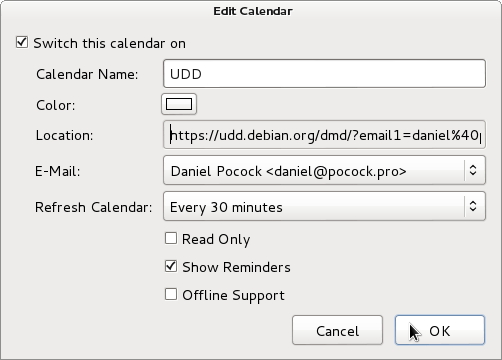
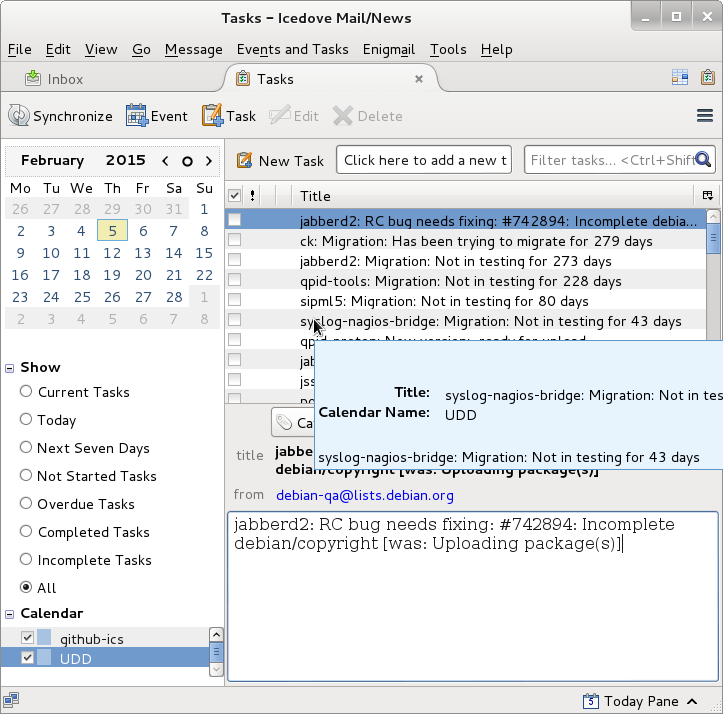
Contributors to Debian can now monitor their list of pending activities using iCalendar clients on their desktop or mobile device. Thanks to the tremendous work of the Debian QA team, the Ultimate Debian Database has been scooping up data from all around the Debian universe and storing it in a PostgreSQL back-end. The Debian Maintainer Dashboard allows developers to see a summary of outstanding issues across all their packages in a range of different formats. With today's update, an aggregated list of Debian tasks and to-dos can now be rendered in iCalendar format and loaded into a range of productivity tools. Using the iCalendar URL Many productivity tools like Mozilla Lightning (Iceowl extension on Debian) allow you to poll any calendar or task list just using a URL. For UDD iCalendar feeds, the URLs look like this:
https://udd.debian.org/dmd/?format=ics&email1=daniel%40pocock.pro
You can also get the data by visiting the Debian Maintainer Dashboard, filling out the form and selecting the iCalendar output format. Next steps Currently, the priority and deadline attributes are not set on any of the tasks in the feed. The strategy of prioritizing issues has been raised in bug #777112. iCalendar also supports other possibilities such as categories and reminders/alarms. It is likely that each developer has their own personal preferences about using these features. Giving feedback through the Debian QA mailing list or the bug tracker is welcome. Screenshots

Dirk Eddelbuettel: Introducing drat: Lightweight R Repositories

A new package of mine just got to CRAN in its very first version 0.0.1: drat. Its name stands for drat R Archive Template, and an introduction is provided at the drat page, the GitHub repository, and below. drat builds on a core strength of R: the ability to query multiple repositories. Just how one could always query, say, CRAN, BioConductor and OmegaHat---one can now adds drats of one or more other developers with ease. drat also builds on a core strength of GitHub. Every user automagically has a corresponding github.io address, and by appending drat we are getting a standardized URL. drat combines both strengths. So after an initial install.packages("drat") to get drat, you can just do either one of
library(drat)
addRepo("eddelbuettel")
or equally
drat:::add("eddelbuettel")
to register my drat. Now install.packages() will work using this new drat, as will update.packages(). The fact that the update mechanism works is a key strength: not only can you get a package, but you can gets its updates once its author replaces them into his drat. How does one do that? Easy! For a package foo_0.1.0.tar.gz we do
library(drat)
insertPackage("foo_0.1.0.tar.gz")
The default git repository locally is taken as the default ~/git/drat/ but can be overriden as both a local default (via options()) or directly on the command-line. Note that this also assumes that you a) have a gh-pages branch and b) have that branch as the currently active branch. Automating this / testing for this is left for a subsequent release. Also available is an alternative unexported short-hand function:
drat:::insert("foo_0.1.0.tar.gz", "/opt/myWork/git")
show here with the alternate use case of a local fileshare you can copy into and query from---something we do at work where we share packages only locally. The easiest way to obtain the corresponding file system layout may be to just fork the drat repository. So that is it. Two exported functions, and two unexported (potentially name-clobbering) shorthands. Now drat away! Courtesy of CRANberries, there is also a copy of the DESCRIPTION file for this initial release. More detailed information is on the drat page.

This post by Dirk Eddelbuettel originated on his Thinking inside the box blog. Please report excessive re-aggregation in third-party for-profit settings.

Next.

Previous.