Search Results: "bod"

25 May 2010

Lucas Nussbaum: Booting ISO or USB key images directly from Grub2?

I m playing with the idea of booting ISO images and USB key images stored in a disk partition directly from Grub2. That would allow to install Linux or test liveCDs without even using a USB key. It seems that Grub2 has everything needed for that (with a combination of drivemap and chainloader), but I can t seem to get it working and, as usual with boot stuff, it s a pain to understand what s happening. Has somebody recently tried that, or can point me to a howto?

Russell Coker: Links May 2010

AdRevenge is an interesting concept to pay for Google Adsense adverts about how companies suck [1]. If a suitably large group of people pay to warn you about a company then it s a good signal that the company is actually doing the wrong thing. A guest post by Mili on Charles Stross blog has an interesting analysis of the economcs of Intellectual Property and concludes that content is a public good [2]. New Age Terrorists Develop Homeopathic Bomb [3], an amusing satire of medical fraud and security theatre. The sit has a lot of other good satire too. Mark Shuttleworth wrote an interesting post about new window management changes that will soon go into Ubuntu [4]. He points out that the bottom status bar in applications is a throw-back to Windows 3.1 and notes that a large part of the incentive for removing it (and using the title-bar for the status) is the work on the Netbook version of Ubuntu. This is really ironic given that the resolution of current Netbooks is quite similar to that of desktop systems that were current when Windows 3.1 came out. Omar Ahmad gave an insightful TED talk about the benefit of using a pen and paper to send a letter to a politician [5]. Sebastian Wernicke gave an amusing and informative TED talk about how to give a good TED talk [6]. His talk gives some useful ideas for public speaking that are worth considering. Catherine Mohr gave a brief and interesting TED talk about how to build an energy efficient house with low embodied energy [7]. Her blog at www.301monroe.com has the details. Stephen Wolfram (of Mathematica fame) gave an interesting TED talk [8]. He covers a lot of interesting things that can be done with computers, primarily based on the Wolfram Alpha [9] platform which allows natural language queries of a large data set. He also talks about the search for a Theory of Everything. Esther Duflo gave an interesting TED talk about using social experiments to fight poverty [10]. She describes how scientific tests have been used to determine the effectiveness of various ways of preventing disease and encouraging education in developing countries. One example of the effectiveness of such research is the DeWormTheWorld.org project which was founded after it was discovered that treating intestinal worms was the most cost effective way of getting African children to spend longer at school. David L. Rosenhan wrote an interesting research paper On Being Sane In Insane Places about pseudo-patients admitted to psychiatric hospitals [11]. It seems that psychiatric staff were totally unable to recognise a sane person who was admitted even though other patients could do so. It also documents how psychiatric patients were treated as sub-human. One would hope that things had improved since 1973, but it seems likely that many modern psychiatric hospitals are as bad as was typical in 1973. It s also worth considering the issue of the treatment in society of people who have been diagnosed with a mental illness, it seems likely that the way people are treated in the community would have similar bad results to that which was documented for treatment in psychiatric hospitals even the sanest people will act strangely if treated in an insane manner! Also it seems to me that there could be potential for using a panel of patients assembled via the Delphi Method as part of the psychiatric assessment process as it has been demonstrated that patients can sometimes assess other patients more accurately than psychiatrists! Simon Sinek gave an inspiring TED talk about how great leaders inspire action [12]. Of course the ideas he describes don t just apply to great leaders, they should apply to ordinary people who just want to convince others to adopt their ideas. Stephen Collins write a good article summarising the main reasons why the proposed great firewall of Australia is a bad idea [13]. Lenore Skenazy who is famous for letting her 9yo son catch the metro alone during broad daylight on a pre-planned route home has created a web site about Free Range Kids [14]. She seems to be starting a movement to oppose Helicopter Parenting and has already written a book about her ideas for parenting. The incidence of crime has been steadily increasing, as has the ability of the police to apprehend criminals and recover abducted children. There s no reason for children to be prevented from doing most of the things that children did when I was young!

24 May 2010

Julien Danjou: Making startup-notification XCB native

I'm trying to work on XCB this week. And today I've started to accomplish the second step of a long term goal: making an X11 only library using XCB as its primary interface instead of Xlib. Last year, I had extended the API of startup-notification to support XCB as a back-end. This had been made possible by factorizing some code, duplicating the X11 code and translating it into equivalent XCB. Today, I've accomplished the second step, being dropping the Xlib code inside startup-notification to keep only the XCB one. For this, I used the x11-xcb library, which is available when Xlib is compiled with XCB as its transport, which is nowadays the standard. This library provides the function XGetXCBConnection, which can convert a Display pointer to a xcb_connection_t pointer. Consequently, it's now possible to write and execute XCB based code and being compatible with Xlib. I've made some benchmark of my work for the occasion, in order to measure what the gain is. The first table described 1000 launches of a fake application (a modified version of the startup-notification test suite actually). The X server is local (the latency is very minimal then). The gain is computed between the same back-end type for the total time. Full XCB is the "version" I'm working on.
Version - Back-end User time (seconds) Kernel time (seconds) Total time (seconds) Gain
0.10 - libx11 3.20 7.42 12.989 -
0.10 - libxcb 2.76 7.36 12.414 -
Full XCB - libx11 2.74 7.50 12.380 4.6 %
Full XCB - libxcb 2.72 7.16 12.037 3.0 %
The user time and kernel time are provided but are not really interesting. XCB does not offers a big gain in CPU execution time, but is more about latency. Anyhow, there's always a gain with XCB. This second table describe the same test but running only 100 times over a slow network.
Version - Back-end Total time (seconds) Gain
0.10 - libx11 76 -
0.10 - libxcb 35 -
Full XCB - libx11 72 5.2 %
Full XCB - libxcb 33 5.7%
The gain is relatively small, about 5 %. But anyhow, there's still a gain. Note that the difference between the execution time of the same test written in XCB and Xlib is just huge. I've tried to optimize the Xlib test, but I did not manage to win more seconds. In conclusion, considering that startup-notification is only used when an application launches another application, the perceivable gain might be even smaller. But anyhow, I think it's worth it.

19 May 2010

Martín Ferrari: Je ne veux pas travailler

That's a phrase I fully adhere to (I don't want to work), but that's not the point. There's a catchy song that I like a lot, it's sung in French and sounds like an old song (most places say it's an Edith Piaf's song). The chorus goes "Je ne veux pas travailler, je ne veux pas d jeuner...", and one would imagine that that's indeed the title. But nothing of this is true, once again the Internets is full of fail. The band who performs the song is called Pink Martini, two of them are the authors of it, and they are from Oregon. It was recorded in 1997 (some audio filters did the magic), and it's called "Sympathique". It also seems that it was a big success, but probably not in my part of the world. I thought that somebody should set this straight somewhere, as I couldn't find anybody speaking of this confusion. Having settled that, I invite you to listen to this wonderful song, and sing along that you don't wanna work (forget about the rest of the lyrics, it's a love song :-)). Tags: Planet Debian, Planet Lugfi, M sica

17 May 2010

Francois Marier: List of Open Source Conference Management Systems

Conference Management systems are web applications designed to make the lives of conference organisers easier. They usually include features such as registration, payment, paper submission and review, scheduling and publishing of announcements.

Since Wikipedia is apparently not a place for such a "spammy list," I figured I should at least post this here:
NameUsed byLicenseProgramming Language
A Conference ToolkitYAPC::EuArtistic LicensePerl
ConManUtah Open Source Conference, Texax Linux FestGPLPython (Django)
Open Conference Systemsvarious academic conferencesGPLPHP
OpenConferenceWareOpen Source BridgeMITRuby on Rails
PentabarfDebConf, FOSDEM, CCCGPLRuby on Rails
SCALEregSCALEGPLPython (Django)
Zookeeprlinux.conf.auGPLPython (Pylons)


If you know of any other Open Source systems, please leave a comment!

16 May 2010

Thomas Koch: tnt is not topgit

As I've already written, I'm working on an alternative to topgit. I made a first attempt in perl some weeks ago, but gave up after some frustrating hours. Yesterday I started again in python and had a very nice time putting together the groundwork and the first two commands.
It may be noted, that I've no previous programming experience in neither perl nor python!
By now, I can create a patchset branch and add a patch branch to it. There's still a lot to do. For my talk at the Debian Mini Conference in Berlin next month I'd like to be able to update patch branches, export patchsets and give a status summary.
Maybe I can already find somebody who's interested in joining me with this project? The code is in my github account, however the name will most probably change.
One reason that I've been much faster in python is the fantastic python-git library. I can only recommend it!
In other news: I'm searching a couch to surf in Berlin from june 7.-12. I prefer couchsurfing over hotels mostly to get to know nice people around the world. Please contact me, if you'd like to host me for a night or two. (thomas at koch punkt ro)

13 May 2010

Steve Kemp: Can you stand on your head?

I've been a little quieter than usual recently, having spent more time outdoors putting cute people in front of the camera. However that said I've still been doing some things. Most interestingly I've given away my first ever project. The collection of small scripts known as xen-tools (which was initially a sleazy hack to go with a small introduction to Xen article) has now got new developers, and a new home where development is continuing. This isn't the first time I've stopped working on something, but it is the first time I've explicitly "given away" a project. (Mostly on the basis that if I didn't care nobody else did either, or people cared but were too busy/unable to actually do soemthing useful.) I'll be following new updates with interest, even though these days I'm 100% Xen-free. No need to go into huge details about why, but I'm enjoying KVM. Having said that I recently got into a huge mess with a combination of LVM, KVM, and ext3. I've written up the details on ServerFault in the optimistic hope that somebody will report having experienced a similar problem. If you have seen something similar I'd love to hear from you. Otherwise I'm genuinely at a loss to understand what went wrong, and why things failed. I could suspect hardware issues, but that feels like a cop-out, albeit one that has a potential solution (Mad Hatter: All Change!) rather than my current answer and explaination "It broke. I don't know why. It might happen again. It might not. Trust me?". ObFilm: Alice In Wonderland (1951 version.)

11 May 2010

Gunnar Wolf: e-voting seminar, Mexico City, tomorrow

If anybody is interested or can attend: Tomorrow and the day after (Wednesday and Thursday 12-13/05/2010) FLACSO (a leading Social Sciences faculty spanning countries all over Latin America) and IFE (Mexico's federal electoral authority) are presenting a seminar on e-voting: Electronic vote experiences in Mexico and around the world. Sadly, I will be unable to attend, as I will be on the road once again (Ecuador!). However, I hope those among my readers who are interested in the topic can attend or at least follow the audio and video transmission from the IFE website. The seminar will be held at IFE's auditorium Viaducto Tlalpan No. 100, Col. Arenal Tepepan, Delegaci n Tlalpan, c.p. 14610, M xico, DF. [update] If you don't know what is my stand on this topic (and can read Spanish), please read this short article. In short: I am against e-voting, and hope we are still in time (and can push at the right places) to avoid it becoming the rule in our country.

10 May 2010

Romain Beauxis: Ubuntu, the firm and its employees

This post is not meant to be offensive in any way. I would just like to write down things that came to my mind recently. It all started when I was considering applying for the right to upload the package I maintain into Ubuntu. Looking at the procedure, I realized that this needs to be present during an IRC meeting at a given date online. This stopped me immediately. I am working most of my day-time and, given the time zone I am living now, this was not an option. But, since I had registered to the corresponding mailing list, I started receiving mails of other applicants that where trying to arrange things with their work and private life to be able to participate. Now, today, I stumbled upon these notes of Mark's presentation in Bruxelles, relayed by a friend that is not either working for Ubuntu. Reading it gave me a strong taste of management-oriented presentation, with all this sort of "yeah we want our product in every box next year" propaganda. Not like Steve Ballmer, fortunately, but not far perhaps. So, yeah, there is something that makes me uncomfortable with Ubuntu. I am really happy by its success and I will continue to recommend it to friends around me. However, I wonder if, in a way, Ubuntu is not a model of commercial company where a minimal core of developers are actually payed, while a second layer of developers are fan-boys that are willing to participate as if there were employees but without being actually payed, and a third layer being the open-source developers whose work is actually what makes 90% of the core of the OS. A very good illustration is at the end of the note from Mark's presentation. It reads:
Somebody asks about advertising Ubuntu, looks like there are no plans for the moment to actually advertise Ubuntu across traditional media. Mark uses the Ubuntu Manual as an example of how Ubuntu gets advertised and will reach the mainstream, Mark points out myself and the room applauds the Ubuntu Manual Project! Woohoo!
Now, guess what:
About Us We are a group of individuals trying to promote the use of Ubuntu and its variants. This is a private web site that is not connected in any official or financial way with Ubuntu, Canonical PL or Ubuntu.com. Official Ubuntu guides and downloads are freely available at www.ubuntu.com. Ubuntu is a registered trademark of Canonical PL
Source: http://ubuntumanual.org/about-us

9 May 2010

Alexander Wirt: Debian(.de) needs you!

I volunteered to manage the Debian booth on the Linuxtag 2010 in Berlin. I asked for booth members a few weeks ago on debian-events-eu and debian-user-german - but unfortunately there aren't that many helpers listed at the organisation wiki. So if you attend the Linuxtag or the Debian Miniconf please lend Debian a little bit of your time and apply for the debian booth. You don't have to be a Debian Developer for that, an interested user is enough. I'll plan the booth in a way that nobody will be alone at the booth ;).

6 May 2010

Ian Wienand: How much slower is cross compiling to your own host?

The usual case for cross-compiling is that your target is so woefully slow and under-powered that you would be insane to do anything else. However, sometimes for one of the best reasons of all, "historical reasons", you might ship a 64-bit product but support building on 32-bit hosts, and thus cross-compile even on a very fast architecture like x86. How much does this cost, even though almost everyone is running the 32-bit cross-compiler on a modern 64-bit machine? To test, I got a a 32-bit cross and a 64-bit native x86_64 compiler and toolchain; in this case based on gcc-4.1.2 and binutils 2.17. I then did a allyesconfig build of Linux 2.6.33 x86_64 kernel 3 times using the cross compilier toolchain and then native one. The results (in seconds):
32-bit64-bit
60905684
60505616
60635652
average
60675650
So, all up, ~7% less by building your 64-bit code on a 64-bit machine with a 32-bit cross-compiler.

Andrew Pollock: [life] Crazy few days

Here's why: Zoe's birth Zoe Dianne Pollock was born at 12:30pm PDT, at Lucile Packard Children's Hospital, via Caesarean-section. Her birth weight was 2920 grams (6 lbs, 7 oz) and she's 49.5 centimetres (19.5 inches) long. As for why she was born 11 days early than her previously scheduled early arrival... Monday morning started off like any other normal Monday morning. I got up at 6am to go to the gym with Dan. I got home at around 8am. I asked Sarah if she'd felt any baby movement, and she said she hadn't. Even after some jiggling and a cold glass of orange juice, there was nothing. Not wanting a repeat performance of what happened last time, we wasted no time in heading to Labour and Delivery to get things checked out. When we were nearly at the hospital, Sarah felt some small movement, so that was a relief. When we got to the hospital, they performed a non-stress test as they have previously. They spent a good couple of hours with Sarah hooked up to the monitor, and then the on-call obstetrician asked us how we'd feel about just having the baby today. I asked if there was anything particularly concerning about the NST, and the OB said that she (the baby) was doing marvelously now, but was "less than marvelous" when we first came in. I haven't had a chance since to ask her if there was anything untoward observed during the delivery. Anyway, she (the on call OB) said that rather than have Sarah get stressed out for the following 11 days, she'd talked with our regular OB, and they felt that since she was at 37 weeks (and considered "full term") that it was okay to deliver at that point. At the end of the conversation, it was upgraded to a recommendation, rather than an option. So so much for an attempt at VBAC. We got to the hospital at around 9am, and I think they/we made the decision to deliver at about 10:30am. I had enough time to race home and grab the camera and race back again, and the next thing I knew we were all in the operating room, and Zoe was being delivered. It was amazing getting to see the "extraction". They dropped down the sheet that was blocking our view of the action right at the end, and I got to see (and photograph) Zoe's head and whole body being pulled out. She gave out a little cry, and Sarah and I totally lost it with relief. Things were a bit of a blur after that. I got to come over and meet Zoe while they were weighing her and measuring her, and then they bundled her up and let me take her back to Sarah's head-end on the operating table, so Sarah could get a look at her. Sarah handled this C-section better than last time. She didn't get any nausea, but she still got the itching and involuntary shivering, courtesy of the morphine. While they were still putting Sarah's insides back in, Zoe and I went to the nursery, where they put her under a heater for a little while to warm her up a bit. Then it was back to the recovery room to have a proper meeting with Sarah. Once Sarah was ready to move to the maternity ward, Zoe and I again returned to the nursery, where she got her first bath, had her umbilical cord trimmed some more, and her anti-theft device fitted to her umbilical cord clamp. Then it was off to the maternity ward. I think we were all in the maternity ward by 3pm. After a little while, we managed to get bumped to a private room, which was a lot better than the shared room (the other bed was vacant, but just having more space made a big difference), and that's where we've been ever since. I've stayed each night on the roll away bed, helping out with diaper (sorry Aussies, I've been here too long, and dealt with too many babies, I never think of them as "nappies" any more) changes, and burping and other miscellaneous tasks. Monday night was okay. Tuesday was a bit rough. Sarah didn't get any sleep on Monday night, and the anaesthesia totally wore off and she was in a fair bit of pain. She slept better on Tuesday night, and today, the breastfeeding has been going well, and the post-operative pain is well and truly under control. She's lost a bit of weight since delivery (as is to be expected). She was down to 5 lbs 14 oz (2664 grams) at last night's weigh-in, and at tonight's weigh-in she came in at 5 lbs 13 oz (2636 grams). So the weight loss is starting to plateau. We're already supplementing the breastfeeding with syringes of colostrum/milk that Sarah's pumped previously, so I hope the weight loss will have turned around by tomorrow night's weigh-in. The breastfeeding in general is going pretty well as of today. Mum and bub have both mastered the latch. I think it's just a matter of Sarah's milk coming in now. I've brought forward my 7 weeks paternity leave (an excellent benefit Google offers) to start as of Zoe's delivery. Sarah's Mum arrives on the 19th for 4 weeks, which will be great. We expect to be discharged from hospital on Friday. Luckily we were pretty much all ready for this happening a little bit earlier. We had our last baby classes on the weekend. The nursery is ready enough to bring a baby home to, so aside from Sarah's Mum being disappointed that Zoe's going to be a bit older when she first gets to see her, we're all good. The WiFi in the hospital is great. We've already Skyped with both grandmothers and they've had a chance to see Zoe. We've had a steady trickle of visitors, and the whole baby routine is making the time go pretty quickly.

5 May 2010

MJ Ray: General Election 2010

You may have noticed that the UK votes in a General Election tomorrow. It looks like the closest for at least 18 years and maybe more. Happily, all the major parties are saying nice things about cooperatives, but I wonder how much of that will translate into policies that are practical for co-ops like mine. Our national body Cooperatives UK has gathered the commitments from 18 manifestos and summarised them in a PDF. The first 7 pages deal with the five biggest English parties. One striking thing is how many gaps there are in the Labour, LibDem and UKIP policies, while it s not really clear to me that the Conservatives or LibDems really understand cooperatives. The Conservatives seem to suggest council-controlled co-ops (which wouldn t normally be co-ops if they lack autonomy), while the LibDems mention employee trusts more often than worker co-ops. I m sulking at Labour after several recent schemes that subsidised private competitors and excluded worker co-ops and I don t believe Labour can win in Weston-super-Mare. That would leave the Greens, who probably can t win but do seem to get it, except that there s no Green candidate where I live because he stood aside and recommended the LibDems (as I understand it). Drat. So, only a few hours to go before the start of the ballot and I m still an undecided voter.
Ana Beatriz Guerrero Lopez: KDE 4.4.3 in unstable

Following Qt 4.6.2, uploaded a couple of weeks ago, KDE 4.4.3, has finally found its way to unstable in the last 48 hours.
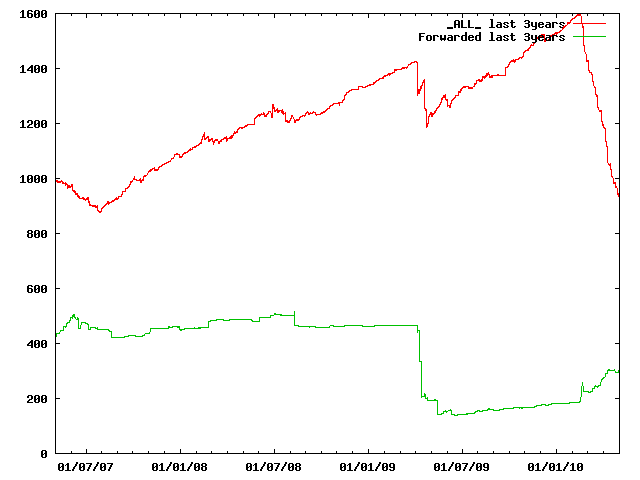
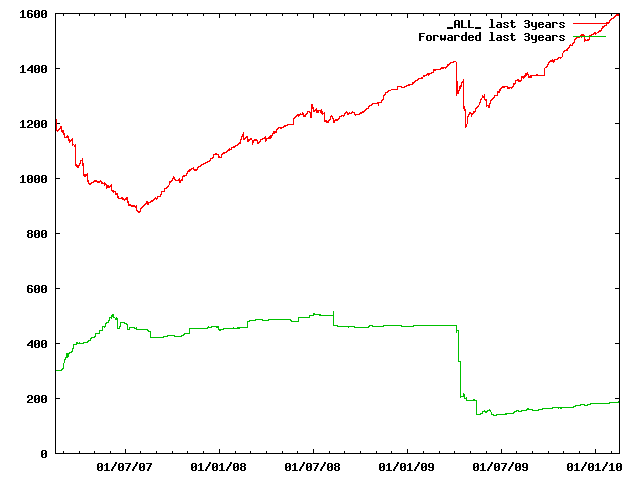
Given KDE 4.5.0 is not expected until August, it is likely the next point release, 4.4.4, will be the KDE version included in next Debian stable, Squeeze. What this means: go and update to 4.4.3, test, and when you find a bug, please, follow this instructions. If you are lazy to read it: report upstream bugs at the KDE Bugzilla and report the packaging/integration bugs in the Debian BTS. When in doubt, you have the Debian KDE mailing list, that is being successful so far in maintaining a good signal-noise ratio. I would like highlight the drop in the open bugs in the BTS experimented in the last 2-3 months, I published this graph in February: Number of bugs reported against KDE in Debian in the last 3 years - February 2010 And look at the situation now: Number of bugs reported against KDE in Debian in the last 3 years -May 2010 This is mainly due to the great work of Eckhart W rner. Also there is other people who contributed to it more modestly, a big thank you to all of you! As you can see in the second graph, there are less than 1000 bugs open now in the BTS, they are still too much and time has taught us it is very easy going over 1000 again, so we still welcome more volunteers looking at bugs. If you are not the bugsquasher type, you can write HTML and you do some IRC, we also need somebody to help us reorganize a bit the pkg-kde website. I will help you personally on this task, but it is good if you can lurk by IRC and you are not scared to share your doubts with the rest of the team there. Finally, I promise I will publish something about the status of KOffice pre-2.2 in Debian, but I still can not say whether it will be in Squeeze.

Gunnar Wolf: Post-apocalyptic times

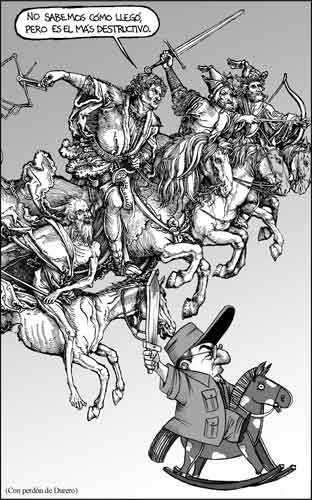
Pestilence, War, Famine, and Death, the mythological Four Horsemen of the Apocalypse. Mexico's de facto president, Felipe Calder n, once again showed his involuntary aptitude for deep political analysis: On Monday, on a State visit to Germany, he declared Mexico has faced the Five Horsemen of the Apocalypse (second source, in English). I agree: One year ago, we were facing a health emergency, the AH1N1 epidemic, hence pestilence. Since he took power in December 2006, the president's main action has been the war on drugs, hence war. The country was the worst performing Latin American country in 2009, with our economy falling 6.5%, more than any other country, and prices have been really on the rise, hence famine. Finally, death... official numbers state that there have been over 22000 deaths in the "war on drugs" And merrily he stated that only 10% of that were civilians. Whatever that meant... But... What about the fifth? Who is he? A plausible hypothesis is offered by cartoonist El Fisg n in today's cartoon in La Jornada:
We don't know how he got here, but he is the most effective one Now... However good El Fisg n's analysis might be... Lets not get distracted with silly details. Hern ndez, another of La Jornada's great cartoonists, shows the hidden meaning:
We are over the apocalypse!
Does that mean we are facing the Final Judgement?
The coming of the five horsemen of apocalypse can only mean... It is time for the Final Judgement and the end of time!
AttachmentSize
hernandez_20100505.jpg16.6 KB
fisgon_20100505.jpg28.11 KB

3 May 2010

Matthew Garrett: PCI power management problems

I've previously written about some of the implementation details of runtime PCI power management. One of the key aspects for PCI devices is that the PME line on the device be able to generate a wakeup event. Unfortunately, it turns out that since Windows makes no use of this functionality at present, some vendors have started failing to wire this up. This is problematic because the device itself still announces PME support and will even raise a PME signal when it gets woken up - but it's pretty much screaming as hard as it can and nobody's listening because somebody's replaced the air with cheese.

Bother, etc.

The obvious question is what to do next. We could poll all the PCI devices every second or so to see if there's a PME status register that's been set. This would be reasonably cheap (we're going to wake up at least once a second on x86 anyway, so it makes no real difference to power consumption) but would introduce obvious latency in the wakeup path. This would be fine for certain types of situation (you're probably not going to be too sad if your SD reader takes a second longer to notice a card insertion) but not others (if an sdio wireless card generates a wakeup interrupt then we really ought to do something about it in a more sensible timeframe). A second is to force users to pass a boottime argument to enable this at all. That kind of sucks.

The third possibility is limited to a subset of hardware, but does allow the introduction of some kind of elegance into what would otherwise be one of those nightmarish scenarios that makes me consider taking up farming instead. If we can trigger a PME ourselves then we can test whether the line is connected. This doesn't appear to be possible on SDHCI but the spec for firewire makes it look like we can do it there - one of the interrupt sources is the port enable/disable register, and we can hit toggle that ourselves. I haven't actually tested this yet, but if it works that would let us make this determination.

It's depressing that doing anything interesting with power management is still heavily determined by what Microsoft have bothered to implement - to the extent that on some machines (hello, Thinkpads) there are no GPE methods at all for PME signals and you don't get runtime power management at all. The only thing that saves us is that (a) it's pretty hard to be able to screw up stuff that's already all glued into one chip package, so integrated stuff like USB should be fine anyway, and (b) PCIe does this as part of the normal traffic stream so there's no way to get that wrong. Unless you're still missing the GPE methods for the signals (hello, Thinkpads) in which case you get nothing unless the native PCIe signalling works. I suspect that we can always force that, so there's some hope yet.

In summary, then: dispassionate.

Wouter Verhelst: Yves Leterme, Belgian minister for resignation.

At least that's what it looks like right now. No less than five times did he offer his resignation as prime minister of Belgium to the king. Looks like fifth time is a charm now, too we get to go elect a new parliament in a month or two. Sigh. The 'fun' bit is, there's no real reason why this is necessary. The main issue that they've been talking about these past few years is the 'BHV' thing. While the issue is somewhat complex and, I'm sure, involves a huge heap of all kinds of side issues, the crux of the matter is that there's one group of politicians who wants to forbid another group of politicians from running in a region of the country around the capital. Now I'm sure that's hugely important to politicians after all, their career depends on it but beyond a few fanatics in and around that very capital, I'm pretty sure nobody actually cares what the particular names are of the particular groups of people that appear on the list of people they can vote for. Because, you see, this isn't actually about politicians wanting to forbid other politicians from running; it's about politicians wanting to forbid other political parties from running. Which, of course, makes a whole world of difference. Yeah, right. Now I wouldn't care about this much, except that it interferes with the smooth running of this country. The fact that they've come up with "problem" after "problem" related to this BHV "issue" for these past years has made it hard(er) for the government to actually to any real work. So although I hate the current situation, I'm actually quite relieved that an election is coming up. Perhaps this time we can get the fanaticals out and have a real government. (no comments allowed on this item; please use your own blog)

28 April 2010

John Goerzen: Download A Piece of Internet History

Back in the early 1990s, before there was a World Wide Web, there was the Internet Gopher. It was a distributed information system in the same sense as the web, but didn t use hypertext and was text-based. Gopher was popular back then, as it made it easy to hop from one server to the next in a way that FTP didn t. Gopher has hung on over the years, and is still clinging to life in a way. Back in 2007, I was disturbed at the number of old famous Gopher servers that had disappeared off the Internet without a trace. Some of these used to be known by most users of the Internet in the early 90s. To my knowledge, no archive of this data existed. Nobody like archive.org had ever attempted to save Gopherspace. So I decided I would. I wrote Gopherbot, a spidering archiver for Gopherspace. I ran it in June 2007, and saved off all the documents and sites it could find. That saved 40GB of data, or about 780,000 documents. Since that time, more servers have died. To my knowledge, this is the only comprehensive archive there is of what Gopherspace was like. (Another person is working on a new 2010 archive run, which I m guessing will find some new documents but turn up fewer overall than 2007 did.) When this was done, I compressed the archive with tar and bzip2 and split it out to 4 DVDs and mailed copies to a few people in the Gopher community. Recently, we ve noted that hard disk failures have hobbled a few actually maintained Gopher sites, so I read this archive back in and posted it on BitTorrent. If you d like to own a piece of Internet history, download the torrent file and go to town (and please stick around to seed if you can). This is 15GB compressed, and also includes a rare video interview with two of the founders of Gopher. There are some plans to potentially host this archive publicly in the manner of archive.org; we ll have to wait and see if anything comes of it. Finally, I have tried to find a place willing to be a permanent host of this data, and to date have struck out. If anybody knows of such a place, please get in touch. I regret that so many Gopher sites disappeared before 2007, but life is what it is, and this is the best snapshot of the old Gopherspace that I m aware of and would like to make sure that this piece of history is preserved.

27 April 2010

Ingo Juergensmann: Johan Schl ter: "Child pornography is great"

For many activists in net-politics it is apparent that the fight against child pornography is just an excuse for establishing a EU-wide content filtering infrastructure. This infrastructure for content filtering can be used to filter other content than child pornography as well. For example politicians in Germany already requested blocking gambling sites, Nazi sites, left extremistic political sites and others, when we had that kind of discussion last year over here. The proposal of a law putting up stop pages in front of child pronography sites by former minister for family Ursula "Zensursula" von der Leyen passed the parliament, but shortly after last years parliament elecetion all political parties didn't want that law anymore.
EU commissioner Cecilia "Censilia" Malmstr m introduced a similar proposal for a EU-wide blocking iinitiative a short while ago, as you might now. Christian Engstr m, member of the EU parliament of the swedish Pirate Party, wrote today on his blog that content right industry welcomes child pornography as a way to introduce content filter and blocking infrastructure:

Child pornography is great, the speaker at the podium declared enthusiastically. It is great because politicians understand child pornography. By playing that card, we can get them to act, and start blocking sites. And once they have done that, we can get them to start blocking file sharing sites .

The venue was a seminar organized by the American Chamber of Commerce in Stockholm on May 27, 2007, under the title Sweden A Safe Haven for Pirates? . The speaker was Johan Schl ter from the Danish Anti-Piracy Group, a lobby organization for the music and film industry associations, like IFPI and others.

[...]

Start with child porn, which everybody agrees is revolting, and find some politicians who want to appear like they are doing something. Never mind that the blocking as such is ridiculously easy to circumvent in less than 10 seconds. The purpose at this stage is only to get the politicians and the general public to accept the principle that censorship in the form of filters is okay. Once that principle has been established, it is easy to extend it to other areas, such as illegal file sharing. And once censorship of the Internet has been accepted in principle, they can start looking at ways to make it more technically difficult to circumvent.


If you already have not, then please act now and contact your local EU representive and kindly ask to refuse this directive of Malmstr m and enlighten them by supplying arguments such those MOGIS (MissbrauchsOpfer Gegen InternetSperren, abuse survivors against internet blocking) put up on their webpage (English and other languages).

The abuse of childs and the documentation of such abuse (child pornography is a bad term anyway) needs to be stopped! But access blocking is the wrong direction. Better take care of a more effective criminal prosecution. Documentation of child abuse needs to get removed from the web and the producers needs to get arrested.

So, please act now!

P.S.: there's a nice video on http://cleanternet.org/

24 April 2010

Margarita Manterola: After the campaign

I spent the whole last week in bed with an acute case of pharyngitis, so I haven't been able to gather my thoughts in a blog post up to now. I'd like to congratulate zack on winning the election, and I have faith that he will be a great DPL. I'm happy with my second place, I'd like to thank everybody that supported me and I think that I'll probably try again in the future, although not necessarily next year. Since zack is probably not going to have time to keep up with his bug squashing campaign, I'm going to try and continue that myself. And, if time permits I'm also going to try to put some of the ideas in my platform into action. Finally, last friday both Maxy and me were granted the US visa that we needed to go to DC10, so we finally can say:

Next.

Previous.