Search Results: "ana"

30 August 2015

DebConf team: DebConf15: Farewell, and thanks for all the Fisch (Posted by DebConf Team)

A week ago, we concluded our biggest DebConf ever! It was a huge success. Handwritten feedback note We are overwhelmed by the positive feedback, for which we re very grateful. We want to thank you all for participating in the talks; speakers and audience alike, in person or live over the global Internet it wouldn t be the fantastic DebConf experience without you! Many of our events were recorded and streamed live, and are now available for viewing, as are the slides and photos. To share a sense of the scale of what all of us accomplished together, we ve compiled a few statistics: Our very own designer Valessio Brito made a lovely video of impressions and images of the conference.
We re collecting impressions from attendees as well as links to press articles, including Linux Weekly News coverage of specific sessions of DebConf. If you find something not yet included, please help us by adding links to the wiki.
DebConf15 group photo (by Aigars Mahinovs)
We tried a few new ideas this year, including a larger number of invited and featured speakers than ever before. On the Open Weekend, some of our sponsors presented their career opportunities at our job fair, which was very well attended. And a diverse selection of entertainment options provided the necessary breaks and ample opportunity for socialising. On the last Friday, the Oscar-winning documentary Citizenfour was screened, with some introductory remarks by Jacob Appelbaum and a remote address by its director, Laura Poitras, and followed by a long Q&A session by Jacob. DebConf15 was also the first DebConf with organised childcare (including a Teckids workshop for kids of age 8-16), which our DPL Neil McGovern standardised for the future: it s a thing now, he said. The participants used the week before the conference for intensive work, sprints and workshops, and throughout the main conference, significant progress was made on Debian and Free Software. Possibly the most visible was the endeavour to provide reproducible builds, but the planning of the next stable release stretch received no less attention. Groups like the Perl team, the diversity outreach programme and even DebConf organisation spent much time together discussing next steps and goals, and hundreds of commits were made to the archive, as well as bugs closed. DebConf15 was an amazing conference, it brought together hundreds of people, some oldtimers as well as plenty of new contributors, and we all had a great time, learning and collaborating with each other, says Margarita Manterola of the organiser team, and continues: The whole team worked really hard, and we are all very satisfied with the outcome. Another organiser, Martin Krafft adds: We mainly provided the infrastructure and space. A lot of what happened during the two weeks was thanks to our attendees. And that s what makes DebConf be DebConf. Photo of hostel staff wearing DebConf15 staff t-shirts (by Martin Krafft) Our organisation was greatly supported by the staff of the conference venue, the Jugendherberge Heidelberg International, who didn t take very long to identify with our diverse group, and who left no wishes untried. The venue itself was wonderfully spacious and never seemed too full as people spread naturally across the various conference rooms, the many open areas, the beergarden, the outside hacklabs and the lawn. The network installed specifically for our conference in collaboration with the nearby university, the neighbouring zoo, and the youth hostel provided us with a 1 Gbps upstream link, which we managed to almost saturate. The connection will stay in place, leaving the youth hostel as one with possibly the fastest Internet connection in the state. And the kitchen catered high-quality food to all attendees and their special requirements. Regional beer and wine, as well as local specialities, were provided at the bistro. DebConf exists to bring people together, which includes paying for travel, food and accomodation for people who could not otherwise attend. We would never have been able to achieve what we did without the support of our generous sponsors, especially our Platinum Sponsor Hewlett-Packard. Thank you very much. See you next year in Cape Town, South Africa!
The DebConf16 logo with white background

Dirk Eddelbuettel: RcppGSL 0.3.0

A new version of RcppGSL just arrived on CRAN. The RcppGSL package provides an interface from R to the GNU GSL using our Rcpp package. Following on the heels of an update last month we updated the package (and its vignette) further. One of the key additions concern memory management: Given that our proxy classes around the GSL vector and matrix types are real C++ object, we can monitor their scope and automagically call free() on them rather then insisting on the user doing it. This renders code much simpler as illustrated below. Dan Dillon added const correctness over a series on pull request which allows us to write more standard (and simply nicer) function interfaces. Lastly, a few new typedef declaration further simply the use of the (most common) double and int vectors and matrices. Maybe a code example will help. RcppGSL contains a full and complete example package illustrating how to write a package using the RcppGSL facilities. It contains an example of computing a column norm -- which we blogged about before when announcing an much earlier version. In its full glory, it looks like this:
#include <RcppGSL.h>
#include <gsl/gsl_matrix.h>
#include <gsl/gsl_blas.h>
extern "C" SEXP colNorm(SEXP sM)  
  try  
        RcppGSL::matrix<double> M = sM;     // create gsl data structures from SEXP
        int k = M.ncol();
        Rcpp::NumericVector n(k);           // to store results
        for (int j = 0; j < k; j++)  
            RcppGSL::vector_view<double> colview = gsl_matrix_column (M, j);
            n[j] = gsl_blas_dnrm2(colview);
         
        M.free() ;
        return n;                           // return vector
    catch( std::exception &ex )  
        forward_exception_to_r( ex );
    catch(...)  
        ::Rf_error( "c++ exception (unknown reason)" );
   
  return R_NilValue; // -Wall
 
We manually translate the SEXP coming from R, manually cover the try and catch exception handling, manually free the memory etc pp. Well in the current version, the example is written as follows:
#include <RcppGSL.h>
#include <gsl/gsl_matrix.h>
#include <gsl/gsl_blas.h>
// [[Rcpp::export]]
Rcpp::NumericVector colNorm(const RcppGSL::Matrix & G)  
    int k = G.ncol();
    Rcpp::NumericVector n(k);           // to store results
    for (int j = 0; j < k; j++)  
        RcppGSL::VectorView colview = gsl_matrix_const_column (G, j);
        n[j] = gsl_blas_dnrm2(colview);
     
    return n;                           // return vector
 
This takes full advantage of Rcpp Attributes automagically creating the interface and exception handler (as per the previous release), adds a const & interface, does away with the tedious and error-pronce free() and uses the shorter-typedef forms for RcppGSL::Matrix and RcppGSL::VectorViews using double variables. Now the function is short and concise and hence easier to read and maintain. The package vignette has more details on using RcppGSL. The NEWS file entries follows below:
Changes in version 0.3.0 (2015-08-30)
  • The RcppGSL matrix and vector class now keep track of object allocation and can therefore automatically free allocated object in the destructor. Explicit x.free() use is still supported.
  • The matrix and vector classes now support const reference semantics in the interfaces (thanks to PR #7 by Dan Dillon)
  • The matrix_view and vector_view classes are reorganized to better support const arguments (thanks to PR #8 and #9 by Dan Dillon)
  • Shorthand forms such as Rcpp::Matrix have been added for double and int vectors and matrices including views.
  • Examples such as fastLm can now be written in a much cleaner and shorter way as GSL objects can appear in the function signature and without requiring explicit .free() calls at the end.
  • The included examples, as well as the introductory vignette, have been updated accordingly.
Courtesy of CRANberries, a summary of changes to the most recent release is available. More information is on the RcppGSL page. Questions, comments etc should go to the rcpp-devel mailing list off the R-Forge page.

This post by Dirk Eddelbuettel originated on his Thinking inside the box blog. Please report excessive re-aggregation in third-party for-profit settings.

Sven Hoexter: 1960 SubjectAlternativeNames on one certificate

tl;dr; You can add 1960+ SubjectAlternativeNames on one certificate and at least Firefox and Chrome are working fine with that. Internet Explorer failed but I did not investigate why. So why would you want to have close to 2K SANs on one certificate? While we're working on adopting a more dynamic development workflow at my workplace we're currently bound to a central development system. From there we serve a classic virtual hosting setup with "projectname.username.devel.ourdomain.example" mapped on "/web/username/projectname/". That is 100% dynamic with wildcard DNS entries and you can just add a new project to your folder and use it directly. All of that is served from just a single VirtualHost. Now our developers started to go through all our active projects to make them fit for serving via HTTPS. While we can verify the proper usage of https on our staging system where we've validating certificates, that's not the way you'd like to work. So someone approached me to look into a solution for our development system. Obvious choices like wildcard certificates do not work here because we've two dynamic components in the FQDN. So we would've to buy a wildcard certificate for every developer and we would've to create a VirtualHost entry for every new developer. That's expensive and we don't want all that additional work. So I started to search for documented limits on the number of SANs you can have on a certificate. The good news: there are none. The RFC does not define a limit. So much about the theory. ;) Following Ivans excellent documentation I setup an internal CA and an ugly "find ... sed ... tr ..." one-liner later I had a properly formated openssl config file to generate a CSR with all 1960 "projectname.username..." SAN combinations found on the development system. Two openssl invocations (CSR generation and signing) later I had a signed certificate with 1960 SANs on it. I imported the internal CA I created in Firefox and Chrome, and to my surprise it worked. Noteworthy: To sign with "openssl ca" without interactive prompts you've to use the "-batch" option. I'm thinking about regenerating the certificate every morning so our developers just have to create a new project directory and within 24h serving via HTTPS would be enabled. The only thing I'm currently pondering about is how to properly run the CA in a corporate Windows world. We could of course ask the Windows guys to include it for everyone but then we would've to really invest time in properly running the CA. I'd like to avoid that hassle. So I'd guess we just stick to providing the CA for those developers who need it. This all or nothing model is a constant PITA, and you really do not want to get owned via your own badly managed CA. :( Regarding Internet Explorer it jumped in my face with a strange error message that recommended to enable TLS 1.0, 1.1 and 1.2 in the options menu. Of course that's already enable. I'll try to take a look at the handshake next week, but I bet we've to accept for the moment that IE will not work with so many SANs. Would be interesting to try out Windows 10 with Spartan, but well I'm not that interested in Windows to invest more time on that front. Other TLS implementations, like Java, would be also interesting to test.

Russ Allbery: Review: Pound Foolish

Review: Pound Foolish, by Helaine Olen
Publisher: Penguin
Copyright: 2012, 2013
Printing: 2013
ISBN: 1-59184-679-X
Format: Trade paperback
Pages: 241
For at least the last six years, it's not been surprising news that the relationship between the average person and the US financial system is tense at best, and downright exploitative at worst. The collapse of the housing bubble revealed a morass of predatory lending practices, spectacularly poor (or spectacularly cynical) investment decisions, and out-of-control personal debt coupled with erosion of bankruptcy law. Despite this, there's always a second story in all discussions of the finances of the US population: the problem isn't with financial structures and products, but with us. We're too stupid, or naive, or emotional, or uninformed, or greedy, or unprincipled, or impatient. Finances are complicated, yes, but that just means we have to be more thoughtful. All of these complex financial products could have been used properly. Helaine Olen's Pound Foolish is a systemtic, biting, well-researched, and pointed counter to that second story. The short summary of this book is that it's not us. We're being set up for failure, and there is a large and lucrative industry profiting off of that failure. And many (although not all) people in that industry know exactly what they're doing. Pound Foolish is one of my favorite forms of non-fiction: long-form journalism. This is an investigative essay into the personal finance and investment industry, developed to book length. Readers of Michael Lewis will feel right at home. Olen doesn't have Lewis's skill with characterization and biography, but she makes up for it in big-picture clarity. She takes a wealth of individual facts about who is involved in personal finance, how they make money, what they recommend, and who profits, and develops it into a clear and coherent overview. If you have paid any attention to US financial issues, you'll know some of this already. Frontline has done a great job of covering administrative fees in mutual funds. Lots of people have warned about annuities. The spectacular collapse of the home mortgage is old news now. But Olen does a great job of finding the connections between these elements and adding some less familiar ones, including an insightful and damning analysis of financial literacy campaigns and the widespread belief that these problems are caused by lack of consumer understanding. I've read and watched a lot of related material, including several full-book treatments of the mortgage crisis, so I think it's telling that I never got bored in the middle of Olen's treatment. I find the deep US belief in the power of personal improvement fascinating. It feels like one of the defining characteristics of US culture, for both good and for ill. We're very good at writing compelling narratives of personal improvement, and sometimes act on them. We believe that everyone can and should improve themselves. But that comes coupled to a dislike and distrust of expertise, even when it is legitimate and earned (Hofstadter's Anti-Intellectualism in American Life develops this idea at length). And I believe we significantly overestimate the ability of individuals to act despite systems that are stacked against us, and significantly overestimate our responsibility for the inevitable results. This was the main message I took from Pound Foolish: we desperately want to believe in the myth of personal control. We want to believe that our financial troubles are something we can fix through personal education, more will power, better decisions, or just the right investment. And so, we turn to gurus like Suze Orman and buy their mix of muddled financial advice and "tough love" that completely ignores broader social factors. We're easy marks for psychologically-trained investment sellers who mix fear, pressure, and a fantasy of inside knowledge and personal control. We're fooled by a narrative of empowerment and stand by while a working retirement system (guaranteed benefit pensions) is undermined and destroyed in favor of much riskier investment schemes... riskier for us, at least, but loaded with guaranteed profits for the people who "advise" us. And we cling to financial literacy campaigns that are funded by exactly the same credit card companies who fight tooth and nail against regulations that would require they provide simple, comprehensible descriptions of loan terms. One wonders if they support them precisely because they know they don't work. Olen mentions, in passing, the Stanford marshmallow experiment, which is often used as a foundation for arguments about personal responsibility for financial outcomes, but she doesn't do a detailed critique. I wish she had, since I think it's such a good example of the theme of this book. The Stanford marshmallow experiment was a psychological experiment from the late 1960s and early 1970s in delayed gratification. Children were put in a room in front of some treat (marshmallows, cookies, pretzels) and told that they could eat it if they wished. But if they didn't eat the treat before the monitor came back, they would get two of the treat instead. Long-term follow-up studies found that the children who refrained from eating the treat and got the reward had better life outcomes along multiple metrics: SAT scores, educational attainment, and others. On the surface, this seems to support everything US culture loves to believe about the power of self-control, self-improvement, and the Protestant work ethic. People who can delay gratification and save for a future reward do better in the world. (The darker interpretation, also common since the experiment was performed on children, is that the ability to delay gratification has a genetic component, and some people are just doomed to make poor decisions due to their inability to exercise self-control.) However, I can call the traditional interpretation into question with one simple question that the experimenters appeared not to ask: under what circumstances would taking the treat immediately be the rational and best choice? One answer, of course, is when one does not trust the adult to produce the promised reward. If the adult might come back, take the treat away, and not give any treat, it's to the child's advantage to take the treat immediately. Even if the adult left the treat but wouldn't actually double it, it's to the child's advantage to take the treat immediately. The traditional interpretation assumes the child trusts the adults performing the experiment a logical assumption for those of us whose childhood experience was that adults could generally be trusted and that promised rewards would materialize. If the child instead came from a chaotic family where adults weren't reliable, or just one where frequent unexpected money problems meant that promised treats often didn't materialize, the most logical assumption may be much different. One has to ask if such a background may have more to do with the measured long-term life outcomes than the child's unwillingness to trust in a future reward. And this is one of the major themes of this book. Problems the personal finance industry attributes to our personal shortcomings (which they're happy to take our money to remedy) are often systematic, or at least largely outside of our control. We may already be making the most logical choices given our personal situations. We're in worse financial shape because we're making less money. Our retirements are in danger because our retirement systems were dismantled and replaced with risky and expensive alternatives. And where problems are attributed to our poor choices, one can find entire industries that focus on undermining our ability to make good choices: scaring us, confusing us, hiding vital information, and exploiting known weaknesses of human psychology to route our money to them. These are not problems that can be solved by watching Suze Orman yell at us to stop buying things. These are systematic social problems that demand a sweeping discussion about regulation, automatic savings systems, and social insurance programs to spread risk and minimize the weaknesses of human psychology. Exactly the kind of discussion that the personal finance industry doesn't want us to have. Those who are well-read in these topics probably won't find a lot new here. Those who aren't in the US will shake their heads at some of the ways that the US fails its citizens, although many of Olen's points apply even to countries with stronger social safety nets. But if you're interested in solid long-form journalism on this topic, backed by lots of data on just how badly a focus on personal accountability is working for us, I recommend Pound Foolish. Rating: 8 out of 10

29 August 2015

Tassia Camoes Araujo: Report from the MicroDebconf Bras lia 2015

This was an event organized due to a coincidental meeting of a few DD s in the city of Brasilia on May 31st 2015. What a good thing when we can mix vacations, friends and Debian ;-)

Group photo

We called it Micro due to its short duration and planning phase, to be fair with other Mini DebConfs that take a lot more of organization. We also ended up having a translation sprint inside the event that attracted contributors from other cities. Our main goal was to boost the local community and bring new contributors to Debian. And we definitely made it! The meeting happened at University of Brasilia (UnB Gama). It started with a short presentation where each DD and Debian contributor presented their involvement with Debian and plans for the hacking session. This was an invitation for new contributors to choose the activities they were willing to engage, taking advantage of being guided by more experienced people. Then we moved to smaller rooms where participants were split in different groups to work on each track: packaging, translation and community/contribution. We all came together later for the keysigning party. Some of the highlights of the day: For more details of what happened, you can read our full report. The MicroDebconf wouldn t be possible without the support of prof. Paulo Meirelles from UnB Gama and all the LAPPIS team for the local organization and students mobilization. We also need to thank to Debian donnors, who covered the travel costs of one of our contributors. Last but not least, thanks to our participants and the large Brazilian community who is giving a good example of team work. A similar meeting happened in July during the Free Software International Forum (FISL) and another one is already planned to happen in October as part of the LatinoWare. I hope I can join those folks again in the near future!

28 August 2015

Zlatan Todori : The big life adventure called DebConf15

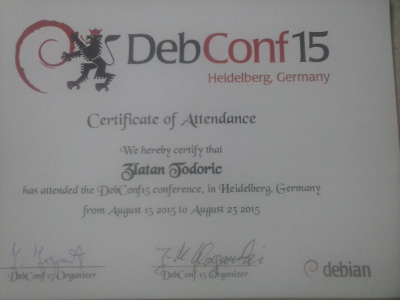
By the help of sponsorship I managed again to attend the conference where Debian family gathers. This is going to be a mix without any particular order of everything, anything and nothing else ;) attendance pic I arrived to Heidelberg Main Train Station around 9am on 15th August and almost right away found Debian people so it made my trip to hostel easier. After arrival I checked in but needed to wait for 3 hours to get the key (it seems that SA will not have that problem at all, which is already an improvement). Although waiting was 3 hours long, it wasn't actually difficult at all as I started hugging and saying hi to many old (the super old super friend of mine - moray, or how I call him, "doc") and new friends. I just must say - if you know or don't know Rhonda, try to get somehow into her hugs. With her hug I acknowledged that I really did arrive to reunion. Read more (14 min remaining to read)

Lucas Nussbaum: DebConf 15

I attended DebConf 15 last week. After being on semi-vacation from Debian for the last few months, recovering after the end of my second DPL term, it was great to be active again, talk to many people, and go back to doing technical work. Unfortunately, I caught the debbug quite early in the week, so I was not able to make it as intense as I wanted, but it was great nevertheless. I still managed to do quite a lot: DC15 was a great DebConf, probably one of the two bests I ve attended so far. I m now looking forward to DC16 in Cape Town!

25 August 2015

Lunar: Reproducible builds: week 17 in Stretch cycle

A good amount of the Debian reproducible builds team had the chance to enjoy face-to-face interactions during DebConf15.
Names in red and blue were all present at DebConf15
Picture of the  reproducible builds  talk during DebConf15
Hugging people with whom one has been working tirelessly for months gives a lot of warm-fuzzy feelings. Several recorded and hallway discussions paved the way to solve the remaining issues to get reproducible builds part of Debian proper. Both talks from the Debian Project Leader and the release team mentioned the effort as important for the future of Debian. A forty-five minutes talk presented the state of the reproducible builds effort. It was then followed by an hour long roundtable to discuss current blockers regarding dpkg, .buildinfo and their integration in the archive. Picture of the  reproducible builds  roundtable during DebConf15 Toolchain fixes Reiner Herrmann submitted a patch to make rdfind sort the processed files before doing any operation. Chris Lamb proposed a new patch for wheel implementing support for SOURCE_DATE_EPOCH instead of the custom WHEEL_FORCE_TIMESTAMP. akira sent one making man2html SOURCE_DATE_EPOCH aware. St phane Glondu reported that dpkg-source would not respect tarball permissions when unpacking under a umask of 002. After hours of iterative testing during the DebConf workshop, Sandro Knau created a test case showing how pdflatex output can be non-deterministic with some PNG files. Packages fixed The following 65 packages became reproducible due to changes in their build dependencies: alacarte, arbtt, bullet, ccfits, commons-daemon, crack-attack, d-conf, ejabberd-contrib, erlang-bear, erlang-cherly, erlang-cowlib, erlang-folsom, erlang-goldrush, erlang-ibrowse, erlang-jiffy, erlang-lager, erlang-lhttpc, erlang-meck, erlang-p1-cache-tab, erlang-p1-iconv, erlang-p1-logger, erlang-p1-mysql, erlang-p1-pam, erlang-p1-pgsql, erlang-p1-sip, erlang-p1-stringprep, erlang-p1-stun, erlang-p1-tls, erlang-p1-utils, erlang-p1-xml, erlang-p1-yaml, erlang-p1-zlib, erlang-ranch, erlang-redis-client, erlang-uuid, freecontact, givaro, glade, gnome-shell, gupnp, gvfs, htseq, jags, jana, knot, libconfig, libkolab, libmatio, libvsqlitepp, mpmath, octave-zenity, openigtlink, paman, pisa, pynifti, qof, ruby-blankslate, ruby-xml-simple, timingframework, trace-cmd, tsung, wings3d, xdg-user-dirs, xz-utils, zpspell. The following packages became reproducible after getting fixed: Uploads that might have fixed reproducibility issues: Some uploads fixed some reproducibility issues but not all of them: Patches submitted which have not made their way to the archive yet: St phane Glondu reported two issues regarding embedded build date in omake and cduce. Aur lien Jarno submitted a fix for the breakage of make-dfsg test suite. As binutils now creates deterministic libraries by default, Aur lien's patch makes use of a wrapper to give the U flag to ar. Reiner Herrmann reported an issue with pound which embeds random dhparams in its code during the build. Better solutions are yet to be found. reproducible.debian.net Package pages on reproducible.debian.net now have a new layout improving readability designed by Mattia Rizzolo, h01ger, and Ulrike. The navigation is now on the left as vertical space is more valuable nowadays. armhf is now enabled on all pages except the dashboard. Actual tests on armhf are expected to start shortly. (Mattia Rizzolo, h01ger) The limit on how many packages people can schedule using the reschedule script on Alioth has been bumped to 200. (h01ger) mod_rewrite is now used instead of JavaScript for the form in the dashboard. (h01ger) Following the rename of the software, debbindiff has mostly been replaced by either diffoscope or differences in generated HTML and IRC notification output. Connections to UDD have been made more robust. (Mattia Rizzolo) diffoscope development diffoscope version 31 was released on August 21st. This version improves fuzzy-matching by using the tlsh algorithm instead of ssdeep. New command line options are available: --max-diff-input-lines and --max-diff-block-lines to override limits on diff input and output (Reiner Herrmann), --debugger to dump the user into pdb in case of crashes (Mattia Rizzolo). jar archives should now be detected properly (Reiner Herrman). Several general code cleanups were also done by Chris Lamb. strip-nondeterminism development Andrew Ayer released strip-nondeterminism version 0.010-1. Java properties file in jar should now be detected more accurately. A missing dependency spotted by St phane Glondu has been added. Testing directory ordering issues: disorderfs During the reproducible builds workshop at DebConf, participants identified that we were still short of a good way to test variations on filesystem behaviors (e.g. file ordering or disk usage). Andrew Ayer took a couple of hours to create disorderfs. Based on FUSE, disorderfs in an overlay filesystem that will mount the content of a directory at another location. For this first version, it will make the order in which files appear in a directory random. Documentation update Dhole documented how to implement support for SOURCE_DATE_EPOCH in Python, bash, Makefiles, CMake, and C. Chris Lamb started to convert the wiki page describing SOURCE_DATE_EPOCH into a Freedesktop-like specification in the hope that it will convince more upstream to adopt it. Package reviews 44 reviews have been removed, 192 added and 77 updated this week. New issues identified this week: locale_dependent_order_in_devlibs_depends, randomness_in_ocaml_startup_files, randomness_in_ocaml_packed_libraries, randomness_in_ocaml_custom_executables, undeterministic_symlinking_by_rdfind, random_build_path_by_golang_compiler, and images_in_pdf_generated_by_latex. 117 new FTBFS bugs have been reported by Chris Lamb, Chris West (Faux), and Niko Tyni. Misc. Some reproducibility issues might face us very late. Chris Lamb noticed that the test suite for python-pykmip was now failing because its test certificates have expired. Let's hope no packages are hiding a certificate valid for 10 years somewhere in their source! Pictures courtesy and copyright of Debian's own paparazzi: Aigars Mahinovs.

Norbert Preining: Kobo Japanese Dictionary Enhancer 1.0

I have just released a wastly improved new version of the Kobo Japanese Dictionary Enhancer. It allows you to enhance the Kobo Japanese dictionary with English translations. kobo-japanese-dictionary-enhancer The new version provides now 326064 translated entries, which covers most non-compound words, including Hiragana. In my daily life reading Harry Potter and some other books in Japanese, I haven t found many untranslated words by now. Please head over to the main page of the project for details and download instructions. If you need my help in creating the updated dictionary, please feel free to contact me. Enjoy.


24 August 2015

Jonathan McDowell: Random post-DebConf 15 thoughts

There are a bunch of things I mean to blog about, but as I have just got fully home from Heidelberg and DebConf15 this afternoon that seems most appropriate to start with. It s a bit of a set of disjoint thoughts, but I figure I should write them down while they re in my head. DebConf is an interesting conference. It s the best opportunity the Debian project has every year to come together and actually spend a decent amount of time with each other. As a result it s a fairly full on experience, with lots of planned talks as a basis and a wide range of technical discussions and general social interaction filling in whatever gaps are available. I always find it a thoroughly enjoyable experience, but equally I m glad to be home and doing delightfully dull things like washing my clothes and buying fresh milk. I have always been of the opinion that the key aspect of DebConf is the face time. It was thus great to see so many people there - we were told several times that this was the largest DebConf so far (~ 570 people IIRC). That s good in the sense that it meant I got to speak to a lot of people (both old friends and new), but does mean that there are various people I know I didn t spend enough, or in some cases any, time with. My apologies, but I think many of us were in the same situation. I don t feel it made the conference any less productive for me - I managed to get a bunch of hacking done, discuss a number of open questions in person with various people and get pulled into various interesting discussions I hadn t expected. In short, a typical DebConf. Also I d like to say that the venue worked out really well. I ll admit I was dubious when I heard it was in a hostel, but it was well located (about a 30 minute walk into town, and a reasonable bus service available from just outside the door), self-contained with decent facilities (I m a big believer in having DebConf talks + accommodation be as close as possible to each other) and the room was much better than expected (well, aside from the snoring but I can t blame the DebConf organisers for that). One of the surprising and interesting things for me that was different from previous DebConfs was the opportunity to have more conversations with a legal leaning. I expect to go to DebConf and do OpenPGP/general crypto related bits. I wasn t expecting affirmation about the things I have learnt on my course over the past year, in terms of feeling that I could use that knowledge in the process of helping Debian. It provided me with some hope that I ll be able to tie my technology and law skills together in a way that I will find suitably entertaining (as did various conversations where people expressed significant interest in the crossover). Next year is in Cape Town, South Africa. It s a long way (though I suppose no worse than Portland and I get to stay in the same time zone), and a quick look at flights indicates they re quite expensive at the moment. The bid presentation did look pretty good though so as soon as the dates are confirmed (I believe this will happen as soon as there are signed contracts in place) I ll take another look at flights. In short, excellent DebConf, thanks to the organisers, lovely to see everyone I managed to speak to, apologies to those of you I didn t manage to speak to. Hopefully see you in Cape Town next year.

21 August 2015

Rhonda D'Vine: DebConf15

I tried to start to write this blog entry like I usually do: Type along what goes through my mind and see where I'm heading. This won't work out right now for various reasons, mostly because there is so much going on that I don't have the time to finish that in a reasonable time and I want to publish this today still. So please excuse me for being way more brief than I usually am, and hopefully I'll find the time to expand some things when asked or come back to that later. Part of the reason of me being short on time is different stuff going on in my private life which requires additional attention. A small part of this is also something that I hinted in a former blog entry: I switched my job in June. I really was looking forward to this. I made them aware of what the name Rhonda means to me and it's definitely extremely nice to be addressed with female pronouns at work. And also I'm back in a system administration job which means there is an interest overlap with my work on Debian, so a win-win situation on sooo many levels! I'm at DebConf15 since almost two weeks now. On my way here I was complimented on my outfit by a security guard at the Vienna airport which surprised me but definitely made my day. I was wearing one of these baggy hippie pants (which was sent to me by a fine lady I met at MiniDebConf Bucharest) but pulled up the leg parts to the knees so it could be perceived as a skirt instead. Since I came here I was pretty busy with taking care of DCschedule bot adjustments (like, changing topic and twittering from @DebConf at the start of the talks), helping out with the video team when I noticed there was a lack of people (which is a hint for that you might want to help with the video team in the future too, it's important for remote people but also for yourself because you can't attend multiple sessions at the same time). And I have to repeat myself, this is the place I feel home amongst my extended family, even though I it still is sometimes for me to get to speak up in certain groups. I though believe it's more an issue of certain individuals taking up a lot of space in discussions without giving (more shy) people in the round the space to also join in. I guess it might be the time that we need a session on dominant talking patterns for next year and how to work against them. I absolutely enjoyed such a session during last year's FemCamp in Vienna which set the tone for the rest of the conference, and it was simply great. And then there was the DebConf Poetry Night. I'm kinda disappointed with the outcome this year. It wasn't able to attract as much people anticipated, which I to some degree account to me not making people aware of it well enough, overlapping with a really great band playing at the same time in competition, and even though the place where we did it sounded like a good idea at first, it didn't had enough light for someone to read something from a book (but that was solved through smartphone lights). I know that most people did enjoy it, so it was good to do it, but I'm still a fair bit disappointed with the outcome and will try to work on improving on that grounds for next year. :) With all this going on there unfortunately wasn't as much time as I would have liked to spend with people I haven't seen for a long time, or new people I haven't met yet. Given that this year's DebConf had an height in attendees (526 being here at certain times during the two weeks, and just today someone new arrived too, so that doesn't even have to be the final number) it makes it a bit painful to have picked up so many tasks and thus lost some chances to socialize as much as I would have liked to. So, if you are still here and have the feeling we should have talked more, please look for me. As Bdale pointed out correctly in the New to DebConf BoF (paraphrased): When you see us DebConf old timers speaking to someone else and you feel like you don't want to disturb, please do disturb and speak to us. I always enjoyed to get to know new people. This for me always is one of the important aspects of DebConf. Also, I am very very happy to have received feedback from different people about both my tweets and my blog, thank you a lot of that. It is really motivating to keep going. So, lets enjoy the last few hours of DebConf! Another last side notice: While my old name in the Debian LDAP did manage to find some wrongly displayed names in the DebConf website, like for speakers, or volunteers, it was clear to me that having it exposed through SSO.debian.org isn't really something I appreciate. So I took the chance and spoke to Luca from the DSA team right here today, and ... got it fixed. I love it! Next step is getting my gpg key exchanged, RT ticket is coming up. :)

/debian permanent link Comments: 1 Flattr this

Simon Kainz: DUCK challenge: Final week

Well, here are the stats for the final week of the DUCK challenge as well as DebConf15: So we had 21 packages fixed and uploaded by 14 different uploaders. People were really working hard on this during DebConf. A big "Thank You" to you!! Since the start of this challenge, a total of 89 packages, were fixed. Here is a quick overview:
Week 1 Week 2 Week 3 Week 4 Week 5 Week 6 Week 7
# Packages 10 15 10 14 10 9 21
Total 10 25 35 49 59 68 89
Thank you all for participating - either on purpose or "accidentially": Some people were really surprised as i sneaked up on them at DebConf15, confronting them with a green lighter! I just tried to put even more fun into Debian, i hope this worked out Pevious articles are here: Week 1, Week 2, Week 3, Week 4, Week 5,Week 6.

20 August 2015

Axel Beckert: German-written Debian Package Management Book

Thursday was our big day: After more than 2.5 years of working in the hidden, ups and downs, Frank Hofmann and myself were able to announce the availability of our book project Debian Package Management under a free license (Creative Commons Attribution ShareAlike 4.0 International License, short CC BY-SA 4.0 ) during a Lightning Talk at DebConf15 in Heidelberg. This became possible because we found Onyx Neon, a publishing company which is specialised on books with contents under free licenses. Its founder does not only have a faible for Perl but also for Debian. (Since the question already came up: We also thought about self-publishing, e.g. via Lulu or Epubli and it would have been our fallback solution , but we prefer the professionalism and services of a real publisher. I m though happy to share what I found out about self-publishing in the past few months.) The source code of the book is written in the AsciiDoc format and available on GitHub. The book is still work in progress. But if you want, you can already build an e-book out of the publically available source code:
sudo apt-get install asciidoc dblatex git
git clone git://github.com/dpmb/dpmb.git
cd dpmb
make
(Works fine on Debian 7 Wheezy, Debian 8 Jessie and Ubuntu 14.04 LTS Trusty. Does not work on Ubuntu 12.04 LTS Precise.) If you find an error in the book, please file an issue on GitHub. If you also know how to fix the error, please for the Git repository on GitHub, fix the error in your Git repository and file a pull request. (The first pull request already happenend and has been applied.) Initially there will be only a German written issue as e-book (at least in HTML, PDF and EPUB formats, maybe also KF8/MOBI and EPUB3) and at some point in the future also as printed book at Onyx Neon. But we re also planning a translation to English as well as a Debian package. If your want to get informed when we publish a printed book, a translation or an official e-book release, please subscribe to one of our mailing lists: There s one in German and one in English.

19 August 2015

Patrick Schoenfeld: aptituz/ssh 2.3.2 published

I ve just uploaded an update version of my puppet ssh module to the forge. The module aims at being a generic module to manage of ssh server and clients, including key generation and known_hosts management. It provides a mechanism to generate and deploy ssh keys without the need of storeconfig or PuppetDB but a server-side cache instead. This is neat, if you want to remain ssh keys during a reprovisioning of a host. Updates The update is mostly to push out some patches I ve received from contributors via pull requests in the last few months. It adds:

Russell Coker: The Purpose of a Code of Conduct

On a private mailing list there have been some recent discussions about a Code of Conduct which demonstrate some great misunderstandings. The misunderstandings don t seem particular to that list so it s worthy of a blog post. Also people tend to think more about what they do when their actions will be exposed to a wider audience so hopefully people who read this post will think before they respond. Jokes The first discussion concerned the issue of making jokes . When dealing with the treatment of other people (particularly minority groups) the issue of jokes is a common one. It s fairly common for people in positions of power to make jokes about people with less power and then complain if someone disapproves. The more extreme examples of this concern hate words which are strongly associated with violence, one of the most common is a word used to describe gay men which has often been associated with significant violence and murder. Men who are straight and who conform to the stereotypes of straight men don t have much to fear from that word while men who aren t straight will associate it with a death threat and tend not to find any amusement in it. Most minority groups have words that are known to be associated with hate crimes. When such words are used they usually send a signal that the minority groups in question aren t welcome. The exception is when the words are used by other members of the group in question. For example if I was walking past a biker bar and heard someone call out geek or nerd I would be a little nervous (even though geeks/nerds have faced much less violence than most minority groups). But at a Linux conference my reaction would be very different. As a general rule you shouldn t use any word that has a history of being used to attack any minority group other than one that you are a member of, so black rappers get to use a word that was historically used by white slave-owners but because I m white I don t get to sing along to their music. As an aside we had a discussion about such rap lyrics on the Linux Users of Victoria mailing list some time ago, hopefully most people think I m stating the obvious here but some people need a clear explanation. One thing that people should consider jokes is the issue of punching-down vs punching-up [1] (there are many posts about this topic, I linked to the first Google hit which seems quite good). The basic concept is that making jokes about more powerful people or organisations is brave while making jokes about less powerful people is cowardly and serves to continue the exclusion of marginalised people. When I raised this issue in the mailing list discussion a group of men immediately complained that they might be bullied by lots of less powerful people making jokes about them. One problem here is that powerful people tend to be very thin skinned due to the fact that people are usually nice to them. While the imaginary scenario of less powerful people making jokes about rich white men might be unpleasant if it happened in person, it wouldn t compare to the experience of less powerful people who are the target of repeated jokes in addition to all manner of other bad treatment. Another problem is that the impact of a joke depends on the power of the person who makes it, EG if your boss makes a joke about you then you have to work on your CV, if a colleague or subordinate makes a joke then you can often ignore it. Who does a Code of Conduct Protect One member of the mailing list wrote a long and very earnest message about his belief that the CoC was designed to protect him from off-topic discussions. He analysed the results of a CoC on that basis and determined that it had failed due to the number of off-topic messages on the mailing lists he subscribes to. Being so self-centered is strongly correlated with being in a position of power, he seems to sincerely believe that everything should be about him, that he is entitled to all manner of protection and that any rule which doesn t protect him is worthless. I believe that the purpose of all laws and regulations should be to protect those who are less powerful, the more powerful people can usually protect themselves. The benefit that powerful people receive from being part of a system that is based on rules is that organisations (clubs, societies, companies, governments, etc) can become larger and achieve greater things if people can trust in the system. When minority groups are discouraged from contributing and when people need to be concerned about protecting themselves from attack the scope of an organisation is reduced. When there is a certain minimum standard of treatment that people can expect then they will be more willing to contribute and more able to concentrate on their contributions when they don t expect to be attacked. The Public Interest When an organisation declares itself to be acting in the public interest (EG by including Public Interest in the name of the organisation) I think that we should expect even better treatment of minority groups. One might argue that a corporation should protect members of minority groups for the sole purpose of making more money (it has been proven that more diverse groups produce better quality work). But an organisation that s in the Public Interest should be expected to go way beyond that and protect members of minority groups as a matter of principle. When an organisation is declared to be operating in the Public Interest I believe that anyone who s so unable to control their bigotry that they can t refrain from being bigoted on the mailing lists should not be a member.

18 August 2015

Matthew Garrett: Canonical's deliberately obfuscated IP policy

I bumped into Mark Shuttleworth today at Linuxcon and we had a brief conversation about Canonical's IP policy. The short summary:
The even shorter summary: Canonical won't clarify their IP policy because they believe they can make more money if they don't.

Why do I keep talking about this? Because Canonical are deliberately making it difficult to create derivative works, and that's one of the core tenets of the definition of free software. Their IP policy is fundamentally incompatible with our community norms, and that's something we should care about rather than ignoring.

comment count unavailable comments

Arturo Borrero Gonz lez: 2015 FLOSS summer report

debian logo
Good news. Many things happened since my last report (8 months ago), some of them very interesting :-)

debian maintainer

Back in April 2015 I applied to become Debian Maintainer (DM). I was supported by several Debian Developers (DD), including Ana Guerrero, Anibal Monsalve, Michael Prokop and Vicent Cheng. They are people I have been somehow involved with in the last times (developing, in-person meetings, other talks...).

After a month or two, my PGP key was added to the debian keyring.

And what means this? If a DD gives me the corresponding authorization, I can now upload packages directly to the archive without the need for a sponsor.

I have been maintaining packages as a standard contributor since early 2014. From 2014 to 2015 I've learned many many things about Debian. That knowledge was key to become DM.

Google Summer of Code 2015

This is my 3 year in GSoC. In 2013 and 2014 I was involved with the Netfilter Project, but this time I'm contributing to the Debian project.
In concrete, my project is "Improve the Debian port mipsel".

Most of the software is developed to run in common CPU architectures like amd64 and i386. However, Debian can run in a large variety of arches (not so many operating systems have this power). Developers tend to consider these arches 'exotic' and don't pay much attention to them.
The mips/mipsel architecture is somewhat similar to arm: its mainly intended for small devices.

My tasks consist mainly into fixing bugs and FTBFS errors in the mipsel architecture.

Roughly speaking, this can be done in two ways: emulating the mipsel arch using qemu, or using a physical mipsel machine. The qemu way is very very slow. Fortunately, as part of my GSoC involvement, I was given a ci20 mipsel board by Imagination Technologies. I have been using this board for all my GSoC work.

Detailing my work during this GSoC deserves his own blog post. However, the Debian workflow for GSoC'15 requires a weekly report, and here are mine:

  1. week 1
  2. week 2
  3. week 3
  4. week 4
  5. week 5
  6. week 6
  7. week 7
  8. week 8
  9. week 9
  10. week 10
  11. week 11
  12. week 12

no longer involved with the Netfilter Project

Such is life. Days only have 24 hours. I had to 'refactor' my priorities and my involvement with the Netfilter Project is now almost none. This happened back in May'15. I was in so many business that I had stress and even had anxiety. Among other things, this hard decision meant that I missed the Netfilter Workshop 2015 in Budapest :-(

My plan for 2016 is to focus in the University and pay bills with my full-time job as a system administrator.

other debian sutff

Regarding packaging, it worth mention my latest new package: liquidprompt. For people who get their hands dirty with the CLI, I recommend it :-)
I made lot of updates to the other packages as well.

The nftables package is now in jessie-backports. Debian includes now Linux v4 in jessie-backports as well, which mean you can start playing with a full-featured nftables right now :-)
I'm looking forward to package the following version of upstream nftables, which is to include new exciting changes.

best regards!

Enrico Zini: standup-comedy-notes

My semi serious stand up comedy notes Video Disclaimers
Someone has said that it requires less mental effort to condemn than to think. (Emma Goldman, on several things including mailing list flamewars)
Fascinating A da's "Dogging" song. Look for "dogging etiquette" for more examples of code of conducts. Just don't take your computer for repair immediately afterwards . Introduction
Every daring attempt to make a great change in existing conditions, every lofty vision of new possibilities for the human race, has been labeled Utopian. (Emma Goldman, on the Debian Social Contract)
I am going to talk about many topics that we all know have so much in common: They are all, after all: BDSM
A person is no less a slave because they are allowed to choose a new master once in a term of years. (Lysander Spooner about proprietary cloud service providers)
If you thought you've seen it all with recursive acronyms, here's a chain acronym: Bondage Discipline, Dominance Submission, Sado Masochism. Why I think BDSM is interesting: not (just) because of whips, but for having a lot of awareness about power releationships. Why should one accept from a coworker a level of abuse that would be considered a hard limit when negotiating with a trusted dom? The BDSM Free Software definition: "I refuse to be bound by software I cannot negotiate with". YKINMKBYKIOK (Your Kink Is Not My Kink But Your Kink Is Okay) is a nice example of dealing with diversity, and it also definitely solves the emacs vs vi debate. Comfort zones, safewords, traffic light flow control, safety. "No means no", unless there has been a long discussion first, and a safeword is in place, in which case "Fuzzy purple unicorn" means "no" "No means no", and if someone insists after a "no", it becomes harassment. "No means no" is a precondition for being able to say "yes": http://pervocracy.blogspot.de/2011/03/no-and-no-and-no-and-yes.html Aftercare! Aftercare! Release parties! High fives! Solidarity after flamewars or votes! Poliamory
If love does not know how to give and take without restrictions, it is not love, but a transaction that never fails to lay stress on a plus and a minus. (Emma Goldman, on volunteer projects)
Polyamory is the practice, desire, or acceptance of intimate relationships that are not exclusive with respect to other sexual or intimate relationships, with knowledge and consent of everyone involved. Compersion, n: the feeling you get when someone else also takes good care of one of your packages. We currently allow only one value in the Maintainer field: * takeover is traumatic, because values can only be replaced * if values could be added instead, and removed when they don't make sense anymore... What is your definition of love? My current one is: my world is better with you in it. Relationship anarchy is the practice of forming relationships which are not bound by rules aside from what the people involved mutually agree on. How do you call a relationship that is bound by rules that the people involved do not agree on? From discussions after the talk New Relationship Energy, the excitement when you start to maintain a new package, and the risk of been carried away by the excitement and neglecting all the other ones. Consent
Anarchism, to me, means not only the denial of authority, not only a new economy, but a revision of the principles of morality. It means the development of the individual as well as the assertion of the individual. It means self-responsibility, and not leader worship. (Voltairine de Cleyre about trusting lintian warnings)
You need to know what you are doing, and what situation you're putting yourself into. You need to know that the person asking a question really is able to accept any answer, and take it seriously. You need to feel that you have alternatives. Be selfish when you ask, honest when you reply, and when others reply, take them seriously. If any of this doesn't stand, I find it hard to trust that we are in a consensual situation. When is one supposed to learn about consent? Consent explained with tea. Practical advice
Anarchism has but one infallible, unchangeable motto, Freedom. Freedom to discover any truth, freedom to develop, to live naturally and fully. (Lucy Parsons about the DFSG)
Relationship advice and work advice have a lot in common: Relationship advice from 99 ways to ruin an open source project Online participation advice from How to Screw Up Your Relationship (and make everyone miserable while you re at it) Packaging advice from BDSM Basics: 20 Unsolicited Tips for New Dominants Advice about joining a new community from Advice to a newbie submissive about dominants Dear Debian, and dear everyone contributing to it: my world is better with you in it. I love you all :* <3

Russell Coker: BTRFS Training

Some years ago Barwon South Water gave LUV 3 old 1RU Sun servers for any use related to free software. We gave one of those servers to the Canberra makerlab and another is used as the server for the LUV mailing lists and web site and the 3rd server was put aside for training. The servers have hot-swap 15,000rpm SAS disks IE disks that have a replacement cost greater than the budget we have for hardware. As we were given a spare 70G disk (and a 140G disk can replace a 70G disk) the LUV server has 2*70G disks and the 140G disks (which can t be replaced) are in the server for training. On Saturday I ran a BTRFS and ZFS training session for the LUV Beginners SIG. This was inspired by the amount of discussion of those filesystems on the mailing list and the amount of interest when we have lectures on those topics. The training went well, the meeting was better attended than most Beginners SIG meetings and the people who attended it seemed to enjoy it. One thing that I will do better in future is clearly documenting commands that are expected to fail and documenting how to login to the system. The users all logged in to accounts on a Xen server and then ssh d to root at their DomU. I think that it would have saved a bit of time if I had aliased commands like btrfs to echo you must login to your virtual server first or made the shell prompt at the Dom0 include instructions to login to the DomU. Each user or group had a virtual machine. The server has 32G of RAM and I ran 14 virtual servers that each had 2G of RAM. In retrospect I should have configured fewer servers and asked people to work in groups, that would allow more RAM for each virtual server and also more RAM for the Dom0. The Dom0 was running a BTRFS RAID-1 filesystem and each virtual machine had a snapshot of the block devices from my master image for the training. Performance was quite good initially as the OS image was shared and fit into cache. But when many users were corrupting and scrubbing filesystems performance became very poor. The disks performed well (sustaining over 100 writes per second) but that s not much when shared between 14 active users. The ZFS part of the tutorial was based on RAID-Z (I didn t use RAID-5/6 in BTRFS because it s not ready to use and didn t use RAID-1 in ZFS because most people want RAID-Z). Each user had 5*4G virtual disks (2 for the OS and 3 for BTRFS and ZFS testing). By the end of the training session there was about 76G of storage used in the filesystem (including the space used by the OS for the Dom0), so each user had something like 5G of unique data. We are now considering what other training we can run on that server. I m thinking of running training on DNS and email. Suggestions for other topics would be appreciated. For training that s not disk intensive we could run many more than 14 virtual machines, 60 or more should be possible. Below are the notes from the BTRFS part of the training, anyone could do this on their own if they substitute 2 empty partitions for /dev/xvdd and /dev/xvde. On a Debian/Jessie system all that you need to do to get ready for this is to install the btrfs-tools package. Note that this does have some risk if you make a typo. An advantage of doing this sort of thing in a virtual machine is that there s no possibility of breaking things that matter.
  1. Making the filesystem
    1. Make the filesystem, this makes a filesystem that spans 2 devices (note you must use the-f option if there was already a filesystem on those devices):
      mkfs.btrfs /dev/xvdd /dev/xvde
    2. Use file(1) to see basic data from the superblocks:
      file -s /dev/xvdd /dev/xvde
    3. Mount the filesystem (can mount either block device, the kernel knows they belong together):
      mount /dev/xvdd /mnt/tmp
    4. See a BTRFS df of the filesystem, shows what type of RAID is used:
      btrfs filesystem df /mnt/tmp
    5. See more information about FS device use:
      btrfs filesystem show /mnt/tmp
    6. Balance the filesystem to change it to RAID-1 and verify the change, note that some parts of the filesystem were single and RAID-0 before this change):
      btrfs balance start -dconvert=raid1 -mconvert=raid1 -sconvert=raid1 force /mnt/tmp
      btrfs filesystem df /mnt/tmp
    7. See if there are any errors, shouldn t be any (yet):
      btrfs device stats /mnt/tmp
    8. Copy some files to the filesystem:
      cp -r /usr /mnt/tmp
    9. Check the filesystem for basic consistency (only checks checksums):
      btrfs scrub start -B -d /mnt/tmp
  2. Online corruption
    1. Corrupt the filesystem:
      dd if=/dev/zero of=/dev/xvdd bs=1024k count=2000 seek=50
    2. Scrub again, should give a warning about errors:
      btrfs scrub start -B /mnt/tmp
    3. Check error count:
      btrfs device stats /mnt/tmp
    4. Corrupt it again:
      dd if=/dev/zero of=/dev/xvdd bs=1024k count=2000 seek=50
    5. Unmount it:
      umount /mnt/tmp
    6. In another terminal follow the kernel log:
      tail -f /var/log/kern.log
    7. Mount it again and observe it correcting errors on mount:
      mount /dev/xvdd /mnt/tmp
    8. Run a diff, observe kernel error messages and observe that diff reports no file differences:
      diff -ru /usr /mnt/tmp/usr/
    9. Run another scrub, this will probably correct some errors which weren t discovered by diff:
      btrfs scrub start -B -d /mnt/tmp
  3. Offline corruption
    1. Umount the filesystem, corrupt the start, then try mounting it again which will fail because the superblocks were wiped:
      umount /mnt/tmp
      dd if=/dev/zero of=/dev/xvdd bs=1024k count=200
      mount /dev/xvdd /mnt/tmp
      mount /dev/xvde /mnt/tmp
    2. Note that the filesystem was not mountable due to a lack of a superblock. It might be possible to recover from this but that s more advanced so we will restore the RAID.
      Mount the filesystem in a degraded RAID mode, this allows full operation.
      mount /dev/xvde /mnt/tmp -o degraded
    3. Add /dev/xvdd back to the RAID:
      btrfs device add /dev/xvdd /mnt/tmp
    4. Show the filesystem devices, observe that xvdd is listed twice, the missing device and the one that was just added:
      btrfs filesystem show /mnt/tmp
    5. Remove the missing device and observe the change:
      btrfs device delete missing /mnt/tmp
      btrfs filesystem show /mnt/tmp
    6. Balance the filesystem, not sure this is necessary but it s good practice to do it when in doubt:
      btrfs balance start /mnt/tmp
    7. Umount and mount it, note that the degraded option is not needed:
      umount /mnt/tmp
      mount /dev/xvdd /mnt/tmp
  4. Experiment
    1. Experiment with the btrfs subvolume create and btrfs subvolume delete commands (which act like mkdir and rmdir).
    2. Experiment with btrfs subvolume snapshot SOURCE DEST and btrfs subvolume snapshot -r SOURCE DEST for creating regular and read-only snapshots of other subvolumes (including the root).

17 August 2015

Iustin Pop: Nikkor 300mm f/4E tests and happy dogs!

I recently got a new lens, which I'm still trying to learn how to properly use . The new lens is the Nikon 300m f/4E PF ED VR (wow, that's a mouthful of acronyms ) and it's as good as I expected, except that it seems that it's too good for the person using it (me). Physically, the lens is indeed very light and very easy to hand-hold; it's barely heavier and longer than the 70-300mm f/4-5.6 zoom, although a bit more bulky. I was fearing something "bigger" and heavier for a fixed-aperture lens, even after hearing all the good reports about it, but it was better than I expected. I was also slightly concerned, this being a prime lens, about finding the subject fast, especially if smaller or far away. It turned out that if the lens is focused at somewhat the right distance (not at the opposite end), it is not a real problem. So, as the first test/learning exercise, I did a couple of hour long walks outdoor, photographing random subjects. First day I used the lens by itself, on the second day I added the Nikon TC-14E(III) tele-converter, for a 420mm focal length. All pictures below except the Huskies are non-cropped, just down-sampled (they have the original field of view); the Husky pictures were cropped. In all cases, camera was set to semi-manual mode, mostly at 1/1000s or 1/2000s, various apertures between f/4 and f/8; this means wide open or stopped down one (when with the tele-converter) or two stops. Semi-manual as auto-ISO was on. Lens focus limiter on, VR either active or sport (to help with the viewfinder image mostly, at this speed), camera set to AF-C and group mode most of the time. Also, all pictures were shot hand-held, with bad technique - until somebody stopped me, turns out he was a photographer, and showed me how to properly hold a telephoto lens; thanks, whoever you were! The "random subjects" parts worked only somewhat, as (at first) the subjects were not too interesting; air-plane flying high above - check, fast focus (although it is easy to focus on a plane in clear sky), or close, static subjects: Airplane in the sky Test of close focusing Birds flying around - almost check, fast focus (both with just the lens and with the TC), although I learned that shooting flying birds while panning needs 1/2000s - my initial attempt at 1/1000s was not enough to eliminate either panning blur or wing-tip blur (both depend on the speed of the respective action); in any case, initial focus acquisition is speedy enough for me. A couple of examples (first without, second with the TC; in the second one, I was unprepared when the I saw the bird from the corner of my eye, and managed to bring up the camera and take exactly one photo before the bird was gone): Not enough speed Too much blur Another attempt was to focus on dogs jumping in the water. Here the problem was different: focusing on the correct object! The splashing around meant that there were lots of water droplets both in front and behind the dog, the dog being partially obscured by them. I don't know what AF settings would have helped here (maybe 3D tracking pre-focused on the black dog)? I had a low success rate on the first attempt, so I'll have to try again. The lens did correctly track the wrong thing, though . Examples: Almost focused Wrong focus Once the dog caught its target, the lens focused well enough, of course, but not perfect; it might need some AF fine-tuning or photographer upgrade : Not quite perfect focus At one point, I was lucky to have a dog running towards me; focus tracking on a subject approaching the camera is a good test for the lens (and camera) auto-focus performance. I was pleasantly surprised, given my failure to track left-to-right flying birds (which should be easier!): Run! Not yet tired! In any case, I was walking and thinking on how to improve on my technique, when I saw in the distance a pair of dogs (Husky's, I believe) which were very active. This case was relatively easy for the camera and lens, since they were moving only left-to-right, instead of forward-backward, so the focus distance was mostly constant, and I just had to pan. Full gallery here, two examples: Jump! Play over, going home These two dogs had an education value beyond the "how is the lens performing"; they were so fast, active (they kept going at it non-stop for a good number of minutes) and playful that they made my day brighter . So, that concludes my first test of this lens and the 1.4 tele-converter. Conclusion: equipment good, need to upgrade the photographer!

Next.

Previous.