I agree with
Destiny --
this letter from
wp:Steely Dan to
wp:Luke Wilson is just excellent. If only all creative property disputes were handled this way.
tags:
steely dan luke wilson destiny
Hot in the City tonight
It's been a hot last couple of days in Montreal -- I mean, not hot like wt:California or wt:Europe but hot enough that it feels pretty bad. According to Sacr Blues -- one of my favorite books about wt:Quebec -- Montreal has the highest variation in temperature of any inhabited place on earth -- from highs of 40C in the summer to lows of -40C in the winter. We're at the high part now.
Yesterday was my Primary Caregiver ("PCG") day, so I took the opportunity to take the baby for a long walk in Parc La Fontaine, under the gigantic poplars, where it's always cool and fresh. We also went for a nice dip in the baby pool. That kept things pretty nice.

Bonne F te
Speaking of hotness, last night was the 30th birthday party for my friend Niko Ritoux. Maj and I took the opportunity to do our first evening out as a couple without the baby -- our great babysitter Julia came by with her boyfriend Antoine and took Amita June to a jazz concert at the Theatre de Verdure in Parc La Fontaine. How great is that?
Anyways, we had a good night with Niko. We went to Le 2, the teensy but uber-cool bistro-bar our friend Daran co-owns. It's in possibly the most valuable real estate in all Montreal -- the corner of St. Laurent and Sherbrooke -- but it's unassuming and doesn't have that Lower Main clubbed-out fake tan feel. We had a great dinner of "international tapas" -- the little appetizers that remind me a lot of Toqu -style gourmet micro-meals -- and lots of liquor and good fun. I saw a lot of people I hadn't seen in a while -- P.E. and his girlfriend Ode, who were living in Taiwan for a long time; Fred; Daran and his new friend Annie; Joannie; and our own lovely Italian princess the Other Annie.


 After dinner (11:30PM!) we hustled up to Bily Kun on Mont Royal and then Plan B across the street. Nicely, for a Friday night, everything was open and airy -- Montreal bars can get so damn crowded, but in the summer everyone's in Cottage Country and there's plenty of room for dedicated barflies. I'm not sure when I got home, but I think Niko had a good time.
tags: birthday niko jf joannie le 2 bily kun plan b
And more time
Today I spent my time creating data feeds of Wikitravel content for researchers at the University of Zurich who are doing some sort of work on the reliability and development of online travel information. I can't wait to find out how their research comes out.
Maj, Amita June and I went up on the Pont Jacques-Cartier tonight to watch the last event in the International des feux at La Ronde. One of the great things about being in Mtl for the summer is this months-long fireworks festival, in which national teams compete every Saturday and Wednesday night. This is the first time I've been on the bridge for the event, and it was amazing -- much louder and bigger than when we've watched from home.
Amita June, of course, was dumbfounded by the fireworks -- she gawked open-mouthed through the whole thing. I thought she'd be scared by the lights and noise and the crowd, but she loved it -- reached out and pointed for each explosion, and even said ooooooooh for the big finale. She conked out on the 8-block walk home, which gave Mama and Papa a little extra rest.
tags: amitajune fireworks montreal la ronde maj
GPLv3 and license compatibility
According to this article on Linuxworld.com, compatibility with other licenses like the Apache 2.0 is going to be a major focus of the GPLv3 development process.
I say huzzah to that. Trivial differences between licenses are a shameful waste of time and energy for hackers who have better things to do. The world needs too much good Open Source software for us to waste time with license incompatibilities.
Hopefully this same philosophy will bleed over into the FDL. Creative Commons made an overture for unilateral compatibility between the Attribution and Attribution-ShareAlike licenses and the FDL, which got stony silence from the FSF. It's time to start thinking of the users and playing nice with each other.
tags: gplv3 licenses open source compatibility
Put one foot in front of the other
I nearly forgot to mention: Amita June took her first step today. She's been "cruising" (walking around holding onto furniture) for about 6-8 weeks now, and she loves walking around holding onto Mama or Papa's fingers. And she's been spending longer and longer periods standing on her own -- up to about 20-30 seconds. Today, she was standing up, and she wanted to walk so I held out my finger just a little out of her reach. She extended her arm for it, then took two little steps to get to me. Ta-da!
Maj and I took turns getting her to stand up on her own then walk to us. She's only got about 3-4 steps in her right now before she freaks out and sits down, but it's still pretty amazing.
tags: amitajune first steps maj baby
I uploaded a new maintenance release for kazehakase (0.2.7-2.sarge2) which is ment to address a top-crasher bug posted in
#345905 to my
p.d.o. security archive. Once there has been positive feedback, I will upload this to proposed-updates.
This makes we wonder … do package maintainers actually care about sarge?
I understand that running sarge is not as much fun as working on your bleeding edge unstable/experimental mix. But that does not mean that you can leave grave bugs in sarge untouched for half a year, right?
Wow, just spent 4 hours integrating other people's patches and plugins into
ikiwiki. That's what they coded up while I was asleep last night.
Now I'm just waiting for all of them to go to sleep so I can code up the
ikiwiki feature I was
planning to work on today: RSS aggreagation, so it
can be used as a Planet.
Anyway, as far as we know, ikiwiki is now 100% utf-8 supporting right down
to the filenames in svn. And it can do tag clouds. And, perhaps best of
all, I don't even need to write blog entries anymore, since ikiwiki now
supports polygen, and can
just generate text for me.
A freshly downloaded version of
palm-db-tools
(using the most recent version 0.3.6 from June 2003) will not compile with
g++ 4.0.3
and its pickier interpretation of C++.
A simple patch which removes trailing semicolons after class definitions, and
adds virtual destructors for a few classes, is below. The mailing list
archives show one other
patch
for a different (yet probably relevant :) problem, and its from November 2003.
By the way, would be nice if someone added the package to
Debian. The Makefile's
make
clean
target isn't quite right, and
make install isn't
exactly correct either. Plus, I seem to be building this by hand every few
years, and it's so much easier to just
apt-get. And no, my
plate is
already too full.
diff -ru palm-db-tools-0.3.6.orig/libpalm/Block.h palm-db-tools-0.3.6/libpalm/Block.h
--- palm-db-tools-0.3.6.orig/libpalm/Block.h	2003-06-19 18:37:47.000000000 -0500
+++ palm-db-tools-0.3.6/libpalm/Block.h	2006-07-29 15:04:19.000000000 -0500
@@ -176,7 +176,7 @@
 	size_type m_size;
      ;

- ;
+

 bool operator == (const PalmLib::Block& lhs, const PalmLib::Block& rhs);

diff -ru palm-db-tools-0.3.6.orig/libpalm/File.h palm-db-tools-0.3.6/libpalm/File.h
--- palm-db-tools-0.3.6.orig/libpalm/File.h	2003-06-19 18:37:47.000000000 -0500
+++ palm-db-tools-0.3.6/libpalm/File.h	2006-07-29 15:04:42.000000000 -0500
@@ -89,6 +89,6 @@
 	uid_map_t m_uid_map;
      ;

- ;
+

 #endif
diff -ru palm-db-tools-0.3.6.orig/libsupport/infofile.h palm-db-tools-0.3.6/libsupport/infofile.h
--- palm-db-tools-0.3.6.orig/libsupport/infofile.h	2003-06-19 18:37:47.000000000 -0500
+++ palm-db-tools-0.3.6/libsupport/infofile.h	2006-07-29 15:07:08.000000000 -0500
@@ -33,6 +33,7 @@

         public:
             virtual void parse(int linenum, std::vector< std::string> array) = 0;
+	  virtual ~Parser()  ;
          ;
         class ConfigParser: public Parser

@@ -40,6 +41,7 @@
                 ConfigParser(DataFile::CSVConfig& state)
                     : m_Config(state)

+	        virtual ~ConfigParser()  ;
                 virtual void parse(int linenum, std::vector< std::string> array);
             private:
                 DataFile::CSVConfig& m_Config;
@@ -50,6 +52,7 @@
                 DatabaseParser(PalmLib::FlatFile::Database& db)
                     : m_DB(db)

+	        virtual ~DatabaseParser()  ;
                 virtual void parse(int linenum, std::vector< std::string> array);
             private:
                 PalmLib::FlatFile::Database& m_DB;
@@ -60,6 +63,7 @@
                 TypeParser(std::string& p_Type)
                     : m_Type(p_Type)

+	        virtual ~TypeParser()  ;
                 virtual void parse(int linenum, std::vector< std::string> array);
             private:
                 std::string& m_Type;
Well, it's been a few weeks since my last update, but I was still out there once a week taking pictures. The changes have been less dramatic -- but then it's hard to get as dramatic as tearing off the kitchen and pulling off a chunk of a house.
So check out the
week 3-5 photos. Note there are two pages of photos.
The lath and plaster is all down. So it looks really empty inside.
The foundation work starts Thursday and continues for about 2 weeks. Then the reconstruction will begin.
Here's this week's highlight:
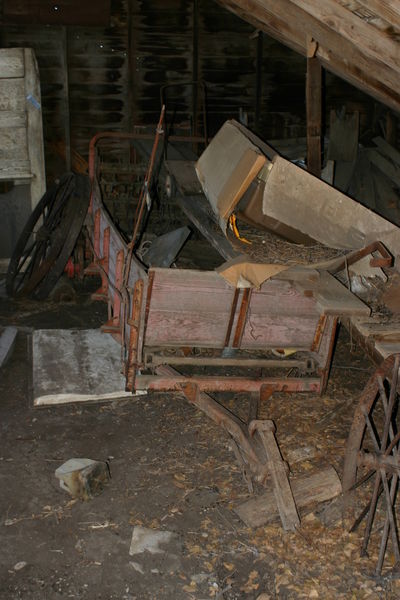
It's an old wagon that was in the chicken house. Because of the pickup that was in there, I had never been able to get a good picture of it before.
Tonight I shall be mostly playing dress-up games and weight training.
Simultaneously.
My intention is to wear my larger boots (2 x 2kg total) along with a nice chainmail top (1 x 5kg).
Including beer (how much does that weight?) I’ll expect to be carrying about 10Kg / 1.5 Stones of extra weight .. whilst dancing.
I’m going to be sore tomorrow but it will be worth it.
Now to go shave my head before I get ready to go out ..
Today
aj applied two
patches to the dak code running on ftp-master i supplied. One got the
part in dak that processes
NEW up to reality for non-free (well,
non-main) debian-installer components, they are now able to go in.
The other, more interesting one, affects the mails people receive when a
NEW package is accepted. Those now contain an added paragraph, basically
looking like the following:
   Override entries for your package:
   foo.deb - optional devel
   bar.udeb - extra admin
   foo2.0-1.dsc - source interpreters
That means you can now directly see if you have a different opinion of
the override entries and change your package, avoiding a “Override
disparity” mail with your next upload.
And just because it was a nice rainy (and cold!) day today, I also went
and rejected those two old packages we had in the queue. rte, real
time encoder, was the first, and looks like it wont ever get included in
Debian, containing non-free code. The other, more flame-attached
package, is mplayer - which may get into the archive in the future, but
needs a lot of work before that can actually happen.
Now - people only need to stop uploading
NEW packages, and we
are all fine. :)
Update: And after aj applied my fix to my override patch people
now get the right data mailed…
Well, I haven't been much active blogging these days. I indeed was quite
busy at work with a reorganization taking place in my department and a few
more responsibilities to have for me.
My biggest holidays of the year begin right now. I'll leave today and visit
my mom and my sister's family in the region of St-Etienne, in France.
Then back home three days later and we will leave for a 18-days trip in
Mexico on Thursday. This year is my mexican year..:-)
That means a 3-week break in mail and Debian activities. See you in late
August with, hopefully, a new beta of the installer which will have been
released by our tireless release manager Frans Pop. I will come back and the
base system will already be frozen and all of us on our way to the Etch
release. Great.
Hugs to those of you I use to hug and kisses to others!
I am not happy with
dh_pthon in the current state that it was (NMUed
into)
debhelper. It is preventing me from feeling good about or
generally maintaining debhelper. This is a plan for fixing that.
- Transform dh_python into a perl module or program by some other name
and possibly different interface, and put this in some other package(s).
- Modify dh_pysupport and dh_pycentral to call above so they take
over dh_python's part of the work.
- Reduce dh_python to a no-op warning script and put on deprecation track
for removal.
- Add a regression test to debhelper that fails if any debhelper script
exceeds 150 lines, excluding POD docs. (Done in svn)
- If at any point the python maintainers find an approach that does not
invole multiple competing implementations and that is either simple or
has the complexity encapsulated into some other program, I can
add back a dh_python.
Until then the current mess will be Not My Problem.
- Be much, much, much more cautious accepting niche programs into debhelper
in the future. :-(
Possible technical complications:
- dh_pthon supports params for passing additional module directories.
dh_pysupport does too, but it seems that dh_pycentral does not. Need to
check if this means that noone using dh_pycentral can use it with
non-standard directories, so none of them pass directories to dh_python.
- dh_python has -V and -X flags that affect its behavior and the other two
programs would not have access to this information.
- I doubt that -X is used widely. Grep.
- -V is a redundant interface, since it does something
approximating
what
debian/pyversons does. So things should be able to switch to the
other interface, except in edge cases (although IMHO it's not an
appropriate interface for a debhelper program), and for the edge cases,
-V could be added to the other two programs.
- It's possible that someone might set dh_python's -n flag but not also set
it on their call to dh_pycentral or dh_pysupport. Can't imagine why
though.
- Not all packages use the new python policy yet. For example, debconf
doesn't. I'm not sure if that's a bug or not. One alternative would be
reverting dh_python to the pre-NMU version (plus a small shim to make it a
no-op if it detects the new policy), to avoid breaking such packages until
they transition.
Copley Square in Boston is a busy place on Fridays, it seems, though I would guess it depends on the Friday. Today there was a whole bunch of people gathering to protest Israel’s recent actions towards Lebanon, a couple hundred people on bikes for
Critical Mass (which I was there for), and a couple Green Party members handing out “fruit for free,” “soybeans, cherries, and strawberries in the bag!”, wearing some shirts that said something about voting for Ralph Nader.
So, the Green Party handed out food to the bikers while we were circling up and getting ready to head out, and the bikers and protesters cheered each other on as we rode by, in a sort of bizarre, random symbiotic relationship.
Today was also the first time I rode through the heart of a thunderstorm. We were passing through Harvard Square when the worst of it hit, though it was really obvious that we were heading
into the storm a good deal of time beforehand. Some parts were a little like riding blind into a sheet of pins, but it really made the whole thing just a little more exhilarating. Especially when you get to ride through six inches of runoff on Mass Ave. Mmm, puddles.
Luckily, I had the foresight to check the forecast and pack my laptop into a plastic bag since I didn’t go home before riding out with a couple friends from the Media Lab. Really, that’s amazingly lucky on my part. I never think of these things in advance. I think, however, that the laptop was the only thing dry in the bag by the time I got home.
The ride petered out in the middle of Brighton somewhere, and a guy from BU and I broke off to head back. Neither of us really knew exactly where we were, or how to get back to our respective residences. There is nothing quite like the feeling of being completely lost at dusk, with the whole night before you to find your way back home. It’s a good feeling. IMHO. Provided you’re not lost in a sketchy neighbourhood.
After a little while of based-off-the-sun-setting-in-the-west wandering, I was about to break out the laptop and go wifi hunting. Somehow, we just ended up asking for directions at a 7-11.
I love friends made in really weird and random ways.
I've just installed dssi-vst. I tried to use Linux as music instrument one
year ago, but it failed.
It was not so hard just now. I googled and found very usable site about
VST on Linux. I did not receive the USB-MIDI connector yet,
that I bought on
Allegro , so I used the vkeybd. It was pretty
cool.
The first instrument that I tested was
SUPERWAVE. I started the
jack-dssi-host
dssi-vst.so:SUPERWAVEP8.dll and the instrument appeared as another MIDI and audio client in JACK
Audio Connection dialog.

Now I'm missing FL Studio on Linux
badly...
Today
aj applied two
patches to the dak code running on ftp-master i supplied. One got the
part in dak that processes
NEW up to reality for non-free (well,
non-main) debian-installer components, they are now able to go in.
The other, more interesting one, affects the mails people receive when a
NEW package is accepted. Those now contain an added paragraph, basically
looking like the following:
   Override entries for your package:
   foo.deb - optional devel
   bar.udeb - extra admin
   foo2.0-1.dsc - source interpreters
That means you can now directly see if you have a different opinion of
the override entries and change your package, avoiding a “Override
disparity” mail with your next upload.
And just because it was a nice rainy (and cold!) day today, I also went
and rejected those two old packages we had in the queue. rte, real
time encoder, was the first, and looks like it wont ever get included in
Debian, containing non-free code. The other, more flame-attached
package, is mplayer - which may get into the archive in the future, but
needs a lot of work before that can actually get true.
Now - people only need to stop uploading
NEW packages, and we are all
fine. :)
According to
the documentation it should be possible to setup a shared SSH key for logins to
Debian.org machines.
However after sending the request several days ago nothing appears to have happened. No confirmation/reject mail sent, and no key-based logins accepted on the random machines I tested against.
Is this something that was tightened up post-compromise?
My intention was twofold:
- Setup a shared key for logins to Debian machines.
- Then determine how many people use such a key - as an argument towards removing password auth if the number was sufficiently high.
I expected to be able to
use the LDAP search to determine how many people had keys set (without getting access to the keys themselves). My attempted LDAP searchs failed, although I can’t tell whether they failed because support is removed/restricted, or if my queries were just malformed/bogus.
Anybody who can post statistics on the number of keys setup, or a working LDAP query would earn a virtual beverine.
Today was the first time I clicked on these buttons in Amazon that allow you
to look at a few pages of a book. That is some Ajax application (which of
course warned me first with some fancy schmancy Ajax popup, fading the window
etc. that they only support Firefox, IE etc., ignoring the fact that Epiphanys
rendering engine is, well, the same as Firefoxs'. I actually clicked the Ok
button twice before it finally closed...)
Anyway, what I want to share with you is a screenshot of some malfunction:

So apparently they scanned the page word-by-word; often clipping the lower
part (notice the missing parts of the p, g, y letters in most words). Some
words have gone missing altogether (before "life"). However, the page appears
to be a Jpeg image; you can see some compression artifacts around the words
that are not my fault (you might need to zoom the image).
So it seems like they disassemble the pages when scanning, then reassemble them
to present them to the user. Sometimes messing up the background color, like
in this example... interesting. Is there much data storage to be saved by
merging word images and storing them only once? Are they reassembled on-demand?
Lars, of course
billard balls don't
shoot back, if you hit them with a lame stick. Use some real weapons,
and they'll probably shoot back. Try some rocket launcher.
To me, the best shooter is the original QuakeWorld TeamFortress. Screw
non-Linux-supporting modern stuff like counterstrike. It's boring.
I think I never played any shooter beyond Quake3, actually. That one didn't
care about being "realistic" (which sucks) but was about fun and arcade.
Oh, make sure you don't install sgt-puzzles. Best make any local packages
of yours (say... your self-compiled kernel with suspend2) conflict with it.
It's just a couple of tiny games, with very simple rules. But they totally
take over your mind.
I've really enjoyed reading the recent writings of
Joseph Reagle on Wikipedia and online communities. Somebody sent me his
Notions of Openness essay. I think it's an excellent complement to Jonathan Nolen's
Open Company Test for those of us who are working in the Open Source/Open Content/Open Communities nexus.
Anyways,
Joseph Reagle's blog is a good read if you're interested in the WP and sociology of wiki and Open Content. I note that he quotes and references
Biella Coleman's great work on Debian; I think it's pretty cool that this field of study is expanding.
Joseph will be giving a talk titled
Is Wikipedia Neutral?'' at
Wikimania; I'm looking forward to it.
tags:
joseph reagle blogs debian wikipedia biella coleman open communities open company wikimania
How good is Linux as a tool for the uninitiated, really?
When journalists review Linux, they usually concentrate
on the initial installation experience. Given their
deadlines, that's logical: they don't often have time to
spend months on using it, so installation is all they have
time for.
I wanted to know how good Linux, or more specifically
Debian with GNOME, is for the uninitiated, or more specifically,
for someone who has been using Windows for a number of years,
and switches to Linux. I'm specifically uninterested in
the installation experience.
To see what it is like, I recruited a friend of mine,
and gave her my old laptop with Linux pre-installed and
pre-configured. She has agreed to try switching all her
computer use to Linux, and tell me about any problems
she has. We'll do this for several months, to make it
realistic. Anyone can suffer through a week in a new
computer environment.
She's now used Linux for a bit over a week. The initial
session, when she tried out the new computer at my home,
went pretty well, with only a couple of real problems.
Here's an edited version of the notes I made:
Bringing up the network (the laptop is configured
to use NetworkManager): She found the networking
subfolder of the computer folder in GNOME: "Why
does it say 'Windows Network'? And why is that empty?".
Later: "Why does 'Network tools' not configure the
network?".
She doesn't know if configuring network in Windows
would be as bewildering, never having done it. She
can't find anything useful about network configuration
in the GNOME help system. Eventually I point out the
Network Manager icon in the notification area.
She selects a wireless network to connect to
and enters the WPA password I give her. She then gets
the GNOME Keyring dialog and doesn't understand what
it is, wondering why she needs to give the WPA password
a second time.
She then proceeds to open some windows. "Minimization
works, good." She is happy that there is a task bar
at the bottom of the screen, and happens to find the
"Show desktop" button there as well: "Oh, you can
hide all the windows here if you have many."
She finds mplayer and thinks it looks OK. She
comments that she doesn't really care what player
she uses, she uses several under Windows, too, and
all of them have quirks.
XChat has too many networks to choose from at
startup. She's never had to choose an IRC network
before, IRCnet being the default for Mirc (or the
Mirc installation she has, anyway). She wonders why
XChat didn't ask for a server to connect to after
selecting the right network (XChat has a lot of
servers configured for each network and chose one of
them).
She continues to configure XChat: "Oh Lord,
NO spell checking." She finds the
color selector in XChat (the GNOME or GTK+ default
one) to be very confusing. The "Nicks not to
highlight on" setting is bewildering, does it mean
that XChat highlights by default all nicknames, even
for other users?
She'd like "shut up completely" setting for XChat
sounds. Giving ops from a popup is intuitive. XChat
in general seems intuitive to her.
Next, Bittorrent, using the GNOME torrent
downloader. The .torrent file is saved directly to
the desktop, which is good. The downloaded file goes
there too, which is good, too. Seems intuitive
enough, but doesn't seem to have very many settings:
it would be nice to be able to prioritize different
parts of a multi-file download. She also can't get
it to continue a download after restarting the
client (possibly related to multi-file torrents).
Next, OpenOffice.org. The Windows version doesn't
split up into Base, Writer, Impress, etc, but
finding the interesting one (Writer) is no problem.
That Abiword was installed, too, was a bit
confusing.
Totem: space doesn't play/pause (except in full
screen mode). Sound volume control is a bit
confusing, since it has to be done using multiple
slidebars (master, pcm, etc) in the GNOME sound
control dialog, and also in Totem.
After maximizing Totem, quitting it, restarting
it, the window is now as big as the whole desktop
(minus top and bottom panels), so maximizing and
un-maximizing doesn't seem to have much effect,
which is weird.
Other problems have surfaced since. The big one was that
I had configured a simple firewall for her that didn't let
anyone connect to her laptop, meaning that torrenting was
not working very well. I use the same firewall settings on my
own laptop, but since I mostly torrent for Debian's ISO
images, and those have really fast seeders, I've never noticed
that I don't torrent outward. Ah well.
She also doesn't like the GNOME torrent client very much.
It lacks ways of monitoring and controlling the torrenting
process that she cares about: seeder and peer counts
especially, or (but less importantly) changing the order in
which parts of a multi-file torrent are downloaded. We tried
installing Azureus, but the version in Debian etch at the
time seems quite broken.
Firefox seems to occasionally also work very badly for
her, taking tens of seconds to load pages, but this seems to
be a known bug that will be fixed in the next upstream
version. We'll upgrade when we can, and hope that fixes it.
Firefox's default font size was too small. Same for the
default window size. And sometimes, maximizing the window
still doesn't make the contents become bigger (but it works
under the Windows version of Firefox). I haven't seen this
myself yet, but if I do and can replicate it, I'll file
bugs.
Another problem that was due to my bad installation: I
had forgotten to install acpid, so every time she booted,
she got an error message saying "Can't access ACPI events in
var/run/acpid.socket". Her exact words when reporting this
were: "I don't want to know. Really, I don't. But, just in
case you do."
That's it for now. I may write an updated report later,
if there's any interest.
(For the curious, I'm intentionally not naming her, to
let her try the experiment in peace, rather than getting her
mailbox full of well-intentioned advice on things to try or
do.)
When I was young, about 1992, I played through
Wolfenstein 3D. It was great fun. When DOOM came out later,
however, I found it to be boring. It was a better game than
the Wolfenstein one, but not so much better that I wanted to
spend time on it. I never even looked at Quake, or any of
the numerous newer games released since. Partly this was
because I had converted completely to Linux, and most of the
games didn't work on it. Partly, however, I didn't really
care, since my favorite games were C and Python.
I have friends who play a lot, though. I even know a game
design professional, Ville. Recently I asked him to to show
me a good selection of games, primarily first person
shooters. I saw, and played, Quake 2, Quake 4, Far cry, and
Halo. They were all quite impressive, and pretty enjoyable,
with Ville giving me advice all the time. Since Quake 2
works on Linux these days, I bought the CD-ROM and installed
it.
Unfortunately, it doesn't work on my laptop. It doesn't
make any sounds at all, and sounds are fairly important for
the game play. It does work on my desktop machine, so I've
played it with that, despite the mouse trouble I have: my
optical mouse seems to be incompatible with fast paced game
playing, or possibly it is the surface of my coffee table.
Either way, occasionally (and usually during a fight) the
character starts looking straigh up at the ceiling and
rotating along the vertical axis several times a second. It
takes a couple of seconds to fix this. Not very good for
survival.
I'd fix it by trying a new mouse or getting a mouse pad,
but I'm not sure I enjoy a first person shooter game enough
to spend any effort on that. I've now played Quake 2 for a
number of hours, and died a dozen times I think, without
advancing very far. As long as I can spend time lazily shooting
at alien monsters, I'm happy, but running around in mazes or
figuring out which magic buttons to press in which order
(after running through the maze to find them), has begun
to bore me already.
The fact that I find the quick pace of game play during
close combat more frustrating than rewarding isn't
helping.
I will probably occasionally return to Quake 2, because
the immersion in a glorious 3D world is so enticing, but
I probably won't ever become enthusiastic.
There's other kinds of games, of course. Foobillard,
for example, gives much of the same kind of "wow, it's like
the real world" experience to me than Quake 2, but I can
take my time aiming before shooting. Also, of course, billiards
balls don't shoot back.
Unfortunately, I had to purge foobillard from my machine
because it is too much fun, and I'd start
a game (or a series of games) every time I had to wait for
a compilation. One minute of fixing code and starting
make, fifteen minutes of playing billiards, is not a good
formula for productivity.
