Search Results: "ag"

2 August 2006

Christine Spang: SIGGRAPH 06: can you feel the culture?

It’s true: you never know when you may end up bringing home a teapot. Like, for instance, when attending an international graphics conference. A teapot The reason for this apparently had to do with the large exhibit of teapot-based digital art in the International Center section of the conference, inspired by this guy whose name I don’t remember who was drinking tea with his wife one afternoon and looking for a cool object with lots of curves to render. And she told him to use the teapot. There’s nothing quite like Boston Skyline rendered in teapots. Served with a slideshow presentation of the history of the most popular beverage in the world (including, of course, many references to the Boston tea party), SCONES, tea, SCONES, and free teapots from Upton Tea Imports–at least for four minutes or so until the buzzing hordes got through with snatching them up. I’m really quite pleased, since I, being a poor college student and only recently having started collecting my own kitchenwares, didn’t own a teapot before and am now able to conduct devious experiments with loose tea instead of relying on teabags all the time. The pot’s not big but it’ll do fine for one person!

Lars Wirzenius: Debian: LowThresholdNmu at 102

The LowThresholdNmu wiki page is now up to 102 people. It's been mentioned a few times on debian-devel lately, which probably explains the sudden quick growth rate. It was dormant for a long time before that. LowThresholdNmu is about keeping a list of maintainers who don't mind ifyou make a non-maintainer upload immediately, without the two weeks of minimal delay mandated by the Debian Developer's Reference.

Dirk Eddelbuettel: New version of digest package for R

A few days ago, Henrik Bengtsson reported that my digest package breaks under R-devel, i.e. what will be R 2.4.0 come October. Being a good sport, he also debugged and patched this :-). I made a new version (0.2.2) available that is waiting in CRAN's incoming area until the CRAN maintainers come back from vacation. In the meantime, it is also available on a simple digest page I finally added to the code section here. So as an belated into, digest provides hash digests of arbitrary R objects by relying on the wonderss of R's serialize() function, and a simple interface to (C-level) md5, sha-1 and crc32 functions. Clearly, digest is not meant for crypto but rather to quickly summarize, compare or even cache complex R objects that may have arisen from larger computations or simulations. Apparently, Henrik uses digest to compute hash functions of arbitrary R objects that can be cached using his R.cache package.

John Goerzen: Fire updates

Whew. Lots has been going on the past couple of days.

First, many thanks to all that sent us e-mails, comments, and notes. We appreciate it! It's nice to have people the care.

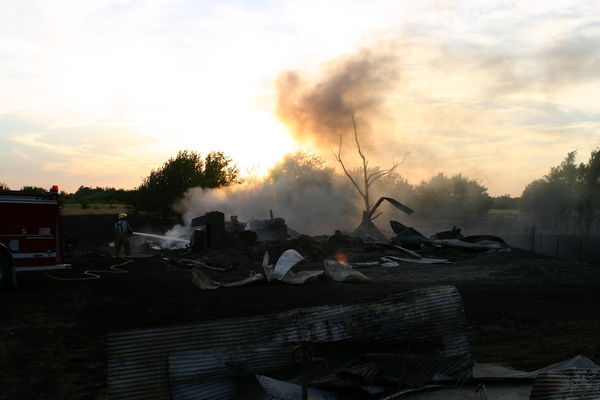
Next, in addition to the first set of fire photos I posted, I have now added more photos: a second set of fire photos. Note that there are two pages to that as well.

I've also added some photos to the Grandpa's Farm set -- this shows what things looked like back in April, before the fire. The buildings that burned are the barn, calf barn, and chicken house.

On to the updates...

Monday I went out to the farm first thing in the morning. Some areas were still smoldering -- basically wherever there was hay. It was a bit concerning. I went up to the 2nd floor in the house and took some photos of the yard.

I headed on in to work. Later in the evening, I went back out to check on things. Two fire fighters were back out there with a fire truck dousing the remaining smoldering areas. Apparently the fire fighters had been checking on the place intermittently all day and had been out there with water earlier as well.

The Goessel Fire Dept. is an all-volunteer department. These people aren't getting paid for this, and they do an EXCELLENT job. Someone was out at 1AM Monday, again at 10AM Monday, then twice more with the truck. They did all this on their own -- I hadn't asked them to. It is amazing how much these people care about the community and taking care of fires.

I also never knew how long bales of hay burn.

Here's one of the new photos:

Jaldhar Vyas: Like If Vorlon Starts Drawing Anarchy Symbols On His Trapper-Keeper I Am So Going To Hurl

Duffman thrusts in the direction of the problem. Oh yeah!
On Debian Policy
When your package contains GDFL docs
or when it break other programs
it stores passwords in mode 666
has incorrect dependencies
that's RC.
When you think that rpath is justified
just because libtool inserted it there
and don't use -fPIC,
libtool is a fool
and you are retarded.
When you have to use Minix
and there are conf files in /usr/local/etc,
Lintian will say,
you had it coming.

Martin Zobel-Helas: For those who wondered about proposed-updates

In collaborative work of Alexander Wirt, Marc Brockschmidt, Julien Danjou and me there is now a public list of packages which are in proposed-updates and await moderation currently. The backlog in that queue is currently decreasing drastically, thanks to AJ. Builds of the new D-I for Sarge r3 should start as soon as all needed packages are now spread to all mirrors. Update: Ooops, perhaps i should also add the link to that page.

1 August 2006

Gintautas Miliauskas: Firefox tip-of-the-day

A small tip for Firefox: use mouse gestures for basic operations. They are provided by the mouse gestures extension. I am no big expert here, as I only use three gestures: go back (left), go forward (right) and close tab (down,right). Nevertheless, having these around is already very convenient, because they are so simple and so frequently needed. I usually do browsing with (surprise) my mouse and these gestures streamline the process because now I don't have to care about the toolbar (and the close tab buttton in particular) any more. If you are only interested in the simple gestures, I found that it helps to disable diagonal gestures: in the extension's properties, Additional Settings tab, set diagonal tolerance to 0 percent. This will disable some advanced gestures but I never wanted those anyway, so it reduces the chance of my gesture being incorrectly recognized. I also disable the New window (down) gesture ("General" tab, "Edit gestures" button) because it would sometimes be activated instead of close tab when the "right" in my "down, right" motion were too small. Mouse gestures, like anything, need some time to get used to, but after a while they require much less effort than seeking out a button. In a few days you will learn that very little motion is required for the gesture to be recognized. For other applications usually the keyboard is actively used, so keystroke shortcuts would be faster, but for web browsing in particular, mouse gestures fit the bill very well in my opinion. By the way, Opera supports mouse gestures natively. In other news, my work on Debian l10n project was mentioned on Debian Weekly News. I found it very funny that they linked to Worldforge, which is an open sorce MMORPG, instead of WordForge, the localisation project. Admittedly I had made this mistake myself previously, and unfortunately WordForge has a much lower profile than WorldForge. Oh well, real news publishers do this kind of stuff all the time :)

John Goerzen: Asterisk: The Software Phone Company

Issue 13 of Free Software Magazine is out, and it includes my article Asterisk: The Software Phone Company. If you're interested in running your own PBX in software, check it out.

Julien Danjou: The Etch song

Hi - Hi! We're your Debian Developers - Ah-huh -
And have we got news for you - You better listen!
Get ready, all you lonely geeks
and leave those packages at home. - Alright! - Graph is rising - motivation's getting low
According to all sources, the BTS's the place to go
Cause tonight for the first time
Just about half-past ten
For the first time in history
It's gonna start raining bugs. It's raining bugs! Hallelujah! - It's raining bugs! Amen!
I'm gonna go out to run and let my packages get
Absolutely bug free!
It's raining bugs! Hallelujah!
It's raining bugs! Every Specimen!
Critical, grave, important and serious
Normal, minor and gorgeous! God bless ours RM, they're brave men too
They took off to heaven and they did they what they had to do
They taught every developer to rearrange the archive
So that each and every package could find its perfect bug
It's raining bugs! Hallelujah! - It's raining bugs! Amen!
It's raining bugs! Hallelujah!
It's raining bugs! Ame-nnnn! I feel Etch coming / NMU about to begin
Hear the buildd / Don't you lose your head
Rip off the swirl and stay in red It's raining bugs! Hallelujah! - It's raining bugs! Amen!
It's raining bugs! Hallelujah! - It's raining bugs!

Roland Mas: Migrated to Ikiwiki

I finally took some time to migrate my blog from a (very old) Wordpress to a fairly new Ikiwiki. As I write these lines, the version of Ikiwiki I'm using isn't even released, and it includes two patches made by yours truly (and submitted upstream, of course, as bugs #380680 and #380743), allowing the creation of monthly archives and the possibility of making these archives RSS-less (it doesn't make much sense to have an RSS feed for something that's supposed to be static). The whole blog is now static, since I haven't investigated the comments system. I will probably enable the comments eventually, and I will of course migrate the existing ones (much like I migrated the existing articles, with a combination of a Perl script and some hand-tuning). In the meantime, I'll enjoy a spamless blog. The other regression is the lack of a search facility, but from what I can see it was hardly ever used anyway. Note to readers: old URLs should still work (thanks to Apache's magic mod_rewrite), but please update your bookmarks and feed readers and agregators and so on to use the new ones, since I'll probably disable URLs at some point. Update: I also hacked a new plugin, linkbar.pm, which appends a static Markdown string to all *.mdwn pages before they are rendered. So you should now see the lovely navigation menu on all pages, including the article pages.

Simon Law: 2006 Ottawa Linux Symposium


Penguin and his boy
Originally uploaded by sfllaw.
The Ottawa Linux Symposium is arguably Canada's biggest conference about Linux and its associated technologies. It happens every year, right after the Kernel Summit, which virtually guarantees that some famous people stick around afterwards to attend OLS. Now the Kernel Summit is a small gathering of Linux developers where they hash out big issues in the kernel. After all, it's a lot easier to get your point across when you're sitting in the same room as the person you're talking to. Mailing lists are just not the same. OLS, however, is a free-for-all. If you pay in time, you get to show up. This makes for an astoundingly large conference, about 850 people in total. I brought along [info]wlach, who had never been to OLS before. So I was doing my part in inflating the number of people there. I think he ended up in the right crowds. Which is difficult, because there are a lot of crowds there. People walk past in a blur and you can never quite remember if you've met someone before.

Bowtied
Originally uploaded by sfllaw.
At the conference, there are four tracks of presentations, at any one time. Some of these are perennial talks, like the tutorial on writing your own kernel module. And others change as the years go by. The big topic this year was Xen, the free virtualization software that really got huge in the past two years. Xen allows people to run multiple copies of their operating system inside one computer, with very little overhead. This makes it attractive to a lot of people, be they system administrators, software developers, or people who like fiddling with their machine. I met a consultant from Chicago that sells Xen-based solutions. She builds a big server and runs various virtual servers for small business inside that one box. It's very cost effective and is a good way to make server maintanance easy. Whenever I wanted to find her, I'd just pop into one of the ubiquitous Xen talks. The amount of work that gets done at this conference is astounding. You'll see people sitting around at tables hashing out designs and beating out flaws. Hackers huddle around laptops in an attempt to get the C library building on PA-RISC again. That's because the bandwidth to communication is very high and the latency is inconsequential. There were times when I wanted to pull out my laptop and do some work. But then I remembered that I left it in the hotel. Because it's heavy. There's actually a lot of space at OLS, because it's spread across the three floors of the Ottawa Congress Centre. It's really easy to miss someone for weeks before bumping into him at a party. Like [info]opalmirror, for example, who I was very glad to meet in person. And are there ever parties.

Super balls
Originally uploaded by sfllaw.
Ostensibly, you go there for the talks. And talks there are: some of them quite good and the vast majority are rather mediocre. They're the results of a year of hacking, months of academic research, or inspired observation. I have to admit that I get a bit lax when attending speakers. It reminds me too much of the classroom. And just like university, I buy the course notes to mitigate my guilt. They make for good reading when finals come along. It's the conversation that you go there for. When you get to sit down with Alan and have a good laugh about geeky topics. Or buy Donald a drink for working on those ugly network cards all those years ago. You get to connect with people that you've only seen online, or read as their names flashed past in the boot messages. That's that kind of bonding that people yearn for. I'm looking forward to next year already.

Ian Murdock: Open source licenses are obsolete

Tim O’Reilly: “[I]t’s clear to me at least that the open source activist community needs to come to grips with the change in the way a great deal of software is deployed today. And that, after all, was my message: not that open source licenses are unnecessary, but that because their conditions are all triggered by the act of software distribution, they fail to apply to many of the most important types of software today, namely Web 2.0 applications and other forms of software as a service.”

Adam Rosi-Kessel: The Onion Still Has It

Wikipedia Celebrates 750 Years Of American Independence:
NEW YORK. Wikipedia, the online, reader-edited encyclopedia, honored the 750th anniversary of American independence on July 25 with a special featured section on its main page Tuesday. “It would have been a major oversight to ignore this portentous anniversary,” said Wikipedia founder Jimmy Wales, whose site now boasts over 4,300,000 articles in multiple languages, over one-quarter of which are in English, including 11,000 concerning popular toys of the 1980s alone. “At 750 years, the U.S. is by far the world’s oldest surviving democracy, and is certainly deserving of our recognition,” Wales said. “According to our database, that’s 212 years older than the Eiffel Tower, 347 years older than the earliest-known woolly-mammoth fossil, and a full 493 years older than the microwave oven.”
I also thought this Dan Rather/Michael Stipe bit was hilarious, but it only works if you’re already in on the joke.

Josselin Mouette: Some transitions can go quite smoothly

I am quite happy to see that we will be able to make GConf FHS-compliant in etch.

Here are the packages still shipping files in /etc/gconf.

That makes really few, given that:


This leaves only 2 bugs : #380728 (apt-watch, I only noticed it today) and #369858 (gnome-panel). Gnome-panel is the only case that couldn't be handled by dh_gconf, and I'll try to push one of the solutions that were thought of ASAP.

Thanks to everyone who made this possible, especially package maintainers who updated their packages so quickly (e.g. one hour for goobox).

MJ Ray: z39.50 search debugging

I found a small loop in koha's z39.50 search results page which did:
(define (output-page)
  (display (current-results))
  (if (pending-results?) (output-page)))
On the face of it, that makes sense. The problem comes if all searches complete between the display and the more-results? test: if so, the last batch of results won't be displayed. So far, I've only noticed it causing a problem on fast connections. I've fixed it in CVS to do:
(define (output-page)
  (let ((refresh? (pending-results?)))
    (display (current-results))
    (if refresh? (output-page))))
Worst case, it displays an unnecessary page. If only all bugs were so shallow.

Arnaud Vandyck: New upstreams

I’ve just upload new upstream (new for Debian, not really brand new! ;-) ) of libgnucrypto-java, libcommons-httpclient-java. The first upload will solve the libjessie-java FTBFS. I’ll work on new upstream of libcommons-net-java, then, I’ll track down Tomcat5 and Tomcat5.5 bugs.

Erich Schubert: Recently bought music

My latest music CDs (of course already ripped to my Ogg Vorbis player... CDs suck usability-wise, actually...): Sing when you're swinging
Sing when you're Swinging
Two CDs - the second is titled "(If you can't sing it) You'll have to swing it" - with recordings of the swing era. Some slow, some better for dancing. Rather cheap, and well worth the money unless you have many songs of that era already. Pop Swings
Pop swings
This CD is a mixed bag. It's swing covers of well-known songs of the 70s-90s. Some work great, others don't. A lot is personal taste, depending on the memories you have of the originals or how you liked them. If you didn't like the original, you might like the swing cover. If you loved the original, you'll likely hate the cover, just like any cover. The funniest thing is that one artist, Paul Anka, is on the CD in both roles, as cover artist (Smells like teen spirit) and as original artist (Diana). This is a CD you can't really listen to on-block (thats why CDs suck) or play on a party. You'll usually pick some specific songs. Perfect for parties
Perfect for parties
The full title is
Bear Family
"Perfect for parties
Highlight Album
This CD was the surprise CD. Very cheap, but very convincing. It's odd and fun at the same time. Actually it's probably as much country as it's rockability and swing. But who cares when you can have lots of fun with it? The song I like currently like best is "Burn that candle" by Charline Arthur. Note: above amazon.de links will earn me a tiny commission. It would be nice if you'd use them if you plan to order some of these CDs. Thanks. It will certainly never pay off, but when I set links I can as well set some that might allow me to buy myself a CD from it sometime later, too. ;-)

Gunnar Wolf: Israeli mistakes

Reading Jordi's blog, I cannot but agree with him (in most points): I plainly cannot understand Israel's actions in the last weeks. I can sadly understand how some people defend them, specially people not living in Israel - I was talking with a friend today, a friend who does not share a single political viewpoint with me, but still... The world seems to be completely polarized. Some have the impression that Israelis live under constant shelling, that life is unsustainable in that poor country, the last corner of civilization in that mess called the Middle East, and that the Arab countries (which are huge and petroleum-rich) just want to throw Jews to the sea or worse. The rest of the world think that Israelis are mass-murderers who decided to take a heavily populated bit of land and martyrize its originary population by any possible means, establishing an Apartheid.
Both views are false. But of course, both views hold their bits of truth.
I cannot claim to be neutral on this: Although I lived there in total for ~18 months, I am an Israeli by choice (I adopted the Israeli nationality in 1996 and wanted to live my life there - I came back to Mexico for personal reasons, and I later decided to stay here). I have not been to Israel since then - But I try to keep myself informed. And, living in a Jewish family, it's hard not to be somewhat informed - and of course, shocked at your relatives' opinions. Jews outside Israel tend to be right-wingers. I lived in a kibbutz, and I still sympathyze with Meretz, the most leftwing Zionist party.
I won't restate what Jordi eloquently said. I know not everybody who reads my blog reads Jordi's as well - Please do. If you missed it some lines above, here is the link. I insist: I agree with most of what he wrote. What could Israel do to protect itself from its enemies? The answer is simple: Don't give them a reason to hate you.
One year ago, I was optimistic because Israel was heading the right way. Of all people, Ariel Sharon (one of Israel's most hawkish, right-wing strongmen of all times) decided to withdraw from Gaza, and hinted that areas in the West Bank would follow. No, not the best way possible, not as his predecessor Menahem Begin did with Egypt leading to a strong and long lasting peace, and certainly not in the very notable way Itzhak Rabin did with Jordan, getting peace and even friendship. But at least, Sharon accepted the reality, and seemed he meant to let Palestinians build their state. When he organized a new party which reduced Likud to a shadow of its past, one of Israel's most prominent figures for the peace camp, Shimon Peres, joined. Amazing.
But still, there is too much hatred. Of course, life in Gaza is plainly not sustainable. You can walk the Gaza strip side to side in less than one hour, and North to South it's less than 50 Km long. Still, over 400,000 people live in there. The area is simply unsustainable.
Gaza depends for everything from Israel. Of course, according to the never-stable security status, the border between Gaza and Israel opens or closes every day. When I lived in Zikim, mostly every day there were five or six Arabs working with us... Except for the days when they weren't there. And, of course, Israel also depends on the Arabs for much of its hard labor jobs (as it's always the case when two economically disparate populations live together).
Anyway, back on track: Besides giving the Arabs their slice of land (which in a squeezed area as Israel is always hard; people have fought for such small spaces it's hard to believe), the only thing Israel can do is help them. It has worked before: Israeli Arabs (the Arabs living inside the internationally recognized borders of Israel) are full citizens. Yes, there is racism in the country towards them, and yes, they are not really equal with Jewish Israelis - But they have voting rights, they have the right to be elected, they can optionally join the army (it's not compulsory as it is with the Jewish population), and they get government aid. Arab towns are poorer than Jewish towns, yes, but they have their dignity.
The problem in Gaza and South Lebanon (somewhat less so in the West Bank, but also) is that it's plainly all made up of refugee camps. Refugees that were born there, and whose parents were born there as well. And, let me emphasize this, they are not Israel's fault. The refugees fled the newborn Israel because the Arab states said (in May 1948) they would enter Palestine and butcher everybody, inviting Arab civilians to flee and then get back home - of course, 700,000 (out of 1,300,000 who lived in Palestine by then) Arabs did so. And when the Arabs lost the war, the Palestinians were denied citizenship by all the Arab countries except for Jordan (not surprisingly, the most stable of them all, and with which Israel has the closest relation). They were given refugee camps to live, one over the other. When Egypt signed the peace with Israel, it demanded back every inch of the Sinai - But not an inch of Gaza. And not a single Palestinian refugee.
I agree here with Jordi as well: There is a huge military operation in Gaza, but it's more spectacular in Lebanon today. The media talks about Lebanon, but not about Gaza. And the crisis in Gaza is not easier. But how can it be solved in a permanent way? Israel does neither have land to spare to give to the Palestinians - and even if it did, most of Gaza is surrounded by the Negev, a desert where it would not be easy for them to get anything better than what they have inside Gaza. As desirable as it would be to have a completely independent Palestinian state, Gaza would just remain a concentration camp. There is too much hatred, and neither Arabs nor Israelis want to keep working together, not trusting each other. The only solution I can find to this is to have an agreement with Egypt, where Egypt opens its border with Gaza, gives either nationality or work permits to Gazan Palestinians, and Israel injects capital to develop Northern Sinai, to give some hope of survival to the almost half million people.
The same in Lebanon: Israel was widely applauded to withdraw from South Lebanon in 2000. The area is mostly peaceful - For $ DEITY 's sake, what is the kidnapping of two soldiers in a six year period compared to soldiers being killed in the occupation army every week or two? Israel did well to leave Lebanon. Lebanon was starting an incredible national rebuilding process, as Robert Fisk tells us (Spanish only. I could find only the first paragraphs of the original English version, which appears to require subscription) of the wonders of the rebuilding process, reduced to rubble again. Of course, Israeli and Syrian armies left Lebanon. The Lebanese government and army are plainly too weak to care for the country. Hezbollah (which, indoubtely, is a terrorist entity, no matter how many benefical aspects it does have) have poured tremendous amounts of money to rebuild its area of influence, South Lebanon. Of course, they rebuilt, healed and educated with a strong ideological inclination, and that's not good for Israel. What can Israel do to leasen the Islamist influence? Simple: Send aid. Don't just leave. Don't leave a void, don't invite bad people to loot, don't invite extremist people to recruite future bombers. Turn occupation into aid. Build hospitals. Build houses. Give money, give infrastructure. Do it behind your back, as you gave money to the South Lebanon Army for almost 20 years. But make the people see you don't want to kill and rob them - Make the Lebanese Arabs feel their neighbour as a friend, although different. Bring back the good border. What's that? That's the nickname for the Lebanese border between +- 1950 and 1970 - The only border that was stable, that was not filled with hatred, where Israeli doctors treated Lebanese patients across the fence. And still today, the border is just a simple fence.
How can you convince a people of not killing themselves to kill the invasor? Don't act as an invasor. Act in all your best self-interest - Save them from poverty and from indignity.

Erich Schubert: Speeding up Bittorrent

I've recently used bittorrent a bit. For example, I loaded the Ubuntu installer CD with it. For power users, I think rtorrent is a good client. I tried freeloader, but apart from some obvious bugs (it doesn't save the maximum bandwidth settings value), i'm lacking interesting information such as the number of peers or of distributed copies. When toying around with rtorrent and it's options I noticed a couple of interesting things. First of all, if you're firewalled, you'll be much slower. Allowing incoming connetions (and having a port forwarding in your router) makes a huge difference in the number of peers. My estimates are that 70% of peers are firewalled; if both of you are, you can't transfer data! The other thing is that apparently BitTorrent clients use some kind of "Tit for Tat" strategy. They request a packet, you request a packet. If you don't send them data, they'll stop sending you any. They'll still eventually retry (maybe you were overloaded), but largely your download speed will be related to your upload speed. I don't know how much peers (and seeds) trade information on who has which parts or is sharing how much upload speed. I guess they do somehow to deflect cheaters. Assuming that the illegal file sharing tools work similarly, this gives some interesting (theoretical?) ways to recude illegal file sharing:

31 July 2006

Pierre Habouzit: Python transition

You thought that buglist was soon over ? sadly for you, I've tracked (using the Contents.gz of the archive) all the packages that seemed to have private python modules. I've found many that were even not compliant with the previous python policy (and that shiped public extensions btw), and a big lot that need update. I'm way to tired to launch the big mass bug now, because I've worked more than 2 hours straight on that, looking at almost a hundred of packages list files in the eyes, to know if there was a tiiiiiiny python module hidden in there. Still expect it soon Sadly, it does not looks so good: my first list was 265 packages long, I suppose there is a whole bunch of false-positives, but I fear there will remain in the 200 bugs. Though, this is the final step. If you do maintain a package that depends upon python, please help ! Migrating your package to the new policy is often easy if you use debhelper/cdbs/ and other high-level packaging tools.

Next.

Previous.