Search Results: "ag"

9 August 2006

Martin F. Krafft: At Twelve?

If I remember correctly, then at 12 years of age, I was making my first attempts at chasing girls (mostly to play pranks on them), causing a hell of a lot of trouble in school, smoking and acquiring my first alcohol experiences, hacking on my Mac SE/30, and taking my wonderful mountain bike to places noone had ever gone before. Unfortunately, I did not pay any serious attention to the art of percussion back then, or else I would have maybe... ah, nevermind, no way I would have ever done this (videodownloader.net has links to other formats -- and there is a Firefox extension). I miss my drum kit, which is at this moment a mere 1872.45 kilometres away (or so says map24.com anyway, which is crap and does not give me a way to link to the route from Limerick to Munich, it seems).

8 August 2006

Aigars Mahinovs: SBackup revitalising - I18N

The development of SBackup was very stale for most of this year, mostly because many of the bug/feature that user were requesting required a significant rewrite of the codebase and at the same time I saw how messy the code has become over time. A few people came up and offered some help, but out of that only new icons and a command-line parameter parser were fully developed - other developers just took a task or a an idea and disappeared. However this week my trust in Open Source development model was reinforced by Jonh Wendell. He approached me yesterday about localising SBackup to Portuguese and was also willing to add the i18n support that was needed for that. I gave him all the details he needed and forgot about it. But today he came back with working code and a translation. That really inspired me to resume working on improving SBackup one little it at a time. Expect a new release version 0.10 soon with i18n and a few long awaited bugfixes. Also, if you want to translate SBackup to your language - use this file as your template. There are only 75 strings to translate. P.S. One happy user of SBackup donated some of his time cleaning up SBackup wiki from spam. Thank you for that! Now I only need a way to prevent the spam from coming back there :(

Ross Burton: Cornish Bliss (part 2)

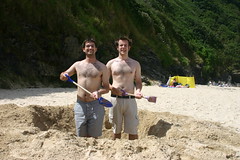
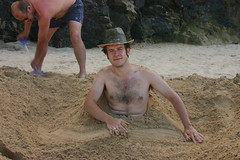
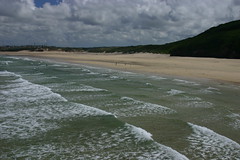
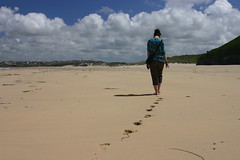
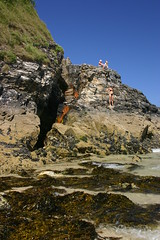
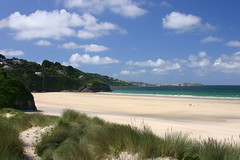
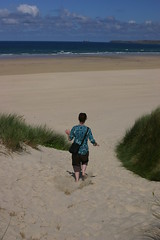
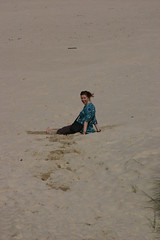
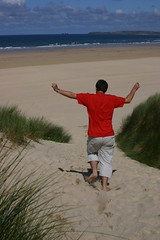
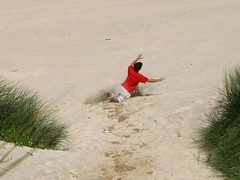
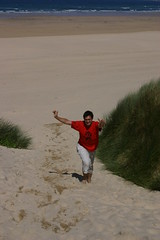
Now, where was I... Carbis Bay Carbis Bay Ah yes. After the horrendously grim weather had passed, the weather improved and we headed for the beach. On the way down we commented on how this was the classic British burning weather: bright sunshine, a strong breeze, and occassional clouds combine to burn skin without even feeling that hot. Of course knowing this meant nothing, we were too distracted with purchasing pasties and drink to think about putting a decent amount of sunblock on. Steve Relaxing Obviously the main thing to do at the beach, after we'd sat down, not applied sunblock, and scoffed a pasty, was to dig a hole. A huge hole. Spades were purchased and we took turns to help Pete dig The Hole. Digging Diggers Astute readers will notice the inevitable outcome of saying this is burning weather, not putting enough sunblock on, and digging a hole (an activity that results in the back being exposed to the sun). Ouch. After the hole had been dug we had to full it in again to avoid trapping small childen in it. Obviously this led to a series of hilarious scenes involving burying Pete up to his chest, modelling breasts and a penis, and so on. Finally the hole was flat again, at which point an impromptu long jump sand pit was arranged. I came first in the long jump, and although failing miserably at triple jump although I swear my technique was best (it's all in the wrists). Pete Next was to explore the costal path in the opposite direction towards Porthkidney beach. The beach is pretty huge by my standards, and due to the lack of facilities (no close car park, shops, toilets, and so on) it's almost deserted: there were a few other people there with dogs (the other local beaches are dog-free in summer) and that's about it. Googling to confirm the name of the beach reveals that there is a history of naturism and "inappropriate gay activity", but we didn't encounter any of that. ;) Progression Ross Footprints The costal path was great, far more rough than the walk to St Ives (often just a foot wide cutting in the ground), steep in places, and generally running very close to the cliff edge. The views were great, but I always think what a horror paths like these would be in winter, with the full force of the Atlantic winds pounding against the cliffs. As a finale it turns out that the costal path follows the cliff all the way along the back of the beach, which would easily be another twenty minutes of walking to reach sand. There is a shortcut down some stone stairs to the beach, but we arrived at high tide and the bottom of the stairs (well, rocks) were a foot deep in water. Wading up to the beach was a fitting end to the walk, and made the beach feel like our own little desert island! Cliff Steps Wading To Land Limpets! Ross I'll have to explain the expression on Vicky in the above photo. As a child when Vicky went to visit her father in Devon they used to go to the beach and spend the day annoying the wildlife: chasing crabs, kicking limpets off rocks and so on. When Vicky noticed that the rocks at the bottom of the cliff were covered in limpets, she shouted "limpets!" with a manic expression and preceeded to prod them frantically. After lots of sitting around and digging tunnels, we headed for the dunes for a spot of dune diving. This involves running at top spead down the dunes and throwing yourself into the sand at the bottom. Ah, the simple pleasures in life! Porthkidney Beach Dune Diving Dune Diving Dune Diving Dune Diving After my dive I ran back up the hill in the manner of a mad man, arms out-stretched to Vicky as I collapsed in front of her, gasping "It's". "What?", was the confused reply. This is terrible, I really need to get Vicky to watch the Best Of Monty Python DVD we have somewhere... It's! Possibly more to write, but Lost is on, so I'm off for now.

Martin Zobel-Helas: mostly done

The moderation queue of proposed-updates is now down to four packages, with one waiting to be accepted by ftpmaster. As soon as the Debian Installer is now build on the still missing architectures (alpha, arm and m68k), we should be ready to release Sarge r3 realy soon. Update: two packages are now waiting for ftpmasters, thanks to dannf, who’s first accept this was.

Lucas Nussbaum: Good questions to ask yourself when working inside teams

Many people agree that teams are good : doing team maintenance of packages is often seen as A Good Thing inside Debian, and Ubuntu enforces it by switching to the everything is team-maintained philosophy. However, teams are subject to complex group dynamics, and raise interesting issues that you don’t encounter when working alone. It is important to ask yourself those few questions Dilution of knowledge: Team members tend to individually know less about specific packages. Does the sum of all team members really know more than an individual developer would know about a specific package ? Responsibility: Are there some clear responsibilities in your team ? Are people feeling responsible for packages ? Not having clear responsibilities is dangerous, because a package could become sort-of-orphaned inside the team, because nobody would consider “his duty” to work on it. Hierarchy inside teams: Is there a clear hierarchy inside your team ? If there isn’t (which could be OK), are you sure there isn’t an unofficial hierarchy that built up with time, causing people to wait for an unofficial leader’s decision, while this leader might not even be aware that he is that leader ? Scalability: How much can a team scale ? How does *your* team scale ? How many team members are really active ? External interface: When dealing with the outside world (read: upstream), it’s easier to have a single point of communication. How does your team’s external interface look like ? Remember that teams’ external interfaces can easily become much more complex for upstream developers to deal with. There are no magic way to build a team that work, but it’s important to look at your team with a critical eye and try to improve its inner workings.

Gunnar Wolf: Biting your tongue

Sorry, this post will only mean anything to you if you can grok an es_* locale, preferrably an es_ES one. B3co points to a wonderful site, which I came accross sadly when I am about to start working. Still, lots of good laughs taken from mistakes in the Spanish press. The site? Morderse la Lengua (Biting your tongue), from Centro Virtual Cervantes. I found such beauties as the world's largest telescope, which can see object 100 meters away, a Boeing that goes back to Madrid through a crack, a Spanish airplane crashing in Turkey for the third time in a year. A Spanish party asks for the right to conduct abortions until the twelfth month, and -avoiding the problems that come with advanced age- a business looks for secretaries between 20 and 290 years old. And many, many, many more.

Joey Hess: moving kite

(This is a long ramble with a concluding announcement that kitenet.net users should read even if they skip the rest.)
Back in spring of '03 I bought a used VA Linux 2u on ebay for $300 and dropped it a cabinet in the blue spaceship halls of the Hurricane Electic co-lo in Fremont, CA. I've never seen it again; I use it every day. Weird world.
Digression: The reason I needed to have a hunk of silicon and spinning metal hooked up to a power and an ethernet cable somewhere is this: On the internet you can either be a soverign entity, controlling your own computation, choosing your own software, making your own mistakes, and doing things your way -- or you can be a sheep. Or at least that's what I believe; reasonable people think otherwise. Here's a story illistrating this concept. Not only do I want to be a sovereign entity on the internet, but I want to empower others to be the same, to the small extent that I can: making software that supports it easier to install; contributing to co-ops like the one that hosts my computer; working on software that empowers users to become programmers; fiddling with making special-purpose embedded hardware useful for general purpose use; and letting a few users run code and such on my server and use it much the same as I do. It's a theme through a lot of my activities.
Anyway, it seems like my computer has been there longer than three years, and it's had a good run, despite little incidents like: Mostly though it has kept on running without problems for years, being my personal server and performing a few other roles. This seems to prove something I've long suspected; that computer hardware runs much better when I'm not near it. But that can't last. Eventually a hard drive will die, eventually whatever fans have (probably) already died will overheat it. Eventually I'll screw up a kernel update (which still have to be done blind, since I never did get grub talking to that serial port.) One option was to go back out there and do enough maintenance for it to last another three years. The other option was to move away from running my server on that nasty computer hardware stuff. Happily, in the intervening three years, that has become, in a way, possible. Xen and the like are big news, letting a single standard server appear as multiple separate machines. Not a new idea, but an idea newly within easy reach. So when I heard that Steve Kemp was puttng together a Xen co-op to buy a machine and split it up 6 ways, into 6 virtual machines, I jumped at the opportunity. Not only does Steve know a lot more about administering Xen than I do, but he got a good deal for on hardware that should be fully managed in case of breakage. Plus, he's providing a template for doing this on a grassroots level that I hope many other people follow. (Only partly because I want to have more than one little virtual server other there, rather than one big physical one..)
I'm still a bit unsure about Xen from the point of view of wanting to fully control my machine, since it does a) let the admin of the underlying hardware get at any data they want to if it's not encrypted and, b) it doesn't make it easy to run your own kernel. Luckily I a) basically trust Steve, and b) he seems to want me to run the exact same kernel (latest Debian unstable stock kernel) that I want to run.
So, the conclusion to this ramble is that kitenet.net will be moving, over the next few weeks, to wren.kitenet.net, which is theoretically located in London, but which is not a "real" computer as you might be accustomed to thinking of them. I decided against moving it all at once, and will be trying to keep all the various services working while shifting them around. The utterly gory details of the transitions are being kept on kite's page in my wiki, and announcements for kite users will be posted to kite's blog.

7 August 2006

Isaac Clerencia: Homesick

Well, it is actually the other way around, I’m really sick of “home”, longing to get out of here (both Zaragoza and Spain).
Tomorrow in the morning I’m taking a plane to visit London for a week, but I fear that’s only going to make things worse.
I will report when I’m back, and also release Battle for Wesnoth 1.2 :)

Gunnar Wolf: Re: sshfs

Junichi is delighted with sshfs. So am I - I now keep mounted some directories from several of my servers from my workstation, and it becomes oh-so-much-easier to do basically everything. Besides, sshfs seems to have been planned right security-wise - It is based on FUSE, so any user can just do
$ mkdir remote_home
$ sshfs user_at_server_dot_org:/home/user remote_home
and start working - What I found as a very sensible default is that the mounted pseudofilesystem is not visible by any other local user - Not even to almighty root. Of course, this is overridable.
Now, Junichi just misses some performance when -of course- working with large files. I have noticed that, of course (after all, my home DSL connection is 512/128, so... opening by mistake a mere 1MB file makes me quite unhappy). My gripe is that it is slow dealing with directories with too many files, even though directories are (supposed to be?) cached. After thinking on this for a while (and not having straced mutt to assure me I'm right, I think it's because I tried to run a local mutt with remote maildirs - of course, scanning a couple thousand messages for their headers will not be a fast operation. Well, some day or other I'll finish setting up my mailbox at home to be IMAPable. And not even then, I fear, it will be very fast. I think it's time to dust off EOT, which seemed like a good idea, was a neat and easy implementation... But I never really used it.

Evan Prodromou: 20 Thermidor CCXIV

Wikimania is over now, and although I have to admit that I'm relieved in a lot of ways, since it's been a long week, I was still a little bummed to say goodbye to people at the closing event last night. I'm a big believer in the meaning and value of on-line communication, but there's something about being physically present with the people who are making wiki and Open Content happen that means a lot to me. Saturday's discussions were all pretty good -- I really liked hearing about The Internet Archive and the amazing amount of knowledge they're making available for future generations. 26 million books, 300,000 films, 3-4 million audio recordings... there is a lot of human culture that we can and should preserve in digital format. Brion's talk about future developments in MediaWiki was great, too. As usual, the hallway conversations were almost as productive as the sessions themselves. I talked to Ray and Mark about using WikiIndex as a clearinghouse for wp:Interwiki coordination. I talked to Ward, who's going to dig in deeper to the MediaWiki parser (impressive!). Maj and I talked with Gil Penchina, who's a real nice guy. And, as the event was wrapping up Saturday evening, I spent a half-hour talking with Kevin Scott, who's got some interesting ideas for launching a new wiki site (or cluster of sites). As I was getting ready to leave, I ran into a cluster of people around wp:Richard Stallman, who'd shown up more or less out of the blue. He was haranguing the crowd about the term intellectual property, and as Brad Patrick, interim CEO of the Wikimedia Foundation and an IP lawyer, was at the front of the line, I got the feeling that Brad had made the mistake of introducing himself. Whoops. I talked with Mako for a while; he had a t-shirt that said, "debian-legal stole my DFSG". Excellent! I also met Thomas Malone, and we talked a bit about how an information commons affects what we think of as "work" and "knowledge workers". Everyone was drifting off to eat before the party, and Professor Malone invited me to join him, but I had to get back and see Maj and Amita June. But, catching a familiar face nearby, I said, "Thomas, have you met wp:Ward Cunningham before...?" They headed off to dinner together, and since they were still hanging out when I saw them later at the party, I assume they hit it off. We had dinner Saturday night at Charlie's Kitchen, a misnamed bar with lots of good, fried crab items. I guess the burgers are good, too, but we enjoyed the seafood and the juke box. Poor Amita June -- growing up in juke joints across North America. She does love french fries, though... Saturday night we went to the Wikimania party at the MIT Museum, which had an amazing number of great exhibits of neat AI schtuff. I spent some time talking with Professor Malone and Ross Mayfield of SocialText. Ross had on a T-shirt from d-Camp, and as we talked about the BarCamp phenomenon Professor Malone decided to hold one at MIT. Cool. Ross had some questions about the recent launch of Wikicars, which has some configuration issues at launch time such that the license shown was incorrect. He was glad to hear it was fixed. I think Ross does a good job keeping an eye on the business aspect of wikis -- I don't think there's another blogger out there who's doing quite as good a job at it. We headed home early -- we've been dragging our poor baby around to too many parties lately -- and got a good night's sleep. tags:

Sunday Sunday's events were pretty good, although I was starting to feel pretty crispy. The discussion about the Wikimedia Foundation's board was really fascinating, but also a bit alarming. The Foundation has a huge job, and they're such a young organization -- like a colt just standing on its feet. Growing pains are inevitable, but it's impressive how committed the people on the board are. They love Wikipedia and the other Wikimedia as much as we all do. I saw a great discussion of wiki map editing (using SVG and Javascript to provide in-browser editing), something very near and dear to my heart, since we need it for Wikitravel. Sadly it was opposite Joseph Reagle's talk on neutrality, so I missed parts of both switching between events. The event ended with a big speech about the nature of knowledge by wp:Dave Weinberger. He started off with a hilarious send-up of Lawrence Lessig's presentation style, but got down to some fundamentals of semiotics in a very approachable way. It was a good finisher for the Wikimania event. Today we're going to stop in to see some people here in wt:Cambridge (Massachusetts), then it's off to wt:New Hampshire and back home. Where we'll be for all of 10 days before packing off for WikiSym. Man, what a month of wikis. tags:

Felipe Augusto van de Wiel: 6 Aug 2006

Here we go...

[Debian]
On Saturday (05.Aug.2006) I sent the answers for some questions that zorglub (my AM) in reply to the first part of T&S. At the same time he sent the second part of the T&S, that I just replied with the answers. The second part was not as time intensive as the first part (but took me almost the entire weekend to finish).

CVS pserver for webwml repository is still disabled, which makes the life for non-DD translators a little bit hard, since we don't have access to CVS using SSH and all the files and/or patches needs to go throught the very cool commiters on debian-www. Recently, a new helping page (while we do not have pserver access restored), based on the mail sent by Raphael Hertzog to debian-devel, was launched by Frans Pop: tarballs of the webwml CVS repository. Thanks Frans! And I would like to point all translators that use check_trans.pl to the website statistics with a special hint to the specific language page that contains almost the same information from the check_trans.pl and could help to keep track of files being too out of date.

Jos Parrella: About apt-proxy

apt-proxy has become an omnipresent tool in Debian-based environments. Both in work and in my clients I usually install it so we have a great way to save bandwidth (in a Country where a 512 Kbps ADSL line costs you around 50$/month, it matters) I have noticed also several Ubuntu users using it, even in big environments where a local mirror might be justified and even when other solutions like apt-cacher seem to be getting stronger. Sadly, current state of apt-proxy is not so good (see bugs 282746, 316670, 274679, 262528, 327268, 302503, 295329 and probably others). While upstream is doing a great job implementing fixes, the user base has evolved very quickly and it’s starting to find (and fix) bugs by its own. One example of this is the current release of this version of apt-proxy, made by Daniel Baur, which implements pending patches for eight bugs, including patches which solve Ubuntu-specific issues. A partial debdiff which shows the relevant changes on the code is here for the lazy admin. Chris Halls has acknowledged these fixes and plans to upload a new version to Sid soon. That would be a happy-ending chapter of saving apt-proxy from death. Personally, I’m going to have a closer look on apt-cacher while this new package appears.

6 August 2006

Josselin Mouette: How to introduce bugs in other packages

As the hdf5 maintainer, I already knew upstream developers are able to imagine really innovative ways of writing broken autoconf scripts, but this one made my day.

After my first package build on my fresh amd64 system, I noticed lintian complained about a rpath:
W: gconf2: binary-or-shlib-defines-rpath ./usr/bin/gconftool-2 /usr/lib64

I found soon that this was caused by /usr/lib64 being mentioned in the libpopt.la file. The popt build system is, well, interesting. Or funny, if it doesn't affect you.

In configure.ac:
dnl XXX Choose /usr/lib or /usr/lib64 for library installs.
MARK64=
case "$ target_cpu " in
x86_64* powerpc64* ppc64* sparc64* s390x*)        MARK64=64 ;;
esac
AC_SUBST(MARK64)

And in Makefile.am:
usrlibdir = $(libdir)@MARK64@

This is subtly breaking a large number of packages on amd64, as libtool, not knowing it is a symbolic link to /usr/lib, introduces a rpath for this directory it doesn't know about. This was already reported as #374797.

David Nusinow: Where The Hell Did That Come From?

Much to my surprise, I'm currently running AIGLX. The package and at least a few drivers, should be on their way to experimental right now. It shouldn't be able to run compiz yet, but I'll have a look at the patches needed to do so sometime in the near future.

Ross Burton: Cornish Bliss (part 1)

Let's start this with a cliché: A Short History of Tractors in Ukrainian: £8
Best Of by Nina Simone: £14
One week in a rather swish house just outside St. Ives: about £200
No email. No Jabber. No Subversion. No Bugzilla: priceless For the last week Vicky and myself were in Cornwall, staying in a house just outside St. Ives with her family. The house was much nicer than we expected, very tastefully decorated and well equipped, with a DVD player, hi-fi, coffee machine, and so on. Settling In The house was in Carbis Bay, about a twenty minute walk from St. Ives along the costal path that was directly off the bottom of the garden. The path towards St. Ives is also the nicest stretch of costal path I've been on: it is surfaced and wide enougth to drive on, unlike the paths we've been on previously which are often no more than a foot wide cutting in the earth, next to a sheer cliff. St. Ives The Sea Our first impression of Cornwall was one of chill: when the taxi dropped me off at the train station to start the journey down the thermometer said 38°C, but at the same time the next day it was only 23°C. Brrrr. The traditional Cornish summer proceeded to roll in a few days later, with heavy rain, gusty wind and general grimness for a day. Yay for DVD players! Typical Cornish Summer St. Ives is a lovely town. Unlike Newquay which was got far too popular for it's own good (the two-carriage train had both a Stag and Hen party on board en route to Newquay, trying not that subtly to pull each other), St. Ives is busy but not crammed. There is no demographic that dominates the tourists, a mix of families young and old, surfers, twenty-somethings and pensioners means it doesn't feel like a tourist hotspot, and it manages to cater for everyone. The habour front has lounge bars, traditional pubs, restaurants and cornish pasty shops, catering for everyone. The town has become quite a focal point for artists recently (since 1928, Wikipedia tells me), and there seems to be more independent art galleries than pasty shops (!), including the Cornwish outpost of the Tate. Tate St. Ives is pretty small for anyone who has been to Tate Modern, but it's damn good: due to the size it is very focused (there are just two galleries) and the building itself is a wonderful modern piece of art deco architecture. We went with the intention of getting some more pictures for the house and did quite well: a print of Horizontal Stripes by Patrick Heron, and a limited run print (427/600) by a local artist. I'm too lazy to remember the name of the picture or the artist, but I'll take a photo of it later. Our Grand Plan of having more individual art in the house is going well, we've an original oil-on-canvas abstract to collect from the framers that we bought in Paris too. To be continued...

Andrew Pollock: [tech] Initial bonnie++ results with the uber-disk

So I ran bonnie++ over my 1.5 terabyte, exported via ATA-over-Ethernet logical volume of extreme immensity. I don't really know what I'm looking at, but I'll record the results here before I lose them. From both the MythTV front-end, and from minotaur, the box that has the disks attached, I ran bonnie++ twice:
bonnie++ -d /mnt -s 2G -n 1 -u nobody:nogroup
and
bonnie++ -d /mnt -s 2G -n 1024 -u nobody:nogroup
Firstly, I guess the results where the disks are directly attached (via USB):
Version  1.03       ------Sequential Output------ --Sequential Input- --Random-
                    -Per Chr- --Block-- -Rewrite- -Per Chr- --Block-- --Seeks--
Machine        Size K/sec %CP K/sec %CP K/sec %CP K/sec %CP K/sec %CP  /sec %CP
minotaur         2G 13595  95 20652  24 10204  12 13625  92 21362   6 295.5   1
                    ------Sequential Create------ --------Random Create--------
                    -Create-- --Read--- -Delete-- -Create-- --Read--- -Delete--
              files  /sec %CP  /sec %CP  /sec %CP  /sec %CP  /sec %CP  /sec %CP
                  1 +++++ +++ +++++ +++ +++++ +++ +++++ +++ +++++ +++ +++++ +++
and
Version  1.03       ------Sequential Output------ --Sequential Input- --Random-
                    -Per Chr- --Block-- -Rewrite- -Per Chr- --Block-- --Seeks--
Machine        Size K/sec %CP K/sec %CP K/sec %CP K/sec %CP K/sec %CP  /sec %CP
minotaur         2G 13646  95 20864  24 10195  12 13348  91 21377   6 288.8   2
                    ------Sequential Create------ --------Random Create--------
                    -Create-- --Read--- -Delete-- -Create-- --Read--- -Delete--
              files  /sec %CP  /sec %CP  /sec %CP  /sec %CP  /sec %CP  /sec %CP
               1024  6173  37  6090  17  2215  22  1032  22   184   0    93   2
The +'s indicate that the result occurred in an impossible to accurately measure, sub-500ms time. From the MythTV front-end, so with the ATA-over-Ethernet overhead thrown in:
Version  1.03       ------Sequential Output------ --Sequential Input- --Random-
                    -Per Chr- --Block-- -Rewrite- -Per Chr- --Block-- --Seeks--
Machine        Size K/sec %CP K/sec %CP K/sec %CP K/sec %CP K/sec %CP  /sec %CP
teevee           2G  3789   7  3761   0  3138   0 10742  23 11445   0 152.9   0
                    ------Sequential Create------ --------Random Create--------
                    -Create-- --Read--- -Delete-- -Create-- --Read--- -Delete--
              files  /sec %CP  /sec %CP  /sec %CP  /sec %CP  /sec %CP  /sec %CP
                  1 +++++ +++ +++++ +++  1029   2  1372   1 +++++ +++ +++++ +++
and
Version  1.03       ------Sequential Output------ --Sequential Input- --Random-
                    -Per Chr- --Block-- -Rewrite- -Per Chr- --Block-- --Seeks--
Machine        Size K/sec %CP K/sec %CP K/sec %CP K/sec %CP K/sec %CP  /sec %CP
teevee           2G  3848   8  3862   0  2876   0  9871  31 11440   1 147.9   0
                    ------Sequential Create------ --------Random Create--------
                    -Create-- --Read--- -Delete-- -Create-- --Read--- -Delete--
              files  /sec %CP  /sec %CP  /sec %CP  /sec %CP  /sec %CP  /sec %CP
               1024  2488   7  4633   8  1752  15   752   8   444   1   159   1
Wow, I'm going to go away and analyse these numbers and update this post, but on the face of it, it looks like there's a significant performance impact (at least on my home network, I'm sure it's not optimal) in using ATA over Ethernet. Hmmm.

Daniel Jacobowitz: Look Ma, I can blog too!

I've been meaning to set up a blog to keep track of random things that I run into and feel like sharing. One of those happened today, so I finally figured out how to install blosxom. I haven't gotten around to making a pretty CSS for it yet (not sure if I ever will, but I can pretend...) so for now it's somewhat utilitarian and default-looking. Blosxom is pretty bare-bones without plugins, and while Blosxom itself seems well documented the plugins are much less so. I spent about ten hours mucking around with the minimal set of plugins I needed to get something acceptable (timezone, autoblock, feedback, entriescache, interpolate_conditional, permalink, cooluri2, lastmodified, and a bunch of modified templates to use feedback and permalink). I tried and then discarded followsymlinks and metadate (for not playing well with other plugins I was using) and entries_index (lastmodified wanted something which set %others, so I used entriescache instead). I needed to hack lastmodified to work with entriescache, since it cleverly gets the timestamps from the cache, which are now publication dates. So here's a slightly modified lastmodified plugin which stats files directly. I spent a while getting RSS to behave, too. I used lastmodified to set lastBuildDate, modified the story template to use permalinks which were acceptable to feedback (it wants .rss on the end or it decides they aren't story pages), and eventually figured out that I needed to set <guid> to prevent liferea from thinking each modified post was new by comparing descriptions. All in all it was far more work than I meant to do last night when I decided this was a good idea. Hopefully I haven't messed it up too badly. We'll see whether I upset Planet. Leave me a note if it makes your feed reader unhappy, or something. I was actually going to use ikiwiki, but chickened out at the last moment; blosxom had fewer dependencies and I didn't want to mess around with getting ikiwiki to install on sarge. And it still seems to be evolving - so while it's wicked cool, I think I'll let it have a little more time to settle first. I spent most of this morning messing around with OpenWRT. I bought a LinkSys WRT54G quite a while ago (to replace a flaky D-Link DI-614+), and put OpenWRT on it. It took a little work to get it to do what I wanted, including fixing a quoting bug in the WPA startup script and tracking down an updated dnsmasq, but eventually I got it set up. Mostly the stock things: NAT, firewalling, wireless with WPA2, DHCP, internal DNS. Except that it can do one thing that none of the stock firmwares could: provide static DHCP addresses to specific boards, including custom options. This was absolutely essential for me to retire my old DHCP server, since I keep an embedded board lab in my office. I need the DHCP server to be able to tell boards where to get kernels and root filesystems. Anyway, it works well. Except that I've been having too many dropped connections lately and I have no way to track down whether it's the laptop (Dell Latitude D400, ipw2200 - mostly in Windows lately, I haven't retested it in Ubuntu in a bit) or the AP. I updated the Windows drivers and now it periodically tries to rekey, fails, reports "duplicated RSN" whatever that means, and periodically reports authentication failures. About the same as before except that now it has better diagnostic tools to tell me in undocumented messages what went wrong, instead of just telling me that something went wrong. So I next went looking for an updated driver for the other end. Which was a mistake. Note to others: if most of your packages are on a cromfs, running "ipkg update" is going to tear through your available MTD space really fast. And ipkg is not graceful at updates the way dpkg is; it failed to upgrade base-files due to file conflicts, leaving the updated dnsmasq unable to start. These are the same sorts of conflicts that you see in apt-get upgrade periodically: files moving from one package to another without sufficient package relationships (or in ipkg's case, maybe sufficient package manager support) to do it seamlessly. Then when I retried the update it succeeded, but it wiped out my firewall config and password file without asking. I don't really blame OpenWRT for this. "ipkg update" just isn't a good idea with their tools. But I miss apt. And I really miss 2.6 kernels; the binary-only Broadcom drivers that power the WRT54G only work on 2.4.30. And it's tight on flash/RAM anyway. So I went looking at options. Obviously, I can't get something that does exactly what I want for the kind of mass-market price the WRT54G sells at. But a suggestion from a coworker sent me looking at Mini-ITX systems, like the nice-looking Mini-Box M200. And at smaller things, like the WRAP WiFi and Soekris boards. I haven't done a hardware project of any sort since last summer, so I'm thinking about building myself an access point with benefits. I haven't decided what the benefits will be yet - if I get something like one of the Soekris boards, probably just bigger compact flash and back to dnsmasq for internal DHCP. But if I get a Mini-ITX system, I can throw a hard drive in it, arrange over-the-network backups, and use it as an incoming mail hub. This would let me decomission one of the always-on computers in my office. A mighty attractive proposition, although a bit less so now that the heat wave has broken.

Norbert Tretkowski: Removal of postgresql-8.0 backport

I'm going to remove postgresql-8.0 from the backports.org archive. It's was already removed from Debian, and the last version of the Debian package which was available is vulnerable to CVE-2006-2313 and CVE-2006-2314, hence the backport is also affected. Please upgrade to the postgresql-8.1 backport.

Alexander Sack: Please test firefox/thunderbird/mozilla security packages

Hi all, we uploaded preview packages for the next security update of mozilla applications
in debian sarge. This is the second maintenance release after mozilla foundation officially ended
support for the product versions we ship in sarge. The packages are based on the patches I
backported and announced a few days ago [1]. If you are a more or less advanced debian-sarge user (or developer) who wants to contribute and
you are using one of the mozilla apps, then please help by testing
this preview release and provide both, negative and positive feedback to pkg-mozilla-maintainers@lists.alioth.debian.org. To test this release, please upgrade your favorite mozilla app from the sources given below. The repository that contains the new packages can be found at http://people.debian.org/~asac/security. The applications and versions of concern are: You can either download the .debs manually or add the following to your apt sources.list:
deb http://people.debian.org/~asac/security ./
If you run into troubles with any of the new packages, chances are high this is due to some
extension that makes use of some corner-case feature. In order to help to track these cases down
you should disable your extensions one by one until you get rid of the problem. If you find the
extension that causes all the troubles, please don’t forget to mention its name and version. Thanks for your support! [1] – http://www.asoftsite.org/s9y/archives/112-Its-mozilla-patch-day!.html

5 August 2006

Aigars Mahinovs: Cobert takes on Latvia (future, hopefull)

I was just told that Steven Colbert is going to feature Latvia in it’s new sketch “Meet an ally”. On his show, he often does thematic multi-part sketches where he meets with all participants of some kind of group. The best example is his ongoing ‘434-part series’ “Better know a district” that even earned a Wikipedia article for itself. After talking with the representative of Pilau to UN, he found out that only military force they had was one single patrol boat and that it’s ambassador has barely any relation to the small island state from the Pacific. Hopefully we will look a bit better :) P.S. Regarding spelling - I have found that it is still more convenient to use gnome-blog package then to use the Wordpress on-line spelling plugins.

Next.

Previous.