Search Results: "pm"

2 October 2011

Wouter Verhelst: Test suites considered good

Yesterday, I uploaded NBD 2.9.24-1 to Debian. The big new feature in that release is that it now has an 'includedir' global configuration variable, with which it supports a conf.d-style directory. This feature was implemented by request of Vagrant Cascadian, of LTSP fame. Only it didn't build on kFreeBSD. The reason? The particular test that I added for that new feature failed. It turned out to be a simple bug in the code, which just didn't trigger on Linux but which was a bug none the less. I hadn't noticed, since my main development machine runs Linux; this is why I added a test suite to the code. Bug fixed, new package is in incoming. Whee.

Theppitak Karoonboonyanan: Myanmar Visit

Quite a belated English blog (after the Thai version), due to busy personal life lately. I had visited Yangon during 4-11 Sep. to give some talks and tutorials on Debian packaging and mirroring. And I've shared some information with community. The visit was initiated by Ngwe Tun and the Myanmar L10N team. I found later that a Facebook event had been created for this. Localization The first day was a comparison between Myanmar and Thai supports in GNU/Linux, in which I briefed the status on Thai side, and Thura Hlaing on Myanmar side. It was nice that we had the Myanmar Computer Federation (MCF) director presiding the meeting til the end. That means GNU/Linux support has been awared at executive level. According to Thura, Burmese has gained support in GNU/Linux quite well. On the rendering side, all the reordering for the logical order is normally done with pure GSUB in the fonts, without special processing on the rendering engine. This is suboptimal in principle, but it's the most effective way, as Windows redering engine itself does not yet support Myanmar, either. For input method, Myanmar XKB map has been available in xkb-data for a long time, but to serve users' familarity with visual order typing, some reordering input methods have been developed, based on keymagic and ibus. But all are not context-sensitive like what's done for Thai in other frameworks. Fortunately, with the surrounding text API recently added to ibus, this has become possible. One unusual requirement for Myanmar script editing is the caret movements. It needs to move syllable-wise, not character-wise nor cluster-wise. So, I suggested them to have a look on UAX #29 to see how it should be amended. Myanmar locales are already done, both for GNU C library and CLDR. And even a GNOME applet for Myanmar lunar calendar is also available. This latter thing is what Thai can learn from. Burmese word segmentation is not supported in general. But R&D works have been done for this in its NLP lab. A serious issue left to solve is the existing abuses of Unicode. In Myanmar, there exist at least 14 variations of font hacks, abusing some free slots in Unicode charts as pre-composed clusters for information interchange (not for font internals), making plain text interchange impossible without the proper font for rendering. For program translation, the new Myanmar L10N team is trying to request for a mass submission to the current GNOME team. And for Debian, Thura Hlaing and Ngwe Tun has already started the translation process with Christian's help. Along my stay, I could see the team actively discussing on the IT glossary, trying to settle down the translated terms. This looked very fun. Debian Then, the next three days were a workshop on Debian packaging, where I have presented the basics of Debian package building, uploading, quality-controlling, modifying, creating and delivering. This aimed toward the development of a local distribution based on Debian. Each day in the afternoon was the time for setting up a Debian mirror, not only for convenient local distro developement, but also for general users. This is important because internet penetration is still low in Myanmar. The main media for software distribution is CD/DVD, which means only stable version of Debian can be spread, which is not good for desktop users. Having a mirror should improve the situation somehow. It should make dist-upgrading to testing/unstable easier. And it should make CD snapshotting using local distributions easier, too. For this, I also presented another quick slide on Debian mirroring & caching. In the last day, I was introduced to the staffs of Myanmar NLP Lab and their projects, which include Myanmar OCR (based on tesseract), information retrieval, machine translation, and other lingustic resources like dictionary, lexicon and text corpus. Furthermore, I was also offerred technical helps on developing a Lao/Esaan Tham font for a Lao and North Eastern Thailand variation of Tham script, which is Mon-based and is closely related to Myanmar script. (See some sample transliterations if you are curious how it looks like. It was part of my hacking during DebConf11 travelling.) Currently, its OpenType support is quite sufficient, but it still renders poorly on Mac OSX. To cope with this, I was given a Mac Mini as a present from Myanmar for its development, as well as some explanations on AAT features from a Myanmar font developer. And I am very grateful for that.

1 October 2011

Tiago Bortoletto Vaz: flickr backup tool in Debian

Forked from hivelogic-flickrtouchr, which is forked from flickrtouchr, flickrbackup is a simple tool to perform a backup of your photos in flickr. It's is in a very early development stage and code looks weird, but critical functionality is working :)
tiago@x61:~$ flickrbackup -h
Usage: flickrbackup [OPTIONS] -o OUTPUT_DIR
Backup your flickr photos.
Options:
  --version             show program's version number and exit
  -h, --help            show this help message and exit
  -o OUTPUT_DIR, --output_dir=OUTPUT_DIR
                        set the local directory where you want to store your
                        pictures
  -e, --metadata-exif   store flickr metadata (title, description etc) as EXIF
                        tags in your local files [default: False]
  -x, --metadata-xml    store metadata as default flickr XML files [NOT
                        IMPLEMENTED]
  -u, --metadata-update
                        update flickr metadata to your local files. Use this
                        option with -x and/or -e [default: False]
  -g, --html-gallery    generate a local HTML gallery [NOT IMPLEMENTED]

Wouter Verhelst: Bugs filed versus the phase of the moon.

One of the more classic jokes about not yet understood bugs is that the phase of the moon is somehow involved in causing it. Being bored, I decided to spend some time to see whether "date of bug filed" could somehow be correlated with "phase of the moon" for a given source package. Fast forward an hour of perl experimenting, and here we are:
#!/usr/bin/perl -w
use strict;
use warnings;
use constant PI => 3.1415926535;
use feature "say";
use SOAP::Lite;
use Astro::Coord::ECI::Moon;
my $soap = SOAP::Lite->uri('Debbugs/SOAP')->proxy('http://bugs.debian.org/cgi-bin/soap.cgi');
if (!defined($ARGV[0]))  
	die "E: must have a source package!\n";
 
my @bugs = $soap->get_bugs(src=>$ARGV[0])->result();
my $bugsdata = $soap->get_status(@bugs)->result();
my $moon = Astro::Coord::ECI::Moon->new();
my %count = ( 'new' => 0, 'first' => 0, 'full' => 0, 'last' => 0);
foreach my $bug (keys %$bugsdata)  
	my $time = $$bugsdata $bug -> date ;
	my $phase = $moon->phase($time);
	if ($phase <= 45 * PI / 180   $phase > 315 * PI / 180)  
		$count 'new'  = $count 'new'  + 1;
	  elsif ($phase <= 135 * PI / 180 && $phase > 45 * PI / 180)  
		$count 'first'  = $count 'first'  + 1;
	  elsif ($phase <= 225 * PI / 180 && $phase > 135 * PI / 180)  
		$count 'full'  = $count 'full'  + 1;
	  elsif ($phase <= 315 * PI / 180 && $phase > 225 * PI / 180)  
		$count 'last'  = $count 'last'  + 1;
	 
 
say "Number of bug submissions during new moon     : " . $count new ;
say "Number of bug submissions during first quarter: " . $count first ;
say "Number of bug submissions during full moon    : " . $count full ;
say "Number of bug submissions during last quarter : " . $count last ;
This uses the (not packaged in Debian) Astro::Coord::ECI::Moon perl module. Use like so:
wouter@carillon:~code/perl$ ./debbugsmoon nbd
Number of bug submissions during new moon     : 2
Number of bug submissions during first quarter: 10
Number of bug submissions during full moon    : 1
Number of bug submissions during last quarter : 3
Apparently there's a reasonable correlation between 'the moon is in the first quarter' and 'people file bugs on nbd'. Note: no, the above is probably not very scientific. That's not the point.

29 September 2011

Roland Mas: Fusionforge, September 2011

A summary of my FusionForge-ish activities this month:

27 September 2011

Vincent Bernat: Speeding up SSL: enabling session reuse

Session reuse is one of the most important mechanism to improve SSL performance: by submitting an appropriate blob to the server, a client is able to trigger an abbreviated handshake, improving latency and computation time. There exists two distinct ways to achieve session reuse: session identifiers as described in RFC 5246 and session tickets as depicted in RFC 5077. A quick note: when I say SSL, unless I mention a version number, you should read TLS instead. Look at the article for TLS on Wikipedia for some background on this.

Theory of operation To establish a SSL connection, four messages need to be exchanged between client and server. With a latency of 50 ms, we have a 200 ms overhead to establish the connection (plus TCP handshake). Moreover, to share a common secret, both the client and the server needs to achieve some public-key cryptographic operations which are costly, computation-wise. SSL full handshake To avoid a full SSL handshake each time a client request a resource, it is possible for the client to request an abbreviated handshake, saving a complete round-trip (100 ms) and avoiding the costliest part of the full SSL handshake. SSL abbreviated handshake Two mechanisms can be used to accomplish an abbreviated handshake:
  1. When the server sends the Server Hello message, it can include a session identifier. The client should store it and present it in the Client Hello message of the next session. If the server finds the corresponding session in its cache and accepts to resume the session, it will send back the same session identifier and will continue with the abbreviated SSL handshake. Otherwise, it will issue a new session identifier and switch to a full handshake. This mechanism is detailed in RFC 5246. It is the most common mechanism because it exists since earlier versions of SSL.
  2. In the last exchange of a full SSL handshake, the server can include a New Session Ticket message (not represented in the handshake described in the picture) which will contain the complete session state (including the master secret negotiated between the client and the server and the cipher suite used). Therefore, this state is encrypted and integrity-protected by a key known only by the server. This opaque datum is known as a session ticket. The details lie in RFC 5077 which supersedes RFC 4507.
The ticket mechanism is a TLS extension. The client can advertise its support by sending an empty Session Ticket extension in the Client Hello message. The server will answer with an empty Session Ticket extension in its Server Hello message if it supports it. If one of them does not support this extension, they can fallback to the session identifier mechanism built into SSL. RFC 5077 identifies situations where tickets are desirable over session identifiers. The main improvement is to avoid to maintain a server-side session cache since the whole session state is remembered by the client, not the server. A session cache can be costly in term of memory and difficult to share between multiple hosts when requests are load-balanced across servers.

Browser support Session identifiers are part of SSL and are therefore supported since a long time by clients and servers. However, session tickets are an optional TLS extension and therefore, the support is not as widespread as for session identifiers. Support for tickets was added in OpenSSL 0.9.8f (October 2007). In GnuTLS, this is version 2.9.3 (August 2009). For NSS, the set of libraries behind most browsers, support of RFC 5077 is in version 3.12 (June 2008). Schannel, Microsoft implementation of TLS, does not currently supports tickets. To check if a browser supports session resume without and with tickets, I have written a web server listening to several ports with different configurations (session cache disabled or enabled, ticket support disabled or enabled). With the help of some Javascript, it is possible to interact with this server to determine what kind of session resume a browser support. Checking for browser support for session resume It is difficult to get extensive results this way since you need to install a lot of browsers to get something valuable. Surprisingly, Android 2.3.4 browser (as shipped by Cyanogen Mod) does not support any session resume. Another way to check if a browser supports session resume is to use a sniffer and to spot Client Hello messages. If a client tries to resume a session, it will use an appropriate session identifier or send a ticket. A simple program parsing PCAP files allows to automate this task and get some interesting statistics. Here are random facts from more than 300 000 requests (38 000 clients) to a customer care service of an important French telco:
  • 35% of requests exhibit support of tickets;
  • 53.3% of requests ask to resume without tickets; 25.6% with tickets;
  • 67.2% of requests exhibit support of SNI;
  • 86.7% of requests use TLS 1.0; the remaining uses SSL 3.0; almost no TLS 1.1/1.2;
  • in average, a client execute 8 SSL handshakes;
  • ciphers supported by all clients are 3DES-SHA, RC4-MD5 and RC4-SHA.
With some log analysis to match each requests with the appropriate user agent, we can split the world in two parts: browsers supporting RFC 5077 (Chrome and Firefox) and browsers not supporting RFC 5077 (Internet Explorer, Opera 9.80, Safari for MacOS and iOS and Android browser).

Web server support There is no unique recipe to configure a web server to handle appropriately and efficiently session resume. Here are some generic directions :
  • if the web server uses multiple processes, you need to configure a shared memory session cache; usually, tickets will work just fine in this setup;
  • if you use local load-balancing, one easy way to avoid any problem is to use ensure that one IP is mapped to one server (either statically with hashing or dynamically with a stick table); if your load-balancer understands SSL, you can also use session identifier (and disable tickets1) to build a stick table;
  • if you don t want to apply the previous advice, you need to share the session cache between the servers with something like memcached and disable tickets;
  • if you use global load-balancing (DNS based), there is no need to ensure that session resumption works across geographic pools since a user will usually stick to one pool.
Remember that only one client out of three supports TLS tickets. Therefore, you cannot rely on them to ensure proper session resume. You need a session cache.

Setting a session cache with Apache & nginx Apache features two different SSL engines. The first one is mod_ssl and uses OpenSSL as backend. It is possible to setup a shared session cache with SSLSessionCache but the memcached-enabled session cache is available only in the development branch. You can also get one by switching to mod_gnutls backend. The cache is enabled with GnuTLSCache. In this case, do not enable tickets because they cannot be shared. With nginx, you need to enable the shared session cache with ssl_session_cache. Currently, it lacks a memcached-enabled session cache but Matt Palmer has some patches to add it to the 0.8 branch. However, those patches can have a serious impact on nginx performance since retrieving a session from memcached is done synchronously (mostly because a limitation in OpenSSL design who does not allow to register asynchronous callbacks with SSL_CTX_sess_set_get_cb()). As a proof of concept, I have also added a similar feature to stud, the scalable TLS unwrapping daemon, a very efficient network proxy terminating SSL connections. The same limitation as for nginx applies: performances will suffer. Look at the pull request for more details.

Sharing tickets RFC 5077 tells tickets allow to load-balance requests across servers. However, to the best of my knowledge, there is currently no web server able to share tickets across a pool. Actually, when a server initializes its SSL stack, it will randomly generate some keys that will be used to protect and encrypt tickets. In OpenSSL, from ssl/ssl_lib.c:
    /* Setup RFC4507 ticket keys */
    if ((RAND_pseudo_bytes(ret->tlsext_tick_key_name, 16) <= 0)
              (RAND_bytes(ret->tlsext_tick_hmac_key, 16) <= 0)
              (RAND_bytes(ret->tlsext_tick_aes_key, 16) <= 0))
            ret->options  = SSL_OP_NO_TICKET;
Therefore, with a round-robin load-balanced pool of servers, tickets have to be disabled because servers would not accept tickets from neighbors. One way to solve this is to generate keys deterministically by hashing some common secret with the private key. I have implemented this approach for stud. Here is a simplified version (no error handling, no allocation) of the pull request for this feature:
    unsigned char keys[48];
    EVP_PKEY *pkey = grab_private_key();
    /* To get our key, we sign the seed with the private key */
    unsigned int siglen;
    unsigned char sign[LARGE_ENOUGH];
    EVP_MD_CTX mdctx;
    EVP_MD_CTX_init(&mdctx);
    EVP_SignInit(&mdctx, EVP_sha256());
    EVP_SignUpdate(&mdctx, some_secret, strlen(some_secret));
    EVP_SignFinal(&mdctx, sign, &siglen, pkey);
    /* And we keep only the first bytes. */
    memcpy(keys, sign, sizeof(keys));
    /* Tell OpenSSL to use those keys */
    SSL_CTX_set_tlsext_ticket_keys(ctx, keys, sizeof(keys));

Testing While tests can be done with just openssl s_client and openssl sess_id, testing all aspects can take a lot of time. For this purpose, I have written a client testing session resume with and without tickets. Here is a typical result: twitter.com RFC session resume The program will try to establish five consecutive SSL connections for each IP without and with tickets. For each IP, the last four SSL connections should always reuse the first SSL session. Here, Twitter web servers seem properly configured: for each IP, session resume is successful. Their web servers do not support tickets or they may have disabled it because they share the session cache between servers inside the same pool.

  1. RFC 5077 describes interactions between session identifiers and session tickets. When using tickets, the server should send back an empty session identifier. The client may present an empty session identifier or generate one. However, for all practical purposes, it seems that servers send back a non-empty session identifier and clients just stick to this identifier. Please, investigate if you want to use SSL session identifiers for load-balancing while keeping tickets enabled.

26 September 2011

Gunnar Wolf: e-voting: Something is brewing in Jalisco...

There's something brewing, moving in Jalisco (a state in Mexico's West, where our second largest city, Guadalajara, is located). And it seems we have an opportunity to participate, hopefully to be taken into account for the future. Ten days ago, I was contacted by phone by the staff of UDG Noticias, for an interview on the Universidad de Guadalajara radio station. The topic? Electronic voting. If you are interested in what I said there, you can get the interview from my webpage. I held some e-mail contact with the interviewer, and during the past few days, he sent me some links to notes in the La Jornada de Jalisco newspaper, and asked for my opinion on them: On September 23, a fellow UNAM researcher, C sar Astudillo, claims the experience in three municipalities in Jalisco prove that e-voting is viable in the state, and today (September 26), third generation of an electronic booth is appearingly invulnerable. Of course, I don't agree with the arguments presented (and I'll reproduce the mails I sent to UDG Noticias about it before my second interview just below They are in Spanish, though). However, what I liked here is that it does feel like a dialogue. Their successive texts seem to answer to my questioning. So, even though I cannot yet claim this is a real dialogue (it would be much better to be able to sit down face to face and have a fluid conversation), it feels very nice to actually be listened to from the other side! My answer to the first note:
El tema de las urnas electr nicas sigue dando de qu hablar por ac en Jalisco... nosotros en Medios UDG hemos presentado distintas voces como la del Dr. Gabriel Corona Armenta, que est a favor del voto electr nico, del Dr. Luis Antonio Sobrado, magistrado presidente del tribunal supremo de elecciones de Costa Rica, quien nos habl sobre los 20 MDD que les cuesta implementar el sistema por lo que no lo han logrado hasta el momento, pudimos hablar hasta argentina con Federico Heinz y su rotunda oposici n al voto electr nico y por supuesto la entrevista que le realizamos a usted. Sin embargo este d a La Jornada Jalisco publica la siguiente nota http://www.lajornadajalisco.com.mx/2011/09/23/index.php?section=politica... nos gustar a saber cu l es su punto de vista al respecto, quedo a la espera de su respuesta
Hola, Pues... Bueno, s que el IFE hizo un desarrollo muy interesante y bien hecho hace un par de a os, dise ando desde cero las urnas que propon an emplear, pero no se instrumentaron fuera de pilotos (por cuesti n de costos, hasta donde entiendo). Se me hace triste y peligroso que el IEPC de Jalisco est proponiendo, teniendo ese antecedente, la compra de tecnolog a prefabricada, y confiando en lo que les ofrece un proveedor. Se me hace bastante iluso, directamente, lo que propone el t tulo: comicios en tres municipios prueban la viabilidad del voto electr nico en todo el estado . Pong moslo en estos t rminos: El que no se caiga una choza de l mina con estructura de madera demuestra que podemos construir rascacielos de l mina con estructura de madera? Ahora, un par de p rrafos que me llaman la atenci n de lo que publica esta nota de La Jornada:
la propuesta de realizar la elecci n en todo el estado con urnas electr nicas que desea llevar a cabo el Instituto Electoral y de Participaci n Ciudadana (IEPC) es viable, pues los comicios realizados en tres municipios son pruebas suficientes para demostrar que la urna es fiable
y algunos p rrafos m s adelante,
Cu ntas experiencias m s se necesitan para saber si es confiable, 20, 30, no lo s (...) Pero cuando se tiene un diagn stico real, efectivo y serio de cu ndo t cnicamente procede, se puede tomar la decisi n
Como lo menciono en mi art culo... No podemos confundir a la ausencia de evidencia con la evidencia de ausencia. Esto es, que en un despliegue menor no haya habido irregulares no significa que no pueda haberlas. Que haya pa ses que operan 100% con urnas electr nicas no significa que sea el camino a seguir. Hay algunas -y no pocas- experiencias de fallas en diversos sentidos de urnas electr nicas, y eso demuestra que no puede haber confianza en las implementaciones. Aunque el equipo nos saliera gratis (que no es el caso), hay que invertir recursos en su resguardo y mantenimiento. Aunque se generara un rastro impreso verificado por el votante (que s lo ha sido el caso en una peque a fracci n de las estacione de votaci n), nada asegura que los resultados reportados por el equipo sean siempre consistentes con la realidad. El potencial para mal uso que ofrecen es demasiado. Saludos,
And to September 26th:
Disculpe que lo molestemos otra vez, pero este d a fue publicada otra nota m s sobre el tema de las Urnas electr nicas en Jalisco donde se asegura que la urna es invulnerable. http://www.lajornadajalisco.com.mx/2011/09/26/index.php?section=politica... nos podr a conceder unos minutos para hablar con usted, como la vez pasada, v a telef nica sobre el caso espec fico de Jalisco, en referencia a estas notas publicadas recientemente? si es posible podr a llamarle este d a a las 2 pm? Quedo a la espera de su respuesta agradeci ndole su ayuda, apreciamos mucho esta colaboraci n que est haciendo con nosotros
Hola, ( ) Respecto a esta nota: Nuevamente, ausencia de evidencia no es evidencia de ausencia. Se le permite a un peque o segmento de personas jugar con una m quina. Significa eso que fue una prueba completa, exhaustiva? No, s lo que ante un jugueteo casual no pudieron encontrar fallos obvios y graves. Un verdadero proceso que brindara confianza consistir a en (como lo hicieron en Brasil - Y resultaron vulnerables) convocar a la comunidad de expertos en seguridad en c mputo a hacer las pruebas que juzguen necesarias teniendo un nivel razonable de acceso al equipo. Adem s, la seguridad va m s all de modificar los resultados guardados. Un par de ejemplos que se me ocurren sin darle muchas vueltas:
  • Qu pasa si meto un chicle a la ranura lectora de tarjeta magn tica?
  • Qu pasa si golpeo alguna de las teclas lo suficiente para hacerla un poquito menos sensible sin destruirla por completo? (o, ya entrados en gastos, si la destruyo)
La negaci n de servicio es otro tipo de ataque con el cual tenemos que estar familiarizados. No s lo es posible modificar el sentido de la votaci n, sino que es muy f cil impedir que la poblaci n ejerza su derecho. Qu har an en este caso? Bueno, podr an caer de vuelta a votaci n sobre papel - Sobre hojas de un block, probablemente firmadas por cada uno de los funcionarios, por ejemplo. Pero si un atacante bloque la lectura de la tarjeta magn tica, que es necesaria para que el presidente de casilla la marque como cerrada, despoj de su voto a los usuarios. S , se tienen los votos impresos (que, francamente, me da mucho gusto ver que esta urna los maneja de esta manera). El conteo es posible, aunque un poco m s inc modo que en una votaci n tradicional (porque hay que revisar cu les son los que est n marcados como invalidados - no me queda muy claro c mo es el escenario del elector que vot por una opci n, se imprimi otra, y el resultado fue corregido y marcado como tal)... Pero es posible. Sin embargo, y para cerrar con esta respuesta: Si hacemos una corrida de prueba, en circunstancias controladas, obviamente no se notar n los much simos fallos que una urna electr nica puede introducir cuando los "chicos malos" son sus programadores. Podemos estar seguro que este marcador Atlas-Chivas-Cruz Azul tenga el mismo ndice de fiabilidad como una elecci n de candidatos reales, uno de los cuales puede haberle pagado a la empresa desarrolladora para manipular la elecci n? Y a n si el proceso fuera perfecto, indican aqu que est n _intentando_ licitar estas urnas (y nuevamente, si lo que menciona esta nota es cierto, son de las mejores urnas disponibles, y han atendido a muchos de los se alamientos - Qu bueno!)... Para qu ? Qu nos van a dar estas urnas, qu va a ganar la sociedad? Mayor rapidez? Despreciable - Media hora de ganancia. A cambio de cu nto dinero? Mayor confiabilidad? Me queda claro que no, siendo que no s lo somos cuatro trasnochados los que ponemos su sistema en duda, sino que sus mismos proponentes apuntan a la duda generalizada. La frase con la que cierra la nota se me hace digna para colgar un ep logo: "en ese futuro quiz no tan distante la corrupci n tambi n ocurre y sta se debe siempre al factor humano". Y el factor humano sigue ah . Las urnas electr nicas son programadas por personas, por personas falibles. Sin importar del lado que est n, recordar n la pol mica cuando se hizo p blico que la agregaci n de votos en el 2006 fue supervisada por la empresa Hildebrando, propiedad del cu ado del entonces candidato a la presidencia Felipe Calder n. Qu evita que caigamos en un escenario similar, pero ampliamente distribu do? Y aqu hay que referirnos a la sentencia de la Suprema Corte de Alemania: En dicho pa s, las votaciones electr nicas fueron declaradas anticonstitucionales porque s lo un grupo de especialistas podr an auditarlas. Una caja llena de papeles con la evidencia clara del sentido del voto de cada participante puede ser comprendida por cualquier ciudadano. El c digo que controla a las urnas electr nicas, s lo por un peque o porcentaje de la poblaci n.

John Goerzen: Five

Dad, will you and mom stay up all night decorating the house for me?
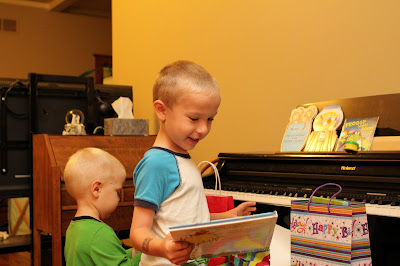
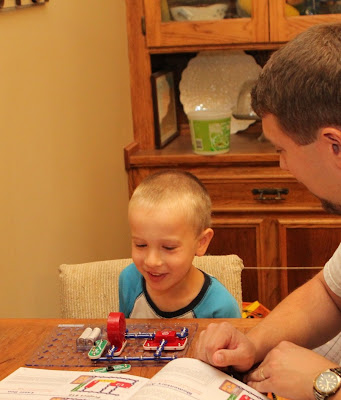
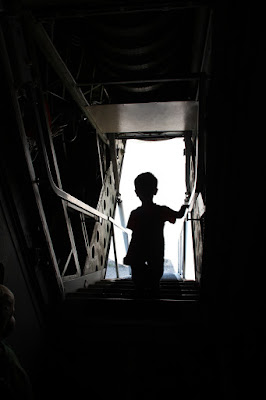
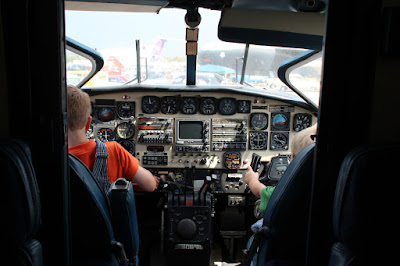
That was Jacob s question to me at bedtime the evening before his fifth birthday. Jacob had already had his birthday party a few weeks ago. When scheduling means that parties happen that far away from the boys real birthdays, they get a smaller celebration with just Terah and me where we open their presents from us. A low-key thing, so we weren t planning to decorate the house. I said, Well, I don t think we ll be doing all that since you already had your birthday party. And the look of eager anticipation on his face turned to a very sad and disappointed look, and made me feel really bad. Uhoh. So while Jacob was sleeping, I mentioned it to Terah. We decided we should improvise something simple, so she found some old streamers and we taped them up, running them through several rooms in the house and across his door. It took a few minutes using supplies we already had, but the joy the next morning was priceless. Oh dad, you said you wouldn t stay up all night, BUT YOU DID! Oh I am SO HAPPY! YAY YAY YAY! And he ran through the house to discover what else was set up. Then he ran to find Oliver and gave him a tour of everything. Then we sat down to open his presents. Here he is, holding a present from Terah and me: That s a copy of The Lorax. My friend Jonathan had brought a copy along during our road trip in Mexico, and Jacob was really excited about it. And didn t really want to give it up, because You can only get The Lorax in Mexico. He (and Oliver) really enjoyed all his presents he also got a train book from us (which he said, Oh, yay, it s the book they have at preschool! ), and a game and some other presents from the distant relatives. But the highlight was something of an impulse buy. I was at the RadioShack in Derby a place I ve written about before, It is what a RadioShack should (and used to) be. It has a large amateur radio section, sells all sorts of coax by the foot, and provides astonishingly good post-sale service. Well, I was there with a radio question, and Mark (the owner) who is an excellent salesman in a positive way pointed me to a display of snap kits. I noticed their Electronics 101 Snap-Kit (a rebranded Snap Circuits Jr. SC-100). A ham in Pennsylvania had suggested them to me once, and as Jacob s birthday was coming up, I gave it some thought. The kit said ages 8 and up. I asked Mark what he thought about a boy just turning 5. He said, Well, probably not normally. But knowing you, if you re there to work on them with him, I think he d enjoy it. But I wouldn t have him work on it by himself. I agreed and we bought it. I pondered how to explain the concept of this thing to Jacob. Eventually I decided I would call it a toy-building kit. He understood that. Jacob and I spent hours together working with it. He would flip through the book, either picking circuits that looked interesting or telling me what kind of circuit he wanted to build. Then I would tell him what to put where, and he d snap them together and play with them. He only played with each finished product a few minutes before he was ready to try another. Once I got him very excited with my offer to show him how to hook up two switches in parallel for the fan he built (and later introduced the parallel vs. series concept by hooking them up in series instead.) Here we are working on it together. Jacob repeatedly called Terah over to look at the things he built. He was very excited that he assembled it himself. Eventually, Oliver (age 2) came over wanting to help. So he sat on my lap, and handed parts to Jacob, then Jacob put them on the grid. Oliver really enjoyed being involved in this way, even though I had to keep him from doing things like ripping the capacitor off its mount. We tend to be modest in terms of the number of things we give the boys and their cost, reasoning that we, like many, already have too many toys in our house, and that greater cost doesn t necessarily equate with a better experience for the boys. I particularly look for things with lasting value and unique experiences for them, and I think we succeeded this year. But I realized quickly that the greatest value of this kit wasn t electronics. It was having a great way for me to spend a lot of time doing things with the boys which all of us enjoyed. Those hours building things together were as much a present for me as for Jacob, I m quite sure. Jacob s real party was a few weeks ago at the Great Plains Transportation Museum in Wichita. They let people rent a historic caboose to use for a birthday party for children. So we did that for Jacob this year. That was a huge hit for the boys. Jacob got to help his grandpa make some pie (instead of cake) for the party. He enjoyed eating it, of course. He enjoyed opening his presents high up on the observation chair in the caboose. And the boys got to play on all the other equipment in the museum. Jacob enjoyed playing tour guide for family since most of them hadn t been there. He also enjoyed watching freight trains pass on the other side of the fence from the museum preferably while sitting in one of the museum s engines. Oliver certainly didn t get left out. Train-watching is serious business, after all. Jacob has long talked about going to the train museum and the airplane museum (Kansas Aviation Museum) on the same day, so one of his birthday surprises was that we went to the airplane museum after his party. His favorite item there is a retired FedEx 727. Here he is walking down the rear of the plane. And, of course, they played captain and co-pilot in several different planes.

25 September 2011

Gregor Herrmann: RC bugs 2011/38

quick overview over my RC bug activities during the last week: random notes:

Clint Adams: Yesod in Debian

Thanks to the tireless efforts of the Debian Haskell Group, Yesod has been updated to version 0.9.2.2 in unstable. Yesod is a Haskell web framework for productive development of type-safe, RESTful, high performance web applications. It is the foundation for hledger-web. It is an alternative to Happstack, the framework used by gitit.

20 September 2011

Maximilian Attems: Recurring Maxima failures

Every once in a while I try out latest Debian/sid Maxima as it sees continuous development: Maxima git repo. Todays failure is an integral given at the Bloc course "Aspects of QCD at Finite Density". It is an exercise to calculate following simple integral that should just give a Bessel function:
(%i3) integrate(exp(z*cos(t))*cos(a*t), t, 0, %pi);
                           %pi
                          /
                          [               cos(t) z
(%o3)                     I    cos(a t) %e         dt
                          ]
                          /
                           0
As usual the result it returns is the integral itself.. :/ So yes indeed Maxima is nice for simple undergrads calculation: Maximum Calculus with Maxima, but unfortunately don't expect much for more complex problems. The result is the partition function of the chiral perturbation theory in the simple setup of equal quark masses and one quark flavour family. Sadly Integrals returning Bessel functions seem to regularly fail.

17 September 2011

Andrew Pollock: [life/americania] Whirlwind visit to the Windy City

Our friend Susan was going to be in Chicago for a conference, and as we hadn't seen Chicago yet, and it was on the list of cities we wanted to visit, we made the semi-spur of the moment decision to have a three day weekend there last weekend. We got the Virgin America red-eye flight from SFO, which left on Friday at around 5pm, and got into Chicago at around 11:30pm, local time. Zoe didn't do as well as she has previously, and didn't sleep very well on the flight over, despite us getting lucky and scoring an empty seat between us on an otherwise fairly full flight. I think she's getting too big to comfortably sleep in the Ergo baby carrier (or isn't keen on sleeping vertically any more). We stayed at the Swissotel, because that was where Susan was staying (and was where her conference was) and nearby hotels seemed to be around the same price range. When we checked in, we let them talk us into an upgrade to a larger room, which had fantastic views of Lake Michigan and the Chicago River. Lake Michigan is just mind-bogglingly big. It's an inland sea. What can I say? I was totally in love with Chicago. The weather while we were there was unbelievable. Clear skies. High 20's (Celsius). It was more humid than the Bay Area, but less humid than Brisbane. The first thing we did on Saturday was go visit a friend of Sarah's who lived in Bryn Mawr. We took the "L" there. The elevated train was an interesting affair, and turned out to be less accessible than we'd been led to believe from some light research in advance. In fact, I found Chicago in general to be fairly wheelchair (and by extension, stroller) unfriendly. We had to lug Zoe's stroller up and down stairs quite a bit to get from the river level to where the hotel was. Zoe seemed to find it amusing, at least. Aside from that problem, the city seemed pretty flat. I'm really glad that we got out of the city and into Bryn Mawr, because it was really great to see that aspect of Chicago life as well. Lovely, quiet, tree-lined streets with wide sidewalks. Beautiful buildings. Sarah's friend was fostering 8 kittens, so Zoe got to have a play with all of them, which she thought was pretty cool. After we returned to the city, Sarah and I kicked back in Millennium Park while Zoe napped in the stroller. Saturday, being 9/10/11 in US date format, seemed to be particularly popular for weddings, and there were a lot of couples getting wedding photos taken in the park. That night, we tried to have some deep dish pizza at Uno, the home of deep dish pizza, but the line was ridiculous. We subsequently learned about Due, and went there the following night. The pizza was good, and I found the crust to be slightly different from what we'd get at Patxi's. We checked out the Navy Pier on both Sunday and Monday, taking Zoe to the Chicago Children's Museum both days (we got free entry thanks to our membership at the Children's Discovery Museum of San Jose). We had grand plans of checking out the Shedd Aquarium, but it turned out that Monday was a "free for all Illinois residents" day, and the line at 11am was ridiculous, so we gave it a miss and took at water taxi back to Navy Pier. It was Zoe's first boat ride, and she enjoyed it. I got some unbelievably good photos of the city skyline from the boat. Our flight out was at 7pm, so we took the train to Midway. I was very impressed that we could get all the way to the airport by train for the standard price. I love flat-rate fares. I really love a city with good mass public transit. The only thing that detracted from this in Chicago was the accessibility issues. We explicitly went to the Orange Line Clarke/Lake station to go to Midway because it was listed as being wheelchair accessible, and we had a stroller and a suitcase. We ended up going up to the wrong platform, and getting across to the other side was a bit of a mission. We'd entered the station from the street level, took the elevator up, and then realised we were on the wrong side. We had to go back down the elevator to the level below the street, cross the street from underneath it, and then go back up the elevator on the other side. Aside from these sorts of shenanigans, the whole elevated train thing was pretty cool (but I wouldn't have wanted to have an apartment with the train line right outside my window). If only the cars had glass roofs, the Loop would have been a lot more scenic. Overall, it'd be hard to say whether I liked Chicago or New York City better. I liked the clean, flat nature of Chicago, the architecture and the lower density of buildings, but I also really love New York just because it's New York, and has an awesome (probably equally stroller-unfriendly) subway system. Photos from the trip are here.

15 September 2011

Christian Perrier: An update about Debian Installer localization

It's quite some time since I haven't nagged fellow translators about Debian Installer translation status. D-I development, these days, has ups and down. The team is quite loose and activity has not been that high after Debconf. Still, enough changes took place since squeeze for localization completeness to drop to about 93% for languages that were previously 100% when we released squeeze. So, this week, I felt the need to send a call for translation updates. As usual, this woke up several translators and a bunch of updates were committed. I suspect that more will come over the next days. Sadly, as usual, the call for translation lead to several translators sending me their updates directly instead of committing them to SVN. This is unfortunately something I probably have to live with even though I keep explaining and documenting how to do things. I suspect that nobody really imagines the hassle it is when you have to check and commit files and files and files and files..... Any, here's the status for D-I level 1 (core D-I files): Your language is not listed here? This is because its statistics are lower and it had no single update since the release of squeeze. See the the full statistics page for details about rankings and statistics for levels, sublevels and all the crap that's described in the beautiful D-I internationalization and localization documentation. In the upcoming weeks, I'll try to continue giving updates about the progress of this effort. The only demotivating part is that I already know it will lead to gazillion of exchanges by mail with people asking about how to help...leading me to explain over and over and over and over always the same thing. Sometimes, I wonder why I took time to write all these documentation and statistics pages.... So, before you jump on your mail client and write me a mail asking me how to help in translating D-I in Northern Bechuanalese (ijekavian variant)....please join debian-i18n and/or debian-boot lists, read available documentation, check existing PO files and try to get in touch with existing teams and/or individuals. Learn a bit about SVN and figure out how to commit things. Read documentation. Ask about robots that can notify you when a file changes. Read documentation. Read documentation. In short, try to help yourself first before expecting me to hold your hands. I like holding hands and helping people. It's only that you are so many folks that I can't help you individually. But, of course, if you mail me, I'll answer anyway.. And, of course, I'll keep posting updates and nagging you guys. And, of course, we'll have more complete languages for wheezy than we had for squeeze.

14 September 2011

Mike Hommey: Building a custom kernel for the Nexus S

There are several reasons why someone would want to build a custom kernel for their Android phone. In my case, this is because I wanted performance counters (those used by the perf tool that comes with the kernel source). In Julian Seward s case, he wanted swap support to overcome the limited memory amount on these devices in order to run valgrind. In both cases, the usual suspects (AOSP, CyanogenMod) don t provide the wanted features in prebuilt ROMs. There are also several reasons why someone would NOT want to build a complete ROM for their Android phone. In my case, the Nexus S is what I use to work on Firefox Mobile, but it is also my actual mobile phone. It s a quite painful and long process to create a custom ROM, and another long (but arguably less painful thanks to ROM manager) process to backup the phone data, install the ROM, restore the phone data. And if you happen to like or use the proprietary Google Apps that don t come with the AOSP sources, you need to add more steps. There are however tricks that allow to build a custom kernel for the Nexus S and use it with the system already on the phone. Please note that the following procedure has only been tested on two Nexus S with a 2.6.35.7-something kernel (one with a stock ROM, but unlocked, and another one with an AOSP build). Also please note that there are various ways to achieve many of the steps in this procedure, but I ll only mention one (or two in a few cases). Finally, please note some steps rely on your device being rooted. There may be ways to do without, but I m pretty sure it requires an unlocked device at the very least. This post doesn t cover neither rooting nor unlocking. Preparing a build environment To build an Android kernel, you need a cross-compiling toolchain. Theoretically, any will do, provided it targets ARM. I just used the one coming in the Android NDK:
$ wget http://dl.google.com/android/ndk/android-ndk-r6b-linux-x86.tar.bz2
$ tar -jxf android-ndk-r6b-linux-x86.tar.bz2
$ export ARCH=arm
$ export CROSS_COMPILE=$(pwd)/android-ndk-r6b/toolchains/arm-linux-androideabi-4.4.3/prebuilt/linux-x86/bin/arm-linux-androideabi-
For the latter, you need to use a directory path containing prefixed versions (such as arm-eabi-gcc or arm-linux-androideabi-gcc), and include the prefix, but not gcc . You will also need the adb tool coming from the Android SDK. You can install it this way:
$ wget http://dl.google.com/android/android-sdk_r12-linux_x86.tgz
$ tar -zxf android-sdk_r12-linux_x86.tgz
$ android-sdk-linux_x86/tools/android update sdk -u -t platform-tool
$ export PATH=$PATH:$(pwd)/android-sdk-linux_x86/platform-tools
Building the kernel For the Nexus S, one needs to use the Samsung Android kernel tree, which happens to be unavailable at the moment of writing due to the kernel.org outage. Fortunately, there is a clone used for the B2G project, which also happens to contain the necessary cherry-picked patch to add support for the PMU registers on the Nexus S CPU that are needed for the performance counters.
$ git clone -b devrom-2.6.35 https://github.com/cgjones/samsung-android-kernel
$ cd samsung-android-kernel
You can then either start from the default kernel configuration:
$ make herring_defconfig
or use the one from the B2G project, which enables interesting features such as oprofile:
$ wget -O .config https://raw.github.com/cgjones/B2G/master/config/kernel-nexuss4g
From then, you can use the make menuconfig or similar commands to further configure your kernel. One of the problems you d first encounter when booting such a custom kernel image is that the bcm4329 driver module that is shipped in the system partition (and not in the boot image) won t match the kernel, and won t be loaded. The unfortunate consequence is the lack of WiFi support. One way to overcome this problem is to overwrite the kernel module in the system partition, but I didn t want to have to deal with switching modules when switching kernels. There is however a trick allowing the existing module to be loaded by the kernel: compile a kernel with the same version string as the one already on the phone. Please note this only really works if the kernel is really about the same. If there are differences in the binary interface between the kernel and the modules, it will fail in possibly dangerous ways. To use that trick, you first need to know what kernel version is running on your device. Settings > About phone > Kernel version will give you that information on the device itself. You can also retrieve that information with the following command:
$ adb shell cat /proc/version
With my stock ROM, this looks like the following:
Linux version 2.6.35.7-ge382d80 (android-build@apa28.mtv.corp.google.com) (gcc version 4.4.3 (GCC) ) #1 PREEMPT Thu Mar 31 21:11:55 PDT 2011
In the About phone information, it looks like:
2.6.35.7-ge382d80
android-build@apa28
The important part above is -ge382d80, and that is what we will be using in our kernel build. Make sure the part preceding -ge382d80 does match the output of the following command:
$ make kernelversion
The trick is to write that -ge382d80 in a .scmversion file in the kernel source tree (obviously, you need to replace -ge382d80 with whatever your device has):
$ echo -ge382d80 > .scmversion
The kernel can now be built:
$ make -j$(($(grep -c processor /proc/cpuinfo) * 3 / 2))
The -j part is the general rule I use when choosing the number of parallel processes make can use at the same time. You can pick whatever suits you better. Before going further, we need to get back to the main directory:
$ cd ..
Getting the current boot image The Android boot image living in the device doesn t contain only a kernel. It also contains a ramdisk containing a few scripts and binaries, that starts the system initialization. As we will be using the ramdisk coming with the existing kernel, we need to get that ramdisk from the device flash memory:
$ adb shell cat /proc/mtd awk -F'[:"]' '$3 == "boot" print $1 '
The above command will print the mtd device name corresponding to the boot partition. On the Nexus S, this should be mtd2.
$ adb shell
$ su
# dd if=/dev/mtd/mtd2 of=/sdcard/boot.img bs=4096
2048+0 records in
2048+0 records out
8388608 bytes transferred in x.xxx secs (xxxxxxxx bytes/sec)
# exit
$ exit
In the above command sequence, replace mtd2 with whatever the previous command did output for you. Now, you can retrieve the boot image:
$ adb pull /sdcard/boot.img
Creating the new boot image We first want to extract the ramdisk from that boot image. There are various tools to do so, but for convenience, I took unbootimg, on github, and modified it slightly to seemlessly support the page size on the Nexus S. For convenience as well, we ll use mkbootimg even if fastboot is able to create boot images. Building unbootimg, as well as the other tools rely on the Android build system, but since I didn t want to go through setting it up, I figured a minimalistic way to build the tools:
$ git clone https://github.com/glandium/unbootimg.git
$ git clone git://git.linaro.org/android/platform/system/core.git
The latter is a clone of git://android.git.kernel.org/platform/system/core.git, which is down at the moment.
$ gcc -o unbootimg/unbootimg unbootimg/unbootimg.c core/libmincrypt/sha.c -Icore/include -Icore/mkbootimg
$ gcc -o mkbootimg core/mkbootimg/mkbootimg.c core/libmincrypt/sha.c -Icore/include
$ gcc -o fastboot core/fastboot/ protocol,engine,bootimg,fastboot,usb_linux,util_linux .c core/libzipfile/ centraldir,zipfile .c -Icore/mkbootimg -Icore/include -lz
Once the tools are built, we can extract the various data from the boot image:
$ unbootimg/unbootimg boot.img
section sizes incorrect
kernel 1000 2b1b84
ramdisk 2b3000 22d55
second 2d6000 0
total 2d6000 800000
...but we can still continue
Don t worry about the error messages about incorrect section sizes if it tells you we can still continue . The unbootimg program creates three files: All that is left to do is to generate the new boot image:
$ eval ./mkbootimg $(sed s,boot.img-kernel,samsung-android-kernel/arch/arm/boot/zImage, boot.img-mk)
Booting the image There are two ways you can use the resulting boot image: one-time boot or flash. If you want to go for the latter, it is best to actually do both, starting with the one-time boot, to be sure you won t be leaving your phone useless (though recovery is there to the rescue, but is not covered here). First, you need to get your device in the fastboot mode, a.k.a. boot-loader:
$ adb reboot bootloader
Alternatively, you can power it off, and power it back on while pressing the volume up button. Once you see the boot-loader screen, you can test the boot image with a one-time boot:
$ ./fastboot boot boot.img
downloading 'boot.img'...
OKAY [ 0.xxxs]
booting...
OKAY [ 0.xxxs]
finished. total time: 0.xxxs
As a side note, if fastboot sits waiting for device , it either means your device is not in fastboot mode (or is not connected), or that you have permissions issues on the corresponding USB device in /dev. Your device should now be starting up, and eventually be usable under your brand new kernel (and WiFi should be working, too). Congratulations. If you want to use that kernel permanently, you can now flash it after going back in the bootloader:
$ adb reboot bootloader
$ ./fastboot flash boot boot.img
sending 'boot' (2904 KB)...
OKAY [ 0.xxxs]
writing 'boot'...
OKAY [ 0.xxxs]
finished. total time: 0.xxxs
$ ./fastboot reboot
Voil .

Christian Perrier: Sometimes, I'm really happy to live in the Debian world...

...and not in this other world where you have to deal with a bug reported against apt because installing libreoffice in the distro development branch is not possible:
sudo apt-get install libreoffice
Reading package lists... Done
Building dependency tree       
Reading state information... Done
Some packages could not be installed. This may mean that you have
requested an impossible situation or if you are using the unstable
distribution that some required packages have not yet been created
or been moved out of Incoming.
The following information may help to resolve the situation:
The following packages have unmet dependencies:
 libreoffice : Depends: libreoffice-core (= 1:3.4.3-1ubuntu2) but it is not going to be installed
               Depends: libreoffice-writer but it is not going to be installed
               Depends: libreoffice-calc but it is not going to be installed
               Depends: libreoffice-impress but it is not going to be installed
               Depends: libreoffice-draw but it is not going to be installed
               Depends: libreoffice-math but it is not going to be installed
               Depends: libreoffice-base but it is not going to be installed
               Depends: libreoffice-report-builder-bin but it is not
 going to be installed
               Depends: libreoffice-filter-mobiledev but it is not going to be installed
               Depends: libreoffice-java-common (>= 1:3.4.3~) but it is not going to be installed
E: Unable to correct problems, you have held broken packages.
And I therefore really admire those folks who are brave enough to triage out bugs reported in Launchpad (current counter: about #850000...in only SEVEN years). Yeah, I know, whining about clueless users is BAD, we should be friendly and gentle and kind and polite and nice and happy, but COME ON DUDE, could you at least think ONE BLOODY SECOND? End of rant.

Christian Perrier: An update about Debian Installer localization

It's quite some time since I haven't nagged fellow translators about Debian Installer translation status. D-I development, these days, has ups and down. The team is quite loose and activity has not been that high after Debconf. Still, enough changes took place since squeeze for localization completeness to drop to about 93% for languages that were previously 100% when we released squeeze. So, this week, I felt the need to send a call for translation updates. As usual, this woke up several translators and a bunch of updates were committed. I suspect that more will come over the next days. Sadly, as usual, the call for translation lead to several translators sending me their updates directly instead of committing them to SVN. This is unfortunately something I probably have to live with even though I keep explaining and documenting how to do things. I suspect that nobody really imagines the hassle it is when you have to check and commit files and files and files and files..... Any, here's the status for D-I level 1 (core D-I files): Your language is not listed here? This is because its statistics are lower and it had no single update since the release of squeeze. See the the full statistics page for details about rankings and statistics for levels, sublevels and all the crap that's described in the beautiful D-I internationalization and localization documentation. In the upcoming weeks, I'll try to continue giving updates about the progress of this effort. The only demotivating part is that I already know it will lead to gazillion of exchanges by mail with people asking about how to help...leading me to explain over and over and over and over always the same thing. Sometimes, I wonder why I took time to write all these documentation and statistics pages.... So, before you jump on your mail client and write me a mail asking me how to help in translating D-I in Northern Bechuanalese (ijekavian variant)....please join debian-i18n and/or debian-boot lists, read available documentation, check existing PO files and try to get in touch with existing teams and/or individuals. Learn a bit about SVN and figure out how to commit things. Read documentation. Ask about robots that can notify you when a file changes. Read documentation. Read documentation. In short, try to help yourself first before expecting me to hold your hands. I like holding hands and helping people. It's only that you are so many folks that I can't help you individually. But, of course, if you mail me, I'll answer anyway.. And, of course, I'll keep posting updates and nagging you guys. And, of course, we'll have more complete languages for wheezy than we had for squeeze.

13 September 2011

Christian Perrier: 10 years being Debian Developer - part 4: NM process

So, this story begins in January 2001, when I applied in the Debian New Maintainer Process. I wanted to maintain Geneweb, which I was using to publish my genealogy research results. And I wanted to keep it up-to-date while upstream was doing a quite fast development. Moreover, I quickly noticed that Geneweb had big trouble in respecting the way data is organized on a Debian system, and respect the FHS. How to have weveral users able to publish their data on the same server without compromizing the overall system security, etc. Upstream development didn't really care about that. Daniel de Rauglaudre is an excellent genealogist and developer but he was not interested in making Geneweb clean "the Debian way". For instance, at that time, it wasn't easy to setup a server, where genealogy databases could be published without having to manually launch a daemon in user mode at each reboot. Arranging this was indeed my first contribution. I contributed a few patches to make it easier to turn Geneweb into something FHS-compliant...and I developed init scripts and an organization allowing one to have shared databases after system reboots. That was rapidly a great introduction to Debian maintainer scripts and even security-related challenges. And all this....because I needed it. Basically, in 2001, the geneweb package adopted the organization it still has in Debian and Ubuntu, 10 years later: While doing so, I was going through the New Maintainer Process. The Debian developer who had signed my key was Sam Tardieu, of of those longstanding "Freenix" dudes I was sometimes hanging around. I don't remember who did write my advocacy. Michael Mattice was my first Application Manager. Interestingly, here are the three first questions he asked my as part of the Policy and Procedures check : Mike actually asked the questions on February 17th and I probably answered immediately. Unfortunately it seems that I lost my answers. Maybe they are in some archive somewhere. Would be interesting to see how I ended giving an answer about the TeX exception.:-) Immediately, Mike moved to the Tasks and Skills step and checked my geneweb and lifelines packages (I already prepared a package for that other genealogy software). From my records, he found a few lintian warnings, which I probably made my best to fix, then later on, on March 12th, he answered me that thigns were OK and he was marking the T&S step as passed...handing things over to the NM database, asking me what username I wanted on debian.org (obviously, you know what I answered to this!). Then nothing happened..:-) I was not that impatient, but finally, around June 27th, I politely mailed NM Frontdesk (I guess) to get news...and I got a very quick answer by Martin Michlmayr. Martin was indeed worried about the situation (he told me I was on his radar....fun as, many years later, as many DDs, Martin probably went on mine because of pending localization work..:-)) Finally, Martin decided he was not entirely happy with the (maybe too short) processing for P&P and proposed me (very politely, you know how Martin is!) to do it again. So, some more questions...:-) Here, I have the answers. Really fun ro read. Hang on, pure bubulle style, very verbose! What a bunch of questions..:-). Reading my answers ten years after, I see that some answers are somehow naive but, after all, they're not so bad. I really remember spending hours in writing them (my English was somehow more shaky at that time) The last question was: "Please tell me about about yourself and what you intend to do for Debian". Here, Martin opened a big can of worms..:-) So, you'll learn about this in the next episode..:-)

Martin Pitt: PostgreSQL 9.1 final packages available for Debian/Ubuntu

Hot on the heels of the PostgreSQL 9.1.0 release I am happy to announce that the final version is now packaged for Debian unstable, the current Ubuntu development version Oneiric , and also in my Ubuntu backports PPA for Ubuntu 10.04 LTS, 10.10, and 11.04. Enjoy trying out all the cool new features like builtin synchronous replication or per-column collation settings for correctly handling international strings, or an even finer-grained access control for large environments. Please see the detailled explanation of the new features. As already announced a few days ago, 9.0 is gone from Ubuntu 11.10, as it is still only a development version and not an LTS. 9.1 will be the version which the next 12.04 LTS will support, so this slightly reduces the number of major upgrades Ubuntu users will need to do. However, 9.0 will still be available in Debian unstable and backports, and the Ubuntu backports PPA for a couple of months to give DB administrators some time to migrate.

10 September 2011

Biella Coleman: How to secure revolution in Silicon Valley

This is the best response to this (simplistic) claim about net access and revolt in Egypt featured in the New York Times: [m] In a widely circulated American Political Science Association conference paper, Yale scholar Navid Hassanpour argues that shutting down the internet made things difficult for sustaining a centralized revolutionary movement in Egypt. But, he adds, the shutdown actually encouraged the development of smaller revolutionary uprisings at local levels where the face-to-face interaction between activists was more intense and the mobilization of inactive lukewarm
[m] maybe we ll have some more fiber optic cable cuts in silicon valley and then the revolution will happen

9 September 2011

MJ Ray: Help with co-op development? Don t ask here

The blog is back. We ve moved it to our new blog hosting (please contact us if you d like us to host your blog or if you spot a problem with our blog), so the adverts are gone and I m still correcting the plugin setup for the new version. Among the comments was this one:
My small design firm needs to upgrade its software, which is very expensive. I am wondering what the legalities might be of putting together a cooperative of other designers to share the $4900.00 expense + additional seats.
Legalities of a buying co-op for seat-licensed software? I can write reams about co-ops but I shouldn t because:
  1. Our co-op doesn t sell seat-licensed software and we re basically opposed to that concept, preferring co-operative development of free and open source software (FOSS).
  2. This is a site about software, not co-op development. I helped set up our co-op, but I don t know enough to help many others. For co-op development, our co-op is a member of Somerset Co-operative Services and Co-operatives UK who can advise far better on that sort of thing and publish the damn fine Simply series of guides. We refer enquiries about co-op development to them, Co-operative Assistance Network and the co-operative enterprise hub.
  3. Mentioning $ makes me think this is a US-based question, so National Co-op Business Association may be a better place to start. If it s another dollar, the International Cooperative Alliance membership may show the right country. The legalities vary by country.
Anyway, now the blog is back, I ll write about software more soon. If you ve got questions about software for co-ops, co-op-made software and that sort of thing, please leave them in a comment.

Next.

Previous.