Search Results: "ana"

17 September 2015

Russ Allbery: Review: How to Make Your Dreams Come True

Review: How to Make Your Dreams Come True, by Mark Forster
Publisher: Hodder
Copyright: 2002
Printing: 2006
ISBN: 0-340-78629-9
Format: Kindle
Pages: 208
Mark Forster is my favorite time management author. His books are less comprehensive systems and more collections of tips, mental shortcuts, and ways of thinking about time management and prioritization that tend to resonate for me. I've already read and reviewed several other books by Forster, but hadn't read this one because it was thoroughly out of print (at least in the US). When it turned up for the Kindle, I decided to give it a try, if for no other reason than completionism. After reading How to Make Your Dreams Come True, I can see why it fell out of print. It's a rather odd book, and quite different from Forster's other work. The topic is still time management, if you squint at it properly, but in the form of a philosophical discussion of life goals and becoming an artist who creates one's own life. Forster structures the book as a series of dialogues between Forster in the present and his own future self and takes the mental exercise surprisingly seriously, even comparing his own coaching technique with that of his future self. The levels of meta get even deeper towards the end of the book, where Forster writes a dialogue between his future self and his even more future self. Those drift into philosophy of life, high-level (and personal) life goals, and some speculations about the reason for existence. The primary concept Forster is exploring is the difference between push, pull, and drift modes of life. He argues that a lot of time management falls into the category of push systems: you're exerting effort to push yourself along towards goals. In this book, he argues that this is a starting point but not a technique to stop on. Instead, one should try to move to pull mode, where one has a compelling and detailed vision of where one wants to be, repeatedly developing and refining it, and then lets that vision pull you through life. The advantages, in his conception, over the push form of time management is that this requires less expenditure of effort, feels more natural, and lets one be more flexible and nimble in how one achieves one's goals. It can be tricky, however, to avoid settling into the middle ground of drift mode, where one does not have a goal in mind and doesn't act towards anything in particular. I found the idea interesting and mildly useful, but Forster's presentation of it seemed too convinced of its own correctness. The exercises he proposes don't seem interesting to me; the dialogues with one's future self in particular felt very gimmicky. I admire his ability to invent some of the interactions he came up with, but I don't think it would be a useful technique for me, or as universal as he seems to think it could be. Forster talks quite a lot about reducing effort in his blog (somewhat less in his other books), and seems constantly convinced that he's found a new way to reduce the sense of effort around time management. After having tried a few of these, I suspect that new systems feel less effortful than older systems, and that it's the constant changing of systems that reduces the feeling of effort more than the details of any specific system. I can develop a lot of enthusiasm about a new system for tracking work, and enthusiasm makes everything feel like it requires less effort. Other than that central idea, and quite a lot of philosophy that didn't particularly speak to me, this book reiterates a few of Forster's ideas in a less specific framework: adopt a process and trust it, use it for long enough to give it a chance to work, keep refreshing your vision, and try to reach a flow where you're not exerting lots of effort to force yourself to do things. Good ideas, but better, and more practically, presented in Forster's other books. I'd characterize this as an odd and minor work. I like Forster's writing in general and still only read this for the sake of completeness. His other books offer more practical and actionable ideas. Unless this idea and method of presentation really speaks to you, I think you'll get more out of other books. Rating: 5 out of 10

15 September 2015

Russ Allbery: Review: Let's Pretend This Never Happened

Review: Let's Pretend This Never Happened, by Jenny Lawson
Publisher: Berkley
Copyright: 2012, 2013
Printing: March 2013
ISBN: 0-425-26101-8
Format: Trade paperback
Pages: 366
Let's Pretend This Never Happened, subtitled (A Mostly True Memoir), is the closest that I've ever found to the book form of a stand-up comedy routine. Lawson grew up in rural Texas with a taxidermist father, frequent contact with animals in various forms of distress, an undiagnosed anxiety disorder, and a talent for creatively freaking out about things that never occur to anyone else. But, more importantly, she has a talent for putting down on paper the random thoughts that go through her head so the rest of us can read them. Not to mention excellent comic timing and absolute mastery of the strangely relevant digression. It's always tricky to review comedy. I think tastes differ more wildly in this genre than any other. Things some people find hilarious others will find offensive or just boring. That may be particularly true of Lawson, who, similar to some of the best stand-up comics, specializes in taking off filters and saying all sorts of offensive things that people might think but not say. This kind of comedy is a knife's edge, since it can easily turn into punching down. Lawson avoids this (rather well, in my opinion) by making herself the punch line of most of the jokes. A pretty typical paragraph of the book, so that you know the sort of thing that you're in for:
The following is a series of actual events pulled form my journal that led me to believe that our home was possessed by demons and/or built over an Indian burial ground. (Also, please note that the first part of this chapter actually happens just before the previous chapter, and the last part of it happens just after it. This could be viewed as "clunky and awkward," but I prefer to think of it as "intellectually challenging and chronologically surreal. Like if Memento was a book. About dead dogs and vaginas and puppets made out of squirrel corpses." You can feel free to use that quote if you're reviewing this chapter, or if you're a student and your teacher asks you, "What was the author trying to say here?" That was it. That's what I was trying to say. That and "Use condoms if you're going to have sex, for God's sake. There are a lot of skanks out there." That's not really covered in this book, but it's still good advice.)
That has a little bit of everything this book had for me: Lawson's somewhat surreal worries, the extended digression, a rhythm that's quite compelling once you start reading it, random uncomfortable topics, and the occasional miss that I don't find funny (the last few sentences). It's all mixed together in a slightly breathless rush of narrative momentum. For more samples, Lawson's writing started as a blog and she's still actively blogging, so you can get a good advance sample by reading some of The Bloggess. Her tone there matches the book closely. What makes this book more than only comedy is that Lawson is very open about her struggles with mental illness (anxiety and depression). A lot of the humor comes from "this is the ridiculous nonsense that my brain throws out on a regular basis" and inviting you to laugh along with her, but the undertone is use of humor as a coping mechanism to deal with anxiety spirals. And alongside that coping mechanism is an open-hearted message of "you are not the only person to have completely irrational reactions to the world please laugh along with mine and feel better about yours." Due to that, the best comparison I can make to another book I've read is to Allie Brosh's Hyperbole and a Half. Brosh is more serious in places, more analytical, and a bit better at generalizing to experiences the reader can identify with. (And, of course, more graphical.) Lawson is more madcap, a bit more manic, and focused on absurd situations that don't normally happen to people. I loved this book from beginning to end, and it had me laughing out-loud in multiple places. Despite being a collection of disconnected stories, it has a rhythm and flow that kept me reading. Some books of this kind are best read in small segments with a break between, but I devoured Let's Pretend This Never Happened in large chunks (and had to be careful about reading it in public and laughing too loudly). Check first whether the sense of humor works for you, but if it does, highly recommended. Rating: 9 out of 10

Clint Adams: It's just like that thing

Hi, Craige.

14 September 2015

Julien Danjou: Visualize your OpenStack cloud: Gnocchi & Grafana

We've been hard working with the Gnocchi team these last months to store your metrics, and I guess it's time to show off a bit. So far Gnocchi offers scalable metric storage and resource indexation, especially for OpenStack cloud but not only, we're generic. It's cool to store metrics, but it can be even better to have a way to visualize them! Prototyping We very soon started to build a little HTML interface. Being REST-friendly guys, we enabled it on the same endpoints that were being used to retrieve information and measures about metric, sending back text/html instead of application/json if you were requesting those pages from a Web browser. But let's face it: we are back-end developers, we suck at any kind front-end development. CSS, HTML, JavaScript? Bwah! So what we built was a starting point, hoping some magical Web developer would jump in and finish the job. Obviously it never happened. Ok, so what's out there? It turns out there are back-end agnostic solutions out there, and we decided to pick Grafana. Grafana is a complete graphing dashboard solution that can be plugged on top of any back-end. It already supports timeseries databases such as Graphite, InfluxDB and OpenTSDB. That was largely enough for that my fellow developer Mehdi Abaakouk to jump in and start writing a Gnocchi plugin for Grafana! Consequently, there is now a basic but solid and working back-end for Grafana that lies in the grafana-plugins repository.
With that plugin, you can graph anything that is stored in Gnocchi, from raw metrics to metrics tied to resources. You can use templating, but no annotation yet. The back-end supports Gnocchi with or without Keystone involved, and any type of authentication (basic auth or Keystone token). So yes, it even works if you're not running Gnocchi with the rest of OpenStack.
It also supports advanced queries, so you can search for resources based on some criterion and graphs their metrics. I want to try it! If you want to deploy it, all you need to do is to install Grafana and its plugins, and create a new datasource pointing to Gnocchi. It is that simple. There's some CORS middleware configuration involved if you're planning on using Keystone authentication, but it's pretty straightforward just set the cors.allowed_origin option to the URL of your Grafana dashboard. We added support of Grafana directly in Gnocchi devstack plugin. If you're running DevStack you can follow the instructions which are basically adding the line enable_service gnocchi-grafana. Moving to Grafana core Mehdi just opened a pull request a few days ago to merge the plugin into Grafana core. It's actually one of the most unit-tested plugin in Grafana so far, so it should be on a good path to be merged in the future and have support of Gnocchi directly into Grafana without any plugin involved.

13 September 2015

Norbert Preining: Gaming: The Talos Principle

Over the last weekends I finally managed to finish The Talos Principle, all of its endings. Compared to the actual play time I needed for Portal 2, namely about 12 hours, The Talos Principle challenged me much longer, about 36 hours. An enjoyable ride through many different and stunningly created worlds filled with many many puzzles that need to be solved.
Combined with three different endings the games offers great fun for those who love riddle games. Comparing it to my favorite riddle game (series), Myst, the graphics have of course developed and provide stunning views. I haven t played games in a landscape since the Myst series (Portal is indoors), so I was taken by surprise about all the details and love that has been put into the graphics. Maybe its only me because it was the first game of this quality I have played. And above all, I could actually play it on my normal Intel GPU laptop (but surprisingly only on Linux, the Windows version refused to play on my under-powered laptop).
There are only two slightly negative points I have to mention: Due to the nature of very restricted tool set, the riddles feel a bit repetitive. Some of them stand out, but after having played through the A and B worlds, you feel like you have seen that before when entering a new riddle. Still challenging, and that is what I was looking for, but a bit more variation would be nice. Here is a riddle that stood out due to its funny nature.
The game also has a long list of Easter Eggs, some of which I could find, some of which I surely missed. Most funny of those I found was the Developer World where funny characters lounge. Another I found was this money throwing guy called Fork Parker, who happens to be the financial officer of the developers team. Did they really make sooo much money from the game?
Something a bit uncommon or new to me was the fact that there are three (3!) endings, depending on what you choose to do. The first and easiest one is the ending of the good student you collect enough sigils, and follow Elohims words and ascent to eternity rather boring. Reminds me of an old Viennese song how boring it is to be an angel in heaven.
Bit more challenging is the bad student ending: You ignore Elohim s warnings and ascent the tower, solve several more riddles, and via a few more twists manage to escape to the real world. Nice graphics, great ending.
The most challenging ending is the enlighted student ending. To manage to reach this ending, one needs to collect each and everything that is to be found in the game, including all hidden stars and grey sigils. Here I have to mention the second slightly negative point: Finding the stars is rather luck then problem solving ability. Often one needs to guess a location of a reflector, or stumble over a hidden staircase, or press some arbitrary buttons. For my feeling the riddles for the stars were to arbitrary. So I managed to collect several of the stars by myself, but for many I needed hints on how to solve the riddles. Anyway, in case you managed to listen to all recordings, collect all texts, get all stars and collect all sigils from the extra worlds, you might ascend to the last floor of the tower and become a messenger yourself. Not sure if I want to become a messenger there, though.
Just in time with me finishing the game, the developers shipped out an extension called Road to Gehenna . Stunning graphics, even better, waiting ahead now I only need the time!
All in all a great piece of game, lovingly crafted graphics, interesting game play, lots of small levels, which helps people like me who cannot play for hours overnight, but need to do riddles one by one in short gaming sessions. So if you are in for riddle games, watch out for the next offer on Steam. Enjoy.

Gregor Herrmann: RC bugs 2015/31-37

during the last weeks, I spent time mostly with RC bug prevention but I at least managed to also fix a couple of actual RC bugs:

Russ Allbery: Review: The Sea Thy Mistress

Review: The Sea Thy Mistress, by Elizabeth Bear
Series: Edda of Burdens #3
Publisher: Tor
Copyright: February 2011
ISBN: 0-7653-1884-9
Format: Hardcover
Pages: 334
The Sea Thy Mistress is the third book in the Edda of Burdens series, but the second book (By the Mountain Bound) was a prequel to the first, telling the story of an earlier world and the betrayal that ended it. This one is a direct sequel to All the Windwracked Stars, a complex and idea-rich book that I read more than six years ago. A challenging property of Bear's fiction is that it's short on explanation and doesn't hold your hand. This makes it lean, sharp, and effective if you're fully invested in it and can keep the context in your head. It becomes very hard to understand if you've mostly forgotten the plot of an earlier book. (Once again, I bemoan the death of the previous book synopsis in series fiction.) The Sea Thy Mistress is all about aftermath, loss, despair, unhealed wounds, old grudges, and complicated personal histories, and it relies very heavily on the reader being invested enough in the characters to care about all of those things. I wish I'd read this entire series closer together so that I could retain more of the state. The start of this story was therefore somewhat frustrating, as I scrambled to rebuild my memory of the first book and piece together the large cast. Thankfully, most of the characters are easy to care about. Aethelred reliably brought a smile to my face, and the opening scene of him finding a baby on the sea shore is a great piece of writing. Selene is back; she was one of my favorite characters in the first book. And Bear pulls off something I didn't think she could: the Grey Wolf is also back, for the third book, and he actually won me over. I think he grew up a bit; there's at least less whining and angst, and more effective action. It probably also helped that less of the story was told from his perspective. The Sea Thy Mistress is primarily the story of Cathoair and his son, Cathmar, and their encounter with a truly nasty threat: a goddess who has way more knowledge of how their world works than they do, and is out to destroy it. This review will necessarily be sketchy on details; most of them would partly spoil All the Windwracked Stars. (I suppose I'm spoiling it a bit anyway just by listing characters who are still around.) Cathmar is... not too irritating. He's young and stupid, and the first half of the book is a bit painful as he plays into the hands of the plot with much less information than the reader has available. But I was okay with him by the end of the book. Cathoair is a more complicated matter. I suspect whether you like this book will depend mostly on whether you can find some sympathy for his personal angst and self-destructive behavior, or at least tolerate him long enough to get to the ending. Quite a lot of this book consists of people behaving stupidly and horribly while those who love them stand by helplessly, unable to figure out how to break the cycle. If that sounds frustrating, you have the right impression. I really struggled with the first two-thirds of the book and started regretting reading it. But there is a payoff: one that's uncomfortable, raw, perilous, and sad, but also beautiful and honest and effective. Muire's role in this book may be minor, but it's very memorable. Despite the difficulties of the early book, I was very glad to have read it for the payoff. I'm not sure whether to recommend this or not, but I think it's worth reading if you enjoyed All the Windwracked Stars. If you do read it, though, try to read the whole series in close proximity. You'll want to remember the details between books. I'm now somewhat tempted to go back and re-read the whole series to experience it in context. Rating: 6 out of 10

11 September 2015

Daniel Pocock: Payment for shadow work

A significant court ruling yesterday means that companies in the EU have to pay employees for time spent traveling to and from work. If something seems too good to be true, it usually is. Once you get past the headline, you find that it only applies to workers who are going to appointments outside their workplace. Some companies have been careless about scheduling such appointments, sometimes leaving an employee more than 2 hours from his home at the end of the day and this new ruling may just force them to either try a little harder to schedule appointments with consideration for the employee or pay for the extra time if excessive travel sometimes occurs. The ruling may be good news for IT workers, road congestion and the environment. With companies now becoming more efficient in managing travel time, they may well need to improve the software they use for scheduling the employee's time. With certain types of employee potentially having a shorter journey after the last appointment, this means less road congestion and less pollution. Professionals who have to fly may also be taking note: if you work in Paris but have to fly to London one day for meetings, then your working time starts when you leave your home at 05:30 and finishes at 22:00 when you get home. Shadow work comes in many forms It is good to see society taking note of the hidden cost of shadow work. What about all those other nasty and inefficient practices that take time but you don't get paid for them? Have you ever wondered why some companies send bills and statements to you by email or post, but others expect you to waste 5 minutes of your time logging in to their web site to download the bill or statement? Should people be paid for this time too and would that force these companies to stop being so lazy? Some companies have been trying to avoid doing the right thing by arguing that email is not secure, but this just doesn't add up: the original PGP MIME specs for email encryption were published through the IETF process in 1996. Barclaycard recently began offering to send credit card statements using encrypted PDF, proving that many of the excuses given by other companies are just that: excuses. For developers For people who are interested in improving the way their organization sends communications to customers, a popular choice is the Apache Camel integration framework. I've deployed Camel for customer trade notification and other purposes at several large and well known firms in financial services. It has a rich set of features for transforming messages, including a PGP data format for encryption and it is able to send messages out using a vast number of connectivity options, including many of the basic ones like SMTP, SMPP (for SMS), XMPP/Jabber and message queues.

10 September 2015

Dirk Eddelbuettel: Rcpp 0.12.1: First boat load of fixes!

The first updated in the 0.12.* series of Rcpp is now on the CRAN network for GNU R this morning, and I will push a Debian package. This follows the 0.12.0 release from late July which started to some serious new features. Rcpp has become the most popular way of enhancing GNU R with C++ code. As of today, 461 packages on CRAN depend on Rcpp for making analyses go faster and further. This release once again features contributions from a number of new contributors, with Florian Plaza O ate and Dan Dillon joining the fray with several pull requests each. Kurt Hornik also helped with a fix for a bad interaction between very recent R (3.2.2) changes and Rcpp; another related one was also addressed. A big Thanks! to everybody helping with code, bug reports or documentation, See below for a detailed list of changes extracted from the NEWS file.
Changes in Rcpp version 0.12.1 (2015-09-10)
  • Changes in Rcpp API:
    • Correct use of WIN32 instead of _WIN32 to please Windows 10
    • Add an assignment operator to DimNameProxy (PR #339 by Florian)
    • Add vector and matrix accessors .at() with bounds checking (PR #342 by Florian)
    • Correct character vector conversion from single char (PR #344 by Florian fixing issue #343)
    • Correct on use of R_xlen_t back to size_t (PR #348 by Romain)
    • Correct subsetting code to allow for single assignment (PR #349 by Florian)
    • Enable subset assignment on left and righ-hand side (PR #353 by Qiang, fixing issue #345)
    • Refreshed to included tinyformat template library (PR #357 by Dirk, issue #356)
    • Add operator<<() for vectors and matrices (PR #361 by Dan fixing issue #239)
    • Make String and String_Proxy objects comparable (PR #366 and PR #372 by Dan, fixing issue #191)
    • Add a new class Nullable for objects which may be NULL (PR #368 by Dirk and Dan, fixing issue #363)
    • Correct creation and access of large matrices (PR #370 by Florian, fixing issue #369)
  • Changes in Rcpp Attributes:
    • Correctly reset directory in case of no-rebuilding but Windows code (PR #335 by Dirk)
  • Changes in Rcpp Modules:
    • We no longer define multiple Modules objects named World in the unit tests with was seen to have a bad effect with R 3.2.2 or later (PR #351 by Dirk fixing issue #350).
    • Applied patch by Kurt Hornik which improves how Rcpp loads Modules (PR #353 by Dirk)
  • Changes in Rcpp Documentation:
    • The Rcpp.bib file with bibliographic references was updated.
Thanks to CRANberries, you can also look at a diff to the previous release As always, even fuller details are on the Rcpp Changelog page and the Rcpp page which also leads to the downloads page, the browseable doxygen docs and zip files of doxygen output for the standard formats. A local directory has source and documentation too. Questions, comments etc should go to the rcpp-devel mailing list off the R-Forge page.

This post by Dirk Eddelbuettel originated on his Thinking inside the box blog. Please report excessive re-aggregation in third-party for-profit settings.

Antoine Beaupr : Switched to bootstrap theme

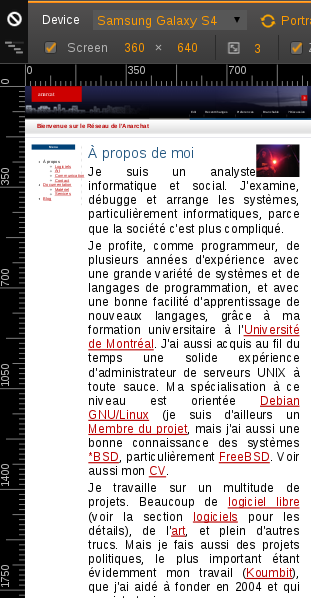
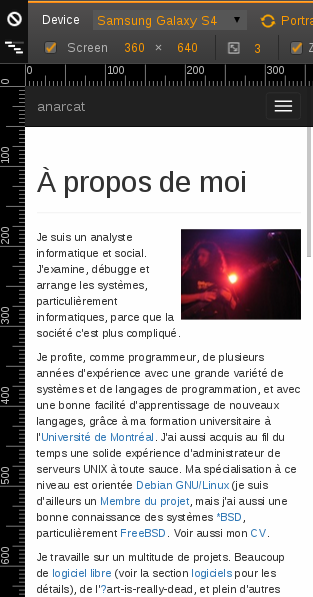
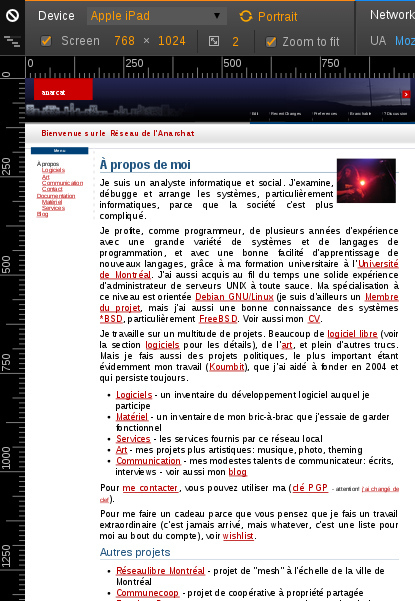
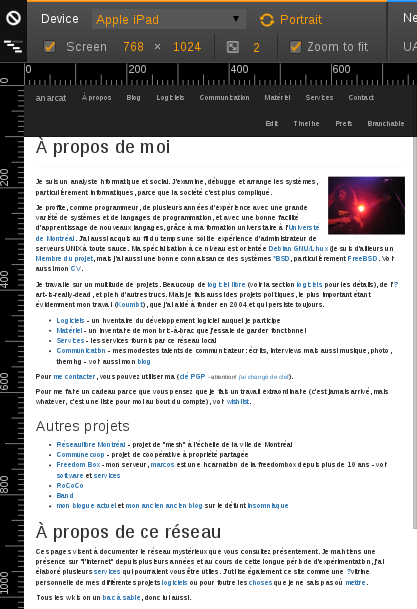
I finally gave up and drank the cool-aid of the Bootstrap theme. The main reason was that I noticed the site was basically unusable on any mobile device, including tablet computers like the iPad, which are unfortunately very, very common. Phones wouldn't render the site in a legible way either, unfortunately. The change is rather drastic, so I figured it was important to mention it here. I am not so satisfied pretty exctied with the result: the theme is very basic, if not absent. I actually like that purified form now, and it works across devices now much better. But I do feel I just made my blog look like everyone else that uses Bootstrap. We seem to enter an era where non-graphic designers (like me) are back to building web pages that all look the same, not very different, in a way, from the old days of plain HTML, like the default ikiwiki theme. I did some work to change the look at least minimally, but the top black navbar is really a killer giveaway this is a bootstrap theme. Bootstrap does a lot for the typography, at least when checking the presslabs checklist or the practical typography checklist, but I still had to change the main body width, which helped a lot I think. Anyways, the old Night City theme is still available for download and I could still flip it back on here if I need to.

What changed The new theme keeps the distractions away, but ironically, it's slower than the previous theme even though there are no images and basically no colors at all. On my tests, it now loads in about 3.42 seconds on the "Regular 2G (250Kbps)" simulation of Chromium with 72KB in 12 requests. Whereas my tests with the previous theme were taking 3.25 seconds with 43.5KB in 17 requests. This is due to the Bootstrap CSS, which takes a whopping 19KB itself, but especially because I now load JQuery, which takes a whopping 32.8KB! And that is probably gzip-compressed, as the original is more around 90KB. But at least the thing is readable on phones and tablets now. Compare:

Samsung S3, before Screenshot of a fake rendering on the Samsung Galaxy S3 in night city

Samsung S3, after Screenshot of a fake rendering on the Samsung Galaxy S3 in bootstrap I like this: much simpler, purer version on smaller devices. And we see what counts: the freaking text. Of course, on tablets, it doesn't fare as well: the top menu gets wrapped around...

Apple iPad, before Screenshot of a fake rendering on the iPad in night city

Apple iPad, after Screenshot of a fake rendering on the iPad in bootstrap Apparently, the fix would be for me to "customize the @grid-float-breakpoint variable" in LESS (which I thought was a pager, but seems to be a CSS preprocessor, graaah). Still, I think it's better that way, more readable, and less crufty.

How it was done After doing a thorough evaluation of all the Bootstrap ikiwiki themes I could find (there are more than 4 at least!), I figured I prefered the Jak Linux one. It seemed to be better implemented than the others, cleaner, and I liked the mean black border on top. Black is cool. Oh, and I liked the subtle footer as well. Subtle is cool. Unfortunately, that theme originally required a custom plugin to have a menu on top, which i thought was silly. So I patched it to make it work with the sidebar plugin, which turned out to be trivially simple: just dump the sidebar content, and make the sidebar page have explicit HTML tags in it that match Bootstrap's required classes. I also added the regular action links in the top navbar, but that does overload it quite a bit. I also did some code cleanups and various other small changes, all of which are available in my personnal git repo.

What doesn't work So of course, there are always problems. The first problem is the extra bandwidth usage. Not sure that can be fixed, other than switching to the upcoming Bootstrap 4, which is smaller than Bootstrap 3, bizarrely. The more annoying problems are weird alignment issues. If the screen gets two narrow without kicking some collapse rules in place (the iPad bug above), the navbar rows overflow and look ugly. Even more bizarre, in some cases the right navbar can just completely disappear, in fact, that's the only fix I could find: to assign the hidden-xs and hidden-sm classes to the navbar-right <UL> element. But then it just goes away, which is pretty darn stupid. Still - I assigned the classes to a few actions that seemed low priority, both in the theme and in the sidebar page. Similarly, the search form at the bottom of the page doesn't seem to want to fit in the footer properly. No idea why and I can't bother to figure that one out. I ended up merging this with the backlinks, tags and trails navigation items. Oh, and amazingly enough: comments are simply not rendered at all right now. Oops. I seemed to have picked the single bootstrap Ikiwiki theme that does *not* have comments rendering... Aaaargh. For now I just copy-pasted stuff from the [ramseydsilva][] theme and it looks pretty ugly, but at least it works. I ended up theming comments the same way i did for Night City, which looks pretty good, but is not in sync with the LESS stuff in Bootstrap. I also add to add back trails, backlinks and favicon... looks like the Jak theme wasn't made for a blog after all... but that's now fixed! :) Another improvement would be to change the font from the canonical Helvetica to something prettier, like suggested in Practical Typography, in the font recommendations section, or the presslabs checklist. So far I have settled on Mozilla's Fira font (which means, yes, one set of objects is actually loading from the CDN, sorry). Feedback welcome.

8 September 2015

Daniel Silverstone: Orchestration, a cry for help

Over the past few years, a plethora of orchestration frameworks have been exploding onto the scene. Many have been around for quite a while but not all have the same sort of community behind them. For example there's a very interesting option in Joey Hess' Propellor but that is hurt by needing to be able to build Propellor on all the hosts you manage. On the other hand, Ansible is able to operate without installing extra software on your target hosts, but instead it ends up very latency-bound which can cause problems when your managed hosts are "far away". I have considered CFEngine, Chef, Puppet and Salt in addition to the above mentioned options, but none of them feel quite right to me. I am looking for a way to manage a small number of hosts, at least one of which is not always online (my laptop) and all of which are essentially snowflakes whose sparkleybits I want some reasonable control over. I have a few basic requirements which I worry would be hard to meet -- I want to be able to make changes to my hosts by editing a file and committing/pushing it to a git server. I want to be able to manage a host entirely over SSH from one or more systems, ideally without having to install the orchestration software on the target host, but where if the software is present it will get used to accelerate matters. I don't want to have to install Ruby or PHP on any system in order to have orchestration, and some of the systems I wish to manage simply can't compile Haskell stuff sanely. I'm not desperately interested in learning yet more DSLs, but I appreciate that it will be necessary, but I really don't want to have to learn more than one DSL simply to run one frameworks. I don't want to have to learn strange and confusing combinations of file formats. For example, Ansible quite sensibly uses YAML for its structured data except for its host/group lists. It uses Jinja2 for its templating and looping, except for some things which it generates its own looping constructs inside its YAML. I also personally find Ansible's sportsball oriented terminology to be confusing, but that might just be me. So what I'm hoping is that someone will be able to point me at a project which combines all the wonderful features of the above, with a need to learn only one DSL and which doesn't require to be installed on the managed host but which can benefit from being so installed, is driven from git, and won't hurt my already overly burdened brain. Dear Lazyweb, pls. kthxbye.

7 September 2015

Matthias Klumpp: Update notifications in Debian Jessie

Piwik told me that people are still sharing my post about the state of GNOME-Software and update notifications in Debian Jessie. So I thought it might be useful to publish a small update on that matter: I hope that clarifies things a little. Have fun using Debian 8!
UPDATE: It appears that many people have problems with getting update notifications in GNOME on Jessie. If you are affected by this, please try the following:
  1. Open dconf-editor and navigate to org.gnome.settings-daemon.plugins.updates. Check if the key active is set to true
  2. If that doesn t help, also check if at org.gnome.settings-daemon.plugins.updates the frequency-refresh-cache value is set to a sane value (e.g. 86400)
  3. Consider increasing the priority value (if it isn t at 300 already)
  4. If all of that doesn t help: I guess some internal logic in g-s-d is preventing a cache refresh then (e.g. because I thinks it is on a expensive network connection and therefore doesn t refresh the cache automatically, or thinks it is running on battery). This is a bug. If that still happens on Debian Stretch with GNOME-Software, please report a bug against the gnome-software package. As a workaround for Jessie you can enable unconditional cache refreshing via the APT cronjob by installing apt-config-auto-update.

5 September 2015

Christoph Berg: 10 Years Debian Developer

I knew it was about this time of the year 10 years ago when my Debian account was created, but I couldn't remember the exact date until I looked it up earlier this evening: today :). Rene Engelhard had been my advocate, and Marc Brockschmidt my AM. Thanks guys! A lot of time has passed since then, and I've worked in various parts of the project. I became an application manager almost immediately, and quickly got into the NM front desk as well, revamping parts of the NM process which had become pretty bureaucratic (I think we are now, 10 years later, back where we should be, thanks to almost all of the paperwork being automated, thanks Enrico!). I've processed 37 NMs, most of them between 2005 and 2008, later I was only active as front desk and eventually Debian account manager. I've recently picked up AMing again, which I still find quite refreshing as the AM will always also learn new things. Quality Assurance was and is the other big field. Starting by doing QA uploads of orphaned packages, I attended some QA meetings around Germany, and picked up maintenance of the DDPO pages, which I still maintain. The link between QA and NM is the MIA team where I was active for some years until they kindly kicked me out because I was MIA there myself. I'm glad they are still using some of the scripts I was writing to automate some things. My favorite MUA is mutt, of which I became co-maintainer in 2007, and later maintainer. I'm still listed in the uploaders field, but admittedly I haven't really done anything there lately. Also in 2007 I started working at credativ, after having been a research assistant at the university, which meant making my Debian work professional. Of course it also meant more real work and less time for the hobby part, but I was still very active around that time. Later in 2010 I was marrying, and we got two kids, at which point family was of course much more important, so my Debian involvement dropped to a minimum. (Mostly lurking on IRC ;) Being a PostgreSQL consultant at work, it was natural to start looking into the packaging, so I started submitting patches to postgresql-common in 2011, and became a co-maintainer in 2012. Since then, I've mostly been working on PostgreSQL-related packages, of which far too many have my (co-)maintainer stamp on them. To link the Debian and PostgreSQL worlds together, we started an external repository (apt.postgresql.org) that contains packages for the PostgreSQL major releases that Debian doesn't ship. Most of my open source time at the moment is spent on getting all PostgreSQL packages in shape for Debian and this repository. According to minechangelogs, currently 844 changelog entries in Debian mention my name, or were authored by me. Scrolling back yields memories of packages that are long gone again from unstable, or I passed on to other maintainers. There are way too many people in Debian that I enjoy(ed) working with to list them here, and many of them are my friends. Debian is really the extended family on the internet. My last DebConf before this year had been in Mar del Plata - I had met some people at other conferences like FOSDEM, but meeting (almost) everyone again in Heidelberg was very nice. I even remembered all basic Mao rules :D. So, thanks to everyone out there for making Debian such a wonderful place to be!

4 September 2015

Riku Voipio: Migration to Scaleway ARM server

The C1 ServerScaleway started selling ARM based hosted server in April. I've intended to blog about this for a while, since it was time to upgrade from wheezy to jessie was timely, why not switch provider from an X86 based to ARM one at the same time? In many ways scaleway node is opposite to what "Enterprise ARM" people are working on. Each server is based on an oldish ARMv7 Quad-Core Marvell Armada XP, instead of a brand new 64-bit ARMv8 cpu. There is no UEFI, ACPI or any other "industry standards" involved, just a smooth web interface and a command line tool to manage your node(s). And the node is yours, it's not shared with others with virtualization. The picture above is a single node, which is stacked with 911 other nodes into a single rack. This week, the C1 price was dropped to a very reasonable 2.99 per month, or 0.006 per hour. Software runs on hardware, news at 11The performance is more than enough for my needs - shell, email and light web serving. dovecot, postfix, irssi and apache2 are just an apt-get away. Anyone who says you need x86 for Linux servers is forgetting that Linux software is open source, and if not already available, can be compiled to any architecture with little effort. Thus the migration pains were only because I chose to modernize configuration of dovecot and friends. Details of the new setup shall be left for another post.

Guido G nther: Debian work in August 2015

Debian LTS August was the fourth month I contributed to Debian LTS under the Freexian umbrella. In total I spent four hours working on: Besides that I did CVE triaging of 9 CVEs to check if and how they affect oldoldstable security as part of my LTS front desk work. Debconf 15 was a great opportunity to meet some of the other LTS contributors in person and to work on some of my packages: Git-buildpackage git-buildpackage gained buildpackage-rpm based on the work by Markus Lehtonnen and merging of mock support is hopefully around the corner. Debconf had two gbp skill shares hosted by dkg and a BoF by myself. A summary is here. Integration with dgit as (discussed with Ian) looks doable and I have parts of that on my todo list as well. Among other things gbp import-orig gained a --merge-mode option so you can replace the upstream branches verbatim on your packaging branch but keep the contents of the debian/ directory. Libvirt I prepared an update for libvirt in Jessie fixing a crasher bug, QEMU error reporting. apparmor support now works out of the box in Jessie (thanks to intrigeri and Felix Geyer for that). Speaking of apparmor I learned enough at Debconf to use this now by default so we hopefully see less breackage in this area when new libvirt versions hit the archive. The bug count wen't down quiet a bit and we have a new version of virt-manager in unstable now as well. As usual I prepared the RC candidates of libvirt 1.2.19 in experimental and 1.2.19 final is now in unstable.

Norbert Preining: How to rename a local OfflineIMAP managed folder

Since quite some time I am using OfflineIMAP to keep my mailbox status from various servers locally available on my machine. I did more or less follow the excellent guide A unix style mail setup, but didn t use folder name translation right from the beginning. So I got stuck with four folders named INBOX: acc1/INBOX, acc2/INBOX, etc. This wouldn t be a big problem, but when using Mutt with the folder sidebar patch (as available in the mutt-patched package in Debian), there is the problem that only the INBOX part is shown. offlineimap So I decided to rename all the local folders to the scheme described in the above guide. At the end I want to have a folder layout as follows:
  Maildir/acc1/acc1
  Maildir/acc1/acc1.folder1
  Maildir/acc1/acc1.folder2
where the acc1 related to the INBOX on the remote account acc1, and the others are folders on the remote end. Unfortunately, renaming is not supported in offlineimap, it would simply download everything again at best! So I checked what needs to be done, and it turned out it is not as complicated as I thought. The necessary steps are: To make this more specific, let us assume I want to reorganize the account acc1 in this way, and there are two folders synced. That is, before we start the Maildir folder contains:
Maildir/acc1/INBOX
Maildir/acc1/folder1
Maildir/acc1/folder2
and we want to achieve that the layout is
Maildir/acc1/acc1
Maildir/acc1/acc1.folder1
Maildir/acc1/acc1.folder2
Due to the fact that both the LocalStatus files and the FolderValidity files are naned in the same way as the folders, the following trivial script does all the necessary renaming for this simple case:
for d in ~/Maildir/acc1 ~/.offlineimap/Account-acc1/LocalStatus ~/.offlineimap/Repository-acc1local/FolderValidity ; do
  mv $d/INBOX $d/acc1
  mv $d/folder1 $d/acc1.folder1
  mv $d/folder2 $d/acc1.folder2
done
Finally, the correct renaming has to be done by adding nametrans rules to the helper script. The functions oimaptransfolder_acc1 and localtransfolder_acc1 as defined in the above tutorial can be used as is, and need only be added to the respective Repository sections in the configuration file. After having done the necessary renaming, what remains is to give it a good test. Best way to do it is with
offlineimap --dry-run -o -a acc1
which runs the syncronization in dry-run mode, so nothing is actually copied, and only once and only for acc1. If during this test run nothing strange appears, like many many emails are deleted on either end, then you are fine. Enjoy.

3 September 2015

Vincent Fourmond: Releases 1.19.1 of Tioga and 0.13.1 of ctioga2

I've just released the versions 1.19.1 of Tioga and 0.13.1 of ctioga2. They both fix installation problems with recent versions of Ruby. Update as usual, though that isn't strictly necessary if you've managed to install them properly.
~ gem update tioga ctioga2

1 September 2015

Rapha&#235;l Hertzog: My Free Software Activities in August 2015

My monthly report covers a large part of what I have been doing in the free software world. I write it for my donators (thanks to them!) but also for the wider Debian community because it can give ideas to newcomers and it s one of the best ways to find volunteers to work with me on projects that matter to me. Debian LTS This month I have been paid to work 6.5 hours on Debian LTS. In that time I did the following: Apart from that, I also gave a talk about Debian LTS at DebConf 15 in Heidelberg and also coordinated a work session to discuss our plans for Wheezy. Have a look at the video recordings: DebConf 15 I attended DebConf 15 with great pleasure after having missed DebConf 14 last year. While I did not do lots of work there, I participated in many discussions and I certainly came back with a renewed motivation to work on Debian. That s always good. :-) For the concrete work I did during DebConf, I can only claim two schroot uploads to fix the lack of support of the new overlay filesystem that replaces aufs in the official Debian kernel, and some Distro Tracker work (fixing an issue that some people had when they were logged in via Debian s SSO). While the numerous discussions I had during DebConf can t be qualified as work , they certainly contribute to build up work plans for the future: As a Kali developer, I attended multiple sessions related to derivatives (notably the Debian Derivatives Panel). I was also interested by the Debian in the corporate IT BoF led by Michael Meskes (Credativ s CEO). He pointed out a number of problems that corporate users might have when they first consider using Debian and we will try to do something about this. Expect further news and discussions on the topic. Martin Kraff, Luca Filipozzi, and me had a discussion with the Debian Project Leader (Neil) about how to revive/transform the Debian s Partner program. Nothing is fleshed out yet, but at least the process initiated by the former DPL (Lucas) is again moving forward. Other Debian work Sponsorship. I sponsored an NMU of pep8 by Daniel Stender as it was a requirement for prospector which I also sponsored since all the required dependencies are now available in Debian. \o/ Packaging. I NMUed libxml2 2.9.2+really2.9.1+dfsg1-0.1 fixing 3 security issues and a RC bug that was breaking publican. Since there s no upstream fix for more than 8 months, I went back to the former version 2.9.1. It s in line with the new requirement of release managers a package in unstable should migrate to testing reasonably quickly, it s not acceptable to keep it unfixed for months. With this annoying bug fixed, I could again upload a new upstream release of publican so I prepared and uploaded 4.3.2-1. It was my first source only upload. This release was more work than I expected and I filed no less than 3 bug to upstream (new bash-completion install path, request to provide sources of a minified javascript file, drop a .po file for an invalid language code). GPG issues with smartcard. Back from DebConf, when I wanted to sign some key, I stumbled again upon the problem which makes it impossible for me to use my two smartcards one after the other without first deleting the stubs for the private key. It s not a new issue but I decided that it was time to report it upstream, so I did it: #2079 on bugs.gnupg.org. Some research helped me to find a way to work-around the problem. Later in the month, after a dist-upgrade and a reboot, I was no longer able to use my smartcard as a SSH authentication key again it was already reported but there was no clear analysis, so I tried to do my own one and added the results of my investigation in #795368. It looks like the culprit is pinentry-gnome3 not working when started by the gpg-agent which is started before the DBUS session. Simple fix is to restart the gpg-agent in the session but I have no idea yet of what the proper fix should be (letting systemd manage the graphical user session and start gpg-agent would be my first answer, but that doesn t solve the issue for users of other init systems so it s not satisfying). Distro Tracker. I merged two patches from Orestis Ioannou fixing some bugs tagged newcomer. There are more such bugs (I even filed two: #797096 and #797223), go grab them and do a first contribution to Distro Tracker like Orestis just did! I also merged a change from Christophe Siraut who presented Distro Tracker at DebConf. I implemented in Distro Tracker the new authentication based on SSL client certificates that was recently announced by Enrico Zini. It s working nice, and this authentication scheme is far easier to support. Good job, Enrico! tracker.debian.org broke during DebConf, it stopped being updated with new data. I tracked this down to a problem in the archive (see #796892). Apparently Ansgar Burchardt changed the set of compression tools used on some jessie repositorie, replacing bz2 by xz. He dropped the old Packages.bz2 but missed some Sources.bz2 which were thus stale and APT reported Hashsum mismatch on the uncompressed content. Misc. I pushed some small improvement to my Salt formulas: schroot-formula and sbuild-formula. They will now auto-detect which overlay filesystem is available with the current kernel (previously aufs was hardcoded). Thanks See you next month for a new summary of my activities.

No comment Liked this article? Click here. My blog is Flattr-enabled.

Russ Allbery: Review: Kanban

Review: Kanban, by David J. Anderson
Publisher: Blue Hole
Copyright: 2010
ISBN: 0-9845214-0-2
Format: Trade paperback
Pages: 240
Another belated review, this time of a borrowed book. Which I can now finally return! A delay in the review of this book might be a feature if I had actually used it for, as the subtitle puts it, successful evolutionary change in my technology business. Sadly, I haven't, so it's just late. So, my background: I've done a lot of variations of traditional project management for IT projects (both development and more operational ones), both as a participant and as a project manager. (Although I've never done the latter as a full-time job, and have no desire to do so.) A while back at Stanford, my team adopted Agile, specifically Scrum, so I did a fair bit of research about Scrum including a couple of training courses. Since then, at Dropbox, I've used a few different variations on a vaguely Agile-inspired planning process, although it's not particularly consistent with any one system. I've been hearing about Kanban for a while and have friends who swear by it, but I only had a vague idea of how it worked. That seemed like a good excuse to read a book. And Anderson's book is a good one if, like me, you're looking for a basic introduction. It opens with a basic description and definition, talks about motivation and the expected benefits, and then provides a detailed description of Kanban as a system. The tone is on the theory side, written using the terminology of (I presume) management theory and operations management, areas about which I know almost nothing, but the terminology wasn't so heavy as to make the book hard to read. Anderson goes into lots of detail, and I thought he did a good job of distinguishing between basic principles, optional techniques, and variations that may be appropriate for particular environments. If you're also not familiar, the basic concept of Kanban is to organize work using an in-progress queue. It eschews time-bounded planning entirely in favor of staging work at the start of a sequence of queues and letting the people working on each queue pull from the previous queue when they're ready to take on a new task. As you might guess from that layout, Kanban was originally invented for assembly-line manufacturing (at Toyota). That was one of the problems that I had with it, or at least the presentation in this book: most of my software development doesn't involve finishing one part of something and handing it off to someone else, which made it hard to identify with the pipeline model. Anderson has clearly spent a lot of time working with large-scale programming shops, including outsourced development firms, with dedicated QA and operations roles. This is not at all how Silicon Valley agile development works, so parts of this book felt like missives from a foreign country. That said, the key point of Kanban is not the assembly line but the work limit. One of the defining characteristics of Kanban, at least as Anderson presents it, is that one does not try to estimate work and tile it based on estimates, not even to the extent that Scrum and other Agile methodologies do within the sprint. Instead, each person takes as long as they take on the things they're working on, and pulls a new task when they have free capacity. The system instead puts a limit on how many things they can have in progress at a time. The problem of pipeline stalls is dealt with both via continuous improvement and "swarming" of a problem to unblock the line (since other teams may not be able to work until the block is fixed), and with being careful about the sizing of work items (I'm used to calling them stories) that go in the front end. Predictability, which Scrum uses story sizing and team velocity analysis to try to achieve, is basically statistical. One uses a small number of buckets of sizes of stories, and the whole pipeline will finish some number of work items per unit time, with a variance. The promise made to clients and other teams is that some percentage of the work items will be finished within some time frame from when they enter the system. Most importantly, these are all descriptive properties, determined statistically after the fact, rather than planned properties worked out through story sizing and extensive team discussion. If you, like me, are pretty thoroughly sick of two-hour sprint planning meetings and endless sizing exercises, this is rather appealing. My problem with most work planning systems is that I think they overplan and put too much weight our ability to estimate how long work will take. Kanban is very appealing when viewed through that lens: it gives up on things we're bad at in favor of simple measurement and building a system with enough slack that it can handle work of various different sizes. As mentioned at the top, I haven't had a chance to try it (and I'm not sure it's a good fit with the inter-group planning methods in use at my current workplace), but I came away from this book wanting to do so. If, like me, your experience is mostly with small combined teams or individual programming work, Anderson's examples may seem rather large, rather formal, and bureaucratic. But this is a solid introduction and well worth reading if your only experience with Agile is sprint planning, story writing and sizing, and fast iterations. Rating: 7 out of 10

31 August 2015

Matthew Garrett: Working with the kernel keyring

The Linux kernel keyring is effectively a mechanism to allow shoving blobs of data into the kernel and then setting access controls on them. It's convenient for a couple of reasons: the first is that these blobs are available to the kernel itself (so it can use them for things like NFSv4 authentication or module signing keys), and the second is that once they're locked down there's no way for even root to modify them.

But there's a corner case that can be somewhat confusing here, and it's one that I managed to crash into multiple times when I was implementing some code that works with this. Keys can be "possessed" by a process, and have permissions that are granted to the possessor orthogonally to any permissions granted to the user or group that owns the key. This is important because it allows for the creation of keyrings that are only visible to specific processes - if my userspace keyring manager is using the kernel keyring as a backing store for decrypted material, I don't want any arbitrary process running as me to be able to obtain those keys[1]. As described in keyrings(7), keyrings exist at the session, process and thread levels of granularity.

This is absolutely fine in the normal case, but gets confusing when you start using sudo. sudo by default doesn't create a new login session - when you're working with sudo, you're still working with key posession that's tied to the original user. This makes sense when you consider that you often want applications you run with sudo to have access to the keys that you own, but it becomes a pain when you're trying to work with keys that need to be accessible to a user no matter whether that user owns the login session or not.

I spent a while talking to David Howells about this and he explained the easiest way to handle this. If you do something like the following:
$ sudo keyctl add user testkey testdata @u
a new key will be created and added to UID 0's user keyring (indicated by @u). This is possible because the keyring defaults to 0x3f3f0000 permissions, giving both the possessor and the user read/write access to the keyring. But if you then try to do something like:
$ sudo keyctl setperm 678913344 0x3f3f0000
where 678913344 is the ID of the key we created in the previous command, you'll get permission denied. This is because the default permissions on a key are 0x3f010000, meaning that the possessor has permission to do anything to the key but the user only has permission to view its attributes. The cause of this confusion is that although we have permission to write to UID 0's keyring (because the permissions are 0x3f3f0000), we don't possess it - the only permissions we have for this key are the user ones, and the default state for user permissions on new keys only gives us permission to view the attributes, not change them.

But! There's a way around this. If we instead do:
$ sudo keyctl add user testkey testdata @s
then the key is added to the current session keyring (@s). Because the session keyring belongs to us, we possess any keys within it and so we have permission to modify the permissions further. We can then do:
$ sudo keyctl setperm 678913344 0x3f3f0000
and it works. Hurrah! Except that if we log in as root, we'll be part of another session and won't be able to see that key. Boo. So, after setting the permissions, we should:
$ sudo keyctl link 678913344 @u
which ties it to UID 0's user keyring. Someone who logs in as root will then be able to see the key, as will any processes running as root via sudo. But we probably also want to remove it from the unprivileged user's session keyring, because that's readable/writable by the unprivileged user - they'd be able to revoke the key from underneath us!
$ sudo keyctl unlink 678913344 @s
will achieve this, and now the key is configured appropriately - UID 0 can read, modify and delete the key, other users can't.

This is part of our ongoing work at CoreOS to make rkt more secure. Moving the signing keys into the kernel is the first step towards rkt no longer having to trust the local writable filesystem[2]. Once keys have been enrolled the keyring can be locked down - rkt will then refuse to run any images unless they're signed with one of these keys, and even root will be unable to alter them.

[1] (obviously it should also be impossible to ptrace() my userspace keyring manager)
[2] Part of our Secure Boot work has been the integration of dm-verity into CoreOS. Once deployed this will mean that the /usr partition is cryptographically verified by the kernel at runtime, making it impossible for anybody to modify it underneath the kernel. / remains writable in order to permit local configuration and to act as a data store, and right now rkt stores its trusted keys there.

comment count unavailable comments

Next.

Previous.