Search Results: "ads"

2 November 2020

Sandro Knau : Bugzilla integration for KDE Project API

The KDE Bugzilla handles a lot of projects and they often match with the repo name, but not always. For instance we have ancient products and components at Bugzilla, as projects have a lifecycle from playground into Release Service, or Frameworks, sometimes with a change of name. So you may end up searching Bugzilla quite awhile for the correct product and component to be able to confirm or create bug reports against an application. Let's have a look at KPeople, and see why the situation is complicated. You find two products in KDE Bugzilla: kpeople (the repository's name) and on the other hand Frameworks have the scheme of a "frameworks-" prefix: frameworks-kpeople. From the data displayed even I as a developer am unable to tell which is the correct product to add new bug reports. Both have bug reports this year that got fixed and the number of bug reports is too low to get a clear picture of which to choose. This is not only a problem of KDE; it is a general problem in different communities that it is hard for newcomers to find the correct place to search and add new bug reports. That's why Debian added the bug report information for every package. This should help users to search the upstream bug reports or create new ones (Bug-Submit and Bug-Database): https://wiki.debian.org/UpstreamMetadata#Fields While I was collecting this information for Frameworks and KDE PIM, I wondered why KDE does not have links between each project and Bugzilla. After some searching and discussions it became obvious, that KDE does not have this information that can be processed. Okay let's fix this. The obvious place to reach this information is the Project API available under https://projects.kde.org/api/. To reach this goal I began adding Bugzilla information to the data source of the Project API named Git Repo Metadata. Then a merge request later the Project API is able to generate the links to Bugzilla invent:sysadmin/projects-api!2. Where you should search for bugs in kontact? Go to https://projects.kde.org/api/v1/identifier/kontact: After implementing the needed bits I found out that Nicolas Alvarez had the same idea, to store Bugzilla information in Git Repo Metadata invent:sysadmin/repo-metadata@085d878ea. Fortunately I can say that since June the information are used by Project API. So now, back to my task to add upstream metadata to Debian packages. After I filled the needed information to Repo Metadata I created a script to update the links in Debian salsa:qt-kde-team/pkg-kde-dev-scripts/function_collection/functions_plasma.py:addMissingBugMetadatafields. This should hopefully help to always point to the correct Bugzilla links in future. A random list came to my mind of places that may benefit from the Bugzilla information in Git Metadata Repository: The truth is, that Nicolas is right that adding the Bugzilla links are a manual task. But on the other hand, let's add this information once at one place and than we can use it at several places. Please help adding this information; it is simple a yaml file. If you see the data missing example commit and create a merge request. Or you can also give me the data and I'll add it.

1 November 2020

Steve Kemp: Archiving Debian-Administration.org, for real

Back in 2017 I announced that the https://Debian-Administration.org website was being made read-only, and archived. At the time I wrote a quick update to save each requested page as a flat-file, hashed beneath /tmp, with the expectation that after a few months I'd have a complete HTML-only archive of the site which I could serve as a static-website, instead of keeping the database and pile of CGI scripts running. Unfortunately I never got round to archiving the pages in a git-repository, or some other store, and I usually only remembered this local tree of content was available a few minutes after I'd rebooted the server and lost the stuff - as the reboot would reap the contents of /tmp! Thinking about it today I figured I probably didn't even need to do that, instead I just need to redirect to the wayback machine. Working on the assumption that the site has been around for "a while" it should have all the pages mirrored by now I've made a "final update" to Apache:
 RewriteEngine on
 RewriteRule   ^/(.*)  "http://web.archive.org/web/https://debian-administration.org/$1"  [R,L]
Assuming nobody reports a problem in the next month I'll retire the server and make a simple docker container to handle the appropriate TLS certificate renewal, and hardwire the redirection(s) for the sites involved.

Utkarsh Gupta: FOSS Activites in October 2020

Here s my (thirteenth) monthly update about the activities I ve done in the F/L/OSS world.

Debian
This was my 22nd month of contributing to Debian. I became a DM in late March last year and a DD last Christmas! \o/ Whilst busy with my undergrad, I could still take some time out for contributing to Debian (I always do!). Here are the following things I did in Debian this month:

Uploads and bug fixes:

Other $things:
  • Attended the Debian Ruby team meeting. Logs here.
  • Mentoring for newcomers.
  • FTP Trainee reviewing.
  • Moderation of -project mailing list.
  • Sponsored phpmyadmin, php-bacon-baconqrcode, twig, php-dasprid-enum, sql-parser, and mariadb-mysql-kbs for William.

Debian (E)LTS
Debian Long Term Support (LTS) is a project to extend the lifetime of all Debian stable releases to (at least) 5 years. Debian LTS is not handled by the Debian security team, but by a separate group of volunteers and companies interested in making it a success. And Debian Extended LTS (ELTS) is its sister project, extending support to the Jessie release (+2 years after LTS support). This was my thirteenth month as a Debian LTS and fourth month as a Debian ELTS paid contributor.
I was assigned 20.75 hours for LTS and 30.00 hours for ELTS and worked on the following things:
(for ELTS, I worked for 5.25 hours extra, so my total hours this month for ELTS were 35.25!)

LTS CVE Fixes and Announcements:
  • Issued DLA 2389-1, fixing CVE-2019-18978, for ruby-rack-cors.
    For Debian 9 Stretch, these problems have been fixed in version 0.4.0-1+deb9u2.
  • Issued DLA 2390-1, fixing CVE-2019-18848, for ruby-json-jwt.
    For Debian 9 Stretch, these problems have been fixed in version 1.6.2-1+deb9u2.
  • Issued DLA 2391-1, fixing CVE-2020-25613, for ruby2.3.
    For Debian 9 Stretch, these problems have been fixed in version 2.3.3-1+deb9u9.
  • Issued DLA 2392-1, fixing CVE-2020-25613, for jruby.
    For Debian 9 Stretch, these problems have been fixed in version 1.7.26-1+deb9u3.
  • Uploaded ruby2.5 to buster, fixing CVE-2020-25613. For Debian 10 Buster, these problems have been fixed in version 2.5.5-3+deb10u3.
  • Uploaded ruby2.7 to unstable, fixing CVE-2020-25613. For Debian Sid, these problems have been fixed in version 2.7.1-4.
  • Uploaded rails to unstable, fixing CVE-2020-8264. For Debian Sid, these problems have been fixed in version 2:6.0.3.4+dfsg-1.

ELTS CVE Fixes and Announcements:

Other (E)LTS Work:
  • Front-desk duty from 28-09 to 04-10 and from 26-10 until 01-10 for both LTS and ELTS.
  • Triaged libproxy, libvirt, libonig, ant, erlang, ruby2.3, jruby, dpdk, php7.0, spice, spice-gtk, wireshark, djangorestframework, python-urllib3, python-cryptography, qtsvg-opensource-src, and open-build-service.
  • Marked CVE-2020-26137/python-urllib3 as no-dsa for Stretch and Jessie.
  • Marked CVE-2020-1437 4,5,6,7,8 /dpdk as no-dsa for Stretch.
  • Marked CVE-2020-2586 2,3 /wireshark as postponed for Stretch.
  • Marked CVE-2020-25626/djangorestframework as no-dsa for Stretch.
  • Marked CVE-2020-11979/ant as not-affected for Jessie.
  • Marked CVE-2020-25623/erlang as not-affected for Jessie.
  • Marked CVE-2020-25659/python-cryptography as no-dsa for Stretch and Jessie.
  • Auto EOL ed jruby, libjs-handlebars, linux, pluxml, mupdf, and djangorestframework for Jessie.
  • [E/LTS] Worked on putting survey online, deployed LTS Team Pages \o/
  • [ELTS] Fix suite-name in ela-needed file and fix other tags and ordering of triages to fix errors in the security tracker.
  • [LTS] Sent out invitations for the meeting.
  • Attended the sixth private LTS meeting.
  • General discussion on LTS private and public mailing list.

Until next time.
:wq for today.

Paul Wise: FLOSS Activities October 2020

Focus This month I didn't have any particular focus. I just worked on issues in my info bubble.

Changes

Issues

Review
  • Spam: reported 2 Debian bug reports and 147 Debian mailing list posts
  • Patches: merged libicns patches
  • Debian packages: sponsored iotop-c
  • Debian wiki: RecentChanges for the month
  • Debian screenshots:

Administration
  • Debian: get us removed from an RBL
  • Debian wiki: reset email addresses, approve accounts

Communication

Sponsors The pytest-rerunfailures/pyemd/morfessor work was sponsored by my employer. All other work was done on a volunteer basis.

Junichi Uekawa: I'm playing more computer games recently.

I'm playing more computer games recently. Splatoon2, Ring Fit Adventure, Fit Boxing, and NieR Automata.

31 October 2020

Chris Lamb: Free software activities in October 2020

Here is my monthly update covering what I have been doing in the free software world during October 2020 (previous month): For Lintian, the static analysis tool for Debian packages, I uploaded versions 2.97.0, 2.98.0, 2.99.0 & 2.100.0 as well as updated the declares-possibly-conflicting-debhelper-compat-versions tag as we may specify the Debhelper compatibility level in debian/rules or debian/control (#972464) and dropped a reference to missing manual page [...].

Reproducible Builds One of the original promises of open source software is that distributed peer review and transparency of process results in enhanced end-user security. However, whilst anyone may inspect the source code of free and open source software for malicious flaws, almost all software today is distributed as pre-compiled binaries. This allows nefarious third-parties to compromise systems by injecting malicious code into ostensibly secure software during the various compilation and distribution processes. The motivation behind the Reproducible Builds effort is to ensure no flaws have been introduced during this compilation process by promising identical results are always generated from a given source, thus allowing multiple third-parties to come to a consensus on whether a build was compromised. The project is proud to be a member project of the Software Freedom Conservancy. Conservancy acts as a corporate umbrella allowing projects to operate as non-profit initiatives without managing their own corporate structure. If you like the work of the Conservancy or the Reproducible Builds project, please consider becoming an official supporter. This month, I: I also updated the main Reproducible Builds website and documentation:
Lastly, I made the following changes to diffoscope, including preparing and uploading version 161 to Debian: trydiffoscope is the web-based version of diffoscope. This month, I made the following changes:

Debian Debian LTS This month I have worked 18 hours on Debian Long Term Support (LTS) and 12 hours on its sister Extended LTS project. You can find out more about the project via the following video:

Uploads Bugs filed

Jonathan Carter: Free Software Activities for 2020-10

Another month, another bunch of uploads. The freeze for Debian 11 (bullseye) is edging closer, so I ve been trying to get my package list in better shape ahead of that. Thanks to those who worked on fixing lintian.debian.org and the lintian reports on the QA pages, those are immensely useful and it s great to have that back! 2020-10-04: Upload package gnome-shell-extension-draw-on-your-screen (8-1) to Debian unstable. 2020-10-05: Sponsor package flask-restful (0.3.8-4) for Debian unstable (Python Team request). 2020-10-05: Sponsor package python-potr (1.0.2-3) for Debian unstable (Python Team request). 2020-10-06: Sponsor package python-pyld (2.0.3-1) for Debian unstable (Python Team request). 2020-10-06: Sponsor package flask-openid (1.2.5+dfsg-4) for Debian unstable (Python Team request). 2020-10-06: Sponsor package qosmic (1.6.0-4) for Debian unstable (E-mail request). 2020-10-07: File removal for gnome-shell-extension-workspace-to-dock (RC Buggy, no longer maintained: #971803). 2020-10-07: Upload package gnome-shell-extension-pixelsaver (1.20-2) to Debian unstable (Closes: #971689). 2020-10-07: Upload package calamares (3.2.31-1) to Debian unstable. 2020-10-07: Upload package gnome-shell-extension-dashtodock (69-1) to Debian unstable (Closes: #971654). 2020-10-08: Sponsor package python3-libcloud (3.020-1) for Debian unstable. 2020-10-09: Upload package gnome-shell-extension-dashtopanel (40-1) to Debian unstable (Closes: #971087). 2020-10-09: Upload package gnome-shell-extension-draw-on-your-screen (8.1-1) to Debian unstable. 2020-10-12: Upload package gnome-shell-extension-pixelsaver (1.24-1) to Debian unstable. 2020-10-14: Sponsor package python3-onewire (0.2-1) for Debian unstable (Python Team request). 2020-10-15: Sponsor package cheetah (3.2.5-1) for Debian unstable (Python Team request). 2020-10-15: Sponsor package xmodem (0.4.6+dfsg-1) for Debian unstable (Python Team request). 2020-10-15: Sponsor package ansi (0.1.5-1) for Debian unstable (Python Team request). 2020-10-15: Sponsor package cbor2 (5.2.0-1) for Debian unstable (Python Team request). 2020-10-16: Upload package calamares (3.2.32-1) to Debian unstable. 2020-10-17: Upload package calamares (3.2.32.1-1) to Debian unstable. 2020-10-18: Upload package kpmcore (4.2.0-1) to Debian unstable. 2020-10-18: Upload package gnome-shell-extension-draw-on-your-screen (9-1) to Debian unstable. 2020-10-18: Upload package bundlewrap (4.2.1-1) to Debian unstable. 2020-10-18: Upload package bcachefs-tools (0.1+git20201017.8a4408-1~exp1) to Debian experimental. 2020-10-18: Upload package calamares (3.2.32.1-2) to Debian unstable. 2020-10-18: Upload package partitionmanager (4.1.0-2) to Debian unstable. 2020-10-19: Upload package kpmcore (4.2.0-2) to Debian unstable. 2020-10-21: Upload package calamares (3.2.32.1-3) to Debian unstable. 2020-10-21: Upload package calamares-settings-debian (11.0.3-1) to Debian unstable (Closes: #969930, #941301). 2020-10-21: Upload package partitionmanager (4.2.0-1) to Debian unstable. 2020-10-21: Upload package gnome-shell-extension-hard-disk-led (22-1) to Debian unstable (Closes: #971041). 2020-10-21: Merge MR!1 for catimg (Janitor improvements). 2020-10-21: Sponsor package r4d (1.7-1) for Debian unstable (Python Team request). 2020-10-22: Upload package aalib (1.4rc5-47) to Debian unstable. 2020-10-22: Upload package fabulous (0.3.0+dfsg1-8) to Debian unstable. 2020-10-22: Merge MR!1 for gdisk (Janitor improvements). 2020-10-22: Merge MR!1 for gnome-shell-extension-arc-menu (New upstream URLs, thanks Edward Betts). 2020-10-22: Upload package gnome-shell-extension-arc-menu (49-1) to Debian unstable. 2020-10-22: Upload package gnome-shell-extension-draw-on-your-screen (10-1) to Debian unstable. 2020-10-22: Merge MR!1 for vim-airline (Janitor improvements). 2020-10-22: Merge MR!1 for vim-airline-themes (Janitor improvements). 2020-10-22: Merge MR!1 for preload (Janitor improvements). 2020-10-22: Upload package aalib (1.4rc5-48) to Debian unstable. 2020-10-22: Upload package gnome-shell-extension-trash (0.2.0-git20200326.3425fcf1-1). 2020-10-26: Upload package bcachefs-tools (0.1+git20201025.742dbbdb-1) to Debian unstable. 2020-10-26: Sponsor package dunst (1.5.0-1) for Debian unstable (mentors.debian.net request).

30 October 2020

Kees Cook: combining apt install and get dist-upgrade ?

I frequently see a pattern in image build/refresh scripts where a set of packages is installed, and then all packages are updated:
apt update
apt install -y pkg1 pkg2 pkg2
apt dist-upgrade -y
While it s not much, this results in redundant work. For example reading/writing package database, potentially running triggers (man-page refresh, ldconfig, etc). The internal package dependency resolution stuff isn t actually different: install will also do upgrades of needed packages, etc. Combining them should be entirely possible, but I haven t found a clean way to do this yet. The best I ve got so far is:
apt update
apt-cache dumpavail   dpkg --merge-avail -
(for i in pkg1 pkg2 pkg3; do echo "$i install")   dpkg --set-selections
apt-get dselect-upgrade
This gets me the effect of running install and upgrade at the same time, but not dist-upgrade (which has slightly different resolution logic that d I d prefer to use). Also, it includes the overhead of what should be an unnecessary update of dpkg s database. Anyone know a better way to do this? Update: Julian Andres Klode pointed out that dist-upgrade actually takes package arguments too just like install. *face palm* I didn t even try it I believed the man-page and the -h output. It works perfectly!

2020, Kees Cook. This work is licensed under a Creative Commons Attribution-ShareAlike 4.0 License.
CC BY-SA 4.0

29 October 2020

Ulrike Uhlig: Better handling emergencies

We all know these situations when we receive an email asking Can you check the design of X, I need a reply by tonight. Or an instant message: My website went down, can you check? Another email: I canceled a plan at the hosting company, can you restore my website as fast as possible? A phone call: The TLS certificate didn t get updated, and now we can t access service Y. Yet another email: Our super important medical advice website is suddenly being censored in country Z, can you help? Everyone knows those messages that have URGENT in capital letters in the email subject. It might be that some of them really are urgent. Others are the written signs of someone having a hard time properly planning their own work and passing their delays on to someone who comes later in the creation or production chain. And others again come from people who are overworked and try to delegate some of their tasks to a friendly soul who is likely to help.

How emergencies create more emergencies In the past, my first reflex when I received an urgent request was to start rushing into solutions. This happened partly out of empathy, partly because I like to be challenged into solving problems, and I m fairly good at that. This has proven to be unsustainable, and here is why.

Emergencies create unplanned work The first issue is that emergencies create a lot of unplanned work. Which in turn means not getting other, scheduled, things done. This can create a backlog, end up in working late, or working on weekends.

Emergencies can create a permanent state of exception Unplanned work can also create a lot of frustration, out of the feeling of not getting the things done that one planned to do. We might even get a feeling of being nonautonomous (in German I would say fremdbestimmt, which roughly translates to being directed by others ). On the long term, this can generate unsustainable situations: higher work loads, and burnout. When working in a team of several people, A might have to take over the work of B because B has not enough capacities. Then A gets overloaded in turn, and C and D have to take over A s work. Suddenly the team is stuck in a permanent state of exception. This state of exception will produce more backlog. The team might start to deprioritize social issues over getting technical things done. They might not be able to recruit new people anymore because they have no capacity left to onboard newcomers.

One emergency can result in a variety of emergencies for many people The second issue produced by urgent requests is that if I cannot solve the initial emergency by myself, I might try to involve colleagues, other people who are skilled in the area, or people who work in another relevant organization to help with this. Suddenly, the initial emergency has become my emergency as well as the emergency of a whole bunch of other people.

A sidenote about working with friends This might be less of an issue in a classical work setup than in a situation in which a bunch of freelancers work together, or in setups in which work and friendships are intertwined. This is a problem, because the boundaries between friend and worker role, and the expectations that go along with these roles, can get easily confused. If a colleague asks me to help with task X, I might say no; if a friend asks, I might be less likely to say no.

What I learnt about handling emergencies I came up with some guidelines that help me to better handle emergencies.

Plan for unplanned work It doesn t matter and it doesn t help to distinguish if urgent requests are legitimate or if they come from people who have not done their homework on time. What matters is to make one s weekly todo list sustainable. After reading Making work visible by Domenica de Grandis, I understood the need to add free slots for unplanned work into one s weekly schedule. Slots for unplanned work can take up to 25% of the total work time!

Take time to make plans Now that there are some free slots to handle emergencies, one can take some time to think when an urgent request comes in. A German saying proposes to wait and have some tea ( abwarten und Tee trinken ). I think this is actually really good advice, and works for any non-obvious problem. Sit down and let the situation sink in. Have a tea, take a shower, go for a walk. It s never that urgent. Really, never. If possible, one can talk about the issue with another person, rubberduck style. Then one can make a plan on how to address the emergency properly, it could be that the solution is easier than at first thought.

Affirming boundaries: Saying no Is the emergency that I m asked to solve really my problem? Or is someone trying to involve me because they know I m likely to help? Take a deep breath and think about it. No? It s not my job, not my role? I have no time for this right now? I don t want to do it? Maybe I m not even paid for it? A colleague is pushing my boundaries to get some task on their own todo list done? Then I might want to say no. I can t help with this. or I can help you in two weeks. I don t need to give a reason. No. is a sentence. And: Saying no doesn t make me an arse.

Affirming boundaries: Clearly defining one s role Clearly defining one s role is something that is often overlooked. In many discussions I have with friends it appears that this is a major cause of overwork and underpayment. Lots of people are skilled, intelligent, and curious, and easily get challenged into putting on their super hero dress. But they re certainly not the only person that can help even if an urgent request makes them think that at first. To clearly define our role, we need to make clear which part of the job is our work, and which part needs to be done by other people. We should stop trying to accomodate people and their requests to the detriment of our own sanity. You re a language interpreter and are being asked to mediate a bi-lingual conflict between the people you are interpreting for? It s not your job. You re the graphic designer for a poster, but the text you ve been given is not good enough? Send back a recommendation to change the text; don t do these changes yourself: it s not your job. But you can and want to do this yourself and it would make your client s life easier? Then ask them to get paid for the extra time, and make sure to renegotiate your deadline!

Affirming boundaries: Defining expectations Along with our role, we need to define expectations: in which timeframe am I willing to do the job? Under which contract, which agreement, which conditions? For which payment? People who work in a salary office job generally do have a work contract in which their role and the expectations that come with this role are clearly defined. Nevertheless, I hear from friends that their superiors regularly try to make them do tasks that are not part of their role definition. So, here too, role and expectations sometimes need to be renegotiated, and the boundaries of these roles need to be clearly affirmed.

Random conclusive thoughts If you ve read until here, you might have experienced similar things. Or, on the contrary, maybe you re already good at communicating your boundaries and people around you have learnt to respect them? Congratulations. In any case, for improving one s own approach to such requests, it can be useful to find out which inner dynamics are at play when we interact with other people. Additionally, it can be useful to understand the differences between Asker and Guesser culture:
when an Asker meets a Guesser, unpleasantness results. An Asker won t think it s rude to request two weeks in your spare room, but a Guess culture person will hear it as presumptuous and resent the agony involved in saying no. Your boss, asking for a project to be finished early, may be an overdemanding boor or just an Asker, who s assuming you might decline. If you re a Guesser, you ll hear it as an expectation.
Askers should also be aware that there might be Guessers in their team. It can help to define clear guidelines about making requests (when do I expect an answer, under which budget/contract/responsibility does the request fall, what other task can be put aside to handle the urgent task?) Last, but not least, Making work visible has a lot of other proposals on how to visibilize and then deal with unplanned work.

Norbert Preining: Deleting many files from an S3 bucket

So we found ourselves in the need to delete a considerable amount of files (around 500000, amounting to 1.6T) from an S3 bucket. With the list of files in hand my first shot was calling
aws s3 rm s3://BUCKET/FILE
for each file. That wasn t the best idea I have to say, since first of all, it makes 500000 requests, and then it takes a looong time. And this command does not allow to pass in multiple files. Fortunately there is aws s3api delete-objects which takes a json input and can delete multiple files:
aws 3api delete-objects --bucket BUCKET --delete ' "Objects": [   "Key" : "FILE1"  ,   "Key" : "FILE2"  ... ] '
That did help, and with a bit of magic from bash (mapfile which can read in lines from stdin in batches) and jq, at the end it was a business of some 20min or so:
cat files-to-be-deleted    while mapfile -t -n 500 ary && (($ #ary[@] )); do
        objdef=$(printf '%s\n' "$ ary[@] "   jq -nR ' Objects: (reduce inputs as $line ([]; . + [ "Key":$line ])) ')
        aws s3api --no-cli-pager  delete-objects --bucket BUCKET --delete "$objdef"
done
This reads 500 files a time, and reformats it using jq into the proper json format: reduce inputs is a jq filter that iterates over the input lines and does a map/reduce step. In this case we use an empty array as start and add new key/filename pairs on the go. Finally, the whole bunch is send to AWS with the above API call. Puuuh, 500000 files and 1.6T less, in 20min.

28 October 2020

Daniel Lange: Git shared hosting quirk

Show https://github.com/torvalds/linux/blob/b4061a10fc29010a610ff2b5b20160d7335e69bf/drivers/hid/hid-samsung.c#L113-L118 to a friend. Oops 'eh? Yep, Linux has been backdoored. Well, or not. Konstantin Ryabitsev explains it nicely in a cgit mailing list email:
It is common for git hosting environments to configure all forks of the same repo to use an "object storage" repository. For example, this is what allows git.kernel.org's 600+ forks of linux.git to take up only 10GB on disk as opposed to 800GB. One of the side-effects of this setup is that any object in the shared repository can be accessed from any of the forks, which periodically confuses people into believing that something terrible has happened.
The hack was discussed on Github in Dec 2018 when it was discovered. I forgot about it again but Konstantin's mail brought the memory back and I think it deserves more attention. I'm sure putting some illegal content into a fork and sending a made up "blob" URL to law enforcement would go quite far. Good luck explaining the issue. "Yes this is my repo" but "no, no that's not my data" ... "yes, it is my repo but not my data" ... "no we don't want that data either, really" ... "but, but there is nothing we can do, we host on github...1". Update 05.11.20 Nate Friedman (CEO of Github) promises
[..] we are going to make it much more obvious when you're viewing an orphaned commit.
For context: The source code of Github (the product) had been leaked as a commit to Github's own DMCA repository. The repository has turned into a playground since Github took down the hosting for youtube-dl as the result of a DMCA complaint. 14.11.20 Seems Github now adds a warning to commits that are not in a reachable branch Github commit warning message

  1. Actually there is something you can do. Making a repo private takes it out of the shared "object storage". You can make it public again afterwards. Seems to work at least for now.

Kentaro Hayashi: lltsv 0.6.1-2: applied background color patch for readability

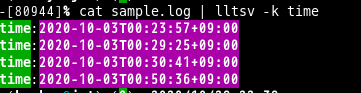
Original version of lltsv doesn't specify background color, so it is hard to recognize texts in dark background. I've fixed this issue by specifying background color explicitly. Here is the screenshot of fixed version. Yay! f:id:kenhys:20201028223848p:plain This issue was already forwarded as PR github.com

27 October 2020

Noah Meyerhans: Debian STS: Short Term Support

In another of my frequent late-night bouts with insomnia, I started thinking about the intersection of a number of different issues facing Debian today, both from a user point of view and a developer point of view. Debian has a reputation for shipping stale software. Versions in the stable branch are often significantly behind the latest development upstream. Debian s policy here has been that this is fine, our goal is to ship something stable, not something bleeding edge. Unofficially, our response to users is: If you need bleeding edge software, Debian may not be for you. Officially, we have no response to users who want fresher software. Debian also has a problem with a lack of manpower. I believe that part of why we have a hard time attracting contributors is our reputation for stale software. It might be worth it for us to consider changes to our approach to releases.

What about running testing? People who want newer software often look to Debian s testing branch as a possible solution. It s tempting, as it s a dynamically generated release based on unstable, so it should be quite current. In practice, it s not at all uncommon to find people running testing, and in fact I m running it right now on the ThinkPad on which this is being typed. However, testing comes with a glaring issue: a lack of timely security support. Security updates must still propagate through unstable, and this can take some time. They can be held up by dependencies, library transitions, or other factors. Nearly every list of best practices for computer security lists keeping software up-to-date at or near the top of most important steps to take to safely use networked computer. Debian s testing branch makes this very difficult, especially when faced with a zero-day with potential for real-world exploit.

What about stable-backports? Stable backports is both better and worse than testing. It s better in that it allows you to run a system comprised mainly of packages from the stable branch, which receive updates from the security team in a timely manner. However, it s worse in that the packages from the backports repository incur an additional delay. The expectation around backports is that a package migrates naturally from unstable to testing, and then requires a maintainer to upload a new package based on the version in testing specifically targeted at stable backports. The migration can potentially be bypassed, and we used to have a mechanism for announcing the availability of security updates for the stable backports archive, but it has gone unused for several years now. The documentation describes a workflow for posting security updates that involves creating a ticket in Debian s RT system, which is going to be quite foreign to most people. News from mid 2019 suggests that this process might change, but nothing appears to have come of this in over a year, and we still haven t seen a proper security advisory for stable backports in years.

Looking to LTS for ideas The Long-Term Support project is an alternative branch of Debian, maintained outside the normal stable release infrastructure. It s stable, and expected to behave that way, but it s not supported by the stable security team or release team. LTS provides a framework for providing security updates via targeted uploads by a team of interested individuals working outside the structure of the existing stable releases. This project seems to be quite active (how much of this is because at least some members are being paid?), and as of this writing has actually published more security advisories in the past month than the stable security team has published for the current stable branch. This is also interesting in that the software in LTS is quite old, first appearing in a Debian stable release in 2017. LTS is particularly interesting here as it s an example an initiative within the Debian community taken specifically to address user needs. For some of our users, remaining on an old release is a perfectly valid thing for them to do, and we recognize this and support them in doing so.

Debian Short-Term Support So, what would it take to create an LTS-like initiative in the other direction? Instead of providing ongoing support for ancient versions of software that previously comprised a stable release, could we build a distribution branch based on something that hasn t yet reached stable? What would that look like? How would it fit in the existing unstable testing migration process? What impact would it have on the size of the archive? Would we want a rolling release, or discrete releases? If the latter, how many would we want between proper stable releases? The security tracker already tracks outstanding issues in unstable and testing, and can even show issues that have been fixed in unstable but haven t yet propagated to testing. If we want a rolling release, maybe we could just open up the testing-security repository more broadly? There was once a testing security team, which IIRC was chartered to publish updated packages directly to testing security, along with associated security advisory. Based on the mailing list history, that effort seems to have shut down around the time of the squeeze (Debian 6.0) release in early 2011. Would it be worth resurrecting it? We ve probably got much of the infrastructure required in place already, since it previously existed. Personally I m not really a fan of a pure rolling release. I d rather see a light-weight release. Maybe a snapshot of testing that gets just a date, not a Toy Story codename. Probably skip building a dedicated installer for it. Upgrade from stable or use a d-i snapshot from testing if needed. This mini release is supported until the next one comes out, maybe 6 or 8 months later. By supported, I mean that the Short Term Release team is responsible for it. They can upload security or other critical bug fixes directly to a dedicated repository. When the next STS snapshot is released, packages in the updates repository are either archived, if they re a lower version than the one in the new mini release, or rebuilt against the new mini release and preserved. Using some of the same mechanisms as the LTS release, we d need
  1. Something to take the place of oldstable, that is the base release against which updates are released. This could be something that effectively maps to a date snapshot served by http://snapshot.debian.org/. (Snapshot itself could not currently handle the increased load, as I understand it, but conceptually it s similar.)
  2. Something to take the place of the dist/updates apt repository that hosts the packages that are updated.
In theory, if the infrastructure could support hose things, then we could in effect generate a mini release at any time based on a snapshot. I wonder if this could start as something totally unofficial; mirror an arbitrary testing snapshot and provide a place for interested people to publish package updates.

Not a proposal, nor a criticism To be clear, I don t really intend this as a proposal; It s really half-baked. Maybe these ideas have already been considered and dismissed. I don t know if people would be interested in working on such a project, and I m not nearly familiar enough with the Debian archive tooling to even make a guess as to how hard it would be to implement much of it. I m just posting some ideas that I came up with while pondering something that, from my perspective, is an area where Debian is clearly failing to meet the needs of some of our users. We know Debian is a popular and respected Linux distribution, and we know people value our stability. However, we also know that people like running Fedora and Ubuntu s non-LTS releases. People like Arch Linux. Not just end-users , but also the people developing the software shipped by the distros themselves. There are a lot of potential contributors to Debian who are kept away by our unwillingness to provide a distro offering both fresh software and security support. I think that we could attract more people to the Debian community if we could provide a solution for these people, and that would ultimately be good for everybody. Also, please don t interpret this as being critical of the release team, the stable security team, or any other team or individual in Debian. I m sharing this because I think there are opportunities for Debian to improve how we serve our users, not because I think anybody is doing anything wrong. With all that said, though, let me know if you find the ideas interesting. If you think they re crazy, you can tell me that, too. I ll probably agree with you.

26 October 2020

Marco d'Itri: RPKI validation with FORT Validator

This article documents how to install FORT Validator (an RPKI relying party software which also implements the RPKI to Router protocol in a single daemon) on Debian 10 to provide RPKI validation to routers. If you are using testing or unstable then you can just skip the part about apt pinnings. The packages in bullseye (Debian testing) can be installed as is on Debian stable with no need to rebuild them, by configuring an appropriate pinning for apt:
cat <<END > /etc/apt/sources.list.d/bullseye.list
deb http://deb.debian.org/debian/ bullseye main
END
cat <<END > /etc/apt/preferences.d/pin-rpki
# by default do not install anything from bullseye
Package: *
Pin: release bullseye
Pin-Priority: 100
Package: fort-validator rpki-trust-anchors
Pin: release bullseye
Pin-Priority: 990
END
apt update
Before starting, make sure that curl (or wget) and the web PKI certificates are installed:
apt install curl ca-certificates
If you already know about the legal issues related to the ARIN TAL then you may instruct the package to automatically install it. If you skip this step then you will be asked at installation time about it, either way is fine.
echo 'rpki-trust-anchors rpki-trust-anchors/get_arin_tal boolean true' \
    debconf-set-selections
Install the package as usual:
apt install fort-validator
You may also install rpki-client and gortr on Debian 10, or maybe cfrpki and gortr. I have also tried packaging Routinator 3000 for Debian, but this effort is currently on hold because the Rust ecosystem is broken and hostile to the good packaging practices of Linux distributions.

Marco d'Itri: RPKI validation with OpenBSD's rpki-client and Cloudflare's gortr

This article documents how to install rpki-client (an RPKI relying party software, the actual validator) and gortr (which implements the RPKI to Router protocol) on Debian 10 to provide RPKI validation to routers. If you are using testing or unstable then you can just skip the part about apt pinnings. The packages in bullseye (Debian testing) can be installed as is on Debian stable with no need to rebuild them, by configuring an appropriate pinning for apt:
cat <<END > /etc/apt/sources.list.d/bullseye.list
deb http://deb.debian.org/debian/ bullseye main
END
cat <<END > /etc/apt/preferences.d/pin-rpki
# by default do not install anything from bullseye
Package: *
Pin: release bullseye
Pin-Priority: 100
Package: gortr rpki-client rpki-trust-anchors
Pin: release bullseye
Pin-Priority: 990
END
apt update
Before starting, make sure that curl (or wget) and the web PKI certificates are installed:
apt install curl ca-certificates
If you already know about the legal issues related to the ARIN TAL then you may instruct the package to automatically install it. If you skip this step then you will be asked at installation time about it, either way is fine.
echo 'rpki-trust-anchors rpki-trust-anchors/get_arin_tal boolean true' \
    debconf-set-selections
Install the packages as usual:
apt install rpki-client gortr
And then configure rpki-client to generate its output in the the JSON format needed by gortr:
echo 'OPTIONS=-j' > /etc/default/rpki-client
You may manually start the service unit to immediately generate the data instead of waiting for the next timer run:
systemctl start rpki-client &
gortr too needs to be configured to use the JSON data generated by rpki-client:
echo 'GORTR_ARGS=-bind :323 -verify=false -checktime=false -cache /var/lib/rpki-client/json' > /etc/default/gortr
And then it needs to be restarted to use the new configuration:
systemctl restart gortr
You may also install FORT Validator on Debian 10, or maybe cfrpki with gortr. I have also tried packaging Routinator 3000 for Debian, but this effort is currently on hold because the Rust ecosystem is broken and hostile to the packaging practices of Linux distributions.

24 October 2020

Dirk Eddelbuettel: digest 0.6.27: Build fix

Exactly one week after the previous release 0.6.26 of digest, a minor cleanup release 0.6.27 just arrived on CRAN and will go to Debian shortly. digest creates hash digests of arbitrary R objects (using the md5, sha-1, sha-256, sha-512, crc32, xxhash32, xxhash64, murmur32, spookyhash, and blake3 algorithms) permitting easy comparison of R language objects. It is a fairly widely-used package (currently listed at one million monthly downloads, 282 direct reverse dependencies and 8068 indirect reverse dependencies, or just under half of CRAN) as many tasks may involve caching of objects for which it provides convenient general-purpose hash key generation. Release 0.6.26 brought support for the (nice, even cryptographic) blake3 hash algorithm. In the interest of broader buildability we had already (with a sad face) disabled a few very hardware-specific implementation aspects using intrinsic ops. But to our chagrin, we left one #error define that raised its head on everybody s favourite CRAN build platform. Darn. So 0.6.27 cleans that up and also removes the check and #error as all the actual code was already commented out. If you read this and tears start running down your cheeks, then by all means come and help us bring blake3 to its full (hardware-accelerated) potential. This (probably) only needs a little bit of patient work with the build options and configurations. You know where to find us My CRANberries provides the usual summary of changes to the previous version. For questions or comments use the issue tracker off the GitHub repo. If you like this or other open-source work I do, you can now sponsor me at GitHub. For the first year, GitHub will match your contributions.

This post by Dirk Eddelbuettel originated on his Thinking inside the box blog. Please report excessive re-aggregation in third-party for-profit settings.

23 October 2020

Dirk Eddelbuettel: RcppSpdlog 0.0.3: New features and much more docs

A good month after the initial two releases, we are thrilled to announce relase 0.0.3 of RcppSpdlog. This brings us release 1.8.1 of spdlog as well as a few local changes (more below). RcppSpdlog bundles spdlog, a wonderful header-only C++ logging library with all the bells and whistles you would want that was written by Gabi Melman, and also includes fmt by Victor Zverovic. This version of RcppSpdlog brings a new top-level function setLogLevel to control what events get logged, updates the main example to show this and to also make the R-aware logger the default logger, and adds both an extended vignette showing several key features and a new (external) package documentation site. The NEWS entry for this release follows.

Changes in RcppSpdlog version 0.0.3 (2020-10-23)
  • New function setLogLevel with R accessor in exampleRsink example
  • Updated exampleRsink to use default logger instance
  • Upgraded to upstream release 1.8.1 which contains finalised upstream use to switch to REprintf() if R compilation detected
  • Added new vignette with extensive usage examples, added compile-time logging switch example
  • A package documentation website was added

Courtesy of my CRANberries, there is also a diffstat report. More detailed information is on the RcppSpdlog page. If you like this or other open-source work I do, you can now sponsor me at GitHub. For the first year, GitHub will match your contributions.

This post by Dirk Eddelbuettel originated on his Thinking inside the box blog. Please report excessive re-aggregation in third-party for-profit settings.

Molly de Blanc: Endorsements

Transparency is essential to trusting a technology. Through transparency we can understand what we re using and build trust. When we know what is actually going on, what processes are occurring and how it is made, we are able to decide whether interacting with it is something we actually want, and we re able to trust it and use it with confidence. This transparency could mean many things, though it most frequently refers to the technology itself: the code or, in the case of hardware, the designs. We could also apply it to the overall architecture of a system. We could think about the decision making, practices, and policies of whomever is designing and/or making the technology. These are all valuable in some of the same ways, including that they allow us to make a conscious choice about what we are supporting. When we choose to use a piece of technology, we are supporting those who produce it. This could be because we are directly paying for it, however our support is not limited to direct financial contributions. In some cases this is because of things hidden within a technology: tracking mechanisms or backdoors that could allow companies or governments access to what we re doing. When creating different types of files on a computer, these files can contain metadata that says what software was used to make it. This is an implicit endorsement, and you can also explicitly endorse a technology by talking about that or how you use it. In this, you have a right (not just a duty) to be aware of what you re supporting. This includes, for example, organizational practices and whether a given company relies on abusive labor policies, indentured servitude, or slave labor.
Endorsements inspire others to choose a piece of technology. Most of my technology is something I investigate purely for functionality, and the pieces I investigate are based on what people I know use. The people I trust in these cases are more inclined than most to do this kind of research, to perform technical interrogations, and to be aware of what producers of technology are up to. This is how technology spreads and becomes common or the standard choice. In one sense, we all have the responsibility (one I am shirking) to investigate our technologies before we choose them. However, we must acknowledge that not everyone has the resources for this the time, the skills, the knowledge, and therein endorsements become even more important to recognize. Those producing a technology have the responsibility of making all of these angles something one could investigate. Understanding cannot only be the realm of experts. It should not require an extensive background in research and investigative journalism to find out whether a company punishes employees who try to unionize or pay non-living wages. Instead, these must be easy activities to carry out. It should be standard for a company (or other technology producer) to be open and share with people using their technology what makes them function. It should be considered shameful and shady to not do so. Not only does this empower those making choices about what technologies to use, but it empowers others down the line, who rely on those choices. It also respects the people involved in the processes of making these technologies. By acknowledging their role in bringing our tools to life, we are respecting their labor. By holding companies accountable for their practices and policies, we are respecting their lives.

22 October 2020

Vincent Fourmond: QSoas tips and tricks: generating smooth curves from a fit

Often, one would want to generate smooth data from a fit over a small number of data points. For an example, take the data in the following file. It contains (fake) experimental data points that obey to Michaelis-Menten kinetics: $$v = \frac v_m 1 + K_m/s $$ in which \(v\) is the measured rate (the y values of the data), \(s\) the concentration of substrate (the x values of the data), \(v_m\) the maximal rate and \(K_m\) the Michaelis constant. To fit this equation to the data, just use the fit-arb fit:
QSoas> l michaelis.dat
QSoas> fit-arb vm/(1+km/x)
After running the fit, the window should look like this:
Now, with the fit, we have reasonable values for \(v_m\) (vm) and \(K_m\) (km). But, for publication, one would want to generate "smooth" curve going through the lines... Saving the curve from "Data.../Save all" doesn't help, since the data has as many points as the original data and looks very "jaggy" (like on the screenshot above)... So one needs a curve with more data points. Maybe the most natural solution is simply to use generate-buffer together with apply-formula using the formula and the values of km and vm obtained from the fit, like:
QSoas> generate-buffer 0 20
QSoas> apply-formula y=3.51742/(1+3.69767/x)
By default, generate-buffer generate 1000 evenly spaced x values, but you can change their number using the /samples option. The two above commands can be combined to just one call to generate-buffer:
QSoas> generate-buffer 0 20 3.51742/(1+3.69767/x)
This works, but it is quite cumbersome and it is not going to work well for complex formulas or the results of differential equations or kinetic systems... This is why to each fit- command corresponds a sim- command that computes the result of the fit using a "saved parameters" file (here, michaelis.params, but you can also save it yourself) and buffers as "models" for X values:
QSoas> generate-buffer 0 20
QSoas> sim-arb vm/(1+km/x) michaelis.params 0
This strategy works with every single fit ! As an added benefit, you even get the fit parameters as meta-data, which are displayed by the show command:
QSoas> show 0
Dataset generated_fit_arb.dat: 2 cols, 1000 rows, 1 segments, #0
Flags: 
Meta-data:	commands =	 sim-arb vm/(1+km/x) michaelis.params 0	fit =	 arb (formula: vm/(1+km/x))	km =	 3.69767
	vm =	 3.5174
They also get saved as comments if you save the data. Important note: the sim-arb command will be available only in the 3.0 release, although you can already enjoy it if you use the github version. About QSoasQSoas is a powerful open source data analysis program that focuses on flexibility and powerful fitting capacities. It is released under the GNU General Public License. It is described in Fourmond, Anal. Chem., 2016, 88 (10), pp 5050 5052. Current version is 2.2. You can download its source code and compile it yourself or buy precompiled versions for MacOS and Windows there.

21 October 2020

Dirk Eddelbuettel: RcppZiggurat 0.1.6

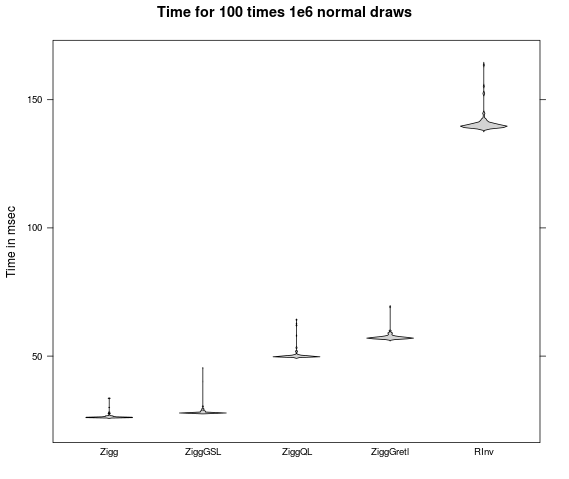
ziggurats A new release, now at version 0.1.6, of RcppZiggurat is now on the CRAN network for R. The RcppZiggurat package updates the code for the Ziggurat generator by Marsaglia and other which provides very fast draws from a Normal distribution. The package provides a simple C++ wrapper class for the generator improving on the very basic macros, and permits comparison among several existing Ziggurat implementations. This can be seen in the figure where Ziggurat from this package dominates accessing the implementations from the GSL, QuantLib and Gretl all of which are still way faster than the default Normal generator in R (which is of course of higher code complexity). This release brings a corrected seed setter and getter which now correctly take care of all four state variables, and not just one. It also corrects a few typos in the vignette. Both were fixed quite a while back, but we somehow managed to not ship this to CRAN for two years. The NEWS file entry below lists all changes.

Changes in version 0.1.6 (2020-10-18)
  • Several typos were corrected in the vignette (Blagoje Ivanovic in #9).
  • New getters and setters for internal state were added to resume simulations (Dirk in #11 fixing #10).
  • Minor updates to cleanup script and Travis CI setup (Dirk).

Courtesy of my CRANberries, there is a diffstat report for this release. More information is on the RcppZiggurat page. If you like this or other open-source work I do, you can now sponsor me at GitHub. For the first year, GitHub will match your contributions.

This post by Dirk Eddelbuettel originated on his Thinking inside the box blog. Please report excessive re-aggregation in third-party for-profit settings.

Next.

Previous.