Search Results: "tb"

1 October 2011

Dirk Eddelbuettel: Reminder: One week til Rcpp class in San Francisco

Just a quick note to remind everyone that the Rcpp class in San Francisco, which I am holding together with Revolution Analytics, will take place a week from today. We are happy to report that the number of registrations has met our initial targets. But as a number of open slots remain, we have decided to offer a few places at discounts of 25% for academics (with code acad1) and 50% for students (with code student). Course details are at the Revolution course page, registration is at the Eventbrite page. And just for completeness, here is what I wrote in the previous announcement:
The format will follow the workshop Romain and I gave during the tutorial day preceding this year's R/Finance conference. The style will once again be hands-on, with copious concrete examples and solid coverage of most aspects of Rcpp and related packages such as RInside, RcppArmadillo and others. The eight-hour schedule contains about six hours of instruction, split into four sessions of around ninety minutes. This leaves ample time for both lunch and coffee breaks, and for informal discussions and Q+A. The one-day class will be offered in San Franciso on Saturday, October 8, 2011. Please see the official course page for more details, concrete location info and maps as well as registration details.
Feel free to contact me at the usual email address with questions. Or with suggestions for the after-party in San Francisco :)

Wouter Verhelst: Bugs filed versus the phase of the moon.

One of the more classic jokes about not yet understood bugs is that the phase of the moon is somehow involved in causing it. Being bored, I decided to spend some time to see whether "date of bug filed" could somehow be correlated with "phase of the moon" for a given source package. Fast forward an hour of perl experimenting, and here we are:
#!/usr/bin/perl -w
use strict;
use warnings;
use constant PI => 3.1415926535;
use feature "say";
use SOAP::Lite;
use Astro::Coord::ECI::Moon;
my $soap = SOAP::Lite->uri('Debbugs/SOAP')->proxy('http://bugs.debian.org/cgi-bin/soap.cgi');
if (!defined($ARGV[0]))  
	die "E: must have a source package!\n";
 
my @bugs = $soap->get_bugs(src=>$ARGV[0])->result();
my $bugsdata = $soap->get_status(@bugs)->result();
my $moon = Astro::Coord::ECI::Moon->new();
my %count = ( 'new' => 0, 'first' => 0, 'full' => 0, 'last' => 0);
foreach my $bug (keys %$bugsdata)  
	my $time = $$bugsdata $bug -> date ;
	my $phase = $moon->phase($time);
	if ($phase <= 45 * PI / 180   $phase > 315 * PI / 180)  
		$count 'new'  = $count 'new'  + 1;
	  elsif ($phase <= 135 * PI / 180 && $phase > 45 * PI / 180)  
		$count 'first'  = $count 'first'  + 1;
	  elsif ($phase <= 225 * PI / 180 && $phase > 135 * PI / 180)  
		$count 'full'  = $count 'full'  + 1;
	  elsif ($phase <= 315 * PI / 180 && $phase > 225 * PI / 180)  
		$count 'last'  = $count 'last'  + 1;
	 
 
say "Number of bug submissions during new moon     : " . $count new ;
say "Number of bug submissions during first quarter: " . $count first ;
say "Number of bug submissions during full moon    : " . $count full ;
say "Number of bug submissions during last quarter : " . $count last ;
This uses the (not packaged in Debian) Astro::Coord::ECI::Moon perl module. Use like so:
wouter@carillon:~code/perl$ ./debbugsmoon nbd
Number of bug submissions during new moon     : 2
Number of bug submissions during first quarter: 10
Number of bug submissions during full moon    : 1
Number of bug submissions during last quarter : 3
Apparently there's a reasonable correlation between 'the moon is in the first quarter' and 'people file bugs on nbd'. Note: no, the above is probably not very scientific. That's not the point.

28 September 2011

Joey Hess: borrowed dogs

I've never had a dog of my own since I grew up, but there have always been dogs in my life.
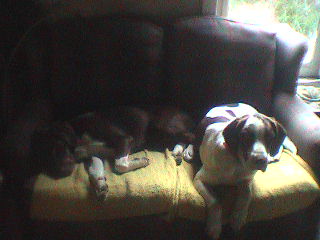
Calypso and Percy
Calypso was dropped off at Wortroot soon after I moved in, and was my borrowed dog for years. And she remained out there, spending a good decade with run of the woods, fields and streams, a good doggy life. She got old and feeble, spent winters by the fireplace, and finally it was too much for her. I'll miss her, the best dog I've known. Recently I've caught glimpses of a dog lurking in the distance here at the Hollow. When I noticed it was sleeping on the roof of the battery box, I realized it was probably one of the dogs that used to live here but were given away last year. Exchanged email with the likely owners, now in Sudan, and they tell me her name is Domino, and she must have run away home. So I've been putting out food for Domino this week, and yesterday she came close enough to be petted. Medium sized and white, her name is for a black mask extending from eyes to ears. Although currently skittish, she seems basically a good, calm dog.

Alexander Reichle-Schmehl: How to properly route packages on hosts with multiple NICs?

Dear lazyweb, I'm encountering a routing problem on one of my Linux machine, for which I haven't found a solution so far. I have a machine which has several network interfaces in different network (it's our monitoring system). So I have eth0 with 192.168.1.2 and eth1 with 10.0.0.2, and an dns entry pointing from myname to 192.168.1.2. Problems occur, if hosts in the 10.x.x.x network try to access the hosts. Accessing it via it's IP address in that network works, however if they try to access him via his other IP address 192.168.1.2 (e.g. because they resolve it via dns), it leads to some problems: The host send their packet to his IP address (which works), however when my machine sends the answer, it takes a shortcut, and sends them directly via eth1 and with 10.0.0.2 as source IP. This however gets filtered by a (stateful) firewall somewhere in between, as packet send to 192.168.1.2 are suddenly answered by 10.0.0.2. So far I found two solutions: Adjust the DNS to resolve to different IPs depending on the source of the request (ugly) or tell all firewalls to always let packet from my host pass, despite the changes source IP (also ugly, and probably quite some work). Is there anything else I can do? What I would really like, would be a way to tell my linux box to always respond with the IP it was talked to, even if there would be a shorter way to the origin according to the routing rable. So, if a host 10.0.0.42 contacts my host via the IP 192.168.1.2, the answer packet should come from 192.168.1.2 via eth0 instead of instead of having a source IP set to 10.0.0.2, it should be send via eth1. Is that somehow possible? Update: Wow, that was fast! The ink of my blog is still fresh, and I already got the answer! The solution to my problem is policy based routing. Thanks to weasel, Peter and Dale for their pointers! More information available at http://lartc.org/howto/lartc.rpdb.html, http://www.itbuzzer.net/corner/2007/09/how-to-implement-source-routing-with.asp or http://wiki.georgweiss.de/Linux/source_routing.

27 September 2011

Vincent Bernat: Speeding up SSL: enabling session reuse

Session reuse is one of the most important mechanism to improve SSL performance: by submitting an appropriate blob to the server, a client is able to trigger an abbreviated handshake, improving latency and computation time. There exists two distinct ways to achieve session reuse: session identifiers as described in RFC 5246 and session tickets as depicted in RFC 5077. A quick note: when I say SSL, unless I mention a version number, you should read TLS instead. Look at the article for TLS on Wikipedia for some background on this.

Theory of operation To establish a SSL connection, four messages need to be exchanged between client and server. With a latency of 50 ms, we have a 200 ms overhead to establish the connection (plus TCP handshake). Moreover, to share a common secret, both the client and the server needs to achieve some public-key cryptographic operations which are costly, computation-wise. SSL full handshake To avoid a full SSL handshake each time a client request a resource, it is possible for the client to request an abbreviated handshake, saving a complete round-trip (100 ms) and avoiding the costliest part of the full SSL handshake. SSL abbreviated handshake Two mechanisms can be used to accomplish an abbreviated handshake:
  1. When the server sends the Server Hello message, it can include a session identifier. The client should store it and present it in the Client Hello message of the next session. If the server finds the corresponding session in its cache and accepts to resume the session, it will send back the same session identifier and will continue with the abbreviated SSL handshake. Otherwise, it will issue a new session identifier and switch to a full handshake. This mechanism is detailed in RFC 5246. It is the most common mechanism because it exists since earlier versions of SSL.
  2. In the last exchange of a full SSL handshake, the server can include a New Session Ticket message (not represented in the handshake described in the picture) which will contain the complete session state (including the master secret negotiated between the client and the server and the cipher suite used). Therefore, this state is encrypted and integrity-protected by a key known only by the server. This opaque datum is known as a session ticket. The details lie in RFC 5077 which supersedes RFC 4507.
The ticket mechanism is a TLS extension. The client can advertise its support by sending an empty Session Ticket extension in the Client Hello message. The server will answer with an empty Session Ticket extension in its Server Hello message if it supports it. If one of them does not support this extension, they can fallback to the session identifier mechanism built into SSL. RFC 5077 identifies situations where tickets are desirable over session identifiers. The main improvement is to avoid to maintain a server-side session cache since the whole session state is remembered by the client, not the server. A session cache can be costly in term of memory and difficult to share between multiple hosts when requests are load-balanced across servers.

Browser support Session identifiers are part of SSL and are therefore supported since a long time by clients and servers. However, session tickets are an optional TLS extension and therefore, the support is not as widespread as for session identifiers. Support for tickets was added in OpenSSL 0.9.8f (October 2007). In GnuTLS, this is version 2.9.3 (August 2009). For NSS, the set of libraries behind most browsers, support of RFC 5077 is in version 3.12 (June 2008). Schannel, Microsoft implementation of TLS, does not currently supports tickets. To check if a browser supports session resume without and with tickets, I have written a web server listening to several ports with different configurations (session cache disabled or enabled, ticket support disabled or enabled). With the help of some Javascript, it is possible to interact with this server to determine what kind of session resume a browser support. Checking for browser support for session resume It is difficult to get extensive results this way since you need to install a lot of browsers to get something valuable. Surprisingly, Android 2.3.4 browser (as shipped by Cyanogen Mod) does not support any session resume. Another way to check if a browser supports session resume is to use a sniffer and to spot Client Hello messages. If a client tries to resume a session, it will use an appropriate session identifier or send a ticket. A simple program parsing PCAP files allows to automate this task and get some interesting statistics. Here are random facts from more than 300 000 requests (38 000 clients) to a customer care service of an important French telco:
  • 35% of requests exhibit support of tickets;
  • 53.3% of requests ask to resume without tickets; 25.6% with tickets;
  • 67.2% of requests exhibit support of SNI;
  • 86.7% of requests use TLS 1.0; the remaining uses SSL 3.0; almost no TLS 1.1/1.2;
  • in average, a client execute 8 SSL handshakes;
  • ciphers supported by all clients are 3DES-SHA, RC4-MD5 and RC4-SHA.
With some log analysis to match each requests with the appropriate user agent, we can split the world in two parts: browsers supporting RFC 5077 (Chrome and Firefox) and browsers not supporting RFC 5077 (Internet Explorer, Opera 9.80, Safari for MacOS and iOS and Android browser).

Web server support There is no unique recipe to configure a web server to handle appropriately and efficiently session resume. Here are some generic directions :
  • if the web server uses multiple processes, you need to configure a shared memory session cache; usually, tickets will work just fine in this setup;
  • if you use local load-balancing, one easy way to avoid any problem is to use ensure that one IP is mapped to one server (either statically with hashing or dynamically with a stick table); if your load-balancer understands SSL, you can also use session identifier (and disable tickets1) to build a stick table;
  • if you don t want to apply the previous advice, you need to share the session cache between the servers with something like memcached and disable tickets;
  • if you use global load-balancing (DNS based), there is no need to ensure that session resumption works across geographic pools since a user will usually stick to one pool.
Remember that only one client out of three supports TLS tickets. Therefore, you cannot rely on them to ensure proper session resume. You need a session cache.

Setting a session cache with Apache & nginx Apache features two different SSL engines. The first one is mod_ssl and uses OpenSSL as backend. It is possible to setup a shared session cache with SSLSessionCache but the memcached-enabled session cache is available only in the development branch. You can also get one by switching to mod_gnutls backend. The cache is enabled with GnuTLSCache. In this case, do not enable tickets because they cannot be shared. With nginx, you need to enable the shared session cache with ssl_session_cache. Currently, it lacks a memcached-enabled session cache but Matt Palmer has some patches to add it to the 0.8 branch. However, those patches can have a serious impact on nginx performance since retrieving a session from memcached is done synchronously (mostly because a limitation in OpenSSL design who does not allow to register asynchronous callbacks with SSL_CTX_sess_set_get_cb()). As a proof of concept, I have also added a similar feature to stud, the scalable TLS unwrapping daemon, a very efficient network proxy terminating SSL connections. The same limitation as for nginx applies: performances will suffer. Look at the pull request for more details.

Sharing tickets RFC 5077 tells tickets allow to load-balance requests across servers. However, to the best of my knowledge, there is currently no web server able to share tickets across a pool. Actually, when a server initializes its SSL stack, it will randomly generate some keys that will be used to protect and encrypt tickets. In OpenSSL, from ssl/ssl_lib.c:
    /* Setup RFC4507 ticket keys */
    if ((RAND_pseudo_bytes(ret->tlsext_tick_key_name, 16) <= 0)
              (RAND_bytes(ret->tlsext_tick_hmac_key, 16) <= 0)
              (RAND_bytes(ret->tlsext_tick_aes_key, 16) <= 0))
            ret->options  = SSL_OP_NO_TICKET;
Therefore, with a round-robin load-balanced pool of servers, tickets have to be disabled because servers would not accept tickets from neighbors. One way to solve this is to generate keys deterministically by hashing some common secret with the private key. I have implemented this approach for stud. Here is a simplified version (no error handling, no allocation) of the pull request for this feature:
    unsigned char keys[48];
    EVP_PKEY *pkey = grab_private_key();
    /* To get our key, we sign the seed with the private key */
    unsigned int siglen;
    unsigned char sign[LARGE_ENOUGH];
    EVP_MD_CTX mdctx;
    EVP_MD_CTX_init(&mdctx);
    EVP_SignInit(&mdctx, EVP_sha256());
    EVP_SignUpdate(&mdctx, some_secret, strlen(some_secret));
    EVP_SignFinal(&mdctx, sign, &siglen, pkey);
    /* And we keep only the first bytes. */
    memcpy(keys, sign, sizeof(keys));
    /* Tell OpenSSL to use those keys */
    SSL_CTX_set_tlsext_ticket_keys(ctx, keys, sizeof(keys));

Testing While tests can be done with just openssl s_client and openssl sess_id, testing all aspects can take a lot of time. For this purpose, I have written a client testing session resume with and without tickets. Here is a typical result: twitter.com RFC session resume The program will try to establish five consecutive SSL connections for each IP without and with tickets. For each IP, the last four SSL connections should always reuse the first SSL session. Here, Twitter web servers seem properly configured: for each IP, session resume is successful. Their web servers do not support tickets or they may have disabled it because they share the session cache between servers inside the same pool.

  1. RFC 5077 describes interactions between session identifiers and session tickets. When using tickets, the server should send back an empty session identifier. The client may present an empty session identifier or generate one. However, for all practical purposes, it seems that servers send back a non-empty session identifier and clients just stick to this identifier. Please, investigate if you want to use SSL session identifiers for load-balancing while keeping tickets enabled.

Kartik Mistry: Updates

* Life: As usual. * Debian: Lots of stuffs going on. We ve yet another MiniDebConf edition, this time at Mangalore. (Not really, it is at: NMAM Institute of Technology, Nitte) And, yes, we ve some nice international guests this time. (Ah, hello, bubulle!). I ve booked ticket etc. even I m heading there during Diwali time, I hope that it will be more fun than usual crackers + sweets etc this time! gwibber still sucks. * There is nothing apart from Life, Debian that needs update. Aye. Aye.

26 September 2011

John Goerzen: Five

Dad, will you and mom stay up all night decorating the house for me?
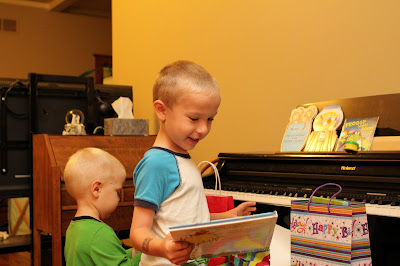
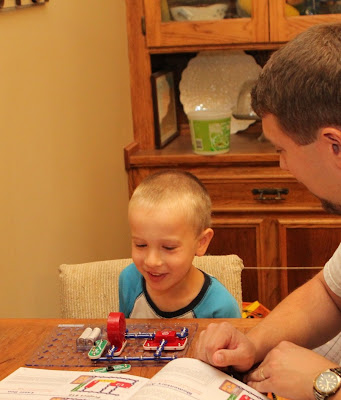
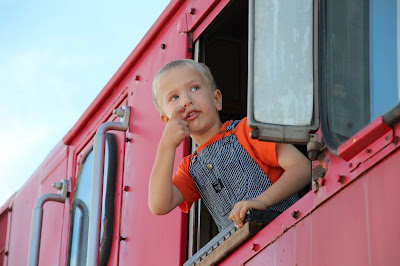
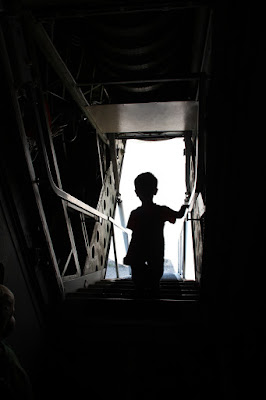
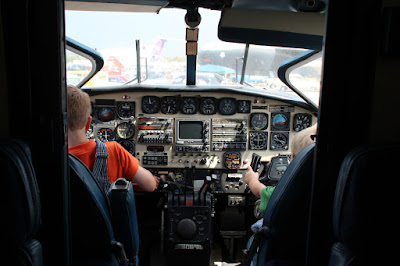
That was Jacob s question to me at bedtime the evening before his fifth birthday. Jacob had already had his birthday party a few weeks ago. When scheduling means that parties happen that far away from the boys real birthdays, they get a smaller celebration with just Terah and me where we open their presents from us. A low-key thing, so we weren t planning to decorate the house. I said, Well, I don t think we ll be doing all that since you already had your birthday party. And the look of eager anticipation on his face turned to a very sad and disappointed look, and made me feel really bad. Uhoh. So while Jacob was sleeping, I mentioned it to Terah. We decided we should improvise something simple, so she found some old streamers and we taped them up, running them through several rooms in the house and across his door. It took a few minutes using supplies we already had, but the joy the next morning was priceless. Oh dad, you said you wouldn t stay up all night, BUT YOU DID! Oh I am SO HAPPY! YAY YAY YAY! And he ran through the house to discover what else was set up. Then he ran to find Oliver and gave him a tour of everything. Then we sat down to open his presents. Here he is, holding a present from Terah and me: That s a copy of The Lorax. My friend Jonathan had brought a copy along during our road trip in Mexico, and Jacob was really excited about it. And didn t really want to give it up, because You can only get The Lorax in Mexico. He (and Oliver) really enjoyed all his presents he also got a train book from us (which he said, Oh, yay, it s the book they have at preschool! ), and a game and some other presents from the distant relatives. But the highlight was something of an impulse buy. I was at the RadioShack in Derby a place I ve written about before, It is what a RadioShack should (and used to) be. It has a large amateur radio section, sells all sorts of coax by the foot, and provides astonishingly good post-sale service. Well, I was there with a radio question, and Mark (the owner) who is an excellent salesman in a positive way pointed me to a display of snap kits. I noticed their Electronics 101 Snap-Kit (a rebranded Snap Circuits Jr. SC-100). A ham in Pennsylvania had suggested them to me once, and as Jacob s birthday was coming up, I gave it some thought. The kit said ages 8 and up. I asked Mark what he thought about a boy just turning 5. He said, Well, probably not normally. But knowing you, if you re there to work on them with him, I think he d enjoy it. But I wouldn t have him work on it by himself. I agreed and we bought it. I pondered how to explain the concept of this thing to Jacob. Eventually I decided I would call it a toy-building kit. He understood that. Jacob and I spent hours together working with it. He would flip through the book, either picking circuits that looked interesting or telling me what kind of circuit he wanted to build. Then I would tell him what to put where, and he d snap them together and play with them. He only played with each finished product a few minutes before he was ready to try another. Once I got him very excited with my offer to show him how to hook up two switches in parallel for the fan he built (and later introduced the parallel vs. series concept by hooking them up in series instead.) Here we are working on it together. Jacob repeatedly called Terah over to look at the things he built. He was very excited that he assembled it himself. Eventually, Oliver (age 2) came over wanting to help. So he sat on my lap, and handed parts to Jacob, then Jacob put them on the grid. Oliver really enjoyed being involved in this way, even though I had to keep him from doing things like ripping the capacitor off its mount. We tend to be modest in terms of the number of things we give the boys and their cost, reasoning that we, like many, already have too many toys in our house, and that greater cost doesn t necessarily equate with a better experience for the boys. I particularly look for things with lasting value and unique experiences for them, and I think we succeeded this year. But I realized quickly that the greatest value of this kit wasn t electronics. It was having a great way for me to spend a lot of time doing things with the boys which all of us enjoyed. Those hours building things together were as much a present for me as for Jacob, I m quite sure. Jacob s real party was a few weeks ago at the Great Plains Transportation Museum in Wichita. They let people rent a historic caboose to use for a birthday party for children. So we did that for Jacob this year. That was a huge hit for the boys. Jacob got to help his grandpa make some pie (instead of cake) for the party. He enjoyed eating it, of course. He enjoyed opening his presents high up on the observation chair in the caboose. And the boys got to play on all the other equipment in the museum. Jacob enjoyed playing tour guide for family since most of them hadn t been there. He also enjoyed watching freight trains pass on the other side of the fence from the museum preferably while sitting in one of the museum s engines. Oliver certainly didn t get left out. Train-watching is serious business, after all. Jacob has long talked about going to the train museum and the airplane museum (Kansas Aviation Museum) on the same day, so one of his birthday surprises was that we went to the airplane museum after his party. His favorite item there is a retired FedEx 727. Here he is walking down the rear of the plane. And, of course, they played captain and co-pilot in several different planes.

25 September 2011

Gregor Herrmann: RC bugs 2011/38

quick overview over my RC bug activities during the last week: random notes:

23 September 2011

Matthew Garrett: UEFI secure booting (part 2)

Microsoft have responded to suggestions that Windows 8 may make it difficult to boot alternative operating systems. What's interesting is that at no point do they contradict anything I've said. As things stand, Windows 8 certified systems will make it either more difficult or impossible to install alternative operating systems. But let's have some more background.

We became aware of this issue in early August. Since then, we at Red Hat have been discussing the problem with other Linux vendors, hardware vendors and BIOS vendors. We've been making sure that we understood the ramifications of the policy in order to avoid saying anything that wasn't backed up by facts. These are the facts:
Microsoft have a dominant position in the desktop operating system market. Despite Apple's huge comeback over the past decade, their worldwide share of the desktop market is below 5%. Linux is far below that. Microsoft own well over 90% of the market. Competition in that market is tough, and vendors will take every break they can get. That includes the Windows logo program, in which Microsoft give incentives to vendors to sell hardware that meets their certification requirements. Vendors who choose not to follow the certification requirements will be at a disadvantage in the marketplace. So while it's up to vendors to choose whether or not to follow the certification requirements, Microsoft's dominant position means that they'd be losing sales by doing so.

Why is this a problem? Because there's no central certification authority for UEFI signing keys. Microsoft can require that hardware vendors include their keys. Their competition can't. A system that ships with Microsoft's signing keys and no others will be unable to perform secure boot of any operating system other than Microsoft's. No other vendor has the same position of power over the hardware vendors. Red Hat is unable to ensure that every OEM carries their signing key. Nor is Canonical. Nor is Nvidia, or AMD or any other PC component manufacturer. Microsoft's influence here is greater than even Intel's.

What does this mean for the end user? Microsoft claim that the customer is in control of their PC. That's true, if by "customer" they mean "hardware manufacturer". The end user is not guaranteed the ability to install extra signing keys in order to securely boot the operating system of their choice. The end user is not guaranteed the ability to disable this functionality. The end user is not guaranteed that their system will include the signing keys that would be required for them to swap their graphics card for one from another vendor, or replace their network card and still be able to netboot, or install a newer SATA controller and have it recognise their hard drive in the firmware. The end user is no longer in control of their PC.

If Microsoft were serious about giving the end user control, they'd be mandating that systems ship without any keys installed. The user would then have the ability to make an informed and conscious decision to limit the flexibility of their system and install the keys. The user would be told what they'd be gaining and what they'd be giving up.

The final irony? If the user has no control over the installed keys, the user has no way to indicate that they don't trust Microsoft products. They can prevent their system booting malware. They can prevent their system booting Red Hat, Ubuntu, FreeBSD, OS X or any other operating system. But they can't prevent their system from running Windows 8.

Microsoft's rebuttal is entirely factually accurate. But it's also misleading. The truth is that Microsoft's move removes control from the end user and places it in the hands of Microsoft and the hardware vendors. The truth is that it makes it more difficult to run anything other than Windows. The truth is that UEFI secure boot is a valuable and worthwhile feature that Microsoft are misusing to gain tighter control over the market. And the truth is that Microsoft haven't even attempted to argue otherwise.

comment count unavailable comments

18 September 2011

Gregor Herrmann: RC bugs 2011/37

& another week has gone by, & here's my #RCBW report.

summary: details:

Keith Packard: MacBook-Air

Installing Linux on Sandybridge MacBook Air Matthew Garrett got a report from someone who bought a brand new Sandybridge MacBook Air and was trying to install Fedora on it. The screen went black as soon as the i915 driver tried to set the initial mode. I bought one to try and help out. Just getting Linux installed turned out to be a minor adventure and I thought I d write a few notes for the next person who comes along and tries to do this. The obvious method I downloaded a collection of Debian ISO images, live images, netboot images from testing and CD-1 of squeeze. I downloaded a Fedora 16 alpha XFCE live image. I burned all of these to actual CDs, and then stuck them in a CD drive and held the c key while booting the machine. Nothing worked. The CD would spin up, the screen would switch from white to a black text mode with a blinking cursor at the upper left and then then CD would stop. rEFIt attempts rEFIt provides a boot selection menu and various configuration bits to provide for a multi-boot environment. This is necessary to leave the OS-X install on the disk and also install Linux. It also lets you boot from removable media, or at least that was the story. rEFIt would list removable USB flash storage devices, but it would not list CD drives, even after the CD drive spun up and did stuff for a while. This makes me wonder if the c key technique wasn t actually trying to boot from the CD. However, rEFIt wouldn t boot from a grub2-enabled USB key. ISO on USB flash key What rEFIt will boot is a Fedora or Debian ISO image copied directly to the USB flash device. The Ubuntu 11.04 live image and it did not work. Fedora F16 Alpha The live image came up and started X in frame buffer mode. However, when I went to install the image to the hard disk, it got stuck trying to discover devices. I waited about 20 minutes and it never finished, although it did chew up a lot of CPU time. Debian Squeeze I copied CD-1 of the 32-bit Squeeze distribution to my flash key. That booted up to text mode and went through the install. Nothing really unusual until it came to installing grub. I let it install grub to /dev/sda4, the new partition I had created for Linux. I figured installing grub to /dev/sda would be a bad idea (I think it would have actually worked just fine in retrospect). A slight out-of-sync diversion here I couldn t get the 32-bit kernel to talk to any keyboard or USB networking device, so I eventually installed a 64-bit kernel and that works just fine. You can run a 32-bit user space with a 64-bit kernel without any trouble. Making EFI boot Naturally, I couldn t get the machine to boot to Linux after this. rEFIt, the multi-boot tool for Mac OS X appears only interested in booting EFI images, or at least was not interested in booting my BIOS-based Grub2 installation on /dev/sda4. I used the rescue mode on the USB flash drive to get back to my installed Linux image and installed grub-efi-amd64. The OS X EFI version does not support 32-bit EFI code, which seems entirely reasonable to me. What took a while was figuring out that all of the grub files need to be readable through EFI, and that the Mac EFI code can only read FAT (and HFS?) partitions. So, the trick appears to be to stick the grub files on the Mac OS X efi partition (/dev/sda1). I created a directory over there, /EFI/grub and then mounted that as /efi and made a symlink from /boot/grub to /efi/EFI/grub. Now, grub-install sticks the files in the right place, and update-grub will even place grub.cfg in the directory where it needs to go. At this point, rEFIt will happily find the core.efi and grub.efi files and show them in the list of possible operating systems to boot. I don t know why there are both core.efi and grub.efi files; I ve only ever picked grub.efi and that has worked nicely. Broadcom WiFi I haven t gotten that working yet; the b43 supported chip list says it works in kernel 3.1. I m busy building a 3.1-rc4 kernel as I type this, so perhaps that will just work when I boot that. i915 KMS The whole reason for doing the install is to fix problems with the eDP EDID discovery which is currently preventing the machine from running X. I ll be working on that next; a quick kludge to just read the current mode from the device should get something on the screen (we already do that for LVDS panels). Beyond that, I ll be trying to figure out whether I can make EDID actually work, or whether it s just not available in this machine. Somehow the kernel frame buffer ended up as 1280x800, which was quite annoying. As a temporary kludge, I ran fbset -yres 768 to at least avoid having text disappear off the bottom of the screen. Once the panel size is discovered correctly, that should be fixed. Status This is sure not like installing Linux on a regular PC. However, I m reasonably hopeful that the devices in the machine will be working pretty well under Debian within the next few days.

15 September 2011

Dirk Eddelbuettel: littler 0.1.4

Matthias Klose, the tireless force behind the Debian / Ubuntu gcc, python, and what have you packages, sent me a minimal patch to let littler build when the ld linker uses the --as-needed option (as Ubuntu builds now do): all it took was a little reordering of arguments. With that, I did a little cleanup as it has been a while since version 0.1.3. The brief (upstream) ChangeLog is as follows:
2011-09-15  Dirk Eddelbuettel  <edd>
        * configure.in: Mark as release 0.1.4
        * Makefile.am: Applied patch by Mathias Klose to prevent FTBFS with
          'ld --as-needed', cf LP bug 770980.
        * littler.c: A few small tweaks suggested by 'gcc -Wall'
        * examples/install2.r: Added a second R package installer example
        * examples/update.r: Switch to '/usr/bin/r -t' as shebang line
        * examples/fsizes.r: Dito
        * littler.c: Update copyrights to 2011
        * README: Idem
littler provides r (pronounced littler), a shebang / scripting / quick eval / pipelining front-end to the the R language and data analysis environment. As usual, our code is available via our svn archive or from tarballs off my littler page and the local directory here. A fresh package is in Debian's incoming queue and will hit mirrors shortly.

14 September 2011

Thorsten Glaser: MirBSD online manpages major facelift

Our MirBSD online manual pages and other assorted BSD documentation (except of course the merely copied ncurses, lynx etc. documentation and the texinfo generated HTML pages) has just gained a major facelift. They look alike in lynx(1) best web browser ever and less(1)/man(1) now, and remind of a DEC VT420 on a CSS capable Buntbrause. Thanks to our contributor XTaran for aid with the colour scheme! Since these are generated from catmanpages, heuristics are used for things like where should bold/underline begin/end (since nroff(1) is not always the brightest but working on that), and hyperlinks can only be generated for other manpage references (whose targets may or may not exist, for example if they aren t part of MirOS base/XFree86 ). But on the other hand, Valid XHTML/1.1 and CSS speaks for itself

Mike Hommey: Building a custom kernel for the Nexus S

There are several reasons why someone would want to build a custom kernel for their Android phone. In my case, this is because I wanted performance counters (those used by the perf tool that comes with the kernel source). In Julian Seward s case, he wanted swap support to overcome the limited memory amount on these devices in order to run valgrind. In both cases, the usual suspects (AOSP, CyanogenMod) don t provide the wanted features in prebuilt ROMs. There are also several reasons why someone would NOT want to build a complete ROM for their Android phone. In my case, the Nexus S is what I use to work on Firefox Mobile, but it is also my actual mobile phone. It s a quite painful and long process to create a custom ROM, and another long (but arguably less painful thanks to ROM manager) process to backup the phone data, install the ROM, restore the phone data. And if you happen to like or use the proprietary Google Apps that don t come with the AOSP sources, you need to add more steps. There are however tricks that allow to build a custom kernel for the Nexus S and use it with the system already on the phone. Please note that the following procedure has only been tested on two Nexus S with a 2.6.35.7-something kernel (one with a stock ROM, but unlocked, and another one with an AOSP build). Also please note that there are various ways to achieve many of the steps in this procedure, but I ll only mention one (or two in a few cases). Finally, please note some steps rely on your device being rooted. There may be ways to do without, but I m pretty sure it requires an unlocked device at the very least. This post doesn t cover neither rooting nor unlocking. Preparing a build environment To build an Android kernel, you need a cross-compiling toolchain. Theoretically, any will do, provided it targets ARM. I just used the one coming in the Android NDK:
$ wget http://dl.google.com/android/ndk/android-ndk-r6b-linux-x86.tar.bz2
$ tar -jxf android-ndk-r6b-linux-x86.tar.bz2
$ export ARCH=arm
$ export CROSS_COMPILE=$(pwd)/android-ndk-r6b/toolchains/arm-linux-androideabi-4.4.3/prebuilt/linux-x86/bin/arm-linux-androideabi-
For the latter, you need to use a directory path containing prefixed versions (such as arm-eabi-gcc or arm-linux-androideabi-gcc), and include the prefix, but not gcc . You will also need the adb tool coming from the Android SDK. You can install it this way:
$ wget http://dl.google.com/android/android-sdk_r12-linux_x86.tgz
$ tar -zxf android-sdk_r12-linux_x86.tgz
$ android-sdk-linux_x86/tools/android update sdk -u -t platform-tool
$ export PATH=$PATH:$(pwd)/android-sdk-linux_x86/platform-tools
Building the kernel For the Nexus S, one needs to use the Samsung Android kernel tree, which happens to be unavailable at the moment of writing due to the kernel.org outage. Fortunately, there is a clone used for the B2G project, which also happens to contain the necessary cherry-picked patch to add support for the PMU registers on the Nexus S CPU that are needed for the performance counters.
$ git clone -b devrom-2.6.35 https://github.com/cgjones/samsung-android-kernel
$ cd samsung-android-kernel
You can then either start from the default kernel configuration:
$ make herring_defconfig
or use the one from the B2G project, which enables interesting features such as oprofile:
$ wget -O .config https://raw.github.com/cgjones/B2G/master/config/kernel-nexuss4g
From then, you can use the make menuconfig or similar commands to further configure your kernel. One of the problems you d first encounter when booting such a custom kernel image is that the bcm4329 driver module that is shipped in the system partition (and not in the boot image) won t match the kernel, and won t be loaded. The unfortunate consequence is the lack of WiFi support. One way to overcome this problem is to overwrite the kernel module in the system partition, but I didn t want to have to deal with switching modules when switching kernels. There is however a trick allowing the existing module to be loaded by the kernel: compile a kernel with the same version string as the one already on the phone. Please note this only really works if the kernel is really about the same. If there are differences in the binary interface between the kernel and the modules, it will fail in possibly dangerous ways. To use that trick, you first need to know what kernel version is running on your device. Settings > About phone > Kernel version will give you that information on the device itself. You can also retrieve that information with the following command:
$ adb shell cat /proc/version
With my stock ROM, this looks like the following:
Linux version 2.6.35.7-ge382d80 (android-build@apa28.mtv.corp.google.com) (gcc version 4.4.3 (GCC) ) #1 PREEMPT Thu Mar 31 21:11:55 PDT 2011
In the About phone information, it looks like:
2.6.35.7-ge382d80
android-build@apa28
The important part above is -ge382d80, and that is what we will be using in our kernel build. Make sure the part preceding -ge382d80 does match the output of the following command:
$ make kernelversion
The trick is to write that -ge382d80 in a .scmversion file in the kernel source tree (obviously, you need to replace -ge382d80 with whatever your device has):
$ echo -ge382d80 > .scmversion
The kernel can now be built:
$ make -j$(($(grep -c processor /proc/cpuinfo) * 3 / 2))
The -j part is the general rule I use when choosing the number of parallel processes make can use at the same time. You can pick whatever suits you better. Before going further, we need to get back to the main directory:
$ cd ..
Getting the current boot image The Android boot image living in the device doesn t contain only a kernel. It also contains a ramdisk containing a few scripts and binaries, that starts the system initialization. As we will be using the ramdisk coming with the existing kernel, we need to get that ramdisk from the device flash memory:
$ adb shell cat /proc/mtd awk -F'[:"]' '$3 == "boot" print $1 '
The above command will print the mtd device name corresponding to the boot partition. On the Nexus S, this should be mtd2.
$ adb shell
$ su
# dd if=/dev/mtd/mtd2 of=/sdcard/boot.img bs=4096
2048+0 records in
2048+0 records out
8388608 bytes transferred in x.xxx secs (xxxxxxxx bytes/sec)
# exit
$ exit
In the above command sequence, replace mtd2 with whatever the previous command did output for you. Now, you can retrieve the boot image:
$ adb pull /sdcard/boot.img
Creating the new boot image We first want to extract the ramdisk from that boot image. There are various tools to do so, but for convenience, I took unbootimg, on github, and modified it slightly to seemlessly support the page size on the Nexus S. For convenience as well, we ll use mkbootimg even if fastboot is able to create boot images. Building unbootimg, as well as the other tools rely on the Android build system, but since I didn t want to go through setting it up, I figured a minimalistic way to build the tools:
$ git clone https://github.com/glandium/unbootimg.git
$ git clone git://git.linaro.org/android/platform/system/core.git
The latter is a clone of git://android.git.kernel.org/platform/system/core.git, which is down at the moment.
$ gcc -o unbootimg/unbootimg unbootimg/unbootimg.c core/libmincrypt/sha.c -Icore/include -Icore/mkbootimg
$ gcc -o mkbootimg core/mkbootimg/mkbootimg.c core/libmincrypt/sha.c -Icore/include
$ gcc -o fastboot core/fastboot/ protocol,engine,bootimg,fastboot,usb_linux,util_linux .c core/libzipfile/ centraldir,zipfile .c -Icore/mkbootimg -Icore/include -lz
Once the tools are built, we can extract the various data from the boot image:
$ unbootimg/unbootimg boot.img
section sizes incorrect
kernel 1000 2b1b84
ramdisk 2b3000 22d55
second 2d6000 0
total 2d6000 800000
...but we can still continue
Don t worry about the error messages about incorrect section sizes if it tells you we can still continue . The unbootimg program creates three files: All that is left to do is to generate the new boot image:
$ eval ./mkbootimg $(sed s,boot.img-kernel,samsung-android-kernel/arch/arm/boot/zImage, boot.img-mk)
Booting the image There are two ways you can use the resulting boot image: one-time boot or flash. If you want to go for the latter, it is best to actually do both, starting with the one-time boot, to be sure you won t be leaving your phone useless (though recovery is there to the rescue, but is not covered here). First, you need to get your device in the fastboot mode, a.k.a. boot-loader:
$ adb reboot bootloader
Alternatively, you can power it off, and power it back on while pressing the volume up button. Once you see the boot-loader screen, you can test the boot image with a one-time boot:
$ ./fastboot boot boot.img
downloading 'boot.img'...
OKAY [ 0.xxxs]
booting...
OKAY [ 0.xxxs]
finished. total time: 0.xxxs
As a side note, if fastboot sits waiting for device , it either means your device is not in fastboot mode (or is not connected), or that you have permissions issues on the corresponding USB device in /dev. Your device should now be starting up, and eventually be usable under your brand new kernel (and WiFi should be working, too). Congratulations. If you want to use that kernel permanently, you can now flash it after going back in the bootloader:
$ adb reboot bootloader
$ ./fastboot flash boot boot.img
sending 'boot' (2904 KB)...
OKAY [ 0.xxxs]
writing 'boot'...
OKAY [ 0.xxxs]
finished. total time: 0.xxxs
$ ./fastboot reboot
Voil .

John Goerzen: Mexico Part 4: Street Scenes and Architecture

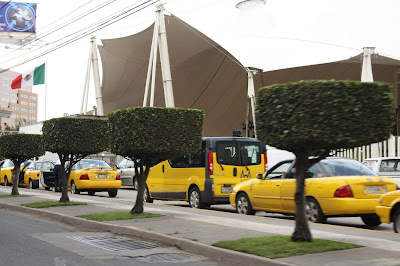
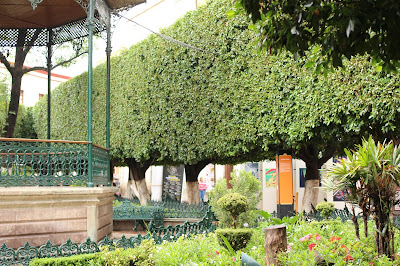
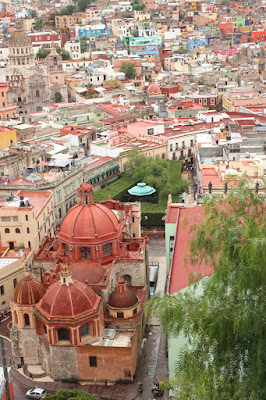
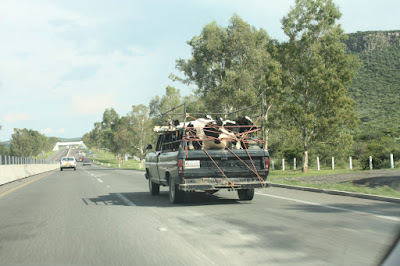
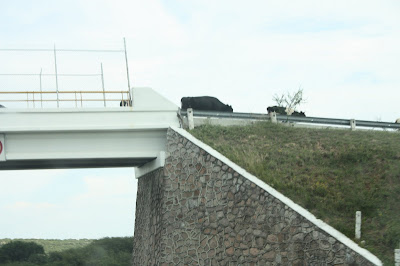
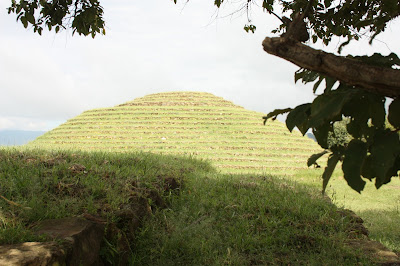
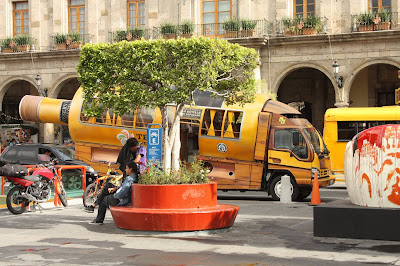
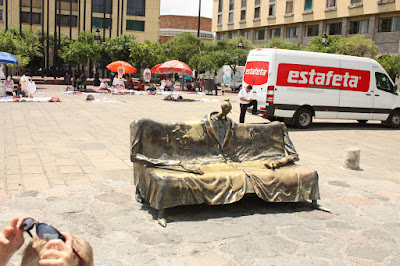
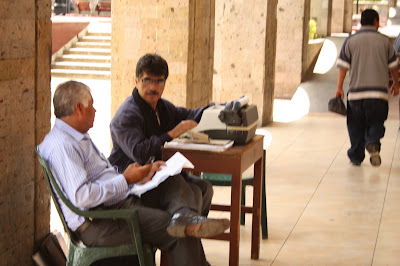
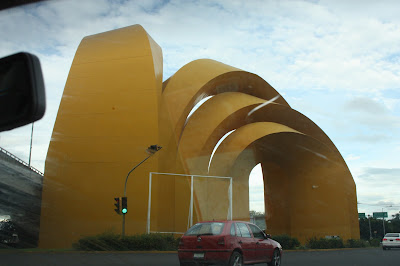
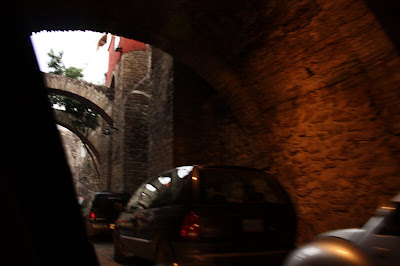
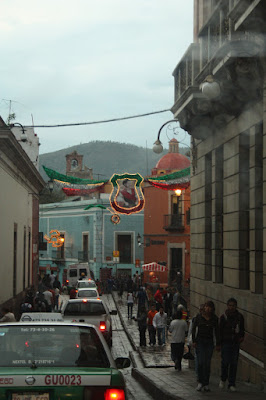
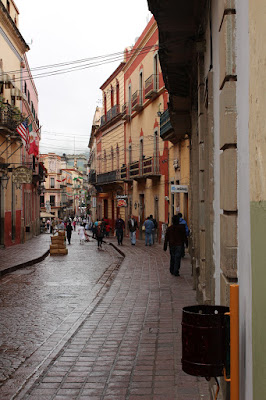
The fourth in a series; see also parts 1, 2, and 3. This post is going to be more a photolog than a narrative, and I apologize in advance for it being a bit disjointed. I ve already touched on these themes a bit in the other post, but now it s time to focus on them. Immediately after leaving the airport, it s quite clear that things are a little different. Trees are square. People ride around in the backs of pickups sometimes on top of piles of debris. Left turns are made in front of other lanes of traffic going the same way. But those are just the things obvious from the road. It s a lot of fun to enjoy the differences. First, the ubiquitous square trees. They look pretty, and are found all over. I also found carefully-manicured trees in cone shapes, more cylindrical shapes, etc. It seems that tree care is taken seriously in Mexico. It was also not uncommon to see the bottom few feet of a tree painted white. A park in Guanajuato had a whole bunch of trees carefully trimmed. And from up on the mountain, it still looked impressive (the green area behind the dome). Driving in Mexico was interesting for a lot of reasons. The highways there aren t quite as limited access as the freeways in the USA. It was quite common to see bicyclists, walkers, a mule, or some cattle ambling along the side of the road. Roadside taco stands don t require taking an exit. You just pull off the road because it s right there. Some sights were a bit surprising. Cattle in a pickup, with rope, for instance. Or cattle crossing the highway on the overpass. Street vendors were everywhere. Stop at a red light and someone might spring from the side of the road and suddenly start washing your windshield (expecting a tip); try to sell you flowers, juice, or bug zappers; or even throw business card-sized advertisements for adult websites into any open windows they can find. One night we saw an incredible fire juggler. I would have tipped him well but he was too far away to do so before the light turned green. Mexico s history stretches back into prehistoric times, and we saw the Teuchitlan ruins at Guachimontones one day. It was truly a remarkable feeling to be able to walk down the middle of the ancient ball court, or to climb up one pyramid and see the other from it. It s not exactly architecture, but Jacob and Oliver sure enjoyed visiting the hot springs at Bosque de la Primavera. Jacob still remembers that where the steam is, the water is 200 degrees, and we CAN T TOUCH IT THERE! Back in Guadalajara, here s a photo from the inside of the grand old cathedral. Compared to the cathedrals we saw in Europe, this was of a similar general size and design, and perhaps only slightly newer. But one big difference: worshipers outnumbered tourists at every Mexican cathedral I saw, whether in the center of Guadalajara or at a rainy intersection in Guanajuato or a plaza in Tlaquepaque. It made them feel more alive, and perhaps more sacred as well. One surprise was seeing people sitting on the steps of the cathedral in downtown Guadalajara selling trinkets such as beads. I think the only other place I had seen something like that was in New Orleans. All of Guadalajara s Centro was beautiful. Much of it survives from colonial days; I think a person could spend days exploring its museums and buildings. Way too many of my 900 photos were taken in Centro to post on the blog, but just for flavor, here s one of the less than historic scenes. Yes, that is a bus shaped like a tequila bottle. Fountains were beautiful and common across Mexico. A few of them were easily reachable by boys, and ours sure loved those. There was a lot of public art, including this interesting chair/skeleton/I m not sure what it is: And, just for good measure while walking around Centro, they tossed in an apparent Redundant Array of Inexpensive Typewriters. I don t know what they were doing, but there were about a dozen guys sitting out in the sun typing on their manual typewriters on their identical tables. And who can leave Guadalajara without seeing one of North America s most impressive traffic circles. I ve got to hand it to the Mexicans for making something that is normally really boring into an interesting work of art. Over in Guanajuato, a lot of driving takes place in the city s vast underground tunnel system. Here s a scene emerging from one of them. Guanajuato was already getting decorated for Mexican independence day festivities (Sept. 15-16) while we were there. Here s a typical Guanajuato street scene. Many of the streets were closed to traffic and perhaps not wide enough to handle vehicles anyway. Those streets had a wonderful peaceful and slow feel to them. I feel that I ve barely done the trip justice with this post. The feelings of walking down a beautiful Guanajuato street, or stepping into a Spanish cathedral, or even seeing a bunch of guys with typewriters, just can t be replicated. It s brimming with history and character, and shouldn t be missed.

13 September 2011

Jose Luis Rivas Contreras: Changing background sync d with jQueryUI Tabs

I love to use jQuery UI plugins. The one I use constantly is Tabs and this time I needed to sync the auto-changing of tab with the background. For this I used an event called tabsshow to trigger my function + the code I wrote yesterday for full-page background with CSS:
/* @author Jose Luis Rivas <joseluis@eserre.com>
*
* @desc swaping full-background pages with jQuery UI's Tabs plugin events.
*/


$(document).ready(function()

$( "#slides" ).bind( "tabsshow", function(event, ui)
var tabattr = $('.ui-state-active').find('a').attr('href');

switch(tabattr)
case '#tab1':
$('img#bg').attr('src', '/img/tab1.jpg');
break;

case '#tab2':
$('img#bg').attr('src', '/img/tab2.jpg');
break;

default:
$('img#bg').attr('src', '/img/tab1.jpg');
break;


);

);
What it does the script? Finds the active-tab identified with the .ui-state-active class and then changes the img tab src attribute according to the href attribute of the active-tab.

12 September 2011

Jose Luis Rivas Contreras: Full-Page Background with CSS with crossbrowser support

I ve been trying to get the perfect full-page background without using JavaScript since a while. I tried with CSS3 but, obviously for IE <9 was a pain in the ass, even for older Firefox' releases. So I decided to go with the plain-CSS option:
<!doctype html>
<head>
<link rel="stylesheet" href="style.css">
</head>
<body>
<img id="bg" src="/img/bg.jpg">

<p>Content</p>
</body>
</html>
img#bg
min-width: 100%;
min-height: 100%;

/* Proportionate re-dimension */
width: 100%;
height: auto;

position: fixed; top: 0; left: 0;

z-index: -1;
What does it does? It takes an inline image and uses it as if were a background-image thanks to the z-index: -1 CSS-rule. There are lots of other techniques at CSS-Tricks but none works in every browser as this one in particular. Enjoy.

11 September 2011

Gregor Herrmann: RC bugs 2011/36

after some months of looking only at "my" packages, I'm back in the #RCBW flow. here's my overview of RC bug activities & NMUs in the last week: two short observations:

9 September 2011

Mike Hommey: Initial VMFS 5 support

Today I added an initial VMFS 5 support to vmfs-tools. For the most part, VMFS 5 is VMFS 3, so these should just work as before, and adds new features; but this initial support is very limited: On related news, while the git repository here is kept alive, I also pushed it to github. The main reason I did so is the Issue tracker. Update: It turns out the small file support makes the vmfs-tools crash when accessing files bigger than 256GB, because the assumption made when reverse engineering was wrong and clashes with how files bigger than 256GB are implemented. It also turns out large single extent volumes may be working already because it looks like it was only about tuning an existing value, like smaller sub-block and increased file count. Update 2: Latest master now supports small files without crashing with files bigger than 256GB.

Russell Coker: Modern Laptops Suck

One of the reasons why I m moving from a laptop to a cloud lifestyle [1] is that laptops suck nowadays. Engineering Trade-offs Laptops have always had disadvantages when compared to desktop systems. The screen has to be smaller, the keyboard is inconveniently small on the smaller laptops and netbooks, you don t get PCI slots (CardBus isn t nearly as good), you usually can t have multiple hard drives and expansion options for other things are limited. Also due to the difficulty in designing a computer that uses a small volume it s very difficult to repair a laptop and there are no realistic options for upgrading the motherboard to use a faster CPU etc. This is OK, it s engineering trade-offs that we have to deal with. CPU Speed Modern laptops however have some bad design choices. Firstly they appear to be trying to compete with desktop systems for CPU speed. This was reasonable when desktop systems had 200MHz CPUs which dissipated about 15W (see the Wikipedia page about CPU power dissipation) but now that desktop CPUs are dissipating 65W at the low end and more than 100W at the high end it s really not practical to try and compete. My Thinkpad T61 has a T7500 CPU that can dissipate 35W, getting that much heat out of a laptop case is a significant engineering challenge no matter how you do it. It s a pity that no-one seems to be making laptops with large screens that have a low-power CPU. Sure it takes a moderate amount of CPU power to use a large display for games or playing video, but if you want to use a laptop for work purposes then not much CPU power is required. For tasks which take a lot of CPU power you can offload it to the cloud, I can ssh to a server to do compiles, and one of my clients is setting up an Adobe After Effects render farm [2] (in the broadest sense of the word Cloud can include a server accessed by ssh and a few servers on the LAN running After Effects). Thin Laptops The next problem is laptops being thin, it is really convenient to have a thin laptop, but the thinner it is the smaller the fans have to be and the faster the cooling air has to travel through small heat sinks. At the best of times this results in more noise from the cooling fan (which really isn t so bad). But it also increases the rate at which dust builds up inside the case and insulates the heat sink. When a laptop is thin and light for convenience and also wide to have a large display it just can t be that strong, so laptops tend to bend. If I put an Australian 10c piece (the size of a US Quarter) under one of the feet of my Thinkpad T61 the other three feet touch the desk! Presumably the laptop would bend in every way imaginable if you were to put it on your lap which of course you can t do because there are cooling vents in the bottom so it can give you a hot lap and an overheated laptop. My first Thinkpad was 61mm high according to the IBM spec sheet. I measured my latest one at 34mm. As 61mm wasn t too bad I think I could survive now with a laptop that was 45mm high and had more strength and less cooling problems. My Thinkpad T61 currently has some serious cooling problems, I suspect that something is broken inside. As it s out of warranty I took it apart but couldn t find anything wrong, so I guess I ll have to pay to get it repaired. This will be the third time I ve had a Thinkpad repaired because of cooling problems, but the first time one has been out of warranty. I blame the engineering trade-offs required to make them thin. Portable Desktop/Server systems If you want a small portable computer that delivers great performance then a Mac Mini seems to be a good option [3]. The people who use a laptop at their desk at work and their desk at home would probably be better served by a Mac Mini. The Mac Mini can be purchased with SSD storage to reduce the risk of data loss due to being dropped. Admittedly the Mac Mini needs to be plugged in before it can be used, but if you had a USB Ethernet device and a USB hub then only three cables would be required, power, USB, and video one more cable than the typical office laptop use with Ethernet and power. Some modern laptop/netbook systems (such as the Thinkpad T61 and the EeePC 701) seem to be designed to use the keyboard as part of the cooling system. If you run it with the lid closed then it becomes significantly hotter. This makes laptops unsuitable for use as a portable server. Probably one exception to this is the Apple laptops which have a rubbery keyboard that doesn t allow air flow of course anyone who likes the feel of a real keyboard won t buy an Apple laptop for that reason (but a keyboard that has one really hot section above the CPU doesn t feel great either). In the past I ve used laptops as servers once they become unsuitable for their primary use, probably in future I won t be able to do that. ARM Laptops There are some laptops and tablets with ARM CPUs that should dissipate little heat. But I m not aware of any such devices that I consider to be practical Linux laptops. I ve done some work with iPaQ s running Familiar in the past, it was a nice system but it was a niche market and everything was different from every other system I ve ever used. That made all the work take longer. What would be ideal is an ARM based laptop (not netbook a big screen is good) that boots from a regular CF or SD card (so the main storage can be installed in another machine to fix any boot failures) and which is supported by a major Linux distribution. Does anyone know of any work towards such a goal?

Next.

Previous.