Search Results: "sf"

19 January 2011

Russell Coker: Free Amazon EC2 Servers

Amazon is providing free EC2 access for new customers (who have never been customers before) for one year [1]. It is 750 hours per month (enough to run non-stop for an entire month) of access to a Linux micro instance which has 613M of RAM and the ability to burst to two ECUs of compute power. The main EC2 web page [2] describes an ECU as the equivalent CPU capacity of a 1.0-1.2 GHz 2007 Opteron or 2007 Xeon processor and they also describe a single core of a modern CPU as having 3.5 ECUs. So a micro instance could burst to half the CPU power of a single core. The DomU that runs my blog (as well as some web sites for friends) has been averaging less than 1% use of a CPU core over the last few months, so the CPU capacity of a micro instance should be more than adequate for most things that run on the net.The free offering only provides 15G of free data transmission and 15G of free data reception per month. For my blog server that would be more than adequate as it has sent 24.5G and received 14G over the last 75 days.The Cost of Disk IOThe offer requires that you sign up with a credit card so if you use more than the free capacity then you have to start paying. It seems that the main issue in this regard is disk IO.The only storage that is available for a micro instance is the Elastic Block Store (EBS) [3]. The main way that EC2 operates is that when you create a new virtual machine it copies the data from an existing image so you can easily create dozens or hundreds of virtual machines with local disk performance and the data is removed when the instance is shut down. EBS is essentially SAN based storage, it s persistent and operates like a regular disk.The pricing for EBS is $0.10 per allocated GB per month plus $0.10 per million IOs. Unfortunately they don t define what an IO is apart from mentioning that you can use IOSTAT to measure them. According to iostat the server running my blog is doing 0.99 tps, so that means in a 30 day month I would expect 30*24*3600*0.99 = 2.56M transactions. Iostat also tells me that my blog server has read 62075330 blocks and written 91683344 blocks over the last 75 days 16 hours of uptime, that means it would do about (62075330+91683344)/75.66*30 = 61M block transfers in a 30 day month. So if I was to run my blog server on EC2 I could be spending either $0.15 or $6.00 per month on disk IO depending on how they count it (or maybe something in between, something larger than a 512 byte block but smaller than a transaction as reported by iostat could be used). Given that the last time I checked the prices one could rent a DomU for less than $6 per month [4] the difference in possible ways of measuring IOs is very significant!The MySQL server that is the backend to my blog (as well as a few other things) seems to be averaging about 3 writes per second (and no reads during operation because the databases are small). So it might be another 5 million IOs per month for the database.It s unfortunate that Amazon haven t clearly specified what they mean when measuring IO for billing purposes. Some aspects of measurement such as whether the bills for bandwidth include Ethernet headers can be ignored as a 26 byte Ethernet header won t make much difference to the bill when the average packet size is around 400 bytes or more (from ifconfig output it seems that my blog server sends packets of an average size of 459 bytes and receives packets of an average size of 1250 bytes). But the methods of measuring disk IO could give a factor of 20 difference in the bill.Optimising for EC2If I was going to put my blog on EC2 then I would start by configuring Apache to log to a fifo and then write a daemon that stores the log data and allows my home server to poll it and get the log data. As the filesystem is already mounted with noatime it seems that writing logs is the cause of all the disk writes so if they were stored in RAM (which shouldn t be a problem with 4M of logs per day) then all those writes could be avoided. Another possible solution to this would be to make /var/log be a tmpfs and then rsync the files periodically to my home server. I don t really need to have all the logs remain on the server I just need them to remain somewhere.Amazon also offers 100,000 messages on their Simple Queue Service (SQS) for free [5]. The messages can be up to 8K in size and are stored for up to 4 days. So it seems possible to put Apache logs into SQS messages in bundles of less than 8K and then get them out later for transfer to a server outside EC2.If I was able to get my disk writes to almost zero then there s a good chance that I could get into the free zone for one year.ConclusionWould I use this service? If I was looking for new hosting for my blog then I would seriously consider it. EC2 is quite fast and well connected and depending on how they work out the billing for disk IO I could probably keep the cost close to zero.EC2 is a different way of running things so you can t just have a virtual server running and expect it to automatically restart if it goes down for any reason (a standard feature of virtual hosting companies). Amazon does have a range of tools for managing EC2 instances and they all seem to be available in the free trial. So after spending the time to learn those tools the result should be good.I think that there are two groups of people who could benefit from using this. One is hobbyists, this is a great way to learn some skills related to high-end server stuff and EC2 experience should look good on a CV. The other is companies who want to use EC2 anyway and who will just save some money that they would otherwise pay. I ve seen someone recommend the free offering from EC2 for a company that needed a small server, I think that isn t a good option as a company that only wants a single small server will be better off paying something between $5 and $20 per month for a DomU from one of the virtual hosting providers.After a year you have to pay regular prices. A micro instance costs $0.02 per hour which is $14.40 per month, SQS costs $0.10 per month for sending up to 1G of data in and at $0.01 per 10,000 SQS requests would costs $0.03 (the 4M of log data I generate per day would be 1000 requests to write and read it which would be 30,000 requests per month), the EBS for MySQL would cost $0.10 for 1G of storage and maybe $0.50 for IOs. That means $15.13 before counting bandwidth.My blog server averages just under 10G of transmitted data per month, the first Gig is free so that would cost $0.15 for each subsequent Gig which is $1.35 per month. It receives just under 6G per month which at $0.10 per gig would be $0.60. So including data transfer it would be about $17.08 per month.This is a lot more expensive than some of the cheaper virtual server offerings but admittedly the cheaper virtual offerings don t have as much RAM. Also with a blog instance running on EC2 I could easily configure it so that I could create some big instances that use the same MySQL database if a lot of extra traffic suddenly started arriving. A micro instance running MySQL on it s own could cope with a heap of load a lot more easily than the PHP code for my blog. So using bigger servers to run the PHP code while running MySQL on the same server would be a good option particularly if the bigger servers use caching.Finally if you want to run an EC2 instance for a year then you can get a reserved instance, you pay $54 per annum and the cost drops to $0.007 per hour instead of $0.02 per hour. Using a reserved instance for my blog would give a cost of $54+365*24*0.007+12*(0.10+0.03+0.10+0.50) or about $124.08 per annum. $10 per month isn t too bad. So if I migrated my blog to EC2 then I would probably keep it there after the free period expired. The ability to expand rapidly when necessary is worth paying extra. Of course I am making some assumptions such as that the performance of a micro instance doesn t totally suck as Amazon don t specify what bursting to 2ECU really means it could have some performance problems.Note that all prices in this post are in US Dollars.

18 January 2011

Russell Coker: Conferences and People on the Autism Spectrum

There have been some recent discussions about issues related to the treatment of women at Free Software conferences, I ve written posts about Aspie Social Skills and Free Software [1] and Empathy, Autism, and Geeks [2] about this. But of course discussion continued on how Aspies supposedly cause problems that no-one seems to be noticing.Lisa of Chaotic Idealism wrote an interesting post about the NT social bias [3]. In summary NTs seem to think that Autism Spectrum Disorders are only about socialisation, not realising that for many people on the Spectrum it s sensory issues that are their main problem. Social problems are exacerbated by sensory issues and other causes of stress, so I think it s worth considering ways in which conferences can be planned to be less stressful for people on the Autism Spectrum, people who have SPD [4] that isn t associated with an ASD, and NTs who just get annoyed by loud noises etc.What Autism Conferences DoAutscape is one of only two conferences for people on the Autism Spectrum and the only one which clearly documents how they plan their conference [5]. The first noteworthy thing that they do is have badge colors to indicate what level of social interaction is desired by each delegate, I don t think that this is relevant to Free Software conferences as people who don t have sufficient social skills to suit at least a green badge probably won t be attending. But I think that when attending a conference about Free Software or any other equally geeky topic (if there is an equally geeky topic) it s worth keeping in mind the fact that there are probably a lot of people who would like to talk to you but lack the social skills to start a conversation.
No initiationRedPlease do not initiate any interaction with me.
Prior PermissionYellowPlease do not initiate unless I have already given you permission to approach me on a yellow badge.
Please initiateGreenI would like to socialise, but I have difficulty initiating. Please initiate with me.
NeutralWhite (or no badge)I am able to regulate my own interaction.
The next thing that they document is a black circle badge which indicates that the wearer shouldn t be photographed. Prior to reading that web site I wasn t aware of this being an Autistic issue, I was only aware of it being an issue for women who don t want zoomed-in pictures of themselves appearing on guys web sites (even pictures that aren t up-skirt or down-blouse can be unwelcome). A conference policy that prohibited photographs that zoom in on one person without that person s consent (or parental consent in the case of minors) would probably be a good idea.Another thing about badges is that it s a really good idea to have the delegate s name on both sides of the badge if the badge is attached in a way that permits it to turn. People on the Autism Spectrum tend to have some difficulty in recognising people and in remembering names. I find it inconvenient when someone expects me to recognise them but has their badge turned around so I can t see their name. Some people get really unhappy if they think that someone doesn t recognise them.Autscape has long breaks between activities and a leisure session each afternoon to allow delegates to recover from the stress of dealing with people. It seems to me that computer conferences in some cases could do with longer breaks between sessions. I find that a lot of the benefit of a conference is in what happens outside sessions and the standard practice of publishing videos of presentations makes personal meetings a more important part of the conference.Autscape has designated quiet spaces. I think that for computer conferences which have hack-labs (which seems to be most Free Software conferences nowadays even if they aren t labelled as such) it would be good to have some lab areas designated as quiet zones. I think that it is a really good thing to meet people you ve only known by email and then play some LAN based games against them and that this should be encouraged as part of a conference, but having that sort of thing separated from people who want to do some quiet coding is a really good idea. Whether people want to do quiet coding, read email, or just escape from the stress of a conference a quiet hack-lab would be a good place for it.An issue that s related to quiet spaces is the ability to escape from social situations. One of my pet hates is corporate meetings on boats, when the boat is in motion there is no escape. Corporate meetings that are only accessible by coach are also bad. Fortunately most conferences aren t like that.The Autscape web site states that they prohibit people from wearing perfume or aftershave to help people who are sensitive to smell. My observation of Free Software conferences is that encouraging everyone to have a shower every morning would be a good idea as there are stronger smells from unwashed people than from perfume.One thing that s interesting about the Autscape web site is that they have different color schemes available and have tested it in multiple web browsers including Safari and Konqueror (which apparently don t work so well). It s interesting to note that they test with such a variety of browsers including free software ones most corporations don t do that.Sensory Processing IssuesThe main SPD issues related to conferences seem to be noise and light related.For social events one difficulty that most people on the Spectrum seem to face is in listening to one person in a noisy crowded room. As well as that sudden noises and loud background noises can be very stressful. While it s sometimes impossible to avoid crowds (which can be another problem) it is often possible to select venues that have less noise problems. A venue with carpet on the floor and soft walls (anything other than brick or concrete) will be a lot quieter than one with hard surfaces that reflect noise. It seems that a quiet venue will benefit NTs as well, there seems to be a strong correlation between the price of food at restaurants and the amount of sound absorbing material on the floor and walls people who can afford a good dining experience seem to want it quiet.In terms of visual issues the relevant problems seem to be related to sudden transitions and lecture halls that are extremely dark. The only thing that can be done by conference organisers is to seek to have the lights in the lecture halls as bright as possible without preventing the viewing of the projector screen, this is usually done anyway.For social events the whole binge drinking at crowded bars thing doesn t work too well due to noise, poor lighting, crowds, and the smell of vomit. But there s no shortage of reasons to discourage binge drinking at conferences.FoodPsychology Today has a good article about preferences for food and picky eaters [6]. Lots of people on the Autism Spectrum have similar issues. The thing to do when arranging a conference meal is to have things neat and without needless combinations. Think about making food look more like what you would expect to see in a Japanese restaurant and less like Paella. Also having some very plain food on offer is a good thing, I think that bread-rolls for dinner and ice-cream for desert makes a viable meal. But any dish with a word like hash or mixed in it s name isn t a good option. Finally some combinations are really bad, I always find rare steak and potatoes on the same plate to be rather disgusting potato that s blood-stained doesn t appeal. The majority of conference meals satisfy these criteria.Autscape provides options of eating outside the main dining hall for people who can t tolerate the noise. For a Free Software conference it might be a better idea to provide seating outside the main area for people who are going to make noise. I don t mind people who want to get really drunk at the conference dinner, but I would prefer them to be in a separate room. Also when assisting a drunk friend to leave the venue before they cause more problems it would be convenient if there was a good place to take them to. The one occasion when I had to strongly encourage a friend to leave a conference dinner to reduce his embarrassment the next day (and reduce the annoyance for everyone else) there was no good place to take him so he just came back!ConclusionI don t expect that anyone will make any significant changes to conference plans after reading this post. I have tried to focus on things that would benefit NTs as well, but there are practical issues that get in the way such as the cost and availability of venues that are large enough. But there are some smaller ideas that can be implemented with relative ease.I hope that the people who are making claims about Autism and conference behavior will refer to this in future. If you think that there is a problem with the way people on the Spectrum act at conferences then the solution will more likely involve the suggestions I make here than anything else.

John Goerzen: Backing Up to the Cloud

I m recently taking some big-picture looks at how we do things, and one thing that I think could be useful would be for us to back up a limited set of data to an offsite location states away. Prices are cheap enough for this to make it useful. Services such as Amazon S3 and Rackspace Cloud Files (I ve heard particularly good things about that one) seem to be perfect for this. I m not quite finding software that does what I want, though. Here are my general criteria:
  1. Storage fees of $0.15 per gigabyte-month or less
  2. Free or cheap ($0.20 per gigabyte or less) bandwidth fees
  3. rsync-like protocol to avoid having to re-send those 20GB files that have 20MB of changes in their entirety every night
  4. Open Source and cross-platform (Linux, Windows, Mac, Solaris ideally; Linux and Windows at a minimum)
  5. Compression and encryption
  6. Easy way to restore the entire backup set or individual files
  7. Versatile include/exclude rules
  8. Must be runnable from scripts, cron, etc. without a GUI
  9. Nice to have: block or file-level de-duplication
  10. Nice to have: support for accurately backing up POSIX (user, group, permission bits, symlink, hard links, sparse files) and Windows filesystem attributes
  11. Nice to have: a point-and-click interface for the non-Unix folks to use to restore Windows files and routine restore requests
So far, here s what I ve found. I should note that not a single one of these solutions appears to handle hard links or sparse files correctly, meaning I can t rely on them for complete system-level backups. That doesn t mean they re useless I could still use them to back up critical user data just less useful. Of the Free Software solutions, Duplicity is a leading contender. It has built-in support for Amazon S3 and Rackspace Cloud Files storage. It uses rdiff, which is a standalone implementation of the rsync binary delta algorithm. So you send up a full backup, then binary deltas from that for incrementals. That makes it bandwidth-efficient for incremental backups, and storage-efficient. However, periodic full backups will have to be run, which will make it less bandwidth-efficient. (Perhaps not incredibly *often*, but they will still be needed.) Duplicity doesn t offer block-level de-deuplication or a GUI for the point-and-click folks. But it DOES offer the most Unixy approach and feels like a decent match for the task overall. The other service relying on Free Software is rsync.net, which supports rsync, sftp, scp, etc. protocols directly. That would be great, as it could preserve hard links and be compatible with any number of rsync-based backup systems. The downside is that it s expensive really expensive. Their cheapest rate is $0.32 per GB-month and that s only realized if you store more than 2TB with them. The base rate is $0.80 per GB-month. They promise premium support and such, but I just don t think I can justify that for what is, essentially, secondary backup. On the non-Open Source side, there s JungleDisk, which has a Server Edition that looks like a good fit. The files are stored on either S3 or Rackspace, and it seems to be a very slick and full-featured solution. The client, however, is proprietary though it does seem to offer a non-GUI command-line interface. They claim to offer block-level de-duplication which could be very nice. The other nice thing is that the server management is centralized, which presumably lets you easily automate things like not running more than one backup at a time in order to not monopolize an Internet link. This can, of course, be managed with something like duplicity with appropriate ssh jobs kicked off from appropriate places, but it would be easier if the agent just handled it automatically. What are people s thoughts about this sort of thing?

17 January 2011

Julien Viard de Galbert: Triaging bugs is not that hard !

There is a big thread on -devel that started about Forwarding bugs upstream, the idea is that it should be the maintainer s job. While it s true in general, some understaffed teams are so flooded by bugs that they just can t do it.
I ve seen more than once the X Strike Force asking a user to report upstream (pointing to the relevant BTS) and come back with the tracking URL to be attached to the bug. This was mostly for driver issue if I remember well.
And most users did it, so thanks! Then the thread evolved in lots of directions, I m not following all of it, but there was the question of the bug triaging and as I m doing it for the X packages, I want to share about my experience here. The available triaging docs The debian wiki already have a general Bug Triage page.
The thread pointed to the KDE Bug triaging page.
The X Strike Force has some pages, one on the wiki and a new one more specific to bug triaging on the alioth project s doc.
And when it comes to closing bugs with version information, there is a good read on the wiki: Bugs Version Tracking.
Finally don t hesitate to reopen the BTS documentation whenever you need to write to control@b.d.o ! Now if all those docs don t help you, then try to improve the docs as a first step ! ;) Talk with the maintainer(s) Well I did met Julien Cristau and Cyril Brulebois in person during mini-DebConf Paris/2010 that certainly helped. But we exchanged several mails, or met on IRC channel #debian-x.
But the triaging rules of the X Strike Force (linked above) were pretty clear anyway. My current process This process has evolved over time with the response of several contributors either to help or to fix to my mistakes, thanks!
  1. List bug from UDD: XSF unstable bugs sorted by date.
  2. Pick an old bug (once you answer and UDD runs, the bug moves down the list, so there are always old bugs on the top).
  3. Read the report, don t be afraid by the subject, it might be unrelated, the bug might be merged with other bugs, then reading the other bugs can help.
  4. If relevant try to reproduce it. (most bugs in X are hardware related or specific to one setup, so it s not that often that I have something to test).
  5. Decide what to do, most of the time, I will ping the submitter.
  6. I m a mutt user, and to my help the bts command as a way to open the bug mbox in mutt, that makes it really easy to answer the bug.
    So I launch bts -m show $n where $n is the bug number, and I can then answer the bug from mutt.
    The triaging procedure suggest to ping -submitter, but using mutt it s easier to just reply and add a -quiet to the bug number (this avoid spamming the debian-x with all my pings).
  7. In the message, always try to be kind and helpful, most of the time ask to test newer versions.
  8. Keep track of the pinged bugs, well I do it for my blog but it will be useful anyway, see below.
  9. When the submitter answers, just react accordingly, if the bug can be closed, then close it ! ;)
  10. If after some time, the bug are still not answered, consider closing them (I haven t started that yet, but this will probably get the bug number down faster:) ).
Note: Sometime I don t send the bug to -quiet so that other debian-x subscriber can have a look at the bug. They then can give me advices, or close the bug directly with a stronger reason than any I could have found. ;) To submitters, please keep the bug CCed when you answer, thanks. For the skeptics Yes as a newbie I did some mistakes, but I was always corrected in a nice way, with explanations. Also I try to have a conservative approach, I don t close bugs if I m not sure, I ask if I can close them, so it might take longer, but in the end the effect is the same for the bug, but not the same to the submitter ! ;) Also this work might look boring, but it s actually rewarding, most of the answers I received included a cheerful message thanking me for following up on the bug. Not to mention all I ve learned on Xorg. Conclusion As long as I have time for it, I ll continue to triage bugs and I d love to see others coming to help me on X or probably better go and help some other teams that also need help, and flood the planet with bug triaging reports ! ;) Get involved !

Raphaël Hertzog: Review of my Debian related goals for 2010

Last year I shared my Debian related goals for 2010 . I announced that I would not be able to complete them all and indeed I have not, but I have still done more than what I expected. Let s have a look. Translate my Debian book into English and get it published: NOT DONE Or rather not yet done. It s still an important project of mine and I will do it this year. When I wrote this last year, I expected to find a publisher that would take care of everything but we failed to find a suitable one so we re going to do it ourselves. Cleanup the dpkg perl API and create libdpkg-perl: DONE libdpkg-perl has been introduced with dpkg 1.15.6. Create dpkg-buildflags: DONE dpkg-buildflags has been introduced with dpkg 1.15.7. It s not widely used yet and it won t really be until debhelper 7 supports it (see #544844). It would be nice to see progress on this front this year. Ensure the new source formats continue to gain acceptance: DONE The adoption rate has been steady, it clearly slowed down since the freeze though. I have implemented quite a few features to satisfy the needs of users, like the possibility to unapply the patches after the build, or the possibility to fail in case of unwanted upstream changes. Design a generic vcs-buildpackage infrastructure to be integrated in dpkg-dev: NOT DONE I believe it s something important on the long term but it never made it to my short-term TODO list and it s unlikely to change any time soon. Continue fixing dpkg bugs faster than they are reported: PARTLY DONE We have dealt with many bugs over the year, but we still have 20 more bugs than at the start of last year (370 vs 350). We re not doing bad compared to many other Debian teams but we can still benefit from some help. Start here if you re interested. Enhance our infrastructure to ease interaction between contributors and to have a better view of how each package is maintained: NOT DONE I am convinced that we need something to have a clearer idea of the commitments made by each contributor. I don t put the same amount of care in maintaining smarty-gettext that I do on dpkg. If we had a database of the stuff that we know we don t do well enough, it s easier to point new contributors towards those. Anyway, this project is still unlikely to come to the top of my priorities any time soon. Work on the developers-reference: NOT DONE We have switched the Maintainer field to debian-policy@lists.debian.org to have more review of the changes suggested through the bug tracking system but that has not changed much on the global situation. I still hope to become more active on it sometimes this year. Maybe by trying to make it more fun and creating the text for some of the wishlist bugs as blog articles first. Rewrite in C the last Perl scripts provided by the dpkg binary package: DONE Dpkg 1.15.8 was the first version working without Perl, I announced it in July. Integrate the 3-way merge tool for Debian changelogs in dpkg-dev: DONE dpkg-mergechangelogs is part of dpkg-dev since 1.15.7. I enjoy it regularly. Unfortunately it doesn t work well for cherry-picks. Would be nice to see this fixed, anyone up to the task? :-)
Click here to subscribe to my free newsletter and get my monthly analysis on what s going on in Debian and Ubuntu. Or just follow along via the RSS feed, Identi.ca, Twitter or Facebook.

One comment Liked this article? Click here. My blog is Flattr-enabled.

16 January 2011

John Goerzen: 24 hours with Jacob

Friday, I wrote about the train trip Jacob and I were planning to take. Here s the story about it. Friday night, Jacob was super excited. He was running around the house, talking about trains. I had him pack his own backpack with toys this time, which were you guessed it trains. Plus train track. His usual bedtime is around 7. He was still awake in his room at about 11, too excited to sleep. The train was an hour late into Newton, so got up, got ready, and then went into Jacob s room at 3:15AM. I put my arm around him and said his name softly. No response. I said, just a little louder, Jacob, it s time to wake up to go to the train station. There was about a 2-second pause and then he sat bolt upright rubbing his eyes. A couple seconds later, in a very tired but clear voice, OK dad, let s go! That is, I believe, a record for waking up speed for Jacob. We went downstairs, got coats, mittens, hats, etc. on, made sure we had the stuffed butterfly he always sleeps with, and went out the door. As usual, Jacob chattered happily during the entire 15-minute drive to the Amtrak station. One of these days I need to remember to record it because it s unique. He described things to me ranging from the difference between freight and passenger trains, to what the dining car is all about, to tractors and how to ride them safely. Newton has some winter lights , and a few places still had Christmas lights, which were of course big hits. We had to wait a few minutes at the Amtrak station, and Jacob hadn t shown any signs of slowing down yet. He wanted to look at every Amtrak poster, picture, logo, or sign in the building. This generally meant me holding him up high while he leaned over to touch it and make out a few words. Then, of course, he would pick out minute details about the trains, such as how many coach cars he thought they had, and we d visit about that for awhile. We got on at about 4:20. We found our seats, and Jacob showed no signs of calming down, despite having had only 4 hours of sleep (instead of his usual 11) so far. We checked out the buttons for lights. And, of course, he excitedly yelled out, Dad, the train is moving! He spent the next while mostly watching out his window, but also still exploring his space. Finally at about 5, I said, Jacob, I am really tired. I am going to sleep now. Will you sleep too? His response: Oh sure dad, I will sleep with my eyes open! As a result, no sleep was had for Jacob, and only a little for me. The dining car opens for breakfast at 6:30, which is normally a rather foreign time for breakfast on the train for us. But we were both awake so I figured might as well go. So Jacob and I went to the dining car. We sat with a woman going from New Mexico to Lawrence for her grandpa s funeral, though it was expected and she was having a good time on the train. Jacob turned completely shy, and refused to say a word, except maybe a few whispered into my ear. He got his favorite railroad French toast, and had me drizzle some syrup on it. I used the word drizzle for syrup the first time he had French toast on the train, and if I fail to use that word in the dining car, I will hear about it in no uncertain terms from Jacob. He loved his dining car breakfast, but we spent about an hour and a half there. He was really slow at eating because his face was pressed up against the window so much. But that was just fine; we had nowhere else to be, the person eating breakfast with us enjoyed visiting (and, apparently, scaring the dining car staff with tales of bears in the New Mexico mountains). This was what the train trip was all about, after all. We played in the lounge car for awhile. The almost floor-to-ceiling wrap-around windows provided a great view for him, and more opportunities to press his face against a window. We talked about freight trains that he saw, noticed the snow on some of them. Then we found the back of the train and he got to look out the back window. Back at our seat, he played with his toys for about 10 minutes, which was all he used them on the entire trip. There was just too much else to enjoy. When we used the restroom on the train, he d comment on how much he liked the Amtrak soap. It smells SO very very good! He wanted to wash his hands on the train. By late morning, he had decided: Dad, I LOVE this Amtrak soap. It smells like peaches! Shall your hands smell like peaches too? And, when we d get back up to our seats, he d put his hands in my face, saying, Dad, smell that! My hands smell like peaches! It was from the AMTRAK SOAP! At some point, he discovered the airline-style safety brochures in the seat back pockets. These were filled with diagrams of the train car, a few photos, and lots of icons with descriptions. I don t know how many times I read the thing to him, or really how many times he then recited it to me from memory. It was a lot. He spent hours with those brochures. Jacob had already told me that he wanted pizza for lunch, so I got him the kid-sized pizza. It wasn t all that big, and he could have devoured at least half of it when hungry. But he was getting really tired and ate only a few bites of pizza and a few chips. Pretty soon he was leaning up against me, the window, and eventually had his head on the table in some tomato sauce. But he didn t quite fall asleep by the time we went back to our seats, and of course was wide awake by that point. Jacob loves spotting the word Amtrak on things. It was very exciting when he noticed his orange juice at breakfast, and milk at lunch, were Amtrak juice and Amtrak milk due to the logo on the cups. At dinner he noticed we had Amtrak plates, and when I pointed out that his metal fork had the Amtrak logo on it, he got very excited and had to check every piece of silverware within reach. Dad, I have an Amtrak fork too! . And dad, YOU also have an Amtrak fork! We ALL have Amtrak forks! *cackling laughter* I finally insisted that Jacob lay down for some quiet time. I closed the curtains, and he finally did fall asleep less than an hour before our arrival into Galesburg. So by 2:15 he was up to 4.75 hours of sleep, I guess. We stopped in the train station briefly, then started our walk to the Discovery Depot Children s Museum, which was right nearby. Although I made no comment about it, Jacob said, Dad, there is a train museum RIGHT HERE! Yes, you re right Jacob. I can see a steam engine and some cars here. Let s go in! I don t think it s open today. It IS open shall we go check? It wasn t, and that was mighty sad though when he spotted another old caboose sitting outside the children s museum, the day suddenly seemed brighter. He complained of how cold he was, although my suggestion that he stop walking through the big piles of snowdrifts was met with a whiny, But dad, I WANT to do that! We went inside the museum (having to walk right buy the locked caboose thankfully the people at the desk promised to unlock it for us when we were ready) and Jacob started to explore. There was some wooden play trains big enough for children to climb in which he enjoyed, but in general he went from one thing to the next every minute or two as he does when he s really tired or overstimulated. Until, that is, he discovered the giant toy train table. It had a multi-level wooden track setup, and many toy trains with magnetic hitches. It was like what we have at home, only much bigger and fancier. He spent a LONG time with that. We then briefly explored the rest of the museum and went out into the caboose. It wasn t the hit it might have been, possibly because there are several at the Great Plains Transportation Museum that he gets to go in on a somewhat regular basis. After that, he was ready to go back into the museum, but I was feeling rather over-stimulated. On a day when the highs were still well below freezing, it seemed just about every family in Galesburg was crowded into the children s museum, making it loud and crowded which I don t enjoy at all. So I suggested maybe it was snack time instead. A moment s thought, then he started to pull me out of the caboose before I could get my gloves back on Yes dad, I think it IS snack time. Let s go. Let s go NOW! We walked over to Uncle Billy s Bakery (Google link or minimal website). Jacob spotted some sugar cookies shaped like mittens. Despite my reluctance to get him more sugar, he was so excited plus I had barely prevented a meltdown at lunch by promising him that he would get dessert later in the day so he picked two red mitten cookies. I got myself a wonderful peach muffin and a croissant and we sat down at one of the tables by the window. I taught Jacob how to hang his coat on his chair and he lit into those cookies. I spotted a guy at the next table over wearing a BNSF jacket, and asked him if he worked for the railroad. He had retired as an engineer a couple of years ago, and had worked various jobs before that. He grew up in Manhattan, KS and so was interested in our trip and very friendly. While we visited, Jacob devoured his cookies and increasing portions of my snack as well. He told us about a new shop The Stray Cat just two stores down that was having a grand opening event today. They make decorations and art out of basically discarded items, and had some really nifty things that I may have bought had I not been wanting for space in our backpack. Then I spotted Sweets Old-Fashioned Ice Cream, Candy, and Soda Shop across the road. I figured he d love it and I was already in for the sugar so might as well. He picked out some birthday cake flavor ice cream for himself. I got huckleberry ice cream, which he insisted on calling purpleberry and managed to get some tastes of as well. After that, we went to the train station. It was about an hour until our train would be there. I wasn t sure if we d find enough to do, but I shouldn t have worried. Earlier, we had made the happy discovery that the station s restroom featured the Amtrak soap, so there was that. Then there was the model Amtrak train in the ticket window, which Jacob kept wanting to look at while I d hold him. And also, the California Zephyr came in. We watched it arrive from the station window, saw people get off and on, and saw it leave maybe the first time Jacob has witnessed all that in person. And, of course, we looked at the pictures in that train station. The ticketmaster gave Jacob a paper conductor s hat with puzzles and mazes on the back side. And then it was time to get onto our train back home. We ate dinner Jacob again ate little and almost fell asleep and got back to our seats. I let Jacob stay awake until about 8, when he was starting to get a bit fragile. It took him awhile to fall asleep, but he finally did at about 8:30. Today he s still been all excited. He will randomly tell us about bits of the trip, that the man at supper called his grilled cheese sandwich piece little when it was really big, what we did at the ice cream store, etc. And I do think that he is now a train safety expert. All in all, I think that is probably the most excitement he s ever had in 24 hours and it was a lot of fun to be with him for it!

15 January 2011

Jordi Mallach: Hiking through the Pyrenean GR 11

Tomorrow, at this time, I'll probably be unsuccessfully trying to find a comfortable position on a seat of the Bilmanbus to Irun. Very early on Saturday, as soon as we get off the bus, Maria and I will quickly head to Hondarribia's beach in Cape Higer to symbolically wet our feet in the waters of the Cantabrian Sea. We won't have much time to enjoy the cold waters of the ocean, though. Soon after that, we'll have to take a deep breath, look East, and start walking if we want to achieve our utmost objective: take a bath in the beautiful beaches of the Cap de Creus, in the Mediterranean sea. In between, 30 days and 840 kilometres of thick woods, deep valleys, high peaks and cold waters, all of which shape incredible landscapes.
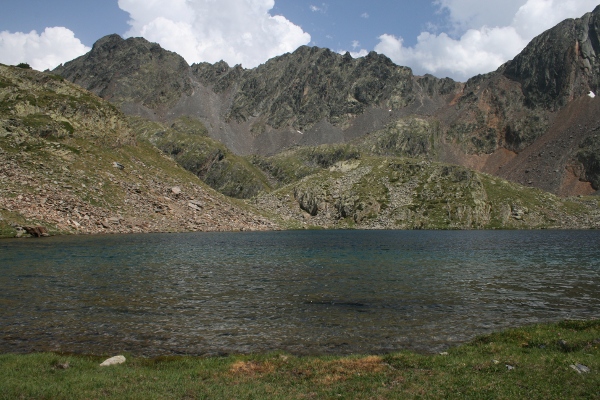

The Portella de Baiau, during our 2008 trip For a whole month, we'll be mostly disconnected from everything else that isn't our knee ache, our blisters, the Sun over our heads or where to get food. It's the first time I leave on a hiking trip as long and tough as this one, and I feel both uncertainty and eagerness. We've been so busy during the last few months that we've been unable to train at all for this, and I'm probably in the worst physical condition in a decade. It's too late to take care of that now, so we'll try to take good care of our legs and spine. In order to get back home in the Mediterranean, we'll have to be fast, some days joining two stages and skipping a few that we know are not that interesting (sections over asphalt, etc.). It's hard to make it in just one month, but we'll try our best. The plan is going to sleep not long after sunset, getting up at dawn, to be able to walk for a decent time before the heat starts being a handicap and just resting at midday, when the Sun is strongest. Of course, this means that I'm missing, yet again, this year's edition of DebConf in New York City, which is really sad because I was looking forward hanging around with Mako, Mika, Biella, micah, Clint and the rest of the NYC/ Boston gang, but when the idea of doing a long trip this summer popped up around January, it was clear DebConf seemed unlikely this year. I hope all of you have a lot of fun, and see you in a few weeks!

14 January 2011

Jordi Mallach: New project to discuss

Reading Scott's recent announcement on his move to Google was both surprising and a pleasure. Surprising, because it'll take time to stop associating his name to Ubuntu, Canonical, and the nice experiences I had while I worked with them. A pleasure, because his blog post was full of reminiscences of the very early days of a project that ended up being way more successful in just a few years than probably anyone in the Oxford conference could imagine. Scott, best of luck for this new adventure! Scott's write-up includes a sentence that made me remember I had been wanting to write a blog post related to all of this, but was pending Mark Shuttleworth's permission for posting:
Ok, Mark wasn t really a Nigerian 419 scammer, but some people did discard his e-mail as spam! Scott James Remnant
Many know the story of how I ended not being part of the Super-Secret-Debian-Startup Scott mentions. I even wrote about it in a blog post, 3 years ago:
[...] nothing beats the next email which sat for some dramatic 6 months in my messy inbox until I found out in the worst of the possible scenarios. Let's go back to late February, 2004, when I had no job, and I didn't have a clue on what to do with my life.
From: Mark Shuttleworth <mark@hbd.com>
Subject: New project to discuss
To: Jordi Mallach <jordi@debian.org>
Date: Sun, 29 Feb 2004 18:33:51 +0000
[...]
I'm hiring a team of debian developers to work full time on a new
distribution based on Debian. We're making internationalisation a prime
focus, together with Python and regular release management. I've discussed
it with a number of Debian leaders and they're all very positive about it.
[...]
I'm not sure if I totally missed it as it came in, or I skimmed through it and thought WTF?! Dude on crack or I just forgot I need to reply to this email , but I'd swear it was the former. Not long after, no-name-yet.com popped up, the rumours started spreading around Debian channels. Luckily, I got a job at LliureX two months later, where I worked during the following 2 years, but that's another story. I guess it was July or so when Ubuntu was made public, and Mark and his secret team organised a conference (blog entries [1] [2] [3] [4] [5]), just before the Warty release, and I was invited to it, for the same reasons I got that email. During that conference, probably because Mark sent me some email and I applied a filter to get to it, I found the lost email, and felt like digging a hole to hide for a LONG while. I couldn't believe the incredible opportunity I had missed. I went to Mark and said "hey, you're not going to believe this", and he did look quite surprised about someone being such an idiot. I wonder if I should reply to his email today...
When the usual suspects in the secret Spanish Debian Cabal channel read this blog post, they decided Mark deserved a reply, even if it would hit his inbox more than three and a half years late. :) With great care, we crafted an email that would look genuinely stupid in late 2007, but just arrogant and idiotic in 2004, when Ubuntu was just an African word, and the GNU/Linux distribution landscape was quickly evolving at the time, Gentoo Linux had the posh distribution crown, that Debian had held for quite a few years. I even took enough care to forge the X-Operating-System and User-Agent headers so they matched whatever was current in Debian in February 2004, and of course, top-posting seemed most appropriate. So Mark woke up that Monday, fired up his email client, and got... this:
Date: Mon, 1 Mar 2004 09:47:55 +0100
From: Jordi Mallach <jordi@sindominio.net>
To: Mark Shuttleworth <mark@hbd.com>
Subject: Re: New project to discuss
Organization: SinDominio
X-Operating-System: Debian GNU/Linux sid (Linux 2.6.3 i686)
User-Agent: Mutt/1.5.5.1+cvs20040105i
Hi Mark,
Thanks for your email. I nearly deleted this e-mail because for some
reason I thought it was targetted spam.
Your project looks very interesting, almost like a dream come true.
However, I feel a bit uneasy about your proposal. Something just doesn't
fit.
Why would someone start a company to work on /yet another/ Debian
derivative? Have you heard about Progeny's sad story? I think it's a
great example to show that Debian users don't want Debian-based distros,
they want people to work on the "real thing". Besides, I don't think
there's much more place for successful commercial distros, with Red Hat
and SuSE having well-established niches in the US and Europe.
Also, why focus on Debian specifically, Why not, for example, Gentoo,
which has a lot of buzz these days, and looks poised to be the next big
distribution?
To be honest, I think only a few people have the stamina or financial
stability to undertake a project like this, so I'd like to know
a bit more about you, and details on how you plan to sustain the
expenses.
Those are the main issues that worry me about your project. Other than
that, I would be interested in taking part in it, as I'm currently
unemployed and working on something Debian-based would be just too good
to miss.
You can reach me at +34 123 45 67 89, or if you feel like flying people
around Europe, I probably can be in the UK whenever it fits you.
Thanks, and hoping to hear from you again,
Jordi
On Sun, Feb 29, 2004 at 06:33:51PM +0000, Mark Shuttleworth wrote:
> Hi Jordi
>
> We haven't met, but both Jeff Waugh and Martin Michelmayr recommended that
> I get in touch with you in connection with a new project that I'm starting.
>
> I'm hiring a team of debian developers to work full time on a new
> distribution based on Debian. We're making internationalisation a prime
> focus, together with Python and regular release management. I've discussed
> it with a number of Debian leaders and they're all very positive about it.
>
> Would you be available to discuss it by telephone? I'm in the UK, so we
> could probably find a good timezoine easily enough ;-) Let me knof if
> you're keen to discuss it, when and what number to call.
>
> Cheers,
> Mark
>
> --
> Try Debian GNU/Linux. Software freedom for the bold, at www.debian.org
> http://www.markshuttleworth.com/
As you can imagine, his reaction was immediate:
Date: Mon, 22 Oct 2007 11:13:54 +0100
From: Mark Shuttleworth <mark@hbd.com>
To: Jordi Mallach <jordi@sindominio.net>
Subject: Re: New project to discuss
Jordi! I just got this now! Did you recently flush an old mail queue?
With thanks to all the Spanish Cabal members who were involved!

Jo Shields: The phantom fifth freedom

Not for the first time, I ve seen the suggestion in the echo chamber that Mono packages should be moved from Debian into the non-free repository, which is not formally part of Debian. The reason, as it so often is, is patents specifically this time, the searing risk posed to Debian and its users that Mono s packaging does not (and technically could not without forking from upstream) provide base class libraries which implement only the content of ECMA-335 4th Edition. As I understand it, this implies three things about the suggestion/demand: firstly, that the individual in question believes that Mono end users are at risk from patent litigation from Microsoft Corp because Mono s implementation of Microsoft.NET beyond the content of ECMA 334/335 infringes on Microsoft patents; secondly, that the Microsoft Community Promise which promises not to assert legal claims over third party implementations of ECMA-335 4th Edition (and ECMA-334 4th Edition which defines the C# language) would render a pure ECMA-only runtime safe if it existed (which it does not); thirdly that without the protection offered by the Microsoft Community Promise, the source code licenses of Mono are irrelevant the patent risk renders the software non-Free. It appears, unfortunately, that the community of Free Software Advocates don t actually understand what Free Software actually IS. That explains an awful lot, but should surprise nobody. So here s a lesson on what, exactly, is being advocated for. The Free Software Foundation defines four Software Freedoms these are the minimum criteria required for something to be considered Free Software by the FSF: Other groups have their own variants on these, but those are really just clarifications on the FSF definition - for example, the Debian Free Software Guidelines mostly line up, but have some additional clauses such as clause 4 which allows software to be considered Free if source code may be redistributed without modifications, as long as patches may be shipped alongside. These four freedoms are offered to you by the software s copyright holders only, and apply regardless of their choice of license any Free license, from a lengthy legal tome like the MPL to the completely-Free WTFPL, will offer you these four basic freedoms as a minimum, and any additional clauses in their licenses cannot seek to restrict these freedoms. These four freedoms represent the beginning, and end, of whether a piece of software is Free or not. Software does not need to be developed in the open, in a community-responsive way, in order to qualify as Free projects such as Google s Android, which are developed under a throw a final release over the wall, bugs and all, and expect people to thank you for it model, are still free, even if contribution is difficult. Actually, on a related note, software does not need to solicit upstream contribution of any kind in order to qualify as Free as long as you personally can redistribute the code with changes, then that s enough. Software does not need to serve a fully or even partially legal purpose in order to qualify as Free the favoured tool for causing distributed denial of service attacks, Low Orbit Ion Cannon, is Free Software, even though realistically it serves no legal purpose. DeCSS, the code initially used to allow DVD media to play on Linux (by breaking the CSS encryption mechanism) is Free Software. Software does not need to be useful or tasteful in order to qualify as Free the Last Measure Operating System, a minimalist OS primarily designed to loudly display the famous shock site images from goatse and related, is Free Software. Even in somewhat less clear-cut cases of taste, your personal opinion of software has no bearing on whether it is Free Software, as long as the four freedoms are guaranteed by the author(s). Software does not need to have only Free dependencies to qualify as Free Software it is entirely permissible to write software which relies upon a non-Free framework or library, and release your code under a Free license. It is the downstream recipient s problem to provide the dependencies, including their choice to craft a Free replacement for any non-Free code you make use of. Debian has a special repository called contrib, where Free software which only works with non-Free data, lives for example, Free game engines which require the insertion of proprietary game data in order to operate. You could write Free addons for expensive proprietary software such as Matlab, and as long as your code is Free, your responsibilities are met. Software does not need to avoid patents software, algorithmic, or otherwise in order to qualify as Free. The Freetype font library was still entirely Free Software when Apple were slinging threats around regarding font hinting data. FFmpeg, the Swiss Army knife of media codec libraries, is Free Software regardless of the number of codec patents it breaks. Software does not need any third party approval to be Free Software the rights of Free Software can only be offered by the copyright holders, and the opinion of third parties is an irrelevance as to whether software is Free. The GPL d clone of Blizzard Entertainment s Battle.net servers, bnetd, is Free Software, regardless of legal takedown notices. Third parties cannot influence whether or not a piece of software is Free. They can influence tangentially related topics, such as whether the software can be legally used, but that s the limit. And even within a given piece of software, where copyright is shared by contributors, the author of one component has no say on other components. And you can t make code which is already released as Free, suddenly un-Free you can, if you hold all the copyrights, close up future versions, but your existing code remains Free forever. Reasonably, you can opt to avoid using a piece of software because you have requirements beyond it merely being Free Software Cdrtools has been avoided in Debian for a long time due to the upstream author s legal threats and rambling but that is a side issue as to the question of whether or not the software is Free. Patents are simply not involved in the question of whether or not something is Free Software, except for one narrow case: where Free Software is released by somebody who also holds related patents, and uses a license such as Ms-PL or Apache 2.0 or GPLv3 which requires them to also release those patents to those using/distributing the software. Outside that narrow situation, patents do not relate to the question of whether something is Free Software even if a company releases some source code under a license like BSD then demands patent fees from end users. So, on to the original topic of Mono. Every piece of Mono s source code is released by its authors under a license which guarantees the FSF s Four Freedoms. Whether or not you find Mono useful or tasteful does not affect that Free status. Whether or not Mono infringes upon any laws or patents does not affect that Free status. That Mono contains some libraries whose upstream author is Microsoft does not give Microsoft even the remotest claim to a single line of code outside the code they wrote and even then, it wouldn t be an issue, since the licenses they use are Free. In fact, both the licenses used in the Microsoft portions of the source base make patent grants to all users, in addition to guaranteeing the FSF s Four Freedoms and any license contamination would decrease, not increase, any risk of legal attack from Microsoft. There s even plenty of Microsoft code available for re-use at a lower level than the currently re-used libraries: The Microsoft.NET Micro Framework (for use on embedded platforms direct to the metal) is under the Free Software Apache 2.0 license, and would provide access to some of Microsoft s runtime and class library code, complete with a patent grant, if it were desired. Please try to keep your thought processes straight. If you want to argue that you re all for Free Software, please remember that there s plenty of Free Software you might not approve of and don t claim to be a Free Software advocate then use bogus arguments to claim that Free Software is not Free. Free Software includes LMOS and LOIC and Mono, whether you like it or not.

13 January 2011

Cyril Brulebois: X11R7.6: Katamari summary

X11R7.6 got released on the 20th of December 2010. There were several status updates about XServer 1.9 in experimental on this blog previously, but here s a more thorough review of this katamari. Terminology: that s how upstream calls a badged annual rollup release. In other words, the server, drivers, client libraries, protocols, fonts, and basic applications are all individually released, and a rollup of all those is released from time to time, with a version for all of those components. The term comes from a series of video games. (Explanations taken from a message by Alan Coopersmith.) Katamaris are released with a consolidated changelog, where all components and versions are listed. There s also a git shortlog available for each component, pointing back to freedesktop s git web interface for each and every commit. I modified the table of versions to get the following table, dropping the X11R7.5 column, and adding a distribution one, so as to mention where each component for X11R7.6 can be found. It boils down mostly to: So there s the summary:
Type Component Version Distribution
xserver 1.9.3 experimental
app bdftopcf 1.0.3 unstable
app iceauth 1.0.4 experimental
app luit 1.1.0 experimental
app mkfontdir 1.0.6 unstable
app mkfontscale 1.0.8 unstable
app sessreg 1.0.6 unstable
app setxkbmap 1.2.0 experimental
app smproxy 1.0.4 experimental
app x11perf 1.5.2 experimental
app xauth 1.0.5 unstable
app xbacklight 1.1.2 will be dropped
app xcmsdb 1.0.3 experimental
app xcursorgen 1.0.4 experimental
app xdpyinfo 1.2.0 experimental
app xdriinfo 1.0.4 experimental
app xev 1.1.0 experimental
app xgamma 1.0.4 experimental
app xhost 1.0.4 experimental
app xinput 1.5.3 unstable
app xkbcomp 1.2.0 experimental
app xkbevd 1.1.2 experimental
app xkbutils 1.0.3 experimental
app xkill 1.0.3 experimental
app xlsatoms 1.1.0 unstable
app xlsclients 1.1.1 experimental
app xmodmap 1.0.5 experimental
app xpr 1.0.3 will be dropped
app xprop 1.2.0 experimental
app xrandr 1.3.4 experimental
app xrdb 1.0.7 experimental
app xrefresh 1.0.4 experimental
app xset 1.2.1 experimental
app xsetroot 1.1.0 experimental
app xvinfo 1.1.1 experimental
app xwd 1.0.4 experimental
app xwininfo 1.1.1 experimental
app xwud 1.0.3 experimental
data bitmaps 1.1.1 unstable
data cursors 1.0.3 unstable
doc xorg-docs 1.6 unstable
doc xorg-sgml-doctools 1.6 unstable
driver xf86-input-acecad 1.4.0 experimental
driver xf86-input-aiptek 1.3.1 experimental
driver xf86-input-evdev 2.5.0 experimental
driver xf86-input-joystick 1.5.0 experimental
driver xf86-input-keyboard 1.5.0 experimental
driver xf86-input-mouse 1.6.0 experimental
driver xf86-input-synaptics 1.3.0 experimental
driver xf86-input-vmmouse 12.6.10 experimental
driver xf86-input-void 1.3.1 experimental
driver xf86-video-apm 1.2.3 experimental
driver xf86-video-ark 0.7.3 experimental
driver xf86-video-ast 0.91.10 dropped
driver xf86-video-ati 6.13.2 experimental
driver xf86-video-chips 1.2.3 experimental
driver xf86-video-cirrus 1.3.2 experimental
driver xf86-video-dummy 0.3.4 experimental
driver xf86-video-fbdev 0.4.2 experimental
driver xf86-video-geode 2.11.10 todo: needs upload
driver xf86-video-glide 1.1.0 experimental
driver xf86-video-glint 1.2.5 experimental
driver xf86-video-i128 1.3.4 experimental
driver xf86-video-i740 1.3.2 experimental
driver xf86-video-intel 2.13.0 experimental
driver xf86-video-mach64 6.8.2 experimental
driver xf86-video-mga 1.4.13 experimental
driver xf86-video-neomagic 1.2.5 experimental
driver xf86-video-newport 0.2.3 todo: needs upload
driver xf86-video-nv 2.1.18 will be dropped
driver xf86-video-r128 6.8.1 experimental
driver xf86-video-rendition 4.2.4 experimental
driver xf86-video-s3 0.6.3 experimental
driver xf86-video-s3virge 1.10.4 experimental
driver xf86-video-savage 2.3.1 experimental
driver xf86-video-siliconmotion 1.7.4 experimental
driver xf86-video-sis 0.10.3 experimental
driver xf86-video-sisusb 0.9.4 experimental
driver xf86-video-suncg14 1.1.1 experimental
driver xf86-video-suncg3 1.1.1 experimental
driver xf86-video-suncg6 1.1.1 experimental
driver xf86-video-sunffb 1.2.1 experimental
driver xf86-video-sunleo 1.2.0 experimental
driver xf86-video-suntcx 1.1.1 experimental
driver xf86-video-tdfx 1.4.3 experimental
driver xf86-video-tga 1.2.1 experimental
driver xf86-video-trident 1.3.4 experimental
driver xf86-video-tseng 1.2.4 experimental
driver xf86-video-v4l 0.2.0 dropped
driver xf86-video-vesa 2.3.0 experimental
driver xf86-video-vmware 11.0.3 experimental
driver xf86-video-voodoo 1.2.4 experimental
driver xf86-video-wsfb 0.3.0 dropped
driver xf86-video-xgi 1.6.0 dropped
driver xf86-video-xgixp 1.8.0 dropped
font fonts skipped
lib libAppleWM 1.4.0 not for us
lib libFS 1.0.3 unstable
lib libICE 1.0.7 unstable
lib libSM 1.2.0 unstable
lib libWindowsWM 1.0.1 not for us
lib libX11 1.4.0 experimental
lib libXScrnSaver 1.2.1 unstable
lib libXau 1.0.6 unstable
lib libXaw 1.0.8 unstable
lib libXcomposite 0.4.3 unstable
lib libXcursor 1.1.11 unstable
lib libXdamage 1.1.3 unstable
lib libXdmcp 1.1.0 unstable
lib libXext 1.2.0 experimental
lib libXfixes 4.0.5 unstable
lib libXfont 1.4.3 experimental
lib libXft 2.2.0 experimental
lib libXi 1.4.0 experimental
lib libXinerama 1.1.1 unstable
lib libXmu 1.1.0 unstable
lib libXpm 3.5.9 unstable
lib libXrandr 1.3.1 unstable
lib libXrender 0.9.6 unstable
lib libXRes 1.0.5 unstable
lib libXt 1.0.9 experimental
lib libXtst 1.2.0 unstable
lib libXv 1.0.6 unstable
lib libXvMC 1.0.6 unstable
lib libXxf86dga 1.1.2 unstable
lib libXxf86vm 1.1.1 unstable
lib libdmx 1.1.1 unstable
lib libfontenc 1.1.0 unstable
lib libpciaccess 0.12.0 unstable
lib libxkbfile 1.0.7 unstable
lib libxtrans 1.2.6 unstable
proto applewmproto 1.4.1 not for us
proto bigreqsproto 1.1.1 unstable
proto compositeproto 0.4.2 unstable
proto damageproto 1.2.1 unstable
proto dmxproto 2.3 unstable
proto dri2proto 2.3 unstable
proto fixesproto 4.1.2 unstable
proto fontsproto 2.1.1 unstable
proto glproto 1.4.12 unstable
proto inputproto 2.0.1 unstable
proto kbproto 1.0.5 unstable
proto randrproto 1.3.2 unstable
proto recordproto 1.14.1 unstable
proto renderproto 0.11.1 unstable
proto resourceproto 1.1.1 unstable
proto scrnsaverproto 1.2.1 unstable
proto videoproto 2.3.1 unstable
proto windowswmproto 1.0.4 not for us
proto xcmiscproto 1.2.1 unstable
proto xextproto 7.1.2 unstable
proto xf86bigfontproto 1.2.0 unstable
proto xf86dgaproto 2.1 unstable
proto xf86driproto 2.1.0 unstable
proto xf86vidmodeproto 2.3 unstable
proto xineramaproto 1.2 unstable
proto x11proto 7.0.20 unstable
util makedepend 1.0.3 unstable
util macros 1.11.0 unstable
xcb pthread-stubs 0.3 unstable
xcb libxcb 1.7 experimental
xcb proto 1.6 unstable

12 January 2011

Mike Hommey: Attempting to track I/O with systemtap

There are several ways a program can hit the disk, and it can be hard to know exactly what s going on, especially when you want to take into account the kernel caches. This includes, but is not limited to: There are various ways to track system calls (e.g. strace) allowing to track what a program is doing with files and directories, but that doesn t tell you if you re actually hitting the disk or not. There are also various ways to track block I/O (e.g. blktrace) allowing to track actual I/O on the block devices, but it is then hard to back-track what part of which files or directories these I/O relate to. To the best of my knowledge, there are unfortunately no tools to do such tracking easily. Systemtap, however, allows to access the kernel s internals and to gather almost any kind of information from any place in a running kernel. The downside is that it means you need to know how the kernel works internally to gather the data you need ; that will limit the focus of this post. I had been playing, in the past, with Taras script, which he used a while ago to track I/O during startup. Unfortunately, it became clear something was missing in the picture, so I had to investigate what s going on in the kernel. Setting up systemtap On Debian systems, you need to install the following packages: That should be enough to pull all the required dependencies. You may want to add yourself to the stapdev and stapusr groups, if you don t want to run systemtap as root. If, like in my case, you don t have enough space left for all the files in /usr/lib/debug, you can trick dpkg into not unpacking files you don t need:
# echo path-exclude /usr/lib/debug/lib/modules/*/kernel/drivers/* > /etc/dpkg/dpkg.cfg.d/kernel-dbg
The file in /etc/dpkg/dpkg.cfg.d can obviously be named as you like, and you can adjust the path-exclude pattern to what you (don t) want. In the above case, kernel drivers debugging symbols will be ignored. Please note that this feature requires dpkg version 1.15.8 or greater. Small digression One of the first problems I had with Taras script is that systemtap would complain that it doesn t know the kernel.function("ext4_get_block") probe. It is due to a very unfortunate misfeature of systemtap, where the kernel.* probes refer to whatever is in the vmlinux image. Modules probes have a separate namespace, namely module("name").*. So for the ext4_get_block() function, this means you need to set a probe for either kernel.function("ext4_get_block") or module("ext4").function("ext4_get_block"), depending how your kernel was compiled. And you can t even use both in your script, because systemtap will complain about either being an unknown probe Tracking the right thing I was very recently pointed to a Red Hat document containing 4 useful systemtap scripts ported from dtrace, which gives me a good occasion to explain the issue at hand with the first of these scripts. This script attempts to track I/O by following read() and write() system calls. Which is not tracking I/O, it is merely tracking some system calls (Taras script had the same kind of problem with read()/write() induced I/O). You could just do the very same with existing tools like strace, and that wouldn t even require some system privileges. To demonstrate the script doesn t actually track the use of storage devices as the document claims, consider the following source code:
#include <fcntl.h>
#include <sys/stat.h>
#include <unistd.h>
/* Ensure the resulting binary is decently sized */
const char dummy[1024 * 1024] = "a";
int main(int argc, char *argv[])  
  struct stat st;
  char buf[65536];
  int i, fd = open(argv[0], O_RDONLY);
  for (i = 0; i < 100000; i++)  
    read(fd, buf, 65536);
    lseek(fd, 0, SEEK_SET);
    read(fd, buf, 65536);
    lseek(fd, 512 * 1024, SEEK_SET);
   
  close(fd);
  return 0;
 
All it does is reading some parts of the executable a lot of times (notice the trick to make the executable size at least 1MB). Not a lot of programs will actually do something as bold as reading the same data again and again (though we could probably be surprised), but this easily points the problem. Here is what the output of the systemtap script looks like for this program (stripping other unrelevant processes):
         process     read   KB tot    write   KB tot
            test   400002 25600001        0        0
Now, do you really believe 25MB have actually been read from the disk? (Note that the read() count seems odd as well, as there should only be around 200000 calls) Read-ahead, page cache and mmap() What the kernel actually does is that a read() on a file is going to check the page cache first. If there is nothing corresponding to the read() request in the page cache, then it goes down to the disk, and fills page cache. But as loading only a few bytes or kilobytes from the disk could be wasteful, the kernel also reads a few more blocks ahead, apparently with some heuristic. But read() and write() aren t the sole way a program may hit the disk. On UNIX systems, a file can be mapped in memory with the mmap() system call, and all accesses in the memory range corresponding to this mapping will be reflected on the file. There are exceptions, depending on how the mapping is established, but let s keep it simple. There is a lot of litterature on the subject if you want to document yourself on mmap(). The way the kernel will read from the file, however, is quite similar to that of read(), and uses page cache and read ahead. The systemtap script debunked above doesn t track these. I ll skip write accesses, because for now, they haven t been in my scope. Tracking some I/O with systemtap What I ve been trying to track so far has been limited to disk reads, which happen to be the only accesses occurring on shared library files. Programs and shared libraries are first being read() from, so that the dynamic linker gets the ELF headers and knows what to load, and then are mmap()ed following PT_LOAD entries in these headers. As far as my investigation in the Linux kernel code goes, fortunately, both accesses, before they end up actually hitting the disk, go through the __do_page_cache_readahead kernel function (this function was tracked in Taras script). Unfortunately, while it is called with an offset and a number of pages to read for a given file, it turns out the last pages in that number are not necessarily being read from the disk. I don t know for sure, because the latter had an effect on my observations, but some might even already be in the page cache. Going further down, we reach the VFS layer, which ends up being file-system specific. But fortunately, a bunch of (common) file-systems actually share page mapping code, and commonly use the mpage_readpage and mpage_readpages functions, both calling do_mpage_readpage to do the actual work. And this function seems to be properly called only once for each page not in the page cache already. If my reading of the kernel source is right, this however is not really where it ends, and do_mpage_readpage doesn t actually hit the disk. It seems to only gather some information (basically, a mapping between storage blocks and memory) that is going to be submitted to the block I/O layer, which itself may do some fancy stuff with it, such as reordering the I/Os depending on other requests it got from other processes, the position of the disk heads, etc. And when I say do_mpage_readpage doesn t actually hit the disk, I m again simplifying the issue, because it actually might, as there might be a need to read some metadata from the disk to know where some blocks are located. But tracking metadata reads is much harder, and I haven t investigated it. Anyways, skipping metadata, going further down after do_mpage_readpage is hard because it s difficult to back-track which block I/O is related to which read-ahead, corresponding to what read at what position in which file. do_mpage_readpage already has part of this problem because it is not called with any reference to the corresponding file. But __do_page_cache_readahead is. So knowing all the above, here is my script, the one I used to get the most recent Firefox startup data you can find in my last posts:
global targetpid;
global file_path;
probe begin  
  targetpid = target();
 
probe kernel.function("__do_page_cache_readahead")  
  if (targetpid == pid())
    file_path[tid()] = d_path(&$filp->f_path);
 
probe kernel.function("do_mpage_readpage")  
  if (targetpid == pid() && (tid() in file_path))  
    now = gettimeofday_us();
    printf("%d %s %d\n", now, file_path[tid()], $page->index*4096);
   
 
probe kernel.function("__do_page_cache_readahead").return  
  if (targetpid == pid())
    delete file_path[tid()];
 
This script needs to be used with a command given to systemtap, with the -c option, such as in the following command line:
# stap readpage.stp -c firefox
Each line of output represents a page (i.e. 4,096 bytes) being read, and contains a timestamp, the name of the file being read, and the offset in the file. As discussed above, do_mpage_readpage is not really the place the I/O actually occurs, so the timestamps are not entirely accurate, and the actual read order from disk might be slightly different, but it still is a quite reliable view in that the result should be reproducible with the same files even when they re not located on the same blocks on disk, and provided their page cache status is the same when starting the program. This systemtap script ignores writes, as well as metadata accesses (including but not limited to inodes, dentries, bitmap blocks and indirect blocks). It also doesn t account accesses to files opened with the O_DIRECT flag or similar constructs (raw devices, etc.) Read-ahead in action Back to the small example program, my systemtap script records 102 page accesses, that is, 417,792 bytes, much less than the actual binary size on my system (1,055,747 bytes). We are still far from the 25MB figure from the other systemtap script. But we are also far from the 128KiB the program actively reads (64KiB twice, leaving a hole between the two blocks). At this point, it is important to note that the ELF headers and program code all fit within a single page (4 KiB), and following the 1MiB section corresponding to the dummy variable, there are only 5,219 bytes of other ELF sections, including the .dynamic section. So even counting everything the dynamic linker needs to read, and the program code itself, we re still far from what my systemtap script records. Grouping consecutive blocks with consecutive timestamps, here is what can be observed:
Offset Length
0 16,384
983,040 73,728
16,384 262,144
524,288 65,536
(By now, you should have guessed why I wanted that big hole between the read()s ; if you want to reproduce at home, I suggest you also use my page cache flush helper) As earlier investigations showed, the first accesses by the dynamic loader are to read the ELF headers and .dynamic section. As mentioned above, these are really small. Yet, the kernel actually reads much more: 16KiB at the beginning of the file when reading the ELF headers, and 72KiB at the end when reading the .dynamic section. Subsequent accesses from the dynamic loader are obviously already covered by these accesses. Next accesses are those due to the program itself. The program actively reads 64KiB at the beginning of the file, then 64KiB starting at offset 524,288. For the first read, the kernel already had 16KiB in the page cache, so it didn t read them again, but instead of reading the remainder, it reads 256KiB. For the second read, however, it only reads the requested 64KiB. As you can see, this is far from being something like you wanted n KiB, I ll read that fixed amount now . Further testing with different read patterns (e.g. changing the hole size, read size, or reading from the dummy variable directly instead of read()ing the binary) is left as an exercise to the reader.

Michal &#268;iha&#345;: GPL violation - what next?

After previous series of posts about Gammu usage in proprietary software, finding culprit and getting the sources I got number of questions and suggestions. So what are the suggestions? Lesson I've learned is that even though the website seems to be dead, the project itself does not have to be. This is what I thought about http://gpl-violations.org/ and I was proven wrong and these guys are now looking at my case. Another option is Software Freedom Law Center - http://www.softwarefreedom.org/. I've contacted them from the very beginning (about year ago) and got some useful hints, though now my contact seems to be gone (or simply too busy). FSF also provides information how to proceed in case of license violation. Maybe these hints will be also useful for somebody else and I hope they will help me as well.

Filed under: English Gammu Gpl 0 comments Flattr this!

10 January 2011

Michal &#268;iha&#345;: GPL violation - finding the culprit

After finding that Sonim's software uses GPL licensed Gammu, the obvious step was to ask them for sources of the software. They quickly transferred their responsibility to company which made software for them - A&W (Anwsoft). It took some iterations to explain them that I'm pretty sure that their software is based on Gammu and finally they gave up pointing to some external contributor for being guilty of this:
Due to the product was developed years ago, and the source code was bought from a SOHO programmer on the first beginning, so we didn t notice it included some open source code inside.
The good thing in the same thing was that they were willing to cooperate:
We are willing to cooperate with you to follow GPL License and provide corresponding sources.
As it turned out in upcoming communication, they didn't have (and still don't have) idea what GPL license contains and what they should publish. But that's story for the next post.

Filed under: English Gammu Gpl 0 comments Flattr this!

7 January 2011

Rapha&#235;l Hertzog: How to create custom RSS feeds with WordPress

WordPress has many alternate built-in feeds: per category, per tag, per author, per search-keyword. But in some cases, you want feeds built with some more advanced logic. Let s look at the available options. WordPress advanced built-in feeds You can create feeds for unions or intersections of tags, you just have to use a URL like /tag/foo,bar/feed/ (all articles tagged with foo or bar) or /tag/foo+bar/feed/ (all articles tagged with foo and bar). You can also have feeds excluding a category, although that requires you to know the category identifier (and hardcode it in the URL like this: /?feed=rss2&cat=-123 where 123 is the category id that you want to exclude). But there s no simple way to have a feed that excludes articles with a given tag. The best solution found involves creating a custom feed. I ll show you a variation of this below. Creating a custom feed
  1. First of, install the Feed Wrangler plugin, it will take care of registering our custom feeds with wordpress.
  2. Go to Settings > Feed Wrangler in your WordPress administrative interface and create a new feed, let s call it myfeed .
  3. You should now create a feed-myfeed.php file and put it in your current theme s directory. The initial content of that file should be this:
    <?php
    include('wp-includes/feed-rss2.php');
    ?>
  4. At this point, you already have a new feed that you can access at /feed/myfeed/ (or /?feed=myfeed). It s a complete feed like the main one.
Now, we re going to look at ways to customize this feed. We re going to do this by changing/overriding the default query that feed-rss2.php s loop will use. A feed excluding articles with a tag If you want to create a feed that excludes the tag foo , you could use this:
<?php
global $wp_query;
$tag = get_term_by("slug", "foo", "post_tag");
$args = array_merge(
        $wp_query->query,
        array('tag__not_in' => array($tag->term_id))
);
query_posts($args);
include('wp-includes/feed-rss2.php');
?>
That was relatively easy, thanks to the tag__not_in query parameter. Now you can further customize the feed by adding supplementary query parameters to the $args array. The documentation of query_posts details the various parameters that you can use. A feed excluding articles with a custom field (meta-data) I went further because I did not want to use a tag to exclude some posts: that tag would have been public even if it was only meaningful to me. So I decided to use a custom field to mark the posts to exclude from my new feed. I named the field no_syndication and I always give it the value 1 . This time it s not so easy because we have no query parameter that can be used to exclude posts based on custom fields. We re going to use the post__not_in parameter that can be used to exclude a list of posts. But we must first generate the list of posts that we want to exclude. Here we go:
<?php
global $wp_query;
$excluded = array();
$args_excluded = array(
    'numberposts'     => -1,
    'meta_key'        => 'no_syndication',
    'meta_value'      => 1,
    'post_type'       => 'post',
    'post_status'     => 'published'
);
foreach (get_posts($args_excluded) as $item)  
        $excluded[] = $item->ID;
 
$args = array_merge(
        $wp_query->query,
        array('post__not_in' => $excluded)
);
query_posts($args);
include('wp-includes/feed-rss2.php');
?>
A feed with modified content You might want to add a footer to the articles that are syndicated. I use the Ozh Better Feed plugin for this but it applies to all your feeds. You could do that sort of transformation only in your customized feed by using the WordPress filter named the_content_feed. Here s a simple example:
<?php
function myfeed_add_footer($content)  
        return $content . "<hr/>My footer here";
 
add_filter('the_content_feed', 'myfeed_add_footer');
include('wp-includes/feed-rss2.php');
?>
I ll stop here but obviously you have lots of options and many ways to tweak all the snippets above. They have been tested with WordPress 3.0.4. Note that in all those examples, I took care to not duplicate the code from feed-rss2.php, instead I used include() to execute it. That way my custom feeds will automatically benefit from all the future enhancements and fixes made by the WordPress developers. But if you have to modify the XML structure of your custom feeds, you can paste the content of feed-rss2.php in your file and change it like you want

One comment Liked this article? Click here. My blog is Flattr-enabled.

6 January 2011

Enrico Zini: Streaming JSON objects with python

Streaming JSON objects with python Dear Lazyweb, Suppose I'd like to create an HTTP service that gives you a looong list of JSON objects. For example, one JSON object for every package in Debian. One way I could do that is to just transfer a big, dozens of megabytes JSON array with one element per package. With the standard json module in python, this requires the client to buffer all the data in memory for decoding, as the JSON result would be something like this:
[
    info for package 1  ,
    info for package 2  ,
  ...dozens of megabytes...
    info for package 30000  ,
  ...
]
However, it would be reasonable to engineer things so that the client can process packages one at a time, as they are produced. This can dramatically reduce client memory usage, as well as remove a large latency between the start of the request and the start of processing. One trivial idea would be to just send JSON objects one after the other, and sort of call load multiple times. It doesn't work:
import json
from cStringIO import StringIO
a = StringIO()
json.dump( 1:3 , a)
json.dump( 2:4 , a)
a.reset()
print a.getvalue()
print json.load(a)
gives:
$ python z1.py 
 "1": 3 "2": 4 
Traceback (most recent call last):
  File "z1.py", line 8, in <module>
    print json.load(a)
  File "/usr/lib/python2.6/json/__init__.py", line 267, in load
    parse_constant=parse_constant, **kw)
  File "/usr/lib/python2.6/json/__init__.py", line 307, in loads
    return _default_decoder.decode(s)
  File "/usr/lib/python2.6/json/decoder.py", line 322, in decode
    raise ValueError(errmsg("Extra data", s, end, len(s)))
ValueError: Extra data: line 1 column 8 - line 1 column 16 (char 8 - 16)
And the json module documentation does not provide any way of telling the "stream" decoder to just stop parsing after the first valid object. An alternative can be to use chunked transfer encoding and transfer each JSON object in a separate HTTP chunk. It would add the overhead of a little HTTP header per JSON object, which could be significant when generating lots of small JSON objects, but it would be an implementation that strictly follows HTTP and JSON standards to the letter in a clean way. Except:
  1. How do you stream HTTP chunks in WSGI? The WSGI specification's only mention of chunks is that if you produce a result as a generator of "chunks", they are just sent one after the other (effectively, concatenated) in the response stream.
  2. How do you read and process one chunk at a time with urllib/urllib2? I searched on Google but I only found people in tears.
Another alternative is to wrap the JSON objects in some custom container protocol, but then we are not talking standards anymore. Is this all you can do with the standard python library? Can this only be done by adding a dependency on a C library with two obscure separately maintained bindings, or by writing my own JSON parser? Ideas? Please mail enrico@enricozini.org and I'll add them here. Updates Wouter van Heyst mentions that he heard of ijson, which indeed has my exact use case in the synopsis, but after some research looks like a third binding for yajl. Aigars Mahinovs suggests using YAML instead of JSON. Indeed YAML supports streaming very well (it's even already supported in DDE, but last time I tried to do anything serious with it, PyYaml was slooow. Of course, this being the Python ecosystem, There Are Lots Other Ways To Do It And You Shall Be Patronised For Not Chosing The Proper One, but Debian only has PyYaml. Another itch with YAML is that there is no YAML parser in the standard python library, which requires clients to add an extra dependency. Jyrki Pulliainen has so far mailed my favourite solution: disable formatting in the encoder and separate JSON objects with newlines:
we built a streaming JSON app as a part of our platform. However, we
didn't stream a single JSON object as that was a bit cumbersome. When
having syntax like:
[
  <json-obj1>,
  <json-obj2>,
  ....
  <json-objN>
]
The reader has some problems. Should it read the whole stream to find
the closing bracket ] even if the stream would me tens of megabytes?
Should it try to split on , and parse single objects? What if the
objects contain , so should there be some regexp magic?
We ended up streaming separate JSON objects separated by newlines
(\n). This way the reader can read until hitting \n or end of stream
and then split the result on newlines. The new stream looked like
this:
<json-obj1>\n
<json-obj2>\n
...
<json-objN>\n
This way we could efficiently stream hundreds of thousands of JSON
objects from server to client without reserving a load of memory. For
the WSGI part how to do this, the best would probably to do a
generator that would yield a single JSON object with the newline (we
didn't use WSGI back then). Reading can be done using any reader
capable of handling streams. We used pycurl for reading, but I can't
really recommend it as it is way too complicated for a simple task
like this :p
Hopefully this helps!
This means that if the client has no access to a JSON reader that supports a stream of concatenated toplevel objects, they can still trivially code it on top of any JSON library. This means that working clients can be written based just on Squeeze's python standard library. That's what I'm going to do; I'll probably implement it as a separate 'jsons' output format for DDE, because producing a JSON response with multiple toplevel obejcts somehow breaks the JSON standard. Thanks to all who provided this excellent information!

4 January 2011

Gregor Herrmann: RC bugs 2010/50 - 2010/52

the release team has started to usertag [0] the remaining RC bugs yeah, another step towards the release!

here are my small contributions around RC bugs: [0] if I got it right: update: all tags combined: http://tinyurl.com/squeeze-sort (thanks to the RT for the URL & to zack for the pointer)

31 December 2010

Julien Viard de Galbert: Triage X Bugs of the last 2010 Week (TXBW8)

Happy new year ! The X Strike Force (still) needs you ! You can have a look at the X Strike Force Bug Closing Procedure and check XSF unstable bugs sorted by date.

Russell Coker: Links December 2010

Aaron Huey gave a disturbing TED talk titled America s native prisoners of war [1]. He says the last chapter in any successful genocide is the one in which the oppressor can remove their hands and say my god, what are these people doing to themselves, they re killing each other, they re killing themselves while we watch them die .Peter Haas gave an interesting TED talk about how the poor engineering work in Haiti contributed to the significant death toll from the earthquake [2]. He advocates training for builders to prevent death and property damage from the next earthquake which is a lot cheaper than cleaning up the mess after buildings have fallen down.Wired has an interesting article on Phylo, a new crowd-sourced science game where you can sequence DNA [3]. The article also has links to other crowd-sourced science games.Brendan Scott gives a good summary of some of the most interesting news articles related to Wikileaks [4].Petter Reinholdtsen published a detailed and informative letter that Peruvian Congressman Edgar Villanueva wrote to Microsoft on the topic of a Peruvian bill to compell the government to use free software [5]. This has a lot of great ideas for anyone who wants to lobby their government for free software related legislation.Melissa McEwan wrote an informative blog post about why she doesn t trust men [6]. I can t do justice to this with a summary so just read it if you are male.Diana Laufenberg gave an interesting and inspiring TED talk about ways of teaching children [7]. Her main point was about embracing failure, having children learn from their mistakes. I think that perhaps embracing failure is only going to work with an exceptional teacher such as Diana, and that the majority of teachers would probably fail if they tried to implement it. She does have some really interesting examples of how she teaches so it s worth watching even if you don t agree with the central point.

30 December 2010

Bastian Venthur: Canon IXUS 130

Dear Lazyweb, Today I bought me a Canon IXUS 130 and was quite disappointed to see that it couldn t properly connect to my Debian/Sid machine via USB. Apparenty the camera is not recognized as a USB Mass Storage Device but utilizes PTP. I upgraded to libgphoto2 (2.4.10.1-3) from experimental and added a proper udev rule with vendor- and product-id but it did not help. Is there anything more I can try? Update: Accessing the camera actually works, even with ligbphoto2 (2.4.6) from unstable. I can access the camera with gphoto2 and download pictures (but not with KDE s filemanager). My problem was that I had rhythmbox running and the camera was automatically mounted by it as a media device. When KDE s filemanager or gphoto2 tried to access the camera I got an error like: ( Could not lock the device ): Camera is already in use., which is probably also a bug. Closing rhythmbox solved the issue and I was able to download images with gphoto2.

29 December 2010

Lars Wirzenius: Obnam 0.14 and btree 0.14

After several months of leisurely development (I've read through everything on the Internet several times, and notified everyone who was wrong), I have finally gotten obnam, my backup application, into a state where it successfully backs up my laptop's hard disk to a USB disk. I therefore declare it to be perfe... no, wait, I don't. It's slow. It's probably buggy in ways that will make you want to abandon computers forever. It's also slow. And buggy. Did I mention it is slow, making backups at only a few megabytes per second? Disclaimers aside, I am happy to have gotten obnam to this stage. It's not nearly ready, but it's getting along nicely. If you've been curious about obnam ever since I first mentioned it in 2007, now might be a good time to try it out. I would be very interested in hearing any feedback. Obnam is implemented using copy-on-write B-trees, and I've also released my B-tree implementation. See the NEWS file in each source tree for information for what's changed since the previous release. Links: I have made Debian packages of obnam, btree, and some of my other stuff that they need, for all, amd64, and i386 architectures. The repository is at http://code.liw.fi/debian/, so add this to your sources.list if you want to use that:
deb http://code.liw.fi/debian squeeze main
Note, however, that I do not guarantee that this repository will be in any useful state at any given time. I use it, and rely on it, and will fix things when they bother me, but that's all the guarantee I give. (Do you get the impression I've read too many contracts?) Once obnam is ready, and Debian squeeze is released, I'll upload it to Debian, and then you'll get it for any architecture Debian runs one. If anyone wants to help me maintain the packages for Debian, please e-mail me. If, on the other hand, you'd like to help make obnam faster, or better, the bug tracker has some pointers. Right now speed is perhaps the biggest problem. The B-tree library needs optimizing, as does obnam itself. And the LRU cache I use. The worst missing feature is encryption support. I do my backups to a local hard disk, which is full-disk encrypted, which is why I haven't cared about implementing encryption yet. Also, I need to design a good way to manage keys, etc. Help with that would be quite welcome.

Next.

Previous.