Search Results: "nate"

16 January 2014

Andrew Pollock: [life] And now for something completely different...

After 8 years, February 6 will be my last day with Google. The hardest pill to swallow with the end of my marriage was the reduction in my time with Zoe. It was one thing to lose my wife, but to lose 50% of my daughter as well has been, and will continue to be, a struggle for me. 2014 is the last year before Zoe starts in Prep (Queensland's school grade before "one"). This is my last opportunity to be able to have a big chunk of time with her before she gets swallowed up by the school system. It's ridiculous to be sticking her in full-time long day care if I have an alternative. And I do have an alternative. I'm in the fortunate financial position of not having a mortgage, or any debt to speak of, and a modest amount of savings. I shall be Daddy Day Care. It had always been my career goal in life to be a stay at home Dad. I'd wanted to have another child and be the one to stay at home and look after the kids, and allow Sarah to resume her career. Obviously none of that worked out, but there's no reason why I can't be a stay at home Dad for at least this year. Zoe's at a wonderful age now. We can have a lot of fun together this year. She's going to be in a 5 day a fortnight Kindergarten program (Monday, Tuesday and every other Wednesday) between 8:20am to 2:30pm, so I'm planning on using one of those days for Debian contributions, one of those days for exploring some of the crazy startup ideas I have rattling around in my head, and every second Wednesday to keep the home tidy. It's going to be a fun, different year for Zoe and I, and I'm so looking forward to it. I'm planning on doing lots of activities from Play at Home Mom, doing lots of baking and we'll be doing Science Friday's. If anyone knows where I can get a toddler-sized lab coat, drop me a line. I'm hoping I can make time to write up our activities for posterity as well.

15 January 2014

Russ Allbery: kadmin-remctl 3.6

Another minor tweak to the remctl backend for Kerberos administrative functions that we use at Stanford. This still isn't the long-awaited rewrite that might make this more generally useful outside of Stanford's specific requirements. This release adds support for setting a password expiration on newly-created accounts via a configuration setting in the local configuration file. The password expiration period can be configured per-instance. (Eventually, this should be handled via policy support instead, but this was easier for my immediate purposes.) This release also maps password quality error messages on create or reset_passwd to generic messages in the Heimdal backend. This is only of interest to sites such as ours that have patched Heimdal to do password quality checks for administrative actions as well as user-initiated password changes. The kadmin protocol unfortunately doesn't have a way to pass back the verbose password quality error. You can get the latest version from the kadmin-remctl distribution page.

13 January 2014

Daniel Pocock: PostFinance, where is my money?

Update: my money has been returned by PostFinance very soon after this blog appeared There's no better way to get the year off to a good start than finding money has gone missing from your bank account. Where I live in Switzerland, it is mandatory for everybody to make a monthly payment for health insurance (as it is mandatory, it is basically a tax, like the monthly council tax in England). Just like British council tax, the premiums go up each year and every person in the country has to log into their bank's web site and change their standing order. A few days after doing just that, I went back in to the web site to make another payment and noticed that the first health insurance payment for 2014 had been duplicated on two consecutive days, the 30th and 31st of December: I immediately sent them an email to alert them to the fault and ask for the duplicate transaction to be corrected. Normally, when a company makes a mistake, it would be fixed within a couple of days and certainly never reach my blog. Instead of getting a helpful reply, I was astonished to receive this:
There has been a misunderstanding when you have set up your standing order.
You selected "First execution" December 30, 2013 and then "monthly execution" 31. The system has followed your instruction and it results a double execution December 30 and 31.
Unfortunately, we are not able to return you the amount.
Great, apparently it is all my own fault. I thought "monthly" would mean one payment in each one month but apparently not everybody uses the same definition of monthly. (Actually, banks do have systems such as the 360 day calendar but that is another story). So let's look at these faulty instructions I supposedly gave. I immediately went back to the standing order page to take a screenshot. I even compared the page in English (my default language, which they are kind enough to let me use) and French (one of the four official languages of the Swiss Confederation) and I found they say much the same thing: Note: exact amounts and account numbers concealed The form is relatively clear: I authorised a monthly payment (Periodicite: mensuel) with the first (Premiere) payment on 30.12.2013 and then, or so I believed (and still do) a following payment (ensuite) on the 31st of each month, with the last payment at the end of November, for 12 payments in total. Simple, right? Where it says ensuite le 31, I sincerely believe that means the second payment is on 31 January, but Postfinance seem to be arguing that I meant the 31 December: just one day, rather than one month, after the first payment. Delaying tactics I replied to their email, telling them explicitly that I had authorized a monthly payment only and demanding the immediate return of the duplicate payment. When I got their next reply, I didn't know what to think:
We are pleased to do the necessary to revoke the transfer to SWICA. This will take at least two weeks.
On the one hand, it appears they are now starting to accept they may have made a blunder. But two more weeks? This was already 10 days after the money went missing. Do they even know what is wrong with their system? It doesn't give me confidence. I wrote back again and insisted that this is their error and that an immediate correction is required. Pass the buck, take three Today, another reply came back. After almost 14 days, I've now got three fob-off excuse mails and none of my money returned:
We did the request at SWICA to send back the money on your account on the 8th January 2014. The decision will be taken by them if they agree to send back this amount.
Unfortunately, we cannot do more except waiting their answer. You can call them and explain them the situation. With your call, maybe the reimbursement could be faster.
Why is it in the hands of the health insurance company? It is not their fault that Postfinance has a problem processing standing orders. Why do I have to waste my time chasing people, will I get compensation for that? Am I the only victim? With many people configuring their new health insurance payments at this time of the year, I can imagine that there may be other victims of this fault too. Are they all being fobbed off with these excuses? Some may not even realize if they don't check their account closely. What next? Sure, maybe I can just cancel the next health insurance payment: but why should I have that inconvenience? What exactly was I supposed to put on that form to not make this mistake they suggest I made? If I cancel the next payment like they suggest and then set up the payment again from March, how can I be sure the same duplication won't happen again? Using customers as unpaid QA testers Many leading financial organisations have experienced teams of developers, QA testers, and comprehensive regime of simulation/testing with paid participants to ensure their systems are reliable and as friendly and accurate as possible. Here, it feels like PostFinance has skipped all that, deploying a form that is ambiguous at best and they are using real customers like me to test the system and report the bugs. Normally organisations pay me for doing that very same task as part of my job as a software engineer. Not only have Postfinance taken almost 200 CHF of my money, but they have wasted my time with their strategy of fobbing me off and at the same time they are probably sending my feedback to their developers instead of paying a QA tester to check their systems. You be the judge What is your opinion?
  • Daniel can't use a web form, it is definitely Daniel's mistake, nobody else would make a mistake like that
  • The Postfinance form is ambiguous and so it is probably their fault and they should give back the money, it is likely these are cut and paste emails they send to all the customers who are duped by the form
  • Postfinance is completely wrong. Monthly means one payment each month.

11 January 2014

Matthew Palmer: Keep your gems clean!

Ruby has a reputation for being slow. But there s slow, and then there s three seconds to show the help for a fairly command line program . That s not slow, that s ridiculous. The gem cleanup command is the solution. Rubygems has a nice feature whereby you can have multiple versions of a gem installed at once. That s neat, because it allows programs with different gem version requirements to co-exist on the system. Unfortunately, over time, you can end up with many versions of a gem installed, as upgrades pull in ever-newer versions of all your gems. Couple this accumulation of cruft with a need for Rubygems to look at every one of them on every startup, and you can see how you could very quickly end up with a three second startup time. By running gem cleanup, you ll have the opportunity to nuke all the out-of-date versions of your gems. It takes into account dependencies, so it will at least ask you before nuking a gem that another gem absolutely depends on (I d prefer a command-line switch to say, Don t even think about uninstalling something that another gem depends on! , but you can t have everything). If you ve got non-gem things on your system that rely on out-of-date gems (anything using bundler, for instance), those will assplode the next time you run them, but you can always re-run bundle install to get just the specific versions of gems back you need. The end result of my little spring cleaning? Down from three seconds to three quarters of a second. A 75% improvement. Win!

Johannes Schauer: Why do I need superuser privileges when I just want to write to a regular file

I have written a number of scripts to create Debian foreign architecture (mostly armel and armhf) rootfs images for SD cards or NAND flashing. I started with putting Debian on my Openmoko gta01 and gta02 and continued with devices like the qi nanonote, a marvel kirkwood based device, the Always Innovating Touchbook (close to the Beagleboard), the Notion Ink Adam and most recently the Golden Delicious gta04. Once it has been manufactured, I will surely also get my hands dirty with the Neo900 whose creators are currently looking for potential donors/customers to increase the size of the first batch and get the price per unit further down. Creating a Debian rootfs disk image for all these devices basically follows the same steps:
  1. create an disk image file, partition it, format the partitions and mount the / partition into a directory
  2. use debootstrap or multistrap to extract a selection of armel or armhf packages into the directory
  3. copy over /usr/bin/qemu-arm-static for qemu user mode emulation
  4. chroot into the directory to execute package maintainer scripts with dpkg --configure -a
  5. copy the disk image onto the sd card
It was not long until I started wondering why I had to run all of the above steps with superuser privileges even though everything except the final step (which I will not cover here) was in principle nothing else than writing some magic bytes to files I had write access to (the disk image file) in some more or less fancy ways. So I tried using fakeroot+fakechroot and after some initial troubles I managed to build a foreign architecture rootfs without needing root priviliges for steps two, three and four. I wrote about my solution which still included some workarounds in another article here. These workarounds were soon not needed anymore as upstream fixed the outstanding issues. As a result I wrote the polystrap tool which combines multistrap, fakeroot, fakechroot and qemu user mode emulation. Recently I managed to integrate proot support in a separate branch of polystrap. Last year I got the LEGO ev3 robot for christmas and since it runs Linux I also wanted to put Debian on it by following the instructions given by the ev3dev project. Even though ev3dev calls itself a "distribution" it only deviates from pure Debian by its kernel, some configuration options and its initial package selection. Otherwise it's vanilla Debian. The project also supplies some multistrap based scripts which create the rootfs and then partition and populate an SD card. All of this is of course done as the superuser. While the creation of the file/directory structure of the foreign Debian armel rootfs can by now easily be done without superuser priviliges by running multistrap under fakeroot/fakechroot/proot, creating the SD card image still seems to be a bit more tricky. While it is no problem to write a partition table to a regular file, it turned out to be tricky to mount these partition because tools like kpartx and losetup require superuser permissions. Tools like mkfs.ext3 and fuse-ext2 which otherwise would be able to work on a regular file without superuser privileges do not seem to allow to specify the required offsets that the partitions have within the disk image. With fuseloop there exists a tool which allows to "loop-mount" parts of a file in userspace to a new file and thus allows tools like mkfs.ext3 and fuse-ext2 to work as they normally do. But fuseloop is not packaged for Debian yet and thus also not in the current Debian stable. An obvious workaround would be to create and fill each partition in a separate file and concatenate them together. But why do I have to write my data twice just because I do not want to become the superuser? Even worse: because parted refuses to write a partition table to a file which is too small to hold the specified partitions, one spends twice the disk space of the final image: the image with the partition table plus the image with the main partition's content. So lets summarize: a bootable foreign architecture SD card disk image is nothing else than a regular file representing the contents of the SD card as a block device. This disk image is created in my home directory and given enough free disk space there is nothing stopping me from writing any possible permutation of bits to that file. Obviously I'm interested in a permutation representing a valid partition table and file systems with sensible content. Why do I need superuser privileges to generate such a sensible permutation of bits? Gladly it seems that the (at least in my opinion) hardest part of faking chroot and executing foreign architecture package maintainer scripts is already possible without superuser privileges by using fakeroot and fakechroot or proot together with qemu user mode emulation. But then there is still the blocker of creating the disk image itself through some user mode loop mounting of a filesystem occupying a virtual "partition" in the disk image. Why has all this only become available so very recently and still requires a number of workarounds to fully work in userspace? There exists a surprising amount of scripts which wrap debootstrap/multistrap. Most of them require superuser privileges. Does everybody just accept that they have to put a sudo in front of every invocation and hope for the best? While this might be okay for well tested code like debootstrap and multistrap the countless wrapper scripts might accidentally (be it a bug in the code or a typo in the given command line arguments) write to your primary hard disk instead of your SD card. Such behavior can easily be mitigated by not executing any such script with superuser privileges in the first place. Operations like loop mounting affect the whole system. Why do I have to touch anything outside of my home directory (/dev/loop in this case) to populate a file in it with some meaningful bits? Virtualization is no option because every virtualization solution again requires root privileges. One might argue that a number of solutions just require some initial setup by root to then later be used by a regular user (for example /etc/fstab configuration or the schroot approach). But then again: why do I have to write anything outside of my home directory (even if it is only once) to be able to write something meaningful to a file in it? The latter approach also does not work if one cannot become root in the first place or is limited by a virtualized environment. Imagine you are trying to build a Debian rootfs on a machine where you just have a regular user account. Or a situation I was recently in: I had a virtual server which denied me operations like loop mounting. Given all these downsides, why is it still so common to just assume that one is able and willing to use sudo and be done with it in most cases? I really wonder why technologies like fakeroot and fakechroot have only been developed this late. Has this problem not been around since the earliest days of Linux/Unix? Am I missing something and rambling around for nothing? Is this idea a lost cause or something that is worth spending time and energy on to extend and fix the required tools?

8 January 2014

Steve Kemp: Interesting times

In November I resigned from Bytemark. In December I started working for a local company, here in Edinburgh, in a real office (rather than working from home). Unfortunately today I resigned from that new job, meaning I'm currently unemployed. I plan to take a 1-2 week vacation, then look for another job as a matter of some urgency. (I can live off savings for the next half-year, or so, if I need to, but I'd go crazy if I had nothing to do for that long.) It is unfortunate to have to resign from a new job after only five-six weeks, but much more honest to do so now than pretend everything was OK and do it at the point I'd passed my probationary period (of three months). The people were lovely, the office was lovely, the coffee machine was excellent, the work was interesting, but the nature of a large corporate job with the associated beaurocracy made it a less good fit for me than it looked on paper. I shall pretend that the next week or two of down-time is our honeymoon ;)

Jamie McClelland: New OpenPGP key

After playing around with How secure is my password, I dediced to start changing the handful of passwords I have committed to memory to being very long phrases rather than shorter, concentrated collections of random-seeming characters (another interesting blog post would be to understand the algorythm behind that site but for now I've just taken it at face value). Despite my usual practice of introducing new passphrases by changing my laptop login (which can always be reset if necessary), I went ahead and changed by GPG key instead to a new 50 character phrase. Fifteen minutes passed before I needed access to the key and... I couldn't repeat the passphrase. I tried to be clever. I opened a text file and typed in this passphrase over and over again, ultimately generating 49 unique typo-ridden versions of the passphrase. Then, I wrote a simple script that took each of these versions and generated additional versions by: In the end I had about 350,000 versions of my passphrase. None of them worked. What in the world did I type?? Could I just ask the NSA? In any event, my new OpenPGP key fingerprint is:
1F9C30CB3CFC5DA9987FA035A014C05A607B7535
Please note: I've changed the "real name" part of my User Id from "Jamie McClelland" to "James McClelland" becuase James is on my government issued id. I'll be working on collecting new signatures for the rest of my life. Some interesting information on how this made my life difficult:
Postscript: Thanks to Jordan Uggla, I was directed to passe-partout, a tool that can extract an RSA private key out of memory when ssh-agent is running with the key loaded. Since I am using the Monkeysphere, my OpenPGP key has an authentication-capable subkey, which is fed to an ssh-agent and used to grant me access to remote computers using ssh. After losing my passphrase, I was not able to access that subkey. With the help of pass-partout, and the fact that the subkey was loaded into ssh-agent before I lost the passphrase, I was able to extract the private RSA key from my ssh-agent and save it to a file. Then, I could restart my ssh-agent with my ''new'' authentication-capable OpenPGP subkey, thus allowing me to access servers that have granted me access via my new key and the handful of servers that still only grant me access via my old key.

7 January 2014

Dirk Eddelbuettel: RcppArmadillo 0.400

A new major release 4.000 of Armadillo came out out yesterday morning. This is a new stable release by Conrad with a new major number, and it brings a few nice changes as detailed below. I rolled up RcppArmadillo version 0.400 yesterday morning, and following a little bit of discussion this version is now on CRAN and in Debian. The complete list of changes is below.
Changes in RcppArmadillo version 0.4.000 (2014-01-05)
  • Upgraded to Armadillo release Version 4.000 (Feral Steamroller)
    • added eigen decompositions of sparse matrices: eigs_sym() and eigs_gen() [ but this requires linking against ARPACK which RcppArmadillo as a pure-template package does not do, and R is not linked against ARPACK either. ]
    • added eigen decomposition for pair of matrices: eig_pair()
    • added simpler forms of eig_gen()
    • added condition number of matrices: cond()
    • expanded find() to handle cubes
    • expanded subcube views to access elements specified in a vector
    • template argument for running_stat_vec expanded to accept vector types
    • more robust fast inverse of 4x4 matrices
    • faster divide-and-conquer decompositions are now used by default for eig_sym(), pinv(), princomp(), rank(), svd(), svd_econ()
    • the form inv(sympd(X)) no longer assumes that X is positive definite; use inv_sympd() instead
    • added MEX connector for interfacing Octave/Matlab with Armadillo matrices (contributed by George Yammine)
Courtesy of CRANberries, there is also a diffstat report for the most recent release As always, more detailed information is on the RcppArmadillo page. Questions, comments etc should go to the rcpp-devel mailing list off the R-Forge page.

This post by Dirk Eddelbuettel originated on his Thinking inside the box blog. Please report excessive re-aggregation in third-party for-profit settings.

6 January 2014

Raphaël Hertzog: My Free Software Activities in December 2013

This is my monthly summary of my free software related activities. If you re among the people who made a donation to support my work (147.56 , thanks everybody!), then you can learn how I spent your money. Otherwise it s just an interesting status update on my various projects. The Debian Administrator s Handbook Cover of the Debian Administrator's Handbook (Wheezy edition)I spent a good chunk of December on the book. First finalizing the English version and getting it out (BTW, just for the launch, there s a 10% discount on the paperback that lasts only until January 9th!). Then working on updating the French translation. Eyrolles will publish a new edition of the French book based on this translation. Expect some further news about this during January! Debian France I contributed to many discussions within Debian France. Starting with a complaint that most events are organized in Paris, I proposed to map the location of Debian France members. We added new fields in the membership management page so that members can add their GPS coordinates and Fr d ric Decou made some experiments with Openstreetmap. Someone else (Kiriarat) volunteered to write the required glue code. A manual map is currently maintained on the website. Sample logo receivedIn the discussions about the setup of the Debian France shop, I suggested to update our logo with a nicer looking one. We got a few suggestions and after further discussions with Alexandre Delano and Sylvestre Ledru, we organized a small contest to entice designers to submit a logo proposal to us (the winner earns a set of Debian goodies). We got 46 proposals (see my favorite on the right)! The board is currently pre-selecting the logos and setting up the final vote for our members. The winner shall be announced at the end of the upcoming mini-debconf in Paris. I also continued the work to finalize new bylaws and new internal rules. They shall be adopted during the next general assembly which will happen during the mini-debconf. Misc Debian Work WordPress maintenance. I mentored Pablo Vasquez to do his first small contribution to the WordPress packaging. I really appreciate this but he s not yet ready to assume maintenance of a big package like WordPress on his own. I got multiple other offers of help and pinged them all while filing #733726 to coordinate the work on the new upstream version. But I got no reply :-( Handing over packages to new maintainers is hard Init system discussion. The technical committee has the hard task of picking the default init system that will replace the traditional System V init (see #727708). I followed this huge discussion closely and contributed a bit where I add something meaningful to say. Final decision is expected sometimes in January. FWIW, I share entirely Russ Allbery s point of view in those discussions. I have been running systemd on some of my computers for a few months already. Fixing lxc in stable. The lxc package in stable has a non-working debian template. I really dislike documenting that things are broken so instead of doing that in the Debian Administrator s Handbook, I opted to do something about it. I prepared a non maintainer upload for stable (see #680469 for the problem and #732358 for the stable update request). Misc stuff. I sponsored a tcpdf upload. I filed an enhancement request on Publican to have it keep processing instructions present in translations. I uploaded new versions of publican-librement and debian-handbook. I filed #732678 against git-buildpackage because it failed to properly call lintian when given the -A dpkg-buildpackage argument. Thanks See you next month for a new summary of my activities.


No comment Liked this article? Click here. My blog is Flattr-enabled.

Vincent Sanders: NetSurf Developer Workshop Redux

The NetSurf Developers bringing you alternative LOLcat viewing software since 2002Once again the NetSurf developers congregated in Cambridge at the Collabora offices where we were made welcome in a nice environment for the event.

Five developers managed to attend from around the UK Rob Kendrick, Vincent Sanders, Daniel Silverstone, John-Mark Bell and Michael Drake. We also had Chris Young and Fran ois Revol providing some bug fixes remotely.

This was the first time we had all met since the previous event towards the end of 2012 and we took full advantage of this to discuss a pretty extensive agenda in addition to the practical programming tasks.

From Friday lunchtime through to Sunday evening we managed 30 hours of work consisting of over 70 commits to over 100 files.

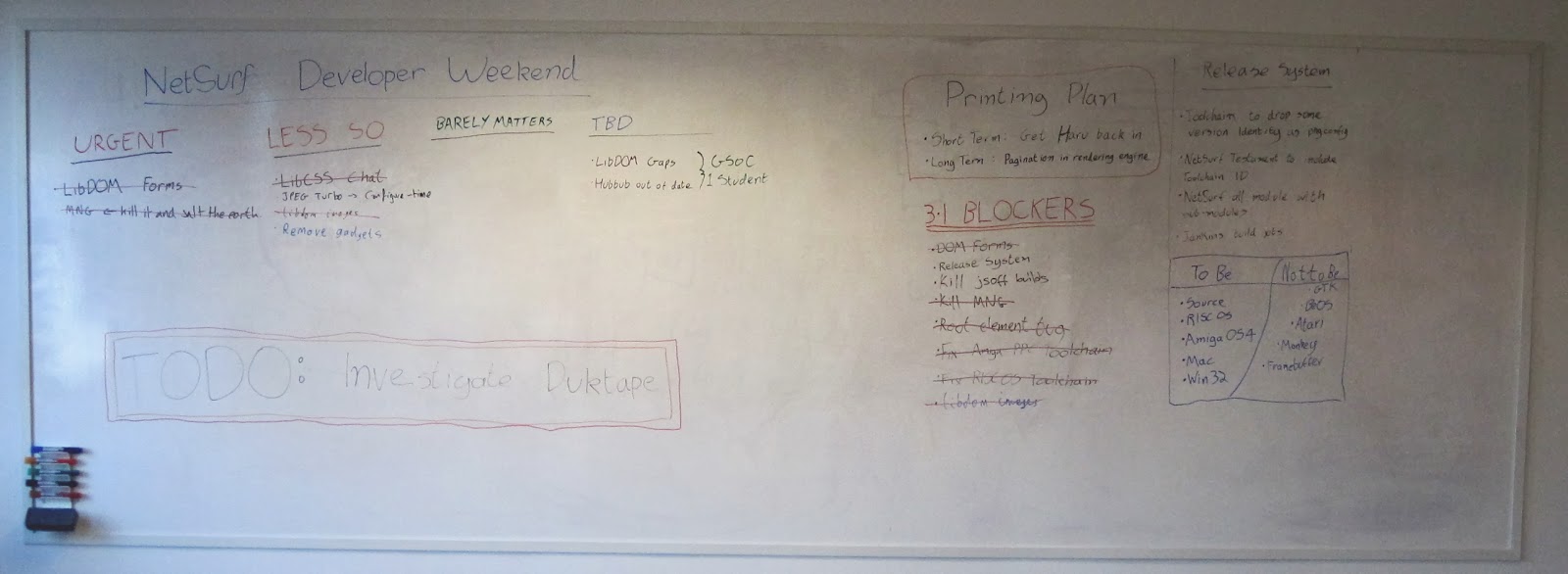
The whiteboard of our notes

Our main focus was working towards a 3.1 release which is scheduled for early April. Along with the source the release will have binary builds for RISC OS, AmigaOS, Windows and Mac OS X (x86 and ppc). Although the NetSurf project will not be directly releasing binaries for the GTK and Framebuffer frontends we will be ensuring the Debian packages are updated which is our prefered method of distribution for those targets.

We analysed the 3.0 release and formulated an improved process for the future. The 3.1 release will be generated automatically by the CI system ensuring constant results and removing the problems we encountered previously.

A set of release blocking issues was derived which we used as a task list during the workshop.The majority of these were completed including:
DOM based forms
Web forms are a feature Netsurf has supported for a long time and their implementation has not kept up with the rest of the browser. This is a long standing problem area which has resulted in numerous strange bugs with form submission. With this change the form system has been reworked to correctly operate directly from the DOM resulting in the squashing of a large number of bugs and a much improved user experience.

DOM based image loading
Up to now image fetching was performed only during the rendering of a page. With this change when the image link is placed into the DOM during the page parse it is scheduled to be fetched, this should give an improved user experience as images should be available earlier in a pages render.

Removal of MNG support
NetSurf has supported MNG since the 1.0 release, indeed the MNG library used to provide the PNG support too though we have long ago transitioned to libPNG. Alas the web has moved on and MNG has been largely forgotten, the libMNG library that performs the image decoding is old and generally unsupported specifically lacking security updates.

The build issues with libMNG (lack of pkg-config, reliance on libcms1 etc.) were causing maintenance issues in code nobody was actually using (there were crash bugs discovered during its removal!). Because of these issues it was decided to join the vast majority of browsers and remove support for this format.
The developers also addressed several issues with toolchain construction and a number of annoying usability bugs.

Plans for how to improve printing support we made. Initially we intend to fix the existing haru based pdf generation using this to print via pdf and in future have correct css styled page paginated printing render output.

The perennial issue of javascript was discussed however, while efforts to improve the existing support are ongoing, our usage of the spidermonkey library continues to raise various challenges including platform support and API changes between versions.

Due to these issues it has been suggested that we might add support for using the duktape JS engine instead, initial results are promising but given the size of the task of implementing an additional javascript engine binding further investigation is necessary before making a commitment.

Amongst the other discussions the group has also agreed that we will once again apply to be a GSoC organisation for a single student with some very focused projects:
  • Improving our HTML5 parser (hubbub)
  • Improving the DOM library implementing missing functionality.
While neither of these projects are as fashionable as some of our previous proposals they are well defined enough that as a group we believe we could offer enough support to the student to make their experience a pleasurable one and get the resulting code reviewed and merged promptly.

This event was very successful with a great deal achieved, the project is much more likely to be in a good shape to release 3.1 by April now and the meeting has given the developers a much welcomed boost.

I would like to extend the groups thanks to Robert McQueen for letting us use the Collabora offices, Dor e Carrier for organising all the administrative things and to Vivek Dasmohapatra for coming out on his Sunday afternoon to let us back in after locking ourselves out.


5 January 2014

Russ Allbery: More on displaying files with head

That was fun! Since my previous entry on using head to display the contents of several files in a form that's easy to cut and paste, multiple people have sent elaborations or related tricks. It seemed like it would be a good idea to post a roundup, since I learned a bunch. Multiple people (I think Josh Triplett was the first) pointed out that one can avoid having to pick a sufficiently large value of -n by instead using:
    head -n -0 *.install
With GNU head at least, a negative number says to print out all lines of the file except that many at the end, so -0 displays the whole file, regardless of size. Unfortunately, while this works anywhere that I am likely to run it, it's not specified by POSIX, while the original is. Another variation, pointed out by Buck Huppmann, is:
    tail -n +0 *.install
The +0 syntax is required by POSIX, unlike the -0 syntax for head... but unfortunately POSIX doesn't require that tail supports multiple files and the headers, although it does for head. Buck also pointed out that including the -v flag will always force the header even if there's only one file, which is useful. (Although be warned that -v isn't a POSIX-recognized flag.) Markus Raab also pointed out the xsel utility, which I'd heard of but hadn't ever used. If the goal is to cut and paste the output, using:
    head -v -n -0 *.install   xsel -i
avoids the cut part by dumping the result directly into the X selection. Buck pointed out xclip, which does the same thing. Both can be used with the -o flag inside an editor to paste as well if you don't want to reach for a mouse. In vi :r !xclip -o, and in Emacs, C-u M-! xclip -o. Finally, Guillem Jover metioned that:
    grep . *.install
does sort of the same thing with a different output format that may be more useful depending on what you're doing. (I find it less human-readable but more machine-parsable.)

4 January 2014

Simon Josefsson: Necrotizing Fasciitis

Dear World, On the morning of December 24th I felt an unusual pain in my left hand between the thumb and forefinger. The pain increased and in the afternoon I got a high fever, at some point above 40 degrees Celsius or 104 degree Fahrenheit. I went to the emergency department and was hospitalized during the night between the 24th and 25th of December. On the afternoon of December 26th I underwent surgery to find out what was happening, and was then diagnosed with Necrotizing Fasciitis (the wikipedia article on NF gives a fair summary), caused by the common streptococcus bacteria (again see wikipedia article on Streptococcus). A popular name for the disease is flesh-eating bacteria. Necrotizing Fasciitis is a rare and aggresive infection, often deadly if left untreated, that can move through the body at speeds of a couple of centimeters per hour. I have gone through 6 surgeries, leaving wounds all over my left hand and arm. I have felt afraid of what the disease will do to me, anxiety over what will happen in the future, confusion and uncertainty about how a disease like this can exist and that I get the right treatment since so little appears to be known about it. The feeling of loneliness and that nobody is helping, or even can help, has also been present. I have experienced pain. Even though pain is something I m less afraid of (I have a back problem) compared to other feelings, I needed help from several pain killers. I ve received normal Paracetamol, stronger NSAID s (e.g., Ketorolac/Toradol), several Opiate pain-killers including Alfentanil/Rapifen, Tramadol/Tradolan, OxyContin/OxyNorm, and Morphine. After the first and second surgery, nothing helped and I was still screaming with pain and kicking the bed. After the first surgery, I received a local anesthetic (a plexus block). After the second surgery, the doctors did not want to masquerade my pain, because sign of pain indicate further growth of the infection, and I was given the pain-dissociative drug Ketamine/Ketalar and the stress-releasing Clonidine/Catapresan. Once the third surgery removed all of the infection, pain went down, and I experienced many positive feelings. I am very grateful to be alive. I felt a strong sense of inner power when I started to fight back against the decease. I find joy in even the simplest of things, like being able to drink water or seeing trees outside the window. I cried out of happiness when I saw our children s room full of toys. I have learned many things about the human body, and I am curious by nature so I look forward to learn more. I hope to be able to draw strength from this incident, to help me prioritize better in my life. My loving wife sa has gone through a nightmare as a consequence of my diagnosis. At day she had to cope with daily life taking care of our wonderful 1-year old daughter Ingrid and 3-year old boy Alfred. All three of them had various degrees of strep throat with fever, caused by the same bacteria and anyone with young kids know how intense that alone can be. She gave me strength over the phone. She kept friends and relatives up to date about what happened, with the phone ringing all the time. She worked to get information out from the hospital about my status, sometimes being rudely treated and just being hanged up on. After a call with the doctor after the third surgery, when the infection had spread from the hand to within 5cm of my torso, she started to plan for a life without me. My last operation were on Thursday January 2nd and I left hospital the same day. I m writing this on the Saturday of January 4rd, although some details and external links have been added after that. I have regained access to my arm and hand and doing rehab to regain muscle control, while my body is healing. I m doing relaxation exercises to control pain and relax muscles, and took the last strong drug yesterday. Currently I take antibiotics (more precisely Clindamycin/Dalacin) and the common Paracetamol-based pain-killer Alvedon together with on-demand use of an also common NSAID containing Ibuprofen (Ipren). My wife and I were even out at a restaurant tonight. Fortunately I was healthy when this started, and with bi-weekly training sessions for the last 2 years I was physically at my strongest peak in my 38 year old life (weighting 78kg or 170lb, height 182cm or 6 feet). I started working out to improve back issues, increase strength, and prepare for getting older. Exercise has never been my thing although I think it is fun to run medium distances (up to 10km). I want thank everyone who helped me and our family through this, both professionally and personally, but I don t know where to start. You know who you are. You are the reason I m alive. Naturally, I want to focus on getting well and spend time with my family now. I don t yet know to what extent I will recover, but the prognosis is good. Don t expect anything from me in the communities and organization that I m active in (e.g., GNU, Debian, IETF, Yubico). I will come back as energy, time and priorities permits. flattr this!

3 January 2014

Wouter Verhelst: Dear google,

About half a decade ago, I created a gmail account (maybe longer not so sure anymore). After testing it out for a while, I decided that it wasn't for me; but as a gmail account comes with a google account for free, I didn't throw it out. As time went on, I added a few other things to that account. I try to limit its use a bit, but I do own a few android devices (for lack of a better alternative), and I do use adsense on my website, and all of these are linked to my existing google account; so I don't want to throw it away. I don't ever read mail sent to my gmail account, though; I prefer to read my mail in a local mail client (I used mutt for about a decade, having switched to thunderbird recently). Since it kept happening that people thought I would read my gmail account (which I do still use for XMPP, in spite of your recent crippling of that service), I configured an autoresponder on gmail to warn people off, and told them to use my main mail address instead of the gmail one. Additionally, I configured my main mail addresses (plural; they're really aliases) as "secondary" addresses on my gmail account, so that people who try to send mail to me could figure out where to actually send it before seeing the autoreply. Unfortunately, for some reason you seem to have interpreted that as "screw his MX records and DNSSEC, we'll just intercept anything coming from our servers and going to Wouter Verhelst as going to his gmail account". There's a word for that. I'm not going to use it.

Dirk Eddelbuettel: New BH release 1.51.1-4

A new release of the BH package is now on CRAN and its mirrors. BH provides (a sizeable subset of) the Boost library for C++, particularly the (large) parts delivered as pure template headers not requiring linking. See the BH page for more details. This release comes from a rewritten build script for the package. We no longer drive the initial set of Boost libraries by the requirements of the bigmemory (and synchronicity) packages, but rather explicitly enumerate an equivalent set of Boost libraries. This ensures that these libraries are included completely. We also move the project repository to this GitHub repo. The complete list changes follows below.
Changes in version 1.51.0-4 (2014-01-01)
  • Rewritten main package creation script to no longer scan for what bigmemory and synchronicity use, but rather explicitly copy over an (equivalent) list of explicitly-enumerated Boost libraries
  • Repository moved from R-Forge to GitHub, scripts and layout adjusted accordingly
  • Besides the implicitly expanded coverage by including the complete libraries, we also expanded from math/distributions to all of math.
Courtesy of CRANberries, there is also a diffstat report for the most recent release. Comments and suggestions are welcome via the mailing list or issue tracker still available via the package page at R-Forge.

This post by Dirk Eddelbuettel originated on his Thinking inside the box blog. Please report excessive re-aggregation in third-party for-profit settings.

1 January 2014

Russ Allbery: 2013 Book Reading in Review

What a strange year. 2013 was marked by a whole sequence of entirely unexpected events, including multiple major work upheavals. For large chunks of the year, I had very little time or emotional energy for personal reading goals, and particularly for writing reviews. I declared personal amnesty on most of my intentions halfway through the year, and all the totals will reflect that. On the plus side (although not for reading and reviews), it was a great year for video games. Next year, there will be no specific goals. Between continuing work fallout, a very busy project schedule, my intent to keep playing a lot of video games, and various other personal goals I want to take on, I'm going to take the pressure off of reading. Things will be read and reviews will be written (and I'm going to make more of an effort to write reviews shortly after reading books), but I'm not going to worry about how many. The below statistics are confined to the books I reviewed in 2013. I read six more books that I've not yet reviewed, due to the chaos at the end of the year. Those will be counted in 2014. There were no 10 out of 10 books this year, partly due to the much lower reading totals and partly due to my tendency this year to turn to safe comfort reading, which is reliably good but unlikely to be exceptional. There were, however, several near-misses that were worth calling out. My favorite book of the year was Neal Stephenson's Anathem, which narrowly missed a 10 for me due to some fundamental problems with the plot premise. But this is still an excellent book: the best novel about the practice of science and philosophy that I've ever read. Also deserving mention are K.E. Lane's And Playing the Role of Herself, lovely and intelligent lesbian romance that's likely to appeal even to people who would not normally try that genre, and Guy Gavriel Kay's River of Stars. The latter isn't quite at the level of Kay's earlier Under Heaven, but it's still an excellent work of alternate historical fiction in a memorable setting. A special honorable mention goes to Lisa O'Donnell's The Death of Bees. It requires a lot of warnings for very dark subject matter and a rather abrupt ending, but it's been a long time since I've cared that much about the characters of a book. My favorite non-fiction book of the year was Gary J. Hudson's They Had to Go Out, a meticulously researched account of a tragic Coast Guard mission. The writing is choppy, the editing could have been better, and it's clear that the author is not a professional writer, but it's the sort of detailed non-fiction account that can only be written by someone who's been there and lived through similar experiences. Also worth mentioning is Mark Jason Dominus's Higher Order Perl, which was the best technical book I read all year and which I found quite inspiring for my own programming. The full analysis includes some additional personal reading statistics, probably only of interest to me.

Vincent Bernat: Testing infrastructure with serverspec

Checking if your servers are configured correctly can be done with IT automation tools like Puppet, Chef, Ansible or Salt. They allow an administrator to specify a target configuration and ensure it is applied. They can also run in a dry-run mode and report servers not matching the expected configuration. On the other hand, serverspec is a tool to bring the well known RSpec, a testing tool for the Ruby programming language frequently used for test-driven development, to the infrastructure world. It can be used to remotely test server state through an SSH connection. Why one would use such an additional tool? Many things are easier to express with a test than with a configuration change, like for example checking that a service is correctly installed by checking it is listening to some port.

Getting started Good knowledge of Ruby may help but is not a prerequisite to the use of serverspec. Writing tests feels like writing what we expect in plain English. If you think you need to know more about Ruby, here are two short resources to get started: serverspec s homepage contains a short and concise tutorial on how to get started. Please, read it. As a first illustration, here is a test checking a service is correctly listening on port 80:
describe port(80) do
  it   should be_listening  
end
The following test will spot servers still running with Debian Squeeze instead of Debian Wheezy:
describe command("lsb_release -d") do
  it   should return_stdout /wheezy/  
end
Conditional tests are also possible. For example, we want to check the miimon parameter of bond0, but only when the interface is present:
has_bond0 = file('/sys/class/net/bond0').directory?
# miimon should be set to something other than 0, otherwise, no checks
# are performed.
describe file("/sys/class/net/bond0/bonding/miimon"), :if => has_bond0 do
  it   should be_file  
  its(:content)   should_not eq "0\n"  
end
serverspec comes with a complete documentation of available resource types (like port and command) that can be used after the keyword describe. When a test is too complex to be expressed with simple expectations, it can be specified with arbitrary commands. In the below example, we check if memcached is configured to use almost all the available system memory:
# We want memcached to use almost all memory. With a 2GB margin.
describe "memcached" do
  it "should use almost all memory" do
    total = command("vmstat -s   head -1").stdout #  
    total = /\d+/.match(total)[0].to_i
    total /= 1024
    args = process("memcached").args #  
    memcached = /-m (\d+)/.match(args)[1].to_i
    (total - memcached).should be > 0
    (total - memcached).should be < 2000
  end
end
A bit more arcane, but still understandable: we combine arbitrary shell commands (in ) and use of other serverspec resource types (in ).

Advanced use Out of the box, serverspec provides a strong fundation to build a compliance tool to be run on all systems. It comes with some useful advanced tips, like sharing tests among similar hosts or executing several tests in parallel. I have setup a GitHub repository to be used as a template to get the following features:
  • assign roles to servers and tests to roles;
  • parallel execution;
  • report generation & viewer.

Host classification By default, serverspec-init generates a template where each host has its own directory with its unique set of tests. serverspec only handles test execution on remote hosts: the test execution flow (which tests are executed on which servers) is delegated to some Rakefile1. Instead of extracting the list of hosts to test from a directory hiearchy, we can extract it from a file (or from an LDAP server or from any source) and attach a set of roles to each of them:
hosts = File.foreach("hosts")
  .map    line  line.strip  
  .map do  host 
   
    :name => host.strip,
    :roles => roles(host.strip),
   
end
The roles() function should return a list of roles for a given hostname. It could be something as simple as this:
def roles(host)
  roles = [ "all" ]
  case host
  when /^web-/
    roles << "web"
  when /^memc-/
    roles << "memcache"
  when /^lb-/
    roles << "lb"
  when /^proxy-/
    roles << "proxy"
  end
  roles
end
In the snippet below, we create a task for each server as well as a server:all task that will execute the tests for all hosts (in ). Pay attention, in , at how we attach the roles to each server.
namespace :server do
  desc "Run serverspec to all hosts"
  task :all => hosts.map    h  h[:name]   #  
  hosts.each do  host 
    desc "Run serverspec to host # host[:name] "
    ServerspecTask.new(host[:name].to_sym) do  t 
      t.target = host[:name]
      #  : Build the list of tests to execute from server roles
      t.pattern = './spec/ ' + host[:roles].join(",") + ' /*_spec.rb'
    end
  end
end
You can check the list of tasks created:
$ rake -T
rake check:server:all      # Run serverspec to all hosts
rake check:server:web-10   # Run serverspec to host web-10
rake check:server:web-11   # Run serverspec to host web-11
rake check:server:web-12   # Run serverspec to host web-12
Then, you need to modify spec/spec_helper.rb to tell serverspec to fetch the host to test from the environment variable TARGET_HOST instead of extracting it from the spec file name.

Parallel execution By default, each task is executed when the previous one has finished. With many hosts, this can take some time. rake provides the -j flag to specify the number of tasks to be executed in parallel and the -m flag to apply parallelism to all tasks:
$ rake -j 10 -m check:server:all

Reports rspec is invoked for each host. Therefore, the output is something like this:
$ rake spec
env TARGET_HOST=web-10 /usr/bin/ruby -S rspec spec/web/apache2_spec.rb spec/all/debian_spec.rb
......
Finished in 0.99715 seconds
6 examples, 0 failures
env TARGET_HOST=web-11 /usr/bin/ruby -S rspec spec/web/apache2_spec.rb spec/all/debian_spec.rb
......
Finished in 1.45411 seconds
6 examples, 0 failures
This does not scale well if you have dozens or hundreds of hosts to test. Moreover, the output is mangled with parallel execution. Fortunately, rspec comes with the ability to save results in JSON format. Those per-host results can then be consolidated into a single JSON file. All this can be done in the Rakefile:
  1. For each task, set rspec_opts to --format json --out ./reports/current/# target .json. This is done automatically by the subclass ServerspecTask which also handles passing the hostname in an environment variable and a more concise and colored output.
  2. Add a task to collect the generated JSON files into a single report. The test source code is also embedded in the report to make it self-sufficient. Moreover, this task is executed automatically by adding it as a dependency of the last serverspec-related task.
Have a look at the complete Rakefile for more details on how this is done. A very simple web-based viewer can handle those reports2. It shows the test results as a matrix with failed tests in red: Report viewer example Clicking on any test will display the necessary information to troubleshoot errors, including the test short description, the complete test code, the expectation message and the backtrace: Report viewer showing detailed error I hope this additional layer will help making serverspec another feather in the IT cap, between an automation tool and a supervision tool.

  1. A Rakefile is a Makefile where tasks and their dependencies are described in plain Ruby. rake will execute them in the appropriate order.
  2. The viewer is available in the GitHub repository in the viewer/ directory.

Russ Allbery: Review: The Female Man

Review: The Female Man, by Joanna Russ
Publisher: Beacon
Copyright: 1975
Printing: 1986
ISBN: 0-8070-6299-5
Format: Trade paperback
Pages: 214
The Female Man is one of the most famous novels of feminist science fiction, written by a giant of the field. Joanna Russ was one of the strongest writers of the first era of explicitly feminist SF and one of the most challenging. Along with Alice Sheldon (James Tiptree, Jr.) and Sheri Tepper, she's probably the best known author whose approach tended towards the directly confrontational. She was also a noted essayist, critic, and reviewer; her book How to Suppress Women's Writing is one of the most famous works of feminist literary criticism. That said, I wasn't sure what to expect from this book. I'd heard that it was about four different women: Jeannine, Joanna, Janet, and Jael. They're parallels of sorts but from far different cultures, alternate worlds displaced in time. I'd also heard that it was full of biting, accurate sarcasm, which is certainly the case. This is a book written from a place of righteous anger combined with keen social observation and a desire to point out how different the world could be. And how toxic male behavior towards women currently is. What it's not, however, is much of a novel, in the sense of having a clear plot that carries the reader through the book. There is a story of sorts, which revolves around the appearance of Janet in Joanna's time. Janet is a native of Whileaway, an alternate future Earth in which there are no men at all and social organization is significantly different. We get a fairly detailed description of her life and of some Whileaway customs over the course of the book. But they're mixed with excerpts from the lives of both Jeannine (from an alternate past in which the Great Depression never ended) and Joanna. If Janet's story is a sort of utopian alternate future, following the basic model of female separatist societies, Jeannine's is the dystopia drawn from our past. She's locked entirely into traditional gender roles and the desire to catch a man and be a wife. I found her the hardest character to read about by far, largely because she locks herself into the worst constraints of that role. She's almost entirely passive, and she's devoted to a man for whom it's difficult to have any respect at all. Janet is interesting in part because she's not particularly exceptional in either ability or intelligence. She just reflects the Whileaway culture, which leads to some sharp conflicts with the norms of Joanna's time. It's a very effective tactic for alienating the reader from current gender roles (or, at least, roles from the 1970s) and showing how absurd they appear with a different set of starting assumptions. Russ makes the point clearly; this is not a book that tends towards the subtle, although it can be a little hard to track the characters' progress through alternate timelines. Towards the end of the book, they meet the fourth character. (This is not really the sort of book that is possible to spoil by summary.) Jael is by far the most aggressive of any of them, the closest that any of them come to the caricature of a "man-hating feminist." One of the strengths of The Female Man is that, by the time the story reaches her, I at least was feeling quite a lot of sympathy towards her aggressively violent approach, after watching Joanna be put down and Jeannine simper ineffectually. However, it's worth nothing that Janet, the representative of the supposed utopia, does not agree with Jael or her methods, and the relationship between their worlds is interestingly complex. None of the four characters are exactly wrong (although Jeannine comes close); none of them are entirely right either. They're all struggling in different ways with how to define femininity. While the quiet and simplicity of Janet's world has definite appeal, it's the sort of utopia that one isn't sure one would actually want. And Jael has some pointed commentary on how wanting such a world is one thing, but the acts required to create it is quite another. I can see why this book is so well-known. Many of the scenes that show gender relations and male behavior are both painful and funny. Reading it forty years after it was written, it's clear that social norms have changed; men do and say things here that they would no longer be able to get away with, that are clearly from another era. But it's also clear that some of the underlying attitudes have not changed, just been cloaked in different language. And Russ's bluntness here is refreshing: this book does not pull its punches, both in openly ridiculing sexist behavior, and in showing how oppressive it is for women. That said, it didn't work as a story for me, in part because the plot is sketchy at best. It's a collection of individual excerpts and commentary, only some of which are shaped like a story. Much of it feels stream of consciousness, and when cut between three different viewpoints, it's also occasionally confusing. There are also a few too-obvious characters: some of the men, particularly in Jael's section, but also Jeannine, who I never liked even after she starts changing her mind about women's roles. I wanted a bit more story and a bit less introspection. I think this is an important book that's worth reading, and sadly it's not as obsolete as one would like. But I don't think it's entirely successful as a novel. Best treated as a piece of literary history. Rating: 6 out of 10

Andrew Pollock: [life] It's a new year, it's a new me

Well, it's 2014. The annus horribilus of 2013 is behind me. I'm entering 2014 in a much better place (on multiple levels) than I did for 2013. I'm positively excited to see what 2014 brings me. I was very fortunate to have someone I looked up to reach out to help me when my marriage fell apart. One of the things he said to me was "A year from now, you won't recognise yourself". He was right. I am such a different person today than I was a year ago. I'm happier, fitter, more self-confident. I'm focusing on different things in my life. One thing that has been a casualty, has been my geeky pursuits. There were a few times last year where I questioned if I was still a geek. I am. I've just deprioritised it. Instead, I've been putting my own self-care and my daughter above all else, meaning that my running has probably been the one thing I'd call a "hobby" at the moment. I've got some stuff in the pipeline that I'm not quite ready to write about yet, but I'm expecting a rearrangement of my time that will hopefully allow for some more geeky endeavours in 2014. I'm also hoping I can regain some momentum on blogging. Here's what I'd say my goals are, going into 2014: plus some other stuff I'm not ready to talk about yet.

31 December 2013

Clint Adams: Tax year close

As I watch my friends and enemies rush to make their 501(c)3-qualified donations before midnight, I think to ask, What if, instead of giving to these fat, corrupt organizations that are rolling in money and waste most of it, you gave to the FSF, the SFLC, or the Tor project?

30 December 2013

Lars Wirzenius: Thoughtful, inspiring words from Russ

Russ Allbery has written up summaries of the research he's done in preparation of a Debian Technical Committee vote on default init system in Debian's next release. The mails are long, and well worth reading completely if the topic interests you at all, but I'd like to quote separately a few paragraphs that I found thoughtful, and inspiring, in the greater Debian context and not just for the init system discussion. From "init system other points, and conclusion":
Here again, I think we have an opportunity for Debian to be more innovative and forward-looking in what we attempt to accomplish in the archive by adopting frameworks that let us incorporate the principles of least privilege and defense in depth into our standard daemon configurations.
And later, from the same mail:
I think we should make wise decisions about which areas we want to invest project effort. I dislike investing significant project effort in catch-up efforts that, when complete, merely get us back to where we would have been if we'd chosen a different solution. I don't think that's wise stewardship of project resources. I want to see Debian focus its efforts on places where we can make a real difference, where we can be leaders. That means adopting the best-of-breed existing solutions and building on top of them, not reinventing wheels and thereby starting from a trailing position.
From "loose ends for init system decision":
It is not, in general, necessary to justify what you want to do in Debian. It doesn't matter if it's going to be used by thousands of people or two people. If you can do your work to the standards that we expect to be maintained across the archive, and without negative impact on Debian's other contributors, you can work on whatever you love. And, furthermore, we all support each other in our passions. Debian is built on a culture of deference to other people's work, and reasonable accomodation to the projects that other people want to work on. Now, there is a fine balance here. Deference to other people's work does not mean a requirement to join their work. Reasonable accomodation does not mean that every Debian developer is required to test their software on non-Linux ports. The goal is that all of us should be empowered to work on the things we are passionate about, which implicitly includes being empowered to not work on the things that are not of interest to us. Therefore, for some efforts, and specifically for the non-Linux port efforts, the work is mostly born by the porters. They're expected to test, diagnose problems, and submit patches. The deference and reasonable accomodation that we expect of Debian contributors is to merge those patches when they are reasonable, to not undermine the porting effort when there is a reasonable approach that preserves it, and to be aware of the implications of their packaging for those ports in the broad sense (such as qualifying build-dependencies with [linux-any] where appropriate). We do not expect Debian contributors to reject significant new upstream versions or significant new integrations because they will affect the non-Linux ports, or, for that matter, other projects in Debian. We do expect those changes to follow the standards that we expect of Debian as a whole, and that porting efforts will be treated with deference and reasonable accomodation.
I won't offer a comment on these quotes I prefer to let them speak for themselves but I will say I find these to be among the wisest things said within Debian all year.

Next.

Previous.