Search Results: "ms"

16 July 2020

Louis-Philippe V ronneau: DebConf Videoteam Sprint Report -- DebConf20@Home

DebConf20 starts in about 5 weeks, and as always, the DebConf Videoteam is working hard to make sure it'll be a success. As such, we held a sprint from July 9th to 13th to work on our new infrastructure. A remote sprint certainly ain't as fun as an in-person one, but we nonetheless managed to enjoy ourselves. Many thanks to those who participated, namely: We also wish to extend our thanks to Thomas Goirand and Infomaniak for providing us with virtual machines to experiment on and host the video infrastructure for DebConf20. Advice for presenters For DebConf20, we strongly encourage presenters to record their talks in advance and send us the resulting video. We understand this is more work, but we think it'll make for a more agreeable conference for everyone. Video conferencing is still pretty wonky and there is nothing worse than a talk ruined by a flaky internet connection or hardware failures. As such, if you are giving a talk at DebConf this year, we are asking you to read and follow our guide on how to record your presentation. Fear not: we are not getting rid of the Q&A period at the end of talks. Attendees will ask their questions either on IRC or on a collaborative pad and the Talkmeister will relay them to the speaker once the pre-recorded video has finished playing. New infrastructure, who dis? Organising a virtual DebConf implies migrating from our battle-tested on-premise workflow to a completely new remote one. One of the major changes this means for us is the addition of Jitsi Meet to our infrastructure. We normally have 3 different video sources in a room: two cameras and a slides grabber. With the new online workflow, directors will be able to play pre-recorded videos as a source, will get a feed from a Jitsi room and will see the audience questions as a third source. This might seem simple at first, but is in fact a very major change to our workflow and required a lot of work to implement.
               == On-premise ==                                          == Online ==
                                                      
              Camera 1                                                 Jitsi
                                                                          
                 v                 ---> Frontend                         v                 ---> Frontend
                                                                                            
    Slides -> Voctomix -> Backend -+--> Frontend         Questions -> Voctomix -> Backend -+--> Frontend
                                                                                            
                 ^                 ---> Frontend                         ^                 ---> Frontend
                                                                          
              Camera 2                                           Pre-recorded video
In our tests, playing back pre-recorded videos to voctomix worked well, but was sometimes unreliable due to inconsistent encoding settings. Presenters will thus upload their pre-recorded talks to SReview so we can make sure there aren't any obvious errors. Videos will then be re-encoded to ensure a consistent encoding and to normalise audio levels. This process will also let us stitch the Q&As at the end of the pre-recorded videos more easily prior to publication. Reducing the stream latency One of the pitfalls of the streaming infrastructure we have been using since 2016 is high video latency. In a worst case scenario, remote attendees could get up to 45 seconds of latency, making participation in events like BoFs arduous. In preparation for DebConf20, we added a new way to stream our talks: RTMP. Attendees will thus have the option of using either an HLS stream with higher latency or an RTMP stream with lower latency. Here is a comparative table that can help you decide between the two protocols:
HLS RTMP
Pros
  • Can be watched from a browser
  • Auto-selects a stream encoding
  • Single URL to remember
  • Lower latency (~5s)
Cons
  • Higher latency (up to 45s)
  • Requires a dedicated video player (VLC, mpv)
  • Specific URLs for each encoding setting
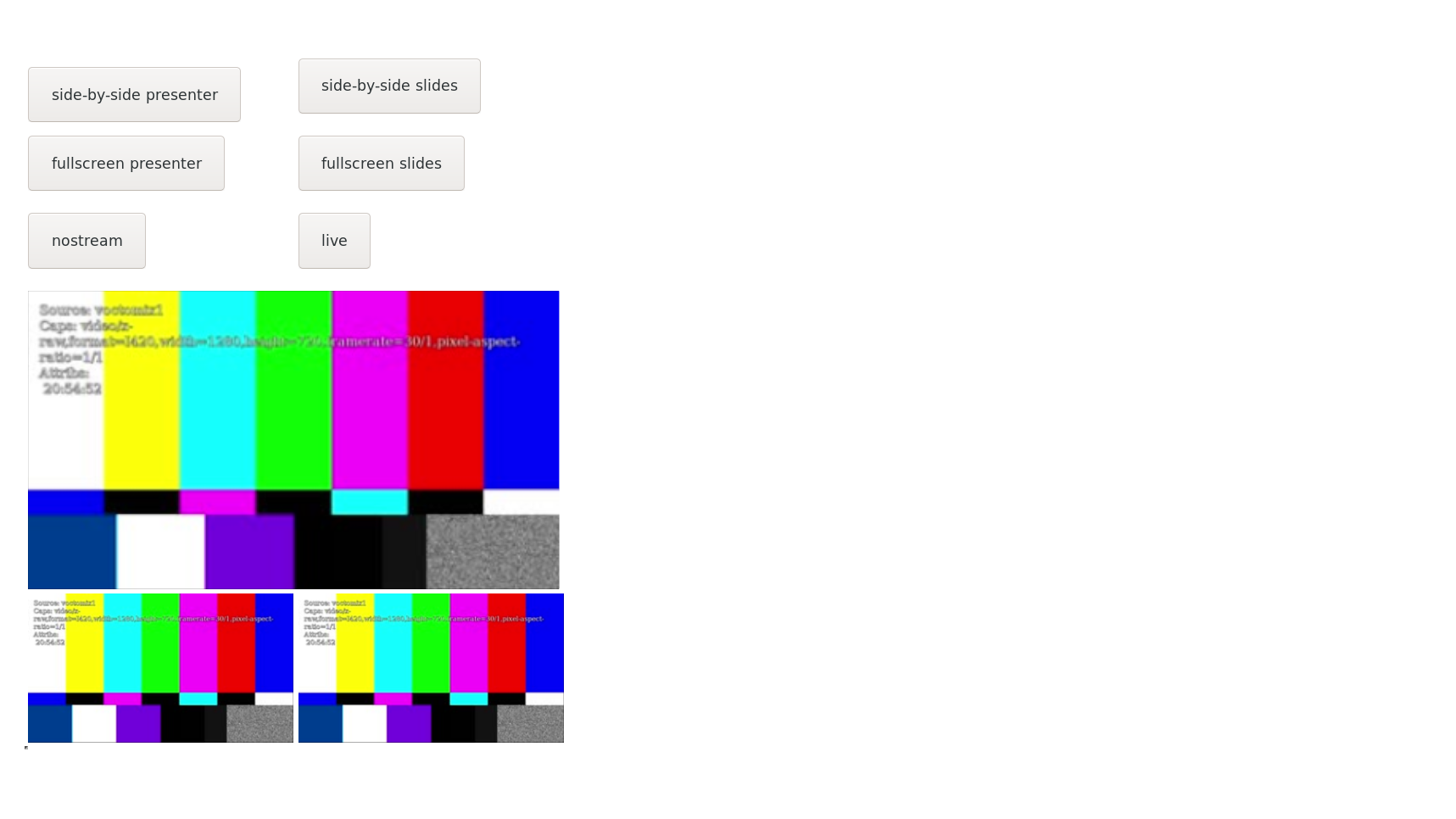
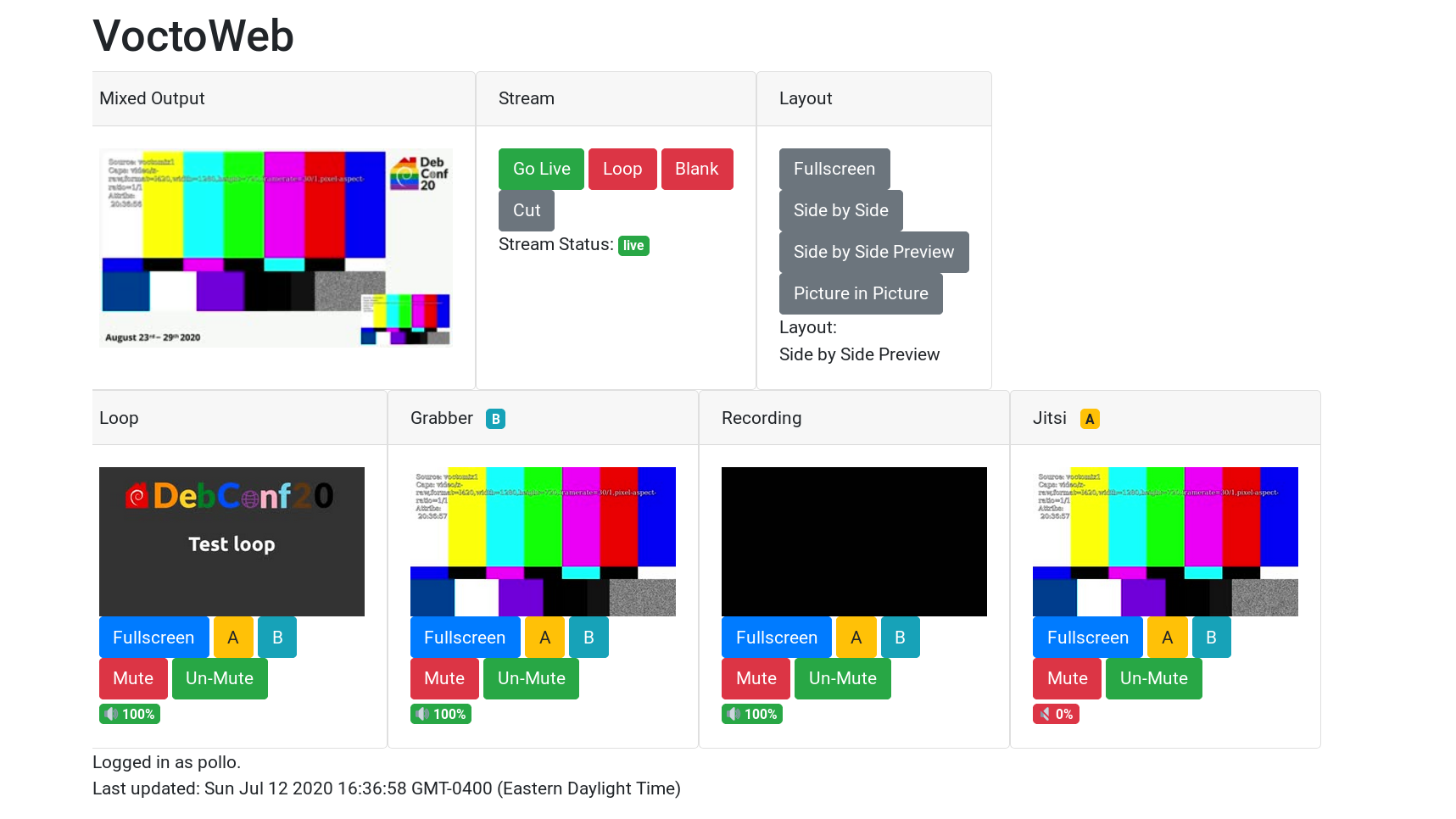
Live mixing from home with VoctoWeb Since DebConf16, we have been using voctomix, a live video mixer developed by the CCC VOC. voctomix is conveniently divided in two: voctocore is the backend server while voctogui is a GTK+ UI frontend directors can use to live-mix. Although voctogui can connect to a remote server, it was primarily designed to run either on the same machine as voctocore or on the same LAN. Trying to use voctogui from a machine at home to connect to a voctocore running in a datacenter proved unreliable, especially for high-latency and low bandwidth connections. Inspired by the setup FOSDEM uses, we instead decided to go with a web frontend for voctocore. We initially used FOSDEM's code as a proof of concept, but quickly reimplemented it in Python, a language we are more familiar with as a team. Compared to the FOSDEM PHP implementation, voctoweb implements A / B source selection (akin to voctogui) as well as audio control, two very useful features. In the following screen captures, you can see the old PHP UI on the left and the new shiny Python one on the right. The old PHP voctowebThe new Python3 voctoweb Voctoweb is still under development and is likely to change quite a bit until DebConf20. Still, the current version seems to works well enough to be used in production if you ever need to. Python GeoIP redirector We run multiple geographically-distributed streaming frontend servers to minimize the load on our streaming backend and to reduce overall latency. Although users can connect to the frontends directly, we typically point them to live.debconf.org and redirect connections to the nearest server. Sadly, 6 months ago MaxMind decided to change the licence on their GeoLite2 database and left us scrambling. To fix this annoying issue, Stefano Rivera wrote a Python program that uses the new database and reworked our ansible frontend server role. Since the new database cannot be redistributed freely, you'll have to get a (free) license key from MaxMind if you to use this role. Ansible & CI improvements Infrastructure as code is a living process and needs constant care to fix bugs, follow changes in DSL and to implement new features. All that to say a large part of the sprint was spent making our ansible roles and continuous integration setup more reliable, less buggy and more featureful. All in all, we merged 26 separate ansible-related merge request during the sprint! As always, if you are good with ansible and wish to help, we accept merge requests on our ansible repository :)

Enrico Zini: Build Qt5 cross-builder with raspbian sysroot: compiling with the sysroot

Whack-A-Mole machines from <https://commons.wikimedia.org/wiki/File:Whac-A-Mole_Cedar_Point.jpg> This is part of a series of posts on compiling a custom version of Qt5 in order to develop for both amd64 and a Raspberry Pi. Now that I have a sysroot, I try to use it to build Qt5 with QtWebEngine. Nothing seems to work straightforwardly with Qt5's build system, and hit an endless series of significant blockers to try and work around.
Problem in wayland code QtWayland's source currently does not compile:
../../../hardwareintegration/client/brcm-egl/qwaylandbrcmeglwindow.cpp: In constructor  QtWaylandClient::QWaylandBrcmEglWindow::QWaylandBrcmEglWindow(QWindow*) :
../../../hardwareintegration/client/brcm-egl/qwaylandbrcmeglwindow.cpp:131:67: error: no matching function for call to  QtWaylandClient::QWaylandWindow::QWaylandWindow(QWindow*&) 
     , m_eventQueue(wl_display_create_queue(mDisplay->wl_display()))
                                                                   ^
In file included from ../../../../include/QtWaylandClient/5.15.0/QtWaylandClient/private/qwaylandwindow_p.h:1,
                 from ../../../hardwareintegration/client/brcm-egl/qwaylandbrcmeglwindow.h:43,
                 from ../../../hardwareintegration/client/brcm-egl/qwaylandbrcmeglwindow.cpp:40:
../../../../include/QtWaylandClient/5.15.0/QtWaylandClient/private/../../../../../src/client/qwaylandwindow_p.h:97:5: note: candidate:  QtWaylandClient::QWaylandWindow::QWaylandWindow(QWindow*, QtWayland
Client::QWaylandDisplay*) 
     QWaylandWindow(QWindow *window, QWaylandDisplay *display);
     ^~~~~~~~~~~~~~
../../../../include/QtWaylandClient/5.15.0/QtWaylandClient/private/../../../../../src/client/qwaylandwindow_p.h:97:5: note:   candidate expects 2 arguments, 1 provided
make[5]: Leaving directory '/home/build/armhf/qt-everywhere-src-5.15.0/qttools/src/qdoc'
I am not trying to debug here. I understand that Wayland support is not a requirement, and I'm adding -skip wayland to Qt5's configure options. Next round. nss not found Qt5 embeds Chrome's sources. Chrome's sources require libnss3-dev to be available for both host and target architectures. Although I now have it installed both on the build system and in the sysroot, the pkg-config wrapper that Qt5 hooks into its Chrome's sources, failes to find it:
Command: /usr/bin/python2 /home/build/armhf/qt-everywhere-src-5.15.0/qtwebengine/src/3rdparty/chromium/build/config/linux/pkg-config.py -s /home/build/sysroot/ -a arm -p /usr/bin/arm-linux-gnueabihf-pkg-config --system_libdir lib nss -v -lssl3
Returned 1.
stderr:
Package nss was not found in the pkg-config search path.
Perhaps you should add the directory containing  nss.pc'
to the PKG_CONFIG_PATH environment variable
No package 'nss' found
Traceback (most recent call last):
  File "/home/build/armhf/qt-everywhere-src-5.15.0/qtwebengine/src/3rdparty/chromium/build/config/linux/pkg-config.py", line 248, in <module>
    sys.exit(main())
  File "/home/build/armhf/qt-everywhere-src-5.15.0/qtwebengine/src/3rdparty/chromium/build/config/linux/pkg-config.py", line 143, in main
    prefix = GetPkgConfigPrefixToStrip(options, args)
  File "/home/build/armhf/qt-everywhere-src-5.15.0/qtwebengine/src/3rdparty/chromium/build/config/linux/pkg-config.py", line 82, in GetPkgConfigPrefixToStrip
    "--variable=prefix"] + args, env=os.environ).decode('utf-8')
  File "/usr/lib/python2.7/subprocess.py", line 223, in check_output
    raise CalledProcessError(retcode, cmd, output=output)
subprocess.CalledProcessError: Command '['/usr/bin/arm-linux-gnueabihf-pkg-config', '--variable=prefix', 'nss']' returned non-zero exit status 1
See //build/config/linux/nss/BUILD.gn:15:3: whence it was called.
  pkg_config("system_nss_no_ssl_config")  
  ^---------------------------------------
See //crypto/BUILD.gn:218:25: which caused the file to be included.
    public_configs += [ "//build/config/linux/nss:system_nss_no_ssl_config" ]
                        ^--------------------------------------------------
Project ERROR: GN run error!
It's trying to look into $SYSROOT/usr/lib/pkgconfig, while it should be $SYSROOT//usr/lib/arm-linux-gnueabihf/pkgconfig. I worked around this this patch to qtwebengine/src/3rdparty/chromium/build/config/linux/pkg-config.py:
--- pkg-config.py.orig  2020-07-16 11:46:21.005373002 +0200
+++ pkg-config.py   2020-07-16 11:46:02.605296967 +0200
@@ -61,6 +61,7 @@
   libdir = sysroot + '/usr/' + options.system_libdir + '/pkgconfig'
   libdir += ':' + sysroot + '/usr/share/pkgconfig'
+  libdir += ':' + sysroot + '/usr/lib/arm-linux-gnueabihf/pkgconfig'
   os.environ['PKG_CONFIG_LIBDIR'] = libdir
   return libdir
Next round. g++ 8.3.0 Internal Compiler Error Qt5's sources embed Chrome's sources that embed the skia library sources. One of the skia library sources, when cross-compiled to ARM with -O1 or -O2 with g++ 8.3.0, produces an Internal Compiler Error:
/usr/bin/arm-linux-gnueabihf-g++ -MMD -MF obj/skia/skcms/skcms.o.d -DUSE_UDEV -DUSE_AURA=1 -DUSE_NSS_CERTS=1 -DUSE_OZONE=1 -DOFFICIAL_BUILD -DTOOLKIT_QT -D_FILE_OFFSET_BITS=64 -D_LARGEFILE_SOURCE -D_LARGEFILE64_SOURCE -DNO_UNWIND_TABLES -D__STDC_CONSTANT_MACROS -D__STDC_FORMAT_MACROS -DCR_SYSROOT_HASH=76e6068f9f6954e2ab1ff98ce5fa236d3d85bcbd -DNDEBUG -DNVALGRIND -DDYNAMIC_ANNOTATIONS_ENABLED=0 -I../../3rdparty/chromium/third_party/skia/include/third_party/skcms -Igen -I../../3rdparty/chromium -w -std=c11 -mfp16-format=ieee -fno-strict-aliasing --param=ssp-buffer-size=4 -fstack-protector -fno-unwind-tables -fno-asynchronous-unwind-tables -fPIC -pipe -pthread -march=armv7-a -mfloat-abi=hard -mtune=generic-armv7-a -mfpu=vfpv3-d16 -mthumb -Wall -U_FORTIFY_SOURCE -D_FORTIFY_SOURCE=2 -Wno-psabi -Wno-unused-local-typedefs -Wno-maybe-uninitialized -Wno-deprecated-declarations -fno-delete-null-pointer-checks -Wno-comments -Wno-packed-not-aligned -Wno-dangling-else -Wno-missing-field-initializers -Wno-unused-parameter -O2 -fno-ident -fdata-sections -ffunction-sections -fno-omit-frame-pointer -g0 -fvisibility=hidden -std=gnu++14 -Wno-narrowing -Wno-class-memaccess -Wno-attributes -Wno-class-memaccess -Wno-subobject-linkage -Wno-invalid-offsetof -Wno-return-type -Wno-deprecated-copy -fno-exceptions -fno-rtti --sysroot=../../../../../../sysroot/ -fvisibility-inlines-hidden -c ../../3rdparty/chromium/third_party/skia/third_party/skcms/skcms.cc -o obj/skia/skcms/skcms.o
during RTL pass: expand
In file included from ../../3rdparty/chromium/third_party/skia/third_party/skcms/skcms.cc:2053:
../../3rdparty/chromium/third_party/skia/third_party/skcms/src/Transform_inl.h: In function  void baseline::exec_ops(const Op*, const void**, const char*, char*, int) :
../../3rdparty/chromium/third_party/skia/third_party/skcms/src/Transform_inl.h:766:13: internal compiler error: in convert_move, at expr.c:218
 static void exec_ops(const Op* ops, const void** args,
             ^~~~~~~~
Please submit a full bug report,
with preprocessed source if appropriate.
See <file:///usr/share/doc/gcc-8/README.Bugs> for instructions.
I reported the bug at https://gcc.gnu.org/bugzilla/show_bug.cgi?id=96206 Since this source compiles with -O0, I attempted to fix this by editing qtwebkit/src/3rdparty/chromium/build/config/compiler/BUILD.gn and replacing instances of -O1 and -O2 with -O0. Spoiler: wrong attempt. We'll see it in the next round. Impossible constraint in asm Qt5's sources embed Chrome's sources that embed the ffmpeg library sources. Even if ffmpeg's development libraries are present both in the host and in the target system, the build system insists in compiling and using the bundled version. Unfortunately, using -O0 breaks the build of ffmpeg:
/usr/bin/arm-linux-gnueabihf-gcc -MMD -MF obj/third_party/ffmpeg/ffmpeg_internal/opus.o.d -DHAVE_AV_CONFIG_H -D_POSIX_C_SOURCE=200112 -D_XOPEN_SOURCE=600 -DPIC -DFFMPEG_CONFIGURATION=NULL -DCHROMIUM_NO_LOGGING -D_ISOC99_SOURCE -D_LARGEFILE_SOURCE -DUSE_UDEV -DUSE_AURA=1 -DUSE_NSS_CERTS=1 -DUSE_OZONE=1 -DOFFICIAL_BUILD -DTOOLKIT_QT -D_FILE_OFFSET_BITS=64 -D_LARGEFILE_SOURCE -D_LARGEFILE64_SOURCE -DNO_UNWIND_TABLES -DCR_SYSROOT_HASH=76e6068f9f6954e2ab1ff98ce5fa236d3d85bcbd -DNDEBUG -DNVALGRIND -DDYNAMIC_ANNOTATIONS_ENABLED=0 -DOPUS_FIXED_POINT -I../../3rdparty/chromium/third_party/ffmpeg/chromium/config/Chromium/linux/arm -I../../3rdparty/chromium/third_party/ffmpeg -I../../3rdparty/chromium/third_party/ffmpeg/compat/atomics/gcc -Igen -I../../3rdparty/chromium -I../../3rdparty/chromium/third_party/opus/src/include -fPIC -Wno-deprecated-declarations -fomit-frame-pointer -w -std=c99 -pthread -fno-math-errno -fno-signed-zeros -fno-tree-vectorize -fno-strict-aliasing --param=ssp-buffer-size=4 -fstack-protector -fno-unwind-tables -fno-asynchronous-unwind-tables -fPIC -pipe -pthread -march=armv7-a -mfloat-abi=hard -mtune=generic-armv7-a -mfpu=vfpv3-d16 -mthumb -g0 -fvisibility=hidden -Wno-psabi -Wno-unused-local-typedefs -Wno-maybe-uninitialized -Wno-deprecated-declarations -fno-delete-null-pointer-checks -Wno-comments -Wno-packed-not-aligned -Wno-dangling-else -Wno-missing-field-initializers -Wno-unused-parameter -O0 -fno-ident -fdata-sections -ffunction-sections -std=gnu11 --sysroot=../../../../../../sysroot/ -c ../../3rdparty/chromium/third_party/ffmpeg/libavcodec/opus.c -o obj/third_party/ffmpeg/ffmpeg_internal/opus.o
In file included from ../../3rdparty/chromium/third_party/ffmpeg/libavutil/intmath.h:30,
                 from ../../3rdparty/chromium/third_party/ffmpeg/libavutil/common.h:106,
                 from ../../3rdparty/chromium/third_party/ffmpeg/libavutil/avutil.h:296,
                 from ../../3rdparty/chromium/third_party/ffmpeg/libavutil/audio_fifo.h:30,
                 from ../../3rdparty/chromium/third_party/ffmpeg/libavcodec/opus.h:28,
                 from ../../3rdparty/chromium/third_party/ffmpeg/libavcodec/opus_celt.h:29,
                 from ../../3rdparty/chromium/third_party/ffmpeg/libavcodec/opus.c:32:
../../3rdparty/chromium/third_party/ffmpeg/libavcodec/opus.c: In function  ff_celt_quant_bands :
../../3rdparty/chromium/third_party/ffmpeg/libavutil/arm/intmath.h:77:5: error: impossible constraint in  asm 
     __asm__ ("usat %0, %2, %1" : "=r"(x) : "r"(a), "i"(p));
     ^~~~~~~
The same source compiles with using -O2 instead of -O0. I worked around this by undoing the previous change, and limiting -O0 to just the source that causes the Internal Compiler Error. I edited qtwebengine/src/3rdparty/chromium/third_party/skia/third_party/skcms/skcms.cc to prepend:
#pragma GCC push_options
#pragma GCC optimize ("O0")
and append:
#pragma GCC pop_options
Next round. Missing build-deps for i386 code Qt5's sources embed Chrome's sources that embed the V8 library sources. For some reason, torque, that is part of V8, wants to build some of its sources into 32 bit code with -m32, and I did not have i386 cross-compilation libraries installed:
/usr/bin/g++ -MMD -MF v8_snapshot/obj/v8/torque_base/csa-generator.o.d -DUSE_UDEV -DUSE_AURA=1 -DUSE_NSS_CERTS=1 -DUSE_OZONE=1 -DOFFICIAL_BUILD -DTOOLKIT_QT -D_FILE_OFFSET_BITS=64 -D_LARGEFILE_SOURCE -D_LARGEFILE64_SOURCE -DNO_UNWIND_TABLES -D__STDC_CONSTANT_MACROS -D__STDC_FORMAT_MACROS -DNDEBUG -DNVALGRIND -DDYNAMIC_ANNOTATIONS_ENABLED=0 -DV8_TYPED_ARRAY_MAX_SIZE_IN_HEAP=64 -DENABLE_MINOR_MC -DV8_INTL_SUPPORT -DV8_CONCURRENT_MARKING -DV8_ENABLE_LAZY_SOURCE_POSITIONS -DV8_EMBEDDED_BUILTINS -DV8_SHARED_RO_HEAP -DV8_WIN64_UNWINDING_INFO -DV8_ENABLE_REGEXP_INTERPRETER_THREADED_DISPATCH -DV8_31BIT_SMIS_ON_64BIT_ARCH -DV8_DEPRECATION_WARNINGS -DV8_TARGET_ARCH_ARM -DCAN_USE_ARMV7_INSTRUCTIONS -DCAN_USE_VFP3_INSTRUCTIONS -DUSE_EABI_HARDFLOAT=1 -DV8_HAVE_TARGET_OS -DV8_TARGET_OS_LINUX -DDISABLE_UNTRUSTED_CODE_MITIGATIONS -DV8_31BIT_SMIS_ON_64BIT_ARCH -DV8_DEPRECATION_WARNINGS -Iv8_snapshot/gen -I../../3rdparty/chromium -I../../3rdparty/chromium/v8 -Iv8_snapshot/gen/v8 -fno-strict-aliasing --param=ssp-buffer-size=4 -fstack-protector -fno-unwind-tables -fno-asynchronous-unwind-tables -fPIC -pipe -pthread -m32 -msse2 -mfpmath=sse -mmmx -Wall -U_FORTIFY_SOURCE -D_FORTIFY_SOURCE=2 -Wno-unused-local-typedefs -Wno-maybe-uninitialized -Wno-deprecated-declarations -fno-delete-null-pointer-checks -Wno-comments -Wno-packed-not-aligned -Wno-dangling-else -Wno-missing-field-initializers -Wno-unused-parameter -fno-omit-frame-pointer -g0 -fvisibility=hidden -Wno-strict-overflow -Wno-return-type -O3 -fno-ident -fdata-sections -ffunction-sections -std=gnu++14 -Wno-narrowing -Wno-class-memaccess -Wno-attributes -Wno-class-memaccess -Wno-subobject-linkage -Wno-invalid-offsetof -Wno-return-type -Wno-deprecated-copy -fvisibility-inlines-hidden -fexceptions -frtti -c ../../3rdparty/chromium/v8/src/torque/csa-generator.cc -o v8_snapshot/obj/v8/torque_base/csa-generator.o
In file included from ../../3rdparty/chromium/v8/src/torque/csa-generator.h:8,
                 from ../../3rdparty/chromium/v8/src/torque/csa-generator.cc:5:
/usr/include/c++/8/iostream:38:10: fatal error: bits/c++config.h: No such file or directory
 #include <bits/c++config.h>
          ^~~~~~~~~~~~~~~~~~
compilation terminated.
New build dependencies needed:
apt install lib32stdc++-8-dev
apt install libc6-dev-i386
dpkg --add-architecture i386
apt install linux-libc-dev:i386
Next round. OpenGL build issues Next bump are OpenGL related compiler issues:
/usr/bin/arm-linux-gnueabihf-g++ -MMD -MF obj/QtWebEngineCore/gl_ozone_glx_qt.o.d -DCHROMIUM_VERSION=\"80.0.3987.163\" -DUSE_UDEV -DUSE_AURA=1 -DUSE_NSS_CERTS=1 -DUSE_OZONE=1 -DOFFICIAL_BUILD -DTOOLKIT_QT -D_FILE_OFFSET_BITS=64 -D_LARGEFILE_SOURCE -D_LARGEFILE64_SOURCE -DNO_UNWIND_TABLES -D__STDC_CONSTANT_MACROS -D__STDC_FORMAT_MACROS -DCR_SYSROOT_HASH=76e6068f9f6954e2ab1ff98ce5fa236d3d85bcbd -DNDEBUG -DNVALGRIND -DDYNAMIC_ANNOTATIONS_ENABLED=0 -DQT_NO_LINKED_LIST -DQT_NO_KEYWORDS -DQT_USE_QSTRINGBUILDER -DQ_FORWARD_DECLARE_OBJC_CLASS=QT_FORWARD_DECLARE_CLASS -DQTWEBENGINECORE_VERSION_STR=\"5.15.0\" -DQTWEBENGINEPROCESS_NAME=\"QtWebEngineProcess\" -DBUILDING_CHROMIUM -DQTWEBENGINE_EMBEDDED_SWITCHES -DQT_NO_EXCEPTIONS -D_LARGEFILE64_SOURCE -D_LARGEFILE_SOURCE -DQT_NO_DEBUG -DQT_QUICK_LIB -DQT_GUI_LIB -DQT_QMLMODELS_LIB -DQT_WEBCHANNEL_LIB -DQT_QML_LIB -DQT_NETWORK_LIB -DQT_POSITIONING_LIB -DQT_CORE_LIB -DQT_WEBENGINECOREHEADERS_LIB -DVK_NO_PROTOTYPES -DGL_GLEXT_PROTOTYPES -DUSE_GLX -DUSE_EGL -DGOOGLE_PROTOBUF_NO_RTTI -DGOOGLE_PROTOBUF_NO_STATIC_INITIALIZER -DHAVE_PTHREAD -DU_USING_ICU_NAMESPACE=0 -DU_ENABLE_DYLOAD=0 -DUSE_CHROMIUM_ICU=1 -DU_STATIC_IMPLEMENTATION -DICU_UTIL_DATA_IMPL=ICU_UTIL_DATA_FILE -DUCHAR_TYPE=uint16_t -DWEBRTC_NON_STATIC_TRACE_EVENT_HANDLERS=0 -DWEBRTC_CHROMIUM_BUILD -DWEBRTC_POSIX -DWEBRTC_LINUX -DABSL_ALLOCATOR_NOTHROW=1 -DWEBRTC_USE_BUILTIN_ISAC_FIX=1 -DWEBRTC_USE_BUILTIN_ISAC_FLOAT=0 -DHAVE_SCTP -DNO_MAIN_THREAD_WRAPPING -DSK_HAS_PNG_LIBRARY -DSK_HAS_WEBP_LIBRARY -DSK_USER_CONFIG_HEADER=\"../../skia/config/SkUserConfig.h\" -DSK_GL -DSK_HAS_JPEG_LIBRARY -DSK_USE_LIBGIFCODEC -DSK_VULKAN_HEADER=\"../../skia/config/SkVulkanConfig.h\" -DSK_VULKAN=1 -DSK_SUPPORT_GPU=1 -DSK_GPU_WORKAROUNDS_HEADER=\"gpu/config/gpu_driver_bug_workaround_autogen.h\" -DVK_NO_PROTOTYPES -DLEVELDB_PLATFORM_CHROMIUM=1 -DLEVELDB_PLATFORM_CHROMIUM=1 -DV8_31BIT_SMIS_ON_64BIT_ARCH -DV8_DEPRECATION_WARNINGS -I../../3rdparty/chromium/skia/config -I../../3rdparty/chromium/third_party -I../../3rdparty/chromium/third_party/boringssl/src/include -I../../3rdparty/chromium/third_party/skia/include/core -Igen -I../../3rdparty/chromium -I/home/build/armhf/qt-everywhere-src-5.15.0/qtwebengine/src/core -I/home/build/armhf/qt-everywhere-src-5.15.0/qtwebengine/src/core/api -I/home/build/armhf/qt-everywhere-src-5.15.0/qtdeclarative/include/QtQuick/5.15.0 -I/home/build/armhf/qt-everywhere-src-5.15.0/qtdeclarative/include/QtQuick/5.15.0/QtQuick -I/home/build/armhf/qt-everywhere-src-5.15.0/qtbase/include/QtGui/5.15.0 -I/home/build/armhf/qt-everywhere-src-5.15.0/qtbase/include/QtGui/5.15.0/QtGui -I/home/build/armhf/qt-everywhere-src-5.15.0/qtdeclarative/include -I/home/build/armhf/qt-everywhere-src-5.15.0/qtdeclarative/include/QtQuick -I/home/build/armhf/qt-everywhere-src-5.15.0/qtbase/include -I/home/build/armhf/qt-everywhere-src-5.15.0/qtbase/include/QtGui -I/home/build/armhf/qt-everywhere-src-5.15.0/qtdeclarative/include/QtQmlModels/5.15.0 -I/home/build/armhf/qt-everywhere-src-5.15.0/qtdeclarative/include/QtQmlModels/5.15.0/QtQmlModels -I/home/build/armhf/qt-everywhere-src-5.15.0/qtdeclarative/include/QtQml/5.15.0 -I/home/build/armhf/qt-everywhere-src-5.15.0/qtdeclarative/include/QtQml/5.15.0/QtQml -I/home/build/armhf/qt-everywhere-src-5.15.0/qtbase/include/QtCore/5.15.0 -I/home/build/armhf/qt-everywhere-src-5.15.0/qtbase/include/QtCore/5.15.0/QtCore -I/home/build/armhf/qt-everywhere-src-5.15.0/qtdeclarative/include/QtQmlModels -I/home/build/armhf/qt-everywhere-src-5.15.0/qtwebchannel/include -I/home/build/armhf/qt-everywhere-src-5.15.0/qtwebchannel/include/QtWebChannel -I/home/build/armhf/qt-everywhere-src-5.15.0/qtdeclarative/include/QtQml -I/home/build/armhf/qt-everywhere-src-5.15.0/qtbase/include/QtNetwork -I/home/build/armhf/qt-everywhere-src-5.15.0/qtlocation/include -I/home/build/armhf/qt-everywhere-src-5.15.0/qtlocation/include/QtPositioning -I/home/build/armhf/qt-everywhere-src-5.15.0/qtbase/include/QtCore -I/home/build/armhf/qt-everywhere-src-5.15.0/qtwebengine/include -I/home/build/armhf/qt-everywhere-src-5.15.0/qtwebengine/include/QtWebEngineCore -I/home/build/armhf/qt-everywhere-src-5.15.0/qtwebengine/include/QtWebEngineCore/5.15.0 -I/home/build/armhf/qt-everywhere-src-5.15.0/qtwebengine/include/QtWebEngineCore/5.15.0/QtWebEngineCore -I.moc -I/home/build/sysroot/opt/vc/include -I/home/build/sysroot/opt/vc/include/interface/vcos/pthreads -I/home/build/sysroot/opt/vc/include/interface/vmcs_host/linux -Igen/.moc -I/home/build/armhf/qt-everywhere-src-5.15.0/qtbase/mkspecs/devices/linux-rasp-pi2-g++ -Igen -Igen -I../../3rdparty/chromium/third_party/libyuv/include -Igen -I../../3rdparty/chromium/third_party/jsoncpp/source/include -I../../3rdparty/chromium/third_party/jsoncpp/generated -Igen -Igen -I../../3rdparty/chromium/third_party/khronos -I../../3rdparty/chromium/gpu -I../../3rdparty/chromium/third_party/vulkan/include -I../../3rdparty/chromium/third_party/perfetto/include -Igen/third_party/perfetto/build_config -Igen -Igen -Igen/third_party/dawn/src/include -I../../3rdparty/chromium/third_party/dawn/src/include -Igen -I../../3rdparty/chromium/third_party/boringssl/src/include -I../../3rdparty/chromium/third_party/protobuf/src -Igen/protoc_out -I../../3rdparty/chromium/third_party/protobuf/src -I../../3rdparty/chromium/third_party/ced/src -I../../3rdparty/chromium/third_party/icu/source/common -I../../3rdparty/chromium/third_party/icu/source/i18n -I../../3rdparty/chromium/third_party/webrtc_overrides -I../../3rdparty/chromium/third_party/webrtc -Igen/third_party/webrtc -I../../3rdparty/chromium/third_party/abseil-cpp -I../../3rdparty/chromium/third_party/skia -I../../3rdparty/chromium/third_party/libgifcodec -I../../3rdparty/chromium/third_party/vulkan/include -I../../3rdparty/chromium/third_party/skia/third_party/vulkanmemoryallocator -I../../3rdparty/chromium/third_party/vulkan/include -Igen/third_party/perfetto -Igen/third_party/perfetto -Igen/third_party/perfetto -Igen/third_party/perfetto -Igen/third_party/perfetto -Igen/third_party/perfetto -Igen/third_party/perfetto -Igen/third_party/perfetto -Igen/third_party/perfetto -Igen/third_party/perfetto -I../../3rdparty/chromium/third_party/crashpad/crashpad -I../../3rdparty/chromium/third_party/crashpad/crashpad/compat/non_mac -I../../3rdparty/chromium/third_party/crashpad/crashpad/compat/linux -I../../3rdparty/chromium/third_party/crashpad/crashpad/compat/non_win -I../../3rdparty/chromium/third_party/libwebm/source -I../../3rdparty/chromium/third_party/leveldatabase -I../../3rdparty/chromium/third_party/leveldatabase/src -I../../3rdparty/chromium/third_party/leveldatabase/src/include -I../../3rdparty/chromium/v8/include -Igen/v8/include -I../../3rdparty/chromium/third_party/mesa_headers -fno-strict-aliasing --param=ssp-buffer-size=4 -fstack-protector -fno-unwind-tables -fno-asynchronous-unwind-tables -fPIC -pipe -pthread -march=armv7-a -mfloat-abi=hard -mtune=generic-armv7-a -mfpu=vfpv3-d16 -mthumb -Wall -U_FORTIFY_SOURCE -D_FORTIFY_SOURCE=2 -Wno-psabi -Wno-unused-local-typedefs -Wno-maybe-uninitialized -Wno-deprecated-declarations -fno-delete-null-pointer-checks -Wno-comments -Wno-packed-not-aligned -Wno-dangling-else -Wno-missing-field-initializers -Wno-unused-parameter -O2 -fno-ident -fdata-sections -ffunction-sections -fno-omit-frame-pointer -g0 -fvisibility=hidden -g -O2 -fdebug-prefix-map=/home/build/armhf/qt-everywhere-src-5.15.0=. -fstack-protector-strong -Wformat -Werror=format-security -Wdate-time -D_FORTIFY_SOURCE=2 -O2 -fno-exceptions -Wall -Wextra -D_REENTRANT -I/home/build/sysroot/usr/include/nss -I/home/build/sysroot/usr/include/nspr -std=gnu++14 -Wno-narrowing -Wno-class-memaccess -Wno-attributes -Wno-class-memaccess -Wno-subobject-linkage -Wno-invalid-offsetof -Wno-return-type -Wno-deprecated-copy -fno-exceptions -fno-rtti --sysroot=../../../../../../sysroot/ -fvisibility-inlines-hidden -g -O2 -fdebug-prefix-map=/home/build/armhf/qt-everywhere-src-5.15.0=. -fstack-protector-strong -Wformat -Werror=format-security -Wdate-time -D_FORTIFY_SOURCE=2 -O2 -std=gnu++1y -fno-exceptions -Wall -Wextra -D_REENTRANT -Wno-unused-parameter -Wno-unused-variable -Wno-deprecated-declarations -c /home/build/armhf/qt-everywhere-src-5.15.0/qtwebengine/src/core/ozone/gl_ozone_glx_qt.cpp -o obj/QtWebEngineCore/gl_ozone_glx_qt.o
In file included from ../../3rdparty/chromium/ui/gl/gl_bindings.h:497,
                 from ../../3rdparty/chromium/ui/gl/gl_gl_api_implementation.h:12,
                 from /home/build/armhf/qt-everywhere-src-5.15.0/qtwebengine/src/core/ozone/gl_ozone_glx_qt.cpp:49:
../../3rdparty/chromium/ui/gl/gl_bindings_autogen_egl.h:227:5: error:  EGLSetBlobFuncANDROID  has not been declared
     EGLSetBlobFuncANDROID set,
     ^~~~~~~~~~~~~~~~~~~~~
../../3rdparty/chromium/ui/gl/gl_bindings_autogen_egl.h:228:5: error:  EGLGetBlobFuncANDROID  has not been declared
     EGLGetBlobFuncANDROID get);
     ^~~~~~~~~~~~~~~~~~~~~
../../3rdparty/chromium/ui/gl/gl_bindings_autogen_egl.h:571:46: error:  EGLSetBlobFuncANDROID  has not been declared
                                              EGLSetBlobFuncANDROID set,
                                              ^~~~~~~~~~~~~~~~~~~~~
../../3rdparty/chromium/ui/gl/gl_bindings_autogen_egl.h:572:46: error:  EGLGetBlobFuncANDROID  has not been declared
                                              EGLGetBlobFuncANDROID get) = 0;
                                              ^~~~~~~~~~~~~~~~~~~~~
cc1plus: warning: unrecognized command line option  -Wno-deprecated-copy 
/usr/bin/arm-linux-gnueabihf-g++ -MMD -MF obj/QtWebEngineCore/display_gl_output_surface.o.d -DCHROMIUM_VERSION=\"80.0.3987.163\" -DUSE_UDEV -DUSE_AURA=1 -DUSE_NSS_CERTS=1 -DUSE_OZONE=1 -DOFFICIAL_BUILD -DTOOLKIT_QT -D_FILE_OFFSET_BITS=64 -D_LARGEFILE_SOURCE -D_LARGEFILE64_SOURCE -DNO_UNWIND_TABLES -D__STDC_CONSTANT_MACROS -D__STDC_FORMAT_MACROS -DCR_SYSROOT_HASH=76e6068f9f6954e2ab1ff98ce5fa236d3d85bcbd -DNDEBUG -DNVALGRIND -DDYNAMIC_ANNOTATIONS_ENABLED=0 -DQT_NO_LINKED_LIST -DQT_NO_KEYWORDS -DQT_USE_QSTRINGBUILDER -DQ_FORWARD_DECLARE_OBJC_CLASS=QT_FORWARD_DECLARE_CLASS -DQTWEBENGINECORE_VERSION_STR=\"5.15.0\" -DQTWEBENGINEPROCESS_NAME=\"QtWebEngineProcess\" -DBUILDING_CHROMIUM -DQTWEBENGINE_EMBEDDED_SWITCHES -DQT_NO_EXCEPTIONS -D_LARGEFILE64_SOURCE -D_LARGEFILE_SOURCE -DQT_NO_DEBUG -DQT_QUICK_LIB -DQT_GUI_LIB -DQT_QMLMODELS_LIB -DQT_WEBCHANNEL_LIB -DQT_QML_LIB -DQT_NETWORK_LIB -DQT_POSITIONING_LIB -DQT_CORE_LIB -DQT_WEBENGINECOREHEADERS_LIB -DVK_NO_PROTOTYPES -DGL_GLEXT_PROTOTYPES -DUSE_GLX -DUSE_EGL -DGOOGLE_PROTOBUF_NO_RTTI -DGOOGLE_PROTOBUF_NO_STATIC_INITIALIZER -DHAVE_PTHREAD -DU_USING_ICU_NAMESPACE=0 -DU_ENABLE_DYLOAD=0 -DUSE_CHROMIUM_ICU=1 -DU_STATIC_IMPLEMENTATION -DICU_UTIL_DATA_IMPL=ICU_UTIL_DATA_FILE -DUCHAR_TYPE=uint16_t -DWEBRTC_NON_STATIC_TRACE_EVENT_HANDLERS=0 -DWEBRTC_CHROMIUM_BUILD -DWEBRTC_POSIX -DWEBRTC_LINUX -DABSL_ALLOCATOR_NOTHROW=1 -DWEBRTC_USE_BUILTIN_ISAC_FIX=1 -DWEBRTC_USE_BUILTIN_ISAC_FLOAT=0 -DHAVE_SCTP -DNO_MAIN_THREAD_WRAPPING -DSK_HAS_PNG_LIBRARY -DSK_HAS_WEBP_LIBRARY -DSK_USER_CONFIG_HEADER=\"../../skia/config/SkUserConfig.h\" -DSK_GL -DSK_HAS_JPEG_LIBRARY -DSK_USE_LIBGIFCODEC -DSK_VULKAN_HEADER=\"../../skia/config/SkVulkanConfig.h\" -DSK_VULKAN=1 -DSK_SUPPORT_GPU=1 -DSK_GPU_WORKAROUNDS_HEADER=\"gpu/config/gpu_driver_bug_workaround_autogen.h\" -DVK_NO_PROTOTYPES -DLEVELDB_PLATFORM_CHROMIUM=1 -DLEVELDB_PLATFORM_CHROMIUM=1 -DV8_31BIT_SMIS_ON_64BIT_ARCH -DV8_DEPRECATION_WARNINGS -I../../3rdparty/chromium/skia/config -I../../3rdparty/chromium/third_party -I../../3rdparty/chromium/third_party/boringssl/src/include -I../../3rdparty/chromium/third_party/skia/include/core -Igen -I../../3rdparty/chromium -I/home/build/armhf/qt-everywhere-src-5.15.0/qtwebengine/src/core -I/home/build/armhf/qt-everywhere-src-5.15.0/qtwebengine/src/core/api -I/home/build/armhf/qt-everywhere-src-5.15.0/qtdeclarative/include/QtQuick/5.15.0 -I/home/build/armhf/qt-everywhere-src-5.15.0/qtdeclarative/include/QtQuick/5.15.0/QtQuick -I/home/build/armhf/qt-everywhere-src-5.15.0/qtbase/include/QtGui/5.15.0 -I/home/build/armhf/qt-everywhere-src-5.15.0/qtbase/include/QtGui/5.15.0/QtGui -I/home/build/armhf/qt-everywhere-src-5.15.0/qtdeclarative/include -I/home/build/armhf/qt-everywhere-src-5.15.0/qtdeclarative/include/QtQuick -I/home/build/armhf/qt-everywhere-src-5.15.0/qtbase/include -I/home/build/armhf/qt-everywhere-src-5.15.0/qtbase/include/QtGui -I/home/build/armhf/qt-everywhere-src-5.15.0/qtdeclarative/include/QtQmlModels/5.15.0 -I/home/build/armhf/qt-everywhere-src-5.15.0/qtdeclarative/include/QtQmlModels/5.15.0/QtQmlModels -I/home/build/armhf/qt-everywhere-src-5.15.0/qtdeclarative/include/QtQml/5.15.0 -I/home/build/armhf/qt-everywhere-src-5.15.0/qtdeclarative/include/QtQml/5.15.0/QtQml -I/home/build/armhf/qt-everywhere-src-5.15.0/qtbase/include/QtCore/5.15.0 -I/home/build/armhf/qt-everywhere-src-5.15.0/qtbase/include/QtCore/5.15.0/QtCore -I/home/build/armhf/qt-everywhere-src-5.15.0/qtdeclarative/include/QtQmlModels -I/home/build/armhf/qt-everywhere-src-5.15.0/qtwebchannel/include -I/home/build/armhf/qt-everywhere-src-5.15.0/qtwebchannel/include/QtWebChannel -I/home/build/armhf/qt-everywhere-src-5.15.0/qtdeclarative/include/QtQml -I/home/build/armhf/qt-everywhere-src-5.15.0/qtbase/include/QtNetwork -I/home/build/armhf/qt-everywhere-src-5.15.0/qtlocation/include -I/home/build/armhf/qt-everywhere-src-5.15.0/qtlocation/include/QtPositioning -I/home/build/armhf/qt-everywhere-src-5.15.0/qtbase/include/QtCore -I/home/build/armhf/qt-everywhere-src-5.15.0/qtwebengine/include -I/home/build/armhf/qt-everywhere-src-5.15.0/qtwebengine/include/QtWebEngineCore -I/home/build/armhf/qt-everywhere-src-5.15.0/qtwebengine/include/QtWebEngineCore/5.15.0 -I/home/build/armhf/qt-everywhere-src-5.15.0/qtwebengine/include/QtWebEngineCore/5.15.0/QtWebEngineCore -I.moc -I/home/build/sysroot/opt/vc/include -I/home/build/sysroot/opt/vc/include/interface/vcos/pthreads -I/home/build/sysroot/opt/vc/include/interface/vmcs_host/linux -Igen/.moc -I/home/build/armhf/qt-everywhere-src-5.15.0/qtbase/mkspecs/devices/linux-rasp-pi2-g++ -Igen -Igen -I../../3rdparty/chromium/third_party/libyuv/include -Igen -I../../3rdparty/chromium/third_party/jsoncpp/source/include -I../../3rdparty/chromium/third_party/jsoncpp/generated -Igen -Igen -I../../3rdparty/chromium/third_party/khronos -I../../3rdparty/chromium/gpu -I../../3rdparty/chromium/third_party/vulkan/include -I../../3rdparty/chromium/third_party/perfetto/include -Igen/third_party/perfetto/build_config -Igen -Igen -Igen/third_party/dawn/src/include -I../../3rdparty/chromium/third_party/dawn/src/include -Igen -I../../3rdparty/chromium/third_party/boringssl/src/include -I../../3rdparty/chromium/third_party/protobuf/src -Igen/protoc_out -I../../3rdparty/chromium/third_party/protobuf/src -I../../3rdparty/chromium/third_party/ced/src -I../../3rdparty/chromium/third_party/icu/source/common -I../../3rdparty/chromium/third_party/icu/source/i18n -I../../3rdparty/chromium/third_party/webrtc_overrides -I../../3rdparty/chromium/third_party/webrtc -Igen/third_party/webrtc -I../../3rdparty/chromium/third_party/abseil-cpp -I../../3rdparty/chromium/third_party/skia -I../../3rdparty/chromium/third_party/libgifcodec -I../../3rdparty/chromium/third_party/vulkan/include -I../../3rdparty/chromium/third_party/skia/third_party/vulkanmemoryallocator -I../../3rdparty/chromium/third_party/vulkan/include -Igen/third_party/perfetto -Igen/third_party/perfetto -Igen/third_party/perfetto -Igen/third_party/perfetto -Igen/third_party/perfetto -Igen/third_party/perfetto -Igen/third_party/perfetto -Igen/third_party/perfetto -Igen/third_party/perfetto -Igen/third_party/perfetto -I../../3rdparty/chromium/third_party/crashpad/crashpad -I../../3rdparty/chromium/third_party/crashpad/crashpad/compat/non_mac -I../../3rdparty/chromium/third_party/crashpad/crashpad/compat/linux -I../../3rdparty/chromium/third_party/crashpad/crashpad/compat/non_win -I../../3rdparty/chromium/third_party/libwebm/source -I../../3rdparty/chromium/third_party/leveldatabase -I../../3rdparty/chromium/third_party/leveldatabase/src -I../../3rdparty/chromium/third_party/leveldatabase/src/include -I../../3rdparty/chromium/v8/include -Igen/v8/include -I../../3rdparty/chromium/third_party/mesa_headers -fno-strict-aliasing --param=ssp-buffer-size=4 -fstack-protector -fno-unwind-tables -fno-asynchronous-unwind-tables -fPIC -pipe -pthread -march=armv7-a -mfloat-abi=hard -mtune=generic-armv7-a -mfpu=vfpv3-d16 -mthumb -Wall -U_FORTIFY_SOURCE -D_FORTIFY_SOURCE=2 -Wno-psabi -Wno-unused-local-typedefs -Wno-maybe-uninitialized -Wno-deprecated-declarations -fno-delete-null-pointer-checks -Wno-comments -Wno-packed-not-aligned -Wno-dangling-else -Wno-missing-field-initializers -Wno-unused-parameter -O2 -fno-ident -fdata-sections -ffunction-sections -fno-omit-frame-pointer -g0 -fvisibility=hidden -g -O2 -fdebug-prefix-map=/home/build/armhf/qt-everywhere-src-5.15.0=. -fstack-protector-strong -Wformat -Werror=format-security -Wdate-time -D_FORTIFY_SOURCE=2 -O2 -fno-exceptions -Wall -Wextra -D_REENTRANT -I/home/build/sysroot/usr/include/nss -I/home/build/sysroot/usr/include/nspr -std=gnu++14 -Wno-narrowing -Wno-class-memaccess -Wno-attributes -Wno-class-memaccess -Wno-subobject-linkage -Wno-invalid-offsetof -Wno-return-type -Wno-deprecated-copy -fno-exceptions -fno-rtti --sysroot=../../../../../../sysroot/ -fvisibility-inlines-hidden -g -O2 -fdebug-prefix-map=/home/build/armhf/qt-everywhere-src-5.15.0=. -fstack-protector-strong -Wformat -Werror=format-security -Wdate-time -D_FORTIFY_SOURCE=2 -O2 -std=gnu++1y -fno-exceptions -Wall -Wextra -D_REENTRANT -Wno-unused-parameter -Wno-unused-variable -Wno-deprecated-declarations -c /home/build/armhf/qt-everywhere-src-5.15.0/qtwebengine/src/core/compositor/display_gl_output_surface.cpp -o obj/QtWebEngineCore/display_gl_output_surface.o
In file included from ../../3rdparty/chromium/gpu/command_buffer/client/gles2_interface.h:8,
                 from ../../3rdparty/chromium/gpu/command_buffer/client/client_transfer_cache.h:15,
                 from ../../3rdparty/chromium/gpu/command_buffer/client/gles2_implementation.h:28,
                 from /home/build/armhf/qt-everywhere-src-5.15.0/qtwebengine/src/core/compositor/display_gl_output_surface.cpp:47:
/home/build/sysroot/opt/vc/include/GLES2/gl2.h:78: warning: "GL_FALSE" redefined
 #define GL_FALSE                          (GLboolean)0
In file included from ../../3rdparty/chromium/gpu/command_buffer/client/client_context_state.h:10,
                 from ../../3rdparty/chromium/gpu/command_buffer/client/gles2_implementation.h:27,
                 from /home/build/armhf/qt-everywhere-src-5.15.0/qtwebengine/src/core/compositor/display_gl_output_surface.cpp:47:
../../3rdparty/chromium/third_party/khronos/GLES3/gl3.h:85: note: this is the location of the previous definition
 #define GL_FALSE                          0
In file included from ../../3rdparty/chromium/gpu/command_buffer/client/gles2_interface.h:8,
                 from ../../3rdparty/chromium/gpu/command_buffer/client/client_transfer_cache.h:15,
                 from ../../3rdparty/chromium/gpu/command_buffer/client/gles2_implementation.h:28,
                 from /home/build/armhf/qt-everywhere-src-5.15.0/qtwebengine/src/core/compositor/display_gl_output_surface.cpp:47:
/home/build/sysroot/opt/vc/include/GLES2/gl2.h:79: warning: "GL_TRUE" redefined
 #define GL_TRUE                           (GLboolean)1
In file included from ../../3rdparty/chromium/gpu/command_buffer/client/client_context_state.h:10,
                 from ../../3rdparty/chromium/gpu/command_buffer/client/gles2_implementation.h:27,
                 from /home/build/armhf/qt-everywhere-src-5.15.0/qtwebengine/src/core/compositor/display_gl_output_surface.cpp:47:
../../3rdparty/chromium/third_party/khronos/GLES3/gl3.h:86: note: this is the location of the previous definition
 #define GL_TRUE                           1
In file included from ../../3rdparty/chromium/gpu/command_buffer/client/gles2_interface.h:8,
                 from ../../3rdparty/chromium/gpu/command_buffer/client/client_transfer_cache.h:15,
                 from ../../3rdparty/chromium/gpu/command_buffer/client/gles2_implementation.h:28,
                 from /home/build/armhf/qt-everywhere-src-5.15.0/qtwebengine/src/core/compositor/display_gl_output_surface.cpp:47:
/home/build/sysroot/opt/vc/include/GLES2/gl2.h:600:37: error: conflicting declaration of C function  void glShaderSource(GLuint, GLsizei, const GLchar**, const GLint*) 
 GL_APICALL void         GL_APIENTRY glShaderSource (GLuint shader, GLsizei count, const GLchar** string, const GLint* length);
                                     ^~~~~~~~~~~~~~
In file included from ../../3rdparty/chromium/gpu/command_buffer/client/client_context_state.h:10,
                 from ../../3rdparty/chromium/gpu/command_buffer/client/gles2_implementation.h:27,
                 from /home/build/armhf/qt-everywhere-src-5.15.0/qtwebengine/src/core/compositor/display_gl_output_surface.cpp:47:
../../3rdparty/chromium/third_party/khronos/GLES3/gl3.h:624:29: note: previous declaration  void glShaderSource(GLuint, GLsizei, const GLchar* const*, const GLint*) 
 GL_APICALL void GL_APIENTRY glShaderSource (GLuint shader, GLsizei count, const GLchar *const*string, const GLint *length);
                             ^~~~~~~~~~~~~~
cc1plus: warning: unrecognized command line option  -Wno-deprecated-copy 
I'm out of the allocated hour budget, and I'll stop here for now. Building Qt5 has been providing some of the most nightmarish work time in my entire professional life. If my daily job became being required to deal with this kind of insanity, I would strongly invest in a change of career. Update Andreas Gruber wrote:
Long story short, a fast solution for the issue with EGLSetBlobFuncANDROID is to remove libraspberrypi-dev from your sysroot and do a full rebuild. There will be some changes to the configure results, so please review them - if they are relevant for you - before proceeding with your work.
And thanks to Andreas, the story can continue...

Enrico Zini: Build Qt5 cross-builder with raspbian sysroot: building the sysroot

This is part of a series of posts on compiling a custom version of Qt5 in order to develop for both amd64 and a Raspberry Pi. As an attempt to get webview to compile, I'm reattempting to build a Qt5 cross-compiling environment using a raspbian sysroot, instead of having dependencies for both arm and amd64 installed in the build system. Using dependencies installed in a straightforward way in the build system has failed because of issues like #963136, where some of the build dependencies are needed for both architectures, but the corresponding Debian -dev packages are not yet coinstallable. This is something that causes many people much pain.
Start from a clean sysroot Looking for a Raspbian image, I found out that it has been renamed to "Raspberry Pi OS". I realised that software names are like underwear: as soon as they become well used, they need to be changed. I downloaded RaspbianRaspberry Pi OS Lite from https://www.raspberrypi.org/downloads/raspberry-pi-os/ to start with something minimal. It came out as something like 1.5G uncompressed, which wasn't as minimal as I would have hoped, but that'll be what I'll have to work with. Adding build dependencies I have acquired significant experience manipulating RaspbianRaspberry Pi OS images from working with Himblick. This time I'm working with the disk image directly, instead of an SD card, since I will be needing it as a sysroot during the build, and I won't need to actually boot it on real hardware. The trick is to work with kpartx to make the partitions in the image available as loopback block devices. I have extracted a lot of relevant code from Himblick into a Python library I called Transilience The result is this provisioning script, which is able to take a RaspbianRaspberry Pi OS image, enlarge it, and install Debian packages into it. I find this script pretty cool, also in the way it embeds quite a bit of experience gathered on the field. I can also be integrated in a fully automated setup and provisioning system. The next step will be to use the result as a sysroot to build Qt.

Russell Coker: Windows 10 on Debian under KVM

Here are some things that you need to do to get Windows 10 running on a Debian host under KVM. UEFI Booting UEFI is big and complex, but most of what it does isn t needed at all. If all you want to do is boot from an image of a disk with a GPT partition table then you just install the package ovmf and add something like the following to your KVM start script:
UEFI"-drive if=pflash,format=raw,readonly,file=/usr/share/OVMF/OVMF_CODE.fd -drive if=pflash,format=raw,readonly,file=/usr/share/OVMF/OVMF_VARS.fd"
Note that some of the documentation on this doesn t have the OVMF_VARS.fd file set to readonly. Allowing writes to that file means that the VM boot process (and maybe later) can change EFI variables that affect later boots and other VMs if they all share the same file. For a basic boot you don t need to change variables so you want it read-only. Also having it read-only is necessary if you want to run KVM as non-root. As an experiment I tried booting without the OVMF_VARS.fd file, it didn t boot and then even after configuring it to use the OVMF_VARS.fd file again Windows gave a boot error about the boot configuration data file that required booting from recovery media. Apparently configuration mistakes with EFI can mess up the Windows installation, so be careful and backup the Windows installation regularly! Linux can boot from EFI but you generally don t want to unless the boot device is larger than 2TB. It s relatively easy to convert a Linux installation on a GPT disk to a virtual image on a DOS partition table disk or on block devices without partition tables and that gives a faster boot. If the same person runs the host hardware and the VMs then the best choice for Linux is to have no partition tables just one filesystem per block device (which makes resizing much easier) and have the kernel passed as a parameter to kvm. So booting a VM from EFI is probably only useful for booting Windows VMs and for Linux boot loader development and testing. As an aside, the Debian Wiki page about Secure Boot on a VM [4] was useful for this. It s unfortunate that it and so much of the documentation about UEFI is about secure boot which isn t so useful if you just want to boot a system without regard to the secure boot features. Emulated IDE Disks Debian kernels (and probably kernels from many other distributions) are compiled with the paravirtualised storage device drivers. Windows by default doesn t support such devices so you need to emulate an IDE/SATA disk so you can boot Windows and install the paravirtualised storage driver. The following configuration snippet has a commented line for paravirtualised IO (which is fast) and an uncommented line for a virtual IDE/SATA disk that will allow an unmodified Windows 10 installation to boot.
#DRIVE="-drive format=raw,file=/home/kvm/windows10,if=virtio"
DRIVE="-drive id=disk,format=raw,file=/home/kvm/windows10,if=none -device ahci,id=ahci -device ide-drive,drive=disk,bus=ahci.0"
Spice Video Spice is an alternative to VNC, Here is the main web site for Spice [1]. Spice has many features that could be really useful for some people, like audio, sharing USB devices from the client, and streaming video support. I don t have a need for those features right now but it s handy to have options. My main reason for choosing Spice over VNC is that the mouse cursor in the ssvnc doesn t follow the actual mouse and can be difficult or impossible to click on items near edges of the screen. The following configuration will make the QEMU code listen with SSL on port 1234 on all IPv4 addresses. Note that this exposes the Spice password to anyone who can run ps on the KVM server, I ve filed Debian bug #965061 requesting the option of a password file to address this. Also note that the qxl virtual video hardware is VGA compatible and can be expected to work with OS images that haven t been modified for virtualisation, but that they work better with special video drivers.
KEYDIR=/etc/letsencrypt/live/kvm.example.com-0001
-spice password=xxxxxxxx,x509-cacert-file=$KEYDIR/chain.pem,x509-key-file=$KEYDIR/privkey.pem,x509-cert-file=$KEYDIR/cert.pem,tls-port=1234,tls-channel=main -vga qxl
To connect to the Spice server I installed the spice-client-gtk package in Debian and ran the following command:
spicy -h kvm.example.com -s 1234 -w xxxxxxxx
Note that this exposes the Spice password to anyone who can run ps on the system used as a client for Spice, I ve filed Debian bug #965060 requesting the option of a password file to address this. This configuration with an unmodified Windows 10 image only supported 800*600 resolution VGA display. Networking To setup bridged networking as non-root you need to do something like the following as root:
chgrp kvm /usr/lib/qemu/qemu-bridge-helper
setcap cap_net_admin+ep /usr/lib/qemu/qemu-bridge-helper
mkdir -p /etc/qemu
echo "allow all" > /etc/qemu/bridge.conf
chgrp kvm /etc/qemu/bridge.conf
chmod 640 /etc/qemu/bridge.conf
Windows 10 supports the emulated Intel E1000 network card. Configuration like the following configures networking on a bridge named br0 with an emulated E1000 card. MAC addresses that have a 1 in the second least significant bit of the first octet are locally administered (like IPv4 addresses starting with 10. ), see the Wikipedia page about MAC Address for details. The following is an example of network configuration where $ID is an ID number for the virtual machine. So far I haven t come close to 256 VMs on one network so I ve only needed one octet.
NET="-device e1000,netdev=net0,mac=02:00:00:00:01:$ID -netdev tap,id=net0,helper=/usr/lib/qemu/qemu-bridge-helper,br=br0"
Final KVM Settings
KEYDIR=/etc/letsencrypt/live/kvm.example.com-0001
SPICE="-spice password=xxxxxxxx,x509-cacert-file=$KEYDIR/chain.pem,x509-key-file=$KEYDIR/privkey.pem,x509-cert-file=$KEYDIR/cert.pem,tls-port=1234,tls-channel=main -vga qxl"
UEFI="-drive if=pflash,format=raw,readonly,file=/usr/share/OVMF/OVMF_CODE.fd -drive if=pflash,format=raw,readonly,file=/usr/share/OVMF/OVMF_VARS.fd"
DRIVE="-drive format=raw,file=/home/kvm/windows10,if=virtio"
NET="-device e1000,netdev=net0,mac=02:00:00:00:01:$ID -netdev tap,id=net0,helper=/usr/lib/qemu/qemu-bridge-helper,br=br0"
kvm -m 4000 -smp 2 $SPICE $UEFI $DRIVE $NET
Windows Settings The Spice Download page has a link for spice-guest-tools that has the QNX video driver among other things [2]. This seems to be needed for resolutions greater than 800*600. The Virt-Manager Download page has a link for virt-viewer which is the Spice client for Windows systems [3], they have MSI files for both i386 and AMD64 Windows. It s probably a good idea to set display and system to sleep after never (I haven t tested what happens if you don t do that, but there s no benefit in sleeping). Before uploading an image I disabled the pagefile and set the partition to the minimum size so I had less data to upload. Problems Here are some things I haven t solved yet. The aSpice Android client for the Spice protocol fails to connect with the QEMU code at the server giving the following message on stderr: error:14094418:SSL routines:ssl3_read_bytes:tlsv1 alert unknown ca:../ssl/record/rec_layer_s3.c:1544:SSL alert number 48 . Spice is supposed to support dynamic changes to screen resolution on the VM to match the window size at the client, this doesn t work for me, not even with the Red Hat QNX drivers installed. The Windows Spice client doesn t seem to support TLS, I guess running some sort of proxy for TLS would work but I haven t tried that yet.

15 July 2020

Evgeni Golov: Scanning with a Brother MFC-L2720DW on Linux without any binary blobs

Back in 2015, I've got a Brother MFC-L2720DW for the casual "I need to print those two pages" and "I need to scan these receipts" at home (and home-office ;)). It's a rather cheap (I paid less than 200 in 2015) monochrome laser printer, scanner and fax with a (well, two, wired and wireless) network interface. In those five years I've never used the fax or WiFi functions, but printed a scanned a few pages. Brother offers Linux drivers, but those are binary blobs which I never really liked to run. The printer part works just fine with a "Generic PCL 6/PCL XL" driver in CUPS or even "driverless" via AirPrint on Linux. You can also feed it plain PostScript, but I found it rather slow compared to PCL. On recent Androids it works using the built in printer service or Mopria Printer Service for older ones - I used to joke "why would you need a printer on your phone?!", but found it quite useful after a few tries. However, for the scanner part I had to use Brother's brscan4 driver on Linux and their iPrint&Scan app on Android - Mopria Scan wouldn't support it. Until, last Friday, I've seen a NEW package being uploaded to Debian: sane-airscan. And yes, monitoring the Debian NEW queue via Twitter is totally legit! sane-airscan is an implementation of Apple's AirScan (eSCL) and Microsoft's WSD/WS-Scan protocols for SANE. I've never heard of those before - only about AirPrint, but thankfully this does not mean nobody has reverse-engineered them and created something that works beautifully on Linux. As of today there are no packages in the official Fedora repositories and the Debian ones are still in NEW, however the upstream documentation refers to an openSUSE OBS repository that works like a charm in the meantime (on Fedora 32). The only drawback I've seen so far: the scanner only works in "Color" mode and there is no way to scan in "Grayscale", making scanning a tad slower. This has been reported upstream and might or might not be fixable, as it seems the device does not announce any mode besides "Color". Interestingly, SANE has an eSCL backend on its own since 1.0.29, but it's disabled in Fedora in favor of sane-airscan even though the later isn't available in Fedora yet. However, it might not even need separate packaging, as SANE upstream is planning to integrate it into sane-backends directly.

Utkarsh Gupta: GSoC Phase 2

Hello, In early May, I got selected as a Google Summer of Code student for Debian to work on a project which is to write a linter (an extension to RuboCop).
This tool is mostly to help the Debian Ruby team. And that is the best part, I love working in/for/with the Ruby team!
(I ve been an active part of the team for 19 months now :)) More details about the project can be found here, on the wiki.
And also, I have got the best mentors I could ve possibly asked for: Antonio Terceiro and David Rodr guez So, the program began on 1st June and I ve been working since then. I log my daily updates at gsocwithutkarsh2102.tk.
The blog for the first part of phase 1 can be found here and that of second part of phase 1 can be found here. Whilst the daily updates are available at the above site^, I ll breakdown the important parts here: Well, the best part yet?
rubocop-packaging is being used by batalert, arbre, rspec-stubbed_env, rspec-pending_for, ISO8601, get_root ( ), gir_ffi, linter, and cucumber-rails. Whilst it has been a lot of fun so far, my plate has started to almost overflow. It seems that I ve got a lot of things to work on (and already things that are due!).
From my major project, college *stuff to my GSoC project, Debian (E)LTS, and a lot *more. Thanks to Antonio for helping me out with *other things (which maps back to his sayings in Paris \o/).
Until next time.
:wq for today.

Antoine Beaupr : Goatcounter analytics in ikiwiki

I have started using Goatcounter for analytics after reading this LWN article called "Lightweight alternatives to Google Analytics". Goatcounter has an interesting approach to privacy in that it:
tracks sessions using a hash of the browser's user agent and IP address to identify the client without storing any personal information. The salt used to generate these hashes is rotated every 4 hours with a sliding window.
There was no Debian package for the project, so I filed a request for package and instead made a fork of the project to add a Docker image. This page documents how Goatcounter was setup from there...

Server configuration
  1. build the image from this fork
    docker build -t zgoat/goatcounter .
    
  2. create volume for db:
    docker volume create goatcounter
    
  3. start the server:
    exec docker run --restart=unless-stopped --volume="goatcounter:/home/user/db/" --publish 127.0.0.1:8081:8080 --detach zgoat/goatcounter serve -listen :8080 -tls none
    
  4. apache configuration:
    <VirtualHost *:80>
                ServerName analytics.anarc.at
                Redirect / https://analytics.anarc.at/
                DocumentRoot /var/www/html/
        </VirtualHost>
    <VirtualHost *:443>
            ServerName analytics.anarc.at
            Use common-letsencrypt-ssl analytics.anarc.at
            DocumentRoot /var/www/html/
            ProxyPass /.well-known/ !
            ProxyPass / http://localhost:8081/
            ProxyPassReverse / http://localhost:8081/
            ProxyPreserveHost on
    </VirtualHost>
    
  5. add analytics.anarc.at to DNS
  6. create a TLS cert with LE:
    certbot certonly --webroot  -d analytics.anarc.at --webroot-path /var/www/html/
    
    note that goatcounter has code to do this on its own, but we avoid it to follow our existing policies and simplify things
  7. create site:
    docker run -it --rm --volume="goatcounter:/home/user/db/" zgoat/goatcounter create -domain analytics.anarc.at -email anarcat+rapports@anarc.at
    
  8. add to ikiwiki template
  9. rebuild wiki:
    ikiwiki --setup ikiwiki.setup --rebuild --verbose
    

Remaining issues
  • Docker image should be FROM scratch, this is statically built golang stuff after all...
  • move to Docker Compose or podman instead of just starting the thing by hand
  • this is all super janky and should be put in config management somehow
  • remove "anarc.at" test site (the site is the analytics site, not the tracked site), seems like this is not possible yet
  • do log parsing instead of Javascript or 1x1 images?
  • compare with goaccess logs, probably at the end of july, to have two full weeks to compare

Fixed issues
  • cache headers are wrong (120ms!) deployed workaround in apache, reported as a bug upstream
  • remove self-referer done, just a matter of configuring the URL in the settings. could this be automated too?
  • add pixel tracking for noscript users done, but required a patch to ikiwi (and I noticed another bug while doing it)
  • goatcounter monitor doesn't with sqlite (fixed upstream!)
  • the :8080 port leaks in some places, namely in the "Site config" documentation that is because i was using -port 8080 which was not necessary.

14 July 2020

Ian Jackson: MessagePack vs CBOR (RFC7049)

tl;dr: Use MessagePack, rather than CBOR. Introduction I recently wanted to choose a binary encoding. This was for a project using Rust serde, so I looked at the list of formats there. I ended up reading about CBOR and MessagePack. Both of these are binary formats for a JSON-like data model. Both of them are "schemaless", meaning you can decode them without knowing the structure. (This also provides some forwards compatibility.) They are, in fact, quite similar (although they are totally incompatible). This is no accident: CBOR is, effectively, a fork of MessagePack. Both formats continue to exist and both are being used in new programs. I needed to make a choice but lacked enough information. I thought I would try to examine the reasons and nature of the split, and to make some kind of judgement about the situation. So I did a lot of reading [11]. Here are my conclusions. History and politics Between about 2010 and 2013 there was only MessagePack. Unfortunately, MessagePack had some problems. The biggest of these was that it lacked a separate string type. Strings were to be encoded simply as byte blocks. This caused serious problems for many MessagePack library implementors: for example, when decoding a MessagePack file the Python library wouldn't know whether to produce a Python bytes object, or a string. Straightforward data structures wouldn't round trip through MessagePack. [1] [2] It seems that in late 2012 this came to the attention to someone with an IETF background. According to them, after unsatisfactory conversations with MessagePack upstream, they decided they would have to fork. They submitted an Internet Draft for a partially-incompatible protocol [3] [4]. Little seemed to happen in the IETF until soon before the Orlando in-person IETF meeting in February 2013.[5] These conversations sparked some discussion in the MessagePack issue tracker. There were long threads including about process [1,2,4 ibid]. But there was also a useful technical discussion, about proposed backward compatible improves to the MessagePack spec.[5] The prominent IETF contributor provided some helpful input in these discussions in the MessagePack community - but also pushed quite hard for a "tagging" system, which suggestion was not accepted (see my technical analysis, below). An improved MessagePack spec resulted, with string support, developed largely by the MessagePack community. It seems to have been available in useable form since mid-2013 and was officially published as canonical in August 2013. Meanwhile a parallel process was pursued in the IETF, based on the IETF contributor's fork, with 11 Internet-Drafts from February[7] to September[8]. This seems to have continued even though the original technical reason for the fork - lack of string vs binary distinction - no longer applied. The IETF proponent expressed unhappiness about MessagePack's stewardship and process as much as they did about the technical details [4, ibid]. The IETF process culminated in the CBOR RFC[9]. The discussion on process questions between the IETF proponent and MessagePack upstream, in the MessagePack issue tracker [4, ibid] should make uncomfortable reading for IETF members. The IETF acceptance of CBOR despite clear and fundamental objections from MessagePack upstream[13] and indeed other respected IETF members[14], does not reflect well on the IETF. The much vaunted openness of the IETF process seems to have been rather one-sided. The IETF proponent here was an IETF Chair. Certainly the CBOR author was very well-spoken and constantly talks about politeness and cooperation and process; but what they actually did was very hostile. They accused the MessagePack community of an "us and them" attitude while simultaneously pursuing a forked specification! The CBOR RFC does mention MessagePack in Appendix E.2. But not to acknowledge that CBOR was inspired by MessagePack. Rather, it does so to make a set of tendentious criticisms of MessagePack. Perhaps these criticisms were true when they were first written in an I-D but they were certainly false by the time the RFC was actually published, which occurred after the MessagePack improvement process was completely concluded, with a formal spec issued. Since then both formats have existed in parallel. Occasionally people discuss which one is better, and sometimes it is alleged that "yes CBOR is the successor to MessagePack", which is not really fair.[9][10] Technical differences The two formats have a similar arrangement: initial byte which can encode small integers, or type and length, or type and specify a longer length encoding. But there are important differences. Overall, MessagePack is very significantly simpler. Floating point CBOR supports five floating point formats! Not only three sizes of IEEE754, but also decimal floating point, and bigfloats. This seems astonishing for a supposedly-simple format. (Some of these are supported via the semi-optional tag mechanism - see below.) Indefinite strings and arrays Like MessagePack, CBOR mostly precedes items with their length. But CBOR also supports "indefinite" strings, arrays, and so on, where the length is not specified at the beginning. The object (array, string, whatever) is terminated by a special "break" item. This seems to me to be a mistake. If you wanted the kind of application where MessagePack or CBOR would be useful, streaming sub-objects of unknown length is not that important. This possibility considerably complicates decoders. CBOR tagging system CBOR has a second layer of sort-of-type which can be attached to each data item. The set of possible tags is open-ended and extensible, but the CBOR spec itself gives tag values for: two kinds of date format; positive and negative bignums; decimal floats (see above); binary but expected to be encoded if converted to JSON (in base64url, base64, or base16); nestedly encoded CBOR; URIs; base64 data (two formats); regexps; MIME messages; and a special tag to make file(1) work. In practice it is not clear how many of these are used, but a decoder must be prepared to at least discard them. The amount of additional spec complexity here is quite astonishing. IMO binary formats like this will (just like JSON) be used by a next layer which always has an idea of what the data means, including (where the data is a binary blob) what encoding it is in etc. So these tags are not useful. These tags might look like a middle way between (i) extending the binary protocol with a whole new type such as an extension type (incompatible with old readers) and encoding your new kind data in a existing type (leaving all readers who don't know the schema to print it as just integers or bytes or string). But I think they are more trouble than they are worth. The tags are uncomfortably similar to the ASN.1 tag system, which is widely regarded as one of ASN.1's unfortunate complexities. MessagePack extension mechanism MessagePack explicitly reserves some encoding space for users and for future extensions: there is an "extension type". The payload is an extension type byte plus some more data bytes; the data bytes are in a format to be defined by the extension type byte. Half of the possible extension byte values are reserved for future specification, and half are designated for application use. This is pleasingly straightforward. (There is also one unused primary initial byte value, but that would be rejected by existing decoders and doesn't seem like a likely direction for future expansion.) Minor other differences in integer encoding The encodings of integers differ. In MessagePack, signed and unsigned integers have different typecodes. In CBOR, signed and unsigned positive integers have the same typecodes; negative integers have a different set of typecodes. This means that a CBOR reader which knows it is expecting a signed value will have to do a top-bit-set check on the actual data value! And a CBOR writer must check the value to choose a typecode. MessagePack reserves fewer shortcodes for small negative integers, than for small positive integers. Conclusions and lessons MessagePack seems to have been prompted into fixing the missing string type problem, but only by the threat of a fork. However, this fork went ahead even after MessagePack clearly accepted the need for a string type. MessagePack had a fixed protocol spec before the IETF did. The continued pursuit of the IETF fork was ostensibly been motivated by a disapproval of the development process and in particular a sense that the IETF process was superior. However, it seems to me that the IETF process was abused by CBOR's proponent, who just wanted things their own way. I have seen claims by IETF proponents that the open decisionmaking system inherently produces superior results. However, in this case the IETF process produced a bad specification. To the extent that other IETF contributors had influence over the ultimate CBOR RFC, I don't think they significantly improved it. CBOR has been described as MessagePack bikeshedded by the IETF. That would have been bad enough, but I think it's worse than that. To a large extent CBOR is one person's NIH-induced bad design rubber stamped by the IETF. CBOR's problems are not simply matters of taste: it's significantly overcomplicated. One lesson for the rest of us is that although being the upstream and nominally in charge of a project seems to give us a lot of power, it's wise to listen carefully to one's users and downstreams. Once people are annoyed enough to fork, the fork will have a life of its own. Another lesson is that many of us should be much warier of the supposed moral authority of the IETF. Many IETF standards are awful (Oauth 2 [12]; IKE; DNSSEC; the list goes on). Sometimes (especially when network adoption effects are weak, as with MessagePack vs CBOR) better results can be obtained from a smaller group, or even an individual, who simply need the thing for their own uses. Finally, governance systems of public institutions like the IETF need to be robust in defending the interests of outsiders (and hence of society at large) against eloquent insiders who know how to work the process machinery. Any institution which nominally serves the public good faces a constant risk of devolving into self-servingness. This risk gets worse the more powerful and respected the institution becomes. References
  1. #13: First-class string type in serialization specification (MessagePack issue tracker, June 2010 - August 2013)
  2. #121: Msgpack can't differentiate between raw binary data and text strings (MessagePack issue tracker, November 2012 - February 2013)
  3. draft-bormann-apparea-bpack-00: The binarypack JSON-like representation format (IETF Internet-Draft, October 2012)
  4. #129: MessagePack should be developed in an open process (MessagePack issue tracker, February 2013 - March 2013)
  5. Re: JSON mailing list and BoF (IETF apps-discuss mailing list message from Carsten Bormann, 18 February 2013)
  6. #128: Discussions on the upcoming MessagePack spec that adds the string type to the protocol (MessagePack issue tracker, February 2013 - August 2013)
  7. draft-bormann-apparea-bpack-01: The binarypack JSON-like representation format (IETF Internet-Draft, February 2013)
  8. draft-bormann-cbor: Concise Binary Object Representation (CBOR) (IETF Internet-Drafts, May 2013 - September 2013)
  9. RFC 7049: Concise Binary Object Representation (CBOR) (October 2013)
  10. "MessagePack should be replaced with [CBOR] everywhere ..." (floatboth on Hacker News, 8th April 2017)
  11. Discussion with very useful set of history links (camgunz on Hacker News, 9th April 2017)
  12. OAuth 2.0 and the Road to Hell (Eran Hammer, blog posting from 2012, via Wayback Machine)
  13. Re: [apps-discuss] [Json] msgpack/binarypack (Re: JSON mailing list and BoF) (IETF list message from Sadyuki Furuhashi, 4th March 2013)
  14. "no apologies for complaining about this farce" (IETF list message from Phillip Hallam-Baker, 15th August 2013)
    Edited 2020-07-14 18:55 to fix a minor formatting issue, and 2020-07-14 22:54 to fix two typos


comment count unavailable comments

Markus Koschany: My Free Software Activities in June 2020

Welcome to gambaru.de. Here is my monthly report (+ the first week in July) that covers what I have been doing for Debian. If you re interested in Java, Games and LTS topics, this might be interesting for you. Debian Games Short news

Debian Java Misc Debian LTS This was my 52. month as a paid contributor and I have been paid to work 60 hours on Debian LTS, a project started by Rapha l Hertzog. In that time I did the following: Thanks for reading and see you next time.

Russell Coker: Debian PPC64EL Emulation

In my post on Debian S390X Emulation [1] I mentioned having problems booting a Debian PPC64EL kernel under QEMU. Giovanni commented that they had PPC64EL working and gave a link to their site with Debian QEMU images for various architectures [2]. I tried their image which worked then tried mine again which also worked it seemed that a recent update in Debian/Unstable fixed the bug that made QEMU not work with the PPC64EL kernel. Here are the instructions on how to do it. First you need to create a filesystem in an an image file with commands like the following:
truncate -s 4g /vmstore/ppc
mkfs.ext4 /vmstore/ppc
mount -o loop /vmstore/ppc /mnt/tmp
Then visit the Debian Netinst page [3] to download the PPC64EL net install ISO. Then loopback mount it somewhere convenient like /mnt/tmp2. The package qemu-system-ppc has the program for emulating a PPC64LE system, the qemu-user-static package has the program for emulating PPC64LE for a single program (IE a statically linked program or a chroot environment), you need this to run debootstrap. The following commands should be most of what you need.
apt install qemu-system-ppc qemu-user-static
update-binfmts --display
# qemu ppc64 needs exec stack to solve "Could not allocate dynamic translator buffer"
# so enable that on SE Linux systems
setsebool -P allow_execstack 1
debootstrap --foreign --arch=ppc64el --no-check-gpg buster /mnt/tmp file:///mnt/tmp2
chroot /mnt/tmp /debootstrap/debootstrap --second-stage
cat << END > /mnt/tmp/etc/apt/sources.list
deb http://mirror.internode.on.net/pub/debian/ buster main
deb http://security.debian.org/ buster/updates main
END
echo "APT::Install-Recommends False;" > /mnt/tmp/etc/apt/apt.conf
echo ppc64 > /mnt/tmp/etc/hostname
# /usr/bin/awk: error while loading shared libraries: cannot restore segment prot after reloc: Permission denied
# only needed for chroot
setsebool allow_execmod 1
chroot /mnt/tmp apt update
# why aren't they in the default install?
chroot /mnt/tmp apt install perl dialog
chroot /mnt/tmp apt dist-upgrade
chroot /mnt/tmp apt install bash-completion locales man-db openssh-server build-essential systemd-sysv ifupdown vim ca-certificates gnupg
# install kernel last because systemd install rebuilds initrd
chroot /mnt/tmp apt install linux-image-ppc64el
chroot /mnt/tmp dpkg-reconfigure locales
chroot /mnt/tmp passwd
cat << END > /mnt/tmp/etc/fstab
/dev/vda / ext4 noatime 0 0
#/dev/vdb none swap defaults 0 0
END
mkdir /mnt/tmp/root/.ssh
chmod 700 /mnt/tmp/root/.ssh
cp ~/.ssh/id_rsa.pub /mnt/tmp/root/.ssh/authorized_keys
chmod 600 /mnt/tmp/root/.ssh/authorized_keys
rm /mnt/tmp/vmlinux* /mnt/tmp/initrd*
mkdir /boot/ppc64
cp /mnt/tmp/boot/[vi]* /boot/ppc64
# clean up
umount /mnt/tmp
umount /mnt/tmp2
# setcap binary for starting bridged networking
setcap cap_net_admin+ep /usr/lib/qemu/qemu-bridge-helper
# afterwards set the access on /etc/qemu/bridge.conf so it can only
# be read by the user/group permitted to start qemu/kvm
echo "allow all" > /etc/qemu/bridge.conf
Here is an example script for starting kvm. It can be run by any user that can read /etc/qemu/bridge.conf.
#!/bin/bash
set -e
KERN="kernel /boot/ppc64/vmlinux-4.19.0-9-powerpc64le -initrd /boot/ppc64/initrd.img-4.19.0-9-powerpc64le"
# single network device, can have multiple
NET="-device e1000,netdev=net0,mac=02:02:00:00:01:04 -netdev tap,id=net0,helper=/usr/lib/qemu/qemu-bridge-helper"
# random number generator for fast start of sshd etc
RNG="-object rng-random,filename=/dev/urandom,id=rng0 -device virtio-rng-pci,rng=rng0"
# I have lockdown because it does no harm now and is good for future kernels
# I enable SE Linux everywhere
KERNCMD="net.ifnames=0 noresume security=selinux root=/dev/vda ro lockdown=confidentiality"
kvm -drive format=raw,file=/vmstore/ppc64,if=virtio $RNG -nographic -m 1024 -smp 2 $KERN -curses -append "$KERNCMD" $NET

13 July 2020

Antoine Beaupr : Not recommending Purism

This is just a quick note to mention that I have updated my hardware documentation on the Librem 13v4 laptop. It has unfortunately turned into a rather lengthy (and ranty) piece about Purism. Let's just say that waiting weeks for your replacement laptop (yes, it died again) does wonders for creativity. To quote the full review:
TL;DR: I recommend people avoid the Purism brand and products. I find they have questionable politics, operate in a "libre-washing" fashion, and produce unreliable hardware. Will not buy again.
People who have read the article might want to jump directly to the new sections: I have also added the minor section of the missing mic jack. I realize that some folks (particularly at Debian) might still work at Purism, and that this article might be demoralizing for their work. If that is the case, I am sorry this article triggered you in any way and I hope this can act as a disclaimer. But I feel it is my duty to document the issues I am going through, as a user, and to call bullshit when I see it (let's face it, the anti-interdiction stuff and the Purism 5 crowd-funding campaign were total bullshit). I also understand that the pandemic makes life hard for everyone, and probably makes a bad situation at Purism worse. But those problems existed before the pandemic happened. They were issues I had identified in 2019 and that I simply never got around to document. I wish that people wishing to support the free software movement would spend their energy towards organisations that actually do honest work in that direction, like System76 and Pine64. And if you're going to go crazy with an experimental free hardware design, why not go retro with the MNT Reform. In the meantime, if you're looking for a phone, I recommend you give the Fairphone a fair chance. It really is a "fair" (as in, not the best, but okay) phone that you can moderately liberate, and it actually frigging works. See also my hardware review of the FP2. Update: this kind of blew up, for my standards: 10k visitors in ~24h while I usually get about 1k visitors after a week on any regular blog post. There were more discussions on the subject here: Trigger warning: some of those threads include personal insults and explicitly venture into the free speech discussion, with predictable (sad) consequences...

12 July 2020

Enrico Zini: Police brutality links

I was a police officer for nearly ten years and I was a bastard. We all were.
We've detected that JavaScript is disabled in your browser. Would you like to proceed to legacy Twitter?
As nationwide protests over the deaths of George Floyd and Breonna Taylor are met with police brutality, John Oliver discusses how the histories of policing ...
La morte di Stefano Cucchi avvenne a Roma il 22 ottobre 2009 mentre il giovane era sottoposto a custodia cautelare. Le cause della morte e le responsabilit sono oggetto di procedimenti giudiziari che hanno coinvolto da un lato i medici dell'ospedale Pertini,[1][2][3][4] dall'altro continuano a coinvolgere, a vario titolo, pi militari dell Arma dei Carabinieri[5][6]. Il caso ha attirato l'attenzione dell'opinione pubblica a seguito della pubblicazione delle foto dell'autopsia, poi riprese da agenzie di stampa, giornali e telegiornali italiani[7]. La vicenda ha ispirato, altres , documentari e lungometraggi cinematografici.[8][9][10]
La morte di Giuseppe Uva avvenne il 14 giugno 2008 dopo che, nella notte tra il 13 e il 14 giugno, era stato fermato ubriaco da due carabinieri che lo portarono in caserma, dalla quale venne poi trasferito, per un trattamento sanitario obbligatorio, nell'ospedale di Varese, dove mor la mattina successiva per arresto cardiaco. Secondo la tesi dell'accusa, la morte fu causata dalla costrizione fisica subita durante l'arresto e dalle successive violenze e torture che ha subito in caserma. Il processo contro i due carabinieri che eseguirono l'arresto e contro altri sei agenti di polizia ha assolto gli imputati dalle accuse di omicidio preterintenzionale e sequestro di persona[1][2][3][4]. Alla vicenda dedicato il documentario Viva la sposa di Ascanio Celestini[1][5].
Il caso Aldrovandi la vicenda giudiziaria causata dall'uccisione di Federico Aldrovandi, uno studente ferrarese, avvenuta il 25 settembre 2005 a seguito di un controllo di polizia.[1][2][3] I procedimenti giudiziari hanno condannato, il 6 luglio 2009, quattro poliziotti a 3 anni e 6 mesi di reclusione, per "eccesso colposo nell'uso legittimo delle armi";[1][4] il 21 giugno 2012 la Corte di cassazione ha confermato la condanna.[1] All'inchiesta per stabilire la cause della morte ne sono seguite altre per presunti depistaggi e per le querele fra le parti interessate.[1] Il caso stato oggetto di grande attenzione mediatica e ha ispirato un documentario, stato morto un ragazzo.[1][5]
Federico Aldrovandi (17 July 1987 in Ferrara 25 September 2005 in Ferrara) was an Italian student, who was killed by four policemen.[1]
24 Giugno 2020

Evgeni Golov: Using Ansible Molecule to test roles in monorepos

Ansible Molecule is a toolkit for testing Ansible roles. It allows for easy execution and verification of your roles and also manages the environment (container, VM, etc) in which those are executed. In the Foreman project we have a collection of Ansible roles to setup Foreman instances called forklift. The roles vary from configuring Libvirt and Vagrant for our CI to deploying full fledged Foreman and Katello setups with Proxies and everything. The repository also contains a dynamic Vagrant file that can generate Foreman and Katello installations on all supported Debian, Ubuntu and CentOS platforms using the previously mentioned roles. This feature is super helpful when you need to debug something specific to an OS/version combination. Up until recently, all those roles didn't have any tests. We would run ansible-lint on them, but that was it. As I am planning to do some heavier work on some of the roles to enhance our upgrade testing, I decided to add some tests first. Using Molecule, of course. Adding Molecule to an existing role is easy: molecule init scenario -r my-role-name will add all the necessary files/examples for you. It's left as an exercise to the reader how to actually test the role properly as this is not what this post is about. Executing the tests with Molecule is also easy: molecule test. And there are also examples how to integrate the test execution with the common CI systems. But what happens if you have more than one role in the repository? Molecule has support for monorepos, however that is rather limited: it will detect the role path correctly, so roles can depend on other roles from the same repository, but it won't find and execute tests for roles if you run it from the repository root. There is an undocumented way to set MOLECULE_GLOB so that Molecule would detect test scenarios in different paths, but I couldn't get it to work nicely for executing tests of multiple roles and upstream currently does not plan to implement this. Well, bash to the rescue!
for roledir in roles/*/molecule; do
    pushd $(dirname $roledir)
    molecule test
    popd
done
Add that to your CI and be happy! The CI will execute all available tests and you can still execute those for the role you're hacking on by just calling molecule test as you're used to. However, we can do even better. When you initialize a role with Molecule or add Molecule to an existing role, there are quite a lot of files added in the molecule directory plus an yamllint configuration in the role root. If you have many roles, you will notice that especially the molecule.yml and .yamllint files look very similar for each role. It would be much nicer if we could keep those in a shared place. Molecule supports a "base config": a configuration file that gets merged with the molecule.yml of your project. By default, that's ~/.config/molecule/config.yml, but Molecule will actually look for a .config/molecule/config.yml in two places: the root of the VCS repository and your HOME. And guess what? The one in the repository wins (that's not yet well documented). So by adding a .config/molecule/config.yml to the repository, we can place all shared configuration there and don't have to duplicate it in every role. And that .yamllint file? We can also move that to the repository root and add the following to Molecule's (now shared) configuration:
lint: yamllint --config-file $ MOLECULE_PROJECT_DIRECTORY /../../.yamllint --format parsable .
This will define the lint action as calling yamllint with the configuration stored in the repository root instead of the project directory, assuming you store your roles as roles/<rolename>/ in the repository. And that's it. We now have a central place for our Molecule and yamllint configurations and only need to place role-specific data into the role directory.

10 July 2020

Enrico Zini: Wait until a command opened a file

In my last post I wrote:
The sleep 0.3s is needed because xdg-open exits right after starting the program, and when invoked by mutt it means that mutt could delete the attachment before evince has a chance to open it. I had to use the same workaround for sensible-browser, since the same happens when a browser opens a document in an existing tab. I feel like writing some wrapper about all this that forks the viewer, then waits for an IN_OPEN event on its argument via inotify before exiting.
I wrote it: https://github.com/spanezz/waitused/
$ ./waitused --help
usage: waitused [-h] path ...
Run a command exiting only after it quits and a given file has been opened and
closed
positional arguments:
  path        file to monitor
  command     command to run
optional arguments:
  -h, --help  show this help message and exit
This works around situations like mutt deleting the temporary attachment file after run-mailcap is run, while run-mailcap runs a program that backgrounds before opening its input file. Example
waitused file.pdf xdg-open file.pdf
waitused file.pdf run-mailcap file.pdf
Example ~/.mailcap entry
application/pdf; waitused -- %s xdg-open %s; test=test -n "$DISPLAY"
Update: Teddy Hogeborn pointed out that the initial mailcap entry would fail on files starting with a dash. I added -- for waitused, but unfortunately there seems to be no way at the moment to have xdg-open open files starting with a dash (see: #964949

Reproducible Builds (diffoscope): diffoscope 151 released

The diffoscope maintainers are pleased to announce the release of diffoscope version 151. This version includes the following changes:
[ Chris Lamb]
* Improvements and bug fixes:
  - Pass the absolute path when extracting members from SquashFS images as we
    run the command with our working directory set to the temporary
    directory. (Closes: #964365, reproducible-builds/diffoscope#189)
  - Increase the minimum length of the output from strings(1) to 8 characters
    to avoid unnecessary diff noise. (Re. reproducible-builds/diffoscope#148)
* Logging improvements:
  - Fix the compare_files message when the file does not have a literal name.
  - Reduce potential log noise by truncating the has_some_content messages.
* Codebase changes:
  - Clarify use of a "null" diff in order to remember an exit code.
  - Don't alias a variable when don't end up it; use "_" instead.
  - Use a  "NullChanges" file to represent missing data in the Debian package
    comparator.
  - Update some miscellaneous terms.
You find out more by visiting the project homepage.

9 July 2020

Enrico Zini: Mime type associations

The last step of my laptop migration was to fix mime type associations, that seem to associate opening file depending on whatever application was installed last, phases of the moon, and what option is the most annoying. The state of my system after a fresh install, is that, for application/pdf, xdg-open (used for example by pcmanfm) runs inkscape, and run-mailcap (used for example by neomutt) runs the calibre ebook viewer. It looks like there are at least two systems to understand, debug and fix, instead of one. xdg-open This comes from package xdg-utils, and works using .desktop files:
# This runs inkscape
$ xdg-open file.pdf
There is a tool called xdg-mime that queries what .desktop file is associated with a given mime type:
$ xdg-mime query default application/pdf
inkscape.desktop
You can use xdg-mime default to change an association, and it works nicely:
$ xdg-mime default org.gnome.Evince.desktop application/pdf
$ xdg-mime query default application/pdf
org.gnome.Evince.desktop
However, if you accidentally mistype the name of the .desktop file, it won't complain and it will silently reset the association to the arbitrary default:
$ xdg-mime default org.gnome.Evince.desktop application/pdf
$ xdg-mime query default application/pdf
org.gnome.Evince.desktop
$ xdg-mime default evince.desktop application/pdf
$ echo $?
0
$ xdg-mime query default application/pdf
inkscape.desktop
You can use a GUI like xfce4-mime-settings from the xfce4-settings package to perform the same kind of changes avoiding typing mistakes. The associations seem to be saved in ~/.config/mimeapps.list run-mailcap This comes from the package mime-support You can test things by running it using --norun:
$ run-mailcap --norun file.pdf
ebook-viewer file.pdf
run-mailcap uses the ~/.mailcap and /etc/mailcap to map mime types to commands. This is what's in the system default:
$ grep application/pdf /etc/mailcap
application/pdf; ebook-viewer %s; test=test -n "$DISPLAY"
application/pdf; calibre %s; test=test -n "$DISPLAY"
application/pdf; gimp-2.10 %s; test=test -n "$DISPLAY"
application/pdf; evince %s; test=test -n "$DISPLAY"
To fix this, I copypasted the evince line into ~/.mailcap, and indeed it gets used:
$ run-mailcap --norun file.pdf
evince file.pdf
There is a /etc/mailcap.order file providing a limited way to order entries in /etc/mailcap, but it can only be manipulated system-wide, and cannot be used for user preferences. Sadly, this means that if a package changes its mailcap invocation because of, say, a security issue in the former one, the local override will never get fixed. I am really not comfortable about that. As a workaround, I put this in my ~/.mailcap:
application/pdf; xdg-open %s && sleep 0.3s; test=test -n "$DISPLAY"
The sleep 0.3s is needed because xdg-open exits right after starting the program, and when invoked by mutt it means that mutt could delete the attachment before evince has a chance to open it. I had to use the same workaround for sensible-browser, since the same happens when a browser opens a document in an existing tab. I feel like writing some wrapper about all this that forks the viewer, then waits for an IN_OPEN event on its argument via inotify before exiting. I wonder if there is any reason run-mailcap could not be implemented as a wrapper to xdg-open. I reported #964723 elaborating on these thoughts.

Enrico Zini: Laptop migration

This laptop used to be extra-flat My laptop battery started to explode in slow motion. HP requires 10 business days to repair my laptop under warranty, and I cannot afford that length of downtime. Alternatively, HP quoted me 375 + VAT for on-site repairs, which I tought was very funny. For 376.55 + VAT, which is pretty much exactly the same amount, I bought instead a refurbished ThinkPad X240 with a dual-core I5, 8G of RAM, 250G SSD, and a 1920x1080 IPS display, to use as a spare while my laptop is being repaired. I'd like to thank HP for giving me the opportunity to own a ThinkPad. Since I'm migrating all my system to the spare and then (hopefully) back, I'm documenting what I need to be fully productive on new hardware. Install Debian A basic Debian netinst with no tasks selected is good enough to get going. Note that if wifi worked in Debian Installer, it doesn't mean that it will work in the minimal system it installed. See here for instructions on quickly bringing up wifi on a newly installed minimal system. Copy /home A simple tar of /home is all I needed to copy my data over. A neat way to do it was connecting the two laptops with an ethernet cable, and using netcat:
# On the source
tar -C / -zcf - home   nc -l -p 12345 -N
# On the target
nc 10.0.0.1 12345   tar -C / -zxf -
Since the data travel unencrypted in this way, don't do it over wifi. Install packages I maintain a few simple local metapackages that depend on the packages I usually used. I could just install those and let apt bring in their dependencies. For the build dependencies of the programs I develop, I use mk-build-deps from the devscripts package to create metapackages that make sure they are installed. Here's an extract from debian/control of the metapackage:
Source: enrico
Section: admin
Priority: optional
Maintainer: Enrico Zini <enrico@debian.org>
Build-Depends: debhelper (>= 11)
Standards-Version: 3.7.2.1
Package: enrico
Section: admin
Architecture: all
Depends:
  mc, mmv, moreutils, powertop, syncmaildir, notmuch,
  ncdu, vcsh, ddate, jq, git-annex, eatmydata,
  vdirsyncer, khal, etckeeper, moc, pwgen
Description: Enrico's working environment
Package: enrico-devel
Section: devel
Architecture: all
Depends:
  git, python3-git, git-svn, gitk, ansible, fabric,
  valgrind, kcachegrind, zeal, meld, d-feet, flake8, mypy, ipython3,
  strace, ltrace
Description: Enrico's development environment
Package: enrico-gui
Section: x11
Architecture: all
Depends:
  xclip, gnome-terminal, qalculate-gtk, liferea, gajim,
  mumble, sm, syncthing, virt-manager
Recommends: k3b
Description: Enrico's GUI environment
Package: enrico-sanity
Section: admin
Architecture: all
Conflicts: libapache2-mod-php, libapache2-mod-php5, php5, php5-cgi, php5-fpm, libapache2-mod-php7.0, php7.0, libphp7.0-embed, libphp-embed, libphp5-embed
Description: Enrico's sanity
 Metapackage with a list of packages that I do not want anywhere near my
 system.
System-wide customizations I tend to avoid changing system-wide configuration as much as possible, so copying over /home and installing packages takes care of 99% of my needs. There are a few system-wide tweaks I cannot do without: For postfix, I have a little ansible playbook that takes care of it. Network Manager system connections need to be copied manually: a plain copy and a systemctl restart network-manager are enough. Note that Network Manager will ignore the files unless their owner and permissions are what it expects. Fine tuning Comparing the output of dpkg --get-selections between the old and the new system might highlight packages manually installed in a hurry and not added to the metapackages. Finally, what remains is fixing the sad state of mimetype associations, which seem to associate opening file depending on whatever application was installed last, phases of the moon, and what option is the most annoying. Currently on my system, PDFs are opened in inkscape by xdg-open and in calibre by run-mailcap. Let's see how long it takes to figure this one out.

7 July 2020

Noah Meyerhans: Setting environment variables for gnome-session

Am I missing something obvious? When did this get so hard? In the old days, you configured your desktop session on a Linux system by editing the .xsession file in your home directory. The display manager (login screen) would invoke the system-wide xsession script, which would either defer to your personal .xsession script or set up a standard desktop environment. You could put whatever you want in the .xsession script, and it would be executed. If you wanted a specific window manager, you d run it from .xsession. Start emacs or a browser or an xterm or two? .xsession. It was pretty easy, and super flexible. For the past 25 years or so, I ve used X with an environment started via .xsession. Early on it was fvwm with some programs, then I replaced fvwm with Window Maker (before that was even its name!), then switched to KDE. More recently (OK, like 10 years ago) I gradually replaced KDE with awesome and various custom widgets. Pretty much everything was based on a .xsession script, and that was fine. One particularly nice thing about it was that I could keep .xsession and any related helper programs in a git repository and manage changes over time. More recently I decided to give Wayland and GNOME an honest look. This has mostly been fine, but everything I ve been doing in .xsession is suddenly useless. OK, fine, progress is good. I ll just use whatever new mechanisms exist. How hard can it be? OK, so here we go. I am running GNOME. This isn t so bad. Alt+F2 brings up the Run Command dialog. It s a different keystroke than what I m used to, but I can adapt. (Obviously I can reconfigure the key binding, and maybe someday I will, but that s not the point here.) I have some executables in ~/bin. Oops, the run command dialog can t find them. No problem, I just need to update the PATH variable that it sees. Hmmm So how does one do that, anyway? GNOME has a help system, but searching that doesn t doesn t reveal anything. But that s fine, maybe it s inherited from the parent process. But there s no xsession script equivalent, since this isn t X anymore at all. The familiar stuff in /etc/X11/Xsession is no longer used. What s the equivalent in Wayland? Turns out, there isn t a shell script at all anymore, at least not in how Wayland and GNOME interact in Debian s configuration, which seems fairly similar to how anybody else would set this up. The GNOME session runs from a systemd-managed user session. Digging in to some web search results suggests that systemd provides a mechanism for setting some environment variables for services started by the user instance of the system. OK, so let s create some files in ~/.config/environment.d and we should be good. Except no, this isn t working. I can set some variables, but something is overriding PATH. I can create this file:
$ cat ~/.config/environment.d/01_path.conf
USER_INITIAL_PATH=$ PATH 
PATH=$ HOME /bin:$ HOME /go/bin:/usr/local/sbin:/usr/local/bin:/usr/sbin:/usr/bin:/sbin:/bin
USER_CUSTOM_PATH=$ PATH 
After logging in, the Run a command dialog still doesn t see my PATH. So I use Alt+F2 and sh -c "env > /tmp/env" to capture the environment, and this is what I see:
USER_INITIAL_PATH=/usr/local/sbin:/usr/local/bin:/usr/sbin:/usr/bin:/sbin:/bin
PATH=/usr/local/bin:/usr/bin:/bin:/usr/games
USER_CUSTOM_PATH=/home/noahm/bin:/home/noahm/go/bin:/usr/local/sbin:/usr/local/bin:/usr/sbin:/usr/bin:/sbin:/bin
So, my environment.d file is there, and it s getting looked at, but something else is clobbering my PATH later in the startup process. But what? Where? Why? The systemd docs don t indicate that there s anything special about PATH, and nothing in /lib/systemd/user-environment-generators/ seems to treat it specially. The string PATH doesn t appear in /lib/systemd/user/ either. Looking for the specific value that s getting assigned to PATH in /etc shows the only occurrence of it being in /etc/zsh/zshenv, so maybe that s where it s coming from? But that should only get set there if it s otherwise unset or otherwise very minimally set. So I still have no idea where it s coming from. OK, so ignoring where my custom value is getting overridden, maybe what s configured in /lib/systemd/user will point me in the right direction. systemd --user status suggests that the interesting part of my session is coming from gnome-shell-wayland.service. Can we use a standard systemd drop-in as documented in systemd.unit(5)? It turns out that we can. This file sets things up the way I want:
$ cat .config/systemd/user/gnome-shell-wayland.service.d/path.conf
[Service]
Environment=PATH=%h/bin:%h/go/bin:/usr/local/sbin:/usr/local/bin:/usr/sbin:/usr/bin:/sbin:/bin
Is that right? It really doesn t feel ideal to me. Systemd s Environment directive can t reference existing environment variables, and I can t use conditionals to do things like add a directory to the PATH only if it exists, so it s still a functional regression from what we had before. But at least it s a text file, edited by hand, trackable in git, so that s not too bad. There are some people out there who hate systemd, and will cite this as an illustration of why. However, I m not one of those people, and I very much like systemd as an init system. I d be happy to throw away sysvinit scripts forever, but I m not quite so happy with the state of .xsession s replacements. Despite the similarities, I don t think .xsession is entirely the same as SysV-style init scripts. The services running on a system are vastly more important than my personal .xsession, and systemd is far better at managing them than the pile of shell scripts used to set things up under sysvinit. Further, systemd the init system maintains compatibility with init scripts, so if you really want to keep using them, you can. As far as I can tell, though, systemd the user session manager does not seem to maintain compatibility with .xsession scripts, and that s unfortunate. I still haven t figured out what was overriding the ~/.config/environment.d/ setting. Any ideas?

6 July 2020

Reproducible Builds: Reproducible Builds in June 2020

Welcome to the June 2020 report from the Reproducible Builds project. In these reports we outline the most important things that we and the rest of the community have been up to over the past month.

What are reproducible builds? One of the original promises of open source software is that distributed peer review and transparency of process results in enhanced end-user security. But whilst anyone may inspect the source code of free and open source software for malicious flaws, almost all software today is distributed as pre-compiled binaries. This allows nefarious third-parties to compromise systems by injecting malicious code into seemingly secure software during the various compilation and distribution processes.

News The GitHub Security Lab published a long article on the discovery of a piece of malware designed to backdoor open source projects that used the build process and its resulting artifacts to spread itself. In the course of their analysis and investigation, the GitHub team uncovered 26 open source projects that were backdoored by this malware and were actively serving malicious code. (Full article) Carl Dong from Chaincode Labs uploaded a presentation on Bitcoin Build System Security and reproducible builds to YouTube: The app intended to trace infection chains of Covid-19 in Switzerland published information on how to perform a reproducible build. The Reproducible Builds project has received funding in the past from the Open Technology Fund (OTF) to reach specific technical goals, as well as to enable the project to meet in-person at our summits. The OTF has actually also assisted countless other organisations that promote transparent, civil society as well as those that provide tools to circumvent censorship and repressive surveillance. However, the OTF has now been threatened with closure. (More info) It was noticed that Reproducible Builds was mentioned in the book End-user Computer Security by Mark Fernandes (published by WikiBooks) in the section titled Detection of malware in software. Lastly, reproducible builds and other ideas around software supply chain were mentioned in a recent episode of the Ubuntu Podcast in a wider discussion about the Snap and application stores (at approx 16:00).

Distribution work In the ArchLinux distribution, a goal to remove .doctrees from installed files was created via Arch s TODO list mechanism. These .doctree files are caches generated by the Sphinx documentation generator when developing documentation so that Sphinx does not have to reparse all input files across runs. They should not be packaged, especially as they lead to the package being unreproducible as their pickled format contains unreproducible data. Jelle van der Waa and Eli Schwartz submitted various upstream patches to fix projects that install these by default. Dimitry Andric was able to determine why the reproducibility status of FreeBSD s base.txz depended on the number of CPU cores, attributing it to an optimisation made to the Clang C compiler [ ]. After further detailed discussion on the FreeBSD bug it was possible to get the binaries reproducible again [ ]. For the GNU Guix operating system, Vagrant Cascadian started a thread about collecting reproducibility metrics and Jan janneke Nieuwenhuizen posted that they had further reduced their bootstrap seed to 25% which is intended to reduce the amount of code to be audited to avoid potential compiler backdoors. In openSUSE, Bernhard M. Wiedemann published his monthly Reproducible Builds status update as well as made the following changes within the distribution itself:

Debian Holger Levsen filed three bugs (#961857, #961858 & #961859) against the reproducible-check tool that reports on the reproducible status of installed packages on a running Debian system. They were subsequently all fixed by Chris Lamb [ ][ ][ ]. Timo R hling filed a wishlist bug against the debhelper build tool impacting the reproducibility status of 100s of packages that use the CMake build system which led to a number of tests and next steps. [ ] Chris Lamb contributed to a conversation regarding the nondeterministic execution of order of Debian maintainer scripts that results in the arbitrary allocation of UNIX group IDs, referencing the Tails operating system s approach this [ ]. Vagrant Cascadian also added to a discussion regarding verification formats for reproducible builds. 47 reviews of Debian packages were added, 37 were updated and 69 were removed this month adding to our knowledge about identified issues. Chris Lamb identified and classified a new uids_gids_in_tarballs_generated_by_cmake_kde_package_app_templates issue [ ] and updated the paths_vary_due_to_usrmerge as deterministic issue, and Vagrant Cascadian updated the cmake_rpath_contains_build_path and gcc_captures_build_path issues. [ ][ ][ ]. Lastly, Debian Developer Bill Allombert started a mailing list thread regarding setting the -fdebug-prefix-map command-line argument via an environment variable and Holger Levsen also filed three bugs against the debrebuild Debian package rebuilder tool (#961861, #961862 & #961864).

Development On our website this month, Arnout Engelen added a link to our Mastodon account [ ] and moved the SOURCE_DATE_EPOCH git log example to another section [ ]. Chris Lamb also limited the number of news posts to avoid showing items from (for example) 2017 [ ]. strip-nondeterminism is our tool to remove specific non-deterministic results from a completed build. It is used automatically in most Debian package builds. This month, Mattia Rizzolo bumped the debhelper compatibility level to 13 [ ] and adjusted a related dependency to avoid potential circular dependency [ ].

Upstream work The Reproducible Builds project attempts to fix unreproducible packages and we try to to send all of our patches upstream. This month, we wrote a large number of such patches including: Bernhard M. Wiedemann also filed reports for frr (build fails on single-processor machines), ghc-yesod-static/git-annex (a filesystem ordering issue) and ooRexx (ASLR-related issue).

diffoscope diffoscope is our in-depth diff-on-steroids utility which helps us diagnose reproducibility issues in packages. It does not define reproducibility, but rather provides a helpful and human-readable guidance for packages that are not reproducible, rather than relying essentially-useless binary diffs. This month, Chris Lamb uploaded versions 147, 148 and 149 to Debian and made the following changes:
  • New features:
    • Add output from strings(1) to ELF binaries. (#148)
    • Dump PE32+ executables (such as EFI applications) using objdump(1). (#181)
    • Add support for Zsh shell completion. (#158)
  • Bug fixes:
    • Prevent a traceback when comparing PDF documents that did not contain metadata (ie. a PDF /Info stanza). (#150)
    • Fix compatibility with jsondiff version 1.2.0. (#159)
    • Fix an issue in GnuPG keybox file handling that left filenames in the diff. [ ]
    • Correct detection of JSON files due to missing call to File.recognizes that checks candidates against file(1). [ ]
  • Output improvements:
    • Use the CSS word-break property over manually adding U+200B zero-width spaces as these were making copy-pasting cumbersome. (!53)
    • Downgrade the tlsh warning message to an info level warning. (#29)
  • Logging improvements:
  • Testsuite improvements:
    • Update tests for file(1) version 5.39. (#179)
    • Drop accidentally-duplicated copy of the --diff-mask tests. [ ]
    • Don t mask an existing test. [ ]
  • Codebase improvements:
    • Replace obscure references to WF with Wagner-Fischer for clarity. [ ]
    • Use a semantic AbstractMissingType type instead of remembering to check for both types of missing files. [ ]
    • Add a comment regarding potential security issue in the .changes, .dsc and .buildinfo comparators. [ ]
    • Drop a large number of unused imports. [ ][ ][ ][ ][ ]
    • Make many code sections more Pythonic. [ ][ ][ ][ ]
    • Prevent some variable aliasing issues. [ ][ ][ ]
    • Use some tactical f-strings to tidy up code [ ][ ] and remove explicit u"unicode" strings [ ].
    • Refactor a large number of routines for clarity. [ ][ ][ ][ ]
trydiffoscope is the web-based version of diffoscope. This month, Chris Lamb also corrected the location for the celerybeat scheduler to ensure that the clean/tidy tasks are actually called which had caused an accidental resource exhaustion. (#12) In addition Jean-Romain Garnier made the following changes:
  • Fix the --new-file option when comparing directories by merging DirectoryContainer.compare and Container.compare. (#180)
  • Allow user to mask/filter diff output via --diff-mask=REGEX. (!51)
  • Make child pages open in new window in the --html-dir presenter format. [ ]
  • Improve the diffs in the --html-dir format. [ ][ ]
Lastly, Daniel Fullmer fixed the Coreboot filesystem comparator [ ] and Mattia Rizzolo prevented warnings from the tlsh fuzzy-matching library during tests [ ] and tweaked the build system to remove an unwanted .build directory [ ]. For the GNU Guix distribution Vagrant Cascadian updated the version of diffoscope to version 147 [ ] and later 148 [ ].

Testing framework We operate a large and many-featured Jenkins-based testing framework that powers tests.reproducible-builds.org. Amongst many other tasks, this tracks the status of our reproducibility efforts across many distributions as well as identifies any regressions that have been introduced. This month, Holger Levsen made the following changes:
  • Debian-related changes:
    • Prevent bogus failure emails from rsync2buildinfos.debian.net every night. [ ]
    • Merge a fix from David Bremner s database of .buildinfo files to include a fix regarding comparing source vs. binary package versions. [ ]
    • Only run the Debian package rebuilder job twice per day. [ ]
    • Increase bullseye scheduling. [ ]
  • System health status page:
    • Add a note displaying whether a node needs to be rebooted for a kernel upgrade. [ ]
    • Fix sorting order of failed jobs. [ ]
    • Expand footer to link to the related Jenkins job. [ ]
    • Add archlinux_html_pages, openwrt_rebuilder_today and openwrt_rebuilder_future to known broken jobs. [ ]
    • Add HTML <meta> header to refresh the page every 5 minutes. [ ]
    • Count the number of ignored jobs [ ], ignore permanently known broken jobs [ ] and jobs on known offline nodes [ ].
    • Only consider the known offline status from Git. [ ]
    • Various output improvements. [ ][ ]
  • Tools:
    • Switch URLs for the Grml Live Linux and PureOS package sets. [ ][ ]
    • Don t try to build a disorderfs Debian source package. [ ][ ][ ]
    • Stop building diffoscope as we are moving this to Salsa. [ ][ ]
    • Merge several is diffoscope up-to-date on every platform? test jobs into one [ ] and fail less noisily if the version in Debian cannot be determined [ ].
In addition: Marcus Hoffmann was added as a maintainer of the F-Droid reproducible checking components [ ], Jelle van der Waa updated the is diffoscope up-to-date in every platform check for Arch Linux and diffoscope [ ], Mattia Rizzolo backed up a copy of a remove script run on the Codethink-hosted jump server [ ] and Vagrant Cascadian temporarily disabled the fixfilepath on bullseye, to get better data about the ftbfs_due_to_f-file-prefix-map categorised issue. Lastly, the usual build node maintenance was performed by Holger Levsen [ ][ ], Mattia Rizzolo [ ] and Vagrant Cascadian [ ][ ][ ][ ][ ].

If you are interested in contributing to the Reproducible Builds project, please visit our Contribute page on our website. However, you can get in touch with us via:

This month s report was written by Bernhard M. Wiedemann, Chris Lamb, Eli Schwartz, Holger Levsen, Jelle van der Waa and Vagrant Cascadian. It was subsequently reviewed by a bunch of Reproducible Builds folks on IRC and the mailing list.

5 July 2020

Enrico Zini: COVID-19 and Capitalism

If the Reopen America protests seem a little off to you, that's because they are. In this video we're going to talk about astroturfing and how insidious it i...
Techdirt has just written about the extraordinary legal action taken against a company producing Covid-19 tests. Sadly, it's not the only example of some individuals putting profits before people. Here's a story from Italy, which is...
Berlin is trying to stop Washington from persuading a German company seeking a coronavirus vaccine to move its research to the United States.
Amazon cracked down on coronavirus price gouging. Now, while the rest of the world searches, some sellers are holding stockpiles of sanitizer and masks.
And 3D-printed valve for breathing machine sparks legal threat
Ischgl, an Austrian ski resort, has achieved tragic international fame: hundreds of tourists are believed to have contracted the coronavirus there and taken it home with them. The Tyrolean state government is now facing serious criticism. EURACTIV Germany reports.
We are seeing how the monopolistic repair and lobbying practices of medical device companies are making our response to the coronavirus pandemic harder.
Las Vegas, Nevada has come under criticism after reportedly setting up a temporary homeless shelter in a parking lot complete with social distancing barriers.

Next.

Previous.