Search Results: "edd"

11 July 2008

Kartik Mistry: Managing Ideas


* What do you do for managing ideas.. - Any software? - Sticky notes? - Diary? I always gets good (sometime even creative too) ideas during bath, loo or breakfast. And, from sometime, I started to maintain ‘Crazy Morning Ideas’ diary with me. And these Google’ internal tools are also interesting..

Andrea De Iacovo: WordPress freeze.


WordPress has reached his final version for lenny. Now we have a package completely lintian clean, with all the most important bugs closed and (which is a great thing) no security bugs! We still miss some feature (theme and plugin editor) but I will not patch the package again before the lenny official release: implementing thoose feature means modifying permissions in a way I’m not still sure will be completely safe. So, please, try out wordpress as soon as possible and report security issues if you find any!

8 July 2008

David Moreno Garza: Updates

6 July 2008

Jeff Bailey: "A third of a gopher'd only arouse my appetite. without beddin' her back down."

Yay, www.gomeat.com! I especially like the gopher that pops up shortly after the rest of the table of meat appears. The fact that he's advertising sausage makes me think that we've truly reached The Restaurant at the End of the Universe.

I'll still take the green salad, thanks.

Kartik Mistry: Misc Life Updates


* Personal: - I am almost settled after one month at Ahmedabad and now early looking for new rented house (ie home), 1 or 2BHK. - Kavin got minor electric shock while playing with switch and socket. Fortunately, my wife was holding him and doctor told that there is nothing to worry. He is difficult to handle and long examination of my fatherhood will start soon when they will be here at Ahmedabad. - Work is going great. I have very good team now! * Debian: - Sandro Tosi will be co-maintainer or probably take over sitecopy package from me and will put it under collab-maint repository. Since, I mentioned that I am bit busy with settling down here and it will not be great if such useful package requires time to fix bugs with patches available already. - D-I translation of Level 1 and 2 for Gujarati language are again 100%. Hunting Level 3 now. - I am not still able to install Debian properly on my macbook! Only useful source for this is, http://wiki.debian.org/MacBook Any other pointers/docs will be :)

2 July 2008

Lior Kaplan: To separate or not to separate (the file systems)?


I have to handle some machines of commercial places which has a different standards about thier installations. The main difference is about creating a lot of file system instread of the normal few familiar in most distributions (/, /usr, /var, /tmp, /home). While they create a FS for each product installed on the machine (a habit taken from UNIX when they didn’t have any meaning of installation other than copying files), they also separate the variale files (e.g. logs or other very active files) of each product. I’m trying to change these standards to be more close to the FHS (and use the advantenges of RPM/DEB), but one of the main questions I get is what will happen when the FS reach 100%. When everything is separated one product can’t affect another, but that costs with a lot of sysadmin overhead. Leaving everhing variale in /var makes things easy, but hold some risk. I’d be happy to hear what other sysadmins chose to do…

Evan Prodromou: 14 Messidor CCXVI

I've been working hard on a new project for the last couple of months, which I'm glad to be able to share with you now. For the impatient: today my company Control Yourself, Inc. is launching Identi.ca, a new microblogging service. (There's a press release on the Control Yourself site). Users can post short messages about themselves to Identi.ca, which are then broadcast to friends in their social network using instant messages (IM), RSS feeds, and the Web. The difference between Identi.ca and other services like Twitter, Jaiku, or Pownce is that it is Open Source software. I tried to meet the requirements of the Open Service Definition -- Free Software and Free Data. In the same spirit, Identi.ca supports open standards like OpenID and OpenMicroBlogging, to integrate with other Web sites and services. A little background: in March of this year, I was privileged to take part in a summit at the Free Software Foundation about open network services. The summit brought together a number of people involved in Open Source and Open Content to discuss problems with "software as a service" and how to solve them. More and more, people are depending on Web sites and other network services "in the cloud" to do much of their computing tasks. Examples: using Yahoo! Maps instead of a desktop mapping application, or using Google Docs instead of Microsoft Word. Software-as-a-service can be extremely convenient -- data on remote servers stays up-to-date, software gets updated regularly, and you can use different computers or mobile devices to get at the same data. The sacrifice, however, is user autonomy. If you decide that Google Docs doesn't work the way you want, you can't tinker with the software and fix it. If you want to share a map on your Web site, you need Yahoo!'s permission. If you want to use a new social networking site, you have to re-enter all your personal data and re-invite all your friends. The data and code belong to someone else, and they're hidden behind servers that you, the user, aren't allowed to touch. There aren't a lot of clear answers to this. But our loosely-organized summit group is moving forward to promote and support Free/Open Network Services. These are Web sites (or other services) that use Free/Open Source software (with the source available) and provide Open Content data (except for data that users mark as private). There are a lot of them popping up -- like OpenStreetMap and Wikipedia. Others are close on the software side, although the data side is a little less clear -- like Wordpress.com, Reddit, or LiveJournal. After the summit, I wanted to try to see what I could do personally to further this mission. I think several of the sites I work on now -- like Vinismo and Keiki -- would qualify. But I also wanted to break some new ground and challenge people's assumptions about software services. And the services I was using, and getting invited to, the most were microblogging sites. Clearly that was the area to dig into further. To do it, I started Laconica, the software underlying Identi.ca. It's AGPL'd PHP using MySQL as a backend -- probably the most accessible platform on the planet right now. I used lots of existing libraries to make development easier, and I hired a great designer (Montreal's Marie-Claude Doyon) to give the site a professional look. Almost as important as the Open Source and Open Content is the distributed nature of Identi.ca. I designed an open protocol called OpenMicroBlogging, based on OAuth, to make it easy for users on one Laconica server to subscribe to notices by users on another server. I hope this will make the service more robust, develop a rich and diverse social network, and stimulate innovation. Because in the end, that's the Internet that we all want to be part of. As a society we rejected "walled gardens" like AOL, Compuserve, and MSN in the early 90s in favor of the distributed, open nature of the World Wide Web. And I think that the new walled gardens like Facebook and Google, need to be replaced with open protocols and standards. Will Open Network Services be the basis of "Web 3.0", the next stage of Web culture? I truly think so, but that's still an open question. People have been using Identi.ca for a few weeks now, although I've asked that folks wait until the software was more mature before posting public links. Today I'm lifting that embargo and asking friends and colleagues to join and participate in the conversation. I hope that people who are sympathetic with the ideals of Identi.ca will take the time to blog about it, invite their friends, and start using the site regularly. And of course I'd love to get feedback on bugs, requested features, and ideas for the future. Please also subscribe to me on the site -- see http://identi.ca/evan -- so I can see who's out there. There are still so many standard services on the Web that I'd like to see open sourced, open content, and distributed -- advertising, storage, image and file sharing, comments, portal pages, social news, social bookmarks, search engines. There's a real business potential for taking the lead in these areas, and I hope more people jump in.

1 July 2008

Edd Dumbill: OSCON: what are your must-see talks?

We've switched on personal schedule sharing on the OSCON web site. When you've put together your desired schedule by starring sessions of interest, just hand out the "public view" link to let others know what you want to see. Here's my personal schedule. In it you'll find all the plenary sessions (as co-chair I simply cannot miss these, and neither should you, however late the party!) Also there's a fair smattering of my pet topics such as open web technologies, virtualization and dynamic languages, and a bunch of things I want to hear more about: Prophet, female participation in open source, Clutter, and of course Erlang. I'm fascinated to find out what other people have got planned, so please publish your schedules too and let's compare notes.Join the conversation about this post

30 June 2008

Riku Voipio: Creating community friendly embedded systems

Netgear has jumped the bandwagon and released Open Source Wireless-G Router (WGR614L). Like the earlier Linksys WRT54GL, it's an existing model with a Linux "L" added to end. It does not really add any hardware to make it community friendly, the "open source" part feels like just a marketing gimmick.

With just a couple of small features, these devices could really become community friendly:


Not as necessary, but nice to have features for a community-oriented product:

Ross Burton: GUPnP Action

Action around GUPnP has been really hotting up recently. Jorn is back from the dead studying and demonstrating that he hasn't lost his touch by refactoring the various audio/visual widgets spread around our toy projects into libowl-av, adding Vala bindings, and then writing a MediaRenderer implementation on top of that. This means we now have reference implementations of the full media specification in the form of gupnp-media-server (server), gupnp-av-cp (control), and gupnp-media-renderer (playback). Also Johan Kristell posted to the list for the first time with an implementation of the Digital Security Camera specifications, both server and client. GUPnP Network Camera currently only supports still images, but as it is based on GStreamer video can't be far away.

29 June 2008

Eddy Petrișor: when printouts don't help to revoke a GPG key

It's official, I am revoking my gpg key because after my laptop returned from service[1] I realized is a bad idea to change the passphrase just before a long break away from a routine that would help the brain to cement the new passphrase. In other words, I forgot the passphrase.

So, let's get the revocation certificate printout and revoke that gpg and generate a new one. All is good and fine until you realize that I (capital i) and l (low case L ) look very much the same on paper. Oops!

So, what do you do? How many I/l -s are there in the certificate? Let's find out...


0 eddy@bounty ~/tmp/revoke $ cat template
-----BEGIN PGP PUBLIC KEY BLOCK-----
Version: GnuPG v1.4.6 (GNU/Linux)
Comment: A revocation certificate should follow

iEkEIBECAAkFAkbYOQUCHQIACgkQY8Chqv3NRNquGgCgxdMDrhycNcoJsaeeg7hk
8vVJZzsAnRicsfjcZnUtmLIsys6KK48FbJ4h
=I5o9
-----END PGP PUBLIC KEY BLOCK-----


Well, I'm not going to count, I'll remove the header and footer and see from there...

0 eddy@bounty ~/tmp/revoke $ cat template.in tr -d '[a-zA-HJ-Z0-9=]'
II
I
I


Ok, so we have 16 possible combinations, not that many.

0 eddy@bounty ~/tmp/revoke $ for i in l I ; do for j in l I ; do for k in l I ; do for l in l I ; do cat template.in sed -e "s#I#$i#" -e "s#I#$j#" -e "s#I#$k#" -e "s#I#$l#" > $i$j$k$l.mid ; done ; done ; done ; done
0 eddy@bounty ~/tmp/revoke $ md5sum *.mid
eab3a5e312bc0314ac2b3d4536bda2f6 IIII.mid
63a9dd10e381b8ff5c758ab3467a5c45 IIIl.mid
63a9dd10e381b8ff5c758ab3467a5c45 IIlI.mid
919d8494c9990c68f50bc9df61f269bc IIll.mid
63a9dd10e381b8ff5c758ab3467a5c45 IlII.mid
919d8494c9990c68f50bc9df61f269bc IlIl.mid
919d8494c9990c68f50bc9df61f269bc IllI.mid
919d8494c9990c68f50bc9df61f269bc Illl.mid
63a9dd10e381b8ff5c758ab3467a5c45 lIII.mid
919d8494c9990c68f50bc9df61f269bc lIIl.mid
919d8494c9990c68f50bc9df61f269bc lIlI.mid
919d8494c9990c68f50bc9df61f269bc lIll.mid
919d8494c9990c68f50bc9df61f269bc llII.mid
919d8494c9990c68f50bc9df61f269bc llIl.mid
919d8494c9990c68f50bc9df61f269bc lllI.mid
919d8494c9990c68f50bc9df61f269bc llll.mid


Oops, that's not ok... I guess I've been replacing some of the characters more than once.

Take 2:
0 eddy@bounty ~/tmp/revoke $ for i in l I ; do for j in l I ; do for k in l I ; do for l in l I ; do cat template.in tr 'Il' '-' sed -e "s#-#$i#" -e "s#-#$j#" -e "s#-#$k#" -e "s#-#$l#" > $i$j$k$l.mid ; done ; done ; done ; done
0 eddy@bounty ~/tmp/revoke $ md5sum *.mid
eab3a5e312bc0314ac2b3d4536bda2f6 IIII.mid
eab3a5e312bc0314ac2b3d4536bda2f6 IIIl.mid
eab3a5e312bc0314ac2b3d4536bda2f6 IIlI.mid
eab3a5e312bc0314ac2b3d4536bda2f6 IIll.mid
7150fa775c83c276223a30d373671333 IlII.mid
7150fa775c83c276223a30d373671333 IlIl.mid
7150fa775c83c276223a30d373671333 IllI.mid
7150fa775c83c276223a30d373671333 Illl.mid
63a9dd10e381b8ff5c758ab3467a5c45 lIII.mid
63a9dd10e381b8ff5c758ab3467a5c45 lIIl.mid
63a9dd10e381b8ff5c758ab3467a5c45 lIlI.mid
63a9dd10e381b8ff5c758ab3467a5c45 lIll.mid
919d8494c9990c68f50bc9df61f269bc llII.mid
919d8494c9990c68f50bc9df61f269bc llIl.mid
919d8494c9990c68f50bc9df61f269bc lllI.mid
919d8494c9990c68f50bc9df61f269bc llll.mid


Oops, that's not good either. Doh, sed works on lines.

Take 3:

Make a one line out of the template and try again:

0 eddy@bounty ~/tmp/revoke $ cat template.in
iEkEIBECAAkFAkbYOQUCHQIACgkQY8Chqv3NRNquGgCgxdMDrhycNcoJsaeeg7hk8vVJZzsAnRicsfjcZnUtmLIsys6KK48FbJ4h=I5o9

0 eddy@bounty ~/tmp/revoke $ for i in l I ; do for j in l I ; do for k in l I ; do for l in l I ; do cat template.in tr 'I' '-' tr 'l' '-' sed -e "s#-#$i#" -e "s#-#$j#" -e "s#-#$k#" -e "s#-#$l#" > $i$j$k$l.mid ; done ; done ; done ; done
0 eddy@bounty ~/tmp/revoke $ md5sum *.mid
66ab0a0bed219db8499debabb9a41c0b IIII.mid
e02c1751c4491ce5db1ebe9e64d8eadc IIIl.mid
c96a33f821d3fba84f655aa986084320 IIlI.mid
998c5c4219a5afdd77f82c9fc9818f6f IIll.mid
e08fe6c5380765d12c4f5e4090a7d9c6 IlII.mid
24241b58c231900b02ebb0410183983e IlIl.mid
72040a77e7cca9a91abf2bb0d51c00dd IllI.mid
a02e8645f3593f5c3549b49adef04bc2 Illl.mid
99a1a47c853ed760ef1f58cba7b75916 lIII.mid
c48bf75f30be46ec576a46a1d5664a93 lIIl.mid
717e9dfdc0d3fba973ba66ccb57d69dc lIlI.mid
3e9a2c937fd269d85c09b449b4da17de lIll.mid
4d283333d1d62086328dbc72425a645d llII.mid
542a7c00e99aad5137975581e57a92c9 llIl.mid
ef0e0a2daad7a933b620331a86455c23 lllI.mid
bdf852887308830475a506f8daad9624 llll.mid


That's better. Now let's put those lines back in place:

0 eddy@bounty ~/tmp/revoke $ for I in *.mid ; do cat $I sed -e 's#\(eeg7hk\)#\1-#' -e 's#\(K48FbJ4h\)#\1-#' tr '-' '\n' > $I.good ; done


And revoke that key...

0 eddy@bounty ~/tmp/revoke $ for I in *.mid.good ; do echo "$I:" && (cat header $I footer) > template && gpg --import -a template ; done
IIII.mid.good:
gpg: CRC error; 73689A - 239A3D
gpg: read_block: read error: invalid keyring
gpg: import from template' failed: invalid keyring
gpg: Total number processed: 0
IIIl.mid.good:
gpg: CRC error; 73689A - 979A3D
gpg: read_block: read error: invalid keyring
gpg: import from template' failed: invalid keyring
gpg: Total number processed: 0
IIlI.mid.good:
gpg: key FDCD44DA: "Eddy Petri or
" revocation certificate imported
gpg: Total number processed: 1
gpg: new key revocations: 1
gpg: public key 67D8E867 is 987014 seconds newer than the signature
gpg: public key 67D8E867 is 987029 seconds newer than the signature
gpg: 3 marginal(s) needed, 1 complete(s) needed, PGP trust model
gpg: depth: 0 valid: 2 signed: 139 trust: 0-, 0q, 0n, 0m, 0f, 2u
gpg: depth: 1 valid: 139 signed: 667 trust: 138-, 0q, 0n, 1m, 0f, 0u
gpg: next trustdb check due at 2008-10-09
IIll.mid.good:
gpg: CRC error; 239A3D - 979A3D
gpg: read_block: read error: invalid keyring
gpg: import from template' failed: invalid keyring
gpg: Total number processed: 0


Cool!


[1] I know is almost a half a year, but I've been busy and hoping

Junichi Uekawa: Wedding Ceremony.

Wedding Ceremony. After 4 hours of Japanese festive ceremonials today, in the National Nara Park, Ancient City of Nara, I am married.

28 June 2008

Martin F. Krafft: Shortcomings of the Nokia E51

I put the Nokia E51, which I had previously acquired, onto Ebay last night, and it sold within minutes. Even though I made a 50 loss on the whole affair, this made me very happy! The phone is crap in so many ways that it made me quite angry. I now consider those 50 the investment I had to make to bring you this post: First of all, the reason why I bought the phone was because it sports wireless LAN as well as Voice-over-IP. Since I ve recently gotten into VoIP, I was looking for reasonable VoIP phones and even though the Siemens C450IP DECT phone works very well, it only does so at home, or where I find a switch port for it. So my theory was to get this Wifi+VoIP phone and be able to use my VoIP infrastructure from anywhere around the world. Penny has the Nokia E65 and loves it, so I went for the E51, a newer model that promised to address some of the issues she had with hers. All of the following is based on the E51 with the 100.34.20 firmware dated 29 September 2007, which runs the (crippled) Symbian S60r3 operating system.

Good things Let s start with the few good things up front: the E51 comes with a regular USB jack, allowing you to plug it into any computer and use it as mass storage device without the need for any Nokia-specific cables. I also liked the remote lock functionality: in the event of a stolen phone, you could send it a pre-defined passphrase that would cause the phone to lock itself. Also, the phone could be configured to lock itself (like a screensaver) after a given amount of idle time. Other than that, I could not find anything outstanding, so let s turn to the downsides, of which there are many more:

VoIP/SIP shortcomings I had previously dismissed the E series phones for good reasons, but both the E65 and the E51 improved their SIP clients a fair bit, and with the SIP VoIP settings utility, it was even possible to configure STUN. But unfortunately, the SIP client, while a nice toy, ended up being unusable in production. Here are some of the reasons: I got VoIP working at home and in some other places, but definitely not everywhere. It may be that some of those networks blocked the SIP port (5060/udp), or that the phone didn t feel well on the day, but in the majority of cases, I could not get the SIP client to connect. And there was no way to find out what was going on, as the client would just claim that registration failed without any additional information. It was also hard to retry, often requiring the phone to be restarted. Whenever if failed, the client would helpfully tell me that it could not establish a connection to the connection network . To get the phone to log on to the SIP server automatically, I had to define a home network for the SIP profile. Changing the access point for that network required a phone reboot to get SIP working again. It was possible to define multiple SIP profiles with different access points and add them all to the one, global VoIP profile, and theoretically get auto-login to work across multiple Wifi networks; unfortunately, I cannot say that this worked, there were always some problems requiring me to change defaults and shift things around. Also, after I had defined a few of those profiles and needed to make a change to the SIP settings (move the SIP port to 53/udp), I had to modify all profiles in turn; it was not possible to share settings. On the other hand, NAT traversal settings and timeouts, which can only be configured with the aforementioned SIP VoIP settings utility, applied to a VoIP profile and thus to all SIP profiles, without exception. I found it mildly annoying that I couldn t use # and * as part of the number/SIP address to call, nor was it possible to dial single-digit extensions the phone will ask you to associate a quick dial number with the key, even if quick dial has been explicitly disabled). I could also not dial a SIP address ad-hoc if I wanted to call sip:someone@sip.somewhere.org, I had to define a contact and add the Internet phone address. One can define Internet calls to be the default call type, thus routing all calls via VoIP if available. Unfortunately, once I dialed a number, the event was hardwired to the call type: I could not redial a number used previously for a VoIP call when all I had available was GSM coverage.

Gripes with the IMAP client The IMAP client, while an interesting addition to my day, turned out to be pretty unusable. The first mistake I made was to tell it to synchronise all messages in some of my larger mailboxes, which caused the phone to take tens of seconds until it switched a folder, and a few seconds just to scroll to the next screen in any given folder. I found that once any mailbox accumulates more than 100 messages, the client turns useless (Nokia s default is to synchronise 30 messages). I could tell the client to synchronise every hour, but only if I locked it to an access point, the home network . If I roamed to a different Wifi network, I could no longer connect to the IMAP server, as this access point would not be found. The phone would not let me use a different access point unless I changed the home access point, but changing that turned off the automatic mail sycnhronisation. If I say mail synchronisation, I mean header synchronisation. Even though there is an option for Headers only , it only applies to POP3; it is impossible to have the phone download message bodies automatically, only manually and then only per-message or per-folder, not for all folders at once. The IMAP client could delete messages, but it could not move a message to a different folder, nor create or delete folders. And even though I could turn off the message tone the phone would play when it received new email, it insisted on vibrating nevertheless. The only other IMAP client I found for Symbian phones is ProfiMail, which looked interesting and much more powerful, but which would randomly crash on me while browsing or operating on larger mailboxes.

Connection hickups While the an application was running that was using the network, the Wifi connection stayed open, but I could not make it stay open between sessions. The phone would obtains an IP, do what I asked it to, and then immediately close the connection. From a power management perspective, this makes sense, but not from the usability angle. I could not make the phone connect to a Wifi network that advertised both, WPA and WPA2 and had to disable WPA at home to let it connect. At times, it was not possible to reuse an existing connection. I haven t been able to figure out the details, but it seemed to me that whenever an application like the IMAP client was locked to an access point, it would be unable to make a connection to the IMAP server, even if e.g. the VoIP client was connected to the server by way of exactly the same access point. The phone would just say that a connection was already active and that I should close it and try again . I had a really hard time working with SSL-enabled websites and IMAP servers, because even though the phone presented me with the server certificate and offered the choice of accepting it permanently, it didn t and would ask the question again and again (which made the phone pretty unusable if the IMAP client was running in the background). Only after I had found out how to import the CACert root certificates, did this problem become irrelevant.

Other pet-peeves The phone came with a lot of smaller issues that made me ask the question of whether its designed ever had to use it too often. Possibly the most annoying aspect of the phone was its speed. It s a lot faster than the E61, but it still takes on the order of seconds to update screens or display simple text messages. Speaking of text messages, I am a little spoiled by the Sony Ericsson K610i (to which I now return), which would offer the contacts with whom I d recently interacted instead of presenting me with the full list, like the E51 does. I could filter the full list, but only by typing the start of the name substring matching was not implemented. It was impossible to receive text files via bluetooth and have them put onto the filesystem. On receipt, the phone just said text file saved , and it took me a while to figure out that it had stored them into the notepad, from where it could not be exported. To get my SSH identity onto the filesystem for PuTTY to use required me to access the phone via USB. The phone could receive vCards with new contacts, but it only offered to import the first contact, even though the standard allows for an arbitrary number of contacts per file. What s even worse though is that the phone silently failed to import contacts with non-ASCII characters in their name, such as or they just didn t show up even though the phone gave every indication of a successful import; creating such contacts on the phone worked, on the other hand. Each time I started the phone, the Nokia greeting screen would show up, accompanied with the Nokia tune, which could not be disabled. Enough said. The last problem I feel worth mentioning is hardly a Nokia or Symbian problem: battery life. With Wifi turned on, the phone would last about 24 hours on standby, which makes it pretty unusable for roaming Wifi or even VoIP usage.

Summing up I am happy to have sold the phone and look forward to returning to my Sony Ericsson K610i. After checking out the E61/E71 a bit, playing with the E65, and trying the E51 out for several weeks, I can conclude that Nokia has a long way to go before they can offer a usable smartphone with Wifi/VoIP capability. It would be a good step forward if they would open-source the Symbian operating system, but until that s done, I am going to look at the OpenMoko FreeRunner next. The E51 once again made it perfectly clear for me that proprietary software is no alternative for my use case. NP: Fat Freddy s Drop: Live at the Matterhorn

27 June 2008

Jan Lübbe: Debian and the Beagle Board

After having read about the board a bit and getting courious, at LinuxTag 2008 i could try the real hardware for the first time. They had a demo running which showed a full Enlightenment desktop and everything seemed quite fast. I would guess the performance is similar to a P3 1GHz. The demo was based on OpenEmbedded, but with a system that is as fast as a few year old desktop system, i would of course prefer to run Debian. read more

Mike Hommey: Firefox and the untrusted SSL warning , even more to it

There seem to be some heat about the new Firefox feature that only allows you to open https urls with untrusted certificate after 5 clicks. The situation is actually worse than what is depicted. Why? Because not only did they put crap to their users, and actually, if they want to, that’s their problem, but they also imposed their crap on embedders. Yes, this means applications such as epiphany, kazehakase, galeon, and others *must* use this crap. I know, there is a browser.xul.error_pages.enabled to disable the error page (note it also disables standard network connection error messages). But, the alternative is not any better: It opens a dialog, with raw HTML in it, allowing to… do nothing. That’s it, you can only acknowledge you’ve been denied access to the so-called untrusted site. The best part is that these applications can’t (or maybe they can, but in several months nobody found how) make the exception dialog work properly: the user will have to enter, himself, the url to add the exception for. And before even reaching the state where you can get the dialog to open from the error page, or even get the buttons to be displayed in the error page itself, you have to add clutter to your application code. For those still wondering what happened to the Gecko platform or whatever you call it (xulrunner, libxul, mozilla-embed, etc.), here is your answer: Gecko evolves with what Firefox needs. If your application needs something else, well, too bad for you. Firefox developers obviously have a big problem taking embedders into consideration when they change the Gecko API, and while it can be fixed afterwards, it’s not a good thing to “tag” a Gecko milestone at the same time as a Firefox release under such conditions. Anyways, what I did in the xulrunner-1.9 package is to forward-port the old interfaces (nsIBadCertListener) allowing embedders to have their own UI for this. While it was certainly far from perfect (and displaying as many dialogs as different errors on a certificate is definitely not something nice), it is still better than something not working at all.

26 June 2008

Neil Williams: Migrating Emdebian changes into Debian, not Ubuntu

During the Emdebian Worksession at TCl, various improvements were made to dpkg-cross, apt-cross and emdebian-tools packages. After a few delays caused by (what turned out to be) a 4 extension cable that blew up 300 of equipment, I'm finally merging those changes into the Debian packages - yet I don't have any control over the same changes in Ubuntu.

I really don't like Launchpad (I have quite enough web-logins thank you very much) or the PTS link that shows Ubuntu bugs that I cannot close from Debian. Lucas' assurance that "I don't expect Debian maintainers to reply to bugs on launchpad", makes it even harder to see the point of the bug listed in the emdebian-tools PTS.


Makes me wonder if a Not-For-Ubuntu field could be used in debian/control to force the removal of Debian packages from Ubuntu Universe where the Ubuntu setup is simply incompatible with the Debian package. This isn't something that the MOTD can "patch-up" in Ubuntu - it is a fundamental difference between Debian and Ubuntu that goes right back to the roots of why Ubuntu was created in the first place.

Yes, I can ignore Ubuntu (already do) but it is still annoying that there are bugs that simply cannot be fixed (and that the Debian PTS reminds me of that fact).

Maybe if someone who does care about such things and has a Ubuntu launchpad login wants to close the bug as "wontfix" or equivalent . . .
https://bugs.launchpad.net/ubuntu/+source/emdebian-tools/+bug/121369 - just to clear it off my radar?

(Oh and why does LP insist on https??? I'm not logged in, that's the entire POINT!) Bah.

Edd Dumbill: My OSCON 2008 picks

In just under a month, the tenth O'Reilly Open Source Convention will get underway in Portland. Over ten years OSCON has developed—along with the world of open source—into an intense, exciting, informative, diverse and exhausting event. This year I've the privilege of being co-chair, along with Alison Randall. We've packed so much into the show, it's a difficult job even being able to comprehend it as a whole! Fortunately, there's a way to start making sense of things before you arrive there, thanks to the personal scheduler. Just mark the sessions you want to go to with a star, and you'll be able to plan out your time in advance. I wanted to list a few sessions from my own personal schedule that particularly piqued my interest. Then at the bottom of this post I'll share a discount code which can give readers of this blog 15% off OSCON registration. There's bribery for you. Practical Erlang Programming Largely thanks to XMPP enthusiasts and ejabberd, I've been hearing increasing amounts about Erlang, and I'd like to know enough about it to be dangerous. This three hour tutorial looks just the ticket. Open Source Virtualization Hacks This is one of several sessions we have on virtualization, something I'm particularly pleased about. Virtualization may be "done" at the kernel level, but I think we're only just starting out on its application. This session is by my friend and sometime co-author, Niel Bornstein, who works for Novell on just this sort of thing. Using Puppet: Real World Configuration Management Puppet is the piece of open source software that is most exciting to me at the moment. As a developer, it enables me to manage my machines like I'd manage my code libraries. A must-see if you've not used Puppet yet. These are just 3 out of the 300 or so confirmed sessions. Don't forget there's a large number of events and parties happening around OSCON too. And finally, the discount code. Use the code os08pgm when you're registering, and you'll get 15% off the ticket price. See you in Portland!Join the conversation about this post

25 June 2008

Kartik Mistry: fortunes-debian-hints 1.9!


* Yay! I did it again!! Tolimar had uploaded fortunes-debian-hints 1.9 just before he went for his marriage. Many thanks and congrats to him! Also, thanks to Nicolas (nekral) and all translators for great job!

Pablo Lorenzzoni: Exciting new World

I ve just tested the improvements in the performance of Javascript in Firefox 3 and WOW! Javascript in FF3 is really fast. While googling about it I just ran across a recent interview with Brendan Eich about the future of Javascript and I got excited about two things about this future. First was what we already have, still in the beginning, but with a lot of potential: HotRuby. Really interesting to script a webpage in Ruby (which is my favorite language) and, while it s not embedded the way Javascript is, it gets compiled in the server side with YARV (the new bytecode compiler for the next version of Ruby, 1.9), and then served to the browser in the form of JSON objects, so it can be interpreted by the Javascript engine in it. All this is transparent and work with XMLHttpRequest. It s not a coincidence that Eich mentions it as being a form of ARAX (changing the J in AJAX for R from Ruby). I already do a lot of coding in Ruby not having to deal with Javascript anymore is surely a plus. ITOH, Eich is talking about improvements in Javascript that would render it as a real programming language Maybe coding in it would not be so painful anymore by then ;-) The whole interview have to do with this Project Tamarin, a high-performance, open source implementation of the ECMAScript 4th edition (ES4) language specification [ ECMAScript 4 is the same thing as Javascript 2 ] by the Mozilla developers. And this is the second thing I got excited for: they ve planned to glue IronRuby (Ruby compiler for argh! .NET) to it via IronMonkey. So exciting news! Either via Tamarin or via HotRuby, we ll get Ruby browser scripting. My free mind tends to favor HotRuby instead of IronRuby/IronMonkey/Tamarin But in the end what matters is that all those people now cursed by Javascript will finally have a taste of what a real programming language feels like.. Who knows! They might even like it ;-D

Gunnar Wolf: Firefox suckyness

I have to agree with Wouter regarding Firefox Iceweasel 3's suckyness. It might be a superior product in many fronts (I prefer it overall to its predecesor), but were it not for the usefulness of its many available extensions (most notably Web Developer, which has become an integral part of my everyday life), I'd have jumped ship for basically any other browser.
I'm just... adding an <AOL>ME TOO!</AOL> on Wouter's comments... WTF, just go to about:config...

So... Are you telling me that Firefox (even if it were the original, Mozilla-blessed version) has a warranty? No? Didn't think so... Go to about:license. You will see the very familiar and expected:
7. Disclaimer of warranty
Covered code is provided under this license on an "as is" basis, without warranty of any kind, either expressed or implied, including, without limitation, warranties that the covered code is free of defects (...)
Other than this downright stupid issue (which by and large goes against the regular Free Software culture), my main gripe is the number of active regions in the location-entry boxes - Yes, I can jump straight to the search box with Ctrl-K and to the location bar with Ctrl-L, but if I happen to try to move between them with good ol' Tab, why must it be inconsistent?
What do I mean? Go to the search field, press Tab. As expected, you are in the Location entry. Now, press Shift-Tab. For 5 points, where are you now? Bzzzt, no, you are not back where you began - You are in a stupid button which looks like your favicon giving you the identity information about the page you are looking at.
Having this button is a great idea - but why does it have to sit in the way of my tabulation? Were it because, in an inspired moment, the Firefox interface designers decided that buttons should be keyboard-accessible, I'd be most happy (it is by far my most mouse-intensive application, and I hate that... But it's just a button embedded in what should be a clean text-entry box.
And for that matter, it is not even a consistent button - Shift-tabbing from the search field will not get you to the search engine selector. And no key combination will lead you to the noisy (and also, mutually inconsistent) iconic buttons at the far right of both fields... Which, again, have no reason to be inside a text entry field!
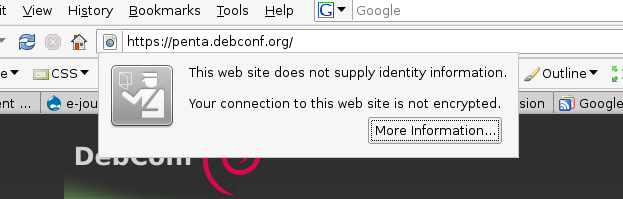
Oh, and I found another pretty little jewel: Go to any site which has a self-signed SSL certificate. Of course, Firefox will go to great lengths to make sure you understand how unsafe is it for you to trust anybody who didn't pay big bucks to Verisign... But this is enough reason for me to send a bug report:

I am connecting through a crypted HTTPS connection. The site is providing identity information - not certified, right, but it does provide something. And the connection is crypted. Firefox/Iceweasel 2 showed me the URL in a light-yellow background showing the connection was secure - Now it just denies penta.debconf.org the right to call itself secure.
(Yes, I am not an interface designer... But it seems neither are they)
[update]Bug filed. Any comments will be welcome in Bugzilla. The bug with the Debconf site (and I do regard it as a bug) is that Iceweasel displays that Your connection to this web site is not encrypted because some of the elements (i.e. the CSS, images..) are sent in the clear - Even though the real information is crypted. Ever heard of data/visualization decoupling?

Next.

Previous.