Marie is a royal bastardess, a product of rape no less, and entirely out
of place in the court in Westminster, where she landed after being kicked
off her mother's farm. She had run the farm since her mother's untimely
death, but there was no way that her relatives would let her inherit. In
court, Marie is too tall, too ugly, and too strange, raised by women who
were said to carry the blood of the fairy M lusine. Eleanor of
Aquitaine's solution to her unwanted house guest is a Papal commission.
Marie is to become the prioress of an abbey.
I am occasionally unpleasantly reminded of why I don't read very much
literary fiction. It's immensely frustrating to read a book in which the
author cares about entirely different things than the reader, and where
the story beats all land wrong.
This is literary historical fiction set in the 12th century. Marie is
Marie de France,
author of the lais about courtly love that are famous primarily due to
their position as early sources for the legends of King Arthur. The lais
are written on-screen very early in this book, but they disappear without
any meaningful impact on the story. Matrix is, instead, about
Shaftesbury Abbey and what it becomes during Marie's time as prioress and
then abbess, following the theory that Marie de France was
Mary of
Shaftesbury.
What I thought I was getting in this book, from numerous reviews and
recommendations, was a story of unexpected competence: how a wild,
unwanted child of seventeen lands at a dilapidated and starving abbey,
entirely against her will, and then over the next sixty years transforms
it into one of the richest abbeys in England. This does happen in this
book, but Groff doesn't seem to care about the details of that
transformation at all.
Instead, Matrix takes the mimetic fiction approach of detailed and
precise description of a few characters, with all of their flaws and
complexities, and with all of the narrative's attention turned to how they
are feeling and what they are seeing. It is also deeply, fully committed
to a Great Man (or in this case a Great Woman) view of history.
Marie is singular. The narrative follows her alone, she makes all the
significant decisions, and the development of the abbey is determined by
her apparently mystical visions. (In typical mimetic fashion, these are
presented as real to her, and the novel takes no position on whether that
reality is objective.) She builds spy networks, maneuvers through local
and church politics, and runs the abbey like her personal kingdom. The
tiny amount of this that is necessarily done by other people is attributed
to Marie's ability to judge character. Other people's motives are simply
steamrolled over and have no effect.
Maddeningly, essentially all of this happens off-screen, and Groff is
completely uninterested in the details of how any of it is accomplished.
Marie decides to do something, the narrative skips forward a year, and it
has happened. She decides to build something, and then it's built. She
decides to collect the rents she's due, the novel gestures vaguely at how
she's intimidating, and then everyone is happily paying up. She builds
spy networks; who cares how? She maneuvers through crises of local and
church politics that are vaguely alluded to, through techniques that are
apparently too uninteresting to bother the reader with.
Instead, the narrative focuses on two things: her deeply dysfunctional,
parasocial relationship with Eleanor, and her tyrannical relationship with
the other nuns. I suspect that Groff would strongly disagree with my
characterization of both of those narratives, and that's the other half of
my problem with this book.
Marie is obsessed with and in love with Eleanor, a completely impossible
love to even talk about, and therefore turns to courtly love from afar as
a model into which she can fit her feelings. While this is the setup for
a tragedy, it's a good idea for a story. But what undermined it for me is
that Marie's obsession seems to be largely physical (she constantly dwells
on Eleanor's beauty), and Eleanor is absolutely horrible to her in every
way: condescending, contemptuous, dismissive, and completely uninterested.
This does change a bit over the course of the book, but not enough to
justify the crush that Marie maintains for this awful person through her
entire life.
And Eleanor is the only person in the book who Marie treats like an equal.
Everyone else is a subordinate, a daughter, a charge, a servant, or a
worker. The nuns of the abbey prosper under her rule, so Marie has ample
reason to justify this to herself, but no one else's opinions or beliefs
matter to her in any significant way. The closest anyone can come to
friendship is to be reliably obedient, perhaps after some initial
objections that Marie overrules. Despite some quite good characterization
of the other nuns, none of the other characters get to do anything.
There is no delight in teamwork, sense of healthy community, or
collaborative problem-solving. It's just all Marie, all the time,
imposing her vision on the world both living and non-living through sheer
force of will.
This just isn't entertaining, at least for me. The writing might be
beautiful, the descriptions detailed and effective, and the research
clearly extensive, but I read books primarily for characters, I read
characters primarily for their relationships, and these relationships are
deeply, horribly unhealthy. They are not, to be clear, unrealistic
(although I do think there's way too much chosen one in Marie and way too
many problems that disappear off-camera); there are certainly people in
the world with dysfunctional obsessive relationships, and there are
charismatic people who overwhelm everyone around them. This is just not
what I want to read about.
You might think, with all I've said above, that I'm spoiling a lot of the
book, but weirdly I don't think I am. Every pattern I mention above is
well-established early in the novel. About the only thing that I'm
spoiling is the hope that any of it is somehow going to change, a hope
that I clung to for rather too long.
This is a great setup for a book, and I wish it were written by a fantasy
author instead of a literary author. Perhaps I'm being too harsh on
literary fiction here, but I feel like fantasy authors are more likely to
write for readers who want to see the growth sequence. If someone is
going to change the world, I want to see how they changed the
world. The mode of fantasy writing tends to think that what people do
(and how they do it) is as interesting or more interesting than what they
feel or what they perceive.
If this idea, with the exact same level of (minor) mysticism and historic
realism, without added magic, were written by, say, Guy Gavriel Kay or
Nicola Griffith, it would be a far different and, in my opinion, a much
better book. In fact, Hildis
part of this book written by Nicola Griffith, and it is a much
better book.
I have seen enough people rave about this book to know that this is a
personal reaction that is not going to be shared by everyone, or possibly
even most people. My theory is that this is due to the different reading
protocols between literary fiction readers and fantasy readers. I put
myself in the latter camp; if you prefer literary fiction, you may like
this much better (and also I'm not sure you'll find my book reviews
useful). I may be wrong, though; maybe there are fantasy readers who
would like this. I will say that the sense of place is very strong and
the writing has all the expected literary strengths of descriptiveness and
rhythm.
But, sadly, this was not at all my thing, and I'm irritated that I wasted
time on it.
Rating: 4 out of 10
Besides several bugfixes, the latest version now supports using higher
compression levels and logging to syslog facility. I also finished packaging
and official packages are now available,
A new release 0.3.3.9.3 of RcppEigen arrived on CRAN moments ago (and just went to Debian). Eigen is a C++ template library for linear algebra: matrices, vectors, numerical solvers, and related algorithms.
This update is again mostly maintenance. To accomodate one small aspect of the Fortran interface, we now require R 3.6.0 or later. Jonah Gabry spotted a really old typo and fixed it. The fastLm support code now uses the unabbreviated df.residual. We accomodated clang-15 in one signature as is common with many recent uploads, and also updated one aspect of GitHub Actions.
And once again as we said for the last four releases:
One additional and recent change was the accomodation of a recent CRAN Policy change to not allow gcc or clang to mess with diagnostic messages. A word of caution: this may make your compilation of packages using RcppEigen very noisy so consider adding -Wno-ignored-attributes to the compiler flags added in your ~/.R/Makevars.
We still find this requirement rather annoying. Eigen is only usable if you set, say,
asoptions in~/.R/Makevars . But CRAN makes the rules. Maybe if a few of us gently and politely nudge them they may relent one day. One can only hope.
The complete NEWS file entry follows.
Changes in RcppEigen version 0.3.3.9.3 (2022-11-04)
The dependency on R is now versioned to 3.6.0 or later for support for USE_FC_LEN_T from Fortran.
An old example typo was corrected (Jonah Gabry in #114).
The fastLm methods now reference df.residual by its full name (Closes #115).
A function prototype was updated for clang-15.
GitHub Actions were updated to checkout version 3.
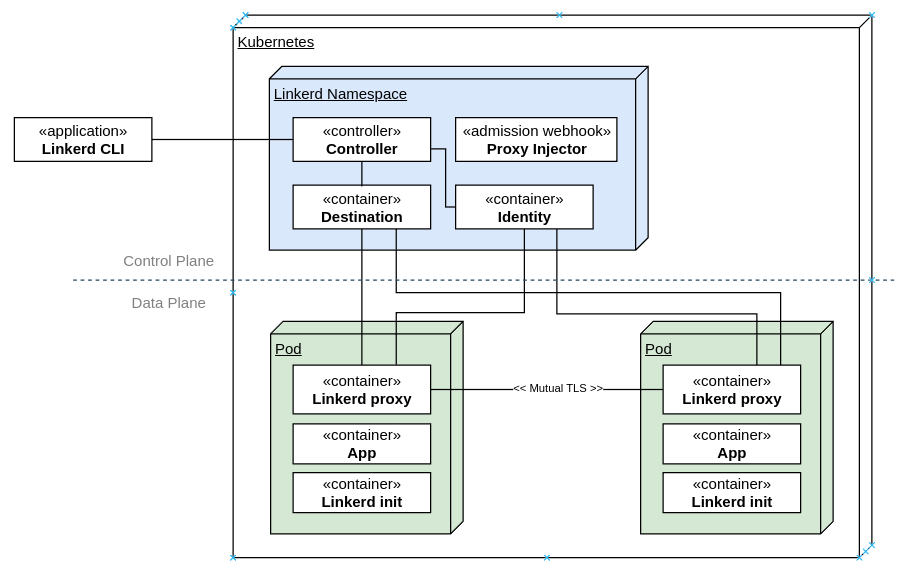
If you ve done anything in the Kubernetes space in recent years, you ve most likely come across the words Service Mesh . It s backed by a set of mature technologies that provides cross-cutting networking, security, infrastructure capabilities to be used by workloads running in Kubernetes in a manner that is transparent to the actual workload. This abstraction enables application developers to not worry about building in otherwise sophisticated capabilities for networking, routing, circuit-breaking and security, and simply rely on the services offered by the service mesh.In this post, I ll be covering Linkerd, which is an alternative to Istio. It has gone through a significant re-write when it transitioned from the JVM to a Go-based Control Plane and a Rust-based Data Plane a few years back and is now a part of the CNCF and is backed by Buoyant. It has proven itself widely for use in production workloads and has a healthy community and release cadence.It achieves this with a side-car container that communicates with a Linkerd control plane that allows central management of policy, telemetry, mutual TLS, traffic routing, shaping, retries, load balancing, circuit-breaking and other cross-cutting concerns before the traffic hits the container. This has made the task of implementing the application services much simpler as it is managed by container orchestrator and service mesh. I covered Istio in a prior post a few years back, and much of the content is still applicable for this post, if you d like to have a look.Here are the broad architectural components of Linkerd:The components are separated into the control plane and the data plane.The control plane components live in its own namespace and consists of a controller that the Linkerd CLI interacts with via the Kubernetes API. The destination service is used for service discovery, TLS identity, policy on access control for inter-service communication and service profile information on routing, retries, timeouts. The identity service acts as the Certificate Authority which responds to Certificate Signing Requests (CSRs) from proxies for initialization and for service-to-service encrypted traffic. The proxy injector is an admission webhook that injects the Linkerd proxy side car and the init container automatically into a pod when the linkerd.io/inject: enabled is available on the namespace or workload.On the data plane side are two components. First, the init container, which is responsible for automatically forwarding incoming and outgoing traffic through the Linkerd proxy via iptables rules. Second, the Linkerd proxy, which is a lightweight micro-proxy written in Rust, is the data plane itself.I will be walking you through the setup of Linkerd (2.12.2 at the time of writing) on a Kubernetes cluster.Let s see what s running on the cluster currently. This assumes you have a cluster running and kubectl is installed and available on the PATH.
On most systems, this should be sufficient to setup the CLI. You may need to restart your terminal to load the updated paths. If you have a non-standard configuration and linkerd is not found after the installation, add the following to your PATH to be able to find the cli:
export PATH=$PATH:~/.linkerd2/bin/
At this point, checking the version would give you the following:
$ linkerd version
Client version: stable-2.12.2
Server version: unavailable
Setting up Linkerd Control PlaneBefore installing Linkerd on the cluster, run the following step to check the cluster for pre-requisites:
kubernetes-api
--------------
  can initialize the client
  can query the Kubernetes API
kubernetes-version
------------------
  is running the minimum Kubernetes API version
  is running the minimum kubectl version
pre-kubernetes-setup
--------------------
  control plane namespace does not already exist
  can create non-namespaced resources
  can create ServiceAccounts
  can create Services
  can create Deployments
  can create CronJobs
  can create ConfigMaps
  can create Secrets
  can read Secrets
  can read extension-apiserver-authentication configmap
  no clock skew detected
linkerd-version
---------------
  can determine the latest version
  cli is up-to-date
Status check results are
All the pre-requisites appear to be good right now, and so installation can proceed.The first step of the installation is to setup the Custom Resource Definitions (CRDs) that Linkerd requires. The linkerd cli only prints the resource YAMLs to standard output and does not create them directly in Kubernetes, so you would need to pipe the output to kubectl apply to create the resources in the cluster that you re working with.
$ linkerd install --crds   kubectl apply -f -
Rendering Linkerd CRDs...
Next, run  linkerd install   kubectl apply -f -  to install the control plane.
customresourcedefinition.apiextensions.k8s.io/authorizationpolicies.policy.linkerd.io created
customresourcedefinition.apiextensions.k8s.io/httproutes.policy.linkerd.io created
customresourcedefinition.apiextensions.k8s.io/meshtlsauthentications.policy.linkerd.io created
customresourcedefinition.apiextensions.k8s.io/networkauthentications.policy.linkerd.io created
customresourcedefinition.apiextensions.k8s.io/serverauthorizations.policy.linkerd.io created
customresourcedefinition.apiextensions.k8s.io/servers.policy.linkerd.io created
customresourcedefinition.apiextensions.k8s.io/serviceprofiles.linkerd.io created
Next, install the Linkerd control plane components in the same manner, this time without the crds switch:
$ linkerd install   kubectl apply -f -
namespace/linkerd created
clusterrole.rbac.authorization.k8s.io/linkerd-linkerd-identity created
clusterrolebinding.rbac.authorization.k8s.io/linkerd-linkerd-identity created
serviceaccount/linkerd-identity created
clusterrole.rbac.authorization.k8s.io/linkerd-linkerd-destination created
clusterrolebinding.rbac.authorization.k8s.io/linkerd-linkerd-destination created
serviceaccount/linkerd-destination created
secret/linkerd-sp-validator-k8s-tls created
validatingwebhookconfiguration.admissionregistration.k8s.io/linkerd-sp-validator-webhook-config created
secret/linkerd-policy-validator-k8s-tls created
validatingwebhookconfiguration.admissionregistration.k8s.io/linkerd-policy-validator-webhook-config created
clusterrole.rbac.authorization.k8s.io/linkerd-policy created
clusterrolebinding.rbac.authorization.k8s.io/linkerd-destination-policy created
role.rbac.authorization.k8s.io/linkerd-heartbeat created
rolebinding.rbac.authorization.k8s.io/linkerd-heartbeat created
clusterrole.rbac.authorization.k8s.io/linkerd-heartbeat created
clusterrolebinding.rbac.authorization.k8s.io/linkerd-heartbeat created
serviceaccount/linkerd-heartbeat created
clusterrole.rbac.authorization.k8s.io/linkerd-linkerd-proxy-injector created
clusterrolebinding.rbac.authorization.k8s.io/linkerd-linkerd-proxy-injector created
serviceaccount/linkerd-proxy-injector created
secret/linkerd-proxy-injector-k8s-tls created
mutatingwebhookconfiguration.admissionregistration.k8s.io/linkerd-proxy-injector-webhook-config created
configmap/linkerd-config created
secret/linkerd-identity-issuer created
configmap/linkerd-identity-trust-roots created
service/linkerd-identity created
service/linkerd-identity-headless created
deployment.apps/linkerd-identity created
service/linkerd-dst created
service/linkerd-dst-headless created
service/linkerd-sp-validator created
service/linkerd-policy created
service/linkerd-policy-validator created
deployment.apps/linkerd-destination created
cronjob.batch/linkerd-heartbeat created
deployment.apps/linkerd-proxy-injector created
service/linkerd-proxy-injector created
secret/linkerd-config-overrides created
Kubernetes will start spinning up the data plane components and you should see the following when you list the pods:
kubernetes-api
--------------
  can initialize the client
  can query the Kubernetes API
kubernetes-version
------------------
  is running the minimum Kubernetes API version
  is running the minimum kubectl version
linkerd-existence
-----------------
  'linkerd-config' config map exists
  heartbeat ServiceAccount exist
  control plane replica sets are ready
  no unschedulable pods
  control plane pods are ready
  cluster networks contains all pods
  cluster networks contains all services
linkerd-config
--------------
  control plane Namespace exists
  control plane ClusterRoles exist
  control plane ClusterRoleBindings exist
  control plane ServiceAccounts exist
  control plane CustomResourceDefinitions exist
  control plane MutatingWebhookConfigurations exist
  control plane ValidatingWebhookConfigurations exist
  proxy-init container runs as root user if docker container runtime is used
linkerd-identity
----------------
  certificate config is valid
  trust anchors are using supported crypto algorithm
  trust anchors are within their validity period
  trust anchors are valid for at least 60 days
  issuer cert is using supported crypto algorithm
  issuer cert is within its validity period
  issuer cert is valid for at least 60 days
  issuer cert is issued by the trust anchor
linkerd-webhooks-and-apisvc-tls
-------------------------------
  proxy-injector webhook has valid cert
  proxy-injector cert is valid for at least 60 days
  sp-validator webhook has valid cert
  sp-validator cert is valid for at least 60 days
  policy-validator webhook has valid cert
  policy-validator cert is valid for at least 60 days
linkerd-version
---------------
  can determine the latest version
  cli is up-to-date
control-plane-version
---------------------
  can retrieve the control plane version
  control plane is up-to-date
  control plane and cli versions match
linkerd-control-plane-proxy
---------------------------
  control plane proxies are healthy
  control plane proxies are up-to-date
  control plane proxies and cli versions match
Status check results are
Everything looks good.Setting up the Viz ExtensionAt this point, the required components for the service mesh are setup, but let s also install the viz extension, which provides a good visualization capabilities that will come in handy subsequently. Once again, linkerd uses the same pattern for installing the extension.
$ linkerd viz install   kubectl apply -f -
namespace/linkerd-viz created
clusterrole.rbac.authorization.k8s.io/linkerd-linkerd-viz-metrics-api created
clusterrolebinding.rbac.authorization.k8s.io/linkerd-linkerd-viz-metrics-api created
serviceaccount/metrics-api created
clusterrole.rbac.authorization.k8s.io/linkerd-linkerd-viz-prometheus created
clusterrolebinding.rbac.authorization.k8s.io/linkerd-linkerd-viz-prometheus created
serviceaccount/prometheus created
clusterrole.rbac.authorization.k8s.io/linkerd-linkerd-viz-tap created
clusterrole.rbac.authorization.k8s.io/linkerd-linkerd-viz-tap-admin created
clusterrolebinding.rbac.authorization.k8s.io/linkerd-linkerd-viz-tap created
clusterrolebinding.rbac.authorization.k8s.io/linkerd-linkerd-viz-tap-auth-delegator created
serviceaccount/tap created
rolebinding.rbac.authorization.k8s.io/linkerd-linkerd-viz-tap-auth-reader created
secret/tap-k8s-tls created
apiservice.apiregistration.k8s.io/v1alpha1.tap.linkerd.io created
role.rbac.authorization.k8s.io/web created
rolebinding.rbac.authorization.k8s.io/web created
clusterrole.rbac.authorization.k8s.io/linkerd-linkerd-viz-web-check created
clusterrolebinding.rbac.authorization.k8s.io/linkerd-linkerd-viz-web-check created
clusterrolebinding.rbac.authorization.k8s.io/linkerd-linkerd-viz-web-admin created
clusterrole.rbac.authorization.k8s.io/linkerd-linkerd-viz-web-api created
clusterrolebinding.rbac.authorization.k8s.io/linkerd-linkerd-viz-web-api created
serviceaccount/web created
server.policy.linkerd.io/admin created
authorizationpolicy.policy.linkerd.io/admin created
networkauthentication.policy.linkerd.io/kubelet created
server.policy.linkerd.io/proxy-admin created
authorizationpolicy.policy.linkerd.io/proxy-admin created
service/metrics-api created
deployment.apps/metrics-api created
server.policy.linkerd.io/metrics-api created
authorizationpolicy.policy.linkerd.io/metrics-api created
meshtlsauthentication.policy.linkerd.io/metrics-api-web created
configmap/prometheus-config created
service/prometheus created
deployment.apps/prometheus created
service/tap created
deployment.apps/tap created
server.policy.linkerd.io/tap-api created
authorizationpolicy.policy.linkerd.io/tap created
clusterrole.rbac.authorization.k8s.io/linkerd-tap-injector created
clusterrolebinding.rbac.authorization.k8s.io/linkerd-tap-injector created
serviceaccount/tap-injector created
secret/tap-injector-k8s-tls created
mutatingwebhookconfiguration.admissionregistration.k8s.io/linkerd-tap-injector-webhook-config created
service/tap-injector created
deployment.apps/tap-injector created
server.policy.linkerd.io/tap-injector-webhook created
authorizationpolicy.policy.linkerd.io/tap-injector created
networkauthentication.policy.linkerd.io/kube-api-server created
service/web created
deployment.apps/web created
serviceprofile.linkerd.io/metrics-api.linkerd-viz.svc.cluster.local created
serviceprofile.linkerd.io/prometheus.linkerd-viz.svc.cluster.local created
A few seconds later, you should see the following in your pod list:
The viz components live in the linkerd-viz namespace.You can now checkout the viz dashboard:
$ linkerd viz dashboard
Linkerd dashboard available at:
http://localhost:50750
Grafana dashboard available at:
http://localhost:50750/grafana
Opening Linkerd dashboard in the default browser
Opening in existing browser session.
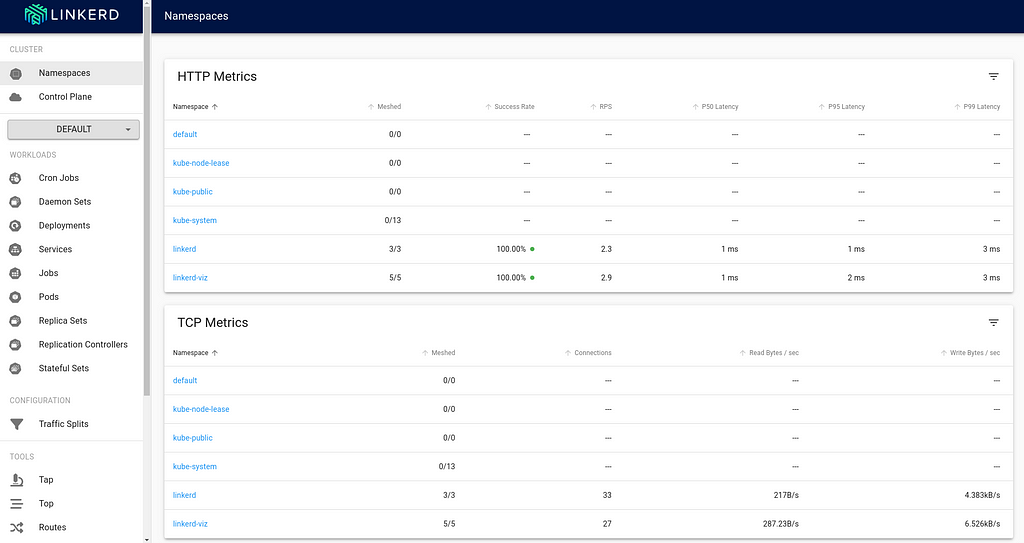
The Meshed column indicates the workload that is currently integrated with the Linkerd control plane. As you can see, there are no application deployments right now that are running.Injecting the Linkerd Data Plane componentsThere are two ways to integrate Linkerd to the application containers:1 by manually injecting the Linkerd data plane components 2 by instructing Kubernetes to automatically inject the data plane componentsInject Linkerd data plane manuallyLet s try the first option. Below is a simple nginx-app that I will deploy into the cluster:
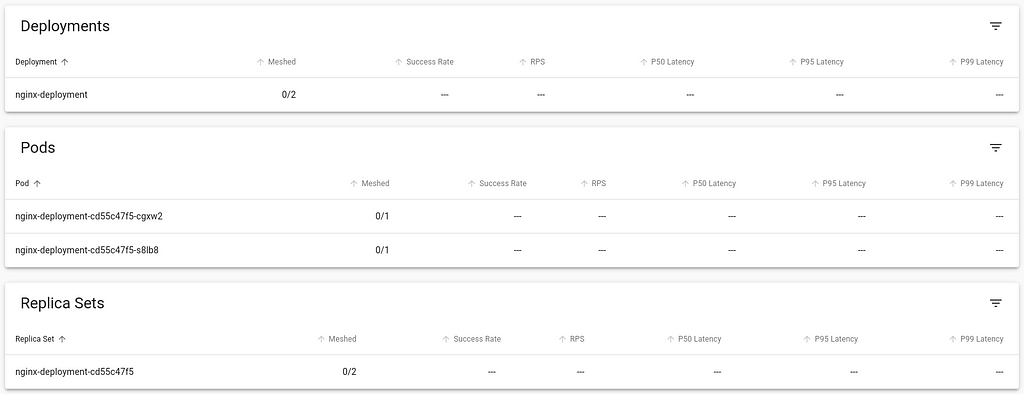
Back in the viz dashboard, I do see the workload deployed, but it isn t currently communicating with the Linkerd control plane, and so doesn t show any metrics, and the Meshed count is 0:Looking at the Pod s deployment YAML, I can see that it only includes the nginx container:
Let s directly inject the linkerd data plane into this running container. We do this by retrieving the YAML of the deployment, piping it to linkerd cli to inject the necessary components and then piping to kubectl apply the changed resources.
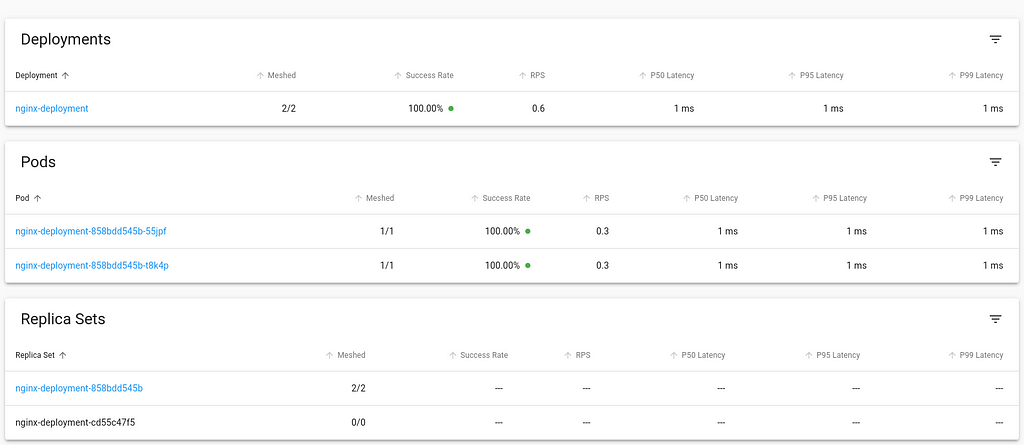
Back in the viz dashboard, the workload now is integrated into Linkerd control plane.Looking at the updated Pod definition, we see a number of changes that the linkerd has injected that allows it to integrate with the control plane. Let s have a look:
At this point, the necessary components are setup for you to explore Linkerd further. You can also try out the jaeger and multicluster extensions, similar to the process of installing and using the viz extension and try out their capabilities.Inject Linkerd data plane automaticallyIn this approach, we shall we how to instruct Kubernetes to automatically inject the Linkerd data plane to workloads at deployment time.We can achieve this by adding the linkerd.io/inject annotation to the deployment descriptor which causes the proxy injector admission hook to execute and inject linkerd data plane components automatically at the time of deployment.
This annotation can also be specified at the namespace level to affect all the workloads within the namespace. Note that any resources created before the annotation was added to the namespace will require a rollout restart to trigger the injection of the Linkerd components.Uninstalling LinkerdNow that we have walked through the installation and setup process of Linkerd, let s also cover how to remove it from the infrastructure and go back to the state prior to its installation.The first step would be to remove extensions, such as viz.
A brand-new version 0.0.9 of RcppSpdlog got onto CRAN overnight. RcppSpdlog bundles spdlog, a wonderful header-only C++ logging library with all the bells and whistles you would want that was written by Gabi Melman, and also includes fmt by Victor Zverovich.
This release contains two changes. First, we extend usability by offering both a set of simple R functions for logging from R, and a matching set of functions at the C++ level that are directly callable (and exported) from this package (so that client packages do not need to compile). Both these changes are described (as sections seven and eight) in the vignette. Second, while we were working on this Gabi released version 1.11.0 upstream so we included this as well.
The NEWS entry for this release follows.
FTP master
This month I accepted 484 and rejected 55 packages. The overall number of packages that got accepted was 492.
Debian LTS
This was my hundredth month that I did some work for the Debian LTS initiative, started by Raphael Hertzog at Freexian. Woohoo, There is a party. (yes I am old). Unfortunately there are already 101 completed month listed in the debian-lts-announce archive, so I seem to have counted wrong once. *sigh*, yes I am old.
This month my all in all workload has been 14h.
During that time I uploaded:
[DLA 3168-1] openvswitch security update for one CVE
[graphicsmagick] debdiff for Bullseye sent to security team (update as DLA or via PU?)
[graphicsmagick] prepared upload for Buster
[libvncserver] debdiff for Buster and Bullseye sent to maintainer (no upload yet :-()
I also started to work on virglrenderer.
Last but not least I took care of NEW packages on security-master.
Debian ELTS
This month was the fifty first ELTS month.
During my allocated time I uploaded:
[ELA-719-1] graphicsmagick security update of Jessie and Stretch for one CVE
[ELA-720-1] bluez security update of Jessie and Stretch for three CVEs
marked two CVEs of curl as not-affected for Jessie and Stretch
checked that all patches for dpdk need to be backported, unfortunately that was beyond my capabilities
I also started to work on snapd.
Last but not least I finally managed to become familiar with the git workflow and imported several packages to the salsa repository.
Debian Astro
This month I uploaded new upstream versions or improved packaging of:
I also uploaded a new package pysqm. This software supports the Sky Quality Meters made by Unihedron. I was kindly given an SQM-LU for USB and SQM-LE with network adapter. I plan to put a working Python3 version of the old PySQM software into Debian, package the UDM (Unihedron Device Manager) and finally check the support within Indi.
Debian IoT
This month I uploaded new upstream versions or improved packaging of:
Debian Mobcom
This month I finished the transition of the Osmocom packages, except osmo-mgw and osmo-msc seem to have problems. I have no idea how I can solve this, so help is appreciated.
Other stuff
This month I uploaded new packages:
Found the reason podman build was failing as normal user.
dbus-user-session was missing and podman wasn't able to connect to systemd user session.
This resulted in trying to use cgroupfs instead of systemd for managing cgroups and other things also broke.
1.3 billion announced for new Forestry Support
Funds to be delivered through new Forestry Programme
Premiums for planting trees to be increased by between 46% and 66% and extended to 20 years for farmers
#GreensInGovernment
The Taoiseach, Miche l Martin TD, Minister of State with responsibility for Forestry, Senator Pippa Hackett, and Minister for Agriculture, Food and the Marine, Charlie McConalogue T.D today announced a proposed investment by the Government of 1.3 billion in Irish forestry. The funding will be for the next national Forestry Programme and represents the largest ever investment by an Irish Government in tree-planting. The programme will now be the subject of state-aid approval by the European Commission.
The Taoiseach said:
This commitment by the Government to such a substantial financial package reflects the seriousness with which we view the climate change and biodiversity challenges, which affect all of society. Forestry is at the heart of delivering on our sustainability goals and strong support is needed to encourage engagement from all our stakeholders in reaching our objectives.
Minister Hackett said:
I m delighted to have secured a package of 1.318 billion for forestry. This will support the biggest and best-funded Forestry Programme ever in Ireland. It comes at an appropriate time, given the urgency of taking climate mitigation measures. Planting trees is one of the most effective methods of tackling climate change as well as contributing to improved biodiversity and water quality. One of my main aims is to re-engage farmers in afforestation. I m delighted therefore to be proposing a new 20-year premium term exclusively for farmers, as well as introducing a new small-scale native woodland scheme which will allow farmers to plant up to 1 hectare of native woodland on farmland and along watercourses outside of the forestry licensing process.
Minister McConalogue said:
Today we commit to providing unprecedented incentives to encourage the planting of trees that can provide a valuable addition to farm income and help to meet national climate and biodiversity objectives. This funding guarantees continued payments to those forest owners who planted under the current scheme and who are still in receipt of premiums. It also offers new and improved financial supports to those who undertake planting and sustainable forest management under the new Programme. We intend to increase premiums for planting trees by between 46% and 66% and to extend the premium period from 15 to 20 years for farmers.
"We are approaching a new and exciting period for forestry in Ireland. The new Forestry Programme will drive a new and brighter future for forestry, for farmers and for our climate.
The proposed new Forestry Programme is currently out to public consultation as part of the Strategic Environmental Assessment and Appropriate Assessment process. The Programme is the main implementation mechanism for the new Forest Strategy (2023 -2030) which reflects the ambitions contained in the recently published Shared National Vision for Trees, Woods and Forests in Ireland until 2050. The public consultation closes on 29th November, 2022 and any changes which result from this process will be incorporated into the Programme and the Forest Strategy.
Minister Hackett commented: The draft Forestry Programme and Forest Strategy are the product of extensive stakeholder consultation and feedback, and both documents are open to public consultation for the next number of weeks. I would strongly encourage all interested parties to engage with the consultation in advance of the Strategy and Programme being finalised.
The new Programme is built around the principle of right trees in the right places for the right reasons with the right management. It aims to deliver more diverse forest which will meet multiple societal objectives, economic, social and environmental. Higher grant rates for forest establishment are also proposed with increases of approximately 20% to reflect rising living costs. The new one hectare native tree area scheme will also make it easier for landowners who wish to plant small areas of trees on their farm.
The Taoiseach concluded I welcome this milestone and I believe that this funding injection will be an important catalyst in delivering on the ambition outlined in the new Forest Strategy. Our environmental challenges are huge but so is our commitment to overcoming them and this Forestry Programme is key to delivering so many of our priorities.
The new Programme will be 100% Exchequer funded and is subject to State Aid approval from the EU Commission. The Department is in contact with the Commission in relation to this approval which is a rigorous process.
Two weeks ago, I had the chance to go see Cory Doctorow at my local independent
bookstore, in Montr al. He was there to present his latest essay, co-written
with Rebecca Giblin1. Titled Chokepoint Capitalism: How Big Tech and
Big Content Captured Creative Labor Markets and How We'll Win Them Back, it
focuses on the impact of monopolies and monopsonies (more on this later) on
creative workers.
The book is divided in two main parts:
Part one, Culture has been captured (chapters 1 to 11), is a series of
case studies that focus on different examples of market failure. The specific
sectors analysed are the book market, the news media, the music industry,
Hollywood, the mobile apps industry and the online video platforms.
Part two, Braking anticompetitive flywheels (chapters 12 to 19), looks at
different solutions to try to fix these failures.
Although Doctorow is known for his strong political stances, I have to say I'm
quite surprised by the quality of the research Giblin and he did for this book.
They both show a pretty advanced understanding of the market dynamics they look
at, and even though most of the solutions they propose aren't new or
groundbreaking, they manage to be convincing and clear.
That is to say, you certainly don't need to be an economist to understand or
enjoy this book :)
As I have mentioned before, the book heavily criticises monopolies, but also
monopsonies a market structure that has only one buyer (instead of one
seller). I find this quite interesting, as whereas people are often familiar
with the concept of monopolies, monopsonies are frequently overlooked.
The classic example of a monopsony is a labor market with a single employer:
there is a multitude of workers trying to sell their labor power, but in the
end, working conditions are dictated by the sole employer, who gets to decide
who has a job and who hasn't. Mining towns are good real-world examples of
monopsonies.
In the book, the authors argue most of the contemporary work produced by
creative workers (especially musicians and writers) is sold to monopsonies and
oligopsonies, like Amazon2 or major music labels. This creates a
situation where the consumers are less directly affected by the lack of
competition in the market (they often get better prices), but where creators
have an increasingly hard time making ends meet. Not only this, but natural
monopsonies3 are relatively rare, making the case for breaking the
existing ones even stronger.
Apart from the evident need to actually start applying (the quite good)
antitrust laws in the USA, some of the other solutions put forward are:
Transparency Rights giving creative workers a way to audit the companies
that sell their work and make sure they are paid what they are due.
Collective Action
Time Limits on Copyright Contracts making sure creators that sell their
copyrights to publishers or labels can get them back after a reasonable
period of time.
Radical Interoperability forcing tech giants to make their walled-gardens
interoperable.
Minimum Wages for Creative Work enforcing minimum legal rates for workers
in certain domains, like what is already done for screenplays in the US by
members of the Writers Guild of America.
Collective Ownership
Overall, I found this book quite enjoying and well written. Since I am not a
creative worker myself and don't experience first-hand the hardships presented
in the book, it was the occasion for me to delve more deeply in this topic.
Chances are I'll reuse some of the expos s in my classes too.
Professor at the Melbourne Law School and Director of the
Intellectual Property Research Institute of Australia, amongst other things.
More on her here.
Amazon owns more than 50% of the US physical book retail market and
has an even higher market share for ebooks and audiobooks (via Audible). Not
only this, but with the decline of the physical book market, audiobooks are
an increasingly important source of revenue for authors.
Natural monopolies happen when it does not make economic sense for
multiple enterprises to compete in a market. Critical infrastructures, like
water supply or electricity, make for good examples of natural monopolies. It
simply wouldn't be efficient to have 10 separate electrical cables connecting
your house to 10 separate electric grids. In my opinion, such monopolies are
acceptable (and even desirable), as long as they are collectively owned,
either by the State or by local entities (municipalities, non-profits, etc.).
A new release 0.4.20 of RProtoBuf arrived on CRAN earlier today. RProtoBuf provides R with bindings for the Google Protocol Buffers ( ProtoBuf ) data encoding and serialization library used and released by Google, and deployed very widely in numerous projects as a language and operating-system agnostic protocol.
This release is somewhat mechanical and in the spirit of many other recent releases. clang-15 is, as more recent compilers do, more stringent on definitions and wants to see some void in argument-less signatures. Happy to oblige. At the same time, GitHub Actions started to nag us about minimum versions of node code so an upgrade to a newer action is warranted, again as with many other affected packages. We also found another http:// URL hiding somewhere so that was cleaned. Lastly, it appears Protocol Buffers themselves moved on and now need / prefer C++17 so were happy to oblige.
The following section from the NEWS.Rd file has full details.
Changes in RProtoBuf version 0.4.20 (2022-11-02)
Two function prototype were updated for clang-15.
GitHub Actions were updated to checkout version 3.
One more http:// URL was updated to https://
The package compilation is now donw with C++17 as the Protocol Buffer headers require it (and clang-15 nags otherwise).
The diffoscope maintainers are pleased to announce the release of diffoscope
version 226. This version includes the following changes:
[ Christopher Baines ]
* Add an lzip comparator with tests.
[ Chris Lamb ]
* Add support for comparing the "text" content of HTML files using html2text.
  (Closes: #1022209, reproducible-builds/diffoscope#318)
* Misc/test improvements:
  * Drop the ALLOWED_TEST_FILES test; it's mostly just annoying.
  * Drop other copyright notices from lzip.py and test_lzip.py.
  * Use assert_diff helper in test_lzip.py.
  * Pylint tests/test_source.py.
[ Mattia Rizzolo ]
* Add lzip to debian dependencies.
So this week I recycled a talk I'd given in the past, about how even using
extremely simple parsers allows a lot of useful static-analysis to be done,
for specific niche use-cases.
This included examples of scanning comments above classes to ensure they
referred to the appropriate object, ensuring that specific function
calls always included a specific (optional) parameter, etc.
Nothing too complex, but I figured I'd give a new example this time, and
I remembered I'd recently written a bunch of functions for an interpreter
which I'd ordered quite deliberately.
Assume you're writing a BASIC interpreter, you need to implement a bunch of
built-in maths functions such as SIN, COS, TAN, then some string-related
functions LEFT$, RIGHT$, MID$, etc.
When it comes to ordering there are a couple of approaches:
Stick them all in one package:
builtins/builtins.go
Create a package and group them:
builtins/maths.go
builtins/string.go
.. etc
Personal preference probably dictates the choice you make, but either way I think it would be rational and obvious that you'd put the functions in alphabetical order:
I did that myself, and I wrote a perl-script to just parse the file using a simple regexp "^func\s+([^(]+)\(" but then I figured this was a good time to write a real static-analysis tool.
The golang environment is full of trivial little linters for various purposes, and the standard "go vet .." driver makes it easy to invoke them. Realizing that I was going to get driven in the same way it was obvious I'd write something called "alphaVet".
So anyway, half written for a talk, half-written because of the name:
Golang linter that reports failures if functions aren't in alphabetical order
I m trying to replace my old OpenPGP key with a new one. The old key wasn t compromised or lost or anything
bad. Is still valid, but I plan to get rid of it soon. It was created in 2013.
The new key id fingerprint is: AA66280D4EF0BFCC6BFC2104DA5ECB231C8F04C4
I plan to use the new key for things like encrypted emails, uploads to the Debian archive, and more. Also,
the new key includes an identity with a newer personal email address I plan to use soon: arturo.bg@arturo.bg
The new key has been uploaded to some public keyservers.
If you would like to sign the new key, please follow the steps in the Debian wiki.
If you are curious about what that long code block contains, check this https://cirw.in/gpg-decoder/
For the record, the old key fingerprint is: DD9861AB23DC3333892E07A968E713981D1515F8
Cheers!
New Planning and Environment Court will reform planning appeals process
#GreensInGovernment
The Green Party has fulfilled an important Programme for Government commitment following the cabinet's decision to establish a new division of the High Court to specialise in environmental and planning issues. This is a major reform that will allow planning law to operate in a more efficient and environmentally friendly manner.
Steven Matthews TD, Green Party Spokesperson for Planning and Local Government, explained the aim of the new court;
The goal is to ensure that our judicial system has the capacity to decide cases as quickly as possible within a growing and increasingly complex body of Irish and EU environmental law. Timely access to justice is a cornersto ne of the effective rule of law and an international legal commitment Ireland has entered under the Aarhus Convention. This is extremely pressing given the urgent need to ease the pressure on the housing system and develop the infrastructure we need to transition to a zero-carbon economy."
The Green Party is committed to ensuring the new Court will have the resources to fulfil its role. The Government will pass new legislation to allow the number of judges to be increased and provide the necessary exchequer funding to pay for these judges.
The new Court will hear all the cases currently taken by the High Court s Commercial Planning and Strategic Infrastructure Development List and other major environmental cases. This is likely to include all major infrastructure cases as well as many cases relating to EU Environmental Law such as Environmental Impact Assessment, Strategic Environmental Assessment, Birds/Habitats, the Water Framework Directive and the Industrial Emissions Directive.
Department of Education confirms 12,544 Ukrainian pupils currently enrolled in Irish schools
#GreensInGovernment
The Department of Education can confirm that as of 1 November, 12,544 Ukrainian pupils have been enrolled in schools across Ireland. Out of that figure, 7,948 of these pupils have been accommodated in primary schools while 4,596 pupils have enrolled in post-primary schools.
To assist with the transition of Ukrainian refugees and their families into Irish schools Regional Education and Language Teams (REALT) continue to operate, hosted by the 16 regional education and training boards around Ireland and staffed by regionally based education support personnel.
These teams are ensuring that clear, accessible information flows are in place between schools, local education support services and national support structures in relation to people arriving from Ukraine.
Information for parents in Ukrainian and Russian on accessing school places is available on gov.ie/Ukraine.
The Department will continue to publish figures on the enrolment of Ukrainian children each month.
user namespace not enabled when running podman.
Completely forgot about this but seems like I need to enable user namespace for podman.
sudo sysctl -w kernel.unprivileged_userns_clone=1.
Not quite sure when this started being required.
Carpe Jugulum is the 23rd Discworld novel and the 6th witches
novel. I would not recommend reading it before Maskerade, which introduces Agnes.
There are some spoilers for Wyrd
Sisters, Lords and Ladies, and
Maskerade in the setup here and hence in the plot description
below. I don't think they matter that much, but if you're avoiding all
spoilers for earlier books, you may want to skip over this one. (You're
unlikely to want to read it before those books anyway.)
It is time to name the child of the king of Lancre, and in a gesture of
good will and modernization, he has invited his neighbors in Uberwald to
attend. Given that those neighbors are vampires, an open invitation was
perhaps not the wisest choice.
Meanwhile, Granny Weatherwax's invitation has gone missing. On the plus
side, that meant she was home to be summoned to the bedside of a pregnant
woman who was kicked by a cow, where she makes the type of hard decision
that Granny has been making throughout the series. On the minus side, the
apparent snub seems to send her into a spiral of anger at the lack of
appreciation.
Points off right from the start for a plot based on a misunderstanding and
a subsequent refusal of people to simply talk to each other. It is partly
engineered, but still, it's a cheap and irritating plot.
This is an odd book.
The vampires (or vampyres, as the Count wants to use) think of themselves
as modern and sophisticated, making a break from the past by attempting to
overcome such traditional problems as burning up in the sunlight and fear
of religious symbols and garlic. The Count has put his family through
rigorous training and desensitization, deciding such traditional
vulnerabilities are outdated things of the past. He has, however, kept
the belief that vampires are at the top of a natural chain of being,
humans are essentially cattle, and vampires naturally should rule and feed
on the population. Lancre is an attractive new food source. Vampires
also have mind control powers, control the weather, and can put their
minds into magpies.
They are, in short, enemies designed for Granny Weatherwax, the witch
expert in headology. A shame that Granny is apparently off sulking.
Nanny and Agnes may have to handle the vampires on their own, with the
help of Magrat.
One of the things that makes this book odd is that it seemed like
Pratchett was setting up some character growth, giving Agnes a chance to
shine, and giving Nanny Ogg a challenge that she didn't want. This sort
of happens, but then nothing much comes of it. Most of the book is the
vampires preening about how powerful they are and easily conquering
Lancre, while everyone else flails ineffectively. Pratchett does pull
together an ending with some nice set pieces, but that ending doesn't
deliver on any of the changes or developments it felt like the story was
setting up.
We do get a lot of Granny, along with an amusingly earnest priest of Om
(lots of references to Small Gods here,
while firmly establishing it as long-ago history). Granny is one of my
favorite Discworld characters, so I don't mind that, but we've seen Granny
solve a lot of problems before. I wanted to see more of Agnes, who is the
interesting new character and whose dynamic with her inner voice feels
like it has a great deal of unrealized potential.
There is a sharp and condensed version of comparative religion from
Granny, which is probably the strongest part of the book and includes one
of those Discworld quotes that has been widely repeated out of context:
"And sin, young man, is when you treat people as things. Including
yourself. That's what sin is."
"It's a lot more complicated than that "
"No. It ain't. When people say things are a lot more complicated
than that, they means they're getting worried that they won t like the
truth. People as things, that's where it starts."
This loses a bit in context because this book is literally about treating
people as things, and thus the observation feels more obvious when it
arrives in this book than when you encounter it on its own, but it's still
a great quote.
Sadly, I found a lot of this book annoying. One of those annoyances is a
pet peeve that others may or may not share: I have very little patience
for dialogue in phonetically-spelled dialect, and there are two
substantial cases of that here. One is a servant named Igor who speaks
with an affected lisp represented by replacing every ess sound with th,
resulting in lots of this:
"No, my Uncle Igor thtill workth for him. Been thtruck by lightning
three hundred timeth and thtill putth in a full night'th work."
I like Igor as a character (he's essentially a refugee from The
Addams Family, which adds a good counterpoint to the malicious and
arrogant evil of the vampires), but my brain stumbles over words like
"thtill" every time. It's not that I can't decipher it; it's that the
deciphering breaks the flow of reading in a way that I found not at all
fun. It bugged me enough that I started skipping his lines if I couldn't
work them out right away.
The other example is the Nac Mac Feegles, who are... well, in the book,
they're Pictsies and a type of fairy, but they're Scottish Smurfs, right
down to only having one female (at least in this book). They're
entertainingly homicidal, but they all talk like this:
"Ach, hins tak yar scaggie, yer dank yowl callyake!"
I'm from the US and bad with accents and even worse with accents
reproduced in weird spellings, and I'm afraid that I found 95% of
everything said by Nac Mac Feegles completely incomprehensible to the
point where I gave up even trying to read it. (I'm now rather worried
about the Tiffany Aching books and am hoping Pratchett toned the dialect
down a lot, because I'm not sure I can deal with more of this.)
But even apart from the dialect, I thought something was off about the
plot structure of this book. There's a lot of focus on characters who
don't seem to contribute much to the plot resolution. I wanted more of
the varied strengths of Lancre coming together, rather than the focus on
Granny. And the vampires are absurdly powerful, unflappable, smarmy, and
contemptuous of everyone, which makes for threatening villains but also
means spending a lot of narrative time with a Discworld version of
Jacob Rees-Mogg. I
feel like there's enough of that in the news already.
Also, while I will avoid saying too much about the plot, I get very
suspicious when older forms of oppression are presented as good
alternatives to modernizing, rationalist spins on exploitation. I see
what Pratchett was trying to do, and there is an interesting point here
about everyone having personal relationships and knowing their roles (a
long-standing theme of the Lancre Discworld stories). But I think the
reason why there is some nostalgia for older autocracy is that we only
hear about it from stories, and the process of storytelling often creates
emotional distance and a patina of adventure and happy outcomes. Maybe
you can make an argument that classic British imperialism is superior to
smug neoliberalism, but both of them are quite bad and I don't want either
of them.
On a similar note, Nanny Ogg's tyranny over her entire extended clan
continues to be played for laughs, but it's rather unappealing and seems
more abusive the more one thinks about it. I realize the witches are not
intended to be wholly good or uncomplicated moral figures, but I want to
like Nanny, and Pratchett seems to be writing her as likable, even though
she has an astonishing lack of respect for all the people she's related
to. One might even say that she treats them like things.
There are some great bits in this book, and I suspect there are many
people who liked it more than I did. I wouldn't be surprised if it was
someone's favorite Discworld novel. But there were enough bits that
didn't work for me that I thought it averaged out to a middle-of-the-road
entry.
Followed by The Fifth Elephant in publication order. This is the
last regular witches novel, but some of the thematic thread is picked up
by The Wee Free Men, the first Tiffany Aching novel.
Rating: 7 out of 10
Someone recently asked what yak shaving means and, because I am a
professional at this pastime, I figured I would share my most recent
excursion in the field.
As a reminder, "yak shaving" describes a (anti?) pattern by which you
engage in more and more (possibly useless) tasks that lead you further
and further away from your original objective.
The path I took through the yak heard is this:
i wondered if i can use my home network to experiment with another
VPN software (e.g. Wireguard instead of IPsec)
I wasn't happy with that, so i tried an IPv6 tunnel
that broke after a few minutes, so i went on to try deploying
Wireguard with Puppet), which involved reviewing about 4
different Puppet modules
while I was there, I might as well share those findings with the
community, so I publish that as a blog post
someone else mentions that Nebula (from Slack) is a thing,
but after investigation, it's not well packaged in Debian, so
didn't test it, but add it to the blog post
now that I found the right Puppet module, I tried to deploy
it with Puppet's g10k, which requires me to input a checksum
I got lazy and figured if i would put the checksum wrong, it would
tell me what the right checksum was, but it didn't: instead it
silently succeeded instead of failing, which seemed really bad
then I looked upstream for such a bug report and saw that the
Debian package was many versions behind and, because I'm on
the Golang packaging team, I figured I would just do the
upgrade myself
... but then tried to readd it to Debian CI instead,
which didn't work
At that point, I had given up, after shaving a 12th yak. Thankfully, a
kind soul provided a working test suite and I was able to roll
back all those parenthesis and:
test the g10k package and confirm it works (and checks the
checksums)
Also notice the 8th yak, above, which might be a security issue. I
wasn't able to confirm it, because g10k does some pretty aggressive
caching, and I could "reproduce" it in the sense that the checksum
wasn't checked if it exists in the cache. So it might have just been
that I had actually already deployed the module before adding the
checksum... but I still had that distressing sentiment:
<anarcat> there's a huge yak breathing down my neck with "CVE" written in large red letters on the side
<anarcat> i'm trying to ignore it, it stinks like hell
Hopefully it's nothing to worry about. Right? Riiight.
Oh. And obviously, writing this blog post is the sugar on top, the one
last yak that is self-documented here.
As President of the GNOME Foundation, I wanted to post a quick note to pass on the thanks from the Board, the Foundation staff team and membership to our outgoing Executive Director, Neil McGovern. I had the pleasure of passing on GNOME s thanks in person at the Casa Bariachi this summer at GUADEC in Guadelajara, at the most exellent mariachi celebration of GNOME s 25th Anniversary. Kindly they stopped the music and handed me the microphone for the whole place, although I think many of the other guests celebrating their own birthdays were less excited about Neil s tenure as Executive Director and the Free and Open Source desktop in general.
Neil s 6-month handover period came to an end last month and he handed over the reins to myself and Thibault Martin on the Executive Committee, and Director of Operations Rosanna Yuen has stepped up to act as Chief of Staff and interface between the Board and the staff team for the time being. Our recruitment is ongoing for a new Executive Director although the search is a little behind schedule (mostly down to me!), and we re hugely grateful to a few volunteers who have joined our search committee to help us source, screen and interview applicants.
I have really enjoyed working closely with Neil in my time on the GNOME board, and we are hugely grateful for his contributions and achievements over the past 5 years which I posted about earlier in the year. Neil is this month starting a new role as the Executive Director of Ruby Central. Our very best wishes from the GNOME community and good luck with your new role. See you soon!
(also posted to Discourse if you wish to add any thanks or comments of your own)
In October I was not assigned additional time by Freexian's Debian
LTS initiative, but carried over 9 hours from September and worked
all those hours.
I updated the linux (4.19) package to the latest stable update, but
didn't upload it. I merged the latest bullseye security update into
the linux-5.10 package, uploaded that, and issued
DLA-3173-1.
 A new release 0.3.3.9.3 of
 Found the reason podman build was failing as normal user.
dbus-user-session was missing and podman wasn't able to connect to systemd user session.
This resulted in trying to use cgroupfs instead of systemd for managing cgroups and other things also broke.
 Two weeks ago, I had the chance to go see Cory Doctorow at my local independent
bookstore, in Montr al. He was there to present his latest essay, co-written
with Rebecca Giblin
 Although Doctorow is known for his strong political stances, I have to say I'm
quite surprised by the quality of the research Giblin and he did for this book.
They both show a pretty advanced understanding of the market dynamics they look
at, and even though most of the solutions they propose aren't new or
groundbreaking, they manage to be convincing and clear.
That is to say, you certainly don't need to be an economist to understand or
enjoy this book :)
As I have mentioned before, the book heavily criticises monopolies, but also
monopsonies a market structure that has only one buyer (instead of one
seller). I find this quite interesting, as whereas people are often familiar
with the concept of monopolies, monopsonies are frequently overlooked.
The classic example of a monopsony is a labor market with a single employer:
there is a multitude of workers trying to sell their labor power, but in the
end, working conditions are dictated by the sole employer, who gets to decide
who has a job and who hasn't. Mining towns are good real-world examples of
monopsonies.
In the book, the authors argue most of the contemporary work produced by
creative workers (especially musicians and writers) is sold to monopsonies and
 So this week I recycled a talk I'd given in the past, about how even using
extremely simple parsers allows a lot of useful static-analysis to be done,
for specific niche use-cases.
This included examples of scanning comments above classes to ensure they
referred to the appropriate object, ensuring that specific function
calls always included a specific (optional) parameter, etc.
Nothing too complex, but I figured I'd give a new example this time, and
I remembered I'd recently written a bunch of functions for an interpreter
which I'd ordered quite deliberately.
Assume you're writing a BASIC interpreter, you need to implement a bunch of
built-in maths functions such as
 I m trying to replace my old OpenPGP key with a new one. The old key wasn t compromised or lost or anything
bad. Is still valid, but I plan to get rid of it soon. It was created in 2013.
The new key id fingerprint is:
 As President of the GNOME Foundation, I wanted to post a quick note to pass on the thanks from the Board, the Foundation staff team and membership to our outgoing Executive Director, Neil McGovern. I had the pleasure of passing on GNOME s thanks in person at the Casa Bariachi this summer at GUADEC in Guadelajara, at the most exellent mariachi celebration of GNOME s 25th Anniversary.
 Kindly they stopped the music and handed me the microphone for the whole place, although I think many of the other guests celebrating their own birthdays were less excited about Neil s tenure as Executive Director and the Free and Open Source desktop in general.

 In October I was not assigned additional time by Freexian's Debian
LTS initiative, but carried over 9 hours from September and worked
all those hours.
I updated the linux (4.19) package to the latest stable update, but
didn't upload it. I merged the latest bullseye security update into
the linux-5.10 package, uploaded that, and issued