Search Results: "agi"

7 July 2012

Keith Packard: FEC

Forward Error Correction with the TI CC1120 Sub-GHz transceiver We re building a new, fancier flight computer and decided to give the new, fancier TI CC1120 chip a try. It has significantly more transmit power (+16dBm) and receive sensitivity (-109dBm) than the transciever built in to the TI CC1111 RF SoC that we ve built our other boards with. Given that we d already decided to use a fancier STM32L processor, using the nicest stand-alone radio chip we could find seemed to make good sense. One of the nice features found in the CC1111 is support for FEC using a 1/2 rate constraint length 4 convolutional code. Both the encoder and the soft-decision Viterbi decoder are built right into the chip; all we had to do was flip a couple of bits and we got error correction, interleaving, data whitening and CRC checking all for free. We assumed that, as the CC1120 was advertised as a better replacement for our CC1111 radio, that it would also include all of these fine features. After we got the chip all soldered down to our first prototype boards, we read through the reference manual looking for the right register values to flip for forward error correction. We found support for CRC computation and data whitening, but no mention of interleaving or forward error correction at all. Thanks, TI. Of course, without the FEC pieces, the other packet handling hardware is worthless you can t exactly do a CRC on the encoded data and expect it to be useful on the other end of the link, and data whitening happens after the CRC. Basic CC1120 driver I assumed I d eventually figure out something to do about the FEC pieces and started writing a basic CC1120 driver AltOS, the operating system used in all of our projects. I started with the transmit side, as that seemed easier as I could use the existing packet hardware by uploading the desired bit sequence using whatever fancy encoding desired and the hardware would happily transmit it. I first tested that using low data-rate bits (2kbps), transmitting an alternating sequence of zeros and ones to generate a 1kHz tone on a regular 70cm receiver. That seemed to work just fine, demonstrating that I had some grasp of the basic operation of the chip. Convolutional Encoding in Software Not to be daunted by a small challenge in software, I set out to replicate the encoding scheme used in the CC1111 chips for use in our CC1120-based design. We obviously want our CC1120 boards to interoperate with the CC1111 boards. Fortunately, TI fully documents the CRC, data whitening, convolutional encoding and interleaving done in the hardware. I created my own implementation of the encoder (licensed, as usual, under the GPLv2) which you can see in the file ao_fec_tx.c It s not quite as flexible as the hardware, it always whitens the data and always appends the CRC bytes to the end of the packet, along with the necessary trellis termination bytes. The core of that code is surprisingly simple:
static const uint8_t ao_fec_encode_table[16] =  
/* next 0  1      state */
    0, 3,   /* 000 */
    1, 2,   /* 001 */
    3, 0,   /* 010 */
    2, 1,   /* 011 */
    3, 0,   /* 100 */
    2, 1,   /* 101 */
    0, 3,   /* 110 */
    1, 2    /* 111 */
 ;
uint8_t
ao_fec_encode(const uint8_t *in, uint8_t len, uint8_t *out)
 
    uint8_t     extra[AO_FEC_PREPARE_EXTRA];
    uint8_t     extra_len;
    uint32_t    encode, interleave;
    uint8_t     pair, byte, bit;
    uint16_t    fec = 0;
    const uint8_t   *whiten = ao_fec_whiten_table;
    extra_len = ao_fec_prepare(in, len, extra);
    for (pair = 0; pair < len + extra_len; pair += 2)  
        encode = 0;
        for (byte = 0; byte < 2; byte++)  
            if (pair + byte == len)
                in = extra;
            fec  = *in++ ^ *whiten++;
            for (bit = 0; bit < 8; bit++)  
                encode = encode << 2   ao_fec_encode_table[fec >> 7];
                fec = (fec << 1) & 0x7ff;
             
         
        interleave = 0;
        for (bit = 0; bit < 4 * 4; bit++)  
            uint8_t byte_shift = (bit & 0x3) << 3;
            uint8_t bit_shift = (bit & 0xc) >> 1;
            interleave = (interleave << 2)   ((encode >> (byte_shift + bit_shift)) & 0x3);
         
        *out++ = interleave >> 24;
        *out++ = interleave >> 16;
        *out++ = interleave >> 8;
        *out++ = interleave >> 0;
     
    return (len + extra_len) * 2;
 
ao_fec_encode_table takes care of the convolutional piece, ao_fec_whiten_table (not shown) contains the data whitening codes while the little loop at the bottom does the interleaving. I didn t spend a lot of time optimizing this as it seemed to run plenty fast on the 32MHz processor. With the bits all nicely encoded, I passed them to my simple CC1120 driver and let it send them along to our CC1111 receiver. Much to my delight, with only a few bugs fixed, it worked just fine! I d managed to get one direction working, validating the hardware and making it clear that we d at least be able to use the board in flight for telemetry. Getting Soft-decision data out of the CC1120 In packet mode, the CC1120 receiver converts the incoming GFSK stream directly into bits, making its best guess as to whether the detected value was a one or zero. Of course, like any FM modulation, the receiver will be producing intermediate values, especially when the signal is weak or masked by interference. A Viterbi decoder can make good use of this information;these noisy intermediate values are less influential in the final resulting path cost which allows the strong 0/1 values to pull the solution to the right one. Soft decision decoding yields a theoretical 2dB gain over hard decision decoders, and given our desire for maximum packet reception over long distances, it seemed important to make this work. The CC1120 has a way to recover the soft decision values, but only one 8-bit value at a time. It does, however, helpfully provide a GPIO wire which can be programmed to interrupt the CPU when the soft decision data has arrived. So, I hooked up a GPIO line on the processor to the GPIO line on the CC1120 and let it interrupt once per bit time, or 38400 times per second, to read this valuable soft decision data out of the radio part. According to TI support, this is the only way to make this work, and that they generally recommend that developers use the packet mode stuff and throw away this valueable source of data. I was happily surprised to learn that the STM32L can in fact survive this interrupt rate, and by setting interrupt priorities appropriately, I manage to reliably capture an entire packets worth of data without dropping a single bit. I set up a simple packet dumping function to run on the prototype board and captured raw encoded bytes from our CC1111-based flight computer so that I d have some real data to work from. Soft-decision Viterbi Decoding The sample encoding implementation from TI made that piece fairly straightforward. Lacking a similar sample for the decoding piece meant that I d be starting from scratch. And, implementing something that seemed like magic to me when I started. I started by reading a few articles on Viterbi decoding: I found Chip Fleming s tutorial very useful as it included a bunch of worked examples using a convolutional encoders with constraint length (k) of 3 instead of 4; this makes all of the trellis diagrams half the size. I also sent my friend, Phil Karn, a query about this process, and he responded with a bunch of helpful suggestions, while also recommending that I just steal his DSP and FEC library implementation. Of course, I don t like using code that I can t understand, and his code only implements much longer codes than I needed, so I d have to understand it anyways to make it work for me. Phil s code is a marvel, but it s not exactly comprehensible to someone who doesn t even know what a Viterbi decoder is supposed to do. So, with Chip s tutorial on my screen, I wrote a primitive Viterbi decoder. This did only the Viterbi step, and split that into two phases. The first computed the cost for each state in the system for every received pair of symbols received. It also tracked the chain of states through the entire decode process:
    for (state = 0; state < 8; state++)  
        struct ao_soft_sym zero = ao_soft_sym(ao_fec_encode_table[state * 2 + 0]);
        struct ao_soft_sym one = ao_soft_sym(ao_fec_encode_table[state * 2 + 1]);
        uint8_t zero_state = ao_next_state(state, 0);
        uint8_t one_state = ao_next_state(state, 1);
        int zero_cost = ao_cost(s, zero);
        int one_cost = ao_cost(s, one);
        zero_cost += cost[b][state];
        one_cost += cost[b][state];
        if (zero_cost < cost[b+1][zero_state])  
            prev[b+1][zero_state] = state;
            cost[b+1][zero_state] = zero_cost;
         
        if (one_cost < cost[b+1][one_state])  
            prev[b+1][one_state] = state;
            cost[b+1][one_state] = one_cost;
         
     
At the end of the packet, it found the least costly path and walked that from back to front, generating output bits (yes, one bit per element of the bits array):
for (state = 1; state < 8; state++)  
    if (cost[b][state] < c)  
        c = cost[b][state];
        min_state = state;
     
 
for (b = len/2; b > 0; b--)  
    bits[b-1] = min_state & 1;
    min_state = prev[b][min_state];
 
Completely separate from this code were the interleaving and data whitening stages. Keeping those separate allowed them to be tested independently, which made debugging them far easier. None of this code ever ran on the STM32L processor, it was instead run in a test framework on my laptop. I first got this working with data generated by the software convolutional encoder, then I managed to get it to decode the raw packets that I had recorded directly from the receiver it self. This marked a significant milestone in my mind I d managed to replace, in software, the CC1111 FEC encoder and decoder. However, the decoder performance was not fast enough to manage back-to-back packets yet. Having something in hand that worked meant that further development would be directly comparable to something that did work, making optimization much easier. Yet another lesson in making it work, and then making it work fast. Optimizing the Viterbi Decoder The first step was to reduce memory usage within the decoder. While it s best to defer computing the path until the very last bit has been received, it s also true that the chances of a bit affecting old data reduces as the distance between the new and old data increases. With the rule of thumb being a distance of k 6 or k 7, I saved 32 output bits for each state and wrote the oldest of 8 each time the buffer filled up, making a distance of 24 bits between the newest saved data and the current decoding position. That meant a fixed amount of storage was needed for an arbitrarily long packet. I tested a variety of different history sizes from 8 to 56 bits (cooresponding to 16, 32 and 64 bits of saved data for each state). With 100000 random packets generated that had gaussian noise added to each bit, here are the error rates for the different history lengths:
History LengthTotal PacketsCorrectIncorrect
8 bits10000090520 (90.52%)9480 (9.48%)
24 bits10000093614 (93.61%)6386 (6.39%)
56 bits10000093620 (93.62%)6380 (6.38%)
The performance of the 8-bit history and 16-bit history versions turned out to be essentially identical (given the 32-bit nature of the STM32L, that shouldn t be too surprising). The performance of the 56-bit version, which manipulated uint64_t data types was sigificantly slower, and given the very modest benefit, deemed not worth it. If we move to a larger constraint length (k > 4), or started using a punctured convolutional encoding, we would want to re-measure this. The next step was to combine the de-interleaving, decoding, de-whitening and CRC computation into a single loop. This would eliminate a pile of data copying and extra memory usage. Nothing fancy here, but it made enough of a difference that I could decode most of the incoming packets now, dropping only about 25% of them. To get to being able to decode every packet, I needed to start decoding the packet while it was being received. Because of interleaving, I had to have 32 bits of data to be able to decode anything, so it was a simple matter of having my per-soft-value interrupt handler start the decoder going after each interleave block of data was received. With this in place, I was able to decode a 76-byte payload (160 transmitted bits) in 14.7 ms, or just about 50% of the time it took to transmit the packet. Unrolling one of the inner decoding loops eliminated a bunch of computation and sped this up even more, decoding packets in 9.5ms. Success at last, a solid 100% of packets received were being decoded, as long as the CPU was otherwise idle. Finally, I went and re-read Phil Karn s code and pondered over how it works. It was opaque until I wrote a message back to Phil asking how it worked and pointing out sections that were confusing. Fortunately, simply phrasing my confusion in words made me understand how the code works. Here s my original code for computing the per-state cost metric:
/* Metric for a zero bit */
uint32_t    bitcost = ((uint32_t) (s0 ^ ao_fec_decode_table[(state<<1)]) +
               (uint32_t) (s1 ^ ao_fec_decode_table[(state<<1)+1]));
 
    /* Total path metric and state for a zero bit */
    uint32_t    cost0 = cost[p][state] + bitcost;
    uint8_t     state0 = ao_next_state(state, 0);
    /* Compare the total path metric against all existing
     * metrics heading into the same new state, choosing
     * the least expensive and killing the others.  Record
     * the new lowest cost and output bit.
     */
    if (cost0 < cost[n][state0])  
        cost[n][state0] = cost0;
        bits[n][state0] = (bits[p][state] << 1)   (state & 1);


    /* Total path metric and state for a one bit.  Because
     * encoding a one is always exactly the opposite of
     * encoding a zero from any state, this cost is
     * 255*2 - bitcost
     */
    uint32_t    cost1 = cost[p][state] + 510 - bitcost;
    uint8_t     state1 = ao_next_state(state, 1);
    if (cost1 < cost[n][state1])  
        cost[n][state1] = cost1;
        bits[n][state1] = (bits[p][state] << 1)   (state & 1);
     
 
Before this loop is run, I have to initialize cost[n] to a large value so that the comparisons will be true for the first case to reach each state. Phil s code, in contrast, doesn t have to initialize cost[n] as we know which two states can reach any possible new state. His code looks like this:
/* Metric for a zero bit */
bitcost = ((uint32_t) (s0 ^ ao_fec_decode_table[(state<<1)]) +
       (uint32_t) (s1 ^ ao_fec_decode_table[(state<<1) 1]));
/* Only state and state+4 reach state<<1 with a zero bit */
/* Cost from state to state<<1 for a zero bit*/
m0 = cost[p][state] + bitcost;
/* Cost from state+4 to state<<1 for a zero bit */
m1 = cost[p][state+4] + (510 - bitcost);
/* Which source state is cheaper? */
bit = m0 > m1;
/* Record the cheaper cost and the add to the path of bits */
cost[n][state<<1] = bit ? m1 : m0;
bits[n][state<<1] = (bits[p][state + (bit<<2)] << 1)   (state&1);
/* State and state+4 reach (state<<1)+1 with a one bit */
/* Cost from state to (state<<1)+1 for a one bit */
m0 -= (bitcost+bitcost-510);
/* Cost from state+4 to (state<<1)+1 for a one bit */
m1 += (bitcost+bitcost-510);
/* Which source state is cheaper? */
bit = m0 > m1;
/* Record cheaper cost and add to the path of bits */
cost[n][(state<<1)+1] = bit ? m1 : m0;
bits[n][(state<<1)+1] = (bits[p][state + (bit<<2)] << 1)   (state&1);
This code does two states at a time, and so while it s slightly longer than the above, it only needs to run half as many times. The resulting code now decodes packets in 5.7ms. The final version of the code can be see in ao_fec_rx.c The whole AltOS operating system, with many drivers and support for CC1111, AVR and STM32L processirs is available, under the GPLv2 from git://git.gag.com/scm/git/fw/altos

5 July 2012

Don Armstrong: Wikipedia Deletion Reviews

Many community driven projects have a problem with overgrown bureaucratic processes reducing the desire and ability of casual contributors to contribute. Debian has struggled with this problem, with efforts like Debian Maintainers and sponsorship to address it, but it's insidious and difficult to completely overcome. I recently ran into this problem again with Wikipedia, where I'm a casual contributor (I probably average an edit a month). Sometime in 2006, I uploaded an image of a Boojum tree I took in 2004 to Wikipedia to provide an image for the Boojum tree article. It wasn't a particularly awe inspiring image, as I took it while I was teaching second quarter freshmen biology on campus, and showing the students the awesome Botanical Gardens at UCR. In 2011, a Wikipedia user asked for deletion of the image because of some confusion about the copyright on the image, as Apache::Gallery's default template footer contains Apache::Gallery's copyright. I didn't notice that during the 7 day deletion review period because I rarely log into Wikipedia. A few days ago, I noticed the deletion and asked for a Deletion Review. I assumed that my explanation that the copyright notice was for Apache::Gallery would be understood (or at least believed), and that at least the original reason for the deletion would be seen to be invalid. Instead, during the process I was questioned as to whether I actually took the picture, why I used GPLv2+ for the pictures, whether I was claiming other people's images, and whether the image was actually good enough to be in Wikipedia in the first place. Hundreds of lines of text, an edit to the template in A::G, hours wasted, people still unsatisfied, and the potential contributor (myself) feeling so annoyed with the entire process that I bothered to write this blog entry. While I'm not sure what to do about Wikipedia, I've been forcibly reminded of how important enabling easy contributions are, and how alienated one can feel when one is stymied by them to the point that your (admittedly insignificant) contribution to a project no longer seems worth the effort.

4 July 2012

Michael Banck: 4 Jul 2012

Update on computational chemistry packages in Debian

For many years, me and the Debichem team maintained two computational chemistry packages, first MPQC and later PSI3. In recent years however, two respected quantum chemistry codes have been open sourced and are now available in Debian: ACESIII and NWChem. Make no mistake, those are not recently started codes or some Ph.D.'s pet-project but state-of-the-art projects targeted at massively parallel supercomputers and developed at the University of Florida's Quantum Chemistry Project (QTP) in the case of ACESIII and at Pacific Northwest National Laboratory (PNNL) for NWChem.

While ACESIII has a somewhat narrow focus on Coupled-Cluster (unfortunately, the current version does not yet implement analytic gradients for the "golden standard" CCSD(T) method) and Multi-Body Perturbation Theory methods, NWChem is a very versatile package supporting a variety of molecular quantum chemistry methods (including Density Functional Theory (DFT)), as well as periodic plane-wave electronic structure and (ab-initio and classical) molecular dynamics. At this point, NWChem probably covers 90% of all use cases for routine computational chemistry compared to the popular non-free codes Gaussian and GAMESS, while likely exhibiting superior parallel scaling at least compared to Gaussian.

Over the last year, I have packaged and integrated NWChem and ACESIII for Debian, and they are now both in testing. Furthermore, I have recently overhauled the packaging of MPQC and enabled parallel execution via MPI. Further, both MPQC and PSI will see updated versions (MPQC3 and PSI4) in the near future with significant increased functionality, including some unique (at least among open source codes) features like Symmetry-Adapted Perturbation Theory (SAPT) for PSI4 and general explicitly correlated corrections ([2]f12) for MPQC3. Unfortunately, they both did not get released in time for the wheezy freeze.

On the periodic/plane-wave front, I have also packaged and uploaded Quantum ESPRESSO (formerly PwSCF), a set of plane-wave programs, and I have been working with lafur Jens Sigur sson to get the latest Abinit release packaged. The nanoscale-physics team is also targeting further periodic ab-initio packages like BigDFT and Octopus, but those as well did not land in time for the freeze.

Finally, I also packaged and uploaded CP2K, a well-engineered and versatile periodic plane-wave/pseudo-potential code which focuses on state-of-the-art ab-initio Molecular Dynamics (AIMD) using Density Functional Theory. Some of the authors have recently published a paper reporting linear scaling benchmark calculations on a system with a million atoms using almost 50,000 CPU cores.

All of the above mentioned packages are included either in the molecular ab-initio or the periodic ab-initio Debichem tasks.

2 July 2012

Rapha&#235;l Hertzog: My Debian Activities in June 2012

This is my monthly summary of my Debian related activities. If you re among the people who made a donation to support my work (168.12 , thanks everybody!), then you can learn how I spent your money. Otherwise it s just an interesting status update on my various projects. Dpkg This month, I resumed my work on dpkg. I concentrated my efforts on some polishing of the 3.0 (quilt) format. With the latest version (1.16.6 which was uploaded to unstable shortly before the freeze), dpkg-source restores the source tree in a clean state after a failed patch application (#652970), doesn t overwrite the patch header from the pre-existing automatic patch, updates automatically debian/source/include-binaries during dpkg-source commit, and supports a new no-unapply-patches option for those who dislike the auto-unapplication at the end of the process when the patches were not applied at the start. I wanted to go further and offer a new feature that could insert the automatic patch at the bottom of the quilt series but I have been short on time to complete this feature. I just managed to factorize all the quilt handling in a dedicated Perl module (Dpkg::Source::Quilt) to have cleaner code in the module handling the source format (Dpkg::Source::Package::V3::quilt). For those who wonder, this feature is meant primarily for the X Strike Force team which maintains packages in Git and are doings lots of upstream cherry-picks (to fix regressions, etc.). But they also use quilt on top of that tree to keep some lasting Debian specific changes. With the 1.0 format, the automatic diff is a bit messy but at least it gets smaller automatically when a new upstream release gets out, there s nothing to clean out. I d like them to be able to use 3.0 (quilt) while keeping their workflow. I m leaning towards allowing --auto-commit=first:cherry-picks that would name the automatic patch cherry-picks and put it in the first position in the quilt series. (Opinions welcome on that feature, BTW) Packaging There s been quite some packaging in this last month before the freeze: While doing all this packaging work, I found 2 possible improvements that I filed as bug reports: Debian France Booth at Solutions Linux From June 19th to June 21th, I manned the Debian France booth at Solutions Linux together with Carl Chenet, Tanguy Ortolo and other members of the association. We answered lots of questions, sold all t-shirts and umbrellas that Carl imported from Germany and Switzerland (we really need to get our own merchandising stuff produced in France!), got people to join the association. We also presented a printed copy of the Debian Administrator s Handbook and of the corresponding French book. You can see Carl, me and Tanguy on this picture (click on it to see a bigger picture, thanks to S bastien Dubois of Evolix for this one!):
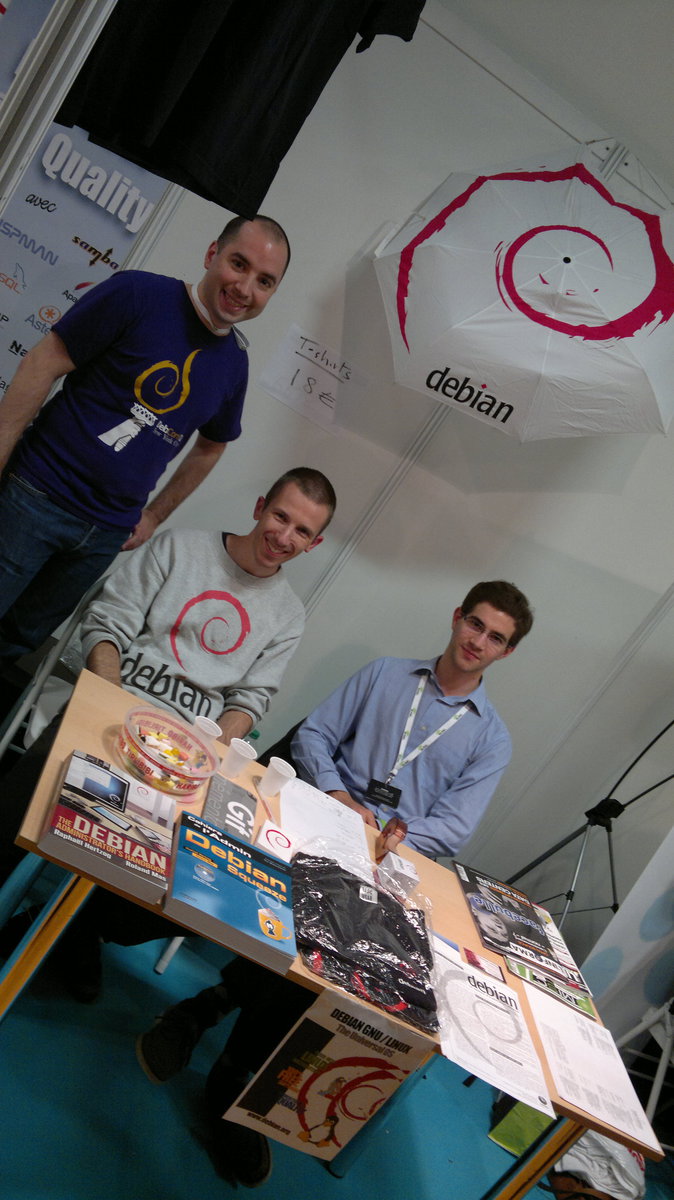
I know lots of people are preparing for Debconf but I decided to not attend this year, the price of the air plane ticket was a bit too hefty for me and it was also in partial conflict with our family vacations. I thought about attending the Libre Software Meeting instead but alas I won t go there either (but Roland Mas will be there!), I have too much work to complete before my own vacation in 2 weeks. Thanks See you next month for a new summary of my activities.

2 comments Liked this article? Click here. My blog is Flattr-enabled.

30 June 2012

Luca Falavigna: FTP Team stats during Wheezy development

Already chilled by Wheezy freeze? It s been a long ride since the release of Squeeze, and your beloved FTP Team tried to assist our tireless developers and contributors at its best. Here are some hot stats to give you a figure about what happened behind the scenes. Since the release of Squeeze, 7462 .changes files with NEW components were processed by dak, with an average of 14.660 NEW packages per day. On the FTP Team side, we had 6877 accepts (13.511 per day), 641 rejects (1.259 per day) and 280 comments to maintainers (0.550 per day). This table represents the activity by single team member:
Login Accepts Rejects Comments
ansgar 407 accepts (0.800 per day) 71 rejects (0.139 per day) 53 comments (0.104 per day)
dak 12 accepts (0.024 per day) 1 rejects (0.002 per day) 0 comments (0.000 per day)
dktrkranz 4319 accepts (8.485 per day) 381 rejects (0.749 per day) 104 comments (0.204 per day)
joerg 100 accepts (0.196 per day) 12 rejects (0.024 per day) 1 comments (0.002 per day)
mhy 214 accepts (0.420 per day) 14 rejects (0.028 per day) 5 comments (0.010 per day)
stew 67 accepts (0.132 per day) 16 rejects (0.031 per day) 7 comments (0.014 per day)
tolimar 1480 accepts (2.908 per day) 93 rejects (0.183 per day) 84 comments (0.165 per day)
twerner 278 accepts (0.546 per day) 53 rejects (0.104 per day) 26 comments (0.051 per day)


Who were the most prolific maintainers who got a NEW processing? Here is our special top ten:
  1. Debian Perl Group (559 accepts)
  2. Debian Haskell Group (491 accepts)
  3. Debian Ruby Extras Maintainers (285 accepts)
  4. Debian Java Maintainers (257 accepts)
  5. Debian Med Packaging Team (164 accepts)
  6. Debian Multimedia Maintainers (160 accepts)
  7. Debian Fonts Task Force (156 accepts)
  8. Debian Javascript Maintainers (137 accepts)
  9. Debian Python Modules Team (129 accepts)
  10. Debian Qt/KDE Maintainers (98 accepts)
That doesn t reflect the real developers, though. Here s our Changed-By top ten:
  1. Clint Adams (216 accepts)
  2. Jonas Smedegaard (208 accepts)
  3. Ben Hutchings (203 accepts)
  4. Joachim Breitner (153 accepts)
  5. TANIGUCHI Takaki (112 accepts)
  6. Alessio Treglia (101 accepts)
  7. David Paleino (95 accepts)
  8. Nicholas Bamber (76 accepts)
  9. Mathieu Parent (68 accepts)
  10. Jeff Breidenbach (63 accepts)
Clint rocks with tons of Haskell packages, followed by Jonas (mostly Perl packages), and Ben (kernel uploads). Italian cabal stands still, with Alessio and David respectively at 6th and 7th place ;)


How long does a package stay in NEW? Some more, some less, but the average is 3 days, 15 minutes and 21 seconds. Now go and check your dak mails to see whether you had a fast processing or not :) liblog4ada 1.2-1 surely had, as it was accepted after 30 seconds! gsoap 2.7.17-1 was not so lucky, it took 103 days, 8 hours, 20 minutes and 43 seconds to clear NEW, but then made its way to the archive. Better late than never ;)


FTP Team is not just accepting NEW packages, but also removing obsolete ones. Here are some details about this task:

FTP Team also took care of override changes:

Andrea Veri: Nagios IRC Notifications

Lately (as I earlier pointed out on my blog) I ve been working on improving GNOME s infrastructure monitoring services. After configuring XMPP it was time to find out a good way for sending out relevant notifications to our IRC channel hosted on GIMPNET. I achieved that with a nice combo: supybot + supybot-notify, all that mixed up with a few grains of Nagios command definitions. But here we go with a little step-by-step guide: Requirements 1. Install supybot and configure a new installation:
apt-get install supybot or yum install supybot
mkdir /home/$user/nagbot && cd /home/$user/nagbot
supybot-wizard (follow the directions to get the bot initially configured)
2. Install and load the supybot-notify plugin by doing:
git clone git://git.fedorahosted.org/supybot-notify.git && cd supybot-notify
mkdir -p /home/$user/nagbot/plugins/notify && cp -r * /home/$user/nagbot/plugins/notify
Finally, load the plugin. (this will require you to authenticate to the bot) Nagios configuration 1. Add the relevant command definitions to the commands.cfg file:
# 'notify-by-ircbot' command definition
define command 
    command_name    notify-by-ircbot
    command_line    /usr/bin/printf "%b" "#channel $NOTIFICATIONTYPE$ - $HOSTALIAS$/$SERVICEDESC$ is $SERVICESTATE$: $SERVICEOUTPUT$ ($$(hostname -s))"   nc -w 1 localhost 5050
     
# 'host-notify-by-ircbot' command definition
define command 
	command_name	host-notify-by-ircbot
	command_line	/usr/bin/printf "%b" "#channel $NOTIFICATIONTYPE$ - $HOSTALIAS$ is $HOSTSTATE$: $HOSTOUTPUT$ ($$(hostname -s))"   nc -w 1 localhost 5050
	 
* adjust the Netcat s host and port to your needs, in my case Supybot and Nagios were running on the same host. In the case of a Supybot running on a different host than Nagios, tweak Iptables to allow the desired port:
-A INPUT -m state --state NEW,ESTABLISHED -m tcp -p tcp --dport 5050 -j ACCEPT
2. Add a new entry on the contacts.cfg file:
define contact 
 	contact_name    nagbot
   	use             generic-contact
        alias		Nagios IRC Bot
        email           example@example.com
        service_notification_commands   notify-by-ircbot
 	host_notification_commands      host-notify-by-ircbot
 
3. Reload Nagios:
sudo /etc/init.d/nagios3 reload
And finally, enjoy the result:
 PROBLEM - $hostalias/load average is CRITICAL: CRITICAL - load average: 30.45, 16.24, 7.16 (nagioshost)
 RECOVERY - $hostalias/load average is OK: OK - load average: 0.06, 0.60, 3.65 (nagioshost)

29 June 2012

Julien Danjou: How to make Twitter's Bootstrap tabs bookmarkable

I've been using Twitter's bootstrap library recently to build this Web site, and wondered how to be able to use the bootstrap-tab Javascript plugin in a bookmark friendly manner. I ended up with a simple solution. These are my first steps in Javascript and front-end manipulation, and it's really not my area of expertise, so don't be harsh. <figure>
function bootstrap_tab_bookmark (selector)   if (selector == undefined)  
    selector = "";  
    /* Automagically jump on good tab based on anchor */
    $(document).ready(function()  
        url = document.location.href.split('#');
        if(url[1] != undefined)  
            $(selector + '[href=#'+url[1]+']').tab('show');
         
     );
    var update_location = function (event)  
        document.location.hash = this.getAttribute("href");
     
    /* Update hash based on tab */
    $(selector + "[data-toggle=pill]").click(update_location);
    $(selector + "[data-toggle=tab]").click(update_location);
 
</figure> All you need is to use and call this function with a selector (only useful if you have several tabs/pills divisions) when the document is ready. The first part takes care of showing the good tab based on the hash contained in the URL. The second part takes care of changing the document location to add the current tab to it when the user clicks.

26 June 2012

Bastian Venthur: .inputrc

A few days ago I found this blog explaining how to improve the tab completion by tinkering with your .inputrc. The magic lines are:

set show-all-if-ambiguous on
set completion-ignore-case on
set completion-map-case on
Last two lines make tab-completion ignore case, hyphens, underscores, the first one spares you one tab when more than one match was found. Very neat! I would have never found out, since there wasn t even an .inputrc in my home directory. Do you know any other cool .inputrc-tricks?

Russ Allbery: Review: Quiet

Review: Quiet, by Susan Cain
Publisher: Crown
Copyright: 2012
ISBN: 0-307-45220-4
Format: Kindle
Pages: 263
I've always been an introvert. This is something that surprises some people when they first meet me since they equate introversion with shyness, and I'm not at all shy. It surprises others because I'm quite vocal and outspoken in meetings, but introversion also doesn't imply a lack of self-confidence. I can run meetings, give presentations, and argue my perspective in front of just about anyone, but I don't like parties, I crave time by myself, and I could happily go for weeks without seeing another human being. I'm an introvert because I find people draining rather than invigorating, written communication far easier and more comfortable than spoken, and superficial social contact more irritating and frustrating than enjoyable. If you think think that means there may be something wrong with me, or that I would be happier if "drawn out of my shell," I wish you would read this book. But I suspect its core audience will be people like me: those who are tired of being pushed to conform with extrovert beliefs about social interaction, those who are deeply disgusted by the word "antisocial" or feel pangs of irrational guilt when hearing it, or those who just want to read an examination of interpersonal interactions that, for once, is written by and about people who like quiet and solitude just like they do. I first encountered Susan Cain via her TED talk, which I think is both the best possible summary of this book and the best advertisement for it. If you've not already seen it, watch it; it's one of the best TED talks I've seen, good enough that I've watched it three times. If you then want more of the same, buy Quiet. Quiet has, I think, three messages. First, it's a tour of the science: what is introversion and extroversion? Is there evidence that these are real physiological differences? (Spoiler: yes.) What do we know about introversion? How do we know those things what experiments have been done and what methods have been used? Here, it's a good general introduction, although Cain is careful to point out that it only scratches the surface and there's much more scientific depth. For example, she touches on the connections between introversion and sensitivity to stimulus and points out that they're two separate, if related, categorizations, but doesn't have the space here to clarify the distinctions and tease them apart. But she lays a reasonable foundation, particularly in defense of introversion as a natural, physiologically grounded, scientifically analyzable, common, and healthy way of interacting with the world. (For those who are curious about the distinctions between introversion and sensitivity, and the argument that most of what Cain says here about introversion is actually about sensitivity, see the blog post by Elaine Aron.) The second message, the one that resonated with me the most, was Cain's passionate defense of introversion. Business culture (at least in the United States, which is what both Cain and I know) is strongly biased towards extroversion; at least faking extroversion seems to be required for some career advancement. Extrovert culture dominates politics and most public discourse. It's common to find people who consider introversion, particularly in children, to be a sign of unhappiness, poor social adjustment, psychological problems, or other issues that should be "cured" or changed. Cain's gentle but firm passion in defense of introversion is a breath of fresh air. She attacks open plan offices, the current obsession with group learning and social school settings, and the modern group-think bias towards collaboration over solitude and concentration, and she does that with a combination of polite frustration and the conclusions of multiple studies. Introverts will be cheering as she constructs solid arguments and musters evidence against things that we've always found miserable and then been told we were wrong, short-sighted, or socially inept for finding miserable. I am so utterly on her side in this argument that I have no way of knowing how persuasive it will be, but it's lovely just to hear someone put into words what I feel. This defense does skew the book. Quiet is not, and does not purport to be, an even-handed presentation of introversion and extroversion. It's written proudly and unabashedly from the introvert's point of view. I'm fine with that: I, like Cain, think the US is saturated in extrovert perspectives and extrovert advice, particularly in the business world, and could use some balancing by activism from the other perspective. But be aware that this is not the book to look to for an objective study of all angles of the introvert/extrovert dichotomy, and I'm not sure her descriptions of extroversion are entirely fair or analogous to those of introversion. The extroversion described here seems somewhat extreme to me. I'm dubious how many extroverts would recognize themselves in it, which partly undermines the argument. The third message of the book, once Cain has won the introvert's heart, is some advice on how to be a proud introvert, to make the space and find the quiet that one desires, and to balance that against places where one may want and need to act like an extrovert for a while. Cain thankfully does not try to make this too much of the book, nor does she hold up any particular approach as The Answer. All the answers are going to be individual. But she does offer some food for thought, particularly around how to be conscious of and make delibrate choices about one's energy expenditures and one's recharge space. She also captures beautifully something that I've not seen explained this well before: the relief that an introvert can feel in the company of an extrovert who helps navigate social situations, make conversation, and keep discussions going until they can reach the depth and comfort level where the introvert can engage. I wish anyone in a position of authority over social situations would read this book, or at least watch the TED talk and be aware of the issues. Particularly managers, since (at least in my relatively limited experience) workplace culture is so far skewed towards extroversion that it can be toxic to introverts. Many of the techniques used by extrovert managers, and the goals and advice they give their employees, are simply wrong for introverts, and even damaging. Cain speaks well to the difficulties of empathy between people with very different interaction preferences, such as the problems with extroverts trying to "draw out" introverts who have hit social overload (or sensitive people who have hit stimulus overload). She also discusses something that I'd previously not thought about, namely how the pressure towards extroversion leads people to act extroverted even when naturally introverted, and how it's therefore very difficult to tell from behavior (and sometimes even to tell internally!) what one's natural interaction style is. But mostly I recommend this book if you're an introvert, if the TED talk linked above speaks to you. Even if we can't convince the world to respect introversion more, or at least stop treating it as abnormal, it's a lovely feeling to read a book from someone who gets it. Who understands. Who fills a book with great stories about introverts and how they construct their worlds and create quiet space in which to be themselves. Rating: 9 out of 10

25 June 2012

Jan Wagner: nagios-plugins 1.4.16 is going to be released

Short before Debian is freezing the upcoming release of a new version of nagios-plugins is scheduled for Wednesday. The good news is, that a recent version is available in unstable and testing. Upstream only fixed some check_ping issues, which are not included in nagios-plugins 1.4.16~pre1-1. There is also a package available through squeeze-backports. If you are able to, please test the packages as soon as possible. If there are some quirks, these can be fixed in the next two days upstream.

24 June 2012

Pablo Lorenzzoni: Zotero and note-taking

I was looking for an excuse to try Zotero and the perfect opportunity appeared when I got a whole lot of references to group for a month of Magnetic Ressonance studies I am currently taking. I was also pleased to notice it is packaged to Debian. I am used to note-taking software. Back when I used a Palm m130 (and a Treo 650), I managed a lot of Memos I eventually migrated to Note-Everything in my current Android phone. Zotero, unfortunatelly, is not interfaceable with my phone (or I was still unable to figure out how to do so), but it s powerful in managing references beyond simple note-taking. Is anyone using Zotero in a more ambitious way? I ve read about people using it to keep large researchs to support fiction and non-fiction book-writing I also watched some YouTube videos on it. As far as I went with it, Zotero might become an important piece in my toolbox wrt reference keeping, so I was just trying to figure out how many other niches it can fill

23 June 2012

Richard Darst: The size of DebConf12

Phil blogged about DebConf12 having many fewer attendees than past DebConfs (10 and 11). Dealing with registration for several years, I can say these numbers tell a different story.First and foremost, these numbers tell me that DebConf12 hasn't happened yet, DC10 and DC11 have. People are told to sign up register early and reconfirm, but in reality, only the people who have accommodations with us have a significant motivation to do it. Once DebConf starts, lots of day-attendees will drop by, be told to register, and greatly inflate our numbers without staying for a very long time. The number of advance registrants also depends on how much advertisement is done. In terms of people who have both dates in the registration system (Phil's updated graph), I don't place much weight on this number, either.It's my opinion that number of beds occupied is a better indication of the scale of a DebConf, and especially at this stage. This also roughly correlates to number of Debian developers staying, though for years with cheap rooms or lots of external funding, even this number can get inflated. We need some things like t-shirts and badges for every attendee (possibly registered before a certain time), but for now, the number of rooms is what matters.In fact, I wouldn't be surprised if DebConf13 had lower "reconfirmed" numbers, because it is further away form population centers, yet still was a "bigger" conference because there are more people staying on-site or coming for multiple days.For DebConf12, I see an average of 130 people/night, for DebConf11, I see an average of 240 people/night, and for DebConf10, I see an average of 200 people/night. So, DebConf12 is smaller, but in a different way than it seems, and even this is subject to change or variable interpretation. I'm not really wanting to predict DebConf sizes at this stage.So basically, one does not simply expect DebConf registration data to make sense. One should not simply dismiss any DebConf before it happens. And most importantly, one can not simply use this data to plan a conference. The registration team has been frantically running around trying to correct every possible inconsistency you can imagine.Tags: debconf

Bernd Zeimetz: Report from the Bug Squashing Party in Salzburg

bsp_2012_salzburg photo from salzburg-cityguide.com, Copyright (C) Uwe Brandl

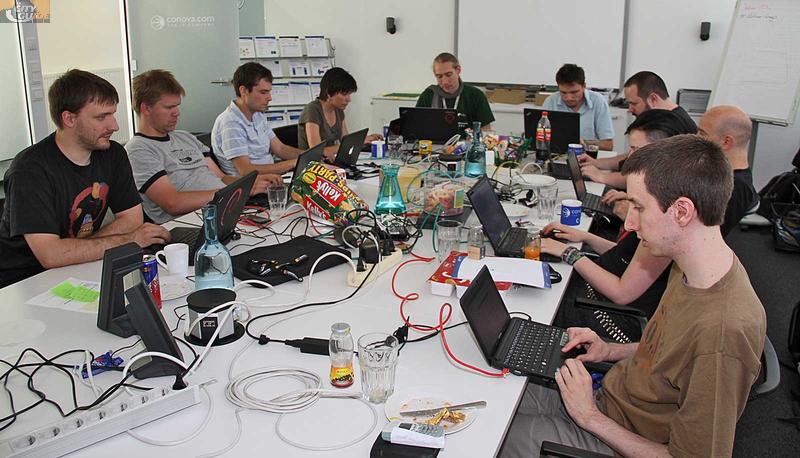
Participation and Results From June 15-17th we held a Debian BugSquashingParty in Salzburg, hosted and sponsored by conova communications GmbH. It was a fun and busy weekend, with 15-17 people from 5 countries being around, mainly working on RC bugs in Testing/Unstable. Gerfried Fuchs (rhonda) also worked on triaging the impact of RC bugs on the version in Squeeze, while Peter Palfrader (weasel) took care of Tor related things and Debian sysadmin work, including starting on the new bugs and udd hosts. Phillip Hug (hug) worked on the debian.ch infrastructure. Together with Miroslav Such from Red Hat Bernd Zeimetz (bzed) worked on the packaging of the necessary libraries and daemons to add (basic) Spacewalk client support to Debian. As soon as the packages passed NEW and #677871 was applied (thanks to the APT guys for working on that already), managing Debian clients with Spacewalk should work out of the box. Of course we also had a little keysigning party :)

Statistics
  • about 68 bugs in unstable/testing were triaged/patched/fixed or at least pinged
  • 54 bugs were tagged to show if they affect Squeeze, several other bugs were pinged to retrieve necessary information or to trigger an update in the next stable pointrelease.
  • 5 packages were introduced into Debian (still in NEW, though) - the Spacewalk client related packages and libapache2-mod-auth-memcookie.

Accomodation Thanks to Debian funds we were able to provide accomodation for four participants in the JUFA youth hostel in Salzburg. We had paid in advance for eight, but changing to rooms with a higher category for only 4 people would have been equally or more expensive.

Press/Media coverage Additionally to being mentioned in the calendars on ProLinux and similar pages, we had some press coverage by the local newspaper and online magazines:

Fun facts We consumed 2kg of Leberkas, a big plate of "Buchteln mit Vanillesosse", about 16000cm^2 of Pizza, about 80 litres of coke, juice, beer and wine and I guess we drank at least the same amount of water. We had coffee made of 1.5kg coffee beans and managed to empty the (formerly well filled) icemaker in the fridge. Also we had successful training sessions of a standard Debconf game (rules won't be explained here obviously). Maybe we even successfully spread the game to the employees of a commercial linux distribution ;)

20 June 2012

DebConf team: Call for DebConf14 venues! (Posted by Gunnar Wolf)

2000, Bordeaux, France. 2001, Bordeaux, France. 2002, Ottawa, Canada. 2003, Oslo, Norway. 2004, Porto Alegre, Brazil. 2005, Helsinki, Finland. 2006, Oaxtepec, Mexico. 2007, Edinburgh, United Kingdom. 2008, Mar del Plata, Argentina. 2009, C ceres, Spain. 2010, New York, United States. 2011, Banja Luka, Bosnia and Herzegovina. 2012, Managua, Nicaragua. 2013, Vaumarcus, Switzerland. We have gone to all different latitudes (although not yet longitudes!). We have had very hot and very cold weather. Great cities and small villages have hosted us. What will be the next addition to this great list? As we approach DebConf12 (10 days to DebCamp and counting, yay!), we should keep the future in mind. So, as every year in recent history, we will once again have a DebConf session presenting possible venues for the next year. Organizing DebConf in your city means a lot of hard work. It also means one of the greatest personal experiences you can imagine. And it is a great way to contribute to Debian. The decision process for every DebConf venue starts two years before, with presentations during DebConf(n-2). That means, if you consider presenting a bid for DebConf14, now is the moment to act! Do you have to be present at Managua to propose your bid? No. You can proxy via somebody I d suggest to do it via somebody who knows the location you are suggesting, but basically, choose a friend that you trust that trusts you. Of course, you can participate in the presentation session via IRC. Do you have to be a Debian Developer to propose a bid? No. For DebConf9, none of the C ceres guys was a DD; for DebConf10, some of the people most involved from the local New Yorkers were not DDs. For DC11, none of our hosts in Bosnia are DDs. And for DC12, the dear and overworked Nicaraguan crew is also made from people interested in getting closer to the Debian project, but not DDs. Do you have to decide now? No. This is just a call for a first presentation, but the decision regarding DC14 will be taken probably around March 2013. However, giving a nice presentation at DebConf helps a lot, gives you visibility, and will get the ball rolling. Is there a geographical bias? Slight. So far, and since the second DebConf, we have kept the tradition not to repeat continents on two successive DebConfs. This is not a hard condition, however! While there is some probability that DebConf14 will be somewhere in America (the continent, of course), it depends on the proposals more than on any pseudo-rule. What do you need to start thinking about? Go visit our prospective location checklist. You can also look at what other teams have historically presented. And of course, go to the DebConf14 wiki planning page Register there, even if you are just in the early phases of finding data.

19 June 2012

Jo Shields: Enormity

(This blog post is a more firm version of a series of tweets and forum posts I made a few weeks ago. This should also be considered a refresh of this post by Mirco Bauer a few years ago) It has been said that Mono is bloated, and that people should use lighter frameworks that don t pull in hundreds of meg . How much basis in reality is there for those comments? Well, let s do a little thought exercise. How much space is the minimum space needed for several languages to work? For this experiment, we will be looking at the required installation size on disk of several language frameworks, each time installing the bare minimum for a command-line hello world app in that language to run. For example, the Ruby result is the minimum install required to run:
puts 'Hello world'
and the Mono result is the minimum install required to run the following code, which has been compiled on a different machine using dmcs :
public class Hello1
 
   public static void Main()
    
      System.Console.WriteLine("Hello, World!");
    
 
Obviously, for dynamic languages like Ruby and Python, there is no compiler step needed. For languages like C# and Java, it is fair to compile these on a different machine as end-users of packages running these frameworks receive binaries, not source they do not need a development environment. So, on to the test environment. This is a bare bootstrapped AMD64 Debian Unstable system, as of today (i.e. debootstrap sid /tmp/badger ). Its install size is 275MB. So how much space? Ruby 1.9 Test code is as follows:
puts 'Hello world'
Install requirements are as follows:
root@dream:/# aptitude install ruby1.9.1
The following NEW packages will be installed:
  libffi5 a  libruby1.9.1 a  libyaml-0-2 a  ruby1.9.1 
0 packages upgraded, 4 newly installed, 0 to remove and 0 not upgraded.
Need to get 4703 kB of archives. After unpacking 13.1 MB will be used.
OpenJDK 7 Test code is as follows:
class HelloWorldApp  
    public static void main(String[] args)  
        System.out.println("Hello world");
     
 
Install requirements are as follows:
root@dream:/# aptitude install openjdk-7-jre-headless
The following NEW packages will be installed:
  ca-certificates a  ca-certificates-java a  dbus a  fontconfig-config a  
  icedtea-7-jre-cacao a  icedtea-7-jre-jamvm a  java-common a  
  krb5-locales a  libavahi-client3 a  libavahi-common-data a  
  libavahi-common3 a  libcap2 a  libcups2 a  libdbus-1-3 a  libexpat1 a  
  libffi5 a  libfontconfig1 a  libfreetype6 a  libglib2.0-0 a  
  libglib2.0-data a  libgssapi-krb5-2 a  libjpeg8 a  libk5crypto3 a  
  libkeyutils1 a  libkrb5-3 a  libkrb5support0 a  liblcms2-2 a  libnspr4 a  
  libnss3 libnss3-1d a  libpcre3 a  libpcsclite1 a  libsystemd-login0 a  
  libxml2 a  openjdk-7-jre-headless openjdk-7-jre-lib a  openssl a  
  sgml-base a  shared-mime-info a  ttf-dejavu-core a  tzdata-java a  ucf a  
  xml-core a  
0 packages upgraded, 43 newly installed, 0 to remove and 0 not upgraded.
Need to get 51.5 MB of archives. After unpacking 137 MB will be used.
Python 3.2 Test code is as follows:
print ("Hello world")
Install requirements are as follows:
root@dream:/# aptitude install python3.2-minimal
The following NEW packages will be installed:
  file a  libexpat1 a  libffi5 a  libmagic1 a  mime-support a  python3.2 a  python3.2-minimal 
0 packages upgraded, 7 newly installed, 0 to remove and 0 not upgraded.
Need to get 4853 kB of archives. After unpacking 17.7 MB will be used.
Mono 2.10 (C#) Test code is as follows:
public class Hello
 
   public static void Main()
    
      System.Console.WriteLine("Hello world");
    
 
Install requirements are as follows:
root@dream:/# aptitude install mono-runtime
The following NEW packages will be installed:
  binfmt-support a  cli-common a  libmono-corlib4.0-cil a  libmono-i18n-west4.0-cil a  libmono-i18n4.0-cil a  
  libmono-security4.0-cil a  libmono-system-configuration4.0-cil a  libmono-system-security4.0-cil a  
  libmono-system-xml4.0-cil a  libmono-system4.0-cil a  mono-4.0-gac a  mono-gac a  mono-runtime 
0 packages upgraded, 13 newly installed, 0 to remove and 0 not upgraded.
Need to get 4383 kB of archives. After unpacking 11.5 MB will be used.
Of course, every time I try to make the argument that Mono is much leaner than what people propose as an alternative, the anti-Mono brigade go on the defensive and insist that nobody in their right minds uses Python or Ruby either everything ever should be written in Qt. So, hypothetically Qt 4.8 (C++) Test code is as follows:
#include <QTextStream>
int main(int argc, char **argv)
 
   QTextStream s(stdout);
   s << "Hello, world!\n";
   return 0;
 
Install requirements are as follows:
root@dream:/# aptitude install libqtcore4
The following NEW packages will be installed:
  libffi5 a  libglib2.0-0 a  libglib2.0-data a  libpcre3 a  libqtcore4 
  libxml2 a  sgml-base a  shared-mime-info a  xml-core a  
0 packages upgraded, 9 newly installed, 0 to remove and 0 not upgraded.
Need to get 10.3 MB of archives. After unpacking 27.8 MB will be used.
Presented without comment for your consideration. Edit: There are complaints that these numbers are misleading, because they show default package manager behaviour, rather than what happens when passing extra flags or config file settings to Apt. When disabling installation of Recommends: packages, the numbers change as follows:

16 June 2012

Jon Dowland: Debian Day #3

Once again Debian day was somewhat compromised: this time by more DIY. I still managed a few bits and pieces, amortized over the rest of the week. I benefited from some train time this weekend. A new version of flactag and catching up the flactag packaging vcs repository. A maintainer endorsement for one of the flactag maintainers and a request to NM for another maintainer to be granted access to the collab-maint repository. More work on the musicbrainz 'transition': First, usertag tracking of packages to update, with upstream bugs where necessary. Tested and confirmed Michael Biebl's sushi patch; found and fixed a sushi bug along the way; wrote patches for sound-juicer ( merged upstream) and goobox.

Russell Coker: New Version of Memlockd

I ve just released a new version of Memlockd, a daemon to lock essential files in RAM to increase the probability of recovering a system that is paging excessively [1]. The new features are:
Using Debian/Wheezy paths for shared objects on i386 and amd64. Added a new config file option to not log file not found errors so we don t see i386 errors on amd64 and amd64 errors on i386. Added a systemd service file which I haven t yet tested, but I won t get to test it for a while so for the moment I ve released it and hope that the person who submitted the file got it right and that my minor change didn t break it. Added a run-parts style config directory, default is /etc/memlock.d and now the config file uses a % to chain to another file or directory. So I fixed all but one of the Debian bugs in time for Wheezy, provided that the systemd stuff works. If someone has time to test it with systemd for me then that would be great! Related posts:
  1. New version of Bonnie++ and Violin Memory I have just released version 1.03e of my Bonnie++ benchmark...
  2. new release of postal Today I have released a significant new version of my...
  3. /run and SE Linux Policy Currently Debian/Unstable is going through a transition to using /run...

15 June 2012

Matthew Garrett: No, really, secure boot does add security

Carla Schroder wrote a piece for linux.com on secure boot, which gives a reasonable overview of the technology and some of the concerns. It unfortunately then encourages everyone to ignore those legitimate concerns by making the trivially false claim that secure boot is just security theatre.

Security isn't some magic binary state where you're either secure or insecure and you can know which. Right now I'd consider my web server secure. If someone finds an exploitable bug in Apache then that would obviously no longer be the case. I could make it more secure by ensuring that Apache runs in a sufficiently isolated chroot that there's no easy mechanism for anyone to break out, which would be fine up until there's also a kernel exploit that allows someone to escalate their privileges enough to change their process root. So it's entirely possible that someone could right now be breaking into my system through bugs I don't even know exist. Am I secure? I don't know. Does that mean I should just disable all security functionality and have an open root shell bound to a well known port? No. Obviously.

Secure boot depends on the correctness of the implementation and the security of the signing key. If the implementation is flawed or if control of the signing key is lost then it stops providing security, and understanding that is important in order to decide how much trust you place in the technology. But much the same is true of any security technique. Kernel flaws make it possible for an unprivileged user to run with arbitrary privileges. Is user/admin separation security theatre? SSL certificate authorities have leaked keys. Is it security theatre for your bank to insist that you use SSL when logging in?

Secure boot doesn't instantly turn an insecure system into a secure one. It's one more technology that makes it more difficult for attackers to take control of your system. It will be broken and it will be fixed, just like almost any other security. If it's security theatre, so is your doorlock.

Why is this important? Because if you tell anyone that understands the technology that secure boot adds no security, they'll just assume that you're equally uninformed about everything else you're saying. It's a perfect excuse for them to just ignore discussion of market restrictions and user freedoms. We don't get anywhere by arguing against reality. Facts are important.

comment count unavailable comments

11 June 2012

Petter Reinholdtsen: Debian Edu - some ideas for the future versions

During my work on Debian Edu based on Squeeze, I came across some issues that should be addressed in the Wheezy release. I finally found time to wrap up my notes and provide quick summary of what I found, with a bit explanation. I guess we will discover more as we continue to work on the Wheezy version.

10 June 2012

Gregor Herrmann: RC bugs 2012/23

here's the list of RC bugs I've worked on during the last week:

Next.

Previous.