Search Results: "zed"

23 August 2008

Ian Wienand: Spice hacking

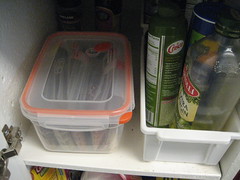
Sick of a ridiculous pile of tiny bottles falling everywhere in your cupboard? Spice Hacking Many people will sell you many expensive solutions. However, I think we've hit on something cheap, effective and practical; zip-lock bags in a deep tub, labelled with sticky tags. Spice Hacking Spice Hacking

22 August 2008

Russell Coker: AppArmor is Dead

For some time there have been two mainstream Mandatory Access Control (MAC) [1] systems for Linux. SE Linux [2] and AppArmor [3]. In late 2007 Novell laid off almost all the developers of AppArmor [4] with the aim of having the community do all the coding. Crispin Cowan (the founder and leader of the AppArmor project) was later hired by Microsoft, which probably killed the chances for ongoing community development [5]. Crispin has an MSDN blog, but with only one post so far (describing UAC) [6], hopefully he will start blogging more prolifically in future. Now SUSE is including SE Linux support in OpenSUSE 11.1 [7]. They say that they will not ship policies and SE Linux specific tools such as “checkpolicy”, but instead they will be available from “repositories”. Maybe this is some strange SUSE thing, but for most Linux users when something is in a “repository” then it’s shipped as part of the distribution. The SUSE announcement also included the line “This is particularly important for organizations that have already standardized on SELinux, but could not even test-drive SUSE Linux Enterprise before without major work and changes“. The next step will be to make SE Linux the default and AppArmor the one that exists in a repository, and the step after that will be to remove AppArmor. In a way it’s a pity that AppArmor is going away so quickly. The lack of competition is not good for the market, and homogenity isn’t good for security. But OTOH this means more resources will be available for SE Linux development which will be a good thing.

21 August 2008

MJ Ray: How To Avoid 6 Common Website Mistakes That Cost Money

According to a recent article, 6 Common Website Mistakes That Cost Money are:
1. JavaScript or other crawler-unfriendly navigation that may impede indexing
This one is best avoided at design-time, by including Web Content Accessibility Guidelines 1.0 Level A in the design brief, but if you’ve ended up with JavaScript-based navigation on your site (check by doing “View Source” and searching for the code for your home page link and so on - if you can find it, then it’s probably not javascript) and it’s based on some template system, a webmaster can probably do a whole-site edit to put the navigation links in the page properly - or at least add a useful <noscript> tag.
2. Navigation that buries important pages within the site architecture.
The structure of the website’s files and the structure of the link menus do not need to match, so if there’s a page that you feel is important, get your webmaster to add it to the navigation links across the whole site.
3. Duplicate “pages” getting indexed under multiple URLs.
This usually happens for one of two reasons: one is inappropriately-parked domains, which is mistake 6 below and often fairly easy to fix; the other is a misbehaving web application, which you’ll need to get a programmer to fix. You can do a simple test of your web application by starting at your homepage and following links to a particular page; then open a new browser window and try to reach the same page by different links (or a site search) and compare the address bars (the bit of your browser showing http://) - do they match? If not, you’ve got this problem.
4. No keyword phrase focus in the content or conversely, keyword phrase stuffing
You can use a good word-counter on the text to see how common different keywords and keyphrases, or use the “webmaster tools” section of some search engines to see what they’re focusing on. Keyword-stuffing can be fairly easy to see. If you “View Source” on a page and there’s a large block of keyword-intensive text somewhere in it that doesn’t appear it when viewed in a browser, then it’s probably stuffing. Many sites regard stuffing as a sort of spam, so you don’t want to be found doing this. To fix these problems, rewrite the page text appropriately.
5. An optimized home page, but that’s it
Repeat your checks from problem 4 on a few pages other than the home page to discover whether you suffer from this. Also, see whether your website statistics show search engine visitors arriving at a variety of different pages (these are sometimes called “Entry Page” statistics).
6. Additional domains owned by the company are not properly redirected
If you usually use .co.uk, but you also have a .com domain, try visiting a random page on your website, then click in the address bar and replace the .co.uk with .com - what happens? If the page is Not Found, then your domains aren’t properly redirected and you need a Redirect adding to the second one. If the page displays but the address doesn’t change itself back, then your domains are probably pointing at the same webspace but aren’t properly redirected, which will mean you’re probably making mistake 3 above. Usually, the simplest way to fix this is with a conditional redirect. On Apache webservers, you can add a .htaccess file containing something like:-
RewriteEngine On
RewriteCond % HTTP_HOST  !^www\.yourdomain\.co\.uk$ [NC]
RewriteRule (.*) http://www.yourdomain.co.uk/$1 [R=permanent,L]
That even works on BT Business web hosting, by the way. If it doesn’t work, try asking your web hosting provider to enable mod_rewrite for you or ask them to suggest how to achieve the same result.
The above list of mistakes was published on Search Engine Land last week. The correction methods are all things used by my webmaster cooperative.

20 August 2008

Adam Rosi-Kessel: Walter Michalik and the Roslindale Community Center

I’ve had little time in the four years I’ve lived in Roslindale to get involved in community volunteer efforts. My wife Rachele, however, has devoted several years to efforts such as the Roslindale Community Center, Roslindale Village Main Streets, and Roslindale Clean and Green. She has served as chair of both RCC and one of the RVMS committees. Over the past few months, I’ve been disappointed to see the RCC board endure repeated senseless attacks by a perhaps overzealous community member, Walter Michalik, who has effectively paralyzed the organization. I have nothing personal against this guy, but I thought I could do my part here by publishing an example of an email he broadcast to the committee, which I think is embarrassing enough on its own merits to need no editorializing from me, except to say any email that starts with “just so you won’t be surprised when the IRS launches its investigation” can be neither productive nor taken seriously. The context is a response to an announcement sent out pursuant to the Community Centers By-Laws scheduling a special meeting to discuss the recent upheaval on the Council. There’s no reason this should not be in the public record:
Rachele Just so you won’t be surprised when the IRS launches its investigation, be advised that YOU DO NOT HAVE THE AUTHORITY TO CALL FOR A SPECIAL MEETING. The By Laws do not allow the President/Chair to call for a Special meeting - that right is reserved for the MEMBERS to have a power over a hostile or non-performing President/Chair. It was created by a Membership wary of annimosity within its ranks in order to protect itself from falling into a useless dysfunctional body. That’s why our By Laws require the majority of the membership request it through the Chair and not the other way around. So you screwed that up too. Your continuous violation of rules and laws have proven beyond a doubt that this current Roslindale Community Center Council has violated the trust behind its IRS-designated not-for-profit status. The failures are on so many significant levels over 6 months it is readily apparent that the Roslindale Community is better served without a Community Center Council. There is no longer any excuse to allow the residents of Roslindale to be denied the services they deserve that you and the officers have no idea how to deliver. Because that’s what you are supposed to do - serve the residents of Roslindale and not preseide over a self-serving board. You’ve taken us from dysfunctional to non-functional over the past 60 days. You and your officers have already driven away our Archdale partners and now the merger is off. Congratulations. You got what you wanted. You and the officers have withheld information from the Members of the Council imposing gag orders along the way and in more than one instance spreading lies within this community. There are so very many lapses on your part and the rest of the officers that it is very apparent that the Roslindale Community Center exists IN SPITE OF the Roslindale Community Center Council - not because of it. It would be far better indeed, if the Center were run without the Council. What have you done in 6 months? All you do is avoid the work of leadership. Please, just gracefully step aside and let a real leader emerge - or dissolve the Council and let the Center run itself under BCYF before the IRS makes that happen. Of course this is my stated opinion. You can choose not to belive it. You can huddle with a group of self-serving officers and invent excuses or change the agenda away from the message and continue with your ad hominem attacks against the messenger. I’m thick-skinned. Feelings aren’t important to me - services to residents are important to me. While I have, in fact, enjoyed the confidences of others within this community and their true displesure with this Council, I will produce that to the appropriate authorities as I see fit along with the Bill of Particulars I have produced with documentation for all charges. As a founder of the Roslindale Community Center Council I can no longer support you or the officers as any legitimate authority in this community.
Technorati Tags: , ,

19 August 2008

Wouter Verhelst: The (almost) 429 tripod

Some interesting two days have just passed. I took the airplane from Mar del Plata to Buenos Aires on the 17th, slept one night in a hostel on a mattress that felt like stone, and went to the 'Circulo del Officieles de la Mar' (or some such, I don't know spanish) where I had to give a talk. The oral feedback I've gotten so far indicates that people did appreciate it, which is good. I had originally planned to do some sightseeing in Buenos Aires after my talk, but me being tired and not immediately finding anyone else to go with me changed those plans. Instead, I just stayed at the C.O.M., where we played some Mao. Amongst other things. About an hour before I left the place, Holger Levsen gave me a tripod, with the request to take it with me to Belgium, and keep it until FOSDEM. As that would also give me the use of an tripod, and being the photography hobbyist that I am, I was too happy to oblige. There was just one problem: the suitcase that contained my luggage already had a bulge from here to tokio, so adding it was a no-no. No problem, I thought. I'll just keep it in my carry-on luggage. There's some space left there, and I certainly didn't have 5kg of carry-on luggage yet. Problem solved. The 'security' in EZE is a joke; the security officer doesn't even look at the screen while X-raying my luggage. Well done. So I fly from EZE to MAD on the first, 11-and-a-half-hour leg of my flight. Madrid Barajas is a crazy airport, with its own private metro. Somewhere between gates R-something (where IB6844 from EZE arrived) and J40 (where the flight to BRU will depart from), we need to go through a security checkpoint. Strange, since I hadn't had to do that on my way in from BRU to EZE; but of course you have no choice, so I comply. As I've gotten used to by now, what with the mess of cabling in my laptop bag and the other metal objects there, I get a baggage check. The security officer who goes through my very messy bag asks me to open the bag containing the tripod, so he can see it. He then promptly decides that it is a "sharp" object, and that it is "not acceptible". Here the fun begins. Of course, trying to argue with a security guard isn't the best idea if you want to be allowed on any flight, ever, so I don't even try that. I ask him 'can I check that in, instead?' and he tells me how to go back, to the exit, and to the departures hall where I can have that little tripod get checked in. So I go there. The lady at the check-in desk tells me that she cannot check the tripod in, because the flight has already been closed and I'm too late. I tell her I'm from a connecting flight, and that I can't help that. She says she knows. So I ask her what my other options are. She tells me I could try to get on the next flight to Brussels, which is at 20:00 (rather than the 16:20 flight that I was booked on). I consider that an acceptable compromise, so ask her how to get that done, and she refers me to the ticket sales desk, some 10 meters to my left. Unfortunately, the 20:00 flight turns out to be completely booked, and there are no other flights on the same day. The best alternative he can give me is a flight to Amsterdam at 19:20, which would cost 'a little more'. I ask him 'how much more'. He starts looking up things in his computer, and after a few minutes tells me that he cannot refund my ticket for the 16:20 flight and that a flight to amsterdam would cost me 429. At this point I get somewhat angry, and tell him that this is not acceptable. He refers me to the customer service desk right across. The lady at the customer service desk is friendly, but firm: she cannot help me. Either I leave the tripod behind, or I pay whatever the ticket service asks me—she takes my word that it is 429, because she cannot check it, and cannot change it, either. I get more agitated, and ask to see the supervisor. She points me to a lady a little across who can 'call' the supervisor. At this point it is 15:55 As I reach that lady, apparently someone else had just asked for the same thing, and starts arguing with a guy in black uniform, who appears to be the supervisor, about the fact that he's got more than 30kg of luggage which he isn't allowed to take along with him. Dude, not a single airline will let you do that, no matter how much you argue. I let them argue for about 10 minutes, all the while nervously looking at my watch, but then I interrupt with 'please, I don't have much time left before my flight leaves'. That gets his attention. In our two-minute conversation, the guy in black backs up everything the other three people have told me, adding that '429 is reasonable; your luggage is already on the flight, and it will cost Iberia a lot of money to delay the flight and get it off'. I curse. He also seems surprised at the notion that I'm not allowed to take a tripod in my carry-on luggage. Hmm. Figuring I have nothing to loose, I curse one more time, and make a run for it. When I reach the security checkpoint, I ask to be allowed to skip the queue in front of it, on the grounds that I have only 15 minutes left before my flight leaves. Mind you, this is not the same security checkpoint as the one where I was rejected about an hour earlier; this is the security checkpoint between the departures hall and the secure area, whereas the other security checkpoint was one between two different terminals. I am granted my request, and quickly throw everything in the X-ray boxes. They need to go through my bag again. I help them, showing where everything conspicuous is, and opening my flute box so they know what's in there. He looks at everything, and signals that I can move on. Hang on, I think. This can't be right. 'Okay,' I ask? 'Yes,' he says. I run for the nearest info desk, show them my boarding pass, and tell them 'please, my flight leaves in 10 minutes, can you tell me where to go?' They are quick and efficient. Gate J40. I make a run for it again, and just make it in time. Of course, I could forget about my plans of finding a power outlet, plugging in my cell phone and calling my parents, but that's not a big deal—there's a train station at Brussels Airport. So what have we learned? Security on airports is random, arbitrary, non-standardized, and utterly stupid. Items that pose no danger at all—plastic bottles containing more than 100ml of water, small quantities of yoghurt that are over 100grammes but not over 100ml, tripods—are not allowed, while on the other hand I've occasionally gotten through security carrying knives and tools that are clearly forbidden by the rules. We've also learned that the rules very much depend on the particular person checking you. If you're refused for an item that is not a knife or a gun or something else similarly problematic, it may help to just find a different security checkpoint and try again. It's not as if they make any sense, anyway.
Vincent Fourmond: What ctioga is missing

I haven't posted for a long while about ctioga, but that does not mean that development has stopped. It goes on, and features get added basically every single time I need them. Recent additions make it possible to tune a little more the look of the legends and add pure text lines in them. I've however realized that now, what ctioga is missing the most is real flexibility over the coordinates. For now, all coordinate positions are either relative to the frame (such as for --inset) or to the graph (for --draw). What I really wish is a way to mix all kind of coordinates: real size (1cm), frame position and graph position. That will require quite a fair deal of work, of course, but that shouldn't be too difficult... I'll go on posting about it here.

18 August 2008

Jurij Smakov: DebConf8 impressions

What I liked What I did not like What I did

16 August 2008

Michael Schultheiss: Happy 15th Birthday, Debian!

15 years ago today, Ian Murdock announced the Debian Linux Release. I've been involved in Debian since 2002 and am amazed at how the project has grown during my involvement, let alone its entire history. Here's to continued success for the Universal Operating System!

15 August 2008

Jos Parrella: DebConf 8 in Mar del Plata, Argentina

Me and Ail arrived at Buenos Aires on saturday. A member of the local team was waiting for people at Ezeiza, and we gave away our 2130 bus reservations in order to take a combi to Mar del Plata with Clint, four fellow german debianites and some venezuelans. The trip was quite long, around six hours IIRC. We arrived in the early morning, and slept past noon. I have no words to describe my particular experience with this year’s conference, but I do agree with our DPL: this has been the best DebConf I’ve ever attended. In general, the Annual Debian Conference is one of the most attractive events for me, since it provides us with the opportunity to share and define a little bit of the future of the universal operating system. I use, develop for and work with this operating system, so there’s the importance of this conference for me. That said, DebConf is a unique event. Some people that I know back in Venezuela are used to a different, more academic style of event, which features a tight schedule and no specific provision of group networking. They are not used to an event like DebConf, and when they attend it they feel they’ve lost their time in an event they don’t understand. And they ask for a participation certificate :) In that respect, besides the very interesting talks and events in the conference, DebConf offers an excellent opportunity for group development and general networking. On the other hand, both the local team and the venue have striked me in many good ways. I’m aware of LatAm limitations for some of the particularities of DebConf such as connectivity, provision for special food needs, special usage of the venue and general receptivity for a bunch of 24/7 geeks. The local team has made a huge effort putting this together in such a special and organized way. I don’t think the Venezuelan DC8 Bid would have made this much success in the same timeframe. Congratulations, Argentina! We will leave Mar del Plata on saturday (at 2200) and then we will spend some more days in Buenos Aires, particularly to attend Debian Day, where I’ll be giving a talk in spanish. Therefore, we’ll be writing a little more (in spanish) about Argentina later, since we loved our time in this country.

DebConf 8 video: the Debian Videoteam -- Behind the Scenes

Since 2005, the talks at Debconf have been recorded on video, to be
published online. Beginning in 2006, talks have also been streamed
live. One of the goals is to get recordings in high quality online
immediately, with little or no post-production work. The video
switcher dvswitch, realized in software, and a disk-based recording
workflow is bringing us closer to that goal. Tape is still used as
backup in case of failures, but we expect those to become rarer as
the system matures. A large part of the post production work is
restoring failed recordings.

Dvswitch was developed by Ben Hutchings just in time for the Debconf7
in Edinburgh. It enabled a multi-camera live production using cheap
cameras and modest laptops. The laptops relays DV streams over
TCP/IP. This avoids any degradation due to long cable stretches, and
makes cabling cheap and convenient. The output is DV straight from
the cameras, producing a very crisp master video.

Dvswitch works with sources and sinks. The sources send video from a
file or a firewire port to a listening instance of dvswitch, which can
run on a remote machine.
dvswitch listens to several sources and displays a scaled down black
and white preview image of each one. One of the sources is displayed
at full resolution in colour; this is the outgoing stream, which is
sent to the listening sinks. Each sink may send the stream to disk or
to an encoder for live streaming. It is common to do both; store the
raw master to disk, and forward the master to an encoder, and
subsequently to a streaming server.

While dvswitch saves us a bundle in hardware, the video team is still
heavy on manpower. Remotely operated cameras would help, and we are
still looking for affordable solutions that work well on Linux.


The talk will cover the hardware, software and manpower required for
a typical dvswitch usecase. Some caveats and challenges regarding
sound, lighting and rigging will be discussed. A live demonstration
of dvswitch in use will be given. We would also like to offer
rehearsal sessions with the demo rig for those who are interested.Full event details

John Goerzen: Asus violating GPL again?

There was a small firestorm last year when people realized that Asus was not releasing source code to GPL'd components of the EeePC. At the time, they eventually did post source code on their website.

Recently I bought an Eee 901. Asus has modified the kernel's ACPI driver. They released the source code to that on an 8G surf model, but the 901 has additional hardware features in the ACPI space (bluetooth radio power toggle, for instance) that are not in the source they released back then. There are no sources released at all under the 901 section of their website.

Anyone know whom to contact at Asus about this?

14 August 2008

Julien Danjou: Documentation usefulness

I had this books since 2 years under my screens to raise them at work. Never though of opening them, I just realized what they are some days ago. xlib-prog-man.jpg That's probably why I became awesome without even knowing it. The truth is out there.

11 August 2008

Wouter Verhelst: Wikipedia is useless

...at least sometimes it is. Take this gem, for example: In probability theory and statistics, the probit function is the inverse cumulative distribution function (CDF), or quantile function associated with the standard normal distribution. It has applications in exploratory statistical graphics and specialized regression modeling of binary response variables. A well-trained statistician will be perfectly able to understand the above, and perhaps fix any errors in it. However, anyone who isn't a highly trained statistician will not; and a trained statistician probably doesn't even need wikipedia to know the above. I did get some basic statistics during my last studies, and have an understanding of some of the basic terms and concepts of statistics. Yet the above makes no sense to me, at all.
As an example, consider the familiar fact that the N(0,1) distribution places 95% of probability between -1.96 and 1.96, and is symmetric around zero. It follows that

\Phi(-1.96) = 0.025 = 1-\Phi(1.96).\,\!
... Or something. Suuuure. (posted belatedly because my server was down yesterday)

8 August 2008

Theodore Ts'o: Fast ext4 fsck times

This wasn’t one of the things we were explicitly engineering for when were designing the features that would go into ext4, but one of the things which we’ve found as a pleasant surprise is how much more quickly ext4 filesystems can be checked. Ric Wheeler reported some really good fsck times that were over ten times better than ext3 using filesystems generated using what was admittedly a very artificial/synthetic benchmark. During the past six weeks, though, I’ve been using ext4 on my laptop, and I’ve seen very similar results. This past week, while at LinuxWorld, I’ve been wowing people with the following demonstration. Using an LVM snapshot, I ran e2fsck on the root filesystem on my laptop. So using a 128 gigabyte filesystem, on a laptop drive, this is what people who got to see my demo saw:
e2fsck 1.41.0 (10-Jul-2008)
Pass 1: Checking inodes, blocks, and sizes
Pass 1: Memory used: 3440k/12060k (3311k/130k), time: 17.82/ 5.52/ 1.11
Pass 1: I/O read: 233MB, write: 0MB, rate: 13.08MB/s
Pass 2: Checking directory structure
Pass 2: Memory used: 3440k/13476k (3311k/130k), time: 41.47/ 2.16/ 3.30
Pass 2: I/O read: 274MB, write: 0MB, rate: 6.61MB/s
Pass 3: Checking directory connectivity
Peak memory: Memory used: 3440k/14504k (3311k/130k), time: 59.88/ 7.75/ 4.42
Pass 3: Memory used: 3440k/13476k (3311k/130k), time:  0.04/ 0.02/ 0.01
Pass 3: I/O read: 1MB, write: 0MB, rate: 27.38MB/s
Pass 4: Checking reference counts
Pass 4: Memory used: 3440k/6848k (3310k/131k), time:  0.25/ 0.24/ 0.00
Pass 4: I/O read: 0MB, write: 0MB, rate: 0.00MB/s
Pass 5: Checking group summary information
Pass 5: Memory used: 3440k/5820k (3310k/131k), time:  3.13/ 1.85/ 0.10
Pass 5: I/O read: 5MB, write: 0MB, rate: 1.60MB/s
  779726 inodes used (9.30%)
       1 non-contiguous inode (0.0%)
         # of inodes with ind/dind/tind blocks: 719/712/712
22706429 blocks used (67.67%)
       0 bad blocks
       4 large files
  673584 regular files
   58903 directories
    1304 character device files
    4575 block device files
      11 fifos
    1818 links
   41336 symbolic links (32871 fast symbolic links)
       4 sockets
--------
  781535 files
Memory used: 3440k/5820k (3376k/65k), time: 63.35/ 9.86/ 4.54
I/O read: 511MB, write: 1MB, rate: 8.07MB/s
How does this compare against ext3? To answer that, I copied my entire ext4 file system to an equivalently sized partition formatted for use with ext3. This comparison is a little unfair since the ext4 file system has six weeks of aging on it, where as the ext3 filesystem was a fresh copy, so the directories are a bit more optimized. That probably explains the slightly better times in pass 2 for the ext3 file system. Still, it was no contest; the ext4 file system was almost seven times faster to check using e2fsck compared to the ext3 file system. Fsck on an ext4 filesystem is fast!
Comparison of e2fsck times on an 128GB partition
Pass ext3 ext4
time (s) I/O time (s) I/O
real user system MB read MB/s real user system MB read MB/s
1 382.63 18.06 14.99 2376 6.21 17.82 5.52 1.11 233 13.08
2 31.76 1.76 2.13 303 9.54 41.47 2.16 3.3 274 6.61
3 0.03 0.01 0 1 31 0.04 0.02 0.01 1 27.38
4 0.2 0.2 0 0 0 0.25 0.24 0 0 0
5 9.86 1.26 0.22 5 0.51 3.13 1.85 0.1 5 1.6
Total 424.81 21.36 17.34 2685 6.32 63.35 9.86 4.54 511 8.07

6 August 2008

Wouter Verhelst: Re: Akademy

Kris blogs about akademy being in Sint-Katelijne-Waver—which, since I moved to Mechelen, is my backyard, really—and wonders why nobody in the Belgian FLOSS community talked about it. It's not that I didn't know; Sune Vuorela, one of our Debian KDE developers, mentioned it to me a few months ago. He knew about our office in Mechelen, since he slept there at some FOSDEM a few years back. Of course, my first reaction was "oh, you'll pay me a visit then, right?", though I quickly realized "hang on, won't I be in Argentina then?" Turns out that's was the case. So I didn't bother blogging; perhaps I should have. Thing is, I've always felt like the Belgian FLOSS community is somewhat disjunct. It shouldn't be; we have a bunch of healthy and working community communication things, we have timely dinner meetings and drink meetings; and we even have a big important international developers meeting in the heart of our country. Even with that, I feel that more could be done. For example, I would probably like more unorganized social gatherings (say, more "lets-have-a-beer-now" type of meetings), and other things. Is this just me? I dunno.

Kartik Mistry: I AM DD now!


* I think it will take time to have updated status on my NM status page but I can’t resist myself because, - kartik@debian.org works - I updated db.debian.org - Added uid in my GPG key and synchronized it with Debian Keyserver - Updated Developers location So, in short, all these things means: I AM DD NOW! Many thanks to My family (Koki, Mom, Papa, brother Rinit and Little Kavin for supporting and encouraging me during this long journey), Jaldhar Vyas for advocating my application, my AM Mohammed Adn ne Trojette (adn), all kind and helpful sponsors of my n number of packages (jaldhar, mones, adn, daniel (special thanks for number of uploads), pabs, joeyh for Festival upload, rkrishnan, acid, tolimar, twerner, bubulle, nijel, bernat, marillat, akumar, hertzog and finally gwolf). Special mention and thanks to bubulle and sam - for coming down and having nice meet at BLR during foss.in/2007, that gave my power back to continue my work when I was frustrated with certain situations. Another special thanks to dear friends - nirav, pradeepto, tuxmaniac and atul chitnis for always encouraging me for my Debian work. In short, you all people rocks! Now, what next? I will keep continue doing my packging work as it is, I have plan to get involve more in near future, but as of now - I first need give time and focus RC bugs for Lenny :P

5 August 2008

William Pitcock: LSB 4 doesn t fix things any better than LSB 1, 2 or 3 did.

As mentioned elsewhere, LSB 4 is due out soon, and won’t really make a lick of difference when it comes to improving compatibility with non RPM/redhat-like systems. With software appliances and software as a service becoming more relevant, and appliance-oriented non-RPM distributions like rPath, Ubuntu JeOS and Defusion coming around that offer equal (or arguably better) value to customized Fedora/RHEL/CentOS and improved administrative ability due to using tools not stuck in the 1990s (RPM, I am looking at you here), one would think that the LSB working group might actually want to make LSB not suck. Right now, Debian derivitives like Ubuntu JeOS and Defusion can compete by using alien, and rPath has the RPMPackageRecipe for conary, but these are kludges and carry their own share of problems. So, why does the LSB require a specific format? There’s no reason for them to. Really, LSB compliance is a redhat-only club. Not just an RPM-only club… last time I checked, SuSE is in the same boat as everyone else and they use RPMs. A lot of the LSB needs to simply be ripped out in order to do any good. Until the LSB working group is willing to drop a lot of the RedHat-isms they have had, non-RedHat distros will always have problems complying. What about source-based distros like Gentoo for example? There is really no easy way they can comply by default (on the other hand, do they care to?). To put things simply, the LSB sucks. Here’s why: Ideally, the LSB spec would define a config format capable of describing how the system worked, and all of that, but it doesn’t. Until it does, then the LSB spec is worthless, because it can’t handle all distributions (even the common ones).

4 August 2008

David Moreno Garza: On phone calls

I've enjoyed reading Sarah Hatter's (from 37signals) blog post about phone support. I can't say anything else that I totally agree about it, and I'd like to share my own experience.

Recently, I bought a ticket for my mom to come to visit us in New York. She finally couldn't do it for the dates we had picked so I had to cancel the airline ticket that I had already paid in Orbitz. I did this through their website, I saw how much of penalties it'd be, and it wasn't too much, so I accepted without too many other alternatives. Basically, from the total cost of the ticket, I'd have to take a small penalty fee for Orbitz and big one for the airline. The rest wouldn't be reimbursed but could be used as credit for another reservation, for the same passenger, of course. None of those tickets are transferrable, which yes, it's OK, it was just a delay of dates on the trip. Now, she is able to come again in a couple of months, so I tried to find a way to use that remaining credit to make a new reservation. I couldn't. After spending a lot of minutes (I should be an idiot, I guess) trying to find their phone number on the website, I called. A nice lady with a very weird accent for me answered, I tried to explain the issue and she was very gentle and told me that I had to do the reservation by phone. I asked if there wasn't any way that I could do the reservation online myself. She said no. I asked how come. She said that in order for me to use that credit I had to do it by phone. She started asking me the preferred days for traveling, whether at morning or at night, etc. All of this was OK, but it was very, very difficult for me to understand what she was saying sometimes, and most of the times I was embarrased to ask her to say things again and again. It was very, very difficult and frustrating to do this over phone for me. I apologized, thanked her and hung up. I couldn't do it.

This could have been easily solved over an online interface or over email (they already have my freaking credit card numbers!). I've been mostly happy with Orbitz and after all they are not guilty on having me as their customer, one that cannot speak to nice ladies with very weird accents, but it'd be easier for everybody to not leave phone support as the last resource for solving an issue. I still have to call and claim my unused credit. I've been avoiding it, both because I still want to find the energy and patience and because I'm waiting for next payroll :)

Paralelly, having spent a couple of weeks with the family in Mexico City I remembered how annoying phone calls to people's houses from companies are. All of us at my family place are economically actives. Because of this, a lot of companies, credit card companies, banks, inssurance companies, etc, annoy at any time offering their products. I almost had forgotten it since my phone activity is not too active here. Those fucking companies (or the representatives rather) call, introduce themselves and start talking saying that you've won an special thing, bonus, award for your records' activities, whatever. This is so impersonal, so cold, so bitter, tacky and so stupidly impolite and annoying that I've reached the point on saying nothing at all but hanging up immediately. Some other times I interrupt saying I was busy, how they dare calling with all their bullcrap without asking me a single question on whether I can or want to receive the call. This is incredibly annoying and find it very unpleasent and impolite. What, as customer, I have to do? Avoid connections with those companies, they don't deserve my attention, they had lost it. I should only maintain a private cell phone for family and friends and try to not give that number to any kind of company.

Die phone support, die!

Runa Sandvik: Assembly 2008

I had to learn it the hard way; really cheap plane tickets doesn’t exist unless you buy them months in advance, and killing three hours at an airport can be done by writing a long post on how to kill three hours at an airport. But Finnair does have the funniest instruction videos I’ve ever seen. Going to Helsinki for Assembly 2008 was worth the money. This was my first party outside Norway, and the one thing that really surprised me was that most of the gamers actually did kill all audio and lights when told to do so. Smash told me that some hardcore gamers just put a towel over their head and screen to continue playing, but I still think it deserves some credit. Being at the party place was ok, even with the security check. I think the scene booth organized by Truck was great, even though I don’t have anything to compare it to. It was nice to see someone walk up to the booth and ask a lot of questions. I’m happy about missing out on Hesburger, and sad that it took me two days to find the Pizza Hut. Boozembly was a lot more fun, even with the rain. I found out that Sauli can be a very nice guy, that you don’t need toothpaste when you have mintu, that guys in kilts got nothing under and that kiitos means thanks. I sure hope information like this will be useful to someone someday. It’s always nice to see old friends, like Spiikki, again and even nicer knowing that you can still pick up where you left two years ago. And it’s fun meeting the skilled people you’ve admired for a long time. Actually telling them that got a bit easier when I managed to stop being so shy. I always find it difficult to keep it short and still cover the most important things, so I just want to say the following; I think the 4k by Portal Process and TBC rocks, and the 64k by Fairlight did impress me. Thanks to Leia and Little Bitchard for letting me crash at their place. And thanks to Gargaj for being awesome.

Next.

Previous.