Search Results: "tb"

24 October 2011

Russell Coker: Stop HRL

Today I attended the Stop HRL demonstration [1]. The government plans to spend $100,000,000 of federal money and $50,000,000 of Victorian state money to build a new coal power station. The state government has imposed some unreasonable restrictions on renewable energy which includes allowing a single person who objects within 2Km of a wind turbine to block the project while also not allowing anyone to object to coal power plants or fracking (both of which have proven health implications). Today VCAT had a hearing about this issue, HRL wants to double the size of the proposed coal power plant while Environment Victoria, Doctors for the Environment Australia, local climate action group Locals Into Victoria s Environment Martin Shield from Climate Action Moreland are opposing the plan. What the government should be doing is permitting (if not encouraging) renewable energy production, particularly wind power which will drive down energy prices by undercutting the energy auctions due to it s almost zero marginal cost. The government should not be spending tax payer money on new coal projects due to climate change and air pollution in addition to the fact that coal is simply more expensive in the long term. As usual it s disappointing that the National party which supposedly represents farmers is supporting the government in such things. The pollution caused by coal power and fracking ends up damaging farmland. The Liberal party doesn t have a majority on it s own in either house of the state government, so this proposed coal power plant could be stopped immediately if the National party supported renewable power, or even if they merely opposed giving $50,000,000 of state tax money to HRL. The demonstration went reasonably well, there was about 80 people there when I arrived and by the time it ended there were more than 150 people. I took the above picture at the start and it missed many people who were off to the right. I think that s a good result for a demonstration that had little publicity and was held in business hours with really bad weather. Update: On Sunday the 13th of November at 13:00-14:30 there is a Going Backwards Under Baillieu demonstration at Parliament House. This is to mark the negative affects that the Liberal state government has had on the environment of Victoria.

23 October 2011

Asheesh Laroia: RFBP: Request for birthday present/package

There is a program that I love: bb. bb is a demo of the famous ASCII Art library, aalib.
     dT8  8Tb     
    dT 8  8 Tb    
   dT  8  8  Tb   
<PROJECT><PROJECT>
 dT    8  8    Tb 
dT     8  8     Tb
bb is a demo-scene-type program that shows how awesome automatic ASCII art is. The personalities of the people who made bb shine through. It's surely one of my favorite programs in Debian, up there with alpine. It's been in Debian since 1998. bb has a serious bug, however: BB's "graphics" freeze when music starts. Here's the issue. So if your system (like most GNU/Linux systems) uses pulseaudio for sound, then bb is broken. That means every Ubuntu user and most desktop Debian users can't use it. There are a few possible fixes, depending on where you'd want to solve the problem. If you just want bb to run on your own machine, without recompiling anything, you can adjust pulseaudio's configuration (in /etc/pulse/default.pa) to disable esound support. If you want to do that, just comment out this line:
 load-module module-esound-protocol-unix
We could also possibly patch bb so that it asks libmikmod not to use its esound "support." I think the smarter thing to do is to adjust libmikmod. Since its esound support seems to be just plain broken, it should be removed. At very least, it should not be the default when ALSA output is available. There is a new upstream release of libmikmod, maybe the esound output is fixed. In Debian, libmikmod is orphaned. When a package is orphaned, it means that a new person must step in and adopt the package. Debian packages need ongoing care and commitment to fix issues and make changes like this that benefit the users. In this case, you'd need to understand some C and be willing to maintain a shared library. Maintaining a library in Debian requires attention to detail, but it is quite doable. Since you would be adopting an existing package, most of the work is already done for you. I would also be quite willing to answer questions. If you're not a Debian developer, I would happily sponsor uploads of this package into Debian so that the fixes are part of the distribution. So: who will maintain libmikmod and fix bb? Could it be you? It would make a really great birthday present if the amazing bb program worked in the next Debian release. Leave a comment if you have questions or are interested! P.S. In a pinch, I can be convinced to maintain libmikmod myself, but I think this is a great opportunity for someone new to Debian to make a big difference.

Gregor Herrmann: RC bugs 2011/42

this week my activities were split between some freshly-reported pkg-perl bugs, & looking at some of the older RC bugs. for most of the ones in the latter category I found again ready-to-be-applied patches, many of them from Ubuntu again. details:

Uwe Hermann: The TrekStor eBook Reader 3.0 (EBR30-a), review and dissection

The TrekStor eBook Reader 3.0, front
The TrekStor eBook Reader 3.0, front on There a many, many, e-book reader devices available these days, and they're quickly becoming pretty affordable. The currently cheapest device in Germany (that I know of) is the TrekStor eBook Reader 3.0, model number EBR30-a, at 59.- Euros via Weltbild or Hugendubel. The device has an 800x480 7" TFT (yep, no e-ink), 2100mAh battery, it can display PDFs, EPUB, and TXT files (and Adobe DRM crap, which I don't really care about), it has an accelerometer which allows for landscape/portrait switching, it can play MP3, OGG, WAV, and WMA audio files (headphone jack), it can display pictures (BMP, GIF, JPG, even PNG, though that's not mentioned in the vendor's specs), and it has 2GB internal storage for books/music/pictures. Uploading of (non-DRM) content is done by a simple file copy, it enumerates as a standard USB mass storage device with FAT filesystem. It's a relatively nice reader for the price, I've read a few PDFs (datasheets, presentations) on it in the subway/train while listening to music from the device and it's quite OK for my purposes. So much for the review part. However, I didn't really buy it for reading books on it, I was more interested in taking it apart, of course ;-) My hope was that it would turn out to be a really cheap device running Linux/U-Boot which would be perfect for playing around with embedded Linux stuff. Unfortunately, I wasn't so lucky (it seems). The TrekStor eBook Reader 3.0, opened I've posted a few photos of the device and its hardware components on my flickr account and over at randomprojects.org, together with all the information I was able to find out so far. Here's a quick summary: The TrekStor eBook Reader 3.0, CPU There are public datasheets for most of the hardware components (see randomprojects.org for links), but unfortunately the most important one (for the CPU) is not yet found/identified. I was told that the CPU/SoC is probably based on an ARM9 (ARM926EJ-S) core and the firmware running on it seems to be some uCos-based RTOS (not Linux, unfortunately). So far I was not able to find out the vendor name or website of the "FI E200" CPU/SoC (let alone any datasheets), any hints would be highly appreciated. I checked arm.com: Processor Licensees, but the only two companies whose name starts with "F" having licensed an ARM9 core are Fujitsu and Freescale, which doesn't fit, I think? I could (and probably will) check the PCB for RX/TX lines on an UART and/or JTAG pads (none are obviously labelled), and given that it's and ARM9 core there is a good chance that OpenOCD can be used and that a standard cross-gcc for ARM will work. However, that is all pretty pointless until it's clear which SoC exactly is used, and thus whether there is already Linux and/or U-Boot support for it and/or whether datasheets are available so that the respective code could be written. Without datasheets, this is going to be a pretty painful experience, not really worth investing much time, IMHO. If anyone knows more about the vendor/device and respective datasheets, please let me know. Thanks!

22 October 2011

Vincent Sanders: I do not want anything NASty to happen

I have a lot of digital data to store, like most people I have photos, music, home movies, email and lots of other random data. Being a programmer I also tend to have huge piles of source code and builds lying about. If all that was not enough I work from home so I have copious mountains of work data too.

Many years ago I decided I wanted a single robust, backed up, file server for all of this. So I slapped together a machine from leftovers stuffed some drives in a software RAID array, served over NFS and CIFS and never looked back.

Over time the hardware has changed and the system upgraded but the basic approach of a custom built server has remained. When I needed a build engine to churn out hundreds of kernels a day for the ARM Linux autobuilder the system was expanded to cope and mid 2009 the current instantiation was created.

Current full height tower fileserverThe current system is a huge tower case (courtesy of Mark Hymers) containing a Core 2 Quad 2.33GHz (8 threads) with 8Gigabytes of memory and 13 drives across four SATA controllers split into several RAID arrays. Despite buying new drives at higher capacities I have tended to keep the old drives around for extra storage resulting in what you see here.

I recently looked at the power usage of this monster and realised I was paying a lot of money to spin rust which was simply uneconomic. Seriously, why did I have six sub 200Gigabyte drives running when a single 2T to replace them would pay for itself in power saved in under a month! In addition I no longer required the compute power available either, most definitely time for a downsize!

Several friends suggested a HP micro server might be just the thing. After examining and evaluating some other options (Thecus and QNAP NAS) I decided the HP route was most definitely the best value for money.

The HP Proliant micro server is a dual core Athlon II 1.3GHz system with a Gigabyte of memory, space for four SATA hard drives and a single 5 inch bay for an optical drive. All this in a roughly 250mm on a side cube.

My HP proliant microserverI went out and bought the server from ebuyer for 235 with free shipping and 100 cashback. I Immediately sent off the cash back paperwork so I would not forget(what an odd way to get discount) so total cost for the unit was 135. I then used Crucial to select a suitable memory upgrade to take the total to 2 Gigabytes of RAM for 14

The final piece of the solution was the drives for the storage. I decided the best capacity to cost ratio could be had from 2 TB drives and with four bays available would give a raw capacity of 8 TB or more usefully for this discussion 7.8 TiB

I did an experiment with 3x1 TB 7200 RPM drives from the existing server and determined that The overall system would not really benefit enough to justify the 50% price premium of 7200 RPM drives over 5400 RPM devices. I ended up getting four Samsung Spinpoint F4EG 2 TB drives for 230.

I also bought a black LG DVD-RW drive for 16 I would have also required a SATA data cable and a molex to SATA power cable if I had not already got them.

My HP microserver with the front door openPutting the components together was really simple. The internal layout and design of the enclosure mean it is easy to work with and has the feel of build quality I usually associate with HP and IBM server kit not something this small and inexpensive.

The provided documentation is good but unnecessary as most operations are obvious. They even provide the bolts to attach all the drives along with a wrench in the lockable front door, how thoughtful is that!

I then installed the system with Debian squeeze from the optical drive. Principally because I happened to have a network installer CD to hand although the BIOS does have network boot capability.

I used the installer to put the whole initial system together and did not have to resort to the command line even once, very impressed with how far D-I has come.

After asking several people for advice the general consensus was that I should create two partitions on each drive one for a RAID 1 /boot and one for a RAID 5 LVM area.

I did have to perform the entire install a second time because there is a gotcha with GUID Partition Table, RAID 1 boot drives and GRUB. You must have a small "BIOS" partition on the front of the drive or GRUB cannot install in the MBR and your system will not boot!

The partition layout I ended up with looks like:
Model: ATA SAMSUNG HD204UI (scsi)
Disk /dev/sda: 2000GB
Sector size (logical/physical): 512B/512B
Partition Table: gpt

Number Start End Size File system Name Flags
1 17.4kB 32.0MB 32.0MB bios_grub
3 32.0MB 1000MB 968MB raid
2 1000MB 2000GB 1999GB raid

The small Gigabyte partition was configured as a RAID 1 across all four drives and formatted with ext2 and mount point of /boot. The large space was configured as RAID 5 across all four drives with LVM on top. Logical volumes were allocated formatted ext3 (on advice from seevral people about ext4 instability they had observed) for 50 GiB root, 4 GiB swap and 1 TiB home space.

The normal Debian install proceeded and after the post install reboot I was presented with a login prompt. Absolutely no surprises at all no additional drivers required and a correctly running system.

Over the next few days I did the usual sysadmin stuff, rsynced data from the old fileserver including creating logical volumes for the various arrays from the old server none of which presented much of a problem. The 5.5TiB Raid 5 did however take a day or so to sync!

I used the microservers eSATA port to attach external drives I use for backup purposes which has also not been an issue so far.

I am currently running both the new and old systems for a few days and rsyncing data to the microserver until I am sure of it. Actually I will make the switch this weekend and shut the old system down and leave it till next weekend before I scrub the old drives.

Before I made it live I decided to run some benchmarks and gather some data just for interest.
Bonnie (Version 1.96) was run in the root logical volume (I repeated the tests in other volumes, there is sub 1% variation) the test used a 4GiB size and 16 files

Sequential OutputSequential InputRandom SeeksSequential CreateRandom Create
Per ChrBlockRewritePer ChrBlockCreateReadDeleteCreateReadDelete
/sec378K41M37M2216K330M412.811697+++++1833014246+++++14371
%CPU9711891301524+++2829+++22
Latency109ms681ms324ms116ms93389 s250ms29021 s814 s842 s362 s51 s61 s

Does not seem to be any notable issues there, the write speeds are a little lower than I might like but that is the cost of RAID 5 and 5400 RPM drives.

The rsync operations used to sync up the live data seem to manage just short of 20MiB/s for the home partition comprising of 250GiB in two and a half million files with the expected mix of file sizes. The video partition managed 33MiB/s on 1TiB of data in nine thousand files.

The bonnie tests were performed accessing the server over NFS with 24GiB size and 16 files.
Sequential OutputSequential InputRandom SeeksSequential CreateRandom Create
Per ChrBlockRewritePer ChrBlockCreateReadDeleteCreateReadDelete
/sec1733K29M19M4608K106M358.3146537142402157640821529
%CPU98249310108109997
Latency10894 s23242ms69159ms49772 s224ms250ms148ms24821 s157ms108ms2074 s719ms

or alternatively as percentages against the previous direct access values

Sequential OutputSequential InputRandom SeeksSequential CreateRandom Create
Per ChrBlockRewritePer ChrBlockCreateReadDeleteCreateReadDelete
/sec4646851213328712+++1311+++10
CPU1011850104347133+++3231+++31
Latency925121324893227795093049186462983440661178688

Not that that tells us much aside from that write is a bit slower over the network, read is gigabit network bandwidth limited and latency of disc over the network is generally poorer than direct.

In summary the total cost was 395 for a complete ready to use system with 5.5TiB of RAID 5 storage which can be NFS served at nearly 900Mbit/s. Overall I am happy with the result, my only real issue is the write performance is a little disappointing but it is good enough for what I need.

Adnan Hodzic: My DebConf11 summary and its after effects

Even though some three months have passed since DebConf11 has successfully ended, I still wanted to give you just a glimpse on how some parts were played through the eyes of a lunatic (read: organizer). Of course, blog post can t come close near of explaining anything but at least it should give some insight and hopefully some pointers to the future DebConf organizers. If you don t feel like reading this much text you can listen to last episode of This Week In Debian podcast and after it just head to Beginning of the end part. DebConf11 First of all I d like to apologize if I offended or hurt anyone in this whole process as it wasn t my intention and during DebConf organization this is nothing irregular, for you to get hurt or you hurting somebody else. One thing that got stuck with me this whole time is when Mart n Ferrari approached me after I did bid proposal of Bosnia/Herzegovina for DebConf11 back on DebConf9 and told me you have no idea what you just got yourself into I played cool and said something along the line of coure I do and boy did I lie. During DebConf organization you re bound to make some of your decisions instantaneously in which you ll lose something, the most you can do is assess what s the thing you can cut the cord on, even though if that thing or a person for that matter might have meant something to you. You ll lose things, relationships, friendships, contacts at the times sense of humor and maybe even common logic. Some of it comes back to you, some the very next day and for some it may take longer. Some of it was lost irreversibly, but even in that case it wasn t lost and could even be traced to some other cause. One thing that I m thankful for is that I didn t lose, not lose but even get distanced from those close to me, and that I didn t lose guy who was with me in this from very first day, my right hand, my partner in crime Velimir ( aroundthfur ). It s not even losing I m talking about here, because even by losing you re gaining something and this is part of your everyday life, it s just that your life frame kinda gets stuck on fast forward button. So once the ride s over you may feel bit dizzy asking yourself what just happened. During this time I was also contacted by Google recruiter regrading software engineer internship but to make a long story short I didn t make it due to my heavy involvement and my lack of time (read: fail). But I don t find this as losing either, first time I was contacted by them, next time they ll be contacted by me maybe even for different position this time (project manager? Big Smile. Even this DebConf wasn t our first bid we lost DebConf7 bid to Edinburgh, but it is perseverance that got us here. The moral I m trying to tell here is if you have a goal never back down from it. What I found to be our biggest problem and what I personally found as most painstaking in all of this was having and reporting to so many different sides and different groups while trying to keep them in same communication channel. Even my right hand (Velimir) was apart from me (Vienna), then place where two of us are coming from is not the place where DebConf is getting organized in. As in the end we ended up having all the parties separated and pulling to their own side, from Government of Republika Srpska to NGO to Debian to local team and to those who remained as undeclared . Option of cutting the cord in this case was missing as these were the components that DebCon11 was made of. Of course this meant you ll be missing workforce and there were days you d wake up driving >= 200 km/h (literally) with one hand on the wheel, other on the phone and your other right hand (Velimir) holding your RedBull. But you wouldn t do this just because you had to and there was no one else to do it, you d do it because you re responsible for the sake of the project and won t be just sitting there because by some unwritten hierarchy rules you re supposed to sit and supervise things. I d advise you do the same thing when you see there s no one else to do something, even if it means making coffee for one of the teams. I m not trying to scare you away from organizing your own DebConf, on the contrary after all I ve been through in past two years if someone asked me would I do it if I knew it was like this, without a doubt my answer would still be fsck yea . All the previous DebConf organizers told me about all of this, but why didn t I give up? For the same reason you won t give up and for the same reason why we believe in the same goal. If anything this is one of the stories you ll want to tell your kids about so When I was your age I used to sleep naked in the snow would turn to When I was your age I organized DebConf11 in Maybe this blog post wasn t even necessary and some things weren t supposed to be said, I guess sometimes I just can t shut up Smile For those who were on DebConf11 I hope you enjoyed and had a great time, otherwise I m saying all of this in vein. As organizer all you see is problems and you miss most of the confrence, but by what I know there are 11 candidate bids for DebConf13 and for me hearing that tells me the results of our efforts. DebConf11 after effects I could write a whole novel about this, but to keep it as short as possible, for last two years as a side project I was working on an idea of Government or some of its institutions migrating to Linux. At first I was somewhat loud about it, then after Microsoft heard about it and after they tried stopping the idea by trying to scare me by trying to interfere with my private life; as that didn t work its lobbyist came even near of obstructing the whole conference within the Government. For the sake of the conference, I convinced the Government that by supporting DebConf it doesn t mean they need to move to Linux and publicly stopped talking about it. I also convinced them that our only goal was to have successful conference and promote alternative options and open ideas. I wasn t lying as I saw this as new opportunity of them concluding on their own why they should or shouldn t not move, the better conference was the more chances of success we had. That s why I tried pushing as many representatives from various companies as in this case we would use reverse psychology where basically no one or few know what Linux or Debian for that matter is, but everybody knows who Google is, so if you have participants from i.e: Google or Austrian E-Health care system talking about how they are using your technology is better way to explain what s it all about really. Eventually Microsoft even had their first ever conference in Bosnia/Herzegovina and you wanna take a wild guess where it was held? Smile In the end we had a great conference, after the conference we were the ones that were approached by some big local companies interested in future co-operation and in the end a meeting with Mark Shuttleworth and President along with the core of Government was scheduled. Topic? Migration to Linux. For me personally this meeting went better then I could possibly even picture it, many topics were discussed and basically it was up to us/me to make a draft of the project plan and submit request for proposal to the Government. There was still some lobbying but it seemed as it all disappeared, runway was clear and open for the lift off. Necessary contacts with potential future partners were made and before any meetings were scheduled I announced I ll be taking a short break. I missed this years vacation, for matter of a fact I missed going to a vacation for last two years. I decided going to Dubrovnik for few days, just to recollect my thoughts, recompile my kernel and switch to lower gear as I was stuck in 6th gear for way too long. Beginning of the end Being on this vacation , even if it was only for few days this gave me an opportunity to look at it all from a different prospective, different angle and that s when it came to me. I realized that even before I was finished with one project without even realizing I was already involved with another one, one that would take much more time and one that might leave me wondering ~5 years later with question what if? After all if get involved with something I m not going to back out, it s either failure is not an option or I won t start doing it at all. Even if it brought me everything I wanted, how would you know if that s what you wanted if you haven t thought about it first? Having DebConf for the first time in this region already showed some (positive) results, but for seeing the actual results it may take a bit longer. We sowed the seeds now the best thing we can do is leave them as it is and see if anything grows out. Of course I could lean over them and protect them from any natural or any other type of hazards, this would also mean when I m not around it wouldn t know how to protect itself on its own. Besides all, interfering with natures way of doing things is rarely a good option. I consider myself to still be relatively young and threatening my well being over safe keeping some seeds and watching over if they grow into something or not doesn t really seem that attractive to me. Maybe one day I ll decide to leave the land, maybe I won t even get to see if anything grows out after all. Maybe some day someone will find this fruit, recognize its worth and claim it as it s own, maybe over time everybody forgets everything and even that this land once was a fertile ground. Maybe, maybe not. I m still a student, I was supposed to graduate last year but I took less classes last year so I wouldn t snap under all the pressure. That s why this year I have less classes and am supposed to graduate in May, that s less then a year until then and I just want to devote some time to myself, figure out what I want with me life, learn the things I want to learn, do the things I want to do. I want to turn back to working on Eclipse, I have some good plans for Eclipse and Android developers, lately I ve been slacking off way too much but I think I have a good excuse Smile In the end, all I know is that I still want to change the world, whether it s doing that inside of Google or in my own company, or some third place; or I ll just be laughing at this statement only time will show. I m hoping that now with all of this out of me I can finally finish the DebConf11 chapter of my life.

Russell Coker: Desks

Lindsay Holmwood has written about the benefits of a standing desk and how to buy one [1]. The case for avoiding sitting is strong, but I couldn t stand up all day. One thing that s been on my list of things to do if I had an unreasonably large amount of spare time or money is to make a reclining computer station. The idea would be to take a bed and mount a TFT display above it so that it can be viewed while lying down. Then a split keyboard would be required so that each hand can be used for half the keys (this would be difficult or expensive). If the keyboard halves were aligned correctly then it would reduce the carpal tunnel problems associated with computer use (which has been a big problem for me in the past and is something that I will probably never fully recover from [2]). As far as I am aware the risk of back problems is eliminated when lying down, so two of the major problems with regular computer desks would be avoided. I don t think that lying down all day would be that great and it wouldn t work for collaborative projects. But as monitors are so cheap nowadays it would be viable to have a second monitor at a desk connected to the same computer. Then I could spend about half my computer time lying down.

21 October 2011

Russell Coker: Occupy Main Street

The Occupy Wall St blog has an informative summary of attempts to reclaim the American political process which has been pwned badly by financiers in recent times [1]. The basic concept is that people who represent the 99% of the population who aren t super rich have protests in Wall St and now other business areas. Care2 has an interesting article about US marines opposing the brutal actions of police against Occupy Wall St protesters [2], apparently they treated Iraqis better than US police are treating Americans. The movement has spread to other locations, the OccupyTogether.org site has information on related events all around the world [3]. We have an ongoing event in Melbourne, Australia. It s been going for a week and yesterday Robert Doyle (the Mayor of Melbourne) ordered police to disperse the protest, so riot police and mounted police forced the protesters out of the city square [4]. According to the news reports there were only 100 people there at the time, here is a Google Maps link to the location, as you can see 100 people would not take up much of that space, not even with banners etc. The smart move would have been for the government to ignore it all until the protesters got bored. Now of course we will have more and bigger protests. The use of riot police will probably be considered as a good thing by some of the more aggressive protesters, but anyone who doesn t want to make the government (and the corporations that control it) look bad would consider it a gross error. Robert Doyle needs to be replaced, the liberal reason for replacing him is that we just don t want unnecessary force used against peaceful protesters. The conservative reason for replacing him is that he s grossly incompetent, he transformed a small protest that wasn t getting much media attention and appeared to be losing interest into a large protest with a lot of media attention. It will be interesting to see what happens next.

Russell Coker: Dedicated vs Virtual Servers

A common question about hosting is whether to use a dedicated server or a virtual server. Dedicated Servers If you use a dedicated server then you will face the risk of problems which interrupt the boot process. It seems that all the affordable dedicated server offerings lack any good remote management, so when the server doesn t boot you either have to raise a trouble ticket with the company running the Data-Center (DC) or use some sort of hack. Hetzner is a dedicated server company that I have had good experiences with [1], when a server in their DC fails to boot you can use their web based interface (at no extra charge or delay) to boot a Linux recovery environment which can then be used to fix whatever the problem may be. They also charge extra for hands-on support which could be used if the Linux recovery environment revealed no errors but the system just didn t work. This isn t nearly as good as using something like IPMI which permits remote console access to see error messages and more direct control of rebooting. The up-side of a dedicated server is performance. Some people think that avoiding virtualisation improves performance, but in practice most virtual servers use virtualisation technologies that have little overhead. A bigger performance issue than the virtualisation overhead is the fact that most companies running DCs have a range of hardware in their DC and your system (whether a virtual server or a dedicated server) will be on a random system from their DC. I have observed hosting companies to give different speed CPUs and for dedicated servers different amounts of RAM for the same price. I expect that the disk IO performance also varies a lot but I have no evidence. As long as the hosting company provides everything that they offered before you sign the contract you can t complain. It s worth noting that CPU performance is either poorly specified or absent in most offers and disk IO performance is almost never specified. One advantage of dedicated servers in this regard is that you get to know the details of the hardware and can therefore refuse certain low spec hardware. The real performance benefit of a dedicated server is that disk IO performance won t be hurt by other users of the same system. Disk IO is the real issue as CPU and RAM are easy to share fairly but disk performance is difficult to share and is also a significant bottleneck on many servers. Dedicated servers also have a higher minimum price due to the fact that a real server is being used which involves hardware purchase and rack space. Hetzner s offers which start at E29 per month are about as cheap as it s possible to get. But it appears that the E29 offer is for an old server new hardware starts at E49 per month which is still quite cheap. But no dedicated server compares to the virtual servers which can be rented for prices less than $10 per month. Virtual Servers A virtual server will typically have an effective management interface. You should expect to get web based access to the system console as well as ssh console access. If console access is not sufficient to recover the system then there is an option to boot from a recovery device. This allows you to avoid many situations that could potentially result in down-time and when things go wrong it allows you to recover faster. Linode is an example of a company that provides virtual servers and provides a great management interface [2]. It would take a lot of work with performance monitoring and graphing tools to give the performance overview that comes for free with the Linode interface. Disk IO performance can suck badly on virtual servers and it can happen suddenly and semi-randomly. If someone else who is using a virtual server on the same hardware is the target of a DoS attack then your performance can disappear. Performance for CPU is generally fairly reliable though. So a CPU bound server would be a better fit on the typical virtual server options than a disk IO bound server. Virtual servers are a lot cheaper at the low end so if you don t need the hardware capabilities of a minimal dedicated server (with 1G of RAM for Hetzner and a minimum of 8G of RAM for some other providers) then you can save a lot of money by getting a virtual server. Finally the options for running a virtual machine under a virtual machine aren t good, AFAIK the only options that would work on a commercial VPS offering are QEMU (an x86 CPU instruction emulator), Hercules (a S/370 S/390, and Z series IBM mainframe emulator), and similar CPU emulators. Please let me know if there are any other good options for running a virtual machine on a VPS. Now while these emulators are apparently good for debugging OS development they aren t something that are generally useful for running a virtual machine. I knew someone who ran his important servers under Hercules so that x86 exploits couldn t be used for attacking them, but apart from that CPU emulation isn t generally useful for servers. Summary If you want to have entire control of the hardware or if you want to run your own virtual machines that suit your needs (EG one with lots of RAM and another with lots of disk space) then a dedicated server is required. If you want to have minimal expense or the greatest ease of sysadmin use then a virtual server is a better option. But the cheapest option for virtual hosting is to rent a server from Hetzner, run Xen on it, and then rent out DomUs to other people. Apart from the inevitable pain that you experience if anything goes wrong with the Dom0 this is a great option. As an aside, if anyone knows of a reliable company that offers some benefits over Hetzner then please let me know. What I would Like to See There is no technical reason why a company like Linode couldn t make an offer which was a single DomU on a server taking up all available RAM, CPU, and disk space. Such an offer would be really compelling if it wasn t excessively expensive. That would give Linode ease of management and also a guarantee that no-one else could disrupt your system by doing a lot of disk IO. This would be really easy for Linode (or any virtual server provider) to implement. There is also no technical reason why a company like Linode couldn t allow their customers to rent all the capacity of a physical system and then subdivide it among DomUs as they wish. I have a few clients who would be better suited by Linode DomUs that are configured for their needs rather than stock Linode offerings (which never seem to offer the exact amounts of RAM, disk, or CPU that are required). Also if I had a Linode physical server that only had DomUs for my clients then I could make sure that none of them had excessive disk IO that affected the others. This would require many extra features in the Linode management web pages, so it seems unlikely that they will do it. Please let me know if there is someone doing this, it s obvious enough that someone must be doing it. Update: A Rimuhosting employee pointed out that they offer virtual servers on dedicated hardware which meets this criteria [3]. Rimuhosting allows you to use their VPS management system for running all the resources in a single server (so no-one else can slow your VM down) and also allow custom partitioning of a server into as many VMs as you desire.

20 October 2011

Pau Garcia i Quiles: The Secure Boot controversy

Red Hat s Matthew Garrett let the cat out of the bag about a month ago: when UEFI Secure Boot is adopted by mainboard manufacturers to satisfy Microsoft Windows 8 requirements, it may very well be the case that Linux and others (BSD, Haiku, Minix, OS/2, etc) will no longer boot. Matthew has written about it extensively and seems to know very well what the issues are (part I, part II), the details about signing binaries and why Linux does not support Secure Boot yet. The Free Software Foundation has also released a statement and started a campaign, which is, as usually, anti-Microsoft instead of pro-solutions. Now let me express my opinion on this matter: this is not Microsoft s fault. Facts Let s see what are the facts in this controversy: Problem The problem stems from the fact that most Linux vendors do not have the power to get their certificates in UEFI BIOS. Red Hat and Suse will for sure get their certificates bundled in server UEFI BIOS. Debian and Ubuntu? Maybe. NetBSD, OpenIndiana, Slackware, etc? No way. This is, in my humble opinion, a serious defect in the standard. A huge omission. Apparently while developing the Secure Boot specification everybody was busy talking about signed binaries, yet nobody thought for a second how the certificates will get into the UEFI BIOS. What should have been done The UEFI secure boot standard should have defined an organization (a Secure Boot Certification Authority ) that would issue and/or receive certificates from organizations/companies (Red Hat, Oracle, Ubuntu, Microsoft, Apple, etc) that want their binaries signed. This SBCA would also be in charge of verifying the background of those organizations. There is actually no need for a new organization: just use an existing one, such as Verisign, that carries on with this task for Microsoft for kernel-level binaries (AuthentiCode). Given that there is no Secure Boot Certification Authority, Microsoft asked BIOS (UEFI) developers and manufacturers to include their certificates, which looks 100% logical to me. The fact that Linux distributions do not have such power is unfortunate, but it is not Microsoft s fault at all. What can we do? Given its strong ties with Intel, AMD and others, maybe the Linux Foundation could start a task force and a Temporary Secure Boot Certification Authority to deal with UEFI BIOS manufacturers and developers. This task force and TSBCA would act as a proxy for minorities such as Linux, BSD, etc distributions. I am convinced this is our best chance to get something done in a reasonable amount of time. Complaining will not get us anything. Screaming at Microsoft will not get us anything. We need to propose solutions. Wait! Non-Microsoft certificates? Why? In addition to the missing Secure Boot Certification Authority, there is a second problem apparently nobody is talking about: what is the advantage mainboard manufacturers get from including non-Microsoft certificates? For instance: why would Gigabyte (or any other mainboard manufacturer) include the certificate for, say, Haiku? The benefit for Gigabyte would be negligible and if someone with ill-intentions gets Haiku s certificate, that piece of malware will be installable on all Gigabyte s mainboards.This would lead to manufacturer-targetted malware, which would be fatal to Gigabyte: oh, want to be immune to the-grandchild-of-Stuxnet? Buy (a computer with) an MSI mainboard, which does not include Haiku s certificate Given that 99% of desktops and laptops only run Windows, the result of this (yet unresolved) problem would be that manufacturers will only install Microsoft certificates, therefore they would be immune to malware signed with a Slackware certificate in the wild. If we are lucky, mainboard manufacturers will give us an utility to install more certificates under your own risk. The solution to the first problem looks easy to me. The solution to the second looks much more worrying to me.

18 October 2011

Russell Coker: Servers vs Phones

Hetzner have recently updated their offerings to include servers with 16G and 24G of RAM [1]. You can get a dedicated server with two 3TB SATA disks, an i7-2600 quad-core CPU, and 16G of RAM for E49 per month plus an E149 setup fee. That is a good deal and I ll probably soon be running a few more servers at Hetzner because of it. HTC is currently offering five different Android phones that have 1G of RAM [2]. So while Hetzner is offering some great deals on dedicated servers, the affordable option has 16* the memory of a modern phone and the high-end option and the biggest option has a mere 24* the RAM of a phone! Linode is a virtual server provider that I m using for some of my clients, they offer virtual servers with 20GB of RAM for $US800 per month [3]. That doesn t compare well to Hetzner s offer of 24G for E59 ($US81) per month. Admittedly the management interface for Linode is really good while the process of recovering from a Hetzner server with a serious configuration issue is painful but getting two Hetzner servers in some sort of HA configuration would be 1/5 the cost of a Linode virtual server. HTC offers two Android phones with 16G of built-in flash storage that have the ability to take a 32G microSD card for a total of 48G of storage. Linode s smallest virtual server plans have 20G, 30G, and 40G of storage, so a modern phone can store more than twice as much data as the smallest Linode plan and more data than any of the three smallest plans. While it s obvious that phones don t perform well for any real server use (lack of fast network access, disk IO speed, and CPU power being obvious issues) it does seem that the recent announcements of newer cheaper server plans aren t that exciting when compared to mobile phones. For a similar monthly rate I could get a mobile phone free on a two year contract or a Hetzner server that has 16* the RAM. It s a pity that Hetzner does t offer servers with up to 128G of RAM and more than four disks. RAM isn t THAT expensive nowadays and their business model includes having the customer pay for various options that other companies don t tend to offer in a similar price range (such as SSD and other hardware customisation). Also see XKCD s comparison of HDTV and mobile phones [4].

16 October 2011

Gregor Herrmann: RC bugs 2011/41

here's my list of recent RC bug fixes, again comprising bugs which already had a patch in the BTS:

14 October 2011

John Goerzen: Greece part 2: History (and sauntering up to guys with machine guns)

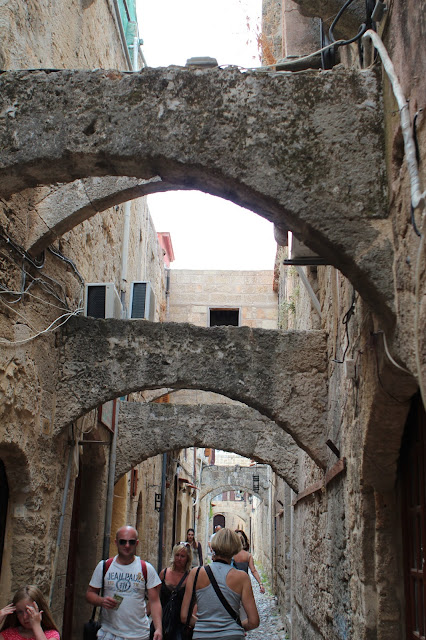
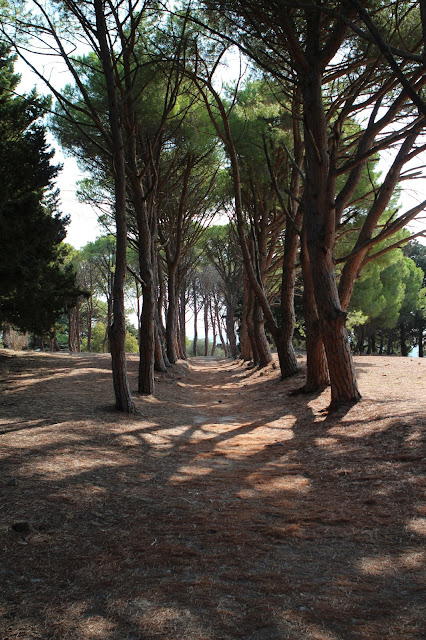
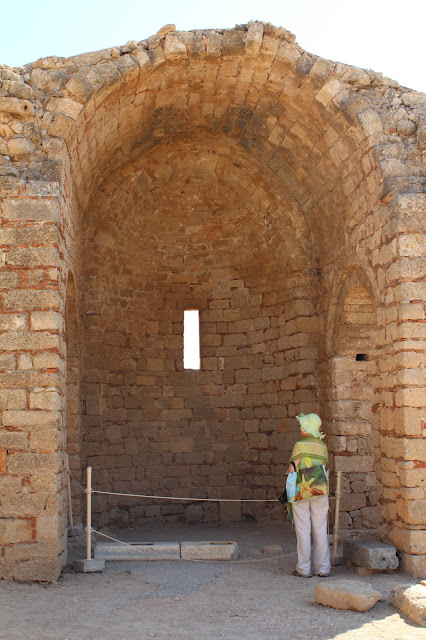
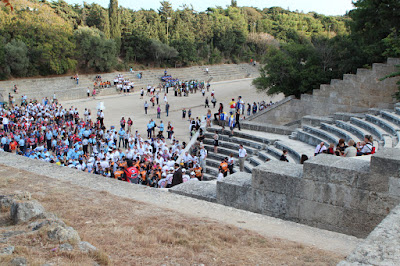
Terah and I went to the Greek island Rhodes recently. This is the second in a series about it. I am one to enjoy history. There is something deeply, well, connecting, about standing in an old place. There is a timeless quality to it a feeling of being connected to so many people of the past, and yet still being connected to change, visible in things such as weathering of stones. To gaze at pottery that s 300 years old, walk past 700-year-old walls, or pass through what remains of the grand portico of an ancient temple to Athena stirs a feeling I can barely explain, of timelessness. Although Rhodes doesn t have the famous Greek sites such as the Parthenon or Delphi, I can t help but wonder why the Rhodes sites aren t better known. They were incredible and it is hard to condense all that we saw into a short blog post. I have to start with the medieval Rhodes Old Town. We got off the bus a few blocks from it one bright morning, and our first task was to find a gate across the moat. Oh yes, A GATE ACROSS THE MOAT. It s a dry moat, and that bridge off in the distance is the gate we were headed to. Outside of the outer wall is a nice quiet walking area. The moat and walls completely surround Old Town and, for the most part, date back about 500 years. The round stones you see on that picture, we were told, were likely surplus from catapults and other projectile weapons. Cross one line of walls and you come to another, with original canons still present. The Knights Hospitaller of St. John, which held Rhodes for a few centuries until the Ottomans captured it, sure knew how to build to impress. The gate we happened to use was Amboise, the Grand Master s Gate. Right there is the stunningly rebuilt landmark Palace of the Grand Master. It is absolutely impossible for any photograph to begin to do this building justice. Between its imported Greek and Roman floors, to the grand nature of everything in it, and the archaeological museum in one corner, it was a fitting start to a visit to Old Town. Here s one of the main staircases. Just near the Palace is quiet courtyard with an old door. Pass through that door and suddenly you re in the midst of the busy Old Town. And among the landmarks in Old Town, the most prominent is Ippoton, the Avenue of the Knights. Along this avenue are the buildings built by the various nationalities of knights, many of which are historical sites in their own. Taken together, it is quite clear why Rhodes is said to be one of the world s best-preserved medieval cities. Down at the other end of Ippoton is the Knights Hospital, which is now part of the archaeological museum. Step off the Avenue a few blocks and you get to some quieter narrow streets just as old, in many cases. On Sunday morning, we were able to visit Mount Filerimos. In contrast to the busy Rhodes, Filerimos had an air of quiet and still to it. It was the site of a monastery, two historic churches, and a landmark Italian cross on the mountaintop. We arrived, and begin our visit with a walk up the quiet stone path. When we got to the top, we walked past this peaceful church. As we walked past the outside, we heard the beautiful music of chant from indoors. We got to step in and listen to mass for a few minutes. In typical fashion, directly in front of the church are two much older sites: one, the ruins of a temple to Athena, and the other a 4th-century Christian bapistery. Rhodes is a popular tourist destination, and of course we saw plenty of popular sites (such as the grandmaster s palace). Filerimos had a few tourists too, but not as many. I frequently like to operate on the plan of going wherever all the tourists aren t. And so, on Filerimos, that meant seeing what was behind the monastery. It started with this peaceful tree-lined path. And the deserted, but intentionally open, gate led to the remains of a Byzantine fortress, which had been a staging area for both the Knights and the Ottomans before their campaigns to capture Rhodes. It also provided incredible views of the surrounding countryside. The first historic site we had visited on our trip was the Acropolis of Lindos, parts of which are 2300 years old. Here s a view of the mountain from the rooftop of the Kalypso, our favorite restaurant in Lindos. The columns of the temple to Athena Lindia are visible, and of course so are the walls. The road up to the acropolis is accessible only on foot or by donkey. It is apparently the only road that has ever been used to get to the acropolis. Here is the partially-restored grand portico to the temple. There s an old Christian church (4th century, if memory serves) at the Acropolis too. The Acropolis makes some pretty good use of natural defenses too. Here s a view from one level of it. There s a manmade wall up there at the very top. And, of course, the beautiful Aegean always in the background. There are lots of cats on Rhodes. Here is a kitten napping at the top of the Lindos Acropolis: Lindos itself is a beautiful town. Here s one of the quieter streets: Notice the pebble steps leading into the houses those intricate pieces of artwork are all over. This post won t be complete without the story of our visit to the Acropolis of Rhodes. We walked there from Old Town. At the Acropolis, there are the remains of a temple to Apollo, an ancient theater, and an ancient stadium where qualifying matches for the Olympics were held. As we got closer to the area, we were repeatedly passed by people dressed in uniforms of various types. And as we got there, we joined a stream of people entering the area. The ancient stadium had apparently thousands of people in it, country names were being read off over the loudspeakers, policemen wielding machine guns were standing by, and we had absolutely no idea what was going on. At this point, you can appreciate the difference between Terah and me. Terah thought that we have no idea what is happening, she was tired from the walk, and so thought we should just leave. I thought that we have no idea what is happening, which is a great reason to stay. So Terah opted to sit and read a bit under some trees while I explored. Here s a view of the stadium as it was emptying out, seen from the theater: I explored the temple and theater, and eventually we were ready to head back. We knew there was a bus back to the New Market (from where we could get a bus back to our hotel), but didn t know where the bus stop was. The obvious place to ask were the policemen, which I thought I would do. Terah thought she would just stay sitting under the trees, on the grounds that the policemen nearest us were all carrying machine guns and perhaps wouldn t like to be disturbed. This led to my cryptic tweet:

Only ONE of us is the kind of person that goes up to guys with machine guns to ask what s happening. Me to Terah today
They told me that it was the preparations for the opening ceremony for a global shooting contest, and also gave me directions to the bus stop.

11 October 2011

Thomas Koch: Gemeinsam f r globalen Wandel

english abstract: call to assembly on October 15th in Constance (Germany).

ATTAC Konstanz und www.echte-demokratie-jetzt.de laden ein zur Versammlung "Gemeinsam f r globalen Wandel" am 15. Oktober 2011 um 15:10 Uhr auf die Marktst tte (in Bankenn he)
  • United for global change
  • Wir sind die 99%!
  • Wir zahlen nicht f r Eure Krise!
  • Echte Demokratie jetzt!
Weltweit gehen an diesem Tag Menschen auf die Stra e, um dar ber ins Gespr ch zu kommen, in welcher Gesellschaft sie leben wollen. Mit ihnen gemeinsam emp ren wir uns dar ber, dass heute die Interessen von Banken und Konzernen vielfach ber die Interessen der Menschen gestellt werden, und die Kluft zwischen Arm und Reich immer gr er wird. Wir sehen uns durch Politik und Wirtschaft nicht mehr repr sentiert und wollen selbst f r grundlegende Ver nderungen eintreten. Wir engagieren uns f r neue Wege aus der Krise, jenseits von Parteien, Gewerkschaften und anderen Gruppeninteressen.Dar ber wollen wir auch in Konstanz auf der Marktst tte miteinander reden. Zur Information, wie sich Menschen in anderen L ndern f r ihre Anliegen einsetzen, wird es einen Informationsstand ber die Protestbewegungen in Spanien, Griechenland, Israel, Chile und den USA geben.Weitere Informationen:

Russell Coker: Akonadi on a MySQL Server

Wouter described how to get Akonadi (the back-end for KDE PIM) to use PostgreSQL [1]. I don t agree with his MySQL is a toy sentiment. But inspired by his post I decided to convert some of my systems to use a MySQL instance running on a server instead of one instance for each user. In the default configuration you have 140M of disk space and 200M of RAM used by each user for a private MySQL installation which has about 24K of data (at least at the moment on systems I run, maybe more in future). Here s some pseudo shell script to dump the database and get a new config: mysqldump socket=$HOME/.local/share/akonadi/socket-$HOSTNAME/mysql.socket akonadi > dump.sql
akonadictl stop
rm -rf .config/akonadi
rm -rf .local/share/akonadi
mkdir .config/akonadi
cat > .config/akonadi/akonadiserverrc <<EOF
[%General]
Driver=QMYSQL
SizeThreshold=4096
ExternalPayload=false

[QMYSQL]
Name=$USER_akonadi
Host=IP_OR_HOST
User=$USER
Password=$PASS
StartServer=false
Options=
ServerPath=/usr/sbin/mysqld

[Debug]
Tracer=null
EOF Then with DBA privs you need to run the following in the mysql client: create database $USER_akonadi;
GRANT ALL PRIVILEGES ON $USER_akonadi.* to $USER @'% IDENTIFIED BY $PASS ; Then run the following to import the SQL data: mysql $USER_akonadi < dump.sql Ideally that would be it, but on my test installation (Debian/Squeeze MySQL server and Debian/Unstable KDE workstations) I needed to run the following SQL commands to deal with some sort of case problem.
rename table schemaversiontable to SchemaVersionTable;
rename table resourcetable to ResourceTable;
rename table collectionattributetable to CollectionAttributeTable;
rename table collectionmimetyperelation to CollectionMimeTypeRelation;
rename table collectionpimitemrelation to CollectionPimItemRelation;
rename table collectiontable to CollectionTable;
rename table flagtable to FlagTable;
rename table mimetypetable to MimeTypeTable;
rename table parttable to PartTable;
rename table pimitemflagrelation to PimItemFlagRelation;
rename table pimitemtable to PimItemTable; I am not using any PIM features other than the AddressBook (which hasn t been working well for a while), so I m not sure that this is working correctly. But I would prefer that something I don t use and is probably broken take up disk space and RAM on a server instead of a workstation anyway.

10 October 2011

Vincent Bernat: SSL termination: stunnel, nginx & stud, round 2

A month ago, I published an article on the compared performances of stunnel, nginx and stud as SSL terminators. The conclusion was to use stud on a 64-bit system, with session caching and AES. stunnel was unable to scale properly and nginx exhibited important latency issues. I got constructive comments on many aspects. Therefore, here is the second round. The protagonists are the same but both the conditions and the conclusions have changed a bit.

Benchmarks The hardware platform remains unchanged: We focus on the following environment:
  • Ubuntu Lucid, featuring a patched version of OpenSSL 0.9.8k with AES-NI builtin and enabled by default
  • 2.6.39 kernel (250 HZ)
  • 64-bit
  • 1 core for HAProxy, 2 cores for network cards1, 4 cores for SSL, 1 core for the system
  • system limit of 100,000 file descriptors per process
On the SSL side, the main components are:
  • 2048-bit certificates
  • AES128-SHA cipher suite
  • 8 HTTP/1.0 requests per client
  • HTTP response payload of 1024 bytes
If you are interested in different conditions (32-bit, number of cores, 1024-bit certificates, proportion of session reuses), have a look at the previous article whose results on the matter are still valid. I only consider 2048-bit certificates because most certificates issued today are 2048-bit. In SP800-57, NIST advises that 1024-bit RSA keys will no longer be viable after 2010 and advises moving to 2048-bit RSA keys:
If information is initially signed in 2009 and needs to remain secure for a maximum of ten years (i.e., from 2009 to 2019), a 1024-bit RSA key would not provide sufficient protection between 2011 and 2019 and, therefore, it is not recommended that 1024-bit RSA be used in this case.
And the protagonists are: UPDATED: Configuration of nginx has been updated to switch to off both multi_accept and accept_mutex thanks to the feedback of Maxim Dounin on latency issues that were present in the previous article (and still present in the early version of this article). HAProxy (configuration) is used for stunnel and stud to add load-balancing. For each test, we want to maximize the number of HTTP transactions per second (TPS) while minimizing latency and unsucessful transactions. The maximum number of allowed failed transactions is set at 1 transaction out of 1000. The maximum allowed average latency is 100 ms2.

Control case Below is the first comparison between stud, nginx and stunnel on plain Ubuntu Lucid. Like in previous benchs, stunnel is not able to scale, with a maximum of 400 TPS. However, early latency issues of nginx has been solved, thanks to the change in configuration. stud and nginx gets similar performance but, as you can see on the bottom plot (whose scale is logarithmic) stud starts with an initial latency of 40 ms. This is pretty annoying. I have tried some micro optimization to solve this issue but without luck. If latency matters for you, stick with stunnel or nginx (or find where the problem lies in stud). UPDATED: After reporting this issue, a fix has been commited. The culprit was Nagle s algorithm which improves bandwidth at the expense of latency. With the fix, performances are mostly the same but there is no latency penalty any more. stud, nginx, stunnel on Ubuntu Lucid

OpenSSL 1.0.0e When I published the first round of benchmarks, Micha Trojnara was dubious about the bad results of stunnel. He told me on Twitter:
I solved it! You compiled stunnel against a 4 years old OpenSSL with MT-unsafe SSL_accept. Upgrade OpenSSL and rebuild stunnel. This bug was fixed in OpenSSL 1.0.0b. I implemented a (slow) workaround, so stunnel doesn t crash with earlier versions of OpenSSL.
Therefore, I backported Ubuntu Oneiric OpenSSL 1.0.0e to Ubuntu Lucid3 and, as you can see yourself on the plot below, there is a huge performance boost for stunnel: about 400%! stud features a slight improvement too (about 8%) but still starts with a latency of 40 ms while nginx does not improve. stud, nginx, stunnel with OpenSSL 1.0.0e

Intel Accelerator Engine Most Linux distributions are still using OpenSSL 0.9.8. For example, Debian Squeeze ships with OpenSSL 0.9.8o, Ubuntu Lucid with 0.9.8k and RHEL 5.7 with 0.9.8e. Therefore, they are not eligible to recent performance improvements. To solve this, Intel released Intel Accelerator Engine, which also brings, among other things, AES-NI support:
This is essentially a collection of assembler modules from development OpenSSL branch, packed together as a standalone engine. Standalone means that it can be compiled outside OpenSSL source tree without patching the latter. Idea is to provide a way to utilize new code in already released OpenSSL versions constrained by support and release policies limiting their evolvement to genuine bug fixes.
Alas, in my tests, there was no improvement compared to OpenSSL 1.0.0e (already patched with AES-NI support). stunnel comes with out-of-the-box support for additional engines. Just add something like this to your stunnel.conf:
engine=dynamic
engineCtrl=SO_PATH:/WOO/intel-accel-1.4/libintel-accel.so
engineCtrl=ID:intel-accel
engineCtrl=LIST_ADD:1
engineCtrl=LOAD
engineCtrl=INIT
For stud, you should grab support for engine selection from GitHub and for nginx, just specify the engine with ssl_engine.

Intel Performance Primitives In his great article Accelerated SSL , Simon Kuhn shows huge performance improvements by using Intel s IPP library, a library aimed at leveraging power of multi-core processors and including some cryptographic primitives and a patch to make use of them in OpenSSL. Unfortunately, this library is not free, not even as in free beer . The patch provided by Intel only applies on OpenSSL 0.9.8j. Simon updated it for OpenSSL 1.0.0d. It also applies with a slight modification to OpenSSL 1.0.0e. Look at Simon s article for instructions on how to compile OpenSSL with IPP. Simon measured 220% improvement on RSA 1024-bit private key operations by using this library. Unfortunately, we don t get such a performance burst with stud which exhibits a 15% improvement (but remember that private key operations only happen once every 8 transactions thanks to session reuse). Worst, with stunnel, performances are reduced by one third and nginx just segfaults. I think such a library is risky to use in production. stud and stunnel with IPP

Hyperthreading During the previous tests, only half the capacity of each core were used. For stud, adding more workers per core only slightly improves this situation (less than 10% with 4 workers per core). Therefore, I thought using hyperthreading could rectify the situation here. In this case, stud, stunnel and nginx are allocated 8 virtual cores instead of 4. stud only got a small improvement of 5%, nginx a moderate improvement of 11% while stunnel got a significant improvement of 26%. stud, stunnel and nginx with hyperthreading

Conclusion Here is a quick recap of the maximum TPS reached on each tests (while keeping average response time below 100 ms). All tests were run on 4 physical cores with 2048-bit certificates, AES128-SHA cipher suite. Each client makes 8 HTTP requests and reuse the first SSL session.
Context nginx 1.1.4 stunnel 4.44 stud @e207dbc5a3
OpenSSL 0.9.8k 1489 TPS 400 TPS 1492 TPS
OpenSSL 1.0.0e 1501 TPS 1561 TPS 1609 TPS
OpenSSL 1.0.0e + IPP - 1101 TPS 1857 TPS
OpenSSL 1.0.0e + HT 1718 TPS 1973 TPS 1694 TPS
I also would like to stress that below 1500 TPS, stunnel adds an overhead of a few milliseconds while stud adds 40 milliseconds. With OpenSSL 1.0.0e and hyperthreading enabled, stunnel has both good performance and low latency on low loads to moderate loads. You may just want to limit the number of allowed connections to avoid collapsing on high loads. While in the previous round, stud was the champion and stunnel lagged behind, the situation is now reversed : stunnel is on top! UPDATED: As said earlier, the latency issue with stud has been solved. Performances remain mostly the same.

  1. HAProxy and network cards don t need dedicated core for this kind of load. However, if you also want to handle non SSL traffic, those dedicated cores can get busy.
  2. The real condition is more complex. Each point is considered valid if the corresponding average latency is less than 100 ms or if the average on the next 8 points is less than 100 ms. Temporary latency bursts are therefore allowed. We are not so forgiveful with failed transactions.
  3. This is pretty straighforward: I just dropped multiarch support. I chose to use Ubuntu version of OpenSSL instead of upstream because there are some interesting patches, like automatic support of AES-NI.

9 October 2011

Gregor Herrmann: RC bugs 2011/40

another week, another list of fixed RC bugs, again most of them with patches from ubuntu. &, as zack said today, the next freeze is not really imminent but it's getter closer.

2 October 2011

Jose Luis Rivas Contreras: Moving from Screen to Tmux

I ve been a long-time user of GNU Screen, as almost every person I know that spend a lot of time in a terminal. I must admit I was happy, I really was. I was used to my workflow with 4 terminals 8 25 and a bunch of screens, with several nested-screens. I used awesome-wm before, so definitely I felt I wasn t using all the space in my laptop screen (my laptop is a ThinkPad X61, so 1024 768 in a 12 inches-screen) but that was OK, after all my workflow was, well, good. Until 2 days ago, I was told to try tmux, in fact, I was told and why are you using screen? use tmux . As a daily-user of Screen my first reaction was I m used to , I can use it as I want , and a lot of excuses for just not trying something new. But then I made a little research (on Google, of course). In about 30 minutes I ended up with a multiplexer working as I wanted and as I never got Screen to work. Finally I was using just a terminal and using all the space available in my tiny-laptop-screen and plus: saving a lot of bandwidth with my permanent SSH connection (a really big plus now that I m living with a capped link to the net with a GSM-modem). I changed the Ctrl-b shortcut to Ctrl-a (b is too far for using it with only one hand), configured so I could use nested tmux es like screen when I push Ctrl-a a, activated visual monitoring and even got to use the tmux s buffer along with my X11 buffer when I press Ctrl-a >!! It s all in my ~/.tmux.conf, use it at will. Later I will make a screencast about using tmux, so more people can get a working tmux easily. ATM, I m even more happy than I was with GNU Screen, so, any other recommendation, people?

Gregor Herrmann: RC bugs 2011/39

another weekly report about RC bugs I've fixed, this time mostly by applying patches from ubuntu:

1 October 2011

Sergio Talens-Oliag: Static website generators

The last month I was supposed to work on a OpenStack related project, but for administrative reasons it has been delayed and I've tried to do small tasks to be able to finish them quickly and start the work on the main project when the issues get solved. As the delay has been longer than expected last Wednesday I've realized than on the last weeks I did a lot of small system administration tasks: With all the changes I did I noticed that I had to do something with our Intranet server; it is just a reverse proxy for a lot of different web services and its main page was one static HTML page with links to them, nothing else. In the long term maybe we will replace it with something based on Drupal or Lifeay, but for now I just wanted something to be able to organize the links and provide some information about the services for the new users without having to write HTML (I really like Agile Documentation Tools that let me focus on the content and forget about the markup), and started to look at some of them. My first idea was to use ikiwiki, as it has all the features I was looking for: I can use Markdown or reStructuredText to write the contents, the source pages are easily handled on a Version Control System, it supports the use of templates for the HTML, etc., but it seemed to me that using ikiwiki was like killing flies with a cannon (that's a Spanish say, I guess it's easy to understand it in English, no?) and I decided to review other tools to build static web sites. To make a long story short, I selected some tools that met my requirements and looked nice on their demo sites; after my first review I thought that Hyde was going to be my bet, as it uses technologies I'm already familiar with, but after trying it I saw that I was going to have a problem with documentation (the current Hyde version lacks it) and it was going to be more complicated that using ikiwiki. Before giving up I decided to review simpler tools, just in case, and after looking some of them I ended up using poole, a simple python script (the source is just one file and it only requires python-markdown to work). Before moving to the content I tried to adapt a couple of free themes to be used by the tool, but I didn't liked the result, so I went back to the plain style provided by the tool and added a logo and a background. With that simple look and feel I started to work with the content, splitting it into eight markdown files and a python macro to include a file that has all the links used on the site. While trying to make the main page look good I noticed how little I know about CSS, but using search engines I was able to build a two column block into the main page and publish the contents and with the help of some CSS enabled co-workers I changed the look and feel of the site in about 30 minutes. In summary, if you want a really simple website, you know a little bit of python and don't want to spend much time learning how to use a website generator then Poole is a good option. If you want something more complex I still think that ikiwiki is a good option, but YMMV.

Next.

Previous.
