Search Results: "sf"

3 February 2011

Pietro Abate: Package Managers Comparison

The Mancoosi Team has recently published the details of a study we conducted analyzing different packages managers available in debian. The goal of this study was to compare MPM (the mancoosi package manager) to other legacy solvers and try to get a big picture regarding of the state of the art. A similar study was conduct during EDOS and the results are still available here. As I wrote few months ago, MPM is a proof of concept that we wrote to test the behavior of a number of solvers that have been developed for the MISC competition in a real world scenario. These results do not show anything new w.r.t. the experience of a lot of poeple dueling daily with their machines in order to install a new piece of software. In a nutshell, we have shown that apt-get, aptitude, smart and cupt perform pretty well when used only with one baseline (for example a stable release) : this conforms with the experience of the majority of users of debian based systems. However problems start to arise when a user start mixing more then one baseline putting a lot of stress on the solver in order to find a satisfying solution. This solution of course exists, but it is cleverly hidden in the dependency structure of more then 40K packages... MPM is not as fast as other package solvers (say 10 seconds for mpm, while apt-get is able to find a solution in 3 second), but is remarkably stable. It is always able to find a satisfying solution, even in the harder cases where all the other failed. In these experiments MPM uses the postdam solver aspcud. This solver uses only GPL components and it would be a good candidate for inclusion in debian (there are actually a couple of ITP already filled for clasp and gringo). The results (with a lot of details) are published on the mancoosi website (a more detailed report is in the works). Enjoy ! During fosdem the Mancoosi team that authored this work (Roberto, Ralf, Zack and Me) will be around, so, please stop us for a chat ! And don't miss Ralf's talk !!

1 February 2011

Ana Beatriz Guerrero Lopez: Debian at the Google Code-in 2010-11

As you might know, Debian was one of the 20 organizations selected to participate in the first Google Code-in. We got a moderate success since we started preparing the contest very late (I joined as mentor/admin the very first day of the contest!). Because of this, unlike other organizations, we did not manage to engage interested students from the very beginning of the Code-in. Since we did not have too many Debian tasks the first days, we did not attract many students, and thus did not have very many throughout the contest. Given Debian tasks were mostly about improving and contributing to Debian, it was quite hard having tasks that did not require having a Debian installation and that made it difficult for many students to get involved. Also, until the last two weeks we did not have any translation task that could have attracted earlier students without too much confidence in their technical and English skills. Nonetheless, Debian got 39 tasks done: With about 30 students participating and at least one of the students has keep contributing to Debian after the contest! The contest was sometimes stressful with several students wanting their tasks to be reviewed at the same time, and the date was problematic due to the winter (or summer!) holidays but still I am quite happy with the final result :D Debian will be also participating again this year in the Google Summer of Code 2011. Join the soc-coordination mailing list and stay tunned if you want to participate as mentor or student.

Cyril Brulebois: Debian XSF News #3

Time for a third Debian XSF News issue! Debian XSF News #3 It s been a year On a personal note, it s been a year to the day since I first looked into X. After having hacked on the Debian Installer to make it use X.Org instead of DirectFB, I did some heavy bug triaging, resulting in a drop in the xorg-server bug count in March. The same happened past week as written above, resulting in a second drop. In the meanwhile, the bug count remained more or less stable, since we try to reply quickly to new bugs, and since Julien Viard de Galbert does bug triaging on a weekly basis: BTS graph for xorg-server One might ask: what does maintaining X mean?

31 January 2011

Stefano Zacchiroli: who the bloody hell cares about Debian

A down-under talk on the role of Debian, A.D. 2011 I'm back from LCA 2011, which I've attended to share some thoughts about the role that Debian plays in the Free Software ecosystem, 18 years after its inception (yes, we are that old^Welder). The talk title---Who the bloody hell cares about Debian? [1]---was meant to be rather provocative. The idea was indeed to challenge the meme that, in the era of distributions that release every 6 months, a distribution with a release cycle of circa 2 years (like Debian, considering the past 5 years) is not a project that deserves your attention anymore. Is it really the case? In the talk I (obviously) claim it is not, using two main arguments. The first argument is based on the observation that Debian offers a set of pretty rare, if not unique, features among mainstream FOSS distributions. Those features consist of a mix of technical and "political" aspects: (1) a focus on package quality, with no distinction among first and second class packages; (2) a strong culture of software freedom, which refuses to offer non-free software (or firmware) by default to users and distribution developers (as parts of the infrastructure used to make Debian); (3) independence from commercial interests, with no single company or entity that could claim to babysit Debian; and (4) a decision making model based on a weighted sum of do-ocracy and democracy, which implies that by doing (rather than talking) everyone has a chance to have an impact on Debian. Considering all that and looking at the most popular FOSS distributions, one can easily identify Debian as one of the few remaining players who both care about Free Software and can be trusted in making choices not driven by profit. Mind you, I've nothing against companies in general and I'm very well aware that many FOSS companies carry a good deal of the burden of developing and promoting Free Software. Nonetheless, in days in which it is striking how quickly FOSS-friendly companies can become very much FOSS-unfriendly, I can't help putting my trust and efforts into community-driven projects, better if with no attached company label whatsoever. Furthermore, having distributions like Debian around can encourage other company-backed distributions to demand more and more independence and clarifications about the relationships between the community and the backing company. The second argument about the relevance of Debian is more pragmatic and rather straightforward: Debian is the root of a huge tree of derived-distribution (AKA "derivatives"), more than 120 according to popular distribution indexing sites. Each Debian derivative focuses its attention on, and directs its people power to, customizing Debian for a specific target and build entierly upon Debian work for all parts that do not need customization. That possibility is one key advantage of Free Software, after all. A well-known derivative example is Ubuntu, which is probably the most popular Debian derivative, enjoying a user base way larger than that of Debian itself. Ubuntu is heavily customized with respect to Debian and still had only about (at the time of Natty) 25% of packages which either differed from their Debian counterparts or that did not exist in Debian at all. Other Debian derivatives tend to be way less customized than that. Either way, if you are running a Debian derivative, chances are that you heavily depend on Debian and on its well-being. (Yes, it is so also if you didn't know about that, sorry.) Let's now fast-forward to the end of the talk, skipping my usual comments on how to keep the whole tree of Debian derivatives sustainable and beneficial for Free Software as a whole (i.e. by reducing as much as possible the viscosity of patch flow along the derivatives tree). Feedback People's reaction to such a provocative talk has been positive and we have enjoyed a fairly long Q&A session discussing the topics mentioned above as well as other Debian-related topics. A (commented) summary of the obtained feedback is reported below. Judging from the recurrent questions and suggestions I've received doing Debian talks in the past 8 months, I dare to say that LCA feedback is fairly representative of the feelings of many Debian users. Slides of the talk are available, while a video will eventually be posted at http://linuxconfau.blip.tv.
[1] Kudos to Francois Marier for suggesting the title. If the title doesn't ring a bell for you (it didn't for me in the beginning), you might want to check out the story of this ad. Update: minor rephrasing in the 4th paragraph

Michael Banck: 31 Jan 2011

Debian Med Bioinformatics Sprint Last weekend, I was at the Debian Med Meeting in Travem nde near L beck, thanks to an invitation by Steffen M ller and Andreas Tille. It was a great opportunity to finally meet Steffen and some of the other bioinformatics people in Debian like Manuel Prinz face-to-face for the first time. Also, lots of upstream and related bioinformatics packagers from e.g. Biolinux were present as well, many of them from the UK. I discussed with and helped some people about Debian packaging. There is a big push to get Debian packages done and integrated in Debian and Ubuntu, but often enough people are not exactly sure what the requirements are and what needs to be done. Hopefully, the sprint was successful to clear things up and move forward. I also managed to finalize the initial Jmol packaging and uploaded it to Debian towards the end of the sprint. I plan to update the other bioinformatics related packages in debichem like pymol and openbabel as soon as squeeze is released. Overall, it was a great weekend, many thanks to NERC and Debian for making it possible, and to Steffen M ller for organizing it!

John Sullivan: Churchill Club Panel Discussion on Software Patents

My FSF colleague Brett Smith and I will be making the case against software patents on a panel at the Churchill Club in Mountain View, CA, the evening of February 16th. Hope to see End Software Patents supporters in the audience! More information: Churchill Club Panel Discussion on Software Patents Free Software Foundation working together for free software

30 January 2011

Dominique Dumont: How to configure OpenSsh through a virtual filesystem

Hello My blog How about a configfs with Config::Model ? mentioned the on-going work to provide an access to configuration data through a virtual file system , i.e. through fuse. This new feature is now working since Config::Model 1.231. As an example, let s see how Fuse can be used to your ssh client. I.e. how to use config-edit command to modify your ~/.ssh/config through a virtual file system. Note that this is just an example, Fuse can also be used for other configuration withan existing model. First, you need to install Config::Model and Fuse and the fuse software. If you re on Debian/Sid, installing all this is straightforward:
$ sudo aptitude install libconfig-model-perl libfuse-perl
On other systems, you can use CPAN to install the Perl modules
$ cpanp i Fuse
$ cpanp i Config::Model
Hopefully, fuse library will be available through a package on your favorite repository. Let s start from an empty ssh configuration file. First you need to create a directory that will be used by Fuse as a mount point:
$ mkdir my_fuse_dir
Then run config-edit-ssh (which will be changed later to config-edit -applit ssh ):
$ config-edit-ssh -ui fuse -fuse_dir my_fuse_dir
Mounting config on my_fuse_dir in background.
Use command fusermount -u my_fuse_dir to unmount
Now, all parameters that can be configured in /.ssh/config are shown as files and directories in the fuse directory (the list was reduced to save electrons):
$ tree my_fuse_dir/
my_fuse_dir/
AddressFamily
BatchMode
BindAddress
ForwardX11
ForwardX11Trusted
[snip]
HashKnownHosts
Host
*
ConnectionAttempts
[snip]
User
UserKnownHostsFile
VerifyHostKeyDNS
VisualHostKey
XAuthLocation
HostbasedAuthentication
HostKeyAlgorithms
[snip] 14 directories, 119 files
Let s say that we want to configure specific settings for 2 hosts: First step is to create the repoman entry:
$ mkdir my_fuse_dir/Host/repoman
A ls command in that new directory will show a lot of files:
$ ls my_fuse_dir/Host/repoman
IdentityFile Protocol Tunnel
CheckHostIP ForwardX11 KbdInteractiveAuthentication ProxyCommand TunnelDevice
Lo and behold, one of them is ForwardX11 ! Let s check what s in there:
$ cat my_fuse_dir/Host/repoman/ForwardX11
Since the entry is new, it s still empty. Enabling X11Forward for repoman is quite easy:
$ echo 1 > my_fuse_dir/Host/repoman/ForwardX11
Let s check:
$ cat my_fuse_dir/Host/repoman/ForwardX11
1
Now, unmount the fuse directory:
$ fusermount -u my_fuse_dir
And see the modified .ssh/config file:
$ cat ~/.ssh/config
Host repoman
ForwardX11 yes
You can see that ForwardX11 is indeed set to yes for host repoman. Last but not least, you may consider that handling files and directories through shell commands is not very easy for the end user. You re right. But that s not the point. The idea is to enable programmers to access and edit configuration data with any language (not only Perl). Just like a lot of program can access kernel data through /proc and /sys, configuration data can now be accessed in a unified way through this virtual file system. May be, one day, exploring /config will be as common as exploring /sys All the best

Russell Coker: P2P Car Sharing Etc

Rachel Botsman gave an interesting TED talk about Collaborative Consumption, various ways of sharing and redistributing objects to save money and reduce their environmental impact [1]. It s a pity that there isn t something like swap.com in Australia.P2P Car RentalAmong other things she mentioned P2P car rentals. The first company she listed is Drive My Car (link to the Australian site) [2] which has a good range of vehicles. They charge 16.5% as an admin fee, the rest is paid to the owner. Strangely they have a web page to estimate what you can get for your vehicle, but the rates that are returned by that page seem to be a lot lower than what cars are actually advertised for (I guess that the owner can ignore the recommendation and charge whatever they want). They deal in daily rentals and the owner may specify a minimum period 4 days seems common. There are no changes needed to the car and the car owner only has to pay $25 per annum to be listed.Relay Rides operates in Boston and San Francisco [3], they operate on a per-hour basis and require some sort of RFID unlocking device to be added to each car. The normal setup fee for a car owner is $250 but they currently have a promotion that waives that fee.Get Around is a beta service that presumably operates only in the US (they seem US centric and don t specify locations) [4]. They appear to offer per-hour rentals and require hardware to unlock the car. It seems that to get most of the useful information (prices etc) you need to sign up which is a mistake on their part.Whip Car advertises their service on a supposed relationship between the car owner and the renter [5], I ve met the people who live in about 10 houses of the 50 in my street, so if a random person in my street offered a car for rent then there would be a 80% chance that I don t know them but I guess if one of my neighbors had a car to rent at a low price I might be more inclined to get to know them. The information page says that drivers must have a UK driving licence which implies that they only operate in the UK. Why don t these people state clearly on their web site the country that they service? Their business model seems interesting, I can imagine a few people who live near each other pooling funds to buy a vehicle and then using Whip Car to control reservations and manage sharing the costs.P2P Rental of Other ThingsA logical extension of the Whip Car concept is to have a service which only mediates sharing between trusted parties. It would have a web site that manages bookings including issues such as the minimum time between bookings, charges a flat fee per item that is managed, and then gives a summary to all parties of what the use was. Ideally it would allow for bidding for peak times. This could work for cars, computers, cameras, holiday homes, or anything else which can usefully be transferred between different users.

28 January 2011

Axel Beckert: Cool new feature in OpenSSH 5.7: scp between two remote hosts

Just a few days after OpenSSH 5.7 was released upstream, our (Debian s as well as Ubuntu s) tireless OpenSSH and GRUB maintainer Colin Watson uploaded a first package of OpenSSH 5.7 to Ubuntu Natty and to Debian Experimental. Besides the obvious new thing, the implementation of Elliptic Curve Cryptography which promises better speed and shorter keys while staying at the same level of security, one other item of his changelog entry stuck out and caught my attention: That s something I always wondered why it didn t just work . While it still doesn t seem to detect such a situation by default, it s now at least possible to copy stuff from on remote box to another without ugly port forwarding and tunneling hacks. Further cool stuff in the changelog: Colin++

25 January 2011

Benjamin Mako Hill: Annual Free Software Foundation Fundraiser

<script type="text/javascript"> var fsf_widget_text = "Help protect your freedom!"; var fsf_widget_d_btn = "Donate"; var fsf_widget_share = "Share this widget."; var fsf_widget_size = "normal"; var fsf_associate_id = "3427"; </script> <script src="http://gplv3.fsf.org/static/widget/widget.js" type="text/javascript"></script>
The Free Software Foundation is in the last week of its annual fundraiser and has still has a bit of ground to make up. The FSF needs members and donations to merely sustain its basic activity protecting free software and engaging in minimal outreach. So as I've done in the last couple years, I've written a fundraising appeal for the organization. That why today my face is plastered, Jimmy Wales style, all over the FSF website. (For the record, the last bit was not my idea and I find it a little embarrassing.) My appeal this year begins with my feeling that as our lives become increasingly mediated by technology, the question of who controls technology becomes another way of asking "Who controls us?" Read the appeal for more. That statement, like much of the FSF's work, is not going to get very far with most users today. Most people don't think of technology as the source of control, power, or autonomy. They don't understand why software should be free or even what that might mean. Making this argument widely is something the FSF works hard to do. But supporting this work is a bit of a chicken-egg problem. The users we most need to reach have never heard our message and it can take some time to turn even the most receptive into supporters. For those of us that do care about technology and the power it has over its users, it's hugely important that we take action to support software freedom and organizations like the FSF that play a key place in this struggle. If we don't, nobody else will. The pool of people who might support the FSF today is small -- there are currently about 3,000 members -- but the stakes are huge: A choice between a world of DRM, locked down mobile phones, and non-free network services on one hand, and the possibility of a world where there are free alternatives on the other. The FSF won't win this fight alone, but it plays a critical role in it. The FSF is a small, humble, and responsible non-profit and a little money can have a big impact. If you are not an FSF associate member, now would be a great time to join. Membership is $120 per year ($60 for students) and payable monthly. In preparing this appeal, I realized that my membership had lapsed a couple months ago and that my partner Mika was still donating at the reduced student price. We've personally fixed both these things and made an addition donation. If you are a member, you can check your status or make a donation. If you are not yet, Please consider joining us.

23 January 2011

Dirk Eddelbuettel: CRANberries is now tweeting

The CRANberries service (which reports on new and updated CRAN packages for the R language and environment) is now tweeting about new packages. Simply follow @CRANberriesFeed to receive theses messages. For the technically minded, adding this to the existing 200-line program which runs all of CRANberries was very easy. CRANberries relies only on R itself and a few Unix tools like diffstat as well as the simple blosxom txt-to-html/rss 'blog compiler'. The tweeting itself is now done by this new function
tweetNewBlogEntry <- function(curPkg, curVer, reposurl)  
    ## tests reveal that pipe(), cat(), close() is easiest
    ## to send multiple messages, may need --background option
    con <- pipe("bti --config bti.conf", "w")
    cat("New CRAN package", curPkg, "with initial version", curVer, " http://goo.gl/pgljT\n", file=con)
    close(con)
 
which simply pipes the message in Greg KH's bti program (which is now a new dependency). Special thanks to its Debian maintainer Gregor Herrmann for some helpful emails; I am using the newest release 0.29 which itself needs liboauth0. Once OAuth tokens are set-up (and see here for how to do that) all we need is the three-liner above. At this point I am not too sure what to do about updated packages. One message per updated package seems too noisy. To be seen---comments or suggestions welcome.

22 January 2011

Julien Viard de Galbert: Triage X Bugs of 2011 first Weeks (TXBW9-10-11)

I ve been lasy about the reporting lately, so this is a 3 weeks update at once ! The bug count according to udd is down to 818. I guess this is due to Kibi s triaging on input related bugs, but I helped to close a few one too ! I kept my week numbering as before, so now I know the first bugs I pinged are more that 11 weeks old. I guess if some submitter did not answer in that delay, they will probably never do it. I think the bug count will go down again ! ;) The X Strike Force (still) needs you ! You can have a look at the X Strike Force Bug Closing Procedure and check XSF unstable bugs sorted by date.

21 January 2011

Rapha&#235;l Hertzog: People behind Debian: Michael Vogt, synaptic and APT developer

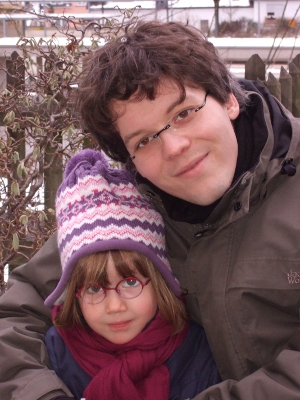
Michael and his daughter Marie

Michael has been around for more than 10 years and has always contributed to the APT software family. He s the author of the first real graphical interface to APT synaptic. Since then he created software-center as part of his work for Ubuntu. Being the most experienced APT developer, he s naturally the coordinator of the APT team. Check out what he has to say about APT s possible evolutions. My questions are in bold, the rest is by Michael. Who are you? My name is Michael Vogt, I m married and have two little daughters. We live in Germany (near to Trier) and I work for Canonical as a software developer. I joined Debian as a developer in early 2000 and started to contribute to Ubuntu in 2004. What s your biggest achievement within Debian or Ubuntu? I can not decide on a single one so I will just be a bit verbose. From the very beginning I was interested in improving the package manager experience and the UI on top for our users. I m proud of the work I did with synaptic. It was one of the earliest UIs on top of apt. Because of my work on synaptic I got into apt development as well and fixed bugs there and added new features. I still do most of the uploads here, but nowadays David Kalnischkies is the most active developer. I also wrote a bunch of tools like gdebi, update-notifier, update-manager, unattended-upgrade and software-properties to make the update/install situation for the user easier to deal with. Most of the tools are written in python so I added a lot of improvements to python-apt along the way, including the initial high level apt interface and a bunch of missing low-level apt_pkg features. Julian Andres Klode made a big push in this area recently and thanks to his effort the bindings are fully complete now and have good documentation. My most recent project is software-center. Its aim is to provide a UI strongly targeted for end-users. The goal of this project is to make finding and installing software easy and beautiful. We have a fantastic collection of software to offer and software-center tries to present it well (including screenshots, instant search results and soon ratings&reviews). This builds on great foundations like aptdaemon by Sebastian Heinlein, screenshots.debian.net by Christoph Haas, ddtp.debian.org by Michael Bramer, apt-xapian-index by Enrico Zini and many others (this is what I love about free software, it usually adds , rarely takes away ). What are your plans for Debian Wheezy? For apt I would love to see a more plugable architecture for the acquire system. It would be nice to be able to make apt-get update (and the frontends that use this from libapt) be able to download additional data (like debtags or additional index file that contains more end-user targeted information). I also want to add some scripts so that apt (optionally) creates btrfs snapshots on upgrade and provide some easy way to rollback in case of problems. There is also some interesting work going on around making the apt problem resolver a more plugable part. This way we should be able to do much faster development. software-center will get ratings&reviews in the upstream branch, I really hope we can get that into Wheezy. If you could spend all your time on Debian, what would you work on? In that case I would start with a refactor of apt to make it more robust about ABI breaks. It would be possible to move much faster once this problem is solved (its not even hard, it just need to be done). Then I would add a more complete testsuite. Another important problem to tackle is to make maintainer scripts more declarative. I triaged a lot of upgrade bug reports (mostly in ubuntu though) and a lot of them are caused by maintainer script failures. Worse is that depending on the error its really hard for the user to solve the problem. There is also a lot of code duplication. Having a central place that contains well tested code to do these jobs would be more robust. Triggers help us a lot here already, but I think there is still more room for improvement. What s the biggest problem of Debian? That s a hard question :) I mostly like Debian the way it is. What frustrated me in the past were flamewars that could have been avoided. To me being respectful to each other is important, I don t like flames and insults because I like solving problems and fighting like this rarely helps that. The other attitude I don t like is to blame people and complain instead of trying to help and be positive (the difference between it sucks because it does not support $foo instead of it would be so helpful if we had $foo because it enables me to let me do $bar ). For a long time, I had the feeling you were mostly alone working on APT and were just ensuring that it keeps working. Did you also had this feeling and are things better nowadays ? I felt a bit alone sometimes :) That being said, there were great people like Eugene V. Lyubimkin and Otavio Salvador during my time who did do a lot of good work (especially at release crunch times) and helped me with the maintenance (but got interested in other area than apt later). And now we have the unstoppable David Kalnischkies and Julian Andres Klode. Apt is too big for a single person, so I m very happy that especially David is doing superb work on the day-to-day tasks and fixes (plus big project like multiarch and the important but not very thankful testsuite work). We talk about apt stuff almost daily, doing code reviews and discuss bugs. This makes the development process much more fun and healthy. Julian Andres Klode is doing interesting work around making the resolver more plugable and Christian Perrier is as tireless as always when it comes to the translations merging. I did a quick grep over the bzr log output (including all branch merges) and count around ~4300 total commits (including all revisions of branches merged). Of that there ~950 commits from me plus an additional ~500 merges. It was more than just ensuring that it keeps working but I can see where this feeling comes from as I was never very verbose. Apt also was never my only project, I am involved in other upstream work like synaptic or update-manager or python-apt etc). This naturally reduced the time available to hack on apt and spend time doing the important day-to-day bug triage, response to mailing list messages etc. One the python-apt side Julian Andres Klode did great work to improve the code and the documentation. It s a really nice interface and if you need to do anything related to packages and love python I encourage you to try it. Its as simple as:
import apt
cache = apt.Cache()
cache["update-manager"].mark_install()
cache.commit()
Of course you can do much more with it (update-manager, software-center and lots of more tools use it). With pydoc apt you can get a good overview. The apt team always welcomes contributors. We have a mailing list and a irc channel and it s a great opportunity to solve real world problems. It does not matter if you want to help triage bugs or write documentation or write code, we welcome all contributors. You re also an Ubuntu developer employed by Canonical. Are you satisfied with the level of cooperation between both projects? What can we do to get Ubuntu to package new applications developed by Canonical directly in Debian? Again a tricky question :) When it comes to cooperation there is always room for improvement. I think (with my Canonical hat on) we do a lot better than we did in the past. And it s great to see the current DPL coming to Ubuntu events and talking about ways to improve the collaboration. One area that I feel that Debian would benefit is to be more positive about NMUs and shared source repositories (collab-maint and LowThresholdNmu are good steps here). The lower the cost is to push a patch/fix (e.g. via direct commit or upload) the more there will be. When it comes to getting packages into Debian I think the best solution is to have a person in Debian as a point of contact to help with that. Usually the amount of work is pretty small as the software will have a debian/* dir already with useful stuff in it. But it helps me a lot to have someone doing the Debian uploads, responding to the bugmail etc (even if the bugmail is just forwarded as upstream bugreports :) IMO it is a great opportunity especially for new packagers as they will not have to do a lot of packaging work to get those apps into Debian. This model works very well for me for e.g. gdebi (where Luca Falavigna is really helpful on the Debian side). Is there someone in Debian that you admire for his contributions? There are many people I admire. Probably too many to mention them all. I always find it hard to single out individual people because the project as a whole can be so proud of their achievements. The first name that comes to my mind is Jason Gunthorpe (the original apt author) who I ve never met. The next is Daniel Burrows who I met and was inspired by. David Kalnischkies is doing great work on apt. From contributing his first (small) patch to being able to virtually fix any problem and adding big features like multiarch support in about a year. Sebastian Heinlein for aptdaemon. Christian Perrier has always be one of my heroes because he cares so much about i18n. Christoph Haas for screenshots.debian.net, Michael Bramer for his work on debian translated package descriptions.
Thank you to Michael for the time spent answering my questions. I hope you enjoyed reading his answers as I did. Subscribe to my newsletter to get my monthly summary of the Debian/Ubuntu news and to not miss further interviews. You can also follow along on Identi.ca, Twitter and Facebook.

4 comments Liked this article? Click here. My blog is Flattr-enabled.

MJ Ray: The co-operative difference

I ve been a bit quiet on this blog and it s mainly been because our co-op is busy, with the annual reports and tax returns to do as well as an increasing amount of client work. It seems that we re not the only busy co-op:
Last year, whilst the UK economy as a whole contracted by 4.9%, the co-operative economy grew by 15.8% to 33.5 billion. This is partly down to the success of The Co-operative Group, but also stems from the success of over 4,990 other co-operatives in the UK which have continued to thrive. From Differences revealed in consumer views between PLCs and co-operatives Co-operatives UK
Meanwhile, I ve been testing out a couple of bits of software, including encrypted filesystems and new firmware for the FS-4400 Satellite PVR, which I could post about soon. We ve developed some Wordpress add-ons which I will package, release and announce. Finally, we re attending a couple of events next week. Busy times indeed!

Cyril Brulebois: Debian XSF News #2

Time for a second Debian XSF News issue! I ll skip stuff related to the new katamari since I wrote about that already.

20 January 2011

John Goerzen: Research on deduplicating disk-based and cloud backups

Yesterday, I wrote about backing up to the cloud. I specifically was looking at cloud backup services. I ve been looking into various options there, but also various options for disk-based backups. I d like to have both onsite and offsite backups, so both types of backup are needed. Also, it is useful to think about how the two types of backups can be combined with minimal overhead. For the onsite backups, I d want to see:
  1. Preservation of ownership, permissions, etc.
  2. Preservation of symlinks and hardlinks
  3. Space-efficient representation of changes ideally binary deltas or block-level deduplication
  4. Ease of restoring
  5. Support for backing up Linux and Windows machines
Deduplicating Filesystems for Local Storage Although I initially thought of block-level deduplicating file systems as something to use for offsite backups, they could also make an excellent choice for onsite disk-based backups. rsync-based dedup backups One way to use them would be to simply rsync data to them each night. Since copies are essentially free, we could do (or use some optimized version of) cp -r current snapshot/2011-01-20 or some such to save off historic backups. Moreover, we d get dedup both across and within machines. And, many of these can use filesystem-level compression. The real upshot of this is that the entire history of the backups can be browsed as a mounted filesystem. It would be fast and easy to find files, especially when users call about that file that they deleted at some point in the past but they don t remember when, exactly what it was called, or exactly where it was stored. We can do a lot more with find and grep to locate these things than we could do with tools in Bacula (or any other backup program) restore console. Since it is a real mounted filesystem, we could also do fun things like make tarballs of it at will, zip parts up, scp them back to the file server, whatever. We could potentially even give users direct access to their files to restore things they need for themselves. The downside of this approach is that rsync can t store all the permissions unless it s running as root on the system. Wrappers such as rdup around rsync could help with that. Another downside is that there isn t a central scheduling/statistics service. We wouldn t want the backup system to be hammered by 20 servers trying to send it data at once. So there d be an element of rolling our own scripts, though not too bad. I d have preferred not to authorize a backup server with root-level access to dozens of machines, but may be inescapable in this instance. Bacula and dedup The other alternative I thought of system such as Bacula with disk-based volumes . A Bacula volume is normally a tape, but Bacula can just write them to disk files. This lets us use the powerful Bacula scheduling engine, logging service, pre-backup and post-backup jobs, etc. Normally this would be an egregious waste of disk space. Bacula, like most tape-heritage programs, will write out an entire new copy of a file if even one byte changes. I had thought that I could let block-level dedupe reduce the storage size of Bacula volumes, but after looking at the Bacula block format spec, this won t be possible as each block will have timestamps and such in it. The good things about this setup revolve around using the central Bacula director. We need only install bacula-fd on each server to be backed up, and it has a fairly limited set of things it can do. Bacula already has built-in support for defining simple or complicated retention policies. Its director will email us if there is a problem with anything. And its logs and catalog are already extensive and enable us to easily find out things such as how long backups take, how much space they consume, etc. And it backs up Windows machines intelligently and comprehensively in addition to POSIX ones. The downsides are, of course, that we don t have all the features we d get from having the entire history on the filesystem all at once, and far less efficient use of space. Not only that, but recovering from a disaster would require a more extensive bootstrapping process. A hybrid option may be possible: automatically unpacking bacula backups after they ve run onto the local filesystem. Dedupe should ensure this doesn t take additional space if the Bacula blocksize aligns with the filesystem blocksize. This is certainly not a given however. It may also make sense to use Bacula for Windows and rsync/rdup for Linux systems. This seems, however, rather wasteful and useless. Evaluation of deduplicating filesystems I set up and tested three deduplicating filesystems available for Linux: S3QL, SDFS, and zfs-fuse. I did not examine lessfs. I ran a similar set of tests for each:
  1. Copy /usr/bin into the fs with tar -cpf - /usr/bin tar -xvpf - -C /mnt/testfs
  2. Run commands to sync/flush the disk cache. Evaluate time and disk used at this point.
  3. Rerun the tar command, putting the contents into a slightly different path in the test filesystem. This should consume very little additional space since the files will have already been there. This will validate that dedupe works as expected, and provide a hint about its efficiency.
  4. Make a tarball of both directories from the dedup filesystem, writing it to /dev/zero (to test read performance)
I did not attempt to flush read caches during this, but I did flush write caches. The test system has 8GB RAM, 5GB of which was free or in use by a cache. The CPU is a Core2 6420 at 2.13GHz. The filesystems which created files atop an existing filesystem had ext4 mounted noatime beneath them. ZFS was mounted on an LVM LV. I also benchmarked native performance on ext4 as a baseline. The data set consists of 3232 files and 516MB. It contains hardlinks and symlinks. Here are my results. Please note the comments below as SDFS could not accurately complete the test.
Test ext4 S3QL SDFS zfs-fuse
First copy 1.59s 6m20s 2m2s 0m25s
Sync/Flush 8.0s 1m1s 0s 0s
Second copy+sync N/A 0m48s 1m48s 0m24s
Disk usage after 1st copy 516MB 156MB 791MB 201MB
Disk usage after 2nd copy N/A 157MB 823MB 208MB
Make tarball 0.2s 1m1s 2m22s 0m54s
Max RAM usage N/A 150MB 350MB 153MB
Compression none lzma none gzip-2
It should be mentioned that these tests pretty much ruled out SDFS. SDFS doesn t appear to support local compression, and it severely bloated the data store, which was much larger than the original data. Moreover, it permitted any user to create and modify files, even if the permissions bits said that the user couldn t. tar gave many errors unpacking symlinks onto the SDFS filesystem, and du -s on the result threw up errors as well. Besides that, I noted that find found 10 fewer files than in my source data. Between the huge memory consumption, the data integrity concerns, and inefficient disk storage, SDFS is out of the running for this project. S3QL is optimized for storage to S3, though it can also store its files locally or on an sftp server a nice touch. I suspect part of its performance problem stems from being designed for network backends, and using slow compression algorithms. S3QL worked fine, however, and produced no problems. Creating a checkpoint using s3qlcp (faster than cp since it doesn t have to read the data from the store) took 16s. zfs-fuse appears to be the most-used ZFS implementation on Linux at the moment. I set up a 2GB ZFS pool for this test, and set dedupe=on and compress=gzip-2. When I evaluated compression in the past, I hadn t looked at lzjb. I found a blog post comparing lzjb to the gzip options supported by zfs and wound up using gzip-2 for this test. ZFS really shone here. Compared to S3QL, it took 25s instead of over 6 minutes to copy the data over and took only 28% more space. I suspect that if I selected gzip -9 compression it would have been closer both in time and space to S3QL. But creating a ZFS snapshot was nearly instantaneous. Although ZFS-fuse probably doesn t have as many users as ZFS on Solaris, still it is available in Debian, and has a good backing behind it. I feel safer using it than I do using S3QL. So I think ZFS wins this comparison. I spent quite some time testing ZFS snapshots, which are instantaneous. (Incidentally, ZFS-fuse can t mount them directly as documented, so you create a clone of the snapshot and mount that.) They worked out as well as could be hoped. Due to dedupe, even deleting and recreating the entire content of the original filesystem resulted in less than 1MB additional storage used. I also tested creating multiple filesystems in the zpool, and confirmed that dedupe even works between filesystems. Incidentally wow, ZFS has a ton of awesome features. I see why you OpenSolaris people kept looking at us Linux folks with a sneer now. Only our project hasn t been killed by a new corporate overlord, so guess that maybe didn t work out so well for you <grin>. The Cloud Tie-In This discussion leaves another discussion: what to do about offsite backups? Assuming for the moment that I want to back them up over the Internet to some sort of cloud storage facility, there are about 3 options:
  1. Get an Amazon EC2 instance with EBS storage and rsync files to it. Perhaps run ZFS on that thing.
  2. Use a filesystem that can efficiently store data in S3 or Cloud Files (S3QL is the only contender here)
  3. Use a third-party backup product (JungleDisk appears to be the leading option)
There is something to be said for using a different tool for offsite backups if there is some tool-level issue, that could be helpful. One of the nice things about JungleDisk is that bandwidth is free, and disk is the same $0.15/GB-mo that RackSpace normally charges. JungleDisk also does block-level dedup, and has a central management interface. This all spells nice for us. The only remaining question would be whether to just use JungleDisk to back up the backup server, or to put it on each individual machine as well. If it just backs up the backup server, then administrative burdens are lower; we can back everything there up by default and just not worry about it. On the other hand, if there is a problem with our main backups, we could be really stuck. So I d say I m leaning towards ZFS plus some sort of rsync solution and JungleDisk for offsite. I had two people suggest CrashPlan Pro on my blog. It looks interesting, but is a very closed product which makes me nervous. I like using standard tools and formats gives me more peace of mind, control, and recovery options. CrashPlan Pro supports multiple destinations and says that they do cloud hosting, but don t list pricing anywhere. So I ll probably not mess with it. I m still very interested in what comments people may have on all this. Let me know!

Simon Josefsson: Introducing the OATH Toolkit

I am happy to announce a project that I have been working quietly on for about a year: the OATH Toolkit. OATH stands for Open AuTHentication and is an organization that specify standards around authentication. That is a pretty broad focus, but practically it has translated into work on specifying standards around deploying and using electronic token based user authentication such as the YubiKey. YubiKey OATH s most visible specification has been the HOTP algorithm which is a way to generate event-based one-time passwords from a shared secret using HMAC-SHA1. HOTP has been published through the IETF as RFC 4226. Built on top of HOTP is the time-based variant called TOTP, which requires a clock in the token. OATH do some other work too, like specifying a data format for transferring the token configuration data (e.g., serial number and shared secret) called PSKC.

The aim of my project OATH Toolkit is to provide an implementation of various OATH related technologies. I m intentionally leaving it open ended because you never know what they may specify that I find interesting. However, the primary goal has been to focus on HOTP and TOTP. Throughout 2010, the project was called HOTP Toolkit but that name made it difficult to support TOTP in a non-confusing way. During the last month, after discussion with Daniel Pocock on Dynalogin which is a potential consumer of my package, I took the time to create a fork of the HOTP Toolkit and the OATH Toolkit was born. Now what does the OATH Toolkit actually do? Primarily it provides a library called liboath that implements HOTP and TOTP. Liboath is a relatively small library, and my goal is to keep it well documented and of high quality. There is GTK-DOC generated API documentation. Of course there is a command line tool to go with it, called oathtool which makes working with HOTP/TOTP from the command line easier. It can generate and validate one-time passwords. Let s say you want to generate the first four OTP based on the dummy key 1234.
jas@latte:~$ oathtool -w4 1234
376439
299783
041392
819202
158134
jas@latte:~$
By default the tool is using HOTP, but you can switch it into TOTP mode with the totp parameter. The output OTP will now depend on the current time on your machine, unless you specify the time manually using the now parameter.
jas@latte:~$ oathtool now= 2011-01-20 15:46 UTC totp 1234
527971
jas@latte:~$
The tool can do more, check the oathtool man page for all the details. The final component of the OATH Toolkit is a PAM module pam_oath. With it, you can login to your machine using an OTP and optionally a password. Right now the user and password management is simplistic, but that should improve over time. To setup single-factor authentication for su you would create a file containing the user information and HOTP key as /etc/users.oath like this:
HOTP root 1234
Then configure PAM to use the pam_oath module like this in /etc/pam.d/su:
auth requisite pam_oath.so debug usersfile=/etc/users.oath window=20
The user file will be rewritten every time you su to hold the current state. There is a README for the PAM-module with more documentation. That s it for an intro! From the OATH Toolkit webpage we link to binary packages for Debian and Ubuntu so please try the OATH Toolkit yourself and provide feedback to the oath-toolkit-help mailing list.

Alexander Reichle-Schmehl: Myths and Facts about Firmwares and their non-removal from Debian

Debian's announcement to release Squeeze with a completely free Linux kernel caused quite some attention, which is actually a good thing. However, it also seems to have caused quite some uncertainty and was often partially misunderstood and miss quoted. I'll try to summarize and answer some of them in this blog post: So, one question remains: What is to bad about non-free firmware files? Aren't they just some tiny programs executed in the CPU of the device? Why care about them Good question! Let's take possible legal issues aside, and just look the practical side. The core problem is: Without source (and tool chain to use the source) firmware files are just some random numbers for us. We don't know what they are doing, we can't analyse and improve them. We can't change them, we can't support them. Maybe you already followed the link above to comment of the Fedora developer. I cite him here again, because I think he summarized the problem so well:
Updated qlogic 2400 and 2500 firmware to 5.03.13. What does 5.03.13 do? No one knows, except for QLogic, and they're not telling. I asked, and they told me that information was only available under NDA. So, I encourage you to imagine what this firmware does, and the bugs it fixes. While you're at it, imagine a world where vendors release source code for their firmware.
So, now that we established the fact, that we can't support firmware files, one could wonder, if we actually need to do so. What harm can a simple, tiny program in a peripheral device do to your computer? Well, scientist already managed to created trojaned firmwares for some network cards. So it is a problem, and can even under some circumstanced lead to security problems! So, to summarise: Yes, Debian changed something in the Kernels. No, it will continue to work as well as usual. Some users might need to enable the non-free repository in their sources list, but those who won't, don't have to. Firmware files needed during installation are also available, and can be loaded by the installation system. So, what's all the fuss about? BTW: Those of you, who can't remember links very well, but fear, they still might need the links to the non-free images and tarballs. just remember two things: wiki and Firmware, as you'll find all you need on the Firmware page of Debian's wiki.

Julien Danjou: Code fontification with Gnus and Org-mode

I've added code fontification using Org src blocks inside Gnus. This interprets the block as an Org buffer and fontify it accordingly if org-src-fontify-natively it set to t. Thanks to S bastien Vauban for the original idea and implementation. Now it works out of the box without any customization. Flattr this

19 January 2011

Eddy Petri&#537;or: Picking up the pieces

Update: After trying KiBi's suggestion to take advantage of this information, I looked for more info on the issue and found this conversation. A git upgrade to the backported git 1:1.7.1-1.1~bpo50+1 version, and git svn rebase started pulling the right stuff in. Yes, I left the svn-remote.svn.rewriteRoot stuff set to the old value and the svn-remote.svn.url to the new value.

Keywords:

Unable to determine upstream SVN information from working tree history

when running git svn reabase


As I said yesterday, I am going to come back to being active in Debian.

I remember looking a little at my page on the Debian Wiki and it was clear that it was stale. (I sometimes find it amusing how I presented myself my name is Eddy Petrisor .) For some reason now the wiki seems to be down.

Two days ago I tried to get the Wormux/Warmux upstream source but git svn appears not to like the rename although I even modified the .git/config and .git/svn/.metadata, but it still wasn't satisfied and answered in a bad mood with this message (after a long waiting period):

$ git svn rebase
Unable to determine upstream SVN information from working tree history


And, yes, I am aware of the compromise and I changed my password for the project on gna.org.

I guess is better if I try to take a look at the RC bugs for the moment.

Next.

Previous.