Search Results: "pm"

11 November 2011

Niels Thykier: build-arch for everyone

The other day, I was asked if it was really possible to get build-arch support in Wheezy (as in, buildds using build-arch) by adding these optional targets. Lets have a look at the data that is available to us: To simplify my calculation I will assume we can fix packages over a course of 150 days (which is 5 months of ~30 days or every day in Dec to April). So 500/150 = 10/3 =~ 3.3 packages from the reduced set should be fixed every day. Erring on the side of caution, we should make that 4 packages every day. So if we fix 4 packages from the reduced set every day, we will definitely fix all of them before Wheezy. But the reduced set are only the source packages that could possibly benefit from having a build-arch target (it builds both arch:all and non-arch:all packages). There could (and probably will) still be sources building non-arch:all packages without a build-arch target. Furthermore, with the rate of 4 a day we will only have a month to get dpkg and buildd support In short, no. I do not expect us to get archive-wide build-arch support on buildds for Wheezy. But I will do my best to ensure that option #4 flip the switch becomes very attractive early in the Wheezy + 1 development schedule. I hope you will join us in this endeavour. Most of the time it is a trivial 3-4 line fix and often you can even throw in some hardening flags to spice it up a bit. The easiest way to help is to fix your (team s) packages listed in the reduced set . Once you are done with that you can look at the rest of your (team s) packages (see the full dd-list). The most important thing to remember is that Build-Depends-Indep is still broken! That is, you cannot rely on Build-Depends-Indep being installed on a buildd in the build target. So any existing workarounds have to stay for now (i.e. check for certain commands or deferring indep till binary-indep is called). If you are in doubt about how to fix a certain package feel free to ask for help. Note: I pull the data directly from lintian.d.o (full set) and UDD (reduced set). I try to remember to refresh it daily. The full set is basically (z)grep cut uniq on the lintian log, the reduced set is found using the UDD query from this script (based on a query done by Jakub Wilk). Since all data is (in)directly based on lintian.d.o only packages that are in sid are considered.

10 November 2011

Adnan Hodzic: Linux power regression + overheating problem on ThinkPad [fixed?]

This blog post isn t only directed to ThinkPad owners as most notebook Linux users with Intel Core Duo 1/2 and i3/i5/i7 processors have been affected by this bug if not all. And yes, this problem is present on latest Debian Unstable and Ubuntu 11.10. Prelude I m owner of Thinkpad X300, great machine except the fact that just recently I replaced its 3rd cooling fan! Yea, I do a lot of compiling and it s on all the time, but still this kind of things shouldn t happen. I first linked this problem to the fact that Thinkpad fan on Linux (as of 2.6.22) always works at what s its basically maximum RPM, thus the reason there are numerous fan control scripts. My favorite one is Thinkfan, but controlling fan doesn t really help if you have a overheating problem. For matter of a fact it working on its maximum speed might only help, with its own toll. As of kernel 2.6.38 up until 3.1 (still present) there has been a problem of power regression but besides this I had slight problem with overheating. Regarding overheating in beginning I tried reporting bugs, tried different Thinkfan configurations, blamed proprietary software such as Adobe Flash for spiking up CPU temperature, however this problem was somewhat solved. After numerous battery calibrations and as these didn t work in the end for battery life getting poorer with each day, I just blamed the factor that notebook was getting pretty old (~3 years). Then the consumer woke up inside of me and I thought it was time to get new notebook. I laid my eyes upon ThinkPad X1 thing of beauty except one mayor drawback, its price. I did some reading on X1 and interesting enough, X300 comes with Core Duo 2 L7100 but overheating + power regression was still present even on latest Intel Core I* series. Reading this killed the consumer and woke up the hacker side. Solution Initial workaround to the problems of power regression is to add pcie_aspm=force besides existing GRUB boot arguments, this did help to some point but what really helped in both cases was also adding i915.i915_enable_rc6=1 or at least I thought so since this line only applies to Sandy Bridge (i3/i5/i7) and latter. In the end my /etc/default/grub looks like:
GRUB_CMDLINE_LINUX_DEFAULT="quiet splash pcie_aspm=force i915.i915_enable_rc6=1"
and make sure you run update-grub after making these changes. Besides the arguments I used there are other ones you can use and for more info please head to Tweaks To Extend The Battery Life Of Intel Linux Notebooks . Results I ended up with such simple tweak are more then satisfactory as I got some ~45 extra minutes of battery life besides the fact that it lowered temperature by some ~10 C. Guess this also gives me extra time until I get a chance to lay my hands on X1 Smile P.S: After I posted this some argued that this is a workaround rather then a fix and folks at [Phoronix] just posted what they call a proper solution to this problem. Also please note although Sandy Bridge users that enable this might sometimes get a video corruption bug, i915_enable_rc6 is still supposed to get enabled by default in 3.2. So logical conclusion you can come up with is unless you re troubled by this problem, you might not want to use this work around/fix at this point. And hope it ll be fixed in future releases of your favorite Linux distribution.

Michal Čihař: phpMyAdmin demo server updates

phpMyAdmin demo server got some updates recently. First of all I've updated MySQL and MariaDB version it uses (MySQL is now on 5.5.7 and MariaDB on 5.3.2). Later I've finally found time to make mentions of demo server less intrusive and fit more in existing interface. I've used jQuery to inject information about demo server to main page as one of standard boxes. It fits there nicely and puts information on main page where most users land anyway (you can see it for example here). With most important information on main page, the other pages could be reduced and now only mentions demo server and Git revision it is using. This brings user experience closer to real phpMyAdmin without intrusive information shown on top of every page. I hope you will like it :-).

Filed under: English Phpmyadmin 0 comments Flattr this!

8 November 2011

Jon Dowland: GNOME 3

Oh, boy. Where do I start I postulate that there exists something called the "UI Singularity". Those who spend too much time considering the optimal way to interact with computing devices eventually pass through this singularity and can no longer effectively communicate with those of us on the other side. At least that's one way to explain what seems to be happening to free-software desktop environments. From the outside, it would appear this happened to KDE with KDE 4, and now, unfortunately, it has happened to GNOME, with GNOME 3. I've had GNOME 3.0 running on my Debian laptop for a few months, which I have used casually. At work, we installed Fedora 15 (GNOME 3.0) on our 69-seat Linux lab over the summer, which I have used on occasion to achieve specific things. I haven't dared upgrade my main work machine yet. So, it could be argued that I haven't spent enough time immersed in the GNOME 3 experience to really judge it fairly. On the face of it, I wish 3 was an iterative development from 2, and didn't throw so many babies out with the bathwater. My casual use of it so far has not endeared it to me at all. In the interests of being fair, rather than deliver my opinion of GNOME 3 as it currently stands, I've decided to try and use it in anger for a while to truly see whether I can "get it". Now that we're past the start of term, I am attempting to use a lab-configured Fedora 15 machine as my main work environment. I'll run with this for a while, and then try a Fedora 16 instance (I need to consider whether we should move to F16 for the second semester anyway) to see what improvements GNOME 3.2 brings.

7 November 2011

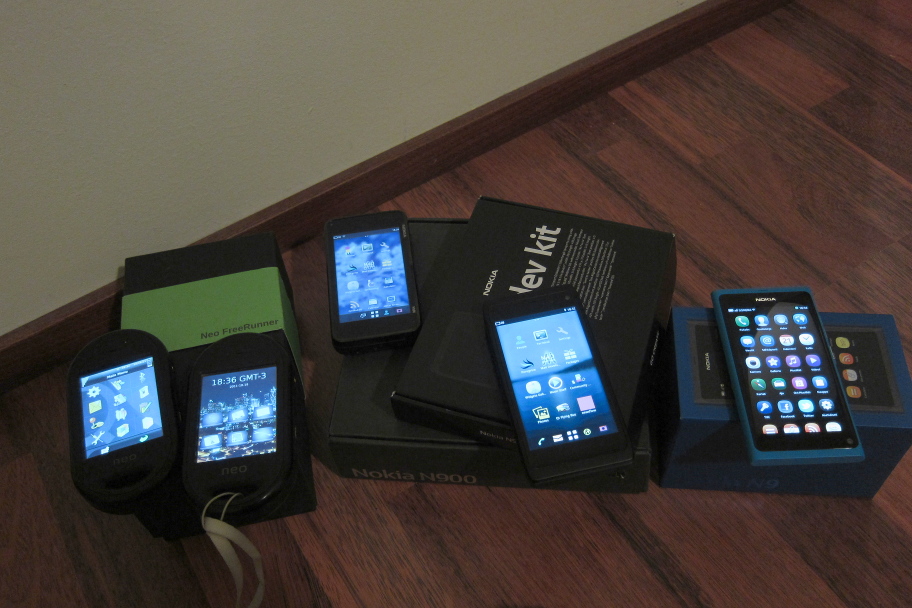
Timo Jyrinki: Free software mobile phone galore

Almost forgot to post this. My mobile phones running free software in photos. From left to right:


All of that software running on the devices is more or less free software, with Harmattan obviously being by far the least free, especially applications, but still better than any other on-the-shelf phone software *), and the others being 99% or "Ubuntu like" free ie. possibly with firmware and a few driver exceptions. N9 needs some bootloader work still before Nemo, Debian, Ubuntu etc. can be run there. I've collected a few things about N9 from this point of view at a wiki page.
*) Not sure about every Android phone, but Android is not openly developed anyway so it's hardly a similar free software project such as freedesktop.org projects or Qt

I gave my N900 away now since obviously I cannot make full use of each one of these. I'm multi-SIMming my N9 and the GTA02a7 Neo FreeRunner for daily use, while the other FreeRunner and N950 are purely for tinkering related purposes. The development FreeRunner will get on upgrade to GTA04 once it's available, and then hopefully that can be made into a daily usable phone as well.

By the way, see you in FSCONS in Gothenburg next weekend. Even rms will be there, which is always interesting of course :)

Roland Mas: Guitar Hero Controller (Wii) to MIDI

This is a follow-up on a previous post: I used a bit of a rainy Sunday to read some docs and write some Python, and I now have a script that converts events from a Guitar Hero World Tour drums controller to MIDI. A brief explanation of how it works: in its standard configuration, the drums controller has five pads and a pedal, and it uses a Wiimote to communicate the events (what pad was hit with what force, or what button was pressed/released, or the position of the mini-stick) to the Wii itself. This communication happens over Bluetooth and not over a dedicated cable or protocol, so it is possible to remove the Wii and use a standard computer with Bluetooth (built-in or via a dongle) instead, and the computer will receive messages. There's some decoding to do, but fortunately people have reverse-engineered the frames, and come up with the libcwiid library and its Python binding, which hides the complexity of the decoding and just delivers structured data to the programs that use it. Then we analyze this data and extract the relevant info from it (with some juggling of bits): "the X pad was hit with force Y". From there, it's a simple matter of mapping the pads to a MIDI note and the force to a MIDI velocity, and of sending the appropriate MIDI message to the target, for instance with the libportmidi library. What you do with the MIDI output is your call: I use it to add more pads to my electronic drum kit, but it could equally be used to drive a software synthetizer, or an external sound module. Or a light-show machine. Or fireworks. Or a model railway. Or whatever. Here's the current version of the wiigh2midi.py script (for updated versions, see the Bazaar repository).
#! /usr/bin/python
import cwiid, time, asyncore, pypm
class Wiimidi:
    wiimote = None
    midiout = None
    lastaction = time.time()
    wii2color =   27: 'kick',
                  25: 'red',
                  17: 'yellow',
                  15: 'blue',
                  14: 'orange',
                  18: 'green'  
    color2midi =   'kick': 36, # Bass drum
                   'red': 38, # Snare drum
                   'blue': 48, # High tom
                   'green': 43, # Low tom
                   'yellow': 42, # Closed hi-hat
                   'orange': 52, # Crash cymbal
                    
    def connect_wiimote(self):
        print "Press 1+2 on the Wiimote..."
        try:
            self.wiimote = cwiid.Wiimote()
        except:
            self.wiimote = None
            return None
        print "Connected."
        self.lastaction = time.time()
        self.wiimote.rumble=1
        time.sleep(.2)
        self.wiimote.rumble=0
        return self.wiimote
    def disconnect_wiimote(self):
        if self.wiimote is not None:
            print "Closing connection to the Wiimote."
            self.wiimote.close()
            self.wiimote = None
        return
    def connect_midi(self):
        for i in range(pypm.CountDevices()):
            interf,name,inp,outp,opened = pypm.GetDeviceInfo(i)
            if outp == 1:
                if name == 'UM-1G MIDI 1':
                    self.midiout = pypm.Output(i, 0)
                    return
        for i in range(pypm.CountDevices()):
            interf,name,inp,outp,opened = pypm.GetDeviceInfo(i)
            if outp == 1:
                print i, name," ",
                print
        dev = int(raw_input("Type output number: "))
        self.midiout = pypm.Output(dev, 0)
    def wiimote_callback(self, messages, timestamp):
        self.lastaction = time.time()
        m = messages[0][1]
        # rx = m['r_stick'][0]
        ry = m['r_stick'][1]
        l = m['l']
        # r = m['r']
        which = ( (l << 1) & 16) + (ry >> 1)
        softness = l & 7
        if softness == 7 or which == 0:
            return
        # print "rx=%d\t ry=%d\t l=%d\t r=%d\t rest=%d" % (rx,ry,l,r,rest)
        # print "which = %d, softness = %d" % (which, softness)
        strength = 7-softness
        color = self.wii2color[which]
        midi_vel = 16*strength
        midi_note = self.color2midi[color]
        self.midiout.WriteShort(0x9a,midi_note,midi_vel)
        self.midiout.WriteShort(0x9a,midi_note,0)
        # print "%s %d -> %d %d" % (color, strength, midi_note, midi_vel)
    def main(self):
        self.connect_midi()
        while True:
            if self.wiimote is None:
                self.connect_wiimote()
                if self.wiimote:
                    # Tell Wiimote to display rock sign
                    self.wiimote.led = cwiid.LED1_ON   cwiid.LED4_ON
                    # We only care for the extension data
                    self.wiimote.rpt_mode = cwiid.RPT_EXT
                    self.wiimote.enable(cwiid.FLAG_MESG_IFC   cwiid.FLAG_REPEAT_BTN)
                    self.wiimote.mesg_callback = self.wiimote_callback
                    self.lastaction = time.time()
                else:
                    print "Retrying... "
                    print
            asyncore.loop(timeout=0, count=1)
            if self.lastaction < time.time() - 3600:
                print "An hour passed since last action..."
                self.disconnect_wiimote()
            time.sleep(0.05)
        print "Exited safely."
# Instantiate and run
inst = Wiimidi()
inst.main()
There are a few obvious improvements to be made: first, handling guitar controllers in addition to drums. Second, handling the buttons could provide extra "pads", to trigger sound effects for instance (thunder, lasers, voices ), or to initiate program changes, or to change the mappings of the pads. Maybe storing the mutable parts (default MIDI adapter, pad-to-note mapping) in a configuration file. Maybe add a user interface to ease the configuration. Patches welcome, otherwise maybe I'll do that myself on another rainy Sunday. Notes and references (in other words, the giants on whose shoulders this program stands): More cowbell!

5 November 2011

Christian Perrier: People behind Debian: Rapha l Hertzog, dpkg maintainer, book author

It's about time that Rapha l is interviewed in the "People behind Debian" series he initiated on his blog. Indeed, when he interviews people, Rapha l asks about other people they could suggest for next interviews. So, during mine, I suggested him to be a next "victim". As he couldn't interview himself, I volunteered for this. As you'll see below, Rapha l (who's a friend of mine as I'm a friend of his) likes to speak and that shows in the length of his answers :-) but you always know more about Debian when reading his blog posts, books, mails, etc. I personnally think that he is among the best promoters of the project for years and it was a pleasure for me to conduct this interview. My questions are in bold, the rest is by Rapha l. Who are you? Hi, Rapha l Hertzog, I'm a 32 years old French Debian developer who is married and who has a 2-year old son. I'm running my own company (Freexian) since 2005, I started it 3 years after the end of my computer science studies. I'm also a very proud author of the Cahier de l'Admin Debian, a French book about Debian. You often wrote about your attempts to make your living partly, if not completely, out of your Debian work. Can you describe the way you're trying to do this? My first try has been with Freexian. I always advertised this company as being specialized in Debian GNU/Linux. While Freexian is successful enough to provide me a decent income, I'm not really satisfied with the result because very few of my contracts are about improving Debian. I use Debian daily for the benefit of my customers, writing new customer specific (embedded) software, deploying a service on Debian servers, etc. But except for the occasional bugfix, all this work does not improve Debian (the only exception has been the dpkg multiarch implementation work sponsored by Linaro). The positive side is that I don't need to fill my entire schedule to earn enough money to live. So I'm regularly taking some days off work to be able to contribute to Debian. This is a freedom that I enjoy... My French book has also been a bestseller and depending on the years the royalties represented between 1 and 2 months of supplementary time that I can spend on Debian (that is between 2000 and 4000 EUR of income). Now since last year, I decided to actively work towards my goal of making a living out of my Debian work. I want to build on what has been most successful for me up to now, that is my book. My strategy has been to build an audience around my blog: with a direct contact with my readers I have the opportunity to sell e-books, and without any intermediary taking the biggest part of the price, I don't need a very large audience to be successful. I have also been experiencing micro-donations with Flattr, people who are enjoying my articles on my blog can use it to give a few cents for each article they find useful. With a large enough userbase, this could fund free documentation and would avoid the need for commercial e-books but we're not there currently and I don't know if it will ever reach the critical mass. Last but not least, I'm soliciting donations for my Debian work on the sidebar of my blog, and I have the chance to a have a few (regular) donators. You're a proud father since last year. How do you manage your commitment to the project with your family life? There are few things that I put above Debian in my life, but my family certainly is. I try to handle most of my Debian duties during work hours so that I can spend time with my family on evenings and during week-ends but in truth I never really disconnect from Debian. It happens quite often that I say to my wife I'll come in a few minutes, let me finish this and then I end up responding to a Debian mail, or an IRC query and take 30 minutes instead of the 5 expected ones. I try hard to avoid this but it's difficult. Luckily for me, my wife is very supportive of my Debian involvement and knows me well... By the way my wife is using Debian on her computer, and my son has already played with DoudouLinux (a Debian derivative!). Have you already been accused of self-promotion in your writings? If that would ever happen, what would you answer to that? Yes, more than once. I am proud of what I do for Debian, I enjoy sharing the result of my work. Because of this, some people believe that I'm selfish and egocentric. And this has somewhat increased since I have been soliciting donations: for me it's important to be transparent towards donators so that they see what I really do for Debian. But some people have the feeling that I'm getting undeserved attention and that I bring everything towards my own person. On the other side, as an author, I'm a public figure who is definitely seeking some attention... I don't have any miraculous answer, we are a large and diverse community, it's next to impossible to please everybody. I listen to all the concerns that people bring forward, I take them into account as much as possible, in particular when I believe they are reasonable/well justified, or when they come from people that I highly respect. But sometimes I have to plainly ignore them too... in particular when they are trying to impose their own political view on a topic that's not directly related to the only value that we all share: the social contract. Contributing to Debian is a challenge, we all have to make efforts to put aside our differences and to concentrate on the work that brings us closer to the best free software operating system ever built. You recently launched a campaign to free out the soon-to-be-published "Debian Administrator Handbook", an English version of your well-known book about Debian in French. Can you tell us more about this project? My French book has been very successful at helping people to get started with Debian, and like I already explained, it was also effective to fund a part of my Debian work. So I wanted to make it available world-wide by publishing an English translation of it. I tried to find an English-speaking editor willing to take on the challenge but I found none interested. Not put off by a setback, Roland (my co-author) and I decided to negotiate with our French editor Eyrolles to recuperate the necessary rights to translate the book into English. Handling everything ourselves represents a lot of work, but it also means that we have the freedom required to decide of the license of the resulting book. We would love to see it under a license compatible with the Debian Free Software Guidelines. But at the same time we firmly believe that we deserve a reasonable monetary compensation for the work on the book, so we conditioned its liberation to a predefined amount of money (25 K ) in what we call the "liberation fund". And since we wanted to be sure that we would have the required means to complete the translation, we used a crowfunding platform to seek support of people interested by the book. With such a platform you're only debited if the minimal requested amount is reached. Anyone can participate, pre-order the book and/or put some money in the liberation fund. As of today, we already reached the minimal funding goal (15 K ) so the book translation will happen. But the liberation target has not yet been reached so we don't know yet if the book will be free from the start... you can follow the progress right on the fundraising page or on the website dedicated to the book. PS: If you want to contribute to this project and also make a donation to Debian at the same time, you should check out this page. You're one of the main developers of dpkg, a critical tool for Debian systems. Can you tell us more about the current development challenges it is facing? What will be the new dpkg features for wheezy? The current challenges are not really technical. dpkg is a relatively mature piece of software and it will continue to work for the foreseeable future without needing much maintenance work. The real challenge is trying to setup a healthy developement community around it so that we can keep tackling new interesting problems (there are many listed in the roadmap and in the 225 wishlist bugs). There is a real problem of leadership and communication in the current team. We used to be three, and we're only two nowadays. Guillem is the legitimate leader since he's involved in dpkg's developement since early 2006 while I joined only in late 2007. But in the last 4 years, we did not manage to recruit anyone else on the team. Some persons tried to contribute significant new features (like Sean Finney with a rework of the way we handle configuration files) but they gave up frustrated after a while because we did not manage to review their work (and discuss the design) in any reasonable timeframe. Another famous case is Ian Jackson with his trigger work. His work got merged, but so late that in the mean time he blew up while trying to hijack the maintenance of dpkg. For a long time I was concentrating my work on the Perl part of dpkg (aka dpkg-dev mainly), so I did not feel qualified to review and merge work related to the C part and I was just a worried observator of this situation. I tried to improve it by setting up some basic review infrastructure, it should have brought some lisibility to the status of each change left to be reviewed... but it has not been used and it changed nothing. Over the years, I became much more interested in the C part. My first big contribution in C has been the rewrite of update-alternatives (from Perl to C). I made other small changes in between, but at the start of this year I had this great opportunity to work on the multiarch implementation (FYI, multiarch is the possibility to mix packages from several architectures on a single system). This really forced me to jump into the C codebase and learn a lot about how dpkg is implemented. Thanks to this I have been able to tackle other small projects (like the improved triggers). This would be all great if my multiarch work was already merged, but it's not. It's a large work, I do not mind waiting a bit in particular since Guillem is a highly skilled C programmer. His sharp analysis of new designs are invaluable, when he reviews code he always finds something to improve. I learnt a lot just by reviewing the code he wrote over the years. That said I have been waiting since April without almost no updates from him. With the release team asking us to hurry up, the situation is getting somewhat strained as I really want to see multiarch in Wheezy and I do not really want to short-circuit Guillem. Hum, I may have drifted a bit from your original question... what great new features can people expect? Well multiarch is supposed to be the big new feature, apart from that there aren't many things that matter to the end users. But there are already quite a few changes that are of interest to package maintainers (like hardened build flags, source package improvements, improved triggers, ). What's the biggest problem of Debian? Manicheism and a tendency to quickly polarize the discussions. In reality, there are very few situations where everything is all good or all bad. Ever since I have read The 7 Habits of Highly Effective People I try hard to put into practice the habits of interdependence . Instead of having only my point of view in mind, I try to understand the motivations from the other party ( Seek First to Understand, Then to be Understood ) in order to be able to put forward solutions acceptable to both parties ( Think Win-Win ). I highly recommend this book to anyone. And I invite everybody to at least try to follow those simple advices. Is there someone in Debian you admire for their contributions? There are many and I can't give an exhaustive list... here are some that I would like to highlight (in no particular order): Most of those people are working on improving Debian's infrastructure so that we can all be more effective and do an even better work. This kind of work is not always very visible but it's crucial to Debian's future. Thank you to Rapha l for the time spent answering my questions. I hope you enjoyed reading his answers as I did. And, anyway, it was fun to just play the game "the other way".

Jose Luis Rivas Contreras: Polipo and uncachable file

Dear lazyweb, I was searching through the internet what was I doing wrong, I wrote to the polipo-user list but my email got stuck on moderation, and my connection is really shitty (that s why I m using polipo the way I m using it). I have relaxTransparency and mindlesslyCacheVary set to true, but I don t need so aggresive caching in my development stages that are located under *.local and another development subdomain on the net. Already tried setting uncachableFile to /etc/polipo/uncachable and to ~/.polipo-uncachable, according to the web-config thing is properly setted up, but can t get it to recognize it s content. I first thought it was I was writing bad the regex, .*\.local but it does work in the /etc/polipo/forbidden file. Besides, adding complete domains to the uncachable file doesn t works neither. Could someone confirm this or throw me a hand on this? I m using 1.0.4.1-1.1 version which is the last one on unstable repos.

4 November 2011

Paul Wise: Migrating from Galeon to Iceweasel/Firefox

I have been a long-time user of the Galeon web browser, which, while powerful for its time, is getting a bit long in the teeth and has been abandoned for a long time. As a result I need to find something new. As Galeon uses the Mozilla engine I figure switching to Iceweasel/Firefox will be the least amount of pain since they share similar formats for lots of the user configuration and data (with the exception of history). Switching to Firefox also gives me access to a lot of configurability and a vast sea of extensions all written in RDF, JavaScript and zoooool (ahem, XUL). Another plus was that I was already using Firebug for the occasional web development project. Looking at the Mozilla addons site is like entering someone's shed. There will be the few beautiful unfinished projects still being worked on, one polished finished scuplture gathering dust but still admirable, things with power plugs from a bygone era, some things that have a coin slot on them, some cryptic machines with no visible screws or manuals, some spiders and their cobwebs and a few rats and mice chewing through things. A place where you can find some excellent, well documented, useful and Free Software extensions alongside lots of crud. Luckily for me the good stuff that I wanted to use was already in Debian or the friendly Debian Mozilla extension maintainers team was willing to package them for me. In my quest for freedom from Galeon I first noticed that there is no up button in Iceweasel. Bummer, I use that a lot so I went searching for extensions. I soon found one extension, but it hadn't kept up with the ever-changing Mozilla APIs so it fell by the wayside. Thanks to the leavers of breadcrumbs I picked up the trail to a new shiny and working extension. Lo-and-behold I found Uppity, which was all about going up and as it turns out, much better at that than Galeon. Thanks to MozExt team, thats solved, next! The next glaring problem was the lack of Galeon-style smart bookmarks. Before you ask, yes, Firefox smart keyword bookmarks are not the same thing. This was rediculously hard to search for due to the wording used by both projects being same same but different. Some folks switched to Epiphany to get the extra search boxes on their toolbars. Like this guy I was not interested in that, mainly due to the addons I would be missing out on. I tried a few different tacks, even searching for a way to have multiple search boxes in the Firefox toolbars. I soon gave up on finding an extension that would do this like Galeon does so I figured its time to roll up the sleeves and learn some zzzoooool. I already know a little bit about JavaScript and CSS so... First slap a dash of a tutorial about adding toolbar buttons, add a slither of adding extensions without installing them, stare down some Mozilla reference manuals, thrown in a pinch of favicons, give up on a wild goose chase or two, add a big fat blob of zoooool and sautee in fugly hacks. Soon enough you will have something hardcoded that works like Galeon smart bookmarks but looks even better. A screenshot of hacky galeon smart bookmarks in Iceweasel I may eventually turn this into a proper and functionally equivalent extension for Galeon-stlye smart bookmarks but for now it will remain a useful hack. If you want to get your hands dirty with zzzoooooool and try this out after modifying it to use your personal search URLs, please feel free to contact me. For now the only remaining issue I can see is that the forward/back buttons in Iceweasel don't have the explict menu buttons. This is a minor issue for me so now it is time for me to figure out how to migrate my data and config1 before permanently switching away from Galeon. Wish me luck! 1. Of course the data and config are fugly, but that is a something for another, much broader and more complicated hack

1 November 2011

Michal &#268;iha&#345;: New Pootle on l10n.cihar.com

Translation server for phpMyAdmin and Gammu/Wammu has been updated to run latest Pootle. I had to do this upgrade to be able to run on latest Django, which is used by other websites as well (this blog is one of them). Unfortunately it was not as easy as running apt-get upgrade as Pootle package has been dropped from Debian recently. So I had to make quick and dirty packages myself (no removal of embedded software and so on). Installing newer version lead to major breakage as the database upgrade silently failed and I had to recover manually. In the end I've dropped all pootle_* tables and recreated them again. Unfortunately this lead to loss of some data from user profiles, but I could not see other way around. Anyway the service should be now back running in normal shape, so go ahead and translate :-).

Filed under: Debian English Phpmyadmin 0 comments Flattr this!

Philipp Kern: Useful Firefox extensions

Many people around me switched to Chrome or Chromium. I also used it for a bit, but I was a bit disappointed about the extensions available. To show why, here's a list of the extensions I've currently installed:
If Firefox on Android were quicker to start and faster overall, I might even use it there. But as-is it's not very useful. Sadly this also means that I can't use Firefox Sync on my phone and as I don't use Chrome on my desktop I also can't use Chrome to Phone. So I usually go and build a QR code on my laptop and read that with Android's Barcode Scanner.

Of course I'm actually using Iceweasel and I'm very grateful for Mike Hommey's efforts to track the release channel on mozilla.debian.net.

31 October 2011

Russell Coker: SE Linux Status in Debian 2011-10

Debian/Unstable Development deb http://www.coker.com.au wheezy selinux The above APT sources.list line has my repository for SE Linux packages that have been uploaded to Unstable and which will eventually go to testing and then the Wheezy release (if they aren t obsoleted first). I have created that repository for people who want to track SE Linux development without waiting for an Unstable mirror to update. In that repository I ve included a new version of policycoreutils that now includes mcstrans and also has support for newer policy such that the latest selinux-policy-default package can be installed. The version that is currently in Testing supports upgrading policy on a running system but doesn t support installing the policy on a system that previously didn t run SE Linux. I have also uploaded SE Linux Policy packages from upstream release 20110726 compared to the previous packages which were from upstream release 20100524. As the numbers imply there is 14 months of upstream policy development which changes many things. Many of the patches from my Squeeze policy packages are not yet incorporated in the policy I have uploaded to Unstable. I won t guarantee that an Unstable system in Enforcing mode will do anything other than boot up and allow you to login via ssh. It s definitely not ready for production but it s also very suitable for development (10 years ago I did a lot of development on SE Linux systems that often denied login access, it wasn t fun). Kyle Moffett submitted a patch for libselinux which dramatically changed the build process. As Manoj (who wrote the previous build scripts) was not contactable I accepted Kyle s patch as provided. Thanks for the patch Kyle, and thanks for all your work over the years Manoj. Anyway the result of these changes should mean that it s easier to bootstrap Debian on a new architecture and easier to support multi-arch but I haven t tested either of these. Squeeze The policy packages from Squeeze can t be compiled on Unstable. The newer policy compilation tool chain is more strict about how some things can be declared and used, thus some policy which was fairly dubious but usable is now invalid. While it wouldn t be difficult to fix those problems I don t plan to do so. There is no good reason for compiling Squeeze policy on Unstable now that I ve uploaded a new upstream release. deb http://www.coker.com.au squeeze selinux I am still developing Squeeze policy and releasing it in the above APT repository. I will also get another policy release in a Squeeze update if possible to smooth the transition to Wheezy the goal is that Squeeze policy will be usable on Wheezy even if it can t be compiled. Also note that the compilation failures only affect the Debian package, it should still be possible to make modules for local use on a Wheezy system with Squeeze policy. MLS On Wednesday I m giving a lecture at my local LUG about MLS on SE Linux. I hope to have a MLS demonstration system available to LUG members by then. Ideally I will have a MLS system running on a virtual server somewhere that s accessible as well as a Xen/KVM image on a USB stick that can be copied by anyone at the meeting. I don t expect to spend much time on any aspect of SE Linux unrelated to MLS for the rest of the week. Version Control I need to change the way that I develop SE Linux packages, particularly the refpolicy source package (source of selinux-policy-default among others). A 20,000 line single patch is difficult to work with! I will have to switch to using quilt, once I get it working well it should save me time on my own development as well as making it easier to send patches upstream. Also I need to setup a public version control system so I can access the source from my workstation, laptop, and netbook. While doing that I might as well make it public so any interested people can help out. Suggestions on what type of VCS to use are welcome. How You Can Help Sorting out the mess that is the refpolicy package, sending patches upstream and migrating to a VCS is a fair bit of work. But there are lots of small parts. Sending patches upstream is a job that could be done in small pieces. Writing new policy is not something to do yet. There s not much point in doing that while I still haven t merged all the patches from Squeeze maybe next week. However I can provide the missing patches to anyone who wants to review them and assist with the merging. I have a virtual server that has some spare capacity. One thing I would like to do is to have some virtual machines running Unstable with various configurations of server software. Then we could track Unstable on those images and use automated testing to ensure that nothing breaks. If anyone wants root access on a virtual server to install their favorite software then let me know. But such software needs to be maintained and tested!

Russell Coker: Links October 2011

Ron has written an interesting blog post about the US as a lottery economy [1]. Most people won t win the lottery (literally or metaphorically) so they remain destined for poverty. Tim Connors wrote an informative summary of the issues relating to traffic light timing and pedestrians/cyclists [2]. I have walked between Southgate and the Crown Casino area many times and have experienced the problem he describes many times. Scientific American has an interesting article about a new global marketplace for scientific research [3]. The concept is that instead of buying a wide range of research equipment (and hiring people to run it) you can outsource non-core research for a lower cost. Svante P bo gave an interesting TED talk about his work analysing human DNA to determine prehistoric human migration patterns [4]. Among other things he determined that 2.5% of the DNA from modern people outside Africa came from the Neandertals. Lisa wrote an informative article about Emotional Support Animals (as opposed to Service Animals such as guide dogs) for disabled people [5]. It seems that the US law is quite similar to Australian law in that reasonable accommodations have to be made for disabled people which includes allowing pets in rental properties even if such pets aren t officially ESAs. Beyond Zero Emissions has an interesting article about electricity prices which explains how wind power forces prices down [6]. This should offset the new carbon tax . Problogger has an article listing some of the ways that infographics can be used on the web [7]. This can be for blog posts or just for your personal understanding. Petter Reinholdtsen wrote a handy post about ripping DVDs which also explains how to do it when the DVD has errors [8], I haven t yet ripped a DVD but this one is worth noting for when I do. Miriam has written about the Fantastic Park ICT training for 8-12yo kids [9]. It s run in Spain (and all the links are in Spanish but Google Translation works well) and is a camp to teach children about computers and robotics using Lego Wedo among other things. We need to have more of these things in other countries. The Atlantic Cities has an interesting article comparing grid and cul-de-sac based urban designs [10]. Apparently the cul-de-sac design forces an increase in car use and therefore an increase in fatal accidents while also decreasing the health benefits of walking. Having lived in both grid and cul-de-sac based urban areas I have personally experienced the benefits of the grid based layout. Sarah Chayes wrote an interesting LA Times article about governments being taken over by corruption [11]. She argues that arbitrary criminal government leads to an increase in religious fundamentelism. Michael Lewis has an insightful article in Vanity Fair about the bankruptcy of US states and cities [12]. Ben Goldacre gave an interesting TED talk about bad medical science [13]. He starts with the quackery that is published in tabloid newspapers and then moves on to deliberate scientific fraud by medical companies. Geoff Mulgan gave an interesting TED talk about the Studio Schools in the UK which are based around group project work [14]. The main thing I took from this is that the best method of teaching varies by subject and by student. So instead of having a monolithic education department controlling everything we should have schools aimed at particular career paths and learning methods. Sophos has an interesting article about the motion sensors of smart phones being used to transcribe keyboard input based on vibration [15]. This attack could be launched by convincing a target to install a trojan application on their phone. It s probably best to regard your phone with suspicion nowadays. Simon Josefsson wrote a good article explaining how to use a GPG smart-card to authenticate ssh sessions with particular reference to running backups over ssh [16]. C ran wrote a good article explaining how to use all the screen space when playing DVDs on a wide screen display with mplayer [17]. Charles Stross has an informative blog post about Wall St Journal circulation fraud [18]. Apparently the WSJ was faking readership numbers to get more money from advertisers, this should lead to law suits and more problems for Rupert Murdoch. Is everything associated with Wall St corrupt?

30 October 2011

Dominique Dumont: Config::Model: How to test configuration models

Hello With Config::Model, configuration models are created to validate configuration data. But, before that, how can we validate a model ? This has long been a sore spot of Config::Model. During its development, I ve progressively enhanced a test script to tests the various models (and their corner cases) shipped with Config::Model. This script is able to test several models with several subtests. Currently, more that 400 unit tests are done on 5 models and about 50 configuration files. Which is great, but usable only inside Config::Model distribution. Which is not so great So I ve bitten the bullet and created a new Config::Model::Tester class from this test script. This new class is shipped with Config::Model 1.260 (also available on Debian/sid). For instance, let s see how this tester is used to test Xorg model (shipped in Config::Model::Xorg). Xorg features a small test file (t/model_test.t):
use warnings;
use strict;
use Config::Model::Tester ;
use ExtUtils::testlib;
my $arg = shift   '';
my $test_only_model = shift   '';
my $do = shift ;
run_tests($arg, $test_only_model, $do) ;
The xorg files to test are specified by t/model_tests.d/xorg-test-conf.pl:
$conf_file_name = "xorg.conf" ;
$conf_dir = "etc/X11" ;
$model_to_test = "Xorg" ;
@tests = (
      name => 'fglrx',  ,
      name => 'modern',  ,
      name => 'vesa',  ,
      name => 'xorg',  ,
      name => 'xorg-ati',  ,
);
1;
And the xorg.conf files are there:
$ ls t/model_tests.d/xorg-examples/
fglrx  modern  vesa  xorg  xorg-ati
Here s the output of the xorg-ati subtest:
$ perl -Ilib t/model_tests.t x xorg xorg-ati
ok 1 - compiled
# Beginning xorg test (t/model_tests.d/xorg-test-conf.pl)
# xorg uses Xorg model on file xorg.conf
# Beginning subtest xorg xorg-ati
ok 2 - Copied xorg example xorg-ati
ok 3 - Read wr_root/test-xorg-ati/etc/X11/xorg.conf and created instance with init() method with warning check
ok 4 - Ran dump_tree
ok 5 - Dumped xorg config tree in full mode
ok 6 - Dumped xorg config tree in custom mode
ok 7 - xorg write back done
ok 8 - Created instance xorg-test-xorg-ati-w
ok 9 - Dumped xorg 2nd config tree in custom mode
ok 10 - compare original xorg custom data with 2nd instance custom data
ok 11 - check that original xorg file was not clobbered
# End of subtest xorg xorg-ati
# End of xorg test
1..11
Now, it s quite easy to create non regression tests for bug triggered by err, unexpected, configuration files: Just drop the file in the example directory and edit the *-test-conf.pl file. This saves a lot of typing. All the best

28 October 2011

Lars Wirzenius: On the future of Linux distributions

Executive summary Debian should consider: Introduction I've taken a job with Codethink, as part of a team to develop a new embedded Linux system, called Baserock. Baserock is not a distribution as such, but deals with many of the same issues. I thought it might be interesting to write out my new thoughts related to this, since they might be useful for proper distributions to think about too. I'll hasten to add that many of these thoughts are not originally mine. I shamelessly adopt any idea that I think is good. The core ideas for Baserock come from Rob Taylor, Daniel Silverstone, and Paul Sherwood, my colleagues and bosses at Codethink. At the recent GNOME Summit in Montreal, I was greatly influenced by Colin Walters. This is also not an advertisment for Baserock, but since my of my current thinking come from that project, I'll discuss things in the context of Baserock. Finally, I'm writing this to express my personal opinion and thoughts. I'm not speaking for anyone else, least of all Codethink. On the package abstraction Baserock abandons the idea of packages for all individual programs. In the early 1990s, when Linux was new, and the number of packages in a distribution could be counted on two hands in binary, packages were a great idea. It was feasible to know at least something about every piece of software, and pick the exact set of software to install on a machine. It is still feasible to do so, but only in quite restricted circumstances. For example, picking the packages to install a DNS server, or an NFS server, or a mail server, by hand, without using meta packages or tasks (in Debian terminology), is still quite possible. On embedded devices, there's also usually only a handful of programs installed, and the people doing the install can be expected to understand all of them and decide which ones to install on each specific device. However, those are the exceptions, and they're getting rarer. For most people, manually picking software to install is much too tedious. In Debian, we've realised this a great many years ago, and developed meta packages (whose only purpose is to depend on other packages) and tasks (solves the same problem, but differently). These make it possible for a user to say "I want to have the GNOME desktop environment", and not have to worry about finding every piece that belongs in GNOME, and install that separately. For much of the past decade, computers have had sufficient hard disk space that it is no longer necessary to be quite so picky about what to install. A new cheap laptop will now typically come with at least 250 gigabytes of disk space. An expensive one, with an SSD drive, will have at least 128 gigabytes. A fairly complete desktop install uses less than ten gigabytes, so there's rarely a need to pick and choose between the various components. From a usability point of view, choosing from a list of a dozen or two options is much easier than from a list of thirty five thousand (the number of Debian packages as I write this). This is one reason why Baserock won't be using the traditional package abstraction. Instead, we'll collect programs into larger collections, called strata, which form some kind of logical or functional whole. So there'll be one stratum for the core userland software: init, shell, libc, perhaps a bit more. There'll be another for a development environment, one for a desktop environment, etc. Another, equally important reason, to move beyond packages is the problems caused by the combinatorial explosion of packages and versions. Colin Walters talks about this very well. When every system has a fairly unique set of packages, and versions of them, it becomes much harder to ensure that software works well for everyone, that upgrades work well, and that any problems get solved. When the number of possible package combinations is small, getting the interactions between various packages right is easier, QA has a much easier time to test all upgrade paths, and manual test coverage improves a lot when everyone is testing the same versions. Even debugging gets easier, when everyone can easily run the same versions. Grouping software into bigger collections does reduce flexibility of what gets installed. In some cases this is important: very constrainted embedded devices, for example, still need to be very picky about what software gets installed. However, even for them, the price of flash storage is low enough that it might not matter too much, anymore. The benefit of a simpler overall system may well outweigh the benefit of fine-grained software choice. Everything in git In Baserock, we'll be building everything from source in git. It will not be possible to build anything, unless the source is committed. This will allow us to track, for each binary blob we produce, the precise sources that were used to bulid it. We will also try to achieve something a bit more ambitious: anything that affects any bit in the final system image can be traced to files committed to git. This means tracking also all configuration settings for the build, and the whole build environment, in git. This is important for us so that we can reproduce an image used in the field. When a customer is deploying a specific image, and needs it to be changed, we want to be able to make the change with the minimal changes compared to the previous version of the image. This requires that we can re-create the original image, from source, bit for bit, so that when we make the actual change, only the changes we need to make affect the image. We will make it easy to branch and merge not just individual projects, but the whole system. This will make it easy to do large changes to the system, such as transitioning to a new version of GNOME, or the toolchain. Currently, in Debian, such large changes need to be serialised, so that they do not affect each other. It is easy, for example, for a GNOME transition to be broken by a toolchain transition. Branching and merging has long been considered the best available solution for concurrent development within a project. With Baserock, we want to have that for the whole system. Our build servers will be able to build images for each branch, without requiring massive hardware investment: any software that is shared between branches only gets built once. Launchpad PPAs and similar solutions provide many of the benefits of branching and merging on the system level. However, they're much more work than "git checkout -b gnome-3.4-transition". I believe that the git based approach will make concurrent development much more efficient. Ask me in a year if I was right. Git, git, and only git There are a lot of version control systems in active use. For the sake of simplicity, we'll use only git. When an upstream project uses something else, we'll import their code into git. Luckily, there are tools for that. The import and updates to it will be fully automatic, of course. Git is not my favorite version control system, but it's clearly the winner. Everything else will eventually fade away into obscurity. Or that's what we think. If it turns out that we're wrong about that, we'll switch to something else. However, we do not intend to have to deal with more than one at a time. Life's too short to use all possible tools at the same time. Tracking upstreams closely We will track upstream version control repositories, and we will have an automatic mechanism of building our binaries directly from git. This will, we hope, make it easy to follow closely upstream development, so that when, say, GNOME developers make commits, we want to be able to generate a new system image which includes those changes the same day, if not within minutes, rather than waiting days or weeks or months. This kind of closeness is greatly enhanced by having everything in version control. When upstream commits changes to their version control system, we'll mirror them automatically, and this then triggers a new system image build. When upstream makes changes that do not work, we can easily create a branch from any earlier commit, and build images off that branch. This will, we hope, also make it simpler to make changes, and give them back to upstream. Whenever we change anything, it'll be done in a branch, and we'll have system images available to test the change. So not only will upstream be able to easily get the change from our git repository, they'll also be easily verify, on a running system, that the change fixes the problem. Automatic testing, maybe even test driven development We will be automatically building system images from git commits for Baserock. This will potentially result in a very large number of images. We can't possibly test all of them manually, so we will implement some kind of automatic testing. The details of that are still under discussion. I hope to be able to start adding some test driven development to Baserock systems. In other words, when we are requested to make changes to the system, I want the specification to be provided as executable tests. This will probably be impossible in real life, but I can hope. I've talked about doing the same thing for Debian, but it's much harder to push through such changes in an established, large project. Solving the install, upgrade, and downgrade problems All mainstream Linux distributions are based on packages, and they all, pretty much, do installations and upgrades by unpacking packages onto a running system, and then maybe running some scripts from the packages. This works well for a completely idle system, but not so well on systems that are in active use. Colin Walters again talks about this. For installation of new software, the problem is that someone or something may invoke it before it is fully configured by the package's maintainer script. For example, a web application might unpack in such a way that the web server notices it, and a web browser may request the web app to run before it is configured to connect to the right database. Or a GUI program may unpack a .desktop file before the executable or its data files are unpacked, and a user may notice the program in their menu and start it, resulting in an error. Upgrades suffer from additonal problems. Software that gets upgraded may be running during the upgrade. Should the package manager replace the software's data files with new versions, which may be in a format that the old program does not understand? Or install new plugins that will cause the old version of the program to segfault? If the package manager does that, users may experience turbulence without having put on their seat belts. If it doesn't do that, it can't install the package, or it needs to wait, perhaps for a very long time, for a safe time to do the upgrade. These problems have usually been either ignored, or solved by using package specific hacks. For example, plugins might be stored in a directory that embeds the program's version number, ensuring that the old version won't see the new plugins. Some people would like to apply installs and upgrades only at shutdown or bootup, but that has other problems. None of the hacks solve the downgrade problem. The package managers can replace a package with an older version, and often this works well. However, in many cases, any package maintainer scripts won't be able to deal with downgrades. For example, they might convert data files to a new format or name or location upon upgrades, but won't try to undo that if the package gets downgraded. Given the combinatorial explosion of package versions, it's perhaps just as well that they don't try. For Baserock, we absolutely need to have downgrades. We need to be able to go back to a previous version of the system if an upgrade fails. Traditionally, this has been done by providing a "factory reset", where the current version of the system gets replaced with whatever version was installed in the factory. We want that, but we also want to be able to choose other versions, not just the factory one. If a device is running version X, and upgrades to X+1, but that version turns out to be a dud, we want to be able to go back to X, rather than all the way back to the factory version. The approach we'll be taking with Baserock relies on btrfs and subvolumes and snapshots. Each version of the system will be installed in a separate subvolume, which gets cloned from the previous version, using copy-on-write to conserve space. We'll make the bootloader be able to choose a version of the system to boot, and (waving hands here) add some logic to be able to automatically revert to the previous version when necessary. We expect this to work better and more reliably than the current package based one. Making choices Debian is pretty bad at making choices. Almost always, when faced with a need to choose between alternative solutions for the same problem, we choose all of them. For example, we support pretty much every init implementation, various implementations of /bin/sh, and we even have at least three entirely different kernels. Sometimes this is non-choice is a good thing. Our users may need features that only one of the kernels support, for example. And we certainly need to be able to provide both mysql and postresql, since various software we want to provide to our uses needs one and won't work with the other. At other times, the inability to choose causes trouble. Do we really need to support more than one implemenation of /bin/sh? By supporting both dash and bash for that, we double the load on testing and QA, and introduce yet another variable to deal with into any debugging situation involving shell scripts. Especially for core components of the system, it makes sense to limit the flexibility of users to pick and choose. Combinatorial explosion d j vu. Every binary choice doubles the number of possible combinations that need to be tested and supported and checked during debugging. Flexibility begets complexity, complexity begets problems. This is less of a problem at upper levels of the software stack. At the very top level, it doesn't really matter if there are many choices. If a user can freely choose between vi and Emacs, and this does not add complexity at the system level, since nothing else is affected by that choice. However, if we were to add a choice between glibc, eglibc, and uClibc for the system C library, then everything else in the system needs to be tested three times rather than once. Reducing the friction coefficient for system development Currently, a Debian developer takes upstream code, adds packaging, perhaps adds some patches (using one of several methods), builds a binary package, tests it, uploads it, and waits for the build daemons and the package archive and user-testers to report any problems. That's quite a number of steps to go through for the simple act of adding a new program to Debian, or updating it to a new version. Some of it can be automated, but there's still hoops to jump through. Friction does not prevent you from getting stuff done, but the more friction there is, the more energy you have to spend to get it done. Friction slows down the crucial hack-build-test cycle of software development, and that hurts productivity a lot. Every time a developer has to jump through any hoops, or wait for anything, he slows down. It is, of course, not just a matter of the number of steps. Debian requires a source package to be uploaded with the binary package. Many, if not most, packages in Debian are maintained using version control systems. Having to generate a source package and then wait for it to be uploaded is unnecessary work. The build daemon could get the source from version control directly. With signed commits, this is as safe as uploading a tarball. The above examples are specific to maintaining a single package. The friction that really hurts Debian is the friction of making large-scale changes, or changes that affect many packages. I've already mention the difficulty of making large transitions above. Another case is making policy changes, and then implementing them. An excellent example of that is in Debian is the policy change to use /usr/share/doc for documentation, instead of /usr/doc. This took us many years to do. We are, I think, perhaps a little better at such things now, but even so, it is something that should not take more than a few days to implement, rather than half a decade. On the future of distributions Occasionally, people say things like "distributions are not needed", or that "distributions are an unnecessary buffer between upstream developers and users". Some even claim that there should only be one distribution. I disagree. A common view of a Linux distribution is that it takes some source provided by upstream, compiles that, adds an installer, and gives all of that to the users. This view is too simplistic. The important part of developing a distribution is choosing the upstream projects and their versions wisely, and then integrating them into a whole system that works well. The integration part is particularly important. Many upstreams are not even aware of each other, nor should they need to be, even if their software may need to interact with each other. For example, not every developer of HTTP servers should need to be aware of every web application, or vice versa. (It they had to be, it'd be a combinatorial explosion that'd ruin everything, again.) Instead, someone needs to set a policy of how web apps and web servers interface, what their common interface is, and what files should be put where, for web apps to work out of the box, with minimal fuss for the users. That's part of the integration work that goes into a Linux distribution. For Debian, such decisions are recorded in the Policy Manual and its various sub-policies. Further, distributions provide quality assurance, particularly at the system level. It's not realistic to expect most upstream projects to do that. It's a whole different skillset and approach that is needed to develop a system, rather than just a single component. Distributions also provide user support, security support, longer term support than many upstreams, and port software to a much wider range of architectures and platforms than most upstreams actively care about, have access to, or even know about. In some cases, these are things that can and should be done in collaboration with upstreams; if nothing else, portability fixes should be given back to upstreams. So I do think distributions have a bright future, but the way they're working will need to change.

Roland Mas: FusionForge, October 2011

As usual, a brief roundup of what happened in FusionForge land this month.

Russell Coker: Desktop Equivalent Augmented Reality

Augmented reality is available on all relatively modern smart phones. I ve played with it on my Android phone but it hasn t delivered the benefits that I hoped, there is a game where you can walk through a virtual maze which didn t work for me, and a bunch of programs which show me the position of stars, pizza restaurants, and other things which are cool but not really useful. It has been proven that larger screen size can make a surprising difference in productivity for increasing monitor size. The general concept seems to be that ideally everything you are thinking about at one time should be on the screen at once. I m not aware of any research comparing phones to desktop monitors but it is obvious that some tasks become extremely difficult or nearly impossible when attempted on the tiny screen of a phone. One significant example is coding. One noteworthy thing about coding is that the amount of typing is often quite small when compared to the amount of time spent looking at code, so the lack of good keyboard options on phones isn t always a serious problem. The iPhone 4 has a resolution of 640*960 which seems to be the best available phone resolution (with 480*854 being the highest resolution that is available in many phones). The Dell Streak at 5 inches seemed to have the largest screen in a phone, but they have stopped selling them. It seems that the largest screen available in a phone is about 4.2 inches. Probably the minimum that would be considered usable for development would be a resolution of about 1280*1024 and a screen size of about 14 inches, while opinion will vary a lot about this I think that the vast majority of programmers will agree that the bigger tablet computers and Netbooks (at about 10 inches and something like 1366*768 resolution) are well below the minimum size. It seems to me that a possible solution to this problem involves using augmented reality to provide a virtual desktop that is significantly larger and which has a significantly higher resolution. The advantage of augmented reality over merely scrolling is that it should allow faster and more reliable seeking for the section of virtual desktop that is of interest, and seek speed is probably the bottleneck with small monitors. One problem for this would be turning corners when on public transport, but the camera button could be used to reset the current phone position to be the middle of the viewing area, if the process of resetting the angle is fast enough it wouldn t be a great distraction. I don t think that a mobile phone will ever be a great device for software development and I don t think that the places where a serious computer isn t available are good places to work. But sometimes I get inspiration for tracking down a difficult bug when on the move and it would be really good to be able to read the code immediately. I won t have any time to work on such things myself. I m just publishing the idea in case someone who likes it happens to have a lot of spare time

27 October 2011

Axel Beckert: Conkeror usable on Ubuntu again despite XULRunner removal

Because of the very annoying new Mozilla release politics (which look like a pissing contest with the similar annoying Google Chrome/Chromium release schedule), Ubuntu kicked out Mozilla XULRunner with its recent release of 11.10 Oneiric. And with XULRunner, Ubuntu also kicked out Conkeror and all other XULRunner reverse dependencies, too. Meh. Sparked by this thread on the Conkeror mailing list, I extended the Debian package s /usr/bin/conkeror wrapper script so that it looks for firefox in the search path, too, if no xulrunner* is found, and added an alternative dependency on firefox versions greater or equal to 3.5, too. From now on, if the wrapper script finds no xulrunner but firefox in the search path, it calls firefox -app instead of xulrunner-$VERSION to start Conkeror. With the expection of the about:-page showing the orange-blue Firefox logo and claiming that this is Firefox $CONKEROR_VERSION , it works as expected on my Toshiba AC100 netbook running the armel port of Ubuntu 11.10. From version 1.0~~pre+git1110272207-~nightly1 on, the Conkeror Nightly Built Debian Packages will be installable on Ubuntu 11.10 Oneiric again without the need to install or keep XULRunner version from Ubuntu 11.04 Natty. For those who don t want to use the nightly builds, I created a (currently still empty) specific PPA for Conkeror where I ll probably upload all the conkeror packages I upload to Debian Unstable.

26 October 2011

Russ Allbery: Review: Scrum and XP from the Trenches

Review: Scrum and XP from the Trenches, by Henrik Kniberg
Publisher: InfoQ
Copyright: 2007
ISBN: 1-4303-2264-0
Format: Trade paperback
Pages: 127
For those not already familiar with it, Scrum is a project management methodology that's most often seen in the agile software development community. It attempts to do for project management what agile techniques do for software development (and, other than test-driven development, I think is more useful than most of agile). I'm not going to explain it here in detail, but if you do software development or project management of software-style projects (including integration and computing infrastructure), it's worth your attention. It provides some nice techniques for dealing with some of the banes of technical projects, particularly constantly changing requirements and the difficulties of estimates. Scrum and XP from the Trenches is subtitled "How we do Scrum" and is exactly what it says on the tin. It is a fairly detailed description of how Crisp (an agile Java development company in Sweden) does Scrum (with a little discussion of Extreme Programming). It doesn't explain what Scrum is, although it does provide a few pointers to resources if you've never heard of it (but this isn't the sort of book you'd be buying if you'd never heard of it). It also doesn't try to convince you that Scrum is wonderful, which is a nice trap to avoid. It gets right down to business and packs quite a bit of relentlessly practical content into a small number of pages. I've been doing Scrum for about a year, across two large projects, both times not entirely following the full Scrum model. Both times, most of the team was learning Scrum during the project. I've gone to some Scrum training and read a bit, largely on-line, but I haven't made an exhaustive study of it. I think I'm exactly the ideal audience for this book, although my guess is that people who have been doing Scrum for longer will also get something out of it. This is not an introduction; I don't think one is likely to get much benefit out of it without a couple of Scrum projects under one's belt so that one has a feel for the problems and failure modes. As Kniberg accurately points out, Scrum is a framework, not a precise rule set, and it can't be applied blindly in one situation using analysis from another. For that audience, though, this book is great. Kniberg has used Scrum in a variety of different situations and tried multiple solutions to many of its problems, so he can provide guidance not only on his preferred solutions but on the other solutions he's tried and why they don't work. I started taking extensive notes just a few pages in; it was exactly the book I needed to read for the full-project retrospective on how Scrum worked for a just-concluded work project, and for planning what changes we'll want to make for the next project. He goes through every step of the Scrum cycle and offers advice on each step, particularly for the sprint planning (which was extremely helpful). He then walks through release planning and advance estimation (one of the best parts of the book; I've seen the concept of a focus factor before, but this is one of the best and clearest explanations I've seen), talks about XP (Extreme Programming) techniques and testing, and then discusses how to coordinate multiple Scrum teams in a larger organization. The chapter on testing was the reason why I bought the book; the rest of the book lives up to it. As mentioned, my Scrum exposure is not broad, so Kniberg may just be following different orthodoxies. That said, he broke with the ones I was previously familiar with in some useful places. One is to attach a time unit to story points, something that I was told was close to anethema, but as presented here looks very useful. Another, not so much a break but an idea that I'd not encountered elsewhere, is downtime between sprints, an brilliant solution to a problem that I'd not even fully articulated but which had been plaguing our Scrum process. He also has some suggestions about communication that, while fairly obvious and common-sense stuff, still were things that hadn't occurred to me and that we should adopt. I paid for a hard-copy version of this book from Lulu because I like things like this on paper and am happy to support the author financially, but you can download a PDF file and read it for free from InfoQ and see whether it works as well for you as it did for me. If you're ramping up on Scrum, seeing some problems, and looking for good ideas on how to fix them, I highly recommend it. I'd love to read two or three more case studies like this to get some more perspectives on how to make Scrum work. The paper book will likely be making a circuit around our office to serve as fodder for our upcoming Scrum projects. Rating: 8 out of 10

Gunnar Wolf: Construcci n Colaborativa del Conocimiento , the book: Finally!

Finally! Last Friday, after two years worth of work, I finally got the first box of books for the Construcci n Colaborativa del Conocimiento (Collaborative Knowledge Construction) project I worked on as a coordinator together with Alejandro Miranda (pooka), and together with a large group of 11 authors: Translating over from the back cover text (and this is just a quick translation from me It reads better in Spanish ;-) ):

What defines us as humans is our ability, on one side, to
create knowledge, and on the other, to share or communicate it with our neighbors. Both features have worked together over tens of thousands of years, and, working together, have led the knowledge to transcend the individual, avoiding the need to rediscovery or reinvention of is already known. Sharing knowledge is what has taken our species to the dominant role it occupies today. But knowledge creation and sharing has seen a deep transformation in recent decades, thanks to the quick evolution of telecommunications, specially the massification of Internet and cellular telephony. We are transiting towards the so desired and at the same time so feared knowledge society. In this book, eleven authors from very different disciplinary backgrounds and geographic origins ellaborate on how a hyper-connected world has modified the basic rules of interaction in areas as diverse as artistic creation, social organizations, computer code development, education or the productive sector. This book is the result of a year worth of work for in the "Collaborative Construction of Knowledge" seminar, during which we
used the same new forms of knowledge production we have studied. The videos of the sessions, electronic participations and the full contents of this book are available under a permisive license at
http://seminario.edusol.info/seco3/
We will soon have the book ready in IIEc's e-store (which is mostly meant for national requests). I am also uploading the book to the lulu.com self-publishing service, and we are working on a epub-like edition. Right now it is still not available, but it should be there in some days. I will keep you posted. Meanwhile, the full contents can be read online at http://seminario.edusol.info/seco3

Next.

Previous.