Search Results: "ed"

12 November 2022

Bastian Venthur: Mastodon

Due to recent events around Twitter, I finally decided to give Mastodon a try. Naturally, I find the idea of an open and decentralized platform much more appealing than the privately owned walled gardens that became so hugely popular in the past two decades. I m curious whether Mastodon can keep up the momentum of the last two weeks and eventually establish itself as an alternative to Twitter. On that note, I think it will be interesting to see how well moderation of hate speech etc. works- and scales on Mastodon. I believe that Twitter, Facebook and the likes, spend a significant amount of resources on content moderation, so this may become a huge headache for Mastodon instance admins when it gets more popular. Choosing an Instance For no particular reason, I went with the mastodon.social instance, so my handle is @venthur@mastodon.social. After my first steps, I realized that choosing the instance does have an impact, particularly if you follow the local timeline. mastodon.social is currently one of the biggest instances and therefore the local timeline is very busy and the topics naturally very random. Maybe I ll try out a more specialized instance such as fosstodon at some point one of the awesome features of Mastodon is that it actually supports the migration of accounts between instances! I wonder if there are plans to have an official Debian instance? First Impressions So far I m quite happy with Mastodon. There s good quality content and I already found a few people that I was following on Twitter here on Mastodon too. Interestingly, some of them actually are more active on Mastodon than on Twitter. But truth to be told: many of them do cross-post on both mediums, and most of the people I follow on Twitter are not on Mastodon yet. I do like the concepts of the local- and federated timelines, although they are quite busy. I like that you can set the language of your (individual) toots which allows users to filter their timelines for languages. In practice, this does not work so well yet, and I still see a lot of different languages in my local and federated timelines. I assume the problem is that people just forget to set the language of their toots so the default language is used. This problem should be easily solvable in the frontend by guessing the language once a few words have been typed. I also like the idea that you can follow hashtags, although for me the results were mixed. I tried to follow #debian and #python and got a lot of toots that were not really relevant for me in the case of #python I got quite spammed with job ads so I had to unfollow it again. Unfollwing a hashtag is not very intuitive, as the tags are not in your list of people you follow, so you have to find the page of the hashtag itself (e.g. #debian) and unfollow from there. You see, there are some rough edges here and there, but I find the overall experience much more enjoyable than Twitter. Debian Folks in the Fediverse? Which brings me to: are there any Debian Developers or -Maintainers out there to follow in the fediverse? I found most of the ones I m following on Twitter, but I m sure there s more hiding out there.

Wouter Verhelst: Day 3 of the Debian Videoteam Sprint in Cape Town

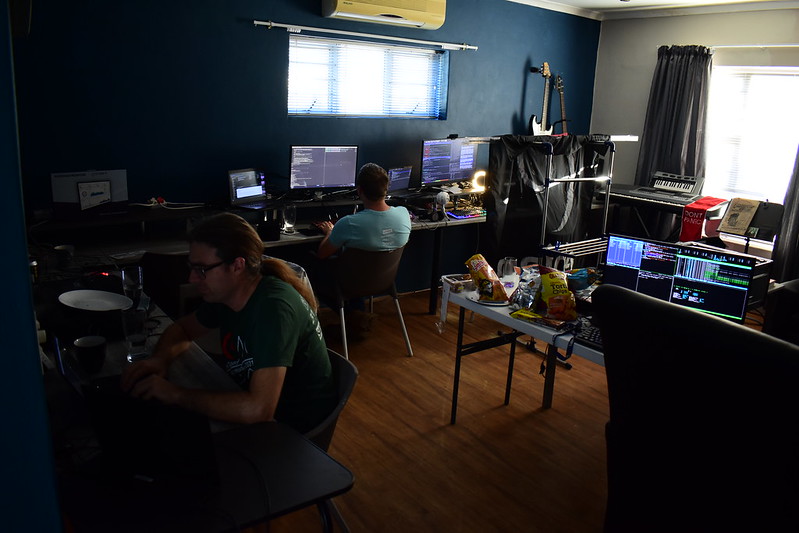
The Debian Videoteam has been sprinting in Cape Town, South Africa -- mostly because with Stefano here for a few months, four of us (Jonathan, Kyle, Stefano, and myself) actually are in the country on a regular basis. In addition to that, two more members of the team (Nicolas and Louis-Philippe) are joining the sprint remotely (from Paris and Montreal). Videoteam sprint (Kyle and Stefano working on things, with me behind the camera and Jonathan busy elsewhere.) We've made loads of progress! Some highlights: The sprint isn't over yet (we're continuing until Sunday), but loads of things have already happened. Stay tuned!

Craig Small: WordPress 6.1

Debian will soon have WordPress version 6.1 I m not really sure of the improvements, but there is a new 2023 theme as part of the update. They really weren t mucking around when they said the 6.0.3 security release would be short-lived. The updates seem to be focused on content creation and making the formatting do what content creators want it to do. For me, I need headings 1 and 2 , paragraphs and preformatted text.

11 November 2022

Debian Brasil: Participa o da comunidade Debian no Latinoware 2022

De 2 a 4 de novembro de 2022 aconteceu a 19 edi o do Latinoware - Congresso Latino-americano de Software Livre e Tecnologias Abertas, em Foz do Igua u. Ap s 2 anos acontecendo de forma online devido a pandemia do COVID-19, o evento voltou a ser presencial e sentimos que a comunidade Debian Brasil deveria estar presente. Nossa ltima participa o no Latinoware foi em 2016 A organiza o do Latinoware cedeu para a comunidade Debian Brasil um estande para que pud ssemos ter contato com as pessoas que visitavam a rea aberta de exposi es e assim divulgarmos o projeto Debian. Durante os 3 dias do evento, o estande foi organizado por mim (Paulo Henrique Santana) como Desenvolvedor Debian, e pelo Leonardo Rodrigues como contribuidor Debian. Infelizmente o Daniel Lenharo teve um imprevisto de ltima hora e n o pode ir para Foz do Igua u (sentimos sua falta l !). Latinoware 2022 estande 1 V rias pessoas visitaram o estande e aquelas mais iniciantes (principalmente estudantes) que n o conheciam o Debian, perguntavam do que se tratava o nosso grupo e a gente explicava v rios conceitos como o que Software Livre, distribui o GNU/Linux e o Debian propriamente dito. Tamb m recebemos pessoas da comunidade de Software Livre brasileira e de outros pa ses da Am rica Latina que j utilizavam uma distribui o GNU/Linux e claro, muitas pessoas que j utilizavam Debian. Tivemos algumas visitas especiais como do Jon maddog Hall, do Desenvolvedor Debian Emeritus Ot vio Salvador, do Desenvolvedor Debian Eriberto Mota, e dos Mantenedores Debian Guilherme de Paula Segundo e Paulo Kretcheu. Latinoware 2022 estande 4 Foto da esquerda pra direita: Leonardo, Paulo, Eriberto e Ot vio. Latinoware 2022 estande 5 Foto da esquerda pra direita: Paulo, Fabian (Argentina) e Leonardo. Al m de conversarmos bastante, distribu mos adesivos do Debian que foram produzidos alguns meses atr s com o patroc nio do Debian para serem distribu dos na DebConf22(e que haviam sobrado), e vendemos v rias camisetas do Debian produzidas pela comunidade Curitiba Livre. Latinoware 2022 estande 2 Latinoware 2022 estande 3 Tamb m tivemos 3 palestras inseridas na programa o oficial do Latinoware. Eu fiz as palestras: como tornar um(a) contribuidor(a) do Debian fazendo tradu es e como os SysAdmins de uma empresa global usam Debian . E o Leonardo fez a palestra: vantagens da telefonia Open Source nas empresas . Latinoware 2022 estande 6 Foto Paulo na palestra. Agradecemos a organiza o do Latinoware por receber mais uma vez a comunidade Debian e gentilmente ceder os espa os para a nossa participa o, e parabenizamos a todas as pessoas envolvidas na organiza o pelo sucesso desse importante evento para a nossa comunidade. Esperamos estar presentes novamente em 2023. Agracemos tamb m ao Jonathan Carter por aprovar o suporte financeiro do Debian para a nossa participa o no Latinoware. Vers o em ingl s

Debian Brasil: About Debian Brasil at Latinoware 2022

From November 2nd to 4th, 2022, the 19th edition of Latinoware - Latin American Congress of Free Software and Open Technologies took place in Foz do Igua u. After 2 years happening online due to the COVID-19 pandemic, the event was back in person and we felt Debian Brasil community should be there. Out last time at Latinoware was in 2016 The Latinoware organization provided the Debian Brazil community with a booth so that we could have contact with people visiting the open exhibition area and thus publicize the Debian project. During the 3 days of the event, the booth was organized by me (Paulo Henrique Santana) as Debian Developer, and by Leonardo Rodrigues as Debian contributor. Unfortunately Daniel Lenharo had an issue and could not travel to Foz do Igua u (we miss you there!). Latinoware 2022 booth 1 A huge number of people visited the booth, and the beginners (mainly students) who didn't know Debian, asked what our group was about and we explained various concepts such as what Free Software is, GNU/Linux distribution and Debian itself. We also received people from the Brazilian Free Software community and from other Latin American countries who were already using a GNU/Linux distribution and, of course, many people who were already using Debian. We had some special visitors as Jon maddog Hall, Debian Developer Emeritus Ot vio Salvador, Debian Developer Eriberto Mota, and Debian Maintainers Guilherme de Paula Segundo and Paulo Kretcheu. Latinoware 2022 booth 4 Photo from left to right: Leonardo, Paulo, Eriberto and Ot vio. Latinoware 2022 estande 5 Photo from left to right: Paulo, Fabian (Argentina) and Leonardo. In addition to talking a lot, we distributed Debian stickers that were produced a few months ago with Debian's sponsorship to be distributed at DebConf22 (and that were left over), and we sold several Debian t-shirts) produced by Curitiba Livre community). Latinoware 2022 booth 2 Latinoware 2022 booth 3 We also had 3 talks included in Latinoware official schedule. I) talked about: "how to become a Debian contributor by doing translations" and "how the SysAdmins of a global company use Debian". And Leonardo) talked about: "advantages of Open Source telephony in companies". Latinoware 2022 booth 6 Photo Paulo in his talk. Many thanks to Latinoware organization for once again welcoming the Debian community and kindly providing spaces for our participation, and we congratulate all the people involved in the organization for the success of this important event for our community. We hope to be present again in 2023. We also thank Jonathan Carter for approving financial support from Debian for our participation at Latinoware. Portuguese version

Reproducible Builds: Reproducible Builds in October 2022

Welcome to the Reproducible Builds report for October 2022! In these reports we attempt to outline the most important things that we have been up to over the past month. As ever, if you are interested in contributing to the project, please visit our Contribute page on our website.

Our in-person summit this year was held in the past few days in Venice, Italy. Activity and news from the summit will therefore be covered in next month s report!
A new article related to reproducible builds was recently published in the 2023 IEEE Symposium on Security and Privacy. Titled Taxonomy of Attacks on Open-Source Software Supply Chains and authored by Piergiorgio Ladisa, Henrik Plate, Matias Martinez and Olivier Barais, their paper:
[ ] proposes a general taxonomy for attacks on opensource supply chains, independent of specific programming languages or ecosystems, and covering all supply chain stages from code contributions to package distribution.
Taking the form of an attack tree, the paper covers 107 unique vectors linked to 94 real world supply-chain incidents which is then mapped to 33 mitigating safeguards including, of course, reproducible builds:
Reproducible Builds received a very high utility rating (5) from 10 participants (58.8%), but also a high-cost rating (4 or 5) from 12 (70.6%). One expert commented that a reproducible build like used by Solarwinds now, is a good measure against tampering with a single build system and another claimed this is going to be the single, biggest barrier .

It was noticed this month that Solarwinds published a whitepaper back in December 2021 in order to:
[ ] illustrate a concerning new reality for the software industry and illuminates the increasingly sophisticated threats made by outside nation-states to the supply chains and infrastructure on which we all rely.
The 12-month anniversary of the 2020 Solarwinds attack (which SolarWinds Worldwide LLC itself calls the SUNBURST attack) was, of course, the likely impetus for publication.
Whilst collaborating on making the Cyrus IMAP server reproducible, Ellie Timoney asked why the Reproducible Builds testing framework uses two remarkably distinctive build paths when attempting to flush out builds that vary on the absolute system path in which they were built. In the case of the Cyrus IMAP server, these happened to be: Asked why they vary in three different ways, Chris Lamb listed in detail the motivation behind to each difference.
On our mailing list this month:
The Reproducible Builds project is delighted to welcome openEuler to the Involved projects page [ ]. openEuler is Linux distribution developed by Huawei, a counterpart to it s more commercially-oriented EulerOS.

Debian Colin Watson wrote about his experience towards making the databases generated by the man-db UNIX manual page indexing tool:
One of the people working on [reproducible builds] noticed that man-db s database files were an obstacle to [reproducibility]: in particular, the exact contents of the database seemed to depend on the order in which files were scanned when building it. The reporter proposed solving this by processing files in sorted order, but I wasn t keen on that approach: firstly because it would mean we could no longer process files in an order that makes it more efficient to read them all from disk (still valuable on rotational disks), but mostly because the differences seemed to point to other bugs.
Colin goes on to describe his approach to solving the problem, including fixing various fits of internal caching, and he ends his post with None of this is particularly glamorous work, but it paid off .
Vagrant Cascadian announced on our mailing list another online sprint to help clear the huge backlog of reproducible builds patches submitted by performing NMUs (Non-Maintainer Uploads). The first such sprint took place on September 22nd, but another was held on October 6th, and another small one on October 20th. This resulted in the following progress:
41 reviews of Debian packages were added, 62 were updated and 12 were removed this month adding to our knowledge about identified issues. A number of issue types were updated too. [1][ ]
Lastly, Luca Boccassi submitted a patch to debhelper, a set of tools used in the packaging of the majority of Debian packages. The patch addressed an issue in the dh_installsysusers utility so that the postinst post-installation script that debhelper generates the same data regardless of the underlying filesystem ordering.

Other distributions F-Droid is a community-run app store that provides free software applications for Android phones. This month, F-Droid changed their documentation and guidance to now explicitly encourage RB for new apps [ ][ ], and FC Stegerman created an extremely in-depth issue on GitLab concerning the APK signing block. You can read more about F-Droid s approach to reproducibility in our July 2022 interview with Hans-Christoph Steiner of the F-Droid Project. In openSUSE, Bernhard M. Wiedemann published his usual openSUSE monthly report.

Upstream patches The Reproducible Builds project detects, dissects and attempts to fix as many currently-unreproducible packages as possible. We endeavour to send all of our patches upstream where appropriate. This month, we wrote a large number of such patches, including:

diffoscope diffoscope is our in-depth and content-aware diff utility. Not only can it locate and diagnose reproducibility issues, it can provide human-readable diffs from many kinds of binary formats. This month, Chris Lamb prepared and uploaded versions 224 and 225 to Debian:
  • Add support for comparing the text content of HTML files using html2text. [ ]
  • Add support for detecting ordering-only differences in XML files. [ ]
  • Fix an issue with detecting ordering differences. [ ]
  • Use the capitalised version of Ordering consistently everywhere in output. [ ]
  • Add support for displaying font metadata using ttx(1) from the fonttools suite. [ ]
  • Testsuite improvements:
    • Temporarily allow the stable-po pipeline to fail in the CI. [ ]
    • Rename the order1.diff test fixture to json_expected_ordering_diff. [ ]
    • Tidy the JSON tests. [ ]
    • Use assert_diff over get_data and an manual assert within the XML tests. [ ]
    • Drop the ALLOWED_TEST_FILES test; it was mostly just annoying. [ ]
    • Tidy the tests/test_source.py file. [ ]
Chris Lamb also added a link to diffoscope s OpenBSD packaging on the diffoscope.org homepage [ ] and Mattia Rizzolo fix an test failure that was occurring under with LLVM 15 [ ].

Testing framework The Reproducible Builds project operates a comprehensive testing framework at tests.reproducible-builds.org in order to check packages and other artifacts for reproducibility. In October, the following changes were made by Holger Levsen:
  • Run the logparse tool to analyse results on the Debian Edu build logs. [ ]
  • Install btop(1) on all nodes running Debian. [ ]
  • Switch Arch Linux from using SHA1 to SHA256. [ ]
  • When checking Debian debstrap jobs, correctly log the tool usage. [ ]
  • Cleanup more task-related temporary directory names when testing Debian packages. [ ][ ]
  • Use the cdebootstrap-static binary for the 2nd runs of the cdebootstrap tests. [ ]
  • Drop a workaround when testing OpenWrt and coreboot as the issue in diffoscope has now been fixed. [ ]
  • Turn on an rm(1) warning into an info -level message. [ ]
  • Special case the osuosl168 node for running Debian bookworm already. [ ][ ]
  • Use the new non-free-firmware suite on the o168 node. [ ]
In addition, Mattia Rizzolo made the following changes:
  • Ensure that 2nd build has a merged /usr. [ ]
  • Only reconfigure the usrmerge package on Debian bookworm and above. [ ]
  • Fix bc(1) syntax in the computation of the percentage of unreproducible packages in the dashboard. [ ][ ][ ]
  • In the index_suite_ pages, order the package status to be the same order of the menu. [ ]
  • Pass the --distribution parameter to the pbuilder utility. [ ]
Finally, Roland Clobus continued his work on testing Live Debian images. In particular, he extended the maintenance script to warn when workspace directories cannot be deleted. [ ]
If you are interested in contributing to the Reproducible Builds project, please visit our Contribute page on our website. However, you can get in touch with us via:

Enrico Zini: Sharing argparse arguments with subcommands

argparse subcommands are great, but they have a quirk in which options are only available right after the subcommand that define them. So, if you for example add the --verbose / -v argument to your main parser, and you have subcommands, you need to give the -v option before the subcommand name. For example, given this script:
#!/usr/bin/python3
import argparse
parser = argparse.ArgumentParser(description="test")
parser.add_argument("-v", "--verbose", action="store_true")
subparsers = parser.add_subparsers(dest="handler", required=True)
subparsers.add_parser("test")
args = parser.parse_args()
print(args.verbose)
You get this behaviour:
$ ./mycmd test
False
$ ./mycmd -v test
True
$ ./mycmd test -v
usage: mycmd [-h] [-v]  test  ...
mycmd: error: unrecognized arguments: -v
This sometimes makes sense, and many other times it's really annoying, since the user has to remember at which level an option was defined. Last night some pieces clicked in my head, and I created a not-too-dirty ArgumentParser subclass that adds a shared option to arguments, that propagates them to subparsers:
#!/usr/bin/python3
from hacks import argparse
parser = argparse.ArgumentParser(description="test")
parser.add_argument("-v", "--verbose", action="store_true", shared=True)
subparsers = parser.add_subparsers(dest="handler", required=True)
subparsers.add_parser("test")
args = parser.parse_args()
print(args.verbose)
And finally, -v can be given at all levels:
$ ./mycmd test
False
$ ./mycmd -v test
True
$ ./mycmd test -v
True
It even works recursively, forwarding arguments to sub-subparsers, but at the moment it can only do it for store_true and store kind of arguments.

10 November 2022

Melissa Wen: V3D enablement in mainline kernel

Hey, If you enjoy using upstream Linux kernel in your Raspberry Pi system or just want to give a try in the freshest kernel graphics drivers there, the good news is that now you can compile and boot the V3D driver from the mainline in your Raspberry Pi 4. Thanks to the work of Stefan, Peter and Nicolas [1] [2], the V3D enablement reached the Linux kernel mainline. That means hacking and using new features available in the upstream V3D driver directly from the source. However, even for those used to compiling and installing a custom kernel in the Raspberry Pi, there are some quirks to getting the mainline v3d module available in 32-bit and 64-bit systems. I ve quickly summarized how to compile and install upstream kernel versions (>=6.0) in this short blog post.
Note: V3D driver is not present in Raspberry Pi models 0-3.
First, I m taking into account that you already know how to cross-compile a custom kernel to your system. If it is not your case, a good tutorial is already available in the Raspberry Pi documentation, but it targets the kernel in the rpi-linux repository (downstream kernel). From this documentation, the main differences in the upstream kernel are presented below:

Raspberry Pi 4 64-bit (arm64)

Diff short summary:
  1. instead of getting the .config file from bcm2711_defconfig, get it by running make ARCH=arm64 defconfig
  2. compile and install the kernel image and modules as usual, but just copy the dtb file arch/arm64/boot/dts/broadcom/bcm2711-rpi-4-b.dtb to the /boot of your target machine (no /overlays directory to copy)
  3. change /boot/config.txt:
    • comment/remove the dt_overlay=vc4-kms-v3d entry
    • add a device_tree=bcm2711-rpi-4-b.dtb entry

Raspberry Pi 4 32-bits (arm)

Diff short summary:
  1. get the .config file by running make ARCH=arm multi_v7_defconfig
  2. using make ARCH=arm menuconfig or a similar tool, enable CONFIG_ARM_LPAE=y
  3. compile and install the kernel image and modules as usual, but just copy the dtb file arch/arm/boot/dts/bcm2711-rpi-4-b.dtb to the /boot of your target machine (no /overlays directory to copy)
  4. change /boot/config.txt:
    • comment/remove the dt_overlay=vc4-kms-v3d entry
    • add a device_tree=bcm2711-rpi-4-b.dtb entry

Step-by-step for remote deployment:

Set variables Raspberry Pi 4 64-bit (arm64)
cd <path-to-upstream-linux-directory>
KERNEL= make kernelrelease 
ARCH="arm64"
CROSS_COMPILE="aarch64-linux-gnu-"
DEFCONFIG=defconfig
IMAGE=Image
DTB_PATH="broadcom/bcm2711-rpi-4-b.dtb"
RPI4=<ip>
TMP= mktemp -d 
Raspberry Pi 4 32-bits (arm)
cd <path-to-upstream-linux-directory>
KERNEL= make kernelrelease 
ARCH="arm"
CROSS_COMPILE="arm-linux-gnueabihf-"
DEFCONFIG=multi_v7_defconfig
IMAGE=zImage
DTB_PATH="bcm2711-rpi-4-b.dtb"
RPI4=<ip>
TMP= mktemp -d 

Get default .config file
make ARCH=$ARCH CROSS_COMPILE=$CROSS_COMPILE $DEFCONFIG
Raspberry Pi 4 32-bit (arm) Additional step for 32-bit system. Enable CONFIG_ARM_LPAE=y using make ARCH=arm menuconfig

Cross-compile the mainline kernel
make ARCH=$ARCH CROSS_COMPILE=$CROSS_COMPILE $IMAGE modules dtbs

Install modules to send
make ARCH=$ARCH CROSS_COMPILE=$CROSS_COMPILE INSTALL_MOD_PATH=$TMP modules_install

Copy kernel image, modules and the dtb to your remote system
ssh $RPI4 mkdir -p /tmp/new_modules /tmp/new_kernel
rsync -av $TMP/ $RPI4:/tmp/new_modules/
scp arch/$ARCH/boot/$IMAGE $RPI4:/tmp/new_kernel/$KERNEL
scp arch/$ARCH/boot/dts/$DTB_PATH $RPI4:/tmp/new_kernel
ssh $RPI4 sudo rsync -av /tmp/new_modules/lib/modules/ /lib/modules/
ssh $RPI4 sudo rsync -av /tmp/new_kernel/ /boot/
rm -rf $TMP

Set config.txt of you RPi 4 In your Raspberry Pi 4, open the config file /boot/config.txt
  • comment/remove the dt_overlay=vc4-kms-v3d entry
  • add a device_tree=bcm2711-rpi-4-b.dtb entry
  • add a kernel=<image-name> entry

Why not Kworkflow? You can safely use the steps above, but if you are hacking the kernel and need to repeat this compiling and installing steps repeatedly, why don t try the Kworkflow? Kworkflow is a set of scripts to synthesize all steps to have a custom kernel compiled and installed in local and remote machines and it supports kernel building and deployment to Raspberry Pi machines for Raspbian 32 bit and 64 bit. After learning the kernel compilation and installation step by step, you can simply use kw bd command and have a custom kernel installed in your Raspberry Pi 4.
Note: the userspace 3D acceleration (glx/mesa) is working as expected on arm64, but the driver is not loaded yet for arm. Besides that, a bunch of pte invalid errors may appear when using 3D acceleration, it s a known issue that are still under investigation.

Shirish Agarwal: The Road to Gandolfo, Webforms, Hearing Loss info & Mum s Birthday.

The Road to Gandolfo I think I had read this book almost 10-12 years back and somehow ended up reading it up again. Apparently, he had put this fiction, story, book under some other pen name earlier. It is possible that I might have read it under that name and hence forgotten all about it. This book/story is full of innuendo, irony, sarcasm and basically the thrill of life. There are two main characters in the book, the first is General Mackenzie who has spent almost 3 to 4 decades being a spy/a counterintelligence expert in the Queen s service. And while he outclasses them all even at the ripe age of 50, he is thrown out under the pretext of conduct unbecoming of an officer. The other main character is Sam Devereaux. This gentleman is an army lawyer and is basically counting the days when he completes his tour of duty as a military lawyer and start his corporate civil law with somebody he knows. It is much to his dismay that while under a week is left for his tour of duty to be left over he is summoned to try and extradite General MacKenzie who has been put on house arrest. Apparently, in China there was a sculpture of a great Chinese gentleman in the nude. For reasons unknown or rather not being shared herein, he basically breaks part of the sculpture. This of course, enrages the Chinese and they call it a diplomatic accident and try to put the General into house arrest. Unfortunately for both the General and his captors, he decides to escape/go for it. While he does succeed entering the American embassy, he finds himself to be person non-grata and is thrown back outside where the Chinese recapture him. This is where the Embassy & the Govt. decide it would be better if somehow the General could be removed from China permanently so he doesn t cause any further diplomatic accidents. In order to do that Sam s services are bought. Now in order to understand the General, Sam learns that he has 4 ex-wives. He promptly goes and meet them to understand why the general behaved as he did. He apparently also peed on the American flag. To his surprise, all the four ex-wives are still very much in with the general. During the course of interviewing the ladies he is seduced by them and also gives names to their chests in order to differentiate between each one of them. Later he is seduced by the eldest of the four wives and they spend the evening together. Next day Sam meets and is promptly manhandled by the general and the diplomatic papers are seen by the general. After meeting the general and the Chinese counterpart, they quickly agree to extradite him as they do not know how to keep the general control. During his stay of house arrest, the General reads one of the communist rags as he puts it and gets the idea to kidnap the pope and that forms the basis of the story. Castel Gandolfo seems to be a real place which is in Italy and is apparently is the papal residence where s/he goes to reside every winter. The book is written in 1976 hence in the book, the General decides to form a corporation for which he would raise funds in order to make the kidnapping. The amount in 1976 was 40 million dollars and it was a big sum, to be with times, let s think of say 40 billion dollars so gets the scale of things. Now while a part of me wants to tell the rest of the story, the story isn t really mine to tell. Read The Road to Gandolfo for the rest. While I can t guarantee you much, I can say you might find yourself constantly amused by the antics of both the General, Sam and the General s ex-wives. There are also a few minute characters that you will meet on the way, hope you discover them and enjoy it immensely as I have. One thing I have to say, while I was reading it, I very much got vibes of Not a penny more, not a penny less by Jeffrey Archer. As shared before, lots of twists and turns, enjoy the ride

Webforms Webforms are nothing but a form you fill on the web or www. Webforms are and were a thing from early 90s to today. I was supposed to register for https://www.swavlambancard.gov.in/ almost a month back but procrastinated till few couple of days back and with good reason. I was hoping one of my good friends would help me but they had their own thing. So finally, I tried to fill the form few days back. It took me almost 30 odd attempts to finally fill the form and was given an enrollment number. Why it took me 30 odd attempts and with what should tell you the reason
  1. I felt like I was filling the form from 1990 s rather than today because
  2. The form doesn t know either its state or saves data during a session This lesson has been learned a long time back by almost all service providers except Govt. of India. Both the browsers on a mobile as well as desktop can save data during session. If you don t know what I mean by that go to about:preferences#privacy in Firefox and look at Manage Data. There you will find most sites do put some data along with cookies arguably to help make your web experience better. Chrome or Chromium has the same thing perhaps shared under a different name but its the same thing. But that is not all.
  3. None of the fields have any verification. The form is of 3 pages. The verification at the end of the document doesn t tell you what is wrong and what needs to be corrected. Really think on this, I am on a 24 LED monitor and I m filling the form and I had to do it at least 20-30 times before it was accepted. And guess what, I have no clue even about why it was selected. The same data, the same everything and after the nth time it accepted. Now if I am facing such a problem when I have some idea how technology works somewhat how are people who are trying to fill this form on 6 mobiles supposed to do? And many of them not at all clued in technology as I am.
I could go on outlining many of the issues that I faced but they are all similar in many ways the problems faced while filling the NEW Income Tax forms. Of course the New Income Tax portal is a whole ball-game in itself as it gives new errors every time instead of solving them. Most C.A. s have turned to third-party xml tools that enable you to upload xml compliant data to the New Income tax portal but this is for businesses and those who can afford it. Again, even that is in a sort of messy state but that is a whole another tale altogether. One of the reasons to my mind why the forms are designed the way they are so that people go to specific cybercafes or get individual people to fill and upload it and make more money. I was told to go to a specific cybercafe and meet a certain individual and he asked for INR 500/- to do the work. While I don t have financial problems, I was more worried about my data going into the wrong hands. But I can see a very steady way to make money without doing much hard work.

Hearing Loss info. Now because I had been both to Kamla Nehru Hospital as well as Sasoon and especially the deaf department, I saw many kids with half-formed ears. I had asked the doctors and they had shared this is due to malnutrition. We do know that women during pregnancies need more calories, more everything as they are eating for two bodies, not one. And this is large-scale, apparently more than 5 percent of population have children like this. And this number was of 2014, what is it today nobody knows. I also came to know that at least for some people like me, due to Covid they became deaf. I had asked the doctors if they knew of people who had become deaf due to Covid. They basically replied in the negative as they don t have the resources to monitor the same. The Govt. has an idea of health ID but just like Aadhar has to many serious sinister implications. Somebody had shared with me a long time back that in India systems work inspite of Govt. machinery rather than because of it. Meaning that the Government itself ties itself into several knots and then people have to be creative to try and figure a way out to help people. I found another issue while dealing with them. Apparently, even though I have 60% hearing loss I would be given a certificate of 40% hearing loss and they call it Temporary Progressive Loss. I saw almost all the people who had come, many of them having far severe defencies than me getting the same/similar certificate. All of them got Temporary Progressive. Some of the cases were real puzzling. For e.g. I met another Agarwal who had a severe accident few months ago and there is some kind of paralysis & bone issue. The doctors have given up but even that gentleman was given Temporary Progressive. From what little I could understand, the idea is that over period if there is possibility of things becoming better then it should be given. Another gentleman suffered a case of dwarfism. Even he was given the same certificate. Think there have been orders from above so that people even having difficulties are not helped. Another point if you look in a macro sense, it presents a somewhat rosy picture. If someone were to debunk the Govt. data either from India or abroad then from GOI perspective they have an agenda even though the people who are suffering are our brothers and sisters  And all of this is because I can read, write, articulate. Perhaps many of them may not even have a voice or a platform. Even to get this temporary progressive disability certificate there is more than 4 months of running from one place to the other, 4 months of culmination of work. This I can share and tell from my experience, who knows how much else others might have suffered for the same. In my case a review will happen after 5 years, in most other cases they have given only 1 year. Of course, this does justify people s jobs and perhaps partly it may be due to that. Such are times where I really miss that I am unable to hear otherwise could have fleshed out lot more other people s sufferings. And just so people know/understand this is happening in the heart of the city whose population easily exceeds 6 million plus and is supposed to be a progressive city. I do appreciate and understand the difficulties that the doctors are placed under.

Mum s Birthday & Social Engineering. While I don t want to get into details, in the last couple of weeks mum s birthday was there and that had totally escaped me. I have been trying to disassociate myself from her and at times it s hard and then you don t remember and somebody makes you remember. So, on one hand guilty, and the other do not know what to do. If she were alive I would have bought a piece of cake or something. Didn t feel like it, hence donated some money to the local aged home. This way at least I hope they have some semblance of peace. All of them are of her similar age group. The other thing that I began to observe in the earnest, fake identities have become the norm. Many people took elon musk s potrait using their own names in the handles, but even then Elon Free Speech Musk banned them. So much for free speech. Then I saw quite a few handles that have cute women as their profile picture but they are good at social engineering. This has started only a couple of weeks back and have seen quite a few handles leaving Twitter and joining Mastodon. Also, have been hearing that many admins of Mastodon pods are unable to get on top of this. Also, lot of people complaining as it isn t user-friendly UI as twitter is. Do they not realize that Twitter has its own IP and any competing network can t copy or infringe on their product. Otherwise, they will be sued like how Ford was & potentially win. I am not really gonna talk much about it as the blog post has become quite long and that needs its own post to do any sort of justice to it. Till later people

Alastair McKinstry: Government approves T&Cs for first offshore wind auction under the ...

Government approves T&Cs for first offshore wind auction under the Renewable Electricity Support Scheme ORESS 1 expected to secure 2.5GW of electricity generating capacity #GreensInGovernment The Government has today approved the Terms and Conditions of ORESS 1, the first auction for offshore wind under the Renewable Electricity Support Scheme. This is a seminal moment in the delivery of offshore wind in Ireland. The offshore auction, the first in Ireland's history, is expected to provide a route to market for up to 2.5GW of offshore renewable energy to the Irish grid, enough to power 2.5 million Irish homes with clean electricity. Coming during the weeks of COP27, publishing details of the auction sends a strong international signal that Ireland is serious about offshore energy and our national climate targets and obligations. Recognising the critical role of local hosting communities in the development of this critical infrastructure, all offshore wind projects developed via ORESS will be required to make Community Benefit Fund contributions, from construction phase and continuing for the duration of the support period, typically for a total period of 25 years. This will result in lasting, tangible benefits for these communities. Speaking about this development, Minister Ryan said: The publication of these ORESS 1 Terms and Conditions is another massive step forward for offshore wind, for Irish climate leadership and towards Ireland s future as an international green energy hub. The first stage of this transformative auction will start before Christmas and it sets us on a path to powering many more of our homes and businesses from our own green energy resources over the coming years. It follows the enactment of the Maritime Area Planning Act last year, and the announcement regarding the awarding of Maritime Area Consents to Phase One projects last month. A final ORESS 1 auction calendar will be published by EirGrid shortly. The pre-qualification stage will launch next month (December). The qualification stage and the auction process will take place in the first half of 2023. Final auction results will be published by June 2023. Eligible projects Any project that has been awarded a Maritime Area Consent is eligible to partake in the ORESS 1 auction. Seven projects known as Relevant Projects were deemed ready to apply for Maritime Area Consents in Spring 2022. Once Maritime Area Consents are granted, these projects can not only compete for State support via the ORESS, but can also apply for planning permission from An Bord Plean la. Delivering on our broader targets ORESS 1 is expected to procure approximately 2.5GW of electricity generating capacity. Further auctions will be required to meet our renewable energy and climate ambitions. At least three offshore energy auctions are currently planned for this decade. The aim is to progress enough viable offshore projects through the consenting system to have competitive auctions. This will ultimately drive down cost for electricity consumers.

Dirk Eddelbuettel: RcppArmadillo 0.11.4.2.1 on CRAN: Updates

armadillo image Armadillo is a powerful and expressive C++ template library for linear algebra and scientific computing. It aims towards a good balance between speed and ease of use, has a syntax deliberately close to Matlab, and is useful for algorithm development directly in C++, or quick conversion of research code into production environments. RcppArmadillo integrates this library with the R environment and language and is widely used by (currently) 1027 packages other packages on CRAN, downloaded 26.9 million times (per the partial logs from the cloud mirrors of CRAN), and the CSDA paper (preprint / vignette) by Conrad and myself has been cited 503 times according to Google Scholar. This release reflect as new upstream bugfix release 11.4.2 made recently by Conrad. To accomodate CRAN and their preference for at most a release per month, we held it back since the 11.4.0 release early October. As we usually do, we generally update once upstream Armadillo releases are made. When we do not immediately release to CRAN (in order to lower the release cadence), we make those interim releases available via GitHub source and the Rcpp drat repo. This release also brings a rearranged, and as we think, simplified layout of the header files. All existing locations are still supported but we will be starting a (very patient and slow) transition at some point. The full set of changes (since the last CRAN release 0.11.4.0.1) follows.

Changes in RcppArmadillo version 0.11.4.2.1 (2022-11-08)
  • Upgraded to Armadillo release 11.4.2 (Ship of Theseus)
    • more robust handling of corner cases in multi-threaded contexts
  • Internal header organisation with new sub-directories while providing full compatibility via existing paths (#395 #396)

Changes in RcppArmadillo version 0.11.4.1.0 (2022-10-10) (GitHub Only)
  • Upgraded to Armadillo release 11.4.1 (Ship of Theseus)
    • fix data race in Cube::slice()
    • workarounds for false warnings emitted by GCC 12 when compiling with FORTIFY_SOURCE enabled (already in RcppArmadillo 0.11.4.0.1 too)

Courtesy of my CRANberries, there is a diffstat report relative to previous release. More detailed information is on the RcppArmadillo page. Questions, comments etc should go to the rcpp-devel mailing list off the R-Forge page. If you like this or other open-source work I do, you can sponsor me at GitHub.

This post by Dirk Eddelbuettel originated on his Thinking inside the box blog. Please report excessive re-aggregation in third-party for-profit settings.

9 November 2022

Debian Brasil: Brasileiros(as) Mantenedores(as) e Desenvolvedores(as) Debian a partir de julho de 2015

Desde de setembro de 2015, o time de publicidade do Projeto Debian passou a publicar a cada dois meses listas com os nomes dos(as) novos(as) Desenvolvedores(as) Debian (DD - do ingl s Debian Developer) e Mantenedores(as) Debian (DM - do ingl s Debian Maintainer). Estamos aproveitando estas listas para publicar abaixo os nomes dos(as) brasileiros(as) que se tornaram Desenvolvedores(as) e Mantenedores(as) Debian a partir de julho de 2015. Desenvolvedores(as) Debian / Debian Developers / DDs: Marcos Talau Fabio Augusto De Muzio Tobich Gabriel F. T. Gomes Thiago Andrade Marques M rcio de Souza Oliveira Paulo Henrique de Lima Santana Samuel Henrique S rgio Durigan J nior Daniel Lenharo de Souza Giovani Augusto Ferreira Adriano Rafael Gomes Breno Leit o Lucas Kanashiro Herbert Parentes Fortes Neto Mantenedores(as) Debian / Debian Maintainers / DMs: Guilherme de Paula Xavier Segundo David da Silva Polverari Paulo Roberto Alves de Oliveira Sergio Almeida Cipriano Junior Francisco Vilmar Cardoso Ruviaro William Grzybowski Tiago Ilieve
Observa es:
  1. Esta lista ser atualizada quando o time de publicidade do Debian publicar novas listas com DMs e DDs e tiver brasileiros.
  2. Para ver a lista completa de Mantenedores(as) e Desenvolvedores(as) Debian, inclusive outros(as) brasileiros(as) antes de julho de 2015 acesse: https://nm.debian.org/public/people

8 November 2022

Aurelien Jarno: riscv64 porterbox

For quite some time, many people asked for a riscv64 porterbox. Now we've got one called debian-riscv64-porterbox-01.debian.net. A big thanks to SiFive for providing the HiFive Unmatched board and OSUOSL for assembling the hardware and hosting it.

Daniel Lange: Your software stores are a bad idea

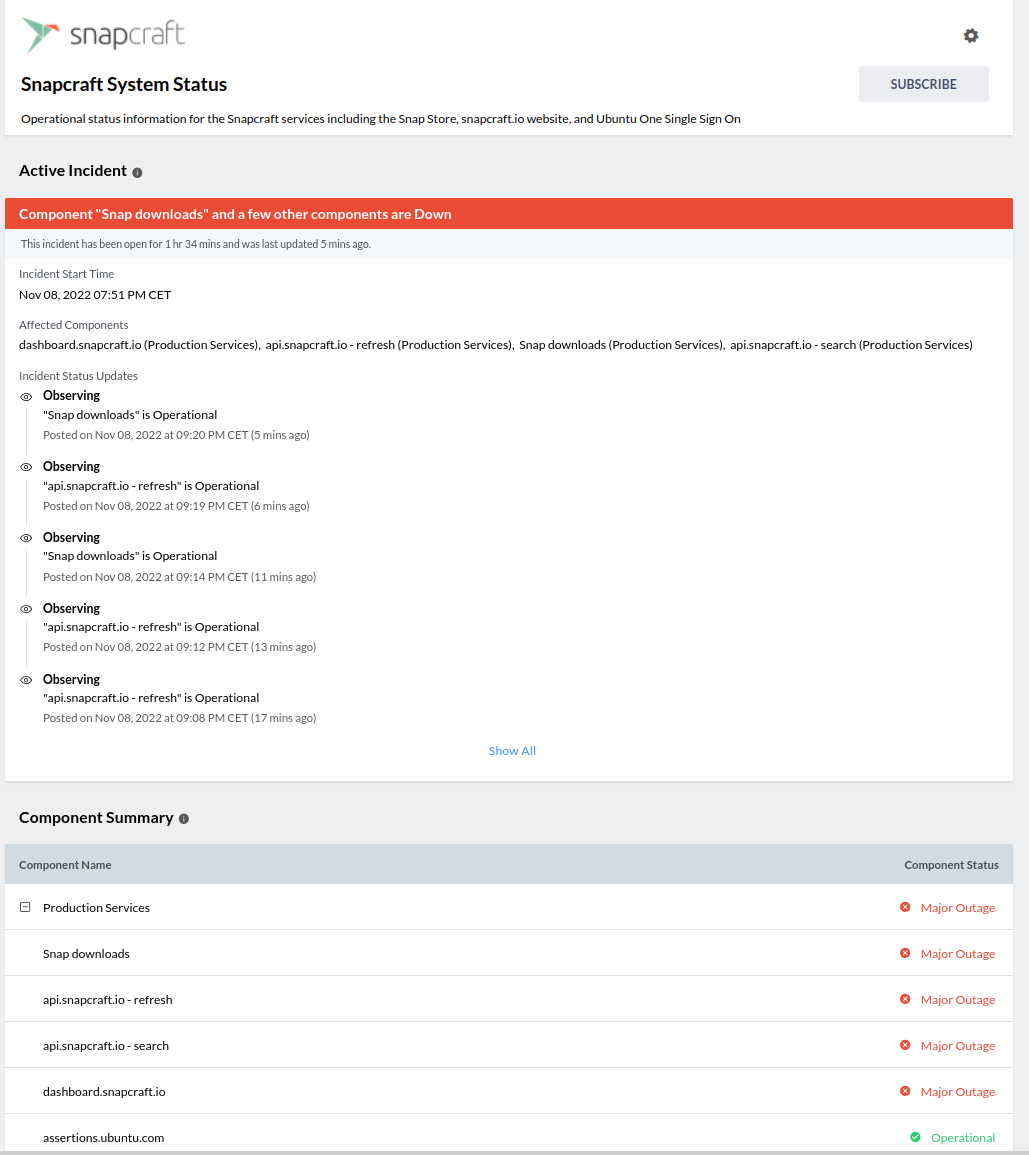
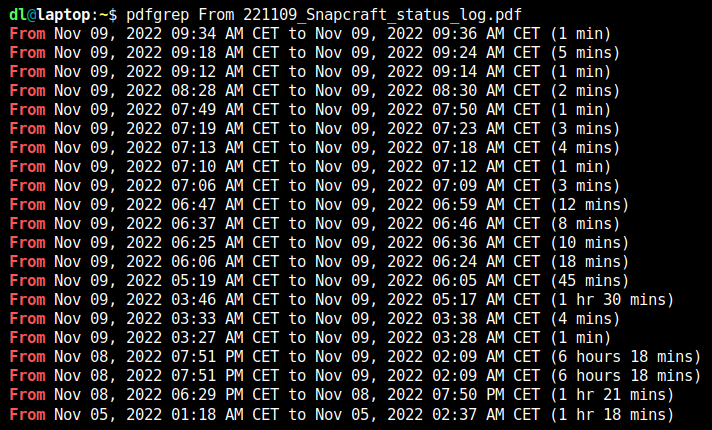
There is significant effort involved to get your apt or dnf commands always have a consistent set of servers to talk to. That's why running separate "software stores" is a bad idea: Snap software store down That way more admins need to learn how to run high availability services for dubious business opportunities to "later" monetize services. Services that nobody cares to pay for and thus opportunities that never materialize. But every company wants to find that out again. Because if Apple could do it, why shouldn't Canonical be able to do it? $$$!1!! So, can't update Firefox on Ubuntu 22.04 right now. At least there is https://status.snapcraft.io/: Snap incodent / monitoring status page So I can check back tomorrow if I can update my web browser ... Update 09.11.2022 12:15 CET The Snapcraft distribution system seems quite flaky, this is the downtime log: Log of (frequent) Snapcraft outages Bonus points for the bad client side implementation:

dl@laptop:~$ sudo snap refresh
All snaps up to date.

# ^this is a lie, just close Firefox and ...

dl@laptop:~$ sudo snap refresh
firefox 106.0.5-1 from Mozilla** refreshed

Antoine Beaupr : Using the bell as modern notification

Computer terminals have traditionally had an actual bell that would ring when a certain control character (the bell character, typically control-g or \a in an C escape sequence) would come in the input stream. That feature actually predates computers altogether, and was present in Baudot code, "an early character encoding for telegraphy invented by mile Baudot in the 1870s", itself superseding Morse code. Modern terminal emulators have, of course, kept that feature: if you run this command in a terminal right now:
printf '\a'
... you may hear some annoying beep. Or not. It actually depends on a lot of factors, including which terminal emulator you're using, how it's configured, whether you have headphones on, or speakers connected, or, if you're really old school, a PC speaker, even. Typically, I have this theory that it does the exact opposite of what you want, regardless of whether you have configured it or not. That is, if you want it to make noises, it won't, and if you want it to stay silent, it will make brutal, annoying noises in moments you would the least expect. I suspect this is a law in computer science, but I'm too lazy to come up with a formal definition. Yet something can be done with this.

Making the bell useful and silent Many terminal emulators have this feature where they can silence the bell somehow. It can be turned into a "visual bell" which basically flashes the screen when a bell arrives. Or that can also be disabled and the bell is just completely ignored. What I did instead is turn the bell into a "urgency hint" (part of the ICCCM standard. In xterm, this is done with this X resource entry (typically in ~/.Xresources):
XTerm*bellIsUrgent:  true
XTerm*visualBell: false
Interestingly, this doesn't clearly say "bell is muted", but it's effectively what it does. Or maybe it works because I have muted "System Sounds" in Pulseaudio. Who knows. I do have this in my startup scripts though:
xset b off
... which, according to the xset(1) manpage, means
If the dash or 'off' are given, the bell will be turned off.
Interestingly, you have the option of setting the bell "volume", "pitch, in hertz, and [...] duration in milliseconds. Note that not all hardware can vary the bell characteristics." In any case, I think that's the magic trick to turn the darn thing off. Now this should send urgency hints to your window manager:
sleep 3 ; printf '\a'
Try it: run the command, switch to another desktop, then wait 3 seconds. You should see the previous desktop show up in red or something. In the i3 window manager I am currently using, this is the default, although I did set the colors (client.urgent and urgent_workspace in bar.colors). Other window managers or desktop environments may require different configurations.

Sending a bell... Now that, on itself, will only be useful when something sets a bell. One place I had found a trick like this, long ago, is this post (dead link, archived) which has various instructions for different tools. I'll recopy some of them here since the original site is dead, but credit goes to the Netbuz blog. (Note that the blog post also features an Awesome WM configuration for urgency hints.)

Mutt
set beep=yes
set beep_new=yes

Irssi
/set beep_when_window_active ON
/set beep_when_away ON
/set beep_msg_level MSGS DCC DCCMSGS HILIGHT
It was also recommending this setting, but it appears to be deprecated and gives a warning in modern irssi versions:
/set bell_beeps ON

GNU Screen This is an important piece of the puzzle, because by default, terminal multiplexers have their own opinion of what to do with the bell as well:
# disabled: we want to propagate bell to clients, which should handle
# it in their own terminal settings. this  vbell off  is also the
# upstream and tmux's default
#
# see also: http://netbuz.org/blog/2011/11/x-bells-and-urgency-hints/
vbell off
# propagate bell from other windows up to the terminal emulator as well
bell_msg 'Bell in window %n^G'
The bell_msg bit is an extra from me: it uses the bell message that pops up when screen detects a bell in another window to resend the bell control character up to the running terminal. This makes it so a bell in any multiplexed window will also propagate to the parent terminal, which is not the default.

Tmux Untested, but that is apparently how you do it:
# listen to alerts from all windows
set -g bell-action any
# notice bell in windows
set -g monitor-bell on
# only propagate bell, don't warn user, as it hangs tmux for a second
set -g visual-bell off
# send bell *and* notify when activity (if monitor-activity)
set -g visual-activity both
Note that this config goes beyond what we have in GNU screen in that inactivity or activity will trigger a bell as well. This might be useful for cases where you don't have the prompt hack (below) but it could also very well be very noisy. It will only generate noise when monitor-activity is enabled though.

bash and shell prompts Now the icing on cake is to actually send the bell when a command completes. This is what I use this for the most, actually. I was previously using undistract-me for this, actually. That was nice: it would send me a nice desktop notification when a command was running more than a certain amount of time, and if the window was unfocused. But configuring this was a nightmare: because it uses a complex PROMPT_COMMAND in bash, it would conflict with my (already existing and way too) complex bash prompt, and lead to odd behaviors. It would also not work for remote commands, of course, as it wouldn't have access to my local D-BUS to send notifications (thankfully!). So instead, what I do now is systematically print a bell whenever a command terminates, in all my shells. I have this in my /root/.bashrc on all my servers, deployed in Puppet:
PROMPT_COMMAND='printf "\a"'
Or you can just put it directly in the shell prompt, with something like:
PS1='\[\a\]'"$PS1"
(I have the equivalent in my own .bashrc, although that thing is much more complex, featuring multi-command pipeline exit status, colors, terminal title setting, and more, which should probably warrant its own blog post.) This sounds a little bonkers and really noisy, but remember that I turned off the audible bell. And urgency hints are going to show up only if the window is unfocused. So it's actually really nice and not really distracting. Or, to reuse the undistract-me concept: it allows me to not lose focus too much when I'm waiting for a long process to complete. That idea actually came from ahf, so kudos to him on that nice hack.

Caveats That is not setup on all the machines I administer for work, that said. I'm afraid that would be too disruptive for people who do not have that configuration. This implies that I don't get notifications for commands that run for a long time on remote servers, most of the time. That said, I could simply run a command with a trailing printf '\a' to get a notification. This might not work in Wayland, your window manager, your desktop environment, your Linux console, or your telegraphy session.

6 November 2022

Dirk Eddelbuettel: RcppCCTZ 0.2.12 on CRAN: Maintenance

A new release 0.2.12 of RcppCCTZ is now on CRAN. RcppCCTZ uses Rcpp to bring CCTZ to R. CCTZ is a C++ library for translating between absolute and civil times using the rules of a time zone. In fact, it is two libraries. One for dealing with civil time: human-readable dates and times, and one for converting between between absolute and civil times via time zones. And while CCTZ is made by Google(rs), it is not an official Google product. The RcppCCTZ page has a few usage examples and details. This package was the first CRAN package to use CCTZ; by now several others packages (four the last time we counted) include its sources too. Not ideal, but beyond our control. This version adds support for NA values when parsing, and updates GitHub Action.

Changes in version 0.2.12 (2022-11-06)
  • Support NA values in numerical or character input
  • GitHub Actions were updated to checkout version 3.

Courtesy of my CRANberries, there is also a diffstat to the previous version. More details are at the RcppCCTZ page; code, issue tickets etc at the GitHub repository. If you like this or other open-source work I do, you can now sponsor me at GitHub.

This post by Dirk Eddelbuettel originated on his Thinking inside the box blog. Please report excessive re-aggregation in third-party for-profit settings.

Marco d'Itri: Using a custom domain as the Mastodon identity

I just did again the usual web search, and I have verified that Mastodon still does not support managing multiple domains on the same instance, and that there is still no way to migrate an account to a different instance without losing all posts (and more?). As much as I like the idea of a federated social network, open standards and so on, I do not think that it would be wise for me to spend time developing a social network identity on somebody else's instance which could disappear at any time. I have managed my own email server since the '90s, but I do not feel that the system administration effort required to maintain a private Mastodon instance would be justified at this point: there is not even a Debian package! Mastodon either needs to become much simpler to maintain or become much more socially important, and so far it is neither. Also, it would be wasteful to use so many computing resources for a single-user instance. While it is not ideal, for the time being I compromised by redirecting WebFinger requests for md@linux.it using this Apache configuration:
<Location /.well-known/host-meta>
  Header set Access-Control-Allow-Origin: "*"
  Header set Content-Type: "application/xrd+json; charset=utf-8"
  Header set Cache-Control: "max-age=86400"
</Location>
<Location /.well-known/webfinger>
  Header set Access-Control-Allow-Origin: "*"
  Header set Content-Type: "application/jrd+json; charset=utf-8"
  Header set Cache-Control: "max-age=86400"
</Location>
# WebFinger (https://www.rfc-editor.org/rfc/rfc7033)
RewriteMap lc int:tolower
RewriteMap unescape int:unescape
RewriteCond % REQUEST_URI  ^/\.well-known/webfinger$
RewriteCond $ lc:$ unescape:% QUERY_STRING  (?:^ &)resource=acct:([^&]+)@linux\.it(?:$ &)
RewriteRule .+ /home/soci/%1/public_html/webfinger.json [L,QSD]
# answer 404 to requests missing "acct:" or for domains != linux.it
RewriteCond % REQUEST_URI  ^/\.well-known/webfinger$
RewriteCond $ unescape:% QUERY_STRING  (?:^ &)resource=
RewriteRule .+ - [L,R=404]
# answer 400 to requests without the resource parameter
RewriteCond % REQUEST_URI  ^/\.well-known/webfinger$
RewriteRule .+ - [L,R=400]

Arturo Borrero Gonz lez: Home network refresh: 10G and IPv6

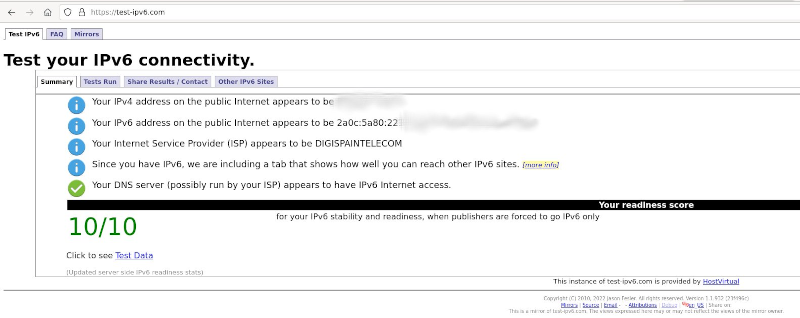
Post header A few days ago, my home network got a refresh that resulted in the enablement of some next-generation technologies for me and my family. Well, next-generation or current-generation, depending on your point of view. Per the ISP standards in Spain (my country), what I ll describe next is literally the most and latest you can get. The post title spoiled it already. I have now 10G internet uplink and native IPv6 since I changed my ISP to https://digimobil.es. My story began a few months ago when a series of fiber deployments started in my neighborhood by a back-then mostly unknown ISP (digimobil). The workers were deploying the fiber inside the street sewers, and I noticed that they were surrounded by advertisements promoting the fastest FTTH deployment in Spain. Indeed, their website was promoting 1G and 10G fiber, so a few days later I asked the workers when would that be available for subscription. They told me to wait just a couple of months, and the wait ended this week. I called the ISP, and a marketing person told me a lot of unnecessary information about how good service I was purchasing. I asked about IPv6 availability, but that person had no idea. They called me the next day to confirm that the home router they were installing would support both IPv6 and Wi-Fi 6. I was suspicious about nobody in the marketing department knowing anything about any of the two technologies, but I decided to proceed anyway. Just 24 hours after calling them, a technician came to my house and 45 minutes later the setup was ready. The new home router was a ZTE ZXHN F8648P unit. By the way, it had Linux inside, but I got no GPL copyright notice or anything. It had 1x10G and 4x1G ethernet LAN ports. The optical speed tests that the technician did were giving between 8 Gbps to 9 Gbps in uplink speed, which seemed fair enough. Upon quick search, there is apparently a community of folks online which already know how to get the most out of this router by unbloking the root account (sorry, in spanish only) and using other tools. When I plugged the RJ45 in my laptop, the magic happened: the interface got a native, public IPv6 from the router. I ran to run the now-classic IPv6 browser test at https://test-ipv6.com/. And here is the result: IPv6 test If you are curious, this was the IPv6 prefix whois information:
route6: 2a0c:5a80::/29
descr: Digi Spain Telecom S.L.U.
origin: AS57269
They were handing my router a prefix like 2a0c:5a80:2218:4a00::/56. I ignored if the prefix was somehow static, dynamic, just for me, or anything else. I ve been waiting for native IPv6 at home for years. In the past, I ve had many ideas and projects to host network services at home leveraging IPv6. But when I finally got it, I didn t know what to do next. I had a 7 months old baby, and honestly I didn t have the spare time to play a lot with the setup. Actually, I had no need or use for such fast network either. But my coworker Andrew convinced me: given the price 30 EUR / month, I didn t have any reason not to buy it. In fact, I didn t have any 10G-enabled NIC at home. I had a few laptops with 2.5G ports, though, and that was enough to experience the new network speeds. Since this write-up was inspired by the now almost-legenday post by Michael Stapelberg My upgrade to 25 Gbit/s Fiber To The Home, I contacted him, and he suggested running a few speed tests using the Ookla suite against his own server. Here are the results:
$ docker run --net host --rm -it docker.io/stapelberg/speedtest:latest -s 50092
[..]
     Server: Michael Stapelberg - Zurich (id = 50092)
        ISP: Digi Spain
    Latency:    34.29 ms   (0.20 ms jitter)
   Download:  2252.42 Mbps (data used: 3.4 GB )
     Upload:  2239.27 Mbps (data used: 2.8 GB )
Packet Loss:     0.0%
 Result URL: https://www.speedtest.net/result/c/cc8d6a78-c6f8-4f71-b554-a79812e10106
$ docker run --net host --rm -it docker.io/stapelberg/speedtest:latest -s 50092
[..]
     Server: Michael Stapelberg - Zurich (id = 50092)
        ISP: Digi Spain
    Latency:    34.05 ms   (0.21 ms jitter)
   Download:  2209.85 Mbps (data used: 3.2 GB )
     Upload:  2223.45 Mbps (data used: 2.9 GB )
Packet Loss:     0.0%
 Result URL: https://www.speedtest.net/result/c/32f9158e-fc1a-47e9-bd33-130e66c25417
This is over IPv6. Very satisfying. Bonus point: when I called my former ISP to cancel the old subscription the conversation was like: I didn t even bother mentioning IPv6. Cheers!

Russ Allbery: Review: Matrix

Review: Matrix, by Lauren Groff
Publisher: Riverhead Books
Copyright: 2021
ISBN: 0-698-40513-7
Format: Kindle
Pages: 260
Marie is a royal bastardess, a product of rape no less, and entirely out of place in the court in Westminster, where she landed after being kicked off her mother's farm. She had run the farm since her mother's untimely death, but there was no way that her relatives would let her inherit. In court, Marie is too tall, too ugly, and too strange, raised by women who were said to carry the blood of the fairy M lusine. Eleanor of Aquitaine's solution to her unwanted house guest is a Papal commission. Marie is to become the prioress of an abbey. I am occasionally unpleasantly reminded of why I don't read very much literary fiction. It's immensely frustrating to read a book in which the author cares about entirely different things than the reader, and where the story beats all land wrong. This is literary historical fiction set in the 12th century. Marie is Marie de France, author of the lais about courtly love that are famous primarily due to their position as early sources for the legends of King Arthur. The lais are written on-screen very early in this book, but they disappear without any meaningful impact on the story. Matrix is, instead, about Shaftesbury Abbey and what it becomes during Marie's time as prioress and then abbess, following the theory that Marie de France was Mary of Shaftesbury. What I thought I was getting in this book, from numerous reviews and recommendations, was a story of unexpected competence: how a wild, unwanted child of seventeen lands at a dilapidated and starving abbey, entirely against her will, and then over the next sixty years transforms it into one of the richest abbeys in England. This does happen in this book, but Groff doesn't seem to care about the details of that transformation at all. Instead, Matrix takes the mimetic fiction approach of detailed and precise description of a few characters, with all of their flaws and complexities, and with all of the narrative's attention turned to how they are feeling and what they are seeing. It is also deeply, fully committed to a Great Man (or in this case a Great Woman) view of history. Marie is singular. The narrative follows her alone, she makes all the significant decisions, and the development of the abbey is determined by her apparently mystical visions. (In typical mimetic fashion, these are presented as real to her, and the novel takes no position on whether that reality is objective.) She builds spy networks, maneuvers through local and church politics, and runs the abbey like her personal kingdom. The tiny amount of this that is necessarily done by other people is attributed to Marie's ability to judge character. Other people's motives are simply steamrolled over and have no effect. Maddeningly, essentially all of this happens off-screen, and Groff is completely uninterested in the details of how any of it is accomplished. Marie decides to do something, the narrative skips forward a year, and it has happened. She decides to build something, and then it's built. She decides to collect the rents she's due, the novel gestures vaguely at how she's intimidating, and then everyone is happily paying up. She builds spy networks; who cares how? She maneuvers through crises of local and church politics that are vaguely alluded to, through techniques that are apparently too uninteresting to bother the reader with. Instead, the narrative focuses on two things: her deeply dysfunctional, parasocial relationship with Eleanor, and her tyrannical relationship with the other nuns. I suspect that Groff would strongly disagree with my characterization of both of those narratives, and that's the other half of my problem with this book. Marie is obsessed with and in love with Eleanor, a completely impossible love to even talk about, and therefore turns to courtly love from afar as a model into which she can fit her feelings. While this is the setup for a tragedy, it's a good idea for a story. But what undermined it for me is that Marie's obsession seems to be largely physical (she constantly dwells on Eleanor's beauty), and Eleanor is absolutely horrible to her in every way: condescending, contemptuous, dismissive, and completely uninterested. This does change a bit over the course of the book, but not enough to justify the crush that Marie maintains for this awful person through her entire life. And Eleanor is the only person in the book who Marie treats like an equal. Everyone else is a subordinate, a daughter, a charge, a servant, or a worker. The nuns of the abbey prosper under her rule, so Marie has ample reason to justify this to herself, but no one else's opinions or beliefs matter to her in any significant way. The closest anyone can come to friendship is to be reliably obedient, perhaps after some initial objections that Marie overrules. Despite some quite good characterization of the other nuns, none of the other characters get to do anything. There is no delight in teamwork, sense of healthy community, or collaborative problem-solving. It's just all Marie, all the time, imposing her vision on the world both living and non-living through sheer force of will. This just isn't entertaining, at least for me. The writing might be beautiful, the descriptions detailed and effective, and the research clearly extensive, but I read books primarily for characters, I read characters primarily for their relationships, and these relationships are deeply, horribly unhealthy. They are not, to be clear, unrealistic (although I do think there's way too much chosen one in Marie and way too many problems that disappear off-camera); there are certainly people in the world with dysfunctional obsessive relationships, and there are charismatic people who overwhelm everyone around them. This is just not what I want to read about. You might think, with all I've said above, that I'm spoiling a lot of the book, but weirdly I don't think I am. Every pattern I mention above is well-established early in the novel. About the only thing that I'm spoiling is the hope that any of it is somehow going to change, a hope that I clung to for rather too long. This is a great setup for a book, and I wish it were written by a fantasy author instead of a literary author. Perhaps I'm being too harsh on literary fiction here, but I feel like fantasy authors are more likely to write for readers who want to see the growth sequence. If someone is going to change the world, I want to see how they changed the world. The mode of fantasy writing tends to think that what people do (and how they do it) is as interesting or more interesting than what they feel or what they perceive. If this idea, with the exact same level of (minor) mysticism and historic realism, without added magic, were written by, say, Guy Gavriel Kay or Nicola Griffith, it would be a far different and, in my opinion, a much better book. In fact, Hild is part of this book written by Nicola Griffith, and it is a much better book. I have seen enough people rave about this book to know that this is a personal reaction that is not going to be shared by everyone, or possibly even most people. My theory is that this is due to the different reading protocols between literary fiction readers and fantasy readers. I put myself in the latter camp; if you prefer literary fiction, you may like this much better (and also I'm not sure you'll find my book reviews useful). I may be wrong, though; maybe there are fantasy readers who would like this. I will say that the sense of place is very strong and the writing has all the expected literary strengths of descriptiveness and rhythm. But, sadly, this was not at all my thing, and I'm irritated that I wasted time on it. Rating: 4 out of 10

Next.

Previous.