Search Results: "sf"

20 February 2011

Andreas Metzler: license incompatibilities

GnuTLS has recently made Nettle its prefered crypto backend. I think Debian will need to continue to use libgcrypt for license reasons. While GnuTLS+libgcrypt and its dependencies are LGPL-2.1+ nettle itself is LGPL-2.1+, except for small GPL-2+ parts (serpent and blowfish). But these are being replaced by LGPL-2.1+ implementations currently. However nettle's public key library (libhogweed) uses and links against the GNU Multiple Precision Arithmetic Library which is LGPL-3+. Afaiui this is a deal-breaker, GPL-2 (without the "any later version" clause) and (L)GPL-3 are incompatible. A nontrivial number of GnuTLS using applications and libraries are licensed (L)GPL-2. I started checking but stopped at "j" after finding cherokee-1.0.20, cluster-glue-1.0.7, cups-1.4.6, drizzle-2010.09.180, echoping-6.0.2, elinks-0.12~pre5, gtk-vnc-0.4.2, inspircd-1.1.22+dfsg and jd-2.8.1~beta110214.

18 February 2011

Ben Hutchings: Distinguishing Ethernet-like net device types

David Paleino asks:
I'm still missing how to reliably detect if a device is a "wired" or a "wireless" one. I suspect that checking the existence of /phy80211 would be enough, but I can't really tell, and seems like I'm not able to find an exhaustive sysfs reference manual.
Sadly there is no exhaustive manual, but many attributes found in sysfs are documented under Documentation/ABI/. In this case you need the DEVTYPE name from the net device's uevent, which may be e.g. 'wlan' or 'wwan' (and is absent for wired Ethernet devices). I don't know why this isn't also exposed as an attribute in its own right.

17 February 2011

David Paleino: Getting network devices with Python and udev

UPDATE I wrote a new article based on Ben Hutching's response. Just a quick post, mainly as a reminder for when I'll try to implement this in WICD:
#!/usr/bin/python
import gudev
client = gudev.Client(['rfkill', 'net'])
for dev in client.query_by_subsystem('net'):
    if dev.get_sysfs_attr_as_int("type") != 1:
        continue
    driver = dev.get_driver()
    if not driver:
        parent = dev.get_parent()
        if parent:
            driver = parent.get_driver()
    print type, dev.get_name(), driver, dev.get_sysfs_path()
This will print all network devices with ethernet-encapsulated packets (that's what sysfs type "1" is). Here's the output on my system:
eth0 e1000e /sys/devices/pci0000:00/0000:00:19.0/net/eth0
wlan0 b43 /sys/devices/pci0000:00/0000:00:1c.1/0000:10:00.0/ssb0:0/net/wlan0
I'm still missing how to reliably detect if a device is a "wired" or a "wireless" one. I suspect that checking the existence of /phy80211 would be enough, but I can't really tell, and seems like I'm not able to find an exhaustive sysfs reference manual.

Jan Hauke Rahm: Gnome calendar

Dear lazyweb, I m using Gnome for quite some time now and I m always satisfied with the interfaces I have to whatever I need. There is one thing, though, that I miss: a calendar. I don t like evolution, I don t need another mail client. What I want is a simple, yet sophisticated application that I can put appointments in and which reminds me of them (recurring issues should be possible, too). It may but doesn t have to be somehow attached to the Gnome clock or whatever. Though I expect it to look Gnome-like and be accessible from the panel. Do you know such? And is there even a Debian package for it? Thanks.
<fb:like action="like" colorscheme="light" href="http://blog.jhr-online.de/266" layout="default" show_faces="true" width="400">

Cyril Brulebois: Debian XSF News #5

Time for a fifth Debian XSF News issue!

16 February 2011

Steve Kemp: Upgrading from Lenny to Squeeze

Rather than waiting for a few months, as I typically do, I decided to be brave and upgrade my main virtual machine from Lenny to Squeeze. That host runs QPSMTPD, Apache, thttpd, and my blogspam server; nothing too complex or atypical. The upgrade was mostly painless; I was interrupted several times by debconf asking me if I wished to replace configuration files I'd modified, but otherwise there were only two significant messages in the process:
crm114
crm114 warned me that its spam database and/or configuration files had changed and would most likely result in brokenness, post-upgrade, and I should do something to stop avoiding lost mail. Happily this was expected.
sysv-rc
It transpired I had a couple of local init scripts which didn't have dependency information succesfully encoded into them; so I couldn't migrate to dependency-based bootup. Given that this server gets a reboot maybe once every six months that wasn't really worth telling me about; but nevermind. No harm done.
That aside there were no major surprises; all services seemed to start normally and my use of locally-compiled backports meant that custom services largely upgraded in a clean fashion. The only exception was my patched copy of mutt which was replaced unexpectedly. That meant my lovely mutt-sidebar was horribly full of mailboxes, rather than showing only new messages. I created a hasty backported mutt package for Squeeze and made it available. (This patch a) enables the side-bar, and b) allows you to toggle between the display of all mailboxes and those with only new mail in them. It is buggy if you're using IMAP; but works for me. I would not choose to live without it.) Now that I've had a quick scan over the machine the only other significant change was an upgrade of the mercurial revision control system, the updated templates broke my custom look & feel and also required some Apache mod_rewrite updates to allow simple clones via HTTP. (e.g. "hg clone http://asql.repository.steve.org.uk/"). So in conclusion: ObQuote - "Hmm, upgrades " - The Matrix Reloaded (shudder).

Michal &#268;iha&#345;: SF.net has back git email notifications

As I have complained quite loudly in this blog, I think it's fair to post a status update again. Yesterday the emails started suddenly to work. So the major reason for my complains is gone. What I still don't like that this issue was not at all communicated to project admins. It stopped to work, what was sort of announced in blog post. It started to work again without any announcement and last status update in blog still claims they do not work. At least for direct question, we've received reply that they have intentionally re-enabled this service.

Filed under: English Phpmyadmin 0 comments Flattr this!

14 February 2011

Julien Blache: QLogic QLE73xx InfiniBand adapters, QDR, ib_qib, OFED 1.5.2 and Debian Squeeze

A few weeks ago, I ve had to look into getting a QLogic QLE7342 InfiniBand adapter working on a Debian Squeeze system, with OFED 1.5.2. This post will probably save quite some time to anyone trying to do the same; it applies to all the QLogic adapters supported by the ib_qib kernel module. Note: on the ibverbs side of things, the adapters are supported by the ipath plugin, just like older QLogic adapters (that use the ib_ipath kernel module). First of all: grab a recent version of the ofa-kernel package. The ib_qib module in ofa-kernel from OFED 1.5.2 did not work at all for me. I used the ofa-kernel snapshot from 20110203. There are two things to know about the QLogic adapters: QLogic offers a complete IB stack based on OFED and dubbed QLogic OFED+ . The complete package weighs in at over 500 MB and contains the QLogic-blessed drivers, OFED stack, libraries and, of utmost importance to us, the QLogic-specific utilities. Unfortunately, as simple as the QLogic utilities are, they don t come with source. The package also only exists for RedHat 4 and 5. So, go to the QLogic support website, select your hardware and download the QLogic OFED+ Host Software for RHEL 5 package. In the tarball, one directory contains the OFED stack and another contains all the utilities (QLogic-Tools.*). For setting the adapter speed, you ll want the iba_portconfig utility along with the initscript (shipped as iba_portconfig.sh). The desired adapter speed is set in the initscript by choosing the proper arguments to iba_portconfig (-s 1 for SDR, -s 2 for DDR, -s 4 for QDR or any combination thereof). The iba_portconfig initscript must run after the drivers have been loaded. Which brings us to loading the driver and mounting the ipathfs. This is all handled by the openibd initscript provided in ofa-kernel (under ofed_scripts/) and its companion script dedicated to QLogic adapters, truescale.cmds. This initscript will load the OFED stack and drivers; if a QLogic adapter is present, it ll mount the ipathfs in the right place. Voila, once this is done, the adapter should happily report itself ACTIVE/LinkUp.

12 February 2011

Michal &#268;iha&#345;: More on sf.net git notifications

As I've already written, SourceForge.Net has limited things which you can do on git/mercurial servers and one of the things they have prohibited is sending emails. This is one of few things which almost every projects uses so it has brought quite obvious reaction, people are reporting bugs that it stopped to working. The major reason for reporting bug is that this change was not at all communicated to users (nor users nor project admins), so it was just a surprise and every body expects bug and not this kind of reply. As I don't have way to reopen the ticket, I had to open another one, that the documentation is wrong and I hope the reply will be slightly better. SF.net, if you still don't believe people used this feature quite a lot, just look at number of bug reports you have in your tracker right now...

Filed under: English Phpmyadmin 0 comments Flattr this!

Joey Hess: d-i is ten

I just realized that the Debian Installer is ten years old! It actually got started ten years ago last summer, but now is also an apt anniversary -- ten years ago, I successfully booted d-i for the first time. It's amazing that d-i has been around as long as Debian Developers who have "been with the project longer than most". (Many of whom have been long-time contributors to d-i themselves.) Astonishing that my basic design has held up and remains relevant. And every time I boot up the Debian kFreeBSD installer, or run the graphical installer, or hear someone raving about how easy Ubuntu was for them to install (and know d-i was underneath), I'm amazed at the places people have taken d-i. The code has recently moved to git. As changes like ext4 by default start to flow in to d-i, with Wheezy development starting up, I hope to see more people enticed into working on d-i. Anyone can do like Matthew Palmer has done with netcfg -- pick a component of d-i that interests you, check out its git repository, and take it from being reasonably well team-maintained to awesomely you-maintained. In five or ten years Matthew will be able to look back at all the people who have used d-i to install over IPv6, and on WPA wireless, and with his other netcfg improvements. Trust me, it's a great feeling. Previously: d-i retrospective (better written than the above & well worth a re-read)

Wouter Verhelst: Ten years of Debian

My first ever Linux installation was done in the late nineties 1998 or thereabouts but was a RedHat 4.5 installation rather than a Debian one. The reason for that was fairly simple: the Infomagick sixpack CD set that I'd bought contained RedHat, Debian, and Slackware, but the RedHat installation was the only one that could be installed directly from CD the other two required me to write floppies and boot from those to start the installation, and I wasn't very fond of that idea. It was only a few years and a few broken RedHat upgrades later that I saw the light and considered trying out this Debian thing that some of my classmates were talking about. The fact that I'd just bought my own computer (rather than having to compete for time with my siblings on my parents' computer) was a good reason to do a fresh Linux installation. I'd been planning to install Linux From Scratch, but as what was still known as the LFS HOWTO told me you'd need a working Linux installation to do that, I considered my options. Since I'd developed a strong dislike of RedHat, I wasn't interested in doing another RedHat anymore. So, I downloaded the most recent version of Debian at the time (Potato Test Cycle III), wrote it to a CD, and installed. I've probably still got the CD lying around somewhere. A few months later, I found these "Linux Gazette" packages in the archive, with the latest packaged issue being 47, but the latest upstream version being much higher. Trying to figure out what was going on, I mailed the maintainer, Adrian Bridgett, who encouraged me to take over maintenance. Thus began my life of actively contributing to Open Source software. In November 2000, I applied to become a Debian Developer. In January 2001, Martin Michlmayr was assigned to be my AM. And in early February 2001, now just over ten years ago, I'd become a Debian Developer. Yes, that was fast, and no, I probably wasn't really ready yet, at the time. Originally, I only cared much about these Linux Gazette packages. But, as time went on, I started looking around, too. A friend passed me an old Macintosh Centris 610. As I tried to install Debian on it, I found that it didn't actually run very well. This turned out to be due to it having a broken 68LC040 processor, so I bought me another m68k-based mac, one with a full 68040 processor (a Centris 650). Thus I became involved in the m68k port and buildd maintenance. As these old machines came with 80MB or 250MB SCSI hard disks of which I had none laying around, and a then-recent Debian installation had minimum requirements of about 200MB, I was in need of network storage to be able to do anything useful with the mac. NFS didn't work as expected; the RTC implementation on m68k mac hardware was reverse engineered and didn't work too well at the time, which meant that the clock would run slower if the machine was under load, and that in turn would mean that make would get confused about timestamps, since they would suddenly appear to originate from the future (in NFS, it's the server that assigns time stamps, not the client). There was a simple solution, however; Pavel Macheck had written this neat 'Network Block Device', which would let the client do its own filesystem on network storage. Only it wasn't packaged; but then, that was easy to fix. Thus I started maintaining the single piece of software that I've worked the most on, to date. A few years later, Pavel lost interest in maintaining NBD, and handed over upstream maintenance to me and maintenance of the kernel side to Paul Clements. Thus began my life in upstream work. And while I originally joined Debian with the intent of using it as a learning experience and stepping stone on my way to more "important" free software, I found that it wasn't as satisfying as was my work for Debian. Over the years, there's been this duality where I've felt like I was doing too much and not enough at the same time. Too much, because the things I was doing would eat up much of my spare time, leaving little time left for other hobbies. Not enough, because I witnessed other people doing much more for Debian than I did, and I wanted to make a difference. As the years passed by, many things have changed. Not only in Debian, but also besides it. I became an independent contractor, focusing mostly on supporting people in using Debian (although I support them with other distributions, too). The importance of a port went from 'something which these weird porter people are doing, and that we should probably help them with if it doesn't work, but is their problem really' to 'something that I really really really have to make sure works for my packages', and back for the port that I cared about most. After several years of trying, I finally managed to explain to my parents what this Debian thing is, why it matters, and what my role in the whole thing is. We did a few releases, some taking longer than I would've liked. People joined the project, and left again. Some of my friends died. My fame in the project rose, even though I wasn't aware of it initially; and thus I was rather surprised when someone asked me whether I was "the Wouter Verhelst" at a key signing party. Recently, I've started looking back, and considered the things which Debian has meant to me. Ten years ago, I was 22, still in college, and had way too much spare time on my hands. I'd recently gotten my first Internet installation, and all these online communities were very new to me. Yes, that was all probably rather late. Debian has changed my life in many ways; it has allowed me to meet various kinds of people, both online and in meatspace. I've been to Helsinki, Edinburgh, Mar del Plata, C ceres, and New York City, places that I might otherwise not have visited. Each of these trips was an incredible experience that I have fond memories of; and while the most fond ones originate from Helsinki, I cherish the memories of each of these trips as some of the best trips I've ever done. Working on Debian has forced me to learn about the inner workings of a Linux-based system, which is knowledge that has helped me tremendously professionally, too. And finally, working on Debian has given me a unique perspective on this whole FOSS community, which has helped shape my ethics and my view of the world. While I believe that I would've subscribed to most of that ideology at any rate, I'm not sure that the details of my beliefs and understanding would've been exactly the same. And while I don't agree on every position that the project subscribes to as a whole, I do believe that the philosophies that lie at the core of this project contain just the right mix of pragmatism and ideology that makes it possible for our project to thrive in a changing world of not only a growing group of people who subscribe unconditionally to the free software ideals, but also business people who care mostly about money. Over the years, somehow I moved from "one of the recent batch of new Debian Developers" to "someone who's been with the project longer than most". It still feels weird to see people shut up because you've built up a reputation in some area, and you give your gut opinion on some subject without researching it too much. I try not to let that happen too often. Today, ten years and just over a week ago, my life as a Debian Developer started, and it would change the way I looked at the world, the things I would do in my spare time, and the people I would meet. I wouldn't have it any other way. Thanks, Debian, for what's been a blast; may the next ten years be as inspiring to me and everyone as the past ten!

11 February 2011

Michal &#268;iha&#345;: Tightening too much

After recent attack on sf.net servers, some services have been unavailable for some time. Now things are returning to "normal" operations, CVS has been made available yesterday. But this has lead to other (quite unrelated) change, affecting all SCM services:
outbound email is not functional, so any script utilizing this will fail. If you need to send outbound email, a workaround would be to use curl and and external site or Project Web to send the email.
I think this is just wrong. If this is as a measure against spam, it will rather open dozens of other places where to send spam, because every project wanting commit notifications (or using CIA.vc), will need to deploy some script on web to send mail. And I guess it simply won't be much protected. Maybe it's time to consider changing service provider... PS: The bug I've reported on this topic is here.

Filed under: English Phpmyadmin 3 comments Flattr this!

Julien Viard de Galbert: Triage X Bugs of the Week (TXBW12)

This report is 2 week late It was delayed by an important event, not the release of squeeze, but the birth of my first child: C lestine is born Monday the 31th of January. My wife and C lestine are both fine now but the firsts days were not that easy. I m starting to recover from the lack of sleep, but I m still very late on my debian tasks ;) So I guess I just drop Triaging for week 13, 14 and maybe 15 Now the bugs I triaged just before : The X Strike Force (still) needs you ! You can have a look at the X Strike Force Bug Closing Procedure and check XSF unstable bugs sorted by date.

10 February 2011

Charles Plessy: Chain reaction

Now that maintain several dozens of packages in Debian, I think twice before uploading a new one. Does it have a future, a public ? Some of the packages I prepare are available on git.debian.org, and are listed in Debian Med's tasks pages. It would not take me long to finish most of them, but that does not take into account the time others will spend on it. They will make our archive bigger and our quality tests longer to execute. Somebody will translate their description. Somebody else will perhaps write a security patch someday, or a patch to make the package compilable with a new version of GCC. All in all, each package has a footprint in Debian's ecosystem. That footprint starts early, as soon as the package is sent to the NEW queue. For instance, I kept by mistake some old content in the copyright file of clustalw, that was recently freed and has to go through the NEW queue to be transferred from the non-free to the main area of our archive. That costed a small of exchange of emails, that could have been avoided. Our packages should be perfect, but that is difficult to achieve alone. For that reason, I proposed two years ago a package review system, that functions like a chain reaction. The principle is simple. After uploading to the NEW queue, download two neighbor packages and check their copyright file. The errors found can be corrected by their maintainer before the the FTP team inspects it, which save their time. For instance, after uploading tabix, I found an error in mediathekview, that was corrected. That compensates for my mistake with clustalw. If each person receiving a package review does a review of two other packages, that will create a chain reaction that will clean the queue from the simplest mistakes, leaving only the really problematic cases. As Torsten noted recently, the NEW queue is getting long. So how about trying to help ?
8 February 2011

Cyril Brulebois: Debian XSF News #4

Here comes the forth Debian XSF News issue! I usually try to keep the items sorted chronologically (but grouped by topic when possible), so if you re wondering about the current status of X in unstable, make sure you read the last entry.

Mike Hommey: Knowing how much disk seeks hurt

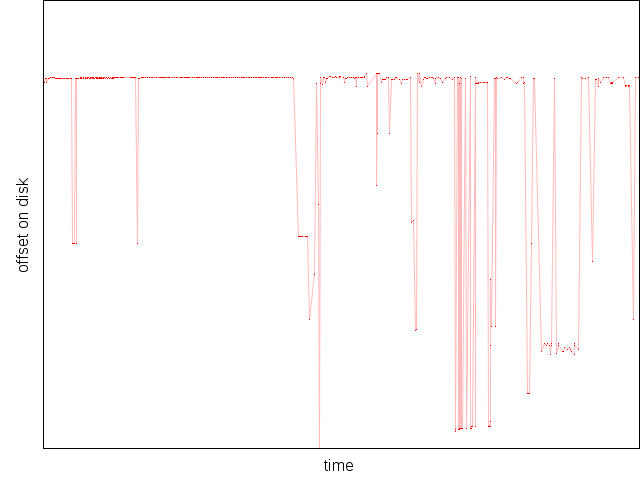
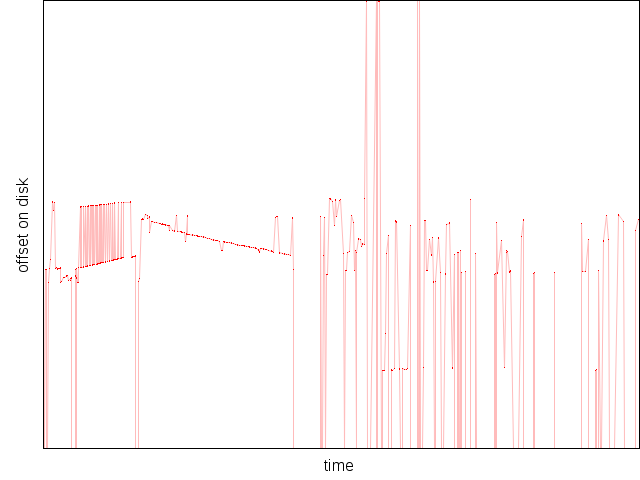
We all know disk seeks hurt. But we usually don t have a precise idea how much. How about getting that idea? Here is a little experiment I ran a few days ago. I took the output from the systemtap script tracking I/O I wrote, on a Firefox startup after boot. Each line of that output, which gives a timestamp (which we don t care about here), a file name, and an offset, represents a 4096 bytes read (one page). The first set of data points I got is how much time it takes to reproduce this read pattern after a reboot, and how that compares to Firefox startup time. For what it s worth, I did group following reads, to avoid doing too many system calls, and also avoided kernel readahead by using direct I/O, meaning I would only read exactly what the kernel reads when Firefox normally starts. All the following tests were done under the usual conditions (see previous posts), but I limited the tests to the x86-64 architecture, because all that really matters is the disk. I ll mention, however, that the amount of data read in these tests is 34,729,984 bytes, and that the original I/O pattern looks like this: Zooming around the main location where most I/O happen, we can see the pattern is still bumpy: This somehow looks familiar, doesn t it? We already know for a fact that even these patterns that, on the whole disk, look like pretty much insignificant, have an important impact on startup time. Try to imagine what kind of difference could be observed if we were reordering all these reads. Anyways, back to that I/O simulation, we first need to see how far it is from the actual Firefox startup. We would rather that simulated I/O + warm startup/hot cache end up close to the real thing. However, we need to keep in mind, as we saw in a previous post, that CPU scaling, when mixed with I/O, has an influence on startup time. Warm startup not involving I/O, the CPU can run at maximum speed the whole time. As such, for a fair comparison, we need to compare to cold startup time with the CPU forced at maximum speed, which we saw is faster than startup time with CPU scaling.
Average time (ms)
Simulated cold startup 2,764.26 0.42%
Warm startup 250.74 0.18%
Simulated cold + warm 3015
Real cold startup 3087.47 0.31%
Difference 72.47 (2.35%)
Close enough, I d say. The difference is most probably caused by metadata reads and a few other things, that isn t in the systemtap script scope. Now we know our simulated I/O is close to reality, what happens if we reorder all these reads according to the position on disk?
Average time (ms) Corresponding transfer rate
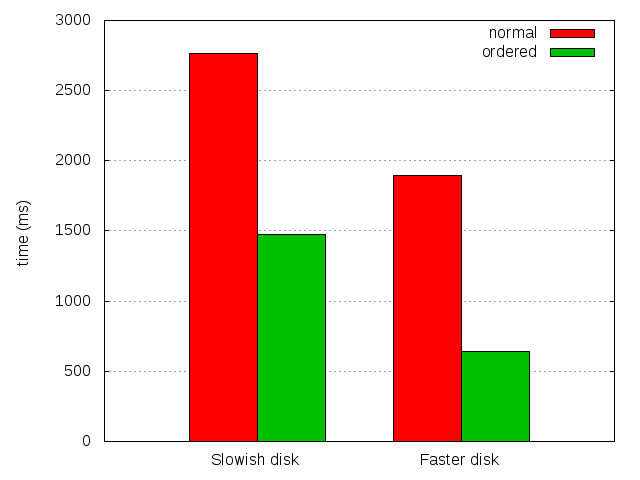
Simulated I/O 2,764.26 0.42% 12.56 MB/s
Reordered I/O 1,473.34 0.43% 23.57 MB/s
Difference 1,290.92 (46.7%) n/a
That s almost twice as fast ! And the disk doesn t even have a big throughput (around 30MB/s). Let s see what it does with a disk with a bigger throughput (85MB/s).
Average time (ms) Corresponding transfer rate
Simulated I/O 1,898.66 0.16% 18.29 MB/s
Reordered I/O 644.0 0.15% 53.93 MB/s
Difference 1,254.66 (66.08%) n/a
That s almost three times as fast ! The faster the disk, the bigger the improvement we can get by reordering and grouping I/O, which is not unexpected, but here we can see how much having to go back and forth on the disk hurt badly. Obviously, the numbers from the faster disk can t be directly compared to the ones from the slower disk, because the data was not arranged the same way on the disk, and file system fragmentation, as well as how the file system is filled also have their own share to add to the problem. And because it s more impressive to see on a graph than in a result table: Disks seeks hurt. Badly.

7 February 2011

Matt Zimmerman: A diversity statement for Ubuntu

The Ubuntu website states that we aim to make Ubuntu a wonderful place to participate . We developed the Ubuntu Code of Conduct to set a standard for participants to accept each other in the spirit of cooperation, and have improved it over time to state these principles more clearly. It is implicit in our philosophy that these and other Ubuntu values should hold equally true for everyone. I would like to propose that we upgrade this to an explicit statement on behalf of the project. I have spoken with many people who were interested in joining a free software project, but were put off because they felt unwelcome. I know various people who participate in Ubuntu today, but sometimes face difficult social obstacles in order to do so. Going forward, I would like for us, as members of the Ubuntu community, to make the extra effort to accept all kinds of people. This may sound simple, but it can be very difficult to put into practice. People often don t even notice they ve gotten it wrong, until the offended party points it out to them. We need tools and guidance to make this a reality. To that end, I would like to propose a diversity statement for Ubuntu. This draft has already received support from a majority of the Community Council, but I d like to take it a step further. Because I want this to be a commitment that we can all stand behind, I m also calling for support from the community as a whole. Please give this issue your consideration, and let me know in the comments if you can get on board with an official statement like this. The more support we have, the more real this commitment can be. Here s the text. Many thanks to Mary Gardiner, Valerie Aurora and Benjamin Mako Hill for their review and input.
The Ubuntu project welcomes and encourages participation by everyone. We are committed to being a community that everyone feels good about joining. Although we may not be able to satisfy everyone, we will always work to treat everyone well. Standards for behavior in the Ubuntu community are detailed in the Code of Conduct and Leadership Code of Conduct. We expect participants in our community to meet these standards in all their interactions and to help others to do so as well. Whenever any participant has made a mistake, we expect them to take responsibility for it. If someone has been harmed or offended, it is our responsibility to listen carefully and respectfully, and do our best to right the wrong. Although this list cannot be exhaustive, we explicitly honor diversity in age, culture, ethnicity, genotype, gender identity or expression, language, national origin, neurotype, phenotype, political beliefs, profession, race, religion, sexual orientation, socio-economic status, subculture, and technical ability. Some of the ideas and wording for this statement were based on diversity statements from the Python community and Dreamwidth Studios (CC-BY-SA 3.0).

6 February 2011

Martin Michlmayr: Upgrading to Debian 6.0 (squeeze) on ARM

Debian 6.0 (squeeze) has been released. Here are some notes if you're running Debian on an ARM-based NAS device or plug computer and are planning to upgrade. First of all, make sure to read the release notes for Debian 6.0 on ARM. This document contains a lot of information on performing a successful upgrade. Second, during the kernel upgrade, you'll get the following message about the boot loader configuration:
The boot loader configuration for this system was not recognized. These
settings in the configuration may need to be updated:
 * The root device ID passed as a kernel parameter;
 * The boot device ID used to install and update the boot loader.
On ARM-based NAS devices and plug computers, you can simply ignore this warning. We put the root device into the ramdisk so it will be updated automatically. Finally, after doing the upgrade and before rebooting your system, make sure to run flash-kernel to activate the new kernel.

Benjamin Mako Hill: Editor-to-Reader Ratios on Wikipedia

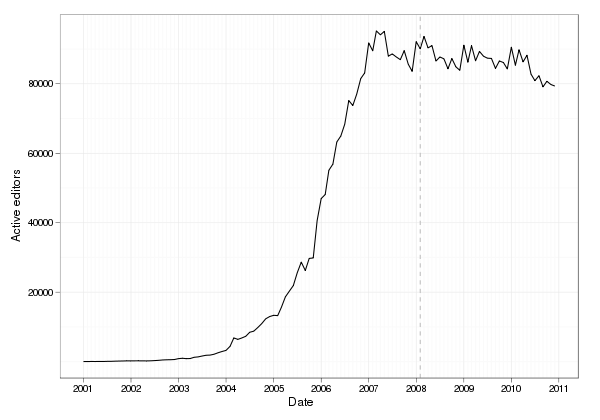
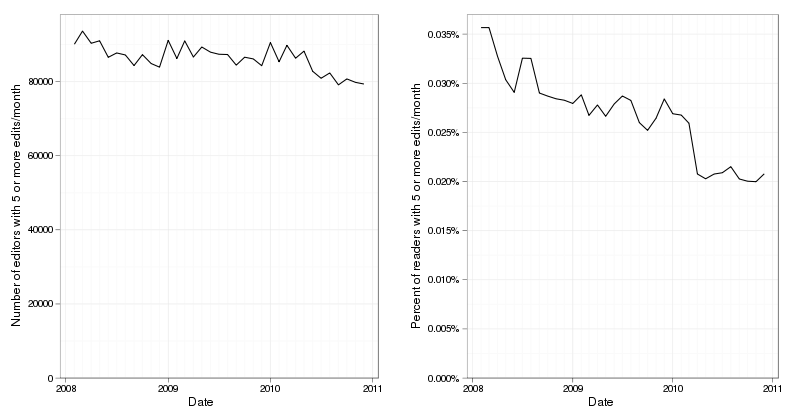
It's been reported for some time now that the number of active editors on Wikipedia (usually defined as people who have edited at least 5 times in a given month) peaked in 2007 and has been mostly stable since then. A graph of the total number of active editors in every month since Wikipedia's founding is shown below. The graph shows the aggregate numbers for all language Wikipedias. English Wikipedia is the largest component of this and is generally more variable. That said, very similar patterns exist for most larger languages. /copyrighteous/images/active_editors_all_wikpiedia.png Felipe Ortega, who has provided many of these statistics, has warned against fatalist claims. Although there seems to be a decrease in the total number of active editors over the last two years, the situation seems to have somewhat stabilized in most languages. New editors in Wikipedia are replacing folks at almost the rate that they are leaving. It is also widely known that the number of readers of Wikipedia has been increasing during this period. According to the report cards released by the foundation using comScore data, the number of unique visitors to Wikipedia each month has increased by 61 million people in the last year -- over 17%. This discrepancy between rising readership and stable or sinking editorship should raise major concern. After all, the Wikimedia Foundation's mission is two part: (1) to empower and engage people around the world to collect and develop educational content and (2) to disseminate it effectively and globally. Although the Foundation report cards include measures of raw levels of editorship, a better metric of engagement and empowerment might be the proportion of readers who engage in editing. I could not find reliable data on the number of unique readers reached each month for more than a few months in the last year. What is available, however, is wonderful data on page views each month going back to 2008. Analysis of the data from available report cards show that, at least during the last year, there is a very stable ratio of 35 page views per unique visitor, as estimated by comScore. Using that measure, we can do a back of the envelope estimation on the proportion of users that are editors for the period where page view data is available, dating back from February 2008 ( marked with the grey dashed lined above). The graphs below show the very different results you get when you consider the change in the number of Wikipedia editors and the change in the editor-to-reader ratio. Once again, these data are combined data for all language Wikipedias although graphs look very similar for most larger languages. The results are striking. Although there has been a 12% decrease between February 2008 and December 2010 in the number of active editors, there is a 42% decrease in the proportion of readers who edit at least five times a month. We can see that fulfilling the first half of the Wikimedia mission remains a struggle. /copyrighteous/images/wikipedia_editors_combined_graph.png Although the graphs above do not say anything directly about the most active core contributors to Wikipedia, the fact that Wikipedia is being maintained by a tiny -- and shrinking -- proportion of its readership does mean that the idea behind Wikipedia is under threat. Although none are as big as Wikipedia, there are lots of good encyclopedias out there. The reason Wikipedia is different, interesting, and important is because -- unlike all those others -- Wikipedia is the encyclopedia that anyone can edit. Wikipedia is powerful because it allow its users to transcend their role as consumers of the information they use to understand the world. Wikipedia allows users to define the reference works that define their understanding of the their environment and each other. But 99.98% of the time, readers do not transcend that role. I think that's a problem. Worse, that the number is growing. The Wikimedia Foundation recently ran a major successful effort to attract donations in its annual fundraiser. Jimmy Wales' smiling mug is apparently enough in the way of motivation to get something like 1% of its readers to donate money to support the project. I think that's very good news. If the Wikimedia community can entice even half of those people to contribute through an increased involvement in the projects themselves, they might do more than ensure Wikipedia's continued growth. They would help take a step toward the empowerment and engagement of those users in sharing their own knowledge, and the continued fulfillment of a critically important mission.
5 February 2011

Julien Blache: pommed v1.36/v1.37: updates, fixes, MacBook7,1

pommed v1.36 is out and brings support for the MacBook7,1, along with a few fixes and updates. A typo in the pmac keyboard backlight has been fixed, so fading now works there too. Product IDs for the ANSI and JIS keyboard variants for pmac machines were also added. It s been like forever since I last touched that code; not a lot of people still use those (great) machines. This release also contains a small update that will make it compatible with future kernel releases as applesmc will no longer have a fixed a name and location in sysfs. Update: I just noticed a bug in 1.36, so 1.37 is out now. It also contains two patches that were submitted through Alioth.

Next.

Previous.