Search Results: "pm"

7 December 2011

Gustavo Noronha Silva: WebKitGTK+ hackfest \o/

It s been a couple days since I returned from this year s WebKitGTK+ hackfest in A Coru a, Spain. The weather was very nice, not too cold and not too rainy, we had great food, great drinks and I got to meet new people, and hang out with old friends, which is always great!

Hackfest black board, photo by Mario

I think this was a very productive hackfest, and as usual a very well organized one! Thanks to the GNOME Foundation for the travel sponsorship, to our friends at Igalia for doing an awesome job at making it happen, and to Collabora for sponsoring it and granting me the time to go there! We got a lot done, and although, as usual, our goals list had many items not crossed, we did cross a few very important ones. I took part in discussions about the new WebKit2 APIs, got to know the new design for GNOME s Web application, which looks great, discussed about Accelerated Compositing along with Joone, Alex, Nayan and Martin Robinson, hacked libsoup a bit to port the multipart/x-mixed-replace patch I wrote to the awesome gio-based infrastructure Dan Winship is building, and some random misc. The biggest chunk of time, though, ended up being devoted to a very uninteresting (to outsiders, at least), but very important task: making it possible to more easily reproduce our test results. TL;DR? We made our bots and development builds use jhbuild to automatically install dependencies; if you re using tarballs, don t worry, your usual autogen/configure/make/make install have not been touched. Now to the more verbose version! The need

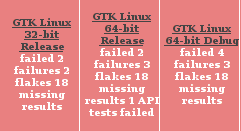
Our three build slaves reporting a few failures

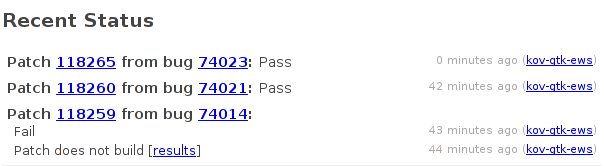
For a couple years now we have supported an increasingly complex and very demanding automated testing infrastructure. We have three buildbot slaves, one provided by Collabora (which I maintain), and two provided by Igalia (maintained by their WebKitGTK+ folks). Those bots build as many check ins as possible with 3 different configurations: 32 bits release, 64 bits release, and 64 bits debug. In addition to those, we have another bot called the EWS, or Early Warning System. There are two of those at this moment: one VM provided by Collabora and my desktop, provided by myself. These bots build every patch uploaded to the bugzilla, and report build failures or passes (you can see the green bubbles). They are very important to our development process because if the patch causes a build failure for our port people can often know that before landing, and try fixes by uploading them to bugzilla instead of doing additional commits. And people are usually very receptive to waiting for EWS output and acting on it, except when they take way too long. You can have an idea of what the life of an EWS bot looks like by looking at the recent status for the WebKitGTK+ bots. Maintaining all of those bots is at times a rather daunting task. The tests require a very specific set of packages, fonts, themes and icons to always report the same size for objects in a render. Upgrades, for instance, had to be synchronized, and usually involve generating new baselines for a large number of tests. You can see in these instructions, for instance, how strict the environment requirements are yes, we need specific versions of fonts, because they often cause layouts to change in size! At one point we had tests fail after a compiler upgrade, which made rounding act a bit different! So stability was a very important aspect of maintaining these bots. All of them have the same version of Debian, and most of the packages are pinned to the same version. On the other hand, and in direct contradition to the stability requirement, we often require bleeding edge versions of some libraries we rely on, such as libsoup. Since we started pushing WebKitGTK+ to be libsoup-only, its own progress has been pretty much driven by WebKitGTK+ s requirements, and Dan Winship has made it possible to make our soup backend much, much simpler and way more featureful. That meant, though, requiring very recent versions of soup. To top it off, for anyone not running Debian testing and tracking the exact same versions of packages as the bots it was virtually impossible to get the tests to pass, which made it very difficult for even ourselves to make sure all patches were still passing before committing something. Wow, what a mess. The explosion^Wsolution So a few weeks back Martin Robinson came up with a proposed solution, which, as he says, is the nuclear bomb solution. We would have a jhbuild environment which would build and install all of the dependencies necessary for reproducing the test expectations the bots have. So over the first three days of the hackfest Martin and myself hacked away in building scripts, buildmaster integration, a jhbuild configuration, a jhbuild modules file, setting up tarballs, and wiring it all in a way that makes it convenient for the contributors to get along with. You ll notice that our buildslaves now have a step just before compiling called updated gtk dependencies (gtk is the name we use for our port in the context of WebKit), which runs jhbuild to install any new dependencies or version bumps we added. You can also see that those instructions I mentioned above became a tad simpler. It took us way more time than we thought for the dust to settle, but it eventually began to. The great thing of doing it during the hackfest was that we could find and fix issues with weird configurations on the spot! Oh, you build with AR_FLAGS=cruT and something doesn t like it? OK, we fix it so that the jhbuild modules are not affected by that variable. Oh, turns out we missed a dependency, no problem, we add it to the modules file or install them on the bots, and then document the dependency. I set up a very clean chroot which we could use for trying out changes so as to not disrupt the tree too much for the other hackfest participants, and I think overall we did good. The aftermath By the time we were done our colleagues who ran other distributions such as Fedora were already being able to get a substantial improvements to the number of tests passing, and so did we! Also, the ability to seamlessly upgrade all the bots with a simple commit made it possible for us to very easily land a change that required a very recent (as in unreleased) version of soup which made our networking backend way simpler. All that red looks great, doesn t it? And we aren t done yet, we ll certainly be making more tweaks to this infrastructure to make it more transparent and more helpful to the users (contributors and other people interested in running the tests). If you ve been hit by the instability we caused, sorry about that, poke mrobinson or myself in the #webkitgtk+ IRC channel on FreeNode, and we ll help you out or fix any issues. If you haven t, we hope you enjoy all the goodness that a reproducible testing suite has to offer! That s it for now, folks, I ll have more to report on follow-up work started at the hackfest soon enough, hopefully =).

6 December 2011

Kees Cook: EC2 instances in support of a BSP

On Sunday, I brought up EC2 instances to support the combined Debian Bug Squashing Party/Ubuntu Local Jam that took place at PuppetLabs in Portland, OR, USA. The intent was to provide each participant with their own sbuild environment on a 64bit machine, since we were going to be working on Multi-Arch support, and having both 64bit and 32bit chroots would be helpful. The host was an Ubuntu 11.10 (Oneiric) instance so it would be possible to do SRU verifications in the cloud too. I was curious about the juju provisioning system, since it has an interesting plugin system, called charms , that can be used to build out services. I decided to write an sbuild charm, which was pretty straight forward and quite powerful (using this charm it would be possible to trigger the creation of new schroots across all instances at any time, etc). The juju service itself works really well when it works correctly. When something goes wrong, unfortunately, it becomes nearly impossible to debug or fix. Repeatedly while working on charm development, the provisioning system would lose its mind, and I d have to destroy the entire environment and re-bootstrap to get things running again. I had hoped this wouldn t be the case while I was using it during production on Sunday, but the provisioner broke spectacularly on Sunday too. Due to the fragility of the juju agents, it wasn t possible to restart the provisioner it lost its mind, the other agent s couldn t talk to it any more, etc. I would expect the master services on a cloud instance manager to be extremely robust since having it die would mean totally losing control of all your instances. On Sunday morning, I started 8 instances. 6 came up perfectly and were excellent work-horses all day at the BSP. 2 never came up. The EC2 instances started, but the service provisioner never noticed them. Adding new units didn t work (instances would start, but no services would notice them), and when I tried to remove the seemingly broken machines, the instance provisioner completely went crazy and started dumping Python traces into the logs (which seems to be related to this bug, though some kind of race condition seems to have confused it much earlier than this total failure), and that was it. We used the instances we had, and I spent 3 hours trying to fix the provisioner, eventually giving up on it. I was very pleased with EC2 and Ubuntu Server itself on the instances. The schroots worked, sbuild worked (though I identified some additional things that the charm should likely do for setup). I think juju has a lot of potential, but I m surprised at how fragile it is. It didn t help that Amazon had rebooted the entire West Coast the day before and there were dead Ubuntu Archive Mirrors in the DNS rotation. For anyone else wanting to spin up builders in the cloud using juju, I have a run-down of what this looks like from the admin s perspective, and even include a little script to produce little slips of paper to hand out to attendees with an instance s hostname, ssh keys, and builder SSH password. Seemed to work pretty well overall; I just wish I could have spun up a few more. :) So, even with the fighting with juju and a few extra instances that came up and I had to shut down again without actually using them, the total cost to run the instances for the whole BSP was about US$40, and including the charm development time, about US$45. UPDATE: some more details on how to avoid the glitches I hit.

2011, Kees Cook. This work is licensed under a Creative Commons Attribution-ShareAlike 3.0 License.
Creative Commons License

5 December 2011

Axel Beckert: automounter vs procmail

At work we use .procmailrc files generated by CGIpaf to let non-technical users create forwards, out-of-office mails, etc. and any combination thereof. This also has the advantage that we can filter out double bounces and spam (which also prevents us from being listed in spammer blacklists). Unfortunately autofs (seems independent if autofs4 or autofs5 is used) seems to be unreliable if there are bursts of mount or umount requests, resulting either in File or directory not found error message while trying to access the home directory of a user, or Directory not empty error messages if the automounter tries to remove the mount point after unmounting. In that case a not mounted directory owned by root is left over. In the end both cases lead to procmail behaving as if that user does not have a .procmailrc which looks like sporadically lost mails to those who forward all mails. (The mails then can be found in the local default INBOX for that user.) Additionally there are similar issues when the NFS servers are not available. The most effective countermeasure we found so far was adding tests to the global /etc/procmailrc to check if the user s home directory exists and belongs to the correct user:
# -----------------
# Global procmailrc
# -----------------
# For debugging, turn off if everything works well
VERBOSE=1
LOGFILE=/var/log/procmail.log
# This only works with bourne shells, $SHELL defaults to the user's
# login shell. And by experience dash seems not work, so we use bash.
OLDSHELL=$SHELL
SHELL=/bin/bash
# temporary failure (see EX_TEMPFAIL in /usr/include/sysexits.h) if
# $LOGNAME is not set for some reason. (Just to be sure our paths
# later on are not senseless.
:0
* ? test -z "$LOGNAME"
 
    LOG="Expected variable LOGNAME not set. "
    EXITCODE=75
    :0
    /dev/null
 
# temporary failure (see EX_TEMPFAIL in /usr/include/sysexits.h) if
# $HOME is not readable. ~$LOGNAME does not seem to work, so this uses
# a hard wired /home/.
:0
* ? test ! -r /home/$LOGNAME
 
    LOG="Home of user $LOGNAME not readable: /home/$LOGNAME "
    EXITCODE=75
    :0
    /dev/null
 
# temporary failure (see EX_TEMPFAIL in /usr/include/sysexits.h) if
# $HOME has wrong owner. ~$LOGNAME does not seem to work, so this uses
# a hard wired /home/.
:0
* ? test ! -O /home/$LOGNAME
 
    LOG="Home of user $LOGNAME has wrong owner: /home/$LOGNAME "
    EXITCODE=75
    :0
    /dev/null
 
[ ]
If you want to store a copy of these mails for debugging purposes on every delivery attempt, replace /dev/null with some Maildir or mbox only accessible for root. One small but important part was to explicitly declare bash as shell for executing the tests, otherwise mails for users with tcsh or zsh as login shell filled up the mail queue and never get delivered (if the SHELL variable never gets fixed). Only drawback so far: This leads to more lagging e-mail on e-mail bursts also for those users who have no .procmailrc because procmail can t check if there s really no .procmailrc. Extensive procmail documentation can be found online at the Procmail Documentation Project as well as in the man pages procmail(1), procmailrc(5) and procmailex(5).

4 December 2011

Francois Marier: Optimising PNG files

I have written about using lossless optimisations techniques to reduce the size of images before, but I recently learned of a few other tools to further reduce the size of PNG images.

Basic optimisationWhile you could use Smush.it to manually optimise your images, if you want a single Open Source tool you can use in your scripts, optipng is the most effective one:
optipng -o9 image.png

Removing unnecessary chunksWhile not as effective as optipng in its basic optimisation mode, pngcrush can be used remove unnecessary chunks from PNG files:
pngcrush -q -rem gAMA -rem alla -rem text image.png image.crushed.png
Depending on the software used to produce the original PNG file, this can yield significant savings so I usually start with this.

Reducing the colour paletteWhen optimising images uploaded by users, it's not possible to know whether or not the palette size can be reduced without too much quality degradation. On the other hand, if you are optimising your own images, it might be worth trying this lossy optimisation technique.

For example, this image went from 7.2 kB to 5.2 kB after running it through pngnq:
pngnq -f -n 32 -s 3 image.png

Re-compressing final imageMost PNG writers use zlib to compress the final output but it turns out that there are better algorithms to do this.

Using AdvanceCOMP I was able to bring the same image as above from 5.1kB to 4.6kB:
advpng -z -4 image.png

When the source image is an SVGAnother thing I noticed while optimising PNG files is that rendering a PNG of the right size straight from an SVG file produces a smaller result than exporting a large PNG from that same SVG and then resizing the PNG to smaller sizes.

Here's how you can use Inkscape to generate an 80x80 PNG:
inkscape --without-gui --export-width=80 --export-height=80 --export-png=80.png image.svg

1 December 2011

Christian Perrier: Between 60 and 64 languages supported in Debian Installer

(including English!) The string freeze of Debian Installer officially ended at 23:59 yesterday (Sept. 20th). Indeed, this was extended a bit to today, with agreement by Otavio Salvador who I thank for this. That allowed Zak to "save" Tagalog and also the Welsh and Latvian translators to polish their work. We now have to decide about some of these languages: those that failed to meet the release criteria but were formerly activated in D-I. There are four such languages: Amharic, Welsh, Estonian and Northern Sami. Please find below the mail I just sent to debian-i18n and debian-boot. I promised that this discussion would happen in public. It will (but it will be short as we can't delay the release of the installer for ages....and I think that my proposals are reasonable!)
First of all, the numbers as of Sunday Sept. 21st 09:32 UTC (date of
the last commit with an l10n update):
Languages meeting the release criteria: 59
------------------------------------------
Already activated and complete for level 1: 51
 Arabic, Belarusian, Bulgarian, Bosnian, Catalan, Czech, Danish,
 German, Dzongkha, Greek, Esperanto, Spanish, Basque, Finnish, French,
 Galician, Gujarati, Hebrew, Hindi, Croatian, Hungarian, Indonesian,
 Italian, Japanese, Georgian, Khmer, Korean, Lithuanian, Latvian,
 Macedonian, Malayalam, Marathi, Norwegian Bokm l, Nepali, Dutch,
 Norwegian Nynorsk, Punjabi, Polish, Portuguese, Brazilian Portuguese,
 Romanian, Russian, Slovak, Albabian, Swedish, Tamil, Thai, Turkish,
 Vietnamese, Simplified Chinese, Traditional Chinese
Already activated and complete for sublevels 1 and 2: 6
Bengali, Kurdish, Slovenian, Tagalog, Ukrainian, Wolof
Not yet activated languages complete for sublevels 1 and 2: 2
 (the mail in -i18n and -boot says 3 but this is an error by me)
Irish, Serbian
Languages failing to meet the release criteria: 15
--------------------------------------------------
Activated languages: 4
Amharic, Welsh, Estonian, Northern Sami
Not yet activated languages: 11
Afrikaans, Persian, Armenian, Icelandic, Kazakh, Kannada,
Malagasy, Malay, Telugu, Urdu, Xhosa
Discussion
----------
(careful people will notice that I moved Welsh down to "failed to meet
the release criteria" as this is what is technically correct)
Nothing to discuss for the 57 already activated languages that meet
the defined criteria. They'll be kept or first activated in the RC1
release of Debian Installer.
Similarly, nothing to discuss for the 11 languages that were not
activated and haven't made it. They will remain unactivated.
Two languages should be activated as they have met the release
criteria for the first time during the string freeze: Irish and Serbian.
This adds more load (and size changes) to D-I but I really don't see
any reason to not follow our own rules there.
The discussion comes for the 4 languages that fail to meet the release
criteria. Here are my proposals with some rationale:
Amharic: 
  I would really dislike deactivating Amharic because it's highly
  symbolic to have the language of Ethiopia activated. We have so few
  African languages. Also, the translation is nearly complete and the
  translator was well coping with updates until July. The missing
  stuff for Amharic in sublevels 1 and 2 are messages about loading
  drivers or firmware from removable media, the rescue mode stuff for
  the graphical installer and some messages that briefly appear during
  finish-install. A little bit more important is the message warning
  that the boot partition is not ext2 or ext3, added in August by
  tbm. I think this is not enough to drop out one year of efforts for
  the translator
  As a consequence, I propose to KEEP Amharic.
Welsh:
  Only five strings are missing in sublevels 1 and 2 because of the
  small experience of PO files by the person who completed the
  translation during last week. One will make the regular user login
  name screen to be in English and others will make the GRUB password
  screen to be in English as well, that's all.
  Additionnally, we can safely assume that all potential users of
  Welsh have good skills in English...and will therefore very easily
  cope with these screens.
  As a consequence, I propose to KEEP Welsh.
Estonian:
  The translation had NO update since Etch. The last update is dated
  back to Feb. 17th 2007. I haven't got any sign of life from the
  translator and no Estonian users have volunteered to maintain the
  translation.
  Missing strings are in many places, including several screens that
  appear in default installs. Even though one can assume that the
  skills of the average Linux user in Estonia is fairly good, I think
  this is not enough to throw users in a big mix of English and
  Estonian.
  As a consequence, I propose to DROP Estonian.
Northern Sami:
  The translation is very incomplete. With about any other language,
  that would be a reason to drop the translation.
  However, a few reasons make me suggest keeping it:
   - Northern Sami is mostly used in Norway and D-I will fall back
     to Norwegian Bokm l which is understood by all potentials users
     as it is teached in all Norwegian schools. 
   - Users will be warned, *in Sami*, about this situation
   - The choice of Sami will be kept in localechooser even if the
     translations are dropped. This is on request of Debian Edu
     developers to avoid them to develop a special boot floppy
     to offer the choice of Sami (a requirement for Norwegian
     schools). I personnally think this is a reward to Debian Edu and
     its ancestor Skolelinux for their initial involvement in the
     development of D-I
  As a consequence, I propose to KEEP Northern Sami.
I understand that these choices may be debatable and some may sound
slightly subjective. I however think this is the best way to be fair
with translators' efforts without compromising the quality of D-I.
Please note that the final word on this will be by D-I release
managers...but advices are very much welcomed.

26 November 2011

Christian Perrier: Bug #650000

Sam Morris reported the Debian bug #650000 on Friday November 25th, against system-tools-backends. Bug #640000 was reported as of September 1st. We're now approching the 3 months mark for 10,000 bugs. It either means that Debian development rate is slowing down...or that we're in the way to stabilize our development version. To be honest, I think that both reasons can be invoked. So, we're indeed halfway in the road from bug #600000 to bug #700000. Remenber the bug #700000 prediction contest? Bug #600000 was reported as of October 12th 2010, So, it took 1 year, 1 month and 13 days to reach #650000. It means that, with the same rate, we should reach bug #700000 at the very very beginning of 2013.And thus, the closest bets as of now are those by David Pr vot and, sorry, myself. There's of course plenty of time (and a release) to change this.

25 November 2011

Marco d'Itri: How to reset a confused iLO

Due to some still unknown bug, all the iLOs of two of my HP blade enclosures became confused and stopped accepting TCP connections. This not only made them unusable, but also prevented upgrading the firmware to an hopefully fixed version... My solution: reset them from the OS by running:
ipmitool mc reset cold
HP's support solution: remove and reseat each blade.

24 November 2011

Michael Banck: 24 Nov 2011

Tomorrow (25th November) evening, I will be giving a short talk about PostgreSQL at the monthly Munich Open-Source-Treffen event.

The meetings start around 6PM and are always in Cafe Netzwerk in Luisenstr. 11, a nice and cosy hangout and hackerspace for young Munich students near Hauptbahnhof.

22 November 2011

Thorsten Glaser: Those small nice tools we all write

This is both a release announcement for the next installment of The MirBSD Korn Shell, mksh R40b, and a follow-up to Sune s article about small tools of various degrees of usefulness. I hope I don t need to say too much about the first part; mksh(1) is packaged in a gazillion of operating environments (dear Planet readers, that of course includes Debian, which occasionally gets a development snapshot; I ll wait uploading R40c until that two month fixed gcc bug will finally find its way into the packages for armel and armhf. Ah, we re getting Arch Linux (after years) to include mksh now. (Probably because they couldn t stand the teasing that Arch Hurd included it one day after having been told about its existence, wondering why it built without needing patches on Hurd ) MSYS is a supposedly supported target now, people are working on WinAPI and DJGPP in their spare time, and Cygwin and Debian packagers have deprecated pdksh in favour of mksh (thanks!). So, everything looking well on that front. I ve started a collection of shell snippets some time ago, where most of those small things of mine ends up. Even stuff I write at work we re an Open Source company and can generally publish under (currently) AGPLv3 or (if extending existing code) that code s licence. I chose git as SCM in that FusionForge instance so that people would hopefully use it and contribute to it without fear, as it s hosted on my current money source s servers. (Can just clone it.) Feel free to register and ask for membership, to extend it (only if your shell-fu is up to the task, KNOPPIX-style scripts would be a bad style(9) example as the primary goal of the project is to give good examples to people who learn shell coding by looking at other peoples code). Maybe you like my editor, too? At OpenRheinRuhr, the Atari people sure liked it as it uses WordStar like key combinations, standardised across a lot of platforms and vendors (DR DOS Editor, Turbo Pascal, Borland C++ for Windows, ) ObPromise: a posting to raise the level of ferrophility on the Planet aggregators this wlog reaches (got pix)

Raphaël Hertzog: People behind Debian: Stefano Zacchiroli, Debian Project Leader

picture by Tiago Bortoletto Vaz, CC BY-NC-SA 2.0


It s been one year since the first People behind Debian interview. For this special occasion, I wanted a special guest and I m happy that our Debian Project Leader (DPL) Stefano Zacchiroli accepted my invitation. He has a difficult role in the community, but he s doing a really great job of it. He s a great mediator in difficult situations, but he s also opinionated and can push a discussion towards a conclusion. Read on to learn how he became a Debian developer and later DPL, what he s excited about in the next Debian release, and much more. Raphael: Who are you? Stefano: I m Stefano Zacchiroli, but I prefer to be called Zack, both on the Internet and in real life. I m 32, Italian, emigrated to France about 4 years ago. I live in Paris, and I find it to be one of the most gorgeous and exciting cities in the world. As my day job I m a Computer Science researcher and teacher at University Paris Diderot and IRILL. In my copious free time I contribute to Debian, and I m firmly convinced that doing so is an effective way to help the cause of Free Software. Besides, I find it to be a lot of fun! Raphael: How did you start contributing to Debian? Stefano: Flash back to 1999, when I was a 2nd year student in Computer Science at the University of Bologna. Back then in Italy it was uncommon for young geeks to get exposed to Free Software: Internet was way less pervasive than today and most computer magazines didn t pay much attention to GNU/Linux. Luckily for me, the professor in charge of the student lab was a Free Software enthusiast and all students machines there were running Debian. Not only that, but there was also a student program that allowed volunteers to become sysadmins after having shown their skills and convinced the director they were trustworthy. Becoming one of those volunteer Debian admins quickly became one of my top objectives for the year, and that is were I ve learned using Debian. The year after that, I got in touch with a research group that was to become the happy bunch of hackers with whom I would have done both my master and PhD theses. They were designing a new proof assistant. Most of the development was in OCaml and happened on Debian. OCaml was available in Debian, but many of the libraries we needed were not. So I approached the Debian OCaml Team offering to help. Before I realize what was going on I was (co-)maintainer of tens of OCaml-related packages. At some point I got told I think you should apply as a Debian Developer . So I did and in a couple of months I went through the New Member (NM) process, that was back then in its infancy. I still remember my happiness while reading the account created mail, the day after my 22nd birthday. I know the NM process went through some bad publicity in the past, but I m happy to see that nowadays the process can be as swift as it has been for me 10 years ago. Raphael: It s your second year as Debian Project Leader (DPL). Are you feeling more productive in the role? Do you fear to burn out? Stefano: I m feeling way more productive, no doubts. The task of the Debian Project Leader is not necessarily difficult, but it is a complex and scarcely documented one. It is also profoundly different from any other task that Debian people usually work on, so that experience doesn t help much in getting started. Before becoming effective as DPL one needs to get to know many people and mechanisms he is not familiar with. More importantly, one needs to set up a personal work-flow that allows to keep up with day-to-day DPL tasks (which are aplenty) as well as with urgencies (that tend to pop-up in the leader@debian.org INBOX at the least convenient time). Finally, one also needs to do proper traffic shaping and always retain enough motivation bandwidth to keep the Project informed about what is going on in DPL-land. Finding the right balance among all these ingredients can take some time. Once one is past it, everything goes way more smoothly. The above is why I m constantly encouraging people interested in running for DPL in the future to reach out to me and work on some tasks of the current DPL s TODO list. I swear it is not just a cheap attempt at slavery!. It is rather an attempt at DPL mentoring that could be beneficial: both to give future candidates more awareness of the task, and to reduce the potential downtime when handing over from one DPL to the next. Regarding burn out, I don t feel prone to its risk these days. If I look back, I can say that my contributions as DPL have been pretty constant in volume over time; my enthusiasm for the task, if anything, is on the rise. The effectiveness of my contributions as DPL are, on the other hand, not mine to judge. Raphael: If you had to single out two achievements where you were involved as DPL, what would they be? Stefano: I d go for the following two, in no particular order: OK, let me cheat and add a third one I m also proud of having been able to report to the Project my whereabouts as DPL, thoroughly and periodically, since the very beginning is first term. People annoyed by my reporting logorrhea now have all my sympathies. Raphael: Among the possible new features of Debian Wheezy, which one gets you excited most? Stefano: It s multi-arch, no doubt. Even though it is not a directly user visible change, it s a very far reaching one. It is also one of those changes that make me feel that moment of truth of coders, when you realize you are finally doing the right thing and ditching piles of ugly hacks.
It s multi-arch [ ] you realize you are finally doing the right thing and ditching piles of ugly hacks.
Raphael: If you were not DPL and could spend all your time on Debian, what project would you do? Stefano: I would sit down and do software development for Debian. It s impressive how many important and beneficial changes for Debian could be delivered by specific software improvements in various parts of our infrastructure. We tend to attract many packagers, but not so many people willing to maintain Debian infrastructure softwares like dak, britney, debbugs, the PTS, etc. Their maintenance burden then falls on the shoulders of the respective teams which are generally very busy with other important tasks. As a project, we seem to be more appealing to packagers than to software developers. That is a pity given the amount of exciting coding tasks that are everywhere in Debian. Part of the reason we are not appealing to developers is that we are not particularly good at collecting coding tasks in a place where interested developers could easily pick them up. It also takes quite a bit of inside knowledge to spot infrastructure bugs and understand how to fix them. I long for some spare hacking time to check if I m still good enough of a coder to hunt down longstanding bugs in our infrastructure, which have ended up being my pet peeves. I d also love to dive again into RCBW. It s less committing than package maintenance, more diverse and challenging, and also an immensely useful activity to get Debian releases done. Raphael: Martin Michlmayr is worried that there is so few paid opportunities around Debian. Do you agree with his sentiment, and if yes do you have ideas on how to improve this situation? Stefano: The idealistic me wishes Debian to be a community made only of volunteers that devote their free time to the Project. Oh, and that me also wishes Debian to be competitive with similar projects, no matter how many full-time employees others have! That is coherent with a view of society where everyone has a day job, but also engages in volunteering activities ensuring that public interest is pursued by people motivated by interests other than profit. But I do realize that for Free Software to succeed companies, employees, and salaries should all have a role. I admire projects that strike a good balance between volunteer and paid work. The Linux kernel is emblematic in that respect: many developers are paid by companies that have a commercial or strategic interest in Linux. Nevertheless volunteers contributions are aplenty and the Linux community gives a convincing impression that choices are driven by the community itself (or by its benevolent dictator) without money-driven impositions.
I do realize that for Free Software to succeed companies, employees, and salaries should all have a role.
Such an ecosystem does not exist around Debian. We do have a partner program that allows for it to happen, but we have very few partners with an interest in doing distribution development work. Like Martin, I m worried by this state of affairs, because it de facto means we lag behind in terms of available people power. In a community of volunteers, that might frustrate people and that is not good. To improve over the status quo the first step is to federate together small and medium companies that have a strategic interest in Debian and listen to their needs. I m already in touch with representatives of such companies that, in many cases, already employ Debian Developers to do some distribution work in Debian. We will be soon sending out a call to reach out to more such companies, but since we are discussing this, why waiting? If some of our readers here are representative of such companies, I encourage them to get in touch with me about this. Raphael: You know that the fundraising campaign for the Debian Administrator s Handbook is on good track but the liberation of the book is not yet assured. What do you think of this project? Stefano: I m happy about the project, to the point that I ve accepted writing a testimonial for it :-) . I m sad about the scarce availability of up to date and high quality (DFSG-)Free books about Debian and I welcome any initiative that might help closing that gap.
I m sad about the scarce availability of up to date and high quality (DFSG-)Free books about Debian.
Free Culture is a great offspring of Free Software and I m convinced we need to stand up against double standards in the two camps. Letting aside software-specific licensing details, the basic freedoms to be defended are the same. They are those freedoms that ensure that a reader is in full control of his book, pretty much as they ensure that a computer user is in full control of the software that runs on it. I m therefore proud that Debian has long resolved that the Debian Free Software Guidelines (DFSG) apply not only to software but also to books and other pieces of documentation. But the status quo implies that not only we have very few up to date, high quality books about Debian. It also implies that, at present, we have no such book that we can distribute in the Debian archive, showing off the Free Software (and Free Culture!) values we stand for.
Crowdfunding is considered to be a good mate for Free Culture, where the services model that applies to Free Software is more difficult to exploit. I so wish any luck to yours and Roland s initiative. A different matter is whether Debian, as a project, should endorse the initiative and actively campaign for it. As you know, I think it should not. While we do advertise general project donations, we don t do mission-specific fundraising campaign for Debian itself. Coherently with that, I don t think we should relay crowdfunding campaigns for 3rd parties, even when the result would be beneficial to Debian. Raphael: Is there someone in Debian that you admire for their contributions? Stefano: There are two classes of people that I particularly admire in Debian:
Thank you to Zack for the time spent answering my questions. I hope you enjoyed reading his answers as I did.

Subscribe to my newsletter to get my monthly summary of the Debian/Ubuntu news and to not miss further interviews. You can also follow along on Identi.ca, Google+, Twitter and Facebook .

7 comments Liked this article? Click here. My blog is Flattr-enabled.

Michal Čihař: phpMyAdmin translations

Today, while merging changes to phpMyAdmin from our translation server I was very surprised that we have two languages which already reached 100% - Slovenian and Turkish (and four more just few strings from 100%). The huge amount of new strings introduced during 3.5 development (mostly being MySQL advisor hints) made me thing it will take very long time till they all get translated, but I was proven wrong. Anyway there is still lot of work to do, so feel free to join our translators team.

Filed under: English Phpmyadmin 0 comments Flattr this!

18 November 2011

Pau Garcia i Quiles: FOSDEM 2012 CrossDesktop DevRoom Call for Talks

FOSDEM is one of the largest gatherings of Free Software contributors in the world and happens each February in Brussels (Belgium). One of the developer rooms will be the CrossDesktop DevRoom, which will host Desktop-related talks. We are now inviting proposals for talks about Free/Libre/Open-source Software on the topics of Desktop development, Desktop applications and interoperativity amongst Desktop Environments. This is a unique opportunity to show novel ideas and developments to a wide technical audience. Topics accepted include, but are not limited to: Enlightenment, Gnome, KDE, XFCE, Windows, Mac OS X, general desktop matters, applications that enhance desktops and web (when related to desktop). Talks can be very specific, such as developing mobile applications with Qt Quick; or as general as predictions for the fusion of Desktop and web in 5 years time. Topics that are of interest to the users and developers of all desktop environments are especially welcome. The FOSDEM 2011 schedule might give you some inspiration. Please include the following information when submitting a proposal: your name, the title of your talk (please be descriptive, as titles will be listed with around 250 from other projects) and a short abstract of one or two paragraphs. The deadline for submissions is December 20th 2011. FOSDEM will be held on the weekend of 4-5 February 2012. Please submit your proposals to crossdesktop-devroom@lists.fosdem.org Also, if you are attending FOSDEM 2012, please add yourself to the KDE community wiki page so that we organize better. We need volunteers for the booth!

17 November 2011

Ross Burton: iPhoneApMon in Shell

This really isn't how it should look, but it's a 15 minute hack in Javascript to give me something that doesn't involve a terminal. One day I'll find the time to integrate this properly into the network menu...

Russell Coker: Cruises

It seems that in theory cruises can make for quite economical vacations. The cheapest prices tend to be around $100 per person per night for an inside cabin (IE no window) with two people (there is a significant extra fee for having a cabin with only one person). If you book a room in a half-decent hotel with a pool in some moderately desirable place then you will probably pay about $200 per night which might get you free breakfast but won t include lunch or dinner. Cruises include all the free food you can eat for at least 16 hours of the day with maybe an extra fee for getting food in the middle of the night. When a cruise ship stops at the port you can pay for an expensive shore trip arranged by the cruise company or have a cheap trip that involves walking on the beach or taking a taxi to somewhere local. Of course there are lots of extras that can make a cruise really expensive, but if you don t plan to eat at speciality restaurants or drink much alcohol then that shouldn t be a problem. I ve just booked a short luxury cruise, mostly as a trial of the cruise concept. The process of doing so was difficult enough that even if I hadn t previously needed a holiday then I d probably need one now. It would be interesting to compare the amount of time that a reasonable person would be likely to spend choosing a holiday and purchasing it for the different types of holiday, I expect that cruising would be a long way behind everything that involves flying to a foreign city and staying in a hotel. The Issues of Booking When booking a regular holiday you choose where to visit, then choose the time of year, the accommodation, and travel. While the order can vary it s generally a sequential process without too many variables at any stage. With a cruise one of the first decisions is to choose the cruise line, different lines cater to various market segments it s clear what Disney cruises aim for but often not so clear for others. Apart from Disney the other cruise lines don t seem to make clear statements about who they are and aren t targeting. Then there are a variety of ships run by each cruise line which in many cases offer different features, do you want 1 pool or 4? Do you want ice skating? The cruise lines that I have investigated don t offer clear comparisons of their ships. As a cruise ship is essentially a hotel, a collection of restaurants, and some other entertainment you can t just arbitrarily choose one the way you might choose a random hotel with a suitable price and rating. Now while you can choose a hotel and generally get a room when you want a cruise booking has to be made when the ship is in a convenient port. So your holiday needs to be scheduled around the availability of the ship. CruiseCritic.com is an excellent source of information on cruises and has a very active and useful advice forum [1]. The forum appears to be dominated by retirees, presumably because retirees have time to just wait for a ship they like to visit their local port while people who have to schedule holidays around work projects etc. When booking a hotel I have found that Wotif.com is really good for comparing hotels and finding a reasonably cheap one and they also have periodic mail-outs about special deals. I have made a couple of short vacations based on Wotif offering me unusually good prices on a hotel in a place that I was mildly interested in visiting. There are also special deals on cruises, but it s a lot more difficult to take them. Firstly as cruises aren t as interchangeable as hotels it s not as appealing to take an offer of a cruise you didn t previously consider because it s going cheap. The second factor is that according to cruise reviews there is more variation among cabins than there is among hotel rooms. The design of the ship that is needed to cram everything in the available space means that some cabins apparently have noise pollution from various activities on the ship while others are considered to have problems for people prone to sea-sickness. Discounts probably only apply after people who pay non-discount rates have had a chance to book what might be considered the better cabins. Of course it could be a good thing to have most of the ship booked out, CruiseCritic.com has some reviews of individual cabins and presumably there are people who compare hundreds of cabins to discover what is ideal for them. The Problem with Princess I have booked a Princess cruise. I chose it because it was going cheap, but the first two travel agents that advertised it were unable to take my order because Princess only allows US based agencies (which means the discount agents on the net) to sell to US customers I don t think that the people who run the Princess cruise company know what the Internet is about. So I booked the cruise through the Princess web site, they took my money, told me that a good chunk of that money would never be returned if I cancelled, and then sent me to the web page for providing all the information that they need which is a lot. The big problem was when their web site absolutely demanded a passport number and said that I would not be allowed to board without one even though their FAQ (and common sense) indicated that a cruise which doesn t involve any international travel has no need of a passport. Taking someone s money and then telling them that they can t attend due to not having a valid passport is one way of making a future passenger very unhappy. I called the support people (which was Carnival) and had to listen to some really strange hold music it was difficult to determine if the music was produced by someone with unusual tastes in electronic music vastly different from my own preference or whether the computer which manages the phone calls was producing noise instead of music. Eventually I got through to an operator who was very helpful and stored my drivers license number which was adequate. While on the topic of their web site, when booking a cruise with Princess they list which types of cabin (interior, balcony, etc) are available and list the price for the cheapest category of cabin in each price. However if the cheapest category is all sold out then it will still list that cheapest price and thus be advertising a price that can t be booked. This is misleading and annoying. Further Hassle But the difficulty doesn t end here. On a cruise you have to book in advance for which dinner seating you desire which is usually only early or late but some ships offer anytime . Then if you happen to be travelling with people who are in a separate cabin and paying separately (which one would expect to be fairly common) there is no obvious way of synchronising dinner preferences the ship people might assign people to different tables. I admit that I haven t fully explored the post-booking part of the Princess web site, maybe I can arrange a shared table but for the moment my pain threshold for the cruise booking process has been exceeded. Other Cruising Stuff Insight Cruises (formerly Geek Cruises) offers a variety of educational cruises including science, astronomy, chess, art, history, and some other things [2]. From a casual inspection of their web site it seems that the cruise prices are around $300 per night for a 2 person cabin and the registration fees for the conferences are between $1200 and $1500. Most readers of my blog will consider this to be unreasonably expensive as registration for a Linux conference tends to be a lot less than $1000. But when compared to typical for-profit conferences $1500 isn t anywhere near the high end of the range. Also while someone who is choosing a cruise holiday can easily get a cruise that costs less than $200 per day for a 2 person cabin, for commercial conferences it s not uncommon to spend more than $300 per night for two people on accommodation and food. So the only noteworthy part about the cost is that accommodation will be quite expensive if you aren t sharing a room. If you want to run a conference on a cruise there are companies which specialise in such things, Landry and Kling is one company that specialises in planning corporate events [3]. They do seem to aim for the high end of the market, including chartering a small cruise ship or half a large cruise ship that means ~1000 passengers. While there are some conferences with more than 1000 delegates it seems that most conferences top out at about 500 delegates. However I know that some conferences have limited the number of delegates to the maximum capacity of the biggest lecture hall available as some cruise ships have a theater with more than 1000 seats it seems that similar conferences could potentially arrange a half ship charter. A half ship charter apparently allows exclusive access to one of the theaters (at least when it s not needed for evening entertainment) and exclusive seating at the main dining room. It s a standard feature that cruise ships have all the equipment you might need to run a conference. Autism on the Seas is a brand used by the Alumni Cruise company for their holiday packages for special needs children [4]. They sell cruise tickets at the regular list price and the commission that they receive when acting as a travel agency is enough to hire staff to look after the kids while presumably still running at a profit. It seems to me that a similar model could be used for a computer conference, make a profit on cruise ticket sales and then have no extra costs for the conference for people sharing a room that would be cheaper than most Linux conferences I ve attended. For smaller conferences and un-conferences there is no minimum reservation size. One down-side for a computer conference is the cost of Internet access, according to Wikipedia a personal installation of satellite net access costs $5 per megabyte and ship pricing for their Internet access is up around $30-$100 per hour per person! But in the old days when attending a conference meant a week of no net access we survived somehow. It also seems to me that if a company had a small development team it could be productive to put everyone on a cruise ship with a server for testing and version control. They could do 9 hour days on board and still have lots of time for relaxation as it s only a few minutes walk to the pool. Of course this wouldn t work if some members of the team wanted to stay home due to slow and expensive net access.

15 November 2011

Michael Casadevall: Secure Boot - its here and been here for quite awhile ...

There's been a lot of noise with Microsoft requiring Secure Boot for Windows 8 OEMs. For those of you unfamiliar with it, Secure Boot requires that the boot chain is signed, and this 'feature' must be enabled by default. Although I have been unable to find specific details, it appears that the chain of trust needs to extend from BIOS/UEFI all the way down to the kernel. Obviously, requiring a signed boot chain makes using FOSS platforms like Ubuntu or Debian an impossibility short of having the UEFI Platform Key and resigning the entire chain.

Steven Sinofsky's MSDN blog has a fairly good overview how it works. Canonical and Red Hat also have a good white paper on why secure boot is a serious problem for Linux distributions. Even if secure boot itself can be disabled, it *greatly* rises the bar for general end-users to successfully install Ubuntu on their machine. In addition, it is the responsibility of OEM and BIOS manufacturers to provide the option to disable it.

There already has been a long history of OEMs removing BIOS options or introducing DRM; for instance, locking out VTx on Sony laptops, or restricting laptops to only accept 'branded' wifi and 3G cards. Given this track record, can OEMs realistically be trusted to have this option available?

What most people don't realize is that secure boot itself is not a new concept; its simply part of the Trusted Computing initiative, and has been implemented on embedded platforms for many years. If you own any iPhone, or one of the vast majority of Android devices, you are using a device that either has the secure boot feature, or something very close. This especially painful in Android as Google's security system restricts users to a *very* limited shell and subset of utilities which can be used on non-rooted devices. WebOS, Maemo, and to my knowledge Meego give the end-user full unrestricted access to the boot chain and you can swap kernels and even the entire OS out if one was so motivated.

Although it is still an ongoing problem, several vendors such as HTC, Samsung, Motorola (kinda), and even Sony. In the Android community, having unlockable bootloaders has been a welcome middle ground in the traditionally restrictive and locked-down world of cellular devices.

While some may argue that such locks are necessary to protect consumers, it is perfectly feasible to create devices with unlocked bootloaders that are still secure. The Nook Color's is an Android powered eReader. It's stock firmware doesn't allow sideloaded applications or even access to a user shell via adb, but the BootROM on the device attempts to boot from the microSD card before eMMC, making it possible for enterprising users to easily modify the underlying OS (as well as making it physically impossible to brick the device due to a bad flash). Barnes and Nobles even sells a book on rooting the Nook Color; it was right next to the devices on display at the time. In addition, they've continued the tradition of easily modifiable devices with both the Nook Simple Touch, and the Nook Tablet.

One of the most impressive attributes is the possibility of running Ubuntu on it. The absolute poster child for this is the Toshiba AC100. For those of you unfamiliar, it ultralight netbook that shipped with Android 2.1/2.2 with easy access to the built in flash via the mini-USB port on the side of the device. Due to the valiant efforts of the AC100 community, Ubuntu was ported to this device, and became a supported platform with images available on cdimages.ubuntu.com. If you were an attendee at UDS, you likely saw several AC100s all running Ubuntu.

This brings me to the point that motivated me to write this post in the first place. One of the most impressive tablets I've seen to date is the ASUS eeePad Transformer, an Android tablet with fully dockable keyboard. I have one of these devices, and its one of the most impressive and usable Android tablets I own. Sadly, such a powerful device was hobbled from its true potential due to ASUS's decision to ship the device with a locked and encrypted bootloader. Surprisingly, the Secure Boot Key (SBK) was acquired and released to the wild, making it possible to reflash the device. Sadly, even with the SBK, the device's bootloader is still extremely hobbled compared to the AC100 making flashing a slow and difficult process.

In response, ASUS refreshed the eeePad's hardware to the new B70 SKU, which has a new Secure Boot. Despite this, a root exploit was recently found to allow people to circumvent these restrictions and install customs ROMs. It is however only a manor of time before ASUS responds and releases a new update that fixes this bug.

Steven Barker (lilstevie) on xda-developers successfully created a port of Ubuntu to the Transformer. Currently, installing Ubuntu on the Transformer requires nvflash access, so its not possible to use his image on the newly liberated B70 devices. I am certain that a new method of installing via an update.zip will be developed for those of us with hobbled devices.

It is a showcase of what is possible when you have open hardware, and also proves one indisputable point: any 'trusted boot' or DRM scheme can and will be defeated; at best you piss off your userbase, and at worst, you force users to exploit bugs to gain control of their device. As it is impossible to reflash these devices from the bootloader, a failed kernel flash WILL brick these devices, increasing warranty and support costs as users try to return their now broken devices.

In closing, while there have been some victories in ongoing war of open hardware vs. trusted comptuing, the road ahead still remains very murky. Victories in the mobile market have shown that there is a market for open devices. Google's own Nexus One was sold as a developers phone and as a way to encourage manufacturers to raise the bar. It sold well enough to recoup its development costs.. While there is no official statements, the Nokia N900 is suspected to have broken all sales expectations, backed up by the fact that Angry Birds sold extremely well on the Ovi Store for the N900.

From the article in question:
What reaction have you had in terms of sales and customer feedback?

Angry Birds had already been launched on App Store before it came out on Ovi Store, and it had a great review average from iPhone reviewers and users alike, so we expected a good reception from N900 users as well.

Even so, we were quite surprised by just how the N900 community immediately took the game to heart. The game obviously made many people very happy, and that is really the greatest achievement that anyone who creates entertainment for a living can hope for. Well, maybe the greatest achievement is huge bundles of cash, but making people happy comes a close second.

In the first week that Angry Birds has been on the Ovi Store, it has been downloaded almost as many times as the iPhone version in six weeks. Given that most N900 users have not even used Ovi Store yet, we are confident that there will be many more downloads in the months to come, and are sure that the N900 version will be very profitable.

That being said, with Microsoft pushing secure boot and trusted computing down everyone's throats with Windows 8, it is hard to say what the future might hold for those of us who want to own our devices.

Michal Čihař: QtSDK installation troubles

Recently my installation of Qt SDK I use for development of applications for Nokia N950 (N9) got broken. It happened by update some postinst script failed what caused almost no part of Harmattan SDK to be installed. I hoped this to be temporary error which will get fixed by later updates, but it turned out to persist even for 1.1.4 which has been released week ago. Yesterday I finally got time to look into it and after some debugging I found out that it was trying to install x86_64 version, which was not downloaded because I was using 32bit installer. I quickly realized this was caused by using 64-bit kernel, while running 32-bit userspace, for which the installer somehow was not prepared. Fortunately there is easy workaround for that:
linux32 ./Qt_SDK_Lin32_online_v1_1_4_en.run
What will run the binary in 32-bit personality and make kernel pretend it is compiled for 32-bit.

Filed under: English Meego 2 comments Flattr this!

14 November 2011

MJ Ray: Growing Your Co-operative, Bristol

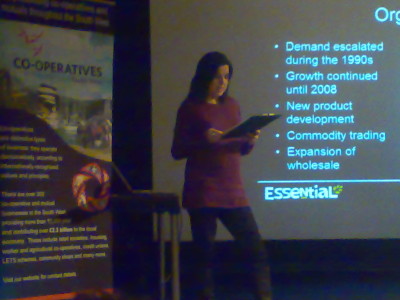
Photo of Eli Sarre

Eli Sarre from Essential Trading speaking at C-SW Annual Conference

Last Friday (11 November 2011), I was at the Cooperatives-SW annual conference at the Cube Cinema in Bristol, titled Growing Your Co-operative and sponsored by the Co-operative Membership South and West. It was another sold-out event, featuring headline talks from Co-op Party member and Labour MP Kerry McCarthy, Eli Sarre of Essential Trading worker co-op (pictured), Carole Theyer of Sparks Inc and Jim Pettipher from Co-operative Futures. There were also some great workshops I went to a finance workshop led by Ian Rothwell from Co-operative and Community Finance and a regulations one with Paul Martin of Kabin (details may appear on their event page) and a brilliant lunch from Runcible Spoon (and those of you who know me will know I have been livid with some co-op event lunches!) with some time to chat and network, although I also went to a fringe meeting about the RISE problems. The event concluded with the formal AGM of Co-operatives SW (electing a new chairperson and approving transfer to a new co-op corporation) as well as a bit more chat afterwards. I felt it was a great event and well worth my time being there. I m glad that some people from outside the co-op movement, from community businesses like the Strawberry Line Cafe and a few people considering joining or forming co-ops, were there and I hope it was good for them too.

Vincent Bernat: A quick look at Typekit

Back in the dark ages of the web, before the introduction of CSS 3, browsers could only display fonts available on the client system. Thanks to the introduction of @font-face and its now widespread support, this is over. Now, Web designers have access to a large selection of fonts and most users will be able to appreciate them. Typekit provides a subscription-based library of hosted, high-quality fonts to use on websites. I expose here my own, mostly uneducated1 on the typographic side, look on this service.

Fonts embedding 101 There are several ways to embed fonts for the Web. Let s have a look at the most common ones.

Self-hosting and @font-face A first possibility is to host fonts yourself and provide a CSS file with the appropriate @font-face declarations. There are five important things to know:
  1. There is no common format. You will need to host different versions of the same font to support most browsers.
  2. Of course, Internet Explorer comes with its own quirks that you need to work around.
  3. Most browsers enforce a same origin policy. You need to serve your fonts from the same domain as the requesting page. You can circumvent such a limitation by enabling cross-origin resource sharing: add an Access-Control-Allow-Origin header when serving fonts.
  4. Fonts are unlikely to change. To leverage caching, configure an explicit expiration date far in the future. Something like 30 days.
  5. There is no MIME types registered for fonts. Don t bother setting one, even if Google Chrome likes to complain about them in the console.
One great resource is Font Squirrel which provides kits with fonts and the appropriate CSS declarations. You choose your font family (or upload one of your own), the formats that you want to use (check them all) and you will get a ZIP archive with all fonts and a CSS file. You may want to tweak it a bit to enable automatic use of the bold variant when needed and to use a local copy if available. For example, if you choose Crimson, an oldstyle typeface, you may want to declare the bold version with font-weight: bold and add local names:
@font-face  
    font-family: 'Crimson';
    src: url('Crimson-Bold-webfont.eot');
    src: local('Crimson Bold'), local('Crimson Text Bold'),
         url('Crimson-Bold-webfont.eot?#iefix') format('embedded-opentype'),
         url('Crimson-Bold-webfont.woff') format('woff'),
         url('Crimson-Bold-webfont.ttf') format('truetype'),
         url('Crimson-Bold-webfont.svg#CrimsonBold') format('svg');
    font-weight: bold;
    font-style: normal;
 

Google Web Fonts For open-source fonts, you can also use Google Web Fonts instead of hosting the files yourself. Build a collection of fonts and choose the variants that you want to use for each of them. You will then be provided with a code snippet to paste in the <head> element of your page. For example, for Crimson:
<link href='http://fonts.googleapis.com/css?family=Crimson+Text:400,700,400italic'
      rel='stylesheet' type='text/css'>
Why choose this solution over self-hosting?
  1. You don t use your own bandwith to serve fonts. This may be important if you pay for it.
  2. Google uses its own CDN to serve fonts. If you don t use a CDN yourself, this can be a major performance improvement.
  3. Caching is more efficient since many sites will use the same font.
  4. It s easier to do it right.
Unless you are concerned about Google tracking your users2, I think this is a better solution than self-hosting. Quick delivery of fonts is pretty important since content rendering can be delayed by them.

Typekit: the good parts So, why choose Typekit? First, there is the very large choice of fonts. The first paid plan comes with more than 500 fonts from about 80 foundries. There are about a hundred serif fonts and a couple hundred sans serif ones. Typekit provides a convenient interface to browse fonts. You can either search fonts by name or by characteristics. In the last case, you can filter on properties like the classification (serif, sans serif, decorative, etc.), weight, width, contrast, x-height, recommended use or language support. Once a font is selected and added to your kit, you can easily choose what variants you want. The kit total size is displayed. If you happen to meet any problem or have some questions, Typekit support is very responsive. I got clear and crisp answers in less than a few hours in the week-end.

and the bad ones Unfortunately, Typekit has also some shortcomings. One of the most commonly cited is that Javascript is mandatory. No Javascript, no fonts. If you want to display the appropriate fonts for users without Javascript, you should just not use Typekit.

Not free, nor free While Typekit offers some open-source fonts, most of them are not. Moreover, only a few of them are available in the free plan. While I would prefer to use open-source fonts, I don t consider this a strong requirement: if you are dissatisfied for some reason, switching back to open-source fonts (or another service) is fast and easy. I like serif fonts a lot and they get less attention from the FLOSS world: it is difficult to find one whose readability on screen is excellent. Droid Serif is a nice font but is a bit too black for me. Maybe Cardo would be a good match. You may disagree and in this case, Google Web Fonts or self-hosting seem the perfect match.

Difficulty to choose and test fonts While browsing fonts is easy and smooth, choosing and testing them is another matter. For example, Typekit is missing some interface to compare font rendering for whole paragraphs at a given size. It also misses a way to check how two fonts render together, one for headings and one for paragraphs. Here, Google Web Fonts is more versatile. Things become really difficult when you want to test your selected fonts for real. Except if you have invested into one of the expensive plans, you can only include a limited number of fonts in your kit. Each time you want to try another set of fonts, you need to modify your kit and wait for it to be distributed across Typekit network. You may have to wait five or ten minutes between each change! Another inconvenient thing is that once you publish your site, any change to the kit will affect the published version. Therefore, you need to use a second kit for development and play back and forth with those two kits. What would be convenient here is a special kit with all fonts from the library with restricted access to some IP to avoid abuse. This is something done by Fontdeck, a competitor.

Poor subset support Because you want to keep the font size small (about 30 kB for each variant), Typekit usually proposes two subsets: the default one contains only latin characters and the complete one with all glyphs. If some glyph is absent from the default subset, you need to use the complete one which is roughly two to four times the size of the default one. This is a bit huge for only one character. What would be nice is to have subsets for each language. In my case, I would take a French subset because I need the glyph which appears in French in words like c ur (heart or core) or il (eye). I don t want to select the complete subset just for this character. When a glyph is absent, the next font in the CSS stack is used. For example, if the selected font is FF Tisa Web Pro and the next font in the stack is Droid Serif, here is how the word c ur may be rendered. On the first line, FF Tisa Web Pro contains the appropriate glyph. On the second line, the glyph is absent and taken from Droid Serif. Since x-height and contrast are a bit different, the replaced glyph seems out of tone. At small sizes, the difference accounts for more than 10%. Various rendering of word "c ur" I have also added a third line where the ligature is built from o and e and the following style is applied to e :
.lf-ligature  
    margin-left: -0.172em;
    zoom: 1; /* Here to trigger hasLayout on IE7 */
 
As you can see, the result seems good. I have a piece of Javascript turning a ligature into the appropriate markup. It can be extended to handle more ligatures and could be adapted to handle other composed characters (like the ones in Anton n Dvo k ).

Defective caching Because a document can only be rendered after the fonts have been loaded3, it is pretty important to deliver fonts as fast as possible. Typekit uses Edgecast as a CDN and DynECT for DNS hosting. Two files are downloaded. Both of them are hosted on use.typekit.com. The first one is a script that will act as a loader. Based on the characteristics of your browser, it will choose how to download the requested fonts for best rendering. The second file is generally a big CSS file containing the fonts. Here are the headers returned for the first file:
HTTP/1.1 200 OK
Accept-Ranges: bytes
Cache-Control: max-age=300
Content-Encoding: gzip
Content-Type: text/javascript
Date: Tue, 08 Nov 2011 18:34:16 GMT
ETag: "388467610+gzip"
Expires: Tue, 08 Nov 2011 18:39:16 GMT
Last-Modified: Sat, 05 Nov 2011 09:31:57 GMT
Server: ECS (cdg/D624)
Vary: Accept-Encoding
X-Cache: HIT
Content-Length: 7440
First, notice that the content is served compressed. Good point. The next headers to look at are Cache-Control, Date, ETag and Expires: the server requests the content to be cached for 5 minutes. When the browser notices that its copy is out-of-date, it will issue a new request including a If-None-Match: 388467610+gzip header. Unless the kit has been modified, the server will answer with 304 Not Modified and no content. The copy of the browser will be valid for another 5 minutes. This means that after 5 minutes, at least 3 round-trips are needed to check if our fonts are up-to-date. Worse, sometimes, Typekit servers may be just slow. They can wait one second before answering, just to send a 304. Since the first file is a script embedded in <head>, the whole page is blocked until you get the answer. Here is an illustrative example with Chromium 14 where a page using Typekit is loaded while all static assets are in the navigator cache and things have gone wrong (which is pretty rare): Screenshot of Chromium Inspector Since fonts are needed, the rendering has been paused for 3.5 seconds until Typekit was fully loaded. If we look more closely, we may also notice we got a status 200 from the server instead of 304. Here is an excerpt of the browser request:
GET /tyt0atd.js HTTP/1.1
Host: use.typekit.com
Connection: keep-alive
Accept-Encoding: gzip,deflate,sdch
If-None-Match: "2200251225+gzip"
If-Modified-Since: Thu, 10 Nov 2011 11:38:11 GMT
And here is an excerpt of the answer headers:
HTTP/1.1 200 OK
Accept-Ranges: bytes
Cache-Control: max-age=300
Content-Type: text/javascript
Date: Fri, 11 Nov 2011 17:10:03 GMT
ETag: "2200251225"
Expires: Fri, 11 Nov 2011 17:15:03 GMT
Last-Modified: Thu, 10 Nov 2011 11:38:11 GMT
Server: EOS (lax001/54E5)
Content-Length: 25755
What happened? For some unknown reason, the server denied the access to the compressed version of the resource: there is no Content-Encoding: gzip while the browser did send Accept-Encoding: gzip. The tag provided by the browser (2200251225+gzip) came obviously from the compressed resource and therefore does not match. RFC 2616 requests If-Modified-Since header to be ignored if the tag does not match. Consequently, the server answers with 200 OK and resend the whole file. The same problem happened with the CSS file. Let me stress again how important the problem is: we had to download again the two files but we also downloaded the non-compressed version. Now, let s suppose that we did not run into this problem and the server answered with 304 Not Modified. The result is still not satisfactory: we would have waited 1.3 seconds to get both answers from the server. Keep in mind that most of the time, Typekit is pretty fast. Here is how I think this should have been done: each time you modify your font kit, you get a new URL to use (containing the version of the font kit for example). This resource and the associated fonts (whose URL is also versioned) are requested to be cached for several days. As a sidenote, this also enables to modify a kit for your development environment without modifying the kit for your production site. I suspect that Typekit did not go this way to track kit usage more accurately and enforce the appropriate pricing. Having multiple versions of the same kit would also allow us to use more fonts that we are paying for. UPDATED: Typekit support knows the problem and is working on it:
You ve identified a small bug in our CDN provider that we re working with them to fix. Hopefully I can give an explanation of what s happening. The CDN edge servers have a cache of recently served kits on them. Any request that is served from that cache will be correctly Gzipped and handle ETags. Unfortunately, if the content isn t already in cache and needs to be fetched from the master origin server then the request won t be gzipped correctly which has the side effect of breaking ETags. [ ] We are working to on getting this bug fixed, but any change to a globally distributed CDN will take some time. We re also working on having our content cached longer than 5 minutes whilst still allowing people to quickly update their site.

Conclusion I have mixed feelings about Typekit. While the difficulty to test fonts and the lack of language-related subsets are annoying, I have been able to work around them. However, the caching problem is more annoying. I am still considering going back to Google Web Fonts just because of this.

  1. While I have a high interest in typography, have my own copy of The Elements of Typographic Style by Robert Bringhurst and have throughly read The Elements of Typographic Style Applied to the Web , I am still fairly novice on this matter.
  2. Google serves fonts from a cookie-less domain. Technically, they could still do some kind of tracking but I believe they don t.
  3. In fact, browsers have different strategies on how to render before fonts availability. Paul Irish wrote a comprehensive article on FOUT. One common strategy is to render a blank space until downloaded fonts are available. If this takes too much time, fallback fonts may be used.

13 November 2011

Axel Beckert: grep everything

During the OpenRheinRuhr I noticed that a friend of mine didn t know about zgrep and friends. So I told him what other grep variations I know and he told me about some grep variations I didn t know about. So here s our collection of grep wrappers, derivatives and variations. First I ll list programs which search for text in different file formats:
grep through whatFixed StringsWildcards / Basic RegExpsExtended RegExpsDebian package
uncompressed text filesfgrepgrepegrepgrep
gzip-compressed text fileszfgrepzgrepzegrepzutils, gzip
bzip2-compressed text filesbzfgrepbzgrepbzegrepbzip2
xz-compressed text filesxzfgrepxzgrepxzegrepxz-utils
uncompressed text files in installed Debian packagesdfgrepdgrepdegrepdebian-goodies
gzip-compressed text files in installed Debian packages-dzgrep-debian-goodies
PDF documents--pdfgreppdfgrep
POD textspodgrep--pmtools
E-Mail folder (mbox, MH, Maildir)-mboxgrep -Gmboxgrep -Emboxgrep
Patches-grepdiffgrepdiff -Epatchutils
Process list--pgrepprocps
Gnumeric spreadsheetsssgrep -Fssgrep?gnumeric
Files in ZIP archives--zipgrepunzip
ID3 tags in MP3s--taggreppertaggrepper
Network packets--ngrepngrep
Tar archives--targrep / ptargrepperl (Experimental only for now)
And then there are also greps for special patterns on more or less normal files:
grep for whatuncompressed filescompressed filesDebian package
PCRE (Perl Compatible Regular Expression)pcregrep (see also the grep -P option)zpcregreppcregrep
IP Address in a given CIDR rangegrepcidr-grepcidr
XPath expressionxml_grep-xml-twig-tools
One question is though still unanswered for us: Is there some kind of meta-grep which chooses per file the right grep from above by looking at the MIME type of the according files, similar to xdg-open. Other tools which have grep in their name, but are too special to properly fit into the above lists: Includes contributions by Frank Hofmann and Faidon Liambotis.

12 November 2011

Russell Coker: Good Riddance to Flash

The Age reports that Adobe has ceased development of Flash for mobile systems [1]. This is described as leading to an improvement in the web experience for iPhone and iPad users, but the more important thing is that it will improve the experience for everyone. The Flash plugin has always been a resource hog and has never been properly supported on all the common platforms. Also most sites that use Flash never needed to as there were other ways of getting equal or better results without it. Now that Flash is officially on the path to obsolescence everyone can move to HTML5. I use the following configuration directives in my Squid configuration to block Flash, I selectively enable Flash for the few web sites which use it for useful things. Blocking flash in this manner means that desktop systems which have the Flash plugin installed probably won t be vulnerable to Flash security flaws as it is unlikely that one of the few sites that I permit to send Flash to my network would end up hosting hostile Flash code. acl swf url_regex swf$ swf\?
acl swftype req_mime_type -i ^application/x-shockwave-flash$
http_access deny swf
http_access deny swftype Wikipedia has a comparison of HTML5 and Flash. One interesting benefit that is claimed for Flash is that it allows DRM and it supports inserting commercials and in other ways giving the user an experience that they don t want. It seems that to put some more nails in the Flash coffin we need tools to suck video from Flash sites regardless of DRM and which skip commercials.

Next.

Previous.