Search Results: "ema"

30 September 2014

Gunnar Wolf: Diego G mez: Imprisoned for sharing

I got word via the Electronic Frontier Foundation about an act of injustice happening to a person for doing... Not only what I do day to day, but what I promote and believe to be right: Sharing academic articles. Diego is a Colombian, working towards his Masters degree on conservation and biodiversity in Costa Rica. He is now facing up to eight years imprisonment for... Sharing a scholarly article he did not author on Scribd. Many people lack the knowledge and skills to properly set up a venue to share their articles with people they know. Many people will hope for the best and expect academic publishers to be fundamentally good, not to send legal threats just for the simple, noncommercial act of sharing knowledge. Sharing knowledge is fundamental for science to grow, for knowledge to rise. Besides, most scholarly studies are funded by public money, and as the saying goes, they should benefit the public. And the public is everybody, is all of us. And yes, if this sounds in any way like what drove Aaron Swartz to his sad suicide early this year... It is exactly the same thing. Thankfully (although, sadly, after the sad fact), thousands of people strongly stood on Aaron's side on that demand. Please sign the EFF petition to help Diego, share this, and try to spread the word on the real world needs for Open Access mandates for academics! Some links with further information:

Raphaël Hertzog: My Debian LTS report for September

Thanks to the sponsorship of multiple companies, I have been paid to work 11 hours on Debian LTS this month. CVE triagingI started by doing lots of triage in the security tracker (if you want to help, instructions are here) because I noticed that the dla-needed.txt list (which contains the list of packages that must be taken care of via an LTS security update) was missing quite a few packages that had open vulnerabilities in oldstable. In the end, I pushed 23 commits to the security tracker. I won t list the details each time but for once, it s interesting to let you know the kind of things that this work entailed: And when I say I reviewed it s a simplification for this kind of process: CVE triaging is often almost half the work in the general process: once you know that you are affected and that you have a patch, the process to release an update is relatively straightforward (sometimes there s still work to do to backport the patch). Once I was over that first pass of triaging, I had already spent more than the 11 hours paid but I still took care of preparing the security update for python-django. Thorsten Alteholz had started the work but got stuck in the process of backporting the patches. Since I m co-maintainer of the package, I took over and finished the work to release it as DLA-65-1.

No comment Liked this article? Click here. My blog is Flattr-enabled.

Mario Lang: A simple C++11 concurrent workqueue

For a little toy project of mine (a wikipedia XML dump word counter) I wrote a little C++11 helper class to distribute work to all available CPU cores. It took me many years to overcome my fear of threading: In the past, whenever I toyed with threaded code, I ended up having a lot of deadlocks, and generally being confused. It appears that I finally have understood enough of this crazyness to be able to come up with the small helper class below.
The problem We want to spread work amongst all available CPU cores. There are no dependencies between items in our work queue. So every thread can just pick up and process an item as soon as it is ready.
The solution This simple implementation makes use of C++11 threading primitives, lambda functions and move semantics. The idea is simple: You provide a function at construction time which defines how to process one item of work. To pass work to the queue, simply call the function operator of the object, repeatedly. When the destructor is called (once the object reachs the end of its scope), all remaining items are processed and all background threads are joined. The number of threads defaults to the value of std::thread::hardware_concurrency(). This appears to work at least since GCC 4.9. Earlier tests have shown that std::thread::hardware_concurrency() always returned 1. I don't know when exactly GCC (or libstdc++, actually) started to support this, but at least since GCC 4.9, it is usable. Prerequisite on Linux is a mounted /proc. The number of maximum items per thread in the queue defaults to 1. If the queue is full, calls to the function operator will block. So the most basic usage example is probably something like:
int main()  
  typedef std::string item_type;
  distributor<item_type> process([](item_type &item)  
    // do work
   );
  while (/* input */) process(std::move(/* item */));
  return 0;
 
That is about as simple as it can get, IMHO. The code can be found in the GitHub project mentioned above. However, since the class template is relatively short, here it is.
#include <condition_variable>
#include <mutex>
#include <queue>
#include <stdexcept>
#include <thread>
#include <vector>
template <typename Type, typename Queue = std::queue<Type>>
class distributor: Queue, std::mutex, std::condition_variable  
  typename Queue::size_type capacity;
  bool done = false;
  std::vector<std::thread> threads;
public:
  template<typename Function>
  distributor( Function function
             , unsigned int concurrency = std::thread::hardware_concurrency()
             , typename Queue::size_type max_items_per_thread = 1
             )
  : capacity concurrency * max_items_per_thread 
   
    if (not concurrency)
      throw std::invalid_argument("Concurrency must be non-zero");
    if (not max_items_per_thread)
      throw std::invalid_argument("Max items per thread must be non-zero");
    for (unsigned int count  0 ; count < concurrency; count += 1)
      threads.emplace_back(static_cast<void (distributor::*)(Function)>
                           (&distributor::consume), this, function);
   
  distributor(distributor &&) = default;
  distributor &operator=(distributor &&) = delete;
  ~distributor()
   
     
      std::lock_guard<std::mutex> guard(*this);
      done = true;
      notify_all();
     
    for (auto &&thread: threads) thread.join();
   
  void operator()(Type &&value)
   
    std::unique_lock<std::mutex> lock(*this);
    while (Queue::size() == capacity) wait(lock);
    Queue::push(std::forward<Type>(value));
    notify_one();
   
private:
  template <typename Function>
  void consume(Function process)
   
    std::unique_lock<std::mutex> lock(*this);
    while (true)  
      if (not Queue::empty())  
        Type item   std::move(Queue::front())  ;
        Queue::pop();
        notify_one();
        lock.unlock();
        process(item);
        lock.lock();
        else if (done)  
        break;
        else  
        wait(lock);


 ;
If you have any comments regarding the implementation, please drop me a mail.

Francois Marier: Encrypted mailing list on Debian and Ubuntu

Running an encrypted mailing list is surprisingly tricky. One of the first challenges is that you need to decide what the threat model is. Are you worried about someone compromising the list server? One of the subscribers stealing the list of subscriber email addresses? You can't just "turn on encryption", you have to think about what you're trying to defend against. I decided to use schleuder. Here's how I set it up.

Requirements What I decided to create was a mailing list where people could subscribe and receive emails encrypted to them from the list itself. In order to post, they need to send an email encrypted to the list' public key and signed using the private key of a subscriber. What the list then does is decrypt the email and encrypts it individually for each subscriber. This protects the emails while in transit, but is vulnerable to the list server itself being compromised since every list email transits through there at some point in plain text.

Installing the schleuder package The first thing to know about installing schleuder on Debian or Ubuntu is that at the moment it unfortunately depends on ruby 1.8. This means that you can only install it on Debian wheezy or Ubuntu precise: trusty and jessie won't work (until schleuder is ported to a more recent version of ruby). If you're running wheezy, you're fine, but if you're running precise, I recommend adding my ppa to your /etc/apt/sources.list to get a version of schleuder that actually lets you create a new list without throwing an error. Then, simply install this package:
apt-get install schleuder

Postfix configuration The next step is to configure your mail server (I use postfix) to handle the schleuder lists. This may be obvious but if you're like me and you're repurposing a server which hasn't had to accept incoming emails, make sure that postfix is set to the following in /etc/postfix/main.cf:
inet_interfaces = all
Then follow the instructions from /usr/share/doc/schleuder/README.Debian and finally add the following line (thanks to the wiki instructions) to /etc/postfix/main.cf:
local_recipient_maps = proxy:unix:passwd.byname $alias_maps $transport_maps

Creating a new list Once everything is set up, creating a new list is pretty easy. Simply run schleuder-newlist list@example.org and follow the instructions After creating your list, remember to update /etc/postfix/transports and run postmap /etc/postfix/transports. Then you can test it by sending an email to LISTNAME-sendkey@example.com. You should receive the list's public key.

Adding list members Once your list is created, the list admin is the only subscriber. To add more people, you can send an admin email to the list or follow these instructions to do it manually:
  1. Get the person's GPG key: gpg --recv-key KEYID
  2. Verify that the key is trusted: gpg --fingerprint KEYID
  3. Add the person to the list's /var/lib/schleuder/HOSTNAME/LISTNAME/members.conf:
    - email: francois@fmarier.org
      key_fingerprint: 8C470B2A0B31568E110D432516281F2E007C98D1
    
  4. Export the public key: gpg --export -a KEYID
  5. Paste the exported key into the list's keyring: sudo -u schleuder gpg --homedir /var/lib/schleuder/HOSTNAME/LISTNAME/ --import

28 September 2014

Clint Adams: Banana Pi is a real thing

Now that I've almost caught up with life after an extended stint on the West Coast, it's time to play. Like Gunnar, I acquired a Banana Pi courtesy of LeMaker. My GuruPlug (courtesy me) and my Excito B3 (courtesy the lovely people at Tor) are giving me a bit of trouble in different ways, so my intent is to decommission and give away the GuruPlug and Excito B3, leaving my DreamPlug and the Banana Pi to provide the services currently performed by the GuruPlug, Excito B3, and DreamPlug. The Banana Pi is presently running Bananian on a 32G SDHC (Class 10) card. This is close to wheezy, and appears to have a mostly-sane default configuration, but I am not going to trust some random software downloaded off the Internet on my home network, so I need to be able to run Debian on it instead. My preliminary belief is that the two main obstacles are Linux and U-Boot. Bananian 14.09 comes with Linux 3.4.90+ #1 SMP PREEMPT Fri Sep 12 18:13:45 CEST 2014 armv7l GNU/Linux, whatever that is, and U-Boot SPL 2014.04-10694-g2ae8b32 (Sep 03 2014 - 20:53:14). I don't yet know what the status of mainline/Debian support is. Someone gave me a wooden cigar box to use as a case, which is not working out quite as hoped. I also found that my hack to power a 3.5" SATA drive does not work, so I'll either need to hammer on that some more or resolve to use a 2.5" drive instead. memory:
Mem:        993700      36632     957068          0       2248      11136
-/+ buffers/cache:      23248     970452
Swap:       524284       1336     522948
cpu:
Processor       : ARMv7 Processor rev 4 (v7l)
processor       : 0
BogoMIPS        : 1192.96
processor       : 1
BogoMIPS        : 1197.05
Features        : swp half thumb fastmult vfp edsp neon vfpv3 tls vfpv4 idiva idivt 
CPU implementer : 0x41
CPU architecture: 7
CPU variant     : 0x0
CPU part        : 0xc07
CPU revision    : 4
Hardware        : sun7i
Revision        : 0000
Serial          : 03c32de75055484880485278165166c9

Jonathan Dowland: What have I been up to?

It's been a little while since I've written about what I've been up to. The truth is I've been busy with moving house - and I'll write a bit more about that at another time. But asides from that there have been some bits and bobs. I use a little tool called archivemail to tidy up old listmail (my policy is to retain 30 days of listmail for most lists). If I unsubscribe to a list, then eventually I end up with an empty mail folder corresponding to that list. I decided it would be nice to extend archivemail to delete mailboxes if, after the archiving has taken place, the mailbox is empty. Doing this properly means adding delete routines to Python's "mailbox" library, which is part of the Python standard library. I've therefore started work on a patch for Python. Since this is an enhancement, Python would only accept a patch for Python 3. Therefore, eventually, I would also have to port archivemail from Python 2 to 3. "archivemail" is basically abandonware at the moment, and the principal Debian maintainer is MIA. There was a release critical bug filed against it, so I joined the Debian Python team to co-maintain archivemail in Debian. I've worked around the RC bug but a proper fix is still to come. In other Debian news, I've been mostly quiet. A small patch for squishyball to get it to build on Hurd, and a temporary fix patch for lhasa to get it to build on the build daemons for all architectures (problems with the test suite). All three of lhasa, squishyball and archivemail need a little bit of love to get them into shape before the jessie freeze. I've had plans to write up some of the more interesting technical things I've been up to at work, but with the huge successes of the School we've been so busy I haven't had time. Hopefully you can soon look forward to some of our further adventures with puppet, including evaluating Shibboleth modules, some stuff about handling user directories, bind mounts and LVM volumes and actually publishing some of our more useful internal modules; I hope we will also (soon) have some useful data to go with our experiments with Linux LXC containers versus KVM-powered virtual machines in some of our use-cases. I've also got a few bits and pieces on Systemd to write up.

27 September 2014

DebConf team: Wrapping up DebConf14 (Posted by Paul Wise, Donald Norwood)

The annual Debian developer meeting took place in Portland, Oregon, 23 to 31 August 2014. DebConf14 attendees participated in talks, discussions, workshops and programming sessions. Video teams captured a lot of the main talks and discussions for streaming for interactive attendees and for the Debian video archive. Between the video, presentations, and handouts the coverage came from the attendees in blogs, posts, and project updates. We ve gathered a few articles for your reading pleasure: Gregor Herrmann and a few members of the Debian Perl group had an informal unofficial pkg-perl micro-sprint and were very productive. Vincent Sanders shared an inspired gift in the form of a plaque given to Russ Allbery in thanks for his tireless work of keeping sanity in the Debian mailing lists. Pictures of the plaque and design scheme are linked in the post. Vincent also shared his experiences of the conference and hopes the organisers have recovered. Noah Meyerhans adventuring to Debian by train, (Inter)netted some interesting IPv6 data for future road and railwarriors. Hideki Yamane sent a gentle reminder for English speakers to speak more slowly. Daniel Pocock posted of GSoC talks at DebConf14, highlights include the Java Project Dependency Builder and the WebRTC JSCommunicator. Thomas Goirand gives us some insight into a working task list of accomplishments and projects he was able to complete at DebConf14, from the OpenStack discussion to tasksel talks, and completion of some things started last year at DebConf13. Antonio Terceiro blogged about debci and the Debian Continuous Integration project, Ruby, Redmine, and Noosfero. His post also shares the atmosphere of being able to interact directly with peers once a year. Stefano Zacchiroli blogged about a talk he did on debsources which now has its own HACKING file. Juliana Louback penned: DebConf 2014 and How I Became a Debian Contributor. Elizabeth Krumbach Joseph s in-depth summary of DebConf14 is a great read. She discussed Debian Validation & CI, debci and the Continuous Integration project, Automated Validation in Debian using LAVA, and Outsourcing webapp maintenance. Lucas Nussbaum by way of a blog post releases the very first version of Debian Trivia modelled after the TCP/IP Drinking Game. Fran ois Marier s shares additional information and further discussion on Outsourcing your webapp maintenance to Debian. Joachim Breitner gave a talk on Haskell and Debian, created a new tool for binNMUs for Haskell packages which runs via cron job. The output is available for Haskell and for OCaml, and he still had a small amount of time to go dancing. Jaldhar Harshad Vyas was not able to attend DebConf this year, but he did tune in to the videos made available by the video team and gives an insightful viewpoint to what was being seen. J r my Bobbio posted about Reproducible builds in Debian in his recap of DebConf14. One of the topics at hand involved defining a canonical path where packages must be built and a BOF discussion on reproducible builds from where the conversation moved to discussions in both Octave and Groff. New helpers dh_fixmtimes and dh_genbuildinfo were added to BTS. The .buildinfo format has been specified on the wiki and reviewed. Lots of work is being done in the project, interested parties can help with the TODO list or join the new IRC channel #debian-reproducible on irc.debian.org. Steve McIntyre posted a Summary from the d-i / debian-cd BoF at DC14, with some of the session video available online. Current jessie D-I needs some help with the testing on less common architectures and languages, and release scheduling could be improved. Future plans: Switching to a GUI by default for jessie, a default desktop and desktop choice, artwork, bug fixes and new architecture support. debian-cd: Things are working well. Improvement discussions are on selecting which images to make I.E. netinst, DVD, et al., debian-cd in progress with http download support, Regular live test builds, Other discussions and questions revolve around which ARM platforms to support, specially-designed images, multi-arch CDs, and cloud-init based images. There is also a call for help as the team needs help with testing, bug-handling, and translations. Holger Levsen reports on feedback about the feedback from his LTS talk at DebConf14. LTS has been perceived well, fits a demand, and people are expecting it to continue; however, this is not without a few issues as Holger explains in greater detail the lacking gatekeeper mechanisms, and how contributions are needed from finance to uploads. In other news the security-tracker is now fixed to know about old stable. Time is short for that fix as once jessie is released the tracker will need to support stable, oldstable which will be wheezy, and oldoldstable. Jonathan McDowell s summary of DebConf14 includes a fair perspective of the host city and the benefits of planning of a good DebConf14 location. He also talks about the need for facetime in the Debian project as it correlates with and improves everyone s ability to work together. DebConf14 also provided the chance to set up a hard time frame for removing older 1024 bit keys from Debian keyrings. Steve McIntyre posted a Summary from the State of the ARM BoF at DebConf14 with updates on the 3 current ports armel, armhf and arm64. armel which targets the ARM EABI soft-float ARMv4t processor may eventually be going away, while armhf which targets the ARM EABI hard-float ARMv7 is doing well as the cross-distro standard. Debian is has moved to a single armmp kernel flavour using Device Tree Blobs and should be able to run on a large range of ARMv7 hardware. The arm64 port recently entered the main archive and it is hoped to release with jessie with 2 official builds hosted at ARM. There is talk of laptop development with an arm64 CPU. Buildds and hardware are mentioned with acknowledgements for donated new machines, Banana Pi boards, and software by way of ARM s DS-5 Development Studio - free for all Debian Developers. Help is needed! Join #debian-arm on irc.debian.org and/or the debian-arm mailing list. There is an upcoming Mini-DebConf in November 2014 hosted by ARM in Cambridge, UK. Tianon Gravi posted about the atmosphere and contrast between an average conference and a DebConf. Joseph Bisch posted about meeting his GSOC mentors, attending and contributing to a keysigning event and did some work on debmetrics which is powering metrics.debian.net. Debmetrics provides a uniform interface for adding, updating, and viewing various metrics concerning Debian. Harlan Lieberman-Berg s DebConf Retrospective shared the feel of DebConf, and detailed some of the work on debugging a build failure, work with the pkg-perl team on a few uploads, and work on a javascript slowdown issue on codeeditor. Ana Guerrero L pez reflected on Ten years contributing to Debian.

25 September 2014

Aigars Mahinovs: Distributing third party applications via Docker?

Recently the discussions around how to distribute third party applications for "Linux" has become a new topic of the hour and for a good reason - Linux is becoming mainstream outside of free software world. While having each distribution have a perfectly packaged, version-controlled and natively compiled version of each application installable from a per-distribution repository in a simple and fully secured manner is a great solution for popular free software applications, this model is slightly less ideal for less popular apps and for non-free software applications. In these scenarios the developers of the software would want to do the packaging into some form, distribute that to end-users (either directly or trough some other channels, such as app stores) and have just one version that would work on any Linux distribution and keep working for a long while. For me the topic really hit at Debconf 14 where Linus voiced his frustrations with app distribution problems and also some of that was touched by Valve. Looking back we can see passionate discussions and interesting ideas on the subject from systemd developers (another) and Gnome developers (part2 and part3). After reading/watching all that I came away with the impression that I love many of the ideas expressed, but I am not as thrilled about the proposed solutions. The systemd managed zoo of btrfs volumes is something that I actually had a nightmare about. There are far simpler solutions with existing code that you can start working on right now. I would prefer basing Linux applications on Docker. Docker is a convenience layer on top of Linux cgroups and namespaces. Docker stores its images in a datastore that can be based on AUFS or btrfs or devicemapper or even plain files. It already has a semantic for defining images, creating them, running them, explicitly linking resources and controlling processes. Lets play a simple scenario on how third party applications should work on Linux. Third party application developer writes a new game for Linux. As his target he chooses one of the "application runtime" Docker images on Docker Hub. Let's say he chooses the latest Debian stable release. In that case he writes a simple Dockerfile that installs his build-dependencies and compiles his game in "debian-app-dev:wheezy" container. The output of that is a new folder containing all the compiled game resources and another Dockerfile - this one describes the runtime dependencies of the game. Now when a docker image is built from this compiled folder, it is based on "debian-app:wheezy" container that no longer has any development tools and is optimized for speed and size. After this build is complete the developer exports the Docker image into a file. This file can contain either the full system needed to run the new game or (after #8214 is implemented) just the filesystem layers with the actual game files and enough meta-data to reconstruct the full environment from public Docker repos. The developer can then distribute this file to the end user in the way that is comfortable for them. The end user would download the game file (either trough an app store app, app store website or in any other way) and import it into local Docker instance. For user convenience we would need to come with an file extension and create some GUIs to launch for double click, similar to GDebi. Here the user would be able to review what permissions the app needs to run (like GL access, PulseAudio, webcam, storage for save files, ...). Enough metainfo and cooperation would have to exist to allow desktop menu to detect installed "apps" in Docker and show shortcuts to launch them. When the user does so, a new Docker container is launched running the command provided by the developer inside the container. Other metadata would determine other docker run options, such as whether to link over a socket for talking to PulseAudio or whether to mount in a folder into the container to where the game would be able to save its save files. Or even if the application would be able to access X (or Wayland) at all. Behind the scenes the application is running from the contained and stable libraries, but talking to a limited and restricted set of system level services. Those would need to be kept backwards compatible once we start this process. On the sandboxing part, not only our third party application is running in a very limited environment, but also we can enhance our system services to recognize requests from such applications via cgroups. This can, for example, allow a window manager to mark all windows spawned by an application even if the are from a bunch of different processes. Also the window manager can now track all processes of a logical application from any of its windows. For updates the developer can simply create a new image and distribute the same size file as before, or, if the purchase is going via some kind of app-store application, the layers that actually changed can be rsynced over individually thus creating a much faster update experience. Images with the same base can share data, this would encourage creation of higher level base images, such as "debian-app-gamegl:wheezy" that all GL game developers could use thus getting a smaller installation package. After a while the question of updating abandonware will come up. Say there is is this cool game built on top of "debian-app-gamegl:wheezy", but now there was a security bug or some other issue that requires the base image to be updated, but that would not require a recompile or a change to the game itself. If this Docker proposal is realized, then either the end user or a redistributor can easily re-base the old Docker image of the game on a new base. Using this mechanism it would also be possible to handle incompatible changes to system services - ten years down the line AwesomeAudio replaces PulseAudio, so we create a new "debian-app-gamegl:wheezy.14" version that contains a replacement libpulse that actually talks to AwesomeAudio system service instead. There is no need to re-invent everything or push everything and now package management too into systemd or push non-distribution application management into distribution tools. Separating things into logical blocks does not hurt their interoperability, but it allows to recombine them in a different way for a different purpose or to replace some part to create a system with a radically different functionality. Or am I crazy and we should just go and sacrifice Docker, apt, dpkg, FHS and non-btrfs filesystems on the altar of systemd? P.S. You might get the impression that I dislike systemd. I love it! Like an init system. And I love the ideas and talent of the systemd developers. But I think that systemd should have nothing to do with application distribution or processes started by users. I am sometimes getting an uncomfortable feeling that systemd is morphing towards replacing the whole of System V jumping all the way to System D and rewriting, obsoleting or absorbing everything between the kernel and Gnome. In my opinion it would be far healthier for the community if all of these projects would developed and be usable separately from systemd, so that other solutions can compete on a level playing field. Or, maybe, we could just confess that what systemd is doing is creating a new Linux meta-distribution.

Gunnar Wolf: #bananapi On how compressed files should be used

I am among the lucky people who got back home from DebConf with a brand new computer: a Banana Pi. Despite the name similarity, it is not affiliated with the very well known Raspberry Pi, although it is a very comparable (although much better) machine: A dual-core ARM A7 system with 1GB RAM, several more on-board connectors, and same form-factor. I have not yet been able to get it to boot, even from the images distributed on their site (although I cannot complain, I have not devoted more than a hour or so to the process!), but I do have a gripe on how the images are distributed. I downloaded some images to play with: Bananian, Raspbian, a Scratch distribution, and Lubuntu. I know I have a long way to learn in order to contribute to Debian's ARM port, but if I can learn by doing... So, what is my gripe? That the three images are downloaded as archive files:
  1. 0 gwolf@mosca 9 ~/Download/banana$ ls -hl bananian-latest.zip \
  2. > Lubuntu_For_BananaPi_v3.1.1.tgz Raspbian_For_BananaPi_v3.1.tgz \
  3. > Scratch_For_BananaPi_v1.0.tgz
  4. -rw-r--r-- 1 gwolf gwolf 222M Sep 25 09:52 bananian-latest.zip
  5. -rw-r--r-- 1 gwolf gwolf 823M Sep 25 10:02 Lubuntu_For_BananaPi_v3.1.1.tgz
  6. -rw-r--r-- 1 gwolf gwolf 1.3G Sep 25 10:01 Raspbian_For_BananaPi_v3.1.tgz
  7. -rw-r--r-- 1 gwolf gwolf 1.2G Sep 25 10:05 Scratch_For_BananaPi_v1.0.tgz
Now... that is quite an odd way to distribute image files! Specially when looking at their contents:
  1. 0 gwolf@mosca 14 ~/Download/banana$ unzip -l bananian-latest.zip
  2. Archive: bananian-latest.zip
  3. Length Date Time Name
  4. --------- ---------- ----- ----
  5. 2032664576 2014-09-17 15:29 bananian-1409.img
  6. --------- -------
  7. 2032664576 1 file
  8. 0 gwolf@mosca 15 ~/Download/banana$ for i in Lubuntu_For_BananaPi_v3.1.1.tgz \
  9. > Raspbian_For_BananaPi_v3.1.tgz Scratch_For_BananaPi_v1.0.tgz
  10. > do tar tzvf $i; done
  11. -rw-rw-r-- bananapi/bananapi 3670016000 2014-08-06 03:45 Lubuntu_1404_For_BananaPi_v3_1_1.img
  12. -rwxrwxr-x bananapi/bananapi 3670016000 2014-08-08 04:30 Raspbian_For_BananaPi_v3_1.img
  13. -rw------- bananapi/bananapi 3980394496 2014-05-27 01:54 Scratch_For_BananaPi_v1_0.img
And what is bad about them? That they force me to either have heaps of disk space available (2GB or 4GB for each image) or to spend valuable time extracting before recording the image each time. Why not just compressing the image file without archiving it? That is,
  1. 0 gwolf@mosca 7 ~/Download/banana$ tar xzf Lubuntu_For_BananaPi_v3.1.1.tgz
  2. 0 gwolf@mosca 8 ~/Download/banana$ xz Lubuntu_1404_For_BananaPi_v3_1_1.img
  3. 0 gwolf@mosca 9 ~/Download/banana$ ls -hl Lubun*
  4. -rw-r--r-- 1 gwolf gwolf 606M Aug 6 03:45 Lubuntu_1404_For_BananaPi_v3_1_1.img.xz
  5. -rw-r--r-- 1 gwolf gwolf 823M Sep 25 10:02 Lubuntu_For_BananaPi_v3.1.1.tgz
Now, wouldn't we need to decompress said files as well? Yes, but thanks to the magic of shell redirections, we can just do it on the fly. That is, instead of having 3 4GB+1 2GB files sitting on my hard drive, I just need to have several files ranging between 145M and I guess ~1GB. Then, it's as easy as doing:
  1. 0 gwolf@mosca 8 ~/Download/banana$ dd if=<(xzcat bananian-1409.img.xz) of=/dev/sdd
And the result should be the same: A fresh new card with Bananian ready to fly. Right, right, people using these files need to have xz installed on their systems, but... As it stands now, I can suppose current prospective users of a Banana Pi won't fret about facing a standard Unix tool! (Yes, I'll forward this rant to the Banana people, it's not just bashing on my blog :-P ) [update] Several people (thanks!) have contacted me stating that I use a bashism: The <( ) construct is specific to Bash. If you want to do this with any other shell, it can be done with a simple pipe:
  1. $ xzcat bananian-1409.img.xz dd of=/dev/sdd
That allows for less piping to be done on the kernel, and is portable between different shells. Also, a possibility would be:
  1. $ xzcat bananian-1409.img.xz > /dev/sdd
Although that might not be desirable, as it avoids the block-by-block nature of dd. I'm not sure if it makes a realdifference, but it's worth saying :) And yes, some alternatives for not unarchiving the file Here in the blog, an anon commenter suggests (respectively, for zip and .tar.gz files):
  1. $ dd if=<(unzip -p bananian-latest.zip) of=/dev/sdd
  2. $ dd if=<(tar -xOf Lubuntu_For_BananaPi_v3.1.1.tgz) of=/dev/sdd
And a commenter by IRC suggests:
  1. $ paxtar -xOaf Raspbian_For_BananaPi_v3.1.tgz Raspbian_For_BananaPi_v3_1.img sudo dd bs=262144 of=/dev/
Thanks!

24 September 2014

Laura Arjona: 10 short steps to contribute translations to free software for Android

This small guide assumes that you know how to create a public repository with git (or other version control system). Maybe some projects use other VCS, Subversion or whatever; the process would be similar although the commands will be different of course. If you don t want to use any VCS, you can just download the corresponding file, translate it, and send it by email or to the BTS of the project, but the commands required are very easy and you ll see soon that using git (or any VCS) is quite comfortable and less scary than what it seems. So, you were going to recommend a nice app that you use or found in F-Droid to your friend, but she does not understand English. Why not translating the app for her? And for everybody? It s a job that can be done in 15 minutes or so (Android apps have very short strings, few menus, and so). Let s go! 1.- Search the app in the F-Droid website You can do it going to the URL: https://f-droid.org/repository/browse/?fdfilter=wordofappname Example: https://f-droid.org/repository/browse/?fdfilter=pomodoro Then, open the details of the app, and learn where s the source code. 2.- Clone the source code If you have an account in that forge, fork/clone the project into your account, and then, clone your fork/clone in local. If you haven t got an account in that forge, clone the project in local. git clone URLofTheProjectOrYourClone 3.- In local, create a new branch, and checkout to it. cd nameofrepo git checkout -b Spanish 4.- Then, copy the /res/values folder into res/values-XX folder (where XX is your language code) cp ./res/values /res/values-es -R 5.- Translate Edit the strings.xml file that is in the res/values-XX folder, and change the English strings to your language (respect the XML format). 6.- Translate other files, or delete them If there are more files in that folder (e.g. arrays.xml ), review them to know if they have translatable strings. If yes, translate them. If not, delete the files. 7.- Commit When you are finished, commit your changes: git add res/values-es/* git commit -a (Message can be Spanish translation or so) 8.- Push your changes to your public repo If you didn t create a public clone of the repo in your forge, create a public repo and push your local stuff into there. git push --all 9.- Request a merge to the original repo (Using the web interface of the forge, if it is the same for the original repo and your clone, or sending an email or creating an issue and providing the URL of your repo). For example, open a new issue in the project s BTS Title: Spanish translation available for merging Body: Hi everybody. Thanks for your work in "nameofapp". I have completed a Spanish translation, it's available for review/merge in the Spanish branch of my repo: https://urlofyourclone Best regards 10.- Congratulations! Translations are new features, and having a new feature in your app for free is a great thing, so probably the app developer(s) will merge your translation soon. Share your joy with your friends, so they begin to use the app you translated, and maybe become translators too! Comments? You can comment on this post in this pump.io thread.
Filed under: Tools, Writings (translations) Tagged: Android, Contributing to libre software, English, Free Software, libre software, translations

Vincent Sanders: I wanted to go to Portland because it's a really good book town.

Plane at Heathrow terminal 5 taking me to America for Debconf 14Patti Smith is right, more than any other US city I have visited, Portland feels different. Although living in Cambridge, which sometimes feels like where books were invented, might give me a warped sense of a place.

Jo McIntyre getting on the tram at PDX
I have visited Portland a few times previously and I feel comfortable every time I arrive at PDX. Sure the place still suffers from the american obsession with the car but similar to New York you can rely on public transport to get about.

On this occasion my visit was for the Debian Conference which i was excited to attend having missed the previous one in Switzerland. This time the conference has changed its format to being 10 days long and mixing the developer time in with the more formal sessions.

The opening session gave Steve McIntyre and myself the opportunity to present a small token of our appreciation to Russ. The keynote speakers that afternoon were all very interesting both Stefano Zacchiroli and Gabriella Coleman giving food for thought on two very different subjects.

The sponsored accomodation rooms were plesent
Several conferences in the past have experienced issues with sponsored accommodation and food, I am very pleased to report that both were very good this time. The room I was in had a small kitchen area, en-suite bathroom, desks and most importantly comfortable beds.

Andy and Patty in the Ondine dining area
The food provision was in the form of a buffet in the Ondine facility. The menu was not greatly varied but catered to all requirements including vegetarian and gluten free diets.

Neil, Rob, Jo, Steve , Neil, Daniel and Andy dining under the planes
Some of us went on a visit to the Evergreen air and space museum to look at some rare aircraft and rockets. I can thoroughly recommend a visit if you are in the area.

These are just the highlights of the week though, the time in the hack-labs was productive with several practical achievements Including:
- Uploading new packages reducing the bug count
- Sorting out getting an updated key into the Debian keyring.

Overall I had a thoroughly enjoyable time and got a lot out of the conference this year. The new format suited me surprisingly well and as usual the social side was as valuable as the practical.

I hope the organisers have recovered enough to appreciate just how good a job they did and not get hung up on the small number of things that went wrong when the majority of things went perfectly to plan.

Robert Collins: what-poles-for-the-tent

So Monty and Sean have recently blogged about about the structures (1, 2) they think may work better for OpenStack. I like the thrust of their thinking but had some mumblings of my own to add. Firstly, I very much like the focus on social structure and needs what our users and deployers need from us. That seems entirely right. And I very much like the getting away from TC picking winners and losers. That was never an enjoyable thing when I was on the TC, and I don t think it has made OpenStack better. However, the thing that picking winners and losers did was that it allowed users to pick an API and depend on it. Because it was the X API for OpenStack . If we don t pick winners, then there is no way to say that something is the X API for OpenStack , and that means that there is no forcing function for consistency between different deployer clouds. And so this appears to be why Ring 0 is needed: we think our users want consistency in being able to deploy their application to Rackspace or HP Helion. They want vendor neutrality, and by giving up winners-and-losers we give up vendor neutrality for our users. Thats the only explanation I can come up with for needing a Ring 0 because its still winners and losers (e.g. picking an arbitrary project) keystone, grandfathering it in, if you will. If we really want to get out of the role of selecting projects, I think we need to avoid this. And we need to avoid it without losing vendor neutrality (or we need to give up the idea of vendor neutrality). One might say that we must pick winners for the very core just by its, but I don t think thats true. If the core is small, many people will still want vendor neutrality higher up the stack. If the core is large, then we ll have a larger % of APIs covered and stable granting vendor neutrality. So a core with fixed APIs will be under constant pressure to expand: not just from developers of projects, but from users that want API X to be fixed and guaranteed available and working a particular way at [most] OpenStack clouds. Ring 0 also fulfils a quality aspect we can check that it all works together well in a realistic timeframe with our existing tooling. We are essentially proposing to pick functionality that we guarantee to users; and an API for that which they have everywhere, and the matching implementation we ve tested. To pull from Monty s post: What does a basic end user need to get a compute resource that works and seems like a computer? (end user facet) What does Nova need to count on existing so that it can provide that. He then goes on to list a bunch of things, but most of them are not needed for that: We need Nova (its the only compute API in the project today). We don t need keystone (Nova can run in noauth mode and deployers could just have e.g. Apache auth on top). We don t need Neutron (Nova can do that itself). We don t need cinder (use local volumes). We need Glance. We don t need Designate. We don t need a tonne of stuff that Nova has in it (e.g. quotas) end users kicking off a simple machine have -very- basic needs. Consider the things that used to be in Nova: Deploying containers. Neutron. Cinder. Glance. Ironic. We ve been slowly decomposing Nova (yay!!!) and if we keep doing so we can imagine getting to a point where there truly is a tightly focused code base that just does one thing well. I worry that we won t get there unless we can ensure there is no pressure to be inside Nova to win . So there s a choice between a relatively large set of APIs that make the guaranteed available APIs be comprehensive, or a small set that that will give users what they need just at the beginning but might not be broadly available and we ll be depending on some unspecified process for the deployers to agree and consolidate around what ones they make available consistently. In sort one of the big reasons we were picking winners and losers in the TC was to consolidate effort around a single API not implementation (keystone is already on its second implementation). All the angst about defcore and compatibility testing is going to be multiplied when there is lots of ecosystem choice around APIs above Ring 0, and the only reason that won t be a problem for Ring 0 is that we ll still be picking winners. How might we do this? One way would be to keep picking winners at the API definition level but not the implementation level, and make the competition be able to replace something entirely if they implement the existing API [and win hearts and minds of deployers]. That would open the door to everything being flexible and its happened before with Keystone. Another way would be to not even have a Ring 0. Instead have a project/program that is aimed at delivering the reference API feature-set built out of a single, flat Big Tent and allow that project/program to make localised decisions about what components to use (or not). Testing that all those things work together is not much different than the current approach, but we d have separated out as a single cohesive entity the building of a product (Ring 0 is clearly a product) from the projects that might go into it. Projects that have unstable APIs would clearly be rejected by this team; projects with stable APIs would be considered etc. This team wouldn t be the TC : they too would be subject to the TC s rulings. We could even run multiple such teams as hinted at by Dean Troyer one of the email thread posts. Running with that I d then be suggesting So OpenStack/NaaS would have an API or set of APIs, and they d be responsible for considering maturity, feature set, and so on, but wouldn t own Neutron, or Neutron incubator or any other component they would be a *cross project* team, focused at the product layer, rather than the component layer, which nearly all of our folk end up locked into today. Lastly Sean has also pointed out that we have large N N^2 communication issues I think I m proposing to drive the scope of any one project down to a minimum, which gives us more N, but shrinks the size within any project, so folk don t burn out as easily, *and* so that it is easier to predict the impact of changes clear contracts and APIs help a huge amount there.

Junichi Uekawa: Sending GCM send message from nodejs.

Sending GCM send message from nodejs. I wanted to send a message from emacs, but it seemed to be relatively difficult to send HTTPS POST request from emacs, so I just decided to use handy nodejs. The attached 'data' is attached to intent as extra, so it can be extracted by intent.getExtras.getString("message") in IntentService#onHandleIntent()

23 September 2014

Enrico Zini: pressure

Pressure I've just stumbled on this bit that seems relevant to me:
Insist on using objective criteria The final step is to use mutually agreed and objective criteria for evaluating the candidate solutions. During this stage they encourage openness and surrender to principle not pressure. http://www.wikisummaries.org/Getting_to_Yes
I find the concept of "pressure" very relevant, and I like the idea of discussions being guided by content rather than pressure. I'm exploring the idea of filing under this concept of "pressure" most of the things described in code of conducts, and I'm toying with looking at gender or race issues from the point of view of making people surrender to pressure. In that context, most code of conducts seem to be giving a partial definition of "pressure". I've been uncomfortable at DebConf this year, because the conference PG12 code of conduct would cause me trouble for talking about what lessons can Debian learn from consent culture in BDSM communities, but it would still allow situations in which people would have to yield to pressure, as long as the pressure was done avoiding the behaviours blacklisted by the CoC. Pressure could be the phrase "you are wrong" without further explanation, spoken by someone with more reputation than I have in a project. It could be someone with the time for writing ten emails a day discussing with someone with barely the time to write one. It could be someone using elaborate English discussing with someone who needs to look up every other word in a dictionary. It could be just ignoring emails from people who have issues different than mine. I like the idea of having "please do not use pressure to bring your issues forward" written somewhere, rather than spend time blacklisting all possible ways of pressuring people. I love how the Diversity Statement is elegantly getting all this where it says: We welcome contributions from everyone as long as they interact constructively with our community. However, I also find it hard not to fall back to using pressure, even just for self-preservation: I have often found myself in the situation of having the responsibility to get a job done, and not having the time or emotional resources to even read the emails I get about the subject. All my life I've seen people in such a situation yell "shut up and let me work!", and I feel a burning thirst for other kinds of role models. A CoC saying "do not use pressure" would not help me much here, but being around people who do that, learning to notice when and how they do it, and knowing that I could learn from them, that certainly would. If you can link to examples, I'd like to add them here.

Dirk Eddelbuettel: RcppArmadillo 0.4.450.1.0

Continuing with his standard pace of approximately one new version per month, Conrad released a new minor release of Armadillo a few days ago. As before, I had created a GitHub-only pre-release which was tested against all eighty-seven (!!) CRAN dependents of our RcppArmadillo package and then uploaded RcppArmadillo 0.4.450.0 to CRAN. The CRAN maintainers pointed out that under the R-development release, a NOTE was issued concerning the C-library's rand() call. This is a pretty new NOTE, but it means using the (sometimes poor quality) rand() generator is now a no-no. Now, Armadillo being as robustly engineered as it is offers a new random number generator based on C++11 as well as a fallback generator for those unfortunate enough to live with an older C++98 compiler. (I would like to note here that I find Conrad's continued support for both C++11, offering very useful modern language idioms, as well as the fallback code for continued deployment and usage by those constrained in their choice of compilers rather exemplary --- because contrary to what some people may claim, it is not a matter of one or the other. C++ always was, and continues to be, a multi-paradigm language which can be supported easily by several standard. But I digress...) In any event, one cannot argue with CRAN about their prescription of a C++98 compiler. So Conrad and I discussed this over email, and came up with a scheme where a user-package (such as RcppArmadillo) can provide an alternate generator which Armadillo then deploys. I implemented a first solution which was then altered / reflected by Conrad in a revised version 4.450.1 of Armadillo. I packaged, and now uploaded, that version as RcppArmadillo 0.4.450.1.0 to both CRAN and into Debian. Besides the RNG change already discussed, this release brings a few smaller changes from the Armadillo side. These are detailed below in the extract from the NEWS file. On the RcppArmadillo side, we now have support for pkgKitten which is both very exciting and likely the topic of another blog post with an example of creating an RcppArmadillo package that purrs. In the process, I overhauled and polished how new packages are created by RcppArmadillo.package.skeleton(). An upcoming blog post may provide an example.
Changes in RcppArmadillo version 0.4.450.1.0 (2014-09-21)
  • Upgraded to Armadillo release Version 4.450.1 (Spring Hill Fort)
    • faster handling of matrix transposes within compound expressions
    • expanded symmatu()/symmatl() to optionally disable taking the complex conjugate of elements
    • expanded sort_index() to handle complex vectors
    • expanded the gmm_diag class with functions to generate random samples
  • A new random-number implementation for Armadillo uses the RNG from R as a fallback (when C++11 is not selected so the C++11-based RNG is unavailable) which avoids using the older C++98-based std::rand
  • The RcppArmadillo.package.skeleton() function was updated to only set an "Imports:" for Rcpp, but not RcppArmadillo which (as a template library) needs only LinkingTo:
  • The RcppArmadillo.package.skeleton() function will now prefer pkgKitten::kitten() over package.skeleton() in order to create a working package which passes R CMD check.
  • The pkgKitten package is now a Suggests:
  • A manual page was added to provide documentation for the functions provided by the skeleton package.
  • A small update was made to the package manual page.
Courtesy of CRANberries, there is also a diffstat report for the most recent release. As always, more detailed information is on the RcppArmadillo page. Questions, comments etc should go to the rcpp-devel mailing list off the R-Forge page.

This post by Dirk Eddelbuettel originated on his Thinking inside the box blog. Please report excessive re-aggregation in third-party for-profit settings.

21 September 2014

Dariusz Dwornikowski: statistics of RFS bugs and sponsoring process

For some days I have been working on statistics of the sponsoring process in Debian. I find this to be one of the most important things that Debian has to attract and enable new contributions. It is important to know how this process works, whether we need more sponsors, how effective is the sponsoring and what are the timings connected to it. How I did this ? I have used Debbugs SOAP interface to get all bugs that are filed against sponsorship-requests pseudo package. SOAP gives a little bit of overhead because it needs to download a complete list of bugs for the sponsorship-requests package, and then process them according to given date ranges. The same information can be easily extracted from the UDD database in the future, it will be faster because SQL is better when working with date ranges than python obviously. The most problematic part was getting the "real done date" of a particular bug, and frankly most of my time I have spent on writing a rather dirty and complicated script. The script gets a log for a particular bug number and returns a "real done date". I have published a proof of concept in a previous post.. What I measured ? RFSs is a queue, and in every queue one is interested in a mean time to get processed. In this case I called the metric global MTTGS (mean time to get sponsored). This is a metric that gives the overall performance insight in RFS queue. Time to get sponsored (TTGS) for a bug is a number of days that passed between filing an RFS bug and closing it (bug was sponsored). Mean time to get sponsored is calculated as a sum of TTGSs of all bugs divided by number of bugs (in a given period of time). Global MTTGS is MTTGS calculated for a period of time 2012-1-1 until today(). Besides MTTGS I have also measured typical bug related metrics: Plots and graphs Below is a plot of global MTTGS vs. time (click for a larger image). mttgs plot As you can see, the trend is roughly exponential and MTTGS tends to settle around 60 days at the end of the year 2013. This does not mean that your package will wait 60 days on average nowadays to get sponsored. I remind that this is a global MTTGS, so even if the MTTGS of last month was very low, the global MTTGS would decrease just slightly. It gives, however, a good glance in performance of the process. Even that more packages are filed for sponsoring (see next graphs) now, than in the beginning of the epoch, the sponsoring rate is high enough to flatten the global MTTGS, and with time maybe decrease it. The image below (click for a larger one) shows how many bugs reside in a queue with status open or closed (calculated for each day). For closed we have an almost linear function, so each day more or less the same amount of bugs are closed and they increase the pool of bugs with status closed. For bugs with status open the interesting part begins around May 2012 after the system is saturated or gets popular. It can be interpreted as a plot of how many bugs reside in the queue, the important part is that it is stable and does not show clear increasing trend. open done plot The last plot shows arrival and departure rate of bugs from RFS queue, i.e. how many bugs are opened and closed each day. The interesting part here are the maxima. Let's look at them. opened closed plot Maximal number of opened bugs (21) was on 2012-05-06. As it appears it was a bunch upload of RFSs for tryton-modules-*..
  706953  RFS: tryton-modules-account-stock-anglo-saxon/2.8.0-1 
  706954  RFS: tryton-modules-purchase-shipment-cost/2.8.0-1 
  706948  RFS: tryton-modules-production/2.8.0-1 
  706969  RFS: tryton-modules-account-fr/2.8.0-1 
  706946  RFS: tryton-modules-project-invoice/2.8.0-1 
  706950  RFS: tryton-modules-stock-supply-production/2.8.0-1 
  706942  RFS: tryton-modules-product-attribute/2.8.0-1 
  706957  RFS: tryton-modules-stock-lot/2.8.0-1 
  706958  RFS: tryton-modules-carrier-weight/2.8.0-1 
  706941  RFS: tryton-modules-stock-supply-forecast/2.8.0-1 
  706955  RFS: tryton-modules-product-measurements/2.8.0-1 
  706952  RFS: tryton-modules-carrier-percentage/2.8.0-1 
  706949  RFS: tryton-modules-account-asset/2.8.0-1 
  706904  RFS: chinese-checkers/0.4-1 
  706944  RFS: tryton-modules-stock-split/2.8.0-1 
  706981  RFS: distcc/3.1-6 
  706945  RFS: tryton-modules-sale-supply/2.8.0-1 
  706959  RFS: tryton-modules-carrier/2.8.0-1 
  706951  RFS: tryton-modules-sale-shipment-cost/2.8.0-1 
  706943  RFS: tryton-modules-account-stock-continental/2.8.0-1 
  706956  RFS: tryton-modules-sale-supply-drop-shipment/2.8.0-1
Maximum number of closed bugs (18) was on 2013-09-24, and as you probably guessed right also tryton modules had impact on that.
  706953  RFS: tryton-modules-account-stock-anglo-saxon/2.8.0-1 
  706954  RFS: tryton-modules-purchase-shipment-cost/2.8.0-1 
  706948  RFS: tryton-modules-production/2.8.0-1 
  706969  RFS: tryton-modules-account-fr/2.8.0-1 
  706946  RFS: tryton-modules-project-invoice/2.8.0-1 
  706950  RFS: tryton-modules-stock-supply-production/2.8.0-1 
  706942  RFS: tryton-modules-product-attribute/2.8.0-1 
  706958  RFS: tryton-modules-carrier-weight/2.8.0-1 
  706941  RFS: tryton-modules-stock-supply-forecast/2.8.0-1 
  706955  RFS: tryton-modules-product-measurements/2.8.0-1 
  706952  RFS: tryton-modules-carrier-percentage/2.8.0-1 
  706949  RFS: tryton-modules-account-asset/2.8.0-1 
  706944  RFS: tryton-modules-stock-split/2.8.0-1 
  706959  RFS: tryton-modules-carrier/2.8.0-1 
  723991  RFS: mapserver/6.4.0-2 
  706951  RFS: tryton-modules-sale-shipment-cost/2.8.0-1 
  706943  RFS: tryton-modules-account-stock-continental/2.8.0-1 
  706956  RFS: tryton-modules-sale-supply-drop-shipment/2.8.0-1
The software Most of the software was written in Python. Graphs were generated in R. After a code cleanup I will publish a complete solution on my github account, free to use by everybody. If you would like to see another statistics, please let me know, I can create them if the data provides sufficient information.

19 September 2014

Daniel Pocock: reSIProcate migration from SVN to Git completed

This week, the reSIProcate project completed the move from SVN to Git. With many people using the SIP stack in both open source and commercial projects, the migration was carefully planned and tested over an extended period of time. Hopefully some of the experience from this migration can help other projects too. Previous SVN committers were tracked down using my script for matching emails to Github accounts. This also allowed us to see their recent commits on other projects and see how they want their name and email address represented when their previous commits in SVN were mapped to Git commits. For about a year, the sync2git script had been run hourly from cron to maintain an official mirror of the project in Github. This allowed people to test it and it also allowed us to start using some Github features like travis-CI.org before officially moving to Git. At the cut-over, the SVN directories were made read-only, sync2git was run one last time and then people were advised they could commit in Git. Documentation has also been created to help people get started quickly sharing patches as Github pull requests if they haven't used this facility before.

18 September 2014

Jonathan McDowell: Automatic inline signing for mutt with RT

I spend a surprising amount of my time as part of keyring-maint telling people their requests are badly formed and asking them to fix them up so I can actually process them. The one that's hardest to fault anyone on is that we require requests to be inline PGP signed (i.e. the same sort of output as you get with "gpg --clearsign"). That's because RT does various pieces of unpacking[0] of MIME messages that mean that a PGP/MIME signatures that have passed through it are no longer verifiable. Daniel has pointed out that inline PGP is a bad idea and got as far as filing a request that RT handle PGP/MIME correctly (you need a login for that but there's a generic read-only one that's easy to figure out), but until that happens the requirement stands when dealing with Debian's RT instance. So today I finally added the following lines to my .muttrc rather than having to remember to switch Mutt to inline signing for this one special case:
send-hook . "unset pgp_autoinline; unset pgp_autosign"
send-hook rt.debian.org "set pgp_autosign; set pgp_autoinline"
i.e. by default turn off auto inlined PGP signatures, but when emailing anything at rt.debian.org turn them on. (Most of the other things I tell people to fix are covered by the replacing keys page; I advise anyone requesting a key replacement to read that page. There's even a helpful example request template at the bottom.) [0] RT sticks a header on the plain text portion of the mail, rather than adding a new plain text part for the header if there are multiple parts (this is something Mailman handles better). It will also re-encode received mail into UTF-8 which I can understand, but Mutt will by default try to find an 8 bit encoding that can handle the mail, because that's more efficient, which tends to mean it picks latin1. Update: Apparently Mutt in Jessie and beyond doesn't have the pgp_autosign option; you want crypt_autosign instead (and maybe crypt_autopgp but that defaults to yes so unless you've configured your setup to do S/MIME by default you should be fine). Thanks to Luca Capello for pointing this out.

15 September 2014

Vincent Sanders: NetSurf 3.2

We recently released a new version of NetSurf this was largely to address numerous small bugs but did also include the persistent caching implementation I have written about previously. A release used to require the release manager (usually me) to perform a lot of manual processes and while we had a checklist it was far too easy to miss things.

The Continuous Integration (CI) system combined with signed release tags in git has resulted in a greatly simplified process indeed it has become almost completely automated. The majority of the manual work is now confined to doing the tasks that require actual decision making and checking we are releasing what was intended.

By having the CI system build release binaries the project now has a much clearer and importantly traceable process, I can recommend such a system to any project that produces releases especially if they release binaries for any of their targets.

I have also managed to package and upload this version of NetSurf ready for the Debian Jessie release. I would like to thank Jonathan Wiltshire for his assistance in ensuring this was a good quality package.

The release incorporates the successfully merged work of Rupinder Singh who was our our GSoc 2014 student. Rupinder mainly made improvements to our core DOM implementation and was very responsive and enthusiastic throughout his time despite the mentor team sometimes not being available.

This work goes towards improving NetSurf in the future by ensuring the underlying features are present in our core libraries. The GSoc mentors and all project developers are all pleased with the results of this years GSoc participation and would like to thank everyone involved in making our participation possible.

Along with the good news comes a little bad:
PowerPC Mac OS X
Despite repeated calls for assistance with new hardware and Java builds none has been forthcoming meaning that from this release we ware no longer able to ship PowerPC builds for MAC OS X.

The main issue is the last version of MAC OS X that runs on PPC is Leopard and there is no viable Java 1.6 port necessary for our CI system to run. Additionally the fully loaded PPC Mac mini (kindly donated to us by Mythic Beasts) had become far too slow to keep up with our builds and was causing long delays.
Bugs
NetSurf 3.2 Bug graph
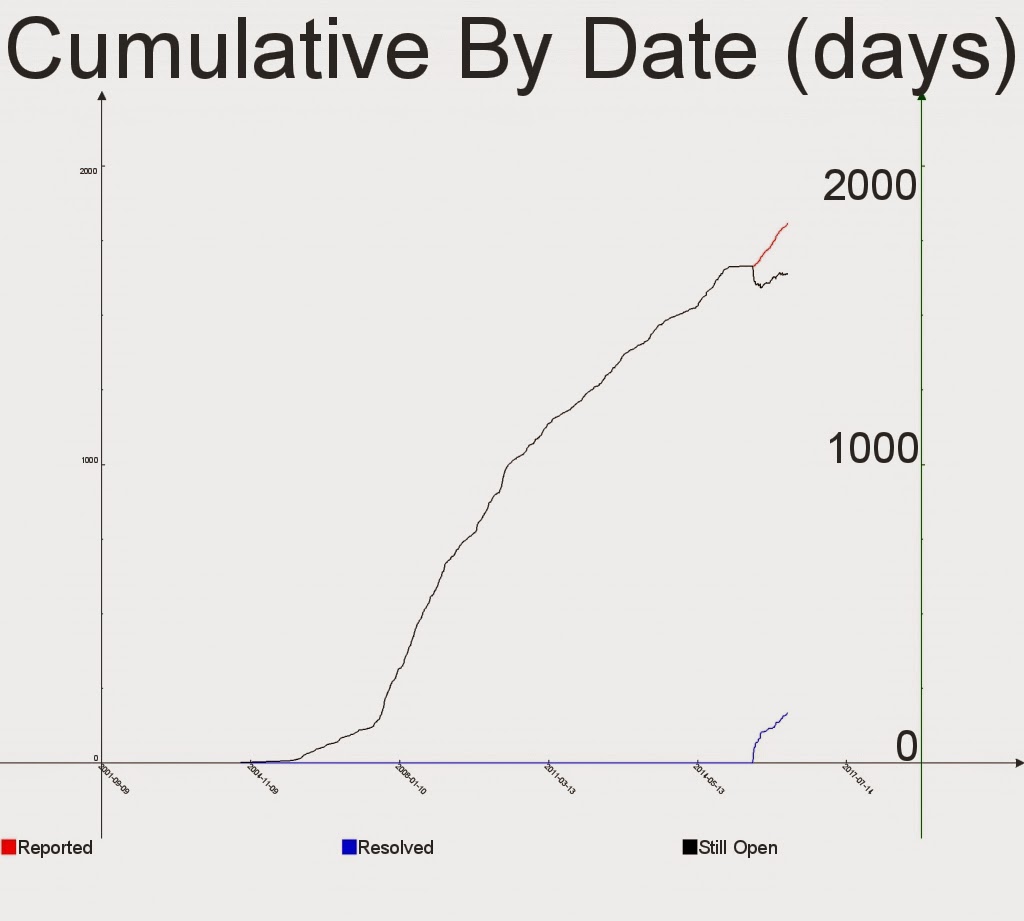
We have a lot of bugs, in fact just during this release cycle we have 30 more bugs reported than we closed.So while the new bug reporting system has been a success and our users are reporting issues when they find them the development team is not keeping up..

The failure to keep up stems from the underlying issue of lack of manpower. We have relatively few active developers which is especially problematic when there are many users for a platform, such as RISCOS, but the maintainer is unable to commit enough time to fixing issues.

If you would like to help making NetSurf a better browser we are always happy to work with new contributors.

Julien Danjou: Python bad practice, a concrete case

A lot of people read up on good Python practice, and there's plenty of information about that on the Internet. Many tips are included in the book I wrote this year, The Hacker's Guide to Python. Today I'd like to show a concrete case of code that I don't consider being the state of the art. In my last article where I talked about my new project Gnocchi, I wrote about how I tested, hacked and then ditched whisper out. Here I'm going to explain part of my thought process and a few things that raised my eyebrows when hacking this code. Before I start, please don't get the spirit of this article wrong. It's in no way a personal attack to the authors and contributors (who I don't know). Furthermore, whisper is a piece of code that is in production in thousands of installation, storing metrics for years. While I can argue that I consider the code not to be following best practice, it definitely works well enough and is worthy to a lot of people. Tests The first thing that I noticed when trying to hack on whisper, is the lack of test. There's only one file containing tests, named test_whisper.py, and the coverage it provides is pretty low. One can check that using the coverage tool.
$ coverage run test_whisper.py
...........
----------------------------------------------------------------------
Ran 11 tests in 0.014s

OK
$ coverage report
Name Stmts Miss Cover
----------------------------------
test_whisper 134 4 97%
whisper 584 227 61%
----------------------------------
TOTAL 718 231 67%

While one would think that 61% is "not so bad", taking a quick peak at the actual test code shows that the tests are incomplete. Why I mean by incomplete is that they for example use the library to store values into a database, but they never check if the results can be fetched and if the fetched results are accurate. Here's a good reason one should never blindly trust the test cover percentage as a quality metric. When I tried to modify whisper, as the tests do not check the entire cycle of the values fed into the database, I ended up doing wrong changes but had the tests still pass. No PEP 8, no Python 3 The code doesn't respect PEP 8 . A run of flake8 + hacking shows 732 errors While it does not impact the code itself, it's more painful to hack on it than it is on most Python projects. The hacking tool also shows that the code is not Python 3 ready as there is usage of Python 2 only syntax. A good way to fix that would be to set up tox and adds a few targets for PEP 8 checks and Python 3 tests. Even if the test suite is not complete, starting by having flake8 run without errors and the few unit tests working with Python 3 should put the project in a better light. Not using idiomatic Python A lot of the code could be simplified by using idiomatic Python. Let's take a simple example:
def fetch(path,fromTime,untilTime=None,now=None):
fh = None
try:
fh = open(path,'rb')
return file_fetch(fh, fromTime, untilTime, now)
finally:
if fh:
fh.close()

That piece of code could be easily rewritten as:
def fetch(path,fromTime,untilTime=None,now=None):
with open(path, 'rb') as fh:
return file_fetch(fh, fromTime, untilTime, now)

This way, the function looks actually so simple that one can even wonder why it should exists but why not. Usage of loops could also be made more Pythonic:
for i,archive in enumerate(archiveList):
if i == len(archiveList) - 1:
break

could be actually:
for i, archive in itertools.islice(archiveList, len(archiveList) - 1):

That reduce the code size and makes it easier to read through the code. Wrong abstraction level Also, one thing that I noticed in whisper, is that it abstracts its features at the wrong level. Take the create() function, it's pretty obvious:
def create(path,archiveList,xFilesFactor=None,aggregationMethod=None,sparse=False,useFallocate=False):
# Set default params
if xFilesFactor is None:
xFilesFactor = 0.5
if aggregationMethod is None:
aggregationMethod = 'average'

#Validate archive configurations...
validateArchiveList(archiveList)

#Looks good, now we create the file and write the header
if os.path.exists(path):
raise InvalidConfiguration("File %s already exists!" % path)
fh = None
try:
fh = open(path,'wb')
if LOCK:
fcntl.flock( fh.fileno(), fcntl.LOCK_EX )

aggregationType = struct.pack( longFormat, aggregationMethodToType.get(aggregationMethod, 1) )
oldest = max([secondsPerPoint * points for secondsPerPoint,points in archiveList])
maxRetention = struct.pack( longFormat, oldest )
xFilesFactor = struct.pack( floatFormat, float(xFilesFactor) )
archiveCount = struct.pack(longFormat, len(archiveList))
packedMetadata = aggregationType + maxRetention + xFilesFactor + archiveCount
fh.write(packedMetadata)
headerSize = metadataSize + (archiveInfoSize * len(archiveList))
archiveOffsetPointer = headerSize

for secondsPerPoint,points in archiveList:
archiveInfo = struct.pack(archiveInfoFormat, archiveOffsetPointer, secondsPerPoint, points)
fh.write(archiveInfo)
archiveOffsetPointer += (points * pointSize)

#If configured to use fallocate and capable of fallocate use that, else
#attempt sparse if configure or zero pre-allocate if sparse isn't configured.
if CAN_FALLOCATE and useFallocate:
remaining = archiveOffsetPointer - headerSize
fallocate(fh, headerSize, remaining)
elif sparse:
fh.seek(archiveOffsetPointer - 1)
fh.write('\x00')
else:
remaining = archiveOffsetPointer - headerSize
chunksize = 16384
zeroes = '\x00' * chunksize
while remaining > chunksize:
fh.write(zeroes)
remaining -= chunksize
fh.write(zeroes[:remaining])

if AUTOFLUSH:
fh.flush()
os.fsync(fh.fileno())
finally:
if fh:
fh.close()

The function is doing everything: checking if the file doesn't exist already, opening it, building the structured data, writing this, building more structure, then writing that, etc. That means that the caller has to give a file path, even if it just wants a whipser data structure to store itself elsewhere. StringIO() could be used to fake a file handler, but it will fail if the call to fcntl.flock() is not disabled and it is inefficient anyway. There's a lot of other functions in the code, such as for example setAggregationMethod(), that mixes the handling of the files even doing things like os.fsync() while manipulating structured data. This is definitely not a good design, especially for a library, as it turns out reusing the function in different context is near impossible. Race conditions There are race conditions, for example in create() (see added comment):
if os.path.exists(path):
raise InvalidConfiguration("File %s already exists!" % path)
fh = None
try:
# TOO LATE I ALREADY CREATED THE FILE IN ANOTHER PROCESS YOU ARE GOING TO
# FAIL WITHOUT GIVING ANY USEFUL INFORMATION TO THE CALLER :-(
fh = open(path,'wb')

That code should be:
try:
fh = os.fdopen(os.open(path, os.O_WRONLY os.O_CREAT os.O_EXCL), 'wb')
except OSError as e:
if e.errno = errno.EEXIST:
raise InvalidConfiguration("File %s already exists!" % path)

to avoid any race condition. Unwanted optimization We saw earlier the fetch() function that is barely useful, so let's take a look at the file_fetch() function that it's calling.
def file_fetch(fh, fromTime, untilTime, now = None):
header = __readHeader(fh)
[...]

The first thing the function does is to read the header from the file handler. Let's take a look at that function:
def __readHeader(fh):
info = __headerCache.get(fh.name)
if info:
return info

originalOffset = fh.tell()
fh.seek(0)
packedMetadata = fh.read(metadataSize)

try:
(aggregationType,maxRetention,xff,archiveCount) = struct.unpack(metadataFormat,packedMetadata)
except:
raise CorruptWhisperFile("Unable to read header", fh.name)
[...]

The first thing the function does is to look into a cache. Why is there a cache? It actually caches the header based with an index based on the file path (fh.name). Except that if one for example decide not to use file and cheat using StringIO, then it does not have any name attribute. So this code path will raise an AttributeError. One has to set a fake name manually on the StringIO instance, and it must be unique so nobody messes with the cache
import StringIO

packedMetadata = <some source>
fh = StringIO.StringIO(packedMetadata)
fh.name = "myfakename"
header = __readHeader(fh)

The cache may actually be useful when accessing files, but it's definitely useless when not using files. But it's not necessarily true that the complexity (even if small) that the cache adds is worth it. I doubt most of whisper based tools are long run processes, so the cache that is really used when accessing the files is the one handled by the operating system kernel, and this one is going to be much more efficient anyway, and shared between processed. There's also no expiry of that cache, which could end up of tons of memory used and wasted. Docstrings None of the docstrings are written in a a parsable syntax like Sphinx. This means you cannot generate any documentation in a nice format that a developer using the library could read easily. The documentation is also not up to date:
def fetch(path,fromTime,untilTime=None,now=None):
"""fetch(path,fromTime,untilTime=None)
[...]
"""

def create(path,archiveList,xFilesFactor=None,aggregationMethod=None,sparse=False,useFallocate=False):
"""create(path,archiveList,xFilesFactor=0.5,aggregationMethod='average')
[...]
"""

This is something that could be avoided if a proper format was picked to write the docstring. A tool cool be used to be noticed when there's a diversion between the actual function signature and the documented one, like missing an argument. Duplicated code Last but not least, there's a lot of code that is duplicated around in the scripts provided by whisper in its bin directory. Theses scripts should be very lightweight and be using the console_scripts facility of setuptools, but they actually contains a lot of (untested) code. Furthermore, some of that code is partially duplicated from the whisper.py library which is against DRY. Conclusion There are a few more things that made me stop considering whisper, but these are part of the whisper features, not necessarily code quality. One can also point out that the code is very condensed and hard to read, and that's a more general problem about how it is organized and abstracted. A lot of these defects are actually points that made me start writing The Hacker's Guide to Python a year ago. Running into this kind of code makes me think it was a really good idea to write a book on advice to write better Python code!
The Hacker's Guide to Python
A book I wrote talking about designing Python applications, state of the art, advice to apply when building your application, various Python tips, etc. Interested? Check it out.

Next.

Previous.