Search Results: "ag"

20 September 2006

Holger Levsen: Get ready for DebConf8

Whatever date and place is choosen, unfortunatly there always will be people who will not be able to make it... (Though it would help if those currently complaining about the (currently only estimated) date for Debconf7 would propose a workable alternative.)

But, there is always a next time. So, get ready and propose your venue for DebConf8!

Eric Dorland: Boy, am I sick of renaming this thing

Phoenix, that was a cool name. Damn you PhoenixBIOS. Firebird was good, and who needs another database anyway? Mozilla Firefox is a cute name, with a cute logo. A logo we can't use. Oh wait, we can't use the name either?

So the Mozilla Corporation has asked us to stop using the name "Firefox" in our version of Firefox, unless we use the fox on a globe logo. We can't use the logo because its copyright license is not free. Even if somehow we could do this, they want to vet every patch we apply before we release a package called Firefox containing it.

This puts us in a very difficult position. If there is no traction on the Mozilla side and Debian stands firm on the freeness of non-program files, I don't really see anyway around having to rename Firefox. So what should this new name be? Preferably something clever, nice sounding and not trademarked. I'd like it to be something other distributions can use if they're so inclined. And while Iceweasel is cute, and I enjoy the parody, I'm not sure it has enough sex appeal. Suggestions welcome.

Andrew Pollock: [life] Reno air races and air show

I asked Marc-who-shall-not-be-linked-to if he could take Sarah and I for a plane ride some time, not expecting it to be for a while, and he turned around and offered to take us out on Saturday, to Reno to see the air show. It was only after we got there that I discovered it was predominately air races, with a bit of a show tacked on. That was okay, it was a good day out. The flight, in a little single-prop, four-seater Trinidad, took about 90 minutes each way, give or take, and was fun. I'd already been in a little plane once before, so it didn't have quite the same novelty value for me as it did for Sarah, who was really excited. This was our first visit to Nevada, if you call flying into Reno International, with a 20 minute cab ride to Reno Stead Field, "seeing Nevada". Nevada's cabs were interesting, with rooftop advertising ranging from the local adult venues featuring pole and cage dancers, to the region's abstinence advocacy group. The airshow itself was an interesting display of patriotism and propaganda. I've never been to an airshow in Australia either, and I don't really know a lot about aeroplanes, but it's fun watching cool military aircraft whizzing around. We've been a bit spoiled living near the Moffet Federal Airfield, but even then, you only get to see stuff flying straight in or out. This was cool to see stuff flying around for the express purpose of being ogled. As for the patriotism and propaganda, I think it was the display of the F-15 Eagle. They had some dude from the Air Force on the public address system talking about whilst it did its tricks, and he was constantly going on about (your) US Air Force's military superiority and how the F-15 could do anything and blah blah blah, all with "God Bless the USA" being played in the background. In fact various versions of this song got played throughout the day, with the crowd often singing along. It was the lines
I'm proud to be an American
where at least I know I'm free,
that particularly make me smirk. It's like America's the only country in the world that's free or something. That, and God only blesses the USA. Gimme a break. Oh, and we all had to stand up for the national anthem. It's funny. Australia just seems so unpatriotic by comparison. Not that I've been to an air show in Australia, so I don't know what sort of a military slant they have. There was a bit of an exhibition also attached to the show, where all manner of government types were doing recruiting, from the state troopers to the military. I ran into the Australian family of a guy from the RAAF on exchange with the USAF, and a lady from Darwin running a stall that sold Australian products. Overall it was a good day out, with some more exposure to good old American culture. Photos from the outing are here

Andrew Pollock: [tech] Destinator 6 review

I received an email recently saying I was eligible for a reduced-price on the upgrade to Destinator 6 (from Destinator 2), so given we've found a few maps to be out of date, and the upgrade was under $100, I thought I'd give it a shot. The good The bad Verdict It's sufficiently different from the previous version in terms of interface that it's going to take some time to get used to. I've also not sliced up the maps, and just loaded all of the West Coast in as one lump, so the first step of every address entry involves selecting California. That may get annoying enough to re-slice the maps again (assuming it'll fix this). The GPS auto-reacquisition has already proved itself to be a double-edged sword. Of course, the workaround is to hack the Prius to always provide power to the accessory plug and leave the iPaq in the cradle, but I have problems with leaving valuable items on display in the car, so I don't think we'll be doing that.

Clint Adams: I do not think that he is superserial, you guys

Inappropriate while driving 30mph - Barracuda Inappropriate while driving 40mph - Lido Shuffle Inappropriate while driving 85mph - Right Now Inappropriate while driving erratically in an illegally-modded car - 15 gallons of combustible liquids in the trunk. Inappropriate to publish on the Internet - The writings of a Hunter College student

Dirk Eddelbuettel: EarthWallpaper.org script, anyone?

A few days ago, the Kottke blog pointed to earthwallpapers.org. While being a most excellent site, it makes uses of a newer version of flash that doesn't run on my computer. But as it happens, the flash programming is merely a shiny (and arguably fairly pretty) 'menu' to the various picture at the Flickr tag set for earthwallpapers. Better still, the author uploads daily additions, see today's in 1280x1024 pixels. Now, I don't really know much about Flickr, but didn't they open some sort of API? Is there a way write a quick Bash, Perl or Python script to have cron download the current picture as a desktop wallpaper?

Brett Parker: I think I've gone insane...

So, today was "interesting", but aside from the working part of the day, I was in a pub... Now, this isn't a new experience for me, as most people will know... but anyways - the subject came up about "religion" (kinda), as I don't actually believe that anyone exists, but do believe in the fact that I find myself in this environment that I can't actually prove does or doesn't exist, and that I then deal with that on a day by day basis of "shit, it's time to go to work..." my view on the world may be "a little" skewed by other people's standards... So, anyways - it came to a point where someone was saying that "animals" don't do "xyz" and so they can't be as intelligent as us... now my view on this is that animals may have already done xyz and decided that "survival" in this environment is the key to sucess, ergo basic instinct assuming that they all know mortality (which if they didn't the wouldn't reproduce) is that the *only* thing in this world that actually matters for any given species is survival of the species. Now, that being the case, and the general case being survival of the fittest, why on *earth* did we invent this medium (the internet) for talking to each other - do we *really* need to know what's happing several thousand miles away? If we ditched the technology and went back to our roots, what seperates us from the thousands of other species on the planet? Isn't it possible that other species have already been through the stages that we are still going through, come out the other end and worked out that, actually, on balance, it's better to hunt/gather and survive than mess with the delicate balance of nature? So, get out the way the messy politics, the correctness, the complete stupidity that is current human nature and go back to the basics - eat, sleep, hunt/gather... we've ended up making the world a much more complicated place than it actually needs to be... and, at the end of the day, what do we actually gain from this? Anyways - just a random brain dump after a potentially stupidly long chat in an establishment that is setup purely to intoxicate it's customers... Night peeps. Brett.

Russell Coker: War On Terror - the game

TerrorBullGames has just released the board game War On Terror. The first I heard of this was a short article in a local news paper about how much the game has offended some people (quoting someone who was injured in the London bombings). A co-creator of the game Andy Thompkins said "We accept that some people think this is in poor taste and may see it as puerile. But we would say that launching an illegal war on Iraq is in poor taste".

It's not as if profiting from terrorism is anything new. Governments in Australia, the UK, and the US have profited from it at the ballot box and also used it to stifle opposition parties to get unpopular legislation approved. An example of this is the attempts of the Bush regeime to legalise torture, see the Washington Post and The Age (Australia).

Shortly after 9-11 almost every computer company that had anything to do with backups or disaster-recovery was advertising heavily. Oil companies have done particularly well with high prices, they would have done even better if the plans for Iraq had succeeded.

TerrorBullGames appears to have an aim to draw attention to the lies of politicians, which makes them better than everyone else who has profited from 9-11. Maybe if they draw enough attention to the bad things that our governments are doing they can influence the results of elections, and we can get governments that don't promote terrorism.

Here's a review of the game.

Nacho Barrientos Arias: Debconf7/NoJune

Taking a look to one of the IRC channels where I’m habitual, I found an URL to a Debian wiki page, where people is adding their names because they will have problems to attend Debconf7 in the planned date. By chance I’m in this set, exams are planned for this date. Please consider add yourself to this list if it is impossible for you attend DebConf7 in June.

19 September 2006

Tollef Fog Heen: Formulating iCalendar in SQL

I am currently working on something which hopefully end up being a good calendar server. The goal is to make it easy to add new frontends such as a CalDAV frontend, a Web frontend, etc. So far, I am just working on getting the data model right. The iCalendar RFC has a data model which I am trying to formulate into SQL, something which is ending up being quite hard. Shannon Clark blogs about why calendars are hard, and all of those issues are issues I am running up against when trying to make the data model. The main problem seems to be related to time zones, more closely: "How do you store timezone information in your database". The easy (but wrong) solution is to just normalise everything to UTC. This will not handle the case of events crossing timezone changes, such as to or from daylight savings. What I am currently considering is making sure all data in the database is stored in UTC, but also store the original time zone information. While a bit more complex, this allows applications to get back the same timezone they put in (I am not convinced Evolution will be happy if the timezones are renamed, for instance) and it allows my application to generate recurring events properly. My main issue with this is having the application responsible for making sure the data in the database makes sense, but without putting half my app in PL/perl, I can not see a way around that. Oh, and if anybody has great ideas on how to represent timezones in a relational database (postgres), please do mail me or grab me on IRC or something similar.

Edd Dumbill: EuroFoo reflections

I got an enormous amount out of the just-finished European FooCamp, with lots of thoughts sparking off and interesting things to consider. Jon Mountjoy proposed a theory to me that Web 2.0 and the enterprise weren't in fact as far apart as a naive observe might imagine. He reckons that mashups, tagging and the like do happen within the enterprise, and in fact are often solving harder problems than found in the wilds of the web. There is a lot in common between Web 2.0 and SOA (even aside from buzzword compliance factors). This is a theme I'd like to follow through. Who are the hackers on the inside of companies, and what stories do they have to tell? Gavin Starks from Global Cool really opened our eyes again to the problem of the environment, and introduced the interesting position that Global Cool are taking. If you want to do anything real right now to avoid catastrophic consequences, it's too late to wait for government initiatives to bear fruit. Private citizens must act too. And that's the aim of Global Cool: educating and lobbying the individual, not the government. I was struck, as were others, by the unfortunate irony that conferences have a big environmental cost in the travel involved, as we sat there among people from many countries. I want to now investigate how XTech could be better in this regard, through carbon offsetting and similar schemes. I guess being in Paris is already a good start, as trains are apparently only 25% as polluting as planes, though this still seems like a lot! Claus Dahl led an interesting and wide-ranging discussion about Second Life as a prototyping space for real life invention. Too many themes there to summarise neatly, but we did have an entertaining side discussion about Second Life's potential environmental impact due to CPU consumption and data centers. One suggestion was that objects and activities could be annotated in-world with their environmental cost. Simon Willison energetically explained OpenID, a decentralized identity system proposed by SixApart and already live in systems such as LiveJournal. It attempts to solve the problem of a username and password pair for every site you visit, without the controversy of centralisation suffered by projects such as Microsoft's passport. Simon demonstrated a proof of concept that I think will be a very neat answer to site providers who ask "why should I support OpenID?" (Sneak preview: because if you don't, it's going to be astonishingly easy for a middleman to provide it, and you wouldn't want that.) I also took time to learn about something I'd been interested in but not known much about, 3D printing and "fabbing". Simon Wardley led a great overview of current systems for 3D printing and their various attributes, and indicated where the current trends were going. It doesn't seem so unrealistic that there'll soon be affordable 3D printing bureaux similar to walk-in reprographic facilities like Kinkos. Plenty more went on that I've not got time to transcribe, but I think will flavour my thinking over the months to come. I was fortunate to be among some incredibly intelligent and welcoming people. My thanks to O'Reilly for putting this on, and to everyone else who went for being inspiring companions. Oh, one more thing. Belgians are excellent at confectionery.

Steve Kemp: Everybody rolls with their fingers crossed

I’ve been using monit on my Debian servers for a long time now. For those that don’t know monit is a simple monitoring service which allows you to check that processes are running, automatically restarting them on failure, etc. When I first started using monit I manually added all the checks to /etc/monit/monitrc - but that soon became unwieldy, even with only three machines to maintain. Adding new software meant I had to keep updating the file, and because each server ran different services things couldn’t be shared. Not good. After I while I figured I’d create /etc/monit/includes and just drop files into there - that way I could include them:
# /etc/monit/monitrc
	
include /etc/monit/include/*.monit
Now to monitor a service I’d just create the appropriate file with a .monit suffix. All was good. Until I needed to start monitoring different services on different systems where adding and removing the files got to be painful. Surely there must be a better way I wondered to myself? Now there is. I’ve come up with a nice approach (perhaps the obvious one to everybody else?): I now have two directories: The master.d can have all your *.monit files dropped into it, regardless of whether they apply to the given host or not. To actually monitor a service you’d symlink master.d/foo.monit to include.d/foo.monit - In much the same way as you use symlinks to handle Apache sites and modules in Apache2.x Now the really clever bit is that you write a (perl) script to automatically parse each .monit file and only link in the ones which apply to this host. That means you can use cfengine to copy everything into the master.d/ file - and not care if some tests only apply to other hots. (e.g. You can crteate apache2.monit - and that will be symlinked in if apache2 is installed on the current host, but ignored otherwise.) For the moment my parsing and detection code is very simple, but it is working. In the future I guess I could create foo.monit and foo.package - then only link in the file foo.monit if the Debian package contained in foo.package was installed. The script is in my cvs repository along with a collection of test files.
I will attempt to catch up on mail tomorrow…

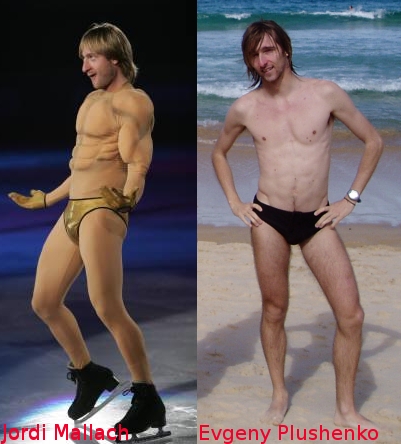
Benjamin Mako Hill: Jordi's Secret Life Uncovered

Could Debian developer and Catalan free software translator Jordi Mallach be living a secret life as champion Russian figure-skater Evgeny Plushenko? Recent photographic evidence uncovered by Mika seems to support such a theory. Decide for yourself:
/copyrighteous/images/jordi_evgeny-lookalike.jpg

Lucas Nussbaum: Of bounties, donations and summers of code influence on volunteer participation

Stuff like the Google Summer of Code, the GNOME Women’s Summer Outreach Program 2006, the Sourceforge donations system, or Dunc-Tank (an experiment to see how targeted fund raising can improve Debian) are generally considered a good ideas. However, experiments have shown that sometimes, paying volunteers decreases the overall participation. Luis Villa wrote about this a few months ago, and summarized like this:
When people do things for their own intrinsic goodness (i.e., for reasons other than payment), introducing payment can reduce the amount of invovement.
I urge you to read Luis Villa’s blog entry about this, and specifically the Motivation Crowding Theory: A Survey of Empirical Evidence paper.

Jeroen van Wolffelaar: Utrecht Bug Squashing Party

Tomorrow we'll have the first real-life meeting, together with Thijs Kinkhorst and dr. Bas Zoetekouw, to organize details about the upcoming Debian Bug Squashing party in Utrecht, The Netherlands, on the weekend of September 30th. As a study association, A-Eskwadraat has had Debian Developers for quite some time, from Bas since 2000 until our most recent addition, Thijs, but we've never organized a Debian event – yet. In 2002 though, there was a Mozilla 1.0 release party where also the release of woody was celebrated. The university has been supportive of the initiative, and is offering the location for free, as long as there are not too many people around that they feel the need for (expensive) security to be on-site 24h/day. For that reason, and also for food planning, please do subscribe yourself in wiki. If more than 25 people end up subscribing, we'll let you know how we'll arrange that. We're still not having a definitive deal with a sponsor, so don't know how flexible we are in this regard. At this moment, we've also got a handful of international attendees too, including Debian's "Second in Command", Steve McIntyre. I'm looking forward to it, and to meeting various Debian contributors (mostly again). See you in Utrecht!

Clint Adams: Draft Debian Code of Business Conduct

The following Code of Business Conduct ('the Code') has not been approved by the Board of Directors of Debian, SPI, or any U.N. committees: Debian and its subsidiary companies operate in many different markets and countries throughout the world. In most instances, we respect national laws and industry codes of conduct. We, the directors and employees of all companies under the Debian umbrella ('corrupt fuckers'), recognize our obligations to all who have a stake in our success including shareowners, clients, employees, and suppliers, unless those obligations run counter to our profitability; Information about our business shall be communicated clearly, and accurately in a non-discriminatory manner and in accordance with local regulations, unless doing so would impact negatively our profitability; We select and promote employees on the basis of their willingness to support our aims and their potential for profitability, without discrimination or concern for race, religion, national origin, creed, sex, sexual orientation, age, disability, or scruples, as long as doing so would improve our profitability; We believe that the Debian mailing lists should be safe and civilized; we will not tolerate sexual harassment, discrimination or offensive behavior of any kind, which includes the persistent demeaning of individuals through words or actions, the display or distribution of offensive material, or the questioning of our integrity, unless such tolerance would improve our profitability; We will not use, possess or distribute illegal drugs or software, unless doing so would improve our profitability; We will treat all information relating to Debian's business, or to its clients, as confidential. In particular, 'insider trading' is expressly prohibited and confidential information must not be used for personal gain, unless such personal gain is acceptable to at least two of the persons involved; We will not knowingly create work which contains statements, suggestions or images offensive to general public decency and will give appropriate consideration to the impact of our work on minority segments of the population, whether that minority be by race, religion, national origin, creed, sex, sexual orientation, age, disability or scruples, unless that minority can be safely ignored without damaging our bottom line; We will not for personal or family gain directly or indirectly engage in any activity which competes with companies within the Debian umbrella or with our obligations to any such company; We will not offer any items of personal inducement to secure business. This is not intended to prohibit appropriate entertainment, the making of occasional gifts of minor value, or any monetary contributions transferred through PayPal, unless the client has a policy which restricts this; No corporate contributions of any kind, including the provision of services or materials for less than the market value, may be made to politicians, political parties or action committees, without the prior written approval of the DPL and a clear assessment of the rate of return on the investment; and we will comply with all applicable local laws and regulations, and any other laws with an international reach, such as the US Foreign Corrupt Practices Act, where relevant; We will disclose fully to the DPL the nature and all relevant details of inducements paid to us by external parties, whether or not such inducements affect our judgments and actions, and we will accord the DPL a percentage of such inducements for use in re-election campaigns or discretionary spending; When we engage in bookmaking, the standard vig should be 10%, and any exceptions should be appealed to the Racketeering Committee, a self-selecting committee with no external oversight; We will not NMU or hijack any packages if the maintainer is refusing to act on said packages as part of a negotiation for inducements; We will not underbid our colleagues in the midst of such negotiations; We will always assume that any inaction or incompetence is due to such negotiations, whether or not that has been disclosed, as it is often the wish of the persons involved to keep such dealings hush-hush; We will spout trite falsehoods such as We are all volunteers here , and At some point you just have to trust people , as a standard business practice; We will avoid sarcasm at all costs.
Anthony Towns: Dunc-Tank announced

After a lot of discussion on -private, and a fair bit more discussion off list, a bunch of Debian developers, including myself, have launched dunc-tank.org. The idea is that we think getting etch out on time is important enough to be worth paying the release managers to work on it full time, so in the free software spirit, we’ve gone ahead and done something about it. We’ve already put up some of our own money, as have some other developers, and if you’d like to join us, there are more details at the website. We’re currently hoping that SPI will agree to accept funds on our behalf, and thus provide a good level of accountability. The board meeting later today will hopefully shed some light on whether that’s feasible. There’s also some information in press release form, and some interesting background detail for people who don’t follow the Debian release process as closely as some of us do. The first article on the topic’s already been published; with one somewhat inaccuracy – this is not a Debian project, and is being specifically handled outside of Debian to both ensure that any conflict of interest that might occur can be decided by Debian in Debian’s favour, and to allow other groups that have different ideas about what priorities are important to encourage contributions to those areas. A question that has been raised is whether the organisation can be sufficiently “outside” of Debian when the DPL is intimately involved. I don’t have the answer to that – in my opinion it can be, but whether this one is will be up to Debian to decide.

Steve McIntyre: Conference in Tenerife

After take#2 at the flight (*grin*) I got here last night. Met by Carlos at the airport in the south of Tenerife, then driven up to Santa Cruz in the north. We met up with a fair-sized group of the locals and went out for pizza. I'm happy to be here; the local people are bending over backwards to include me in conversation, despite my lack of Spanish. They seem to be a really friendly group. Then across to the university at La Laguna this morning. My 90-minute talk about Debian went very well, in front of 40 or so people. I don't normally like public speaking very much, but it helps a lot when I'm talking about something I know very well. People were clearly interested in knowing more about Debian, and asked some good questions at the end. The slides from my talk and some photos will appear on-line at some point when I find a decent net connection. For the rest of my time here, people have suggested a few touristy things to do, and have offered to show me around. My thanks to Ren , Carlos and the others - it's great to be here!

Andree Leidenfrost: AFS Support for Mondo Rescue

I've finally uploaded mondo-2.09-3 packages which contain the changes to get Mondo Rescue working with AFS to fix #385790. I should have communicated better with Bruno because he has done some work in parallel on this. We have come largely to the same conclusions, though, which is always reassuring.

2.09-3 also has some more changes done in the post-nuke arena. I felt that because it is now an integral part of the Debian package it needed some more love. Changes are:
  • Log the fact that no post-nuke script was found during restore.
  • Perform after nuke steps even if we dropped back to interactive mode because of issue with mount list.
  • Ask user after nuke to wait until s/he is returned to command prompt before rebooting.
  • Use run_program_and_log_output() instead of system() to get output of post-nuke logged.
  • Output screen messages about post-nuke.
With these changes added, post-nuke behaviour is still not perfect but probably good enough for now. Hopefully, Bruno agrees and accepts the changes upstream.

Finally, I've managed to get hold of a VXA-1a tape streamer. It's IDE which sucks because Debian removed ide-scsi from the standard kernels a while back, so the vxaTool doesn't work (yes, I know how to compile kernels, but I like to run a standard environment so that I can pick up on and reproduce issues). Then again, it's just for testing anyway and I can report that I've successfully done test runs with Mondo Rescue using it.

Speaking of testing, mondo-2.09-3 was tested:
  • on sid amd64
  • running kernel 2.6.17-2-amd64 (2.6.17-9)
  • using DVD and tape (!!) as backup media (NFS is still stuffed)
(mindi-2.09-2 which I uploaded a few days ago was basically tested the same.)

Uwe Hermann: SELinux by Example - Using Security Enhanced Linux

SELinux by Example Recently in my (physical) mailbox: SELinux by Example by Frank Mayer, Karl MacMillan, David Caplan. The most recent and up-to-date book about SELinux I know about, written by some of the most involved and knowledgeable people in the field. From what I've read until know it seems to be a really in-depth and easy to understand introduction, and what's more important, it covers the practical aspects of how you use, configure, and administer SELinux in real deployed systems. This should make an interesting read...

Next.

Previous.