Search Results: "sf"

4 March 2011

Steve Kemp: A final update on redisfs

I think I'm done with the redis filesystem for the moment. It does everything I need it to do, although I am curious to see how much faster it could go if it were to use non-blocking writes that isn't a major concern. There is only one missing feature I'm planning to play with - and that is the ability to implement snapshots. As a refresher redis is a key+value store, which mostly uses system memory. I've built a simple FUSE filesystem on top of that (now with symlink support!) and so all the file contents, meta-data, and similar is stored in memory. Implementing snapshots could be done by two different routes:
Copying all keys and their values, under a new name.
For example right now, by default, all the filesystem entries in the root directory are stored beneath the key "SKX:/" - where "SKX" is the key prefix. Assume I copy each existing key, and the associated value(s), giving them a new prefix such as "SKX2:" I can mount the filesystem against that prefix - and we've got a point-in-time snapshot.
Serialising all keys & values
Redis has a primitive which allows you to determine the names of keys at runtime. Given that all my filesystem keys have a prefix ("SKX:" by default) it wouldn't be difficult to find them, and serialise them. This would require more effort to re-import and re-mount, but it should be portable across hosts.
Anyway assuming I get this right we'll have a filesystem which is replication-friendly and snapshot-able. A fun combination. ObQuote: "We had been everywhere. We had really seen nothing. " - Lolita

Wouter Verhelst: Dear lazyweb,

I'm a complete font n00b. How does one install Type1 fonts as part of a Debian package in such a way that: PMW, which I'm packaging for Debian, includes Type1 postscript fonts that it absolutely cannot live without; and while it's possible to create a .ps file from pmw that includes those fonts, by default it does not, so it's generally useful to put those fonts somewhere that ghostscript can find them. Only I know squat about how ghostscript finds fonts, and just adding a symlink /usr/share/fonts/type1/gsfonts/pmw -> ../../../pmw/psfonts (as was suggested to me on IRC) does not seem to do the trick. Thanks,

Cyril Brulebois: Debian XSF News #7

Time for a seventh Debian XSF News issue!

3 March 2011

Thorsten Glaser: (Free)BSD vs. Linux

Warning: this is a rant against BSD (specifically FreeBSD , but don t let me get started on DragonFly, who think it s wise to drop all shells except ash from the base system and rely on pkgsrc yay let s compile a dozen packages just to get a shell with tab completion, not to mention boxen with no network access for the task although others seem to go into that direction too ; you know, there s BSD, and then there s FreeBSD ) don t like, don t read. If you want to change something in the BSD world, you gotta fork your own BSD no other way around the thickheads. Ok, back then, I ran into a particularily thick one, but others tend to not be much better. Users share the thickness. If you want to change something in the GNU/Linux world, just make a package, have someone upload it, prod (or pay, Hanno got a Radler) people to do it, or just upload it yourself. At the BSD booth at FOSDEM, despite me bringing the Windows Mobile 6 Professional devive, strictly for Geocaching mind you, Macintosh boxen had a share of more than 50% I didn t manage to tip the scale. At the Debian booth, almost everyone had a I want to buy a new laptop some day, but it just keeps on working and doesn t break pre-Lenovo IBM laptop. No hyping of Google either. (Last year s CLT saw BSD people advocating pro-Schily the guy with the broken encoding in his name shockingly.) Honestly, tcsh, FreeBSD people? Sorry. While I agree that there is merit on having the same script and interactive shell, as someone has pointed out (copy-paste examples into the command line), there s those zsh users who use mksh or GNU bash for scripting. Or just POSIX shell. And that s with an interactive shell which can be used for scripting. On the other hand, the C shell (both csh and tcsh) cannot. And what s with pretending the accent gravis is non-combining, called backtick (such a thing does not exist); and advocating it? Sorry, if your csh/tcsh doesn t handle the POSIX $( ) you should just drop it. (By the way, there is a convention that example command lines are prefixed with % for csh and $ for sh (or # but we write $ sudo instead, these days). Use it. Or leave it. If you have examples that substitute another process output, be specific.) It s funny to see how one person tries to defuse my arguments against csh by telling me it s just an interactive shell , while the other argues that people copy-paste between them, to which that was my response. Read the thread! And please, get your facts right. I would prefer that the standard shell be at least Bourne-compatible. You don t want Bourne ( ^ instead of for pipes), you want POSIX. That GNU bash is called the Bourne-Again Shell in one of their usual semi-bad puns doesn t help the global perception of such things any. Also, the root shell and /bin/sh are disjunct. (Plus, why change the root shell, use sudo(8), plain and simple.) ObNote: in jupp (should I package that for Debian, btw? rather upload, packages are ready ) the key is used as pr fix for Ctrl-X ( X) or to directly enter numerical (decimal, octal, sedecimal/hexadecadic) ASCII, 8-bit or Unicode codepoints. Yay!
And even the FSF has seen the light; for a few releases already, GCC uses ' ' instead of ' for quoting in messages, even without locales. Great job there! (LC_MESSAGES=en_GB.UTF-8 usually works, too, though.) ObDisclaimer: I have an (yes, Google ) Alert on the word mksh , so I know when it s being discussed. This obviously includes certain fora. Also, I m a shell implementer and bound to know a certain amount of details. Plus, mksh s build script runs with pretty much any Bourne/POSIX/Z Shell which has functions and not too many bugs. I wrote it. Go figure. No lowly trolling. FWIW, mksh(1) has the cat(1) builtin both because Android has no cat(1), and as speed hack. Almost all other shells have worse speed hacks, like a printf(1) builtin. And recently, builtins have become direct-callable, so this actually reduces the overall system footprint. (Its inclusion also provides for some other possibilities, internally.) And as two final side notes, if you haven t seen this: determine which shell we are run under (CVS) and I still offer a prompt conversion service (send me any GNU bash or oksh $PS1 and I ll send that to you in mksh(1) syntax optionally with adjustments/improvements, like cwd uses only up to 1/3 of screen width).

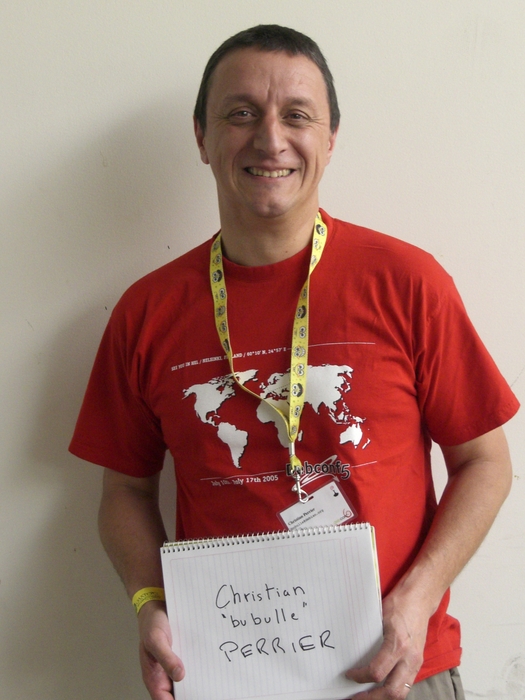
Raphaël Hertzog: People behind Debian: Christian Perrier, translation coordinator

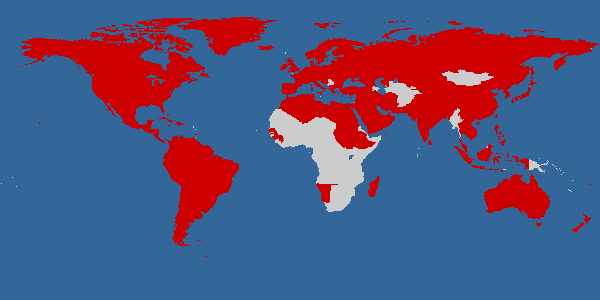
Christian is a figure of Debian, not only because of the tremendous coordination work that he does within the translation project, but also because he s very involved at the social level. He s probably in the top 5 of the persons who attended most often the Debian conference. Christian is a friend (thanks for hosting me so many times when I come to Paris for Debian related events) and I m glad that he accepted to be interviewed. He likes to speak and that shows in the length of his answers :-) but you ll be traveling the world while reading him. My questions are in bold, the rest is by Christian. Who are you? I am a French citizen (which is easy to guess unless you correct my usual mistakes in what follows). I m immensely proud of being married for nearly 26 years with Elizabeth (who deserves a statue from Debian for being so patient with my passion and my dedication to the project). I m also the proud father of 3 wonderful kids , aged 19 to 23. I work as team manager in the Networks and Computers Division of Onera the French Aerospace lab , a public research institute about Aeronautics, Space and Defense. My team provides computer management services for research divisions of Onera, with a specific focus put on individual computing. I entered the world of free software as one of the very first users of Linux in France. Back in the early 1990 s, I happened (though the BBS users communities) to be a friend of several early adopters of Linux and/or BSD386/FreeBSD/NetBSD in France. More specifically, I discovered Linux thanks with my friend Ren Cougnenc (all my free software talks are dedicated to Ren , who passed away in 1996). You re not a programmer, not even a packager. How did you come to Debian? I m definitely not a programmer and I never studied computing (I graduated in Materials Science and worked in that area for a few years after my PhD). However, my daily work always involved computing (I redesigned the creep testing laboratory and its acquisition system all by myself during my thesis research work). An my hobbies often involved playing with home computers, always trying to learn about something new. So, first learning about a new operating system then trying to figure out how to become involved in its development was quite a logical choice. Debian is my distro of choice since it exists. I used Slackware on work machines for a while, but my home server, kheops, first ran Debian 1.1 when I stopped running a BBS on an MS-DOS machine to host a news server. That was back in October 1996. I then happened to be a user, and more specifically a user of genealogy software, also participating very actively in Usenet from this home computer and server, that was running this Debian thing. So, progressively, I joined mailing lists and, being a passionate person, I tried to figure out how I could bring my own little contribution to all this. This is why I became a packager (yes, I am one!) by taking over the geneweb package, which I was using to publish my genealogy research. I applied as DD in January 2001, then got my account in July 2001. My first upload to the Debian archive occurred on August 22nd 2001: that was of course geneweb, which I still maintain. Quite quickly, I became involved in the work on French localization. I have always been a strong supporter of localized software (I even translated a few BBS software back in the early 90 s) as one of the way to bring the power and richness of free software to more users. Localization work lead me to work on the early version of Debian Installer, during those 2003-2005 years where the development of D-I was an incredibly motivating and challenging task, lead by Joey Hess and his inspiring ideas. From user to contributor to leader, I suddenly discovered, around 2004, that I became the coordinator of D-I i18n (internationalization) without even noticing :-) You re the main translation coordinator in Debian. What plans and goals have you set for Debian Wheezy? As always: paint the world in red. Indeed, this is my goal for years. I would like our favorite distro to be able to be used by anyone in the world, whether she speaks English, Northern Sami, Wolof, Uyghur or Secwepemcts n. As a matter of symbol, I use the installer for this. My stance is that one should be able to even install Debian in one s own language. So, for about 7 years, I use D-I as a way to attract new localization contributors. This progress is represented on this page where the world is gradually painted in red as long as the installer supports more languages release after release. The map above tries to illustrate this by painting in red countries when the most spoken language in the country is supported in Debian Installer. However, that map does not give enough reward to many great efforts made to support very different kind of languages. Not only various national languages, but also very different ones: all regional languages of Spain, many of the most spoken languages in India, minority languages such as Uyghur for which an effort is starting, Northern Sami because it is taught in a few schools in Norway, etc., etc. Still, the map gives a good idea of what I would like to see better supported: languages from Africa, several languages in Central Asia. And, as a very very personal goal, I m eagerly waiting for support of Tibetan in Debian Installer, the same way we support its sister language, Dzongkha from Bhutan. For this to happen, we have to make contribution to localization as easy as possible. The very distributed nature of Debian development makes this a challenge, as material to translate (D-I components, debconf screens, native packages, packages descriptions, website, documentation) is very widely spread. A goal, for years, is to set a centralized place where translators could work easily without even knowing about SVN/GIT/BZR or having to report bugs to send their work. The point, however, would be to have this without making compromises on translation quality. So, with peer review, use of thesaurus and translation memory and all such techniques. Tools for this exist: we, for instance, worked with the developers of Pootle to help making it able to cope with the huge amount of material in Debian (think about packages descriptions translations). However, as of now, the glue between such tools and the raw material (that often lies in packages) didn t come. So, currently, translation work in Debian requires a great knowledge of how things are organized, where is the material, how it can be possible to make contribution reach packages, etc. And, as I m technically unable to fulfill the goal of building the infrastructure, I m fulfilling that role of spreading out the knowledge. This is how I can define my coordinator role. Ubuntu uses a web-based tool to make it easy to contribute translations directly in Launchpad. At some point you asked Canonical to make it free software. Launchpad has been freed in the mean time. Have you (re)considered using it? Why not? After all, it more or less fills in the needs I just described. I still don t really figure out how we could have all Debian material gathered in Rosetta/Launchpad .and also how Debian packagers could easily get localized material back from the framework without changing their development processes. I have always tried to stay neutral wrt Ubuntu. As many people now in Debian, I feel like we have reached a good way to achieve our mutual development. When it comes at localization work, the early days where the everything in Rosetta and translates who wants stanza did a lot of harm to several upstream localization projects is, I think, way over. Many people who currently contribute to D-I localization were indeed sent to me by Ubuntu contributors .and by localizing D-I, apt, debconf, package descriptions, etc., they re doing translation work for Ubuntu as well as for Debian. Let s say I m a Debian user and I want to help translate Debian in my language. I can spend 1 hour per week on this activity. What should I do to start? Several language teams use Debian mailing lists to coordinate their work. If you re lucky enough to be a speaker of one of these languages, try joining debian-l10n-<yourlanguage> and follow what s happening there. Don t try to immediately jump in some translation work. First, participate to peer reviews: comment on others translations. Learn about the team s processes, jargon and habits. Then, progressively, start working on a few translations: you may want to start with translations of debconf templates: they are short, often easy to do. That s perfect if you have few time. If no language team exists for your language, try joining debian-i18n and ask about existing effort for your language. I may be able to point you to individuals working on Debian translations (very often along with other free software translation efforts). If I am not, then you have just been named coordinator for your language :-) I may even ask you if you want to work on translating the Debian Installer. What s the biggest problem of Debian? We have no problems, we only have solutions :-) We are maybe facing a growth problem for a few years. Despite the increased welcoming aspects of our processes (Debian Maintainers), Debian is having hard times in growing. The overall number of active contributors is probably stagnating for quite a while. I m still amazed, however, to see how we can cope with that and still be able to release over the years. So, after all, this is maybe not a problem :-) Many people would point communication problems here. I don t. I think that communication inside the Debian project is working fairly well now. Our famous flame wars do of course still happen from time to time, but what large free software project doesn t have flame wars? In many areas, we indeed improved communication very significantly. I want to take as an example the way the release of squeeze has been managed. I think that the release team did, even more this time, a very significant and visible effort to communicate with the entire project. And the release of squeeze has been a great success in that matter. So, there s nearly nothing that frustrates me in Debian. Even when a random developer breaks my beloved 100% completeness of French translations, I m not frustrated for more than 2 minutes. You re known in the Debian community as the organizer of the Cheese & Wine Party during DebConf. Can you tell us what this is about? This is an interesting story about how things build themselves in Debian. It all started in July 2005, before DebConf 5 in Helsinki. Denis Barbier, Nicolas Fran ois and myself agreed to bring at Debconf a few pieces of French cheese as well as 1 or 2 bottles of French wine and share them with some friends. Thus, we settled an informal meeting in the French room where we invited some fellows: from memory, Benjamin Mako Hill, Hannah Wallach, Matt Zimmermann and Moray Allan. All of us fond of smelly cheese, great wine plus some extra p t home-made by Denis in Toulouse. It finally happened that, by word of mouth, a few dozens of other people slowly joined in that French room and turned the whole thing into an improvized party that more or less lasted for the entire night. The tradition was later firmly settled in 2006, first in Debconf 6 in Mexico where I challenged the French DDs to bring as many great cheese as possible, then during the Debian i18n meeting in Extremadura (Sept 2006) where we reached the highest amount of cheese per participant ever. I think that the Creofonte building in Casar de C ceres hasn t fully recovered from it and is still smelling cheese 5 years after. This party later became a real tradition for DebConf, growing over and over each year. I see it as a wonderful way to illustrate the diversity we have in Debian, as well as the mutual enrichment we always felt during DebConfs. My only regret about it is that it became so big over the years that organizing it is always a challenge and I more and more feel pressure to make it successful. However, over the years, I always found incredible help by DebConf participants (including my own son, last year a moment of sharing which we will both remember for years, i think). And, really, in 2010, standing up on a chair, shouting (because the microphone wasn t working) to thank everybody, was the most emotional moment I had at Debconf 10. Is there someone in Debian that you admire for their contributions? So many people. So, just like it happens in many awards ceremonies, I will be very verbose to thank people, sorry in advance for this. The name that comes first is Joey Hess. Joey is someone who has a unique way to perceive what improvements are good for Debian and a very precise and meticulous way to design these improvements. Think about debconf. It is designed for so long now and still reaching its very specific goal. So well designed that it is the entire basis for Joey s other achievement: designing D-I. Moreover, I not only admire Joey for his technical work, but also for his interaction with others. He is not he loudest person around, he doesn t have to .just giving his point in discussion and, guess what? Most of the time, he s right. Someone I would like to name here, also, is Colin Watson. Colin is also someone I worked with for years (the D-I effect, again ) and, here again, the very clever way he works on technical improvements as well as his very friendly way to interact with others just make it. And, how about you, Rapha l? :-) I m really admirative of the way you work on promoting technical work on Debian. Your natural ability to explain things (as good in English as it is in French) and your motivation to share your knowledge are a great benefit for the project. Not to mention the technical achievements you made with Guillem on dpkg of course! Another person I d like to name here is Steve Langasek. We both maintain samba packages for years and collaboration with him has always been a pleasure. Just like Colin, Steve is IMHO a model to follow when it comes at people who work for Canonical while continuing their involvment in Debian. And, indeed, Steve is so patient with my mistakes and stupid questions in samba packaging that he deserves a statue. We re now reaching the end of the year where Stefano Zacchiroli was the Debian Project Leader. And, no offense intended to people who were DPL before him (all of them being people I consider to be friends of mine), I think he did the best term ever. Zack is wonderful in sharing his enthusiasm about Debian and has a unique way to do it. Up to the very end of his term, he has always been working on various aspects of the project and my only hope is that he ll run again (however, I would very well understand that he wants to go back to his hacking activities!). Hat off, Zack!I again have several other people to name in this Bubulle hall of Fame : Don Armstrong, for his constant work on improving Debian BTS, Margarita Manterola as one of the best successes of Debian Women (and the most geeky honeymoon ever), Denis Barbier and Nicolas Fran ois because i18n need really skilled people, Cyril Brulebois and Julien Cristau who kept X.org packaging alive in lenny and squeeze, Otavio Salvador who never gave up on D-I even when we were so few to care about it. I would like to make a special mention for Frans Pop. His loss in 2010 has been a shock for many of us, and particularly me. Frans and I had a similar history in Debian, both mostly working on so-called non technical duties. Frans has been the best release manager for D-I (no offense intended, at all, to Joey or Otavio .I know that both of them share this feeling with me). His very high involvment in his work and the very meticulous way he was doing it lead to great achievements in the installer. The Installation Guide work was also a model and indeed a great example of non technical work that requires as many skills as more classical technical work. So, and even though he was sometimes so picky and, I have to admit, annoying, that explains why I m still feeling sad and, in some way, guilty about Frans loss. One of my goals for wheezy is indeed to complete some things Frans left unachieved. I just found one in bug #564441: I will make this work reach the archive, benefit our users and I know that Frans would have liked that.

Thank you to Christian for the time spent answering my questions. I hope you enjoyed reading his answers as I did. Subscribe to my newsletter to get my monthly summary of the Debian/Ubuntu news and to not miss further interviews. You can also follow along on Identi.ca, Twitter and Facebook.

7 comments Liked this article? Click here. My blog is Flattr-enabled.

2 March 2011

Maximilian Attems: Cross distribution collaboration on longterm 2.6.32 linux-2.6

I'll collect here links to the various linux-2.6 distribution trees based on the longterm release 2.6.32. I won't go into details of bigger external patches (grsec, openvz, rt, xen, ..), which in consequence also aligned themselves on 2.6.32. Important bug fixes usually are connected to some bug report, which may be publicly viewable. So from the patch and changelog entry one can usually assume if a certain patch satisfies the stable criteria and forward it for 2.6.32 longterm inclusion (+ other branches where it might apply). If the patch applies and compiles fine with the Debian tree one can assume that the patch will be fine for upstream 2.6.32 as Debian with small exceptions mostly follows the longterm release: 2.6.32 branch of Debian linux-2.6 (Comment: This is currently only a svn mirror but this bug is worked on for next release). The canonical 2.6.32 linux-2.6 longterm repository is of course on kernel.org maintained by gregkh. Opensuse publishes it's kernel-source on gitorious including all branches and the especially interesting SLE11-SP1 2.6.32 branch. Fedora was following till late Autumn 2.6.32 and the F12 branch has the relevant patches. Ubuntu released 10.04 with 2.6.32 as in a collaborative decision they also based their drm on 2.6.33 (same story as in Debian, thus particularly relevant for us). Oracle had a 2.6.32 that was maintained until Sept 2010 or such. It is already bad that kernel source in Red Hat doesn't really follow upstream 2.6.32 longterm release itself. For 2.6.18 of course no such option existed, but for 2.6.32 this policy already shows a certain snobbery. Red Hat 6.0 Beta at least shipped kernel-2.6.32-37.el6.src.rpm with broken out patches - since then no patch series or git tree to be seen from RH. This strange move got since picked by lwn - RH "obfuscated" kernel source.

Kai Wasserb ch: Downloading entire YouTube playlists

Downloading videos from YouTube isn't a problem thanks to tools like clive. But fetching all videos of a playlist was always a little bit tricky. There is clivescan, but it requires user intervention and needs Tk. Other tools have focused on feed parsing, so in case you have a playlist feed you can then download all (listed) videos. But none of the tools offered me a simple way to download all videos in a playlist from the command line. That's when I started writing ytplaylistfetcher, a simple shell script aiming to parse a YouTube playlist, extract all unique video ids and pass the list on to clive for downloading. By now ytplaylistfetcher is pretty much complete and there aren't many changes ahead (unless YouTube changes its page layout again, e.g. back to multi-page playlists). At the moment ytplaylistfetcher can handle the three common playlist link formats. If you've encountered another format or found a playlist link that doesn't work, let me know. ytplaylistfetcher has just one limitation in my opionin (but one I can live well with): it is limited to YouTube playlists. But that isn't a severe drawback in my opinion, as I rarely receive playlist links to other video hosting platforms (at least none where a simple wget call doesn't solve the problem. This little script show-cases one reason, why I like Linux so much: there is always an easy way to extend existing functionality.

Steve Kemp: I updated my redis-based filesystem

In July last year I made a brief post about a simple filesystem I'd put together which used Redis for the storage. At that time I thought it was a cute hack, and didn't spend too much time with it. But recently I found a use for it so I cleaned it up, synced up the C client for Redis which I used and generally started to care again. If it is useful you can now find it online: The basic idea is the same as it was before, except I did eventually move to an INODE-like system. Each file/directory entry receives a unique identifier (integer) - and then I store the meta-data in a key based off that name. This means for a file I might have keys, and values,like this:
KeyValue
INODE:1:NAMEThe name of the file (e.g. "passwd").
INODE:1:SIZEThe size of the file (e.g. "1661" )
INODE:1:GIDThe group ID of the file's owner (e.g. "0")
INODE:1:UIDThe user ID of the file's owner (e.g. "0")
INODE:1:MODEThe mode of the file (e.g. 0755)
To store these things I use a Redis "SET" which allows me to easily iterate over all the entries in each directory. ObQuote: "They fuck up, they get beat. We fuck up, they give us pensions. " - The Wire

1 March 2011

Joachim Breitner: Nomen est Omen

Google provides a handy image search, and given that the Internet is for porn, it is a good thing that they provide a filter that tries to remove pornographic images. This allows us to define the pornyness of a name (or of any word): It is the percentage of images found by Google that are removed when enabling the SafeSearch filter. For those who want to find out the pornyness of their name without having to count pictures that are NSFW, I have created the pornyness calculator. The range of values goes from 0% (for Ursel) to 97% (for Aletta, exact percentage depends on your location, it seems). This is implemented by some simple JavaScript in a static file, and using Google s API. PS: It was pointed out to me that Maschinenbau (civil engeneering) has a score of 0%, but Mathematik (mathematics) has a score of 2%. Feel free to add more interesting results to the comments.

28 February 2011

Matthew Garrett: Further adventures in mobile Linux

I picked up a couple of cheap Linux devices at the weekend. First of all, a $99 Android tablet from CVS, made by Craig. It's a generic RK2818 device and of course it's lacking any kind of GPL offer in the documentation. As far as I know the only company that's released any Rockchip source so far has been Archos, and even then they haven't released the tools you need to actually build an image - they seem to be floating around the internet anyway. But it's straightforward to get it to run the Android market, and it runs Shortyz quite well, so fit for purpose from my point of view. I am, obviously, attempting to contact Craig to find out how they're going to satisfy their obligations but haven't got past their bizarre text-to-speech based support menu system that dumps you to answerphone after 5 minutes of being on hold. Next attempt will involve pressing more buttons.

The other one was a Sharper Image Literati e-reader, $49 from Macy's (on clearance, obviously). This one's interesting by virtue of not being an Android device. Instead it's got a fairly recognisable Busybox-based Linux environment that's even got udev and dbus running. It brings up a framebuffer and just dumps a QTE-based reader (from Kobo) onto it. Other than being woefully underpowered and slow, it actually seems very competent. There seem to be several versions of the hardware - the one I got has an ARM SoC from SiRF on it. SiRF make GPS chipsets, and it turns out that their Atlas 5 platform is actually intended for Linux-based GPS units. The embedded world always seems to find a way. What surprised me more is that it's probably the most polished looking Linux I've bought for under $300. No bizarre kernel spew. echo mem >/sys/power/state works. Standard backlight interface.

Oh, and no source. Obviously. But an interesting device regardless.

(comment count unavailable Comments Comment on this)

Jonathan McDowell: Notes on moving to America

I've been out here for 6 months now. At the point in time I was coming out I was pointed at Andrew Pollock's On bootstrapping oneself in the US. I figure some extra data may be useful for anyone considering the same. I moved from the UK rather than Australia. Banking I sorted out my US banking long before I ever moved here; in fact I kicked the process off shortly after I accepted the move offer. Matthew had recommended the HSBC approach, so I did that. This meant when I arrived I had a credit card, debit card and check book. They also allow me to do really easy online transfers between my US and UK accounts. Mobile phone My mobile phone was something else that was dealt with before the move. I bought a Simple Mobile SIM off eBay. I thought I'd end up moving to a contract once I had a credit record here, but actually the $60/month unlimited tariff seems to be fairly reasonable. Their customer service leaves a lot to be desired, but I've sadly come to expect that from phone companies. I've got a Google Voice account which is the number I've been giving out, so it's easily for me to switch providers (or redirect things to a VOIP setup for when I'm back in the UK, but I've got a writeup to do for that at a later point in time). Finding somewhere to live One of my concerns was that it would be hard to find somewhere to live at short notice without any credit history or SSN. This turned out to be ill founded. Both of the managed apartment complexes I looked at were ok with the fact I'd just moved to the country and seemed used to such a setup. The place I went with is privately leased and was a bit more wary, but after a conversation with my US manager (who'd managed me even when I was in the UK) it was fine. Social Security Number AKA existing as an entity as far as the US is concern. I was told to wait at least 10 working days after entry before even applying for this, or I wouldn't be in the system and it could cause delays. I did so and the card turned up within about a week (I had been told up to 2 weeks). Which was good, because work were having problems figuring out how to pay me without one. You do seem to need the SSN for everything. The only times I can remember needing my National Insurance number in the UK is for new jobs and my E111 application. Driving licence I haven't ended up buying a car here; I pretty much don't need one most of the time and I've signed up to ZipCar for easy short term rentals - they're happy to take a UK licence for sign up. However I figured getting a licence here was a good idea in case I did decide to get a car, and even just for ID (I kept having to point people at the DOB on my UK licence - everywhere here seems to card). Applying for a licence ideally relies an SSN, so I did so a few days after I'd got that. I did the car + motorbike written tests and got my learner's permit. I applied for the car theory test the same day, but the first available slot was about 6 weeks later. During this period I did the CMSP basic RiderCourse, which meant that when I passed the car test I was also fully entitled to ride a motorbike here. Other useful notes As I live in the Bay Area I got myself a ClipperCard - it's like Oyster except without the clever discounts. Works on more agencies though and helps avoid having to sort out change. For broadband I went with Sonic.net - I'm in their ADSL2 coverage area so I'm getting a reasonable 17Mb/s connection. The other options were AT&T ADSL (slower) or Comcast cable (evil). I've had zero problems with Sonic; It Just Works. Also I sort of ended up with a trial run thanks to DebConf10 being in New York. Due to the way timings worked out this took place only a few weeks before my move to SF was scheduled. My banking and phone were already in place by this point, so it allowed me to check both were working ok. They were, and I didn't really expect them not to be, but it was a nice safety net to have for the move proper. Overall the main issue I had was that a lot of things were dependant on other things; get the SSN, get a learner's permit, apply for the practical test, wait for the licence to actually turn up etc. It probably took over 3 months for everything to actually happen and come through in the post. I can tell when I actually started to exist in the system because Capital One being junk mailing me about whether I want a credit card with them...

26 February 2011

Rog rio Brito: My problems with Chromium

Given that Chromium/Chrome is used more and more (as became apparent with the discussion of including it in Debian's squeeze), I decided to give it some tries, mainly Giuseppe Iuculano's version. I occasionally install Chromium from Fabien Tassin's daily builds. And, to be honest, I have also contributed a good amount (about 400) of translated strings to the Brazilian Portuguese part of Chromium. As a matter of fact, I have even done some "activism" and incentivated other people to create their accounts on Launchpad and help with the projects. But I always come back to Iceweasel/Firefox, especially with Mike Hommey's frequently updated repository. What are my reasons for staying with Iceweasel, and not with Chromium? I would be satisfied if any of the above were fixed or better documented, but it seems that some of those are, at best, going to wait a long time.

Ritesh Raj Sarraf: Patents and the Pharmacy Industry

Mosf of us would be well versed with the Patent system in general. We have patents in every sector - Technology, Agriculture, Pharmacy etc. Most readers in our profession must already be well versed of the Pros/Cons of the Patent system in Software/Technology. Patents in software are more like ammunition. The more you have, the stronger you are. We don't seem much cat fight in Software/Technology because not one organization own all the patents for a product. An IBM ThinkPad might be using a cool track pad feature which might be a patent of Dell. Since the finished product comprises of many patents from different owners in the same industry, it is better to play good with each other. You scratch my back, I scratch yours. But what about the Pharmaceutical Industry? There, one single patent could comprise the product. I was reading this document from Bruce Lehman which touches upon Patents and Pharmaceutical Industries, but couldn't find an answer to my question. read more

24 February 2011

Sean Finney: git merge -s theirs

...For the cases where, yes, you actually do want it. For the impatient assuming you're in a clean checkout on the tip of your current branch:
git merge -s ours ref-to-be-merged
git diff ref-to-be-merged   git apply -R --index
git commit -F .git/COMMIT_EDITMSG --amend
you can then double check that everything is as you expect with git diff ref-to-be-merged, which should be empty. The longer story It's noted from time to time that git does not have a -s theirs option to complement the -s ours strategy when merging (or, it did, but it was removed long ago, see below). For those not savvy the idea with git merge -s ours is to pretend as though a merge from some other branch has occurred, though the result remains the current branch's contents, unchanged. This is a neat trick that can be used to show that all changes in some branch have been superceded by the current branch, which can help ease merges further down the line as parallel devlopment continues. However, there is no corresponding -s theirs option, which would conversely say that "everything developed up to here is superceded by this other branch". This feature was discussed and discarded by one of the git authors, who instead advised a developer to throw away the previous work and start on a fresh branch:
One big problem "-s theirs" has, compared to the above "reset to origin, discarding or setting aside the failed history" is that your 'master' history that your further development is based on will keep your failed crap in it forever if you did "-s theirs". Hopefully you will become a better programmer over time, and you may eventually have something worth sharing with the world near the tip of your master branch. When that happens, however, you cannot offer your master branch to be pulled by the upstream, as the wider world will not be interested in your earlier mistakes at all.
In what would probably qualify as "most cases", he's right, but sometimes you do want to do this, and not because you have "crap" in your history, but perhaps because you want to change the baseline for development in a public repository where rebasing should be avoided. In debian, for example, it's pretty common for maintainers who use git-buildpackage to build debian packages from git to have two branches: an "upstream" branch and a "debianized" branch. The upstream branch will follow the changes from the upstream project (either by importing tarballs, or by pulling directly from the project's git repo if they also use git), while the debianized branch contains all the packaging related changes as well as any debian-specific changes to the code. In this context, if the upstream project uses git and rebases their history (out of your control), or if they shift development to a different branch, you might want to have a way to merge with their latest changes without rebasing/abandoning your current debian branch. Hence, a "theirs" merge. The author is totally right that the upstream project may be less interested in pulling from such a repository (since they would drag in the entire previous history), and if that's a problem you might need to splinter off the old branch and start a fresh branch instead. But at least for the projects with which I work, I find that it's more likely that pulling is pretty much one way upstream to debian, and that the patches flow back to the upstream project by way of bug trackers, git format-patch sendmail, or quilt patches sitting in the patch-tracker. And if it becomes a problem later you're no worse off, you can still split off a new branch or take some other action. So anyway, I asked Teh Internetz and found a few hits in the right direction, such as this guy at stack overflow, or this guy here. But from an aesthetic point of view I thought their solutions still left some room for improvement--they were both more complicated, involved setting up temporary branches, and I don't know, just weren't pretty on the eyes. So, ending where I started, this is the relatively clean and easy to follow 3 lines I conjured up, which I will give to teh internetz for posterity.
git merge -s ours ref-to-be-merged
git diff ref-to-be-merged   git apply -R --index
git commit -F .git/COMMIT_EDITMSG --amend
Alternatively, if you want to keep the local upstream branches fast-forwardable, a potential compromise is to work with the understanding that for sid/unstable, the upstream branch can from time to time be reset/rebased (based on events that are ultimately out of your control on the upstream project's side). This isn't a big deal and working with that assumption means that it's easy to keep the local upstream branch in a state where it only takes fast-forward updates. However, on the debian branch your less interested in the clean upstream development, and instead want to keep a sane history of the debianization work, so on this branch you still do something like a merge -s theirs (though in this case, you probably want to amend the previous version's ./debian dir back in post-merge). So applying the same approach as above with the slight modification, in practice (assuming you're on the clean tip of the debian unstable branch, that'd be):
git branch -m upstream-unstable upstream-unstable-save
git branch upstream-unstable upstream-remote/master
git merge -s ours upstream-unstable
git diff ref-to-be-merged   git apply -R --index --exclude="debian/*"
git commit -F .git/COMMIT_EDITMSG --amend
PS In spirit, this is a similar approach to what's done by the XSF team, though I would argue that with what I'm describing both the approach and the resulting history are a bit cleaner and easier to follow. Also, thanks to ron, mrvn, jcristau, and nthykier on #debian-devel for some quick reviewing of this.

MJ Ray: Event for creative co-operatives

Last week, I was at this event in Bristol where we heard some interesting stories from other creative co-ops. I think the oldest had been running for about the same length as time as our co-op, but with a bit of a smoother history. The organisers have posted their report on the event. What did surprise me is that it seemed that the other tech co-ops weren t as strong about free and open source software. I felt that the links between co-op values of self-help, self-responsibility, democracy, equality, equity, solidarity, honesty, openness, social responsibility and caring for others and the freedoms to use, study, adapt and share were obvious, but maybe I should try to write them out very clearly?

23 February 2011

Joachim Breitner: Goodbye server4you

My server, which is among other things hosting this weblog, is a dedicated server originally hosted by the German webhoster webperoni. It was a bargain at that time, and still a good price, and I was satisfied with webperoni s performance and reliability. Unfortunately, they were taken over by another web hosting company, best known for their server4you brand. They moved my server to a different data center and continued to run it there. Unfortunately, server4you was less reliable and less flexible than my original hoster: For example, when one sector on the hard drive turned bad, they were not able to put in a new drive in my system, let me mirror the content, and then remove the old drive. In another, even worse, instance, my second IP address, which I bought from webperoni, was given to another customer. When I finally noticed and complained, they refunded me the charges that I paid for the IP. But understandably, I wanted to get away from that hoster. The contract is automatically prolonged for one year if not canceled in time, and I missed the deadline last year. This year, I finally got around to rent a slightly better and slightly more expensive server from Hetzner, which whom I already made good experience. I would have preferred to switch when I am back from India, but server4you would not even let me prolong the contract by just two months only a whole year or nothing. So they got nothing, and I started to work on the move yesterday. At first I set off installing the new system from scratch, setting up all the various services and copying over data and configuration. But quickly, I gave up and moved the system by completely by copying programs, configuration and data from the old server. The new system has its root partition on a LVM share on software RAID, and now uses grub2 to boot. I had a hard time to get it booting, and a hard time to debug the issues without access to the physical console. I finally understood the problem by running kvm -hda /dev/sda -hdb /dev/sdb -curses from the recovery system and observing that the initial ramdisk is having problems finding the root partition. The problem was that I thought addressing partitions via file system labels is the way to go now and manually added root=LABEL=root to the Linux command line in /etc/default/grub. But then the initial ramdisk would not activate the logical volume. If I had just left it to the grub package, which inserted root=/dev/mapper/vg-root, everything would work fine. The new IP address (88.198.48.143) has not propagated throughout the Internet yet. Running the following command for a variety of ports on the old machine (80.86.81.20) makes sure nobody notices:
port=443
iptables -t nat -A POSTROUTING -p tcp --dst 88.198.48.143 --dport $port -j SNAT --to-source 80.86.81.20
iptables -t nat -A PREROUTING -p tcp --dst 80.86.81.20 --dport $port -j DNAT --to-destination 88.198.48.143:$port
The only question remaining is: What to do with the old server for the remaining six weeks? I am considering to erase the system, set up a plain Debian system and run a tor/freenet/whatelse node at full speed.

Russell Coker: Virgin Mobile CRM Upgrade Failure

I ve recently got a new Xperia X10 Android phone for my with with Virgin mobile, it s generally been working OK although I am having some issues [1], I ll write another blog post soon about other problems I ve discovered with the phone and how I ve solved some of the previous ones.I upgraded my wife s phone first because I can t be without Nagios SMS messages if things don t work. So now that things are generally working I want to get myself an Xperia through Virgin (and have my wife s phone get the Nagios SMS in the mean-time). But since last Friday the entire Virgin sales infrastructure has apparently been down. It started with just declining my attempts to purchase a new phone on a separate account, but when I decided to add a second phone to my wife s account the web site told me that they are upgrading their CRM system and it should be fixed on the 22nd of Feb (yesterday). The web site is now saying that I should check back in 2 hours for an update , it s been saying that for a couple of days now.So for most of a week potential Virgin customers have been turned away. It could be that Virgin stores are processing sales on paper, but they offer some significant discounts for web sales the plan I want is a $39 per month plan and I ll get 3 months free for buying on the web. I m not about to visit a store and lose $117! I m sure that many people are losing confidence in Virgin and taking their business elsewhere. I have only just installed the 3G Watchdog free Android app that monitors bandwidth use and automatically turns off 3G when the quota is reached. For the first few days of using the phone which were more data intensive than usual I had no monitoring and no way of using the Virgin web site to discover how much was used. If Virgin bill me extra for data use I ll complain and demand that they alter the bill.This is even worse for pre-paid customers who can t add credit to their account while this happens!Virgin state that they are upgrading the hardware, operating system and database our platform uses to ensure that we can service our Members even better for years to come [2]. I wonder how people get themselves into such a mess. I guess they didn t have a decent test environment to allow testing the upgrade process before doing it on the live data, I can understand a routine small upgrade going wrong and corrupting data in a way that takes some time to resolve. But when everything is upgraded then everything should be tested, and tested before going live! One thing that Virgin could do to regain some credibility is to publish what went wrong and what they learned from it. I would be much more happy to trust my personal data and my business critical phone to a company that learns from it s mistakes and publishes plans on how they do better than one that just does PR.According to Whirlpool they did the same thing on the 25th of January, so they have had two outages of their billing/CRM system in two months! [3]. The Whirlpool thread has discussion about last month s down-time and this month s down-time.On the up-side, Whirlpool user Kevin JD is a Virgin representative who advised customers to send email to telesales@virginmobile.com.au with a contact phone number if they have any issues. It s good to see a company engaging with it s customers.Update: An hour after emailing the URL to this post to Virgin I got a call from a service representative. It wasn t a very productive call as I already knew that their servers are down and they can t do anything. But it s good to know that they are very enthusiastic about making things better. One useful thing that I learned is that my wife s service is probably on a pro-rated bandwidth quota. As she got the phone in the middle of the month we can only do 100M of data transfer not 200M before the end of the month, by my rough calculations I ve downloaded well over 50M of data (maybe as much as 100M) from the Android marketplace. So it might be necessary to negotiate about the bill as soon as their CRM system works.

21 February 2011

Stefano Zacchiroli: Squeeze, Debian, and the FSF

Short version: Dear FSF, thanks for your appreciation of Debian Squeeze achievements in getting rid of non-free firmware blobs. We still disagree on the overall freeness assessment of Debian, but I'm positive that steps like this one can further future collaboration, in the interest of both projects. Long version follows.
Historically, the relationships among Debian and the FSF have gone through mixed fortune (and that's quite an euphemism). On the one hand, Debian is committed to 100% Free Software, is an open project explicitly inspired by "the spirit of GNU", has been sponsored by FSF in its infancy, and properly calls itself "GNU/Linux" (or even "GNU/kFreeBSD"). On the other hand, Debian is the project who considers the GNU FDL license to be only conditionally free and which is not considered to be an entirely Free system according to FSF.
So much for the history corner. As a long time member of the Debian Project, as well as an FSF(E) fellow, I've always felt a bit sad about this state of affairs. Not because the two projects should have aligned goals; they clearly focus on different aspects of the quest for a Free (Software) world. Not even because they should agree on how to build a Free distribution: history has shown that FSF technical positions do not always get along with Debian's more "pragmatic" style, as embodied by point 5 of the Social Contract. Rather, my sadness is rooted in the belief that not getting along have encouraged duplication of efforts which could have been easily avoided (e.g. multiple distributions concurrently freeing up kernels). Furthermore, I'm more and more convinced that Debian nowadays enjoys a rather privileged position among Free Software vendors. Indeed, even though GNU/Linux distributions have reached a popularity we didn't dare to imagine 15 years ago or so, most distributions are under the direct or indirect control of commercial vendors. Those commercial vendors play a very important role in the promotion of Free Software. For instance, they are structured in ways that enable them to seal OEM deals with hardware manufacturers to sell computers with GNU/Linux pre-installed. Commercial vendors, by their own nature, are also in general better at marketing than non-commercial vendors. On the flip side however, commercial vendors are not yet relevant enough to drive proprietary drivers out of the market and, as a consequence, cannot yet afford not to support hardware which need such proprietary bits to work. Among mainstream GNU/Linux distributions[1] Debian is one of the very few vendors if not the only one that is both very relevant and, thanks to its independence, can afford taking Free Software's side: no commercial urgency can force Debian to negotiate on that. That is quite an asset to be used in the promotion of Free Software, especially to a public that is interested in and willing to understand what Free Software really is about. Such an "aware" public is on the rise as of lately, together with the general awareness increase of risks entailed by living a digital life, when that life is not under our control (think, as an example, at how often the "Facebook privacy debate" has hit mainstream medias in the last year). The "aware" public is the natural target of both Debian and the FSF. Dividing it would not serve well the cause of Free Software. With all that in mind, last August I took the chance of being on the "right" side of the Atlantic Ocean for DebConf10, to discuss possible venues of collaboration among Debian and the FSF. I sat down and discussed at length with John Sullivan, who I happen to know for his Debian involvement, in his capacities of FSF representative and operations manager. We discussed various topics, with the intention of bringing them up to the respective communities[2]. Then, inevitably, we ended up talking about the overall freeness of Debian and his exclusion from FSF listing of Free systems. (FSF is of course entitled to such judgements, pretty much as Debian is entitled to its own judgements on FSF licenses. Nevertheless those judgements contribute to dividing our public and might lead to wasteful duplication of efforts, where Free Software could better be served by collaboration.) The main ground for exclusion from that list used to be the compromises Debian has made in the past about non-free firmware blobs. But, as I pointed out back in August, those compromises would have been gone starting with Squeeze, making that argument moot. Today 6 months later I'm delighted to cheer at FSF's decision to publicly recognize the achievements Debian has delivered with Squeeze.
Thanks! It's a nice gesture that I've very much appreciated. I'm confident steps like this one will help future collaboration if, on both sides, we will be able to spot actual venues for collaboration. Needlessly to say, I still disagree with the overall FSF assessment of Debian non-freeness. Apparently, it still stands on the basis that Debian also provides a repository of nonfree software [ ] [which] is not part of the Debian system. [ ] but users would be hard-pressed to make a distinction and that people can readily learn about software available through it by browsing Debian's online package database. I respect the principle of non advertising non-free software and I even agree that it is a good principle. But unfortunately it's also a very blurry principle on which, in my opinion, Debian actually scores very well. No non-free software is offered to users by Debian; it's just for users that really want to have non-free software (or need to, in order to run a Free OS on their computers), that Debian tries to stay out of their way. For the "aware" public discussed above, I think it's much better to draw the line where software freedom ends and use that line to explain what does crossing it entails, than locking them up pretending non-free software do not exist. But fair enough: for the time being, I guess, we will need to agree to disagree on this one. Getting a little bit closer in the occasion of the Squeeze release is still an important step forward. It's up to each of us now to seek out initiatives which attract the interest of both projects and that can benefit from synergies.
[1] Sorry, I've no decent definition of "mainstream distribution" to offer, besides folklore and well-established distribution review sites. (Heck, I don't even have a decent definition of "well-established distribution review site" to offer!).
[2] which hasn't happened yet, due to the proverbial amount of available spare time.

Cyril Brulebois: Debian XSF News #6

Enough news to release another Debian XSF News issue, after less than a week. Enough writing for now, I m getting new mails in xorg-announce@.

20 February 2011

David Paleino: Getting network devices with Python and udev - 2

Thank you Ben for your kind reply :) In my first post, I was trying to distinguish Ethernet-like device types. Here's the final code:
#!/usr/bin/python
import gudev
client = gudev.Client(['rfkill', 'net'])
for dev in client.query_by_subsystem('net'):
    if dev.get_sysfs_attr_as_int("type") != 1:
        continue
    driver = dev.get_driver()
    if not driver:
        parent = dev.get_parent()
        if parent:
            driver = parent.get_driver()
    # available: wlan, wwan, wimax
    if dev.get_devtype() == 'wlan':
        type = 'Wireless'
    else:
        type = 'Wired'
    print type, dev.get_name(), driver, dev.get_sysfs_path()
However, I have a few remarks. First, I don't understand why ethernet devices don't have a "devtype" attribute. How can I be sure that, failing to be "wlan", "wwan" or "wimax", it's a wired one? (not that any other kind of device comes to my mind, heh). Second, I had to look through Linux sources to find the possible values for DEVTYPE; in particular, I grepped for device_type structs inside ./drivers/net/. And the documentation you pointed me to, while being useful for other reasons (the rfkill support), didn't solve my doubts about the sysfs hierarchy. Rather, your comment about DEVTYPE helped quite a lot in this particular problem. Thank you! :)

Next.

Previous.