Search Results: "pm"

5 January 2012

Sune Vuorela: Vote verifications

In KDE e.V. (which is to KDE</kde> what SPI is to Debian, Jenkins and others) there is some times a need to vote. For example about accepting new members. Mostly about accepting new members. With the new vote system (ballot.kde.org), voters need to do a bit more to check their votes afterwards. basically and sha256 it in the right order with the right separator chars and so on. All sha256 sums are published together with where the vote was, so voters can verify that they are counted correctly. After failing to construct a couple of times on the command line, I decided to write a small GUI app to help me instead. There it is. Nice. Simple. Effective. Sources available. http://quickgit.kde.org/?p=scratch%2Fsune%2Fkrapyl.git&a=summary have fun, and remember to verify your votes.

Russell Coker: DRBD Benchmarking

I ve got some performance problems with a mail server that s using DRBD so I ve done some benchmark tests to try and improve things. I used Postal for testing delivery to an LMTP server [1]. The version of Postal I released a few days ago had a bug that made LMTP not work, I ll release a new version to fix that next time I work on Postal or when someone sends me a request for LMTP support (so far no-one has asked for LMTP support so I presume that most users don t mind that it s not yet working). The local spool on my test server is managed by Dovecot, the Dovecot delivery agent stores the mail and the Dovecot POP and IMAP servers provide user access. For delivery I m using the LMTP server I wrote which has been almost ready for GPL release for a couple of years. All I need to write is a command-line parser to support delivery options for different local delivery agents. Currently my LMTP server is hard-coded to run /usr/lib/dovecot/deliver and has it s parameters hard-coded too. As an aside if someone would like to contribute some GPL C/C++ code to convert a string like /usr/lib/dovecot/deliver -e -f %from% -d %to% -n into something that will populate an argv array for execvp() then that would be really appreciated. Authentication is to a MySQL server running on a fast P4 system. The MySQL server was never at any fraction of it s CPU or disk IO capacity so using a different authentication system probably wouldn t have given different results. I used MySQL because it s what I m using in production. Apart from my LMTP server and the new version of Postal all software involved in the testing is from Debian/Squeeze. The Tests All tests were done on a 20G IDE disk. I started testing with a Pentium-4 1.5GHz system with 768M of RAM but then moved to a Pentium-4 2.8GHz system with 1G of RAM when I found CPU time to be a bottleneck with barrier=0. All test results are for the average number of messages delivered per minute for a 19 minute test run where the first minute s results are discarded. The delivery process used 12 threads to deliver mail.
P4-1.5 p4-2.8
Default Ext4 1468 1663
Ext4 max_batch_time=30000 1385 1656
Ext4 barrier=0 1997 2875
Ext4 on DRBD no secondary 1810 2409
When doing the above tests the 1.5GHz system was using 100% CPU time when the filesystem was mounted with barrier=0, about half of that was for system (although I didn t make notes at the time). So the testing on the 1.5GHz system showed that increasing the Ext4 max_batch_time number doesn t give a benefit for a single disk, that mounting with barrier=0 gives a significant performance benefit, and that using DRBD in disconnected mode gives a good performance benefit through forcing barrier=0. As an aside I wonder why they didn t support barriers on DRBD given all the other features that they have for preserving data integrity. The tests with the 2.8GHz system demonstrate the performance benefits of having adequate CPU power, as an aside I hope that Ext4 is optimised for multi-core CPUs because if a 20G IDE disk needs a 2.8GHz P4 then modern RAID arrays probably require more CPU power than a single core can provide. It s also interesting to note that a degraded DRBD device (where the secondary has never been enabled) only gives 84% of the performance of /dev/sda4 when mounted with barrier=0.
p4-2.8
Default Ext4 1663
Ext4 max_batch_time=30000 1656
Ext4 min_batch_time=15000,max_batch_time=30000 1626
Ext4 max_batch_time=0 1625
Ext4 barrier=0 2875
Ext4 on DRBD no secondary 2409
Ext4 on DRBD connected C 1575
Ext4 on DRBD connected B 1428
Ext4 on DRBD connected A 1284
Of all the options for batch times that I tried it seemed that every change decreased the performance slightly but as the greatest decrease in performance was only slightly more than 2% it doesn t matter much. One thing that really surprised me was the test results from different replication protocols. The DRBD replication protocols are documented here [2]. Protocol C is fully synchronous a write request doesn t complete until the remote node has it on disk. Protocol B is memory synchronous, the write is complete when it s on a local disk and in RAM on the other node. Protocol A is fully asynchronous, a write is complete when it s on a local disk. I had expected protocol A to give the best performance as it has lower latency for critical write operations and for protocol C to be the worst. My theory is that DRBD has a performance bug for the protocols that the developers don t recommend. One other thing I can t explain is that according to iostat the data partition on the secondary DRBD node had almost 1% more sectors written than the primary and the number of writes was more than 1% greater on the secondary. I had hoped that with protocol A the writes would be combined on the secondary node to give a lower disk IO load. I filed Debian bug report #654206 about the kernel not exposing the correct value for max_batch_time. The fact that no-one else has reported that bug (which is in kernels from at least 2.6.32 to 3.1.0) is an indication that not many people have found it useful. Conclusions When using DRBD use protocol C as it gives better integrity and better performance. Significant CPU power is apparently required for modern filesystems. The fact that a Maxtor 20G 7200rpm IDE disk [3] can t be driven at full speed by a 1.5GHz P4 was a surprise to me. DRBD significantly reduces performance when compared to a plain disk mounted with barrier=0 (for a fair comparison). The best that DRBD could do in my tests was 55% of native performance when connected and 84% of native performance when disconnected. When comparing a cluster of cheap machines running DRBD on RAID-1 arrays to a single system running RAID-6 with redundant PSUs etc the performance loss from DRBD is a serious problem that can push the economic benefit back towards the single system. Next I will benchmark DRBD on RAID-1 and test the performance hit of using bitmaps with Linux software RAID-1. If anyone knows how to make a HTML table look good then please let me know. It seems that the new blog theme that I m using prevents borders. Update: I mentioned my Debian bug report about the mount option and the fact that it s all on Debian/Squeeze. Related posts:
  1. I need an LMTP server I am working on a system where a front-end mail...
  2. Some Notes on DRBD DRBD is a system for replicating a block device across...
  3. paper about ZCAV This paper by Rodney Van Meter about ZCAV (Zoned Constant...

4 January 2012

Michal &#268;iha&#345;: uTidyLib dead?

uTidyLib is definitely something you would call a dead project - no new release for seven years, dozens of open bugs and submitted patches and no active development. On the other side it is still used by several packages in Debian, thus worth maintaining. This is also reason, why there are few crucial patches in Debian repository to make it work (for example on 64-bit architectures). While googling whether there is something new going on with uTidyLib, I've noticed two efforts. One is PyTidyLib, a complete reimplementation, which provides different API and thus does not seem to be used anywhere yet. Another (well almost two years old, but I did not look earlier) effort is to fork in on Github and make it work with MacOS X. Okay, when somebody took the "effort", lets try to merge Debian patches there, hopefully there will be a release sometimes. So here is the pull request. Update: I've just learned, there is another fork going on - https://github.com/lachlan-00/utidylib2

Filed under: Debian English 0 comments Flattr this!

Pau Garcia i Quiles: FOSDEM 2012 CrossDesktop DevRoom: deadline extension

FOSDEM is one of the largest gatherings of Free Software contributors in the world and happens each February in Brussels (Belgium). One of the developer rooms will be the CrossDesktop DevRoom, which will host Desktop-related talks. Are you interested in giving a talk about open source and Qt, KDE, Enlightenment, Gnome, XFCE, Windows, Mac OS X, general desktop matters, mobile development, applications that enhance desktops and/or web? We have extended the deadline for a few more days, until January 8th. If you want to submit a talk proposal, hurry up! I have to say I am very surprised to see very few Qt/KDE talk proposals. Is there nothing interesting the Qt and KDE world have to say to 5,000+ people?
There is more information in the Call for Talks we published a couple of months. If you are interested in Qt/KDE, come visit us at the KDE booth. If you add yourself to the KDE FOSDEM 2012 wiki page, we will be able to better organize the usual dinner on Sunday and/or smaller meetings for special interest groups .

3 January 2012

Rapha&#235;l Hertzog: My Debian Activities in December 2011

This is my monthly summary of my Debian related activities. If you re among the people who made a donation to support my work (364.18 , thanks everybody!), then you can learn how I spent your money. Otherwise it s just an interesting status update on my various projects. Dpkg and Multiarch I had some hope to have a multiarch-enabled dpkg in sid for Christmas as Guillem told me that it was realistic. Alas Guillem got sick. We re in January and we re still not there. While some of Guillem s commits in December were related to multi-arch, the size of his pu/multiarch/master branch did not really shrink. We still have 36 commits to merge most of the work he did was refactoring some parts of the code that were already merged. And he initiated some discussion on interface changes. I participated to those discussions hoping to bring them to a quick resolution. I m still maintaining my own pu/multiarch/full branch, it is based on Guillem s branch but with further fixes that I developed and that he has not yet merged and with a change reverted (Guillem s branch allows crossgrading packages between different architectures while dpkg does not manage this correctly yet). I can only hope that January will be the last month of this never-ending saga. It s been one year since I started working on this project. :- Misc dpkg work I reviewed (and later merged) a patch of Kees Cook to enhance dpkg-buildflags so that it can report which hardening features are enabled. This feature might then be used by tools like lintian to detect missing hardening features. I mentored Gianluca Ciccarelli who is trying to enhance dpkg-maintscript-helper to take care of replacing a directory by a symlink and vice-versa. I took care of #651993 so that dpkg-mergechangelogs doesn t fail when it encounters an invalid version in the changelog, and of #652414 so that dpkg-source --commit accepts a relative filename when a patch file is explicitly given. Guillem also merged a fix I developed for LP#369898. Packaging work WordPress 3.3 came out so I immediately packaged it. Despite my upstream bug report, they did not update their GPL compliance page which offers the corresponding sources for what s bundled in the tarball. So I hunted for the required sources myself, and bundled them in the debian.tar.xz of the Debian source package. It s a rather crude solution but this allowed me to close the release critical bug #646729 and to reintroduce the Flash files that were dropped in the past which is great since the Flash-based file uploader is nicer than the one using the browser s file field. Quilt 0.50 came out after 2 years of (slow) development. The Debian package has many patches and several of them had to be updated to cope with the new upstream release. Fortunately some of them were also merged upstream. It still took an entire morning to complete this update. I also converted the packaging from CDBS to dh with a short rules file. Zim 0.54 came out and I immediately updated the package since it fixed a bug that was annoying me. Review of the ledgersmb packaging As the sql-ledger maintainer (and a user of this software for my accounting), I have been hoping to get ledgersmb packaged as a possible replacement for it. I have been following the various efforts initiated over time but none of them resulted in a real package in Debian. This is a real pity so I tried to fix this by offering to sponsor package uploads. That s why I did a first review of the packaging. It took several hours because you have to explain everything that s not good enough. I also filed a wishlist bug against lintian (#652963) to suggest that lintian should detect improper usage of dpkg-statoverride (this is a mistake that was present in the package that I reviewed). nautilus-dropbox work I wanted to polish the package in time for the Ubuntu LTS release and since Debian Import Freeze is in January, I implemented some of the important fixes that I wanted. The Debian package diverges from upstream in that the non-free binaries are installed in /var/lib/dropbox/ instead of $HOME.
Due to a bug, the files were not properly root-owned so I first fixed this (unpacking the tarball as root lead to reuse of the embedded user & group information, and those information changed recently on the Dropbox side apparently). Then we recently identified other problems related to proxy handling (see #651065). I fixed this too because it s relatively frequent that the initial download triggered during the package configuration fails and in that case it s the user that will re-trigger a package download after having given the appropriate credentials through PackageKit. Without my fix, usage of pkexec would imply the loss of the http_proxy environment variable and thus it would not be possible for a user to download through a proxy. Last but not least I reorganized the Debian specific patches to better separate what can and should be merged upstream, from the changes that upstream doesn t want. Unfortunately Dropbox insists on being able to auto-update their non-free binaries, they are, thus, against the installation under /var/lib/dropbox and the corresponding changes. Book update We re making decent progress in the translation of the Debian Administrator s Handbook, about 6 chapters are already translated (not yet reviewed though). The liberation campaign is also (slowly) going forward. We re at 67% now (thanks to 90 new supporters!) while we were only at 60% at the start of December. Thanks See you next month for a new summary of my activities.

No comment Liked this article? Click here. My blog is Flattr-enabled.

2 January 2012

Michal &#268;iha&#345;: ColorHug for Debian and in Czech

Today, I've spent some time on ColorHug software (which I've preordered some time ago). The first missing bit there were Debian packages. There are already some packages available for Ubuntu, but I've chosen clean start and did all the packaging on my own. The packages are now waiting in NEW queue (which is amazingly empty in last months) and will hopefully get accepted soon. In case you are too impatient, you can look to git repository on Alioth (you will need libgusb as well). Packaging effort lead to writing (quite minimalistic) man page for colorhug-ccmx, which I've also sent upstream. The other thing, where I can help right now (not owning the device itself) is translation. As you can see on Transifex, my task is done here and Czech translation is complete :-).

Filed under: Debian English Photography 0 comments Flattr this!

Thomas Koch: Perils of not switching to Git

Somebody probably already recommended you to switch to Git, because it's the best VCS. I'd like to go a step further now and talk about the risk you're taking if you won't switch soon.
By still using SVN (if you're using CVS you're doomed anyway), you communicate the following:
Be aware that good developers today will not consider working with or for you if you're still using SVN. - And that's the risk.
Until recently I thought that Mercurial would be an acceptable alternative to Git. Until I used mercurial for some time. It is not.

Update: The comments are not too approving, to say the least. Lets see what time will tell. In the meanwhile I'll attach links to this blogpost:

1 January 2012

Lucas Nussbaum: Re: Ubuntu vs Ruby

(original post) > If Ubuntu 12.04 if a LTS release, and Ruby 1.8.7 goes out of support in June of
> 2013, then why is the default still 1.8.7?
>
> Ruby 1.9.2 was released in 2010. Ruby 1.9.3 was released in October of this year. First, there s almost nobody in the Ubuntu development community doing any Ruby work. Packages are just imported from Debian, and Ubuntu follows what is done on the Debian side. In the Debian/Ruby team, we are currently transitioning to a new packaging helper (gem2deb) that makes it much
easier to support several Ruby versions. Once this will be done, switching to 1.9.3 by default will be very easy. We already provide a way for the sysadmin to change the default on a system. Now, doing that transition takes time, and we could have used *your* help (and could still use it). We are still quite on time to do it for Debian wheezy, but it sounds very hard to do it for Ubuntu 12.04 unless someone from Ubuntu steps
up to help.

28 December 2011

Guido G nther: GNOME Prepaid Manager 0.0.3

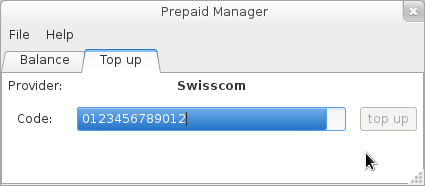
A recent trip to Switzerland made me dig out my prepaid card for UMTS usage again. This resulted in some minor enhancements for Prepaid Manager. The new release handles disabled and missing modems more reliably. It also has some visual feedback if we know the length of the top up code: GNOME Prepaid Manager screenshot This blog is flattr enabled.

26 December 2011

Russ Allbery: Testing PAM modules

I maintain a couple of PAM modules, pam-afs-session and pam-krb5. I'm also a big fan of test-driven development and automated regression testing, and have been slowly converting all of my software over to using a test suite. But therein lies a challenge, since PAM modules are hard to test. First, Linux PAM doesn't offer a good way to run a module in a test environment. Specifically, it doesn't offer a way to use an alternative PAM configuration other than the system PAM configuration, so that one can load only the module being tested (or it and some glue modules to set things up). One has to resort to dedicated test systems that do things like symlink part of their PAM configuration into a shared build tree. Second, even if this problem were solved, Linux PAM doesn't (rightfully) allow a lot of introspection and digging around in its guts. This makes it harder to test whether data items, environment variables, and so forth are set properly and make sense. It also doesn't provide facilities for intercepting logging output that would otherwise go to syslog. So, about a year and a half ago (and then with substantial improvements a year ago), I wrote a fake PAM library to test pam-afs-session. This library provides all of the PAM API that's called by a PAM module (at least the modules I'm testing), but has a much-simplified interface and allows test cases to look through its internals and be sure the module did things properly. This was great as far as it goes. But writing the wrapper code to invoke a PAM module entry point and then check its return status, its logging, and so forth was complicated, messy, and difficult to understand. It also didn't handle testing prompting and other important aspects of PAM modules. So earlier this fall I wrote the beginnings of a PAM test driver that would move as much of the complexity as possible into shared code and into configuration files, and since then I've been expanding and improving it until it could handle the major testing required for pam-krb5 (which is much more complex than pam-afs-session). Yesterday, I released the results as part of rra-c-util. Here's an example configuration file, this one for a pam-krb5 test that simulates prompting the user for a password and then obtaining credentials (but not creating a ticket cache):
    [options]
        auth    = no_ccache
        account = no_ccache
        session = no_ccache
    [run]
        authenticate  = PAM_SUCCESS
        acct_mgmt     = PAM_SUCCESS
        open_session  = PAM_SUCCESS
        close_session = PAM_SUCCESS
    [prompts]
        echo_off = Password:  %p
    [output]
        INFO user %u authenticated as %u
That's a complete and fairly complex test. The test framework takes care of running the listed entry points, passing them the given PAM configuration, and checking the return status. It provides a conversation function that checks the prompt and its type and replies with the text after . As you can see, it supports some escapes that are replaced by data passed into the test suite driver, in this case the password to use for testing. And it checks the logging output, including the priority level, and similarly supports escapes there. Running simple tests is very easy and is doable with a tiny C program. Here's a complete test program from pam-krb5, one that tests functionality that doesn't require a valid password and hence doesn't need to do much setup:
    #include <config.h>
    #include <portable/system.h>
    #include <tests/fakepam/script.h>
    int
    main(void)
     
        struct script_config config;
        plan_lazy();
        memset(&config, 0, sizeof(config));
        config.user = "root";
        run_script_dir("data/scripts/basic", &config);
        return 0;
     
That's all there is to it. That finds every configuration file like the above in the tests/data/scripts/basic directory in the package source and runs through each one, checking the results, and outputing the results as TAP output (the protocol used for the Perl test suite, and also my C TAP Harness package). There are, of course, other things that it can do: more substitutions, setting the authtok in advance of calling the module, and a callback so that one can inspect PAM state before the PAM session is shut down. I've started writing some documentation, although so far it primarily covers the configuration file syntax and the headers are the best reference for the API. The source code of the pam-krb5 package are the best reference so far. The library itself is part of rra-c-util and, like the rest of that package, is designed to be copied into the package that uses it and built alongside it so that it can be linked easily with the test programs. It's worth noting that there isn't a way to use it to test installed PAM modules that are already bound to the system libpam library. The way one builds test programs currently is to link the test program with the individual objects making up the PAM module and then link with this library and the TAP library, since that ensures the right symbols are called. But it may be possible to do something tricky using LD_PRELOAD if anyone feels inspired.

23 December 2011

Keith Packard: calypso

Calypso CalDAV/CardDAV/WebDAV for Android and Evolution Ever since I bought my first Palm Pilot in 1997, I ve relied upon a pocket-able device to carry a copy of my calendar and contacts, and for that same database to be present on my laptop. I went through a long list of Palm-compatible devices, including both the Palm Treo and Palm Centro telephones. I even wrote a number of my own Palm applications. Years ago, it was pretty obvious that I d have to find a new phone, but I was stuck looking for something that could provide the same hot-sync functionality. SyncML on the Series 40 I bought a Series 40 Nokia phone in Shanghai that promised SyncML support. Given that I had seen numerous SyncML implementations for Linux, it seemed like I should be able to get something to work. SyncML on the Series 40 is a disaster the phone couldn t actually store all of my contacts, and it couldn t hold half of the data fields I used. So, that phone landed in the box and back to the Centro I went. SyncML on the N900 Nokia kindly sent me an N900 at some point, so I gave SyncML another try. Given that the N900 runs evolution-data-server, and that I ve had evolution-data-server running on my laptop, it seemed like I should be in business. Well, almost. It took several days of hacking to fix bugs in the evolution SyncML back end, then another several days fussing with opensync. I ended up abandoning direct synchronization as unworkable opensync would sit in an infinite loop, or worse, trash my database completely. I finally found syncml-ds-tool , which is a debugging tool that comes with opensync. This tool simply synchronizes a set of disk files, one per contact or calendar entry, with the phone. That worked for well over a year. And then, a few months ago, Bluetooth on the laptop stopped connecting with the phone s SyncML server. I d get ECONNREFUSED every time I tried to use it. So much for the N900. DUN still worked, mostly, although it too would get ECONNREFUSED at times, but retrying seemed to make it work. However, While the N900 SyncML solution worked, I discovered another thing I wanted contacts and calendar entries stored in individual files and revision controlled with git. This makes it reasonable to delete stale calendar entries and know that they re never really gone, just left behind in an older version of the calendar. And, if you mess up, you can recover by poking at the database with git directly. I switched back to the venerable Palm Centro; it turns out that calendar and contacts are more important to me than being able to surf the web on my phone. Alas, my Centro went swimming in August and has passed on to the great electronics recycling house in the sky. I pulled the SIM out and switched back to the N900. I got my contacts imported on the N900 by copying files over the net work; not a long-term strategy, but at least I had phone numbers again. There was no hope for my calendar. I started looking for a solution in earnest. How about Android? At this point in my story, I m sure you re asking why I didn t just use one of the numerous Android phones that came through my hands. The answer is simple my calendar and contacts are probably some of my most personal data, and I m not willing to store them outside of my direct control, for reasons similar to those which are driving the development of the FreedomBox. When Android first came out, it could only talk to Google services, which didn t meet my hard requirement for personal data storage. One of my co-workers had his Google account suspended for violating the terms-of-service; he asked what he had done, but they wouldn t say. He asked if he could get his data back, and they said no . They invited him to create a new account, but it would not ever get any of the old data. A few days later, he got a nice apologetic email letting him know that they d made a mistake and that he hadn t, in fact, violated any of the terms-of-service, and that his old account was restored with all of his data intact. Wasn t that nice of Google? WebOS? I got a WebOS phone over the summer and discovered that while it had multiple contact/calendar back ends, none of them used standard protocols and so you only had the choice between multiple corporate data centers, which isn t actually a choice at all. Furthermore, the WebOS phone refused route PAN packets over the phone network, even though I have a data plan which allows this. It s not that it couldn t support it, it s that it refused. A couple of weeks after the WebOS phone arrived, HP canceled all of their WebOS hardware products, which made me less interested in trying to solve this problem. Android recovers About the same time the WebOS phone arrived, I discovered that Google had published enough information about the calendar/contacts internals for Marten Gajda to write CalDAV-Sync and CardDAV-Sync. And then, Andrew McMillan wrote aCal, which is a complete replacement for the built-in calendar and contacts applications and supports CalDAV and CardDAV. With two different standards-compliant solutions available, it seemed like it might be time to try Android again. I d love for CardDAV-Sync and CalDAV-Sync to become free software like aCal is. Andrew makes money from aCal by offering it for sale via the Android Market, while still publishing the sources for those who want to build their own copy. CalDAV/CardDAV on Linux I think the most widely known CalDAV server for Linux is probably DAViCal, a huge pile of PHP and SQL sitting on top of Apache. I m sure it s suitable for running on a server and being accessed over the internet, but I m not interested in that, nor am I interested in having my laptop run Apache and PostgreSQL. I found a tiny little CalDAV server, Radicale, which seemed like a lot better fit. It s written in Python and uses the usual Python HTTP server infrastructure, which provides SSL and authentication support along with some fairly convenient APIs for parsing and generating HTML. Before long, I discovered that Radicale was actually too simple for my needs. It stores the whole calendar in a single file, re-parsing it whenever a request is made, so a calendar with just hundreds of entries caused the server to slow down enough that evolution would time-out when talking to it. Also, Radicale doesn t actually parse the calendar entries completely, it has some ad-hoc code that finds various pieces of data, but without dealing with the whole syntax. I started hacking at Radicale to see how far I could get. I changed the storage code to store one event per file, then added hooks to use git for change management. Then, I found a full vcalendar/vcard parsing library in python, vobject, which I used to replace the ad-hoc parsing code. Finally, I added support for VCARD entries as well, allowing the system to store both calendar and contact information. Introducing Calypso, a CardDAV/CalDAV server With this much divergence from the original project, I ve figured I d best rename things to avoid confusion, so I decided to call it calypso , after a brief trip through the dictionary looking for names starting with ca . Calypso works with evolution, iceowl and the Android CalDAV/CardDAV plugins. It does not yet work with aCal; for some reason aCal cannot find any calendars on the server. Calypso also supports importing calendar changes from the command line, allowing you to integrate support into a text-based email application like notmuch or mutt. Calypso is available via git from git://keithp.com/git/calypso and is distributed under the GPL (v3 or later). I still consider it a work derived from Radicale, and so the code retains all of the Radicale copyrights along with my own. Using Calypso Initial setup Calypso runs as a regular user, all data are stored in ~/.config/calypso. To initialize calypso:
$ mkdir ~/.config/calypso ~/.config/calypso/calendars
$ cat > ~/.config/calypso/config << EOF
[server]
ssl=true
certificate=/home/keithp/.config/calypso/ssl/server.crt
key=/home/keithp/.config/calypso/ssl/server.key
[acl]
;type=htpasswd
type=fake
filename=/home/keithp/.config/calypso/passwd
Running calypso Then run calypso:
$ python ./calypso.py
No, I haven t figured out how to install it Creating new calendars To add a new database:
$ mkdir -p ~/.config/calypso/calendars/private/my_calendar
$ cd ~/.config/calypso/calendars/private/my_calendar
$ git init
$ git commit --allow-empty -m'initialize new calendar'
The new calendar should now be visible as https://localhost:5233/private/my_calendar You can add files to the directory at any time; calypso will check the directory mtime at each operation and update its internal state from that on disk automatically when the directory changes. Importing files Given a set of files with VCALENDAR or VCARD entries, you can import them with:
$ calypso --import private/my_calendar <filenames...>
This will update any changed entries and add any new ones. ToDo list for calypso
  1. Document the config file contents.
  2. Make it installable
  3. Figure out what aCal wants
  4. Support calendar creation
More Android info I m running cyanogenmod on my Nexus S as that provides PAN support. With PAN, I can create a network link between laptop and phone which doesn t depend on any local WiFi infrastructure and which gives both phone and laptop static IP addresses, allowing me to configure the sync URLs statically on the phone. I d use mDNS, but Android doesn t bother to support that.

22 December 2011

Dirk Eddelbuettel: Rcpp 0.9.8

A new release 0.9.8 of Rcpp is now on CRAN and will also get into Debian shortly (once I finish building R 2.14.1). This release contains a few incremental changes. Romain, sponsored by by the Open Source Programs Office at Google, had released a new package int64 bringing larger integers to R, and this is now supported by Rcpp as well. John Chambers contributed some code to have Reference Classes extend existing C++ classes (typically brought in via Rcpp Modules). Jelmer Ypma sent us a patch to add a Rcout device not unlike cout, but aligned with R's io buffering. We added some more unit tests, and made a few small fixes here or there. The complete NEWS entry is below; more details are in the ChangeLog file in the package and on the Rcpp Changelog page.
0.9.8   2011-12-21
    o   wrap now handles 64 bit integers (int64_t, uint64_t) and containers 
        of them, and Rcpp now depends on the int64 package (also on CRAN).
        This work has been sponsored by the Google Open Source Programs
        Office.
    o   Added setRcppClass() function to create extended reference classes 
        with an interface to a C++ class (typically via Rcpp Module) which
        can have R-based fields and methods in addition to those from the C++.
    o   Applied patch by Jelmer Ypma which adds an output stream class
        'Rcout' not unlike std::cout, but implemented via Rprintf to
        cooperate with R and its output buffering.
        
    o   New unit tests for pf(), pnf(), pchisq(), pnchisq() and pcauchy()
    o   XPtr constructor now checks for corresponding type in SEXP
    o   Updated vignettes for use with updated highlight package
    o   Update linking command for older fastLm() example using external 
        Armadillo
Thanks to CRANberries, you can also look at a diff to the previous release 0.9.7. As always, even fuller details are on the Rcpp Changelog page and the Rcpp page which also leads to the downloads, the browseable doxygen docs and zip files of doxygen output for the standard formats. A local directory has source and documentation too. Questions, comments etc should go to the rcpp-devel mailing list off the R-Forge page

19 December 2011

Pau Garcia i Quiles: Reminder: FOSDEM 2012 CrossDesktop DevRoom Call for Talks

FOSDEM is one of the largest gatherings of Free Software contributors in the world and happens each February in Brussels (Belgium). One of the developer rooms will be the CrossDesktop DevRoom, which will host Desktop-related talks. Are you interested in giving a talk about open source and Qt, KDE, Enlightenment, Gnome, XFCE, Windows, Mac OS X, general desktop matters, mobile development, applications that enhance desktops and/or web? Hurry up and submit your proposal, deadline is December 20th! There is more information in the Call for Talks we published one month ago. If you are interested in Qt/KDE, come visit us at the KDE booth. If you add yourself to the KDE FOSDEM 2012 wiki page, we will be able to better organize the usual dinner on Sunday and/or smaller meetings for special interest groups .

18 December 2011

Andreas Metzler: GnuTLS 3.0.x in unstable

GnuTLS 3.0.x is finally available in unstable (and squeeze). Please consider upgrading. (Development package: libgnutls28-dev)

14 December 2011

Emanuele Rocca: First steps with Sinatra on Heroku

Lately I have been playing a little bit with different Platform as a Service providers. So far, the most developer-friendly one seems to be Heroku. In particular, Heroku provides an incredibly straightforward way to get started. After creating an account on their website, you just have to install the appropriate gem: sudo gem install heroku The command heroku help will then show you all the possible invocations of the command line client, just to give you an idea of what you can do with it (everything). Alright, that s not particularly interesting without an application to play with, is it? So let s create a new Sinatra application. In order to do that, we need a new directory containing a file like the following one:
# webapp.rb
require 'rubygems'
require 'sinatra'
# Add other gems you might need here
get '/' do
  "Your Sinatra app is working!"
end
Also add a Gemfile with all the required dependencies, in our trivial example sinatra is actually the only gem you need:
source :rubygems
gem "sinatra"
Lastly, you need a config.ru file where you can require our newly created Ruby program and specify that it is a Sinatra application. In this example, the Ruby file is called webapp.rb.
require './webapp'
run Sinatra::Application
A very useful program when developing a Sinatra application is shotgun. gem install shotgun and you will be able to run your new shiny app by executing the command shotgun. While developing on your machine, shotgun will take care of reloading the application for every request, so that you don t have to restart the server after every modification to the source code. Run bundle install to easily install all the required dependencies in your development environment, and shotgun to start the app locally. Pointing your browser to http://127.0.0.1:9393/ you can check if everything works as expected. If nothing went wrong, you can create a git repository to track changes to the source code:
git init
git add . 
git commit -m "Initial commit"
Perfect! Now, how do you create and deploy your application on Heroku?
heroku create
git push heroku master
Heroku will automatically find out that you deployed a Sinatra application, it will install all the required dependencies and start serving requests. A few interesting commands you might want to run to see what s going on are heroku info, heroku ps and heroku logs. The client also provides a command, heroku open, that opens your browser at the right production URL. So, you now have a working application under revision control. Dependencies are handled by specifying them into the Gemfile, and the required gems can be installed locally using bundle. Shotgun is our friend when it comes to use the application for development purposes. A git push heroku master is all we need to deploy a new version of the code. Of course there is way much more about Sinatra and Heroku than what I ve covered in this mini-intro. Please refer to the Sinatra Book and the Heroku Dev Center for more information!

12 December 2011

Norman Garc&iacute;a: Hello Debian Planet

I must confess, I thought only DD s can be on the Debian Planet and a few days ago I read someone telling me that I must add my blog to the planet, so I went to the Planet wikipage and I saw that Planet Debian is for any active and directly involved participant in the Debian development community. This is my first post on the Debian Planet. I m member of the DC12 Local Team and I ll try to post here updated information about DebConf12 organization, my experience in the Debian Community (I m starting to collaborate with Spanish translations for the Debian Plubicity Team), and other Debian-related things as well. Our next DebConf meeting is TBD on doodle, if you are interested to participate in the meeting, please go to doodle and select the dates you are available so we can decide when is going to be the next meeting. Hope to see you next year in Managua!

NeuroDebian: Chroot workaround for fslview (HOWTO)

Chroot workaround for fslview (HOWTO)
Preamble Sometimes research software lags behind developments in libraries it relies upon, because necessary changes to the code might require considerable effort, and thus time. That leads to difficulties building those tools using up-to-date library versions due API incompatibility. That is what happened with fslview from the FSL suite. Today, at the end of 2011, it still relies on Qt3 and VTK GUI support for it.

Note Last version of Qt3, 3.3.8, was released in February 2007, with official support by Trolltech terminated later that year.

Qt4 was first released in 2005, and current stable series 4.7 released appeared in September 2010.

Because of its age and discontinued upstream support, Qt3 was orphaned in Debian, and tools relying on it were encouraged to migrate to use Qt4. As a result, although Qt3 itself is still present in Debian (and thus Ubuntu), VTK GUI support for Qt3 (package libvtk5.4-qt3) which fslview uses, was removed from Debian due to Qt3 deprecation. It should be made clear that it was not removed to annoy people, but rather because it became unfeasible to maintain its robust building and functioning. So nowadays fslview is present only in those previous releases of Debian and Ubuntu which carry the libvtk5.4-qt3 library. Those are Debian squeeze (stable), Ubuntu nutty and maverick. If you upgraded your system from one of those releases, chances are that you still have fslview (and required libraries) installed although not they are not available from the APT repository anymore. Therefore fresh systems installations will not have them at all.
Workaround While everyone is waiting for a new release of fslview compatible with Qt4 there are possible workarounds to keep research going on bleeding edge Debian-based operating systems. The first, obvious choice for a FOSS enthusiast, is to build fslview from source by first building VTK Qt3 bindings, possibly after building Qt3 itself. While it might be educationally valuable and exciting, we are afraid in the end it might be more frustrating than useful. Therefore we would like to suggest another, much more straightforward and hopefully painless approach lightweight virtualization, or chroot jailing, which exists in Unix-land since 1970s. With this exercise in 4 simple steps we will install a complete (minimalistic) installation of Debian stable into a separate directory without harming the original system installation. We will provide a convenience wrapper to run fslview as if it was installed on the main system. So your system will stay intact while you would enhance it with additional software in a stable Debian environment. Moreover if security or critical fixes to any components of that installation become available, this chroot environment, being a complete Debian installation, could be as easily upgraded as your main system, thus guaranteeing robust performance. Although we demonstrate this setup with fslview in mind, such approach is generally useful for various use cases. For example, we have used it in the opposite situation on stable Debian systems we needed to run some software available only from Debian unstable or testing, and backporting of all required dependencies was either cumbersome or just impossible without sacrificing stability of the system.
Prerequisites For this exercise you would need
  • 3 20 minutes depending on the bandwidth to the Debian mirror and efficiency in cut/paste operations
  • root access to the system while performing this setup, although end-users of fslview would not need root access after everything is set up
  • 2 additional tools debootstrap to install Debian in a directory and a convenience utility schroot to enable such an environment
Procedure
  • Install the tools:

    sudo apt-get install debootstrap schroot
  • Choose a location with enough space (600 MB should be enough) and install a complete Debian squeeze installation with fslview:

    sudo debootstrap --include=fslview squeeze /srv/chroots/squeeze http://ftp.us.debian.org/debian

    Note

    You might like to adjust the URL to a Debian mirror closer to you

  • Create schroot configuration file /etc/schroot/chroot.d/squeeze with the following content:

    [squeeze]
    description=Debian squeeze (6.x stable)
    type=directory
    directory=/srv/chroots/squeeze
    users=YOURLOGIN
    aliases=debian,default
    Replace YOURLOGIN with a comma separated list of users who should be allowed to access this chroot environment (see man schroot.conf for more options, e.g. how to specify whole groups with groups=..., etc.)
  • At this point you should already be able to invoke any command within the chroot environment, so just create a little shell script /usr/local/bin/fslview, make it executable and be all set:

    echo -e '#!/bin/sh\nschroot -p -c squeeze /usr/bin/fslview "$@"' > /usr/local/bin/fslview
    chmod a+x /usr/local/bin/fslview

    Note

    You might need to become root for the above.

Optional steps Although at this point you can run fslview from the chroot-ed environment, we would suggest a few additional steps. For some of them (marked with chroot-root) you would need to become root in a chroot environment via following steps:
  • enter chroot using schroot -c squeeze -p
  • become root (via su command, root password should be the same as on the main system)
So here are recommended optional additions:
  • chroot-root: Enable NeuroDebian repository. Choose squeeze release and mirror of preference (remove sudo from provided cmdline).

  • chroot-root: Enable security and functionality updates:

    sed -e 's,squeeze,squeeze-updates,g' /etc/apt/sources.list > /etc/apt/sources.list.d/updates.list
    echo 'deb http://security.debian.org/ stable/updates main' > /etc/apt/sources.list.d/security.list
    apt-get update
    apt-get upgrade
  • Make fsl atlases accessible within the chroot environment. There are two ways and you must choose only one of them, otherwise you might damage your main system installation.

    • chroot-root: Install atlases packages in the chroot-ed environment:

      apt-get install fsl-atlases
      Although this is the best/correct way it would require additional 200MB of space, possibly duplicating what you already have installed in the main system. Also it requires enabling of NeuroDebian repository in chroot environment.
    • Alternatively you can bind-mount those directories with atlases installed on the main system within chroot. For that edit (as root on the main system) /etc/schroot/default/fstab and add following entries:

      /usr/share/fsl/data/atlases /usr/share/fsl/data/atlases none rw,bind 0 0
      /usr/share/data             /usr/share/data             none rw,bind 0 0
      You need to be aware of the potential consequences of this second approach: Any package that installs files under /usr/share/data will modify files in the same directory outside the chroot as well. If you don t want to risk that don t use this method and simply install the necessary data packages inside the chroot environment too, as describe before.

      Note

      Similarly you can bind-mount any other directory you would like to make visible in chroot. Just be careful to not overlap with system directories in chroot which already carry something.

Also you might like to read man schroot on how to enable persistent sessions so that chroot initiation could be done ones during boot instead of per each fslview invocation If you have any comments (typos, improvements, etc) feel welcome to leave a comment below, or just email us@NeuroDebian .

9 December 2011

Christian Perrier: 10 years being Debian Developer - part 5: being a newbie DD...and working on l10n

I left you 2.5 months ago with the last question asked by my applicaiton manager, Martin Michlmayr : "Please tell me about about yourself and what you intend to do for Debian". Interesting question to revisit now, indeed. Here is what I answered: About myself first. I'm a 40 year old project manager and system administrator working in French National Aerospace Research Center. My best definition of my skills in computing is "Know more or less about a Lot of Things and be a Specialist of Nothing"...:-). I'm definitely not a programmer, nor a real system administrator, nor a RDBMS administrator, nor a personal workstation designer, though I do all of these daily. I think I'm perfect for finding the good person for having a defined job done. Besides this, I'm a genealogist for several years now. This is what finally decided me to apply for becoming a package maintainer : there are some quite good free genealogy software for Unix, though for various reasons they are not used very widely, even Unix geeks (my main software for genealogy still runs on Another Operatin System and is evertythig but free).I think that I can bring something here to the Free Software World, by helping some of these good programs in getting into the best Linux distribution I know.... For me, this is a mean for giving back to the free software movement what I gives to me since I discovered Linux 6-7 years ago. My very first intention as soon as I get my way into the Debian Developers Heaven is adopting the Geneweb package currently maintained by Brent Flugham. I'm in close contact with the author (who happens to be french, which helps) as well as a daily user of it. The current package which is in the distribution is already my work for a great part. I gave it to Brent, the current maintainer and we both agreed that it would be better for me to apply to becoming anofficial maintainer. I also contributed to the package for lifelines, another genealogy software. The last version of the package is also 80% my work, acknowledged by Javier, the official maintainer. Concerning that package, I do not have "plans" for adopting it (we didn't discussed of this with Javier, and I'm not sure I could bring him that much things). I came to Linux thanks to a great friend of mine, Ren Cougnenc. Ren opened my eyes to the free software world when I still thought that it was only a variant of free beers. I got really involved into Linux when I forced me to remove any other Operating System from my computer at work and tried to do my daily job with Linux. I have now succeeded at ONERA in getting free software to be accepted as a credible alternative for important projects. At this time, especially for server and network-related projects. I absolutely cannot tell why and how I came to be a Debian user. I simply don't remember. But I know why I am still a Debian user : this is a distribution which is controlled by only one organisation--->its users. And I want to be part of it. Finally, I did not mention above the somewhat "political" nature of my personal involvment into free software. Except for the physical appearence, I think I mimic RMS on several points (though he probably speaks better french than I try to speak english....which does not help for expressing complex ideas like the ones above!). As anyone can see, I was already very verbose when writing, sorry for this. Funnily Martin summed this up in one paragraph when he posted his AM report about my application. From what I see, also, my English didn't improve that much since then. It seems this is a desperatecause, I'm afraid. Anyway, all this was apparently OK for Martin and, on July 21st 2001, he wrote and posted his AM report and, on July 30th 2001, I got a mail by James Troup: An account has been created for you on developer-accessible machines with username 'bubulle'. bubulle@debian.org was born. Now I can more easily destro^W contribute to my favourite Linux distro. Indeed, I don't remember that much about the 2001-2003 years. I was probably not that active in Debian. Mostly, I was maintaining geneweb, for which I polished the package to have it reach a quite decent state, with elaborated debconf configuration. Indeed, at that time, I was still also deeply involved in genealogy research and still contributing to several mutual help groups for this. This is about the time where I did setup my web site (including pages to keep the link with our US family, which we visited in 2002). I think that the major turn in my Debian activities happened around september 2002 when Denis Barbier contacted me to add support in geneweb for a new feature he introduced in Debian : po-debconf. At that time, I knew nearly nothing about localization and internationalization. Denis was definitely one of the "leaders" in this effort in Debian. During these years, he did a tremendous job setting up tools and infrastructure to make the translation work easier. One of his achievements was "po-debconf", this set of tools and scripts that allows translation debconf "templates", the questions asked to users when configuring packages. All this lead me to discover an entire new world : the world of translating software. As often when I discover something I like, I jumped into it very deeply. Indeed, in early January 2003, I did my very first contributions to debian-l10n-french and began working on systematic translation of debconf templates. Guess what was the goal : 100%, of course! Have ALL packages that have debconf templates...translated to French. We reached that goal.....on June 2nd 2008 in unstable (indeed "virtually" : all packages were either 100% translated...or had a bug report with a complete translation) and on December 21st 2010 for testing. Squeeze was indeed the first Debian release with full 100% for French. Something to learn with localization work: it's never finished and you have to be patient. So, back in 2003, we were starting this effort. Indeed, debian-l10n-french was, at that time, an incredibly busy list and the translation rate was very high: I still remember spending my summer holidays translating 2-3 packages debconf templates every day for two weeks. Meanwhile, my packaging activities were low: only geneweb and lifelines, that was all. Something suddenly changed this and it has been the other "big turn" in my Debian life. After summer 2003, I suddenly started coming on some strange packages that were needing translation: they were popping up daily in lists with funny names like "languagechooser", "countrychooser", "choose-mirror", etc. I knew nothing about them and started "translating" their strings too, and sending bug reports after a decent review on debian-l10n-french. Then, Denis Barbier mailed me and explained me that these things were belonging to a new shiny project named Debian Installer and meant to replace the good old boot-floppies. Denis explained me that it would maybe be more efficient to work directly in the "D-I" team and "commit" my work instead of sending bug reports. Commit? What's that? You mean this wizard tool that only Real Power Developers use, named "CVS"? But this is an incredibly complicated tool, Denis. Do you really want me, the nerd DD, to play with it? Oh, and in this D-I development, I see people who are close to be semi-gods. Names I read in mailing lists and always impress me with their Knowledge and Cleverness: Martin Michlmayr (my AM, doh), Tollef Fog Heen, Petter Reinholdtsen and so many others and, doh, this impressive person named "Joey Hess" who seems to be so clever and knowledgeable, and able to write things I have no clue about. Joey Hess, really? But this guy has been in Debian forever. Me, really? Work with the Elite of Debian? Doh, doh, doh. Anyway, in about two months time, I switched from the clueless guy status to the status of "the guy who nags people about l10n in D-I", along with another fellow named Denny "seppy" Stampfer". And then we started helping Joey to release well localized D-I alphas and betas at the end of 2003 (the release rate at the time was incredible: Sarge installer beta1 in November 2003, beta2 in January 2004). I really remember spending my 2003 Christmas holidays hunting for....100% completion of languages we were supporting, and helping new translators to work on D-I translation. Yes, 8 years ago, I was already doing all this..:-)...painting the world in red. All this leads up to the year 2004. Certainly the most important year in my Debian life because it has been....the year of my first DebConf. But you'll learn about this....in another post (hopefully not in 2.5 months).

8 December 2011

Tanguy Ortolo: Return codes

According to Eric S. Raymond, one rule for Unix programming is the Rule of Silence: When a program has nothing surprising to say, it should say nothing. Since return codes are a form of information, I would like to add: when a program has carried out its task with no surprise, it should exit(0).Take xscreensaver-command -lock, for instance. That command is meant to make a running XScreenSaver to lock the screen. I have never seen it fail in doing so, however I sometimes get a non-zero code:
% xscreensaver -lock
xscreensaver-command: could not frobnicate window 4212
zsh: exit 1   xscreensaver-command -lock
Well, xscreensaver-command, I have the deep regret to announce you that despite of your surprising return code, you successfully succeeded to lock my screen. But that return code is wrong and annoying. Wrong, because as a user, I do not care if xscreensaver-command -lock failed to frobnicate some window he would have loved to as long as it does its job and locks my screen. To the user's point of view, locking the screen is binary: either it is done and it is a success or it is not done and that is a failure. And it is annoying, because it makes the return code meaningless and prevents you from using it to do things like:
% # Lock screen and suspend to RAM (only if locking was successful)
% xscreensaver -lock && sudo pm-suspend
With xscreensaver-command sometimes returning a non-zero code with no apparent reason, you end with a locked screen and your computer still running, and have to unlock it and try again. This looks like this meaningless dialogue: So please, when you write a utility, design your return code for the user, not for you. If your utility has done the job, it should exit(0). What happened inside does may interest you as the developer but it does not matter to the user as long as the job is done, so it should not be reported to him, especially not with a misleading failure code.

Thomas Koch: On distributing binaries

Many software developers don't care about security. A typical Java developer downloads the Eclipse binary from eclipse.org, a website that doesn't even support https. He then continues to install binary eclipse plugins from several different web sites. Once development starts, maven continues to pull in hundreds of plugins and dependencies without checking their origin.
How do you still want to trust this machine with your private passwords or gpg key? I don't. Therefor I do java development at least in a chroot'ed environment. To make this point a bit less theoretic I've collected examples of compromised downloads or servers in recent months.
And another funny example, why you should not run sudo make install on any downloaded source code: The bumblebee rm -rf /usr disaster. Not so funny: 154 people killed in malware caused airplane crash. or Malware compromises USAF Predator drones
What's the morale? If you're a developer, then please get a gpg key, get it signed by many other developers and sign your release artifacts! And no, just publishing a SHA-1 or (god beware) MD5 hash of the artifact does not provide any security. It may just fool people to believe they'd be secure. (Google Code team, please fix this! Apache people, signing artifacts with gpg keys that don't have any signatures is at best useless!)
This blog post has been triggered by a post relating to the issue of binary incompatibilities between Scala versions. If I understand Josh Suereth correctly, he recommends to not worry about binary incompatibilities but to distribute libraries as source code and recompile them when necessary. AMEN! Please, make this a habbit in Scala land! If you then distribute source code in Git repositories you can make use of gpg signed tags.
And while you're at it, why not help your favorite linux distribution to package Scala stuff?

Next.

Previous.