Search Results: "ed"

7 December 2022

Matthew Garrett: Making an Orbic Speed RC400L autoboot when USB power is attached

As I mentioned a couple of weeks ago, I've been trying to hack an Orbic Speed RC400L mobile hotspot so it'll automatically boot when power is attached. When plugged in it would flash a "Welcome" screen and then switch to a display showing the battery charging - it wouldn't show up on USB, and didn't turn on any networking. So, my initial assumption was that the bootloader was making a policy decision not to boot Linux. After getting root (as described in the previous post), I was able to cat /proc/mtd and see that partition 7 was titled "aboot". Aboot is a commonly used Android bootloader, based on Little Kernel - LK provides the hardware interface, aboot is simply an app that runs on top of it. I was able to find the source code for Quectel's aboot, which is intended to run on the same SoC that's in this hotspot, so it was relatively easy to line up a bunch of the Ghidra decompilation with actual source (top tip: find interesting strings in your decompilation and paste them into github search, and see whether you get a repo back).

Unfortunately looking through this showed various cases where bootloader policy decisions were made, but all of them seemed to result in Linux booting. Patching them and flashing the patched loader back to the hotspot didn't change the behaviour. So now I was confused: it seemed like Linux was loading, but there wasn't an obvious point in the boot scripts where it then decided not to do stuff. No boot logs were retained between boots, which made things even more annoying. But then I realised that, well, I have root - I can just do my own logging. I hacked in an additional init script to dump dmesg to /var, powered it down, and then plugged in a USB cable. It booted to the charging screen. I hit the power button and it booted fully, appearing on USB. I adb shelled in, checked the logs, and saw that it had booted twice. So, we were definitely entering Linux before showing the charging screen. But what was the difference?

Diffing the dmesg showed that there was a major distinction on the kernel command line. The kernel command line is data populated by the bootloader and then passed to the kernel - it's how you provide arguments that alter kernel behaviour without having to recompile it, but it's also exposed to userland by the running kernel so it also serves as a way for the bootloader to pass information to the running userland. The boot that resulted in the charging screen had a androidboot.poweronreason=USB argument, the one that booted fully had androidboot.poweronreason=PWRKEY. Searching the filesystem for androidboot.poweronreason showed that the script that configures USB did not enable USB if poweronreason was USB, and the same string also showed up in a bunch of other applications. The bootloader was always booting Linux, but it was telling Linux why it had booted, and if that reason was "USB" then Linux was choosing not to enable USB and not starting the networking stack.

One approach would be to modify every application that parsed this data and make it work even if the power on reason was "USB". That would have been tedious. It seemed easier to modify the bootloader. Looking for that string in Ghidra showed that it was reading a register from the power management controller and then interpreting that to determine the reason it had booted. In effect, it was doing something like:
boot_reason = read_pmic_boot_reason();
switch(boot_reason)  
case 0x10:
  bootparam = strdup("androidboot.poweronreason=PWRKEY");
  break;
case 0x20:
  bootparam = strdup("androidboot.poweronreason=USB");
  break;
default:
  bootparam = strdup("androidboot.poweronreason=Hard_Reset");
 
Changing the 0x20 to 0xff meant that the USB case would never be detected, and it would fall through to the default. All the userland code was happy to accept "Hard_Reset" as a legitimate reason to boot, and now plugging in USB results in the modem booting to a functional state. Woo.

If you want to do this yourself, dump the aboot partition from your device, and search for the hex sequence "03 02 00 0a 20"". Change the final 0x20 to 0xff, copy it back to the device, and write it to mtdblock7. If it doesn't work, feel free to curse me, but I'm almost certainly going to be no use to you whatsoever. Also, please, do not just attempt to mechanically apply this to other hotspots. It's not going to end well.

comment count unavailable comments

3 December 2022

Ben Hutchings: Debian LTS work, November 2022

In November I was assigned 24 hours by Freexian's Debian LTS initiative. I worked 9 of those hours and will carry over the remainder. I updated the linux (4.19) package to the latest stable update, but didn't upload it. I attended the monthly LTS team meeting.

Vincent Bernat: Broken commit diff on Cisco IOS XR

TL;DR Never trust show commit changes diff on Cisco IOS XR.

Cisco IOS XR is the operating system running for the Cisco ASR, NCS, and 8000 routers. Compared to Cisco IOS, it features a candidate configuration and a running configuration. In configuration mode, you can modify the first one and issue the commit command to apply it to the running configuration.1 This is a common concept for many NOS. Before committing the candidate configuration to the running configuration, you may want to check the changes that have accumulated until now. That s where the show commit changes diff command2 comes up. Its goal is to show the difference between the running configuration (show running-configuration) and the candidate configuration (show configuration merge). How hard can it be? Let s put an interface down on IOS XR 7.6.2 (released in August 2022):
RP/0/RP0/CPU0:router(config)#int Hu0/1/0/1 shut
RP/0/RP0/CPU0:router(config)#show commit changes diff
Wed Nov 23 11:08:30.275 CET
Building configuration...
!! IOS XR Configuration 7.6.2
+  interface HundredGigE0/1/0/1
+   shutdown
   !
end
The + sign before interface HundredGigE0/1/0/1 makes it look like you did create a new interface. Maybe there was a typo? No, the diff is just broken. If you look at the candidate configuration, everything is like you expect:
RP/0/RP0/CPU0:router(config)#show configuration merge int Hu0/1/0/1
Wed Nov 23 11:08:43.360 CET
interface HundredGigE0/1/0/1
 description PNI: (some description)
 bundle id 4000 mode active
 lldp
  receive disable
  transmit disable
 !
 shutdown
 load-interval 30
Here is a more problematic example on IOS XR 7.2.2 (released in January 2021). We want to unconfigure three interfaces:
RP/0/RP0/CPU0:router(config)#no int GigabitEthernet 0/0/0/5
RP/0/RP0/CPU0:router(config)#int TenGigE 0/0/0/5 shut
RP/0/RP0/CPU0:router(config)#no int TenGigE 0/0/0/28
RP/0/RP0/CPU0:router(config)#int TenGigE 0/0/0/28 shut
RP/0/RP0/CPU0:router(config)#no int TenGigE 0/0/0/29
RP/0/RP0/CPU0:router(config)#int TenGigE 0/0/0/29 shut
RP/0/RP0/CPU0:router(config)#show commit changes diff
Mon Nov  7 15:07:22.990 CET
Building configuration...
!! IOS XR Configuration 7.2.2
-  interface GigabitEthernet0/0/0/5
-   shutdown
   !
+  interface TenGigE0/0/0/5
+   shutdown
   !
   interface TenGigE0/0/0/28
-   description Trunk (some description)
-   bundle id 2 mode active
   !
end
The two first commands are correctly represented by the first two chunks of the diff: we remove GigabitEthernet0/0/0/5 and create TenGigE0/0/0/5. The two next commands are also correctly represented by the last chunk of the diff. TenGigE0/0/0/28 was already shut down, so it is expected that only description and bundle id are removed. However, the diff command forgets about the modifications for TenGigE0/0/0/29. The diff should include a chunk similar to the last one.
RP/0/RP0/CPU0:router(config)#show run int TenGigE 0/0/0/29
Mon Nov  7 15:07:43.571 CET
interface TenGigE0/0/0/29
 description Trunk to other router
 bundle id 2 mode active
 shutdown
!
RP/0/RP0/CPU0:router(config)#show configuration merge int TenGigE 0/0/0/29
Mon Nov  7 15:07:53.584 CET
interface TenGigE0/0/0/29
 shutdown
!
How can the diff be correct for TenGigE0/0/0/28 but incorrect for TenGigE0/0/0/29 while they have the same configuration? How can you trust the diff command if it forgets part of the configuration? Do you remember the last time you ran an Ansible playbook and discovered the whole router ospf block disappeared without a warning? If you use automation tools, you should check how the diff is assembled. Automation tools should build it from the result of show running-config and show configuration merge. This is what NAPALM does. This is not what cisco.iosxr collection for Ansible does. The problem is not limited to the interface directives. You can get similar issues for other parts of the configuration. For example, here is what we get when removing inactive BGP neighbors on IOS XR 7.2.2:
RP/0/RP0/CPU0:router(config)#router bgp 65400
RP/0/RP0/CPU0:router(config-bgp)#vrf public
RP/0/RP0/CPU0:router(config-bgp-vrf)#no neighbor 217.29.66.1
RP/0/RP0/CPU0:router(config-bgp-vrf)#no neighbor 217.29.66.75
RP/0/RP0/CPU0:router(config-bgp-vrf)#no neighbor 217.29.66.110
RP/0/RP0/CPU0:router(config-bgp-vrf)#no neighbor 217.29.66.112
RP/0/RP0/CPU0:router(config-bgp-vrf)#no neighbor 217.29.66.158
RP/0/RP0/CPU0:router(config-bgp-vrf)#show commit changes diff
Tue Aug  2 13:58:02.536 CEST
Building configuration...
!! IOS XR Configuration 7.2.2
   router bgp 65400
    vrf public
-    neighbor 217.29.66.1
-     remote-as 16004
-     use neighbor-group MIX_IPV4_PUBLIC
-     description MIX: MIX-IT
     !
-    neighbor 217.29.66.75
-     remote-as 49367
-     use neighbor-group MIX_IPV4_PUBLIC
     !
-    neighbor 217.29.67.10
-     remote-as 19679
     !
-    neighbor 217.29.67.15
-    neighbor 217.29.66.112
-     remote-as 8075
-     use neighbor-group MIX_IPV4_PUBLIC
-     description MIX: Microsoft
-     address-family ipv4 unicast
-      maximum-prefix 1500 95 restart 5
      !
     !
-    neighbor 217.29.66.158
-     remote-as 24482
-     use neighbor-group MIX_IPV4_PUBLIC
-     description MIX: SG.GS
-     address-family ipv4 unicast
     !
     !
    !
   !
end
The only correct chunk is for neighbor 217.29.66.112. All the others are missing some of the removed lines. 217.29.67.15 is even missing all of them. How bad is the code providing such a diff? I could go all day with examples such as these. Cisco TAC is happy to open a case in DDTS, their bug tracker, to fix specific occurrences of this bug.3 However, I fail to understand why the XR team is not just providing the diff between show run and show configuration merge. The output would always be correct!

  1. IOS XR has several limitations. The most inconvenient one is the inability to change the AS number in the router bgp directive. Such a limitation is a great pain for both operations and automation.
  2. This command could have been just show commit, as show commit changes diff is the only valid command you can execute from this point. Starting from IOS XR 7.5.1, show commit changes diff precise is also a valid command. However, I have failed to find any documentation about it and it seems to provide the same output as show commit changes diff. That s how clunky IOS XR can be.
  3. See CSCwa26251 as an example of a fix for something I reported earlier this year. You need a valid Cisco support contract to be able to see its content.

2 December 2022

Junichi Uekawa: Already December.

Already December. Things changed a lot. Six months ago I was at home most of the time. I hope I can keep on going out for a while.

Paul Wise: FLOSS Activities November 2022

Focus This month I didn't have any particular focus. I just worked on issues in my info bubble.

Changes

Issues

Review

Administration
  • Debian IRC: setup topic/entrymsg to redirect OFTC #debian-jp to the Debian Japan IRC server, cleaned up #debianppc ChanServ metadata
  • Debian wiki: unblock IP addresses, approve domains, approve accounts

Communication

Sponsors The libemail-outlook-message-perl, purple-discord, sptag, celery work was sponsored. All other work was done on a volunteer basis.

Reproducible Builds (diffoscope): diffoscope 228 released

The diffoscope maintainers are pleased to announce the release of diffoscope version 228. This version includes the following changes:
[ FC Stegerman ]
* As an optimisation, don't run apktool if no differences are detected before
  the signing block. (Closes: reproducible-builds/diffoscope!105)
[ Chris Lamb ]
* Support both the python3-progressbar and python3-progressbar2 Debian
  packages, two modules providing the "progressbar" Python module.
  (Closes: reproducible-builds/diffoscope#323)
* Ensure we recommend apksigcopier. (Re: reproducible-builds/diffoscope!105)
* Make the code clearer around generating the Debian substvars and tidy
  generation of os_list.
* Update copyright years.
You find out more by visiting the project homepage.

1 December 2022

Dirk Eddelbuettel: spdl 0.0.2 on CRAN: First Update

A first update to the recently-released package spdl is now om CRAN. The key focus of spdl is a offering the same interface from both R and C++ for logging by relying on spdlog via my RcppSpdlog package. This release exposes simple helpers fmt() (to format text according to the included fmt library) and cat() which formats and prints. The very short NEWS entry for this release follows.

Changes in spld version 0.0.2 (2022-12-01)
  • Helper functions fmt() and cat() have been added

Courtesy of my CRANberries, there is also a diffstat report. More detailed information is on the spdl page. If you like this or other open-source work I do, you can sponsor me at GitHub.

This post by Dirk Eddelbuettel originated on his Thinking inside the box blog. Please report excessive re-aggregation in third-party for-profit settings.

30 November 2022

Enrico Zini: Things I learnt in November 2022

Debian: Python:
>>> name="test"
>>> print(f" name= ")
name='test'
>>> print(f" 3*8= ")
3*8=24
Leaflet:

Matthew Garrett: Making unphishable 2FA phishable

One of the huge benefits of WebAuthn is that it makes traditional phishing attacks impossible. An attacker sends you a link to a site that looks legitimate but isn't, and you type in your credentials. With SMS or TOTP-based 2FA, you type in your second factor as well, and the attacker now has both your credentials and a legitimate (if time-limited) second factor token to log in with. WebAuthn prevents this by verifying that the site it's sending the secret to is the one that issued it in the first place - visit an attacker-controlled site and said attacker may get your username and password, but they won't be able to obtain a valid WebAuthn response.

But what if there was a mechanism for an attacker to direct a user to a legitimate login page, resulting in a happy WebAuthn flow, and obtain valid credentials for that user anyway? This seems like the lead-in to someone saying "The Aristocrats", but unfortunately it's (a) real, (b) RFC-defined, and (c) implemented in a whole bunch of places that handle sensitive credentials. The villain of this piece is RFC 8628, and while it exists for good reasons it can be used in a whole bunch of ways that have unfortunate security consequences.

What is the RFC 8628-defined Device Authorization Grant, and why does it exist? Imagine a device that you don't want to type a password into - either it has no input devices at all (eg, some IoT thing) or it's awkward to type a complicated password (eg, a TV with an on-screen keyboard). You want that device to be able to access resources on behalf of a user, so you want to ensure that that user authenticates the device. RFC 8628 describes an approach where the device requests the credentials, and then presents a code to the user (either on screen or over Bluetooth or something), and starts polling an endpoint for a result. The user visits a URL and types in that code (or is given a URL that has the code pre-populated) and is then guided through a standard auth process. The key distinction is that if the user authenticates correctly, the issued credentials are passed back to the device rather than the user - on successful auth, the endpoint the device is polling will return an oauth token.

But what happens if it's not a device that requests the credentials, but an attacker? What if said attacker obfuscates the URL in some way and tricks a user into clicking it? The user will be presented with their legitimate ID provider login screen, and if they're using a WebAuthn token for second factor it'll work correctly (because it's genuinely talking to the real ID provider!). The user will then typically be prompted to approve the request, but in every example I've seen the language used here is very generic and doesn't describe what's going on or ask the user. AWS simply says "An application or device requested authorization using your AWS sign-in" and has a big "Allow" button, giving the user no indication at all that hitting "Allow" may give a third party their credentials.

This isn't novel! Christoph Tafani-Dereeper has an excellent writeup on this topic from last year, which builds on Nestori Syynimaa's earlier work. But whenever I've talked about this, people seem surprised at the consequences. WebAuthn is supposed to protect against phishing attacks, but this approach subverts that protection by presenting the user with a legitimate login page and then handing their credentials to someone else.

RFC 8628 actually recognises this vector and presents a set of mitigations. Unfortunately nobody actually seems to implement these, and most of the mitigations are based around the idea that this flow will only be used for physical devices. Sadly, AWS uses this for initial authentication for the aws-cli tool, so there's no device in that scenario. Another mitigation is that there's a relatively short window where the code is valid, and so sending a link via email is likely to result in it expiring before the user clicks it. An attacker could avoid this by directing the user to a domain under their control that triggers the flow and then redirects the user to the login page, ensuring that the code is only generated after the user has clicked the link.

Can this be avoided? The best way to do so is to ensure that you don't support this token issuance flow anywhere, or if you do then ensure that any tokens issued that way are extremely narrowly scoped. Unfortunately if you're an AWS user, that's probably not viable - this flow is required for the cli tool to perform SSO login, and users are going to end up with broadly scoped tokens as a result. The logs are also not terribly useful.

The infuriating thing is that this isn't necessary for CLI tooling. The reason this approach is taken is that you need a way to get the token to a local process even if the user is doing authentication in a browser. This can be avoided by having the process listen on localhost, and then have the login flow redirect to localhost (including the token) on successful completion. In this scenario the attacker can't get access to the token without having access to the user's machine, and if they have that they probably have access to the token anyway.

There's no real moral here other than "Security is hard". Sorry.

comment count unavailable comments

Bits from Debian: New Debian Developers and Maintainers (September and October 2022)

The following contributors got their Debian Developer accounts in the last two months: The following contributors were added as Debian Maintainers in the last two months: Congratulations!

Russell Coker: Links November 2022

Here s the US Senate Statement of Frances Haugen who used to work for Facebook countering misinformation and espionage [1]. She believes that Facebook is capable of dealing with the online radicalisation and promotion of bad things on it s platform but is unwilling to do so for financial reasons. We need strong regulation of Facebook and it probably needs to be broken up. Interesting article from The Atlantic about filtered cigarettes being more unhealthy than unfiltered [2]. Every time I think I know how evil tobacco companies are I get surprised by some new evidence. Cory Doctorow wrote an insightful article about resistance to rubber hose cryptanalysis [3]. Cory Doctorow wrote an interesting article When Automation Becomes Enforcement with a new way of thinking about Snapchat etc [4]. Cory Doctorow wrote an insightful and informative article Big Tech Isn t Stealing News Publishers Content, It s Stealing Their Money [5] which should be read by politicians from all countries that are trying to restrict quoting news on the Internet. Interesting articl;e on Santiago Genoves who could be considered as a pioneer of reality TV for deliberately creating disputes between a group of young men and women on a raft in the Atlantic for 3 months [6]. Matthew Garrett wrote an interesting review of the Freedom Phone, seems that it s not good for privacy and linked to some companies doing weird stuff [7]. Definitely worth reading. Cory Doctorow wrote an interesting and amusing article about backdoors for machine learning [8] Petter Reinholdtsen wrote an informative post on how to make a bootable USB stick image from an ISO file [9]. Apparently Lenovo provides ISO images to update laptops that don t have DVD drives. :( Barry Gander wrote an interesting article about the fall of Rome and the decline of the US [10]. It s a great concern that the US might fail in the same way as Rome. Ethan Siegel wrote an interesting article about Iapetus, a moon of Saturn that is one of the strangest objects in the solar system [11]. Cory Doctorow s article Revenge of the Chickenized Reverse-Centaurs has some good insights into the horrible things that companies like Amazon are doing to their employees and how we can correct that [12]. Charles Stross wrote an insightful blog post about Billionaires [13]. They can t do much for themselves with the extra money beyond about $10m or $100m (EG Steve Jobs was unable to extend his own life much when he had cancer) and their money is trivial when compared to the global economy. They are however effective parasites capable of performing great damage to the country that hosts them. Cory Doctorow has an interesting article about how John Deere is being evil again [14]. This time with potentially catastrophic results.

Utkarsh Gupta: FOSS Activites in November 2022

Here s my (thirty-eighth) monthly but brief update about the activities I ve done in the F/L/OSS world.

Debian
This was my 47th month of actively contributing to Debian. I became a DM in late March 2019 and a DD on Christmas 19! \o/ There s a bunch of things I do, both, technical and non-technical. Here are the things I did this month:

Debian Uploads

Other $things:
  • Sponsoring stuff for non-DDs.
  • Mentoring for newcomers.
  • Moderation of -project mailing list.

Ubuntu
This was my 22nd month of actively contributing to Ubuntu. Now that I joined Canonical to work on Ubuntu full-time, there s a bunch of things I do! \o/ I mostly worked on different things, I guess. I was too lazy to maintain a list of things I worked on so there s no concrete list atm. Maybe I ll get back to this section later or will start to list stuff from the fall, as I was doing before. :D

Debian (E)LTS
Debian Long Term Support (LTS) is a project to extend the lifetime of all Debian stable releases to (at least) 5 years. Debian LTS is not handled by the Debian security team, but by a separate group of volunteers and companies interested in making it a success. And Debian Extended LTS (ELTS) is its sister project, extending support to the stretch and jessie release (+2 years after LTS support). This was my thirty-eighth month as a Debian LTS and twenty-nine month as a Debian ELTS paid contributor.
I worked for 41.00 hours for LTS and 30.25 hours for ELTS.

LTS CVE Fixes and Announcements:

ELTS CVE Fixes and Announcements:
  • Issued ELA 731-1, fixing CVE-2022-39377, for sysstat.
    For Debian 9 stretch, these problems have been fixed in version 11.4.3-2+deb9u1.
    For Debian 8 jessie, these problems have been fixed in version 11.0.1-1+deb8u1.
  • Issued ELA 749-1, fixing CVE-2022-41325, for vlc.
    For Debian 9 stretch, these problems have been fixed in version 3.0.17.4-0+deb9u2.
  • Issued ELA 750-1 for a new upstream version update of clamav.
    For Debian 9 stretch, the package has been updated to version 0.103.7+dfsg-0+deb9u1. For Debian 8 jessie, the package has been updated to version 0.103.7+dfsg-0+deb8u1.
  • Started to look at other set of packages.

Other (E)LTS Work:
  • Front desk duty from 21-11 until 27-11 for both, LTS and ELTS.
  • Triaged jqueryui, open-vm-tools, systemd, ffmpeg, lava, pngcheck, snapd, vlc, g810-led, libpgjava, dropbear, python3.5, python3.4, clamav, systat, postgresql-11, and mariadb-10.1.
  • Marked CVE-2009-1143/open-vm-tools as postponed for buster, stretch and jessie.
  • Marked CVE-2022-45873/systemd as not-affected in stretch and jessie.
  • Marked CVE-2022-396 4,5 /ffmpeg as postponed for buster and stretch.
  • Marked CVE-2022-45061/python3. 4,5 as postponed for stretch and jessie.
  • Marked CVE-2022-31160/jqueryui as not-affected for jessie instead.
  • Noted CVE-2022-45061/python3.4 to be marked as postponed; only things to fix is the armhf FTBFS.
  • Auto EOL d linux, libpgjava, nvidia-graphics-drivers, maradns, chromium, and glance for ELTS.
  • Helped and assisted new contributors joining Freexian (LTS/ELTS/internally).
  • Answered questions (& discussions) on IRC (#debian-lts and #debian-elts) and Matrix.
  • Participated and helped fellow members with their queries via private mail and chat.
  • General and other discussions on LTS private and public mailing list.
  • Attended the monthly meeting held on IRC on November 24th.

Until next time.
:wq for today.

Russ Allbery: Review: The Fed Unbound

Review: The Fed Unbound, by Lev Menand
Publisher: Columbia Global Reports
Copyright: 2022
ISBN: 1-7359137-1-5
Format: Kindle
Pages: 156
The Fed Unbound is a short non-fiction exploration of US Federal Reserve actions to reducing systemic risk caused by shadow banking. Its particular focus is the role of the Fed from the 2008 financial crisis to the present, including the COVID shock, but it includes a history of what Menand calls the "American Monetary Settlement," the political compromise that gave rise to the Federal Reserve. In Menand's view, a central cause of instability in the US financial system (and, given the influence of the dollar system, the world financial system as well) is shadow banking: institutions that act as banks without being insured like banks or subject to bank regulations. A bank, in this definition, is an organization that takes deposits. I'm simplifying somewhat, but what distinguishes a deposit from a security or an investment is that deposits can be withdrawn at any time, or at least on very short notice. When you want to spend the money in your checking account, you don't have to wait for a three-month maturity period or pay an early withdrawal penalty. You simply withdraw the money, with immediate effect. This property is what makes deposits "money," rather than something that you can (but possibly cannot) sell for money, such as stocks or bonds. Most people are familiar with the basic story of how banks work. Essentially no bank simply takes people's money and puts it in a vault until the person wants it again. If that were the case, you would need to pay the bank to store your money. Instead, a bank takes in deposits and then lends some portion of that money out to others. Those loans, for things like cars or houses or credit card spending, come due over time, with interest. The interest rate the bank charges on the loans is much higher than the rate it has to pay on its deposits, and it pockets the difference. The problem with this model, of course, is that the bank doesn't have your money, so if all the depositors go to the bank at the same time and ask for their money, the bank won't be able to repay them and will collapse. (See, for example, the movie It's a Wonderful Life, or Mary Poppins, or any number of other movies or books.) Retail banks are therefore subject to stringent regulations designed to promote public trust and to ensure that traditional banking is a boring (if still lucrative) business. Banks are also normally insured, which in the US means that if they do experience a run, federal regulators will step in, shut down the bank in an orderly fashion, and ensure every depositor gets their money back (at least up to the insurance limit). Alas, if you thought people would settle for boring work that makes a comfortable profit, you don't know the financial industry. Highly-regulated insured deposits are less lucrative than acting like a bank without all of those restrictions and rules and deposit insurance payments. As Menand relates in his brief history of US banking, financial institutions constantly invent new forms of deposits with similar properties but without all the pesky rules: eurodollars (which have nothing to do with the European currency), commercial paper, repo, and many others. These forms of deposits are primarily used by large institutions like corporations. The details vary, but they tend to be prone to the same fundamental instability as bank deposits: if there's a run on the market, there may not be enough liquidity for everyone to withdraw their money at once. Unlike bank deposits, though, there is no insurance, no federal regulator to step in and make depositors whole, and much less regulation to ensure that runs are unlikely. Instead, there's the Federal Reserve, which has increasingly become the bulwark against liquidity crises among shadow banks. This happened in 2008 during the financial crisis (which Menand argues can be seen as a shadow bank run sparked by losses on mortgage securities), and again at a larger scale in 2020 during the initial COVID crisis. Menand is clear that these interventions from the Federal Reserve were necessary. The alternative would have been an uncontrolled collapse of large sections of the financial system, with unknown consequences. But the Fed was not intended to perform those types of interventions. It has no regulatory authority to reform the underlying financial systems to make them safer, remove executives who failed to maintain sufficient liquidity for a crisis, or (as is standard for all traditional US banks) prohibit combining banking and more speculative investment on the same balance sheet. What the Federal Reserve can do, and did, is function as a buyer of last resort, bailing out shadow banks by purchasing assets with newly-created money. This works, in the sense that it averts the immediate crisis, but it creates other distortions. Most importantly, constant Fed intervention doesn't create an incentive to avoid situations that require that intervention; if anything, it encourages more dangerous risk-taking. The above, plus an all-too-brief history of the politics of US banking, is the meat of this book. It's a useful summary, as far as it goes, and I learned a few new things. But I think The Fed Unbound is confused about its audience. This type of high-level summary and capsule history seems most useful for people without an economics background and who haven't been following macroeconomics closely. But Menand doesn't write for that audience. He assumes definitions of words like "deposits" and "money" that are going to be confusing or even incomprehensible to the lay reader. For example, Menand describes ordinary retail banks as creating money, even saying that a bank loans money by simply incrementing the numbers in a customer's deposit account. This is correct in the technical economic definition of money (fractional reserve banking effectively creates new money), but it's going to sound to someone not well-versed in the terminology as if retail banks can create new dollars out of the ether. That power is, of course, reserved for the Federal Reserve, and indeed is largely the point of its existence. Much of this book relies on a very specific definition of money and money supply that will only be familiar to those with economics training. Similarly, the history of the Federal Reserve is interesting but slight, and at no point does Menand explain clearly how the record-keeping between it and retail banks works, or what the Fed's "balance sheet" means in practice. I realize this book isn't trying to give a detailed description or history of the Federal Reserve system, but the most obvious audience is likely to flounder at the level of detail Menand provides. Perhaps, therefore, this book is aimed at an audience already familiar with macroeconomics? But, if so, I'm not sure it says anything new. I follow macroeconomic policy moderately closely and found most of Menand's observations obvious and not very novel. There were tidbits here and there that I hadn't understood, but my time would probably have been better invested in another book. Menand proposes some reforms, but they mostly consist of "Congress should do its job and not create situations where the Federal Reserve has to act without the right infrastructure and political oversight," and, well, yes. It's hard to disagree with that, and it's also hard to see how it will ever happen. It's far too convenient to outsource such problems to central banking, where they are hidden behind financial mechanics that are incomprehensible to the average voter. This is an important topic, but I don't think this is the book to read about it. If you want a clearer and easier-to-understand role of the Federal Reserve in shadow banking crises, read Crashed instead. If you want to learn more about how retail bank regulation works, and hear a strong case for why the same principles should be applied to shadow banks, see Sheila Bair's Bull by the Horns. I'm still looking for a great history and explainer of the Federal Reserve system as a whole, but that is not this book. Rating: 5 out of 10

29 November 2022

Jonathan McDowell: onak 0.6.2 released

Over the weekend I released a new version of onak, my OpenPGP compatible keyserver. At 2 years since the last release that means I ve at least managed to speed up a bit, but it s fair to say its development isn t a high priority for me at present. This release is largely driven by a collection of minor fixes that have built up, and the knowledge that a Debian freeze is coming in the new year. The fixes largely revolve around the signature verification that was introduced in 0.6.0, which makes it a bit safer to run a keyserver by only accepting key material that can be validated. All of the major items I wanted to work on post 0.6.0 remain outstanding. For the next release I d like to get some basic Stateless OpenPGP Command Line Interface support integrated. That would then allow onak to be tested with the OpenPGP interoperability test suite, which has recently added support for verification only OpenPGP implementations. I realise most people like to dismiss OpenPGP, and the tooling has been fairly dreadful for as long as I ve been using it, but I do think it fills a space that no competing system has bothered to try and replicate. And that s the web of trust, which helps provide some ability to verify keys without relying on (but also without preventing) a central authority to do so. Anyway. Available locally or via GitHub.

0.6.2 - 27th November 2022
  • Don t take creation time from unhashed subpackets
  • Fix ECDSA/SHA1 signature check
  • Fix handling of other signature requirement
  • Fix deletion of keys with PostgreSQL backend
  • Add support for verifying v3 signature packets

Sam Hartman: Introducing Carthage

For the past four years, I ve been working on Carthage, a free-software Infrastructure as Code framework. We ve finally reached a point where it makes sense to talk about Carthage and what it can do. This is the first in a series of blog posts to introduce Carthage, discuss what it can do and show how it works. Why Another IAC Framework It seems everywhere you look, there are products designed to support the IAC pattern. On the simple side, you could check a Containerfile into Git. Products like Terraform and Vagrant allow you to template cloud infrastructure and VMs. There are more commercial offerings than I can keep up with. We were disappointed by what was out there when we started Carthage. Other products have improved, but for many of our applications we re happy with what Carthage can build. The biggest challenge we ran into is that products wanted us to specify things at the wrong level. For some of our cyber training work we wanted to say things like We want 3 blue teams, each with a couple defended networks, a red team, and some neutral infrastructure for red to exploit. Yet the tools we were trying to use wanted to lay things out at the individual machine/container level. We found ourselves contemplating writing a program to generate input for some other IAC tool. Things were worse for our internal testing. Sometimes we d be shipping hardware to a customer. But sometimes we d be virtualizing that build out in a lab. Sometimes we d be doing a mixture. So we wanted to completely separate the descriptions of machines, networks, and software from any of the information about whether that was realized on hardware, VMs, containers, or a mixture. Dimensional Breakdown In discussing Carthage with Enrico Zini, he pointed me at Cognitive Dimensions of notation as a way to think about how Carthage approaches the IAC problem. I m more interested in the idea of breaking down a design along the idea of dimensions that allow examining the design space than I am particular adherence to Green s original dimensions. Low Viscosity, High Abstraction Reuse One of the guiding principles is that we want to be able to reuse different components at different scales and in different environments. These include being able to do things like: Hidden Dependencies To accomplish these abstraction goals, dependencies need to be non-local. For example, a software role might need to integrate with a directory if a directory is present in the environment. When writing the role, no one is going to know which directory to use, nor whether a directory is present. Taking that as an explicit input into the role is error-prone when the role is combined into large abstract units (bigger roles or collections of machines). Instead it is better to have a non-local dependency, and to find the directory if it is available. We accomplish this using dependency injection. In addition to being non-local, dependencies are sometimes hidden. It is very easy to overwhelm our cognitive capacity with even a fairly simple IAC description. An effective notation allows us to focus on the parts that matter when working with a particular part of the description. I ve found hiding dependencies, especially indirect dependencies, to be essential in building complex descriptions. Obviously, tools are required for examining these dependencies as part of debugging. First Class Modeling Clearly one of the goals of IAC descriptions is to actually build and manage infrastructure. It turns out that there are all sorts of things you want to do with the description well before you instantiate the infrastructure. You might want to query the description to build network diagrams, understand interdependencies, or even build inventory/bill of materials. We often find ourselves building Ansible inventory, switch configurations, DNS zones, and all sorts of configuration artifacts. These artifacts may be installed into infrastructure that is instantiated by the description, but they may be consumed in other ways. Allowing the artifacts to be consumed externally means that you can avoid pre-commitment and focus on whatever part of the description you originally want to work on. You may use an existing network at first. Later the IAC description may replace that, or perhaps it never will. As a result, Carthage separates modeling from instantiation. The model can generally be built and queried without needing to interact with clouds, VMs, or containers. We ve actually found it useful to build Carthage layouts that cannot ever be fully instantiated, for example because they never specify details like whether a model should be instantiated on a container or VM, or what kind of technology will realize a modeled network. This allows developing roles before the machines that use them or focusing on how machines will interact and how the network will be laid out before the details of installing on specific hardware. The modeling separation is by far the difference I value most between Carthage and other systems. A Tool for Experts. In Neal Stephenson s essay In the Beginning Was the Command Line , Stephenson points out that the kind of tools experts need are not the same tools that beginners need. The illustration of why a beginner might not be satisfied with a Hole Hog drill caught my attention. Carthage is a tool for experts. Despite what cloud providers will tell you, IAC is not easy. Doubly so when you start making reusable components. Trying to hide that or focus on making things easy to get started can make it harder for experts to efficiently solve the problems they are facing. When we have faced trade offs between making Carthage easy to pick up and making it powerful for expert users, we have chosen to support the experts. That said, Carthage today is harder to pick up than it needs to be. It s a relatively new project with few external users as of this time. Our documentation and examples need improvement, just like every project at this level of maturity. Similarly, as the set of things people try to do expand, we will doubtless run into bugs that our current test cases don t cover. So Carthage absolutely will get easier to learn and use than it is today. Also, we ve already had success building beginner-focused applications on top of Carthage. For our cyber training, we built web applications on top of Carthage that made rebuilding and exploring infrastructure easy. We ve had success using relatively understood tools like Ansible as integration and customization points for Carthage layouts. But in all these cases, when the core layout had significant reusable components and significant complexity in the networking, only an IAC expert was going to be able to maintain and develop that layout. What Carthage can do. Carthage has a number of capabilities today. One of Carthage s strengths is its extensible design. Abstract interfaces make it easy to add new virtualization platforms, cloud services, and support for various ways of managing real hardware. This approach has been validated by incrementally adding support for virtualization architectures and cloud services. As development has progressed, adding new integrations continues to get faster because we are able to reuse existing infrastructure. Today, Carthage can model: Carthage has excellent facilities for dealing with images on which VMs and Containers can be based, although it does have a bit of a Debian/Ubuntu bias in how it thinks about images: When instantiating infrastructure, Carthage can work with: We have also looked at Oracle Cloud and I believe Openstack, although that code is not merged. Future posts will talk about core Carthage concepts and how to use Carthage to build infrastructure.

comment count unavailable comments

28 November 2022

Jelmer Vernooij: Detecting Package Transitions

Larger transitions in Debian are usually announced on e.g. debian-devel, but it s harder to track the current status of all transitions. Having done a lot of QA uploads recently, I have on occasion uploaded packages involved in a transition. This can be unhelpful for the people handling the transition, but there s also often not much point in uploading if your uploads are going to get stuck. Talking to one of the release managers at a recent BSP, it was great to find out that the release team actually publish a data dump with which packages are involved in which transitions. Here s the script I use to find out about the transitions the package in my current working directory is involved in:
 1
 2
 3
 4
 5
 6
 7
 8
 9
10
11
12
13
14
15
16
17
18
19
20
21
22
23
24
25
26
#!/usr/bin/python3
from urllib.request import urlopen
import sys
from debian.deb822 import Deb822
import yaml
with open('debian/control', 'r') as f:
    package = Deb822(f)['Source']
with urlopen("https://release.debian.org/transitions/export/packages.yaml") as f:
    data = yaml.safe_load(f)
def find_transitions(data, package):
    for entry in data:
        if entry['name'] != package:
            continue
        return dict(entry['list'])
    return  
transitions = find_transitions(data, package)
print(transitions)
sys.exit(1 if 'ongoing' in transitions.values() else 0)
In practice, the output looks something like this:
$ debcheckout bctoolbox
git clone https://salsa.debian.org/pkg-voip-team/linphone-stack/bctoolbox.git bctoolbox ...
Cloning into 'bctoolbox'...
...
$ cd bctoolbox
$ in-transition.py
 'auto-upperlimit-libbctoolbox1': 'ongoing' 

Steve Kemp: I put an LSP in your LISP ..

I recently wrote about yet another lisp I'd been having fun with. Over the past couple of years I've played with a few toy scripting languages, or random interpreters, and this time I figured I'd do something beyond the minimum, by implementing the Language Server Protocol. In brief the language server protocol (LSP) is designed to abstract functionality that might be provided by an editor, or IDE, into a small "language server". If the language-server knows how to jump to definitions, provide completion, etc, etc, then the editor doesn't need to implement those things for NN different languages - it just needs to launch and communicate with something that does know how to do the job. Anyway LSP? LISP? Only one letter different, so that's practically enough reason to have a stab at it. Thankfully I found a beautiful library that implements a simple framework allowing the easy implementation of a golang-based LSP-server Using that I quickly hacked up a server that can provide: I've tested this in both GNU Emacs and Neovim, so that means I'm happy I support all editors! (More seriously if it works in two then that probably means that the LSP stuff should work elsewhere too.) Here's what the "help on hover" looks like, within Emacs: Vim looks similar but you have to press K to see the wee popup. Still kinda cute, and was a good experiment.

John Goerzen: Flying Joy

Wisdom from my 5-year-old: When flying in a small plane, it is important to give your dolls a headset and let them see out the window, too! Moments like this make me smile at being a pilot dad. A week ago, I also got to give 8 children and one adult their first ever ride in any kind of airplane, through EAA s Young Eagles program. I got to hear several say, Oh wow! It s SO beautiful! Look at all the little houses! And my favorite: How can I be a pilot?

26 November 2022

Benjamin Mako Hill: The Financial Times has been printing an obvious error on its Market Data page for 18 months and nobody else seems to have noticed

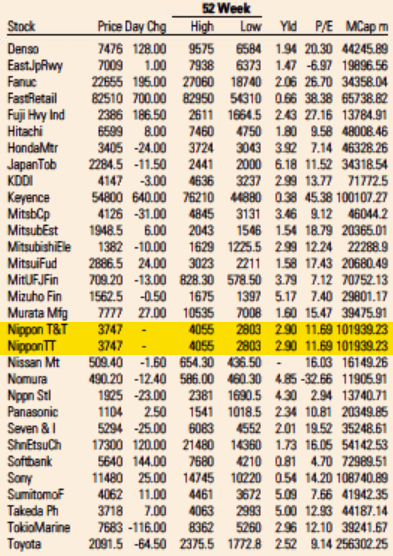
Market Data section of the Financial Times US Edition print edition from May 5, 2021.
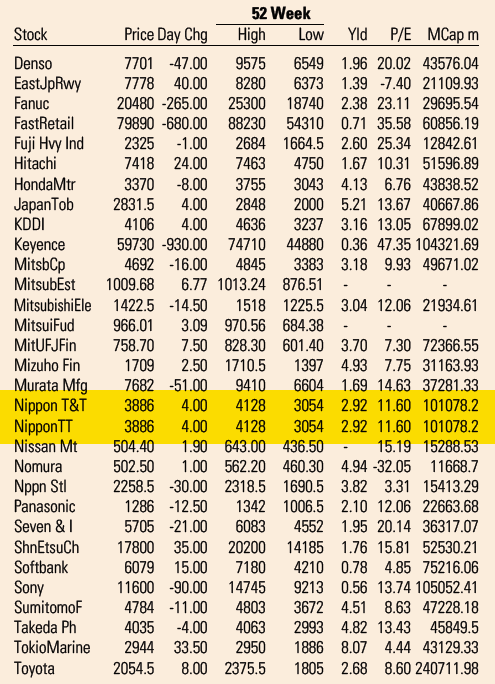
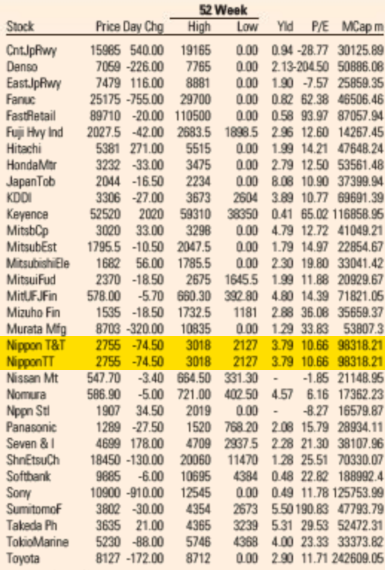
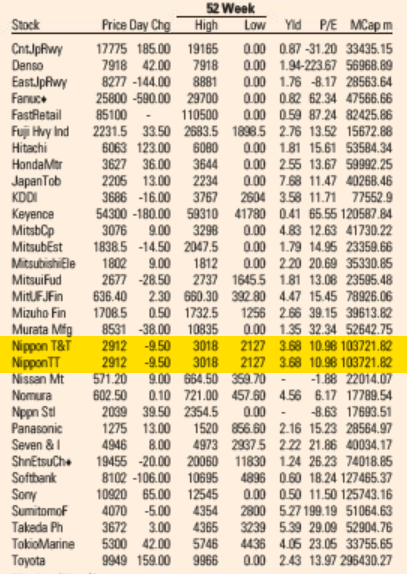
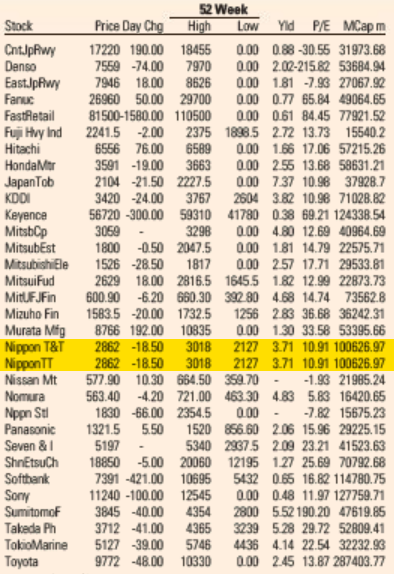
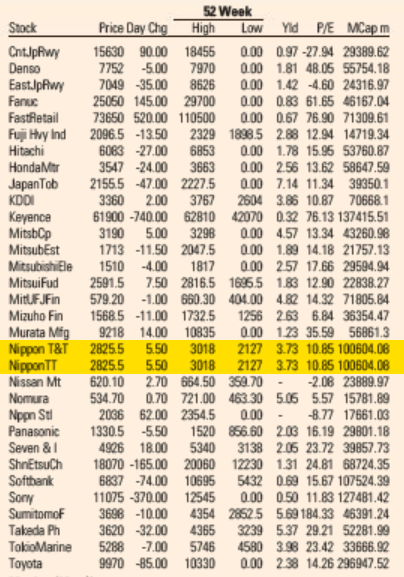
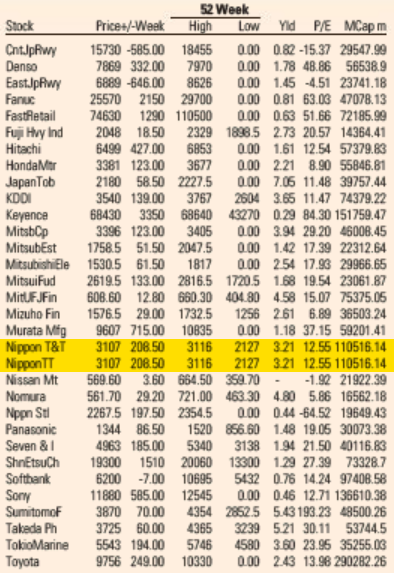
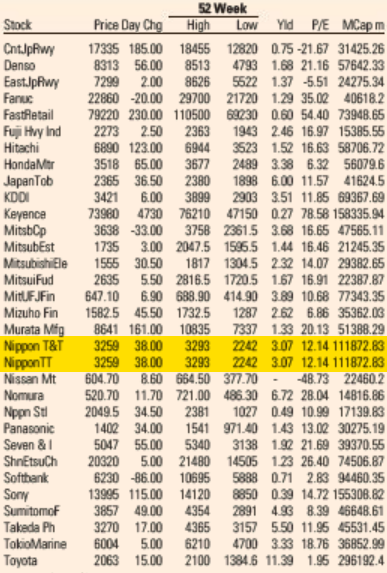
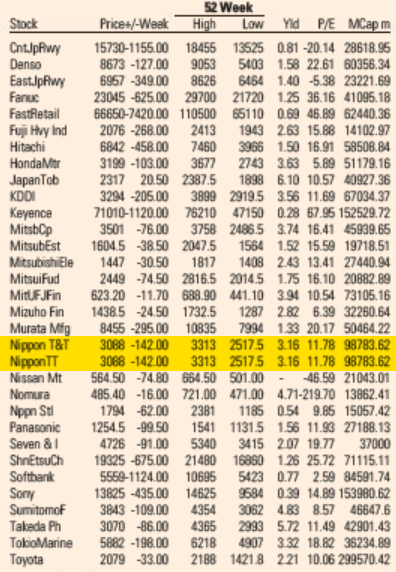
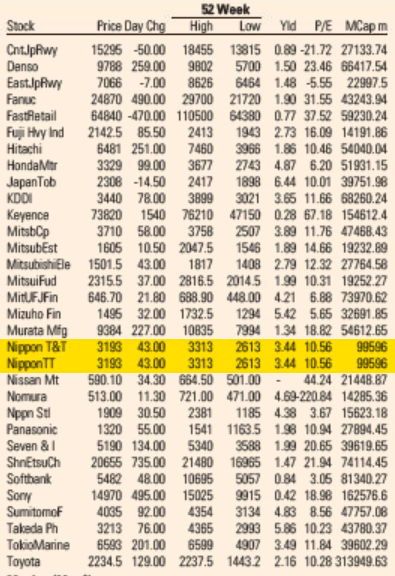
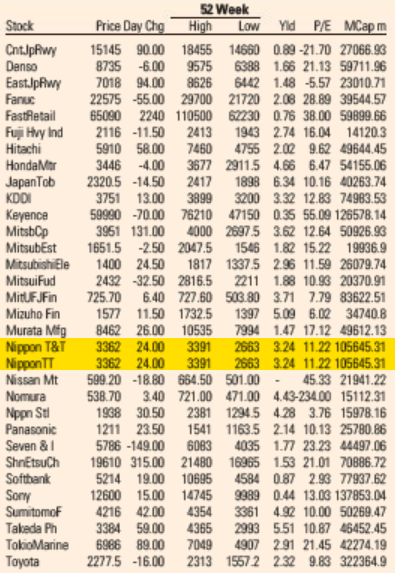
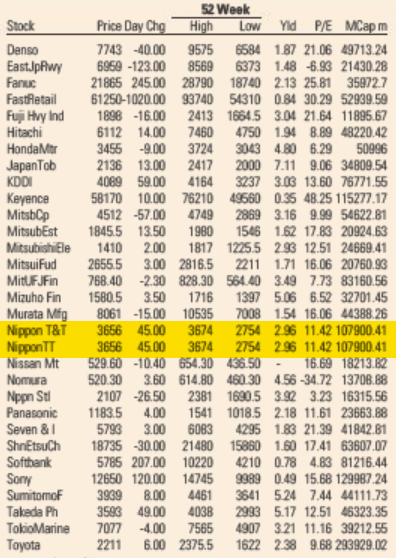
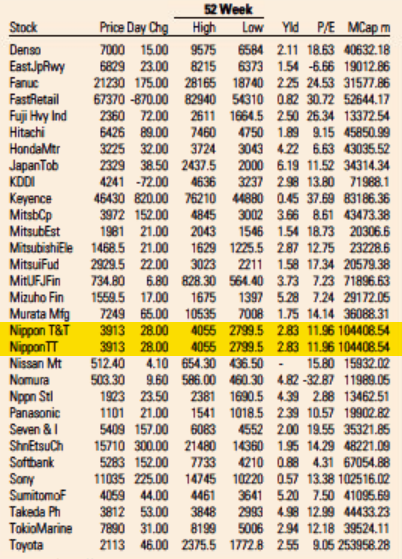
If you ve flipped through printed broadsheet newspapers, you ve probably seen pages full of tiny text listing prices and other market information for stocks and commodities. And you ve almost certainly just turned the page. Anybody interested in this market prices today will turn to the internet where these numbers are available in real time and where you don t need to squint to find what you need. This is presumably why many newspapers have stopped printing these types of pages or dramatically reduced the space devoted to them. Major financial newspapers however like the Financial Times (FT) still print multiple pages of market data daily. But does anybody read them? The answer appears to be no. How do I know? I noticed an error in the FT s Market Data page that anybody looking in the relevant section of the page would have seen. And I have seen it reproduced every single day for the last 18 months. In early May last year, I noticed that the Japanese telecom giant Nippon Telegraph and Telephone (NTT) was listed twice on the FT s list of the 500 largest global companies: once as Nippon T&T and also as Nippon TT. One right above the other. All the numbers are identical. Clearly a mistake.
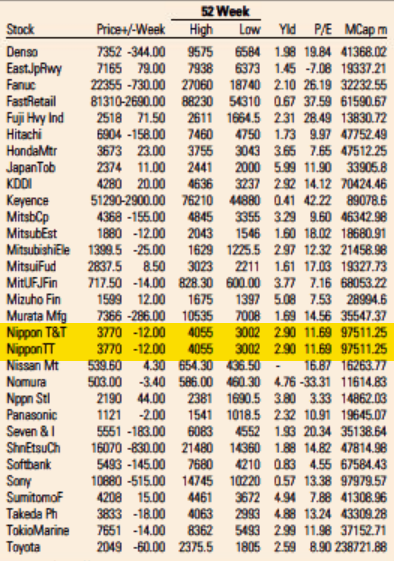
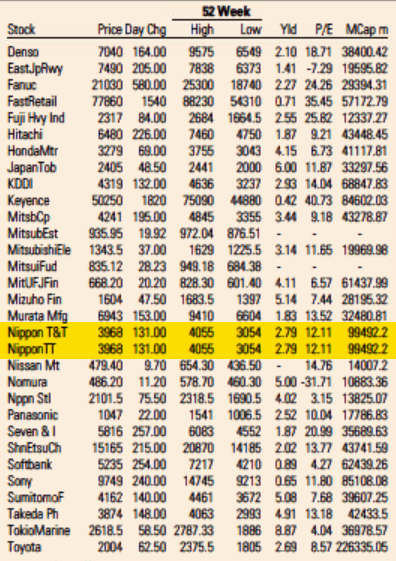
Reproduction of the FT Market Data section showing a subset of Japanese companies from the FT 500 list of global companies. The duplicate lines are highlighted in yellow. This page is from today s paper (November 26, 2022).
Wondering if it was a one-off error, I looked at a copy of the paper from about a week before and saw that the error did not exist then. I looked at a copy from one day before and saw that it did. Since the issue was apparently recurring, but new at the time, I figured someone at the paper would notice and fix it quickly. I was wrong. It has been 18 months now and the error has been reproduced every single day. Looking through the archives, it seems that the first day the error showed up was May 5, 2021. I ve included a screenshot from the electronic paper version from that day and from the fifth of every month since then (or the sixth if the paper was not printed on the fifth) that shows that the error is reproduced every day. A quick look in the archives suggests it not only appears in the US edition but also in the UK, European, Asian, and Middle East editions. All of them. Why does this matter? The FT prints over 112,000 copies of its paper, six days a week. This duplicate line takes up almost no space, of course, so it s not a big deal on its own. But devoting two full broadsheet pages to market data that is out date as soon as it is printed much of which nobody appears to be reading doesn t seem like a great use of resources. There s an argument to made that papers like the FT print these pages not because they are useful but because doing so is a signal of the publications identities as serious financial papers. But that hardly seems like a good enough reason on its own if nobody is looking at them. It seems well past time for newspapers to stop wasting paper and ink on these pages. I respect that some people think that printing paper newspapers at all is wasteful when one can just read the material online. Plenty of people disagree, of course. But who will disagree with a call to stop printing material that evidence suggests is not being seen by anybody? If an error this obvious can exist for so long, it seems clear that nobody not even anybody at the FT itself is reading it.

Matthew Garrett: Poking a mobile hotspot

I've been playing with an Orbic Speed, a relatively outdated device that only speaks LTE Cat 4, but the towers I can see from here are, uh, not well provisioned so throughput really isn't a concern (and refurbs are $18, so). As usual I'm pretty terrible at just buying devices and using them for their intended purpose, and in this case it has the irritating behaviour that if there's a power cut and the battery runs out it doesn't boot again when power returns, so here's what I've learned so far.

First, it's clearly running Linux (nmap indicates that, as do the headers from the built-in webserver). The login page for the web interface has some text reading "Open Source Notice" that highlights when you move the mouse over it, but that's it - there's code to make the text light up, but it's not actually a link. There's no exposed license notices at all, although there is a copy on the filesystem that doesn't seem to be reachable from anywhere. The notice tells you to email them to receive source code, but doesn't actually provide an email address.

Still! Let's see what else we can figure out. There's no open ports other than the web server, but there is an update utility that includes some interesting components. First, there's a copy of adb, the Android Debug Bridge. That doesn't mean the device is running Android, it's common for embedded devices from various vendors to use a bunch of Android infrastructure (including the bootloader) while having a non-Android userland on top. But this is still slightly surprising, because the device isn't exposing an adb interface over USB. There's also drivers for various Qualcomm endpoints that are, again, not exposed. Running the utility under Windows while the modem is connected results in the modem rebooting and Windows talking about new hardware being detected, and watching the device manager shows a bunch of COM ports being detected and bound by Qualcomm drivers. So, what's it doing?

Sticking the utility into Ghidra and looking for strings that correspond to the output that the tool conveniently leaves in the logs subdirectory shows that after finding a device it calls vendor_device_send_cmd(). This is implemented in a copy of libusb-win32 that, again, has no offer for source code. But it's also easy to drop that into Ghidra and discover thatn vendor_device_send_cmd() is just a wrapper for usb_control_msg(dev,0xc0,0xa0,0,0,NULL,0,1000);. Sending that from Linux results in the device rebooting and suddenly exposing some more USB endpoints, including a functional adb interface. Although, annoyingly, the rndis interface that enables USB tethering via the modem is now missing.

Unfortunately the adb user is unprivileged, but most files on the system are world-readable. data/logs/atfwd.log is especially interesting. This modem has an application processor built into the modem chipset itself, and while the modem implements the Hayes Command Set there's also a mechanism for userland to register that certain AT commands should be pushed up to userland. These are handled by the atfwd_daemon that runs as root, and conveniently logs everything it's up to. This includes having logged all the communications executed when the update tool was run earlier, so let's dig into that.

The system sends a bunch of AT+SYSCMD= commands, each of which is in the form of echo (stuff) >>/usrdata/sec/chipid. Once that's all done, it sends AT+CHIPID, receives a response of CHIPID:PASS, and then AT+SER=3,1, at which point the modem reboots back into the normal mode - adb is gone, but rndis is back. But the logs also reveal that between the CHIPID request and the response is a security check that involves RSA. The logs on the client side show that the text being written to the chipid file is a single block of base64 encoded data. Decoding it just gives apparently random binary. Heading back to Ghidra shows that atfwd_daemon is reading the chipid file and then decrypting it with an RSA key. The key is obtained by calling a series of functions, each of which returns a long base64-encoded string. Decoding each of these gives 1028 bytes of high entropy data, which is then passed to another function that decrypts it using AES CBC using a key of 000102030405060708090a0b0c0d0e0f and an initialization vector of all 0s. This is somewhat weird, since there's 1028 bytes of data and 128 bit AES works on blocks of 16 bytes. The behaviour of OpenSSL is apparently to just pad the data out to a multiple of 16 bytes, but that implies that we're going to end up with a block of garbage at the end. It turns out not to matter - despite the fact that we decrypt 1028 bytes of input only the first 200 bytes mean anything, with the rest just being garbage. Concatenating all of that together gives us a PKCS#8 private key blob in PEM format. Which means we have not only the private key, but also the public key.

So, what's in the encrypted data, and where did it come from in the first place? It turns out to be a JSON blob that contains the IMEI and the serial number of the modem. This is information that can be read from the modem in the first place, so it's not secret. The modem decrypts it, compares the values in the blob to its own values, and if they match sets a flag indicating that validation has succeeeded. But what encrypted it in the first place? It turns out that the json blob is just POSTed to http://pro.w.ifelman.com/api/encrypt and an encrypted blob returned. Of course, the fact that it's being encrypted on the server with the public key and sent to the modem that decrypted with the private key means that having access to the modem gives us the public key as well, which means we can just encrypt our own blobs.

What does that buy us? Digging through the code shows the only case that it seems to matter is when parsing the AT+SER command. The first argument to this is the serial mode to transition to, and the second is whether this should be a temporary transition or a permanent one. Once parsed, these arguments are passed to /sbin/usb/compositions/switch_usb which just writes the mode out to /usrdata/mode.cfg (if permanent) or /usrdata/mode_tmp.cfg (if temporary). On boot, /data/usb/boot_hsusb_composition reads the number from this file and chooses which USB profile to apply. This requires no special permissions, except if the number is 3 - if so, the RSA verification has to be performed first. This is somewhat strange, since mode 9 gives the same rndis functionality as mode 3, but also still leaves the debug and diagnostic interfaces enabled.

So what's the point of all of this? I'm honestly not sure! It doesn't seem like any sort of effective enforcement mechanism (even ignoring the fact that you can just create your own blobs, if you change the IMEI on the device somehow, you can just POST the new values to the server and get back a new blob), so the best I've been able to come up with is to ensure that there's some mapping between IMEI and serial number before the device can be transitioned into production mode during manufacturing.

But, uh, we can just ignore all of this anyway. Remember that AT+SYSCMD= stuff that was writing the data to /usrdata/sec/chipid in the first place? Anything that's passed to AT+SYSCMD is just executed as root. Which means we can just write a new value (including 3) to /usrdata/mode.cfg in the first place, without needing to jump through any of these hoops. Which also means we can just adb push a shell onto there and then use the AT interface to make it suid root, which avoids needing to figure out how to exploit any of the bugs that are just sitting there given it's running a 3.18.48 kernel.

Anyway, I've now got a modem that's got working USB tethering and also exposes a working adb interface, and I've got root on it. Which let me dump the bootloader and discover that it implements fastboot and has an oem off-mode-charge command which solves the problem I wanted to solve of having the device boot when it gets power again. Unfortunately I still need to get into fastboot mode. I haven't found a way to do it through software (adb reboot bootloader doesn't do anything), but this post suggests it's just a matter of grounding a test pad, at which point I should just be able to run fastboot oem off-mode-charge and it'll be all set. But that's a job for tomorrow.

Edit: Got into fastboot mode and ran fastboot oem off-mode-charge 0 but sadly it doesn't actually do anything, so I guess next is going to involve patching the bootloader binary. Since it's signed with a cert titled "General Use Test Key (for testing only)" it apparently doesn't have secure boot enabled, so this should be easy enough.

comment count unavailable comments

Next.

Previous.