Eduard Sanou: Reproducible builds on Debian for GSoC 2015, 1st update
This is the second blog post I m writing about my experiences contributing to Debian for Google Summer of Code 2015 (check my first post)
Status update
SOURCE_DATE_EPOCH that contains a known timestamp in Unix epoch format. With this variable exported, tools that would embed the localtime in their generated or processed files, can use this externally supplied date. This would happen only if SOURCE_DATE_EPOCH is exported, so the behaviour of the tool wouldn t change if the variable is not set.
The first package I patched to implement this behaviour was gcc. The reason behind this is that there are about 420 unreproducible packages due to using the __DATE__, __TIME__ and __TIMESTAMP__ C macros. My patch changes the behavior of the macros __DATE__ and __TIME__ if SOURCE_DATE_EPOCH is exported. I submitted this patch to the gcc-patches list. Even though there was some interesting discussions in the list, the patch has not been accepted yet. Seeing how the reproducible builds idea is gaining momentum and becoming widespread, I m positive that at some point the gcc people will be more receptive for such patch.
The second work with SOURCE_DATE_EPOCH was in debhelper; I patched this building tool to export the variable with the latest debian/changelog entry timestamp. With this patch, all the tools that run under dh will be able to use it to embed deterministic timestamps. Unfortunately some parts of the build process of some packages don t happen under debhelper, so the variable needs to be exported in a different way.
Having submitted the debhelper patch allowed many packages to become reproducible after the tools that embedded timestamps were patched to honour SOURCE_DATE_EPOCH. As of today, the toolchain packages I have patched to do that are: gcc, libxslt, gettext, ghostscript and qt4-x11 (qhelpgenerator).
I have also continued working on fixing individual packages affected by timestamps, random orderings (such as the ones from listing hash keys) and locale depending orderings; I have tagged packages in our infrastructure to note what kind of issue makes them unreproducible; I have updated some parts of the Reproducible Builds Wiki.
 The TODO group is an industry body that appears to be trying to define community best practices or something. I don't really know what their backstory is and whether they're trying to do meaningful work or just provide a fig leaf of respectability to organisations that dislike being criticised for doing nothing to improve the state of online communities but don't want to have to actually do anything, and their initial work on codes of conduct was, perhaps, suboptimal. But they do appear to be trying to improve things - this commit added a set of inappropriate behaviours, and also clarified that reverseisms were not actionable behaviour.
 It's been a while since I talked about Ceilometer and its companions, so I
thought I'd go ahead and write a bit about what's going on this side of
OpenStack. I'm not going to cover new features and fancy stuff today, but
rather a shallow overview of the new project processes we initiated.
Ceilometer growing
Ceilometer has grown a lot since that time
when we started it 3 years ago. It has evolved from a system designed to fetch
and store measurements, to a more complex system, with agents, alarms, events,
databases, APIs, etc.
All those features were needed and asked for by users and operators, but let's
be honest, some of them should never have ended up in the Ceilometer code
repository, especially not all at the same time.
The reality is we picked a pragmatic approach due to the rigidity of the
OpenStack Technical Committee in regards to new projects to become OpenStack
integrated and, therefore, blessed projects. Ceilometer was actually the
first project to be incubated and then integrated. We had to go through the
very first issues of that process.
Fortunately, now that time has passed, and all those constraints have been
relaxed. To me, the
OpenStack Foundation is turning into
something that looks like the
Apache Foundation, and there's, therefore,
no need to tie technical solutions to political issues.
Indeed, the
Big Tent
now allows much more flexibility to all of that. Back a year ago, we were
afraid to bring Gnocchi into Ceilometer. Was the Technical Committee going to
review the project? Was the project going to be in the scope of Ceilometer for
the Technical Committee? Now we don't have to ask ourselves those questions,
now that we have that freedom, it empowers us to actually do what we think is
good in term of technical design without worrying too much about political
issues.
 Ceilometer development activity
 Aodh is an Irish word meaning
fire. A word picked so it also had some relation to Heat, and because we have
some Irish influence around the project .
defaults-from http-appmon
destination *:*
interval 9
recv "^HTTP/1\\.1 200 OK"
send "GET /mon/state HTTP/1.1\\r\\nHost: MON\\r\\nConnection: Close\\r\\n\\r\\n"
time-until-up 0
timeout 2
up-interval 1
 What happened in the reproducible
builds effort this week:
Toolchain fixes
debian/control file with all locales. Original patch by Chris Lamb.SOURCE_DATE_EPOCH. She uploded a package with the enhancement to the experimental reproducible repository.
Packages fixed
The following 15 packages became reproducible due to changes in their
build dependencies:
dracut,
editorconfig-core,
elasticsearch,
fish,
libftdi1,
liblouisxml,
mk-configure,
nanoc,
octave-bim,
octave-data-smoothing,
octave-financial,
octave-ga,
octave-missing-functions,
octave-secs1d,
octave-splines,
valgrind.
The following packages became reproducible after getting fixed:
debian/changelog entry.debian/changelog entry in manpage.SOURCE_DATE_EPOCH.SOURCE_DATE_EPOCH.debian/changelog entry.armhf build hosts were provided by Vagrant Cascadian and have been configured to be used by jenkins.debian.net. Work on including armhf builds in the reproducible.debian.net webpages has begun. So far the repository comparison page just shows us which armhf binary packages are currently missing in our repo. (h01ger)
The scheduler has been changed to re-schedule more packages from stretch than sid, as the gcc5 transition has started This mostly affects build log age. (h01ger)
A new depwait status has been introduced for packages which can't be built because of missing build dependencies. (Mattia Rizzolo)
debbindiff development
Finally, on August 31st, Lunar released debbindiff 27 containing a complete overhaul of the code for the comparison stage. The new architecture is more versatile and extensible while minimizing code duplication. libarchive is now used to handle cpio archives and iso9660 images through the newly packaged python-libarchive-c. This should also help support a couple other archive formats in the future. Symlinks and devices are now properly compared. Text files are compared as Unicode after being decoded, and encoding differences are reported. Support for Sqlite3 and Mono/.NET executables has been added. Thanks to Valentin Lorentz, the test suite should now run on more systems. A small defiency in unquashfs has been identified in the process. A long standing optimization is now performed on Debian package: based on the content of the md5sums control file, we skip comparing files with matching hashes. This makes debbindiff usable on packages with many files. Fuzzy-matching is now performed for files in the same container (like a tarball) to handle renames. Also, for Debian .changes, listed files are now compared without looking the embedded version number. This makes debbindiff a lot more useful when comparing different versions of the same package.
Based on the rearchitecturing work has been done to allow parallel processing. The branch now seems to work most of the time. More test needs to be done before it can be merged.
The current fuzzy-matching algorithm, ssdeep, has showed disappointing results. One important use case is being able to properly compare debug symbols. Their path is made using the Build ID. As this identifier is made with a checksum of the binary content, finding things like CPP macros is much easier when a diff of the debug symbols is available. Good news is that TLSH, another fuzzy-matching algorithm, has been tested with much better results. A package is waiting in NEW and the code is ready for it to become available.
A follow-up release 28 was made on August 2nd fixing content label used for gzip2, bzip2 and xz files and an error on text files only differing in their encoding. It also contains a small code improvement on how comments on Difference object are handled.
This is the last release name debbindiff. A new name has been chosen to better reflect that it is not a Debian specific tool. Stay tuned!
Documentation update
Valentin Lorentz updated the patch submission template to suggest to write the kind of issue in the bug subject.
Small progress have been made on the Reproducible Builds HOWTO while preparing the related CCCamp15 talk.
Package reviews
235 obsolete
reviews have
been removed, 47 added and 113 updated this week.
42 reports for packages failing to build from source have been made by Chris West (Faux).
New issue added this week: haskell_devscripts_locale_substvars.
Misc.
Valentin Lorentz wrote a script to report packages tested as unreproducible installed on a system. We encourage everyone to run it on their systems and give feedback!
 It s Seafair weekend in Seattle. As always, the centerpiece is the H1 Unlimited hydroplane races on Lake Washington.
 In my social circle, I m nearly the only person I know who grew up in area. None of the newcomers I know had heard of hydroplane racing before moving to Seattle. Even after I explain it to them i.e., boats with 3,000+ horse power airplane engines that fly just above the water at more than 320kph (200mph) leaving 10m+ (30ft) wakes behind them! most people seem more puzzled than interested.
I grew up near the shore of Lake Washington and could see (and hear!) the races from my house. I don t follow hydroplane racing throughout the year but I do enjoy watching the races at Seafair. Here s my attempt to explain and make the case for the races to new Seattleites.
Before Microsoft, Amazon, Starbucks, etc., there were basically three major Seattle industries: (1) logging and lumber based industries like paper manufacturing; (2) maritime industries like fishing, shipbuilding, shipping, and the navy; (3) aerospace (i.e., Boeing). Vintage hydroplane racing represented the Seattle trifecta: Wooden boats with airplane engines!
The wooden U-60 Miss Thriftway circa 1955 (Thriftway is a Washinton-based supermarket that nobody outside has heard of) below is a picture of old-Seattle awesomeness. Modern hydroplanes are now made of fiberglass but two out of three isn t bad.
 Although the boats are racing this year in events in Indiana, San Diego, and Detroit in addition to the two races in Washington, hydroplane racing retains deep ties to the region. Most of the drivers are from the Seattle area. Many or most of the teams and boats are based in Washington throughout the year. Many of the sponsors are unknown outside of the state. This parochialness itself cultivates a certain kind of appeal among locals.
In addition to old-Seattle/new-Seattle cultural divide, there s a class divide that I think is also worth challenging. Although the demographics of hydro-racing fans is surprisingly broad, it can seem like Formula One or NASCAR on the water. It seems safe to suggest that many of the demographic groups moving to Seattle for jobs in the tech industry are not big into motorsports. Although I m no follower of motorsports in general, I ve written before cultivated disinterest in professional sports, and it remains something that I believe is worth taking on.
It s not all great. In particular, the close relationship between Seafair and the military makes me very uneasy. That said, even with the military-heavy airshow, I enjoy the way that Seafair weekend provides a little pocket of old-Seattle that remains effectively unchanged from when I was a kid. I d encourage others to enjoy it as well!
It s Seafair weekend in Seattle. As always, the centerpiece is the H1 Unlimited hydroplane races on Lake Washington.
 In my social circle, I m nearly the only person I know who grew up in area. None of the newcomers I know had heard of hydroplane racing before moving to Seattle. Even after I explain it to them i.e., boats with 3,000+ horse power airplane engines that fly just above the water at more than 320kph (200mph) leaving 10m+ (30ft) wakes behind them! most people seem more puzzled than interested.
I grew up near the shore of Lake Washington and could see (and hear!) the races from my house. I don t follow hydroplane racing throughout the year but I do enjoy watching the races at Seafair. Here s my attempt to explain and make the case for the races to new Seattleites.
Before Microsoft, Amazon, Starbucks, etc., there were basically three major Seattle industries: (1) logging and lumber based industries like paper manufacturing; (2) maritime industries like fishing, shipbuilding, shipping, and the navy; (3) aerospace (i.e., Boeing). Vintage hydroplane racing represented the Seattle trifecta: Wooden boats with airplane engines!
The wooden U-60 Miss Thriftway circa 1955 (Thriftway is a Washinton-based supermarket that nobody outside has heard of) below is a picture of old-Seattle awesomeness. Modern hydroplanes are now made of fiberglass but two out of three isn t bad.
 Although the boats are racing this year in events in Indiana, San Diego, and Detroit in addition to the two races in Washington, hydroplane racing retains deep ties to the region. Most of the drivers are from the Seattle area. Many or most of the teams and boats are based in Washington throughout the year. Many of the sponsors are unknown outside of the state. This parochialness itself cultivates a certain kind of appeal among locals.
In addition to old-Seattle/new-Seattle cultural divide, there s a class divide that I think is also worth challenging. Although the demographics of hydro-racing fans is surprisingly broad, it can seem like Formula One or NASCAR on the water. It seems safe to suggest that many of the demographic groups moving to Seattle for jobs in the tech industry are not big into motorsports. Although I m no follower of motorsports in general, I ve written before cultivated disinterest in professional sports, and it remains something that I believe is worth taking on.
It s not all great. In particular, the close relationship between Seafair and the military makes me very uneasy. That said, even with the military-heavy airshow, I enjoy the way that Seafair weekend provides a little pocket of old-Seattle that remains effectively unchanged from when I was a kid. I d encourage others to enjoy it as well!
 I have just released version 1.13 of Obnam, my backup program. See the
website at http://obnam.org for details on what it does. The new
version is available from git (see http://git.liw.fi) and as Debian
packages from http://code.liw.fi/debian, and uploaded to Debian,
and soon in unstable.
The NEWS file extract below gives the highlights of what's new in this
version.
Version 1.13, released 2015-08-01
Bug fixes:
obnam forget was interrupted at the wrong moment, it might remove
a chunk, but not the reference to it. This would case a future run
of obnam forget to crash due to a missing chunk (error code
R43272X). obnam forget will now ignore such a missing chunk, since
it would've deleted it anyway.
Lars Wirzenius then changed things so that chunk files are only
removed once references to the chunks have been committed.obnam forget now commits changes after each generation it has
removed. This means that if the operation is committed, less work is
lost. Suggested by Luk Pol ek, re-implemented by Lars Wirzenius.| Series: | Katya and Starbride #1 |
| Publisher: | Bold Strokes |
| Copyright: | September 2012 |
| ISBN: | 1-60282-792-3 |
| Format: | Kindle |
| Pages: | 264 |
 The DUCK challenge is making a quite stable progress: in the last 4 weeks there were approximately 12.25 packages fixed and uploaded per week.
In the current week the following packages were fixed and uploaded into unstable:
| Week 1 | Week 2 | Week 3 | Week 4 | Week 5 | Week 6 | Week 7 | |
|---|---|---|---|---|---|---|---|
| # Packages | 10 | 15 | 10 | 14 | - | - | - |
| Total | 10 | 25 | 35 | 49 | - | - | - |
 So we're in Finland, and the differences start out immediately.
We're renting a flat, in building ten, on a street. You'd think "10
Streetname" was a single building, but no. It is a pair of buildings: 10A, and 10B.
Both of the buildings have 12 flats in them, with 10A having 1-12, and 10B having 13-24.
There's a keypad at the main entrance, which I assumed was to let you press a button and talk to the people inside "Hello I'm the postmaster", but no. There is no intercom system, instead you type in a magic number and the door opens.
The magic number? Sounds like you want to keep that secret, since it lets people into the common-area? No. Everybody has it. The postman, the cleaners, the DHL delivery man, and all the ex-tenants. We invited somebody over recently and gave it out in advance so that they could knock on our flat-door.
Talking of cleaners: In the UK I lived in a flat and once a fortnight somebody would come and sweep the stair-well, since we didn't ever agree to do it ourselves. Here somebody turns up every day, be it to cut the grass, polish the hand-rail, clean the glass on the front-door, or mop the floors of the common area. Sounds awesome. But they cut the grass, right outside our window, at 7:30AM. On the dot. (Or use a leaf-blower, or something equally noisy.)
All this communal-care is paid for by the building-association, of which all flat-owners own shares. Sounds like something we see in England, or even like Americas idea of a Home-Owners-Association. (In Scotland you own your own flat, you don't own shares of an entity which owns the complete building. I guess there are pros and cons to both approaches.)
Moving onwards other things are often the same, but the differences when you spot them are odd. I'm struggling to think of them right now, somebody woke me up by cutting our grass for the second time this week (!)
Anyway I'm registered now with the Finnish government, and have a citizen-number, which will be useful, I've got an appointment booked to register with the police - which is something I had to do as a foreigner within the first three months - and today I've got an appointment with a local bank so that I can have a euro-bank-account.
Happily I did find a gym to join, the owner came over one Sunday to
give me a tiny-tour, and then gave me a list of other gyms to try if
his wasn't good enough - which was a nice touch - I joined a couple of
days later, his gym is awesome.
(I'm getting paid in UK-pounds, to a UK-bank, so right now I'm getting local money by transferring to my wifes account here, but I want to do that to my own, and open a shared account for paying for rent, electricity, internet, water, & etc).
My flat back home is still not rented, because the nice property management company lost my keys. Yeah you can't make that up can you? With a bit of luck the second set of keys I mailed them will arrive soon and the damn thing can be occupied, while I'm not relying on that income I do wish to have it.
midna /tmp $ dh-make-golang github.com/jacobsa/ratelimit
2015/07/25 18:25:39 Downloading "github.com/jacobsa/ratelimit/..."
2015/07/25 18:25:53 Determining upstream version number
2015/07/25 18:25:53 Package version is "0.0~git20150723.0.2ca5e0c"
2015/07/25 18:25:53 Determining dependencies
2015/07/25 18:25:55
2015/07/25 18:25:55 Packaging successfully created in /tmp/golang-github-jacobsa-ratelimit
2015/07/25 18:25:55
2015/07/25 18:25:55 Resolve all TODOs in itp-golang-github-jacobsa-ratelimit.txt, then email it out:
2015/07/25 18:25:55     sendmail -t -f < itp-golang-github-jacobsa-ratelimit.txt
2015/07/25 18:25:55
2015/07/25 18:25:55 Resolve all the TODOs in debian/, find them using:
2015/07/25 18:25:55     grep -r TODO debian
2015/07/25 18:25:55
2015/07/25 18:25:55 To build the package, commit the packaging and use gbp buildpackage:
2015/07/25 18:25:55     git add debian && git commit -a -m 'Initial packaging'
2015/07/25 18:25:55     gbp buildpackage --git-pbuilder
2015/07/25 18:25:55
2015/07/25 18:25:55 To create the packaging git repository on alioth, use:
2015/07/25 18:25:55     ssh git.debian.org "/git/pkg-go/setup-repository golang-github-jacobsa-ratelimit 'Packaging for golang-github-jacobsa-ratelimit'"
2015/07/25 18:25:55
2015/07/25 18:25:55 Once you are happy with your packaging, push it to alioth using:
2015/07/25 18:25:55     git push git+ssh://git.debian.org/git/pkg-go/packages/golang-github-jacobsa-ratelimit.git --tags master pristine-tar upstream
The ITP is often the most labor-intensive part of the packaging process, because any number of auto-detected values might be wrong: the repository owner might not be the Upstream Author , the repository might not have a short description, the long description might need some adjustments or the license might not be auto-detected.
midna /tmp $ cat itp-golang-github-jacobsa-ratelimit.txt
From: "Michael Stapelberg" <stapelberg AT debian.org>
To: submit@bugs.debian.org
Subject: ITP: golang-github-jacobsa-ratelimit -- Go package for rate limiting
Content-Type: text/plain; charset=utf-8
Content-Transfer-Encoding: 8bit
Package: wnpp
Severity: wishlist
Owner: Michael Stapelberg <stapelberg AT debian.org>
* Package name    : golang-github-jacobsa-ratelimit
  Version         : 0.0~git20150723.0.2ca5e0c-1
  Upstream Author : Aaron Jacobs
* URL             : https://github.com/jacobsa/ratelimit
* License         : Apache-2.0
  Programming Lang: Go
  Description     : Go package for rate limiting
 GoDoc (https://godoc.org/github.com/jacobsa/ratelimit)
 .
 This package contains code for dealing with rate limiting. See the
 reference (http://godoc.org/github.com/jacobsa/ratelimit) for more info.
TODO: perhaps reasoning
midna /tmp $
After filling in all the TODOs in the file, let s mail it out and get a sense of what else still needs to be done:
midna /tmp $ sendmail -t -f < itp-golang-github-jacobsa-ratelimit.txt
midna /tmp $ cd golang-github-jacobsa-ratelimit
midna /tmp/golang-github-jacobsa-ratelimit master $ grep -r TODO debian
debian/changelog:  * Initial release (Closes: TODO)
midna /tmp/golang-github-jacobsa-ratelimit master $
After filling in these TODOs as well, let s have a final look at what we re about to build:
midna /tmp/golang-github-jacobsa-ratelimit master $ head -100 debian/**/*
==> debian/changelog <==
golang-github-jacobsa-ratelimit (0.0~git20150723.0.2ca5e0c-1) unstable; urgency=medium
  * Initial release (Closes: #793646)
 -- Michael Stapelberg <stapelberg@debian.org>  Sat, 25 Jul 2015 23:26:34 +0200
==> debian/compat <==
9
==> debian/control <==
Source: golang-github-jacobsa-ratelimit
Section: devel
Priority: extra
Maintainer: pkg-go <pkg-go-maintainers@lists.alioth.debian.org>
Uploaders: Michael Stapelberg <stapelberg@debian.org>
Build-Depends: debhelper (>= 9),
               dh-golang,
               golang-go,
               golang-github-jacobsa-gcloud-dev,
               golang-github-jacobsa-oglematchers-dev,
               golang-github-jacobsa-ogletest-dev,
               golang-github-jacobsa-syncutil-dev,
               golang-golang-x-net-dev
Standards-Version: 3.9.6
Homepage: https://github.com/jacobsa/ratelimit
Vcs-Browser: http://anonscm.debian.org/gitweb/?p=pkg-go/packages/golang-github-jacobsa-ratelimit.git;a=summary
Vcs-Git: git://anonscm.debian.org/pkg-go/packages/golang-github-jacobsa-ratelimit.git
Package: golang-github-jacobsa-ratelimit-dev
Architecture: all
Depends: $ shlibs:Depends ,
         $ misc:Depends ,
         golang-go,
         golang-github-jacobsa-gcloud-dev,
         golang-github-jacobsa-oglematchers-dev,
         golang-github-jacobsa-ogletest-dev,
         golang-github-jacobsa-syncutil-dev,
         golang-golang-x-net-dev
Built-Using: $ misc:Built-Using
Description: Go package for rate limiting
 This package contains code for dealing with rate limiting. See the
 reference (http://godoc.org/github.com/jacobsa/ratelimit) for more info.
==> debian/copyright <==
Format: http://www.debian.org/doc/packaging-manuals/copyright-format/1.0/
Upstream-Name: ratelimit
Source: https://github.com/jacobsa/ratelimit
Files: *
Copyright: 2015 Aaron Jacobs
License: Apache-2.0
Files: debian/*
Copyright: 2015 Michael Stapelberg <stapelberg@debian.org>
License: Apache-2.0
Comment: Debian packaging is licensed under the same terms as upstream
License: Apache-2.0
 Licensed under the Apache License, Version 2.0 (the "License");
 you may not use this file except in compliance with the License.
 You may obtain a copy of the License at
 .
 http://www.apache.org/licenses/LICENSE-2.0
 .
 Unless required by applicable law or agreed to in writing, software
 distributed under the License is distributed on an "AS IS" BASIS,
 WITHOUT WARRANTIES OR CONDITIONS OF ANY KIND, either express or implied.
 See the License for the specific language governing permissions and
 limitations under the License.
 .
 On Debian systems, the complete text of the Apache version 2.0 license
 can be found in "/usr/share/common-licenses/Apache-2.0".
==> debian/gbp.conf <==
[DEFAULT]
pristine-tar = True
==> debian/rules <==
#!/usr/bin/make -f
export DH_GOPKG := github.com/jacobsa/ratelimit
%:
	dh $@ --buildsystem=golang --with=golang
==> debian/source <==
head: error reading  debian/source : Is a directory
==> debian/source/format <==
3.0 (quilt)
midna /tmp/golang-github-jacobsa-ratelimit master $
Okay, then. Let s give it a shot and see if it builds:
midna /tmp/golang-github-jacobsa-ratelimit master $ git add debian && git commit -a -m 'Initial packaging'
[master 48f4c25] Initial packaging
 7 files changed, 75 insertions(+)
 create mode 100644 debian/changelog
 create mode 100644 debian/compat
 create mode 100644 debian/control
 create mode 100644 debian/copyright
 create mode 100644 debian/gbp.conf
 create mode 100755 debian/rules
 create mode 100644 debian/source/format
midna /tmp/golang-github-jacobsa-ratelimit master $ gbp buildpackage --git-pbuilder
[ ]
midna /tmp/golang-github-jacobsa-ratelimit master $ lintian ../golang-github-jacobsa-ratelimit_0.0\~git20150723.0.2ca5e0c-1_amd64.changes
I: golang-github-jacobsa-ratelimit source: debian-watch-file-is-missing
P: golang-github-jacobsa-ratelimit-dev: no-upstream-changelog
I: golang-github-jacobsa-ratelimit-dev: extended-description-is-probably-too-short
midna /tmp/golang-github-jacobsa-ratelimit master $
This package just built (as it should!), but occasionally one might need to disable a test and file an upstream bug about it. So, let s push this package to pkg-go and upload it:
midna /tmp/golang-github-jacobsa-ratelimit master $ ssh git.debian.org "/git/pkg-go/setup-repository golang-github-jacobsa-ratelimit 'Packaging for golang-github-jacobsa-ratelimit'"
Initialized empty shared Git repository in /srv/git.debian.org/git/pkg-go/packages/golang-github-jacobsa-ratelimit.git/
HEAD is now at ea6b1c5 add mrconfig for dh-make-golang
[master c5be5a1] add mrconfig for golang-github-jacobsa-ratelimit
 1 file changed, 3 insertions(+)
To /git/pkg-go/meta.git
   ea6b1c5..c5be5a1  master -> master
midna /tmp/golang-github-jacobsa-ratelimit master $ git push git+ssh://git.debian.org/git/pkg-go/packages/golang-github-jacobsa-ratelimit.git --tags master pristine-tar upstream
Counting objects: 31, done.
Delta compression using up to 8 threads.
Compressing objects: 100% (25/25), done.
Writing objects: 100% (31/31), 18.38 KiB   0 bytes/s, done.
Total 31 (delta 2), reused 0 (delta 0)
To git+ssh://git.debian.org/git/pkg-go/packages/golang-github-jacobsa-ratelimit.git
 * [new branch]      master -> master
 * [new branch]      pristine-tar -> pristine-tar
 * [new branch]      upstream -> upstream
 * [new tag]         upstream/0.0_git20150723.0.2ca5e0c -> upstream/0.0_git20150723.0.2ca5e0c
midna /tmp/golang-github-jacobsa-ratelimit master $ cd ..
midna /tmp $ debsign golang-github-jacobsa-ratelimit_0.0\~git20150723.0.2ca5e0c-1_amd64.changes
[ ]
midna /tmp $ dput golang-github-jacobsa-ratelimit_0.0\~git20150723.0.2ca5e0c-1_amd64.changes
Uploading golang-github-jacobsa-ratelimit using ftp to ftp-master (host: ftp.upload.debian.org; directory: /pub/UploadQueue/)
[ ]
Uploading golang-github-jacobsa-ratelimit_0.0~git20150723.0.2ca5e0c-1.dsc
Uploading golang-github-jacobsa-ratelimit_0.0~git20150723.0.2ca5e0c.orig.tar.bz2
Uploading golang-github-jacobsa-ratelimit_0.0~git20150723.0.2ca5e0c-1.debian.tar.xz
Uploading golang-github-jacobsa-ratelimit-dev_0.0~git20150723.0.2ca5e0c-1_all.deb
Uploading golang-github-jacobsa-ratelimit_0.0~git20150723.0.2ca5e0c-1_amd64.changes
midna /tmp $ cd golang-github-jacobsa-ratelimit
midna /tmp/golang-github-jacobsa-ratelimit master $ git tag debian/0.0_git20150723.0.2ca5e0c-1
midna /tmp/golang-github-jacobsa-ratelimit master $ git push git+ssh://git.debian.org/git/pkg-go/packages/golang-github-jacobsa-ratelimit.git --tags master pristine-tar upstream
Total 0 (delta 0), reused 0 (delta 0)
To git+ssh://git.debian.org/git/pkg-go/packages/golang-github-jacobsa-ratelimit.git
 * [new tag]         debian/0.0_git20150723.0.2ca5e0c-1 -> debian/0.0_git20150723.0.2ca5e0c-1
midna /tmp/golang-github-jacobsa-ratelimit master $
Thanks for reading this far, and I hope dh-make-golang makes your life a tiny bit easier. As dh-make-golang just entered Debian unstable, you can install it using
apt-get install
dh-make-golang
. If you have any feedback, I m eager to hear it.
 Hadley is a popular figure, and rightly so as he successfully introduced many newcomers to the wonders offered by R. His approach strikes some of us old greybeards as wrong---I particularly take exception with some of his writing which frequently portrays a particular approach as both the best and only one. Real programming, I think, is often a little more nuanced and aware of tradeoffs which need to be balanced. As a book on another language once popularized: "There is more than one way to do things." But let us leave this discussion for another time.
As the reach of the Hadleyverse keeps spreading, we sometimes find ourselves at the receiving end of a cost/benefit tradeoff. That is what this post is about, and it uses a very concrete case I encountered yesterday.
As blogged earlier, the RcppZiggurat package was updated. I had not touched it in a year, but Brian Ripley had sent a brief and detailed note concerning something flagged by the Solaris compiler (correctly suggesting I replace
fabs() with abs() on integer types). (Allow me to stray from the main story line here for a second to stress just how insane a work load he is carrying, essentially for all of us. R and the R community are so just so indebted to him for all his work---which makes the usual social media banter about him so unfortunate. But that too shall be left for another time.) Upon making the simple fix, and submitting to GitHub the usual Travis CI was triggered. And here is what I saw:
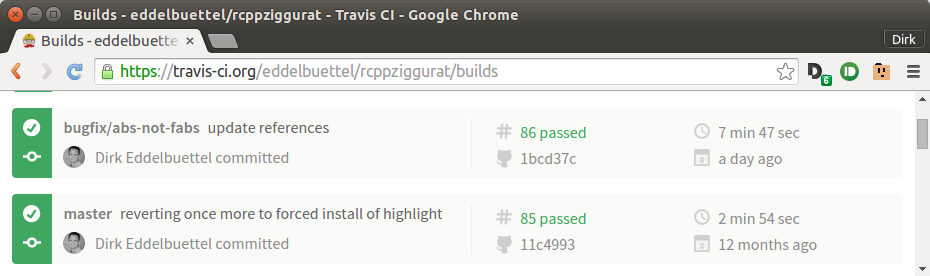
- ./travis-tool.sh install_r RcppGSL rbenchmark microbenchmark highlight - ./travis-tool.sh install_aptget libgsl0-dev r-cran-rcppgsl r-cran-rbenchmark r-cran-microbenchmark r-cran-highlight.travis.yml of RcppZiggurat I just use
before_install:
## PPA for Rcpp and some other packages
- sudo add-apt-repository -y ppa:edd/misc
## r-travis by Craig Citro et al
- curl -OL http://raw.github.com/craigcitro/r-travis/master/scripts/travis-tool.sh
- chmod 755 ./travis-tool.sh
- ./travis-tool.sh bootstrap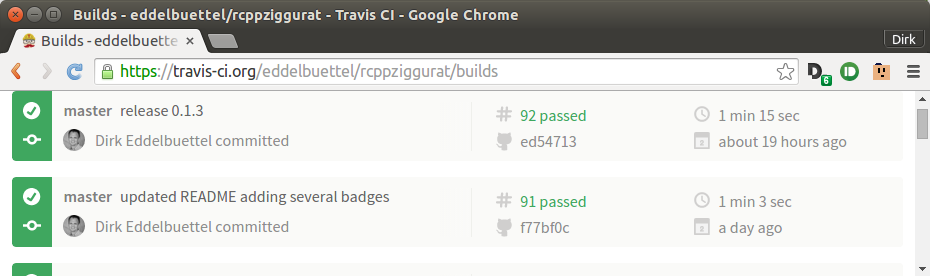
Follow-up: The post got some pretty immediate feedback shortly after I posted it. Craig Citro pointed out (quite correctly) that I could use r_binary_install which would also install the Ubuntu binaries based on their R packages names. Having built R/CRAN packages for Debian for so long, I am simply more used to the r-cran-* notations, and I think I was also the one contributing install_aptget to r-travis ... Yihui Xie spoke up for the "new" Travis approach deploying containers, caching of packages and explicit whitelists. It was in that very (GH-based) discussion that I started to really lose faith in the new Travis approach as they want use to whitelist each and every package. With 6900 and counting at CRAN I fear this simply does not scale. But different approaches are certainly welcome. I posted my 1:03 to 1:15 minutes result. If the "New School" can do it faster, I'd be all ears.
This post by Dirk Eddelbuettel originated on his Thinking inside the box blog. Please report excessive re-aggregation in third-party for-profit settings.
What happened in the reproducible
builds effort this week:
Toolchain fixes
Eric Dorlan uploaded automake-1.15/1:1.15-2 which makes the output of mdate-sh deterministic. Original patch by Reiner Herrmann.
Kenneth J. Pronovici uploaded epydoc/3.0.1+dfsg-8 which now honors SOURCE_DATE_EPOCH. Original patch by Reiner Herrmann.
Chris Lamb submitted a patch to dh-python to make the order of the generated maintainer scripts deterministic. Chris also offered a fix for a source of non-determinism in dpkg-shlibdeps when packages have alternative dependencies.
Dhole provided a patch to add support for SOURCE_DATE_EPOCH to gettext.
Packages fixed
The following 78 packages became reproducible in our setup due to changes in their
build dependencies:
chemical-mime-data,
clojure-contrib,
cobertura-maven-plugin,
cpm,
davical,
debian-security-support,
dfc,
diction,
dvdwizard,
galternatives,
gentlyweb-utils,
gifticlib,
gmtkbabel,
gnuplot-mode,
gplanarity,
gpodder,
gtg-trace,
gyoto,
highlight.js,
htp,
ibus-table,
impressive,
jags,
jansi-native,
jnr-constants,
jthread,
jwm,
khronos-api,
latex-coffee-stains,
latex-make,
latex2rtf,
latexdiff,
libcrcutil,
libdc0,
libdc1394-22,
libidn2-0,
libint,
libjava-jdbc-clojure,
libkryo-java,
libphone-ui-shr,
libpicocontainer-java,
libraw1394,
librostlab-blast,
librostlab,
libshevek,
libstxxl,
libtools-logging-clojure,
libtools-macro-clojure,
litl,
londonlaw,
ltsp,
macsyfinder,
mapnik,
maven-compiler-plugin,
mc,
microdc2,
miniupnpd,
monajat,
navit,
pdmenu,
pirl,
plm,
scikit-learn,
snp-sites,
sra-sdk,
sunpinyin,
tilda,
vdr-plugin-dvd,
vdr-plugin-epgsearch,
vdr-plugin-remote,
vdr-plugin-spider,
vdr-plugin-streamdev,
vdr-plugin-sudoku,
vdr-plugin-xineliboutput,
veromix,
voxbo,
xaos,
xbae.
The following packages became reproducible after getting fixed:
LC_ALL=C when running sort.TZ=UTC when calling unzip.Makefile.debian/changelog in version string.TZ=UTC when calling unzip.TZ=UTC when calling unzip.TZ=UTC when calling unzip.TZ=UTC when calling unzip.TZ=UTC when calling unzip.debian/changelog in manpages.*.pyo and *.pyc from binary package.debian/changelog when generating version strings.debian/changelog.freebsd-hackers mailing list. The build is run on a new virtual machine running FreeBSD 10.1 with 3 cores and 6 GB of RAM, also sponsored by Profitbricks.
strip-nondeterminism development
Andrew Ayer released version 0.009 of strip-nondeterminism. The new version will strip locales from Javadoc, include the name of files causing errors, and ignore unhandled (but rare) zip64 archives.
debbindiff development
Lunar continued its major refactoring to enhance code reuse and pave the way to fuzzy-matching and parallel processing. Most file comparators have now been converted to the new class hierarchy.
In order to support for archive formats, work has started on packaging Python bindings for libarchive. While getting support for more archive formats with a common interface is very nice, libarchive is a stream oriented library and might have bad performance with how debbindiff currently works. Time will tell if better solutions need to be found.
Documentation update
Lunar started a Reproducible builds HOWTO intended to explain the different aspects of making software build reproducibly to the different audiences that might have to get involved like software authors, producers of binary packages, and distributors.
Package reviews
17 obsolete
reviews have
been removed, 212 added and 46 updated this week.
15 new bugs for packages failing to build from sources have been reported by Chris West (Faux), and Mattia Rizzolo.
Presentations
Lunar presented Debian efforts and some recipes on making software build reproducibly at Libre Software Meeting 2015. Slides and a video recording are available.
Misc.
h01ger, dkg, and Lunar attended a Core Infrastructure Initiative meeting. The progress and tools mode for the Debian efforts were shown. Several discussions also helped getting a better understanding of the needs of other free software projects regarding reproducible builds. The idea of a global append only log, similar to the logs used for Certificate Transparency, came up on multiple occasions. Using such append only logs for keeping records of sources and build results has gotten the name Binary Transparency Logs . They would at least help identifying a compromised software signing key. Whether the benefits in using such logs justify the costs need more research.
 A new release 0.12.0 of Rcpp arrived on the CRAN network for GNU R this morning, and I also pushed a Debian package upload.
Rcpp has become the most popular way of enhancing GNU R with C++ code. As of today, 423 packages on CRAN depend on Rcpp for making analyses go faster and further. Note that this is 60 more packages since the last release in May! Also, BioConductor adds another 57 packages, and casual searches on GitHub suggests many more.
And according to Andrie De Vries, Rcpp has now page rank of one on CRAN as well!
And with this release, Rcpp also becomes ready for Big Data, or, as they call it in Texas, Data.
Thanks to a lot of work and several pull requests by Qiang Kou, support for
R_xlen_t has been added.
That means we can now do stunts like
R> library(Rcpp)
R> big <- 2^31-1
R> bigM <- rep(NA, big)
R> bigM2 <- c(bigM, bigM)
R> cppFunction("double getSz(LogicalVector x)   return x.length();  ")
R> getSz(bigM)
[1] 2147483647
R> getSz(bigM2)
[1] 4294967294
R>> getSz(bigM2)
Error in getSz(bigM2) :
long vectors not supported yet: ../../src/include/Rinlinedfuns.h:137
>var() computation to use the proper two-pass method and added better support for lambda functions in Sugar expression using sapply(), Qiang Kou added more pull requests mostly for string initialization, and Romain added a pull request which made data frame creation a little more robust, and JJ was his usual self in tirelessly looking after all aspects of Rcpp Attributes.
As always, you can follow the development via the GitHub repo and particularly the Issue tickets and Pull Requests. And any discussions, questions, ... regarding Rcpp are always welcome at the rcpp-devel mailing list.
Last but not least, we are also extremely pleased to annouce that Qiang Kou has joined us in the Rcpp-Core team. We are looking forward to a lot more awesome!
See below for a detailed list of changes extracted from the NEWS file.
Changes in Rcpp version 0.12.0 (2015-07-24)Thanks to CRANberries, you can also look at a diff to the previous release As always, even fuller details are on the Rcpp Changelog page and the Rcpp page which also leads to the downloads page, the browseable doxygen docs and zip files of doxygen output for the standard formats. A local directory has source and documentation too. Questions, comments etc should go to the rcpp-devel mailing list off the R-Forge page.
- Changes in Rcpp API:
Rcpp_eval()no longer usesR_ToplevelExecwhen evaluating R expressions; this should resolve errors where calling handlers (e.g. throughsuppressMessages()) were not properly respected.- All internal length variables have been changed from
R_len_ttoR_xlen_tto support vectors longer than 2^31-1 elements (via pull request 303 by Qiang Kou).- The sugar function
sapplynow supports lambda functions (addressing issue 213 thanks to Matt Dziubinski)- The
varsugar function now uses a more robust two-pass method, supports complex numbers, with new unit tests added (via pull request 320 by Matt Dziubinski)Stringconstructors now allow encodings (via pull request 310 by Qiang Kou)Stringobjects are preserving the underlyingSEXPobjects better, and are more careful about initializations (via pull requests 322 and 329 by Qiang Kou)- DataFrame constructors are now a little more careful (via pull request 301 by Romain Francois)
- For R 3.2.0 or newer,
Rf_installChar()is used instead ofRf_install(CHAR())(via pull request 332).- Changes in Rcpp Attributes:
- Use more robust method of ensuring unique paths for generated shared libraries.
- The
evalCppfunction now also supports thepluginsargument.- Correctly handle signature termination characters (' ' or ';') contained in quotes.
- Changes in Rcpp Documentation:
- The
Rcpp-FAQvignette was once again updated with respect to OS X issues and Fortran libraries needed for e.g. RcppArmadillo.- The included
Rcpp.bibbibtex file (which is also used by other Rcpp* packages) was updated with respect to its CRAN references.
This post by Dirk Eddelbuettel originated on his Thinking inside the box blog. Please report excessive re-aggregation in third-party for-profit settings.
So we've recently spent our first week together in Helsinki, Finland.
Mostly this has been stress-free, but there are always oddities about living in new places, and moving to Europe didn't minimize them.
For the moment I'll gloss over the differences and instead document the computer problem I had. Our previous shared-desktop system had a pair of drives configured using software RAID. I pulled one of the drives to use in a smaller-cased system (smaller so it was easier to ship).
Only one drive of a pair being present make mdadm scream, via email, once per day, with reports of failure.
The output of cat /proc/mdstat looked like this:
md2 : active raid1 sdb6[0] [LVM-storage-area]
      1903576896 blocks super 1.2 2 near-copies [2/1] [_U]
md1 : active raid10 sdb5[1] [/root]
      48794112 blocks super 1.2 2 near-copies [2/1] [_U]
md0 : active raid1 sdb1[0]  [/boot]
      975296 blocks super 1.2 2 near-copies [2/1] [_U]
See the "_" there? That's the missing drive. I couldn't remove the drive as it wasn't present on-disk, so this failed:
mdadm --fail   /dev/md0 /dev/sda1
mdadm --remove /dev/md0 /dev/sda1
# repeat for md1, md2.
Similarly removing all "detached" drives failed, so the only thing to do was to mess around re-creating the arrays with a single drive:
lvchange -a n shelob-vol
mdadm --stop /dev/md2
mdadm --create /dev/md2 --level=1 --raid-devices=1 /dev/sdb6 --force
..
I did that on the LVM-storage area, and the /boot partition, but "/" is still to be updated. I'll use knoppix/similar to do it next week. That'll give me a "RAID" system which won't alert every day. Thanks to the joys of re-creation the UUIDs of the devices changed, so /etc/mdadm/mdadm.conf needed updating. I realized that too late, when grub failed to show the menu, because it didn't find it's own UUID. Handy recipe for the future:
set prefix=(md/0)/grub/
insmod linux
linux (md/0)/vmlinuz-3.16.0-0.bpo.4-amd64 root=/dev/md1
initrd (md/0)//boot/initrd.img-3.16.0-0.bpo.4-amd64
boot
 http://social.gl-como.it/photos/valhalla/image/401bdd78db4a7eb8265a8119cb28c385
 http://social.gl-como.it/photos/valhalla/image/7ba4c1372772b4d0374b655613f70c99
 http://social.gl-como.it/photos/valhalla/image/2f544e5bef5c08c4ce9490865d22208a
My credit card info was stolen when I used a wifi hotspot in an airport... Should I use open wifi networks? Is it safe to use my credit card for shopping online?Here is a modified version of an answer I sent to a friend recently which I thought could be useful to the larger internet community. The short answer is "sorry about that", "it depends, you generally can, but be careful" and "your credit card company is supposed to protect you".
https://accesd.desjardins.com/
in my case)
directly myself instead of clicking on links, bookmarks or using a
search engine to find my bank site.
In the case of credit cards, it is much trickier because when you buy
stuff online, you end up putting that credit card number on different
sites which you do not necessarily trust. There's no good solution
but complaining to your credit card company if you believe a
website you used has stolen your credit card details. You can also use
services like Paypal,
Dwolla or Bitcoin that hide your credit card details from the
seller, if they support the service.
I usually try to avoid putting my credit card details on sites I do
not trust, and limit myself to known parties
(e.g. Via Rail,
Air Canada, etc). Also, in general, I try to
assume the network connection between me and the website I visit is
compromised. This forced me to get familiar with online
security and use of encryption. It is more accessible to me than
trying to secure the infrastructure i am using, because i often do not
control it at all (e.g. internet cafes...).
Internet security is unfortunately a hard problem, and things are not
getting easier as more things move online. The burden is on us
programmers and system administrators to create systems that are more
secure and intuitive for our users so, as I said earlier, sorry the
internet sucks so much, we didn't think so many people would join the
acid trip of the 70s. 

 so that Google can improve their proprietary algorithms for classifying mail. If you just read or reply to a message in the folder without clicking the button, or if you don't do this for every message, including mailing list posts and other trivial notifications that are not actually spam, more important messages from the same senders will also continue to be misclassified.
If you are not willing to volunteer your time to do this, or if you are simply one of those people who has better things to do, Google's Gmail service is going to have a corrosive effect on your relationships.
A few months ago, we visited Australia and I sent emails to many people who I wanted to catch up with, including invitations to a family event. Some people received the emails in their inboxes yet other people didn't see them because the systems at Google (and other companies, notably Hotmail) put them in a spam folder. The rate at which this appeared to happen was definitely higher than the 0.05% quoted in the Google article above. Maybe the Google spam filters noticed that I haven't sent email to some members of the extended family for a long time and this triggered the spam algorithm? Yet it was at that very moment that we were visiting Australia that email needs to work reliably with that type of contact as we don't fly out there every year.
A little bit earlier in the year, I was corresponding with a few students who were applying for Google Summer of Code. Some of them also observed the same thing, they sent me an email and didn't receive my response until they were looking in their spam folder a few days later. Last year I know a GSoC mentor who lost track of a student for over a week because of Google silently discarding chat messages, so it appears Google has not just shot themselves in the foot, they managed to shoot their foot twice.
What is remarkable is that in both cases, the email problems and the XMPP problems, Google doesn't send any error back to the sender so that they know their message didn't get through. Instead, it is silently discarded or left in a spam folder. This is the most corrosive form of communication problem as more time can pass before anybody realizes that something went wrong. After it happens a few times, people lose a lot of confidence in the technology itself and try other means of communication which may be more expensive, more synchronous and time intensive or less private.
When I discussed these issues with friends, some people replied by telling me I should send them things through Facebook or WhatsApp, but each of those services has a higher privacy cost and there are also many other people who don't use either of those services. This tends to fragment communications even more as people who use Facebook end up communicating with other people who use Facebook and excluding all the people who don't have time for Facebook. On top of that, it creates more tedious effort going to three or four different places to check for messages.
Despite all of this, the suggestion that Google's only response is to build a service to "help qualified high-volume senders" get their messages through leaves me feeling that things will get worse before they start to get better. There is no mention in the Google announcement about what they will offer to help the average person eliminate these problems, other than to stop using Gmail or spend unpaid time meticulously training the Google spam filter and hoping everybody else does the same thing.
Some more observations on the issue
Many spam filtering programs used in corporate networks, such as SpamAssassin, add headers to each email to suggest why it was classified as spam. Google's systems don't appear to give any such feedback to their users or message senders though, just a very basic set of recommendations for running a mail server.
Many chat protocols work with an explicit opt-in. Before you can exchange messages with somebody, you must add each other to your buddy lists. Once you do this, virtually all messages get through without filtering. Could this concept be adapted to email, maybe giving users a summary of messages from people they don't have in their contact list and asking them to explicitly accept or reject each contact?
If a message spends more than a week in the spam folder and Google detects that the user isn't ever looking in the spam folder, should Google send a bounce message back to the sender to indicate that Google refused to deliver it to the inbox?
I've personally heard that misclassification occurs with mailing list posts as well as private messages.
Next.