Search Results: "agi"

7 September 2012

Jonas Smedegaard: Asia 2011 - Khammam

My first morning in India I woke up very late in the house of Pavithrans parents. Pavithran was out organizing events for us, his father was at work, leaving me with his mother. She spoke little english - unsure if it was lack of skills or she was humble, or perhaps she just felt as shy as me in the situation. How to, ahem, do your thing at a restroom when there is no toilet paper but instead a bucket of water? I decided to not yell for help but use my imagination. How to eat breakfast local style? I knew from dinner previous night with Pavithran that local custom was to eat with my hands and that it (lucky for me) was tolerated in India to use left hand, so turned down the kind offer for a spoon. But were I supposed to mix rice with all the curries? Or one at a time? In which order? What if a curry was too hot to dip my fingers into? Was the liquid stuff to drink or to mix with the rice or eat afterwards? I asked for help, and first she just smiled at my alien useless language and then when I persisted, she patiently demonstrated with her hands in my food how to do. The only natural thing to do, really, and I dearly appreciate her help and patiency. But wauw, it was mind-blowing to me! Since early childhood, fingers in food is a forbidden thing: "Don't play with the food!". On top of that, having someone else handle my dish while at the table is something I associate with being very old and needing to be spoon-fed. In the afternoon we went for a small hike to an old stone fortress in the middle of Khammam - with a great view of the sun setting. Next day we went to Sarada Institute of Technology & Science where I gave my first talk to about 100 students. I had intended to provide concrete facts on Debian generally and on my pet project, Debian Pure Blends, but then the night before decided to radically shift focus to their situation in the early twenties - as best as I could imagine it. Pavithran had clearly expected a different style talk, but I liked it and believe it was received well by the audience as well. The teacher responsible for the event, Bhukya Jabber, afterwards asked for hints on running Debian at their computer lab. I suggested to not lock down access but instead make it easy to reinstall, and he explained how he was quite interested in a larger degree of learning-by-doing (which I had also promoted in my talk) but was constrained by curriculum dictated higher up in the educational system. Late that day Pavithrans father introduced me to CPM Khammam - the local offices and community center of the Communist Party - and to a colleague of his at the place, N. N. Rao. I instantly fell in love with the place and its atmosphere, and now have an open invitation to come back to spend 1-2 months to study and to collaborate with other users of the place (including some kids hosted there) on Free Software. Next morning we headed back by train to Hyderabad I am still amazed how radical it feels sticking my fingers into food. Not the physical feeling (I am not that disconnected from my body) but similar to a discovery I had as a teenager: After 7 years of piano lessons (and numerous other instruments less patiently) I gave up because I felt it was too difficult expressing personality through the instrument. After that I exclusively sang - as I had always done, but only now did I recognize my voice as a serious musical instrument. Similarly I now realized that eating with the fingers is not just yet another eating style like fork+knife or sticks - it is the natural one. Obviously, in hinsight. This text is part of my Asia 2011 scriblings.

Andrew Pollock: [life] Sarah Pollock, BBus

Sarah is back in Australia attending the graduation ceremony for her Bachelor of Business degree, at the University of Southern Queensland, an Australia University that specialises in distance education. To say I'm immensely proud of her achievement is putting it lightly. Consider for a moment all of the challenges she has had to face in the past 6 years since she started it: Me, I'd fail at "studying remotely". Heck, I've had two stabs at a Bachelor of Information Technology on campus, and what do I have to show for it? No, I'm so very very proud of her for sticking at it, and doing so very well (she twice received the Dean's Award for having a high GPA for the semester). She decided to embark on a business degree after having a really hard time finding meaningful work when we moved to the US. She had been working in business project management for the Australian Federal Government (and really enjoying the work) before we moved, and couldn't find any project management that wasn't high-tech, which wasn't really her thing, and everything wanted a degree. She briefly contracted at VMWare, in a marketing position, and Google, in a Security Vulnerability Management role, but neither of these were really up her alley, so to speak. So she went "bugger it" and enrolled in the degree. Ironically, mid-way through the course, she decided that nursing was more what she wanted to do, so she has also gone out and done short courses in health care. She has been licensed as a Certified Nurse Assistant and also a Phlebotomist, but never worked as either. She's just started an Emergency Medical Technician course at Mission College, and is keen to try and work in that field for a little while before starting on a post-graduate Nursing degree in Australia. Sarah had indicated to me that she'd really love to go back for the on-campus graduation ceremony, since she's barely set foot on campus in the six years she's been studying at the university. I thought that was an excellent idea, so I sprang for a Business Class flight back for just her, and am staying behind to look after Zoe. It's only a flying visit. She departed Wednesday night, returns on Monday. As I write, she's probably at the ceremony right now. Normally it would take 6 years to complete a degree externally, assuming two subjects a semester for 12 semesters. She's obviously had to take a few semesters off here and there because of some of the aforementioned challenges. To still finish the degree in 6 years, she's had to plow through the "summer" break (I say "summer" because it's during the Northern Hemisphere winter) and use the accelerated "summer semester", also known as "semester 3" to do an additional subject. That's meant that summers over here have been her shorter winter break. This summer has been the first summer where she hasn't had to worry about studying, and it's been really wonderful to be a whole family again for an extended period of time, and we've had a jam packed summer as a result. We bought a tent and did a small amount of camping. We've had weekends away with friends. We've been to Raging Waters. We've been to Disneyland (granted that was in between final exams). It's been go go go. So now that summer is almost over, I'm looking forward to the pace slowing down a bit more and things returning to "normal" (well the new "normal" is Sarah doing her EMT class a couple of nights a week until December). She's only just started, but she's really loving the on-campus aspect of it. I'm also looking forward to getting a bit more "me" time. Since Zoe was born, I have sacrificed my personal time to facilitate Sarah's study. I haven't had much time to tinker and I've barely had time for Debian. I'm looking forward to trying to carve out a few hours a week for some of both, plus a bit of reading.

6 September 2012

Joey Hess: UPS farce

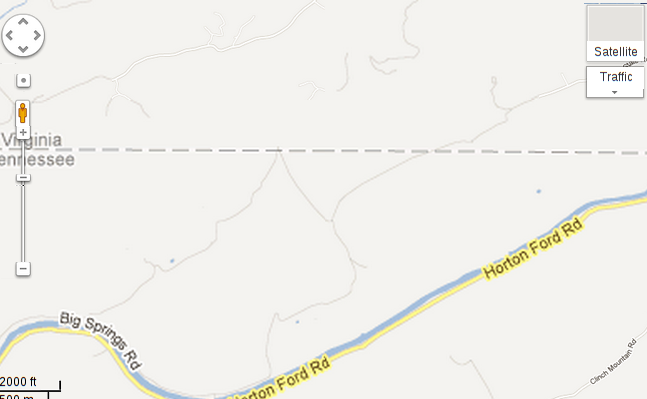
This is not the kind of place I live, though I don't mind a visit. Errol looking out over Salsalito and the Bay I'm not bothered by a more rural life, I thrive on peace and quiet, and am not bothered by needing to haul my water, split firewood, or spend an hour just mowing my driveway. I bought a GPS the other day, and it doesn't know where my driveway is..
or where the road leading to my driveway is..
or even about the highway leading to that road!
not many roads on this map.. The only thing that really bothers me about living here off the map is that I'm in the middle of a food desert too. The nearest semi-decent grocery store and produce market are 40 minutes away. There's one restaurant worth eating at, and while a very congenial place to eat rustic food while watching the river flow by, it serves almost no vegetables. Adding to the problem, my fridge is a rather expensive propane model, which is about half a normal size, and has no freezer. Managing a healthy meal plan is a constant struggle, though I do have time to cook, at least, thanks to not having the kind of commute that is typical around here. Well, the food desert was my only real problem. Now I can add to that the UPS emergency. A week ago, a package left Shenzen China for here. It quickly passed through Anchorage Alaska, and with a few days had arrived an hour and a half from here. Getting it here has taken the whole rest of the week.
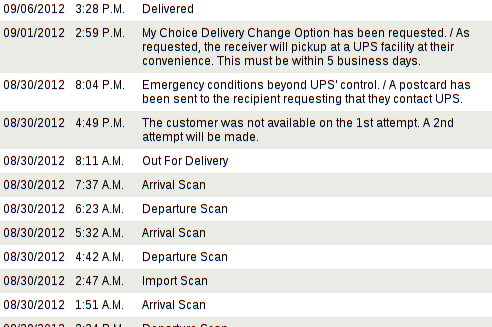
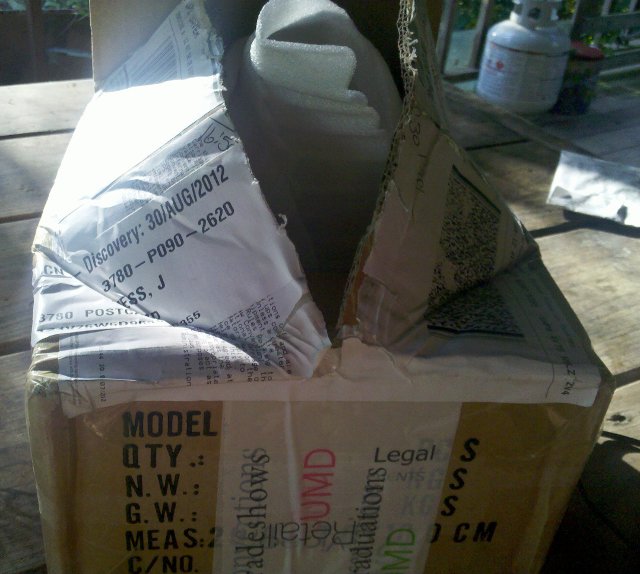
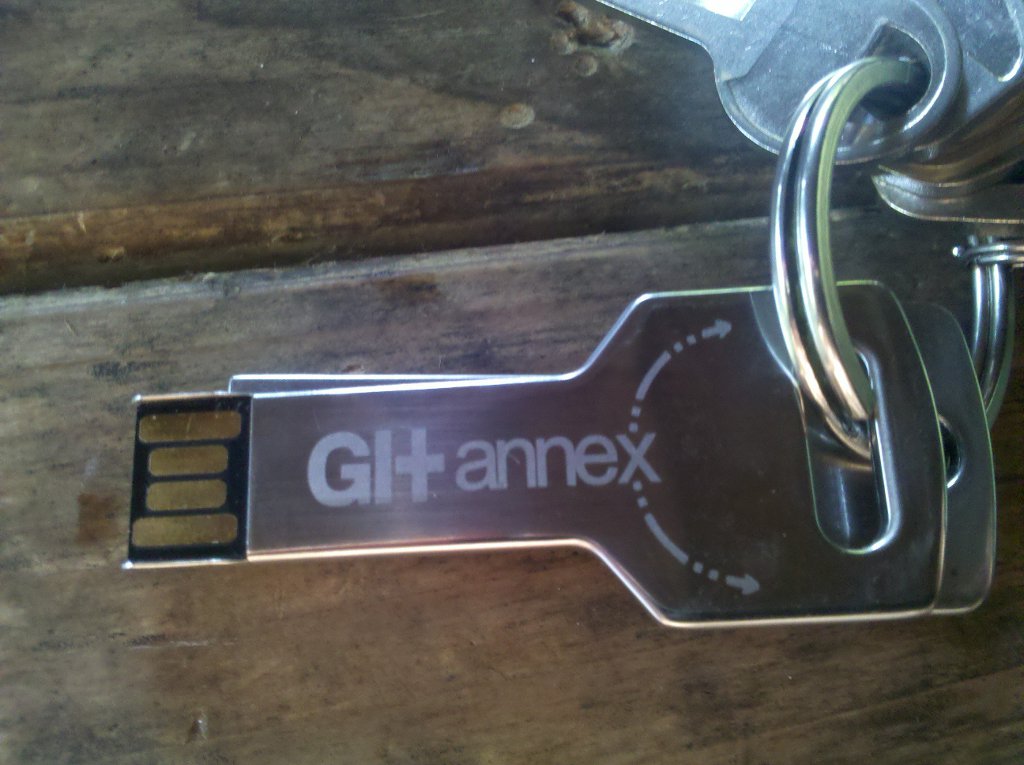
I only knew UPS attempted delivery because a neighbor told me. Seems they took one look at my driveway and turned around. They never tried again, and they didn't bother to leave a note on the mailbox, or anything. Now, the US postal service is happy to drive up this driveway; they drive a sensible 4x4 around here. I think DHL and Fedex have been here too. (Contrary to John Goerzen's experiences) My compact car is not bothered by my driveway either... But UPS's brand involves large brown trucks, even where inappropriate, and damage to them from such things as low-hanging branches apparently comes out of the driver's paycheck. And while normally UPS leaves small things in my mailbox, or with a neighbor, this was an important package from China, and it needed a signature. But really, a post card? "emergency"?! So, I bought the GPS to find UPS, because my package was in an industrial park in some town I've never been to. And on Tuesday I was within an hour of there and swung by. And it was closed. UPS's website had not mentioned this; other businesses are open the day after Memorial day. That turned out to be a really annoying day all around. When I got home, after a night away, I found my fridge's fire had blown out, and nearly all my food was only fit for the dog. Today I went out to try again (and buy groceries). When I reached the UPS depot.. it was closed! Until 3 pm. At this point I felt this story was reaching full-on farce. After cooling my heels in a library for three hours, I was finally able to open the most over-packed package I've probably ever seen. My kickstarter reward sample looks good.. I'll be ordering a lot more, but not to this address. As a coda to the UPS farce, arriving home today I checked my mailbox, and found the UPS postcard had finally arrived. It included mention of the 3 pm opening time, and noted that I had until tomorrow before they'd return my package to China. The coda to the coda is that on my way home from this second annoying day delivered courtesy of UPS, I stumbled on a restaurant overlooking a waterfall, just outside the town where I get my groceries. It serves food that satisfies both my Cajun and healthy cravings. Now I just need a larger fridge..

5 September 2012

Raphaël Hertzog: My Debian Activities in August 2012

This is my monthly summary of my Debian related activities. If you re among the people who made a donation to support my work (88.41 , thanks everybody!), then you can learn how I spent your money. Otherwise it s just an interesting status update on my various projects. This month has again been a short one since I have mostly been in vacation during the last 2 weeks. Dpkg Things are relatively quiet during the freeze. I only took care of fixing 3 bugs: a regression of 3.0 (quilt) (#683547), a segfault of dpkg-query -W -f (commit) and a bad auto-completion for French users (#685863). Testing the upgrade to wheezy We got several reports of wheezy upgrade that failed because dpkg ran the trigger while the dependencies of the package with pending triggers are not satisfied. Unfortunately fixing this in dpkg is not without problems (see #671711 for details) so Guillem decided to defer this fix for Jessie. My suggestion of an intermediary solution has fallen in limbo. Instead we now have to find solutions for each case where this can fail (example of failure: 680626). Another way to avoid those errors is to ensure that triggers are run as late as possible. We can improve this in multiple ways. The first way is to modify most triggers so that they use the interest-noawait directive. In that case, the packages activating the trigger will be immediately marked as configured (instead of triggers-awaited ) and the trigger will thus not need to be run as part of further dependency solving logic. But as of today, there s no package using this new feature yet despite a nudge on debian-devel-announce. :-( The second way is to modify APT to use dpkg no-triggers, and to let the trigger processing for the end (with a last dpkg configure -a call). I requested this early in the wheezy timeframe but for various reasons, the APT maintainers did not act on it. I pinged them again in #626599 but it s now too late for wheezy. I find this a bit sad because I have been using those options for the entire wheezy cycle and it worked fine for me (and I used them for a dist-upgrade on my wife s laptop too). It would have been good to have all this in place for wheezy so that we don t have to suffer from the same problems during the jessie upgrade, but unless someone steps up to steer those changes, it seems unlikely to happen. Instead, we re back to finding klumsy work-arounds in individual packages. Packaging I prepared security updates for python-django (1.4.1 for unstable,
1.2.3-3+squeeze3 for stable). I packaged a new upstream version for cpputest (3.2-1). I reviewed ledgersmb 1.3.21-1 prepared by Robert James Clay and asked him to prepare another version with further fixes. I released nautilus-dropbox 1.4.0-2 with supplementary changes of my own to support https_proxy and to display better diagnostic information when the download fails. With the help of Paul van der Vlis and Michael Ziegler, we did what was required to be able to migrate python-django-registration 0.8 to Wheezy even though it s a new upstream version with backwards incompatible changes. Thanks to Adam D. Barratt who unblocked the package, we now have the right version in Wheezy despite the fact that I missed the freeze deadline. Debian France Julien Cristau reminded the board of Debian France that we have to elect officers (President, Secretary, Treasurer) as the current officers have withdrawn. I was somewhat afraid that nobody would take over so I pinged each member to try to get new volunteers. We now have volunteers (me, Julien Danjou and Sylvestre Ledru) and we re waiting until Julien finds some time to run the election. Misc With the help of DSA, I setup antispam rules for the owner@packages.qa.debian.org alias because I was getting tired by the amount of spam. In the process, they asked me to write a wiki page for dsa.debian.org to document everything so that they can refer to it for future queries. I did it but it looks like that they did not apply my patch yet. I also tested an upstream patch for gnome-keyring (see bugzilla #681081) that reintroduces the support of forgetting GPG passphrases after a specified amount of time. Thanks See you next month for a new summary of my activities.

No comment Liked this article? Click here. My blog is Flattr-enabled.

Russ Allbery: Reacting to excitement

I've been slowly noticing, over a number of years now, a place where I don't react to other people the way that I want to. I've been stumbling over defensive reactions that I didn't realize I had. These are a few rules of thumb that I'm formulating for myself to try to improve that, and I thought it might help to write them down. And maybe they'll be meaningful for someone else.
  1. Things people are excited about are probably exciting. If I don't find them exciting, that's probably because I don't know enough about them to understand why they're exciting. Or perhaps I have a different mindset, and therefore the exciting parts don't connect with me. Both of those are okay! There are way more things to learn about than I will ever possibly have time to learn, and I don't have to get excited about everything other people are excited about. But, equally, just because I'm not excited doesn't mean that the thing is not exciting.
  2. My misplaced sense of obligation should not be someone else's buzzkill. This requires a bit of unpacking, since I only intermittantly realize that I'm doing this. But (partly for cultural reasons, partly due to natural inclinations) I've always felt a strong sense of obligation to "keep up" with things. To know a lot about a lot of topics. And one of the things I've realized is that my brain occasionally twists an interest in knowing lots about the world into a sense of obligation to "stay current" and know something about everything important, at least within my vague field of expertise. And usually that part of my brain has a very expansive notion of field of expertise; all of software development, for example, which is, when I pull it out into the light, ridiculously broad. This then sparks one of the standard failure modes of human cognition. I have an unrealistic expectation of myself. I fail to meet that expectation. This makes me feel guilty and stressed. At that point, my brain starts trying to find targets for me to displace negative feelings onto, and that generally ends up being the next person who is excited about something new that I don't know anything about but feel like I should. This is all very interesting psychologically, in the abstract. However, the concrete result is that I sometimes get all snarky and negative about something that someone else is excited about because it happens to be the moment I hit overload, or because I didn't want to hear about another thing that I feel like I should know more about. And that, in turn, can be either confrontational or discouraging to someone who is legitimately excited (and may rarely get the chance to be excited). And that's not the person I want to be.
  3. It's okay not to have an opinion. Seriously, it's okay. The world is full of stuff, far more stuff than any one person can know anything about. It's okay not to go read about everything people say is exciting. It's okay not to know about something new. It's okay to focus on the things I'm already doing. Really. What's not okay is to make up an opinion about something I know nothing about just so that I can feel better about myself by having an opinion. Particularly since that opinion formed under those circumstances tends to be negative, despite the fact that I have no actual basis for having any opinion at all. I need to practice just quietly not having an opinion. No one else needs to know about my lack of opinion.
  4. Before bristling at imposition, be sure someone is actually imposing. I frequently leap to the conclusion that, when someone raises a topic, they want me to do something about it. It's a gut emotional reaction, I think in part because the emotional part of my brain likes to make everything about me. Intellectually, if I can engage that part of my brain, it's often obvious that it's not about me, or that they're not asking me to do anything. Often, when someone brings something up, they just want to tell someone else about it, or make me aware of it. If I've listened to, or read, all the sentences and understood then, then congratulations! I've done everything that I needed to do and was expected to do and need not feel any further obligation. Even if something further needs to be done, it doesn't necessarily need to be done by me. I'm very protective of my time and available resources because I almost always feel overwhelmed by all the things that I want to work on. This does not entitle me to snap at random people who are being excited around me on the grounds that they're trying to put more obligations on me. They're probably not. If it becomes clear that they really want me to do something I don't have time to do, I can politely decline, but if I just shut up and listen for longer, usually that's not the case at all.
(Please note that this is not prompted by any current discussion happening anywhere, and paticularly not by anything in Debian. Insofar as it was prompted by anything, it was by a throwaway comment in an unrelated private discussion. It's just something that gelled enough to write down while I was walking home from work.)

3 September 2012

Gunnar Wolf: WikiLovesMonuments wants *you* (and me!)

What, haven't you heard about the WikiLovesMonuments photo contest around cultural heritage? Copying from its web page,
Wiki Loves Monuments is an international photo contest around cultural heritage monuments in September. Starting from the Netherlands in 2010 and organized on a European level in 2011, we go global in 2012!
I heard about this initiative in Iv n Mart nez's Wikimedia talk at COSIT 2012, held last week in Coatzacoalcos, Veracruz (I intend to write a bit more regarding COSIT later on). I loved the idea, and intend to participate Not because I take great pictures (I don't, and I usually take them using my aging phone, which gives decent results but nothing beyond that), but because I love to move by bike in the city, and it's one of the best ways to roll in front of some of them. But more on me later Back to the topic! WikiLovesMonuments aims to improve on Wikimedia's (the organization behind Wikipedia and several other Free Culture reference projects) coverage of important landmarks all over the world. To do so, they are offering a trip to attend WikiMania 2013 in Hong Kong to the first place winner, and other "photography-related" prizes to the other winners. So, back to me: My motivation to enter the contest is to help Wikimedia. I know my shots won't be top-notch (although they will be the best I can do). I enjoy biking in my city, and often go not too far from many of the listed monuments. I am amazed at the number of monuments still pending in my area (of course, it's not by mistake this is called "La ciudad de los palacios", The city of the palaces) Surely some of the readers of this post will have (or will find easy to take) some photos to add. Of course, I'll try to focus on the missing monuments, but if you are a good photographer, you might want to submit a better version for a monument that's already there. So, some pointers, from what's closest to what's farthest from me: At least for Mexico, the listings are taken from the National Institute for Anthropology and History (INAH)'s Public registry of archaeological zones and monuments. So, I cannot wait to start my biking session today to get some good end-of-summer evening sun and get some pictures taken! :-D

2 September 2012

Benjamin Mako Hill: Open Brands

In late July, the Awesome Foundations invited me to participate in an interesting conversation about open brands at their conference. Awesome is a young collection of organizations struggling with the idea of if, and how, they want to try to control who gets call themselves Awesome. I was asked to talk about how the free software community approaches the issue. Guidance from free software is surprisingly unclear. I have watched and participated in struggles over issues of branding in every successful free software project I've worked in. Many years ago, Greg Pomerantz and I wrote a draft trademark policy for the Debian distribution over a couple beers. Over the last year, I've been working with Debian Project Leader Stefano Zacchiroli and lawyers at the Software Freedom Law Center to help draft a trademark policy for the Debian project. Through that process, I've come up with three principles which I think lead to more clear discussion about whether a free culture or free software should register a trademark and, if they do, how they should think about licensing it. I've listed those principles below in order of importance. 1. We want people to use our brands. Conversation about trademarks seem to turn into an exercise in imagining all the horrible ways in which a brand might be misused. This is silly and wrong. It is worth being extremely clear on this point: Our problem is not that people will misuse our brands. Our problem is that not enough people will use them at all. The most important goal of a trademark policy should be to make legitimate use possible and easy. We want people to make t-shirts with our logos. We want people to write books about our products. We want people to create user groups and hold conferences. We want people to use, talk about, and promote our projects both commercially and non-commercially. Trademarks will limit the diffusion of our brand and, in that way, will hurt our projects. Sometimes, after carefully considering these drawbacks, we think the trade-off is worth making. And sometimes it is. However, projects are generally overly risk averse and, as a result, almost always err on the side of too much control. I am confident that free software and free culture projects' desire to control their brands has done more damage than all brand misuse put together. 2. We want our projects to be able to evolve. The creation of a trademark puts legal power to control a brand in the hands of an individual, firm, or a non-profit. Although it might not seem like such a big deal, this power is, fundamentally, the ability to determine what a project is and is not. By doing this, it creates a single point of failure and a new position of authority and, in that process, limits projects' ability to shift and grow organically over time. I've heard that in US politics, there is no trademark for the terms Republican or Democrat and that you do not need permission to create an organization that claims to be part of either party. And that does not mean that everybody is confused. Through social and organizational structures, it is clear who is in, who is out, and who is on the fringes. More importantly, this structure allows for new branches and groups outside of the orthodoxy to grow and develop on the margins. Both parties have been around since the nineteenth century, have swapped places on the political spectrum on a large number of issues, and have played host to major internal ideological disagreements. Almost any organization should aspire to such longevity, internal debate, and flexibility. 3. We should not confuse our communities. Although they are often abused, trademarks are fundamentally pro-consumer. The point of legally protected brands is to help consumers from being confused as the source of a product or service. Users might love software from the Debian project, or might hate it, but it's nice for them to be able to know that they're getting "Debian Quality" when they download a distribution. Of course, legally protected trademarks aren't the only way to ensure this. Domains names, internal policies, and laws against fraud and misrepresentation all serve this purpose as well. The Open Source Initiative applied for a trademark on the term open source and had their application rejected. The lack of a registered trademark has not kept folks from policing use of the term. Folks try to call their stuff "open source" when it is not and are kept in line by a community of folks who know better. And since lawyers are rarely involved, it is hardly clear that a registered trademark would help in the vast majority of these these situations. It is also the case that most free software/culture organizations lack the money, lawyers, or time, to enforce trademarks in any case. Keeping your communities of users and developers clear on what is, and what isn't, your product and your project is deeply important. But how we choose to do this is something we should never take for granted.

31 August 2012

Roland Mas: Integrating FWbuilder with fail2ban and port-knocking

This article documents how I'm currently building my firewalls. It builds on netfilter-based-port-knocking, and tries to integrate several components of a firewall as gracefully as possible. For some context: I'm getting involved with servers where the firewall policy goes beyond a handful of SSH from my home and my other servers rules. There are many different network streams that need to be policed, some of them are common across several (potentially many) servers, and so on. So I'm gradually giving up on my hand-made scripts, and trying out higher-level tools. I settled on FWbuilder, which seems nice. However, it only allows static policies, and I still want to keep dynamic policies such as what fail2ban provides, as well as my own port-knocking system. The problem I had was that fail2ban isn't really made to play nice as part of a complex firewalling setup, my port-knocking system was too tightly integrated within my firewall script, and FWbuilder wasn't too flexible when it came to delegating part of the firewall policy to something external. Fortunately, this was only a perceived problem (or a real problem in my understanding), because it is actually possible to have all three blocks playing nicely together. More context: as usual, I'm focusing on Debian-like systems. More precisely, on those with a Linux kernel; it may be that FreeBSD's firewalling subsystem has a feature comparable to Linux's recent module, but I don't know. Let's start with FWbuilder. This is not the place for a manual, the official documentation is rather complete. I'll assume you have defined most relevant blocks in there: firewall, hosts, IP addresses, services, and so on. You define your static policy with the standard rules. From then on, we want to integrate the external tools for dynamic rules. Step 1: Integrating fail2ban We want fail2ban to have its own playground, so that it doesn't overwrite anything in the standard policy. The trick is to define a new policy rule set named fail2ban. Leave it empty in FWbuilder. So far so good, but fail2ban (the daemon) still operates on the INPUT chain in the firewall, and could therefore still mangle the static rules. Fortunately, starting with fail2ban 0.8.5 (available from Debian Wheezy, or in the backports for Squeeze), you can define what chain to operate on: with a configuration item such as chain = fail2ban, fail2ban (the daemon) will now only add its rules to fail2ban (the firewall chain), and won't be able do damage the other chains. The missing part is to send some of the traffic to it using the standard policy: i defined a rule sending the incoming SSH connections to the fail2ban policy ( branching in FWbuilder jargon). Voil : the static policy delegates part of the decision-making to a sub-policy controlled by the fail2ban daemon. Step 2: Integrating port-knocking This is a bit trickier, but we'll use a similar method. First, the traffic used for port-knocking needs to be directed to the chain that does the listening. Define a policy rule set named portknocking, and leave it empty in FWbuilder. It'll be used by the dynamic rules to track progression of source IP addresses through the port-knocking sequence, so you'll need to send ( branch ) incoming traffic there, probably after the rules allowing incoming connections from known hosts. The dynamic part of this will only concern the refreshing of this listening chain , which we assume will do its work and mark IP addresses with PK_ESTABLISHED once the sequence is completed. What we do with these marked IP addresses will still be defined within the FWbuilder policy. We're going to need some complex rules since we want to filter according to this PK_ESTABLISHED bit and according to destination port, for instance; unfortunately FWbuilder doesn't allow combining filter criteria with and, so we define a new policy rule set called accept_if_pk_ok. This ruleset has two rules: the second is an ACCEPT and should be easy to understand. The first rule needs to ensure the ACCEPT is only reached for connections coming from PK_ESTABLISHED addresses, so it's going to be a bit tricky. (Explanation: the first rule matches packets coming from IP addresses not marked as PK_ESTABLISHED, and returns them to the calling policy. Packets remaining after this rule are those coming from the appropriate addresses, and they go on to the ACCEPT. We could have had the first rule match on IP addresses that are marked, and branch to yet another ruleset with the ACCEPT part, but that would make it harder to read, I feel.) Now let's get back to the main policy and add rules concerning what kind of traffic we want to allow once the port-knocking sequence completed. For instance, we define a rule matching on the SSH service , where the action is to branch to accept_if_pk_ok. When an incoming packet tries to establish a connection to the SSH port, it's passed to the accept_if_pk_ok ruleset. If it comes from the same IP as a recent port-knocking sequence, it goes on to be ACCEPTed. If not, it returns to the main policy. Maybe static rules further on will allow it to go through. Step 3: tying it all together Now that we have all the pieces, the rest is plumbing. With this setup, at boot time, the $hostname.fw script creates the static policy and the extra playgrounds; then the port-knocking script implements the listening for the magic sequence; then fail2ban inserts its own rules. And there we are: three different parts for the firewall policy, all integrating nicely. Mission accomplished! Note: (Mostly copy-and-pasted from the previous article) This article is deliberately short on details and ready-to-run scripts. Firstly because firewall scripts vary wildly so any script would have to be adapted anyway, but mostly because security is best handled with one's brain switched on. Fiddling with a firewall can easily open gaping holes or lock everyone out. So please make sure you understand what goes on before blindly pasting stuff into your own setup. Some bits are left as an exercise to the reader.

27 August 2012

Michael Prokop: jenkins-debian-glue: Continuous Integration for Debian and Ubuntu made easy

jenkins-debian-glue is an open source project of mine which recently celebrated its first birthday and it s time to finally write about it. jenkins-debian-glue allows you to build Debian and Ubuntu packages directly from the Jenkins continuous integration system. It retrieves package sources from a version control repository, adjusts debian/changelog (handle version number + mention changes that took place) and builds according source and binary packages out of it. Its lintitan integration provides Q/A reports about the resulting source and binary Debian packages. It started as a small pet project of mine to get integration of Debian packaging inside Jenkins. I mainly had the needs for the Grml project in mind and starting with Grml 2011.12 every release (including also all the daily builds) was built using Jenkins since then. It turned out that my project would also be a perfect match for one of my customers, Sipwise GmbH. In December 2011 the sip:provider 2.4 was the first stable release that was built 100% through Jenkins and featuring jenkins-debian-glue. Thanks to special needs and the open source friendliness of Sipwise I could invest further time into the project. Recently the project got even some further drive thanks to interest by some fellow Debian Developers, most notably are the icinga, nagios-plugins, packages and the PostgreSQL in Debian Hackathon. Now if you re also interested in it: there s an automated deployment procedure available for your service to get started with the whole jenkins-debian-glue and Jenkins stack in less than 10 minutes, working just fine on Debian as well as Ubuntu. For further details please head over to jenkins-debian-glue.org or check out this 6:36min screencast (safe for work, no audio :) ): <iframe allowfullscreen="allowfullscreen" frameborder="0" height="315" src="http://www.youtube.com/embed/9asp2ZvH90A?autohide=1&amp;showinfo=0" width="560"></iframe> This embedded video doesn t work for you? Try heading over to YouTube.

Christoph Berg: PostgreSQL in Debian Hackathon

Almost a year has passed since my talk at pgconf.eu 2011 in Amsterdam on Connecting the Debian and PostgreSQL worlds, and unfortunately little has happened on that front, mostly due to my limited spare time between family and job. pgapt.debian.net is up and running, but got few updates and is lagging behind on PostgreSQL releases. Luckily, we got the project moving. Dimitri Fontaine and Magnus Hagander suggested to do a face-to-face meeting, so we got together at my house for two days last week and discussed ideas, repository layouts, build scripts, and whatnot to get all of us aligned for pushing the project ahead. My employer sponsored my time off work for that. We almost finished moving the repository to postgresql.org infrastructure, barring some questions of how to hook the repository into the existing mirror infrastructure; this should get resolved this week. The build server running Jenkins is still located on my laptop, but moving this to a proper host will also happen really soon now. We are using Mika Prokop's jenkins-debian-glue scripts for driving the package build from Jenkins. The big plus point about Jenkins is that it makes executing jobs on different distributions and architectures in parallel much easier than a bunch of homemade shell scripts could get us with reasonable effort. Here's a list of random points we discussed: We really aim at using unmodified packages from Debian as much as possible, and in fact this project doesn't mean to replace Debian's PostgreSQL packaging work, but to extend it beyond the number of server versions (and Debian and Ubuntu versions covered) supported. The people behind the Debian and Ubuntu packages, and this repository are mostly the same, so we will claim that "our" packages will be the same quality as the "original" ones. Big thanks go to Martin Pitt for maintaining the postgresql-common testsuite that really covers every aspect of running PostgreSQL servers on Debian/Ubuntu systems. Stay tuned for updates! :)

Robert Collins: Why platform specific package systems exist and won t go away

A while back mdz blogged about challenges facing Ubuntu and other Linux distributions. He raises the point that runtime libraries for Python / Ruby etc have a unique set of issues because they tend to have their own packaging systems. Merely a month later he attended Debconf 2010 where a presentation was given on the issues that Java packages have on Dpkg based systems. Since then the conversation seems to have dried up. I ve been reminded of it recently in discussions within Canonical looking at how we deploy web services. Matt suggested some ways forward, including: I think its time we revisit and expand on those points. Nothing much has changed in how Ubuntu or other distributions approach integration with other packaging systems but the world has kept evolving. Internet access is growing ever more ubiquitous, more platforms are building packaging systems clojure, scala, node.js, to name but three, and a substantial and ever growing number of products expect to operate in a hybrid fashion with an evolving web service plus a local client which is kept up to date via package updates. Twitter, Facebook and Google Plus are three such products. Android has demonstrated a large scale app store on top of Linux, with its own custom packaging format. In order to expand them, we need some background context on the use cases that these different packaging systems need to support. Platforms such as antivirus scanners, node.js, Python, Clojure and so forth care a great deal about getting their software out to their users. They care about making it extremely easy to get the latest and greatest versions of their libraries. I say this because the evidence is all around us: every successful development community / product has built a targeted package management system which layers on top of Windows, and Mac OSX, and *nux. The only rational explanation I can come up for this behaviour is that the lower level operating system package management tools don t deliver what they need. E.g. this isn t as shallow as wanting a packaging system written in their own language, which would be easy to write off as parochialism rather than a thoughtful solution to their problems. In general packaging systems provide a language for shipping source or binary form, from one or more repositories, to users machines. They may support replications, and they may support multiple operating systems. They generally end up as graph traversal engines, pulling in dependencies of various sorts you can see the DOAP specification for an attempt at generic modelling of this. One problem that turns up rapidly when dealing with Linux distribution package managers is that the versions upstream packages have, and the versions a package has in e.g. Debian, differ. They differ because at some stage, someone will need to do a new package for the distribution when no upstream change has been made. This might be to apply a local patch, or it might be to correct a defect caused by a broken build server. Whatever the cause, there is a many to one relationship between the package versions that end users see via dpkg / rpm etc, and those that upstream ship. It is a near certainty that once this happens to a library package, that comparing package versions across different distribution packages becomes hard. You cannot reliably infer whether a given package version is sufficient as a dependency or not, when comparing binary packages between Red Hat and Debian. Or Debian and Ubuntu. The result of this is that even when the software (e.g. rpm) is available on multiple distributions (say Ubuntu and RHEL), or even on multiple operating systems (say Ubuntu and Windows), that many packages will /have/ to be targeted specifically to build and execute properly. (Obviously, compilation has to proceed separately for different architectures, its more the depedency metadata that says and build with version X of dependency Y that has to be customised). The result of this is that there is to the best of my knowledge no distribution of binary packages that targets Debian/Ubuntu and RHEL and Suse and Windows and Mac OS X, although there are vibrant communities building distributions of and for each in isolation. Some of the ports systems come close, but they are still focused on delivering to a small number of platforms. There s nothing that gives 99% coverage of users. And that means that to reach all their users, they have to write or adopt a new system. For any platform X, there is a strong pressure to have the platform be maintainable by folk that primarily work with X itself, or with the language that X is written in. Consider Python there is strong pressure to use C, or Python, and nothing else, for any tools that is somewhat parochial, but also just good engineering reducing variables and making the system more likely to be well maintained. The closest system I know of Steam is just now porting to Ubuntu (and perhaps Linux in general), and has reached its massive popularity by focusing entirely on applications for Windows, with Mac OSX a recent addition. Systems like pypi which have multi platform eggs do target the wide range of platforms I listed above, but they do so both narrowly and haphazardly: whether a binary or source package is available for a given platform is up to the maintainer of the package, and the packages themselves are dealing with a very narrow subset of the platforms complexity: Python provides compilation logic, they don t create generic C libraries with stable ABI s for use by other programs, they don t have turing complete scripts for dealing with configuration file management and so forth. Anti virus updaters similarly narrow the problem they deal with, and add constraints on latency- updates of anti virus signatures are time sensitive when a new rapidly spreading threat is detected. A minor point, but it adds to the friction of considering a single packaging tool for all needs is the different use cases of low level package management tools like dpkg or rpm vs the use cases that e.g. pypi has. A primary use case for packages on pypi is for them to be used by people that are not machine administrators. They don t have root, and don t want it. Contrast that with dpkg or rpm where the primary use case (to date) is the installation of system wide libraries and tools. Things like man page installation don t make any sense for non-system-wide package systems, whereas they are a primary feature for e.g. dpkg. In short, the per-platform/language tools are (generally):
  1. Written in languages that are familiar to the consumers of the tools.
  2. Targeted at use on top of existing platforms, by non-privileged users, and where temporary breakage is fine.
  3. Intended to get the software packaged in them onto widely disparate operating systems.
  4. Very narrow they make huge assumptions about how things can fit together, which their specific language/toolchain permits, and don t generalise beyond that.
  5. Don t provide for security updates in any specific form: that is left up to folk that ship individual things within the manager.
operating system package managers:
  1. Are written in languages which are very easy to bootstrap onto an architecture, and to deploy onto bare metal (as part of installation).
  2. Designed for delivering system components, and to avoid be able to upgrade the toolchain itself safely.
  3. Originally built to install onto one operating system, ports to other operating systems are usually fragile and only adopted in niche.
  4. Are hugely broad they install data, scripts, binaries, and need to know about late binding, system caches etc for every binary and runtime format the operating system supports
  5. Make special provision to allow security updates to be installed in a low latency fashion, without requiring anything consuming the package that is updated to change [but usually force-uninstalling anything that is super-tightly coupled to a library version].
Anti virus package managers:
  1. Exist to update daemons that run with system wide escalated privileges, or even file system layer drivers.
  2. Update datasets in realtime.
  3. Without permitting updates that are produced by third parties.
Given that, lets look at the routes Matt suggested Decoupling applications from the core as a strategy makes an assumption that the core and applications are partitionable. If they are not, then applications and the core will share common elements that need to be updated together. Consider, for instance, a Python application. If you run with a system installed Python, and it is built without zlib for some reason, but the Python application requires zlib, you have a problem. A classic example of this problem is facing Ubuntu today, with all the system provided tools moving to Python 3, but vast swathes of Python applications still being unported to Python 3 at all. Currently, the Python packaging system virtualenv/buildout + distribute don t provide a way to install the Python runtime itself, but will happily install their own components for everything up the stack from the runtime. Ubuntu makes extensive use of Python for its own tools, so the system Python has a lot of packages installed which buildout etc cannot ignore this often leads to issues with e.g. buildout, when the bootstrap environment has (say) zope.interfaces, but its then not accessible from the built-out environment that disables the standard sys.path (to achieve more robust separation). If we want to pursue decoupling, whether we build a new package manager or use e.g. virtualenv (or gem or npm or ), we ll need to be aware of this issue and perhaps offer, for an extended time, a dedicated no-frills, no-distro-packages install, to avoid it, and to allow an extended supported period for application authors without committing to a massive, distro sponsored porting effort. While its tempting to say we should install pip/npm/lein/maven and other external package systems, this is actually risky: they often evolve sufficiently fast that Ubuntu will be delivering an old, incompatible version of the tool to users well before Ubuntu goes out of support, or even befor the next release of Ubuntu. Treating data as a service. All the cases I ve seen so far of applications grabbing datasets from the web have depended on web infrastructure for validating the dataset. E.g. SSL certificates, or SSL + content checksums. Basically, small self-rolled distribution systems. I m likely ignorant of details here, and I depend on you, dear reader, to edumacate me. There is potential value in having data repackaged, when our packaging system has behind-firewall support, and the adhoc system that (for instance) a virus scanner system has does not. In this case, I specifically mean the problem of updated a machine which has no internet access, not even via a proxy. The challenge I see it is again the cross platform issue: The vendor will be supporting Ubuntu + Debian + RHEL + Suse, and from their perspective its probably cheaper to roll their own solution than to directly support dpkg + rpm + whatever Apple offer + Windows the skills to roll an adhoc distribution tool are more common than the skills to integrate closely with dpkg or rpm What about creating a set of interfaces for talking to dpkg / rpm / the system packagers on Windows and Mac OSX ? Here I think there is some promise, but it needs as Matt said careful thought. PackageKit isn t sufficient, at least today. There are, I think, two specific cases to cater to:
  1. The anti-virus / fresh data set case.
  2. The egg/gem/npm/ specific case.
For the egg/gem/npm case, we would need to support a pretty large set of common functionality, on Windows/Mac OSX / *nux (because otherwise upstream won t adopt what we create: losing 90% of their users (windows) or 5% (mac) isn t going to be well accepted :) . We d need to support multiple installations (because of mutually incompatible dependencies between applications), and we d need to support multiple language bindings in some fashion some approachable fashion where the upstream will feel capable of fixing and tweaking what we offer. We re going to need to support offline updates, replication, local builds, local repositories, and various signing strategies to match the various tradeoffs made by the upstream tools. For the anti-virus / fresh data case, we d need to support a similar set of operating systems, though I strongly suspect that there would be more tolerance for limited support in that most things in that space either have very platform specific code, or they are just a large-scale form of the egg/gem/npm problem, which also wants easy updates. What next? We should validate this discussion with at least two or three upstreams. Find out whats missing I suspect a lot and whats wrong I hope not much :) . Then we ll be in a position to decide if there is a tractable, widespread solution *possible*. Separately, we should stop fighting with upstreams that have their own packaging systems. They are satisfying different use cases than our core distro packaging systems are designed to solve. We should stop mindlessly repackaging things from e.g. eggs to debs, unless we need that specific thing as part of the transitive runtime or buildtime dependencies for the distribution itself. In particular, if us folk that build system packaging tools adopt and use the upstream application packaging tools, we can learn in a deep way the (real) advantages they have, and become more able to reason about how to unify the various engineering efforts going into them and perhaps even eventually satisfy them using dpkg/rpm on our machines.

24 August 2012

Olivier Berger: Generating RDF description of Debian package sources with ADMS.SW

Edit : I ve now managed to roll out my contribution which is now in production on packages.qa.debian.org. See a later post I ve made on the subject, and beware that the generated RDF has changed a bit also. ADMS.SW proposes specifications for description of software present in software catalogues. I ve tried and apply it to the contents of the Debian Package Tracking System (PTS), using transformation of the information known by the PTS to RDF+XML. The result is not yet in production, but here s an example of what can be done, using the Turtle syntax (more readable) :
<style type="text/css"> .T1 color:#000000; font-size:14pt; font-weight:bold; .T2 color:#000000; font-size:12pt; .T3 color:#000000; font-size:8.5pt; .T4 color:#0000ff; font-size:8.5pt; .T5 color:#a020f0; font-size:8.5pt; .T6 color:#228b22; font-size:8.5pt; .T7 color:#b22222; font-size:8.5pt; .T8 color:#008b8b; font-size:8.5pt; .T9 color:#8b2252; font-size:8.5pt; .dp1 .dp2 </style> @base <http://packages.qa.debian.org/> .
@prefix rdf: <http://www.w3.org/1999/02/22 rdf syntax ns#> .
@prefix admssw: <http://purl.org/adms/sw/> .
@prefix doap: <http://usefulinc.com/ns/doap#> .
@prefix dcterms: <http://purl.org/dc/terms/> .
@prefix rdfs: <http://www.w3.org/2000/01/rdf schema#> .
@prefix foaf: <http://xmlns.com/foaf/0.1/> .
@prefix schema: <http://schema.org/> .
@prefix spdx: <http://www.spdx.org/rdf/terms#> .
@prefix : <http://www.w3.org/1999/xhtml> .
@prefix str: <http://exslt.org/strings> . #
# First the packaging project for apache2 in Debian
#
# <http://packages.qa.debian.org/apache2> resource :
<apache2>
a admssw:SoftwareProject ;
doap:name "apache2" ;
doap:description "Debian apache2 source packaging" ;
doap:homepage "http://packages.debian.org/src:apache2" ;
schema:contributor [
a foaf:OnlineAccount ;
foaf:accountName "Debian Apache Maintainers" ;
foaf:accountServiceHomepage <http://qa.debian.org/developer.php?login=debian apache@lists.debian.org>
], [
a foaf:OnlineAccount ;
foaf:accountName "Stefan Fritsch" ;
foaf:accountServiceHomepage <http://qa.debian.org/developer.php?login=sf@debian.org>
], [
a foaf:OnlineAccount ;
foaf:accountName "Steinar H. Gunderson" ;
foaf:accountServiceHomepage <http://qa.debian.org/developer.php?login=sesse@debian.org>
], [
a foaf:OnlineAccount ;
foaf:accountName "Arno T ll" ;
foaf:accountServiceHomepage <http://qa.debian.org/developer.php?login=arno@debian.org>
] ;
# pointer to the release in the different suites :
doap:release <apache2_2.2.16 6+squeeze7>, <apache2_2.2.22 11>, <apache2_2.4.2 2>. #
# Now the different debian package source releases
#
# <http://packages.qa.debian.org/apache2_2.2.16 6+squeeze7> resource
<apache2_2.2.16 6+squeeze7>
a admssw:SoftwareRelease ;
rdfs:label "apache2 2.2.16 6+squeeze7" ;
admssw:project <apache2> ;
dcterms:description "Debian apache2 source package version 2.2.16 6+squeeze7" ;
doap:revision "2.2.16 6+squeeze7" . # This one is the reference version for the PTS as in unstable, so
# contains more details than the others
<apache2_2.2.22 11>
a admssw:SoftwareRelease ;
rdfs:label "apache2 2.2.22 11" ;
admssw:project <apache2> ;
dcterms:description "Debian apache2 source package version 2.2.22 11" ;
doap:revision "2.2.22 11" ;
# this release contains two components
admssw:includedAsset <apache2/apache2_2.2.22 11_debian>, <apache2/apache2_2.2.22_orig>
;
# this release can be downloaded as one package (with dget)
admssw:package <apache2/apache2_2.2.22 11.dsc> ;
# it also has a related release somewhere else
dcterms:relation <https://launchpad.net/ubuntu/+source/apache2/2.2.22 6ubuntu2> .
<apache2_2.4.2 2>
a admssw:SoftwareRelease ;
rdfs:label "apache2 2.4.2 2" ;
dcterms:description "Debian apache2 source package version 2.4.2 2" ; admssw:project <apache2> ;
doap:revision "2.4.2 2" . # Then the .dsc file for the current unstable version
<apache2/apache2_2.2.22 11.dsc>
a admssw:SoftwarePackage ;
dcterms:description "Debian source package descriptor file for apache2 version 2.2.22 11";
schema:downloadUrl "http://cdn.debian.net/debian/pool/main/a/apache2/apache2_2.2.22 11.dsc";
schema:fileSize "2885" ;
spdx:checksum [
a spdx:Checksum ;
spdx:algorithm <apache2#checksumAlgorithm_md5sum> ;
spdx:checksumValue "d7d03719b9f6432beeecd3aa04f7b22c"
] . #
# Then the upstream project
#
<apache2/apache2_orig>
a admssw:SoftwareProject ;
doap:description "The apache2 upstream project" ;
# either its name or homepage can be matched against other ADMS.SW
# or DOAP descriptors
doap:name "apache2" ;
doap:homepage "http://httpd.apache.org/" . # And a upstream release 2.2.22
<apache2/apache2_2.2.22_orig>
a admssw:SoftwareRelease ;
rdfs:label "Upstream apache2 release 2.2.22" ;
dcterms:description "Upstream source release for apache2 version 2.2.22" ;
doap:revision "2.2.22" ;
admssw:project <apache2/apache2_orig> ;
# and a link to the upstream source tarball s description
admssw:package <apache2/apache2_2.2.22.orig.tar.gz> . # now the (potentially re archived) upstream source archive for that release
<apache2/apache2_2.2.22.orig.tar.gz>
a admssw:SoftwarePackage ;
dcterms:description "Upstream source archive for apache2 version 2.2.22 11 (potentially re archived by Debian)";
schema:downloadUrl "http://cdn.debian.net/debian/pool/main/a/apache2/apache2_2.2.22.orig.tar.gz";
# Those 2 bits should help match packagings of the same tarball if needed
schema:fileSize "7200529" ;
spdx:checksum [
a spdx:Checksum ;
spdx:algorithm <apache2#checksumAlgorithm_md5sum> ;
spdx:checksumValue "d77fa5af23df96a8af68ea8114fa6ce1"
] . #
# Now, document specific details of the second component : Debian
# packaging files archive
#
<apache2/apache2_2.2.22 11_debian>
a admssw:SoftwareRelease ;
rdfs:label "Package sources apache2_2.2.22 11" ;
dcterms:description "Debian packaging sources for apache2 version 2.2.22 11" ;
doap:revision "2.2.22 11" ;
admssw:package <apache2/apache2_2.2.22 11.debian.tar.gz> . <apache2/apache2_2.2.22 11.debian.tar.gz>
a admssw:SoftwarePackage ;
dcterms:description "Debian source package files archive for apache2 version 2.2.22 11" ;
schema:downloadUrl "http://cdn.debian.net/debian/pool/main/a/apache2/apache2_2.2.22 11.debian.tar.gz";
schema:fileSize "195980" ;
spdx:checksum [
a spdx:Checksum ;
spdx:algorithm <apache2#checksumAlgorithm_md5sum> ;
spdx:checksumValue "d3d4146ccad51129636b7dbff284a110"
] . #
# Now, we also weave links with the Ubuntu counterparts
#
<https://launchpad.net/ubuntu/+source/apache2>
a admssw:SoftwareProject ;
doap:description "\"apache2\" source package in Ubuntu" ;
# this one promises some trolls and flames
admssw:forkOf <apache2> ;
doap:homepage "https://launchpad.net/ubuntu/+source/apache2" ;
doap:release <https://launchpad.net/ubuntu/+source/apache2/2.2.22 6ubuntu2> . # and its release known by the PTS
<https://launchpad.net/ubuntu/+source/apache2/2.2.22 6ubuntu2>
a admssw:SoftwareRelease ;
rdfs:label "apache2 2.2.22 6ubuntu2" ;
dcterms:description "\"apache2\" 2.2.22 6ubuntu2 source package in Ubuntu" ;
doap:revision "2.2.22 6ubuntu2" ;
admssw:project <https://launchpad.net/ubuntu/+source/apache2> .

22 August 2012

Thomas Goirand: MiniUPnP now fully in Debian

IT S FINALLY IN! With this last upload of the MiniUPnP daemon 1.7-3, I ve reached a first milestone: all of the MiniUPnP libraries, daemons and clients are finally in Debian, in a shape which I am not ashamed anymore. What is UPnP for? Back in the days (around Linux 2.0.3x), the only way to share a single Internet connection was to run a Linux box as your gateway. These days are far gone, and nearly every home connection is done through a mini home router, which also often provides a small switch and a WiFi access point. Every computer on the LAN gets its connectivity through the router thanks to NAT, and to be more accurate, masquerading. That works very well for outbound connections (browse the web, send a mail, etc.), but it is then a lot harder that something connects to a server located in the LAN. If you run a permanent server with a fixed LAN IP address, that s fine, you just configure your router to do some port forwarding, so that any inbound connection will be forwarded to the computer of your choice in the LAN. But if one application needs to listen on the public IP address just for a while (for example, IRC using DCC connection), so that something can connect to it, it becomes a way more tricky. That s when UPnP comes into play. UPnP stands for Universal Plug and Play. It s a protocol so that any application on the LAN can open ports on the public IP address of the gateway. Note that an UPnP router is also often referenced as UPnP IGD (Internet Gateway Device). Why using MiniUPnP, don t we have already linux-igd? Before my packaging work, the only UPnP server that was available in Debian was linux-igd, which has a dependency on libupnpX. That library is quite big for what it does (about 500KiB, on top of which you have to install the 200KiB daemon itself), while MiniUPnP is designed to be lightweight (only 158K, with dependencies on iptables, iproute, uuid-runtime and libc6 only). That seems ridiculous, but when you have only 8MiB of flash in your old router, saving few hundreds KiB is really important, and here, we re saving more than 500 KiB, with a full implementation of the UPnP protocol, and the Microsoft NATPmP implemented as well (yes, Microsoft decided that one protocol wasn t enough, and that they should implement their own (sic!)). Who is using MiniUPNP? Probably, you already have the libminiupnpc installed in your SID/wheezy desktop, because the transmission bittorent client which is installed with Gnome by default, depends on it, and minissdpd might be in your desktop too, if you installed the Recommends: packages as well. Which is why these are scoring quite high already in popcon. Previously, transmission was embedding its own version of the MiniUPnP client library, so it s nice to have it as a standalone shared library now. Also, because of its very light weight, and the fact that UPnP is often needed for gaming (both XBOX 360 and PSP need, and can use, the MiniUPnP daemon that runs on your IGD), many ISP who ship a router to their customer, install MiniUPnP in it. For example, at least, the 2nd and 3rd largest Internet access provider in France (Free Telecom and SFR) are shipping MiniUPnPd in their box (one of them using OpenWRT on their router). So probably as well, you are also using MiniUPnP daemon without knowing it. But isn t UPnP unsafe? To this question, I d answer that connecting to Internet is unsafe. It isn t less safe than connecting to Internet on a WiFi hotspot for example. So adding UPnP support on your gateway doesn t make it less safe, especially since MiniUPnP has some features to help with security (like an ACL with IP and port lists, or a secure mode were the router will only open ports to the client requesting it). Also, we are running a distribution where dependencies are easy to check, so it s easy for you to check if a client uses UPnP or not, and decide to trust it (or not). I personally have no issue trusting transmission, x-chat or warzone2010 (more exactly: I don t trust that incoming connectivity will make it less safe for these applications, there are so many other things that could go wrong). MiniUPnP consists of what? MiniUPnP is a set of 4 source packages to handle all of your UPnP needs: - The client library, libminiupnpc (and the corresponding -dev package), with its sidekick miniupnpc client program (you can use it to check the public IP of your gateway, or manually open ports). - The UPnP IGD daemon, miniupnpd, which just reached Debian Experimental. The latest version, 1.7-3, also includes debconf configuration so that you can choose the NIC and IP address to bind on. If you installed previous version, I strongly recommend upgrading to fix previous problems. - The libnatpmp client library (and the -dev package) for implementing the Microsoft protocol as a client (it also has a client package binary for your tests). - The minissdpd daemon to keep memory of all UPnP devices that announced themselves, and speed-up using the UPnP protocol (used by the MiniUPnP client library). A long process to have MiniUPnP in Debian All these 4 pieces of the puzzle were not as easy as it seems to be packaged in Debian. Especially, the IGD daemon, MiniUPnPd, used to depend on some header files that were not packaged in Debian. This was a decision of the iptables maintainers, which even after a long discussion, refused to add the necessary headers because it wasn t supposed to be a kernel API. While this might really be truth, the issue was that there was no public API available in the Linux kernel at all, and other distributions (Fedora, Gentoo, etc.) really did supply these needed files. As a consequence, during a very long time (years literally), shamefully, it was impossible to build the MiniUPnP daemon in Debian, while it was no problem on other distributions. Note that I do not want to start a troll discussion here, I m just stating facts, both parties have very strong and respectable arguments. Anyway, this needed API was finally embedded in MiniUPnPd itself thanks to a contributor to the project, and now it builds on both the Squeeze and the Wheezy (that is Linux 3.2) kernel without any issue. Call for testing Unfortunately, I don t have a Linux box as my Internet gateway. So I did the tests that I could: I installed MiniUPnPd on one computer on my LAN, and checked that I could open ports from another computer. So it seems to work, but I had no way to really test it live , with some real clients. So if you have an Debian SID box as your Internet gateway, feedback would be highly appreciated. What is remaining to do? A transition from libminiupnpc5 to libminiupnpc8 has to happen. Of course, this is too late for Wheezy, so this will happen right after the release. There s not so many reverse dependencies, so it should be ok, but I (yet) have zero experience with transitions. BTW, I had hard time to find out what this transition process was, and maybe some more effort for documenting it would help others (I m thinking about adding some text in the Debian wiki for that). Also, I have called for help on debian-devel, because I m currently the only one maintaining all these 4 source packages, and I m trying to have all my packages checked by others, and team maintained. So if you want to give a hand, or just declare yourself as a backup if I m busy, please raise your hand! Upstream is a friend of mine, and is very reactive to any requests (it very rarely took more than 48 hours to get a reply). Enjoy MiniUPnP and report bugs! Again, feedback would be appreciated. :)

21 August 2012

Gunnar Wolf: Impromptu session on information freedom, network neutrality, etc. COSIT 2011, Mexico

TitleImpromptu session on information freedom, network neutrality, etc. COSIT 2011, Mexico
Publication TypeFilm
Year Released2011
AuthorsWolf G, Romo F, Miranda A, M ndez O, Hern ndez C, Araico S
Refereed DesignationNon-Refereed
Running Time0:56:00
Date Released2011-03-30
PublisherCongreso Mexicano de la Sociedad de la Informaci n y Conocimiento Libre (COSIT)
CountryMexico
Full TextDuring the COSIT 2011 conference, we held a very celebrated and fun impromptu talk. This was a very interesting session where many of the long-time Free Software activists in Mexico took the stage (we were waiting for a speaker who was late, so the audience was bored and waiting) and started talking in a completely irreverent, disorganized way about the status of network neutrality, ACTA, Free Software, Free Culture, legal issues regarding copyright and many other similar points.
At some point or another, we had on stage: Fernando Romo "el Pop", Alejandro Miranda "Pooka", Sandino Araico, Claudia Hern ndez, Octavio M ndez... Anybody else?
Regarding the quality of the recording: Regina just found this file in her cheap, aging hand-held, photo camera. Again, this was not a planned session, so don't expect a high quality recording. It is hard to follow the audio at points, and the video is not steady. Anyway, it's worth following!
Great thanks to Regina, and to her quick sense of opportunity, for reaching for her camera and filming this, as it would otherwise just get lost and stay only in our memory!
AttachmentSize
Full video (Ogg Vorbis+Theora encoded)81.19 MB

19 August 2012

John Goerzen: Crazy Enough?

So far this year, I ve read somewhere in the neighborhood of 5000 pages. As I ve started to read more, I ve started to watch TV, movies, and Youtube less, because they are simply boring and shallow in comparison. War and Peace, in particular, deeply touched me. Lately I have been reading the Wheel of Time series, which has its own unique characteristics. Whether an epic (or super-epic, such as Wheel of Time) novel, or the Sherlock Holmes series, or nonfiction works, there is something magical about reading a book. We often see characters, real or fictional, that rise from obscurity to do great things for the world. We are transported in time and place to a time or place we will never be able to experience, perhaps because it is long past, or perhaps because it never was. But in any case, we can be inspired. I am reminded of this quote: The people crazy enough to think they can change the world are the ones that do. If someone told me that a street vendor in Tunisia would, in less than a year, cause the overthrow of 4 dictatorships and reform in a handful more, I would have, yes, thought that was crazy. And while Mohamed Bouazizi isn t a household name in much of the world, he managed exactly that. But not just him. It took crazy unarmed people to occupy Tahrir Square, some to die, for progress to be made in Egypt. This story is written all over history. People have done the impossible, have defied all odds, through sheer belief that they could. Civil rights have been granted due to the leaders we all know, but also due to the millions of marchers we don t. Changing the world doesn t have to mean that the world knows you. It just has to mean that you love the world, as Tolstoy pointed out:
Love hinders death. Love is life. All, everything that I understand, I understand only because I love. Everything is, everything exists, only because I love. Everything is united by it alone. Love is God, and to die means that I, a particle of love, shall return to the general and eternal source.
Whatever your stance on religion, this is a powerful quote. Sometimes particles of love might look crazy. But isn t it then that they are the most alive? Isn t it then that they are the greatest hindrance to death and despair?

Gregor Herrmann: RC bugs 2012/33

it's sunday evening again, & again, here comes my report about activities around RC bugs:

16 August 2012

Lisandro Dami&aacute;n Nicanor P&eacute;rez Meyer: QExtSerialPort in Debian experimental

After some rants about the status of different Qt-based serial port libs, I'm happy to announce that today QExtSerialPort was accepted in Debian experimental (this last link may give a 404 for some time, that's ok).

A great effort was done upstream to put the source in a suitable state for being included in Debian. Thank you all guys!

I packaged a beta version, so I uploaded it to experimental.

In case you are wondering why packaging a lib with (yet) no apps depending on it, the answer is quite simple: there are lots of people already using it in it's home projects (me included). Now those projects have the chance to get into Debian too :-)

As a side note, there is also another nice implementation called QtSerialPort. I have also tested it and works pretty fine too. It aims to become part of Qt as an add-on someday.


Gunnar Wolf: 19 years of Debian

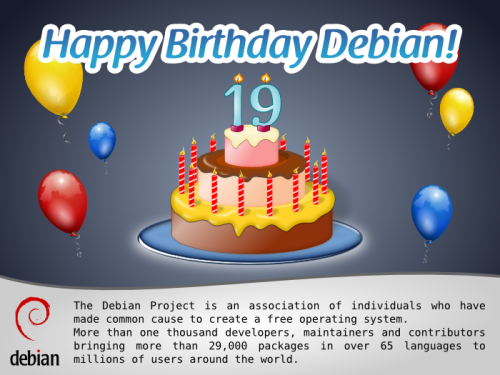
Happy 19th birthday, Debian! The Debian project is 19 years old now. Following Francesca's invitation (and Rapha l's lead, and using Leandro's image, collaboratively as it always happens here), I will tell a bit of my memories: How I got to Debian. I am a Debian user since ~2000, and a Debian Developer since April 2003. But, just as Rapha l's, my history must go somewhat further back in time. In 1992, I got my first 1200bps modem, and almost immediately became an avid BBS user (what's that? Javier Matuk talks [in Spanish] about BBSes in his newspaper column back in 1994). By mid 1993 I started operating my own BBS, CatarSYS. One of the key points that defined CatarSYS is that my focus was large-scale communication. I started connecting to several BBS networks, allowing messages to be relayed to distant people, mainly in the USA and Spain, and getting some feeds that could be seen as the poor man's Usenet. At some point during the year I kept CatarSYS going, I got connected through a strange set of gateways to pure gold: A UUCP feed! This means, during some months, I operated the first (free, hobbyist) service that offered its users a free Internet mail address in Mexico. Yes, it was completely different to what we are used to today. I tried to connect to my provider at least three times a week, but this meant less than one week turnover time for messages sent to people anywhere in the world! But, back to Debian: Via this UUCP feed, I also got some real Usenet newsgroups Including several on the comp.os category. I remember reading about Linux back then, and learning some commands, but didn't really get hooked into it. I was in Israel from July 1994 to June 1995, doing completely non-computer-related tasks. Came back in 1995, and due to my father being an academic, got dialup internet access at home. WOW, *real* Internet! It didn't take me long to start downloading Linux information and floppy images. One failed after another. But before the end of the year, I found in a bookshop a book (that included a CD-ROM) called "Build your own web server with Linux". WOW again Remember this was still 1995! I bought it, and shortly afterwards, I had a Slackware system (Linux kernel 1.0.9) running. That meant many sleepless nights full of joy and frustration (as getting hardware to work was cloe to impossible). By 1996, I got (within one week) my two first real jobs: A systems administrator at a small ISP and a highschool teacher. At the ISP, I got a spare computer to play with Linux, as of course the Big Server was running with Windows NT 3.51. Poor little machine... By then I was already a part of the Mexican Linux User Group. This group had just printed a batch of Linux CDs RedHat 4.0. This was the first release that really made me happy and allowed me to do good work. Together with a friend I took to work with us, Juan Pablo Romero, we installed over a weekend a full replacement for our buggy NT machine, in much cheaper hardware. Of course, Linux was nowhere near corporate-recognition, and our project remained a project, not touching the Windows machine. Anyway... Several years passed, and I was happy with my RedHat choice. I won't mention the milestones and job changes, as it would get boring and leave the point completely aside. By the year 2000, I was quite more involved with the LUG, as well as with the computer security group in DGSCA-UNAM. I became also an OpenBSD user, and had got so hooked up in free software that I felt the need to collaborate: To be a little part of one of those Big Projects that had given me so much. But which one? I have never been much of a programmer Yes, I can solve my everyday needs and have fun with it, and sometimes a bit beyond that. I enjoy programming. But all of my projects have begun little and stayed little. I wanted to join OpenBSD, as it was a community I really believed in, but given my skillset (and given a flame-prone, aggressive developer community), I lost motivation to do so. By 2000, I had also lost faith in RedHat. I don't have the exact dates, so I might be some months off But after RedHat's IPO, I felt a sharp change. Version 7.0 was really demotivating It tried to offer a polished desktop experience, but was really buggy, unstable, and full of bad decisions. In Mexico, Pepe Neif had taken up the job of making a derivative distribution of RedHat (called LinuxPPP), pressing hundreds of CDs and making a teaching program I was part of several times. Talking with Pepe (who continued to release based on RedHat 6), he told me he was interested in switching over to become a Debian-based distribution, but the job of migrating his installed base made the project stall LinuxPPP reached only version 6.4. But I installed Debian in early 2000, and loved it. I started getting familiar with its social philosophy and foundation documents at the same time I started migrating my servers from RedHat to Debian This must have been by Spring 2000, as I installed Potato while it was frozen but not yet stable. By January 2002 I applied for NM. My process took a long time, as my AM got MIA when he had already approved me (but before sending the AM report), so basically I had to go through AM twice And by April 16, 2003, I got accepted as a DD. Contrary to what is acceptable today, I requested the full process to be done before starting to maintain any packages, as I didn't want to bother people with package sponsorship requests, so my whole process was done evaluating packages I would eventually upload. Since becoming a DD, my main involvement in the project has been in packaging groups (I was a pkg-perl founder and member for many years, and am currently working in the pkg-ruby-extras group). But, as I said, my main strength is not programming So my main involvement in Debian has been more social than technical: I have been a DebConf organizer since 2005, a very interesting, stressing, rewarding and (for some months) time-demanding role, and since 2009 I am part of the keyring maintainence team, which is much easier workload, although carries important ramifications. So, after 19 years of Debian, and after nine years of me being part of it, Debian is clearly my strongest link to the Free Software community, a project I have grown to love and whose way of being I share and enjoy studying and explaining. And it is a technically excellent product, and a great place to start and keep learning both about how every aspect and layer of an operating system works, and how human-to-human interaction works in such a diverse, almost impossible environment happens. Congratulations, Debian!
AttachmentSize
debian-19_500.png149.81 KB

15 August 2012

Gintautas Miliauskas: Why Software Engineering Is Not Politics

A recent post by Steve Yegge has made quite a splash. The main thesis of his post is:

Software engineering has its own political axis, ranging from conservative to liberal.

Software engineering, like any other social enterprise, does have a political aspect, but I do not think this thesis is apt. The essential property of politics is that you can not have it both ways. A political problem is a coordination problem, and political decisions by its nature apply for an entire political body. Software engineering as a whole does not have these properties. There is absolutely no reason why any two engineering projects have to follow the same ideals and guidelines. Politics in engineering only appears within boundaries of a project (or, at a slightly higher level, a company), at which point it does not really warrant the name of politics, but rather character traits or personal preferences. If Johnny goes for the puck more often than Louie, that does not really warrant a label of a "liberal".

The fundamental quality that Steve is looking at is actually risk aversiveness, as he noted himself. He should have stopped there. Making that next step of conceptualization in political language does not bring any new insights and just muddles the matter.

It seems that the political labels of "liberal" and "conservative" were picked not for their meaning, but rather for their connotations, as political views are perceived to be 1) very stable, part of a person's self-identity and (therefore) hard to change, 2) inherently polarizing, and 3) difficult or impossible to evaluate objectively. Again, these do not apply to software engineering. For example, probably like many engineers, I am clearly a liberal on personal and small projects, and a conservative on larger and more fundamental ones; so much for the idea of a core identity. As for polarization, it may be prevalent in internet echo chambers, but I have not seen much of that in my professional life, especially when working with experienced engineers. When they do have objections, those objections are grounded in engineering. This leads to the third point, claiming that the approaches can not be compared objectively. This one is the most pernicious of all, because it provides an escape hatch from arguments with substance on what is an engineering decision.

Here is my, admittedly less catchy and impressive, counter thesis: Conservativeness of a software engineering project is an objective decision to be based on circumstances. TL;DR: It depends. (Very original, isn't it?) It is a risk management decision, and those are very tricky, but not subjective.

One thing to note is that the architecture of the system should correspond to the implementation style. Schemaless, heavy on magic, untyped approaches are suited for modular systems where each individual module is of limited complexity, and where the modules are isolated from each other and can recover from failures. The more complex the individual modules (and sometimes the complexity is inherent to the problem), the more benefits from "conservative" techniques. (By the way, this lines up nicely with Steve being liberal and a proponent of service-oriented architectures). If you have the freedom to pick between these two approaches, the decision making does get a bit more ideological. However, neither the "liberal" and "conservative" labels, nor risk averseness by itself is enough for a decision here. Say, if you are developing a service, what is more risky: having a "traditional", monolithic service that is inevitably sensitive to failures and is likely to scale poorly, or a cluster of components that are generally more resistant, but have more complicated aggregate behavior?

Despite the criticisms, I have to give fat credit to Steve. His post was thought-provoking, and it brought attention to the subjective side of engineering, one which is often overlooked. That side should not be left to grow - on the contrary - but the only way to reduce its domain it is to be aware of it. I know I will think twice before making another gut decision where risk averseness plays an important factor.

14 August 2012

Sven Mueller: UK going completely crazy on cryptography law.

It seems that the UK government recently passed a law that makes it illegal to be unable to decrypt what the law enforcement entities think is encrypted: From http://falkvinge.net/2012/07/12/in-the-uk-you-will-go-to-jail-not-just-for-encryption-but-for-astronomical-noise-too/:
But it s worse than that. Much worse. You re not going to be sent to jail for refusal to give up encryption keys. You re going to be sent to jail for an inability to unlock something that the police think is encrypted. Yes, this is where the hairs rise on our arms: if you have a recorded file with radio noise from the local telescope that you use for generation of random numbers, and the police asks you to produce the decryption key to show them the three documents inside the encrypted container that your radio noise looks like, you will be sent to jail for up to five years for your inability to produce the imagined documents.
This is just insane. Edit: The law was created several years ago, but the blog post somehow made me think it was more recent.

Next.

Previous.