Search Results: "ag"

9 October 2006

Wouter Verhelst: On Firefo^WIceWeasel

Recently there's been some awe in the Free Software and general Linux world from several people over the fact that Debian is dropping Firefox from its distribution, and planning to replace it with GNU IceWeasel. Personally, I don't see what else the Firefox maintainers should do. While I can understand the Mozilla people's concern over modified (read: possibly trojaned) versions of Firefox and that they need to protect their trademark against abuse, I can't believe that there can't be a better way to handle this than to require review of every patch in the Debian package. After all, packaging a browser requires more than just writing a script that gets it compiled and that gets the compiled stuff in the .deb archive. There is also branding to be done—the Debian firefox package contains a search engine for Debian packages. I doubt this is part of the original firefox source, and there are more things. Additionally, sometimes you may have to change stuff so that it works with the specific quirks of the Debian distribution, or other things. Finally, in accordance with its published policy on the matter, the Debian distribution also wants to be able to distribute security-patched versions of Firefox after Debian Stable releases; and we want to do that not just by throwing in the new version of Firefox, but by using the older version, patching it so that the security bug (and only the security bug) gets fixed, and releasing that. We can't use the official mozilla.org/mozilla.com source for that, since they cease security support after half a year or so (which is, by far, not enough for Debian); and the discussion in the bug report on the matter does not inspire confidence that we would be allowed to release a security-fixed version of firefox and still call it firefox. The alternative would be to forget about our own security releases and ceding to the braindead mozilla.org/mozilla.com security policy, but I have a pretty public opinion on that one. So that leaves us with not adhering to their braindead trademark policy, which requires us to choose another name. And as it happens, there already appears to be a piece of software that not only is a forked Firefox, it also drops non-free software from the release, something which Debian has to do anyway. So why not use that instead? BTW, yes, I did call their trademark policy braindead. No, IANAL. But you don't have to be a lawyer to see that doing something like the way Debian manages its trademark—you're not allowed to call it "official" unless your product is bit-by-bit the same thing as what Debian produces—is sane enough without being a nuisance like the firefox trademark policy.

Holger Levsen: Suhosin - php hardened

I wonder if anyone can give me advice on Suhosin - a quick search did not reveal many or rather any howtos or debian packages. Did anyone try to patch Suhosin into the current debian php4 or 5 packages and succeeded? Or does (almost) no one care?

And yes, I will look at it myself. But I just got curious now and have no time today. Anybody else interested in getting Suhosin apt-gettable?

Axel Beckert: Fedora Legacy useless?

For a (much too long) time, we ran our three AMD 64 bit virus scanners and spam filter boxes with Fedora Core 4. Since the the official support ended a few months ago when Fedora Core 6 Test 2 came out, so we decided to switch them over to support through the Fedora Legacy Project. For testing purposes we first switched over one of the three boxes. But the test failed: Although the changes (as documented on the Fedora Legacy home page) seemed to work fine, not a single update came until the end of last week, even though there were partially remotely exploitable security issues in OpenSSL, OpenSSH, gzip, etc. during that time. There were also no announcements on the list since FC4 switched over to the Fedora Legacy Project, not for FC4 nor for any other distribution maintained by the Fedora Legacy Project. So what the heck does the Fedora Legacy Project if not security updates? I would be very happy if I could switch over those boxes to Debian or even Ubuntu, but there’s no BiArch support (running 32 bit applications on 64 bit operating systems transparently) in Debian (and therefore neither in Ubuntu) yet without a lot of manual fiddling and chroots, so we can’t run our 32 bit virus scanners on those 64 bit boxes with a debianesk operating system yet. Today we’ve upgraded the last of those three boxes to Fedora Core 5.

Jonathan McDowell: Getting used to a trackball

I've been thinking about getting a trackball for a while, to see if I found it any easier to use. However finding a cheap one didn't seem possible - everything was at least £30 even before P&P. However last week I found the Logitech Marble Mouse which despite the name is really a trackball. It came to £18.03 inc VAT and P&P which I deemed a reasonable amount to try it out (I wasn't sure a trackball would agree with me). So far I've been quite pleased. I haven't found myself wishing for the mouse back. It has 4 buttons but only 3 are easily usable (one ends up under the palm of my hand - if I used the other hand then it'd be the button on the other side that got covered). However that's fine. The lack of a scroll wheel I miss a bit - mainly in JOSM for zooming in and out. I think I can do cunning button mapping to allow it by scrolling the ball, but it hasn't been that annoying yet. I don't (thankfully) have RSI, but I've read various things that suggest a trackball instead of a mouse is a good way to prevent it. Given that I've found it easy enough to use I think I'll be sticking with it for the moment.

Martin-Éric Racine: ALSA pitfalls ... and a bounty ... or two

Daniel Jacobowitz writes about problems he's having getting proper ALSA support for his desktop computer. Boy, does that sound familiar! I myself have three computers that are partially or totally unsupported on ALSA:
  • Apple iMac rev.D a.k.a. 333MHz G3 tray-loading iMac. Partially supported by snd-powermac, except that some controls are inverted and other controls just plain don't work. Probably something as simple as the wrong offset in the bitmap used to select the control on which to act. Bug filed in the ALSA BTS. No reaction. Anyhow, sound support for Apple products is being migrated to snd-aop, which was written from scratch using a modular architecture that enables easily adding support for new sound chips. Nice idea, except that no effort is being put towards supporting pre-G4 products... Back when Ubuntu appeared on the Linux scene, Mark Shuttleworth agreed to pay a 500$ bounty to whoever made ALSA work on all PowerMac variants. Nobody took it, as far as I know. Those who are interested in taking on this challenge might wanna check my wiki page for our summary of the ALSA PowerMac situation.
  • HP 9000 series model 712. Recently supported, thanks to someone on the PA-RISC Linux mailing list having a go at coding it. Never merged by upstream ALSA, though. It's been a while since I gave it a try but, last time, only output worked.
  • AMD Geode SCx200. There is no snd-scx200 driver at all. Bug filed in the ALSA BTS. The issue of sound support on early Geode products was also mentioned on the Linux kernel mailing list, during the big OSS cleanup discussion so, at least, some people are aware of the issue. It so happens that the Geode SC is used in a number of popular embedded boards, such as the Soekris and yet, nobody tried porting the old OSS drivers available on AMD's Geode driver source page. Odd.
As we can see, there's plenty of ALSA support remaining to be coded, ported or cleaned up, and some people are willing to pay for the results. Who's gonna grab it?

Martin F. Krafft: Report from the Zurich BSPs

Yesterday, the second of Zurich's two bug squashing parties came to an end. As organiser I feel as if both events have been very successful. On 9 September, between 5 and 8 people hacked on Debian all day, and we managed to fix 17 release-critical bugs without opening any new ones. This past weekend, we had about the same number of people working between the early morning hours (9:00 o'clock) and dinner time, and fixed 27 release-critical bugs, alongside a slew of normal bugs on the way. Unfortunately, we encountered three new release-critical bugs. In the end, we decreased Debian's release-critical bug count by 41! One of the attendees, Hanspeter Kunz, worked on the BSP beginner's HOWTO while he was learning about the art of bug squashing. The document is still in the works, please feel free to contribute. I would like to thank all attendees for their time and work, and I hope my organisation made the events pleasant for all. I also would like to thank our sponsors: /ch/open and Google for covering our travel and catering expenses, and the Artificial Intelligence Laboratory for letting us use their space and infrastructure. The organisational effort required from my end was minimal, largely due to my relation to the AILab. This means that it would not be too hard for me to organise another event, but I do not think I'll have the time to do so before the release of Debian "etch". Anyway, if I can somehow excite more sponsors, the Zurich BSPs might turn into a semi-regular event, attracting people from far away, like it did to Debian's second-in-command, Steve McIntyre, who honoured us with his presence. NP: Mono / You Are There

Wouter Verhelst: Go Antwerp, Go!

Yesterday was Election day in Belgium; 318 municipal governments were elected, along with 5 provincial governments (of whom nobody really knows what they do) and in some large cities (such as Antwerp, where I live) also district governments. One secret hope I had was that the extreme-right Vlaams Belang party would not get any more successful than they already are. The good news is that they in fact didn't. The bad news is that they didn't lose any votes either. They gained .6% (or so) on the 33% that they already had, which basically is a stagnation. The very good news, however, is that Patrick Janssens, defending mayor of Antwerp, gained a good 16% in votes to arrive at 35%, becoming the largest party of Antwerp. Finally, sanity is beginning to return. Go Antwerp, Go!

Isaac Clerencia: Anti-bullfighting demo

More than a thousand people took part in the anti-bullfighting demo that every year takes place in Zaragoza. (Spanish) For those who are not familiar with bullfighting, it’s basically a Spanish shameful tradition, where six bulls are released one at a time to a bullfighting arena. There the bulls are tortured to death, first they’re stabbed on the neck by horse-mounted lancers, then they got planted in their back several harpoon-pointed sticks, and after half an hour of torture and agony, the bullfighter definitely murders the bull with a sword. Does it sound disgusting, cruel and sadist? It definitely is, and I’ve skipped the worst details. (yeah, I’ve got sick just writing this) We gathered at a square near the bullfighting arena, and then we headed towards it shouting stuff like “torture is neither art nor culture” (as bullfighting defenders usually say that “bullfighting is a central part of Spanish culture”), “murderers”, “torturers”, “sadists”, “you’re cavemen, evolve!”, “if you wanna see blood, slit your wrist” or “you should be ashamed of how you are raising your children” (to people who brought little (5 or 6 years old) children to the bullfight arena). The demo lasted about two hours and was completely peaceful, which is a great thing IMHO, as it clearly shows which side despises violence and which one loves it. There have been several good news for the anti-bullfighting movement last years, like several Catalonian towns declaring bullfighting illegal, Barcelona declaring itself an anti-bullfighting city (although it doesn’t have the legislative power to really ban bullfighting), demos in lots of cities and increase in people attending them. If Bullfighting seems doomed, but we still will have to push for a few years to really bury it. Even if you are not Spanish you can still help abolish bullfighting by taking part in anti-bullfight demos in front of Spanish embassies (there were 17 of them this summer), boycotting travel agents that promote bullfighting, …

Jeff Bailey: Inbox under control

I have my email inbox finally under control. I started with 3000-odd messages in my Inbox a few weeks ago, and decided that I wanted to get my Inbox truly down to messages I hadn't replied to but intended to. I had a few still from when we moved a year ago, and I got to the last of those today - and found out that she's on LJ as well (Hi, Peggy!)

After this, the only one that's not from sometime in the last past week is a message about HPPA ELF ABI documents and LSB.

With some luck I'll be able to keep it this way!

Daniel Jacobowitz: ALSA: Disasters, frustration, hacking, progress, and education

I have had, ever since I got my current desktop, been frustrated with ALSA support for it. The machine is an Shuttle SN25P (with ice1724 onboard 7.1 sound card); it's otherwise very nice. I've had it for a bit over a year. When I got it, I lost several long weekends to hacking on ALSA and peering through asoundrc files, gstreamer and gnome-control-center source code, and other such things. There were two basic problems. One was that no matter what I did, I couldn't get the back speakers to play independent channels. Generally they mirrored the front speakers. The other was they adjusted volume based on the headphone mixer, rather than the master mixer - especially aggravating because muting the master mixer left my music still pouring out of the rear speakers! I filed a bug in the ALSA tracker, but didn't get much feedback, and eventually gave up. Last week, someone else seconded the bug. A helpful fellow responded and pointed us to a couple of basics, like the ALSA datasheet archive (very handy, since as far as I can tell a lot of them aren't available elsewhere, at least without NDAs). We spent some time poring over those. One of the interesting things I learned this weekend: there's a bunch of independent chips involved in onboard sound, in my case three. One seems to do communication between the computer and the analog-digital convertor, another handles the actual conversion (AC97 compatible in this case), and a third (I think...) handles the remaining two channels for 7.1 support since the second one only seems to do six. Digression time. Unfortunately one of the things he asked us to check was physical connections between the chips, and whether there was an onboard EEPROM... and somehow, in lightly applying enough compressed air to dislodge the dust, I got something wedged into the fan of my video card. Which began making a horrible rattling noise. And then when I attempted to clean it, I made it even worse. So at this point in my Saturday afternoon I had to go out and buy another one. The new one is marginally crappier than the old one, which was also pretty cheap, but the new one has the advantage of not needing a fan at all. Digression part two. While I was at the store, I picked up a Slug. I haven't unboxed it yet or gotten a drive for it, but I think I will in a week or two, and see if I can pick up some of Martin's excellent work in running Debian on one. I see that the IXP ethernet driver isn't working at the moment, maybe I can give Lennert a hand... At this point it was clear ALSA had eaten my weekend. So I came back to finish the job. The other reporter of the bug noticed a very interesting bit in the manual for the VT1617A (Via-manufactured AC97 codec) - which affected volume control and routing for the rear surround channels. I poked around in the kernel driver for a while, and discovered that the similar VT1616 chip exposed that bit as an ALSA mixer control (boolean switch)! So, wiring the two together was the next logical step. And suddenly I'd made a world of progress. I could hear things out the back speakers. Apparently - as far as I can tell anyway - no one has good solutions to this problem. I fumbled around with it for a while, wrote two more ALSA patches, and got manual configuration to use a software volume control (the "softvol" plugin) and mute switch which govern all channels. But I'm taking a break from that while I fish around for how this works on other chipsets. It's so immensely awkward that I can't believe there's no standard solution. I mean, is wanting your volume control to affect all your speakers such a rare thing? Anyway, this paragraph summarizes about six hours of beating my head on the wall. Most of this was at the asoundrc format, which is immensely picky, underdocumented, and seems like it really oughtn't to be needed at all. But apparently it is. During the course of this I got to learn how different applications decide which volume control to use, which was exciting in an exasperating and insanity inducing sort of way. You see, ALSA exports basically everything on the card as a "mixer control". There's some things which recognize volume controls by name, and some basic sorting by usefulness. xmms allows you to select any one control to use for its volume slider, which is nice. The GNOME mixer applet allows you to select any arbitrary _set_ of volume controls for the panel applet, which is even nicer. But it's at this point that, both last time and this time, I gave up in general rage. You see, the mixer applet is completely disconnected from the other and more useful way I deal with volume - the hotkeys on my keyboard, which GNOME also handles. But those go to gnome-settings-daemon, and a bunch of code labelled "acme". And this just adjusts the volume on the track which gstreamer (the GNOME audio management libraries) have marked as "MASTER", and that's done based on the order ALSA supplies the controls, which is done by a name-based sorting deep within the bowels of the ALSA library (it's in mixer/simple_none.c). And if you have two with similar enough names, it slaves them together. And nothing has a higher priority than the hardware supplied "Master Playback" controls. The best I could manage was to get the software volume control listed right after the master (in which case it wouldn't get adjusted at all), or adjusted in lockstep with the real master channel (which causes the front speakers to drop at a different rate from the rear speakers, messing up depth). Like last time, this was the point at which I gave up for the weekend. But this time I've learned a lot more and made a whole lot more progress! And written more of it down, so hopefully I have to rediscover less of it next time. I really was going to do a bunch of other things this weekend... but it just didn't happen.

Dirk Eddelbuettel: littler 0.0.7

A few days ago, Jeff and I rolled up 0.0.6, but we forgot one file in 'make dist' (doh!) so version 0.0.7 of our newish toy r (aka 'littler') followed suit. In the meantime, littler was also added to Debian so you can get 0.0.7 via apt-get too.

Kenshi Muto: i386 d-i image for Sarge, with kernel 2.6.18 (early test release)

Last week Pascal, who is a friend of bubulle, asked me how he could make ISO image with kernel 2.6.18 for Sarge. Timely I'd like to have a kernel 2.6.18 image for myself also (I bought Core2Duo machine. It has VIA VT8237A SATA controller isn't supported before 2.6.18), I made it. You can take it from the usual place; sarge-custom-1008.iso for i386.

Matt Brown: Per Client VLANs with Madwifi

I’ve written a patch for the madwifi-ng driver to separate each associated client into a unique VLAN. The patch only makes sense for use when the driver is in master mode being controlled by hostapd. Using this patch with WPA2/RSN you can acheive complete layer 2 isolation between associated clients. The patch does not support placing multiple clients in the same VLAN. Full layer 2 isolation requires that there is no broadcast or multicast traffic transmitted from the access point. To enforce this the patch mangles outgoing broadcast / multicast packets to be directed only to the node associated with the VLAN that the packet was received from. Clients can still send/recieve broadcast and multicast traffic without problems if you bridge them onto another layer 2 network. You must fully understand the consequences of this before using the patch. In the worst case scenario if you bridged the VLANs for each client together onto a common L2 network you will cause every broadcast/multicast packet sent onto that L2 network to be transmitted by the access point as a unicast packet to each associated client. If you have a lot of broadcast/multicast packets this is going to significantly reduce the performance of your network. This is a somewhat contrived situation as there is no point creating the VLANs in the first place if you’re just planning to bridge them back together, but I use it to illustrate the risks this patch can introduce if you don’t understand it properly. At this stage I’m not convinced that the patch is actually useful, and I’m not going to be proposing it for inclusion in the driver. You’re welcome to use it if you find it useful. Please let me know how you are using it and any problems that you run into. I don’t guarantee that I can provide support or assistance though :P The Patch How the patch works
One of the primary constraints I had in writing this patch was that the clients using the access point are not required to do anything special. From their point of view they are simply associated to a standard AP running 802.1x with WPA2. There are no 802.1q packets “on the air”. All of the VLAN functionality is handled within the driver itself. Inside the driver there is a node table listing every node that is associated. The patch adds an entry to each node record specifying a VLAN id for that client. By default this id is automatically assigned when a node associates, but it can be modified by wriiting to the /proc/net/madwifi/<iface>/sta_vlan file. As packets are moved between the kernel and the actual physical card by the driver 802.1q tags are added and removed as appropriate to ensure that the kernel sees every node in it’s own VLAN. The VLAN tagging code in the driver ignores EAPOL frames so that they are always sent to the base device where hostapd is listening. Userspace Setup
By default per node VLANs are disabled and have to be explicitly enabled

echo 1 > /proc/sys/net/<iface>/per_node_vlan

And you almost certainly want to stop the driver from bridging packets between clients

iwpriv <iface> ap_bridge 0

Then it’s simply a matter of creating the appropriate VLANs on the base interface using the standard Linux VLAN tools, eg:

vconfig add <iface> 4
Final Comments
I’ve tested the code fairly extensive and it works fine for me. It’s not particularly clean and the mangling of broadcast/multicast packets is a messy hack. You can achieve a very similar situation using PPPoE from the client to the Access Point without having to patch the driver to support per node VLANs.

Martin-&#201;ric Racine: Linutop - Internet for the masses

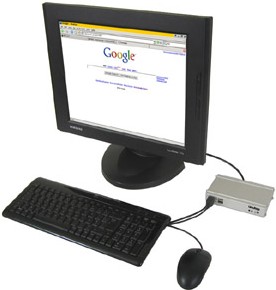
I promised last week that I would be telling more on October 1st, about the mysterious Project X that I had been sporadically blogging about over the last few months. Better late than never, so here's the story: Casablanca I met Morocco-based French entrepreneur Laurent Bervas via his blog in January 2006, while looking for countries nearby EU with a promising ICT market, because of growing obstacles in getting work in my field, due to my not being an EU national. By the time the situation had reached the ridiculous extreme that friends were continuously loosing juicy recruitment bonuses, simply because their employer's HR department had issues with hiring non-EU nationals despite EU policies that clearly favor foreigners married to an EU national I figured that I ought to do something creative and see which of the countries bordering with EU might offer interesting opportunities. Laurent was blogging about all the exciting opportunities he kept on seeing, since he relocated to Morocco to conquer the high-end Real Estate market. One day, he wrote about Morocco becoming a rising figure in the outsourcing business for the Francophone market, which prompted me to contact him. After a couple of weeks of discussion, he cautiously dropped his idea for a niche market he had spotted: a simple Linux-based set top box to surf the Internet. He then asked if I would be interested in developing it and in launching a startup with him to promote it. I gladly accepted. Startup That's when Laurent decided to introduce me to an old friend of his, Fr d ric Baille, who spent several years at Compaq, culminating with a role in the team that launched the iPaq. Fred's help was instrumental in defining the market positioning of our product. Laurent and I discussed the product features at length over IM and immediately agreed that the OS would be based on Free Software. That left the hardware part unresolved... or so did Laurent think. Years ago, I briefly worked in the management team of an Estonian data security startup. This gave me the opportunity to network with several movers and shakers of the Estonian ICT. Among them was a promising ASIC and industrial design startup that produced really cool Thin Client hardware. The answer to our hardware needs, I figured, could easily be fulfilled by them. My idea of contracting the hardware to Estonia was initially received with skepticism, so I made a simple proposal: why don't we hold the inception meeting in Tallinn and meet with the potential hardware supplier at the same time? Fred and Laurent accepted, so we spent part of April 2006 there, with me acting both as their friendly tourist guide and as the middleman for the introductions. Fred and Laurent immediately fell in love with Tallinn's designer bars, omnipresent WiFi network and blond-a-plenty. Most of all, their visit at our potential hardware supplier gave them the answers they needed: Estonia is IT. Overview The hardware we selected is built around the AMD Geode LX, a nifty Pentium-compatible single-chip computer. It comes equipped with VGA output and four USB 2.0 ports, along with high-quality audio via 1/8" input and output jacks, plus a built-in encryption engine. We added 100baseT Ethernet connectivity (with provision for other networking options) to that, to complete the platform. For the software part, we used ingredients from Debian's Etch release, focusing on a configuration that would enable easy access to the most popular applications for home and small business use: Instant Messenger (Gaim), Multimedia player (Totem), PDF reader (Evince), Web browser (Firefox), word processor (AbiWord). The result is this: Press Coverage The editorial team at IT-Neeger (an A-level Estonian ICT blog) immediately scooped the story [in Estonian] and it produced such a strong response that the traditional Estonian media contacted the IT-Neeger team to write a feature article (stay tuned for details). The local Slashdot, Minut.EE, also reported [in Estonian] on the IT-Neeger article. Thus, myself and Laurent Bervas spent the better part of this week being blogged, interviewed and podcasted by a variety of Estonian and French publications, which is how I only got around blogging this bit tonight. Marketing Contrary to our competitors, we fully intend on keeping this platform open, so our initial market will actually be Free Software developers with a penchant for innovation. As such, our first 50 units are exclusively intended for interested developers who want to improve upon our initial idea and participate in defining the final product. Inquiries are welcome!

Adam Rosi-Kessel: Absurd Copyright Law Case of the Day

I’m visiting my parents’ house in Vermont, where they finally got cable after the provider agreed to dig up the ground and run a mile or so of cable to their house in return for a two year subscription agreement. (I think after two years the cable company will almost have broken even on the cost of the installation). Having been absent myself from the cable world for some time, I am impressed by the variety of interactive and “on demand” options. My parents’ low-end package includes dozens of free on-demand movies and music videos, as well as built-in easy-to-use tivo-like functionality. The on-demand music videos show one brief ad before the video — it seems the tradeoff is that if you are really going to watch the ad, they can get more money and show you fewer ads. (Or, maybe I’m wrong — if it’s one ad per video, I suppose that would be more ads, but it feels like fewer because of the “on demand” nature. I guess it’s a perceptual trick.) Anyway, getting to the title of this entry. Anybody in the field of intellectual property these days has got to find Weird Al Yankovic’s music video for Don’t Download This Song (warning, myspace page, authorized by Weird Al!) (or, here) (warning, YouTube page, also authorized by Weird Al!) at least a little amusing. If you haven’t watched it, see it now. The opening verse goes like this:

Once in a while maybe you will feel the urge
To break international copyright law
By downloading MP3s from file sharing sites
Like Morpheus or Grokster, or Limeware or Kazaa
But deep in your heart you know the guilt would drive you mad
And the shame would leave a perminant scar
Cuz you’d start out stealing songs, then you’re robbing liquor stores
And selling crack and running over school kids with your car
On the cable video-on-demand channel, however, the names of all the filesharing services (Morpheus, Grokster, Limewire, and Kazaa), are all replaced with beeps, as if they were vulgarities unfit for broadcast. Or cable. If you had never seen the video online, you’d actually be likely to think this was another Weird Al joke — that he can’t even sing the names of (the mostly now defunct) filesharing services publicly. But I’m pretty sure the video was censored by the cable provider or distributor and the irony is wholly unintended. There are a couple of possibilities here. One is that the distributor was trying to avoid inducement liability under the Supreme Court’s decision in MGM v. Grokster. Could a funny song about filesharing actually meet the inducement standard? I sure hope not. The other possibility is that the distributor just found the references too abhorrent to leave in — basically the equivalent of the seven dirty words banned from broadcast TV and radio. Either way, if Weird Al were dead, I’m sure he’d be spinning in his grave. We’re lucky he’s still kicking. (“case” is kind of a misnomer for the title here, but is included for consistency).

8 October 2006

Biella Coleman: ABILIFY THIS

Yesterday I was catching up with my magazine reading at Chapters (the Canadian equivalent of Border) when I came across an ad for a drug ad for bipolar disorder that struck me as slightly different less euphoric, more cautious to be exact compared with the ads that have been bandied loosely in all sorts of magazines in the last decade in the US. The ad was for a drug called Abilify which must be some verbal riff on Ability (no?) and there was a very clear pronouncement on that ad that admitted they had no idea how the drug even worked. It went like this: ABILIFY may work by adjusting dopmamine activity instead of completely blocking it and by adjusting serotonin activity. However, the exact way any medicine for bipolar disorder works is unknown. I find this interesting because its tone seems to depart from other ads that seem somewhat more confident (or if they were less so, it was probably kept in the fine print). But when I went to the webpage, this caveat was a little harder to find, as it was a few clicks away within a page entitlted The Brain, Bipolar I Disorder, and ABILIFY . It provides a “handy” pictoral representation of what may be going on with your brain with bipolar disorder/treatment. I found the series somewhat odd and amusing, especially the one that used a magnifying glass to see” all the neurons and nerves or whatever they are in your brain. update: so you know, the US and New Zealand are the only 2 countries that allow drug direct to consumer advertising so I am not sure what the ad was doing in this magazine. It was American magazine but in Canada. I would think they would make them get rid of ads like that. Anyone know why it can slip through the border like that?

Petr Rockai: power management on a linux laptop

I have been using powersave until recently, but I have gone from unhappy to fed up. I also have acpi-support and laptop-mode-tools and hell knows how they all interact. To add insult to the injury, powersave loves to crash or get stuck at times and dbus screws up at times too, which in turn screws powersave. Oh dear. So i have ditched powersave, left laptop-mode-tools and acpi-support around. And i wrote a perl script, i have called it "pm" to handle things i used powersave for. Primarily dpm (device power management) in linux, suspend to ram/disk, battery monitoring and friends. Right now it's ~250 LOC with comments, and more importantly, i know how it works. And it can do things powersave can't. So i am basically happy. It can suspend and resume pci devices (using id<->function mapping) and report their status. It has a very slim suspend wrapper, that just locks screen, syncs drives, remembers power states of pci devices and asks kernel to suspend. After resuming, it restores power states, does chvt voodoo to wake up my intel graphics and sets drive spindown timeout (something, somewhere screws this one up). I also added a "summary" output, that i run using watch on one of terminals in my screen session, that reports cpu frequency and scaling policy, system temperature, battery state (including charge/discharge rate in watts and remaining capacity in mAh), harddrive state (when spinning, also temperature and number of spinups in the drive's lifetime... if you know how to get those two without spinning up the drive, tell me). Then power states of devices (usb, ethernet, wlan, sound, modem, pcmcia, smartcard controller and isa bridge). And as a cherry on top, a list of processes and pids that have recently caused block reads from the drive (needs vm/block_dump enabled in kernel), so you can find out what caused drive spinup. That is about it, now for the catch. It works for me, it probably won't for you, at least not out of the box, unless you have same laptop as me. The pci ids of devices are hardcoded (although not hard to change near the top of the script), so is the screen lock function and probably a bunch of other things. It shouldn't be hard to make a similar script for your system using mine as a starting point though. Another thing that is missing is a nice reporter for KDE to be put on the panel or somesuch. Also, since the script is simplistic in its design, it assumes lots of things about both kernel (tested on 2.6.16 stock debian) and userspace utilities (acpi, hdparm, smartctl) and (oh, coarse-grained evilness), that you have sudo (needed for hdparm at least). Another assumption is that you have single battery and single cpu. But for all the limitations, it goes that if you are going to use a script like that, you probably know enough to extend it to multi-battery and/or multi-core situations. The script definitely needs a hacker-nature :-). So for the brave, the script is to be found on the pm page.

Erich Schubert: On Google Reader

First of all, I havn't really used Google reader yet. I think I tried it a long long time ago once, and they apparently did a UI redesign. However, it doesn't work for me anymoe, all I get is "Loading..." (and a Javascript error). I'm using liferea, and I'm quite happy with it. Some of the things I do like: Because of these I can't imagine using an online reader. P.S. If you fold your blog entries or don't do full-text RSS, I likely won't read your entries, either. It doesn't work with offline reading habits.

Uwe Hermann: Unmaintained GNU packages need new maintainer: a2ps, fontutils, thales

I stumbled over this page on gnu.org yesterday, which says that the a2ps, fontutils, and thales packages are in need of new maintainers. Especially a2ps has often been very useful to me, so I instantly added it to the Unmaintained Free Software wiki (the other two will follow soon). It would be nice if someone could take over these packages, fix some bugs, and generally keep them in shape. I don't like seeing such useful programs die.

Ian Murdock: Google Reader gets it right

Google Reader relaunched a few weeks ago, and for the first time since my initial foray into blogging with Radio Userland in 2003, I’m actually enjoying using an RSS reader. Why? River of news. Most feed readers inexplicably model the email workflow, presenting feeds like folders and feed items like messages. Given the state of most peoples’ inboxes, why on earth would you model email when you’re writing one of these things? Google Reader does river of news right. Simply click on “All items” and scroll through the items with the mouse wheel, clicking on the interesting stories (or reading them inline when the feed is full text). Google Reader takes care of marking the items read as they scroll past. Automatically. The praise doesn’t stop there. There are handy keyboard shortcuts (”n” for next item, “r” to refresh, etc.). Performance is excellent, as feed items are loaded on demand using AJAXy techniques. The look and feel is clean and simple, reminiscent of Gmail, down to easy to read timestamps like “9:53 AM (7 minutes ago)”; and, also like Gmail, there’s a mobile version. Intriguingly, you can sort by “auto” in addition to by newest, which presumably applies some sort of relevance algorithm to the feed items. However, it isn’t clear how it determines relevance (does it track my clicks as I scroll through the feeds, examine my broader search history, what?). Google Reader is a good platform citizen too. There’s a gadget you can add to your personalized Google home page, and gadgets, in case you missed it, are becoming full fledged web components as of last week. Oh, there’s an API too. Finally, in concert with Mozilla Firefox 2, subscribing to feeds finally no longer involves configuring a bookmarklet or, worse, the complex gymnastics of right click/copy link location/go to the appropriate URL/paste/subscribe. With Firefox 2, you can configure the feed subscriber to use Google Reader. As a result, you can now click on the feed icon in the address bar to subscribe to the site’s feed. In most cases, you can even click on a link to an RSS/Atom feed, for those sites that don’t have autodiscovery configured properly. My only complaint here is that it doesn’t remember that I want to subscribe in Google Reader; rather, it asks whether I want to “Add to Google Homepage” or “Add to Google Reader” every time. Ideally, it would show me a preview of the feed instead. I’ve seen Google Reader do that before, so perhaps it’s just a matter of configuring it to go to a different URL, though I’m not sure how to do that. So, what’s not to like here? As with most Google products, it’s not particularly well integrated with the Google platform. Indeed, in that particular post, I complained that there were three different ways of creating a bookmark in the Google platform. Well, there now appear to be four. If all of these mechanisms were integrated, that would be enormously powerful. See something interesting in the Google Reader? Click on the star and, optionally, add tags. See something interesting on the search results page? Ditto. See something interesting on a random webpage? Pull down a menu on the Google Toolbar and do the same thing that way. Want to add free form notes to any of the above bookmarks? Pop into Google Notebook. Naturally, all of these actions should result in the bookmarks/tags/notes/etc. being added to a single stream that can be shared with other users, with all of the resulting social network functionality. Etc. etc. etc. Sigh. I guess I have to be patient a little bit longer. Fortunately, Google sees the problem and is finally doing something about it.

Next.

Previous.