Search Results: "tim"

5 December 2020

Thorsten Alteholz: My Debian Activities in November 2020

FTP master Unfortunately a day only has 24h. As the freeze is approaching, I had to concentrate a bit more on keeping my packages in shape. So this month I only accepted nine packages. The good news, I rejected no package. The overall number of packages that got accepted was 328. Debian LTS This was my seventy-seventh month that I did some work for the Debian LTS initiative, started by Raphael Hertzog at Freexian. This month my all in all workload has been 22.75h. During that time I did LTS uploads of: I also started to work on x11vnc and slirp. Last but not least I did some days of frontdesk duties. Debian ELTS This month was the twenty ninth ELTS month. During my allocated time I uploaded: Unfortunately I also had to give back some hours. Last but not least I did some days of frontdesk duties. Other stuff This month I uploaded new upstream versions of: I fixed one or two bugs in: I improved packaging of: and there have been even some new packages: As it is again this time of the year, I would also like to draw some attention to the Debian Med Advent Calendar. Like the past years, the Debian Med team starts a bug squashing event from the December 1st to 24th. Every bug that is closed will be registered in the calendar. So instead of taking something from the calendar, this special one will be filled and at Christmas hopefully every Debian Med related bug is closed. Don t hesitate, start to squash :-). The announcement on the mailing list can be found here.

4 December 2020

Jonathan Dowland: Toronto

selfie skating at night
Nathan Phillips Square rink at night
view over Nathan Phillips Square rink
skaters by day
This time a year ago, I visited Toronto, Canada for my first (and hopefully not last) time, for the Red Hat Java team's face-to-face meetings. The hotel we were staying in was right next to Nathan Phillip's Square, which is an open-air Ice Rink for the winter months. I love Ice Skating and rarely took opportunities to do it (even before Covid-19) so I decided to take full advantage of the locality. Skating was free, but boot rental was not, so I bought some new skates. That meant an interesting problem getting them home on the plane. I think I got out there about 5 times over 5 days. It was busy during the day and very quiet at other times. 8am worked pretty well. My local Ice Rink has been intermittently open over the year as and when the Lockdown rules have allowed it, but the combination of cold air, indoor circulation and strenuous activity seem to me to be very unsafe, so I won't risk it. In Newcastle, the Centre for Life usually puts an outdoor rink on around Christmas, which is very expensive to skate on. Unfortunately they've decided against it this year. Toronto was great for more than just Ice Skating! I had a fantastic time meeting my team members; good food, good drink (especially Ice Wine); The CN Tower; a funky music instrument shop, and the first Teenage Engineering OP-1 I've ever seen in the flesh; not much Maple syrup, which surprised me. Good coffee. A comfortable-feeling city. It'll probably be a long while before I travel for work (or anything else) quite like this again. I'm glad to have made the most of it, whilst I could!
me, covered in snow

Russell Coker: ZFS 2.0.0 Released

Version 2.0 of ZFS has been released, it s now known as OpenZFS and has a unified release for Linux and BSD which is nice. One new feature is persistent L2ARC (which means that when you use SSD or NVMe to cache hard drives that cache will remain after a reboot) is an obvious feature that was needed for a long time. The Zstd compression invented by Facebook is the best way of compressing things nowadays, it s generally faster while giving better compression than all other compression algorithms and it s nice to have that in the filesystem. The PAM module for encrypted home directories is interesting, I haven t had a need for directory level encryption as block device encryption has worked well for my needs. But there are good use cases for directory encryption. I just did a quick test of OpenZFS on a VM, the one thing it doesn t do is let me remove a block device accidentally added to a zpool. If you have a zpool with a RAID-Z array and mistakenly add a new disk as a separate device instead of replacing a part of the RAID-Z then you can t remove it. There are patches to allow such removal but they didn t appear to get in to the OpenZFS 2.0.0 release. For my use ZFS on Linux 0.8.5 has been working fairly well and apart from the inability to remove a mistakenly added device I haven t had any problems with it. So I have no immediate plans to upgrade existing servers. But if I was about to install a new ZFS server I d definitely use the latest version. People keep asking about license issues. I m pretty sure that Oracle lawyers have known about sites like zfsonlinux.org for years, the fact that they have decided not to do anything about it seems like clear evidence that it s OK for me to keep using that code.

Russell Coker: KDE Icons Disappearing in Debian/Unstable

One of my workstations is running Debian/Unstable with KDE and SDDM on an AMD Radeon R7 260X video card. Recently it stopped displaying things correctly after a reboot, all the icons failed to display as well as many of the Qt controls. When I ran a KDE application from the command line I got the error QSGTextureAtlas: texture atlas allocation failed, code=501 . Googling that error gave a blog post about a very similar issue in 2017 [1]. From that blog post I learned that I could stop the problem by setting MESA_EXTENSION_OVERRIDE= -GL_EXT_bgra -GL_EXT_texture_format_BGRA8888 in the environment. In a quick test I found that the environment variable setting worked, making the KDE apps display correctly and not report an error about a texture atlas. I created a file ~/.config/plasma-workspace/env/bgra.sh with the following contents:
export MESA_EXTENSION_OVERRIDE="-GL_EXT_bgra -GL_EXT_texture_format_BGRA8888"
Then after the next login things worked as desired! Now the issue is, where is the bug? GL, X, and the internals of KDE are things I don t track much. I welcome suggestions from readers of my blog as to what the culprit might be and where to file a Debian bug or a URL to a Debian bug report if someone has already filed one. Update When I run the game warzone2100 with this setting it crashes with the below output. So this Mesa extension override isn t always a good thing, just solves one corner case of a bug.
$ warzone2100 
/usr/bin/gdb: warning: Couldn't determine a path for the index cache directory.
27      ../sysdeps/unix/sysv/linux/wait4.c: No such file or directory.
No frame at level 0x7ffc3392ab50.
Saved dump file to '/home/etbe/.local/share/warzone2100-3.3.0//logs/warzone2100.gdmp-VuGo2s'
If you create a bugreport regarding this crash, please include this file.
Segmentation fault (core dumped)
Update 2 Carsten provided the REAL solution to this, run apt remove libqt5quick5-gles which will automatically install libqt5quick5 which makes things work. Another workstation I run that tracks Testing had libqt5quick5 installed which was why it didn t have the problem. The system in question had most of KDE removed due to package dependency issues when tracking Unstable and when I reinstalled it I guess the wrong one was installed.

Dirk Eddelbuettel: #31: Test your R package against bleeding-edge gcc

Welcome to the 31th post in the rapturously rampant R recommendations series, or R4 for short. This post will once again feature Docker for use with R. Earlier this week, I received a note from CRAN about how my RcppTOML package was no longer building with the (as of right now of course unreleased) version 11 of the GNU C++ compiler, i.e. g++-11. And very kindly even included a hint about the likely fix (which was of course correct). CRAN, and one of its maintainers in particular, is extremely forward-looking in terms of toolchain changes. A year ago we were asked to updated possible use of global variables in C code as gcc-10 tightened the rules. This changes is a C++ one, and a fairly simple one of simply being more explicit with include headers. Previous g++ release had done the same. The question now was about the least painful way to get g++-11 onto my machine, with the least amount of side-effects. Regular readers of this blog will know where this is headed, but even use of Docker requires binaries. A look at g++-11 within packages.debian.org comes up empty. No Debian means no Ubuntu. But there is a PPA for Ubuntu with toolchain builds we have used before. And voil there we have it: within the PPA for Ubuntu Toolchain repository is the volatile packages PPA with both g++-10 and g++-11. Here Ubuntu 20.10 works with g++-10, but g++-11 requires Ubuntu 21.04. Docker containers are there for either. So with the preliminaries sorted out, the key steps are fairly straightforward: And that is it! RcppTOML is fairly minimal and could be a member of the tinyverse so no other dependencies are needed if your package has any you could just use the standard steps to install from source, or binary (including using RSPM or bspm). You can see the resulting Dockerfile which contains a minimal amount of extra stuff to deal with some environment variables and related settings. Nothing critical, but it smoothes the experience somewhat. This container is now built (under label rocker/r-edge with tags latest and gcc-11), and you can download it from Docker Hub. With that the proof of the (now fixed and uploaded) package building becomes as easy as

edd@rob:~/git/rcpptoml(master)$ docker run --rm -ti -v $PWD:/mnt -w /mnt rocker/r-edge:gcc-11 g++ --version
g++ (Ubuntu 11-20201128-0ubuntu2) 11.0.0 20201128 (experimental) [master revision fb6b29c85c4:a331ca6194a:e87559d202d90e614315203f38f9aa2f5881d36e]
Copyright (C) 2020 Free Software Foundation, Inc.
This is free software; see the source for copying conditions.  There is NO
warranty; not even for MERCHANTABILITY or FITNESS FOR A PARTICULAR PURPOSE.

edd@rob:~/git/rcpptoml(master)$ 
edd@rob:~/git/rcpptoml(master)$ docker run --rm -ti -v $PWD:/mnt -w /mnt rocker/r-edge:gcc-11 R CMD INSTALL RcppTOML_0.1.7.tar.gz
* installing to library  /usr/local/lib/R/site-library 
* installing *source* package  RcppTOML  ...
** using staged installation
** libs
g++ -std=gnu++11 -I"/usr/share/R/include" -DNDEBUG -I../inst/include/ -DCPPTOML_USE_MAP -I'/usr/lib/R/site-library/Rcpp/include'    -fpic  -g -O2 -fdebug-prefix-map=/build/r-base-Fuvi9C/r-base-4.0.3=. -fstack-protector-strong -Wformat -Werror=format-security -Wdate-time -D_FORTIFY_SOURCE=2 -g  -c RcppExports.cpp -o RcppExports.o
g++ -std=gnu++11 -I"/usr/share/R/include" -DNDEBUG -I../inst/include/ -DCPPTOML_USE_MAP -I'/usr/lib/R/site-library/Rcpp/include'    -fpic  -g -O2 -fdebug-prefix-map=/build/r-base-Fuvi9C/r-base-4.0.3=. -fstack-protector-strong -Wformat -Werror=format-security -Wdate-time -D_FORTIFY_SOURCE=2 -g  -c parse.cpp -o parse.o
g++ -std=gnu++11 -shared -L/usr/lib/R/lib -Wl,-Bsymbolic-functions -Wl,-z,relro -o RcppTOML.so RcppExports.o parse.o -L/usr/lib/R/lib -lR
installing to /usr/local/lib/R/site-library/00LOCK-RcppTOML/00new/RcppTOML/libs
** R
** inst
** byte-compile and prepare package for lazy loading
** help
*** installing help indices
** building package indices
** testing if installed package can be loaded from temporary location
** checking absolute paths in shared objects and dynamic libraries
** testing if installed package can be loaded from final location
** testing if installed package keeps a record of temporary installation path
* DONE (RcppTOML)
edd@rob:~/git/rcpptoml(master)$ 
I hope both the availability of such a base container with gcc-11 (and g++-11 and gfortran-11) as well as a recipe for building similar containers with newer clang version will help other developers. If you like this or other open-source work I do, you can sponsor me at GitHub.

This post by Dirk Eddelbuettel originated on his Thinking inside the box blog. Please report excessive re-aggregation in third-party for-profit settings.

3 December 2020

Andrew Cater: Preparing for release of Debian 10.7 over the weekend and CentOS / Scientific Linux 6.x and EPEL for 6 now EOL

For those keeping score:This weekend - 5th December 2020 - should see us release Debian 10.7 - an update to Debian stable (Buster) so I should be spending a day or so in the company of my friends and colleagues.Red Hat 6.10 is now out of support unless you pay Extended Update subscriptions for individual Red Hat machines. This means that CentOS 6.* has now been removed from CentOS mirrors since these were dependent on Red Hat 6 sources.. Similarly, Scientific Linux have also removed their fork of 6.*. They are continuing to support a Scientific Linux 7 but suggest a move to CentOS 8 thereafter.
Separately, Fedora Linux have removed EPEL 6.* - definitely time to update to Red Hat/CentOS/Scientific Linux 7.* or greater for those affected.
All the very best to all:

Alberto Garc a: Subcluster allocation for qcow2 images

In previous blog posts I talked about QEMU s qcow2 file format and how to make it faster. This post gives an overview of how the data is structured inside the image and how that affects performance, and this presentation at KVM Forum 2017 goes further into the topic. This time I will talk about a new extension to the qcow2 format that seeks to improve its performance and reduce its memory requirements. Let s start by describing the problem. Limitations of qcow2 One of the most important parameters when creating a new qcow2 image is the cluster size. Much like a filesystem s block size, the qcow2 cluster size indicates the minimum unit of allocation. One difference however is that while filesystems tend to use small blocks (4 KB is a common size in ext4, ntfs or hfs+) the standard qcow2 cluster size is 64 KB. This adds some overhead because QEMU always needs to write complete clusters so it often ends up doing copy-on-write and writing to the qcow2 image more data than what the virtual machine requested. This gets worse if the image has a backing file because then QEMU needs to copy data from there, so a write request not only becomes larger but it also involves additional read requests from the backing file(s). Because of that qcow2 images with larger cluster sizes tend to: Unfortunately, reducing the cluster size is in general not an option because it also has an impact on the amount of metadata used internally by qcow2 (reference counts, guest-to-host cluster mapping). Decreasing the cluster size increases the number of clusters and the amount of necessary metadata. This has direct negative impact on I/O performance, which can be mitigated by caching it in RAM, therefore increasing the memory requirements (the aforementioned post covers this in more detail). Subcluster allocation The problems described in the previous section are well-known consequences of the design of the qcow2 format and they have been discussed over the years. I have been working on a way to improve the situation and the work is now finished and available in QEMU 5.2 as a new extension to the qcow2 format called extended L2 entries. The so-called L2 tables are used to map guest addresses to data clusters. With extended L2 entries we can store more information about the status of each data cluster, and this allows us to have allocation at the subcluster level. The basic idea is that data clusters are now divided into 32 subclusters of the same size, and each one of them can be allocated separately. This allows combining the benefits of larger cluster sizes (less metadata and RAM requirements) with the benefits of smaller units of allocation (less copy-on-write, smaller images). If the subcluster size matches the block size of the filesystem used inside the virtual machine then we can eliminate the need for copy-on-write entirely. So with subcluster allocation we get: This figure shows the average number of I/O operations per second that I get with 4KB random write requests to an empty 40GB image with a fully populated backing file.
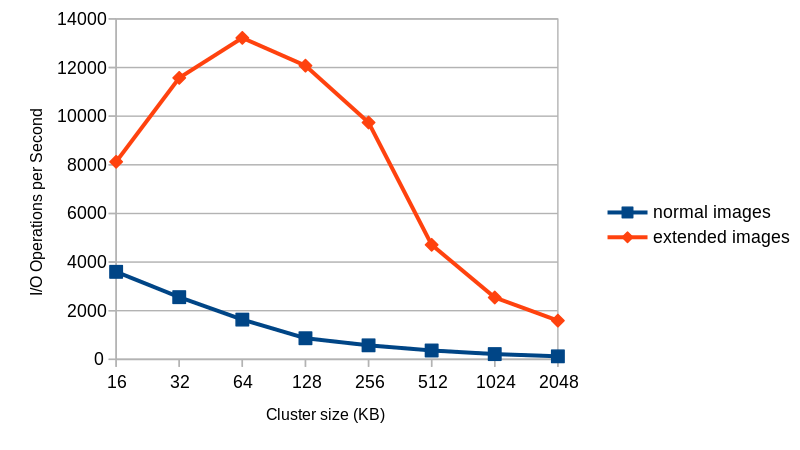
I/O performance comparison between traditional and extended qcow2 images
Things to take into account: How to use this? Extended L2 entries are available starting from QEMU 5.2. Due to the nature of the changes it is unlikely that this feature will be backported to an earlier version of QEMU. In order to test this you simply need to create an image with extended_l2=on, and you also probably want to use a larger cluster size (the default is 64 KB, remember that every cluster has 32 subclusters). Here is an example:
$ qemu-img create -f qcow2 -o extended_l2=on,cluster_size=128k img.qcow2 1T
And that s all you need to do. Once the image is created all allocations will happen at the subcluster level. More information This work was presented at the 2020 edition of the KVM Forum. Here is the video recording of the presentation, where I cover all this in more detail: You can also find the slides here. Acknowledgments This work has been possible thanks to Outscale, who have been sponsoring Igalia and my work in QEMU.
Igalia and Outscale
And thanks of course to the rest of the QEMU development team for their feedback and help with this!

Bdale Garbee: Shifting Emphasis

I joined the Debian project in late 1994, well before the first stable release was issued, and have been involved in various ways continuously ever since. Over the years, I adopted a number of packages that are, or at least were at one time, fundamental to the distribution. But, not surprisingly, my interests have shifted over time. In the more than quarter century I've contributed to Debian, I've adopted existing packages that needed attention, packaged new software I wanted to use that wasn't yet in Debian, offered packages up for others to adopt, and even sometimes requested the removal of packages that became obsolete or replaced by something better. That all felt completely healthy. But over the last couple weeks, I realized I'm still "responsible" for some packages I'd had for a very long time, that generally work well but over time have accumulated bugs in functionality I just don't use, and frankly haven't been able to find the motivation to chase down. As one example, I just noticed that I first uploaded the gzip package 25 years ago today, on 2 December 1995. And while the package works fine for me and most other folks, there are 30 outstanding bugs and 3 forwarded bugs that I just can't muster up any energy to address. So, I just added gzip to a short list of packages I've offered up for adoption recently. I'm pleased that tar already has a new maintainer, and hope that both sudo and gzip will get more attention soon. It's not that I'm less interested in Debian. I've just been busy recently packaging up more software I use or want to use in designing high power model rockets and the solid propellant motors I fly in them, and would rather spend the time I have available for Debian maintaining those packages and all their various build dependencies than continuing to be responsible for core packages in the distribution that "work fine for me" but could use attention. I'm writing about this partly to mark the passing of more than a quarter century as a package maintainer for Debian, partly to encourage other Debian package maintainers with the right skills and motivation to consider adopting some of the packages I'm giving up, and finally to encourage other long-time participants in Debian to spend a little time evaluating their own package lists in a similar way.

Dirk Eddelbuettel: RcppTOML 0.1.7: Support for g++-11, Minor Updates

A new RcppTOML release arrived on CRAN earlier today evening. RcppTOML brings TOML to R. TOML is a file format that is most suitable for configurations, as it is meant to be edited by humans but read by computers. It emphasizes strong readability for humans while at the same time supporting strong typing as well as immediate and clear error reports. On small typos you get parse errors, rather than silently corrupted garbage. Much preferable to any and all of XML, JSON or YAML though sadly these may be too ubiquitous now. TOML has been making inroads with projects such as the Hugo static blog compiler, or the Cargo system of Crates (aka packages ) for the Rust language. CRAN had sent us a note that the package no longer compiled under the [unreleased, of course, never change, BDR ;-) ] g++-11 compiler, but were kind enough to hint that it was only lacking an #include <limits>. These things happen: newer compilers are generally more strict, and that is generally a good things. (Last year this time we prepped code for the more stringent view on global variables under gcc-10. Earlier g++ version had similar demands to clarify include headers.) I set up a simple Docker contain with on Ubuntu 21.04 with g++-11, R, and Rcpp to build the package and make this change (which was of course also PR ed upstream at cpptoml), plus some other small ones that update the package since the last release roughly 18 months ago. We also switched CI use to the r-ci setup I should blog about a little more, removed a bashism and updated a few URLs. The bulleted list of changes in this version follows.

Changes in version 0.1.7 (2020-12-01)
  • Add #include <limits> to header file, also contributed upstream, to permit compilation under the (unreleased) g++-11.
  • Switch the simple cleanup script to sh.
  • Switch CI use to r-ci for focal and bspm.
  • Update several TOML URLs to https://toml.io/en/.

Courtesy of my CRANberries, there is a diffstat report for this release. More information is on the RcppTOML page page. Please use the GitHub issue tracker for issues and bugreports. If you like this or other open-source work I do, you can sponsor me at GitHub.

This post by Dirk Eddelbuettel originated on his Thinking inside the box blog. Please report excessive re-aggregation in third-party for-profit settings.

2 December 2020

Norbert Preining: Debian KDE/Plasma Status 2020-12-02

Another month worth of updates on KDE/Plasma in Debian has accumulated, so here we go. The highlights are: Plasma 5.19.5 based on Qt 5.15 is in Debian/unstable and testing, Plasma 5.20.4 is waiting to be uploaded soon to experimental, and my own builds at OBS have been updated to Plasma 5.20.4, Frameworks 5.76, Apps 20.08.3. OBS packages The OBS packages as usual follow the latest release, and currently ship KDE Frameworks 5.76, KDE Apps 20.08.3, and new, Plasma 5.20.4. The package sources are as usual (only the other-dep has disappeared, these packages are now all in Debian proper), for Debian/unstable:
deb https://download.opensuse.org/repositories/home:/npreining:/debian-kde:/frameworks/Debian_Unstable/ ./
deb https://download.opensuse.org/repositories/home:/npreining:/debian-kde:/plasma520/Debian_Unstable/ ./
deb https://download.opensuse.org/repositories/home:/npreining:/debian-kde:/apps2008/Debian_Unstable/ ./
deb https://download.opensuse.org/repositories/home:/npreining:/debian-kde:/other/Debian_Unstable/ ./
and the same with Testing instead of Unstable for Debian/testing. The latest update to 5.20.4 will probably need one or two install cycles due to missing Replaces. The reason is that the packages in OBS have been synced with the work we have done for the official Debian packages, and thus some files have moved between packages. Debian main packages After a few hiccups, the whole Plasma 5.19.5 stack has landed in Debian/testing, and we are working on an upload of 5.20.4 to Debian/experimental. This takes a bit, because we want to add infrastructure to automatically force all packages to be upgraded only together, so that there is no mix between old and new packages. This has shown quite some problems during the upgrade from 5.17 to 5.19 in testing. Also, I don t think Debian needs to do something else than everybody else by allowing to mix Plasma released. That said, I hope that we have an upload of 5.20 to experimental soon, followed by testing and an upload to unstable, so that it can migrate to testing in time for the freeze of Bullseye. Getting 5.20.5 into Bullseye is possible, but not guaranteed, not too much time between the release of 5.20.5 and proper freeze in Debian. But we will see. Enjoy.

1 December 2020

Shirish Agarwal: The Constitution of Knowledge

Truth, Untruths and Education in India. I read this somewhat disturbing and yet pretty raw truth from foreign affairs. It took me quite a few days to not only digest but also say yes and see the same situation playing out in India. I have been seeing the discourse on Twitter and while a part of it is the equivalent of road rage, a huge part is a disconnect to not acknowledge and be civil. We may come to different conclusions from the same data but being civil seems to be difficult for a lot of people. One part is of course ego, where nobody wants to lose, but more than that are the plain comprehension issues. Most of the literature, good literature is unfortunately based in English.

And while we can have differing opinions of what constitutes good literature, for me it s books like Battle of Belonging,The:On Nationalism, Patriotism, and What it Means Shashi Tharoor. From what little I have understood, the book makes the case of civic nationalism which is far more inclusive than the narrow confines of patriotism. Now this begs the question when you have such books and many books which do tell you about different aspects of social, political and knowledge, why are so many people prone to disinformation in India similar to U.S. and probably other countries as well. One of the biggest reasons per-se is lack of education and quality education. When the number of graduates is less than five percent how do you expect that population to be able to take decisions in their economic self-interest? So sadly the understanding is ingrained from WhatsApp and there is no need to check from alternate sources. And just like Mr. Trump followers, they believe those versions to be the unvarnished truth. I do understand that no truth is immutable except for life and death. All others are imperfect unless it is validated by some sort of scientific validation behind it. At the same time, these truths may themselves be invalidated if a stronger scientific evidence establishes itself. This is the reason why hypothesis and facts themselves are challenged again and again. Sharing couple of examples below.

Nationalization of Banking, RERA and RCEP Most of the people want freedom of the banks i.e. private banking don t really know that private banking existed at a time in free India before they were nationalized and these banks failed at surprisingly regular intervals. Now it isn t as if this fact is hidden but it is not as popular as maybe some other facts or ideas. Now the Government in the center obviously doesn t want to share these facts as they want corporates in banking. And if that fact is known by many people it will be a huge setback to their plans. RBI failures have been to many to count. Even recent legislations like RERA and others which were supposed to bring relief to millions of potential homeowners has become a pawn in the hands of builders and this has been known. One of the interesting points of RCEP which is not so much in public domain is that RCEP would have a mere 4.5% duty on most products which will go down to 1.5% over a 20 year period. Now with India staying out of it, we have done two things. We have said that we will not be competitive even after 20 years of this which is the more damning part. And we will not take part in the growth that other countries will have due to this. Contempt Proceedings against Comic Artist because she has an opinion on SC The fall in SC and constitutional values grows day by day. The AG today consented to have contempt proceedings against a comic artist saying she insulted the SC. Gone are the days when an artist made fun of the PM, and she gave him a Padam Shri (one of the highest civilian honors) for his contributions. Then, even dissent or being cynical was looked as being a contribution to the national effort rather than today. This is the reason why India has been continuously falling in the Global Freedom of Expression Index. I have seen censoring many a time here. I, myself has been locked out of Wikipedia many times. Can you imagine, being locked out of Wikipedia which is perhaps one of the more neutral sites on the web. And then there was this wikibio thing, such a sad thing to happen. Guessing this is the future of the Indian interweb.
Stick figure by Sanitary Panels on SC

Utkarsh Gupta: FOSS Activites in November 2020

Here s my (fourteenth) monthly update about the activities I ve done in the F/L/OSS world.

Debian
This was my 23rd month of contributing to Debian. I became a DM in late March last year and a DD last Christmas! \o/ Apart from doing a bunch of activities like attending KubeCon + RubyConf (blog to follow!), et al and simultaneously giving my undergrad exams, I did (relatively) more work than I had really anticipated! Here are the following things I did in Debian this month:

Uploads and bug fixes:

Other $things:
  • Attended the Debian Ruby team meeting.
  • Mentoring for newcomers.
  • FTP Trainee reviewing.
  • Moderation of -project mailing list.
  • Sponsored phpmyadmin for William and libexif for Hugh.

Debian (E)LTS
Debian Long Term Support (LTS) is a project to extend the lifetime of all Debian stable releases to (at least) 5 years. Debian LTS is not handled by the Debian security team, but by a separate group of volunteers and companies interested in making it a success. And Debian Extended LTS (ELTS) is its sister project, extending support to the Jessie release (+2 years after LTS support). This was my fourteenth month as a Debian LTS and fourth month as a Debian ELTS paid contributor.
I was assigned 22.75 hours for LTS and 45.00 hours for ELTS and worked on the following things:
(for ELTS, I worked for 5.25 hours last month, so I had to work for 39.75 (+1 extra) hours this month)
(also, I did over-work by 5.00 hours for LTS this month, but I ll re-compensate it later to avoid so much fuss!)

LTS CVE Fixes and Announcements:

ELTS CVE Fixes and Announcements:
  • Issued ELA 306-1, fixing CVE-2020-25692, for openldap.
    For Debian 8 Jessie, these problems have been fixed in version 2.4.40+dfsg-1+deb8u7.
  • Issued ELA 310-1, fixing CVE-2020-0452, for libexif.
    For Debian 8 Jessie, these problems have been fixed in version 0.6.21-2+deb8u5.
  • Issued ELA 311-1, fixing CVE-2020-8037, for tcpdump.
    For Debian 8 Jessie, these problems have been fixed in version 4.9.3-1~deb8u2.
  • Issued ELA 312-1, backporting a new upstream release, 2020d, for tzdata.
    For Debian 8 Jessie, these problems have been fixed in version 2020d-0+deb8u1.
  • Issued ELA 313-1, fixing CVE-2020-15166, for zeromq3.
    For Debian 8 Jessie, these problems have been fixed in version 4.0.5+dfsg-2+deb8u3.
  • Prepared a debdiff for lxml (3.4.0-1+deb8u2) upload, which Emilio completed and rolled out later.

Other (E)LTS Work:
  • Front-desk duty from 26-10 until 01-10 and from 23-11 until 29-11 for both LTS and ELTS.
  • Triaged openldap, python-cryptography, motion, nvidia-cuda-toolkit, samba, lxml, highlight.js, imagemagick, mongodb, poppler, wordpress, raptor2, and blueman.
  • Marked CVE-2020-25659/python-cryptography as no-dsa for Stretch and Jessie.
  • Marked CVE-2020-25713/raptor2 as postponed for Stretch and Jessie.
  • Marked CVE-2020-27778/poppler as postponed for Stretch and Jessie.
  • Marked CVE-2020-5991/nvidia-cuda-toolkit as ignored for Stretch.
  • Marked CVE-2020-26566/motion as not-affected for Stretch.
  • Marked CVE-2020-26237/highlight.js as postponed for Jessie.
  • Auto EOL ed libpam-tacplus, motion, blueman, openrc, webcit, wordpress, linux, nvidia-cuda-toolkit, spip, and wireshark for Jessie.
  • Attended the sevent LTS meeting. Logs here.
  • General discussion on LTS private and public mailing list.

Until next time.
:wq for today.

Jonathan Carter: Free Software Activities for 2020-11

This month just went past way too fast, didn t get to all the stuff I wanted to, but managed to cover many essentials (not even listed here) that I ll cover in follow-up posts. In particular, highlights that I m thankful for are that we ve selected the final artwork for Bullseye. We ve also successfully hosted another two MiniDebConfs. One that was gaming themed, and a Brazilian event all in Portuguese! Videos are up on Debian s PeerTube instance (Gaming Edition Brazil) and on the DebConf video archive for direct download. Remember to take care of yourself out there! Physical safety is high on everyone s mind in these times, but remember to pay attention to your mental health too. It s ok if you won t hit all your usual targets and goals in these times, don t be too hard on yourself and burn out! 2020-11-01: Upload package gtetrinet (0.7.11+git20200916.46e7ade-2~bpo10+1) to Debian buster-backports. 2020-11-01: Upload package gnome-shell-extension-disconnect-wifi (26-1) to Debian unstable. 2020-11-02: Merge MR!2, MR!4 and MR!5 for zram-tools, follow 3-way merge closing MR!1 and MR!3. 2020-11-02: Upload package zram-swap (0.3.3-1) to Debian unstable (Closes: #917643, #928439, #928443). 2020-11-02: Close live-installer bugs #646704 (fix released a few years ago already), #700642 (nothing left to fix), #835391 (unproducible on latest images), #847446 (graphical d-i installer no longer provided). #714710 (problem not present on latest installation media) 2020-11-02: File ROM for calcoo (#973638) no longer maintained upstream, GTK-2 only. 2020-11-03: Upload package bundlewrap (4.2.2-1) to Debian unstable. 2020-11-03: Upload package feed2toot (0.14-1) to Debian unstable. 2020-11-03: Upload package feed2toot (0.14-2) to Debian unstable. 2020-11-03: Upload package flask-autoindex (0.6.6-2) to Debian unstable. 2020-11-03: Upload package flask-caching (1.9.0-1) to Debian unstable. 2020-11-03: Upload package flask-restful (0.3.8-5) to Debian unstable. 2020-11-08: Upload package s-tui (1.0.2-2) to Debian unstable (Closes: #961534). 2020-11-09: Merge MR!1 for bluefish (remove old icon). 2020-11-10: Upload package bluefish (2.2.12-1) to Debian unstable. 2020-11-10: Upload package calamares (3.2.33-1) to Debian unstable. 2020-11-11: Upload package calamares-settings-debian (11.0.4-1) to Debian unstable. 2020-11-17: Upload package gnome-shell-extension-multiple-workspaces (22-1) to Debian-unstable. 2020-11-24: Sponsor package xmodem (0.4.6+dfsg-2) for Debian unstable (Python Team request). 2020-11-24: Sponsor package python-opentracing (2.4.0-1) for Debian unstable (Python Team request). 2020-11-24: Sponsor package python-css-parser (1.0.6-1) for Debian unstable (Python Team request). 2020-11-24: Review package buildbot (2.8.4-1) (Needs some more work) (Python Team request). 2020-11-24: Review package gbsplay (0.0.94-1) (Needs some more work) (Games Team request). 2020-11-24: Sponsor package goverlay (0.4.2-1) for Debian unstable (Games Team request). 2020-11-24: Sponsor package lutris (0.5.8-1) for Debian unstable (Games Team request). 2020-11-24: Review package mangohud (0.5.1-1) for Debian unstable (Needs some more work) (Games Team request). 2020-11-24: Sponsor package vkbasalt (0.3.2.3-1) for Debian unstable (Games Team request). 2020-11-25: Sponsor package starfighter (2.3.3-1) for Debian unstable (Games Team request). 2020-11-25: Sponsor package pentobi (18.3-1) for Debian unstable (Games Team request). 2020-11-30: Sponsor package lutris (0.5.8-1) for Debian unstable (Games Team request) (New upload).

C.J. Adams-Collier: Rack coming together

I now have four six-port Qotom systems and one four-port Qotom system in my rack. I have successfully verified that the newest of these is capable of pulling about 745Mbit/s of 1500-byte frames through the switch from six other hosts. I bet it will push data at the same rate. but I can t get iperf to distribute it over the LAG evenly. That s another problem for another day. I know it can handle six large streams at the same time, which is great.

Paul Wise: FLOSS Activities November 2020

Focus This month I didn't have any particular focus. I just worked on issues in my info bubble.

Changes

Issues

Review

Administration
  • Debian wiki: disable attachments due to security issue, approve accounts

Communication
  • Respond to queries from Debian users and contributors on the mailing lists and IRC

Sponsors The visdom, apt-listchanges work and lintian-brush bug report were sponsored by my employer. All other work was done on a volunteer basis.

30 November 2020

Chris Lamb: Free software activities in November 2020

Here is my monthly update covering what I have been doing in the free software world during November 2020 (previous month):

Reproducible Builds One of the original promises of open source software is that distributed peer review and transparency of process results in enhanced end-user security. However, whilst anyone may inspect the source code of free and open source software for malicious flaws, almost all software today is distributed as pre-compiled binaries. This allows nefarious third-parties to compromise systems by injecting malicious code into ostensibly secure software during the various compilation and distribution processes. The motivation behind the Reproducible Builds effort is to ensure no flaws have been introduced during this compilation process by promising identical results are always generated from a given source, thus allowing multiple third-parties to come to a consensus on whether a build was compromised. The project is proud to be a member project of the Software Freedom Conservancy. Conservancy acts as a corporate umbrella allowing projects to operate as non-profit initiatives without managing their own corporate structure. If you like the work of the Conservancy or the Reproducible Builds project, please consider becoming an official supporter.
This month, I:
I also made the following changes to diffoscope:

Debian I performed the following uploads to the Debian Linux distribution this month: I also filed a release-critical bug against the minidlna package which could not be successfully purged from the system without reporting a cannot remove '/var/log/minidlna' error. (#975372)

Debian LTS This month I have worked 18 hours on Debian Long Term Support (LTS) and 12 hours on its sister Extended LTS project, including: You can find out more about the Debian LTS project via the following video:

John Goerzen: Thanksgiving in 2020

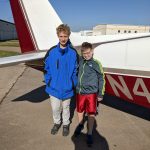
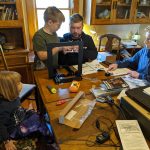
With COVID-19, Thanksgiving is a little different this year. The kids enjoyed doing a little sightseeing by air in our own plane (all socially-distanced of course!). We built a Prusa 3D printer from a kit (the boys and I, though Martha checked in periodically too). It arrived earlier than expected so that kept us busy for several days. And, of course, there was the Christmas decorating and Zoom church (where only our family is in the building, hosting the service for everyone). What, so Thanksgiving doesn t normally involve assembling printers, sightseeing from the sky, and printing tiny cups and dishes for miniature houses on a 3D printer? I ll be glad when COVID is over. Meantime, we have some memories to treasure too.

28 November 2020

Mark Brown: Book club: Rust after the honeymoon

Earlier this month Daniel, Lars and myself got together to discuss Bryan Cantrill s article Rust after the honeymoon. This is an overview of what keeps him enjoying working with Rust after having used it for an extended period of time for low level systems work at Oxide, we were particularly interested to read a perspective from someone who was both very experienced in general and had been working with the language for a while. While I have no experience with Rust both Lars and Daniel have been using it for a while and greatly enjoy it. One of the first areas we discussed was data bearing enums these have been very important to Bryan. In keeping with a pattern we all noted these take a construct that s relatively commonly implemented by hand in C (or skipped as too much effort, as Lars found) and provides direct support in the language for it. For both Daniel and Lars this has been key to their enjoyment of Rust, it makes things that are good practice or common idioms in C and C++ into first class language features which makes them more robust and allows them to fade into the background in a way they can t when done by hand. Daniel was also surprised by some omissions, some small such as the ? operator but others much more substantial the standout one being editions. These aim to address the problems seen with version transitions in other languages like Python, allowing individual parts of a Rust program to adopt potentially incompatible language features while remaining interoperability with older editions of the language rather than requiring the entire program to be upgraded en masse. This helps Rust move forwards with less need to maintain strict source level compatibility, allowing much more rapid evolution and helping deal with any issues that are found. Lars expressed the results of this very clearly, saying that while lots of languages offer a 20%/80% solution which does very well in specific problem domains but has issues for some applications Rust is much more able to move towards a much more general applicability by addressing problems and omissions as they are understood. This distracted us a bit from the actual content of the article and we had an interesting discussion of the issues with handling OS differences in filenames portably. Rather than mapping filenames onto a standard type within the language and then have to map back out into whatever representation the system actually uses Rust has an explicit type for filenames which must be explicitly converted on those occasions when it s required, meaning that a lot of file handling never needs to worry about anything except the OS native format and doesn t run into surprises. This is in keeping with Rust s general approach to interfacing with things that can t be represented in its abstractions, rather than hide things it keeps track of where things that might break the assumptions it makes are and requires the programmer to acknowledge and handle them explicitly. Both Lars and Daniel said that this made them feel a lot more confident in the code that they were writing and that they had a good handle on where complexity might lie, Lars noted that Rust is the first languages he s felt comfortable writing multi threaded code in. We all agreed that the effect here was more about having idioms which tend to be robust and both encourage writing things well and gives readers tools to help know where particular attention is required no tooling can avoid problems entirely. This was definitely an interesting discussion for me with my limited familiarity with Rust, hopefully Daniel and Lars also got a lot out of it!

Russ Allbery: Review: Nine Goblins

Review: Nine Goblins, by T. Kingfisher
Publisher: Red Wombat Tea Company
Copyright: 2013
ASIN: B00G9GSEXO
Format: Kindle
Pages: 140
The goblins are at war, a messy multi-sided war also involving humans, elves, and orcs. The war was not exactly their idea, although the humans would claim otherwise. Goblins kept moving farther and farther into the wilderness to avoid human settlements, and then they ran out of wilderness, and it wasn't clear what else to do. For the Nineteenth Infantry, the war is a confusing business, full of boredom and screaming and being miserable and following inexplicable orders. And then they run into a wizard. Wizards in this world are not right in the head, and by not right I mean completely psychotic. That's the only way that you get magical powers. Wizards are therefore incredibly dangerous and scarily unpredictable, so when the Whinin' Nineteenth run into a human wizard who shoots blue out of his mouth, making him stop shooting blue out of his mouth becomes a high priority. Goblins have only one effective way of stopping things: charge at them and hit them with something until they stop. Wizards have things like emergency escape portals. And that's how the entire troop of nine goblins ended up far, far behind enemy lines. Sings-to-Trees's problems, in contrast, are rather more domestic. At the start of the book, they involve, well:
Sings-to-Trees had hair the color of sunlight and ashes, delicately pointed ears, and eyes the translucent green of new leaves. His shirt was off, he had the sort of tanned muscle acquired from years of healthy outdoor living, and you could have sharpened a sword on his cheekbones. He was saved from being a young maiden's fantasy unless she was a very peculiar young maiden by the fact that he was buried up to the shoulder in the unpleasant end of a heavily pregnant unicorn.
Sings-to-Trees is the sort of elf who lives by himself, has a healthy appreciation for what nursing wild animals involves, and does it anyway because he truly loves animals. Despite that, he was not entirely prepared to deal with a skeleton deer with a broken limb, or at least with the implications of injured skeleton deer who are attracted by magical disturbances showing up in his yard. As one might expect, Sings-to-Trees and the goblins run into each other while having to sort out some problems that are even more dangerous than the war the goblins were unexpectedly removed from. But the point of this novella is not a deep or complex plot. It pushes together a bunch of delightfully weird and occasionally grumpy characters, throws a challenge at them, and gives them space to act like fundamentally decent people working within their constraints and preconceptions. It is, in other words, an excellent vehicle for Ursula Vernon (writing as T. Kingfisher) to describe exasperated good-heartedness and stubbornly determined decency.
Sings-to-Trees gazed off in the middle distance with a vague, pleasant expression, the way that most people do when present at other people's minor domestic disputes, and after a moment, the stag had stopped rattling, and the doe had turned back and rested her chin trustingly on Sings-to-Trees' shoulder. This would have been a touching gesture, if her chin hadn't been made of painfully pointy blades of bone. It was like being snuggled by an affectionate plow.
It's not a book you read for the twists and revelations (the resolution is a bit of an anti-climax). It's strength is in the side moments of characterization, in the author's light-hearted style, and in descriptions like the above. Sings-to-Trees is among my favorite characters in all of Vernon's books, surpassed only by gnoles and a few characters in Digger. The Kingfisher books I've read recently have involved humans and magic and romance and more standard fantasy plots. This book is from seven years ago and reminds me more of Digger. There is less expected plot machinery, more random asides, more narrator presence, inhuman characters, no romance, and a lot more focus on characters deciding moment to moment how to tackle the problem directly in front of them. I wouldn't call it a children's book (all of the characters are adults), but it has a bit of that simplicity and descriptive focus. If you like Kingfisher in descriptive mode, or enjoy Vernon's descriptions of D&D campaigns on Twitter, you are probably going to like this. If you don't, you may not. I thought it was slight but perfect for my mood at the time. Rating: 7 out of 10

27 November 2020

Shirish Agarwal: Farmer Protests and RCEP

Farmer Protests While I was hoping to write about RCEP exclusively, just today farmer protests have happened against three farm laws which had been passed by our Govt. about a month ago without consulting anybody. The bills benefit only big business houses at the cost of farmers. This has been amply shared by an open letter to one of the biggest business house which will benefit the most. Now while that is a national experience and what it tells, let me share, some experience from the State I come from, Maharashtra. About 4-5 years back Maharashtra delisted fruit and vegetables from the APMC market. But till date, the APMC market is working, why, the reasons are many. However, what it did was it forced the change to sugarcane, a water guzzling crop much more than previously. This has resulted in lowering the water table in Maharashtra and put them more into debt trap and later they had to commit suicide. Now let us see why the Punjab farmers have been so agitated that they are walking all the way to Delhi. They are right now, somewhere between Haryana-Delhi border. The reason is that because even their experiments with contract farming have not been good. This is why they are struggling to go to Delhi to make their collective voices heard and get the farm bills rolled back. Even the farmers from Gujarat were sued, but because of elections were put back, the intentions though are clear. This has also happened in Uttar Pradesh and for sugarcane and that too by Bajaj Company. At the end of the day, the laws made by the Govt. leaves our farmer at the mercy of big corporations. It is preposterous to believe that the farmer, with their small land holdings will be able to stand up to the Corporation. Add to that, they cannot go to Court. It is the SDM (Sub-Divisonal Magistrate) who will decide on the matters and has the last word. If this is allowed, in a couple of years there will be only few farmers or corporations who would have large hand-holdings, and they would be easily co-opted by the Government in power. Just in A gentleman who turned off water cannon being shot at farmers has been charged for murder  Currently, the Government procures rice in vast quantities and the farmers are assured at least some basic income, in the states of Punjab and Haryana
Procurement of Rice by Various States
Recently there was also an article in Indian Express which shares the farmer s apprehensions and does share that it s a complex problem with no easy solutions. The solution can only be dialogue between the two parties. This was also shared by Vivek Kaul, who is far more knowledgable than me on the subject and made a long read on the subject.

The Canada Way Recently, while sparring on the Internet, came to know of the Canada way. Here, the Government makes the farmer a corporation and the Government helps them. But the Canada way seems to largely work as the Canadian Government owns the majority of the lands in question. And yes, Indians have benefited from it but that is also due to a. the currency differential between Canadian dollar and Indian Rupee and the 99-year land lease. There may be other advantages that the Canadian Government bestows and that is the reason possibly that most Punjabi farmers go to Canada and UK to farm. While looking at it, I also came across the situation in the United States and it seems the situation there seems to be becoming even more grim.

RCEP RCEP stands for Regional Comprehensive Economic Partnership. We were supposed to be part of this partnership. Now why didn t we join, for two reasons, our judicial infrastructure is the worst. It took 8 years to decide on a tax retrospective case (Vodafone) and that too finally outside India. And that decision, by no means an end. The other thing is all those who have joined RCEP have lesser duties, tariffs then India. What this means is that they are much more competitive than India. While there is fear that perhaps that China may take over its assets as it has done with few countries around the world, the opportunity for those countries was too good to pass up even with the dangers. But, then even India has taken loans from the Asian Infrastructure Investment (AIIB) Bank where China is the biggest shareholder. So it doesn t make sense to be insecure on that front. And again, it is up to India or any other sovereign country to decide to take loans from some country, some multilateral organization or any other way and on what terms.

What China has done and doing is similar to what IMF (being used primarily by the United States) had done in its past. The only difference is that time it was the United States, now it is China. America co-opted Governments, and got assets, China doing the same, no difference in tactics, more or less the same. There has also been a somewhat interesting paper which discusses how the RCEP may unfold in different circumstances. In short, it tells that the partners will benefit, some more than others. It also does compare the RCEP to CPTPP (The Comprehensive and Progressive Agreement for Trans-Pacific Partnership). While the study is a bit academic in nature as the United States has walked out and the new president-elect Joe Biden hasn t made any moves and is unlikely to make any moves as there is deep divide and resentment about multilateral trade partnerships domestically within the United States. This news and understanding was quite shocking to me as it shows that unlike the United States of the past, which was supposed to be a beacon of capitalism and seemed to enjoy capitalism, it seems to be an opportunist only. There is also this truth that under Biden, there is only so many things on which he would need and can spend his political capital on.
Statistica Chart of differences between Republicans and Democrats
As can be seen, economy at least for the democrats, this time around is pretty far round the corner. He has a host of battles and would have to choose which to fight and which to ignore. In the end, we are left to our own devices. At the moment, India does not know when it s economy will recover
PTI News, Nov 27, 2020
There has been another worrying bit of news, now all newspapers will need to get some sort of permission, certification from Govt. of India about any news of the world. This is harking back on the 1970 s, 1980 s era

Next.

Previous.