Search Results: "nate"

25 March 2014

Russell Coker: Nexus5 Armourdillo Hybrid Case

back of case showing both layersfront of casecase standshowing the mirror surface of the Nexus 5 I ve just been given an Armourdillo Hybrid case for the Nexus 5 [1] to review. The above pictures show the back of the case, the front of the case, the stand, and the front of the case with the screen blank. When I first photographed the case the camera focused on a reflection of the window, I include that picture for amusement and to demonstrate how reflective the phone screen is. This case is very hard, the green plastic is the soft inner layer which is still harder than the plastic in a typical gel case . The black part is polycarbonate which is very hard and also a little slippery. The case is designed with lots of bumps for grip (a little like the sole of a running shoe) so it s not likely to slip out of your hand. But the polycarbonate slides easily on plastic surfaces such as the dash of a car. It s fortunate that modern cars have lots of cup holders that can be used for holding a phone. I haven t dropped the phone since getting the new case, but I expect that the combination of a hard outer shell and a slightly softer inner shell (to cushion the impact) will protect it well. All the edges of the case extend above the screen so dropping the phone face down on a hard flat surface shouldn t cause any damage. The black part has a stand for propping the phone on it s side to watch a movie. The stand is very solid and is in the ideal position for use on soft surfaces such as a doona or pillow for watching TV in bed. Appearance This case is mostly designed to protect the phone and the bumps that are used for grip detract from the appearance IMHO. I think that the Ringke Fusion case for my Nexus 4 [2] looks much better, it s a trade-off between appearance and functionality. My main criteria for this case were good protection (better than a gel case) and small size (not one of the heavy waterproof cases). It was a bonus to get a green case for the Enlightened team in Ingress. NB Armourdillo also offers a blue case for the Resistance team in Ingress as well as other colors. MobileZap also have a number of other cases for the Nexus 5 [3].

24 March 2014

Michael Prokop: Building Debian+Ubuntu packages on EC2

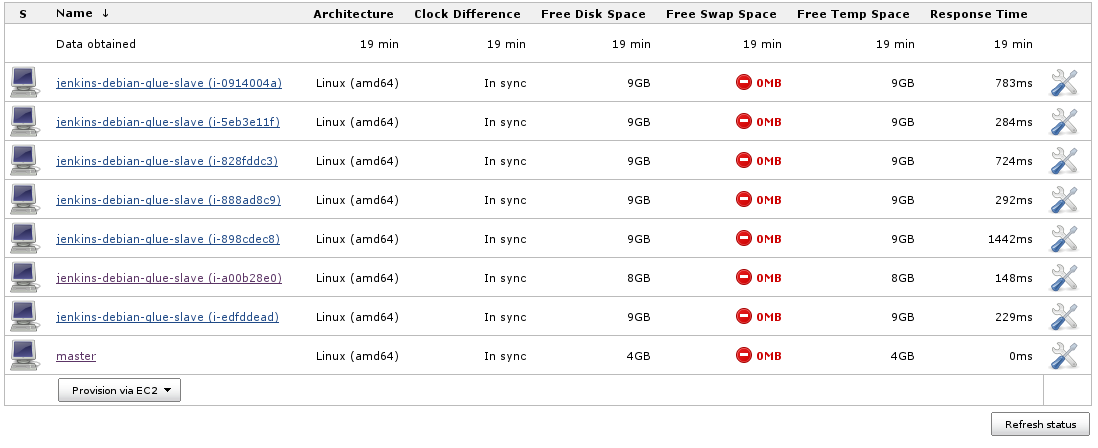
In a project I recently worked on we wanted to provide a jenkins-debian-glue based setup on Amazon s EC2 for building Debian and Ubuntu packages. The idea is to keep a not-so-strong powered Jenkins master up and running 24 7, while stronger machines serving as Jenkins slaves should be launched only as needed. The project setup in question is fully open sourced (more on that in a separate blog post), hereby I am documenting the EC2 setup in usage. Jenkins master vs. slave Debian source packages are generated on Jenkins master where a checkout of the Git repository resides. The Jenkins slaves do the actual workload by building the binary packages and executing piuparts (.deb package installation, upgrading, and removal testing tool) on the resulting binary packages. The Debian packages (source+binaries) are then provided back to Jenkins master and put into a reprepro powered Debian repository for public usage. Preparation The starting point was one of the official Debian AMIs (x86_64, paravirtual on EBS). We automatically deployed jenkins-debian-glue on the system which is used as Jenkins master (we chose a m1.small instance for our needs). We started another instance, slightly adjusted it to already include jenkins-debian-glue related stuff out-of-the-box (more details in section Reduce build time below) and created an AMI out of it. This new AMI ID can be configured for usage inside Jenkins by using the Amazon EC2 Plugin (see screenshot below). IAM policy Before configuring EC2 in Jenkins though start by adding a new user (or group) in AWS s IAM (Identity and Access Management) with a custom policy. This ensures that your EC2 user in Jenkins doesn t have more permissions than really needed. The following policy should give you a starting point (we restrict the account to allow actions only in the EC2 region eu-west-1, YMMV):
 
  "Version": "2012-10-17",
  "Statement": [
     
      "Action": [
        "ec2:CreateTags",
        "ec2:DescribeInstances",
        "ec2:DescribeImages",
        "ec2:DescribeKeyPairs",
        "ec2:GetConsoleOutput",
        "ec2:RunInstances",
        "ec2:StartInstances",
        "ec2:StopInstances",
        "ec2:TerminateInstances"
      ],
      "Effect": "Allow",
      "Resource": "*",
            "Condition":  
                "StringEquals":  
                    "ec2:Region": "eu-west-1"


  ]
 
Jenkins configuration Configure EC2 access with Access Key ID , Secret Access Key , Region and EC2 Key Pair s Private Key (for SSH login) inside Jenkins in the Cloud section on $YOUR_JENKINS_SERVER/configure. Finally add an AMI in the AMIs Amazon EC2 configuration section (adjust security-group as needed, SSH access is enough): As you can see the configuration also includes a launch script. This script ensures that slaves are set up as needed (provide all the packages and scripts that are required for building) and always get the latest configuration and scripts before starting to serve as Jenkins slave. Now your setup should be ready for launching Jenkins slaves as needed: NOTE: you can use the Instance Cap configuration inside the advanced Amazon EC2 Jenkins configuration section to place an upward limit to the number of EC2 instances that Jenkins may launch. This can be useful for avoiding surprises in your AWS invoices. :) Notice though that the cap numbers are calculated for all your running EC2 instances, so be aware if you have further machines running under your account, you might want to e.g. further restrict your IAM policy then. Reduce build time Using a plain Debian AMI and automatically installing jenkins-debian-glue and further jenkins-debian-glue-buildenv* packages on each slave startup would work but it takes time. That s why we created our own AMI which is nothing else than an official Debian AMI with the bootstrap.sh script (which is referred to in the screenshot above) already executed. All the necessary packages are pre-installed and also all the cowbuilder environments are already present then. From time to time we start the instance again to apply (security) updates and execute the bootstrap script with its &dash&dashupdate option to also have all the cowbuilder systems up2date. Creating a new AMI is a no-brainer and we can then use the up2date system for our Jenkins slaves, if something should break for whatever reason we can still fall back to an older known-to-be-good AMI. Final words How to set up your Jenkins jobs for optimal master/slave usage, multi-distribution support (Debian/Ubuntu) and further details about this setup are part of another blog post. Thanks to Andreas Granig, Victor Seva and Bernhard Miklautz for reading drafts of this.

Steve Kemp: So I failed at writing some clustered code in Perl

Until this time next month I'll be posting code-based discussions only. Recently I've been wanting to explore creating clustered services, because clusters are definitely things I use professionally. My initial attempt was to write an auto-clustering version of memcached, because that's a useful tool. Writing the core of the service took an hour or so: At the point I was done the following code worked:
use KeyVal;
# Create an object, and set some values
my $obj = KeyVal->new( logfile => "/tmp/foo.log" );
$obj->incr( "steve" );
print $obj->get( "steve" ) # prints 2.
# Now replay the append-only log
my $replay = KeyVal->new( logfile => "/tmp/foo.log" );
$replay->replay();
print $replay->get( "steve" ) # prints 2.
In the first case we used the primitives to increment a value twice, and then fetch it. In the second case we used the logfile the first object created to replay all prior transactions, then output the value. Neat. The next step was to make it work over a network. Trivial. Finally I wanted to autodetect peers, and deploy replication. Each host would send out regular messages along the lines of "Do you have updates made since $time?". Any that did would replay the logfile from the given unixtime offset. However here I ran into problems. Peer discovery was supposed to be basic, and I figured I'd write something that did leader election by magic. Unfortunately Perls threading code is .. unpleasant: This failed. Majorly. Because you cannot launch the implementation of a class-method as a thread. Equally you cannot make a variable which is "complex" shared across threads. I wrote some demo code which works without packages and a shared singleton: The Ruby version, by contrast, is much more OO and neater. Meh. I've now shelved the project. My next, big, task was to make the network service utterly memcached compatible. That would have been fiddly, but not impossible. Right now I just use a simple line-based network protocol. I suspect I could have got what I wanted using EventMachine, or similar, but that's a path I've not yet explored, and I'm happy enough with that decision.

23 March 2014

Chris Lamb: Fingerspitzengef hl

Loanwords can often appear more insightful than they really are. How prescient of another culture to codify such a concept into a single word! They surely must have lofty and perceptive discussions if it was necessary to coin and codify one. But whilst there is always the danger of over-inflating the currency of the loanword especially the compound one there must be a few that are worth the trouble. One such term is fingerspitzengef hl. Literally meaning "finger-tips feeling" in German, it attempts to capture the idea of an intuitive sophistication, flair or instinct. Someone exhibiting fingerspitzengef hl would be able to respond appropriately, delicately and tactfully to certain things or situations. Oliver Reichenstein clarifies the distinction from a personal taste:
Whether I like pink or not, sugar in my coffee, red or white wine, these things are a matter of personal taste. These are personal preferences, and both designers and non-designers have them. This is the taste we shouldn't bother discussing. Whether I set a text s line height to 100% or 150% is not a matter of taste, it is a matter of knowing the principles of typography. However, whether I set a text s line height at 150% or 145% is a matter of Fingerspitzengef hl; wisdom in craft, or sophistication.
Fingerspitzengef hl is therefore not innate and is probably refined over the years via subconscious rather than conscious study and reflection. However, it always flows naturally in the moment, not dissimilar to Castiglione's sprezzatura. Personally, I am particularly enamoured how this concept of a "trained taste" appears to blur the line between an objective and subjective aesthetic, putting me somewhat at odds with those who baldly assert that taste is "obviously" entirely individual.

Andrew Shadura: ifupdown and command status handling

In 2011, I first tried to fix a Debian bug #547587. The bug was about hook script result codes not being checked, so if a script fails, this isn t detected. Unfortunately, just checking the return code wasn t enough, as lots of scripts didn t care about their return code at all, so I had to unapply the patch. Now, after 2.5 years, I think it s time to try again, as most of the scripts have been fixed since then. At the same time, I ve changed error handling a little bit further: errors in any commands or scripts during interface configuration are considered fatal, but when interface is deconfigured, errors are ignored. However, this may change break configurations which depend on previous behaviour. Please report bugs if you find any.

22 March 2014

Keith Packard: glamor-core

Core Rendering with Glamor I ve hacked up the intel driver to bypass all of the UXA paths when Glamor is enabled so I m currently running an X server that uses only Glamor for all rendering. There are still too many fall backs, and performance for some operations is not what I d like, but it s entirely usable. It supports DRI3, so I even have GL applications running. Core Rendering Status I ve continued to focus on getting the core X protocol rendering operations complete and correct; those remain a critical part of many X applications and are a poor match for GL. At this point, I ve got accelerated versions of the basic spans functions, filled rectangles, text and copies. GL and Scrolling OpenGL has been on a many-year vendetta against one of the most common 2D accelerated operations copying data within the same object, even when that operation overlaps itself. This used to be the most performance-critical operation in X; it was used for scrolling your terminal windows and when moving windows around on the screen. Reviewing the OpenGL 3.x spec, Eric and I both read the glCopyPixels specification as clearly requiring correct semantics for overlapping copy operations it says that the operation must be equivalent to reading the pixels and then writing the pixels. My CopyArea acceleration thus uses this path for the self-copy case. However, the ARB decided that having a well defined blt operation was too nice to the users, so the current 4.4 specification adds explicit language to assert that this is not well defined anymore (even in the face of the existing language which is pretty darn unambiguous). I suspect we ll end up creating an extension that offers what we need here; applications are unlikely to stop scrolling stuff around, and GPUs (at least Intel) will continue to do what we want. This is the kind of thing that makes GL maddening for 2D graphics the GPU does what we want, and the GL doesn t let us get at it. For implementations not capable of supporting the required semantic, someone will presumably need to write code that creates a temporary copy of the data. PBOs for fall backs For operations which Glamor can t manage, we need to fall back to using a software solution. Direct-to-hardware acceleration architectures do this by simply mapping the underlying GPU object to the CPU. GL doesn t provide this access, and it s probably a good thing as such access needs to be carefully synchronized with GPU access, and attempting to access tiled GPU objects with the CPU require either piles of CPU code to de-tile accesses (ala wfb), or special hardware detilers (like the Intel GTT). However, GL does provide a fairly nice abstraction called pixel buffer objects (PBOs) which work to speed access to GPU data from the CPU. The fallback code allocates a PBO for each relevant X drawable, asks GL to copy pixels in, and then calls fb, with the drawable now referencing the temporary buffer. On the way back out, any potentially modified pixels are copied back through GL and the PBOs are freed. This turns out to be dramatically faster than malloc ing temporary buffers as it allows the GL to allocate memory that it likes, and for it to manage the data upload and buffer destruction asynchronously. Because X pixmaps can contain many X windows (the root pixmap being the most obvious example), they are often significantly larger than the actual rendering target area. As an optimization, the code only copies data from the relevant area of the pixmap, saving considerable time as a result. There s even an interface which further restricts that to a subset of the target drawable which the Composite function uses. Using Scissoring for Clipping The GL scissor operation provides a single clipping rectangle. X provides a list of rectangles to clip to. There are two obvious ways to perform clipping here either perform all clipping in software, or hand each X clipping rectangle in turn to GL and re-execute the entire rendering operation for each rectangle. You d think that the former plan would be the obvious choice; clearly re-executing the entire rendering operation potentially many times is going to take a lot of time in the GPU. However, the reality is that most X drawing occurs under a single clipping rectangle. Accelerating this common case by using the hardware clipper provides enough benefit that we definitely want to use it when it works. We could duplicate all of the rendering paths and perform CPU-based clipping when the number of rectangles was above some threshold, but the additional code complexity isn t obviously worth the effort, given how infrequently it will be used. So I haven t bothered. Most operations look like this:
Allocate VBO space for data
Fill VBO with X primitives
loop over clip rects  
    glScissor()
    glDrawArrays()
 
This obviously out-sources as much of the problem as possible to the GL library, reducing the CPU time spent in glamor to a minimum. A Peek at Some Code With all of these changes in place, drawing something like a list of rectangles becomes a fairly simple piece of code: First, make sure the program we want to use is available and can be used with our GC configuration:
prog = glamor_use_program_fill(pixmap, gc,
                               &glamor_priv->poly_fill_rect_program,
                               &glamor_facet_polyfillrect);
if (!prog)
    goto bail_ctx;
Next, allocate the VBO space and copy all of the X data into it. Note that the data transfer is simply memcpy here that s because we break the X objects apart in the vertex shader using instancing, avoiding the CPU overhead of computing four corner coordinates.
/* Set up the vertex buffers for the points */
v = glamor_get_vbo_space(drawable->pScreen, nrect * (4 * sizeof (GLshort)), &vbo_offset);
glEnableVertexAttribArray(GLAMOR_VERTEX_POS);
glVertexAttribDivisor(GLAMOR_VERTEX_POS, 1);
glVertexAttribPointer(GLAMOR_VERTEX_POS, 4, GL_SHORT, GL_FALSE,
                      4 * sizeof (GLshort), vbo_offset);
memcpy(v, prect, nrect * sizeof (xRectangle));
glamor_put_vbo_space(screen);
Finally, loop over the pixmap tile fragments, and then over the clip list, selecting the drawing target and painting the rectangles:
glEnable(GL_SCISSOR_TEST);
glamor_pixmap_loop(pixmap_priv, box_x, box_y)  
    int nbox = RegionNumRects(gc->pCompositeClip);
    BoxPtr box = RegionRects(gc->pCompositeClip);
    glamor_set_destination_drawable(drawable, box_x, box_y, TRUE, FALSE, prog->matrix_uniform, &off_x, &off_y);
    while (nbox--)  
        glScissor(box->x1 + off_x,
                  box->y1 + off_y,
                  box->x2 - box->x1,
                  box->y2 - box->y1);
        box++;
        glDrawArraysInstanced(GL_TRIANGLE_STRIP, 0, 4, nrect);
     
 
GL texture size limits X pixmaps use 16 bit dimensions for width and height, allowing them to be up to 65536 x 65536 pixels. Because the X coordinate space is signed, only a quarter of this space is actually useful, which makes the useful size of X pixmaps only 32767 x 32767. This is still larger than most GL implementations offer as a maximum texture size though, and while it would be nice to just say we don t allow pixmaps larger than GL textures , the reality is that many applications expect to be able to allocate such pixmaps today, largely to hold the ever increasing size of digital photographs. Glamor has always supported large X pixmaps; it does this by splitting them up into tiles, each of which is no larger than the largest texture supported by the driver. What I ve added to Glamor is some simple macros that walk over the array of tiles, making it easy for the rendering code to support large pixmaps without needing any special case code. Glamor also had some simple testing support you can compile the code to ignore the system-provided maximum texture size and supply your own value. This code had gone stale, and couldn t work as there were parts of the code for which tiling support just doesn t make sense, like the glyph cache, or the X scanout buffer. I fixed things so that you could leave those special cases as solitary large tiles while breaking up all other pixmaps into tiles no larger than 32 pixels square. I hope to remove the single-tile case and leave the code supporting only the multiple-tile case; we have to have the latter code, and so having the single-tile code around simply increases our code size for not obvious benefit. Getting accelerated copies between tiled pixmaps added a new coordinate system to the mix and took a few hours of fussing until it was working. Rebasing Many (many) Times I m sure most of us remember the days before git; changes were often monolithic, and the notion of changing how the changes were made for the sake of clarity never occurred to anyone. It used to be that the final code was the only interesting artifact; how you got there didn t matter to anyone. Things are different today; I probably spend a third of my development time communicating how the code should change with other developers by changing the sequence of patches that are to be applied. In the case of Glamor, I ve now got a set of 28 patches. The first few are fixes outside of the glamor tree that make the rest of the server work better. Then there are a few general glamor infrastructure additions. After that, each core operation is replaced, one a at a time. Finally, a bit of stale code is removed. By sequencing things in a logical fashion, I hope to make review of the code easier, which should mean that people will spend less time trying to figure out what I did and be able to spend more time figuring out if what I did is reasonable and correct. Supporting Older Versions of GL All of the new code uses vertex instancing to move coordinate computation from the CPU to the GPU. I m also pulling textures apart using integer operations. Right now, we should correctly fall back to software for older hardware, but it would probably be nicer to just fall back to simpler GL instead. Unless everyone decides to go buy hardware with new enough GL driver support, someone is going to need to write simplified code paths for glamor. If you ve got such hardware, and are interested in making it work well, please take this as an opportunity to help yourself and others. Near-term Glamor Goals I m pretty sure we ll have the code in good enough shape to merge before the window closes for X server 1.16. Eric is in charge of the glamor tree, so it s up to him when stuff is pulled in. He and Markus Wick have also been generating code and reviewing stuff, but we could always use additional testing and review to make the code as good as possible before the merge window closes. Markus has expressed an interest in working on Glamor as a part of the X.org summer of code this year; there s clearly plenty of work to do here, Eric and I haven t touched the render acceleration stuff at all, and that code could definitely use some updating to use more modern GL features. If that works as well as the core rendering code changes, then we can look forward to a Glamor which offers GPU-limited performance for classic X applications, without requiring GPU-specific drivers for every generation of every chip.

Richard Hartmann: Lenovo X1 Carbon

Christine's accidential blog spam on planet.d.o just now gave me the chance to re-read the comments in her post. The state from back then is still the current state on up-to-date Debian unstable: The last item has the most impact on me. The need to tether when you have a dedicated SIM card, built-in modem, and good antennas in your laptop is... infuriating. Especially as it's working as intended on Windows. As an added benefit, even though I saved the PIN in network manager, it asks me for the PIN every time I log in and every time after hibernating. For a device which I can't use in the first place. Argh!

Christine Spang: Donate to OpenHatch

I just donated $500 to OpenHatch. Here's why you should donate too:
  1. Diversity in open source matters. We can't keep making the software the world runs on without involving people of all sorts, from all backgrounds.
  2. OpenHatch is run by community members who I've known for years and trust. They care about data-driven effectiveness and are always getting better at what they do.
  3. A rising tide floats all boats. More contributors == more awesome.
  4. If you donate before December 24th, your donation makes twice the difference.
Diversity and education initiatives are the reason I'm a part of the free and open source software community today. (Thanks, Debian Women.) You don't have to donate $500 to make a difference. $5, $10, $25 from a hundred people all adds up. Please join me in supporting OpenHatch today.

20 March 2014

Andrew Pollock: [life] Day 51, BJJ, library, lunch at Grill'd and a play in the park

Despite having a good, unbroken night's sleep, Zoe seemed a bit out of sorts this morning. She didn't have a particularly good breakfast. I'm not sure if that was because I made the porridge with cow's milk instead of almond milk (because I had some leftover cow's milk), or she was just having a bad day. Zoe has a trial dance class booked for tomorrow, which clashes with her normal Brazilian Jiu-Jitsu class, so we skipped Playgroup and did a BJJ class this morning. It was a good class, because there were 3 other kids there, a regular boy and girl, and a girl who was taking a trial class, so it was nice to have a bit more happening, but the two other regular kids were younger and a little less focused, and I think that distracted Zoe a bit. I think the lack of a decent breakfast also kicked in, and she went on strike a couple of times. Overall, it was a pretty good class though. The one downside was when I accidentally closed her fingers in the door on the way out. I didn't realise she was holding onto the door frame when I let go of the door I was holding open for her. Luckily it wasn't a heavy door or it could have ended more badly. Zoe had chosen to go to BJJ class by car today. I wondered if it was because of the improved music selection with the new radio. Her library books were due back soon, and since I don't have her this weekend, I thought we could just go to the library after BJJ class. I gave her a muesli bar to keep her going after BJJ class, but I think the lack of a good breakfast was really starting to show after we left the library. I was feeling like lunch out, and hadn't been to Grill'd for a while, nor sampled their kids menu, so I asked Zoe if she wanted a burger for lunch, and she said she did. We got to Grill'd, and I eventually managed to extract an order out of Zoe. She went for the mini chicken burger. The kid's menu items were pretty good. They came in a little box, with the burger, some chips, a popper (a.k.a. "juice box") and a colouring sheet with a set of colouring pencils. Unfortunately Zoe had a massive meltdown because she couldn't get the angle of her straw to her liking, and wasn't doing very well expressing how she wanted it ("down and then up" didn't make a whole lot of sense without it having bendy bits in places it didn't have bendy bits). Eventually I got her to eat. I'd say that food was definitely the issue, because after lunch she perked up significantly, and we had a nice little play in Bulimba Memorial Park, where I'd parked the car, and then we went home. We read a few of the new library books, and then she passed out for a late nap without much complaint. After her nap, she was still a little bit out of sorts, but we managed a walk down to the Hawthorne Garage to grab some lamb cutlets for dinner, and then she watched some TV and ate quite a good amount of fruit while I organised dinner. After a handwashing-related meltdown and dinner, we went back to the Hawthorne Garage for a babyccino. She'd perked up somewhat by this stage, and it was a nice outing. Many dogs were patted while there and on the way home. Bath time and bedtime went pretty well. It's another warm night, so I hope she sleeps well.

19 March 2014

Tanguy Ortolo: Self-Destructing Cookies for Firefox

Web cookies are meant to store user preferences for a website, but they are often misused for evil purposes, such as tracking him, sometimes across distinct websites.For the user, there is a simple solution to that problem: set up his browser to refuse cookies by default, and use an extension such as Cookie Monster to accept them on trusted websites where they are known to be useful. Unfortunately, that reveals another problem: some shitty websites will just not work at all without cookies. Well, there is a Firefox extension that brings the solution to that: Self-Destructing Cookies. It works in a fairly simple way: cookies for each are accepted for each website, but destroyed when the user leaves it. So, does EvilCorp want to use a cookie, and refuse to work without it? No problem, here it is. Want to retrieve it on next visit? No way.

Andrew Pollock: [life] Day 50, Kindergarten, appointments central, cleaning, meetings and meltdowns

Today was a very busy day for me. First up, I had my chiropractic adjustment. Then I had my half-yearly dental checkup. Then I got stuck into cleaning the house. Fortunately I'd done a bit the afternoon before, otherwise I'd never have gotten it done before my massage. I'm starting to seriously consider getting a cleaner. I can make much better use of the limited time I get than cleaning the house. Zoe's Kindergarten has a Parent Advisory Group or something like that, which meets monthly. I wasn't able to attend the first one, but the second one was today, about an hour before pickup, so I grabbed a quick lunch after my massage and biked over to Kindergarten early. The meeting wasn't particularly interesting. The majority of it revolved around fund raising. At pickup time, Zoe was fast asleep again, and had another massive meltdown when I woke her up. It took forever to get her out. She wanted to give Megan a hug, but Megan had long gone. Then, rather fortuitously, Megan's Dad texted me to tell me they were in the playground on the neighbouring school grounds, so I managed to use that as an incentive to get Zoe moving. I didn't know until today, but at the foothill of the neighbouring primary school, there's some play equipment. A few of the Kindergarten kids seem to have a play over there after Kindergarten. Megan and Zoe played there for a bit before it was time to go. Once we got home, we unpacked and then walked down to the Hawthorne Garage to get some vegetables, and then, after buying some milk from the corner store and another grumpy meltdown, I figured a quiet afternoon was in order, so Zoe watched a DVD for a bit while I prepared dinner. I'd bumped into the mother of Zoe's friends Eva and Layla from her old day care while I was at the dentist in the morning, and arranged for her to drop by to pick up a copy of the photos I'd taken at their 4th birthday party. I'd hoped that she'd bring the girls with her, and had told Zoe they'd be dropping by, but unfortunately she came on the way to picking them up from day care, so Zoe was a bit disappointed. We did arrange to have them over for dinner next Friday, so I'm sure that will be very exciting. After that, we had dinner, and a fairly uneventful bedtime. It's hot again, so I hope that doesn't mess with her sleep.

17 March 2014

Mario Lang: grub-efi-amd64 on a MacBook Air

When I installed Debian on my MacBookAir4,1 in 2012, there was no way to do it without manual intervention yet. I followed a tutorial on how to boot GRUB from the EFI Boot option in the MacBook EFI Menu. I did not want to fiddle with rEFIt, and I didn't want to boot GRUB by default. When I want to boot Linux, I press the Option key during power up and select EFI Boot from the Apple boot menu. Unfortunately, I neglected to collect notes about how I did it manually. However, Linux 3.2 is getting a bit old, so I finally wanted to replace my manual boot configuration with something handled by the package system. In case you don't have /boot/efi in /etc/fstab yet, you need to mount /dev/sda1 on /boot/efi for the following to work. The documentation I found on the net suggested to just reinstall grub-efi-amd64 and everything should work. That is not quite true. When I do
# apt-get install --reinstall grub-efi-amd64
Nothing changes in /boot/efi. I sort of expected that /boot/efi/EFI/debian would be created, and the EFI image should be placed in there. However, that did not happen. Why is that? It turns out that when I installed grub-efi-amd64 manually in 2012, I created /boot/efi/EFI/boot/bootx64.efi which is the EFI fallback location, and apparently exactly what I want on this MacBook which does not support multiple boot options. Matthew Garrett posted an interesting article called Booting with EFI which sheds light on this issue, go and read it. Looking at /var/lib/dpkg/info/grub-efi-amd64.postinst revealed that /boot/efi/EFI/debian needs to be created manually first. If this directory does not exist, grub-efi-amd64 basically does nothing on reinstall. Running grub-install will actually create a new EFI image. However, it is being created in the wrong place for this machine.
# grub-install --target=x86_64-efi
does the trick. Now /boot/efi/EFI/debian/grubx64.efi gets created. However, since I don't want to make GRUB the default, there is yet another manual step to do:
# cp /boot/efi/EFI/debian/grubx64.efi /boot/efi/EFI/boot/bootx64.efi
Now I can select EFI Boot after pressing the Option key during startup. GRUB is loaded and Linux 3.13 gets booted. Strike! Looking more closely reveals that there is actually a way to tell grub-install that it should install to the fallback location directly. The --removable option does that. For the faint of heart, what does grub-install actually do on an EFI system? It does not directly write to the disk, therefore it does not need a device specified. It looks for files in /boot/efi and assumes the EFI partition is mounted there. So for my use case, the correct way to upgrade to a current GRUB EFI image should have been:
# grub-install --removable --target=x86_64-efi
Meanwhile I've been made aware of Bug#708430. I guess it would be nice to have an option in /etc/default/grub which would indicate that installation to the fallback location is desired. While this is a rather ugly hack to work around a stupid limitation, it is still what I'd like on this MacBook. At least since I don't have a triplle boot situation. Fallback location works fine with just two OSes coexisting.

14 March 2014

Andrew Pollock: [life] Day 45, BJJ, Science Friday and baking cookies

We had a pretty busy day today. Sarah dropped Zoe off at around 8:30am. I reminded Zoe that she'd forgotten to give Sarah her crown that she'd made at Playgroup the previous day, so she gave that to her. After Sarah left, I let Zoe watch a little bit of TV while I finished getting myself organised. We drove to Brazilian Jiu Jitsu class today, because I wanted to go directly to the Planetarium afterwards. Zoe's BFF Megan came to BJJ class today for a trial class. Zoe was very excited. Megan picked everything up really quickly, and the girls had a good time. She didn't want to wear her uniform today though. I managed to get out of her later that she felt it made her sweaty. I told her it was probably all the running around that made her sweaty, not the uniform. We went out for a coffee with Megan, her Dad and her little sister afterwards. We found a little take away shop around the corner. Not quite the place that did babyccinos unfortunately, so Megan's Dad very cleverly got a chocolate milk and split it three ways with the girls and called it a "milkshake". I've realised that for Science Friday, I've pretty much been doing solely chemistry so far, so I wanted to throw in a bit of astronomy this week. The Sir Thomas Brisbane Planetarium had just recently reopened after getting a spanky new projector because 1978 called and wanted theirs back. Unfortunately, they weren't showing Perfect Little Planet today, but the slightly more specific Black Holes: Journey into the Unknown. I wanted Zoe to see something in the auditorium, so I thought we'd give it a shot anyway. I think we got to the Planetarium at around 11am, and the next show was at 1:30pm, so we had a bit of a look around the foyer for a bit, which Zoe quite enjoyed. They had a life-size model of Neil Armstrong's spacesuit, and a scale model of a Saturn V rocket. Zoe quite enjoyed both of them. I'll have to dig up some Youtube footage of a Saturn V launch. We then headed over to the cafe in the adjacent Botantic Gardens, and had a reasonable lunch. After lunch we wandered around the Botanic Gardens to kill some time, so you could say that today's Science Friday also included a goodly amount of botany as well. We went into the Tropical Dome and looked at the fish in the lily pond, and toured the fern garden, before heading back. We timed it pretty well, and got back to the Planetarium with about 10 minutes to kill. I'd prepped Zoe for the presentation, and told her that she needed to keep quiet, and if we had to leave we wouldn't be able to go back in again, and she could whisper to me if she needed to. I have to say, she was so well behaved. She sat through the whole 45 minute presentation and the projected tour of the night sky. I guess the presentation was sufficiently visually interesting to hold her attention for the duration. There was certainly a lot of "wow" out of her. I was so proud of how she went that I had to go and buy her an ice cream as a reward. After that, we went for a drive around Mount Coot-tha. I pointed out the TV towers that we can see from our balcony, and then she fell asleep on the way home. She didn't wake up particularly happy from her late, short nap, when we got home, but once she got herself sorted out, we baked the cookies that we'd made yesterday. They came out very nicely indeed. Once they were all baked, we dropped off a dozen to Megan's place, and then came home to have dinner. Bedtime went pretty well. I hope she has a good night's sleep, as we have a big day tomorrow.

Dirk Eddelbuettel: Rcpp 0.11.1

A new minor release 0.11.1 of Rcpp is now on the CRAN network for GNU R; binaries for Debian have also been uploaded. The release fixes a number of bugs that have come up since the 0.11.0 release in January, but also brings some extensions. See the NEWS file section below for details, or the ChangeLog file in the package and on the Rcpp Changelog page Once again, we tested this release by building against all CRAN packages which depend upon Rcpp. In short, three packages are blacklisted from tests, and three came up with something we noted --- but the remaining 177 packages all build and test cleanly. Detailed results of those tests (and the scripts for it) are on GitHub. There are a number of other fixes, upgrades and other extensions detailed in NEWS file extract below, in the ChangeLog file in the package and on the Rcpp Changelog page.
Changes in Rcpp version 0.11.1 (2014-03-13)
  • Changes in Rcpp API:
    • Preserve backwards compatibility with Rcpp 0.10.* by allowing RObject extraction from vectors (or lists) of Rcpp objects
    • Add missing default constructor to Reference class that was omitted in the header-only rewrite
    • Fixes for NA and NaN handling of the IndexHash class, as well as the vector .sort() method. These fixes ensure that sugar functions depending on IndexHash (i.e. unique(), sort_unique(), match()) will now properly handle NA and NaN values for numeric vectors.
    • DataFrame::nrows now more accurately mimics R's internal behavior (checks the row.names attribute)
    • Numerous changes to permit compilation on the Solaris OS
    • Rcpp vectors gain a subsetting method it is now possible to subset an Rcpp vector using CharacterVectors (subset a by name), LogicalVectors (logical subsetting), and IntegerVectors (0-based index subsetting). Such subsetting will also work with Rcpp sugar expressions, enabling expressions such as x[ x > 0].
    • Comma initialization (e.g. CharacterVector x = "a", "b", "c";, has been disabled, as it causes problems with the behavior of the = operator with Rcpp::Lists. Users who want to re-enable this functionality can use #define RCPP_COMMA_INITIALIZATION, but be aware of the above caveat. The more verbose CharacterVector x = CharacterVector::create("a", "b", "c") is preferred.
  • Changes in Rcpp Attributes
    • Fix issue preventing packages with Rcpp::interfaces attribute from compiling.
    • Fix behavior with attributes parsing of ::create for default arguments, and also allow constructors of a given size (e.g. NumericVector v = NumericVector(10)) gives a default value of numeric(10) at the R level). Also make NAs preserve type when exported to R (e.g. NA_STRING as a default argument maps to NA_character_ at the R level)
  • Changes in Rcpp modules
    • Corrected the un_pointer implementation for object
Thanks to CRANberries, you can also look at a diff to the previous release. As always, even fuller details are on the Rcpp Changelog page and the Rcpp page which also leads to the downloads, the browseable doxygen docs and zip files of doxygen output for the standard formats. A local directory has source and documentation too. Questions, comments etc should go to the rcpp-devel mailing list off the R-Forge page

This post by Dirk Eddelbuettel originated on his Thinking inside the box blog. Please report excessive re-aggregation in third-party for-profit settings.

Andrew Pollock: [life] Day 44, Playgroup, laksa and baking

Zoe had Playgroup this morning. We had a little bit of time to kill between when Sarah dropped her off and it was time to bike over to Playgroup, so we went for a little walk to the post box to mail a letter. It was a beautiful morning, so the walk was nice. We biked over to Playgroup. Today I learned from the mother of the boy who was causing issues last week, that he was extremely allergic to everything. They couldn't use egg cartons for their craft activities, for example, because he was allergic to eggs, and even the empty cartons would cause a problem, apparently. That's quite the allergic sensitivity. I'm glad Zoe outgrew her egg allergy. Zoe wanted to do the craft activity first up, so she made another crown, this time for Mummy. I helped roll scraps of crepe paper into balls, and she very carefully glued them onto the points of the crown. She seems to really enjoy mucking around with Clag glue pots. I'll have to get a bottle for home. It reminds of my early primary school days. After that, we just generally mucked around for the rest of Playgroup. She loved the dress up pink lacy skirt again, and wanted to fool around on stage for a bit. One of my ex-co-workers has an occasional yum cha or laksa lunch with a bunch of his ex-co-workers, and I was invited along to laksa at Super Bowl. I figured that since Zoe loves any opportunity to use her chopsticks, and generally loves a good noodle soup, that this could be something I could bring her along to. So straight after Playgroup, we biked over to the Bulimba ferry terminal, locked up the bike, took the ferry across to Teneriffe and jumped on a City Glider bus to Fortitude Valley. We ended up getting there about 30 minutes earlier than everyone else, so I just ordered Zoe some wonton noodle soup and let her have at it while we waited for everyone else to arrive. We all had a BBQ pork laksa, which I personally found a little bit too spicy for my liking, but it was doable. Lunch went well. Zoe was really well behaved, so I'll definitely bring her along again. The next one is supposed to be yum cha, so I think she'll enjoy the selection. Zoe was looking pretty tired by the end of lunch, and we reversed our way back, and biked home from Bulimba. Once we got home, she practically put herself to bed for a nap. Since she was napping pretty late, I didn't let her nap for too long, and she woke up happy. After her nap, I thought we'd do some baking. I wanted to try and make some oatmeal cookies like our friend Bri used to make, so I found a recipe and adapted it to the Thermomix, and we got stuck into it. The joys of having a small child help is that not always do the ingredients wind up where they're supposed to. We had to mill a cup of raw sugar down to white sugar, and I had the cup's worth of sugar in a bowl and asked Zoe to tip the sugar into the Thermomix bowl. Unfortunately, she didn't line up very well, so some of the sugar made it into the Thermomix, but about as much went all over the Thermomix, the counter, the floor, the Guidecraft kitchen helper, everywhere. I've become quite good at taking these sorts of things in my stride, and didn't bat an eyelid. I was actually more bothered by Zoe asking me if I still loved her. After I reassured her I still loved her, even if she accidentally spilled sugar everywhere, and we cleaned up the sugar together, we continued to the point where I realised the dough was supposed to chill in the fridge for at least an hour. This would have meant the cookies wouldn't be ready to hit the oven until right around when Sarah was due to pick up Zoe, so I figured we'd just leave the dough in the fridge and bake the cookies tomorrow. Zoe watched some TV while I cleaned up the kitchen, and then Sarah arrived to pick her up.

12 March 2014

Matthew Garrett: Dealing with Apple ACPI issues

I wrote about Thunderbolt on Apple hardware a while ago. Since then Andreas Noever has somehow managed to write a working Thunderbolt stack, which awesome! But there was still the problem I mentioned of the device not appearing unless you passed acpi_osi="Darwin" on the kernel command line, and a further problem that if you suspended and then resumed it vanished again.

The ACPI _OSI interface is a mechanism for the firmware to determine the OS that the system is running. It turns out that this works fine for operating systems that export fairly static interfaces (Windows, which adds a new _OSI per release) and poorly for operating systems that don't even guarantee any kind of interface stability in security releases (Linux, which claimed to be "Linux" regardless of version until we turned that off). OS X claims to be Darwin and nothing else. As I mentioned before, claiming to be Darwin in addition to Windows was enough to get the Thunderbolt hardware to stay alive after boot, but it wasn't enough to get it powered up again after suspend.

It turns out that there's two sections of ACPI code where this Mac checks _OSI. The first is something like:

if (_OSI("Darwin")) Store 0x2710 OSYS; else if(_OSI("Windows 2009") Store 0x7D9 OSYS; else

ie, if the OS claims to be Darwin, all other strings are ignored. This is called from \_SB._INI(), which is the first ACPI method the kernel executes. The check for whether to power down the Thunderbolt controller occurs after this and then works correctly.

The second version is less helpful. It's more like:

if (_OSI("Darwin")) Store 0x2710 OSYS; if (_OSI("Windows 2009")) Store 0x7D9 OSYS; if

ie, if the OS claims to be both Darwin and Windows 2009 (which Linux will if you pass acpi_osi="Darwin"), the OSYS variable gets set to the Windows 2009 value. This version gets called during PCI initialisation, and once it's run all the other Thunderbolt ACPI calls stop doing anything and the controller gets powered down after suspend/resume. That can be fixed easily enough by special casing Darwin. If the platform requests Darwin before anything else, we'll just stop claiming to be Windows.

Phew. Working Thunderbolt! (Well, almost - _OSC fails and so we disable PCIe hotplug, but that's easy to work around). But boo, no working battery. Apple do something very strange with their ACPI battery interface. If you're running anything that doesn't claim to be Darwin, Apple expose an ACPI Control Method battery. Control Method interfaces abstract the complexity away into either ACPI bytecode or system management traps - the OS simply calls an ACPI method, magic happens and it gets an answer back. If you claim to be Darwin, Apple remove that interface and instead expose the raw ACPI Smart Battery System interface. This provides an i2c bus over which the OS must then speak the Smart Battery System protocol, allowing it to directly communicate with the battery.

Linux has support for this, but it seems that this wasn't working so well and hadn't been for years. Loading the driver resulted in modprobe hanging until a timeout occurred, and most accesses to the battery would (a) take forever and (b) probably fail. It also had the nasty habit of breaking suspend and resume, which was unfortunate since getting Thunderbolt working over suspend and resume was the whole point of this exercise.

So. I modified the sbs driver to dump every command it sent over the i2c bus and every response it got. Pretty quickly I found that the failing operation was a write - specifically, a write used to select which battery should be connected to the bus. Interestingly, Apple implemented their Control Method interface by just using ACPI bytecode to speak the SBS protocol. Looking at the code in question showed that they never issued any writes, and the battery worked fine anyway. So why were we writing? SBS provides a command to tell you the current state of the battery subsystem, including which battery (out of a maximum of 4) is currently selected. Unsurprisingly, calling this showed that the battery we wanted to talk to was already selected. We then asked the SBS manager to select it anyway, and the manager promptly fell off the bus and stopped talking to us. In keeping with the maxim of "If hardware complains when we do something, and if we don't really need to do that, don't do that", this makes it work.

Working Thunderbolt and working battery. We're even getting close to getting switchable GPU support working reasonably, which is probably just going to involve rewriting the entirety of fbcon or something similarly amusing.

comment count unavailable comments

Dirk Eddelbuettel: QuantLib 1.4 packages also available for Ubuntu and Windoze

QuantLib release 1.4 came out a couple of days ago. Sticking with standard practice, I immediately updated the Debian packages I have been maintaining for over a dozen years now, and corresponding binaries are available for Debian flavors unstable ("sid") and testing ("jessie"). I also updated my RQuantLib package accordingly (though it needed no changes -- yay to stable APIs). However, I also run Ubuntu on a few machines at work and home, and proceeded to create local packages for both 32-bit ("i386") and 64-bit ("amd64") variants of the current release 13.10 ("saucy"). As these may be of use to others, I am now making these available here from my box so that folks can run a current QuantLib version on those machines. Lastly, Brian Ripley was kind enough to also fire up his cross-compilation setup on his Linux box to create similar Windows binaries, These are e.g. used on CRAN and by the win-builder service to compile the RQuantLib CRAN Windows builds of RQuantLib. That corresponding archive file can be obtained as Quantlib14.zip see this short page for details. My thanks to Brian for helping with this. I hope this may be useful to the few people wishing to compile and/or extend RQuantLib and QuantLib.

This post by Dirk Eddelbuettel originated on his Thinking inside the box blog. Please report excessive re-aggregation in third-party for-profit settings.

9 March 2014

Dirk Eddelbuettel: RQuantLib 0.3.12

A new bug-fix / maintenance release RQuantLib 0.3.12 is now on CRAN and in Debian. While adding the plugin feature, I was too optmistic about finding the quantlib-config script. This is now tested more carefully. A few things related to building with Rcpp were updated as well now that Rcpp 0.11.0 is out. Thanks to CRANberries, there is also a diff to the previous release 0.3.11. Full changelog details, examples and more details about this package are at my RQuantLib page.

This post by Dirk Eddelbuettel originated on his Thinking inside the box blog. Please report excessive re-aggregation in third-party for-profit settings.

8 March 2014

Paul Tagliamonte: Donate to MediaGoblin!

If you re the sort that cares about federation, the MediaGoblin project is for you!

MediaGoblin is a media hosting platform, where you can post all sorts of things, like video, images or even 3d models. It s a nice replacement for things like Flickr, and YouTube, and super easy to set up.

If I wasn t such a lazy person, I d have uploaded it to Debian, but alas. Soon. Soon!

It s an official GNU project, and it s maintainer, Chris is a totally awesome guy, and MediaGoblin is really important work.


If you feel the urge to support federation on the web, Support MediaGoblin! Help us take back the net!

Dirk Eddelbuettel: RcppArmadillo 0.4.100.2.1

Conrad made a first bug-fix release 4.100.2 for Armadillo, his templated C++ library for linear algebra, yesterday. See below for details on the the small set of changes. This was quickly wrapped up in a new RcppArmadillo release 0.4.100.2.1 release. I also added some first steps towards turning C++11 on. This can be used now with a pre-release of R 3.1.0, and can be generally activated once R 3.1.0 is released on April 10.
Changes in RcppArmadillo version 0.4.100.2 (2014-03-07)
  • Upgraded to Armadillo release Version 4.100.2
    • fix for handling null vectors by normalise()
    • fix for memory handling by sparse matrices
  • Correct use of [[ depends()]] in skeleton example file
  • Prepare src/Makevars for C++11 support from R 3.1.0 by defining USE_CXX11 which is currently commented out
  • In the Armadillo configuration, turn on C++11 support if USE_CXX11 is defined
Courtesy of CRANberries, there is also a diffstat report for the most recent release As always, more detailed information is on the RcppArmadillo page. Questions, comments etc should go to the rcpp-devel mailing list off the R-Forge page.

This post by Dirk Eddelbuettel originated on his Thinking inside the box blog. Please report excessive re-aggregation in third-party for-profit settings.

Next.

Previous.