Search Results: "ean"

1 January 2016

Russ Allbery: 2015 Book Reading in Review

2015 was another very busy year, but one of stabilization, rebuilding, and recovery. I got through the ramp-up period with my new job, found a better role inside the company for my personal talents and preferences, and ended the year on a professional high note. I also moved, to a place I like much better. It was a year for taking things as they come, focusing on priorities, letting other things slip, and being realistic about how much I can do. All of that, plus quite a lot of company, a business trip, and a few other unexpected distractions, meant less reading than I would have preferred. However, I did catch up completely on review writing, which is another happy sign of stabilization. Reviews came in spotty bursts, but they did come. The only explicit reading goal I'm making for 2016 is to read more than I did in 2015. I'm still working out the best priorities and schedule for me, and finding the best work/life balance points, so a predictable reading schedule will have to wait a while longer. The below statistics are confined to the books I reviewed in 2015, but thanks to significant catch-up work, I've only read one book that I have not yet reviewed (and I finished that one on December 31st). That book will be counted in 2016. Once again, the year saw two 10 out of 10 books, and once again, my favorite book of the year was written by Ann Leckie. The conclusion of the Imperial Radch trilogy, Ancillary Mercy, is as good or better than the start. The second book of the trilogy, Ancillary Sword, was also among my 2015 reviews and got 9 out of 10. I highly recommend the entire trilogy, beginning with Ancillary Justice (my book of the year in 2014), to anyone who hasn't read it. The second 10 out of 10 was non-fiction: Randall Munroe's What If? collection, featuring some material from the web site feature that accompanies xkcd and some original material. These are longer essays exploring interesting bits of science, math, and guesswork in the context of hypothetical questions that usually become surprisingly destructive. As the review says, try a few samples from the web site and see if this is your thing. I loved it. Despite my continuing low reading totals, this was a year full of fiction stand-outs. Becky Chambers's The Long Way to a Small, Angry Planet was the surprise of the year for me: a heart-warming, delightful story of chosen family. Jo Walton's My Real Children was less of a surprise because I already knew she is an excellent writer, but it was probably the best-written book I read all year. In turns sad, thoughtful, and determined, it's slice-of-life fiction so good that it overcame my normal dislike of that subject matter. Other fiction highlights are parts of series: the first two Steerswomen books by Rosemary Kirstein (The Steerswoman and The Outskirter's Secret), which dance between fantasy and scientific discovery, and Seanan McGuire's One Salt Sea, the best of all the October Daye books I've read. In non-fiction, the other book that stands out is Jenny Lawson's Let's Pretend This Never Happened. This combination of memoir and stand-up comedy in book form is one of the funniest things I've read, and it mixes that humor with self-awareness and generous openness. It's a book about being a little crazy and a lot anxious, finding ways to cope by laughing at yourself, and inviting the rest of the world to join in. Finally, Sydney Padua's The Thrilling Adventures of Lovelace and Babbage straddles the line between fiction and non-fiction, but certainly deserves a place in the year-end round-up. Full of great art, humor, steampunk, footnotes galore, and numerous forms of geekery, it's a collection I've been waiting for since Padua's very occasional comic got its moment of Internet fame. The full analysis includes some additional personal reading statistics, probably only of interest to me.

Niels Thykier: Debian, please plan for Stretch

In the 4th quarter of 2016, we will freeze Debian Stretch. If you are hoping to do any larger changes for Stretch, please consider starting on them now. This also includes features that need to be in APT/dpkg (etc.) in Stretch, so we can start using them for Buster. Even something as trivial as the automatic dbgsym packages took over 8 months to complete (from the prototype was announced in April). I call it trivial because: NB: There were certainly other parties involved. But these were the most important ones. Mind you, the dbgsym saga is not complete yet. We are still lacking support for migrating dbgsym packages to testing (and, by extension, the next stable release as well). Meanwhile, you can pull the dbgsym packages from snapshot.debian.org. In summary: If you want a larger change to land in Debian Stretch, please start already now. :)
Filed under: Debian, Release-Team

Russ Allbery: Review: One Salt Sea

Review: One Salt Sea, by Seanan McGuire
Series: October Daye #5
Publisher: DAW
Copyright: September 2011
ISBN: 1-101-54760-X
Format: Kindle
Pages: 368
This is the fifth book of the October Daye series. It's the best book of the series to date, at least in my opinion, but this is a series with a substantial cast and political complications. You could probably start here and work out things on the fly, since each story is largely self-contained, but much of the emotional resonance would be lost. As expected for this series, Toby's life doesn't have much time to stabilize after the events of Late Eclipses. This time, though, the initial threat is less personal and more political. The children of the rulers of the Duchy of Saltmist have been kidnapped, and war between Saltmist and the Kingdom of the Mists (Toby's home) is very near. All that stands in the way of horrible casualties, of fae that can scarce afford more death, is Toby's desperate detective work. Toby's confidence and belief in her own abilities has been growing steadily throughout this series. One of my favorite themes in fiction is someone who doesn't really believe in themselves but tries anyway, because they couldn't live with themselves if they didn't, and discovers they're more capable than they thought. In this series, I think that works best when Toby is less scared and more angry, which is very true in One Salt Sea. That's one reason why I liked this book better than either An Artificial Night or Late Eclipses. Another is that I love the politics and the depth of world-building and lore that McGuire brings to this series, and One Salt Sea is a showcase of both. We get the Undersea Duchy of Saltmist, which comes from both different traditions and different fae than the series so far. We get a plot that combines political maneuvering with a more traditional detective story than the last few books. We get more hidden traditions, past alliances and enmity that Toby didn't know about, and further development of Toby's own abilities. She has to tug hard on some threads, move between levels of the fae world, and draw on her network for uniquely fae forms of forensic analysis. I thoroughly enjoyed it, particularly the rocks. (You'll know what I mean when you get to that part.) But the best thing about this book, by far, is the Luidaeg. I've mentioned in reviews of previous books that the Luidaeg is my favorite character of the series. One Salt Sea just cements that. This is the deepest that the Luidaeg has been involved in a story: she gives Toby her mission at the start, substantial help along the way, and is deeply involved in the ending. We even learn some of her own background, and some of her own worries and pain. (And foreshadowing that there's more of this to come, which I'm eagerly looking forward to.) She's moved from a strange ally through a cautious friend to some combination of aunt and mother to Toby, while always staying her irascible and occasionally painful self. The bits with her in this book are the best so far, and there are a lot of them. It's a delightful reading experience. McGuire also uses this story to clear up a plot element that's been lingering since the first book of the series, but that never worked emotionally for me. (I'm talking about this indirectly since it's a significant spoiler.) It's a great resolution, one with heft and emotion and hard choices and pain, and largely makes up for the showing rather than telling that we've gotten in the previous books, while also (at least I suspect) graciously shuffling that plot out of the way in future books. It's a good bit of series work and personal growth for Toby, and I think frees the series to focus on the bits I enjoy the most. The ending of One Salt Sea hurts, but it's a good hurt, full of hard choices made well, bravery, and sacrifice. The best moments of this series have always had that, but I think this book is the most successful delivery of the whole package to date. This has always been a solid urban fantasy series, but I think it's getting better as it goes along. One major reason is that McGuire doesn't seem to be running out of world-building oomph. In a lot of urban fantasy, particularly the werewolf and vampire sort, I feel like the lore gets thinner, more rehashed, and more mundane as the series ages. But McGuire is still introducing new elements, showing existing elements from new directions and in new light, and has been slowly building major puzzles around Toby's life and abilities that intrigue me. And, even more rare, the eventual revelations usually live up to the preceding tension. It's certainly a recipe to keep me reading. Followed by Ashes of Honor. Rating: 9 out of 10

Matthew Garrett: The current state of boot security

I gave a presentation at 32C3 this week. One of the things I said was "If any of you are doing seriously confidential work on Apple laptops, stop. For the love of god, please stop." I didn't really have time to go into the details of that at the time, but right now I'm sitting on a plane with a ridiculous sinus headache and the pseudoephedrine hasn't kicked in yet so here we go.

The basic premise of my presentation was that it's very difficult to determine whether your system is in a trustworthy state before you start typing your secrets (such as your disk decryption passphrase) into it. If it's easy for an attacker to modify your system such that it's not trustworthy at the point where you type in a password, it's easy for an attacker to obtain your password. So, if you actually care about your disk encryption being resistant to anybody who can get temporary physical possession of your laptop, you care about it being difficult for someone to compromise your early boot process without you noticing.

There's two approaches to this. The first is UEFI Secure Boot. If you cryptographically verify each component of the boot process, it's not possible for a user to compromise the boot process. The second is a measured boot. If you measure each component of the boot process into the TPM, and if you use these measurements to control access to a secret that allows the laptop to prove that it's trustworthy (such as Joanna Rutkowska's Anti Evil Maid or my variant on the theme), an attacker can compromise the boot process but you'll know that they've done so before you start typing.

So, how do current operating systems stack up here?

Windows: Supports UEFI Secure Boot in a meaningful way. Supports measured boot, but provides no mechanism for the system to attest that it hasn't been compromised. Good, but not perfect.

Linux: Supports UEFI Secure Boot[1], but doesn't verify signatures on the initrd[2]. This means that attacks such as Evil Abigail are still possible. Measured boot isn't in a good state, but it's possible to incorporate with a bunch of manual work. Vulnerable out of the box, but can be configured to be better than Windows.

Apple: Ha. Snare talked about attacking the Apple boot process in 2012 - basically everything he described then is still possible. Apple recently hired the people behind Legbacore, so there's hope - but right now all shipping Apple hardware has no firmware support for UEFI Secure Boot and no TPM. This makes it impossible to provide any kind of boot attestation, and there's no real way you can verify that your system hasn't been compromised.

Now, to be fair, there's attacks that even Windows and properly configured Linux will still be vulnerable to. Firmware defects that permit modification of System Management Mode code can still be used to circumvent these protections, and the Management Engine is in a position to just do whatever it wants and fuck all of you. But that's really not an excuse to just ignore everything else. Improving the current state of boot security makes it more difficult for adversaries to compromise a system, and if we ever do get to the point of systems which aren't running any hidden proprietary code we'll still need this functionality. It's worth doing, and it's worth doing now.

[1] Well, except Ubuntu's signed bootloader will happily boot unsigned kernels which kind of defeats the entire point of the exercise
[2] Initrds are built on the local machine, so we can't just ship signed images

comment count unavailable comments

30 December 2015

Julian Andres Klode: APT 1.1.8 to 1.1.10 going faster

Not only do I keep incrementing version numbers faster than ever before, APT also keeps getting faster. But not only that, it also has some bugs fixed and the cache is now checked with a hash when opening. Important fix for 1.1.6 regression Since APT 1.1.6, APT uses the configured xz compression level. Unfortunately, the default was set to 9, which requires 674 MiB of RAM, compared to the 94 MiB required at level 6. This caused the test suite to fail on the Ubuntu autopkgtest servers, but I thought it was just some temporary hickup on their part, and so did not look into it for the 1.1.7, 1.1.8, and 1.1.9 releases. When the Ubuntu servers finally failed with 1.1.9 again (they only started building again on Monday it seems), I noticed something was wrong. Enter git bisect. I created a script that compiles the APT source code and runs a test with ulimit for virtual and resident memory set to 512 (that worked in 1.1.5), and let it ran, and thus found out the reason mentioned above. The solution: APT now defaults to level 6. New Features APT 1.1.8 introduces /usr/lib/apt/apt-helper cat-file which can be used to read files compressed by any compressor understood by APT. It is used in the recent apt-file experimental release, and serves to prepare us for a future in which files on the disk might be compressed with a different compressor (such as LZ4 for Contents files, this will improve rred speed on them by factor 7). David added a feature that enables servers to advertise that they do not want APT to download and use some Architecture: all contents when they include all in their list of architectures. This is to allow archives to drop Architecture: all packages from the architecture-specific content files, to avoid redundant data and (thus) improve the performance of apt-file. Buffered writes APT 1.1.9 introduces buffered writing for rred, reducing the runtime by about 50% on a slowish SSD, and maybe more on HDDs. The 1.1.9 release is a bit buggy and might mess up things when a write syscall is interrupted, this is fixed in 1.1.10. Cache generation improvements APT 1.1.9 and APT 1.1.10 improve the cache generation algorithms in several ways: Switching a lookup table from std::map to std::unordered_map, providing an inline isspace_ascii() function, and inlining the tolower_ascii() function which are tiny functions that are called a lot. APT 1.1.10 also switches the cache s hash function to the DJB hash function and increases the default hash table sizes to the smallest prime larger than 15000, namely 15013. This reduces the average bucket size from 6.5 to 4.5. We might increase this further in the future. Checksum for the cache, but no more syncs Prior to APT 1.1.10 writing the cache was a multi-part process:
  1. Write the the cache to a temporary file with the dirty bit set to true
  2. Call fsync() to sync the cache
  3. Write a new header with the dirty bit set to false
  4. Call fsync() to sync the new header
  5. (Rename the temporary file to the target name)
The last step was obviously not needed, as we could easily live with an intact cache that has its dirty field set to false, as we can just rebuild it. But what matters more is step 2. Synchronizing the entire 40 or 50 MB takes some time. On my HDD system, it consumed 56% of the entire cache generation time, and on my SSD system, it consumed 25% of the time. APT 1.1.10 does not sync the cache at all. It now embeds a hashsum (adler32 for performance reasons) in the cache. This helps ensure that no matter what parts of the cache are written in case of some failure somewhere, we can still detect a failure with reasonable confidence (and even more errors than before). This means that cache generation is now much faster for a lot of people. On the bad side, commands like apt-cache show that previously took maybe 10 ms to execute can now take about 80 ms. Please report back on your performance experience with 1.1.10 release, I m very interested to see if that works reasonably for other people. And if you have any other idea how to solve the issue, I d be interested to hear them (all data needs to be written before the header with dirty=0 is written, but we don t want to sync the data). Future work We seem to have a lot of temporary (?) std::string objects during the cache generation, accounting for about 10% of the run time. I m thinking of introducing a string_view class similar to the one proposed for C++17 and make use of that. I also thought about calling posix_fadvise() before starting to parse files, but the cache generation process does not seem to spend a lot of its time in system calls (even with all caches dropped before the run), so I don t think this will improve things. If anyone has some other suggestions or patches for performance stuff, let me know.
Filed under: Debian, Ubuntu

Clint Adams: Oh what a night, late December 1963

24 Dec. 63 Dear Uncle Ron and Aunt Helen, It has been quite awhile since I have written you folks. I am not too much of one for writing, and when I do write, I keep putting it off, and putting it off; and the next thing you know, the weeks turn into months and then the months into years. I haven't sent any Christmas cards, so at this time I'll offer my best wishes for the season to you. It is Christmas Eve and I am working tonight. I will also work New Year's eve and day. It really doesn't seem like Christmas here, and there isn't that much to do in the evening's; So I'm just as well off working. As I had mentioned, I had intended to send you some coins from Korea but I believe that I put them in with a package that I had sent to Mom and told her to give them to you. In any event, here are some in this box. The Korean coin with the 10 on it is 10 Won, and worth about $.0769. The large copper coin is Japanese ( 10 Yen) and about 2.8 Wait! I was wrong on the Korean coins.They are 10 Hwan which is the old money. When they Changed to Won, they made 10 Hwan equal to 1 Won. (Sounds confusing and tongue-tying, doesn't it?) So these 10 copper pieces with the 10 on them altogether are only worth 7 / The Viet Namese coins with the former president Diem picture on them are soon being taken out of circulation. ( Since he was overthrown and killed, they are going to replace the money also.) The small pieces marked 1 dong are 1 piastre; also called one Viet Namese dollar. 1 piastre is about .7 . I also recall sending some coins home in my hold baggage. I'll tell Mom to look for them and give them to you. Now that I look back on it, the year I spent in Korea wasn't bad. It was difficult at first having to work for an arrogant Jew boss, but after a few months I got out of his office and was on my own working directly for the army people ( U.S.) The country of Korea isn't too bad. As you can see on the coins they were in the year 4294 last year. It is surprising for a civilization to be that far along in years and still live under very primitive conditions. Going from Korea to Japan is like going from the dark ages into the future science fiction world. Those people are really progressing in Japan. I spent several days in Japan after I left Korea. Then I went to Honolulu for almost a month. Then I went back to Japan for Leave for 3 weeks and then down here to Viet Nam in October. They were building like crazy in Japan to get ready for the Olympics. Working 4 hours a day, 7 days a week on construction. You could drive into Tokyo early in the evening and return late in the night and find the road you had gone in on was now completely torn away. And downtown Tokyo is vey nice. Lots of modern building and just about any modern gadget you can think of. I really like their cooking also. Their Kobe Beef is excellent. In this beef, the cattle are pampered from the time they are born until they are slaughtered. They massage them, feed them beer, and let them live a lazy life. I would really like to work a year or two in Japan. The hot baths and big tubs are also great. Only it is almost impossible to stand the hot temperatures that they can. Westerners always have to add quite a lot of cold water before they can get in the tub. The Viet Namese people are much dirtier than the Japanese or Koreans. They don't have any hot baths here in Viet Nam. In fact, the majority of hotels ( built by the French) don't even have hot water in them. The Korean houses don't look like much from the outside, but inside they are spotlessly clean. The older Japanese buildings look nic efrom the outside and are also clean inside. I am here in the town of Nha Trang. It is a small town on the coast of the China Sea. I like it here. My hotel is less than a hundred yards from the beach. We are now in the winter season also, but it just got a little cooler from having winds the past few weeks. This afternoon as we came to work there were all sorts of people in swimming. Lobster is also plentiful here and I eat quite a bit of it. Most of the restaurant make a creamed corn soup with lots of chunks of crab meat in it. This is very good. Being out here in Nha Trang, we missed the coup d'etat. Things were quiet here and the only way we knew what was happening was to listen to the radio and talk to our co-workers of our radio system in Saigon. When they lifted martial law and the curfew in Saigon, it took them several days later to follow suit here. There seems to be a noticed improvement since the coup. The people in general seem much happier and there appears to be much more general activity going on. Well, I guess that's about it for now. I think I may have some Korean Won notes back in my room and I'll check and enclose them if I can find them. Say hello to Ira & family when you see them, and also to Aunt Marie if she is still there with you. 'Bye for now Your nephew PS The Viet Namese coins with 50 XU on them are piastres.

29 December 2015

David Bremner: Converting PDFs to DJVU

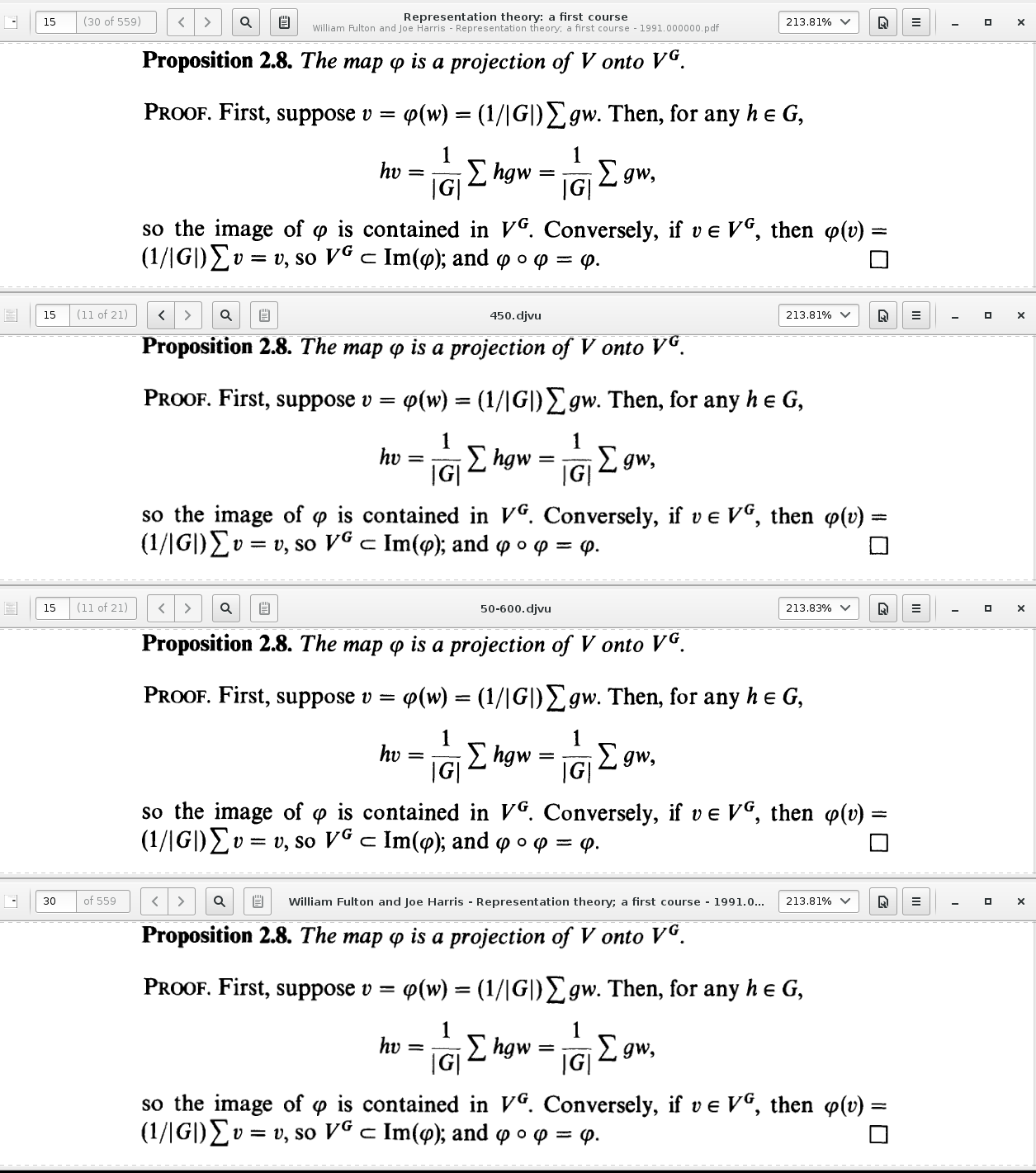
Today I was wondering about converting a pdf made from scan of a book into djvu, hopefully to reduce the size, without too much loss of quality. My initial experiments with pdf2djvu were a bit discouraging, so I invested some time building gsdjvu in order to be able to run djvudigital. Watching the messages from djvudigital I realized that the reason it was achieving so much better compression was that it was using black and white for the foreground layer by default. I also figured out that the default 300dpi looks crappy since my source document is apparently 600dpi. I then went back an compared djvudigital to pdf2djvu a bit more carefully. My not-very-scientific conclusions: Perhaps most compellingly, the output from pdf2djvu has sensible metadata and is searchable in evince. Even with the --words option, the output from djvudigital is not. This is possibly related to the error messages like
Can't build /Identity.Unicode /CIDDecoding resource. See gs_ciddc.ps .
It could well be my fault, because building gsdjvu involved guessing at corrections for several errors. Some of these issues have to do with building software from 2009 (the instructions suggestion building with ghostscript 8.64) in a modern toolchain; others I'm not sure. There was an upload of gsdjvu in February of 2015, somewhat to my surprise. AT&T has more or less crippled the project by licensing it under the CPL, which means binaries are not distributable, hence motivation to fix all the rough edges is minimal.
Version kilobytes per page position in figure
Original PDF 80.9 top
pdf2djvu --dpi=450 92.0 not shown
pdf2djvu --monochrome --dpi=450 27.5 second from top
pdf2djvu --monochrome --dpi=600 --loss-level=50 21.3 second from bottom
djvudigital --dpi=450 29.4 bottom
djvu-compare.png

Mike Gabriel: Jolla has received financing to continue the development of Sailfish OS

The force re-awakens. Jolla has received financing to continue the development of Sailfish OS. For futher reading, see...
https://blog.jolla.com/jolla-back-business/ People, please consider switching over to the Jolla phone and (hopefully) to the upcoming Jolla tablet. Stop using gated community [1] products [2,3]. The efforts done by Jolla on non-gated mobiled hardware is essential and should be supported by buying those products (i.e., help generating revenue). Providing Jolla with financial support can be one means of helping open-sourcing the Sailfish OS UIX developed by Jolla. I wish everyone reading this a good transition into 2016 and a fine 'Twelfth Night' (German: Rauhn chte) period. light+love from 32c3 [4]
Mike [1] https://media.ccc.de/v/32c3-7550-opening_event#video
[2] http://www.apple.com/iphone/
[3] http://www.android.com/
[4] https://streaming.media.ccc.de/32c3/

28 December 2015

Aigars Mahinovs: Moving to Germany

After a long contemplation about what I want to do with my life and just as long a negotiation, I have accepted a job offer at BMW and will be moving from Latvia to Ulm, Germany in January 2016. It is going to be a big change and a big shake-up in my life, but the change should be for the better, eventually. I am going to move there using my car, loading a single car load of essential stuff and leaving the rest behind. My cat will be amond the essentials, so I have already started training him for car rides. The cat is not thrilled about it. I'll be renting out my current apartment - I wish to find someone that I know to rent to, but if noone comes up, then I'll have to give it to a renting company to rent out for me. There should be little change for my online activities, but this means that I will be less available for parties in Riga for the forseable future. Wish me luck!

27 December 2015

Vincent Sanders: The only pleasure I get from moving house is stumbling across books I had forgotton I owned

I have to agree with John Burnside on that statement, after having recently moved house again rediscovering our book collection has been a salve for an otherwise exhausting undertaking. I returned to Cambridge four years ago, initially on my own and then subsequently the family moved down to be with me.

We rented a house but, with two growing teenagers, the accommodation was becoming a little crowded. Melodie and I decided the relocation was permanent and started looking for our own property, eventually finding something to our liking in Cottenham village.

Melodie took the opportunity to have the house cleaned and decorated while empty because of overlapping time with our rental property. This meant we had to be a little careful while moving in as there was still wet paint in places.

Some of our books
Moving weekend was made bearable by Steve, Jonathan and Jo lending a hand especially on the trips to Yorkshire to retrieve, amongst other things, the aforementioned book collection. We were also fortunate to have Andy and Jane doing many other important jobs around the place while the rest of us were messing about in vans.

The desk in the study
The seemingly obligatory trip to IKEA to acquire furniture was made much more fun by trying to park a luton van which was only possible because Steve and Jonathan helped me. Though it turns out IKEA ship mattresses rolled up so tight they can be moved in an estate car so taking the van was unnecessary.

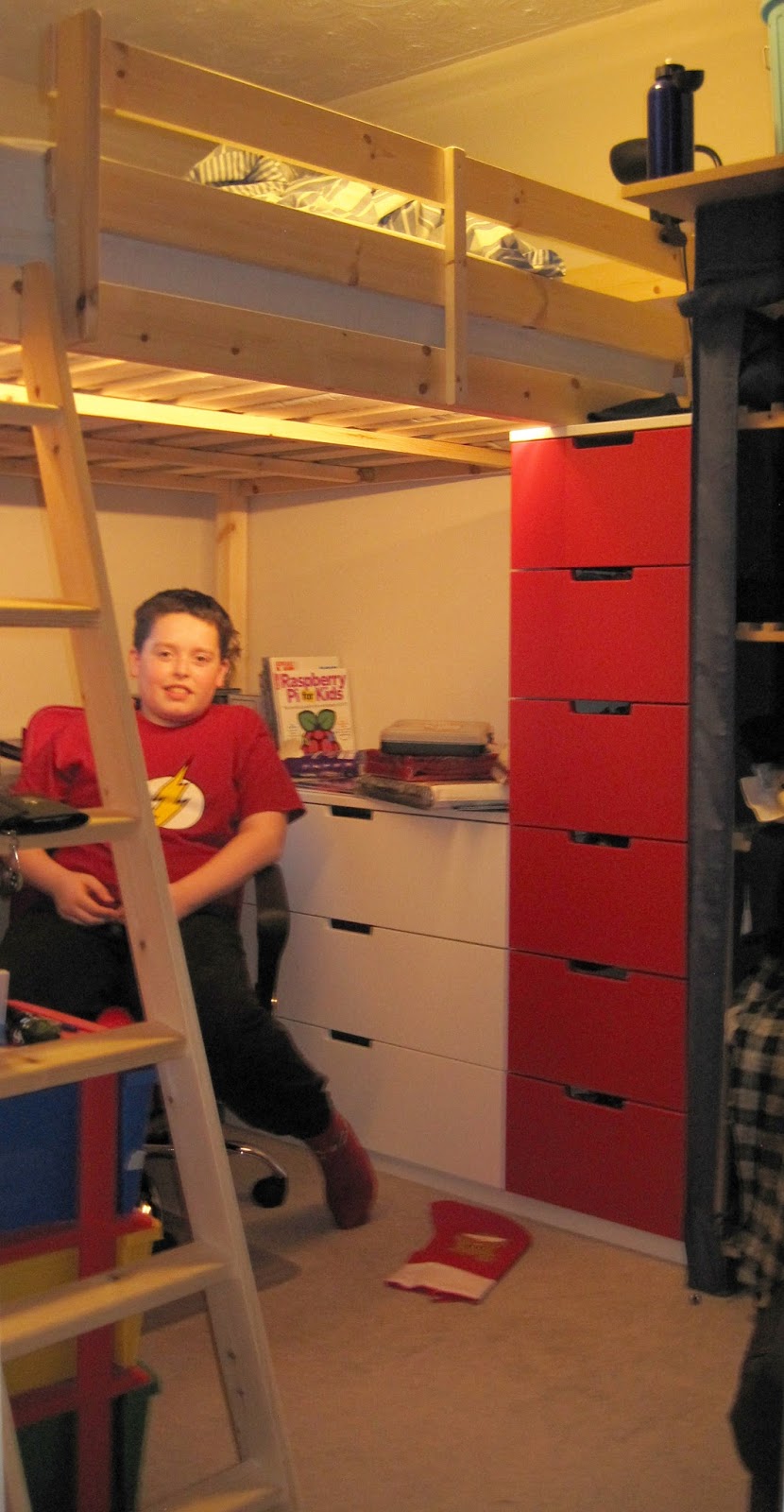
Alex under his loft bed
Having moved in it seems like every weekend is filled with a never ending "todo" list of jobs. From clearing gutters to building a desk in the study. Eight weeks on and the list seems to be slowly shrinking meaning I can even do some lower priority things like the server rack which was actually a fun project.


Joshua in his completed roomThe holidays this year afforded me some time to finish the boys bedrooms. They both got loft beds with a substantial area underneath. This allows them both to have double beds along with a desk and plenty of storage. Completing the rooms required the construction of some flat pack furniture which rather than simply do myself I supervised the boys doing it themselves.

Alexander building flat pack furniture
Teaching them by letting them get on with it was a surprisingly effective and both of them got the hang of the construction method pretty quickly. There was only a couple of errors from which they learned immediately and did not repeat (draw bottoms having a finished side and front becomes back when you are constructing upside down)

Joshua assembling flat pack furniture
The house is starting to feel like home and soon all the problems will fade from memory while the good will remain. Certainly our first holiday season has been comfortable here and I look forward to many more re-reading our books.

Steve Kemp: Some things are universal?

I don't often do retrospectives, but this year has been an unusual one for me, as I moved to Finland almost six months ago. The topic has come up in conversation a lot over the past few months, so when people ask me what I think I can give some simple answers without too much thought. Here's a brief summary. There are some obvious changes:
The Traffic
The traffic drives on the right-hand side of the roads, which took a bit of getting used to, but isn't a huge surprise as I've travelled in Europe in the past. There aren't so many countries that drive on the left after all so most people probably wouldn't even notice this as odd. When it comes to traffic one thing nice about Helsinki is that most junctions are "zebra crossings". Sure they don't have flashing lights, but they have shaded areas, and pedestrians have right of way. As for transport the city of Helsinki has local trains, trams, buses and taxis. The trams and buses all use the same card for payment so transport is integrated very well. I buy a time-based card, spending about 50 for a month of unlimited travel. If you prefer you may add euros to your card and pay for distinct journeys - but that works out more expensive if you travel twice, or more, a day.
The Money
Finland uses the Euro these days, having switched from the Finnish markka in 2002. Enough said. Costs are largely in line with what I'd expect: Cigarettes are cheap, beer is expensive. Some things are very expensive, some things are very cheap. Largely the expensive things are those that are imported. It is a very small country after all.
The Language
Finnish is .. complex. But I've not struggled too much. Mostly I can buy what I want without difficulty. There are weird exceptions though for example I went out to buy soup one day and had to return carrying only shame and disappointment: I can't read the language on the tins and what I thought was soup turned out to be a can of chopped tomatoes. Food is good though, and available easily (!!). The only significant surprise when it comes to shopping is that loose goods must be weighed yourself. You pick up a bunch of bananas, take it to the scales, press the button that has a picture of a banana on it, and it prints out a label you attach to them - at the till the cashier will scan the label and charge you. If you forget, or don't know how to do it they'll tut and complain. In daily life I use two phrases frequently and they are sufficient for communcation:
  • "minua haluan ... kahvi kakku olut"
    • "I want ... coffee cake beer".
  • "kiitos"
    • "Thanks"
Usually people speak to me in English, which is a little annoying as it means I'm not learning as much as I could. But that said over the past few months I've had proper conversations entirely in Finnish with shop-keepers, and similar. So I'm getting better.
The Culture
Finnish people are friendly, but terse. That's the reputation. The Finnish people are alcoholics, and have high rates of suicide. Also the reputation. Finally we know that the Finnish people consume more coffee than the rest of the world. All those things are true, but they're not enough by far to describe the people. Obviously they're all different, and we have a lot of people from other parts of the world here too - Russians, Asians, Somalians. So culture is complex .. but markedly different than in the UK. I could write more about this, but I think for the moment I'll just draw a line under culture and say that I'm enjoying the interactions with people here, and while many things are slightly "off", it's not bad. Just different. Also saunas are fun. I've never had any qualms about being naked with strangers, so I don't really understand why Americans, and others, find this so difficult/surprising. But yeah, saunas are great. Things that Finland is known for internationally: The invention of the molotov cocktail, rally-driving, hockey, world's strongest man, Moomins, Tom of Finland, Salmiakki.
The Weather
Not too hot. Not too cold. But that's largely because I'm one of those "hot" people who doesn't really get cold even at the best of times. My ideal temperatures are about 13 C. My wife prefers 15 C, or more. We don't fight any more. Mostly. Winter is apparently full of snow, but this year has been poor. We had the first snowfall yesterday, here in Helsinki, and we woke this morning a blanket of snow about two inches high. It looks pretty. The biggest thing about weather in Finland is the constant darkness in winter, and the constant sun in Summer. In Summer there were like 22 hours of sunlight a day which made sleeping hard when we moved into our flat - with no curtains. In winter it feels like there is 20 minutes of sunlight a day. It's not that bad here in the south, although I think it is something like five hours and less in the north. I've never had any real issues with depression, or similar: People have good days and bad days, I'd generally be "OK" or "great". In the darkness? I've been grumpy at colleagues, I've made bad choices, I've lapsed attention. I'm not sure I can blame it on the weather, or my reaction to the weather, but I know I've not been as "happy" as I "should". It requires effort to be enthusiastic in a way I've never experienced before. Thankfully once I (slowly) realized this I took action and I think I'm good now. Unlike the UK the buildings here are relatively modern. I think that's the biggest contributing factor to how houses are "warm". Houses have all been built in the last 50-100 years, so you have proper insulation. Even though it might be very very cold outdoors indoors you can be naked without heating. Try that in the UK and you might freeze in some of the older leakier houses! You do have to laugh, though, when people point out "the oldest pub" in the city though. Where I come from if I pub isn't 500+ years old you wouldn't give it a seconds thought - places like The Golden Fleece, etc.
I could write more. I probably should. But it has been an interesting year, and although there are things I miss about the UK, and Edinburgh specifically, I have no regrets. I'm glad I came. What triggered this post? I said "Some things are universal" to my wife, when I saw a child riding a bicycle they'd obviously just received for Christmas. Her reaction "No Finnish person would buy a bicycle at Christmas - they'd expect too much snow!". So perhaps it was another immigrant family. Christmas bicycles universal, or not, it doesn't really matter.

Russ Allbery: Review: The Outskirter's Secret

Review: The Outskirter's Secret, by Rosemary Kirstein
Series: Steerswomen #2
Publisher: Del Rey
Copyright: 1992, 2001
Printing: 2001
ISBN: 0-345-46105-3
Format: Trade paperback
Pages: 389
This is a direct sequel to The Steerswoman, and I don't recommend starting here. I read this novel as part of The Steerswoman's Road omnibus, which is the edition reflected in the metadata (except for the page count, which is just this novel). There are a few plot constructs that occur depressingly often in SFF and almost always annoy me. One is books where nearly all of the book is just a journey from one place to another, without much interesting landscape along the way. Subtract additional points if the land is hostile and there are constant worries about food. Another is illness, or being unable to trust one's senses, or, worse, both. Somehow, this book manages to do both of those things and was still thoroughly enjoyable. This is exceptionally rare. After the conclusions reached in the previous book, Rowan and Bel are even more determined to reach the origin of the jewels on Bel's belt and gather more information. This means travel into the Outskirts, where Rowan has never been (and where people from the Inner Land almost never go). It also means close contact with Bel's people, who have an entirely different set of social rituals and who are notoriously prickly. Nearly all of The Outskirter's Secret is travel through the Outskirts while navigating Outskirter society, politics, and customs. It's anthropological fiction of a sort, particularly given the inquisitive and analytical mindset that Rowan brings to anything new. Anthropological SFF is another one of those things that normally leaves me cold, but which totally worked for me in this book. I rarely remember being this engaged in, or caring this much about, the customs and traditions of an invented and relatively primitive culture. Partly this is because Rowan's mindset continues to be fascinating and contagious. I kind of want to compare this series to Neal Stephenson's Anathem, but where Stephenson's novel was about the practice of organized science, the Steerswomen series is about the individual scholar and scientist. This could go badly in the hands of a lesser author, but Kirstein brilliantly balances analysis and theories with Rowan's child-like wonder in learning, peculiar and determined ethics, and emotional growth. She isn't a disinterested observer or an engineer with a wrench. She lets the world change her, works hard at finding her place and her own strength, and engages with it emotionally as much as she does intellectually. She's a wonderfully compelling character. Another significant factor to this book's success is the slow and deliberate way Kirstein mixes world-building revelations with the day-to-day struggles of the characters. There's much more to that than just the target of Rowan's investigations, and far more complexity and significance to the Outskirters than showed in first appearances. The world is also set up in a way that lets the readers guess various details before the characters, with their more limited knowledge, can work out: another tricky technique that Kirstein gets almost perfect. I never wanted to shake the characters for being dumb; usually, both Rowan and Bel leap to correct conclusions just shortly after the reader, and long before the reader is tired of following their thought processes. There was only one bit of world-building that took Rowan most of the book to figure out despite being obvious to me early in this novel, and I think that one was fair. She didn't have anywhere near enough information to work it out. Bel continues to be wonderful in numerous ways. But even better, Kirstein introduces us to Bel's people and highlights both similarities and differences. It's an excellent job of building a complex culture that feels human: varied, tradition-laden, practical, but also well-adapted to their environment and situation, and far more sophisticated than they might appear. I'm normally a hard sell for this sort of thing, but Kirstein got me thoroughly invested. One scene late in this novel where a tribe welcomes a newcomer is masterful and probably my favorite single moment of the series so far. Once again, unfortunately, the conclusion is a bit less than satisfying. The characters come away knowing more, planning more, but still with numerous unanswered questions. This is not a series that's in a hurry to get to major plot payoffs. Instead, it's a series that takes a close look at the cultures, relationships, emotions, and lives that it touches, and describes them in deft and engaging ways. The Outskirter's Secret is even better than The Steerswoman. Recommended. I bought the third and fourth books while only a little ways into this one and am eager to read them. Followed by The Lost Steersman. Rating: 9 out of 10

26 December 2015

Lucas Nussbaum: Debian packages with /outdated/ packaging style

(This is just a copy of this debian-devel@ email) Following my blog post yesterday with graphs about Debian packaging evolution, I prepared lists of packages for each kind of outdatedness. Of course not all practices highlighted below are deprecated, and there are good reasons to continue to do some of them. But still, given that they all represent a clear minority of packages, I thought that it would be useful to list the related packages. (I honestly didn t know if some of my packages would show up in the lists!) The lists are available at https://people.debian.org/~lucas/qa-20151226/ I also pushed them to alioth, so you can either do:
ssh people.debian.org 'grep -A 10 YOURNAME ~lucas/public_html/qa-20151226/*ddlist'
or:
ssh alioth.debian.org 'grep -A 10 YOURNAME ~lucas/qa-20151226/*ddlist' the meaning of the lists is: If you don t understand why your package is listed, you can have a look at allpackages-20151226.yaml that provides more details. If you still don t understand, just ask me. Excluding duplicates, a total of 5469 packages are listed. The dd-list output for the merged list is also available (which isn t very useful, except to know if you are listed).

Russ Allbery: kstart 4.2

kstart is a collection of two utilities for managing Kerberos tickets, particularly focused on the needs of long-running commands or daemons. This release has taken embarassingly long to release, given that the last release was in January of 2012. Sorry about that, particularly those who were stuck on various bugs! This code base, particularly the test suite, is in dire need of significant refactoring, which reduces my desire to work on it, and then I ran very, very short on free software time. This release is important because I think I've finally worked through all the various tricky complexity of startup when running a command under k5start. The core problem: the original k5start exited when authentication failed. However, it's very nice to start daemons that need a Kerberos ticket by running them via k5start. But if this is done during system startup, the network may not be up yet, and one may not be able to contact the KDC. It's very difficult to get the timing right just by adjusting init scripts. The core fix in this release is that k5start run as a daemon or with a command, and krenew run with the -i option, now keeps retrying the authentication or renewal until it succeeds. It's retried immediately and then with exponential backoff, starting with a delay of a second, until intervals of one minute, and then retried at a delay of one minute until it succeeds. Any command isn't run until the authentication works, so (unlike previous versions) k5start won't start the command without a Kerberos ticket. That should fix various problems people are having. There are also some new options to tweak the renewal behavior. -H can now be used in combination with -K to specify how long of a minimum ticket lifetime k5start or krenew should try to maintain. Alternately, there's now a -a flag that tells both to attempt an authentication or renewal every time they wake up (at the interval specified with -K). This probably should have been the default for -K originally, but I didn't change the original behavior for backwards compatibility. There are also a couple of bug fixes: the temporary ticket cache created by k5start is cleaned up properly, and the programs no longer incorrectly reject the combination of -b and -K or a command. You can get the latest version from the kstart distribution page.

22 December 2015

Ian Wienand: Platform bootstrap for OpenStack Infrastructure

This is a terse guide on bootstrapping virtual-machine images for OpenStack infrastructure, with the goal of adding continuous-integration support for new platforms. It might also be handy if you are trying to replicate the upstream CI environment. It covers deployment to Rackspace for testing; Rackspace is one of the major providers of capacity for the OpenStack Infrastructure project, so it makes a good place to start when building up your support story. Firstly, get an Ubuntu Trusty environment to build the image in (other environments, like CentOS or Fedora, probably work -- but take this step to minimise differences to what the automated machinery of what upstream does). You want a fair bit of memory, and plenty of disk-space. The tool used for building virtual-machine images is diskimage-builder. In short, it takes a series of elements, which are really just scripts run in different phases of the build process. I'll describe building a Fedora image, since that's been my focus lately. We will use a fedora-minimal element -- this means the system is bootstrapped from nothing inside a chroot environment, before eventually being turned into a virtual-machine image (contrast this to the fedora element, which bases itself off the qcow2 images provided by the official Fedora cloud project). Thus you'll need a few things installed on the Ubuntu host to deal with bootstrapping a Fedora chroot
apt-get install yum yum-utils python-lzma
You will hit stuff like that python-lzma dependency on this road-less-travelled -- technically it is a bug that yum packages on Ubuntu don't depend on it; without it you will get strange yum errors about unsupported compression. At this point, you can bootstrap your diskimage-builder environment. You probably want diskimage-builder from git, and then build up a virtualenv for your support bits and pieces.
git clone git://git.openstack.org/openstack/diskimage-builder
virtualenv dib_env
. dib_env/bin/activate
pip install dib-utils
dib-utils is a small part of diskimage-builder that is split-out; don't think too much about it. While diskimage-builder is responsible for the creation of the basic image, there are a number of elements provided by the OpenStack project-config repository that bootstrap the OpenStack environment. This does a lot of stuff, including caching all git trees (so CI jobs aren't cloning everything constantly) and running puppet setup.
git clone git://git.openstack.org/openstack-infra/project-config
There's one more trick required for building the VHD images that Rackspace requires; make sure you install the patched vhd-util as described in the script help. At this point, you can probably build an image. Here's something approximating what you will want to do
break=after-error \
TMP_DIR=~/tmp \
ELEMENTS_PATH=~/project-config/nodepool/elements \
DIB_DEV_USER_PASSWORD="password"  DIB_DEV_USER_PWDLESS_SUDO=1 \
DISTRO=23 \
./bin/disk-image-create -x --no-tmpfs -t vhd \
   fedora-minimal vm devuser simple-init \
   openstack-repos puppet nodepool-base node-devstack
To break some of this down This goes and does its thing; it will take about 20 minutes. Depending on how far your platform diverges from the existing support, it will require a lot of work to get everything working so you can get an image out the other side. To see a rough example of what should be happening, see the logs of the official image builds that happen for a variety of platforms. At some point, you should get a file image.vhd which is now ready to be deployed. The only reasonable way to do this is with shade. You can quickly grab this into the virtualenv we created before
pip install shade
Now you'll need to setup a clouds.yaml file to give yourself the permissions to upload the image. It should look something like
clouds:
  rax:
    profile: rackspace
    auth:
       username: your_rax_username
       password: your_rax_password
       project_id: your_rax_accountnum
    regions:
    - IAD
You should know your user-name and password (whatever you log into the website with), and when you login to Rackspace your project_id value is listed in the drop-down box labeled with your username as Account #. shade has no UI as such, so a simple script will do the upload.
import shade
shade.simple_logging(debug=True)
cloud = shade.openstack_cloud(cloud='rax')
image = cloud.create_image('image-name', filename='image.vhd', wait=True)
Now wait -- this will also take a while. Even after upload it takes a fair while to process (you will see the shade debug output looping around some glance calls seeing if it is ready). If everything works, the script should return and you should be able to see the new image in the output of nova list-images. At this point, you're ready to try booting! One caveat is that the Rackspace web interface does not seem to give you the option to boot with a configuration drive available to the host, essential for simple-init to bring up the network. So boot via the API with something like
nova boot --flavor=2 --image=image-uuid --config-drive 1 test-image
This should build and boot your image! This will allow you to open a whole new door of debugging to get your image booting correctly. You can now iterate by rebuilding/uploading/booting as required. Note these are pretty big images, and uploaded in broken-up swift files, so I find swift delete --all helpful to reset between builds (obviously, I have nothing else in swift that I want to keep). The Rackspace java-based console UI is rather annoying; it cuts itself off every time the host reboots. This makes it quite difficult to catch the early bootup, or modify grub options via the boot-loader, etc. You might need to fiddle timeout options, etc in the image build. If you've managed to get your image booting and listening on the network, you're a good-deal of the way towards having your platform supported in upstream OpenStack CI. At this point, you likely want to peruse the nodepool configuration and get an official build happening here. Once that is up, you can start the process of adding jobs that use your platform to test! Don't worry, there's plenty more that can go wrong from here -- but you're on the way! OpenStack infra is a very dynamic environment, which many changes in progress; so in general, #openstack-infra on freenode is going to be a great place to start looking for help.

Michal Čihař: Weekly phpMyAdmin contributions

Again one week has passed and there has been some progress on phpMyAdmin. This week the focus was on code cleanup and issue fixing. I've identified several pieces of dead code and removed that from our code base (the biggest removal being no longer used PMA_String class). The codebase is quite old and sometimes it's not easy to identify code which is not really being used, as it still might be referenced from some locations, but without actually invoking it. On the issue fixing side, I'm really happy from improving user experience with fields marked as binary - so far phpMyAdmin has displayed them as hexadecimal dump in all cases. Now it will display them as text as long as the content is valid utf-8. Bugs fixed: PS: I will most likely skip report next week due to Christmas.

Filed under: English phpMyAdmin 0 comments

Dmitry Shachnev: ReText 5.3 released

On Sunday I have released ReText 5.3, and here finally comes the official announcement. Highlights in this release are: Also, a week before ReText 5.3 a new version of PyMarkups was released, bringing enhanced support for the Textile markup. You can now edit Textile files in ReText too, provided that python-textile module for Python 3 is installed. As usual, you can get the latest release from PyPI or from the Debian/Ubuntu repositories. Please report any bugs you find to our issue tracker.

21 December 2015

Matthew Garrett: GPL enforcement is a social good

The Software Freedom Conservancy is currently running a fundraising program in an attempt to raise enough money to continue funding GPL compliance work. If they don't gain enough supporters, the majority of their compliance work will cease. And, since SFC are one of the only groups currently actively involved in performing GPL compliance work, that basically means that there will be nobody working to ensure that users have the rights that copyright holders chose to give them.

Why does this matter? More people are using GPLed software than at any point in history. Hundreds of millions of Android devices were sold this year, all including GPLed code. An unknowably vast number of IoT devices run Linux. Cameras, Blu Ray players, TVs, light switches, coffee machines. Software running in places that we would never have previously imagined. And much of it abandoned immediately after shipping, gently rotting, exposing an increasingly large number of widely known security vulnerabilities to an increasingly hostile internet. Devices that become useless because of protocol updates. Toys that have a "Guaranteed to work until" date, and then suddenly Barbie goes dead and you're forced to have an unexpected conversation about API mortality with your 5-year old child.

We can't fix all of these things. Many of these devices have important functionality locked inside proprietary components, released under licenses that grant no permission for people to examine or improve them. But there are many that we can. Millions of devices are running modern and secure versions of Android despite being abandoned by their manufacturers, purely because the vendor released appropriate source code and a community grew up to maintain it. But this can only happen when the vendor plays by the rules.

Vendors who don't release their code remove that freedom from their users, and the weapons users have to fight against that are limited. Most users hold no copyright over the software in the device and are unable to take direct action themselves. A vendor's failure to comply dooms them to having to choose between buying a new device in 12 months or no longer receiving security updates. When yet more examples of vendor-supplied malware are discovered, it's more difficult to produce new builds without them. The utility of the devices that the user purchased is curtailed significantly.

The Software Freedom Conservancy is one of the only organisations actively fighting against this, and if they're forced to give up their enforcement work the pressure on vendors to comply with the GPL will be reduced even further. If we want users to control their devices, to be able to obtain security updates even after the vendor has given up, we need to keep that pressure up. Supporting the SFC's work has a real impact on the security of the internet and people's lives. Please consider giving them money.

comment count unavailable comments

Diego Escalante Urrelo: Stallman on happiness and perseverance

What does happiness signify to you, I asked him, if it isn t based on wealth and comfort? Happiness for me is a combination of feeling good about myself and having love, he said. And to feel good about myself, I have to do things that convince me I deserve it. ( ) The point is, even though it s sad to see people being foolish, there s no use giving up. Nothing good can come of giving up. That just means you lose completely, right away.
Richard Stallman on the 30th anniversary of the GNU Manifesto. It s amazing to think that a broken printer lead to the creation of the Free Software movement which, many years later, would give me a professional career, an education, and incredible friends around the world. Which reminds me I still keep the sticker Richard personally handed at the end of his first talk in Per , back in August 2003:
DSCF9847-web

GNU & Linux: the dynamic duo.

Bonus: Enjoy The Free Software Song by The GNU/Stallmans.

Keith Packard: TeleLaunchTwo

TeleLaunchTwo A Smaller Wireless Launch Controller I've built a wireless launch control system for NAR and OROC. Those are both complex systems with a single controller capable of running hundreds of pads. And, it's also complicated to build, with each board hand-made by elves in our Portland facility (aka, my office). A bunch of people have asked for something simpler, but using the same AES-secured two-way wireless communications link, so I decided to just build something and see if we couldn't eventually come up with something useful. I think if there's enough interest, I can get some boards built for reasonable money. Here's a picture of the system; you can see the LCO end in a box behind the pad end sitting on the bench. Radio Link Each end has a 35mW 70cm digital transceiver (so, they run in the 440MHz amateur band). These run at 19200 baud with fancy forward error correction and AES security to keep the link from accidentally (or maliciously) firing a rocket at the wrong time. Using a bi-directional link, we also get igniter continuity and remote arming information at the LCO end. The LCO Box In the LCO box, there's a lipo battery to run the device, so it can be completely stand-alone. It has three switches and a button -- an arming switch for each of two channels, a power switch and a firing button. The lipo can be charged by opening up the box and plugging it into a USB port. The Pad Box The pad box will have some cable glands for the battery and each firing circuit. On top, it will have two switches, a power switch and an arming switch. The board has two high-power FETs to drive the igniters. That should be more reliable than using a relay, while also allowing the board to tolerate a wider range of voltages -- the pad box can run on anything from 12V to 24V. The Box Unlike the OROC and NAR systems, these boards are both designed to fit inside a specific box, the Hammond 1554E, and use the mounting standoffs provided. This box is rated at NEMA 4X, which means it's fairly weather proof. Of course, I have to cut holes in the box, but I found some NEMA 4X switches, will use cable glands for the pad box wiring and can use silicone around the BNC connector. The result should be pretty robust. I also found a pretty solid-seeming BNC connector, which hooks around the edge of the board and also clips on to the board. Safety Features. There's an arming switch on both ends of the link, and you can't fire a rocket without having both ends armed. That provides an extra measure of safety while working near the pad. The pad switch is a physical interlock between the power supply and the igniters, so even if the software is hacked or broken, disarming the box means the igniters won't fire. The LCO box beeps constantly when either arming switch is selected, giving you feedback that the system is ready to fire. And you can see on any LED whether the pad box is also armed.

Next.

Previous.