Search Results: "dom"

11 November 2010

Erich Schubert: Partial subversion mirror

Does anyone know how to setup a partial subversion mirror? Essentially we have a source code tree, containing various subdirectories, including doc, test, src/tld/domain and src/experimentalcode/usernames.
We'd like to allow public access to the main source subtree, while not exposing the various user directories to the web server (the master subversion is separate anyway; since I want to use Trac I need a local SVN copy!) I'm currently trying to setup "tailor" to do this, but it is not trivial: it seems easy at first to just ignore any change in a particular folder. But when you encounter "move" aka "rename" operations that rename a file from the non-exposed folder to the exposed folder, they will obviously fail on the "stripped" repository. So they need to be mapped to an "add" operation there! Any hints? I might have it working using some hacks in tailor, but I'd like to know any simple solution, if there is any ...

Raphaël Hertzog: People behind Debian: Joey Hess of debhelper fame


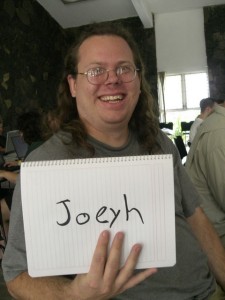
I decided recently to publish interviews from Debian contributors and I picked Joey Hess as my first target. He s one of the few who have heavily influenced Debian by creating software that have become building blocks of the project, like the debian-installer (Joey uses the shorthand d-i to refer to it). My questions are in bold, the rest is by Joey (except for the additional information that I inserted in italics). Who are you? Hello, I m Joey Hess. I m one of the oldtimers in Debian. Actually, I just checked, and there are still up to nineteen active Debian Developers who joined the project before I did, in 1996. I got started fairly young, and am just 34 years old. I spend part of my time working with Lars Wirzenius, another Debian oldtimer, on Branchable. It makes it dead-easy for anyone to make a website that is built from Git, using my Ikiwiki engine to do wiki and blog style things. These days I spend the rest of my time working on free software, when I should really be looking for work to pay the bills. What s your biggest achievement within Debian or Ubuntu? I guess I m mostly known by Debian developers for writing debhelper and perhaps debconf. Probably founding the Debian Installer project has been a bigger impact for users. I m fairly equally proud of all three projects. But while it might sound corny, I am more proud of the accumulation of all the smaller things done in the context of Debian. It s more of a deep connection to the project. All the bugs fixed, and filed, and packages uploaded, and late night discussions, and just being a part of the larger project. What are your plans for Debian Wheezy? Hmm, I stopped thinking of Debian releases by code names back around Slink. :) So, few specific plans for Wheezy. The main thing I would like to help make happen in Debian next is Constantly Usable Testing, and it transcends releases anyway. The only specific plans I have for Wheezy are that there will probably be a new debhelper compat level, and I hope d-i will finally switch to using git. RH: You can learn more about Constantly Usable Testing in my article Can Debian offer a Constantly Usable Testing distribution?. If you could spend all your time on Debian, what would you work on? Getting Debian on all these computers that we carry around in our pockets and can t easily run apt-get on and hack on. Phones that is. It s a bigger problem than just Debian, but I think Debian needs to find a way to be part of the eventual solution. The FreedomBox concept at least hints at a way around the current situation with embedded computers in general. What s the biggest problem of Debian? I believe that the biggest problem is institutional, social and technological inertia. Every specific case of something that frustrates me about Debian today can be traced back to that. You contribute regularly to Debian mailing lists, yet I don t remember any aggressive/frustrated mail of you. How do you manage that? Are you avoiding heated discussions? Rats, sounds like all my wonderful flames of years past have been forgotten! Seriously though, after I noticed thread patterns, I started trying to avoid participating in the bad patterns myself. Now I limit myself to one expression of an opinion, and I don t care who gets the last word. If people can t be convinced, it s time to find another approach to the problem. Also, code talks. Most of the programs you wrote for Debian are in Perl. Do you regret this choice? I love that question! No, no regrets. My only concern is whether the language limits contributors or users. I have not seen Perl significantly limiting the use of anything except for debconf (we had to rewrite it in C for d-i). And I do not notice fewer contributions to my Perl-based code than to other code. I do sometimes regret when someone tells me they had to learn or re-learn Perl to work on something I wrote. But while I m enjoying writing new things in Haskell now, and while I hope it will mean less maintenance burden later, I don t think using Haskell will make it easier for others to contribute to my programs. Anyway, for me the interesting thing about writing a program is the problem it solves and the decisions made doing it. Choice of language is one of the less interesting decisions. Is there someone in Debian that you admire for his contributions? Well, lots. You re tempting me to throw a dart at a map. So arbitrarily, I ll say Anthony Towns. We could all learn something from how he s approached making big, fundamental changes, like introducing Testing, and making Debian Maintainers happen.
Thank you to Joey for the time spent answering my questions. I hope you enjoyed reading his answers as I did. Subscribe to my newsletter and don t miss further interviews. You can also follow along on Identi.ca, Twitter and Facebook. PS: If you want to suggest me someone to interview, leave a comment or mail me.

3 comments Liked this article? Click here. My blog is Flattr-enabled.

9 November 2010

John Goerzen: A Scary Day, and A Walking Miracle

I had been planning to write today about my great uncle Milt Goerzen. Milt passed away last Thursday after a long struggle with dementia, and his funeral was this morning. I was there, and was inspired by a few things I heard. But that will have to wait, because today brought one of those few moments in life that s a sense of an impending possible great loss. I can remember two others: one was when Terah passed out, and the other was when we heard that our place was on fire and our house had burned down (it turned out the house hadn t, but much of the rest had). I got a call during Milt s funeral. I didn t answer because I was, well, at a funeral, and the phone was on vibrate. When I had the chance to check the voicemail, it went something like this: I think we have an emergency with Jacob. He got run over by a tractor. He says he s OK, but I m taking him to the doctor right now. I tried to return the call, but cell phone reception wasn t cooperating. The most I got was he s OK . It s hard to describe how a moment like that feels. My mind jumped to telling Jacob I love you , and how lately when he hears that, he will snuggle in for a big hug, and say, Dad, I love you toooooooooo! On the one hand, I heard the he s OK part, and on the other hand I couldn t forget the tractor running over him part, and my mind leapt at the worst. It turns out that, while I was at the funeral, Jacob had been standing on his usual spot on the tractor, sort of to the side of the driver. He was enjoying himself like usual. The tractor hit a large hole that wasn t really visible. The combination of the jolt and the dip the tractor took towards Jacob s side knocked him off and he went directly under the big rear wheel before the tractor could be brought to a stop. I caught up with him and his grandpa after he had seen the doctor and just as he was being admitted to the hospital. He saw me and crawled over, making his sort of sad and scared sound he sometimes doesn t want to verbalize things when he s in that mood. I held him close and he seemed to appreciate it. He had to have blood drawn, and he was scared of that. I remembered his inquisitive mind, and reminded him how much he liked watching the tube fill up with blood last time he had a blood test (which he calls a blood shot ). That wasn t helping, until the actual blood test started. He cried when the needle went in, but then calmed down as the nurse, getting into the act, pointed out that there was blood filling up the tube. Hmmm! said Jacob. Then she gave him a band-aid. It has an airplane, said the nurse. Um-hmm! said Jacob. I pointed out that it looked like the airplane we were on when we flew home from New York. Jacob got a big smile and said, Yes, it IS that one! He got a sticker there too. Then it was off for an x-ray to check for broken bones and a CT scan to check for internal injuries the tractor had gone right over his abdomen. He had to get an IV at the CT scan, which he certainly didn t like. After it happened, however, he found it very interesting especially when the nurses explained that they would give him a drink through the hose attached to his hand. After that, we went to his room, with orders for him not to eat or drink anything until it was clear he didn t have digestive problems. While we waited at various steps along the way, Jacob wanted to sit on my lap and watch train videos on YouTube on my phone. He loves train videos, and brought my phone s battery nearly to depletion through the course of the afternoon. Jacob eventually seemed to get back to a bit of his usual self. At one point, while Terah had made a run home to pack an overnight bag and grandpa ran some errands of his own, Jacob wanted to leave the room. He had gone exploring in the hospital with me before: when Oliver was born, and when Terah had her thyroid surgery. So this was something he just associated with the hospital. That and lemonade, which is free any time of the day or night in the cafeteria. So we went exploring, even ventured outside into a courtyard for a bit. He was walking fast and seemed good. We had several visitors: grandparents and his aunt and uncle. Jacob got a stuffed rabbit and a colorful bug box with windows (for putting bugs inside for observation). Eventually the doctor came by and gave us the results: the x-rays showed no problems. The labs showed some elevated liver enzymes, which he expected, but no serious trouble. The CT showed contusions on his lung and bruising on his heart which would heal completely in time. He allowed Jacob to have a liquid supper (so I quickly got him the lemonade he had been wanting while the nurses got him some Jello). The doctor examined Jacob, pushing at various places, asking Does it hurt here? No. Does it hurt here? No. Here? No. Are you hungry? Yes. Does it hurt here? No. He gave me a look that said: really? It doesn t hurt ANYWHERE? What could I do but shrug my shoulders? Jacob has some abrasions on his face, arms, and back, which will probably eventually hurt (and sure enough, about 10 minutes later he started getting a little pain when he tried to move, which the doctor checked out) Then the doctor said, I hope you know you have a walking miracle today. This is just amazing. You have some thanking to whatever guardian angels you like tonight all I can say about this is that the Lord must have had some other plan for him. There s no way he could have survived that. Jacob s doctor is one that we really respect: he s scientific in his analysis, cites studies as a matter of routine, doesn t prescribe antibiotics for things that he knows they have a small chance of helping, is common-sense about not over-treating things and yet always engaged in an emergency. That little speech from him was something I d never expected to hear from him. He went on to add that I always visit my sickest patients first. You were my last visit this evening, so that should tell you something. Any other kid as healthy as he is, I might discharge already but I m just not justified doing that with a boy that s, well, been driven over by a tractor this morning. He also wanted to monitor Jacob s progress throughout the coming day, especially his digestive system. They wanted to measure his urine output, which he, predictably, found to be very interesting. Terah said I think it is about 150 ml. Jacob said, No mom, it is closer to the two hundred line. Me: Since when does Jacob know about the number 200? Terah: I don t know . he s 4, where would he have gotten it? Between that, and using every opportunity to tell people that there were not one but TWO red light switches in the x-ray room, Jacob s definitely himself in some ways already. So, that feeling of some impeding great loss is gone, replaced by being more than a bit overwhelmed by how fortunate we were today. We also appreciate all the help we ve had with Jacob and Oliver today.

8 November 2010

Simon McVittie: Debian activities

Most of my recent Debian work has been the usual pkg-telepathy stuff (mainly in experimental while we're frozen), and hacking on the Quake III engine. Having started working on OpenArena DFSG-freeness as random bug-squashing a year ago, I've accidentally ended up taking over the package. The situation for Debian 6.0 (squeeze) looks something like this: The plan for Quake III in Debian 7.0 (wheezy) has already started in experimental: I haven't been doing as much QA work as the RCBW crowd, but here's some halfway-recent bug squashing in the hope that it motivates others: I also started looking at the series of bugs regarding Flash not compiled from source, but I mostly got distracted by all the webapps having a contrib/ directory containing a million embedded code copies...

7 November 2010

Kees Cook: security is more than bug fixing

Security is more than bug fixing. Security fixing/updating, the thing most people are exposed to, is reactive security . However, a large area of security work is proactive where defensive abilities are put in place to try and catch problems before they happen, or make classes of vulnerabilities unexploitable. This kind of security is what a lot of people don t understand, and I think it s important to point out so the distinction can be clearly seen. In the Linux kernel, there s yet another distinction: userspace proactive security and kernel proactive security. Most of the effort in kernel code has been protecting userspace from itself (things like Address Space Layout Randomization), but less attention has been given to protecting the kernel from userspace (currently if a serious enough flaw is found in the kernel, it is usually very easy to exploit it). One project has taken great strides with proactive security for the Linux kernel: PaX and grsecurity. There hasn t been a concerted effort to get its pieces upstream and it s long overdue. People are starting to take proactive kernel security more seriously, though there is still plenty of debate. While I did my best to push some userspace protections upstream earlier in the year, now it s time for kernel protections. What to help? Here is the initial list of things to do. Dan Rosenberg has started the information leaks discussion, and I ve started the read-only memory discussion. Hopefully this will go somewhere good.

6 November 2010

Josselin Mouette: Is HP run by a bunch of idiots?

My wife has been pestering me for months to get a replacement for our dead Epson inkjet printer (which didn t last long, mind you). To avoid the nightmare of printer support, which, unless you buy a high-end professional printer which does everything plus the coffee, is usually somewhere between disaster and works sometimes , we spent a long time on manufacturers websites to choose wisely the model. We chose the HP Laserjet P1102, which, according to HP, has a full support level and is even part of their recommended models. Yet, after plugging it in, it took me quite some time to understand why it would behave as a brick instead of a printer. First, I thought it was a bug in hplip. Then, I soon discovered that the printer advertised itself as a storage device instead of a printer. What, a buggy firmware? Thanks to a random question on Launchpad I discovered it s not a bug, it s a feature. It s named HP Smart Install and it turns out it s yet another stupid idea to support OSes that are too dumb to detect your printers automatically: the printer advertises itself as a CD drive, until you install the driver that will make it switch back to being a printer. What happens to those who don t want this feature that turns your printer into a 10 kg, read-only USB drive? Well, HP has a solution in the Smart Install FAQ:
25. Can I turn HP Smart Install off or on?
Yes. You can use the HP Smart Install utility to disable/enable HP Smart Install. The utility is stored on the software CD, in the UTIL folder. SIUtility.exe is for 32-bit operating systems and SIUtility64.exe is for 64-bit operating systems.
Bunch of idiots. If I buy a 100 printer, it s not so that I have to buy a 100 operating system just to activate it.

5 November 2010

Dominique Dumont: Test CPANPLUS install on a Debian system

Hello I m a Perl author working on a Debian unstable system. The great thing about Debian is that a lot of Perl modules are available though Debian packages. I follow Debian way of life to the point that I no longer install my modules (under development) with sudo make install (or its Module::Build equivalent). I ve often been bitten by weird test errors due to old version of module lingering in /usr/local. Now, I always create Debian package of my modules under development with dh-make-perl. This way, I avoid installing Perl module in /usr/local and my developement versions are cleaned up when actual package are availalble through Debian unstable. () This method has an unfortunate side effect: I never test installation the CPAN way. And Config::Model did fail to install with CPANPLUS. Now here s a way to create a barebone Debian chroot with cowbuilder to test CPANPLUS installation. First create a new chroot: $ sudo cowbuilder --create --distribution sid

Loging into this chroot (the bindmount option is necessary for cpanp to work correctly) : $ sudo cowbuilder --login --bindmounts /dev

In the chroot: Run cpan to configure CPAN: # cpan

Hit return to configure CPAN automatically. Then install your module: # cpanp i Config::Model

Or, if your module is not yet uploaded: # cpanp i http://<path-to-tar.gz>

Once you quit, the chroot is restored to its barebone state. Et voila. I tested full installation with dependencies the CPAN way without mucking up my system. Many thanks to Christian Kuelker of Cipux project for his comments that enable me to improve Config::Model All the best

2 November 2010

Francois Marier: RAID1 alternative for SSD drives

I recently added a solid-state drive to my desktop computer to take advantage of the performance boost rumored to come with these drives. For reliability reasons, I've always tried to use software RAID1 to avoid having to reinstall my machine from backups should a hard drive fail. While this strategy is fairly cheap with regular hard drives, it's not really workable with SSD drives which are still an order of magnitude more expensive.

The strategy I settled on is this one:This setup has the benefit of using a very small SSD to speed up the main partition while keeping all important data on the larger mirrored drives.

Resetting the SSDThe first thing I did, given that I purchased a second-hand drive, was to completely erase the drive and mark all sectors as empty using an ATA secure erase. Because SSDs have a tendency to get slower as data is added to them, it is necessary to clear the drive in a way that will let the controller know that every byte is now free to be used again.

There is a lot of advice on the web on how to do this and many tutorials refer to an old piece of software called Secure Erase. There is a much better solution on Linux: issuing the commands directly using hdparm.

Partitioning the SSDOnce the drive is empty, it's time to create partitions on it. I'm not sure how important it is to align the partitions to the SSD erase block size on newer drives, but I decided to follow Ted Ts'o's instructions anyways.

Another thing I did is leave 20% of the drive unpartitioned. I've often read that SSDs are faster the more free space they have so I figured that limiting myself to 80% of the drive should help the drive maintain its peak performance over time. In fact, I've heard that extra unused unpartitionable space is one of the main differences between the value and extreme series of Intel SSDs. I'd love to see an official confirmation of this from Intel of course!

Keeping the RAID1 array in sync with the SSDOnce I added the solid-state drive to my computer and copied my root partition on it, I adjusted my fstab and grub settings to boot from that drive. I also setup the following cron job (running twice daily) to keep a copy of my root partition on the old RAID1 drives (mounted on /mnt):
nice ionice -c3 rsync -aHx --delete --exclude=/proc/* --exclude=/sys/* --exclude=/tmp/* --exclude=/home/* --exclude=/mnt/* --exclude=/lost+found/* --exclude=/data/* /* /mnt/

Tuning the SSDFinally, after reading this excellent LWN article, I decided to tune the SSD drive (/dev/sda) by adjusting three things:


Is there anything else I should be doing to make sure I get the most out of my SSD?

31 October 2010

Jan Wagner: linux-image-2.6.32-bpo.5-xen-686 and xen/xen-common from squeeze broken?

I m experiencing since some time (out of the blue) spontaneous reboots of some of my dom0s on lenny/i386 (others don t have this effect). As result of this, I started rolling out linux-image-2.6.32-bpo.5-xen-686 from bpo and backported xen and xen-common from testing:

# dpkg -l grep xen grep bpo
ii libxenstore3.0 4.0.1-1~bpo50+1 Xenstore communications library for Xen
ii linux-image-2.6.32-bpo.5-xen-686 2.6.32-26~bpo50+1 Linux 2.6.32 for modern PCs, Xen dom0 suppor
ii xen-hypervisor-4.0-i386 4.0.1-1~bpo50+1 The Xen Hypervisor on i386
ii xen-linux-system-2.6.32-bpo.5-xen-686 2.6.32-26~bpo50+1 Xen system with Linux 2.6.32 on modern PCs (
ii xen-tools 4.1-1~bpo50+1 Tools to manage Debian XEN virtual servers
ii xen-utils-4.0 4.0.1-1~bpo50+1 XEN administrative tools
ii xen-utils-common 4.0.0-1~bpo50+1 XEN administrative tools common files
ii xenstore-utils 4.0.1-1~bpo50+1 Xenstore utilities for Xen This fixed the problem of spontaneous reboots for all of the systems I have migrated . until now! Last week I tried this solution on my private system and it failed in some way.
boot problems
A full dump of the syslog is also available. It looks like /etc/rcS.d/S03udev is hanging in some way .. the syslog for this looks like:

Oct 29 20:51:07 mordor kernel: [ 17.728120] Code: 04 00 00 00 00 83 3c 24 10 74 32 77 0c 83 3c 24 08 0f 85 9f 00 00 00 eb 12 83 3c 24 20 74 30 83 3c 24 40 0f 85 8d 00 00 00 eb 35 <0f> b6 01 8b 54 24 20 89 02 c7 42 04 00 00 00 00 eb 79 0f b7 01
Oct 29 20:51:07 mordor kernel: [ 17.731554] EIP: [<c1184d4c>] acpi_ex_system_memory_space_handler+0 189/0 221 SS:ESP 0069:ec135d74
Oct 29 20:51:07 mordor kernel: [ 17.731791] CR2: 00000000eda86000
Oct 29 20:51:07 mordor kernel: [ 17.731881] [ end trace 7b8af581772a1c55 ]
Oct 29 20:51:07 mordor kernel: [ 18.116622] input: PC Speaker as /devices/platform/pcspkr/input/input6
Oct 29 20:51:07 mordor kernel: [ 18.427607] Error: Driver pcspkr is already registered, aborting
Oct 29 20:51:07 mordor kernel: [ 232.381814] Adding 10000452k swap on /dev/sda2. Priority:-1 extents:1 across:10000452k The dom0 is there hanging in some way I don t have an exact way to get the system proceed from there usually I need to wait some seconds and pressing ^C after a while will get the box up.
Anyways I remember there are some problems with udev >= 150 and older kernels, which is also documented in the squeeze release notes. Maybe there is also a problem with older udev and newer kernels? But why is this combination working on other systems? Booting linux-image-2.6.32-bpo.5-686 works without any issue anyways, so it seems xen related. Any idea is appreciated!
UPDATE: I ve also reported this via #602109.

28 October 2010

Sam Hartman: Moonshot at Kerberos

At The MIT Kerberos Consortium s 2010 conference, Josh Howlett and Sam Hartman delivered a talk on Moonshot. Slides should be up in a day or so. We reported on status and gave a brief overview. The new material was apropos for the venue. At the bar BOF back in March at IETF 77, we received several comments on Moonshot s limitations. It doesn t work well for services that require rapid authentications for multiple requests. There s not a good story for use when a Moonshot service needs to contact another service. There isn t a good standardized mechanism for mapping in domain-specific policy. We presented a proposal that Luke and Sam developed to optionally provide a Kerberos ticket as part of moonshot authentication. This scales from a service that simply generates its own service tickets all the way through resource domains that have many services and complex policy and provide the client a TGT. Clients can implement the feature in order to achieve better performance. Server can implement the feature in order to get delegation support within a resource domain and to get policy mapping. Luke has prototyped a version of this service involving a service ticket. We plan on briefly mentioning a desire to have extensible fast reauthentication support at the ABFAB meeting in IETF 79. However in the interest of getting the working group off to a good start we re going to focus on the well understand parts of the system and formally propose this extension after IETF 79.

27 October 2010

Joey Hess: three thousand lines of Haskell

Three thousand lines of code is not a huge program, but it is enough to get a pretty good feel for a language. Now that I've completed my first real Haskell program I feel that I've gotten over several of the humps in the learning curve and am starting to get a good feel for it. Actually, I've written closer to five thousand lines, since there were several big refactorings. One was when I stopped manually threading my program state around and added a StateT monad. I did know from the beginning I would need one, but it seemed easier and a better learning exercise to let the program start out with a vesigial tail and gills before growing up into a modern Haskell program. (I suppose it's still written in baby-Haskell, really..) Another refactoring came when I realized I needed to use a custom data type, not String, to represent keys. That was a great experience in type-based refactoring. Being able to keep typing ':make' and landing on the next bit of code that needed fixing was great, and simply adding that one type exposed several non-obvious bugs. I found myself writing code that is much more solid and reusable than normally comes easily. And yet it's also very malleable. Actually, pulling out better data types and abstractions can get a bit addictive. When I realized that I had a similar three-stage control flow being used for each of git-annex's subcommands, and factored that control flow out into a function that used the 3 data types below, I felt I'd gone down that rabbit hole perhaps far enough for now.

type SubCmdStart = String -> Annex (Maybe SubCmdPerform)
type SubCmdPerform = Annex (Maybe SubCmdCleanup)
type SubCmdCleanup = Annex Bool
(That will allow for some nice parallelism later though, and removed dozens of lines of code, so was worth it.) Since git-annex is a very Real World Haskell type program, there is a lot of impure code in it. I could probably do better at factoring out more pure code. I count 117 impure functions, and only 37 pure. Anyhow, from my perspective of a long-time perl programmer, some other random impressions..

26 October 2010

Matthew Garrett: On copyright assignment

If the freedom to fork is good, if the person performing a fork should have all the rights and freedoms of the original upstream and if copyright assignments are reasonable in free software, how do I fork a project that requires copyright assignment, use an identical copyright assignment agreement and allow patches to be submitted to both my fork and the original upstream? Perhaps one of my axioms is incorrect?

25 October 2010

Steve Kemp: Delivering to a Maildir folder, but marking as read

Email. We get a lot of it. We filter out the SPAM. Then if we're well-organized we file it away into folders as it arrives. (To be fair some people use priority settings such that all mail stays in their INBOX until they're "done" with it. I've never had the patience for that kind of behaviour.) One problem which I often encounter is wanting to have email be delivered, archived, and stored, but I don't want to read it. Yet when I see a folder in my mail client which has unread mail in it I cannot unsee. In my case I deliver mail to folders as it arrives via either Exim's filter language, or procmail. Procmail blows goats on the whole, but it is common and available everywhere - I just don't trust my own DSL enough to rely upon it (which is a dangerous sign). So, how do you deliver a new mail to a Maildir folder, and mark it read at the same time? Well you can be na ve and do what I did which is to invoke formail to add "Status: ro" to the header. Unfortunately that's insufficient to mark a mail as read when viewed in mutt. When an email is stored in a Maildir folder its status is encoded in part of its filename - which is why you'll have files like:

new/1288039894.28406_3.steve.org.uk
cur/1283711971.11157_3.skx.xen-hosting.net:2,S
The latter file has been Seen. So to mark a message as not-new you need to do two things: I've seen some horrific shell + procmail code to do the job, but the simpler version is:
:0
*^(To: From:).*root@
*^X-added-header:.*debian-administration.org
  ~/bin/read-to-maildir .machines.debian-administration.org/
Similarly you can use Exim's filter language to do the same job:
# Exim filter
if $h_to: contains "hostmaster@" then
    pipe "/home/skx/bin/read-to-maildir /home/steve/Maildir/.hostmaster/"
finish
Cute. Obvious too? Maybe not to me. ObSubject: Why did you murder someone, Raymond? - In Bruges

Rapha&#235;l Hertzog: Secret figures of a Debian/Ubuntu blogger: what you liked most on raphaelhertzog.com

Chart goes up on screenI launched raphaelhertzog.com this summer (taking over the English content of my former multi-lingual blog), when I decided that I would be more serious about blogging on Debian/Ubuntu related topics. On September, I decided to write 2 articles per week and up to now I managed to keep the schedule. Two of my articles were published by Linux Weekly News, those are much more researched than the average blog article (they are tagged with [LWN] in the list below). The most popular articles Most people read my blog through the RSS feed which happens to be syndicated on Planet Debian and Planet Ubuntu. According to the feedburner s statistics, the top-5 articles are:
  1. 5 reasons why I still contribute to Debian after 12 years (32700 views)
  2. [LWN] Understanding Membership Structures in Debian and Ubuntu (31700 views)
  3. Social Micropayment Can Foster Free Software, Discover Flattr (30100 views)
  4. Everything you need to know about conffiles: configuration files managed by dpkg (29900 views)
  5. How to make 110.28 EUR in one month with free software and Flattr (29400 views)
But I also have occasional readers visiting my blog because my articles are announced on Identi.ca, Twitter and Facebook (and they circulate on social networks, thanks to those who are sharing them!). The top-5 articles according to the statistics of my website are:
  1. 5 reasons why I still contribute to Debian after 12 years (6000 views)
  2. [LWN] Can Debian offer a Constantly Usable Testing distribution? (5000 views)
  3. Understanding Debian s release process (1500 views)
  4. Flattr FOSS (1400 views, not an article but I regularly blog about this project)
  5. Can Debian achieve world domination without being on Facebook? (1100 views)
The most flattered Since I am using Flattr on my blog, it can be interesting to see the articles which generated lots of flattr micro-donations. The top-3 articles are my articles about Flattr (1, 2, 3). Excluding articles related to Flattr, the top-5 is:
  1. 5 reasons why I still contribute to Debian after 12 years (12 flattr)
  2. The secret plan behind the 3.0 (quilt) Debian source package format (10 flattr)
  3. How to use multiple upstream tarballs in Debian source packages? (5 flattr)
  4. [LWN] Understanding Membership Structures in Debian and Ubuntu (4 flattr)
  5. Do You Want a Free Debian Book? Read on. (4 flattr)
Most articles get 2 to 3 flattr clicks. The most commented I usually get 4-5 comments on most articles but some generate much more feedback:
  1. [LWN] Can Debian offer a Constantly Usable Testing distribution? (40 comments)
  2. 5 reasons why I still contribute to Debian after 12 years (22 comments)
  3. Can Debian achieve world domination without being on Facebook? (15 comments)
  4. How to generate different dependencies on Debian and Ubuntu with a common source package (14 comments)
  5. [LWN] Understanding Membership Structures in Debian and Ubuntu (12 comments)
Factoids Here are my conclusions based on the above figures: If you also appreciate the above-linked articles, you should click here to subscribe to my email newsletter.

Flattr this Share/Bookmark 4 comments Support my work

Gunnar Wolf: Biking without a set destination: Bas lica de Guadalupe

Sunday. A good day to take some time to myself, and get some much needed excercise. And the pseudo-meditation that comes with it: That's one of the factors I love the most about cycling. It's possibly my favorite way of just idling, of allowing for the time to pass without me noticing, just watching the movie of life, watching the world go around me with very little effort. I just love cycling. I have posted here several mentions of the Ciclot n: Every month, the last Sunday, our city government closes a ~32Km circuit to make it for cycling (and skating, and walking, and jogging, and other human-powered locomotion) use. Whenever I am in the city and have the possibility, I do the Ciclot n. Two months ago, I even did it twice in a row, for a total of almost 70Km. But this Sunday was not the last Sunday of the month! So, why am I writing this? Well, because when I left home today at ~10AM, I thought it was. Only when I reached Circuito Interior and had a this is full of cars moment, I remembered October has 31 days. And next Sunday I'll very probably be in Oaxaca city (for the Hackmitin 04h4ck4 2010). And I didn't want to miss the fun of a nice Sunday ride! I don't care if streets are closed just for bikes I am used to riding in traffic. Of course, this meant I would not take the central lanes in Circuito Interior on the way back, taking the ~10 bridges (which are quite tiring, to be honest!). It also meant I was free to make my own route. So, I thought, a nice small ~20-30Km ride will do. I'll just get to Eje 2 Sur or so, and back by another route (i.e. Plutarco E. Calles or so). But as I got closer to Reforma, I realized that every Sunday (independent of a Ciclot n), Reforma is closed for the "Paseos Dominicales" - Shorter than a Ciclot n, but still a nice way to share the streets with other cyclists. So I headed for Reforma. Part of Reforma (from the ngel roundabout westward) was closed due to a precisely cyclist race. But from there eastwards we had the street for us. Good, lets head downtown. The surprise came when I saw that it was not only towards downtown, but passing Av. Ju rez, Reforma continued to be closed just for cyclist use northwards. Great! Lets see how far does it go. The first surprise there: A couple of days ago, it was the "Noche de los Alebrijes". The alebrijes are a beautiful and very elaborated Mexican typical handicraft, depicting psychodelic dragons or dragonic representations of animals. Of course, alebrijes are usually ~30cm long... But here we had huge ones! And verrrry elaborated! How much so? You tell me. And as I started off... A nice thing about cycling is that you get to meditate. My body continued cycling, taking care not to run over the kids that are not so proficient, stoping at each red light... At some point, my mind entered back the body, and I realized we were passing by Tlatelolco (ok, to be honest, the picture was taken when crossing southwards, on my way back), about to cross Circuito Interior on the North, in that symbolically very strange place where Paseo de la Reforma (a long, beautiful avenue named after the war that marked the complete separation between church and Mexican state, in 1860) becomes two streets... Calzada de los Misterios and Calzada de Guadalupe. And, yes, it is among the greatest peregrination routes in the world. On December 12, the Holiday of the Guadalupe Virgin, up to 7 million people go visit her temple. And also around here, when my mind was busy inside my body, I noticed a pair from the Un paseo a ciegas (roughly translated, a blind ride) program was riding just by me. I knew about this program, but had never seen them before So I took the opportunity to get to know this program. Basically: Two people ride a tandem bike. The one in front, as always, drives and steers. The one in the back is a blind person, who gets the amazing sensation of freedom and enjoyment that only a bike gives you. Un paseo a ciegas is held every Sunday at 9AM except for the last Sunday every month. And I definitively want to be part of it! They told me the program has been adopted as well in Puebla, and if I recall correctly, it will soon be started in Quer taro and Guadalajara. Anyway, by then I realized the ride was probably going to reach the Bas lica, a very impressive church I had just visited for the first time ever a couple of weeks ago. And yes we went all the way up Guadalupe until the place where the street gets impossible to bike on, then left along a small street, and back to the South by Misterios. Then, all the way along Reforma again, saying goodbye to Cuitlahuac, Jos de San Mart n, Sim n Bol var, El Caballito, Cristobal Col n, Cuauhtemoc, La Palmera, El ngel... And back home. Of course, not without the sight of some bizarre signs we enjoy so much to find, point at and laugh. Have I ever told you, my nameless reader, that I love this city? I love getting surprised with so many great things. I love the distances I can safely ride on my bike without ever being far from a bike repair shop (which are only needed when they are far away). I love being surrounded by people breathing their freedom to take the streets. I love the safety of our wide, long streets (and no, I'm not joking here Mexico City is among the safest places for cyclists I have been to). I love its weather, that allows me to go out and enjoy the street at any time of year. And I love biking in it, one of the best ways to get to know so many bits of the city I would have never ventured into otherwise.

Jaldhar Vyas: So You Think You Can Dance...ON MY GRAVE? (4DRL Challenge Day 1)

Kanzepharaz of the one thousand and eight spires. Kanzepharaz capital of the Empire of K'thorv and since the succesful end to the war that led to the annihilation of the Pleiadic Oligarchy in K'threl, the richest and most splendid city in the Middle World. Kanzepheraz whose real estate prices have soared e'en beyond the calculation of the rainbow abacus of Thobis Himself. Anathomelis, a princeling of the Imperial Clan needs a location for his new and expanded orgy dome. Yet the only available and affordable on a seventh rank civil allowance place left in the city of one thousand and eight spires is the tomb of Pharaz the First and Subsequent, lich-emperor of the Jerelite dynasty and his eldritch retainers. Before the construction-serfs can move in, the tomb must be cleared of its unshriven and non-rent-paying denizens. As His Principalities' chief swordbearer it has fallen to you to make the tomb of Pharaz safe for gentrification. Treasures and honors await you if you succeed. Aeons of torment in the Planes of Unlife await you if you fail. WILL YOU RISE TO THE CHALLENGE? rec.games.roguelike.development is having another challenge, this time to complete a roguelike game in four days. My previous attempt to write one in seven days was a failure but as I can build upon my previous work, I think I can make it this time. This time I did not waste lots of time thinking of a name. S.Y.T.Y.C.D...OMG? and The Real Housewives of Mordor were the only ones under serious consideration. With that crucial task out of the way, I spent the morning ripping code out of A.L.F. wherever possible. In the afternoon, I looked into dungeon generation. My previous experiments with this sort of thing were pretty convoluted but now I think I have a simpler algorithm which still provides a random yet plausible-looking map. It basically goes like this:
  1. Divide the map into a grid of sectors.As the S.Y.T.Y.C.D...OMG? map is 60 80, my sectors are 20 16 giving 3 5 grid.
  2. Mark each space on the map as impassable.
  3. In each sector, pick a random square as its "center" not too near the edge of the sector.
  4. Join each pair of centers first W -> E and then N -> S. with passable spaces. These will be the corridors and doing it this way ensures all sectors will be connected. Last time, my mistake was making rooms first and then corridors which is much more complicated to get right.
  5. For each sector, there is a 2/3 chance it contains a room. If there is, randomly a number of spaces to each side of the center square. These will be the dimensions of the room. Make all the spaces in the resulting rectangle passable.
  6. Randomly take a quarter chunk out of some rooms making them "L" shaped for a bit of variety. (at some point I can add round, polygonal or other shapes.)
  7. Create "walls" by making all the outer boundary spaces of the room impassable again. This also ensures rooms do not touch or overlap.
  8. If a wall meets a corridor, turn it into a "door." Doors don't do anything yet but eventually will be locked, trapped etc.
  9. Finally, place monsters, treasure, and items in the room.

20 October 2010

Michal &#268;iha&#345;: Another step in Gammu documentation

I've just fnished another step for new Gammu manual - it includes also documentation for gammu utility. IIt includes all content from the man page, reformatted and improved in some sections. So now the documentation does cover all important parts and can contain correct cross references. The only problematic thing was to handle non dash starting commands in Sphinx. Unfortunately it does not seem to like this idea, so I had to invent some ugly hacks, which workaround that (just changing the regexps which sphinx.domains.std uses). The man page will be from now on generated from this source as well.

Filed under: Gammu 0 comments Flattr this

19 October 2010

Kees Cook: CVE-2010-2963 v4l compat exploit

If you re running a 64bit system, and you ve got users with access to a video device (/dev/video*), then be sure you update your kernels for CVE-2010-2963. I ve been slowly making my way through auditing the many uses in the Linux kernel of the copy_from_user() function, and ran into this vulnerability. Here s the kernel code from drivers/media/video/v4l2-compat-ioctl32.c:
static int get_microcode32(struct video_code *kp, struct video_code32 __user *up)
 
        if (!access_ok(VERIFY_READ, up, sizeof(struct video_code32))  
                copy_from_user(kp->loadwhat, up->loadwhat, sizeof(up->loadwhat))  
                get_user(kp->datasize, &up->datasize)  
                copy_from_user(kp->data, up->data, up->datasize))
                        return -EFAULT;
        return 0;
 
Note that kp->data is being used as the target for up->data in the final copy_from_user() without actually verifying that kp->data is pointing anywhere safe. Here s the caller of get_microcode32:
static long do_video_ioctl(struct file *file, unsigned int cmd, unsigned long arg)
 
        union  
                struct video_tuner vt;
                struct video_code vc;
...
          karg;
        void __user *up = compat_ptr(arg);
...
        switch (cmd)  
...
        case VIDIOCSMICROCODE:
                err = get_microcode32(&karg.vc, up);
...
So, the contents of up are totally under control of the caller, and the contents of karg (in our case, the video_code structure) are not initialized at all. So, it seems like a call for VIDIOCSMICROCODE would write video_code->datasize bytes from video_code->data into some random kernel address, just causing an Oops, since we don t control what is on the kernel s stack. But wait, who says we can t control the contents of the kernel s stack? In fact, this compat function makes it extremely easy. Let s look back at the union. Notice the struct video_tuner? That gets populated from the caller s up memory via this case of the switch (cmd) statement:
...
        case VIDIOCSTUNER:
        case VIDIOCGTUNER:
                err = get_video_tuner32(&karg.vt, up);
...
So, to control the kernel stack, we just need to call this ioctl twice in a row: once to populate the stack via VIDIOCSTUNER with the contents we want (including the future address for video_code->data, which starts at the same location as video_tuner->name[20]), and then again with VIDIOCSMICROCODE. Tricks involved here are: the definition of the VIDIOCSMICROCODE case in the kernel is wrong, and calling the ioctls without any preparation can trigger other kernel work (memory faults, etc) that may destroy the stack contents. First, we need the real value for the desired case statement. This turns out to be 0 4020761b. Next, we just repeatedly call the setup ioctl in an attempt to get incidental kernel work out of the way so that our last ioctl doing the stack preparation will stick, and then we call the buggy ioctl to trigger the vulnerability. Since the ioctl already does a multi-byte copy, we can now copy arbitrary lengths of bytes into kernel memory. One method of turning an arbitrary kernel memory write into a privilege escalation is to overwrite a kernel function pointer, and trigger that function. Based on the exploit for CVE-2010-3081, I opted to overwrite the security_ops function pointer table. Their use of msg_queue_msgctl wasn t very good for the general case since it s near the end of the table and its offset would depend on kernel versions. Initially I opted for getcap, but in the end used ptrace_traceme, both of which are very near the top the security_ops structure. (Though I need share credit here with Dan Rosenberg as we were working together on improving the reliability of the security_ops overwrite method. He used the same approach for his excellent RDS exploit.) Here are the steps for one way of taking an arbitrary kernel memory write and turning it into a root escalation: Here s the source for Vyakarana as seen running in Enlightenment using cap_getcap (which is pretty unstable, so you might want to switch it to use ptrace_traceme), and as a stand-alone memory writer. Conclusions: Keep auditing the kernel for more arbitrary writes; I think there are still many left. Reduce the exploitation surface within the kernel itself (which PaX and grsecurity have been doing for a while now), specifically:

17 October 2010

Dirk Eddelbuettel: RPostgreSQL 0.1-7

After a somewhat long hiatus, RPostgreSQL version 0.1-7 has now been released to CRAN. RPostgreSQL connects R to PostgreSQL database systems using the standard DBI interface. This version fixes a number of issues that had been compiled in the issue tracker on the project site at Google Code. Tomoaki Nishiyama, who joined our small development group for his package a few weeks ago, was instrumental in a number of these fixes, with assistance from Joe Conway. The relevant NEWS file entry follows below:
Version 0.1-7 -- 2010-10-17
    o   Several potential buffer overruns were fixed
    o   dbWriteTable now writes a data.frame to database through a network
        connection rather than a temporary file. Note that row_names may be
        changed in future releases.  Also, passing in filenames instead of
        data.frame is not supported at this time. 
    o   When no host is specified, a connection to the PostgreSQL server 
        is made via UNIX domain socket (just like psql does)
    o   Table and column names are case sensitive, and identifiers are escaped
        or quoted appropriately, so that any form of table/column names can be
        created, searched, or removed, including upper-, lower- and mixed-case.
    o   nullOk in dbColumnInfo has a return value of NA when the column does
        not correspond to a column in the table. The utility of nullOk is
        doubtful but not removed at this time.
    o   Correct Windows getpid() declaration (with thanks to Brian D. Ripley)
    o   A call of as.POSIXct() with a time format string wrongly passed to TZ
        has been corrected; this should help with intra-day timestamps (with
        thanks to Steve Eick)
    o   Usage of tmpdir has been improved on similarly to Linux (with thanks
        to Robert McGehee)
More information is on the my RPostgreSQL page, and on project site at Google Code.

16 October 2010

Pietro Abate: hidden ssh service via tor

We live in a nat-ed / firewall-ed world. Almost all DSL providers don't give public IPs and when the do, they are often behind a draconian firewall. In this context having an emergency remote shell, despite not fast and not public is very handy. A simple way to solve this problem it to create a hidden server on the tor network and the access the shell from anywhere in the world without caring of change of IPs, routing, dns or anything else. On debian you can just install tor from the official repository. Since Tor is not available in ubuntu (but it is available on debian), we need to get it directly from the tor website. There is a nice write-up on the ubuntu site : https://help.ubuntu.com/community/Tor . And these are the details on the tor website. So we add this to apt.sources
deb http://deb.torproject.org/torproject.org lucid main
and the we aptitude install tor .The package will install and run by default the tor daemon. Next step is to edit /etc/tor/torrc to add the proxy server.
HiddenServiceDir /var/lib/tor/ssh/
HiddenServicePort 22 127.0.0.1:22
Remember also to install the openssh-server server if you don't have it already. And this is it. In the directory /var/lib/tor/ssh/ you will find a file with the hostname on the TOR ring that you have to use to connect to you new hidden server. On the client side we need to aptitude install connect-proxy. It's a simple tool to tunnel ssh through a socks5 connection. Now you are ready to test. In your ~/.ssh/config you can simply add something like
Host *.onion
ProxyCommand connect -R remote -5 -S 127.0.0.1:9050 %h %p
and then ssh-way youronionhost.onion server . The connection will be veeeeery slow since you are going through different layers of encryption and indirection. You should also check the hostid of your server before connecting and dropping in a pub-key as you should never trust your friendly TOR providers (US govt, Chinese gvt, Iranian govt, etc ...). For emergency is actually pretty handy. For anything else if will make you die of boredom ...

Update Ahhh . It seems I've assumed that since TOR was not available on ubuntu, this was the same on debian. Tor is definitely available on debian, but not on ubuntu. Blah... check before asserting wrong information ! Post fixed.

Next.

Previous.