Search Results: "beh"

23 December 2007

Martin-Éric Racine: Valga - Valka : 1 linn, 2 riiki - 1 pils ta, 2 valstis

Thursday evening, I joined the inhabitants of the twin town of Valga-Valka, sitting smack on the Estonian-Latvian border, to celebrate their entry into the Schengen treaty. Ever since I first crossed the border there on a roadtrip from Tallinn to Fallingbostel, in year 2001, I knew I would have to return and, sure enough, I briefly passed through during last summer with an Estonian friend, on our way to an acquaintance's birthday party. Still, that told me nothing of the town's life and left me wanting for more. Upon hearing that year 2004 EU accession countries would join Schengen in December 2007, I immediately promised myself to show up and join the crowd. As it turns out, I missed Aleks Tapin of the All About Latvia blog by very little, having I caught his last-minute e-mail the next afternoon. Aleks blogged a great article depicting the Latvian side of life and providing some background info on the town, if you're curious. I arrived late-evening on Thursday via the Tallinn-Viljandi-Valga bus and checked into my hotel, then proceeded to checkpoint Valga II around 23:30, with the intention of grabbing a drink on the Latvian side and returning just before midnight for the celebrations. Hardly anyone was in sight, except for Latvian officer abana who was completing the inspection of a Russian car with three noisy passengers. Upon presenting her with my passport, officer abana cheerfully lead me to the office and slid my passport through a slot to officer Bukss, who was visibly surprised to have any tourist show up on the last day of his job to get their passport stamped. Upon explaining to him the reasons for my presence, he pointed me to a nearby bar where I could have a drink, visibly amused by the situation. I spent the next few minutes in a local casino in the company of three hilarious Latvian truck drivers, Zintars and Aivars, two Latvians with limited English language skills and Yuri, an ethnic Russian living in Ireland who was born stateless on the Latvian side of the town and who later acquired Estonian citizenship by claiming ancestral land on the Estonian side. Upon returning to the border, just minutes before midnight, I found myself in the middle of a huge crowd of villagers, police officers, border guards and politicians from both countries - barely getting noticed by anyone. I handed my passport to an Estonian border guard who emotionally commented to a civilian friend of his nearby that, "Wow! That was the last one!", handing me my passport back just as the midnight bells rang and the mayor of the Estonian side started his speech amidst pyrotechnics lining the road. I then had a chance to chat with the Estonian mayor, who promptly handed me a bilingual certificate, signed by the mayors of both towns, attesting that I was the first to cross the open border, while introducing me to his two young daughters with whom he was about to take a stroll on the Latvian side. The next morning, an even bigger and more symbolic event took place: the demolition of the fence that had been cutting the S prus/Rai a street in half. You can see a picture of what the street looked like before on Aleks' blog article [edit: or on Jens-Olaf's blog article]. After the fence was removed, it instead looked like this: The crowd then proceeded to checkpoint Valga III, where a stage had been setup for the politicians to make their speeches. An interesting fact is that, because of the way the border was drawn, along a creek leading to Pedeli river, an Estonian main road was technically on the Latvian border and thus aptly named "Raja" (border) street. The Estonian mayor commented in his speech that the the brand new supermarket standing behind us was also technically on borderland and could not have possibly been built earlier, weren't it for the Schengen treaty matter-of-factedly eliminating borders between participating EU countries. The speeches were closed by a youth group whose choreography featured six break-dancing boys, dressed as Estonian and Latvian border guards and as border posts. The choreography ended with the teenage border guards carrying away the human posts on their shoulders, just as a choir of young girls replaced them with songs in either languages. Before catching my bus back to Tallinn, I dropped by the Valga tourist info, only to face a nervous-looking Kapo officer in plain clothes. Upon mumbling something about the tourist info and wanting to grab maps, I noticed that a press conference was taking place behind. As he finally let me pass to the tourist info side of the building, a familiar voice said to me, "Hey! Weren't you at our place last summer with Martin Ranna?" Yup, the wife of the acquaintance whose birthday party I had attended last summer is working there and greeted with me refreshments and munchies she had cooked in prevision for the presidential visit! As was my luck, she had one of the commemorative plaques that had been given to the politicians at Valga III on hand: I was glad to see the town becoming one again, even though it is ethnically divided. There are already signs of people on both sides learning one another's languages and shopping on either side of town, not to mention plans of merging the municipal bus operations of the Estonian and Latvian halves of the town, so I'm sure that they'll get there in due course. For me, Schengen brought a much more practical and quite welcome change: the end of messy border crossing stamps that were rapidly filling my almost new passport, every time I visited the head office of our company in Tallinn. While Estonian border guards mostly stamp passports in an orderly fashion, being careful to fit exactly 8 stamps in a single page and to put entry and exit stamps side-by-side, Finnish border guards apparently are incapable of doing so, instead systematically wasting pages by either stamping sloppily in a way that makes it impossible for more than 4 stamps to appear on a given page or by flipping to a brand new page, every time I had to cross the border. In case anyone ever wondered why I'm currently representing Estonian interests abroad, despite living in Finland, this example is one of the many reasons: Finnish authorities routinely display arrogant carelessness towards the population and doubly so towards immigrants. It amounts to an accumulation of idiocy that has costly consequences on people's lives. For some, it's about being denied the public institutions' support when they need it the most and their life forever going downhill thereafter. For me, it has been about countless missed opportunities (jobs, love affairs, travel plans), plus very costly passport and residence permit renewals. Given this, I simply don't see myself ever representing Finnish interests ever again. Faith no more. Besides, the Estonians are fun and easy-going people. Siski ma m tlen, kas ma peaksen n d Eestisse kolima v i?

22 December 2007

Petr Rockai: on blogging

The last time I have blogged, few people told me that it sounds somewhat patronizing or such (especially that it may sound so to people that do not know me). Well, I have to admit that it is hard to write in a decent tone — the intention and motivation behind the text is oftentimes hard to express. Certainly, better writing skills would probably help — or choosing easier topics. But that is how I am — and afterall, you never learn much when you only do things you already know how to do. So please, dear reader, take no offense in my blog… If you know me, you can probably see through my writing and understand what I mean. If you do not and still enjoy it, the better. And if you do not, please accept my apology — but in that case, it probably was not meant for you. Yes, I know the blog is aggregated in a few places, and I will probably have to do something about this — aggregate only subsets of the blog, appropriate for each of the aggregators. But pretty please, bear with me, I am lazy and it always took me ages to fix even trivial problems.

21 December 2007

Andrew Pollock: [tech] Waiting for a software RAID-1 to resync is like watching paint dry

I'm so annoyed with myself. So today was the day I was going to upgrade the disks in daedalus. I'd finally managed to convince Dell to sell me two new 140Gb disks to replace to two 70Gb disks that were fast approaching capacity. I'd organised for access to the datacentre from 10am. I arrived early. I didn't manage to get into the datacentre until about 11am, because they were having problems remotely unlocking the door, and I had to wait until an air conditioning repair guy turned up, who was fixing some air conditioning problem. I hadn't had a lot of time to plan how I was going to do the upgrade, but I figured it was going to be pretty straightforward. Each disk is partitioned into three partitions, all of which are mirrored using software RAID. The first partition is the root filesystem, which is just an ext3 filesystem, mirrored. The second partition is swap, also mirrored, and the third partition is an LVM physical volume. The first two partitions are only a couple of gigabytes. So the basic plan was to remove the second disk (disk 1, aka /dev/sdb), put in the new bigger disk, load the partition table from the original disk 1, resync the three mirrors, and then boot off the new disk 1, and rinse and repeat with disk 0. This was all going swimmingly, when right at the end (in fact after the third partition finished syncing according to the kernel), /dev/sda decided it had a few unreadable sectors. This made the software mirroring have a dummy-spit, and decide it needed to restart the syncing from scratch. I'd seen this before with a bad disk. So I wishfully hoped it was something to do with the new disk being bigger than the old disk, so tried to roll back to the original disk 1. As was pretty much expected, disk 0 exhibited the same problems at the same point. So the problem was disk 0, not the new disk 1. So it seemed like I just managed to pick the wrong half of the mirror to work from. I thought I'd try manually dd'ing the third partition from /dev/sda to /dev/sdb, ignoring the errors, but that didn't result in a usable half of a mirror either. Interestingly, these bad sectors hadn't made themselves known until this point. The RAID array had been otherwise healthy, and SMART hadn't uttered a peep. I think at this point, after spending about 3 hours fighting with it, I decided to move up a layer. I could successfully sync /dev/md0 (the root filesystem) and /dev/md1 (the swap device), and the only reason I could think of these bad sectors not giving me grief already, was because they were right at the end of the disk, and I hadn't quite used all the free physical extents in LVM yet. Lucky I hadn't decided to grow things any further. So I decided that rather than trying to convince this existing /dev/md2 to sync with the new /dev/sdb3, I'd just build a new degraded RAID-1 on /dev/sdb3 and move all the physical extents from the degraded RAID-1 on /dev/sda3 to the new degraded RAID-1 on /dev/sdb3. I tried the logical volume with /tmp on it first, since it was fairly sacrificial. It worked fine. So I tried the largest logical volume, /srv, which was 30Gb. That went fine as well, so I moved the rest. All of them went without complaint. So then I removed the now unused /dev/md2 from the volume group, and finally managed to boot with just the new disk 1. Then I was able to put in the new disk 0, and just do a standard RAID-1 rebuild onto it. Hooray for LVM saving the day yet again. And this is where I should have stopped. At this point it was about 3pm. I'd been aiming to leave by 4pm to pick up a rental car that I had to get by 5pm. I'd wanted to also upgrade to Etch while I was physically in front of the box, in case there were any nasty kernel/udev issues that made the box unbootable. The catch was, I needed to grow /var, which was quite full. The intention had been that once I'd got the two new disks in and all synced up, I'd create a fourth mirrored partition, and add this to LVM as a new physical volume, then I could just keep merrily growing things. It felt a little bit dirty having to make a new partition to get at the extra space, and I'd reading about mdadm's "grow" mode, whilst I was sitting around waiting for things to sync. So I thought to myself, I'd just delete the third partition, and recreate it using the remaining additional cylinders I now had at my disposal, then use this grow feature of mdadm to tell Linux the array was now bigger, then resize the physical volume, and go from there. This is where things went a bit pear-shaped. I deleted and recreated (larger) the third partition on each disk, and rebooted. I was then messing around with mdadm trying to update /etc/mdadm/mdadm.conf, since the UUID of /dev/md2 had changed, when I discovered that /dev/md2 had completely disappeared. It seems that recreating that partition made Linux completely fail to see /dev/sda3 and /dev/sdb3 as RAID-1 members, and so because of the fairly transparent nature of Linux's RAID-1, LVM had seen the underlying physical volumes, and just decided to run with /dev/sda3 as the physical volume, and everything had continued to work. I just had no redundancy any more. So it was about 3:20pm at this stage, and I was starting to panic, thinking I'd never get this sorted out before I had to leave, and I'd end up returning to the US with a non-redundant mess on my hands. Then I remembered that I had the backups of the partition tables of the old disks, from before I removed them. So I thought I'd go back to that state, and just have the additional cylinders unallocated. I hadn't yet attempted to grow the RAID-1 (partly because it had vanished), so in my haste, I didn't see this being a problem. The problem was, I'd booted into multi-user mode, and things had merrily been operating on just half the mirror. I restored the partitions, and rebooted, and lo and behold, /dev/md2 magically reappeared, already 100% consistent according to /proc/mdstat. I was somewhat surprised by that, but I booted back into multi-user mode again, only to discover that the /var filesystem was panicking and remounting itself into read-only mode. This was pretty weird, given that during boot, it was considered clean by e2fsck. So I was really getting bothered by this stage, so I rebooted into emergency mode (single-user mode in Debian starts way too much), and manually started up LVM, and forcibly fscked everything. There was a bit of filesystem damage to /var, /home and /srv. Thinking I'd now fixed the problem, I rebooted into multi-user mode again, but again /var, which was considered clean during the fscking/mounting phase of booting, panicked shortly after mounting, and remounted itself read-only. So I rebooted again, broke the mirror, and forcibly fscked the filesystems again (only operating on what was on /dev/sda3. Then I rebooted without incident into multi-user mode and resynced the mirror. At this point I ran away. So I'm really annoyed with myself. This should have been a blog post about how crap Linux's software RAID is at error recovery, and how LVM saved the day yet again, but it was overshadowed by me overreaching in my haste, and managing to cause silent data corruption. The morals of this story: I think that is all. I'm just so pissed off that what could have been a perfect (enough) upgrade with zero data-loss, even considering I had a bum disk, wasn't.

19 December 2007

Simon Richter: Casting pointers

Ian, what you have discovered is not ARM specific. A lot of cast expressions in use in today's software would actually be undefined behaviour, but compilers accept them anyway. Write that code by explicitly reading the bytes from the array and ORing them together — it is the duty of the compiler to find out that the CPU can optimize this.

18 December 2007

Raphael Geissert: Not a good day

After a very long and stressing day which seems to never end I can't find a better way to feel better than blogging about it.


It's just one of those moments on which every minute the situation goes worse and worse, or in other words: the snow ball effect is occurring on my life right now.
I'm sorry for things I might have said, and my today's behaviour in general.
So, for now, I guess I'll just shut down my PC, have dinner and go to bed and sleep more than the more or less five hours I sleep every day.

17 December 2007

John Goerzen: Everything Update

It's been an interesting week. For those of you that haven't been following along: we lost power Tuesday and have been without ever since.

Yesterday was the annual Christmas party at work. About an hour away, supposed to be there at 6. So at 2:30 I went outside to see if I could get the car out past all the snow. At first, YES! But then, halfway down the driveway... well, no. Our driveway needs help. It's actually lower than the fields around it. Thankfully it's on a hill so it doesn't flood, but it does drift shut when there's snow. So the car got stuck. I dug it out, and it got stuck again. And a third time.

I eventually called my dad to see if he'd be willing to come over with his tractor and open up our driveway. He said yes, and drove the 5 miles in his tractor -- which has no cab, and it was below freezing -- and got the driveway open, and helped me get the car unstuck. We had planned to leave at 4, to give us time to get Jacob to the babysitter. We didn't think a babysitter would enjoy spending the evening at a cold house with only a generator providing power, so we were taking him to their place. Well, we left about 4:30.

We got down our driveway, onto the road, and hey -- more drifts. Yay. Got out onto the highway, over to the road to their place. Which someone, ahem, had assured me was a paved road. But instead we got 5 miles on a very drifty east-west country road. That's the deepest snow I've ever put a car through, and I am still surprised that we didn't get stuck anywhere.

So then we dropped off Jacob, and off to the party, and squeaked in just a few minutes late. Phew. It was nice to be out of the house, too.

When we picked up Jacob later -- taking the non-drifty route -- he was sleeping, of course. I carried him out to the car and put him in his seat. There's nothing quite like carrying a sleeping boy snuggled into you to make you forget the lack of electricity outside.

Today we went to church. Church was canceled last Sunday, and the Wednesday evening activities were too. So I think everybody made an effort to be there today. All sorts of electricity stories were heard. Generators moved around the countryside as those that owned them got power and loaned them out to those that didn't have power. The president of a nearby college called the church and offered two rooms at his personal residence to anyone that needed them. One woman announced during sharing time that her husband was taken to the hospital on Friday. They determined that he needed heart surgery, and that will happen tomorrow... and she added that she'd be with him for a couple of days, so if anyone needed a warm house for a family, theirs was available and had a couple of bedrooms, fridge, and garage that people were welcome to use.

At noon there was a free lunch offered to anyone still without power. We went and enjoyed some warm soup and bread with about 30 others.

After that, we went to my parents' place to do some laundry, then came home.

We ate supper. As Terah got up to give Jacob some more chili, I suggested that she look out the window and see if any yard lights were on yet. I had flipped our master breaker off, just to be extra cautious due to having wired our furnace into the generator temporarily. So this is how we would tell that power was back on somewhere (though we did check it periodically during the day). Terah looked out the window, and said, "I DO see yard lights out there... Do you think?" I got up, went downstairs, flipped the breaker, and light came on! We turned on the lights -- Jacob had missed them -- and plugged in the Christmas tree. The power had come on for people miles in either direction from us at the same time. Dad came over to get our electrical box back to normal state and to help me load up the generator to return tomorrow.

There's nothing quite like this to make us feel fortunate to be a part of such a caring community of friends and family -- people who don't think twice about helping out someone in need, even in the midst of having a husband hospitalized.

Jacob didn't seem to mind the power outage. Except for one thing. He is very excited about lights these days. I can spend 15 to 30 minutes exploring lights with him, especially in the kitchen. He will point at a light and say "da?" ("that"). "Da? Da?" means he wants it turned on or off. We'll go to the light switch, and he'll get to flip it, or watch while I do. "Dooooo!" is his excited response.

Well, when he wants something and it's not happening fast enough for him, "Da? Da?" changes to "Da!... Da!..." and then to "DA!! DA!!" and finally some fussing. That happened several times as we couldn't turn on lights.

Then we got to church this morning and boy was he excited. Lights everywhere! He'd point to one bright light and say "Da!" -- look at the light over there, dad! Point to another place and "Da!" Another one over here! And ceiling fans! Lights everywhere! He was so excited he was trying to jump up and down.

Jacob's favorite new word is "hi." He has just barely figured out how to say it, and it takes effort, and comes out very breathy -- but it's there. He can spend several minutes saying hi to someone over and over if he's in the right mood. He wouldn't say hi to the greeters at church, or anyone that said hi to him. But we were sitting in the back row, and halfway through the sermon, he started saying hi to the ushers that were behind us. I couldn't see them very well, but I imagine they were trying to keep from cracking up.

15 December 2007

Joerg Jaspert: Using a SSH jumphost

As Tolimar was asking about it and I am using the setup at some places to get past idiotic^Wbroken firewalls, where you always want to kill the clueless people that did set them up - lets write a bit how to ease ssh usage at such locations. Imagine a place where you can’t ssh elsewhere directly, you have to go through at least one, in some cases two or three hosts, to get anywhere sane.[1] So the topic is SSH jumphost. Thats basically what you do manually if you
  ssh some.host
  ssh next.host
where some.host is your jumphost. Add as many some.host as you want into this chain. We are all lazy and don’t want to type that by hand, one ssh is enough for everybody. Hurray, ssh already provides what we need, namely the ProxyCommand directive, it’s just not known as much as it should be. For this example imagine I have to ssh via the following host chain to get out: kosh -> vir -> babylon5 -> sheridan and also want to have my local port 2525 forwarded to sheridans port 25. The following config snippet (.ssh/config) is doing that[2]
 Host yay
 ProxyCommand ssh -q -A -X vir ssh -q -A -X babylon5 'nc -w1 sheridan 22'
 LocalForward 2525 localhost:25
   
 Host vir
 ProxyCommand ssh -q -A -X kosh 'nc -w1 %h %p'
The effect of this is: and I end up having a shell on host sheridan. The LocalForward line also tells ssh to tunnel my port forwarding over that multi-hop session, voila, done. Of course there is a little caveat with this - all hosts do have to know the next one (ie. .ssh/known_hosts should have the right data). You should also think about using ssh keys (maybe including Agent forwarding). You really dont want to see 5 Password: prompts right behind each other for a 5-hop setup - with no clue if its for the next host or for a typo… Update: If you are a Debian Developer and do not have a host “outside” that listens to something else than Port 22 but are behind a firewall that only allows Port 80 and 443 - you are lucky. As long as you aren’t hit by [1] you put the following into your .ssh/config file and have fun:
Host foo.gl bar.gl
ProxyCommand ssh -q -a -p 443 -x gluck.debian.org 'nc -w1 $(basename %h .gl) 22'
Add as many other config options as you want. The effect is: and as such you can get out via gluck. We are using the .gl as an extension here to remember that we go via gluck. Idea stolen from someone on IRC, just can’t remember who atm. [1] For added fun, which I have at one place, add things like a proxy with user authentication done in a way that tools like tor or openvpn can’t get through it and you always wish those admins use Windows, just so they suffer. Anyway, I talk about the first part only, using jumphost, other ways getting around crap admins needs, in my case, an own script to do it, not part of this topic… [2] Yes, one can do it in lots of ways and those here might not be the most optimized/nice/whatever ones. But they work and are just examples here, select your own parameters if you dont like mine!

14 December 2007

Joerg Jaspert: Using a SSH jumphost

As Tolimar was asking about it and I am using the setup at some places to get past idiotic^Wbroken firewalls, where you always want to kill the clueless people that did set them up - lets write a bit how to ease ssh usage at such locations. Imagine a place where you can’t ssh elsewhere directly, you have to go through at least one, in some cases two or three hosts, to get anywhere sane.[1] So the topic is SSH jumphost. Thats basically what you do manually if you
  ssh some.host
  ssh next.host
where some.host is your jumphost. Add as many some.host as you want into this chain. We are all lazy and don’t want to type that by hand, one ssh is enough for everybody. Hurray, ssh already provides what we need, namely the ProxyCommand directive, it’s just not known as much as it should be. For this example imagine I have to ssh via the following host chain to get out: kosh -> vir -> babylon5 -> sheridan and also want to have my local port 2525 forwarded to sheridans port 25. The following config snippet (.ssh/config) is doing that[2]
 Host yay
 ProxyCommand ssh -q -A -X vir ssh -q -A -X babylon5 'nc -w1 sheridan 22'
 LocalForward 2525 localhost:25
   
 Host vir
 ProxyCommand ssh -q -A -X kosh 'nc -w1 %h %p'
The effect of this is: and I end up having a shell on host sheridan. The LocalForward line also tells ssh to tunnel my port forwarding over that multi-hop session, voila, done. Of course there is a little caveat with this - all hosts do have to know the next one (ie. .ssh/known_hosts should have the right data). You should also think about using ssh keys (maybe including Agent forwarding). You really dont want to see 5 Password: prompts right behind each other for a 5-hop setup - with no clue if its for the next host or for a typo… [1] For added fun, which I have at one place, add things like a proxy with user authentication done in a way that tools like tor or openvpn can’t get through it and you always wish those admins use Windows, just so they suffer. Anyway, I talk about the first part only, using jumphost, other ways getting around crap admins needs, in my case, an own script to do it, not part of this topic… [2] Yes, one can do it in lots of ways and those here might not be the most optimized/nice/whatever ones. But they work and are just examples here, select your own parameters if you dont like mine!

MJ Ray: Spam: The Leading Company

Today I was cold-called by someone announcing themselves as "UK Bank Claim", a service of "the leading company", asking me questions about my bank charges. Now, that put my back up right away. I co-own most of my banking service providers (aren't cooperatives and mutuals great?), and you can't get much more confusing service and company names if you tried. Then they claimed to be registered with the Ministry of Justice, but I can find no mention of this registration service on the MoJ web site. I've emailed the ministry to let them know. The phone number they called is registered with the Telephone Preference Service. The call did not send any Caller Line ID and refused to give a telephone number when asked, so I suspect it may have been from overseas. I registered a TPS complaint nonetheless. The caller gave me the domain theleadingcompany.co.uk which is registered to The Leading Company ltd - UK Limited Company, (Company number: 6081225), 28-32 church street, slough. Strangely, that is not the Registered Address: Excelsior House, 3-5 Balfour Road, Ilford Essex shown on their web site, nor the one listed at Companies House:- ROPE WALK SHOPPING CENTRE, ROPE WALK, RYE EAST SUSSEX - are companies allowed to use multiple registered addresses? I thought that was forbidden. In short, who is this company, why are they claiming government support and why are they allowed to behave like this this? How far should I go with this? Do you think I should contact hedleycreative.co.uk (whose email address is in their web source) and ask them why they're working for phone-spammers? I guess I shouldn't waste any more time, but I think it's worth publicising this behaviour a bit, to try to avoid these people finding unwary victims.

13 December 2007

Raphael Geissert: HOWTO create and maintain a repository using reprepro and DeBaBaReTools

DeBaBaReTools seems to work good enough that writing an early-stage HOW TO seems to worth the time :)

The first thing to do is of course fetch the sources:
$ svn export https://neo.yahostme.com/svn/DeBaBaReTools/trunk/ DeBaBaReTools


Build and install the package:
$ cd DeBaBaReTools; dpkg-buildpackage -b; dpkg -i ../debabaretools_0.2_all.deb


$ dpkg -L debabaretools
/.
/etc
/etc/DeBaBaReTools
/etc/DeBaBaReTools/common.conf
/usr
/usr/bin
/usr/bin/wannaBuild
/usr/bin/needsBuild
/usr/bin/needsReBuild
/usr/bin/buildQueue
/usr/bin/checkSums
/usr/bin/wannaUpload
/usr/bin/processIncoming
/usr/share
/usr/share/doc
/usr/share/doc/debabaretools
/usr/share/doc/debabaretools/copyright
/usr/share/doc/debabaretools/ENV
/usr/share/doc/debabaretools/changelog.gz
/usr/share/doc/debabaretools/TODO
/usr/share/DeBaBaReTools
/usr/share/DeBaBaReTools/backends
/usr/share/DeBaBaReTools/backends/config
/usr/share/DeBaBaReTools/backends/config/reprepro.sh
/usr/share/DeBaBaReTools/backends/probe.sh
/usr/share/DeBaBaReTools/backends/fetch
/usr/share/DeBaBaReTools/backends/fetch/dget.sh
/usr/share/DeBaBaReTools/backends/verbosity.sh
/usr/share/DeBaBaReTools/backends/lock
/usr/share/DeBaBaReTools/backends/lock/default.sh
/usr/share/DeBaBaReTools/backends/setDefault.sh
/usr/share/DeBaBaReTools/backends/buildQueue
/usr/share/DeBaBaReTools/backends/buildQueue/plaintext.sh
/usr/share/DeBaBaReTools/backends/signature
/usr/share/DeBaBaReTools/backends/signature/gpgv.sh
/usr/share/DeBaBaReTools/backends/check
/usr/share/DeBaBaReTools/backends/check/default.sh
/usr/share/DeBaBaReTools/backends/build
/usr/share/DeBaBaReTools/backends/build/pbuilder.sh
/usr/share/DeBaBaReTools/backends/upload
/usr/share/DeBaBaReTools/backends/upload/dput.sh
/usr/share/DeBaBaReTools/backends/parsers
/usr/share/DeBaBaReTools/backends/parsers/default.sh
/usr/share/DeBaBaReTools/backends/repository
/usr/share/DeBaBaReTools/backends/repository/shared.sh
/usr/share/DeBaBaReTools/backends/repository/reprepro.sh
/usr/share/DeBaBaReTools/backends/misc.sh
/usr/share/DeBaBaReTools/backends/codenamesTable
/usr/share/DeBaBaReTools/backends/codenamesTable/release.sh
/usr/share/DeBaBaReTools/backends/codenamesTable/reprepro.sh
/usr/share/DeBaBaReTools/backends/config/default.sh
/usr/share/DeBaBaReTools/backends/fetch/default.sh
/usr/share/DeBaBaReTools/backends/buildQueue/default.sh
/usr/share/DeBaBaReTools/backends/signature/default.sh
/usr/share/DeBaBaReTools/backends/build/default.sh
/usr/share/DeBaBaReTools/backends/upload/default.sh
/usr/share/DeBaBaReTools/backends/repository/default.sh
/usr/share/DeBaBaReTools/backends/codenamesTable/default.sh


Now you have to create a base reprepro repository. I strongly recommend setting the REPREPRO_BASE_DIR ENV variable if possible.

A recommended repository structure is (in repoitory/):
.:
./build:
./build/cache:
./build/data:
./build/data/logs:
./build/tmp:
./conf:
distributions
incoming
options
tiffany.py
uploaders
./db:
./debian:
./debian/dists:
etch
oldstable
sarge
sid
stable
testing
unstable
./debian/dists/...
./debian/pool/...
./incoming:
./incoming/accepted:
./incoming/new:
./incoming/rejected:
./pub:
./pub/UploadQueue:

Note that the build/, incoming/ and pub/ directory structures are DeBaBaReTools' defaults, if you want to change them you will have to set some variables at the configuration file ($HOME/.DeBaBaReToolsrc).

The distributions file must at least contain the Codename, Suite and Architectures entries for DeBaBaReTools to work correctly. Note that the current code used to correlate the suites with the codenames greps for the given codename/suite including two lines before and two after the match, so the entry must be on that scope.
E.g.
$ cat conf/distributions
Codename: sid
Suite: unstable
Architectures: i386 amd64 source
Components: main contrib non-free
Uploaders: uploaders
DebIndices: Packages Release .bz2 .gz .
DscIndices: Sources Release . .gz .bz2
Contents: .bz2 .gz .
Tracking: minimal includechanges keepsources


conf/incoming must name at least one rule. This is because when installing, DeBaBaReTools will grep for all the rule names and execute them one by one.
The rest of reprepro's setup is trivial.

When building packages with pbuilder, DeBaBaReTools expects the basetgz's to be named like $PBUILDER_CACHE/$CODENAME.tgz where $PBUILDER_CACHE is an environment variable defaulting to /var/cache/pbuilder.

Tweaking DeBaBaReTools:
Because we are using reprepro and pbuilder we'll give some hints to DeBaBaReTools so it uses a reprepro-specific and/or pbuilder-specific backend where possible.

$ echo 'HINT_ALL="reprepro pbuilder"' > $HOME/.DeBaBaReToolsrc


The .DeBaBaReToolsrc file is sourced by all scripts, so you might even set variables like $REPREPRO_BASE_DIR there.

/usr/share/doc/debabaretools/ENV documents only some of the multiple environment variables that can be specified to customise DeBaBaReTools' behaviour. It is important to say that variables which are empty will be filled with a default value.

You may now want to modify .dput.cf by adding a 'local' target for your repository:
[local]
fqdn = localhost
method = local
incoming = /home/raphael/Deb/repository/pub/UploadQueue
allow_unsigned_uploads = 0
run_dinstall = 0


So let the fun begin! :)

To make sure everything is ok let's run processIncoming in verbose mode:
VERBOSE=1 processIncoming
processIncoming v0.1 started.
processIncoming v0.1 stopped.

Not getting that output means something is not ok.

All the scripts will try to source a file called $HOME/.$ APP_NAME rc, where $APP_NAME is the name of the script, e.g. processIncoming. This can be used to customise them even more.

Tweaking the scripts behaviour:

processIncoming offer some options such as:


wannaBuild:


When you should call which DeBaBaReTools script:
processIncoming takes care of accepting package uploads and installing them when told to do so.
needsBuild processes the .changes files accepted by processIncoming and tells the build queue manager that a given package needs to be built, or when the binary package is also uploaded, or is already built.
wannaBuild only takes care of building source packages (note that arch: all-onnly packages WON'T be built, they must be uploaded together with the source package).

So the workflow is:
processIncoming -> needsBuild -> INSTALL=1 processIncoming

A package won't be installed in the repository if it isn't handled before by needsBuild.

Here's a demonstration (note the usage of VERBOSE=1):
$ dput local kcometen3_1.1-1_source.changes
Checking Signature on .changes
...
Uploading to local (via local to localhost):
Successfully uploaded packages.
Not running dinstall.
sh: /usr/bin/mini-dinstall: No such file or directory
Error while executing command.
Continuing...

The package is now at pub/UploadQueue

$ VERBOSE=1 processIncoming
processIncoming v0.1 started.
Processing /home/raphael/Deb/repository/pub/UploadQueue/kcometen3_1.1-1_source.changes...
mv'ing "/home/raphael/Deb/repository/pub/UploadQueue/kcometen3_1.1-1.diff.gz" to "/home/raphael/Deb/repository/incoming/accepted/"
mv'ing "/home/raphael/Deb/repository/pub/UploadQueue/kcometen3_1.1-1.dsc" to "/home/raphael/Deb/repository/incoming/accepted/"
mv'ing "/home/raphael/Deb/repository/pub/UploadQueue/kcometen3_1.1-1_source.changes" to "/home/raphael/Deb/repository/incoming/accepted/"
mv'ing "/home/raphael/Deb/repository/pub/UploadQueue/kcometen3_1.1.orig.tar.gz" to "/home/raphael/Deb/repository/incoming/accepted/"
processIncoming v0.1 stopped.

After checking sums and signature, the upload is accepted.

$ VERBOSE=1 needsBuild
needsBuild v0.2 started.
Architectures: i386 amd64 all
Now processing /home/raphael/Deb/repository/incoming/accepted/kcometen3_1.1-1_source.changes
Adding kcometen3 to be built in i386 for the sid distribution
Adding kcometen3 to be built in amd64 for the sid distribution
mv'ing "/home/raphael/Deb/repository/incoming/accepted/kcometen3_1.1-1.dsc" to "/home/raphael/Deb/repository/incoming"
mv'ing "/home/raphael/Deb/repository/incoming/accepted/kcometen3_1.1.orig.tar.gz" to "/home/raphael/Deb/repository/incoming"
mv'ing "/home/raphael/Deb/repository/incoming/accepted/kcometen3_1.1-1.diff.gz" to "/home/raphael/Deb/repository/incoming"
mv'ing "/home/raphael/Deb/repository/incoming/accepted/kcometen3_1.1-1_source.changes" to "/home/raphael/Deb/repository/incoming"
needsBuild v0.2 stopped.

The package is now marked to be built on i386 and amd64 for sid (note that distro to codename conversion is performed) and moved to incoming/ so processIncoming is able to install it.

$ VERBOSE=1 processIncoming
processIncoming v0.1 started.
processIncoming v0.1 stopped.

There's nothing under pub/UploadQueue and nothing is installed (do you remember the INSTALL=0 option? :))

$ INSTALL=1 VERBOSE=1 processIncoming
processIncoming v0.1 started.
No distribution found for 'kcometen3_1.1-1_source.changes'!
There have been errors!
No distribution found for 'kcometen3_1.1-1_source.changes'!
There have been errors!
No distribution found for 'kcometen3_1.1-1_source.changes'!
There have been errors!
making diffs between /home/raphael/Deb/repository/debian/dists/sid/main/source/Sources and /home/raphael/Deb/repository/debian/dists/sid/main/source/Sources.new:
generating diff
Exporting indices...
processIncoming v0.1 stopped.

The errors can be safely ignored, it is just that reprepro couldn't install kcometen3_1.1-1_source.changes for the specified install rule (I've one for each distro, that's why).

$ VERBOSE=1 wannaBuild
wannaBuild v0.1 started.
Fetching list of packages to be built for unstable
Fetching source package kcometen3 v1.1-1
Use of uninitialized value in string eq at /usr/bin/dget line 377.
cat: /home/raphael/Deb/repository/build/data/needsBuild.unstable: No such file or directory
Starting build backend...
Executing sudo pbuilder --update --basetgz /var/cache/pbuilder/unstable.tgz
Starting build process
Verifying signature of /home/raphael/Deb/repository/build/kcometen3jb3362/kcometen3_1.1-1_i386.changes...
gpgv: no valid OpenPGP data found.
gpgv: the signature could not be verified.
Please remember that the signature file (.sig or .asc)
should be the first file given on the command line.
Fetching list of packages to be built for testing
Fetching list of packages to be built for stable
Fetching list of packages to be built for oldstable
wannaBuild v0.1 stopped.

There are still some things that need to be fixed (e.g. the no such file or directory message).
Other than that, the output is just fine: the package wasn't automatically signed so when trying to check the signature it failed to find it thereby not uploading the package automatically.

Now we cd to build/kcometen3jb3362/, review the build log, the .changes file, and we finally sign it.
Afterwards, we upload the package and install it:

$ VERBOSE=1 processIncoming
processIncoming v0.1 started.
Processing /home/raphael/Deb/repository/pub/UploadQueue/kcometen3_1.1-1_i386.changes...
mv'ing "/home/raphael/Deb/repository/pub/UploadQueue/kcometen3_1.1-1_i386.changes" to "/home/raphael/Deb/repository/incoming/accepted/"
mv'ing "/home/raphael/Deb/repository/pub/UploadQueue/kcometen3_1.1-1_i386.deb" to "/home/raphael/Deb/repository/incoming/accepted/"
processIncoming v0.1 stopped.

$ VERBOSE=1 needsBuild
needsBuild v0.2 started.
Architectures: i386 amd64 all
Now processing /home/raphael/Deb/repository/incoming/accepted/kcometen3_1.1-1_i386.changes
mv'ing "/home/raphael/Deb/repository/incoming/accepted/kcometen3_1.1-1_i386.deb" to "/home/raphael/Deb/repository/incoming"
mv'ing "/home/raphael/Deb/repository/incoming/accepted/kcometen3_1.1-1_i386.changes" to "/home/raphael/Deb/repository/incoming"
needsBuild v0.2 stopped.


$ INSTALL=1 VERBOSE=1 processIncoming
processIncoming v0.1 started.
No distribution found for 'kcometen3_1.1-1_i386.changes'!
There have been errors!
No distribution found for 'kcometen3_1.1-1_i386.changes'!
There have been errors!
No distribution found for 'kcometen3_1.1-1_i386.changes'!
There have been errors!
making diffs between /home/raphael/Deb/repository/debian/dists/sid/main/binary-i386/Packages and /home/raphael/Deb/repository/debian/dists/sid/main/binary-i386/Packages.new:
generating diff
Exporting indices...
processIncoming v0.1 stopped.


done :)

We can now setup some cronjobs:
*/10 * * * * processIncoming
*/5 * * * * needsBuild
@daily INSTALL=1 processIncoming

needsReBuild and uploadQueue still need to be written, so don't expect them to do anything right now.

I hope people start using it so I receive more feedback :D

12 December 2007

Pierre Habouzit: NM: FD is fixed

Following Lucas[1] post about NM, I used his data to create the following two nice graphs[2]. Both are the normalized datas of average count of people waiting for Front Desk, the DAM or their account. The first one does that on a 90 samples window (roughly 3 months) and the second one on a 180 samples one (roughly 6 months). 3 months smoothing 6 months smoothing This kind of smoothing actually eliminates high frequencies, hence we see what a usual behavior each step has. What is clear to me is that FD situation is clearly fixed for quite a long time. FD was definitely an issue one year ago, but it has been really really fixed: for more than a year, even on the 6-months smoothing graph that has quite a long memory, the average queue is around 3 people, I can't see how it could even be reasonably improved. Of course, given that the Keyring step is just after the DAM, and that people at those steps works in batches, the data is a bit biased, though it gives a pretty good idea of the bottlenecks of the whole process.

Notes [1] I'm a lazy bum, and don't have the energy to find the proper link to it [2] gnuplot is a real horror, isn't there any kind of GUI for that ?

Biella Coleman: Less is More, Comments

Since most of the readers of this blog come from Debian Planet where you can’t really see if there are comments, I thought I would link to the comments from my recebt blog post on blogging as many make some nice points. Additionally, here is a link to Joe Reagle’s post aptly entitled blog anxieties where he places a tripartite religious framework to understand the life cycle of a blog. I also agree with Alisa who notes that blogging is as much about the writer as is the reader (and I tend to post stuff for the sake of remembering, archiving etc) but I still think that the issue of overabundance is huge for I am as much a a consumer as I am a producer of blogs. I love reading people’s blogs but I just can’t keep up if they do it too often. Tenured Radical also paid a visit and well, if you have not checked out her blog, she is a fantastic, fantastic writer/thinker and what I like about her blog most is that she weaves together just the right ratio of personal and public (for lack of better words). What I mean is that she tells her stories from the vantage point of her experiences, of her position etc. I can imagine a real person behind the posts, which is always part of the fun of blog reading, a form of imagination that frankly is not there with mainstream news and journalism.

10 December 2007

Ingo Juergensmann: Windows problems with Samba fileservers

Lately our Windows Server 2003 TerminalServer reports frequent errors when logging on. In fact, this only happens with our secretary does her login... Anyway, Windows seems to loose chars of filenames it wants to copy from fileserver (running Debian stable and Samba) to its local storage of user environments.

Die Datei \\ned\user\profiles\.msprofile\Anwendungsdaten\Thunderbird\Profiles\nc6lmfyt.default\ - ImapMail\mail.intranet.wbs-germany.de\mailadmin-1.m konnte nicht nach C:\Dokumente und Einstellungen\user.MOE\Anwendungsdaten\Thunderbird\Profiles\nc6lmfyt.default\ -
ImapMail\mail.intranet.wbs-germany.de\mailadmin-1.m kopiert werden. M gliche Fehlerursachen sind Netzwerkprobleme oder nicht ausreichende Sicherheitsrechte. Wenden Sie sich an den Netzwerkadministrator, wenn das Problem weiterhin besteht.

Details - Das System kann die angegebene Datei nicht finden.


(rough translation: "The file \\ned\...\mailadmin-1.m couldn't be copied to C:\...\mailadmin-1.m. Possible reasons are network problems or no sufficient permissions. Ask your system administrator if the problem persist. Details - the system couldn't find the given file.")

A short search in Microsofts Knowledge Base leads to this article, stating:
Most frequently, this issue affects .lnk, .url or .xml files. During the update of roaming profiles, they are renamed to .tmp while the profile is written back to the home folder on a NetApp Filer share.


Ok, we're not using NetApp Filers but beside that everything is matching our problem. So, if someone knows a solution for Samba fileservers, please comment below! TIA!

UPDATE:
chrismaster wrote in a comment that this behaviour is caused by a Debian bug in Debians Samba package. Thanks!

6 December 2007

Eddy Petrișor: I am laptop-less, but disk-ful

Today I went for the second time[1] to emag's service[2] to have my laptop's[*] battery replaced since it was powering the laptop only for 15 (yes, fifteen) minutes. This after only 11 months since I bought the laptop[**].

I didn't observed this drastic reduction until recently (last time I remember was about 1 hour and 50 minutes, back in August), because I wasn't so mobile since August.

To make the long story short, I had to: wait, wait, argue, wait, argue, talk normally to the manager, wait, wait, argue, argue, observe sheer contempt from the personal when I asked again for the manager, talked normally to the manager, left after 4-5 hours wasted (+2 yesterday).

All this just to be able to keep my data safe by holding on to my hard disk, since they insisted they wanted the whole laptop[3], and making them write on the warranty receipt they were the ones who pulled out the HDD (I might be over-cautious/paranoid, but I wouldn't trust emag with the garbage bin).


Now I am on a forced vacation away from Debian for an undefined time, although I might be able to send mails and do make small patches from work.


Hey, emag:


[*] Dell Inspiron 6400 / E1505
[**] when I think the long battery time was one of the most important points, it looks ridiculous now to have such a bad degradation in such a short time

[1] first was yesterday, but due to some support person's incompetence I had to postpone - I asked two questions, they gave me two wrong answers
[2] after all this I wouldn't recommend emag to anyone
[3] You might ask why would they need the whole laptop for a clear 'battery is broken' complaint? Apparently "the service can't test the batteries without the laptop". They probably have neither any spare laptops nor dedicated equipment to measure batteries.

3 December 2007

Michael Prokop: git[-svn] in 30 minutes

… or something like that… I planned to write a short note about how to start with using git-svn so I can provide a pointer to some of my colleagues. It turned out that git has too many nice features that you should be aware of. :) Hopefully my notes (now being a reference for myself as well, thx to gebi for all the help and feedback) are useful anyway. If you think something (more or less essential, or at least something most of us should be aware of) is missing: please feel free to mention that in the comment section of my blog entry, thanks. Disclaimer: I’m still happy with mercurial for what I - and we at grml in general - use it: linear, but anyway distributed development. git on the other hand provides some really nice features. Rebasing and branching with git is really great - so non-linear development just works. As usual: use the right tool for the right job. git is a bit complicate to use. Not only but especially in the beginning. On the other hand I’m not such a big friend of subversion. If you wanthave to use subversion (Graz University of Technology for example provides a svn service to their students and employees) but prefer to work with git instead you should be aware of git-svn. git-svn gives you bidirectional operation between subversion and git. First of all make sure you have all you might need when working with git. Make sure to use a current version of git (I’m refering to version >=1.5.3). Just execute the following command line on your Debian system to install all relevant packages:
aptitude install \
git-buildpackage git-core git-cvs git-daemon-run \
git-doc git-email git-gui git-load-dirs git-svn \
gitk gitweb qgit
Now let’s start with some general and basic configuration:
# Remove directories from the SVN tree if there
# are no files left behind, configure it globaly:
git config --global svn.rmdir=true
# Want some more global, personal git configuration?
for line in  
  user.name=Michael Prokop 
  user.email=foo@example.invalid 
  color.diff=auto 
  color.diff.new=cyan 
  color.diff.old=magenta 
  color.diff.frag=yellow 
  color.diff.meta=green 
  color.diff.commit=normal 
do
  git config --global $line
done
Check out man git-config for much more details about configuration options. First tip: set ‘g’ as an alias for git so you don’t have to type that much. I’ll write the long version in the following examples so copy/paste works for everyone. Make sure to use the short options of git itself as well: use ‘git co’ for example instead of ‘git checkout’. You can define your own aliases inside git as well - either manually in ~/.gitconfig or running something like:
git config --global alias.st status
Enough pre-configuration for now. It’s time to checkout the SVN repository:
# Check out the SVN repository and set 'svn/' as
# prefix for the branches:
git svn clone -s --prefix=svn/ \
https://svn.tugraz.at/svn/$project foobar && 
cd foobar
# Adjust svn:ignore settings within git:
git svn show-ignore >> .git/info/exclude
# List all branches:
git branch -a
# List all remote branches:
git branch -r
# Rebase your local changes against the
# latest changes in SVN (kind of 'svn up'):
git svn rebase
# Checkout a specific branch:
git checkout $branch
Ok so far? But what do we have to do if we want to work on the upstream source and are allowed to commit/push directly to the repository? Let’s see how to work on that without using branches:
# Hack:
$EDITOR foobar
# Check status
git st[atus]
# List diff:
git diff [foobar]
# Commit it with a commit message using $EDITOR:
git commit -a
# Now commit your changes (that were committed
# previously using git) to SVN, as well as
# automatically updating your working HEAD:
git svn dcommit
But what should we do if we do not have commit rights? Let’s create our own branch and send a patch via mail to upstream:
# Make a new branch:
git checkout -b mikas_demo_patch
# and hack...
$EDITOR
# Commit all changes:
git ci -a -m 'Best patch but worst commit msg ever'
# ... and prepare patch[es]:
git format-patch -s -p -n master
# Now send mail(s) either use git-send-email:
git send-email --to foo@example.invalid *.patch
# ... or if you prefer mutt instead (short zsh syntax):
for f in *.patch ; mutt -H $f
You got a mail from someone else and would like to incorporate changes from the attached patch in your repository? Just store the mail in a seperate mailbox (use save-message in mutt for example, keybinding ’s’ by default), then execute:
# Apply a [series of] patch[es] from a mailbox
git am /path/to/mailbox
Want to work on a seperate branch and rebase your work with upstream?
# First of all make sure to use recent sources...
# So pull when using plain git:
git pull -u
# .. or when using git-svn use:
git svn rebase
# Then create a new branch:
git checkout -b mika
# Hack:
$EDITOR
# Commit:
git ci -a -m 'Best patch but worst commit msg ever'
# Switch to master branch:
git checkout master
# Pull again when using plain git:
git pull -u
# .. or when using git-svn use:
git svn rebase
# Finally switch back
git checkout mika
# Now rebase it with plain git using:
git rebase origin/master
# ... or when using git-svn:
git svn rebase
# Now check out the last 5 commits:
git log -n5
Another branch-session might look like:
git co -b foo
$EDITOR
git ci -a -m 'foo changes'
git co master
git co -b bar
$EDITOR
git ci -a -m 'bar changes''
git co foo
git rebase bar
git log -n5
git st
git branch
Pfuhhh? Right. :) Now it’s time to check out another cool feature: git stash, which is just great when pulling into a dirty tree or when suffering from interrupted workflow. Demo:
git stash
git pull / fetch+rebase
$EDITOR # fix conflicts
git commit -a -m "Fix in a hurry"
git stash apply
git stash clear # unless you want to keep the stash
git reset rocks as well:
# List all recent actions:
git reflog
# Now undo the last action:
git reset --hard HEAD@ 0 
How to get rid of branches?
# Delete a branch. The branch must be fully merged:
git branch -d remove_me_branch
# Delete a branch irrespective of its index status:
git branch -D remove_me_branch
# Delete a remote branch:
git push reponame :branch
Repack a git repository to minimize its disk usage:
git pack-refs --prune
git reflog expire --all
git repack -a -d -f -l
git prune
git rerere gc
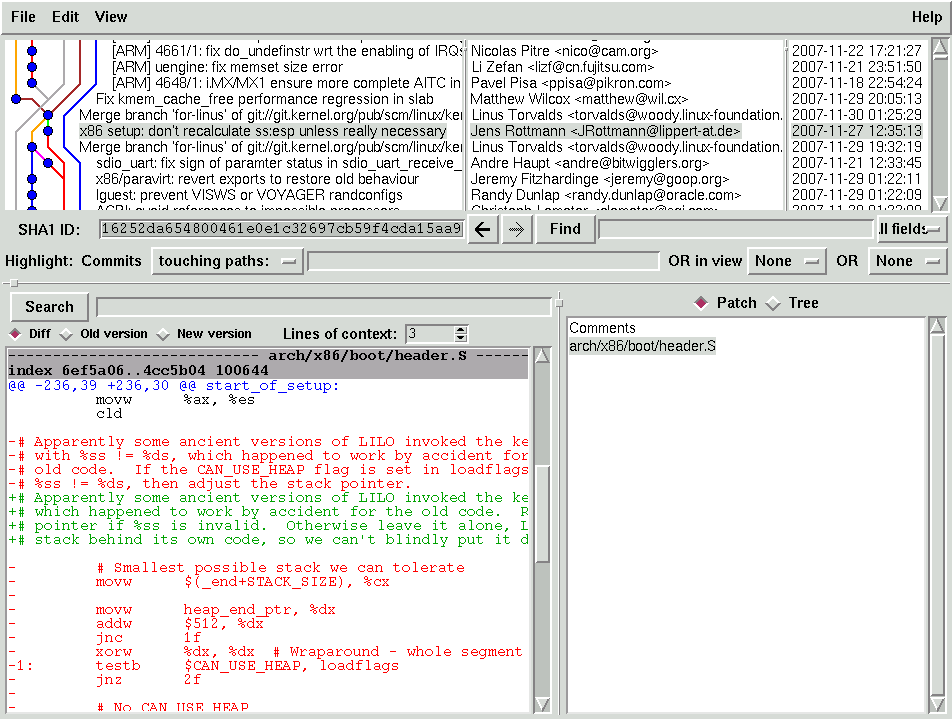
Use git cherry to find commits not merged upstream. Another really cool feature is the interactive rebasing: git rebase –interactive Make sure you are aware of gitk: Screenshot of gitk … and don’t forget to set readable fonts for gitk, like:
[ -r ~/.gitk ]   cat > ~/.gitk << EOF
set mainfont  Arial 10 
set textfont   Courier 10 
set uifont  Arial 10 bold 
EOF
If you prefer a Qt based interface check out qgit. Useful ressources:

Matthew Garrett: Spot the difference

Before takedown request:


After takedown request:


MPAA don't fuck with my shit.

(And yes, I did attempt to contact them by email and phone before resorting to the more obnoxious behaviour of contacting the ISP. No reply to my email, and the series of friendly receptionists I got bounced between had no idea who would be responsible but promised me someone would call back. No joy there, either.)

(Context)

Enrico Zini: mod-proxy-html-and-gzip

mod_proxy_html and compressed pages After putting it behind a reverse proxy, our phpmyadmin setup started showing empty pages. After one morning of deep cursing, this is what happened:
  1. the web server where phpmyadmin runs generates compressed html pages;
  2. modproxyhtml tries to edit them, and "normalises" them, adding <html>...</html> headers around the compressed data;
  3. Firefox fails to decompress because there is extra garbage, and shows a blank page instead of complaining.
Other things to note: How I found it:
  1. nc -l -p 444;
  2. configure mod_proxy to send connections to netcat instead of the web browser;
  3. compare curl headers and Firefox headers;
  4. add the headers from Firefox to curl one by one, until the output breaks.
How to solve it:
  1. a2enmod deflate
  2. Replace SetOutputFilter proxy-html with SetOutputFilter DEFLATE;proxy-html;INFLATE so that we always have mod_proxy_html work on decompressed HTML.

1 December 2007

John Goerzen: Attention Junkmailers

We love to hear from you. I'm sure that's what you're thinking, anyway, as you prepare volumes of paper to send to our mailbox.

But just so you know, let me explain just how much we love the material you send us.

When we get one of your catalogs, it will get added to the junk mail pile. Every so often, I will go through this pile. I will contact the company behind each and every mailing, asking them to remove me from their list and not rent my name further. If I have extra time, I will probably also write that note on your postage-paid envelope and pop it in the mailbox. I will also add your name to my list of companies that send me junk mail, so I can avoid doing business with you in the future. If you have sent me junk mail in the past, rest assured that I will find some creatively enjoyable way of dealing with your refusal to honor my removal request.

After I have processed your piece of artfully-crafted handiwork, possibly trying to sell me pink laptops or a shirt with the word "femail" on it -- whatever that means -- I will deposit your catalog, along with dozens of other similar catalogs, on the kitchen floor.

This is when the real fun begins, because now it's Jacob's turn to process them.

He will usually start by ripping out every page from the catalog. He'll start slowly and carefully, ripping out pages one at a time, savoring the wonderful rrrrriiiiippppp noise as he goes. But then he'll get faster, going for two pages at a time, then more, until finally he just will lunge for paper by the handful to crush, tear, or otherwise mutilate.

After that, there are many things he might do to your fine piece of unsolicited advertising. Perhaps he will enjoy drooling on it -- a satisfying fate for your 4-color catalog, don't you think? Or perhaps he will grab some of your pages, carefully emblazoned with your logo, and tear them into as many tiny bits as he can. Or maybe he will simply gather your work together on the floor, then spin himself around on top of it, scattering the remnants as far and wide as possible, cackling all the while. He may also smear bits of food on them if he ate recently, or perhaps he will simply resume tearing pages apart.

But whatever he does, rest assured that he will treat your catalog with the care and attention it deserves. No catalog will survive intact, and as many pages as possible will be ripped apart and left in bits. He does, after all, have a great attention to detail.

After Jacob is done, we will gather up what remains and put it all in our recycling container.

Oh, and under no circumstances will we actually make a purchase from your catalog.

Here are two pictures of the scene.

img_4160.jpg

Notice the careful concentration in this photo. Obviously he knows that Dell has been ignoring my removal requests for some time, and is taking note to tear their pages into the smallest possible bits.

But it's not all hard work -- processing your catalogs is fun, too.

img_4163.jpg

29 November 2007

Michal &#268;iha&#345;: Too lazy to manually upload to PPA

As I wrote before, I tried to use Ubuntu Personal Package Archive for distributing up to date Gammu, python-gammu and Wammu packages. For first time I failed because I expected it to behave more like OpenSUSE build service than like Debian archives, but I was wrong, so I have to upload different version to each Ubuntu suite. Well that sounds like a work which should be automated. So I hacked a little shell script, which takes current version from unstable, updates changelog and injects it into my PPA. The hacky script is called deb2ppa. It requires dput to be configured for ppa same way as I have it and maybe has some other tricky dependencies which I do not realize right now. Anyway you can now use current Wammu/Gammu versions even on older Ubuntu releases if you wish :-). (Well you have to wait till it is rebuild, but I hope it will not take much time.)

28 November 2007

Andrew McMillan: Which is the more interesting hackspace: X or Linux?

A curiously interesting thread has sprung up on the Xorg mailing list recently regarding the lack of bandwidth the developers might have for accepting patches. Bernardo Innocenti, who hacks on OLPC stuff amongst other things, wants to get some patches reviewed for acceptance, but there aren't enough people around with the time and inclination to review and accept his work. He did a quick and dirty analysis of Xorg LoC vs Linux LoC, to give a "X codebase is roughly 1/2 Linux codebase" (which surprised me, actually, I'd always thought it was larger) and then a similarly rough analysis that suggests that Xorg has roughly 1/20th of the developer base. To some extent Bernardo's metrics are arguable, but the basic facts are that Linux gets the lions share of the developers. Is this what we should expect? Is this a healthy way for the free and open source software community to support the development of what I personally would like to see as the future desktop base? Linux does a fantastic job as an OS, right now. It's been doing it for years, really, but we still need to get behind some of the differential further up the stack. And all credit to those stalwarts of X development who are shouldering more than their fair share of the burden. So if you were looking for an open source software project where you can be appreciated, don't overlook X.

Next.

Previous.