Search Results: "agi"

1 October 2012

Jonas Smedegaard: How I (don't) use Facebook

Dear Facebook friend, I like you and I want to chat with you, just not on Facebook! My Facebook account is there to reach you where you are, but I do not hang out there. Please join me at Free and Open spaces instead - via email, IRC or Jabber

Good old email If you cannot be bothered with change, then simply email me! My email address is dr@jones.dk like always :-)

Simple webchat If you are in a hurry and do not use Jabber yet, then try use my Simple Groupchat. Use guest login if you are not a user at jones.dk.

Proper Jabber Jabber is similar to email: You need 1) an account somewhere, 2) some client application setup to use that account, and 3) the address of those you want to connect.
  1. Register an account at e.g. Indonesian http://jabin.org/ or some other server.
  2. Install a Jabber client program :
    • on Windows try install Gajim from http://gajim.org/.
    • on smartphone try app from https://imo.im/.
    • on Ubuntu try use the Me menu in top right corner.
    • on Debian try install Pidgin: aptitude install pidgin.
  3. Invite me as your friend/buddy: my Jabber ID is jonas@jones.dk
  4. Tell your friends to do the same! :-D

Geeky IRC Many computer geeks hang out on IRC. I find it ugly and clumsy to use, but most of my techie friends are there, so I recommend going there to discuss technical matters. On OFTC my nickname is jonas, and I often hang out at the chatroom #debian-devel (plus a few others).

Why not Facebook? Facebook is a closed system: all activities happen at one central place. Email, Jabber and IRC are open protocols, exchanging between many Free systems (and some non-free ones as well).
Imagine having an overprotecting mother, who allow you only to meet your friends at one spot in town - where she can look after you. You maybe have no secrets from your mom, but probably still appreciate the option of being alone - to have some privacy.
Facebook is that one spot in town. Jabber is "let's go meet somewhere". Regards, Jonas

29 September 2012

Jonathan Carter: LLXC: My little python3-lxc based project


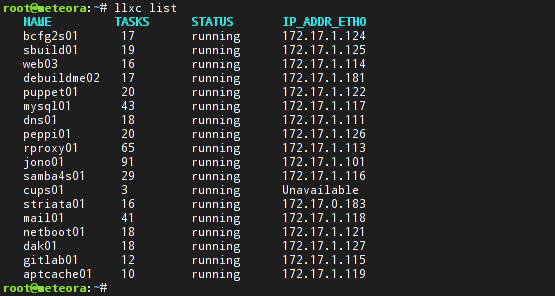
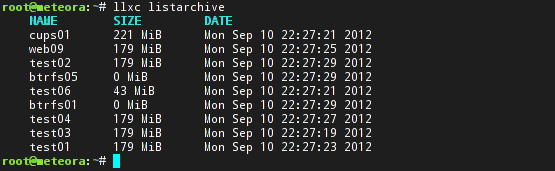
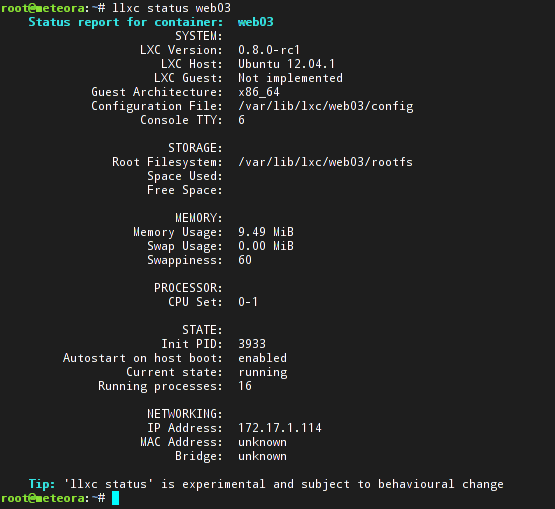
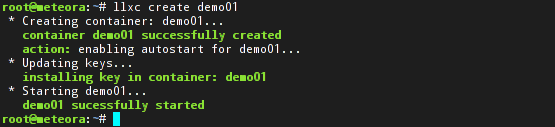
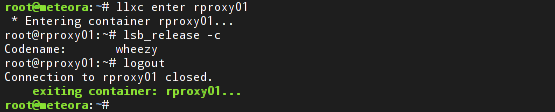
My foray into the world of LXC and RLXC A few months ago, I started trying out LXC (Linux Containers). Before that I used to use OpenVZ, which is an older and more mature contextualization implementation. I was pleased with how well LXC worked and started replacing my personal OpenVZ hosts with LXC. It worked great, but it had a few quirks. While LXC itself works well, the user scripts that ship with it has some space for improvement. The lxc-list command lists anything that s a directory in /var/lib/lxc, so if you have a lost+found directory, it will list it as a container (This has since been fixed upstream). Also, in some cases it would list containers twice or not at all. I was a bit annoyed with that, since OpenVZ s vzlist tool prints out a nice table of your containers along with their IP addresses and other information. Since it s very trivial to implement what I want in a shell script, I went ahead and did just that and called it RLXC. I also missed the vzctl exec <containername> command to execute commands in containers and vzctl enter <containername> to gain a shell inside the container, so I added some more functionality to it so that I could configure ssh keys for these containers and use rlxc enter and rlxc exec like I used to do with the OpenVZ tools, but by using SSH. I also realised that there are others too who wanted similar improvements in the LXC scripts and decided to continue improving RLXC and making it public. Enter LLXC I spoke to St phane about my ideas at the time and he introduced me to python3-lxc that he introduced on his blog yesterday. It provides Python bindings for liblxc, so I took the advantage of that and mostly re-implemented RLXC in Python and called it LLXC. The name doesn t particularly mean anything, I m open to suggestions for what to call it, if anyone cares. Here are some screenshots that explains some of it better than I could do in words: How to get it As St phane mentioned in the python3-lxc blog entry, the API hasn t yet been finalized and llxc itself is in an early state and many changes are planned, so it s definitely not meant for production use yet, but since we believe in release early, release often in the free software community, here goes Currently, llxc.py itself is *very* Ubuntu specific and its only been tested on Ubuntu 12.04, but that will be fixed once more of its kinks have been ironed out. Some people are also working on getting python3-lxc on other distributions, which will help a lot. The llxc.py script itself is hosted on Github: https://github.com/highvoltage/llxc For python3-lxc and friends, you need to enable St phane s experimental PPA: https://launchpad.net/~stgraber/+archive/experimental You will then need to install the following packages: lxc, python3-lxc, python3-crypto, lvm, btrfs-tools To generate the ssh keys used for ssh interaction between the containers, you need to run llxc gensshkeys . The enter and exec commands also rely on your containers being in dns or in your /etc/hosts file, at least for now, which you may have to configure manually. The Future There is a lot that I m planning to add, mostly to scratch my own itches. These include: I ll have some packaging for this available soon and work on making more things work right out of the box, updates will follow. Also, feedback and patches are very welcome!

28 September 2012

Keith Packard: DRI-Next

Thoughts about DRI.Next On the way to the X Developer s Conference in Nuremberg, Eric and I chatted about how the DRI2 extension wasn t really doing what we wanted. We came up with some fairly rough ideas and even held an informal presentation about it. We didn t have slides that day, having come up with the content for the presentation in the hours just before the conference started. This article is my attempt to capture both that discussion and further conversations held over roast pork dinners that week. A brief overview of DRI2 Here s a list of the three things that DRI2 currently offers. Application authentication. The current kernel DRM authentication mechanism restricts access to the GPU to applications connected to the DRM master. DRI2 implements this by having the application request the DRM cookie from the X server which can then be passed to the kernel to gain access to the device. This is fairly important because once given access to the GPU, an application can access any flink d global buffers in the system. Given that the application sends screen data to the X server using flink d buffers, that means all screen data is visible to any GPU-accessing application. This bypasses any GPU hardware access controls. Allocating buffers. DRI2 defines a set of attachment points for buffers which can be associated with an X drawable. An application needing a specific set of buffers for a particular rendering operation makes a request of the X server which allocates the buffers and passes back their flink names. The server automatically allocates new buffers when window sizes change, sending an event to the application so that it knows to request the new buffers at some point in the future. Presenting data to the user. The original DRI2 protocol defined only the DRI2CopyRegion request which copied data between the allocated buffers. SwapBuffers was implemented by simply copy data from the back buffer to the front buffer. This didn t provide any explicit control over frame synchronization, so a new request, DRI2SwapBuffers, was added to expose controls for that. This new request only deals with the front and back buffers, and either copies from back to front or exchanges those two buffers. Along with DRI2SwapBuffers, there are new requests that wait for various frame counters and expose those to GL applications through the OMLsynccontrol extension What s wrong with DRI2? DRI2 fixed a lot of the problems present with the original DRI extension, and made reliable 3D graphics on the Linux desktop possible. However, in the four years since it was designed, we ve learned a lot, and the graphics environment has become more complex. Here s a short list of some DRI2 issues that we d like to see fixed. Proposed changes for DRI.Next Given the three basic DRI2 operations (authentication, allocation, presentation), how can those be improved? Eliminate DRI/DRM magic-cookie based authentication Kristian H gsberg, Martin Peres, Timoth e Ravier & Daniel Vetter gave a talk on DRM2 authentication at XDC this year that outlined the problems with the current DRM access control model and proposed some fairly simple solutions, including using separate device nodes one for access to the GPU execution environment and a separate, more tightly controlled one, for access to the display engine. Combining that with the elimination of flink for communicating data between applications and there isn t a need for the current magic-cookie based authentication mechanism; simple file permissions should suffice to control access to the GPU. Of course, this ignores the whole memory protection issue when running on a GPU that doesn t provide access control, but we already have that problem today, and this doesn t change that, other than to eliminate the global uncontrolled flink namespace. Allocate all buffers in the application DRI2 does buffer allocation in the X server. This ensures that that multiple (presumably cooperating) applications drawing to the same window will see the same buffers, as is required by the GLX extension. We suspected that this wasn t all that necessary, and it turns out to have been broken several years ago. This is the traditional way in X to phase out undesirable code, and provides an excellent opportunity to revisit the original design. Doing buffer allocations within the client has several benefits: Present buffers through DMA-buf The new DMA-buf infrastructure provides a cross-driver/cross-process mechanism for sharing blobs of data. DMA-buf provides a way to take a chunk of memory used by one driver and pass it to another. It also allows applications to create file descriptors that reference these objects. For our purposes, it s the file descriptor which is immediately useful. This provides a reliable and secure way to pass a reference from an underlying graphics buffer from the client to the X server by sending the file descriptor over the local X socket. An additional benefit is that we get automatic integration of data from other devices in the system, like video decoders or non-primary GPUs. The Prime support added in DRI version 2.8 hacks around this by sticking a driver identifier in the driverType value. Once the buffer is available to the X server, we can create a request much like the current DRI2SwapBuffers request, except instead of implicitly naming the back and front buffers, we can pass an arbitrary buffer and have those contents copied or swapped to the drawable. We also need a way to copy a region into the drawable. I don t know if that needs the same level of swap control, but it seems like it would be nice. Perhaps the new SwapBuffers request could take a region and offset as well, copying data when swapping isn t possible. Managing buffer allocations One trivial way to use this new buffer allocation mechanism would be to have applications allocate a buffer, pass it to the X server and then simply drop their reference to it. The X server would keep a reference until the buffer was no longer in use, at which point the buffer memory would be reclaimed. However, this would eliminate a key optimization in current drivers the ability to re-use buffers instead of freeing and allocating new ones. Re-using buffers takes advantage of the work necessary to setup the buffer, including constructing page tables, allocating GPU memory space and flushing caches. Notifying the application of idle buffers Once the X server is finished using a buffer, it needs to notify the application so that the buffer can be re-used. We could send these notifications in X events, but that ends up in the twisty mess of X client event handling which has already caused so much pain with Invalidate events. The obvious alternative is to send them back in a reply. That nicely controls where the data are delivered, but causes the application to block waiting for the X server to send the reply. Fortunately, applications already want to block when swapping buffers so that they get throttled to the swap buffers rate. That is currently done by having them wait for the DRI2SwapBuffers reply. This provides a nice place to stick the idle buffer data. We can simply list buffers which have become idle since the last SwapBuffers reply was delivered. Releasing buffer memory Applications which update only infrequently end up with a back buffer allocated after their last frame which can t be freed by the system. The fix for this is to mark the buffer purgable, but that can only be done after all users of the buffer are finished with it. With this new buffer management model, the application effectively passes ownership of its buffers to the X server, and the X server knows when all use of the buffer are finished. It could mark buffers as purgable at that point. When the buffer was sent back in the SwapBuffers reply, the application would be able to ask the kernel to mark it un-purgable again. A new extension? Or just a new DRI2 version? If we eliminate the authentication model and replace the buffer allocation and presentation interfaces, what of the existing DRI2 protocol remains useful? The only remaining bits are the other synchronization requests: DRI2GetMSC, DRI2WaitMSC, DRI2WaitSBC and DRI2SwapInterval. Given this, does it make more sense to leave DRI2 as it is and plan on deprecating, and eventually eliminating, it? Doing so would place a support burden on existing applications, as they d need to have code to use the right extension for the common requests. They ll already need to support two separate buffer management versions though, so perhaps this burden isn t that onerous?

Alessio Treglia: Be right back soon

Some days ago I moved to Aberdeen, Scotland, and I m still experiencing some issues with my Internet connection, so I m not yet able to come back to work on packaging stuff as usual. So please, have some patience, I ll be right back soon :)

26 September 2012

NOKUBI Takatsugu: Debian Packaging dojo

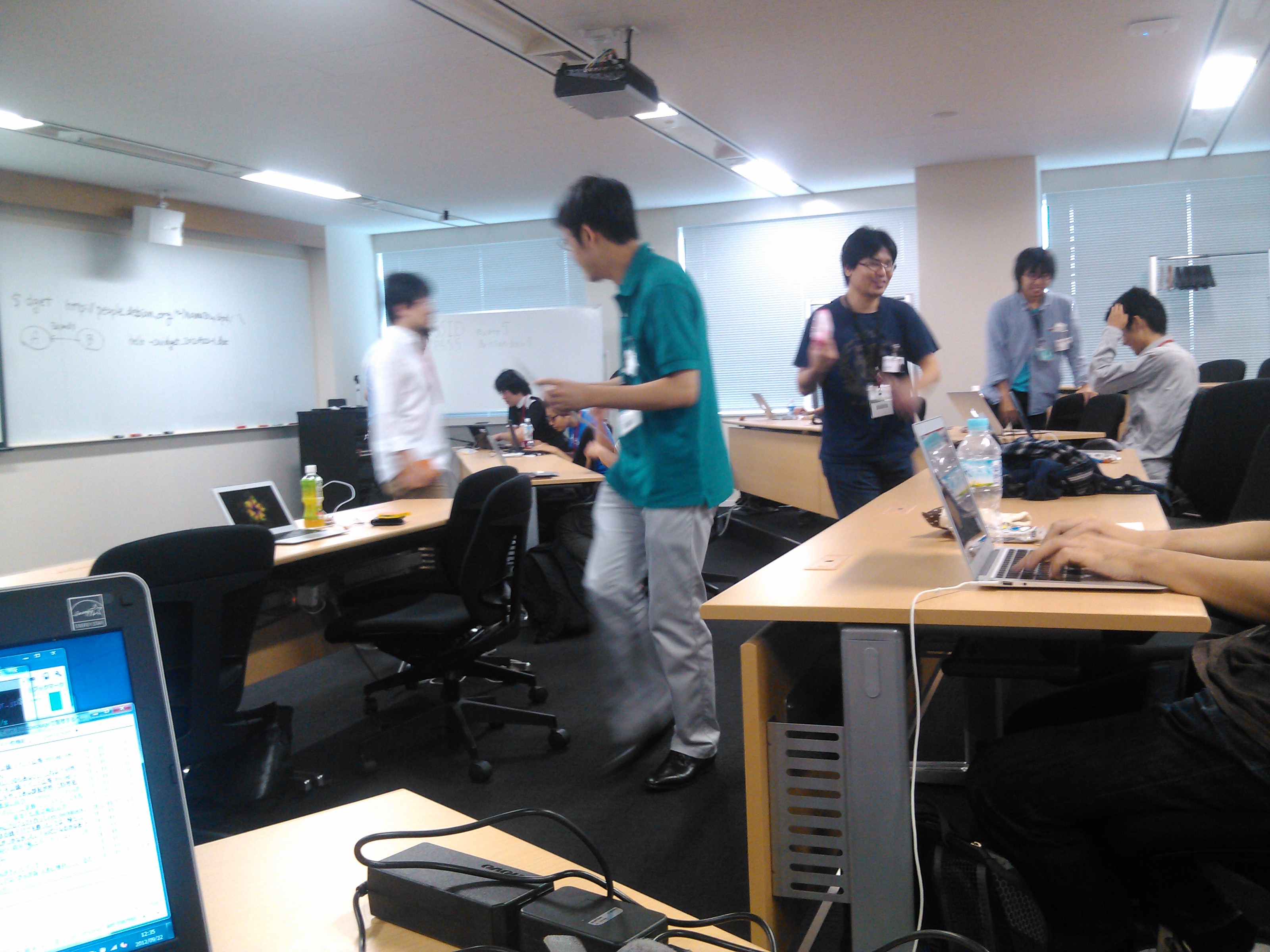
I attended Debian Packaging Dojo at 22 Aug. Dojo ( ) means a training hall for karate, judo, and/or kendo in Japanese. The event is a training for Debian packaging. Attendants were about 15 people. I could learn modern packaging methods. The place is Rakuten Tower in Shinagawa, thank you Rakuten company and Taku YASUI <tach at debian.org>.

25 September 2012

Arnaud Quette: Power management and NUT #1: an introduction

in this series of articles, I will be talking in depth about power management through the NUT project, its packaging on Debian, how to use it in general and how I see it being part of the GreenIT thing. So, let's start with an introduction: NUT is a Free Software (GPL v2+ and 3 to be precise), originally created for power protection using UPS, from home to data-centers:
To shortly describe the main features, I would say that NUT: NUT used to stand for Network UPS Tools. That is, a software for talking to your UPS and shutting down your systems when needed. This definition is a bit limited nowadays, since NUT supports 4 types of power device: Considering this, is the name Network UPS Tools still suitable? Not really! But the acronym NUT is well known! So, for the time being, I just stick using it, and focus on other more important things, until a better opportunity (ideas and comments are welcome!). That said, what can you do exactly with NUT? Currently, you can: All the above is available in a standardized way: Well, this is already a long and dense post, so I will stop there for today. In the next post, we will have a deeper dive into using NUT, for various use cases: submit yours if you can ;-) cheers,
-- Arno

24 September 2012

Felipe Augusto van de Wiel: 24 Sep 2012

A new journey ahead
Changing jobs and moving to a new country... it's just the beginning.

On September 30th, 2012 I'm moving to Menlo Park, CA, USA because back in December 2011 I accepted a job offer as a sysadmin (the name is fancier: Operations Engineer) in Silicon Valley. Since then I'm working on the required documentation, so far everything had worked out. I'm starting at the new work on October 8th, and as I'm arriving on October 1st, I'll have a week to take a look around and get to know a tiny bit of San Francisco Bay Area.


In different levels and aspects it is a big opportunity for me, and I'm confident it'll be an unique experience, not only professional, which of course involves working in a bigger company with more complex scenarios and bigger challenges, and on the personal side, I'll live abroad, be an expat.


As you may imagine, I'm working on this process for more or less 10 months, but in the last 30 days it got more intense. Quitting my jobs, organizing my stuff, cleaning part of backlog (and finding out a have a huge to-do list awaiting for me). Spending quality time with family and friends, and also saying goodbye to them. Finishing some aspects of the move (travel tickets, temporary living).


It's new, it's different! I'm super excited and I do want to change a few things to make it easier for family and friends to keep up, make it easier to follow the news, which might help with the distance.
And now for something completely different! See you all pretty soon! :-)

Gerfried Fuchs: I hate my life

This poem was triggered by a discussion with a special person not special in the sense I address in the poem though.
My life's hating me
But it is not a one-way:
I'm hating my life Hate being special
I know I can help others
But what about me? All quite supportive
Respect for my openness
And encouraging Though, no step further
No clue how to handle me
Afraid to ask me Hooking up with me?
Suddenly embarrassing
Just scolding words left Want to be normal
Maybe I'll lie to myself
Though that won't work out I am what I am
And sometimes it just pains me:
Hate being special I'm hating my life
But it is not a one-way:
My life's hating me
Please refrain from asking whether I feel fine, I am in good mood. :) But I haven't written anything in a way too long time, I noticed how little actually during selecting poems for the International Poetry Night during debconf. So I picked up the idea and caressed it until I came up with the above piece about with which I am quite happy. Think about it, and ... try to enjoy. Potential interesting sidenote, if you wonder: the title refers to this snippet from the first Futurama episode: I hate my life I hate my life I hate my life. :)

/personal permanent link Comments: 1 Flattr this

22 September 2012

Russell Coker: Changing Phone Prices in Australia

18 months ago when I signed up with Virgin Mobile [1] the data transfer quotas were 200MB on the $29 per month plan and 1.5G on the $39 per month plan. About 4 months ago when I checked the prices the amounts of data had gone up on the same plans (2.25G for $39 per month from memory). Now $39 per month gets only 500MB! It seems that recently Virgin has significantly reduced their value for money. Virgin does have an option to pay an exgtra $10 per month for 2GB of data which gets you 2GB per month if you sign up for 24 months. That is reasonably good value, when I first signed up with Virgin I paid $39 per month to get extra data transfer, now I could use the $29 plan for phone access and spend $10 per month on data with a Wifi gateway device. On top of this the phone plans aren t nearly as good value as they used to be. When I signed up with Virgin the Sony Ericsson Xperia X10 was free on a $29 plan, at the time that was a hell of a phone. I believe that the Samsung Galaxy S3 currently occupies a similar market position to the one that the Xperia X10 did 18 months ago so it shouldn t be much more expensive. But Virgin are offering the Galaxy S3 for $21 extra per month over 24 months on the $29 plan a total cost of ($29+$21)*24==$1200 while offering the same amount of calls and data transfer for $19 per month ($19*24==$456) when you don t get a phone this makes the price of a Galaxy S3 $1200-$456==$744 while Kogan [2] sells the same phone for $519 + postage! The cheapest phone that Virgin is offering is a Galaxy S2 for $5 per month on a $29 plan which when compared to $19 per month for the same plan without a phone makes the phone cost ($5+$10)*24==$360. Kogan sells the Galaxy S2 for $399 so there s a possibility of a Virgin plan saving some money over buying a phone from Kogan. But given the choice of $360 for a Galaxy S2 from Virgin and the Kogan prices of $839 for a Galaxy Note 2, $349 for a Galaxy Nexus, $469 for a Galaxy Note, $529 for a Galaxy S3, and $219 for a HTC One V I find it difficult to imagine that anyone would think that the $360 Galaxy S2 is the best option. I ve previously investigated dual-sim phones for cheap calls and data [3] but they didn t seem like good value at the time because the free phones offered by the telcos used to be a good deal. Now it seems that none of the telcos are offering good deals on phones so with my needs the way to go would be to buy a Samsung Galaxy S3 or Samsung Galaxy Note 2 from Kogan, and get the $19 plan from Virgin probably with a $10 per month extra fee to get an extra 2GB of data. For my wife the best option would be to keep using the Xperia X10 on a $19 per month plan as she doesn t seem to have any problem with the Xperia X10 that justifies spending hundreds of dollars. I idly considered getting a portable Wifi-3G device to use a cheap pre-paid 3G data option ($10 per month) and a cheap phone plan without data (maybe $10 per month), but decided that it s not worth the effort. The Virgin $19 plan gives me free calls to my wife and lots of calls to other numbers (more than I can use) and an extra $10 gives me all the data transfer I need. To use a Wifi-3G device would involve buying such a device and the hassle of carrying it and using it, that wouldn t save money for at least a year and would be annoying. The sudden decrease in data quotas is a real concern though. It s an indication that the telco cartel in Australia is pushing prices up, that s not a good sign. LTE is nice, but 3G with better quotas would be more generally useful to me. Related posts:
  1. Dual SIM Phones vs Amaysim vs Contract for Mobile Phones Currently Dick Smith is offering two dual-SIM mobile phones for...
  2. Virgin Refunds Me $200 Virgin Mobile Excessive Billing In my previous post about the...
  3. A Mobile Phone for Sysadmin Use My telco Three have just offered me a deal on...

19 September 2012

Russ Allbery: Debian Policy 3.9.4.0

I just uploaded Debian Policy 3.9.4.0, which includes the implementation of the Technical Committee decision to make build-arch and build-indep mandatory targets and which significantly reworks the section on shared libraries. Nothing here is release-critical for wheezy, and uploads targeted for wheezy should not attempt to update packaging for a new version of Policy. I went into some more detail on debian-devel-announce. The version number probably should have been 3.10.0.0 given the build-arch and build-indep changes and the work on symbols files. Ah well. Here's the upgrading checklist:
2.4
New tasks archive section.
4.9
build-arch and build-indep are now mandatory targets in debian/rules.
5.6.26
New section documenting the Vcs-* fields, which are already in widespread use. Note the mechanism for specifying the Git branch used for packaging in the Vcs-Git field.
7.1
The deprecated relations < and > now must not be used.
7.8
New Built-Using field, which must be used to document the source packages for any binaries that are incorporated into this package at build time. This is used to ensure that the archive meets license requirements for providing source for all binaries.
8.6
Policy for dependencies between shared libraries and other packages has been largely rewritten to document the symbols system and more clearly document handling of shared library ABI changes. symbols files are now recommended over shlibs files in most situations. All maintainers of shared library packages should review the entirety of this section.
9.1.1
Packages must not assume the /run directory exists or is usable without a dependency on initscripts (>= 2.88dsf-13.3) until the stable release of Debian supports /run.
9.7
Packages including MIME configuration can now rely on triggers and do not need to call update-mime.
9.11
New section documenting general requirements for alternate init systems and specific requirements for integrating with upstart.
12.5
All copyright files must be encoded in UTF-8.

18 September 2012

Jon Dowland: My next music player

About two years ago, I wrote about moving to a Sandisk Sansa Fuze as my music player. I transitioned from a 40G, HDD-based iRiver to an 8G flash-based player, with an additional 32G supplied by a micro SD card, both running the rockbox open-source firmware. Of course, my music collection has grown over the last few years and so I needed to find another solution. That solution is
Say hello to red Say hello to red
another Sansa Fuze! This was actually my interim solution, this time with 4G internal capacity (didn't matter too much) with another 32G microsd and a rubber band. It turns out that managing four storage devices (two SDs and two embedded storages) is a complete nightmare. However, as luck would have it, I learned that the new, larger capacity SDXC cards can be made to work in some SD readers, including the Sansa Fuze. At around this time, my original player started to malfunction and so,
the family the family
another Sansa Fuze, again! It took three attempts to get a 64G microsd: the first was faulty or fake, the second never turned up. Third times a charm, and a third sansa fuze (to get 8G internal capacity) completes the story. For the sansa fuze, to get a 64G microsd to work, one needs to change the partition type to 0x0c (W95 FAT32 (LBA)) and reformat with FAT32. (Interestingly that's actually hard to do for Windows users, as Win 7 refuses to offer FAT32 for flash devices over 32G in capacity by default). I now have approximately 67.7G of storage on a single device and all my music in one place again (albeit two storage locations) which feels surprisingly good!

16 September 2012

Russell Coker: Servers in the Office

I just had a conversation with someone who thinks that their office should have no servers. The office in question has four servers, an Internet gateway/firewall system, the old file server (and also Xen server), the new file server, and the VOIP server. The Internet gateway system could possibly be replaced by a suitably smart ADSL modem type device, but that would reduce the control over the network and wouldn t provide much of a benefit. The VOIP server has to be a separate system for low latency IMHO. In theory you could use a Xen DomU for running Asterisk or you could run Asterisk on the Dom0 of the file/Xen server. But that just makes things difficult. A VOIP server needs to be reliable and is something that you typically don t want to touch once it s working, in this case the Asterisk server has been a few more years without upgrades than the Xen server. An Asterisk system could be replaced by a dedicated telephony device which some people might consider to be removing a server, but really a dedicated VOIP server device is just as much of a server as a P4 running Asterisk but with greater expense. A major advantage of a P4 running Asterisk is that you can easily replace the system at no cost if there is a hardware problem. Having two file servers is excessive for a relatively small office. But running two servers is the common practice when one server is being replaced. The alternative is to just immediately cut things over which has the potential for a lot of people to arrive at work on Monday and find multiple things not working as desired. Having two file servers is a temporary problem. File Servers The first real problem when trying to remove servers from an office is the file server. ADSL links with Annex M can theoretically upload data at 3Mb/s which means almost 400KB/s. So if you have an office with a theoretically perfect ADSL2+ Annex M installation then you could save a 4MB file to a file server on the Internet in not much more than 10 seconds if no-one else is using the Internet connection. Note that 4MB isn t THAT big by today s standards, the organisation in question has many files which are considerably bigger than that. Large files include TIFF and RAW files used for high quality image processing, MS-Office documents, and data files for most accounting programs. Saving a 65MB quick-books file in 3 minutes (assuming that your Annex M connection is perfect and no-one else is using the Internet) would have to suck. Then there s the issue of reading files, video files (which are often used for training and promotion) are generally larger than 100MB which would be more than 30 seconds of download time at ADSL2+ speed but if someone sends an email to everyone in the office saying please watch this video then the average time to load it would be a lot more. Through quickly examining my collection of Youtube downloads I found a video which averaged 590KB/s, if an office using a theoretically perfect ADSL2+ connection giving 24Mb/s (3MB/s) download speed had such a file on a remote file server then a maximum of five people could view it at one time if no-one else in the office was using the Internet. Now when the NBN is connected (which won t happen in areas like the Melbourne CBD for at least another 3 years) it will be possible to get speeds like 100Mb/s download and 25Mb/s upload. That would allow up to 20 people to view videos at once and a 65MB quick-books file could be saved in a mere 22 seconds if everyone else was idle. Of course that relies on the size of data files remaining the same for another 3 years which seems unlikely, currently no Youtube videos use resolutions higher than 1920*1080 (so they don t take full advantage of a $400 Dell monitor) and there s always potential for storing more financial data. I expect that by the time we all have 100Mb/25Mb speeds on the NBN it will be as useful to us as 24Mb/3Mb ADSL2+ Annex M speeds are today (great for home use but limited for an office full of people). There are of course various ways of caching data, but all of them involve something which would be considered to be a server and I expect that all of them are more difficult to install and manage than just having a local file server. Of course instead of crunching the numbers for ADSL speeds etc you could just think for a moment about the way that 100baseT networking to the desktop has been replaced by Gigabit networking. When people expect each workstation to have 1000Mb/s send and receive speed it seems quite obvious that one ADSL connection shared by an entire office isn t going to work well if all the work that is done depends on it. Management could dictate that there is to be no server in the office, but if that was to happen then the users would create file shares on their workstations so you would end up with ad-hoc servers which aren t correctly managed or backed up. That wouldn t be an improvement and technically wouldn t achieve the goal of not having servers. Home Networking Without Servers It is becoming increasingly common to have various servers in a home network. Due to a lack of space and power and the low requirements a home file server will usually be a workstation with some big disks, but there are cheap NAS devices which some people are installing at home. I don t recommend the cheap NAS devices, I m merely noting that they are being used. Home entertainment is also something that can benefit from a server. A MythTV system for recording TV and playing music has more features than a dedicated PVR box. But even the most basic PVR ($169 for a 1TB device in Aldi now) is still a fairly complex computer which would probably conflict with any aim to have a house free of servers. The home network design of having a workstation run as a file and print server can work reasonably well as long as the desktop tasks aren t particularly demanding (IE no games) and the system doesn t change much (IE don t track Debian/Testing or otherwise have new versions of software). But this is really something that only works if you only have a few workstations. Running an office without servers seems rather silly as it seems that none of my friends are able to have a home without a server. Running Internet Services Hypothetically speaking if one was to run an office without servers then that would require running all the servers in question on the Internet somewhere. For some things this can work better than a local server, for example most of my clients who insist on running a mail server in their office would probably get a better result if they had a mail server running on Linode or Hetzner or one of the Hosted Exchange offerings if they want a Windows mail sever. But for a file server if you were to get around the issue of bandwidth required to access the files in normal use there s the issue of managing a server (which is going to take more effort and expense than for a server on the LAN). Then there s the issue of backups. In my previous post about Hard Drives for Backup [1] I considered some of the issues related to backing data up over the Internet. The big problem however is a complete restore, if you have even a few dozen gigs of data that you want to transfer to a remote server in a hurry it can be a difficult problem. If you have hundreds of gigs then it becomes a very difficult problem. I m sure that I could find a Melbourne based Data Center (DC) that gives the option of bringing a USB attached SATA disk for a restore but even that case would give a significant delay when compared to backing things up on a LAN. If a server on the office LAN breaks in the afternoon my client can make arrangements to let me work in their office in the evening to fix it, but sometimes DCs don t allow 24*7 access and sometimes when they do allow access there are organisational problems that make it impossible when you want it (EG the people at the client company who are authorised become unavailable). The Growth of Servers Generally it s a really bad idea to build a server that has exactly the hardware you need. The smart thing to do is to install more of every resource (disk, RAM, CPU, etc) than is needed and to allow expansion when possible (EG have some RAM slots and drive bays free). No matter how well you know your environment and it s users you can get surprised by the way that requirements change. Buying a slightly bigger server at the start costs hardly any money but upgrading a server will cost a lot. Once you have a server that s somewhat over-specced you will always find other things to run on it. Many things could be run elsewhere at some cost, but if you have unused hardware then you may as well use it. Xen and other virtualisation systems are really good in this regard as they allow you to add more services without making upgrades difficult. This means that it s quite common to have a server that is purchased for one task but which ends up being used for many tasks. Anyone who would aspire to an office without servers would probably regard adding extra features in such a manner to be a problem. But really if you want to allow the workers to do their jobs then it s best to be able to add new services as needed without going through a budget approval process for each one. Conclusion There probably are some offices where no-one does any serious file access and everyone s work is based around a web browser or some client software that is suited to storing data on the Internet. But for an office where the workers use traditional Office software such as MS-Office or Libre-Office a file server is necessary. Some sort of telephony server is necessary no matter how you do things. If you have a traditional telephone system then you might try not to call the PABX a server , but really that s what it is. Then when the traditional phone service becomes too expensive you have to consider whether to use Asterisk or a proprietary system, in either case it s really a server. In almost every case the issue isn t whether to have a server in the office, but how many servers to have and how to manage them. Related posts:
  1. Planning Servers for Failure Sometimes computers fail. If you run enough computers then you...
  2. a good security design for an office One issue that is rarely considered is how to...
  3. Efficiency of Cooling Servers One thing I had wondered was why home air-conditioning systems...

15 September 2012

Andrea Veri: Manage your website through Git

Ever wondered how you can update your website (in our case a static website with a bunch of HTML and PHP files) by committing to a Git repository hosted on a different server? if the answer to the previous question is yes, then you are in the right place. The scenario: - Website hosted on server A.
- Git repository hosted on server B. and a few details about why would you opt for maintaining your website through Git:
  1. You need multiple people to access the static content of your website and you also want to maintain all the history of changes together with all the Git s magic.
  2. You think using an FTP server is not secure enough.
  3. You think giving out SSH access or more permissions on the server to multiple users it s not what you want. (also using scp will overwrite the files directly with all its consequences)
the setup, on server A: 1. Clone the Git repository over the directory that your Web server will serve.
cd /srv/www.domain.com/http && sudo git clone http://git.example.com/git/domain.git
2. Grab the needed package:
apt-get install fishpolld or yum install fishpolld
3. Set up a topic (called website_update) that will call a git pull each time the repository hosted on server B receives an update. (the file has to be placed into the /etc/fishpoll.d directory)
#!/bin/bash
PATH="/usr/local/sbin:/usr/local/bin:/sbin:/bin:/usr/sbin:/usr/bin"
WEBSITEDIR="/srv/www.domain.com/http"
if [ -d "$ WEBSITEDIR " ]; then
cd "$ WEBSITEDIR "
else
echo "Unable to access theme directory. Failing."
exit 1
fi
git pull
4. Add a little configuration file that will enable the website_update s topic at daemon s startup. (you should name it website_update.conf)
[fishpoll]
on_start = True
5. Open the relevant port on Iptables so that server A and server B can communicate as expected, the daemon runs over port 27527.
-A INPUT -m state --state NEW -m tcp -p tcp -s server-B-IP --dport 27527 -j ACCEPT
6. Start the daemon. (by default, logs are sent to syslog but you can run the daemon in Debug mode by using the -D flag)
sudo /etc/init.d/fishpolld start or sudo systemctl start fishpolld.service or sudo /usr/sbin/fishpolld -D
and on server B: 1. Grab the needed package:
apt-get install fishpoke or yum install fishpoke
2. Configure the relevant Git hook (post-update, located into the hooks directory) and make it executable.
#!/bin/sh
echo "Triggering update of configuration on server A"
fishpoke server-A-IP-or-DNS website_update
Finally test the whole setup by committing to the repository hosted on server B and verify your changes being sent live on your website!

Eddy Petri&#537;or: Why a lack of skepticism is dangerous...

Some of my Romanian readers might know that for the last two years I've got involved in the skeptical movement to such a degree that I am a co-producer of a bi-weekly podcast on science and skepticism (in Romanian) called Skeptics in Romania . Some might even be regular listeners of the show.

(There isn't much to see now visually on the site, but me and the other people behind the project have some ongoing plans to change that.)

In spite of our modest site, up until now we had some successes, one of them being the publication of an article on us in a known Romanian printed publication and another being the invitation to a live show face to face with Oreste Teodorescu, a well known Romanian mysticist and woo promoter.

During that live show we managed to show a demonstration (video below, in Romanian) of how astrology gives the impression of working, without actually working, and, taking into account we had no prior TV camera experience and that it was a live show, I think we managed an honourable presence.


<iframe allowfullscreen="allowfullscreen" frameborder="0" height="315" src="http://www.youtube.com/embed/y5OG1q8_3Ro" width="420"></iframe>

We also have a series of interviews in English with some really interesting people: Dr. Eugenie Scott, Prof. Christopher French, Prof. Edzard Ernst, Samantha Stein and others. We did these interviews at Denkfest 2011, in Zurich, and we integrated the translated (voice over) interviews in our podcast. The conlusion is that most of our activities revolve around the podcast, so let me tell you more about that.

The podcast has a somewhat fixed structure, it starts with a conversation between ourselves, then we have a segment on the history of science, technology, skepticism and woo, and then we have a segment called The dangers of not being skeptical . In this segment we present cases of people who lost their lives, their health, their money or any combination of the former because they were duped into some scam, science-y sounding non-science, unfounded claim or some other woo.

Having lost recently my brother-in-law to a form of cancer known as Hodgkin lymphoma, I became especially sensitive about miracle-cure claims for cancer, and this section of the show has lately seen its fair share of such cases. Honestly, if there could be a way to prosecute the irresponsible, ignorant and/or cynical people promoting all sorts of quack "therapies", especially for cancer*, I would really like to see it happen. But there isn't, and we're trying the best accessible approach, informing the public.

During my brother-in-law's last two years of his life, he went through lots of chemotherapy and radiotherapy sessions, repeated periods of hospitalisation, and lots of drugs. This is the best of what we currently have for treating and curing most forms of cancer, and too many times this isn't enough. I can't even imagine how stressful and discouraging it must feel when the best of what we have doesn't help.

Here is where the desperation and hopes of patients and their families meet the purely irresponsible cynical or ignorant promoters of woo and quack therapies. Because it takes either an ignorant or a really cynical (I really feel this word isn't enough) person to prey on the suffering of other people to make easy money under the false pretence of offering a cure.

It almost happened to my brother-in-law and his family, because they almost went for some herbal concoction promoted as a cancer cure on some forum, blog or page of a seller of this fake therapy. It was really hard for me to make them understand why using such a product it not advisable, not even in parallel with the medical treatment due its possible counter effect or interactions with the real medical treatment, without them getting the wrong idea that I wasn't trying to help. While trying to be brief and informative not to lose their attention, I told them how "natural" doesn't necessarily mean "good" (uranium, lead and Irukandji's venom are all natural), and how plants are drugs because they all contain chemical substances (and no, "chemical" does not mean "human made" or "artificial") which could interact with the medical treatment.


But most people don't even have the chance of having close by a person with a more science-leaning thought process and a skeptical mind. Those unfortunate people are the most vulnerable people and constitute the biggest chunk of the victims of baseless pseudo-cures or pseudo-treatments.

On our last show, I presented the case of Yvonne Main, a cancer suffering patient who mistook an invasive carcinoma for a cyst, and irdologist Ruth Nelson for a real healthcare giver.

Yvonne Main, died from an invasive carcinoma
after seeking help from a iridologist,
and delaying real medical treament for 18 months


Yvonne, after seeking medical advice from a person that essentially promotes the dead idea of guessing diseases by looking at the eyes**, used natural treatments for about 18 months and, after all this time, her carcinoma grew to a size of 10 to 11 cm, eating through her skull and causing damage which was later attempted to be countered through bone transplant from her ribs.

Ruth Nelson wasn't prosecuted in any way and continues her practice of quackery unharmed.

This is not the only case, nor even one case from a select few where woo and quackery lead to grave consequences for patients. There are many, many more; they're so many that even after splitting them in categories they seem too many per category, especially when you realise these are only the findings of, essentially, a single man:


http://www.whatstheharm.net/


This is part of what I have been doing in the last few years, instead of working on Debian. Is it a good thing? Is it a bad thing? Maybe it's good. I want to know what do you think?


* you will, most likely, never hear such a promoter of non-therapies say that there isn't just one cancer, and that, in fact, cancer is a name for a certain family of diseases which are all called cancer - that's a first sign that you might be dealing with quack
** probably in the line of thought that the eyes are the gates to the soul so they must tell something significant about health

12 September 2012

Patrick Matth i: Recent packaging updates 2012/09

What I have done (on my packages for Wheezy) in the last weeks? imvirt 0.9.4-3 and 0.9.4-4 adds two upstream patches to remove an applicable use of /proc in Perls procfs_read() method, which fixes LXC detection and another patch to not count the dmesg lines twice within the KVM detection module.
Much thanks to Thomas Liske! mlt The 0.8.0-4 upload also adds two upstream patches to fix an major memory leak in the mlt_cache function and a crash with LADSPA plugins on dlclose().
And here much thanks to Dan Dennedy!
I have also uploaded 0.8.2-1 to experimental. roaraudio 1.0~beta2-2 and 1.0~beta2-3 added a few upstream patches to fix security and major use problems. The debdiff was a bit huge so it took a bit more time to unblock/migrate.
1.0~beta5-1 is also available in experimental.
Much thanks for the patch support to Philipp Schafft! otrs2 With the 2.4.9+dfsg1-3+squeeze3 upload (DSA-2536-1) there was an security update for otrs2 on Squeeze which fixes a cross-site scripting issue and improved the e-mail filter to detect nested tags. Those with a few other fixes migrated with 3.1.7+dfsg1-5 to testing, while I also uploaded 3.1.10+dfsg1-1 to experimental.
Now I can focus on the upcoming 3.2.x packaging. :)

10 September 2012

Craig Sanders: openstack, bridging, netfilter and dnat

I just posted the following question to ServerFault .and then realised there might be people out there in magical internetland who know the answer but never visit any of the SO sites, so i ve posted it here too. Feel free to respond here on on serverfault.
In a recent upgrade (from Openstack Diablo on Ubuntu Lucid to Openstack Essex on Ubuntu Precise), we found that DNS packets were frequently (almost always) dropped on the bridge interface (br100). For our compute-node hosts, that s a Mellanox MT26428 using the mlx4_en driver module.
We ve found two workarounds for this:
1. Use an old lucid kernel (e.g. 2.6.32-41-generic). This causes other problems, in particular the lack of cgroups and the old version of the kvm and kvm_amd modules (we suspect the kvm module version is the source of a bug we re seeing where occasionally a VM will use 100% CPU). We ve been running with this for the last few months, but can t stay here forever.
2. With the newer Ubuntu Precise kernels (3.2.x), we ve found that if we use sysctl to disable netfilter on bridge (see sysctl settings below) that DNS started working perfectly again. We thought this was the solution to our problem until we realised that turning off netfilter on the bridge interface will, of course, mean that the DNAT rule to redirect VM requests for the nova-api-metadata server (i.e. redirect packets destined for 169.254.169.254:80 to compute-node s-IP:8775) will be completely bypassed.
Long-story short: with 3.x kernels, we can have reliable networking and broken metadata service or we can have broken networking and a metadata service that would work fine if there were any VMs to service. We haven t yet found a way to have both.
Anyone seen this problem or anything like it before? got a fix? or a pointer in the right direction?
Our suspicion is that it s specific to the Mellanox driver, but we re not sure of that (we ve tried several different versions of the mlx4_en driver, starting with the version built-in to the 3.2.x kernels all the way up to the latest 1.5.8.3 driver from the mellanox web site. The mlx4_en driver in the 3.5.x kernel from Quantal doesn t work at all)
BTW, our compute nodes have supermicro H8DGT motherboards with built-in mellanox NIC:
02:00.0 InfiniBand: Mellanox Technologies MT26428 [ConnectX VPI PCIe 2.0 5GT/s - IB QDR / 10GigE] (rev b0)
We re not using the other two NICs in the system, only the Mellanox and the IPMI card are connected.
Bridge netfilter sysctl settings:
net.bridge.bridge-nf-call-arptables = 0
net.bridge.bridge-nf-call-iptables = 0
net.bridge.bridge-nf-call-ip6tables = 0
Since discovering this bridge-nf sysctl workaround, we ve found a few pages on the net recommending exactly this (including Openstack s latest network troubleshooting page and a launchpad bug report that linked to this blog-post that has a great description of the problem and the solution) .it s easier to find stuff when you know what to search for :), but we haven t found anything on the DNAT issue that it causes.

Update 2012-09-12: Something I should have mentioned earlier this happens even on machines that don t have any openstack or even libvirt packages installed. Same hardware, same everything, but with not much more than the Ubuntu 12.04 base system installed. On kernel 2.6.32-41-generic, the bridge works as expected. On kernel 3.2.0-29-generic, using the ethernet interface, it works perfectly.
Using a bridge on that same NIC fails unless net.bridge.bridge-nf-call-iptables=0 So, it seems pretty clear that the problem is either in the mellanox driver, the updated kernel s bridging code, netfilter code. or some interaction between them. Interestingly, I have other machines (without a mellanox card) with a bridge interface that don t exhibit this problem. with NICs ranging from cheap r8169 cards to better quality broadcom tg3 Gbit cards in some Sun Fire X2200 M2 servers and intel gb cards in supermicro motherboards. Like our openstack compute nodes, they all use the bridge interfaces as their primary (or sometimes only) interface with an IP address they re configured that way so we can run VMs using libvirt & kvm with real IP addresses rather than NAT. So, that indicates that the problem is specific to the mellanox driver, although the blog post I mentioned above had a similar problem with some broadcom NICs that used the bnx2 driver. openstack, bridging, netfilter and dnat is a post from: Errata

9 September 2012

Gregor Herrmann: RC bugs 2012/36

highlight of the week: I "wrote" (i.e. copypasted) my first patch in haskell some days ago :) apart from that, nothing exciting:

Patrick Matth i: Hide process information for other users

Debian GNU/Linux Debian 7.0 (aka Wheezy) will be a general hardened distribution in my eyes. Not only that it now enabled hardened building of packages (see http://wiki.debian.org/Hardening), the Kernel team also backported with 3.2.20-1 the IMO very interesting hidepid option (already available in Wheezy since some weeks)! What is the job of hidepid ? hidepid is an new mount option for the procfs (/proc), with that you can hide processes and its information to other users, like other shell users and to web scripts. hidepid accepts three different values: Additionaly you can specifiy an user/group ID which is still able to look up the processes with the gid option. So if you want to hide all processes to other users, except root (uid=0) and in this example gid=1001 (some semi administrative user in this example) your /etc/fstab has to look like this: proc /proc proc defaults,hidepid=2,gid=1001 0 0 It was a good descision to backport this feature IMO, but also be careful, it *may* break programs. I did not found any server related application which will break with hidepid=2, but we had to adjust our Nagios monitoring to execute some process checks with another UID, since the nagios user itself could not see anymore, if process A and B is still running. UPDATE 1:
Since a few people asked (thanks for it) with hidepid=2 the process IDs are not invisible, they are unavailable:
$ ls /proc/1
ls: cannot access /proc/1: No such file or directory
$

Rog rio Brito: Some experiences with ZFS

Continuing the ZFS evaluation journey (which I will summarize here with the things that I learned), I was able to fit about 2.5TB of data on a single 2TB drive, with deduplication enabled. Unfortunately, even moving files around in ZFS (which you would think would be a cheap operation) takes ages. Removing files also takes ages. In a completely unloaded Phenom II X4 910 system running Linux 3.5.2 (actually, from Debian's experimental), and zfsonlinux version 0.6.0.71-0ubuntu1~precise1 (recompiled from source to work with my Debian system), I tried to remove a subdirectory that had about 4000 files. According to time, it took:
real    42m51.487s
user    0m0.188s
sys     0m16.769s
Which is a bit too slow. I just (read: "yesterday") upgraded this machine from 4GB to 6GB of RAM (well, I would have updated it to 8GB of RAM as that is what I ordered, but it one of the RAM chips arrived dead here and I simply took one of the new 4GB card and one of the older 2GB card). But, honestly, I don't see change in upgrading the RAM from 4GB to 6GB and, unless something magic happens with 2GB more, I wouldn't expect a whole different story with 8GB of RAM. Oh, no swap is being used (well, it is an unloaded machine after all), and the Linux kernel swappiness knob is at its default of 60. What I do see, though, is that even for a single file removal, the disk is thrashing a lot. I mean like crazy and that is, of course, the prime suspect of the bad performance (of course, of course). So, there must be some really crazy metadata churning going on here and I guess that the people from the LLNL would like to know of their modules producing this behavior. Keep tuned for some future impressions.

7 September 2012

Rog rio Brito: NOT Trying out AdSense

On the 3rd of September, I applied to Google's AdSense program, as I told in my previous post. Well, that was a short-lived experience. On the 5th of September, I received the following e-mail, which, sincerely, is as uninformative as it could get:
Date: Wed, 05 Sep 2012 16:52:22 -0000
From: adsense-noreply@google.com
To: rbrito@gmail.com
Subject: Google AdSense Support
Hello,
As mentioned in our welcome email, we conduct a second review of your
AdSense application once AdSense code is placed on your site(s). As a
result of this review, we have disapproved your account for the following
violation(s):
Issues:
- Site does not comply with Google policies
---------------------
Further detail:
Site does not comply with Google policies: We're unable to approve your
AdSense application at this time because we feel that your site does not
comply with Google AdSense policies or webmaster quality guidelines. It's
our goal to provide our advertisers sites that offer rich and meaningful
content, receive organic traffic, and allow us to serve well-targeted ads
to users. We believe that currently your site does not fulfill this
criteria. 
For more details, please read the webmaster quality guidelines at
http://www.google.com/support/webmasters/bin/answer.py?answer=35769 and
the AdSense program policies at
http://support.google.com/adsense/bin/answer.py?answer=48182,
https://support.google.com/adsense/bin/topic.py?topic=1271507
(...)
OK, I went on and read all the documentation on program policies etc. I investigate each point here: To cut a long story short, I RTFM and did everything correctly. So, dear lazyweb, what would my options be to fund a tiny bit of my software contributions?

Next.

Previous.