Search Results: "ag"

17 September 2022

James Valleroy: How I avoid sysadmin work

The server running this blog is a RockPro64 sitting in my living room. Besides WordPress (the blogging software), I run various other services on it: Most of these are for my personal use, and a few of them have pages for public viewing (linked at the top of this page). Despite running a server, I don t really consider myself to be a system administrator (or sysadmin for short). I generally try to avoid doing system administration work as much as possible. I think this is due to a number of reasons: These reasons might be surprising to some, but they also suggest that an alternative approach: So my approach is this: if I want to run an additional service, enhance an existing one, or fix a bug, I don t do those changes directly on my server. Instead, I will make (or suggest, or request) the change somewhere upstream of my server: So basically my system administration task turns into a software development task instead. And (in my opinion) there are much better tools available for this: source control systems such as git, test suites and Continuous Integration (CI) pipelines, and code review processes. These make it easier to keep track of and understand the changes, and reduce the possibility of making a catastrophic mistake. Besides this, there is one other major advantage to working upstream: the work is not just benefiting the server running in my home, but many others. Anyone who is using the same software or packages will also get the improvements or bug fixes. And likewise, I get to benefit from the work done by many other contributors. Some final notes about this approach:

Jonathan Dowland: Prusa Mini

In June I caved and bought a Prusa Mini 3D printer for home. I bought it just before an announced price hike. I went for a Prusa because of their reputation for "just working", and the Mini mostly as its the cheapest, although, the print area (7" ) is large enough for most of the things I am likely to print.
Prusa Mini in its setting
To get started, at the same time I bought some Prusament recycled PLA to print with which, unfortunately, I've been a little disappointed with. I was attracted to the idea of buying a recycled material and Prusa make a lot about the quality of their filaments. The description was pretty clear that the colour would be somewhat random and vary throughout the spool, but I didn't mind that, and I planned to use it for mainly functional prints where the precise colour didn't matter. The colour examples from the product page were mostly off-white grey with some tint, typically green. There are not a lot of reviews of the recycled PLA that comment on the colour of their spools, but in a couple of youtube videos (1, 2) the spools have looked a grey-ish silver, sometimes with a greenish tint, pretty similar to the product page. The colour I got is quite unlike those: it's a dull brown, with little flecks of glitter, presumably originally from recycling something like Galaxy Black. That's totally within "spec", of course, but it's a bit boring.
Brown recycled Prusament PLA on the right Brown recycled Prusament PLA on the right
In terms of quality, sadly I've ended up with had at least one tangle in the spool wind so far. There's at least two reviews on their own product page from people who have had similar difficulties. Edit: I realised after I wrote this post that I hadn't actually written much about the printer. That's because I'm still in the early days of using it. In short I'd say it's a very high quality machine, very pleasant to use. Since I also went on a tangent about the recycled Prusament, the tone of the whole post was more negative than I intended. Watch this space for some more positive Prusa news soon!

Jonathan Dowland: Introducing Red Hat UBI9 OpenJDK runtime images

A few weeks ago we shipped the first RHEL UBI9-based OpenJDK container images. Universal Base Image (UBI) is an initiative where you can obtain, share and build upon official Red Hat container images without needing a Red Hat subscription. They're exactly the same base images that Red Hat products are built upon, composed entirely of Open Source software. Your precise rights are covered in the EULA. Nowadays we offer two flavours of images, the original style (now termed builder images) and leaner runtime images, which have a subset of the JDK, and no build tools like Maven, etc. We provide JDK11 and JDK17 for UBI9:
podman pull registry.access.redhat.com/ubi9/openjdk-11
podman pull registry.access.redhat.com/ubi9/openjdk-17
podman pull registry.access.redhat.com/ubi9/openjdk-11-runtime
podman pull registry.access.redhat.com/ubi9/openjdk-17-runtime
In comparison to the UBI8 images, we have done a lot of housecleaning. If you are curious as to exactly what we've changed, you can read the list of commits in this pull request. Perhaps most notable is a change in the way we tune the JVM's memory. In our existing images up to now, partially for legacy reasons, the container start up scripts interrogate the cgroups (v1) virtual filesystems to establish any memory limits imposed on the running container. From that, they calculated a percentage of the memory limit as an absolute value, and then ask the JVM to limit its heap to that calculated sum via the -Xmx flag. This dates back to a time when the JVM was not container aware. It now is, so for the UBI9 images we instead ask the JVM directly for the percentage we want using -XX:MaxRAMPercentage. We've also changed the default percentage from 50% to 80%, to better utilise the memory assigned to Java containers. One big advantage of this is the JVM is cgroups (v2) aware, and the legacy start up scripts we wrote are not. But another is reducing the amount of code we run in the start up scripts, easing maintenance and simplifying the containers as much as possible. Please give them a go, and let me (or us) know what you think!

16 September 2022

Vincent Bernat: FRnOG #36: Akvorado

Here are the slides I presented for FRnOG #36 in September 2022. They are about Akvorado, a tool to collect network flows and visualize them. It was developped by Free. I didn t get time to publish a blog post yet, but it should happen soon!
The presentation, in French, was recorded. I have added English subtitles.

15 September 2022

Jonathan Dowland: things I'd like to 3D print, revisited

Back in November I wrote up a list of 25 things I would 3D print. Let's revisit the list and see how things have developed. Stuff I won't print
  • Some kind of 45 leaning prong to dry bottles and flasks on
  • A tea tray and coasters
  • Small tins to keep loose-leaf tea in
It was pointed out to me that you can't safely print things to store food in with most materials, as their porous/layered nature facilitates the growth of bacteria. So, I'll rule out those items.
A vinyl record.
The size of the grooves in a vinyl record are smaller than conventional FDM printers can achieve. Things I've printed
a replacement prop arm/foot for my computer keyboard
Someone has modelled the exact part I need, and it worked great: https://www.printables.com/model/59132-lenovo-keyboard-kt-1255
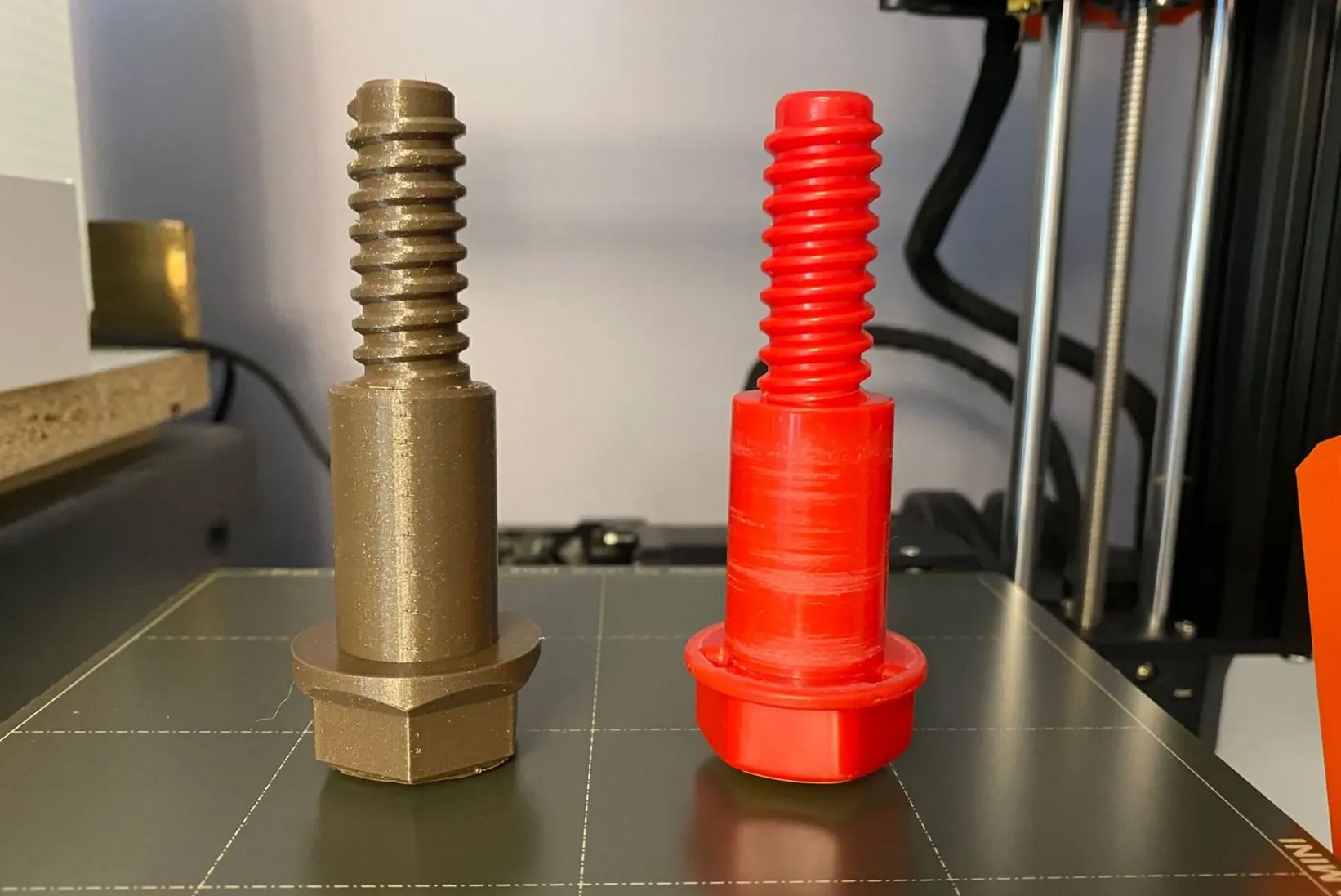
replacement toy bolt replacement toy bolt
replacement bits for an Early Learning Centre Build It Deluxe Set
I was amazed to find that someone has already modelled one of these, too, and it worked beautifully: https://www.printables.com/model/79243-elc-build-it-compatible-bolt
Little kids trinkets. Pacman ghosts
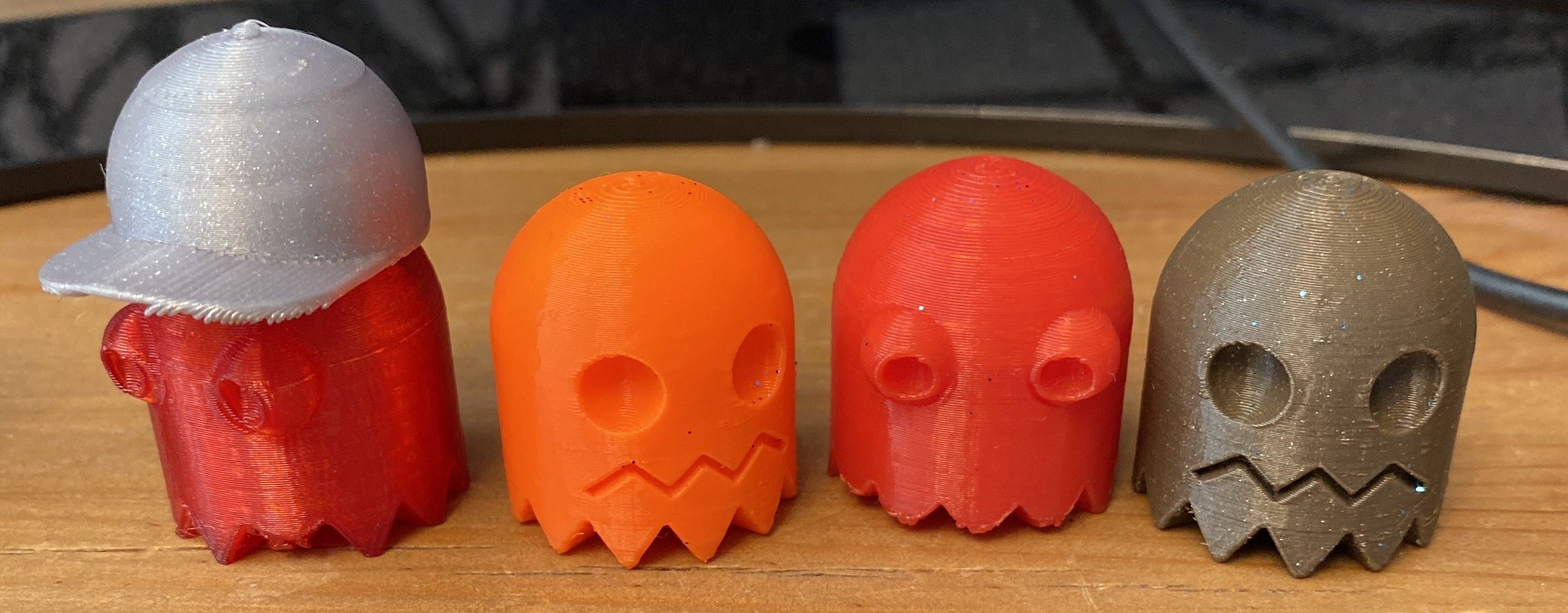
The Pacman ghost family so far The Pacman ghost family so far
So far, I've tried to print useful, functional things, but on a few occasions I've printed a little Pacman ghost when testing printer calibration or similar. I've mostly used these models: https://www.printables.com/model/199425-pac-man-ghost-v2
  • Lego storage/sorters
  • DIY bits-and-bobs sorter/storage (nuts and bolts etc)
I learned about a Slicer setting sometimes called "Vase mode" and found this interesting system of modular drawers that are designed to be printed in Vase mode, so I gave them a go: https://www.printables.com/model/139570-fast-printing-modular-drawer-system-vase-mode I printed one and four drawers for it and gave it to my daughter. It might be used for sorting Lego, or possibly as a chest-of-drawers for a dolls house.
A free-standing inclined vinyl record display stand
https://www.printables.com/model/174711-vinyl-stand-for-kallax
A bracket to install a Gotek drive in my Amiga 500
https://www.thingiverse.com/thing:2745049 Summary From my original list of 25 things to print, I've done 7 of them and determined 4 are not viable. The things in this list I've printed have been off-the-shelf models that other people have constructed. The things I haven't printed are designs I will do myself, which is one reason I haven't printed them yet: building your own designs is the hard part!

Joachim Breitner: rec-def: Dominators case study

More ICFP-inspired experiments using the rec-def library: In Norman Ramsey s very nice talk about his Functional Pearl Beyond Relooper: Recursive Translation of Unstructured Control Flow to Structured Control Flow , he had the following slide showing the equation for the dominators of a node in a graph:
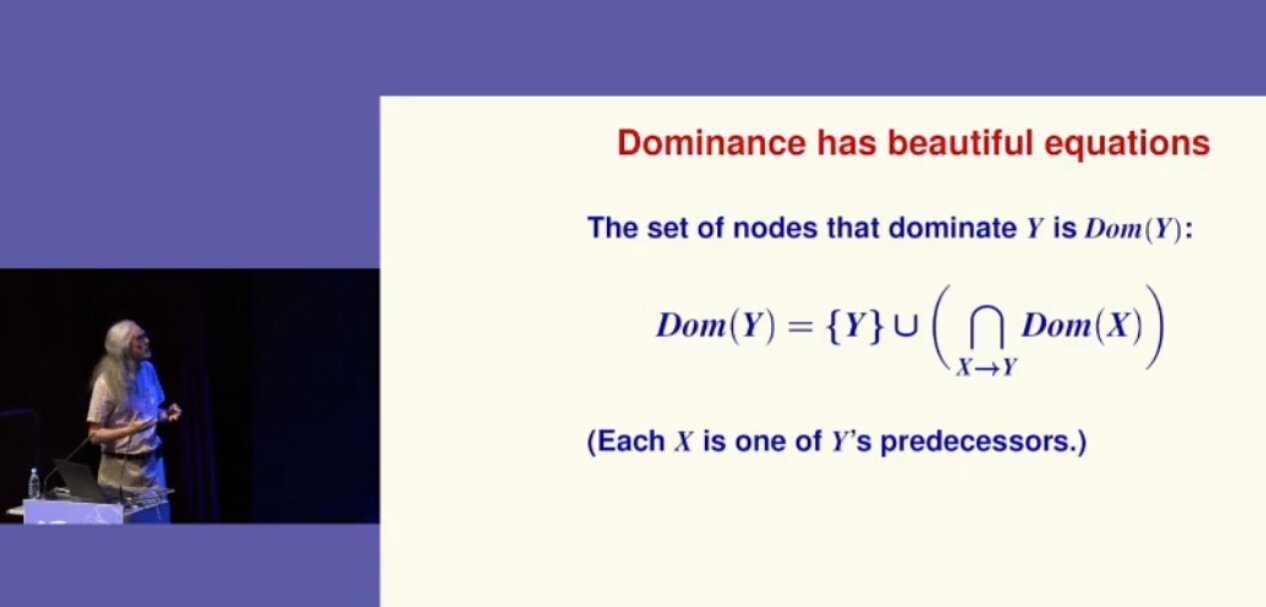
Norman Ramsey shows a formula Norman Ramsey shows a formula
He said it s ICFP and I wanted to say the dominance relation has a beautiful set of equations you can read all these algorithms how to compute this, but the concept is simple . This made me wonder: If the concept is simple and this formula is beautiful shouldn t this be sufficient for the Haskell programmer to obtain the dominator relation, without reading all those algorithms? Before we start, we have to clarify the formula a bit: If a node is an entry node (no predecessors) then the big intersection is over the empty set, and that is not a well-defined concept. For these nodes, we need that big intersection to return the empty set, as entry nodes are not dominated by any other node. (Let s assume that the entry nodes are exactly those with no predecessors.) Let s try, first using plain Haskell data structures. We begin by implementing this big intersection operator on Data.Set, and also a function to find the predecessors of a node in a graph: Now we can write down the formula that Norman gave, quite elegantly: Does this work? It seems it does: But not surprising if you have read my previous blog posts it falls over once we have recursion: So let us reimplement it with Data.Recursive.Set. The hope is that we can simply replace the operations, and that now it can suddenly handle cyclic graphs as well. Let s see: It does! Well, it does return a result but it looks strange. Clearly node 3 and 4 are also dominated by 1, but the result does not reflect that. But the result is a solution to Norman s equation. Was the equation wrong? No, but we failed to notice that the desired solution is the largest, not the smallest. And Data.Recursive.Set calculates, as documented, the least fixed point. What now? Until the library has code for RDualSet a, we can work around this by using the dual formula to calculate the non-dominators. To do this, we
  • use union instead of intersection
  • delete instead of insert,
  • S.empty, use the set of all nodes (which requires some extra plumbing)
  • subtract the result from the set of all nodes to get the dominators
and thus the code turns into:
And with this, now we do get the correct result:
ghci> domintors3 [(1,2),(1,3),(2,4),(3,4),(4,3)]
fromList [(1,[1]),(2,[1,2]),(3,[1,3]),(4,[1,4])]
We worked a little bit on how to express the beautiful formula to Haskell, but at no point did we have to think about how to solve it. To me, this is the essence of declarative programming.

Matthew Garrett: git signatures with SSH certificates

Last night I complained that git's SSH signature format didn't support using SSH certificates rather than raw keys, and was swiftly corrected, once again highlighting that the best way to make something happen is to complain about it on the internet in order to trigger the universe to retcon it into existence to make you look like a fool. But anyway. Let's talk about making this work!

git's SSH signing support is actually just it shelling out to ssh-keygen with a specific set of options, so let's go through an example of this with ssh-keygen. First, here's my certificate:

$ ssh-keygen -L -f id_aurora-cert.pub
id_aurora-cert.pub:
Type: ecdsa-sha2-nistp256-cert-v01@openssh.com user certificate
Public key: ECDSA-CERT SHA256:(elided)
Signing CA: RSA SHA256:(elided)
Key ID: "mgarrett@aurora.tech"
Serial: 10505979558050566331
Valid: from 2022-09-13T17:23:53 to 2022-09-14T13:24:23
Principals:
mgarrett@aurora.tech
Critical Options: (none)
Extensions:
permit-agent-forwarding
permit-port-forwarding
permit-pty

Ok! Now let's sign something:

$ ssh-keygen -Y sign -f ~/.ssh/id_aurora-cert.pub -n git /tmp/testfile
Signing file /tmp/testfile
Write signature to /tmp/testfile.sig

To verify this we need an allowed signatures file, which should look something like:

*@aurora.tech cert-authority ssh-rsa AAA(elided)

Perfect. Let's verify it:

$ cat /tmp/testfile ssh-keygen -Y verify -f /tmp/allowed_signers -I mgarrett@aurora.tech -n git -s /tmp/testfile.sig
Good "git" signature for mgarrett@aurora.tech with ECDSA-CERT key SHA256:(elided)


Woo! So, how do we make use of this in git? Generating the signatures is as simple as

$ git config --global commit.gpgsign true
$ git config --global gpg.format ssh
$ git config --global user.signingkey /home/mjg59/.ssh/id_aurora-cert.pub


and then getting on with life. Any commits will now be signed with the provided certificate. Unfortunately, git itself won't handle verification of these - it calls ssh-keygen -Y find-principals which doesn't deal with wildcards in the allowed signers file correctly, and then falls back to verifying the signature without making any assertions about identity. Which means you're going to have to implement this in your own CI by extracting the commit and the signature, extracting the identity from the commit metadata and calling ssh-keygen on your own. But it can be made to work!

But why would you want to? The current approach of managing keys for git isn't ideal - you can kind of piggy-back off github/gitlab SSH key infrastructure, but if you're an enterprise using SSH certificates for access then your users don't necessarily have enrolled keys to start with. And using certificates gives you extra benefits, such as having your CA verify that keys are hardware-backed before issuing a cert. Want to ensure that whoever made a commit was actually on an authorised laptop? Now you can!

I'll probably spend a little while looking into whether it's plausible to make the git verification code work with certificates or whether the right thing is to fix up ssh-keygen -Y find-principals to work with wildcard identities, but either way it's probably not much effort to get this working out of the box.

Edit to add: thanks to this commenter for pointing out that current OpenSSH git actually makes this work already!

comment count unavailable comments

14 September 2022

Joachim Breitner: rec-def: Program analysis case study

At this week s International Conference on Functional Programming I showed my rec-def Haskell library to a few people. As this crowd appreciates writing compilers, and example from the realm of program analysis is quite compelling.

To Throw or not to throw Here is our little toy language to analyze: It has variables, lambdas and applications, non-recursive (lazy) let bindings and, so that we have something to analyze, a way to throw and to catch exceptions: Given such an expression, we would like to know whether it might throw an exception. Such an analysis is easy to write: We traverse the syntax tree, remembering in the env which of the variables may throw an exception: The most interesting case is the one for Let, where we extend the environment env with the information about the additional variable env_bind, which is calculated from analyzing the right-hand side e1. So far so good:
ghci> someVal = Lam "y" (Var "y")
ghci> canThrow1 $ Throw
True
ghci> canThrow1 $ Let "x" Throw someVal
False
ghci> canThrow1 $ Let "x" Throw (App (Var "x") someVal)
True

Let it rec To spice things up, let us add a recursive let to the language: How can we support this new constructor in canThrow1? Let use naively follow the pattern used for Let: Calculate the analysis information for the variables in env_bind, extend the environment with that, and pass it down: Note that, crucially, we use env', and not just env, when analyzing the right-hand sides. It has to be that way, as all the variables are in scope in all the right-hand sides. In a strict language, such a mutually recursive definition, where env_bind uses env' which uses env_bind is basically unthinkable. But in a lazy language like Haskell, it might just work. Unfortunately, it works only as long as the recursive bindings are not actually recursive, or if they are recursive, they are not used:
ghci> canThrow1 $ LetRec [("x", Throw)] (Var "x")
True
ghci> canThrow1 $ LetRec [("x", App (Var "y") someVal), ("y", Throw)] (Var "x")
True
ghci> canThrow1 $ LetRec [("x", App (Var "x") someVal), ("y", Throw)] (Var "y")
True
But with genuine recursion, it does not work, and simply goes into a recursive cycle:
ghci> canThrow1 $ LetRec [("x", App (Var "x") someVal), ("y", Throw)] (Var "x")
^CInterrupted.
That is disappointing! Do we really have to toss that code and somehow do an explicit fixed-point calculation here? Obscuring our nice declarative code? And possibly having to repeat work (such as traversing the syntax tree) many times that we should only have to do once?

rec-def to the rescue Not with rec-def! Using RBool from Data.Recursive.Bool instead of Bool, we can write the exact same code, as follows: And it works!
ghci> canThrow2 $ LetRec [("x", App (Var "x") someVal), ("y", Throw)] (Var "x")
False
ghci> canThrow2 $ LetRec [("x", App (Var "x") Throw), ("y", Throw)] (Var "x")
True
I find this much more pleasing than the explicit naive fix-pointing you might do otherwise, where you stabilize the result at each LetRec independently: Not only is all that extra work hidden from the programmer, but now also a single traversal of the syntax tree creates, thanks to the laziness, a graph of RBool values, which are then solved under the hood .

The issue with x=x There is one downside worth mentioning: canThrow2 fails to produce a result in case we hit x=x:
ghci> canThrow2 $ LetRec [("x", Var "x")] (Var "x")
^CInterrupted.
This is, after all the syntax tree has been processed and all the map lookups have been resolved, equivalent to
ghci> let x = x in RB.get (x :: RBool)
^CInterrupted.
which also does not work. The rec-def machinery can only kick in if at least one of its function is used on any such cycle, even if it is just a form of identity (which I ~ought to add to the library~ since have added to the library):
ghci> idR x = RB.false   x
ghci> let x = idR x in getR (x :: R Bool)
False
And indeed, if I insert a call to idR in the line then our analyzer will no longer stumble over these nasty recursive equations:
ghci> canThrow2 $ LetRec [("x", Var "x")] (Var "x")
False
It is a bit disappointing to have to do that, but I do not see a better way yet. I guess the def-rec library expects the programmer to have a similar level of sophistication as other tie-the-know tricks with laziness (where you also have to ensure that your definitions are productive and that the sharing is not accidentally lost).

Russell Coker: Storing Local Secrets

In the operation of a normal Linux system there are many secrets stored on behalf of a user. Wifi passwords, passwords from web sites, etc. Ideally you want them to be quickly and conveniently accessible to the rightful user but also be as difficult as possible for hostile parties to access. The solution in GNOME and KDE is to have a wallet that is encrypted to store such passwords, the idea is that if a hostile party gets access to a PC that doesn t use full disk encryption then the secrets will be protected. This is an OK feature. In early versions it required entering a password every time you logged in. The current default mode of operation is to have the login password used to decrypt the wallet which is very convenient. The problem is the case where the user login password has a scope larger than the local PC, EG a domain login password for Active Directory, Kerberos, or similar systems. In such a case if an attacker gets the encrypted wallet that could facilitate a brute force attack on the password used for domain logins. I think that a better option for this would be to store wallets in a directory that the user can t access directly, EG a mode 1770 directory with group wallet . Then when logging in a PAM process running as root could open the wallet and pass a file handle to a process running in the context of the user. For access apart from login there could be SETGID programs to manage it which could require authenticating the user s password before any operation that exports the data so that a vulnerability in a web browser or other Internet facing program can t just grab the file contents. Storing the data in a file that needs a SETGID or root owned process to access it doesn t preclude the possibility of encrypting that file. The same encryption options would be available including encrypting with the login password and unlocking at login time via PAM. The difference is that a brute force attack to discover the login password would first require breaking the security of one of those SETGID programs to get access to the raw data direct attacks by running the wallet open command repeatedly could be managed by the usual rate limiting mechanisms and logging in the system logs. The same methods could be used for protecting the secret keys for GPG and SSH which by default are readable by all processes running in the user context and encrypted with a passphrase. The next issue to consider is where to store such an restricted directory for wallets. Under the user home directory would give the advantage of having the same secrets operate over a network filesystem and not need anything special in backup configuration. Under /var/lib would give the advantage of better isolation from all the less secret (in a cryptographic sense) data in the user home directories. What do you think?

13 September 2022

Alberto Garc a: Adding software to the Steam Deck with systemd-sysext

Yakuake on SteamOS Introduction: an immutable OS The Steam Deck runs SteamOS, a single-user operating system based on Arch Linux. Although derived from a standard package-based distro, the OS in the Steam Deck is immutable and system updates replace the contents of the root filesystem atomically instead of using the package manager. An immutable OS makes the system more stable and its updates less error-prone, but users cannot install additional packages to add more software. This is not a problem for most users since they are only going to run Steam and its games (which are stored in the home partition). Nevertheless, the OS also has a desktop mode which provides a standard Linux desktop experience, and here it makes sense to be able to install more software. How to do that though? It is possible for the user to become root, make the root filesytem read-write and install additional software there, but any changes will be gone after the next OS update. Modifying the rootfs can also be dangerous if the user is not careful. Ways to add additional software The simplest and safest way to install additional software is with Flatpak, and that s the method recommended in the Steam Deck Desktop FAQ. Flatpak is already installed and integrated in the system via the Discover app so I won t go into more details here. However, while Flatpak works great for desktop applications not every piece of software is currently available, and Flatpak is also not designed for other types of programs like system services or command-line tools. Fortunately there are several ways to add software to the Steam Deck without touching the root filesystem, each one with different pros and cons. I will probably talk about some of them in the future, but in this post I m going to focus on one that is already available in the system: systemd-sysext. About systemd-sysext This is a tool included in recent versions of systemd and it is designed to add additional files (in the form of system extensions) to an otherwise immutable root filesystem. Each one of these extensions contains a set of files. When extensions are enabled (aka merged ) those files will appear on the root filesystem using overlayfs. From then on the user can open and run them normally as if they had been installed with a package manager. Merged extensions are seamlessly integrated with the rest of the OS. Since extensions are just collections of files they can be used to add new applications but also other things like system services, development tools, language packs, etc. Creating an extension: yakuake I m using yakuake as an example for this tutorial since the extension is very easy to create, it is an application that some users are demanding and is not easy to distribute with Flatpak. So let s create a yakuake extension. Here are the steps: 1) Create a directory and unpack the files there:
$ mkdir yakuake
$ wget https://steamdeck-packages.steamos.cloud/archlinux-mirror/extra/os/x86_64/yakuake-21.12.1-1-x86_64.pkg.tar.zst
$ tar -C yakuake -xaf yakuake-*.tar.zst usr
2) Create a file called extension-release.NAME under usr/lib/extension-release.d with the fields ID and VERSION_ID taken from the Steam Deck s /etc/os-release file.
$ mkdir -p yakuake/usr/lib/extension-release.d/
$ echo ID=steamos > yakuake/usr/lib/extension-release.d/extension-release.yakuake
$ echo VERSION_ID=3.3.1 >> yakuake/usr/lib/extension-release.d/extension-release.yakuake
3) Create an image file with the contents of the extension:
$ mksquashfs yakuake yakuake.raw
That s it! The extension is ready. A couple of important things: image files must have the .raw suffix and, despite the name, they can contain any filesystem that the OS can mount. In this example I used SquashFS but other alternatives like EroFS or ext4 are equally valid. NOTE: systemd-sysext can also use extensions from plain directories (i.e skipping the mksquashfs part). Unfortunately we cannot use them in our case because overlayfs does not work with the casefold feature that is enabled on the Steam Deck. Using the extension Once the extension is created you simply need to copy it to a place where systemd-systext can find it. There are several places where they can be installed (see the manual for a list) but due to the Deck s partition layout and the potentially large size of some extensions it probably makes more sense to store them in the home partition and create a link from one of the supported locations (/var/lib/extensions in this example):
(deck@steamdeck ~)$ mkdir extensions
(deck@steamdeck ~)$ scp user@host:/path/to/yakuake.raw extensions/
(deck@steamdeck ~)$ sudo ln -s $PWD/extensions /var/lib/extensions
Once the extension is installed in that directory you only need to enable and start systemd-sysext:
(deck@steamdeck ~)$ sudo systemctl enable systemd-sysext
(deck@steamdeck ~)$ sudo systemctl start systemd-sysext
After this, if everything went fine you should be able to see (and run) /usr/bin/yakuake. The files should remain there from now on, also if you reboot the device. You can see what extensions are enabled with this command:
$ systemd-sysext status
HIERARCHY EXTENSIONS SINCE
/opt      none       -
/usr      yakuake    Tue 2022-09-13 18:21:53 CEST
If you add or remove extensions from the directory then a simple systemd-sysext refresh is enough to apply the changes. Unfortunately, and unlike distro packages, extensions don t have any kind of post-installation hooks or triggers, so in the case of Yakuake you probably won t see an entry in the KDE application menu immediately after enabling the extension. You can solve that by running kbuildsycoca5 once from the command line. Limitations and caveats Using systemd extensions is generally very easy but there are some things that you need to take into account:
  1. Using extensions is easy (you put them in the directory and voil !). However, creating extensions is not necessarily always easy. To begin with, any libraries, files, etc., that your extensions may need should be either present in the root filesystem or provided by the extension itself. You may need to combine files from different sources or packages into a single extension, or compile them yourself.
  2. In particular, if the extension contains binaries they should probably come from the Steam Deck repository or they should be built to work with those packages. If you need to build your own binaries then having a SteamOS virtual machine can be handy. There you can install all development files and also test that everything works as expected. One could also create a Steam Deck SDK extension with all the necessary files to develop directly on the Deck
  3. Extensions are not distribution packages, they don t have dependency information and therefore they should be self-contained. They also lack triggers and other features available in packages. For desktop applications I still recommend using a system like Flatpak when possible.
  4. Extensions are tied to a particular version of the OS and, as explained above, the ID and VERSION_ID of each extension must match the values from /etc/os-release. If the fields don t match then the extension will be ignored. This is to be expected because there s no guarantee that a particular extension is going to work with a different version of the OS. This can happen after a system update. In the best case one simply needs to update the extension s VERSION_ID, but in some cases it might be necessary to create the extension again with different/updated files.
  5. Extensions only install files in /usr and /opt. Any other file in the image will be ignored. This can be a problem if a particular piece of software needs files in other directories.
  6. When extensions are enabled the /usr and /opt directories become read-only because they are now part of an overlayfs. They will remain read-only even if you run steamos-readonly disable !!. If you really want to make the rootfs read-write you need to disable the extensions (systemd-sysext unmerge) first.
  7. Unlike Flatpak or Podman (including toolbox / distrobox), this is (by design) not meant to isolate the contents of the extension from the rest of the system, so you should be careful with what you re installing. On the other hand, this lack of isolation makes systemd-sysext better suited to some use cases than those container-based systems.
Conclusion systemd extensions are an easy way to add software (or data files) to the immutable OS of the Steam Deck in a way that is seamlessly integrated with the rest of the system. Creating them can be more or less easy depending on the case, but using them is extremely simple. Extensions are not packages, and systemd-sysext is not a package manager or a general-purpose tool to solve all problems, but if you are aware of its limitations it can be a practical tool. It is also possible to share extensions with other users, but here the usual warning against installing binaries from untrusted sources applies. Use with caution, and enjoy!

12 September 2022

Petter Reinholdtsen: Time to translate the Bullseye edition of the Debian Administrator's Handbook

(The picture is of the previous edition.) Almost two years after the previous Norwegian Bokm l translation of the "The Debian Administrator's Handbook" was published, a new edition is finally being prepared. The english text is updated, and it is time to start working on the translations. Around 37 percent of the strings have been updated, one way or another, and the translations starting from a complete Debian Buster edition now need to bring their translation up from 63% to 100%. The complete book is licensed using a Creative Commons license, and has been published in several languages over the years. The translations are done by volunteers to bring Linux in their native tongue. The last time I checked, it complete text was available in English, Norwegian Bokm l, German, Indonesian, Brazil Portuguese and Spanish. In addition, work has been started for Arabic (Morocco), Catalan, Chinese (Simplified), Chinese (Traditional), Croatian, Czech, Danish, Dutch, French, Greek, Italian, Japanese, Korean, Persian, Polish, Romanian, Russian, Swedish, Turkish and Vietnamese. The translation is conducted on the hosted weblate project page. Prospective translators are recommeded to subscribe to the translators mailing list and should also check out the instructions for contributors. I am one of the Norwegian Bokm l translators of this book, and we have just started. Your contribution is most welcome. As usual, if you use Bitcoin and want to show your support of my activities, please send Bitcoin donations to my address 15oWEoG9dUPovwmUL9KWAnYRtNJEkP1u1b.

11 September 2022

Dirk Eddelbuettel: RcppArmadillo 0.11.2.4.0 on CRAN: Bugfix and Deprecation

armadillo image Armadillo is a powerful and expressive C++ template library for linear algebra and scientific computing. It aims towards a good balance between speed and ease of use, has a syntax deliberately close to Matlab, and is useful for algorithm development directly in C++, or quick conversion of research code into production environments. RcppArmadillo integrates this library with the R environment and language and is widely used by (currently) 1016 packages other packages on CRAN, downloaded 26.2 million times (per the partial logs from the cloud mirrors of CRAN), and the CSDA paper (preprint / vignette) by Conrad and myself has been cited 493 times according to Google Scholar. This new release (made yesterday) brings three changes. First, it updates the release to the upstream 11.2.4 bugfix release made days ago by Conrad. Second, it contains support for the deprecation transition we are managing in issue #391. In short, the (convenient but non-standard) initialization via use of << has been deprecated upstream. Until all packages are updated, we override this in the RcppArmadillo but aim to become compliant . Out of the over 1000 packages, a mere 25 need small adjustments. I reached out email and PRs, and the response has been great. Eight packages are already updated on CRAN, and several others have already in integrated or merged the change. Lastly, Conrad pointed out that the fastLm() example and application can be written more concisely by using arma::dot(). The full set of changes (since the last CRAN release 0.11.2.3.1) follows.

Changes in RcppArmadillo version 0.11.2.4.0 (2022-09-09)
  • Upgraded to Armadillo release 11.2.4 (Classic Roast)
    • fix handling of std::move() involving matrices constructed with auxiliary memory
  • In the fastLm() examples, use arma::dot() to compute to the inner product (as proposed by Conrad), plus small edits
  • Support optional #define named RCPPARMADILLO_FORCE_DEPRECATE to suppress use of ARMA_IGNORE_DEPRECATED_MARKER permitting use and development under deprecation

Courtesy of my CRANberries, there is a diffstat report relative to previous release. More detailed information is on the RcppArmadillo page. Questions, comments etc should go to the rcpp-devel mailing list off the R-Forge page. If you like this or other open-source work I do, you can sponsor me at GitHub.

This post by Dirk Eddelbuettel originated on his Thinking inside the box blog. Please report excessive re-aggregation in third-party for-profit settings.

Shirish Agarwal: Politics, accessibility, books

Politics I have been reading books, both fiction and non-fiction for a long long time. My first book was a comic most probably when I was down with Malaria when I was a kid. I must be around 4-5 years old. Over the years, books have given me great joy and I continue to find nuggets of useful information, both in fiction as well as non-fiction books. So here s to sharing something and how that can lead you to a rabbit hole. This entry would be a bit NSFW as far as language is concerned. NYPD Red 5 by James Patterson First of all, have no clue as to why James Patterson s popularity has been falling. He used to be right there with Lee Child and others, but not so much now. While I try to be mysterious about books, I would give a bit of heads-up so people know what to expect. This is probably more towards the Adult crowd as there is a bit of sex as well as quite a few grey characters. The NYPD Red is a sort of elite police task force that basically is for celebrities. In the book series, they do a lot of ass-kissing (figuratively more than literally). Now the reason I have always liked fiction is that however wild the assumption or presumption is, it does have somewhere a grain of truth. And each and every time I read a book or two, that gets cemented. One of the statements in the book told something about how 9/11 took a lot of police personnel out of the game. First, there were a number of policemen who were patrolling the Two Towers, so they perished literally during the explosion. Then there were policemen who were given the cases to close the cases (bring the cases to conclusion). When you are investigating your own brethren or even civilians who perished 9/11 they must have experienced emotional trauma and no outlet. Mental health even in cops is the same and given similar help as you and me (i.e. next to none.) But both of these were my assumptions. The only statement that was in the book was they lost a lot of bench strength. Even NYFD (New York Fire Department). This led me to me to With Crime At Record Lows, Should NYC Have Fewer Cops? This is more right-wing sentiment and in fact, there have been calls to defund the police. This led me to https://cbcny.org/ and one specific graph. Unfortunately, this tells the story from 2010-2022 but not before. I was looking for data from around 1999 to 2005 because that will tell whether or not it happened. Then I remembered reading in newspapers the year or two later how 9/11 had led NYC to recession. I looked up online and for sure NY was booming before 9/11. One can argue that NYC could come down and that is pretty much possible, everything that goes up comes down, it s a law of nature but it would have been steady rather than abrupt. And once you are in recession, the first thing to go is personnel. So people both from NYPD and NYFD were let go, even though they were needed the most then. As you can see, a single statement in a book can take you to places & time literally. Edit: Addition 11th September There were quite a few people who also died from New York Port Authority and they also lost quite a number of people directly and indirectly and did a lot of patrolling of the water bodies near NYC. Later on, even in their department, there were a lot of early retirements.

Kosovo A couple of days back I had a look at the Debconf 2023 BOF that was done in Kosovo. One of the interesting things that happened during the BOF is when a woman participant chimed in and asks India to recognize Kosovo. Immediately it triggered me and I opened the Kosovo Wikipedia page to get some understanding of the topic. Reading up on it, came to know Russia didn t agree and doesn t recognize Kosovo. Mr. Modi likes Putin and India imports a lot of its oil from Russia. Unrelatedly, but still useful, we rejected to join IPEF. Earlier, we had rejected China s BRI. India has never been as vulnerable as she is now. Our foreign balance has reached record lows. Now India has been importing quite a bit of Russian crude and has been buying arms and ammunition from them. We are also scheduled to buy a couple of warships and submarines etc. We even took arms and ammunition from them on lease. So we can t afford that they are displeased with India. Even though Russia has more than friendly relations with both China and Pakistan. At the same time, the U.S. is back to aiding Pakistan which the mainstream media in India refuses to even cover. And to top all of this, we have the Chip 4 Alliance but that needs its own article, truth be told but we will do with a paragraph  Edit Addition 11th September Seems Kosovo isn t unique in that situation, there are 3-4 states like that. A brief look at worldpopulationreview tells you there are many more.

Chip 4 Alliance For almost a decade I have been screaming about this on my blog as well as everywhere that chip fabrication is a national security thing. And for years, most people deny it. And now we have chip 4 alliance. Now to understand this, you have to understand that China for almost a decade, somewhere around 2014 or so came up with something called the big fund . Now one can argue one way or the other how successful the fund has been, but it has, without doubt, created ripples so strong that the U.S., Taiwan, Japan, and probably South Korea will join and try to stem the tide. Interestingly, in this grouping, South Korea is the weakest in the statements and what they have been saying. Within the group itself, there is a lot of tension and China would use that and there are a number of unresolved issues between the three countries that both China & Russia would exploit. For e.g. the Comfort women between South Korea and Japan. Or the 1985 Accord Agreement between Japan and the U.S. Now people need to understand this, this is not just about China but also about us. If China has 5-6x times India s GDP and their research budget is at the very least 100x times what India spends, how do you think we will be self-reliant? Whom are we fooling? Are we not tired of fooling ourselves  In diplomacy, countries use leverage. Sadly, we let go of some of our most experienced negotiators in 2014 and since then have been singing in the wind

Accessibility, Jitsi, IRC, Element-Desktop The Wikipedia page on Accessibility says the following Accessibility is the design of products, devices, services, vehicles, or environments so as to be usable by people with disabilities. The concept of accessible design and practice of accessible development ensures both direct access (i.e. unassisted) and indirect access meaning compatibility with a person s assistive technology. Now IRC or Internet Relay Chat has been accessible for a long time. I know of even blind people who have been able to navigate IRC quite effortlessly as there has been a lot of work done to make sure all the joints speak to each other so people with one or more disabilities still can use, and contribute without an issue. It does help that IRC and many clients have been there since the 1970s so most of them have had more than enough time to get all the bugs fixed and both text-to-speech and speech-to-text work brilliantly on IRC. Newer software like Jitsi or for that matter Telegram is lacking those features. A few days ago, discovered on Telegram I was shared that Samsung Voice input is also able to do the same. The Samsung Voice Input works wonder as it translates voice to text, I have not yet tried the text-to-speech but perhaps somebody can and they can share whatever the results can be one way or the other. I have tried element-desktop both on the desktop as well as mobile phone and it has been disappointing, to say the least. On the desktop, it is unruly and freezes once in a while, and is buggy. The mobile version is a little better but that s not saying a lot. I prefer the desktop version as I can use the full-size keyboard. The bug I reported has been there since its Riot days. I had put up a bug report even then. All in all, yesterday was disappointing

Russ Allbery: Review: Hogfather

Review: Hogfather, by Terry Pratchett
Series: Discworld #20
Publisher: Harper
Copyright: 1996
Printing: February 2014
ISBN: 0-06-227628-X
Format: Mass market
Pages: 402
Hogfather is the 20th Discworld novel and not a very good place to start. I recommend at least reading Soul Music first for a proper introduction to Susan, and you may want to start with Mort. When we last saw Susan, she was a student at the Quirm College for Young Ladies. Now she's a governess for two adorable youngsters, a job that includes telling them stories and dealing quite capably with monsters in the cellar. (She uses a poker.) It also includes answering questions like whether the Hogfather really exists or whether the presents just come from your parents.
"Look at it this way, then," she said, and took a deep mental breath. "Wherever people are obtuse and absurd... and wherever they have, by even the most generous standards, the attention span of a small chicken in a hurricane and the investigative ability of a one-legged cockroach... and wherever people are inanely credulous, pathetically attached to the certainties of the nursery and, in general, have as much grasp of the physical universe as an oyster has of mountaineering... yes, Twyla: there is a Hogfather.
Meanwhile, the Auditors, last seen meddling with Death in Reaper Man, approach the Assassin's Guild in Ankh-Morpork to hire the assassination of the Hogfather. This rather unusual assignment falls to Mister Teatime, an orphan who was taken in by the guild at an early age and trained to be an assassin. Teatime is a little unnerving, mostly because he enjoys being an assassin. Rather a lot. Hogfather has two major things to recommend it: it's a Death novel, and it features Susan, who is one of my favorite Discworld characters. It also has two major strikes against it, at least for me. The first is relatively minor but, for me, the most irritating. A bit of the way into the story, Pratchett introduces the Oh God of Hangovers fair, that's a good pun and then decides that's a good excuse for nausea and vomiting jokes. A lot of nausea and vomiting jokes. Look. I know a lot of people don't mind this. But I beg authors (and, even more so, filmmakers and cartoonists) to consider whether a joke that some of your audience might like is worth making other parts of your audience feel physically ill while trying to enjoy your work. It's not at all a pleasant experience, and while I handle it better in written form, it still knocks me out of the story and makes me want to skip over scenes with the obnoxious character who won't shut up about it. Thankfully this does stop by the end of the book, but there are several segments in the middle that were rather unpleasant. The second is that Pratchett tries to convince the reader of the mythical importance of the Santa Claus myth (for which Hogfather is an obvious stand-in, if with a Discworld twist), an effort for which I am a highly unsympathetic audience. I'm with Susan above, with an extra helping of deep dislike for telling children who trust you something that's literally untrue. Pratchett does try: he has Death makes a memorable and frequently-quoted point near the end of the book (transcribed below) that I don't entirely agree with but still respect. But still, the book is very invested in convincing Susan that people believing mythology is critically important to humanity, and I have so many problems with the literalness of "believing" and the use of trusting children for this purpose by adults who know better. There are few topics that bring out my grumpiness more than Santa Claus. Grumbling aside, though, I did enjoy this book anyway. Susan is always a delight, and I could read about her adventures as a governess for as long as Pratchett wanted to write them. Death is filling in for the Hogfather for most of the book, which is hilarious because he's far too good at it, in his painfully earnest and literal way, to be entirely safe. I was less fond of Albert's supporting role (who I am increasingly coming to dislike as a character), but the entire scene of Death as a mall Santa is brilliant. And Teatime is an effective, creepy villain, something that the Discworld series doesn't always deliver. The powers arrayed on Discworld are so strong that it can be hard to design a villain who effectively challenges them, but Teatime has a sociopathic Professor Moriarty energy with added creepiness that fills that role in this book satisfyingly. As is typical for Pratchett (at least for me), the plot was serviceable but not the highlight. Pratchett plays in some interesting ways with a child's view of the world, the Unseen University bumbles around as a side plot, and it comes together at the end in a way that makes sense, but the journey is the fun of the story. The conclusion felt a bit gratuitous, there mostly to wrap up the story than something that followed naturally from the previous plot. But it does feature one of the most quoted bits in Discworld:
"All right," said Susan. "I'm not stupid. You're saying humans need... fantasies to make life bearable." REALLY? AS IF IT WAS SOME KIND OF PINK PILL? NO. HUMANS NEED FANTASY TO BE HUMAN. TO BE THE PLACE WHERE THE FALLING ANGEL MEETS THE RISING APE. "Tooth fairies? Hogfathers? Little " YES. AS PRACTICE. YOU HAVE TO START OUT LEARNING TO BELIEVE THE LITTLE LIES. "So we can believe the big ones?" YES. JUSTICE. MERCY. DUTY. THAT SORT OF THING. "They're not the same at all!" YOU THINK SO? THEN TAKE THE UNIVERSE AND GRIND IT DOWN TO THE FINEST POWDER AND SIEVE IT THROUGH THE FINEST SIEVE AND THEN SHOW ME ONE ATOM OF JUSTICE, ONE MOLECULE OF MERCY. AND YET Death waved a hand. AND YET YOU ACT AS IF THERE IS SOME IDEAL ORDER IN THE WORLD, AS IF THERE IS SOME...SOME RIGHTNESS IN THE UNIVERSE BY WHICH IT MAY BE JUDGED. "Yes, but people have got to believe that, or what's the point " MY POINT EXACTLY.
Here's the thing, though: Susan is right. They're not the same sort of thing at all, and Pratchett doesn't present an argument that they are. Death's response is great, but it's also a non sequitur: it is true and correct but has nothing to do with Susan's argument. Justice is not a lie in the sense that Santa Claus is a lie: justice is something that humans can create, just like humans can create gift-giving or a tradition of imaginative story-telling. But this is not at all the same thing as encouraging children to believe in the literal existence of a fat man in red who comes down chimneys to deliver gifts by magic. And Death isn't even correct in Discworld! If one pays careful attention to the story, the consequences he's thinks would follow from the Auditors' attempt on the Hogfather not only don't happen, the exact opposite happens. This is the point of the Unseen University subplot, and it's also what happened in Reaper Man. The Auditors may be trying to kill mythology, but what the books show is that the real danger comes from the backlash. The force they're meddling with is far more powerful and persistent than they are. Death appears to be, by the stated events of the story, completely incorrect in his analysis of Discworld's metaphysics. Maybe Pratchett knows this? He did write a story that contradicts Death's analysis if one reads it carefully. But if so, this is not obvious from the text, or from Susan's reaction to Death's speech, which makes the metaphysics weirdly unsatisfying. So, overall, a mixed bag. Most of the book is very fun, but the metaphysics heavily rest on a pet peeve of mine, and I really could have done without the loving descriptions of the effects of hangovers. This is one of the more famous Discworld novels for the above quote, and on its own this is deserved (it's a great quote), but I think the logic is muddled and the story itself contradicts the implications. A rather odd reading experience. Followed by Jingo in publication order, and Thief of Time thematically. Rating: 7 out of 10

Andrew Cater: 202209110020 - Debian release day(s) - Cambridge - post 4

RattusRattus, Isy, smcv have all just left after a very long day. Steve is finishing up the final stages. The mayhem has quietened, the network cables are coiled, pretty much everything is tidied away. A new experience for two of us - I just hope it hasn't put them off too much.The IRC channels are quiet and we can put this one to bed after a good day's work well done.

10 September 2022

Andrew Cater: 202209101602 Debian release day - Cambridge - post 2

Definitely settling into a rhythm - we've been joined by smcv in person (and bittin on line). Bullseye testing is now well beyond the standard image testing into the live images.Buster images are gradually being built so there's the added confusion of two sets of wiki editing, two sets of potential edit conflicts ...So six people in a small-ish sitting room, several with multiple laptops running several checks at once. It's all good, as ever.Dining room table has nine machines on it, three packet switches are fairly well full ...

Andrew Cater: 202209101115 Debian release day - Cambridge - Bullseye and Buster testing starting

And I'm over here with the Debian images/media release team in Cambridge.First time together in Cambridge for a long time: several of the usual suspects - RattusRattus, Sledge, Isy and myself. Also in the room are Kartik and egw - I think this is their first time.Chat is now physically in Sledge's sitting room as well as on IRC. The first couple of images are trickling in and tests are starting for Bullseye.
This is going to be a very long day - we've got full tests for Bullseye (Debian 11) and Buster (Debian 10) so double duty. This should be the last release for Buster since this has now passed to LTS.

Joachim Breitner: rec-def: Behind the scenes

A week ago I wrote about the rec-def Haskell library, which allows you to write more recursive definitions, such as in this small example:
let s1 = RS.insert 23 s2
    s2 = RS.insert 42 s1
in RS.get s1
This will not loop (as it would if you d just used Data.Set), but rather correctly return the set S.fromList [23,42]. See the previous blog post for more examples and discussion of the user-facing side of this. For quick reference, these are the types of the functions involved here: The type of s1 and s2 above is not Set Int, but rather RSet Int, and in this post I ll explain how RSet works internally.

Propagators, in general The conceptual model behind an recursive equation like above is
  • There are a multiple cells that can hold values of an underlying type (here Set)
  • These cells have relations that explain how the values in the cells should relate to each other
  • After registering all the relations, some form of solving happens.
  • If the solving succeeds, we can read off the values from the cells, and they should satisfy the registered relation.
This is sometimes called a propagator network, and is a quite general model that can support different kind of relations (e.g. equalities, inequalities, functions), there can be various solving strategies (iterative fixed-points, algebraic solution, unification, etc.) and information can flow on along the edges (and hyper-edges) possibly in multiple directions. For our purposes, we only care about propagator networks where all relations are functional, so they have a single output cell that is declared to be a function of multiple (possibly zero) input cells, without affecting these input cells. Furthermore, every cell is the output of exactly one such relation.

IO-infested propagator interfaces This suggests that an implementation of such a propagator network could provide an interface with the following three operations:
  • Functions to declare cells
  • Functions to declare relations
  • Functions to read values off cells
This is clearly an imperative interface, so we ll see monads, and we ll simply use IO. So concretely for our small example above, we might expect
There is no need for an explicit solve function: solving can happen when declareInsert or getCell is called as a User I do not care about that. You might be curious about the implementation of newCell, declareInsert and getCell, but I have to disappoint you: This is not the topic of this article. Instead, I want to discuss how to turn this IO-infested interface into the pure interface seen above?

Pure, but too strict Obviously, we have to get rid of the IO somehow, and have to use unsafePerformIO :: IO a -> a somehow. This dangerous function creates a pure-looking value that, when used the first time, will run the IO-action and turn into that action s result. So maybe we can simply write the following: Indeed, the types line up, but if we try to use that code, nothing will happen. Our insert is too strict to be used recursively: It requires the value of c2 (as it is passed to declareInsert, which we assume to be strict in its arguments) before it can return c1, so the recursive example at the top of this post will not make any progress.

Pure, lazy, but forgetful To work around this, maybe it suffices if we do not run declareInsert right away, but just remember that we have to do it eventually? So let s introduce a new data type for RSet a that contains not just the cell (Cell a), but also an action that we still have to run before getting a value: This is better: insert is now lazy in its arguments (for this it is crucial to pattern-match on RSet only inside the todo code, not in the pattern of insert!) This means that our recursive code above does not get stuck right away.

Pure, lazy, but runs in circles But it is still pretty bad: Note that we do not run get s2 in the example above, so that cell s todo, which would declareInsert 42, will never run. This cannot work! We have to (eventually) run the declaration code from all involved cells before we can use getCell! We can try to run the todo action of all the dependencies as part of a cell s todo action: Now we certainly won t forget to run the second cell s todo action, so that is good. But that cell s todo action will run the first cell s todo action, and that again the second cell s, and so on.

Pure, lazy, terminating, but not thread safe This is silly: We only need (and should!) run that code once! So let s keep track of whether we ran it already: Ah, much better: It works! Our call to get c1 will trigger the first cell s todo action, which will mark it as done before calling the second cell s todo action. When that now invokes the first cell s todo action, it is already marked done and we break the cycle, and by the time we reach getCell, all relations have been correctly registered. In a single-threaded world, this would be all good and fine, but we have to worry about multiple threads running get concurrently, on the same or on different cells. In fact, because we use unsafePerformIO, we have to worry about this even when the program is not using threads. And the above code has problems. Imagine a second call to get c1 while the first one has already marked it as done, but has not finished processing all the dependencies yet: It will call getCell before all relations are registered, which is bad.

Recursive do-once IO actions Making this thread-safe seems to be possible, but would clutter both the code and this blog post. So let s hide that problem behind a nice and clean interface. Maybe there will be a separate blog post about its implementation (let me know if you are curious), or you can inspect the code in System.IO.RecThunk module yourself). The interface is simply
data Thunk
thunk :: IO [Thunk] -> IO Thunk
force :: Thunk -> IO ()
and the idea is that thunk act will defer the action act until the thunk is passed to force for the first time, and force will not return until the action has been performed (possibly waiting if another thread is doing that at the moment), and also until the actions of all the thunks returned by act have performed, recursively, without running into cycles. We can use this in our definition of RSet and get to the final, working solution: This snippet captures the essential ideas behind rec-def:
  • Use laziness to allow recursive definition to describe the propagator graph naturally
  • Use a form of explicit thunk to register the propagator graph relations at the right time (not too early/strict, not too late)

And that s all? The actual implementation in rec-def has a few more moving parts. In particular, it tries to support different value types (not just sets), possibly with different implementations, and even mixing them (e.g. in member :: Ord a => a -> RSet a -> RBool), so the generic code is in Data.Propagator.Purify, and supports various propagators underneath. The type RSet is then just a newtype around that, defined in Data.Recursive.Internal to maintain the safety of the abstraction, I went back and forth on a few variants of the design here, including one where there was a generic R type constructor (R (Set a), R Bool etc.), but then monomorphic interface seems simpler.

Does it really work? The big remaining question is certainly: Is this really safe and pure? Does it still behave like Haskell? The answer to these questions certainly depends on the underlying propagator implementation. But it also depends on what we actually mean by safe and pure ? For example, do we expect the Static Argument Transformation be semantics preserving? Or is it allowed to turn undefined values into defined ones (as it does here)? I am unsure myself yet, so I ll defer this discussion to a separate blog post, after I hopefully had good discussions about this here at ICFP 2022 in Ljubljana. If you are around and want to discuss, please hit me up!

9 September 2022

Reproducible Builds: Reproducible Builds in August 2022

Welcome to the August 2022 report from the Reproducible Builds project! In these reports we outline the most important things that we have been up to over the past month. As a quick recap, whilst anyone may inspect the source code of free software for malicious flaws, almost all software is distributed to end users as pre-compiled binaries. The motivation behind the reproducible builds effort is to ensure no flaws have been introduced during this compilation process by promising identical results are always generated from a given source, thus allowing multiple third-parties to come to a consensus on whether a build was compromised. As ever, if you are interested in contributing to the project, please visit our Contribute page on our website.

Community news As announced last month, registration is currently open for our in-person summit this year which is due to be held between November 1st November 3rd. The event will take place in Venice (Italy). Very soon we intend to pick a venue reachable via the train station and an international airport. However, the precise venue will depend on the number of attendees. Please see the announcement email for information about how to register.
The US National Security Agency (NSA), Cybersecurity and Infrastructure Security Agency (CISA) and the Office of the Director of National Intelligence (ODNI) have released a document called Securing the Software Supply Chain: Recommended Practices Guide for Developers (PDF) as part of their Enduring Security Framework (ESF) work. The document expressly recommends having reproducible builds as part of advanced recommended mitigations, along with hermetic builds. Page 31 (page 35 in the PDF) says:
Reproducible builds provide additional protection and validation against attempts to compromise build systems. They ensure the binary products of each build system match: i.e., they are built from the same source, regardless of variable metadata such as the order of input files, timestamps, locales, and paths. Reproducible builds are those where re-running the build steps with identical input artifacts results in bit-for-bit identical output. Builds that cannot meet this must provide a justification why the build cannot be made reproducible.
The full press release is available online.
On our mailing list this month, Marc Prud hommeaux posted a feature request for diffoscope which additionally outlines a project called The App Fair, an autonomous distribution network of free and open-source macOS and iOS applications, where validated apps are then signed and submitted for publication .
Author/blogger Cory Doctorow posted published a provocative blog post this month titled Your computer is tormented by a wicked god . Touching on Ken Thompson s famous talk, Reflections on Trusting Trust , the early goals of Secure Computing and UEFI firmware interfaces:
This is the core of a two-decade-old debate among security people, and it s one that the benevolent God faction has consistently had the upper hand in. They re the curated computing advocates who insist that preventing you from choosing an alternative app store or side-loading a program is for your own good because if it s possible for you to override the manufacturer s wishes, then malicious software may impersonate you to do so, or you might be tricked into doing so. [..] This benevolent dictatorship model only works so long as the dictator is both perfectly benevolent and perfectly competent. We know the dictators aren t always benevolent. [ ] But even if you trust a dictator s benevolence, you can t trust in their perfection. Everyone makes mistakes. Benevolent dictator computing works well, but fails badly. Designing a computer that intentionally can t be fully controlled by its owner is a nightmare, because that is a computer that, once compromised, can attack its owner with impunity.

Lastly, Chengyu HAN updated the Reproducible Builds website to correct an incorrect Git command. [ ]

Debian In Debian this month, the essential and required package sets became 100% reproducible in Debian bookworm on the amd64 and arm64 architectures. These two subsets of the full Debian archive refer to Debian package priority levels as described in the 2.5 Priorities section of the Debian Policy there is no canonical minimal installation package set in Debian due to its diverse methods of installation. As it happens, these package sets are not reproducible on the i386 architecture because the ncurses package on that architecture is not yet reproducible, and the sed package currently fails to build from source on armhf too. The full list of reproducible packages within these package sets can be viewed within our QA system, such as on the page of required packages in amd64 and the list of essential packages on arm64, both for Debian bullseye.
It recently has become very easy to install reproducible Debian Docker containers using podman on Debian bullseye:
$ sudo apt install podman
$ podman run --rm -it debian:bullseye bash
The (pre-built) image used is itself built using debuerrotype, as explained on docker.debian.net. This page also details how to build the image yourself and what checksums are expected if you do so.
Related to this, it has also become straightforward to reproducibly bootstrap Debian using mmdebstrap, a replacement for the usual debootstrap tool to create Debian root filesystems:
$ SOURCE_DATE_EPOCH=$(date --utc --date=2022-08-29 +%s) mmdebstrap unstable > unstable.tar
This works for (at least) Debian unstable, bullseye and bookworm, and is tested automatically by a number of QA jobs set up by Holger Levsen (unstable, bookworm and bullseye)
Work has also taken place to ensure that the canonical debootstrap and cdebootstrap tools are also capable of bootstrapping Debian reproducibly, although it currently requires a few extra steps:
  1. Clamping the modification time of files that are newer than $SOURCE_DATE_EPOCH to be not greater than SOURCE_DATE_EPOCH.
  2. Deleting a few files. For debootstrap, this requires the deletion of /etc/machine-id, /var/cache/ldconfig/aux-cache, /var/log/dpkg.log, /var/log/alternatives.log and /var/log/bootstrap.log, and for cdebootstrap we also need to delete the /var/log/apt/history.log and /var/log/apt/term.log files as well.
This process works at least for unstable, bullseye and bookworm and is now being tested automatically by a number of QA jobs setup by Holger Levsen [ ][ ][ ][ ][ ][ ]. As part of this work, Holger filed two bugs to request a better initialisation of the /etc/machine-id file in both debootstrap [ ] and cdebootstrap [ ].
Elsewhere in Debian, 131 reviews of Debian packages were added, 20 were updated and 27 were removed this month, adding to our extensive knowledge about identified issues. Chris Lamb added a number of issue types, including: randomness_in_browserify_output [ ], haskell_abi_hash_differences [ ], nondeterministic_ids_in_html_output_generated_by_python_sphinx_panels [ ]. Lastly, Mattia Rizzolo removed the deterministic flag from the captures_kernel_variant flag [ ].

Other distributions Vagrant Cascadian posted an update of the status of Reproducible Builds in GNU Guix, writing that:
Ignoring the pesky unknown packages, it is more like ~93% reproducible and ~7% unreproducible... that feels a bit better to me! These numbers wander around over time, mostly due to packages moving back into an "unknown" state while the build farms catch up with each other... although the above numbers seem to have been pretty consistent over the last few days.
The post itself contains a lot more details, including a brief discussion of tooling. Elsewhere in GNU Guix, however, Vagrant updated a number of packages such as itpp [ ], perl-class-methodmaker [ ], libnet [ ], directfb [ ] and mm-common [ ], as well as updated the version of reprotest to 0.7.21 [ ]. In openSUSE, Bernhard M. Wiedemann published his usual openSUSE monthly report.

diffoscope diffoscope is our in-depth and content-aware diff utility. Not only can it locate and diagnose reproducibility issues, it can provide human-readable diffs from many kinds of binary formats. This month, Chris Lamb prepared and uploaded versions 220 and 221 to Debian, as well as made the following changes:
  • Update external_tools.py to reflect changes to xxd and the vim-common package. [ ]
  • Depend on the dedicated xxd package now, not the vim-common package. [ ]
  • Don t crash if we can open a PDF file using the PyPDF library, but cannot subsequently parse the annotations within. [ ]
In addition, Vagrant Cascadian updated diffoscope in GNU Guix, first to to version 220 [ ] and later to 221 [ ].

Community news The Reproducible Builds project aims to fix as many currently-unreproducible packages as possible as well as to send all of our patches upstream wherever appropriate. This month we created a number of patches, including:

Testing framework The Reproducible Builds project runs a significant testing framework at tests.reproducible-builds.org, to check packages and other artifacts for reproducibility. This month, Holger Levsen made the following changes:
  • Debian-related changes:
    • Temporarily add Debian unstable deb-src lines to enable test builds a Non-maintainer Upload (NMU) campaign targeting 708 sources without .buildinfo files found in Debian unstable, including 475 in bookworm. [ ][ ]
    • Correctly deal with the Debian Edu packages not being installable. [ ]
    • Finally, stop scheduling stretch. [ ]
    • Make sure all Ubuntu nodes have the linux-image-generic kernel package installed. [ ]
  • Health checks & view:
    • Detect SSH login problems. [ ]
    • Only report the first uninstallable package set. [ ]
    • Show new bootstrap jobs. [ ] and debian-live jobs. [ ] in the job health view.
    • Fix regular expression to detect various zombie jobs. [ ]
  • New jobs:
    • Add a new job to test reproducibility of mmdebstrap bootstrapping tool. [ ][ ][ ][ ]
    • Run our new mmdebstrap job remotely [ ][ ]
    • Improve the output of the mmdebstrap job. [ ][ ][ ]
    • Adjust the mmdebstrap script to additionally support debootstrap as well. [ ][ ][ ]
    • Work around mmdebstrap and debootstrap keeping logfiles within their artifacts. [ ][ ][ ]
    • Add support for testing cdebootstrap too and add such a job for unstable. [ ][ ][ ]
    • Use a reproducible value for SOURCE_DATE_EPOCH for all our new bootstrap jobs. [ ]
  • Misc changes:
    • Send the create_meta_pkg_sets notification to #debian-reproducible-changes instead of #debian-reproducible. [ ]
In addition, Roland Clobus re-enabled the tests for live-build images [ ] and added a feature where the build would retry instead of give up when the archive was synced whilst building an ISO [ ], and Vagrant Cascadian added logging to report the current target of the /bin/sh symlink [ ].

Contact As ever, if you are interested in contributing to the Reproducible Builds project, please visit our Contribute page on our website. However, you can get in touch with us via:

Jonathan Dowland: memtest

Since I'm writing about my NAS, a month ago I happened to notice an odd kernel message:
Aug 8 04:04] list_del corruption. prev->next should be ffff90c96e9c2090,
but was ffff90c94e9c2090
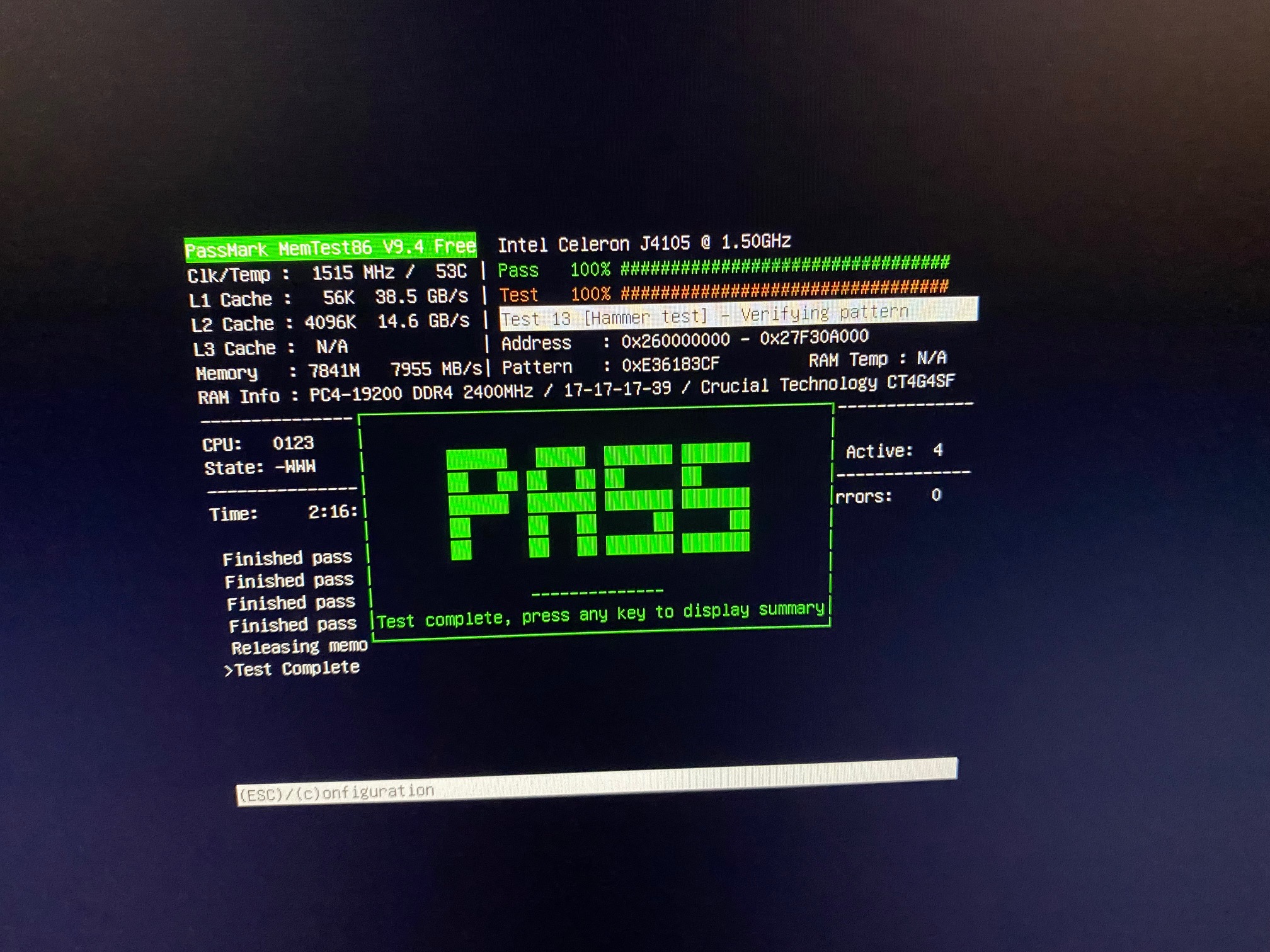
A kernel dev friend said "I'm familiar with that code ... you should run memtest86". This seemed like advice it would be foolish to ignore! I installed the memtest86 package, which on Debian stable, is actually the formerly open-source "memtest86" software, last updated in 2014, rather than the currently open-source "memtest86+". However the package (incorrectly, I think) Recommends: memtest86+ so I ended up with both. The package scripts integrate with GRUB, so both were added as boot options. Neither however, would boot on my NAS, which is a UEFI system: after selection from the GRUB prompt, I just had a blank screen. I focussed for a short while on display issues: I wondered if trying to run a 4k monitor over HDMI was too much to expect from a memory tester OS, but my mainboard has a VGA out as well. It has some quirky behaviour for the VGA out: the firmware doesn't use it at all, so output only begins appearing after something boots (GRUB for example). I fiddled about with the HDMI output, VGA output, and trying different RGB cables, to no avail. The issue was (likely) nothing to do with the video out, but rather that the packaged versions of memtest/memtest86+ don't work properly on UEFI systems. What did work, was Passmark Software's non-FOSS memtest86. It drew on HDMI, albeit in a postage stamp sized window. After some time (much less than I expected, some kind of magic modern memory matrix stuff going on I think), I got a clean bill of health:
memtest86(.com) passes
It's quite possible the FOSS versions of memtest (pcmemtest is another) have better support for UEFI in more recent versions than I installed (I just went with what's in Debian stable), and if not, then this is a worthy feature to work on.

Next.

Previous.