Search Results: "zed"

13 November 2008

Lucas Nussbaum: Living in France? Not an April member? You are WRONG.

I’ve been a member of April, the french association for promotion and defense of Free Software, for a bit more than a year, and I often regret not becoming a member earlier. (I was feeling so guilty and shameful about not being a member that I actually postponed becoming a member.) Stop feeling guilty and shameful, become an April member today! Why Is becoming an April member so important? Some of the things they worked on recently (from the top of my head): So, really, become a member today. It’s only 10 EUR, and you already know they will be well used. April is trying to reach 5000 members by the end of 2008. (Apparently, if you use that address, April will now that you came from me. No benefit for me at all.)

11 November 2008

John Goerzen: Review: Silicon Mechanics

After some hilariously frightening reactions from Dell support to simple problems, and HP becoming aggressively competitive on price, we've been using HP servers for a few years now. The hardware is good, and the support, while reasonable, always... pauses... when I mention that we're running Debian. I try not to let it slip if I don't have to.

We put in some HP blades a couple of years ago, and I was annoyed to discover that they have discontinued that enclosure and all the blades in it. I decided this was a good time to look at their newer options, as well as at other companies.

Back in July, I had noticed a Silicon Mechanics booth at OSCon. I noticed their slogan "experts included." That sounds great; we've got software experts here, but not hardware experts, and I'd enjoy dealing with a company that knows more about their hardware than I do. I went up to their booth and asked what they'd say about us running Debian on their hardware. "That would be just fine." "So you'd fully support it when I'm running Debian?" "Sure." "What about management software - do you have any of that which I'd find annoying to port to Debian?" "Our servers don't need any management software other than what comes with your kernel." Good answers.

So, when it came time for us to decide what to do about getting a new server in here, I figured I'd call up Silicon Mechanics and see what they'd recommend. They put me on a conference call with a sales rep and an IT engineer, and wound up recommending a 1U server for us to start with, and an iSCSI storage device to address some of the storage needs we have (both for that server and others). I had heard of iSCSI only vaguely, and asked how it worked, and what the performance would be like compared to our 2Gb FC SAN. I got back intelligent (and correct) answers.

They probably spent 2 hours with me on the phone before we placed an order. I was incredibly happy with their service, level of expertise, and helpfulness. They even did a webinar to demo the management interface on the storage unit for me.

Today, the 1U server arrived. I unboxed it and set it on my desk to configure. First item: set an IP address for the IPMI card. That's the device that lets me connect to it over a web browser and interact with the console, power cycle it, etc. as if I was there. I set an IP, but somehow couldn't seem to figure out the username and password for the web interface.

So I called Silicon Mechanics support at the number that was included on the fridge magnet (!) that came with the shipment. Phone rang once. Then a live, capable American answered. No menus, no fuss. I asked my question. He apologized, saying, "I should know that, but I'll have to look it up... hold on just a bit." I had my answer about 90 seconds later. He offered to send me the full docs for the IPMI card if I wanted as well.

So I've been very impressed with them so far. From what I've heard, their iSCSI enclosure ought to be quite something as well. They even helped us spec out a switch that supports trunking for use with it.

I'll give them a "highly recommended".

9 November 2008

Raphael Geissert: yummy yummy


Simon McVittie: Encrypted root filesystem on a Debian laptop

I've been meaning to document this for ages... My laptop is set up with an encrypted root filesystem using LVM and dmcrypt. It also has a small Debian stable system for recovery purposes (I don't have a CD drive, so if everything goes horribly wrong, I can't just boot from a live CD). Here's how to set up something similar:

Step 1. Set up the recovery system Start the Debian lenny (beta) installer as usual. (I originally used etch, but these instructions are for lenny - either should work.) When you get to "Partition disks", choose "Manual". Here's the partitioning scheme to use:
  • main partition for LVM, taking up the whole disk minus 1GB or so. select "Do not use", for now
  • 1GB recovery partition at the end of the disk (this will also be the main system's /boot, since /boot needs to be unencrypted anyway). Use the defaults: ext3 mounted at /.
Finish partitioning and write changes to disk, and wait for the base system to install. Say yes to installing Grub to the MBR for now (it might be possible to do the install more cleanly by installing Grub to the recovery partition's boot sector instead - I haven't tested that). Reboot into the freshly installed recovery system and satisfy yourself that it works.

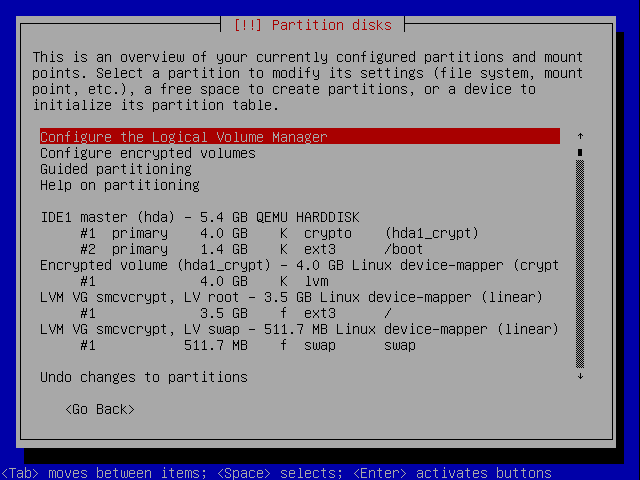
Step 2. Set up the main system Now boot the Debian installer again. This time it's for your installed system. At the "Partition disks" stage, choose "Manual" again. Select the main partition and choose "Use as: physical volume for encryption". Next select "Configure encrypted volumes". Your main partition will now be randomized - this is slow - and some time later you'll be asked for a passphrase. You'll have to type this in at each boot. Select the contents of the "disk" Encrypted volume (hda1_crypt) and choose Use as: physical volume for LVM. Now "Configure the Logical Volume Manager" and create a Volume Group. I always use the laptop's hostname as the VG name (this reduces confusion if you ever plug the disk into another machine for disaster recovery). Create a Logical Volume called swap, the size you want your swap space to be. If you plan to use suspend-to-disk, this needs to be at least as large as your RAM. Create a Logical Volume called root, for the root filesystem. If you want separate "partitions" for things like /home, now is a good time to create them too; if you want to use my schroot howto, leave some unallocated space in the VG for that. Set your swap LV to be used as a swap area, and your root LV to be used as ext3 mounted at /. If you wanted extra LVs, set them up too. Also set your recovery partition to be used as ext3, mounted on /boot, and not reformatted. It should now look something like this (smcvcrypt is the name of a KVM virtual machine in which I've been testing these instructions, normally you'd have the laptop's hostname there). Screenshot from d-i Proceed with the installation. Install Grub to the MBR - this will temporarily make the recovery system unbootable, but shrug never mind. Finish the installation and reboot into your new main system.

Step 3. Make them dual-boot Within the main system your recovery system is also visible, at /boot. Bind-mount /dev onto /boot/dev, chroot into /boot, and run "update-grub /dev/hda2", where hda2 is the partition where the recovery partition is. Leave the chroot. Edit /boot/grub/menu.lst and put this right at the end:
title Go to recovery system
root (hd0,1)
chainloader +1
(Replace (hd0,1) with what Grub thinks the recovery partition is - the second number is the partition number starting from 0, so /dev/hda5 would be (hd0,4) and so on.) Also edit /boot/boot/grub/menu.lst and put this right at the end:
title Back to main system
root (hd0)
chainloader +1
Also, still in /boot/boot/grub/menu.lst, go to the top of the file and change the colour scheme to something else (I used a red background) to indicate that this boot menu is for the recovery system. Reboot and try it out. You should now have an extra boot menu option, "Recovery system". Selecting it will switch to the recovery system's boot menu, which has an option to switch back, and so on. Each boot menu also has some entries for kernels, any of which will boot with the appropriate root filesystem (encrypted root for the main system, unencrypted for the recovery system). Success!

8 November 2008

Steve McIntyre: 3rd Free Software Congress in Valencia

I spent much of this week in Alicante. It was wonderful to have a few days away from the beginnings of Winter in Cambridge - Alicante's in South West Spain, right on the Mediterranean. It's a lovely city, although it was very quiet due to the time of year. I was invited down to Alicante by organisers of the Congr s de Programari Lliure, Comunitat Valenciana, to present a talk about Debian. That I did, and as always my slides and photos are available in case people are interested. I wasn't too sure about what level to aim the talk, so I deliberately went for a general introduction to Debian. That seems to have been the correct level - nobody threw anything at me, and nobody was visibly falling asleep. *grin* It's also the first time I've ever given a talk with official translators, which is a weird experience! The main topic for the conference was the new release of Lliurex, Valencia's own GNU/Linux distribution targeted primarily at use in schools. The conference was massive; I was told there were about 1500 attendees in all, most of whom were teachers who wanted to come and learn more about Free Software. There was a good spread of talks and workshops, covering topics from development through to deployment in the classroom. The level of enthusiasm for Free Software here was immense - lots of people were keen to learn more about it and get involved. I was told that out of the 15 regions/states of Spain, 11 of them have now started their own distributions to use in schools! Extremadura were the first region to experiment with Free Software like this, and their success with LinEx was a clear inspiration to their neighbours elsewhere in Spain. As well as the obvious cost advantages of moving from proprietary to Free Software, the local governments also love the freedom to use and modify their software however they like - including the ability to provide their own translations. Conference welcome I met up with a lot of cool people at the conference too. The local education minister (Alejandro Font de Mora) was keen to talk with all the speakers and very enthusiastic about the future of Free Software in his schools. As is increasingly common at FS events around the world, there were of course quite a few Debian people around too. Luciano and Miriam were also giving talks, and I bumped into Rene and Miguel and a whole bunch of others whose names I'm too crap to remember - sorry! I also spoke a lot with Kurt Gramlich, the mega-enthusiastic Skolelinux developer who was also happy to push Debian to everybody he spoke to *grin*. Jon "Maddog" Hall had some excellent ideas that I'm sure we'll all hear more about soon, and his talk was excellent. He did a very good job of explaining how Free Software makes such a difference, including how it helps people to make money. He also explained that due to travel he had missed Halloween at home and he wanted to share the experience of scary masks with the people at the conference: Maddog Bush I had a great time in Alicante, and I'm very grateful for the invitation to go there. I wish that the UK was as far as advanced as Spain in the use of Free Software in education - they've done a huge amount of good work in this area and I'm glad we can help them.

Joerg Jaspert: Debian mirror scripts

With a small mail to our mirrors-announce list, I just opened the work of more than one month to the public. Even better, I strongly encourage every mirror admin to use my scripts, or at least scripts that follow a minimal set of rules I wrote down… Some long time (somewhere in April or May this year) I got added to the Debian mirroradm group. First it was only to get some problems with packages.debian.org solved, but later on I started doing more. This group is basically the one that handles the archvsync user on .debian.org machines and also manages the official Debian mirrors listing. As the archvsync user exists on multiple .debian.org machines, and many of them do mirror a copy of our archive for various reasons, all of them had some version of a mirroring script, and sometimes also a version of a pushmirror script. Unfortunately, as they all had been maintained mostly on their own per machine - they sometimes had evolved a bit different. Additionally all of them had a few problems which could leave us with a broken mirror behind, despite it looking all well. So on Sept. 26 I decided to trash it all and rewrite the script and put it all in a VCS (and selected git). For that I set myself a few goals, like (in no particular order) Now, 109 commits and more than a month later, I was finally able to open the scripts to the wide public. (Had multiple people test them before this, but thats always different than a real “release”). The scripts are in use on all .debian.org machines and some other mirrors already, so I’m fairly sure they work.
As I already wrote, Debian mirror admins are strongly encouraged to use this scriptset and not to invent their own. In case you miss a feature either send me a mail describing it, or better, a patch implementing it. I’m happy to implement as much as possible (and sensible :) ) And while it is discouraged to use own scripts, sometimes people have reasons to have their own, so there is now a minimal set of functionality that such a script MUST support. All of those requirements are easy to fulfill. Well, at least the MUST ones. The first one is basically a given, all scripts I know are doing this already. The second one sounds more complicated, but actually might just be about 4 lines of actual code changes. Just touch an extra file before you gain a lockfile (to avoid two scripts running at the same time) and then rerun rsync as long as that extra file is around. (It helps to rm this trigger file right before you call rsync :) ). The should directive is actually a little more work to implement correctly. I won’t show source here, read the ftpsync script if you want to see it, but I try some small explanation. Background: Debian mirror synchronisation is usually done by scripts that get started via ssh. As mirror operators (understandably) do not like their upstream mirror to be able to login, this is done using “ssh triggers”, a feature I wrote about earlier. Those are sshkeys using a forced command, so nothing else than this command will be run, ever. SSH, if used with such forced commands, has the helpful feature that it sets the environment variable SSH_ORIGINAL_COMMAND containing the original arguments. Which means that, if the mirror pushes you with “ssh yourhost -l mirror sleep 1” you will see *sleep 1 in that variable. It is what many mirror operators currently use when pushing their downstreams. Now, we can use that to tell the receiving end all things we want it to know. If you look in my script you will see that I defined a little more than the minimal arguments. But none of the additional ones are a requirement, they only make life much easier. My script currently understands, additional to the 3 minimal ones:
As if that wasn’t enough, I also had to rewrite the runmirrors script. The old 10-line one just didn’t cope with the more general approach. This script is used to “push” your downstream mirrors, telling them that they need to update. (Which is the only sane way to run a mirror. cron is just not made for mirrors that can update at random times!). One nice new feature of it is the ability to update multiple mirrors nearly at the same time. This is extremely helpful in case of DNS Round Robin entries like security.debian.org (multiple hosts offering the same archive under one hostname). You do not want to have such hosts out of sync. Not even for a minute, if you can avoid that. So we now push the mirrors with sync:stage1 as argument. Then we wait until all of them have finished the stage1 sync before we push them all again, this time with sync:stage2 as argument. This will erase any update delays thanks to network latency / low bandwidth one of the security mirrors might have, as the large transfers (all the binary and source packages) are done in stage1. They can take time, a normal user won’t notice it - the Package and Source indices are not transferred yet. They arevery small and as such transfered pretty fast whenever stage1 is done everywhere and we tell mirrors to do stage2.
All in all it was a pretty nice exercise writing those scripts. Comments: 0

6 November 2008

Josselin Mouette: Security by incompetence

Hey Romain, you d be impressed by the number of upstreams whose knowledge of security measures is similarly close to the absolute zero. Since bad guys are always digging through commits for suspicious things, hiding the relevant commits is the best thing you can do to help them. Given things like this exist, It s likely that they have even automated tools to do this search for them. This way, distributors and security engineers have to do the same job, hoping to never miss a change that was actually a security fix. Unfortunately, two small scale projects that we happen to use have exactly the policy Romain described regarding security updates. I m amazed by the fantastic job the distributions security teams manage to achieve in these conditions.

4 November 2008

Russell Coker: Basics of EC2

I have previously written about my work packaging the tools to manage Amazon EC2 [1]. First you need to login and create a certificate (you can upload your own certificate - but this is probably only beneficial if you have two EC2 accounts and want to use the same certificate for both). Download the X509 private key file (named pk-X.pem) and the public key (named cert-X.pem). My Debian package of the EC2 API tools will look for the key files in the ~/.ec2 and /etc/ec2 directories and will take the first one it finds by default. To override the certificate (when using my Debian package) or to just have it work when using the code without my package you set the variables EC2_PRIVATE_KEY and EC2_CERT. This Amazon page describes some of the basics of setting up the client software and RSA keys [2]. I will describe some of the most important things now: The command “ec2-add-keypair gsg-keypair > id_rsa-gsg-keypair” creates a new keypair for logging in to an EC2 instance. The public key goes to amazon and the private key can be used by any ssh client to login as root when you creat an instance. To create an instance with that key you use the “-k gsg-keypair” option, so it seems a requirement to use the same working directory for creating all instances. Note that gsg-keypair could be replaced by any other string, if you are doing something really serious with EC2 you might use one account to create instances that are run by different people with different keys. But for most people I think that a single key is all that is required. Strangely they don’t provide a way of getting access to the public key, you have to create an instance and then copy the /root/.ssh/authorized_keys file for that. This Amazon page describes how to set up sample images [3]. The first thing it describes is the command ec2-describe-images -o self -o amazon which gives a list of all images owned by yourself and all public images owned by Amazon. It’s fairly clear that Amazon doesn’t expect you to use their images. The i386 OS images that they have available are Fedora Core 4 (four configurations with two versions of each) and Fedora 8 (a single configuration with two versions) as well as three other demo images that don’t indicate the version. The AMD64 OS images that they have available are Fedora Core 6 and Fedora Core 8. Obviously if they wanted customers to use their own images (which seems like a really good idea to me) they would provide images of CentOS (or one of the other recompiles of RHEL) and Debian. I have written about why I think that this is a bad idea for security [4], please make sure that you don’t use the ancient Amazon images for anything other than testing! To test choose an i386 image from Amazon’s list, i386 is best for testing because it allows the cheapest instances (currently $0.10 per hour). Before launching an instance allow ssh access to it with the command “ec2-authorize default -p 22“. Note that this command permits access for the entire world. There are options to limit access to certain IP address ranges, but at this stage it’s best to focus on getting something working. Of course you don’t want to actually use your first attempt at creating an instance, I think that setting up an instance to run in a secure and reliable manner would require many attempts and tests. As all the storage of the instance is wiped when it terminates (as we aren’t using S3 yet) and you won’t have any secret data online security doesn’t need to be the highest priority. A sample command to run an instance is “ec2-run-instances ami-2b5fba42 -k gsg-keypair” where ami-2b5fba42 is a public Fedora 8 image available at this moment. This will give output similar to the following: RESERVATION r-281fc441 999999999999 default
INSTANCE i-0c999999 ami-2b5fba42 pending gsg-keypair 0 m1.small 2008-11-04T06:03:09+0000 us-east-1c aki-a71cf9ce ari-a51cf9cc The parameter after the word INSTANCE is the serial number of the instance. The command “ec2-describe-instances i-0c999999” will provide information on the instance, once it is running (which may be a few minutes after you request it) you will see output such as the following: RESERVATION r-281fc441 999999999999 default
INSTANCE i-0c999999 ami-2b5fba42 ec2-10-11-12-13.compute-1.amazonaws.com domU-12-34-56-78-9a-bc.compute-1.internal running gsg-keypair 0 m1.small 2008-11-04T06:03:09+0000 us-east-1c aki-a71cf9ce ari-a51cf9cc The command “ssh -i id_rsa-gsg-keypair root@ec2-10-11-12-13.compute-1.amazonaws.com” will then grant you root access. The part of the name such as 10-11-12-13 is the public IP address. Naturally you won’t see 10.11.12.13, it will instead be public addresses in the Amazon range - I replaced the addresses to avoid driving bots to their site. The name domU-12-34-56-78-9a-bc.compute-1.internal is listed in Amazon’s internal DNS and returns the private IP address (in the 10.0.0.0/8 range) which is used for the instance. The instance has no public IP address, all connections (both inbound and outbound) run through some sort of NAT. This shouldn’t be a problem for HTTP, SMTP, and most protocols that are suitable for running on such a service. But for FTP or UDP based services it might be a problem. The part of the name such as12-34-56-78-9a-bc is the MAC address of the eth0 device. To halt a service you can run shutdown or halt as root in the instance, or run the ec2-terminate-instances command and give it the instance ID that you want to terminate. It seems to me that the best way of terminating an instance would be to run a script that produces a summary of whatver the instance did (you might not want to preserve all the log data, but some summary information would be useful), and give all operations that are in progress time to stop before running halt. A script could run on the management system to launch such an orderly shutdown script on the instance and then uses ec2-terminate-instances if the instance does not terminate quickly enough. In the near future I will document many aspects of using EC2. This will include dynamic configuration of the host, dynamic DNS, and S3 storage among other things.

2 November 2008

Decklin Foster: Tap that class

And now, something entirely impractical. I picked up Beginning Ruby by Peter Cooper the other day to look for some teaching material. Flipping through, I came across a basic feature that had heretofore escaped my notice: the Struct class. If you want to use a class for nothing more than bundling together a few values, you can create a Struct instead of writing out initialize and attr_accessor yourself. The idiom is like this:
class Server < Struct.new(:host, :port, :password)
  def to_s
    port == 6600 ? host : "# host :# port "
  end
end
That particular one's from Njiiri (which may clue you in that it took me several months to get around to writing this post). For educational purposes, it's nice: you can point out how we give a name to a class (I've also tried to explain assignment as "naming" rather than "storing"), that there's an unnamed class (classes are also objects!), and overriding a method (which uses the dynamically defined stuff), without any boilerplate to get in the way. So it's tempting to use this in a lesson. Unfortunately, Ruby is a little bit weird here, and you run into those distracting "practical" issues about the particular language you're working in. Your classes can't subclass Class, and thus you can't say Foo.new like you can Struct.new. Struct is actually implemented in C (or Java, or whatever's native). So you have to do some handwaving. This is because the "metaclasses" we have in Ruby are implemented, so to speak, as singleton classes of objects (including class objects). I do not mean this as a criticism of Matz at all, but they seem like more of a serendipitous thing than an intentional design -- "hey, if we implement classes in this particular way, we get this sort of metaclassing automatically [1]." (The clearest explanation of why this is that I've found is in the first chapter of Advanced Rails by Brad Ediger.) I wanted to be able to just subclass Class, rather than have all that fun power that we normally get to abuse in Ruby, only because I think this is the clearest way to explain the abstraction. Even I still have trouble describing singletons in plain English. Struct is intuitively a class of classes, and factors out similar/boring stuff -- a good practice. It could be an example of how to refactor some simple classes, if only we could follow it. I decided to give up on the idea for my tutorial, but it kept me up at night. Ruby metaclasses clearly can do anything that the sort of Struct-like metaclasses I have in my mind -- "parametric" classes, if you will -- can do, and I can dynamically define just about anything; why not make it happen? We can instantiate Class itself, but the tool we have to shape that class is singleton methods. This can certainly be abstracted away. So, I whipped something up. Before getting to it, though, let's visit a new construct in Ruby 1.9 and 1.8.7: Object#tap. Apart from the obvious debugging use described in its documentation, it makes it quite easy to factor out this pattern:
def gimme_a_thing
  thing = Thing.new
  thing.do_stuff_to_it
  thing
end
Into something closer to the style of functional or declarative programming:
def gimme_a_thing
  Thing.new.tap  thing 
    thing.do_stuff_to_it
  end
end
(Well, "do stuff" is obviously still procedural, but A for effort.) Which one is "better" could probably be the subject of much debate, but: I really prefer the second one; even though it has exactly the same effect, it looks like "what" rather than "how" (something else I try to beat into impressionable young heads. :-)), which is I think easier to write tests for. I'm going to use it here, because it's shorter. Now, Object#tap passes the object as an argument to the block; in our case, we are going to define a metaclass, so we want to work with self, instead. So we define a new version, class_tap -- by analogy with class_def, I suppose --- which class_evals the block rather than simply evaluating it:
class Class
  def class_tap(&blk)
    tap  _self  _self.class_eval &blk  
  end
end
And to do the following trickery, we make use of MetAid, written by why the lucky stiff -- it's very small, so we could always just incorporate the bits we want into the code here, but this short file provides a common vocabulary for talking about metaclass stuff which is quite valuable. Now, we can write a method to create our new classes on the fly. Here's what I came up with:
require 'metaid'
class << Class
  def meta(_super=Object, &blk)
    new.class_tap do                     # 1
      meta_def :new do  *args            # 2
        Class.new(_super).class_tap do   # 3
          class_exec *args, &blk         # 4
        end
      end
    end
  end
end
(Note the "class << Class", opening the singleton, rather than "class Class", opening Class itself. Also, the distinction between new and Class.new -- they are the same method, but from inside the meta_def we're no longer in the Class class.) The lines of meta itself mean:
  1. The value of this thing is a generated class, which we will describe thusly:
  2. Its singleton class has a new method, which gives you a value that is:
  3. Another generated class, which is defined by:
  4. the original block, which now gets run with new's arguments.
Nary an assignment in sight! The (embarrassing) caveat is that methods in the block that defines the new class instance cannot use def to create methods as normal. A def is evaluated in a totally fresh scope (I don't think I get the opinion behind this decision, to be honest), so we need to use class_def instead. This is, I must admit, rather hideous. Perhaps someday the language will change. But, first things first: now we can implement Struct in pure Ruby.
class MyStruct < Class.meta \
  do  *args 
    attr_accessor *args
    class_def :initialize do  *instance_args 
      args.zip(instance_args).each do  attr, val 
        instance_variable_set :"@# attr ", val
      end
    end
  end
end
The real Struct class does a few other nice things for you, but this is the heart of it; I can go back to that Njiiri example and just swap in MyStruct for Struct (Providing an instant performance gain of -200%... :-)). Here's a "shapes" example from my abandoned OO lesson:
class Polygon < Struct.new(:sides)
  def perimeter
    @sides.inject(&:+)
  end
end
class RegularPolygonClass < Class.meta(Polygon) \
  do  n_sides 
    class_def :initialize do  side_length 
      @sides = [side_length] * n_sides
    end
    class_def :area do
      @sides.size * @sides.first**2 / Math.tan(Math::PI / @sides.size) / 4
    end
  end
end
class Square < RegularPolygonClass.new(4); end
class Pentagon < RegularPolygonClass.new(5); end
(Note that area has no free variables and thus could actually be defined with def. It would just look funny.) You only have to change one number here to make new polygon classes, rather than accumulating parameter lint or explicitly subclassing and redefining something implicit just for the derived class [2]. In a way it the exact analogue of the imperative vs. tap style described above. There is quite a bit of aesthetics involved; one way is not "right". Apart from the syntactical wart, I like being able to do things this way. Ruby is, as they say, optimized for programmer happiness and the principle of least surprise. Still, I'm sure it is quite slow, and I don't particularly need it for any real-world application right now. For an intro to OO it's way too much complexity to have lurking unexplained beneath the surface and still requires getting bogged down in the language you happen to be using. But hey! It's neat.
[1]I basically try to do this whenever possible, anyway. Design decisions are like sex: they're better when they're free.
[2]Of course, if Ruby class variables were not leaked across the entire inheritance hierarchy, something as trivial as this one-variable example would be... trivial. At least, few people would actually miss metaprogramming features. Blub blub blub.

1 November 2008

Thomas Girard: Playing with C++0x -- tuple

C++0x is approaching, and it comes with a lot of new stuff, so I've decided to play with it. Some C++0x features are already available in g++ 4.3. Others will be available in the 4.4 release -- see this page for a summary of C++0x language support in g++. What is a tuple? It's a std::pair on stero ds: it can contain any number of elements. For the impatient, the whole sample program is available from here. It can be compiled with: g++-4.3 --std=c++0x tuple.cpp -o tuple. Now let's see how to create a tuple:
#include <string>
#include <tuple>
typedef std::tuple<int, double, std::string> my_tuple_t;
my_tuple_t a_tuple(1, 5.0);
Every element of the tuple gets initialized to its default value if it's not specified. Indeed displaying the third element:
std::cout << std::get<2>(a_tuple) << std::endl;
outputs nothing, because the string element was default-constructed to an empty string. The std::make_tuple function, like std::make_pair for std::pair, can be used to create a tuple using type deduction:
std::cout << std::get<1>(std::make_tuple(false, std::string("see"))) << std::endl;
A tuple element can be changed using the same get function:
std::get<2>(a_tuple) = "a string";
Of course, a tuple is type safe. Trying to put a string at the first element:
std::get<0>(a_tuple) = "another string";
does not compile. But there's more: you also get a compilation error when trying to access an element that does not exist. For example trying to display fourth element does not compile:
std::cout << std::get<3>(a_tuple) << std::endl;
What else can you do with tuples? You can test them for equality, or assign them:
my_tuple_t another_tuple = std::make_tuple(2, 10.0, std::string("nothing"));
std::cout << (a_tuple == another_tuple) << std::endl;
another_tuple = a_tuple;
std::cout << (a_tuple == another_tuple) << std::endl;
You can also retrieve multiple elements at once, possibly ignoring some of them:
std::string a_string;
std::tie(std::ignore, std::ignore, a_string) = another_tuple;
Last, you can concatenate two tuples into a new tuple:
std::tuple<int, double, std::string, bool, std::string> cat =
    std::tuple_cat(a_tuple, std::make_tuple(false, std::string("see")));

Francois Marier: Preventing accidental deletion of important files using safe-rm

Some weeks ago, I accidentally deleted half of my /usr/lib. I didn't lose anything important and was able to restore everything (thanks to my Ctrl+C'ing the process in time) but that user error did strike me as too easy to make (apparently, I'm not alone). So I started thinking about how I could prevent something like that from happening again.

I realized one thing: there is no way I would ever want to delete /usr or /etc for example. I figured that "rm" should, by default, refuse to delete certain critical directories (or files). Of course, that would be a very controversial patch to "rm" itself and the chances of this approach succeeding were pretty close to zero.

So instead, I decided to build a wrapper around "rm" which prevents the deletion of important files by checking each one against a blacklist. Anything you add to the blacklist will not be deletable using "rm" unless you override this protection by calling "rm.real" directly.


This tool, safe-rm, ships with a default system-wide configuration file (/etc/safe-rm.conf), but each user can supplement that list of "protected" directories and files by adding lines to ~/.safe-rm.

Debian and Ubuntu packages are available from the usual places.

There are of course different approaches to preventing these kinds of problems...

31 October 2008

Michael Schutte: Soundcycle vs. car horns

Wikipedia says:
Critical Mass is a bicycling event typically held on the last Friday of every month in over 300 cities around the world.
My home town of Innsbruck has been one of these cities since 29th August. I joined the movement for the third protest ride (de_AT) today to avoid the Hallowe en fuss, to have some fun, to get to know people, and out of personal conviction. Bicycling ludicrously slowly for a good hour, we managed to claim some fairly busy streets while many people tried to get home by car. A few of them attempted to get us out of their way by honking, but they gave up when they realized that our constant ringing and the music coming from the Soundcycle was louder than them. The hardest part was to get attention by pedestrians and drivers without interfering with buses and trams, but it worked most of the time. What s so great about Critical Mass is that it makes the participants experience just what they want to deliver: When there are more cyclists on the streets, every single one feels much safer, and motorists drive more carefully. I would usually avoid S dring at 5 p. m., but with an estimated fifty people around me, it is an entirely different matter. I also basically like the overall non-organisation of the trips: Whoever is at the top of the convoy can decide where it goes. Sadly, this spontaneity has its drawbacks: It briefly got us into the absurd situation of unlawfully using the street even though a cycle lane was available, which made our protest pointless for a few minutes. But a little room for improvement won t prevent me from taking part once more before the winter break.

Andrew McMillan: Graphics in OpenOffice.org: SVG, EPS and WMF

When Heather designed a logo for me for Morphoss she did it with a bitmap editor, naturally enough because that's the tool she's most familiar with using. I'd rather not use a bitmap as the source format for the logo though, because it will degrade when it gets resized, so I redrew it as a vector graphic. One of the best free, open-source tools around for vector graphics seems to be Inkscape and I've mucked around with it for many years, so I naturally used that. Once you have a logo though, you naturally want to use it in documents, and the importing of SVG graphics into OpenOffice.org documents is a long-outstanding bug (let alone embedding SVG graphics) so I needed to convert them to another format. It's actually the most requested feature in OOo, appearing twice in the top 10, and even spawning an external SVG importer project. Since both programs support encapsulated postscript I was able to save the logo from Inkscape as .eps and use it directly in OpenOffice.org. While this initially seemed satisfactory, after a few weeks of using documents with the .eps logo embedded in them I started to get annoyed with the strange pauses when my CPU was maxed out while paging up and down. I was sure that that had not happened in the past when I was using a logo in WMF format, which OOo inevitably has to support well for compatibility with other Office Suites. After some searching around for more complicated ways to convert SVG or EPS to WMF, I discovered that what I could do was simply to open the EPS in OpenOffice.org draw, and save it from there as a WMF. This seems to work well, for my purposes anyway, so now when I use my logo in my OpenOffice.org documents I don't see any annoying slowdown paging up and down within the document, and I didn't have to download the SVG importer for OpenOffice.org either. Well alright, I did download the SVG importer as well, but my logo didn't look nearly so good without it's text, and with everything displaced up and to the right at various offsets!

30 October 2008

Michael Banck: 30 Oct 2008

Systems Expo 2008 As the last years, Debian was offered a booth at last week's Systems expo here in Munich again. However, this year the Free Projects area was not organized by Rosa Riebl from C&L publishing, but by Wolfgang Drotschmann from LinuxTag e.V.. This made some things a bit more difficult, e.g. we did not know our exact booth number until a couple of days before the expo and the small conference programme was made up in an ad-hoc fashion after the expo started, but in the end most things worked out fine in some way or the other. While the booth (a demo-point, really) was as big (or rather small) as last year, there was much more space around the booth this year (something which seemed to apply to all of Systems), so things did not get too crowded even when a handful of visitors approached the booth at once. Also, the visibility was much improved as our demo point was visible by strolling visitors this year (last year, our demo point was just facing the wall). As nobody else stepped up, I had to organize the booth again. Fewer people than last year were around; only Robert Grimm, Arne Wichmann, Franziska Lichtblau, Johannes Wiedersich, Andreas Barth and I were able to commit to staffing the booth; other people were busy over the week or moved away from Munich since last year, like Robert Lemmen or Wolfgang Lonien. Luckily, we still had the computer the GNOME project donated to us last year, and I took a TFT, keyboard and mouse from the university along. This year, I decided to not show up for the booth build-up the day before Systems starts. On the one hand, I had made the experience that there is not much one can do then anyway, and would have to put the computer/TFT into the central locker room overnight anyway. On the other hand, there was as always a very low attendence in the first few hours of the expo so building up the booth in the morning turned out to be no problem. The Credativ people again provided us with merchandise (due to some miscommunication on my part the package had to arrive directly at the expo, but in the end I was glad about this as I had enough trouble carrying the computer and TFT to the expo). This year, thanks to Credativ, we were able to provide some t-shirts for the first time, something quite some visitors had requested over the years. Besides t-shirts, we had some swirl stickers and the popular Debian keychains provided by Joerg Jaspert through Credativ. In the end the booth mostly consisted of the computer (demonstrating Lenny most of the time) and some A4 sized Swirls I had printed out the day before. From Wednesday on we were able to provide Lenny Beta2 CDs as well thanks to Johannes Wiedersich who organized them. Initially, I asked ADR whether they would produce some CDs for us again as they did last year, but they did not bring the appropriate hardware this time. But thanks to Johannes we were still able to provide interested visitors with CDs through LSK. In the end, we ran out of most t-shirts at some point on Thursday and managed to sell the two remaining Lady shirts on Friday. All the other merchandise was gone by the end of the show as well so the way back was not that difficult, even more so as Andreas Barth helped me carry the computer to the subway and my car. The days I was at Systems (first and last day) the attendance was rather low, so not that many interesting discussions happened. Almost everybody who stepped by knew Debian already and the majority was using it themselves as well, at least on their servers. Those people were also really quite happy, we rarely heard much critizism, even after asking people for some. The most frequently asked question was undoubtly "when will Lenny release?", followed by "do you have that cool t-shirt in L or XL as well?". Overall it was a pretty good experience, albeit slightly stressful organizing it. In any case, this was probably the last time I had to do this as the Systems organizers announced they will rethink their concept and there will be no Systems 2009.

29 October 2008

David Welton: Slicehost + Ubuntu Intrepid Upgrade

As I wrote previously, I started looking around for a new hosting provider, as Layered Tech is jacking up their prices too much. This isn't something I consider 'fun', as it will involve a lot of time swapping things over, with the potential for problems, but the amount of money disappearing every month is too much to ignore at this point. After some dithering, I finally went ahead and spent some money for a minimal slice at Slicehost. Linode seems pretty competitive too, but I more or less flipped a mental coin. I was actually ready to go ahead the other day, but I stopped to think some more after seeing that Slicehost has been acquired by Rackspace. In terms of seeing hard working people rewarded for their efforts, I am of course happy for the guys at Slicehost, but it also leaves a few questions:
  • Sometimes, perhaps not immediately, but after a while, there is less incentive to bust your butt if you cashed in in a big way.
  • Rackspace is not my kind of hosting outfit: they don't even list their prices where people can see them, like Slicehost, Layered Tech, and most everyone else does. I've heard they're good, but quite expensive. I don't need 'managed' servers - I can do that myself.
  • The FAQ says that Slicehost will continue as a going concern in its own right, but there's always the chance that they were acquired for their tech, and that the FAQ just says that they will continue to operate to keep their current clients from bolting.
Of course, good things could come out of the deal too, so I decided to put my paranoia aside and test the waters. There are a lot of things to like about a system like Slicehost's: it's relatively quick and easy to set up new slices, fiddle with the resources that each slice has, and so on, compared with a physical server. Furthermore, they have a reputation for not 'overbooking' their servers, which is why I wanted to get away from a VPS in the first place, many years ago. Setting up a slice was very quick and easy, but unfortunately got off to a rough start: their "fraud detection" system had a problem with me being in a different place than my billing address. Luckily, they were very fast at correcting the problem. As an aside, I think that fraud detection is probably best left to the credit card companies, although of course I don't really know their business, so maybe that particular check has saved them some money/frustration in the past. Upgrading the Slicehost Ubuntu to Intrepid In any case, once I got it up and running, I wanted to test out the upgrade to Intrepid, as that's going to be out in less than a week, and I might as well upgrade while I have 'fresh' servers to play with, and prior to installing a bunch of stuff. It went very well. I did a do-release-upgrade -d, hit 'yes' to everything, rebooted, and everything was fine! Admittedly, I don't have anything running on the server yet, so that kept things short and sweet, and didn't require the upgrade of various systems which might have had troubles, but so far so good If you'd like to sign up for Slicehost, it looks like they give you a referral code. Mine can be utilized by going here.

David Welton: Slicehost + Ubuntu Intrepid Upgrade

As I wrote previously, I started looking around for a new hosting provider, as Layered Tech is jacking up their prices too much. This isn't something I consider 'fun', as it will involve a lot of time swapping things over, with the potential for problems, but the amount of money disappearing every month is too much to ignore at this point. After some dithering, I finally went ahead and spent some money for a minimal slice at Slicehost. Linode seems pretty competitive too, but I more or less flipped a mental coin. I was actually ready to go ahead the other day, but I stopped to think some more after seeing that Slicehost has been acquired by Rackspace. In terms of seeing hard working people rewarded for their efforts, I am of course happy for the guys at Slicehost, but it also leaves a few questions: Of course, good things could come out of the deal too, so I decided to put my paranoia aside and test the waters. There are a lot of things to like about a system like Slicehost's: it's relatively quick and easy to set up new slices, fiddle with the resources that each slice has, and so on, compared with a physical server. Furthermore, they have a reputation for not 'overbooking' their servers, which is why I wanted to get away from a VPS in the first place, many years ago. Setting up a slice was very quick and easy, but unfortunately got off to a rough start: their "fraud detection" system had a problem with me being in a different place than my billing address. Luckily, they were very fast at correcting the problem. As an aside, I think that fraud detection is probably best left to the credit card companies, although of course I don't really know their business, so maybe that particular check has saved them some money/frustration in the past. Upgrading the Slicehost Ubuntu to Intrepid In any case, once I got it up and running, I wanted to test out the upgrade to Intrepid, as that's going to be out in less than a week, and I might as well upgrade while I have 'fresh' servers to play with, and prior to installing a bunch of stuff. It went very well. I did a do-release-upgrade -d, hit 'yes' to everything, rebooted, and everything was fine! Admittedly, I don't have anything running on the server yet, so that kept things short and sweet, and didn't require the upgrade of various systems which might have had troubles, but so far so good If you'd like to sign up for Slicehost, it looks like they give you a referral code. Mine can be utilized by going here.

Benjamin Mako Hill: An Invisible Handful of Stretched Metaphors

The following list is merely a small selection of scholarly articles listed in the ISI Web of Knowledge with "invisible hand" in their title: And, finally:

28 October 2008

Ond&#345;ej &#268;ert&iacute;k: Google Mentor Summit III

On Sunday I checked out from the hotel and enjoyed the breakfast, basically the same as the first picture here. Which is cool, the best way to start a day is with a good breakfast in the morning.


At Google I finally met with Bart Massey, who works at the Portland State University where I was an intern (in 2005) and also he was sponsoring one SymPy GSoC student in 2007.


Then we started to port SymPy to Jython with Philip Jenvey. I first installed openjdk-6, which is in Debian main, then checked out Jython svn, typed "ant" and it just worked. This is so awesome, that we finally have a truly opensource and fully working java implementation in Debian. Philip fixed some bugs already, so SymPy imports just fine. Most of the tests run, but also quite a lot still fail.

We managed to isolate two bugs: issue 1158 and 1159. Then there was an annoying recursion bug, that took us several hours to dig into and I then had to leave at 6pm without a clue. But Philip kept saying, I just need to look more at the java stacktraces that Jython was generating and I'll figure it out. And he did! The next morning he filed an issue 412 in the PyPy tracker, because they seem to have the same problem. There are subtle differences in how to handle __mul__ and __rmul__ methods that are not well documented, so it works in CPython but fails in Jython/PyPy. I think we can fix that in SymPy too in the meantime, so I am very excited, because it seems SymPy will work on top of Jython soon.

There was also a git vs hg session with both hg and git developers. Since I recently switched from hg to git for all stuff where I can choose the vcs, it was very interesting for me. And I must say I am glad I switched. Mercurial works fine enough and with the recent rebase feature I think it is usable, but git just has a bigger momentum at the moment and it just doesn't get in my way.

During the day Steve sent an email to the GSoC list that Dirk forgot his jacket in the hotel room, so I said to myself, haha, that's a pity. And then I realized, oh shit, I left my jacket there as well. They didn't have it in the evening when I stopped there, but fortunately they sent me an email yesterday that they found it, so I'll stop there on my way back.

We also took couple of group pictures, here is just my lame attempt (I am sure people will soon post better ones):


On Monday morning I met with Fernando Perez, the author of ipython, he know works with Jarrod. Then I rented a car and came to visit Brian Granger and his family in San Luis Obispo.

We went to the beach in the evening:


And had a dinner together. Brian showed me his options pricing example he did with SymPy, so I made him create an issue 1175 with the code.
Then we played with the parallel stuff that Brian contributed to ipython and we tried sympy with it and to our disappointment, we found pickling bugs in sympy, it works with protocol 0, but not protocol 2, see the issue 1176 and 1177. This almost smells like a bug in Python itself, but I need to investigate that later more deeply.

Today is Tuesday and we'll work on doing atomic physics calculations with sympy. See also Brian's email to the sympy list about it.

27 October 2008

Decklin Foster: We could customer care less

(And now, a cathartic "I hate this company and I am never patronizing them again, please don't either" post. I should have done ones for at least Speakeasy/Covad and IBM's server division last year. Ah well.) I went to go register a new domain yesterday (announcement soon! Probably this weekend). I've been using Joker for a while, IIRC on the principle that the cooks were using it so it must be decent enough. While registering, I had a bunch of problems with the horrid, useless "Verified by Visa" popup [1] that you see everywhere these days, and eventually this must have looked like suspicious activity to the bank so my card was declined. I only actually found this out when I got mail saying my order was canceled. Okay, sure. I wrote back and explained what I thought was going on and that I'd like to resolve it. Another half hour later, I got this response:
Hello,
please use
   https://joker.com/goto/support/
for all support inquiries.
Regards, your Joker.com team
This is complete and utter bullshit [2]. If a company is going to mail me, I expect to be able to mail them. I have a mail client; it manages communication the way I want it to, and runs my preferred editor to compose messages (which is, in fact, how I am writing this very blog post). I am sick of dicking around on JavaScript-requiring web forms that all work differently and typing in postage-stamp-sized little textareas. Anything I do type in them is lost, because unlike my email client, web forms don't save sent messages unless the authors feel like letting you have a Cc:. When a company forces me to do this, I take it as a sign of disrespect. I tolerate a web browser [3] for reading pages; "applications" are universally painful [4]. One of the things I used to like about Joker was the PGP mail interface. AFAIK, they have not killed it (I didn't bother to check), but with automatic "we don't want to listen to you unless you inconvenience yourself" bounces like this, what's the point? I surmise that there is, or was, some smart person there who understood how (and more to the point, why) to hook a pseudo-mailbox up to a software system, and that they have been overridden by someone in management who realized it's much easier to have dime-a-dozen webmonkeys hook a form up to the same system since 90% of users just don't care (and even people who do notice and dislike this, but are not as inflamed as I, have come to expect it because everyone else refuses mail, so, y'know, pick yr battles son, etc.). Not the sort of culture I put faith my in. The irony of it all was that I was registering this domain to run a service I had decided to create specifically because of another site refusing mail and directing me to an even lamer web form. That would take incoming mail and, you know... process it with software. Suffice it to say, I am no longer going to be their customer. In deciding who to use instead, I figured I'd do a survey of where the domains in that "Subscription" column [5] on Planet Debian were registered, but... WHOIS is basically useless. Every server just returns free text, formatted differently by (apparently) every implementation under the sun. Cheaply parsing something out from .com/.org/.net is possible, but InterNIC kindly blacklists your IP after making more than a few requests in a few minutes. I guess I'm just gonna go with Gandi (but other suggestions would be welcome). In somewhat unrelated developments, I went to nic.at to update my nameservers for Where the Bus At? last week. There was no authentication or anything on the request form, so I just filled it in and sent it off. I got some automatic mail saying I need to print out a PDF, sign it, and fax it internationally. Annoying, and hardly as secure as mailing them with PGP, but whatever. But then, also yesterday, I got another mail saying the update was complete (lo and behold, it was). I am now somewhat concerned about the security of my domain: it seems like anyone can come by and put something in the form and if I'm not around to notice the courtesy mail and ask that they stop the request, it'll eventually go through, no questions asked. I have not yet written them to figure out what the deal is, though. Kinda burned out. I guess I didn't really have high hopes for dealing directly with a ccTLD registrar (this was the first time I've done it... I can't believe I blew 60 on a cutesy domain name) rather than a reseller who competes in a market, but then, I go and google "domain registrar" and look at all the AdWords dollars spent trying to compete with GoDaddy [6] and just kind of want to put my head in my hands. On DJB's DNS pages there's this bit about setting up a domain. It doesn't say "How to (buy register whatever) a domain name". It says, "How to receive a delegation from .com". Which is of course, how it works. And what I want to buy. I don't want "parking" or even gratis nameservers. Just a delegation from .com. Please. No AdWords came up when I googled for that phrase to copy the link. Sometimes I guess markets just sink to the bottom. Anyway. I feel like there's a free-software angle here. My continuing irrational hatred of using other people's forms, web-based mailing-list substitutes, nameservers, etc. stems not so much from their suckage but from the fact that there is no longer any software there, in front of me, for the four freedoms to possibly apply to. Being able to run your mail reader for any purpose doesn't win you much if no one uses mail. I don't really know what to do about this.
[1]It was only twelve dollars! If I go to hipster market or some other place with brand-new POS systems they don't even make me sign a paper slip for less than $20 or so. But this is the sort of thing dreamed up by people who think good security is setting a cookie to denote that I've answered "what was your first dog's name" or whatever. IF YOU WANT TO BREAK INTO MY BANK ACCOUNTS: I've set the answer to every single one of these questions to "security theater". Easy to remember.
[2]Not to mention a glaringly RESTless URI.
[3]Also, as a rule I normally try not to have anything up on my desktop that I can't close and re-open at any time, thanks to screen, MPD, emacsclient, actually using my browser's bookmark function and resisting the lure of tab-bar.js, etc. Web browsers are supposed to suck at preserving state; HTTP is stateless. See also here (and for further reading on that in the Haskell world, check out Yi. I'm hoping to switch to it someday).
[4]Debbugs, for example, may not have the slickest interface, but if I want to do flags, labels, archiving, threading, or whatever, I can; I'm not at the mercy of some front-end web developer. But we've all heard this litany before.
[5]Thanks, Hpricot!
[6]Even if GoDaddy's customer service were completely hacker-friendly, I would not use them, because their president Hates America.

Joey Hess: I voted

I voted early because Sullivan County, TN is phasing in new voting machines this election. On election day, they will use the old touch screen system, while early voters get to test the "new" paper system. The new system is sure to please fans of paper. However, it has two flaws that were obvious to me. I have no way of knowing that my vote will be counted as I filled it out, and I realized half way through that election officials can determine how I voted. Here's why... You have two pieces of paper during the vote. A registration sheet is signed by the voter. A paper ballot has little rectangles that the votor fills in with a ballpoint pen in the privacy of the voting booth. The instructions say to fill in choices completely. Since the voting booths have a hard top, it's difficult to write on them with a ballpoint, let alone fill in little squares completely. The natural thing to do? Slide your second piece of paper under the ballot, so the pen can dig in better. If you don't think about it, you'll probably do this unconciously. Half-way through, I realized that I was leaving imprints on the registration paper, with my name on it, that corresponded to my choices on the ballot. Due to the two-column layout, and the distinctive spacing between different choices, it's possible to look at those imprints and determine exactly how I voted. The registration paper has to be handed in at the end, so the official who sits there all day collecting these has plenty of time to work this out and determine the votes of anyone. (I moved my ballot around and re-filled in squares to try to confuse things.) (Relatedly, one has to carry the paper ballot around the room to take it to the voting machine. It's difficult to keep the ballot obscured while doing this, since you can't fold it, and since they take the registration paper before the ballot, so you can't keep the ballot covered with it either.) The second obvious flaw is that once I fed my ballot into the voting machine, which presumably scanned it and put it in a safe, there was only a confimation that "you've voted!". There was no way to verify that it had counted my vote as I'd marked it.
Most voting system work seems to be in the direction of advocating paper ballots for paper ballots' sake. This doesn't seem like the right approach to me. Is no-one working on writing down the characteristics that an ideal voting system would have, and trying to make them all requirements? My take on requirements of an ideal voting system are:
  1. Only living people in the set of registered voters may vote.
  2. Each votor can only vote once.
  3. The votor should be able to verify that his vote was counted correctly.
  4. There must be a way for the votor to prove if his vote was not counted.
  5. The votor must not be able to prove which way he voted (to avoid payoffs, intimidation, etc).
  6. Others must not be able to determine how a votor voted.
  7. Individual votes must be retained to allow recounts.
  8. The entire vote data should be published so that the results can be verified by third parties.
  9. The system must scale to many millions of voters.
  10. The correctness of the entire voting system should be formally provable.
The paper ballot system I experienced today fails on at least points #2 [A] , #3 (see above), #4 (I walked away with nothing I can use to prove anything), #5 (I can video my vote), #6 (see above), and #8 [B]. At least it scales well though. The old touch screen system failed most of the same points, though it made at least a small attempt to satisfy #3 (by confirming the vote onscreen) -- and it failed #7, and probably scaled worse. Outside of the American election system, I've participated in voting systems that seem able meet requirements #1 [C], #2, #3, #4, #7, #8, and #10. To me, #10 is the most important point, but it seems to be the one that is neglected most. Some of the points may be worth weakening if they block other points. Is it really worth avoiding giving me something to prove how I've voted, and banning taking cameras into the polling place, in order to meet point #5, if this defeats point #4? I'm curious what requirments I may have left out too. My list is just a rough stab at it. The real point is to analyze voting systems, and reject ones that don't provably meet criteria. Until it becomes accepted practice to do that, our voting systems will not get appreciably less flawed.
[A] If you can get two copies of the ballot, you can vote twice ... fairly easy with a friend on the inside to arrange for the two copies to get "stuck together", and another one at the vote scanner to allow you to scan both. [B] The ballots could be published, but there's no way to prove all of them, or the true ballots would be. And in reality, they're either shredded, or locked away, or tossed in a dumpster, or variously all three. [C] Mostly. Perfectly accomplishing #1 is harder than most of the other points, and may be worth leaving out of scope.

Next.

Previous.