Search Results: "ed"

20 December 2022

Reproducible Builds (diffoscope): diffoscope 229 released

The diffoscope maintainers are pleased to announce the release of diffoscope version 229. This version includes the following changes:
[ Chris Lamb ]
* Skip test_html.py::test_diff if html2text is not installed.
  (Closes: #1026034)
[ Holger Levsen ]
* Bump standards version to 4.6.2, no changes needed.
You find out more by visiting the project homepage.

19 December 2022

Simon Josefsson: Second impressions of Guix 1.4

While my first impression of Guix 1.4rc2 on NV41PZ was only days ago, the final Guix 1.4 release has happened. I thought I should give it a second try, although being at my summer house with no wired ethernet I realized this may be overly optimistic. However I am happy to say that a guided graphical installation on my new laptop went smooth without any problem. Practicing OS installations has a tendency to make problems disappear. My WiFi issues last time was probably due to a user interface mistake on my part: you have to press a button to search for wireless networks before seeing them. I m not sure why I missed this the first time, but maybe the reason was that I didn t really expect WiFi to work on this laptop with one Intel-based WiFi card without firmware and a USB-based WiFi dongle. I haven t went back to the rc2 image, but I strongly believe it wasn t a problem with that image but my user mistake. Perhaps some more visual clues could be given that Guix found a usable WiFi interface, as this isn t completely obvious now. My main pet problem with the installation is the language menu. It contains a bazillion languages, and I want to find Swedish in it. However the list is half-sorted so it looks like it is alphabetized but paging through the list I didn t find svenska , but did notice that the sorting restarts after a while. Eventually I find my language of chose, but a better search interface would be better. Typing s to find it jumps around in the list. This may be a user interface misunderstanding on my part: I may be missing whatever great logic I m sure there is to find my language in that menu. I did a simple installation, enabling GNOME, Cups and OpenSSH. Given the experience with sharing /home with my Trisquel installation last time, I chose to not mount it this time, fixing this later on if I want to share files between OSes. Watching the installation proceed with downloading packages over this slow WiFi was meditative, and I couldn t help but wonder what logic there was to the many steps where it says it is going to download X MB of software, downloads a set of packages, and then starts another iteration saying it is going to download Y MB and then downloads another set of packages. Maybe there is a package dependency tree being worked out while I watch. After logging into GNOME I had to provide the WiFi password another time, it seems it wasn t saved during installation, or I was too impatient to wait for WiFi to come up automatically. Using the GNOME WiFi selection menu worked fine. The webcam issue is still present, the image is distorted and it doesn t happen in Trisquel. Other than that, everythings appear to work, but it has to be put through more testing. Upgrading Guix after installation is still suffering from the same issue I noticed with the rc2 images, this time I managed to save the error message in case someone wants to provide an official fix or workaround. The initial guix pull command also takes forever, even on this speedy laptop, but after the initial run it is faster. Here are the error messages (pardon the Swedish):
jas@kaka ~$ sudo -i
...
root@kaka ~# guix pull
...
root@kaka ~# guix system reconfigure /etc/config.scm 
guix system: fel: aborting reconfiguration because commit 8e2f32cee982d42a79e53fc1e9aa7b8ff0514714 of channel 'guix' is not a descendant of 989a3916dc8967bcb7275f10452f89bc6c3389cc
tips: Use  --allow-downgrades' to force this downgrade.
root@kaka ~# 
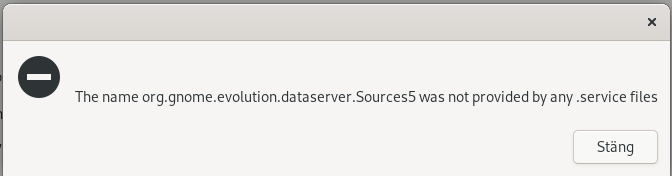
I ll avoid using allow-downgrades this time to see if there is a better solution available. Update: Problem resolved: my muscle memory typed sudo -i before writing the commands above. If I stick to the suggested guix pull (as user) followed by sudo guix system reconfigure /etc/config.scm everything works. I ll leave this in case someone else runs into this problem. I m using the Evolution mail/calendar/contacts application, and it was not installed via GNOME so I had to manually install it using guix package -i evolution . Following the guided setup worked remarkable well (it auto-detects all my email settings after giving it my email address), although at the end I get a surprising error message:
Puzzling error message from Evolution
If I didn t know a bit about how Evolution works internally, I would have been stuck here the solution is to install the evolution data server package. This should probably be a dependency from the main package? Fix it by guix package -i evolution-data-server . It works directly, no need to even restart Evolution or go through the configuration dialog again. After this, I m happily using email against my Dovecot server and contacts/calendars against my Nextcloud server via GNOME s builtin Nextcloud connector which was straight-forward to setup.

Russ Allbery: Review: Artifact Space

Review: Artifact Space, by Miles Cameron
Series: Arcana Imperii #1
Publisher: Gollancz
Copyright: June 2021
ISBN: 1-4732-3262-7
Format: Kindle
Pages: 483
Artifact Space is a military (mostly) science fiction novel, the first of an expected trilogy. Christian Cameron is a prolific author of historical fiction under that name, thrillers under the name Gordon Kent, and historical fantasy under the name Miles Cameron. This is his first science fiction novel. Marca Nbaro is descended from one of the great spacefaring mercantile families, but it's not doing her much good. She is a ward of the Orphanage, the boarding school for orphaned children of the DHC, generous in theory and a hellhole in practice. Her dream to serve on one of the Greatships, the enormous interstellar vessels that form the backbone of the human trading network, has been blocked by the school authorities, a consequence of the low-grade war she's been fighting with them throughout her teenage years. But Marca is not a person to take no for an answer. Pawning her family crest gets her just enough money to hire a hacker to doctor her school records, adding the graduation she was denied and getting her aboard the Greatship Athens as a new Midshipper. I don't read a lot of military science fiction, but there is one type of story that I love that military SF is uniquely well-suited to tell. It's not the combat or the tactics or the often-trite politics. It's the experience of the military as a system, a collective human endeavor. One ideal of the military is that people come to it from all sorts of backgrounds, races, and social classes, and the military incorporates them all into a system built for a purpose. It doesn't matter who you are or what you did before: if you follow the rules, do your job, and become part of a collaboration larger than yourself, you have a place and people to watch your back whether or not they know you or like you. Obviously, like any ideal, many militaries don't live up to this, and there are many stories about those failures. But the story of that ideal, told well, is a genre I like a great deal and is hard to find elsewhere. This sort of military story shares some features with found family, and it's not a coincidence that I also like found family stories. But found family still assumes that these people love you, or at least like you. For some protagonists, that's a tricky barrier both to cross and to believe one has crossed. The (admittedly idealized) military doesn't assume anyone likes you. It doesn't expect that you or anyone around you have the right feelings. It just expects you to do your job and work with other people who are doing their job. The requirements are more concrete, and thus in a way easier to believe in. Artifact Space is one of those military science fiction stories. I was entirely unsurprised to see that the author is a former US Navy career officer. The Greatships here are, technically, more of a merchant marine than a full-blown military. (The author noted in an interview that he based them on the merchant ships of Venice.) The weapons are used primarily for defense; the purpose of the Greatships is trade, and every crew member has a storage allotment in the immense cargo area that they're encouraged to use. The setting is in the far future, after a partial collapse and reconstruction of human society, in which humans have spread through interstellar space, settled habitable planets, and built immense orbital cities. The Athens is trading between multiple human settlements, but its true destination is far into the deep black: Tradepoint, where it can trade with the mysterious alien Starfish for xenoglas, a material that humans have tried and failed to reproduce and on which much of human construction now depends. This is, to warn, one of those stories where the scrappy underdog of noble birth makes friends with everyone and is far more competent than anyone expects. The story shape is not going to surprise you, and you have to have considerable tolerance for it to enjoy this book. Marca is ridiculously, absurdly central to the plot for a new Middie. Sometimes this makes sense given her history; other times, she is in the middle of improbable accidents that felt forced by the author. Cameron doesn't entirely break normal career progression, but Marca is very special in a way that you only get to be as the protagonist of a novel. That said, Cameron does some things with that story shape that I liked. Marca's hard-won survival skills are not weirdly well-suited for her new life aboard ship. To the contrary, she has to unlearn a lot of bad habits and let go of a lot of anxiety. I particularly liked her relationship with her more-privileged cabin mate, which at first seemed to only be a contrast between Thea's privilege and Marca's background, but turned into both of them learning from each other. There's a great mix of supporting characters, with a wide variety of interactions with Marca and a solid sense that all of the characters have their own lives and their own concerns that don't revolve around her. There is, of course, a plot to go with this. I haven't talked about it much because I think the summaries of this book are a bit of a spoiler, but there are several layers of political intrigue, threats to the ship, an interesting AI, and a good hook in the alien xenoglas trade. Cameron does a deft job balancing the plot with Marca's training and her slow-developing sense of place in the ship (and fear about discovery of her background and hacking). The pacing is excellent, showing all the skill I'd expect from someone with a thriller background and over forty prior novels under his belt. Cameron portrays the tedious work of learning a role on a ship without boring the reader, which is a tricky balancing act. I also like the setting: a richly multicultural future that felt like it included people from all of Earth, not just the white western parts. That includes a normalized androgyne third gender, which is the sort of thing you rarely see in military SF. Faster-than-light travel involves typical physics hand-waving, but the shape of the hand-waving is one I've not seen before and is a great excuse for copying the well-known property of oceangoing navies that longer ships can go faster. (One tech grumble, though: while Cameron does eventually say that this is a known tactic and Marca didn't come up with anything novel, deploying spread sensors for greater resolution is sufficiently obvious it should be standard procedure, and shouldn't have warranted the character reactions it got.) I thoroughly enjoyed this. Artifact Space is the best military SF that I've read in quite a while, at least back to John G. Hemry's JAG in space novels and probably better than those. It's going to strike some readers, with justification, as cliched, but the cliches are handled so well that I had only minor grumbling at a few absurd coincidences. Marca is a great character who is easy to care about. The plot was tense and satisfying, and the feeling of military structure, tradition, jargon, and ship pride was handled well. I had a very hard time putting this down and was sad when it ended. If you're in the mood for that class of "learning how to be part of a collaborative structure" style of military SF, recommended. Artifact Space reaches a somewhat satisfying conclusion, but leaves major plot elements unresolved. Followed by Deep Black, which doesn't have a release date at the time of this writing. Rating: 9 out of 10

18 December 2022

Ian Jackson: Rust needs #[throws]

tl;dr: Ok-wrapping as needed in today s Rust is a significant distraction, because there are multiple ways to do it. They are all slightly awkward in different ways, so are least-bad in different situations. You must choose a way for every fallible function, and sometimes change a function from one pattern to another. Rust really needs #[throws] as a first-class language feature. Code using #[throws] is simpler and clearer. Please try out withoutboats s fehler. I think you will like it. Contents A recent personal experience in coding style Ever since I read withoutboats s 2020 article about fehler, I have been using it in most of my personal projects. For Reasons I recently had a go at eliminating the dependency on fehler from Hippotat. So, I made a branch, deleted the dependency and imports, and started on the whack-a-mole with the compiler errors. After about a half hour of this, I was starting to feel queasy. After an hour I had decided that basically everything I was doing was making the code worse. And, bizarrely, I kept having to make individual decisons about what idiom to use in each place. I couldn t face it any more. After sleeping on the question I decided that Hippotat would be in Debian with fehler, or not at all. Happily the Debian Rust Team generously helped me out, so the answer is that fehler is now in Debian, so it s fine. For me this experience, of trying to convert Rust-with-#[throws] to Rust-without-#[throws] brought the Ok wrapping problem into sharp focus. What is Ok wrapping? Intro to Rust error handling (You can skip this section if you re already a seasoned Rust programer.) In Rust, fallibility is represented by functions that return Result<SuccessValue, Error>: this is a generic type, representing either whatever SuccessValue is (in the Ok variant of the data-bearing enum) or some Error (in the Err variant). For example, std::fs::read_to_string, which takes a filename and returns the contents of the named file, returns Result<String, std::io::Error>. This is a nice and typesafe formulation of, and generalisation of, the traditional C practice, where a function indicates in its return value whether it succeeded, and errors are indicated with an error code. Result is part of the standard library and there are convenient facilities for checking for errors, extracting successful results, and so on. In particular, Rust has the postfix ? operator, which, when applied to a Result, does one of two things: if the Result was Ok, it yields the inner successful value; if the Result was Err, it returns early from the current function, returning an Err in turn to the caller. This means you can write things like this:
    let input_data = std::fs::read_to_string(input_file)?;
and the error handling is pretty automatic. You get a compiler warning, or a type error, if you forget the ?, so you can t accidentally ignore errors. But, there is a downside. When you are returning a successful outcome from your function, you must convert it into a Result. After all, your fallible function has return type Result<SuccessValue, Error>, which is a different type to SuccessValue. So, for example, inside std::fs::read_to_string, we see this:
        let mut string = String::new();
        file.read_to_string(&mut string)?;
        Ok(string)
     
string has type String; fs::read_to_string must return Result<String, ..>, so at the end of the function we must return Ok(string). This applies to return statements, too: if you want an early successful return from a fallible function, you must write return Ok(whatever). This is particularly annoying for functions that don t actually return a nontrivial value. Normally, when you write a function that doesn t return a value you don t write the return type. The compiler interprets this as syntactic sugar for -> (), ie, that the function returns (), the empty tuple, used in Rust as a dummy value in these kind of situations. A block ( ... ) whose last statement ends in a ; has type (). So, when you fall off the end of a function, the return value is (), without you having to write it. So you simply leave out the stuff in your program about the return value, and your function doesn t have one (i.e. it returns ()). But, a function which either fails with an error, or completes successfuly without returning anything, has return type Result<(), Error>. At the end of such a function, you must explicitly provide the success value. After all, if you just fall off the end of a block, it means the block has value (), which is not of type Result<(), Error>. So the fallible function must end with Ok(()), as we see in the example for std::fs::read_to_string. A minor inconvenience, or a significant distraction? I think the need for Ok-wrapping on all success paths from fallible functions is generally regarded as just a minor inconvenience. Certainly the experienced Rust programmer gets very used to it. However, while trying to remove fehler s #[throws] from Hippotat, I noticed something that is evident in codebases using vanilla Rust (without fehler) but which goes un-remarked. There are multiple ways to write the Ok-wrapping, and the different ways are appropriate in different situations. See the following examples, all taken from a real codebase. (And it s not just me: I do all of these in different places, - when I don t have fehler available - but all these examples are from code written by others.) Idioms for Ok-wrapping - a bestiary Wrap just a returned variable binding If you have the return value in a variable, you can write Ok(reval) at the end of the function, instead of retval.
    pub fn take_until(&mut self, term: u8) -> Result<&'a [u8]>  
        // several lines of code
        Ok(result)
     
If the returned value is not already bound to variable, making a function fallible might mean choosing to bind it to a variable. Wrap a nontrivial return expression Even if it s not just a variable, you can wrap the expression which computes the returned value. This is often done if the returned value is a struct literal:
    fn take_from(r: &mut Reader<'_>) -> Result<Self>  
        // several lines of code
        Ok(AuthChallenge   challenge, methods  )
     
Introduce Ok(()) at the end For functions returning Result<()>, you can write Ok(()). This is usual, but not ubiquitous, since sometimes you can omit it. Wrap the whole body If you don t have the return value in a variable, you can wrap the whole body of the function in Ok( ). Whether this is a good idea depends on how big and complex the body is.
    fn from_str(s: &str) -> std::result::Result<Self, Self::Err>  
        Ok(match s  
            "Authority" => RelayFlags::AUTHORITY,
            // many other branches
            _ => RelayFlags::empty(),
         )
     
Omit the wrap when calling fallible sub-functions If your function wraps another function call of the same return and error type, you don t need to write the Ok at all. Instead, you can simply call the function and not apply ?. You can do this even if your function selects between a number of different sub-functions to call:
    fn fmt(&self, f: &mut std::fmt::Formatter<'_>) -> std::fmt::Result  
        if flags::unsafe_logging_enabled()  
            std::fmt::Display::fmt(&self.0, f)
          else  
            self.0.display_redacted(f)
         
     
But this doesn t work if the returned error type isn t the same, but needs the autoconversion implied by the ? operator. Convert a fallible sub-function error with Ok( ... ?) If the final thing a function does is chain to another fallible function, but with a different error type, the error must be converted somehow. This can be done with ?.
     fn try_from(v: i32) -> Result<Self, Error>  
         Ok(Percentage::new(v.try_into()?))
      
Convert a fallible sub-function error with .map_err Or, rarely, people solve the same problem by converting explicitly with .map_err:
     pub fn create_unbootstrapped(self) -> Result<TorClient<R>>  
         // several lines of code
         TorClient::create_inner(
             // several parameters
         )
         .map_err(ErrorDetail::into)
      
What is to be done, then? The fehler library is in excellent taste and has the answer. With fehler: fehler provides: This is precisely correct. It is very ergonomic. Consequences include: Limitations of fehler But, fehler is a Rust procedural macro, so it cannot get everything right. Sadly there are some wrinkles. But, Rust-with-#[throws] is so much nicer a language than Rust-with-mandatory-Ok-wrapping, that these are minor inconveniences. Please can we have #[throws] in the Rust language This ought to be part of the language, not a macro library. In the compiler, it would be possible to get the all the corner cases right. It would make the feature available to everyone, and it would quickly become idiomatic Rust throughout the community. It is evident from reading writings from the time, particularly those from withoutboats, that there were significant objections to automatic Ok-wrapping. It seems to have become quite political, and some folks burned out on the topic. Perhaps, now, a couple of years later, we can revisit this area and solve this problem in the language itself ? Explicitness An argument I have seen made against automatic Ok-wrapping, and, in general, against any kind of useful language affordance, is that it makes things less explicit. But this argument is fundamentally wrong for Ok-wrapping. Explicitness is not an unalloyed good. We humans have only limited attention. We need to focus that attention where it is actually needed. So explicitness is good in situtions where what is going on is unusual; or would otherwise be hard to read; or is tricky or error-prone. Generally: explicitness is good for things where we need to direct humans attention. But Ok-wrapping is ubiquitous in fallible Rust code. The compiler mechanisms and type systems almost completely defend against mistakes. All but the most novice programmer knows what s going on, and the very novice programmer doesn t need to. Rust s error handling arrangments are designed specifically so that we can avoid worrying about fallibility unless necessary except for the Ok-wrapping. Explicitness about Ok-wrapping directs our attention away from whatever other things the code is doing: it is a distraction. So, explicitness about Ok-wrapping is a bad thing. Appendix - examples showning code with Ok wrapping is worse than code using #[throws] Observe these diffs, from my abandoned attempt to remove the fehler dependency from Hippotat. I have a type alias AE for the usual error type (AE stands for anyhow::Error). In the non-#[throws] code, I end up with a type alias AR<T> for Result<T, AE>, which I think is more opaque but at least that avoids typing out -> Result< , AE> a thousand times. Some people like to have a local Result alias, but that means that the standard Result has to be referred to as StdResult or std::result::Result.
With fehler and #[throws] Vanilla Rust, Result<>, mandatory Ok-wrapping

Return value clearer, error return less wordy:
impl Parseable for Secret impl Parseable for Secret
#[throws(AE)]
fn parse(s: Option<&str>) -> Self fn parse(s: Option<&str>) -> AR<Self>
let s = s.value()?; let s = s.value()?;
if s.is_empty() throw!(anyhow!( secret value cannot be empty )) if s.is_empty() return Err(anyhow!( secret value cannot be empty ))
Secret(s.into()) Ok(Secret(s.into()))
No need to wrap whole match statement in Ok( ):
#[throws(AE)]
pub fn client<T>(&self, key: & static str, skl: SKL) -> T pub fn client<T>(&self, key: & static str, skl: SKL) -> AR<T>
where T: Parseable + Default where T: Parseable + Default
match self.end Ok(match self.end
LinkEnd::Client => self.ordinary(key, skl)?, LinkEnd::Client => self.ordinary(key, skl)?,
LinkEnd::Server => default(), LinkEnd::Server => default(),
)
Return value and Ok(()) entirely replaced by #[throws]:
impl Display for Loc impl Display for Loc
#[throws(fmt::Error)]
fn fmt(&self, f: &mut fmt::Formatter) fn fmt(&self, f: &mut fmt::Formatter) -> fmt::Result
write!(f, :? : , &self.file, self.lno)?; write!(f, :? : , &self.file, self.lno)?;
if let Some(s) = &self.section if let Some(s) = &self.section
write!(f, )?; write!(f, )?;
Ok(())
Call to write! now looks the same as in more complex case shown above:
impl Debug for Secret impl Debug for Secret
#[throws(fmt::Error)]
fn fmt(&self, f: &mut fmt::Formatter) fn fmt(&self, f: &mut fmt::Formatter)-> fmt::Result
write!(f, "Secret(***)")?; write!(f, "Secret(***)")
Much tiresome return Ok() noise removed:
impl FromStr for SectionName impl FromStr for SectionName
type Err = AE; type Err = AE;
#[throws(AE)]
fn from_str(s: &str) -> Self fn from_str(s: &str) ->AR< Self>
match s match s
COMMON => return SN::Common, COMMON => return Ok(SN::Common),
LIMIT => return SN::GlobalLimit, LIMIT => return Ok(SN::GlobalLimit),
_ => _ =>
; ;
if let Ok(n@ ServerName(_)) = s.parse() return SN::Server(n) if let Ok(n@ ServerName(_)) = s.parse() return Ok(SN::Server(n))
if let Ok(n@ ClientName(_)) = s.parse() return SN::Client(n) if let Ok(n@ ClientName(_)) = s.parse() return Ok(SN::Client(n))
if client == LIMIT return SN::ServerLimit(server) if client == LIMIT return Ok(SN::ServerLimit(server))
let client = client.parse().context( client name in link section name )?; let client = client.parse().context( client name in link section name )?;
SN::Link(LinkName server, client ) Ok(SN::Link(LinkName server, client ))
edited 2022-12-18 19:58 UTC to improve, and 2022-12-18 23:28 to fix, formatting


comment count unavailable comments

Bastian Venthur: The State of Python Packaging in 2022

Every year or so, I revisit the current best practices for Python packaging. This was my summary for 2021 here s the update for 2022. PyPA PyPA is still the place to go for information, best practices and tutorials for packaging Python projects. My only criticism from last year, namely that PyPA was heavily biased towards their own tooling (e.g. pipenv), has been addressed: the tool recommendations section lists now several tools for the same purpose with their own ones not necessarily being the first anymore. setup.py, setup.cfg, requirements.txt, Pipfile, pyproject.toml oh my! This is the reason why I m revisiting the documentation every year, to see what s the current way to go. Good progress has been made since last year: Bye setup.py and setup.cfg hello pyproject.toml pyproject.toml finally got mature enough to replace setup.py and setup.cfg in most cases. Recent versions of setuptools and pip now fully support pyproject.toml and even PyPA s packaging tutorial completely switched their example project from away setup.py towards pyproject.toml, making it an official recommendation. So, now you can replace your setup.py with pyproject.toml. If you had already some kind of declarative configuration in setup.cfg you can move that as well into pyproject.toml. Most tools, like pypy or pytest also support configuration in pyproject.toml (flake8 being a notable exception ) so there s no reason to keep setup.cfg around anymore. Actually, if you migrate to pyproject.toml it is best to do it properly and remove setup.py and setup.cfg as setuptools behaves a bit buggy when building a package that has either of them and the pyproject.toml. requirements.txt requirements.txt are still needed if you develop a deployable application (vs. a library) and want to provide pinned dependencies, i.e. with the specific versions that you ve tested your application with. Usually, the list of requirements in requirements.txt is the same as defined in pyproject.toml, but with pinned versions. Pipfile + Pipfile.lock I still do completely ignore Pipfile and Pipfile.lock as they are only supported by pipenv and not backed by any standard. Summary The major change this year was the proper support of pyproject.toml. I am slowly replacing all setup.py and setup.cfg in my projects with pyproject.toml and haven t discovered any issues yet. Even packaging those packages as Debian packages is well-supported by Debian s tooling. I m still running a quite boring stack based on pyproject.toml and requirements.txt, ignoring more advanced tools like poetry or such for dependency management. My build-system defined in pyproject.toml requires setuptools and I m using build for building and twine for uploading. Since PyPA changed the packaging tutorial towards pyproject.toml and away from setup.py, I think we will slowly see setup.py and setup.cfg go away over the years. Speaking of PyPA, I m happy that they changed their attitude towards a more unbiased recommendation of tooling.

Russell Coker: Wall Facers

I m currently reading the second book of the TriSolar Sci-Fi series by Cixin Liu, I ve only just started it so this post can t have spoilers for it and I will also only have minimal spoilers for the first book (nothing more than you will get from pop culture references to it). In the second book there are people called Wall Facers who have broad powers to shape the course of the Human response to an alien invasion in 400+ years time. The idea is that as the aliens have an ability to see everything that can be seen on Earth any ideas that leave the brain of one person can be snooped on, so if some people act independently without communicating their plans they can take the aliens by surprise. While that is probably going to work out well in the books history in general seems to show that people who act independently without any useful feedback from others tend to perform poorly, every king and dictator seems to demonstrate this. Efficient Work I ve been thinking about what I would do if I had significant powers to guide the response to an alien threat in some hundreds of years. The first thing to do would be to get all people working as efficiently as possible. Without the imminent threat of alien invasion we can have debates about how much time to spend working vs leisure time. Should we make 24 hours per week the new normal work week? But if the threat of annihilation is looming then the discussion should be about how to get as many people as possible working as much as possible. Currently 1/4 of the world population lack access to safe drinking water [1], there s a plan to achieve universal and equitable access to safe and affordable drinking water for all by 2030 . But 2030 isn t soon enough, another 8 years where 1/4 of children born won t reach their potential due to poor water is unacceptable. Currently 13% of the world population don t have access to electricity and 40% don t have access to clean fuels for cooking [2]. Lack of energy access reduces health and opportunities for education. Healthcare is another major obstacle to human development and therefore economic development. Even some allegedly first-world countries like the US lack universal affordable healthcare. I think we could reasonably get safe water to 99% of the world population before 2025 if we tried hard (IE applied a small fraction of the resources of a single war to it). Getting electricity to 95% of the world population and clean cooking fuels to 90% of the world population are probably achievable goals for 2025 as well. Healthcare is a slightly harder problem as we need to train more nurses and doctors. A registered nurse apparently needs 3 years of training after completing high school. We may have to improve high schools to get more students up to the standard of nursing degrees. If it takes 3 years to improve schools in year 9+ and then 3 years to get more high school graduates that would mean that it would take about 9 years to get an increase in nurses. Doing this would require increasing the capacity of universities and making university almost free (as it was for decades). So in about 2031 we could start sending a significant number of nurses from developed countries to help out developing countries. Becoming a doctor apparently requires 8 years of study plus a minimum of 3 years residency . So if doctors were entirely trained in first world countries then we wouldn t be able to send many doctors to developing countries until 2039. If the residency was performed in other countries then it could be as early as 2036. According to the WHO currently only half the world s population have adequate healthcare [3]. To get adequate healthcare to the world we need to more than double the number of doctors because currently we don t have enough in countries with decent healthcare systems such as Australia. It would probably take to at least 2060 to get enough doctors trained. The end goal of course would be to have every country able to train enough of it s citizens to provide all medical services, but countries that have serious widespread healthcare problems that reduce the number of people who can pursue higher education will have difficulty in that until some of the healthcare problems are alleviated. Education Obviously education is important to all achievements. Currently education seems very poorly run, it is possible to create a school system that teaches children effectively without the bullying that is common in Australia and without the sort of pressure that South Korea is infamous for. One of the main issues to resolve with the school system is the idea that everyone should learn at the same speed, that goal can only be achieved by making the majority of the students learn slowly. Students should be able to freely skip ahead as their skill permits and finish school at any age. Also high school isn t for everyone, the tech schools that teach trades need to be brought back. Deceiving Aliens A plot point in the TriSolar series is that the aliens can see each other s thoughts, the local communication (their equivalent to talking) is based on reading each other s thoughts without the possibility of deception. While deceptive written communication is potentially possible for them they haven t developed skills in that area. As a first step towards exploiting this humans could focus more on linguistic development that increases language complexity, such as the way the English language adopts words from other languages and gives them slightly different meanings for example the difference between driver and chauffeur and the difference between dog and hound is not obvious to many Europeans who otherwise speak English fluently. When involved in conversation it s possible to convey meaning without directly stating things, this is used extensively by people who are interested in security. My observations of this are based on conversations with people who do government work, but I imagine that criminal organisations also do similar things for similar reasons. An increased focus on poetry in schools might be helpful in developing skills for conveying ideas to people who think in human ways where the message is unclear to non-humans who have no experience of deception. I wonder whether the ability to understand human poetry would make aliens less hostile to humans, if they can think like us then they would be less likely to want to exterminate us. Poker is a game that depends on the ability to deceive others, I ve never been any good at it. I wonder if making it part of the school curriculum would help improve the overall human ability to deceive aliens. I don t think that such schools would become dens of sociopathy as depicted in Kakegurui, but it might have some negative results. Spreading education to a larger portion of the world s population requires more use of electronic education. Anything learned via text can be more easily assimilated by aliens than things that are learned directly from other people. For high school and the basics of a university degree this is fine. But for more advanced education it seems that having a large face to face component might help keep the value away from the aliens. More Ideas? What do you think I missed on this list? I wasn t trying to list every possibility, just the more important ones. Also for any goals other than increasing inequality for it s own sake we should improve health and education for the world.

Freexian Collaborators: Monthly report about Debian Long Term Support, November 2022 (by Anton Gladky)

Like each month, have a look at the work funded by Freexian s Debian LTS offering.

Debian LTS contributors In November, 15 contributors have been paid to work on Debian LTS, their reports are available:
  • Abhijith PA did 0.0h (out of 14.0h assigned), thus carrying over 14.0h to the next month.
  • Anton Gladky did 6.0h (out of 15.0h assigned), thus carrying over 9.0h to the next month.
  • Ben Hutchings did 9.0h (out of 24.0h assigned), thus carrying over 15.0h to the next month.
  • Chris Lamb did 18.0h (out of 18.0h assigned).
  • Dominik George did 10.0h (out of 0h assigned and 24.0h from previous period), thus carrying over 14.0h to the next month.
  • Emilio Pozuelo Monfort did 0.0h (out of 38.0h assigned and 19.5h from previous period), thus carrying over 57.5h to the next month.
  • Enrico Zini did 0.0h (out of 0h assigned and 8.0h from previous period), thus carrying over 8.0h to the next month.
  • Helmut Grohne did 17.5h (out of 20.0h assigned).
  • Markus Koschany did 40.0h (out of 40.0h assigned).
  • Ola Lundqvist did 7.5h (out of 11.0h assigned and 5.0h from previous period), thus carrying over 8.5h to the next month.
  • Roberto C. S nchez did 20.25h (out of 0.75h assigned and 31.25h from previous period), thus carrying over 11.75h to the next month.
  • Stefano Rivera did 2.5h (out of 0h assigned and 17.0h from previous period), thus carrying over 14.5h to the next month.
  • Sylvain Beucler did 35.5h (out of 23.0h assigned and 34.5h from previous period), thus carrying over 22.0h to the next month.
  • Thorsten Alteholz did 14.0h (out of 14.0h assigned).
  • Utkarsh Gupta did 41.0h (out of 32.5h assigned and 25.0h from previous period), thus carrying over 16.5h to the next month.

Evolution of the situation In November, we released 43 DLAs, fixing 183 CVEs. We currently have 63 packages in dla-needed.txt that are waiting for updates, which is 19 fewer than the previous month. We re excited to announce that two Debian Developers Tobias Frost and Guilhem Moulin, have completed the on-boarding process and will begin contributing to LTS as of December 2022. Welcome aboard!

Thanks to our sponsors Sponsors that joined recently are in bold.

16 December 2022

Charles Plessy: Bad words in Debian.

A discussion on the debian-project mailing list caught my attention to an Italian word meaning something like would you be so kind to please go somewhere else? , but in a more direct and vulgar manner. I then used http://codesearch.debian.net to study its usage more in detail. I found it in: That was a refreshing and pleasant recreation in the Debian package universe.

Simon Josefsson: Guix 1.4 on NV41PZ

On the shortlist of things to try on my new laptop has been Guix. I have been using Guix on my rsnapshot-based backup server since 2018, and experimented using it on a second laptop but never on my primary daily work machine. The main difference with Guix for me, compared to Debian (or Trisquel), is that Guix follows a rolling release model, even though they prepare stable versioned installation images once in a while. It seems the trend for operating system software releases is to either following a Long-Term-Support approach or adopt a rolling approach. Historically I have found that the rolling release approach, such as following Debian testing, has lead to unreliable systems, since little focus was given to system integration stability. This probably changed in the last 10 years or so, and today add-on systems like Homebrew on macOS gives me access to modern releases of free software easily. While I am likely to stay with LTS releases of GNU/Linux on many systems, the experience with rolling Guix (with unattended-upgrades from a cron job to pull in new code continously) on my backup servers has been smooth: no need for re-installation or debugging of installations for over four years! I tried the Guix 1.4 rc2 installation image on top of my previous Trisquel 11 installation; following the guided Guix installation menus was simple. I installed using wired network, since the WiFi dongle I had did not automatically become available. I put the Guix system on a separate partition, that I left empty when I installed Trisquel, and mounted the same /home that I used for Trisquel. Everything booted fine, and while I had some issues doing guix pull followed by guix system reconfigure /etc/config.scm I eventually got it working by using --allow-downgrade once. I believe this was a symptom of using a release candidate installation image. Guix did not auto-detect Trisquel or set up a Grub boot menu for it, and I have been unable to come up with the right Guix bootloader magic to add a Trisquel boot item again. Fortunately, the EFI boot choser allows me to boot Trisquel again. Guix 1.4 uses Linux-libre 6.0 which is newer than Trisquel 11 s Linux-libre 5.15. The WiFi dongle worked automatically once the system was installed. I will continue to tweak the default system configuration that was generated, it seems a standard GNOME installation does not include Evolution on Guix. Everything else I have tested works fine, including closing the lid and suspend and then resume, however the builtin webcam has a distorted image which does not happen on Trisquel. All in all, it seems the resulting system would be usable enough for me. I will be switching between Trisquel and Guix, but expect to spend most of time for daily work within Trisquel because it gives me the stable Debian-like environment that I ve been used to for ~20 years. Sharing the same /home between Trisquel and Guix may have been a mistake: GNOME handles this badly, and the dock will only contain the lowest-common-denominator of available applications, with the rest removed permanently.

15 December 2022

Reproducible Builds: Supporter spotlight: David A. Wheeler on supply chain security

The Reproducible Builds project relies on several projects, supporters and sponsors for financial support, but they are also valued as ambassadors who spread the word about our project and the work that we do. This is the sixth instalment in a series featuring the projects, companies and individuals who support the Reproducible Builds project. We started this series by featuring the Civil Infrastructure Platform project and followed this up with a post about the Ford Foundation as well as a recent ones about ARDC, the Google Open Source Security Team (GOSST), Jan Nieuwenhuizen on Bootstrappable Builds, GNU Mes and GNU Guix and Hans-Christoph Steiner of the F-Droid project. Today, however, we will be talking with David A. Wheeler, the Director of Open Source Supply Chain Security at the Linux Foundation.

Holger Levsen: Welcome, David, thanks for taking the time to talk with us today. First, could you briefly tell me about yourself? David: Sure! I m David A. Wheeler and I work for the Linux Foundation as the Director of Open Source Supply Chain Security. That just means that my job is to help open source software projects improve their security, including its development, build, distribution, and incorporation in larger works, all the way out to its eventual use by end-users. In my copious free time I also teach at George Mason University (GMU); in particular, I teach a graduate course on how to design and implement secure software. My background is technical. I have a Bachelor s in Electronics Engineering, a Master s in Computer Science and a PhD in Information Technology. My PhD dissertation is connected to reproducible builds. My PhD dissertation was on countering the Trusting Trust attack, an attack that subverts fundamental build system tools such as compilers. The attack was discovered by Karger & Schell in the 1970s, and later demonstrated & popularized by Ken Thompson. In my dissertation on trusting trust I showed that a process called Diverse Double-Compiling (DDC) could detect trusting trust attacks. That process is a specialized kind of reproducible build specifically designed to detect trusting trust style attacks. In addition, countering the trusting trust attack primarily becomes more important only when reproducible builds become more common. Reproducible builds enable detection of build-time subversions. Most attackers wouldn t bother with a trusting trust attack if they could just directly use a build-time subversion of the software they actually want to subvert.
Holger: Thanks for taking the time to introduce yourself to us. What do you think are the biggest challenges today in computing? There are many big challenges in computing today. For example:
Holger: Do you think reproducible builds are an important part in secure computing today already? David: Yes, but first let s put things in context. Today, when attackers exploit software vulnerabilities, they re primarily exploiting unintentional vulnerabilities that were created by the software developers. There are a lot of efforts to counter this: We re just starting to get better at this, which is good. However, attackers always try to attack the easiest target. As our deployed software has started to be hardened against attack, attackers have dramatically increased their attacks on the software supply chain (Sonatype found in 2022 that there s been a 742% increase year-over-year). The software supply chain hasn t historically gotten much attention, making it the easy target. There are simple supply chain attacks with simple solutions: Unfortunately, attackers know there are other lines of attack. One of the most dangerous is subverted build systems, as demonstrated by the subversion of SolarWinds Orion system. In a subverted build system, developers can review the software source code all day and see no problem, because there is no problem there. Instead, the process to convert source code into the code people run, called the build system , is subverted by an attacker. One solution for countering subverted build systems is to make the build systems harder to attack. That s a good thing to do, but you can never be confident that it was good enough . How can you be sure it s not subverted, if there s no way to know? A stronger defense against subverted build systems is the idea of verified reproducible builds. A build is reproducible if given the same source code, build environment and build instructions, any party can recreate bit-by-bit identical copies of all specified artifacts. A build is verified if multiple different parties verify that they get the same result for that situation. When you have a verified reproducible build, either all the parties colluded (and you could always double-check it yourself), or the build process isn t subverted. There is one last turtle: What if the build system tools or machines are subverted themselves? This is not a common attack today, but it s important to know if we can address them when the time comes. The good news is that we can address this. For some situations reproducible builds can also counter such attacks. If there s a loop (that is, a compiler is used to generate itself), that s called the trusting trust attack, and that is more challenging. Thankfully, the trusting trust attack has been known about for decades and there are known solutions. The diverse double-compiling (DDC) process that I explained in my PhD dissertation, as well as the bootstrappable builds process, can both counter trusting trust attacks in the software space. So there is no reason to lose hope: there is a bottom turtle , as it were.
Holger: Thankfully, this has all slowly started to change and supply chain issues are now widely discussed, as evident by efforts like Securing the Software Supply Chain: Recommended Practices Guide for Developers which you shared on our mailing list. In there, Reproducible Builds are mentioned as recommended advanced practice, which is both pretty cool (we ve come a long way!), but to me it also sounds like this will take another decade until it s become standard normal procedure. Do you agree on that timeline? David: I don t think there will be any particular timeframe. Different projects and ecosystems will move at different speeds. I wouldn t be surprised if it took a decade or so for them to become relatively common there are good reasons for that. Today the most common kinds of attacks based on software vulnerabilities still involve unintentional vulnerabilities in operational systems. Attackers are starting to apply supply chain attacks, but the top such attacks today are typosquatting (creating packages with similar names) and dependency confusion) (convincing projects to download packages from the wrong repositories). Reproducible builds don t counter those kinds of attacks, they counter subverted builds. It s important to eventually have verified reproducible builds, but understandably other issues are currently getting prioritized first. That said, reproducible builds are important long term. Many people are working on countering unintentional vulnerabilities and the most common kinds of supply chain attacks. As these other threats are countered, attackers will increasingly target build systems. Attackers always go for the weakest link. We will eventually need verified reproducible builds in many situations, and it ll take a while to get build systems able to widely perform reproducible builds, so we need to start that work now. That s true for anything where you know you ll need it but it will take a long time to get ready you need to start now.
Holger: What are your suggestions to accelerate adoption? David: Reproducible builds need to be: I think there s a snowball effect. Once many projects packages are reproducible, it will be easier to convince other projects to make their packages reproducible. I also think there should be some prioritization. If a package is in wide use (e.g., part of minimum set of packages for a widely-used Linux distribution or framework), its reproducibility should be a special focus. If a package is vital for supporting some societally important critical infrastructure (e.g., running dams), it should also be considered important. You can then work on the ones that are less important over time.
Holger: How is the Best Practices Badge going? How many projects are participating and how many are missing? David: It s going very well. You can see some automatically-generated statistics, showing we have over 5,000 projects, adding more than 1/day on average. We have more than 900 projects that have earned at least the passing badge level.
Holger: How many of the projects participating in the Best Practices badge engaging with reproducible builds? David: As of this writing there are 168 projects that report meeting the reproducible builds criterion. That s a relatively small percentage of projects. However, note that this criterion (labelled build_reproducible) is only required for the gold badge. It s not required for the passing or silver level badge. Currently we ve been strategically focused on getting projects to at least earn a passing badge, and less on earning silver or gold badges. We would love for all projects to get earn a silver or gold badge, of course, but our theory is that projects that can t even earn a passing badge present the most risk to their users. That said, there are some projects we especially want to see implementing higher badge levels. Those include projects that are very widely used, so that vulnerabilities in them can impact many systems. Examples of such projects include the Linux kernel and curl. In addition, some projects are used within systems where it s important to society that they not have serious security vulnerabilities. Examples include projects used by chemical manufacturers, financial systems and weapons. We definitely encourage any of those kinds of projects to earn higher badge levels.
Holger: Many thanks for this interview, David, and for all of your work at the Linux Foundation and elsewhere!


For more information about the Reproducible Builds project, please see our website at reproducible-builds.org. If you are interested in ensuring the ongoing security of the software that underpins our civilisation and wish to sponsor the Reproducible Builds project, please reach out to the project by emailing contact@reproducible-builds.org.

Russell Coker: Pixel 6A

I have just bought a Pixel 6A [1] for my wife. It s one of the latest Google phones that was released almost at the same time as the Pixel 7 series, so if you want to spend a lot of money on a phone that s the latest and greatest then the Pixel 7 and Pixel 7 Pro are the options, but if you want to save some money and don t need something really high end then the Pixel 6A is a good option. The one I bought cost $550 when I bought it from Google which seemed like a good deal when it was advertised as being discounted from $750. Later I discovered that other retailers were selling it for $500 or for $550 when bundled with a Chromecast. Also one of the other retailers was a company that I could get discount gift cards for. So this is the type of item you should really shop around for. It doesn t come with a charger so you don t have the gray-market disadvantage of getting yet another charger that doesn t fit the sockets in your country. The main new feature of this phone is a fingerprint scanner built in to the screen. I don t think this is a good thing, sure it s neat technology to both display pictures and read fingerprints through the same piece of glass but there are benefits to using a different location. Huawei phones with a fingerprint reader at the rear of the phone allow the user to answer calls, drag down the notifications list, and scroll sideways via touching the fingerprint reader. So the Pixel 6A clearly gives less functionality than some Huawei phones in this regard. One major annoyance with the phone is a combination of the phone hardware and Android 13 which gives no back arrow (swipe sideways) and no button to get the task list (swipe upwards at the correct speed from the bottom of the screen). The Android 12 way of swiping up from the bottom of the screen to get buttons for back, task-list, and home-screen is much better IMHO. Hopefully they will release a software update to make this a configuration option. Generally this is a nice phone, but the lack of buttons for back and task-list is annoying. Maybe the lack of buttons is something you can get used to after using it for a while. But millions of people just taking whatever companies like Google offer isn t what I imagined when I first hoped for a large portion of the world using Linux. On PCs we have a choice between KDE, GNOME, and other UIs. It would be nice if we had similar choices on phones.

Abhijith PA: Running PostmarketOS on my phone

Couple of weeks back I installed PostmarketOS on my idle phone Leeco Le 1s , which was paper weight for some time now. It all started with a roadtrip to Pondicherry (I will soon write about this trip). As I was sitting on the front seat where Praveen s Librem 5 kept charing on the car dashboard. And we had a small discussion about PostmarketOS and how much new ports are available now. My idle phone came to my mind. After reaching home I started setting up porting pmOS to this device. Going through pmOS website, to my surprise there is already a port for this device. The OEM unlock is quite easy even though a little hiccup at begin (I suspect it is solely of my cable). The Xiaomi users knows the pain of unlocking bootloader. With the pmOS community preferred practice of using pmbootstrap, I built image for my device, flashed it. And phone boot stopped with pmOS logo. I thought I went to bootloop. I tried sxmo, xfce4, everything same nothing happening after boot logo splash. The pmOS troubleshooting wiki is quite good. They have documented most issues. Though screen is stuck I can still ssh to the phone. From wiki I came to know its a screen refresh problem. I installed msm-fb-refresher package and ran it as a daemon. Voila, I have a mate desktop. Mate Mate desktop is not at all touch friendly even though I tried to scaled up to read and tap things on the screen. Wiki suggest xfce4 is little more touch friendly. I started moving to xfce. Then again same problem, stuck at boot loop. This time it was with lightdm, I turned off CanGraphical issue warning and now I have xfce desktop. pmos xfce seems great comparing with mate. Nothing works as of now from a Mobile phone point of view. The phone maintainer says the battery is working, but I couldn t get it working. Its always in battery mode and 50% status. I thought the hardware buttons will never work. But with xev, I can see the hardware key event triggering.

Dirk Eddelbuettel: spdl 0.0.3 on CRAN: Adding File Logger

A second update to the still-new package spdl is now om CRAN, and in Debian. The key focus of spdl is a offering the same interface from both R and C++ for logging by relying on spdlog via my RcppSpdlog package. This release add support for a simple filesetup() initialiser to direct logging output to a file. For now the console logger and the file logger are exclusive, if there is interest we could borrow a page from upstream and combine them. The short NEWS entry follows.

Changes in spld version 0.0.3 (2022-12-14)
  • Add filesetup method

Courtesy of my CRANberries, there is also a diffstat report. More detailed information is on the spdl page. If you like this or other open-source work I do, you can sponsor me at GitHub.

This post by Dirk Eddelbuettel originated on his Thinking inside the box blog. Please report excessive re-aggregation in third-party for-profit settings.

14 December 2022

Russ Allbery: Review: Contact

Review: Contact, by Carl Sagan
Publisher: Pocket Books
Copyright: 1985
Printing: October 1986
ISBN: 0-671-43422-5
Format: Mass market
Pages: 434
Contact is a standalone first-contact science fiction novel. Carl Sagan (1934 1996) was best known as a non-fiction writer, astronomer, and narrator of the PBS non-fiction program Cosmos. This is his first and only novel. Ellie Arroway is the director of Project Argus, a radio telescope array in the New Mexico desert whose primary mission is SETI: the search for extra-terrestrial intelligence by scanning the skies for unexpected radio signals. Its assignment to SETI is controversial; there are radio astronomy projects waiting, and although 25% of the telescope time is assigned to non-SETI projects, some astronomers think the SETI mission should be scrapped and Argus fully diverted to more useful research. That changes overnight when Argus picks up a signal from Vega, binary pulses representing the sequence of prime numbers. The signal of course doesn't stop when the Earth rotates, so Ellie and her team quickly notify every radio observatory they can get hold of to follow the signal as it passes out of their line of sight. Before long, nearly every country with a radio telescope is involved, and Russian help is particularly vital since they have ship-mounted equipment. The US military and intelligence establishment isn't happy about this and make a few attempts to shove the genie back into the bottle and keep any further discoveries secret, without a lot of success. (Sagan did not anticipate the end of the Cold War, and yet ironically relations with the Russians in his version of the 1990s are warmer by far than they are today. Not that this makes the military types any happier.) For better or worse, making sense of the alien signal becomes a global project. You may be familiar with this book through its 1997 movie adaptation starring Jodie Foster. What I didn't know before reading this book is that it started life as a movie treatment, co-written with Ann Druyan, in 1979. When the movie stalled, Sagan expanded it into a novel. (Given the thanks to Druyan in the author's note, it may not be far wrong to name her as a co-author.) If you've seen the movie, you will have a good idea of what will happen, but the book gives the project a more realistic international scope. Ellie has colleagues carefully selected from all over the world, including for the climactic moment of the story. The biggest problem with Contact as a novel is that Sagan is a non-fiction writer who didn't really know how to write a novel. The long, detailed descriptions of the science and the astronomical equipment fit a certain type of SF story, but the descriptions of the characters, even Ellie, are equally detailed and yet use the same style. The book starts with an account of Ellie's childhood and path into science written like a biography or a magazine profile, not like a novel in which she's the protagonist. The same is true of the other characters: we get characterization of a sort, but the tone ranges from Wikipedia article to long-form essay and never quite feels like a story. Ellie is the most interesting character in the book, partly because the way Sagan writes her is both distant but oddly compelling. Sagan (or perhaps Druyan?) tries hard to show what life is like for a woman born in the middle of the 20th century who is interested in science and I think mostly succeeds, although Ellie's reactions to sexism felt weirdly emotionless. The descriptions of her relationships are even odder and the parts where this book felt the least like a novel, but Sagan does sell some of that tone as reflective of Ellie's personality. She's a scientist, the work is the center of her life, and everything else, even when important, is secondary. It doesn't entirely make the writing style work, but it helps. Sagan does attempt to give Ellie a personal development arc related to her childhood and her relationships with her father and step-father. I thought the conclusion to that was neither believable nor anywhere near as important as Sagan thought it was, which was off-putting. Better were her ongoing arguments with evangelical Christians, one of whom is a close-minded ass and the other of which is a far more interesting character. They felt wedged into this book, and I'm dubious a realistic version of Ellie would have been the person to have those debates, but it's a subject Sagan clearly has deep personal interest in and that shows in how they're written. The other problem with Contact as a novel is that Sagan does not take science fiction seriously as a genre, instead treating it as a way to explore a thought experiment. To a science fiction reader, or at least to this science fiction reader, the interesting bits of this story involve the aliens. Those are not the bits Sagan is interested in. His attention is on how this sort of contact, and project, would affect humanity and human politics. We do get some more traditional science fiction near the end of the book, but Sagan then immediately backs away from it, minimizes that part of the story, and focuses exclusively on the emotional and philosophical implications for humans of his thought experiment. Since I found his philosophical musings about agnosticism and wonder and discovery less interesting than the actual science fiction bits, I found this somewhat annoying. The ending felt a bit more like a cheap trick than a satisfying conclusion. Interestingly, this entire novel is set in an alternate universe, for reasons entirely unexplained (at least that I noticed) in the book. It's set in the late 1990s but was written in 1985, so of course this is an alternate future, but the 1985 of this world still isn't ours. Yuri Gagarin was the first man to set foot on the moon, and the space program and the Cold War developed in subtly different ways. I'm not sure why Sagan made that choice, but it felt to me like he was separating his thought experiment farther from our world to give the ending more plausible deniability. There are, at the time of the novel, permanent orbital colonies for (mostly) rich people, because living in space turns out to greatly extend human lifespans. That gives Sagan an opportunity to wax poetic about the life-altering effects of seeing Earth from space, which in his alternate timeline rapidly sped up nuclear disarmament and made the rich more protective of the planet. This is an old bit of space boosterism that isn't as common these days, mostly because it's become abundantly clear that human psychology doesn't work this way. Sadly, rich sociopaths remain sociopaths even when you send them into space. I was a bit torn between finding Sagan's predictions charmingly hopeful and annoyingly daft. I don't think this novel is very successful as a novel. It's much longer than it needs to be and long parts of it drag. But it's still oddly readable; even knowing the rough shape of the ending in advance, I found it hard to put down once the plot properly kicks into gear about two-thirds of the way through. There's a lot in here that I'd argue with Sagan about, but he's thoughtful and makes a serious attempt to work out the political and scientific ramifications of such a discovery in detail. Despite the dry tone, he does a surprisingly good job capturing the anticipation and excitement of a very expensive and risky scientific experiment. I'm not sure I would recommend this book to anyone, but I'm also the person who found Gregory Benford's Timescape to be boring and tedious, despite its rave reviews as a science fiction novel about the practice of science. If that sort of book is more your jam, you may like Contact better than I did. Rating: 6 out of 10

13 December 2022

Dirk Eddelbuettel: RcppSpdlog 0.0.11 on CRAN: Small Enhancement

Version 0.0.11 of RcppSpdlog is now on CRAN and in Debian. RcppSpdlog bundles spdlog, a wonderful header-only C++ logging library with all the bells and whistles you would want that was written by Gabi Melman, and also includes fmt by Victor Zverovich. This release adds support for a basic file logger as a alternative to the console logger. This can be helpful with code which suppresses or hides console output as for example unit test code does. We also expose the formatting helper function for direct use at the C level from other packages, and mention the handy wrapper spdl in the README. The NEWS entry for this release follows.

Changes in RcppSpdlog version 0.0.11 (2022-12-13)
  • Export the formatter at C level
  • Mention package spdl in README.md
  • Support simple file-based logger

Courtesy of my CRANberries, there is also a diffstat report. More detailed information is on the RcppSpdlog page, or the package documention site. If you like this or other open-source work I do, you can sponsor me at GitHub.

This post by Dirk Eddelbuettel originated on his Thinking inside the box blog. Please report excessive re-aggregation in third-party for-profit settings.

Matthew Garrett: Trying to remove the need to trust cloud providers

First up: what I'm covering here is probably not relevant for most people. That's ok! Different situations have different threat models, and if what I'm talking about here doesn't feel like you have to worry about it, that's great! Your life is easier as a result. But I have worked in situations where we had to care about some of the scenarios I'm going to describe here, and the technologies I'm going to talk about here solve a bunch of these problems.

So. You run a typical VM in the cloud. Who has access to that VM? Well, firstly, anyone who has the ability to log into the host machine with administrative capabilities. With enough effort, perhaps also anyone who has physical access to the host machine. But the hypervisor also has the ability to inspect what's running inside a VM, so anyone with the ability to install a backdoor into the hypervisor could theoretically target you. And who's to say the cloud platform launched the correct image in the first place? The control plane could have introduced a backdoor into your image and run that instead. Or the javascript running in the web UI that you used to configure the instance could have selected a different image without telling you. Anyone with the ability to get a (cleverly obfuscated) backdoor introduced into quite a lot of code could achieve that. Obviously you'd hope that everyone working for a cloud provider is honest, and you'd also hope that their security policies are good and that all code is well reviewed before being committed. But when you have several thousand people working on various components of a cloud platform, there's always the potential for something to slip up.

Let's imagine a large enterprise with a whole bunch of laptops used by developers. If someone has the ability to push a new package to one of those laptops, they're in a good position to obtain credentials belonging to the user of that laptop. That means anyone with that ability effectively has the ability to obtain arbitrary other privileges - they just need to target someone with the privilege they want. You can largely mitigate this by ensuring that the group of people able to do this is as small as possible, and put technical barriers in place to prevent them from pushing new packages unilaterally.

Now imagine this in the cloud scenario. Anyone able to interfere with the control plane (either directly or by getting code accepted that alters its behaviour) is in a position to obtain credentials belonging to anyone running in that cloud. That's probably a much larger set of people than have the ability to push stuff to laptops, but they have much the same level of power. You'll obviously have a whole bunch of processes and policies and oversights to make it difficult for a compromised user to do such a thing, but if you're a high enough profile target it's a plausible scenario.

How can we avoid this? The easiest way is to take the people able to interfere with the control plane out of the loop. The hypervisor knows what it booted, and if there's a mechanism for the VM to pass that information to a user in a trusted way, you'll be able to detect the control plane handing over the wrong image. This can be achieved using trusted boot. The hypervisor-provided firmware performs a "measurement" (basically a cryptographic hash of some data) of what it's booting, storing that information in a virtualised TPM. This TPM can later provide a signed copy of the measurements on demand. A remote system can look at these measurements and determine whether the system is trustworthy - if a modified image had been provided, the measurements would be different. As long as the hypervisor is trustworthy, it doesn't matter whether or not the control plane is - you can detect whether you were given the correct OS image, and you can build your trust on top of that.

(Of course, this depends on you being able to verify the key used to sign those measurements. On real hardware the TPM has a certificate that chains back to the manufacturer and uniquely identifies the TPM. On cloud platforms you typically have to retrieve the public key via the metadata channel, which means you're trusting the control plane to give you information about the hypervisor in order to verify what the control plane gave to the hypervisor. This is suboptimal, even though realistically the number of moving parts in that part of the control plane is much smaller than the number involved in provisioning the instance in the first place, so an attacker managing to compromise both is less realistic. Still, AWS doesn't even give you that, which does make it all rather more complicated)

Ok, so we can (largely) decouple our trust in the VM from having to trust the control plane. But we're still relying on the hypervisor to provide those attestations. What if the hypervisor isn't trustworthy? This sounds somewhat ridiculous (if you can't run a trusted app on top of an untrusted OS, how can you run a trusted OS on top of an untrusted hypervisor?), but AMD actually have a solution for that. SEV ("Secure Encrypted Virtualisation") is a technology where (handwavily) an encryption key is generated when a new VM is created, and the memory belonging to that VM is encrypted with that key. The hypervisor has no access to that encryption key, and any access to memory initiated by the hypervisor will only see the encrypted content. This means that nobody with the ability to tamper with the hypervisor can see what's going on inside the OS (and also means that nobody with physical access can either, so that's another threat dealt with).

But how do we know that the hypervisor set this up, and how do we know that the correct image was booted? SEV has support for a "Launch attestation", a CPU generated signed statement that it booted the current VM with SEV enabled. But it goes further than that! The attestation includes a measurement of what was booted, which means we don't need to trust the hypervisor at all - the CPU itself will tell us what image we were given. Perfect.

Except, well. There's a few problems. AWS just doesn't have any VMs that implement SEV yet (there are bare metal instances that do, but obviously you're building your own infrastructure to make that work). Google only seem to provide the launch measurement via the logging service - and they only include the parsed out data, not the original measurement. So, we still have to trust (a subset of) the control plane. Azure provides it via a separate attestation service, but again it doesn't seem to provide the raw attestation and so you're still trusting the attestation service. For the newest generation of SEV, SEV-SNP, this is less of a big deal because the guest can provide its own attestation. But Google doesn't offer SEV-SNP hardware yet, and the driver you need for this only shipped in Linux 5.19 and Azure's SEV Ubuntu images only offer up to 5.15 at the moment, so making use of that means you're putting your own image together at the moment.

And there's one other kind of major problem. A normal VM image provides a bootloader and a kernel and a filesystem. That bootloader needs to run on something. That "something" is typically hypervisor-provided "firmware" - for instance, OVMF. This probably has some level of cloud vendor patching, and they probably don't ship the source for it. You're just having to trust that the firmware is trustworthy, and we're talking about trying to avoid placing trust in the cloud provider. Azure has a private beta allowing users to upload images that include their own firmware, meaning that all the code you trust (outside the CPU itself) can be provided by the user, and once that's GA it ought to be possible to boot Azure VMs without having to trust any Microsoft-provided code.

Well, mostly. As AMD admit, SEV isn't guaranteed to be resistant to certain microarchitectural attacks. This is still much more restrictive than the status quo where the hypervisor could just read arbitrary content out of the VM whenever it wanted to, but it's still not ideal. Which, to be fair, is where we are with CPUs in general.

(Thanks to Leonard Cohnen who gave me a bunch of excellent pointers on this stuff while I was digging through it yesterday)

comment count unavailable comments

12 December 2022

Dirk Eddelbuettel: digest 0.6.31 on CRAN: snprintf Update

Release 0.6.31 of the digest package arrived at CRAN this weekend, and is being uploaded to Debian as well. digest creates hash digests of arbitrary R objects (using the md5, sha-1, sha-256, sha-512, crc32, xxhash32, xxhash64, murmur32, spookyhash, and blake3 algorithms) permitting easy comparison of R language objects. It is a mature and widely-used as many tasks may involve caching of objects for which it provides convenient general-purpose hash key generation to quickly identify the various objects. This release contains the tiny change (in maybe a dozen places) triggered recently by macOS and now checked for by r-devel which consists of replacing (v)sprintf calls with (v)snprintf. No more, no less. My CRANberries provides the usual summary of changes to the previous version. For questions or comments use the issue tracker off the GitHub repo. If you like this or other open-source work I do, you can now sponsor me at GitHub.

This post by Dirk Eddelbuettel originated on his Thinking inside the box blog. Please report excessive re-aggregation in third-party for-profit settings.

Jonathan McDowell: Setting up FreshRSS in a subdirectory

Ever since the demise of Google Reader I have been looking for a suitable replacement RSS reader. In the past I used to use Liferea but that was when I used a single desktop machine; these days I want to be able to read on my phone and multiple machines. I moved to Feedly and it s been mostly ok, but I m hitting the limit of feeds available in the free tier, and $72/year is a bit more than I can justify to myself. Especially when I have machines already available to me where I could self host something. The problem, of course, is what to host. It seems the best options are all written in PHP, so I had to get over my adverse knee-jerk reaction to that. I ended up on FreshRSS but if it hadn t worked out I d have tried TinyTinyRSS. Of course I m hosting on Debian, and the machine I chose to use was already running nginx and PostgreSQL. So I needed to install PHP:
$ sudo apt install php7.4-fpm php-curl php-gmp php-intl php-mbstring \
	php-pgsql php-xml php-zip
I put my FreshRSS install in /srv/freshrss so I grabbed the 1.20.2 release from GitHub (actually 1.20.1 at the time, but I ve upgraded to the latest since) and untared it in there. I gave www-data access to the data directory (sudo chown -R www-data /srv/freshrss/data) (yes, yes, I could have created a new user specifically for FreshRSS, but I ve chosen not to for now). There s no actual need to configure things up on the filesystem, you can do the initial setup from the web interface. Which is where the trouble came. I ve been an Apache user since 1998 and as a result it s what I know and what I go to. nginx is new to me. And I wanted my FreshRSS instance to live in a subdirectory of an existing TLS-enabled host, rather than have it s own hostname. Now, at least FreshRSS copes with this (unlike far too many other projects), you just have to configure your webserver correctly. Which took me more experimentation than I d like, but I ve ended up with the following snippet:
    # PHP files handling
    location ~ ^/freshrss/.+?\.php(/.*)?$  
        root /srv/freshrss/p;
        fastcgi_pass unix:/run/php/php-fpm.sock;
        fastcgi_split_path_info ^/freshrss(/.+\.php)(/.*)?$;
        set $path_info $fastcgi_path_info;
        fastcgi_param PATH_INFO $path_info;
        include fastcgi_params;
        fastcgi_param SCRIPT_FILENAME $document_root$fastcgi_script_name;
     
    location ~ ^/freshrss(/.*)?$  
        root /srv/freshrss/p;
        try_files $1 /freshrss$1/index.php$is_args$args;
     
Other than the addition of the freshrss prefix this ends up differing slightly from the FreshRSS webserver configuration example. I ended up having to make the path info on the fastcgi_split_path_info optional, and my try_files in the bare directory location directive needed $is_args$args added or I just ended up in a redirect loop because the session parameters didn t get passed through. I m sure there s a better way to do it, but I did a bunch of searching and this is how I ended up making it work. Before firing up the web configuration I created a suitable database:
$ sudo -Hu postgres psql
psql (13.8 (Debian 13.8-0+deb11u1))
Type "help" for help.
postgres=# create database freshrss;
CREATE DATABASE
postgres=# create user freshrss with encrypted password 'hunter2';
CREATE ROLE
postgres=# grant all privileges on database freshrss to freshrss;
GRANT
postgres=# \q
I ran through the local configuration, creating myself a user and adding some feeds, then created a cronjob to fetch updates hourly and keep a log:
# mkdir /var/log/freshrss
# chown :www-data /var/log/freshrss
# chmod 775 /var/log/freshrss
# cat > /etc/cron.d/freshrss-refresh <EOF
33 * * * * www-data /srv/freshrss/app/actualize_script.php > /var/log/freshrss/update-$(date --iso-8601=minutes).log 2>&1
EOF
Experiences so far? Reasonably happy. The interface seems snappy enough, and works well both on mobile and desktop. I m only running a single user instance at present, but am considering opening it up to some other folk and will see how that scales. And it clearly indicated a number of my feeds that were broken, so I ve cleaned some up that are still around and deleted the missing ones. Now I just need to figure out what else I should be subscribed to that I ve been putting off due to the Feedly limit!

Matthew Garrett: Quick update on Pluton and Linux

I've been ridiculously burned out for a while now but I'm taking the month off to recover and that's giving me an opportunity to catch up on a lot of stuff. This has included me actually writing some code to work with the Pluton in my Thinkpad Z13. I've learned some more stuff in the process, but based on everything I know I'd still say that in its current form Pluton isn't a threat to free software.

So, first up: by default on the Z13, Pluton is disabled. It's not obviously exposed to the OS at all, which also means there's no obvious mechanism for Microsoft to push out a firmware update to it via Windows Update. The Windows drivers that bind to Pluton don't load in this configuration. It's theoretically possible that there's some hidden mechanism to re-enable it at runtime, but that code doesn't seem to be in Windows at the moment. I'm reasonably confident that "Disabled" is pretty genuinely disabled.

Second, when enabled, Pluton exposes two separate devices. The first of these has an MSFT0101 identifier in ACPI, which is the ID used for a TPM 2 device. The Pluton TPM implementation doesn't work out of the box with existing TPM 2 drivers, though, because it uses a custom start method. TPM 2 devices commonly use something called a "Command Response Buffer" architecture, where a command is written into a buffer, the TPM is told to do a thing, and the response to the command ends up in another buffer. The mechanism to tell the TPM to do a thing varies, and an ACPI table exposed to the OS defines which of those various things should be used for a given TPM. Pluton systems have a mechanism that isn't defined in the existing version of the spec (1.3 rev 8 at the time of writing), so I had to spend a while staring hard at the Windows drivers to figure out how to implement it. The good news is that I now have a patch that successfully gets the existing Linux TPM driver code work correctly with the Pluton implementation.

The second device has an MSFT0200 identifier, and is entirely not a TPM. The Windows driver appears to be a relatively thin layer that simply takes commands from userland and passes them on to the chip - I haven't found any userland applications that make use of this, so it's tough to figure out what functionality is actually available. But what does seem pretty clear from the code I've looked at is that it's a component that only responds when it's asked - if the OS never sends it any commands, it's not able to do anything.

One key point from this recently published Microsoft doc is that the whole "Microsoft can update Pluton firmware" thing does just seem to be the ability for the OS to push new code to the chip at runtime. That means Microsoft can't arbitrarily push new firmware to the chip - the OS needs to be involved. This is unsurprising, but it's nice to see some stronger confirmation of that.

Anyway. tl;dr - Pluton can (now) be used as a regular TPM. Pluton also exposes some additional functionality which is not yet clear, but there's no obvious mechanism for it to compromise user privacy or restrict what users can run on a Free operating system. The Pluton firmware update mechanism appears to be OS mediated, so users who control their OS can simply choose not to opt in to that.

comment count unavailable comments

Vasudev Kamath: Installing Debian from GRML Live CD

I had bought a Thinkpad E470 laptop back in 2018 which was lying unused for quite some time. Recently when I wanted to use it, I found that the keyboard is not working, especially some keys and after some time the laptop will hang in Lenovo boot screen. I came back to Bangalore almost after 2 years from my hometown (WFH due to Covid) and thought it was the right time to get my laptop back to normal working state. After getting the keyboard replaced I noticed that 1TB HDD is no longer fast enough for my taste!. I've to admit I never thought I would start disliking HDD so quickly thanks to modern SSD based work laptops. So as a second upgrade I got the HDD removed from my laptop and got a 240G SSD. Yeah I know its reduction from my original size but I intend to continue using my old HDD via USB SATA enclosure as an external HDD which can house the extra data which I need to save. So now that I've a SSD I need to install Debian Unstable again on it and this is where I tried something new. My colleague (name redacted on request) suggested to me use GRML live CD and install Debian via debootstrap. And after giving a thought I decided to try this out. Some reason for going ahead with this are listed below
  1. Debian Installer does not support a proper BTRFS based root file system. It just allows btrfs as root but no subvolume support. Also I'm not sure about the luks support with btrfs as root.
  2. I also wanted to give a try to systemd-boot as my laptop is UEFI capable and I've slowly started disliking Grub.
  3. I really hate installing task-kde-desktop (Yeah you read it right, I've switched to be a KDE user for quite some time) which will pull tons of unwanted stuff and bloat. Well it's not just task-kde-desktop but any other task-desktop package does similar and I don't want to have too much of unused stuff and services running.
Disk Preparation As a first step I went to GRML website and downloaded current pre-release. Frankly, I'm using GRML for first time and I was not sure what to expect. When I booted it up I was bit taken a back to see its console based and I did not have a wired lan just a plain wireless dongle (Jiofi device) and was wondering what it will take to connect. But surprisingly curses based UI was pretty much straight forward to allow me to connect to Wifi AP. Another thing was the rescue CD had non-free firmware as the laptop was using ath10k device and needed non-free blobs to operate. Once I got shell prompt in rescue CD first thing I did was to reconfigure console-setup to increase font size which was very very small on default boot. Once that is done I did the following to create a 1G (FAT32) partition for EFI.
parted -a optimal -s /dev/sda mklabel gpt
parted -a optimal -s /dev/sda mkpart primary vfat 0% 1G
parted -a optimal -s /dev/sda set 1 esp on
mkfs.vfat -n boot_disk -F 32 /dev/sda1
So here is what I did: created a 1G vfat type partition and set the esp flag on it. This will be mounted to /boot/efi for systemd-boot. Next I created a single partition on the rest of the available free disk which will be used as the root file system. Next I encrypted the root parition using LUKS and then created the BTRFS file system on top of it.
cryptsetup luksFormat /dev/sda2
cryptsetup luksOpen /dev/sda2 ENC
mkfs.btrfs -L root_disk /dev/mapper/ENC
Next is to create subvolumes in BTRFS. I followed suggestion by colleague and created a top-level @ as subvolume below which created @/home @/var/log @/opt . Also enabled compression with zstd and level of 1 to avoid battery drain. Finally marked the @ as default subvolume to avoid adding it to fstab entry.
mount -o compress=zstd:1 /dev/mapper/ENC /mnt
btrfs subvol create /mnt/@
cd /mnt/@
btrfs subvol create ./home
btrfs subvol create ./opt
mkdir -p var
btrfs subvol create ./var/log
btrfs suvol set-default /mnt/@
Bootstrapping Debian Now that root disk is prepared next step was to bootstrap the root file system. I used debootstrap for this job. One thing I missed here from installer was ability to preseed. I tried looking around to figure out if we can preseed debootstrap but did not find much. If you know the procedure do point it to me.
cd /mnt/
debootstrap --include=dbus,locales,tzdata unstable @/ http://deb.debian.org/debian
Well this just gets a bare minimal installation of Debian I need to install rest of the things post this step manually by chroot into target folder @/. I like the grml-chroot command for chroot purpose, it does most of the job of mounting all required directory like /dev/ /proc /sys etc. But before entering chroot I need to mount the ESP partition we created to /boot/efi so that I can finalize the installation of kernel and systemd-boot.
umount /mnt
mount -o compress=zstd:1 /dev/mapper/ENC /mnt
mkdir -p /mnt/boot/efi
mount /dev/sda1 /mnt/boot/efi
grml-chroot /mnt /bin/bash
I remounted the root subvolume @ directly to /mnt now, remember I made @ as default subvolume before. I also mounted ESP partition with FAT32 file system to /boot/efi. Finally I used grml-chroot to get into chroot of newly bootstrapped file system. Now I will install the kernel and minimal KDE desktop installation and configure locales and time zone data for the new system. I wanted to use dracut instead of default initramfs-tools for initrd. I also need to install cryptsetup and btrfs-progs so I can decrypt and really boot into my new system.
apt-get update
apt-get install linux-image-amd64 dracut openssh-client \
                        kde-plasma-desktop plasma-workspace-wayland \
                        plasma-nm cryptsetup btrfs-progs sudo
Next is setting up crypttab and fstab entries for new system. Following entry is added to fstab
LABEL="root_disk" / btrfs defaults,compress=zstd:1 0 0
And the crypttab entry
ENCRYPTED_ROOT UUID=xxxx none discard,x-initrd.attach
I've not written actual UUID above this is just for the purpose of showing the content of /etc/crypttab. Once these entries are added we need to recreate initrd. I just reconfigured the installed kernel package for retriggerring the recreation of initrd using dracut. .. Reconfiguration was locales is done by editing /etc/locales.gen to uncomment en_US.UTF-8 and writing /etc/timezone with Asia/Kolkata. I used DEBIAN_FRONTEND=noninteractive to avoid another prompt asking for locale and timezone information.
export DEBIAN_FRONTEND=noninteractive
dpkg-reconfigure locales
dpkg-reconfigure tzdata
Added my user using adduser command and also set the root password as well. Added my user to sudo group so I can use sudo to elevate privileges.
Setting up systemd-boot So now basic usable system is ready last part is enabling the systemd-boot configuration as I'm not gonna use grub. I did following to install systemd-boot. Frankly I'm not expert of this it was colleague's suggestion. Before installing the systemd-boot I had to setup kernel command line. This can be done by writing command line to /etc/kernel/cmdline with following contents.
systemd.gpt_auto=no quiet root=LABEL=root_disk
I'm disabling systemd-gpt-generator to avoid race condition between crypttab entry and auto generated entry by systemd. I faced this mainly because of my stupidity of not adding entry root=LABEL=root_disk
apt-get install -y systemd-boot
bootctl install --make-entry-directory=yes --entry-token=machine-id
dpkg-reconfigure linux-image-6.0.0-5-amd64
Finally exit from the chroot and reboot into the freshly installed system. systemd-boot already ships a hook file zz-systemd-boot under /etc/kernel so its pretty much usable without any manual intervention. Previously after kernel installation we had to manually update kernel image in efi partitions using bootctl
Conclussion Though installing from live image is not new and debian-installer also does the same only difference is more control over installation and doing things which is installer is not letting you do (or should I say is not part of default installation?). If properly automated using scripts we can leverage this to do custom installation in large scale environments. I know there is FAI but I've not explored it and felt there is too much to setup for a simple installations with specific requirements. So finally I've a system with Debian which differs from default Debian installation :-). I should thank my colleague for rekindling nerd inside me who had stopped experimenting quite a long time back.

Next.

Previous.